Article

Dielectric Anomalies and High-Temperature Dielectric Relaxation Dependence on B-Site Ordering of Li-Substituted Pb(Yb1/2Nb1/2)O3


1
Guangxi Key Laboratory of Calcium Carbonate Resources Comprehensive Utilization, College of Materials and Environmental Engineering, Hezhou University, Hezhou 542899, China
2
Guangxi Key Lab of Optical and Electronic Functional Materials and Devices, Collaborative Innovation Center for Exploration of Nonferrous Metal Deposits and Efficient Utilization of Resources, College of Materials Science and Engineering, Guilin University of Technology, Guilin 541004, China
3
BCMaterials, Basque Center for Materials, Application & Nanostructures, UPV/EHU Science Park, 48940 Leioa, Spain
4
IKERBASQUE, Basque Foundation for Science, 48009 Bilbao, Spain
5
Guangxi Key Laboratory of Special Steel and New Materials, Guangxi Beigang New Materials Co., Ltd., Beihai 536000, China
*
Authors to whom correspondence should be addressed.
Inorganics 2026, 14(6), 156; https://doi.org/10.3390/inorganics14060156
Submission received: 29 April 2026 / Revised: 3 June 2026 / Accepted: 3 June 2026 / Published: 8 June 2026
(This article belongs to the Section Inorganic Materials)

Abstract

B-site ordering of Li-modified Pb0.95Li0.05(Yb1/2Nb1/2)O3 (PLYN) ceramics can be changed by duration during sintering. In this paper, the conventional solid-state reaction method was employed to prepare antiferroelectric perovskite Li-substituted PLYN ceramics. Crystal structure evolution dependence of sintering time was investigated using X-ray diffraction (XRD), Raman spectroscopy, and dielectric response. Two dielectric anomalies responses, attributed to the transition from B-site order to disorder and antiferroelectric-paraelectric phase transition depend on B-site ordering. The high-temperature dielectric relaxation associated with charged carries (oxygen-vacancy hopping) was characterized by isothermal electric modulus and universal dielectric response. Impedance spectroscopy was used to uncover the relationship between defect type and the oxygen partial pressure (pO2) dependence on sintering time in PLYN systems. These findings provide new insights into the interplay among B-site ordered phase structure, dielectric response, and defect types.

1. Introduction

Perovskites with complex B-site compositions are essential materials for inducing colossal effects such as ferroelectric, piezoelectric, and ferromagnetic properties [1,2,3]. The discovery of Pb(ZrxTi1−x)O3 (PZT) and its abnormally high piezoelectric and electromechanical properties in the nearly Morphotropic phase (MPB) rapidly dominated the global market for piezoelectric materials and devices [4,5]. Additionally, various types of PZT (PZT-4, PZT-5A, PZT-5H, PZT-8, etc.) exhibiting “hard” and “soft” characteristics through acceptor or donor doping have been established. Similarly, the Pb(Mg1/3Nb2/3)O3 (PMN) system demonstrates a large dielectric constant, the excellent electro-strictive coefficient, and low strain hysteresis, being PMN materials actively studied for medical and underwater transducer applications [6,7,8,9]. These crystal structure and physical properties are mainly dependent on B-site ordering in the Pb(BxB1−x)O3 system [10]. Short-range 1:1 B-site ordering is generally observed in the Pb(B1/3B2/3)O3 system. The Pb(B1/2B1/2)O3 system exhibits three B-site ordering state: complete ordering, ordering variably influenced by different thermal processes, and no ordering. It suggests that differences in both charge and size between B′ and B″ complexes minimize electrostatic and elastic energies in the B-site ordered crystal structure. Furthermore, distinct superlattice reflections corresponding to B-site ordering are observed in the Pb(B1/3B2/3)O3 system through X-ray diffraction (XRD) patterns [11,12,13].
Pb(Yb1/2Nb1/2)O3 (PYN) is classified among the Pb(B1/2B1/2)O3 complex perovskites, characterized by highly ordered B-site cations [14,15]. PYN undergoes an antiferroelectric-paraelectric phase transition at its Curie temperature (Tc = 583 K). Above Tc, the PYN system exhibits a cubic phase (space group: Fm-3m) corresponding to 1:1 ordering of B-site ions. Below Tc, the B-site ordering and the antiparallel displacement of Pb2+ ions induce the formation of an orthorhombic phase structure (space group: Pnam). During the sintering process, the volatilization of Pb2+/Nb5+ cations makes it difficult to obtain the pure perovskite phase of PYN. Bokov et al. found that due to the comparatively low temperatures (800 °C), the compositionally ordered perovskite structure of PYN is formed, and the ratio of ordered structure to disordered structure decreases during sintering at higher temperatures [16]. The presence of pure and doped Li in PYN results in apparent anomalies in the temperature dependence of the permittivity, attributed to the B-site ordering. Vedantam et al. [13] observed a phase transition from antiferroelectric to relaxor ferroelectric in BaxPb1−x(Yb0.5Nb0.5)O3 with increasing x, indicating a decrease in the antiparallel displacement of Pb2+ due to Ba2+ substitution. In the Raman spectra of pure PYN, there are 60 Raman active modes associated with the antiferroelectric orthorhombic phase. Increasing the amount of Ba2+ cations, and the number of Raman active modes at A- and B-sites, while increasing the deviation and rotation of BO6 octahedral due to local lattice distortion caused Ba2+ doping. Kim et al. [17] investigated the crystal structure, the dielectric response, and ferroelectric properties in (1−x)Pb(Yb1/2Nb1/2)O3-xBa(Yb1/2Nb1/2)O3 (0 ≤ x ≤ 0.3) antiferroelectric ceramics. With increasing Ba(Yb1/2Nb1/2)O3 content, the superstructure with antiparallel modulation displacement of Pb2+ ions and B-site order gradually weakens and disappears. The two diffraction peaks 2θ about 45° amalgamate one peak of (400), suggesting the phase transition from orthorhombic phase to pseudo-cubic phase. The temperature dependence of the dielectric constant of (1−x)Pb(Yb1/2Nb1/2)O3-xBa(Yb1/2Nb1/2)O3 shows a diffuse phase transition from antiferroelectric phase structure (such as: PbZrO3) to relaxor ferroelectric phase structure (such as: Pb(Mg1/3Nb2/3)O3) with increasing amount x [18]. It is noteworthy that the temperature dependence of dielectric response and P-E loops of the Pb0.86Ba0.14(Yb1/2Nb1/2)O3 system exhibits similarities to that of Bi0.5Na0.5TiO3.
In this study, we investigated the relationship between phase structure, dielectric response, and defects by varying the sintering times of Pb0.95Li0.05(Yb1/2Nb1/2)O3 samples (1, 4, 6, 8, and 12 h). All ceramic samples exhibited two dielectric responses across the entire temperature range examined. Understanding the behavior of the crystal structure and impedance response in this solid solution system is essential. These analyses contribute to a deeper understanding of the structure and electric mechanisms within the Pb(B1/2B1/2)O3 system, highlighting its unique original antiferroelectric behavior and its potential for use in antiferroelectric capacitors for energy storage.

2. Results and Discussion

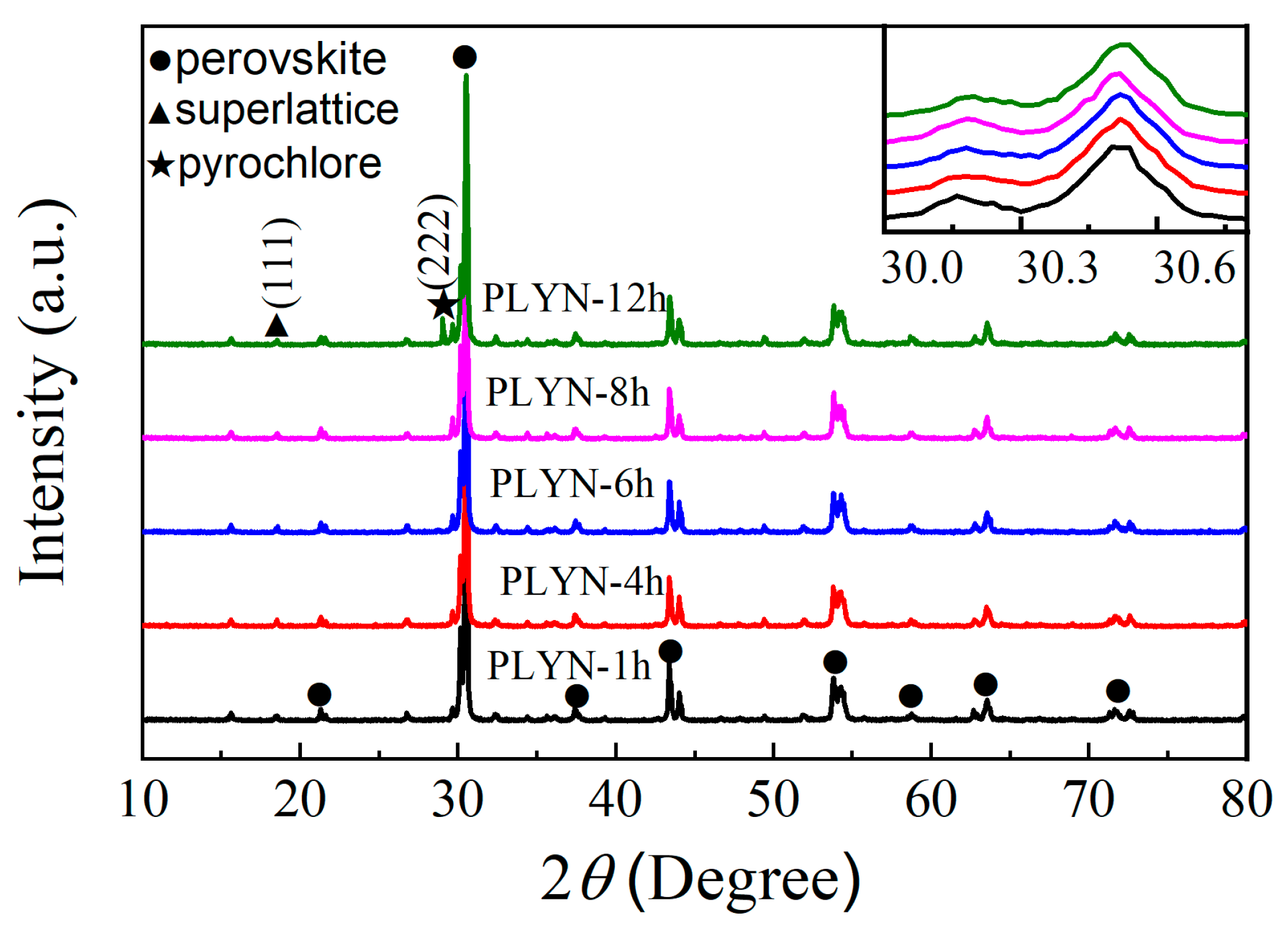
Figure 1 displays the XRD patterns of Pb0.95Li0.05(Yb1/2Nb1/2)O3 ceramics prepared after varying sintering times for 1, 4, 6, 8, and 12 h, identified as: PLYN-1h, PLYN-4h, PLYN-6h, PLYN-8h, and PLYN-12h. These patterns predominantly exhibit a perovskite structure, alongside traces of a pyrochlore structure with superlattice diffractions. The intensity of this secondary phase increases with the increasing sintering temperature time. The triangle makers in the XRD patterns signify superlattice reflections stemming from the antiparallel displacement of Pb2+ cations and B-site ordering within the PLYN system. The reflection peak (200) was not split into (002) and (200) peaks. This suggests that real perovskite structures can deviate from the ideal cubic phase, displaying three main structural distortions: (i) vibration displacements of A-site cations around the center of four BO6 octahedra; (ii) distortion of the anion octahedra; (iii) tilting of the BO6 octahedra, influenced by the “lone-pair electron effect” at the A-site. These variations lead to variations in the B′-O and B″-O bond lengths, as well as deviations in O-B′-O and O-B″-O bond angles within the A(BxB1−x)O3 system [19]. Furthermore, the occurrence of F-centering reactions due to B-site ordering suggests that the crystal structure of A(BxB1−x)O3 effectively doubles the perovskite unit cell along all the crystallographic axis directions. The emergence of an antiferroelectric orthorhombic phase in Pb0.95Li0.05(Yb1/2Nb1/2)O3 results from interactions between the volume disparity of NbO6 and YbO6 octahedra, structural imperfections in YbO6 octahedra due to rigid rotation, and the “lone-pair effect” of Pb2+ cations. The perovskite structural tolerance factor is calculated after Equation (1):
τ = R A + R O 2 ( R B + R O )
where RA, RB and RO are the cation radii of A-site, the cation radii of B-site and the oxygen radii, respectively [20]. The tolerance factor (τ) of antiferroelectric (AFE) perovskites falls within the limited distribution 0.78 ≤ τ ≤ 1.00, whereas ferroelectric (FE) perovskites encompass the range 0.78 ≤ τ ≤ 1.05. Therefore, PYN-based ceramics exhibit a series of antiferroelectric perovskite properties, originating from the superlattice refection [17]. The radius of Li+ [0.76 Å (CN12)] at the A-site is smaller than the one of Pb2+ [1.49 Å (CN12)] [19]. Compared to the pure Pb(Yb1/2Nb1/2)O3 solid solution [τ = 0.92(38)], the presence of a small amount of Li+ at the A-site [PLYN, τ = 0.91(21)] significantly reduces and eventually eliminates the pyrochlore phase only observed in the PLYN-12 system. This emphasizes the importance of reducing the tolerance factor and optimizing sintering temperature and time for achieving high-purity perovskite structures in PLYN ceramics [11].
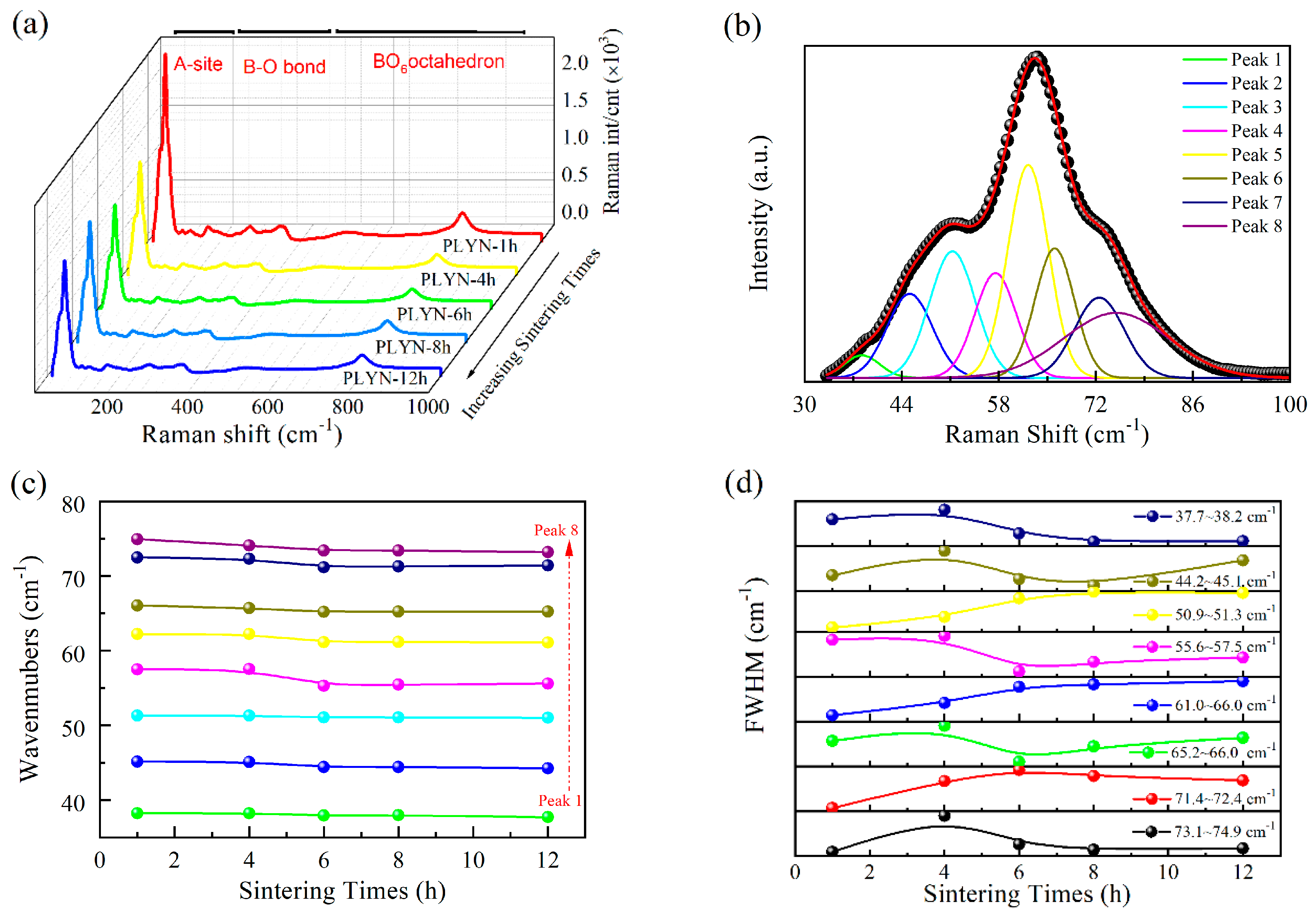
To gain further insight into the static and dynamic behavior of the local structure within the B-ordered perovskite lattice, the room temperature Raman spectra of PLYN are presented in Figure 2a. Theoretical Raman active modes for orthorhombic symmetries include: Γ(O, Raman) = 18 Ag + 18 B1g + 12 B2g + 12 B3g, while for cubic symmetries, they are Γ(C, Raman) = A1g+Eg + 2 F2g [13,21,22,23]. The Raman data were fitted using the Lorentzian function, and the fitting results are shown in Figure 2b. Eight peaks were obtained and labeled as Peak 1, 2, 3, 4, 5, 6, 7 and Peak 8. Figure 2c shows the variation in Raman shifts in the eight peaks as a function of sintering times. The mode at 55 cm−1 corresponds to Pb–O stretching. The mode is influenced by the mass of A-site cations and the A–O binding force. Hence the corresponding mode occurs in the low-frequency region. For many lead-based complex perovskites, this mode is observed in the 50–60 cm−1 range [13]. Peak 4 is consistent with this mode. Unfortunately, the scattering of phonons of Yb-O/Nb-O bonds and YbO3/NbO3 octahedron Raman modes is weak, resulting in only a slight increase in the width of neighboring modes. Raman spectral deconvolution of the A-site was performed using eight Gaussian–Lorentzian peak functions via a best-fitting algorithm, as shown in Figure 2b. Notably, there are no significant shifts in the wavenumbers of the Raman peaks with increasing sintering time, as shown in Figure 2c. This suggests that the crystal structure of PLYN exhibits orthorhombic symmetry, consistent with the XRD results. The sintering time dependence of full width at half maximum (FWHM) of the related modes in PLYN is illustrated in Figure 2d. An anomaly in the FWHM of all parks is observed in the sintering time 6 h, indicating the appearance of the same pyrochlore due to a higher degree of disorder in the PLYN lattice [23]. In essence, this suggests that the suitable sintering time for PLYN enables the adjustment of the phase structure ratio and B-site order.
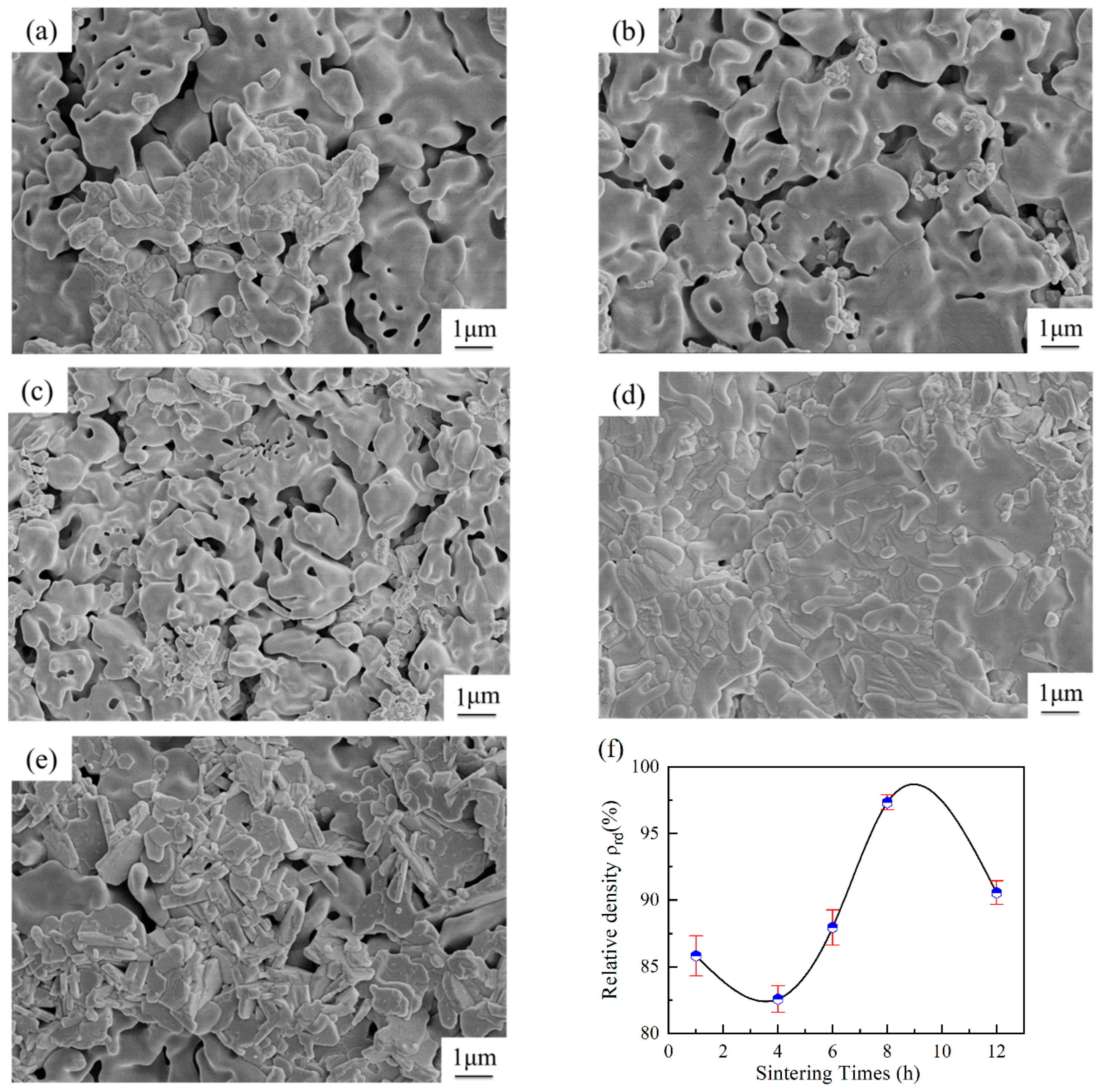
SEM micrographs of the PLYN-1h, PLYN-4h, PLYN-6h, PLYN-8h, and PLYN-12h ceramics are shown in Figure 3a–e. Among these, the PLYN-8 ceramic exhibits the most dense and homogeneous grains compared to all other samples. The appearance of a liquid phase during the sintering process could enhance the diffusion rate of ions across grain boundaries and/or weld the smaller grains together [24]. This phenomenon is particularly evident when the sintering time increases from 1 h to 8 h, allowing ample time for the formation of low melting temperature liquid phases. However, with further increases in sintering time, Pb2+ and Li+ cations volatilize, leading to the formation of the micro-holes in localized regions. This observation is in good agreement with the trend of relative density, as depicted in Figure 3f.
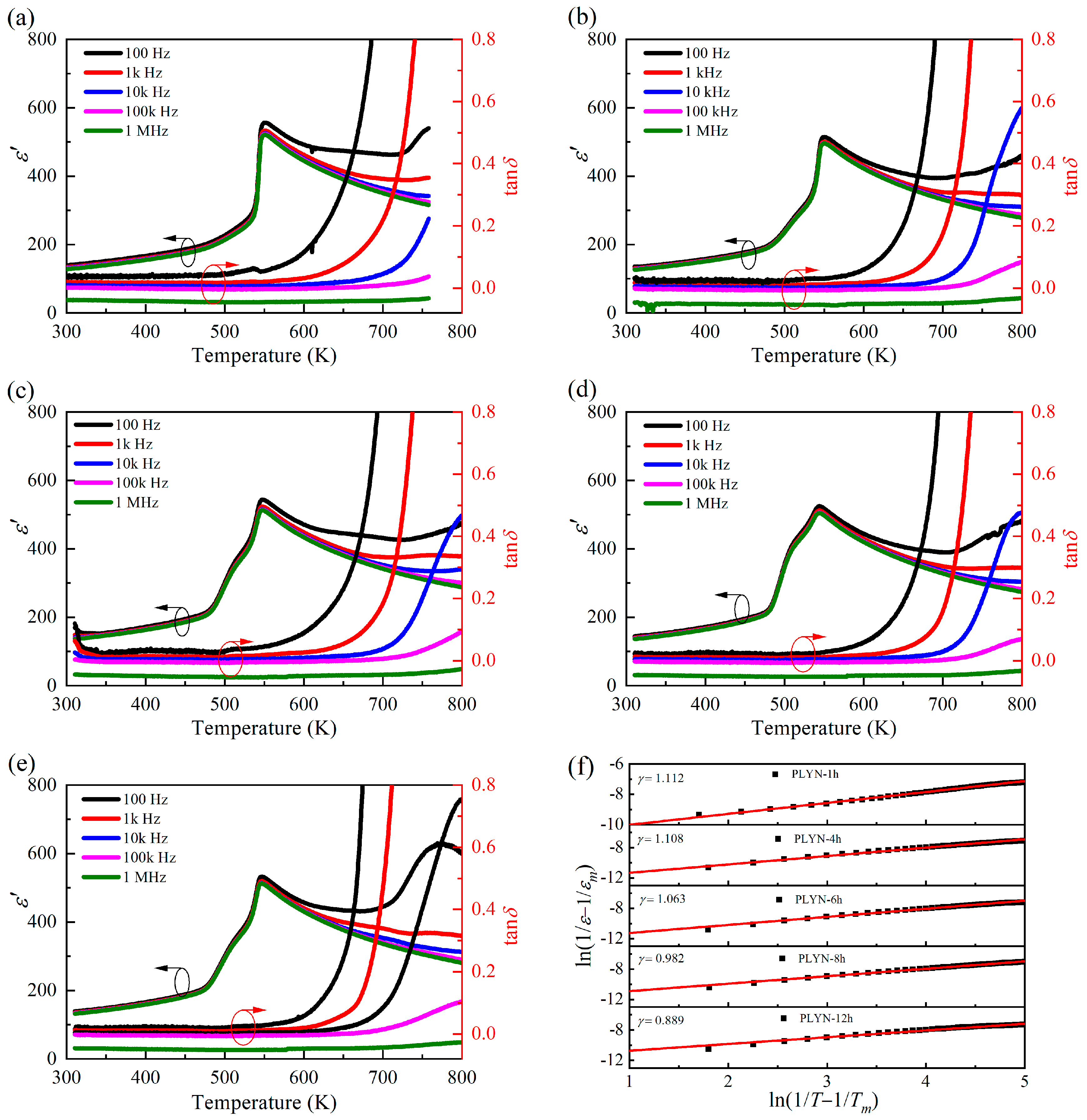
Figure 4a–e depict the temperature dependence of the real part of the dielectric permittivity (ε′) and dielectric loss (tanδ) over the frequency range from 100 Hz to 1 MHz for PLYN-1h, PLYN-4h, PLYN-6h, PLYN-8h, and PLYN-12h. Two anomalies are observed in ε′. Firstly, a high-temperature diffusion phase transition occurs at TC (approximately at 546 K), indicating a paraelectric-antiferroelectric phase transition. Secondly, between 470 and 546 K, a significant dielectric response anomaly is observed, suggesting the formation of B-site disorder. To further investigate the paraelectric-antiferroelectric phase transition, the modified Curie–Weiss law was employed to fit the ε′ at temperatures considerably higher than TC:
1 ε 1 ε m = ( T T C W ) γ C
where TCW is the Curie–Weiss temperature, C the Curie coefficient, εm the dielectric parameter at TC, and γ the diffuseness constant. When the exponent γ approaches 1, it signifies the presence of a normal ferroelectric material characterized by long-range ferroelectric ordering. Conversely, when γ tends toward 2, it indicates a conventional relaxor ferroelectric material [25,26]. Figure 4f demonstrates that the values of γ for PLYN-1h, PLYN-4h, PLYN-6h, PLYN-8h, and PLYN-12h are 1.112, 1.108, 1.063, 0.982, and 0.889, respectively. These values diverge from the γ value of normal ferroelectric (such as BaTiO3) and relaxor ferroelectric materials (such as Pb(Mg1/3Nb2/3)O3). Furthermore, when coupled with the slender P-E loops, it suggests that PLYN exhibits weakly antiferroelectric properties [27].
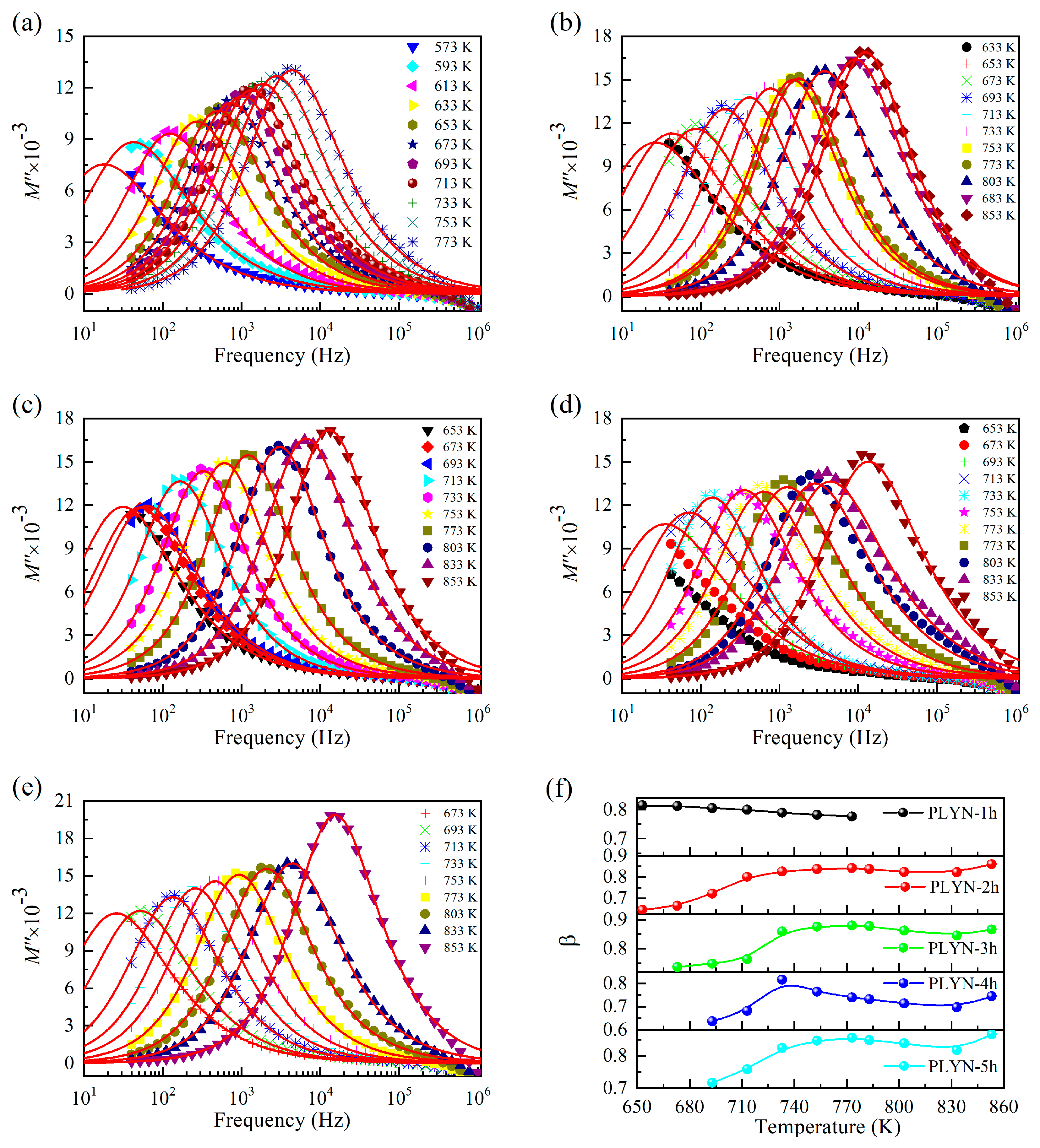
In order to characterize the two dielectric anomalies in the PLYN system, impedance spectroscopy stands out as one of the most relevant techniques for investigating phase transitions and defect behaviors across a broad frequency range. The temperature dependence of the imaginary part of the modulus (M″) is depicted in Figure 5a–e [28]. The M″ peak rapidly shifts to higher frequencies as temperature increases across the entire testing temperature range. This suggests the involvement of a single thermal activation process [29]. To describe M″ in Equation (3), a combination of the Fourier transforms of a relaxation function (ω(t)) and the Kohlrausch–Williams–Watts function (KWW) is employed:
M = M max / { ( 1 β ) + β 1 + β [ β ( ω max / ω ) + ( ω / ω max ) β ] }
where Mmax is the peak value of M″ and ωmax the corresponding frequency. The quantity (1 − β) serves as a measure of the degree of correlation between the carriers involved in the conduction process. As (1 − β) approaches zero, it indicates that charge carriers undergo long-distance jump motion, confined within potential wells and free to move solely within those wells. Figure 5f shows the variation in β with temperature. As β increases, the PLYN system approaches closer to the ideal Debye relaxation, which is associated with the paraelectric-antiferroelectric phase transition and with a sharp reduction in the number of dipoles. The β curve reaches a maximum value, suggesting the complete transformation from the antiferroelectric orthorhombic phase to the paraelectric cubic phase. Subsequently, as temperature rises further, the decreasing β values correspond to the thermal activation of carriers, leading to charge-mismatch and the activation of oxygen vacancies induced by volatile elements.
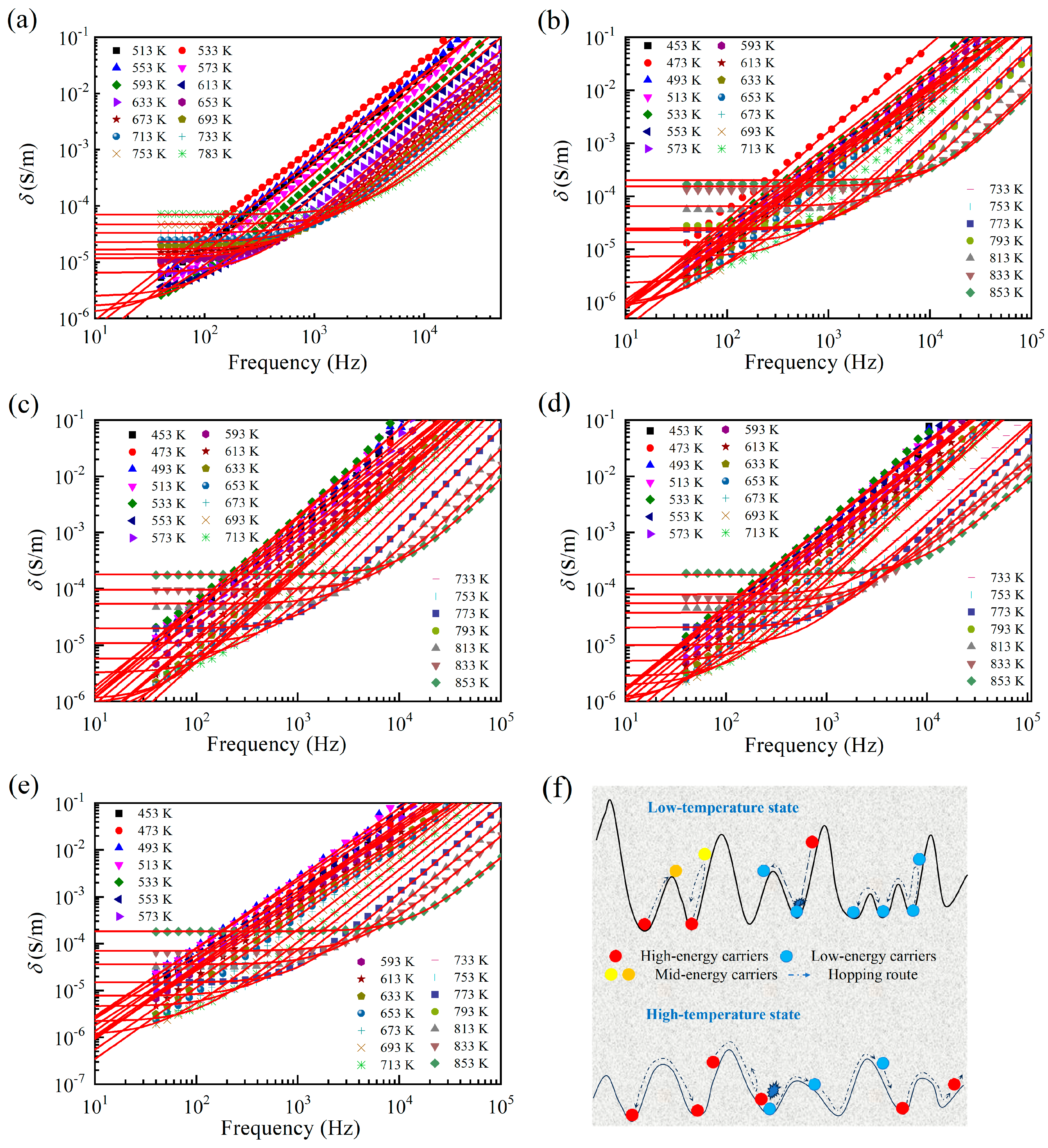
Figure 6a–e depict the real part of the ac conductivity (σac) for the different sintering times of PLYN at the testing temperature. The conductivity behavior was described via the universal dielectric response (UDR) law [30,31]:
σ ac = σ dc + σ 0 f s
where σac is the dc bulk conductivity, f the frequency, σ0 a constant, and 0 < s ≤ 1. The relationship, involving local interactions between charges and dipoles, is described by Equation (4). As temperature increases, the activation hopping of electrons over barriers becomes easier, leading to the formation of DC conductivity at low frequencies. The UDR law properly fits the curves of σac for all PLYN samples. For temperatures over the melting temperature of PbO and Li2O, it is easy for Pb2+ and Li+ to volatilize and produce oxygen vacancies. The defect compensation should follow Equations (5) and (6):
P b 2 + P b g a s + V P b + V O
L i + L i g a s + V L i + 1 / 2 V O
During the oxygen annealing process, defect reactions occur in the PLYN system:
2 V A s i t e + V O + 1 / 2 O 2 2 V A s i t e + O O X + 2 h
V O + 1 / 2 O 2 + 2 e O O X
where V P b represents the lead vacancies, V L i represents the lithium vacancies, O2 is the oxygen and V O represents oxygen vacancies.
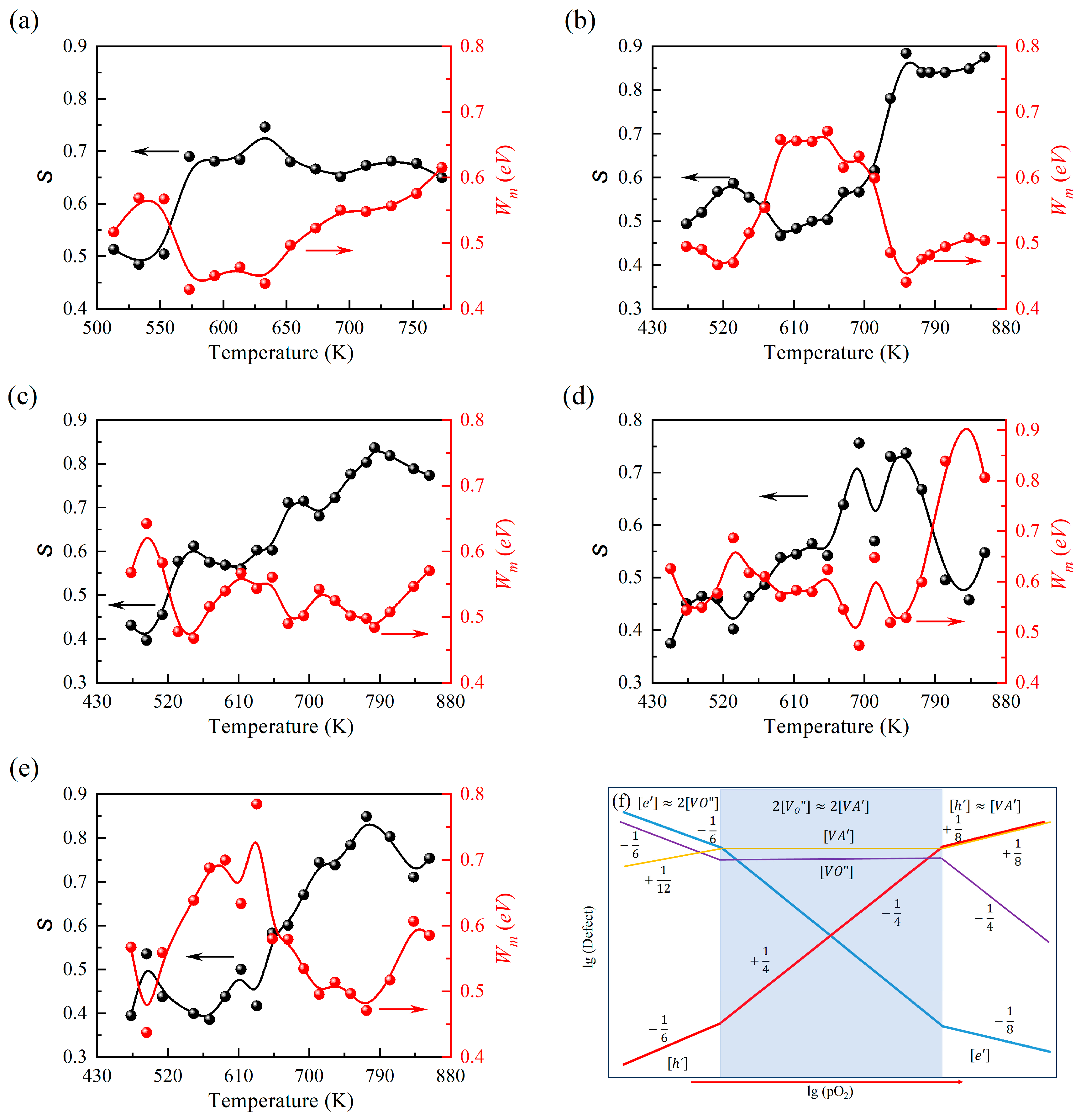
Figure 6f illustrates the mechanism behind the hopping of carriers within potential wells and its effect on conductivity behavior. In a low-temperature state, high-energy hopping carriers struggle to overcome the depth of the potential well, resulting in a single particle hopping back and forth within a double well with infinite barriers on either side, forming the entire contribution by σac [32]. At high temperature, the frequency dependence of conductivity can be divided into two parts due to potential barriers caused by short-distance motion of cations and the hopping of small polarons. At high frequency, the short-distance migration of carriers is unaffected by potential barriers, leading to exponential growth in a part of σac. Conversely, at sufficiently low frequencies, activation carriers are blocked by potential barriers related to the hopping of small polarons contributing to σac. The index ‘s’ increases with temperature due to the dominating mechanism of classical hopping of electrons over barriers. However, factors such as the antiferroelectric-paraelectric phase transition, intrinsic oxygen vacancies, and mismatched crystal cells with different charged cations induce complex conductivity behavior across a range of temperatures, as depicted in Figure 7. To further understand this complex conductivity behavior, the correlated barrier hopping (CBH) model is employed [33]. The binding energy is calculated using the following equation:
S = 1 β
and
β = 6 K B T W m
where Wm is the binding energy, which is defined as the energy required to remove an electron completely from one site to another site. Figure 7a–e display the temperature dependence of Wm ranging from 0.5 to 0.9 eV. Figure 7f depicts the defect equilibria along with a reduced electroneutrality condition, illustrating various oxygen partial chemistries (pO2) to elucidate different types of activation defects in the ABO3 system [34,35,36,37,38]. Theoretical analysis of the defect chemistry diagram can be segmented into three sections: (i) In a low pO2 region, n-type-doped ABO3 is prevalent; (ii) In a medium PO2 region, a balanced electroneutrality coexistence occurs between local n-type-doped and local p-type-doped ABO3; (iii) In a high PO2 region, p-type-doped ABO3 predominates [39,40,41]. In a n-type solid solution system, where the conduction of electrons is independent of pO2, it is controlled by cation donors, maintaining a constant ratio between electrons concentration and pO2. Conversely, when the bilection concentration is governed by oxygen vacancies, a log-plot of conductivity versus pO2 yields a slope of 1/6. If cation donors or anion vacancies are compensated by cation vacancies, the relationship between the log-plot of conductivity and pO2 shows a slope of 1/4. The Wm value of PLYN falls within the range 0.5 to 0.9 eV, differing from the formation of partial Schottky acceptor defects (Ea ≥ 1.5 eV) in the n-type BaTiO3-BiMeO3 system and the negative slope observed in K0.5Na0.5NbO3 and K0.5Na0.5NbO3-Na, indicating electron conducting and fewer A-site vacancies. This aligns well with the highest pO2 region, demonstrating a series of p-type solid solution properties, reflecting a lower energy barrier between two potential wells for PLYN. To further understand the bulk conductivity characteristic in the PLYN system, the values of the binding energy minimum hopping distance Rmin are calculated [42,43]:
R m i n = 2 e 2 π ε 0 ε W m
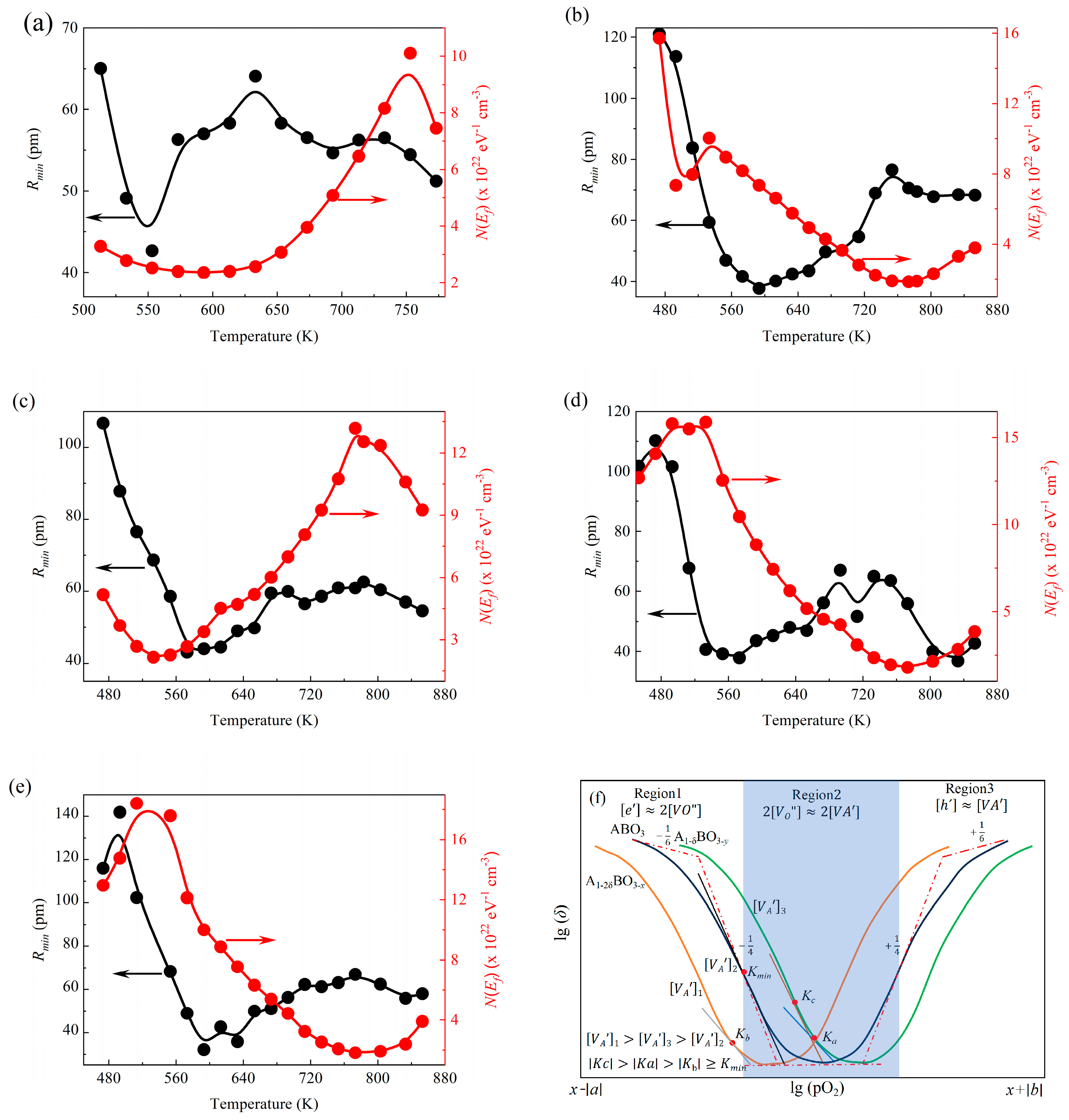
where ε0 is the dielectric permittivity of free space and ε is the dielectric constant at probing frequency. Figure 8a–e display the temperature dependence of Rmin at 1 kHz. The minimum value of Rmin is typically observed at around the antiferroelectric-paraelectric phase transition temperature. As per the hopping model, the behavior of σac indicates that conductivity drives charge transport at low frequencies, while hopping among finite clusters dominates at higher frequencies. Throughout the entire temperature range, Rmin was consistently measured to be approximately 40.00~140.00 × 10⁻¹² m. The data on ac conductivity have been used to determine the density of states at the Fermi level (N(Ef)). In the equation, ε0 is the dielectric permittivity of free space and ε is the dielectric constant at probing frequency. Figure 8a–e display the temperature dependence of Rmin at 1 kHz. The minimum value of Rmin is typically observed at around the antiferroelectric-paraelectric phase transition temperature. As per the hopping models, the behavior of σac indicates that conductivity drives charge transport at low frequencies, while hopping among finite clusters dominates at higher frequencies. Throughout the entire range, the probing temperature Rmin was consistently measured to be approximately 40.00~140.00 × 10⁻¹² m. The data on ac conductivity have been used to determine the density of states at the N(Ef) employing the following relation [33,42]:
δ A C ω = π 3 e 2 ω K B T N E f 2 α 5 l n f 0 ω 4
where e is the electronic charge, f0 the photon frequency and α the localized wave function, assuming fo = 1013 Hz, α = 1010 m−1 at various operating frequencies and temperatures. At 1 kHz, the temperature dependence of N(Ef) differs among PLYN-1h, PLYN-4h, PLYN-6h, PLYN-8h, and PLYN-12h. In samples with shorter sintering times (PLYN-1h, PLYN-4h and PLYN-6h), factors such as the number of holes in bulk, the phase transitions, and type of defects significantly influence N(Ef). Consequently, N(Ef) for PLYN-1h, PLYN-4h and PLYN-6h exhibits a complex nature across the entire range of probing temperatures. Conversely, in samples with sufficiently long sintering times, the temperature dependence of N(Ef) for PLYN-8h and PLYN-12h reveals that hopping between the pairs of sites dominates the charge transport mechanism. A theoretical nonlinear relationship between defect concentration and pO2 is depicted in Figure 8f. The mix conductance in the hopping transport mechanism is divided into electronic and ionic charge carriers. Based on the predicted pO2 dependence of conductivity in an ideal ABO3 structure, real defect models, such as A1−δBO3−x and A1−2δBO3−y (where δ represents the A-site vacancy concentrations, and x and y are oxygen vacancies concentrations), exhibit different conductivity behaviors. A1−2δBO3−x possesses a higher number of A-site vacancies compared to A1−δBO3−y, indicative of a transition from high pO2 to low pO2 conditions. This difference in stoichiometry leads to theoretically distinct types of doping. Moreover, the temperature dependence of N(Ef) for PLYN-12 is observed at temperatures 10 K higher than those for PLYN-8h. With increasing sintering time, PLYN ceramics release significant amounts of Pb2+ and Li+ ions from the A-site, forming a similar A1−2δBO3−x-type defect structure.

3. Experimental Part

The PLYN ceramics were synthesized using a two-step conventional mixed oxide method. Raw materials used included PbO (99.9%), Yb2O3 (99.99%), Nb2O5 (99.99%), and Li2CO3 (99%). Initially, Yb2O3 and Nb2O5 were thoroughly mixed and sintered at 1000 °C for 2 h to form YbNbO4. The YbNbO4, Li2CO3, and PbO were mixed stoichiometrically according to the PLYN formula. An excess of 2% PbO and Li2CO3 (to compensate for evaporation at high temperature) was further added. The resulting mixtures were ground thoroughly and calcined at 850 °C. The calcined powder was further ground, granulated with a polyvinyl alcohol binder, then pressed into compacts with a diameter of 10 mm and a thickness ranging from 1 to 2 mm at a pressure of 350 MPa. Subsequently, the compacts were heated to 550 °C to remove the binder. Finally, the green compacts were placed into sealed crucibles fully surrounded by the same composition powder, and sintered at 1200 °C for various durations: 1, 4, 6, 8, and 12 h.
For room temperature crystal structure analysis, X-ray diffraction (XRD) was conducted on the samples using Cu radiation (λ = 1.54059 Å, PANalytical X-Pert-PRO, Almelo, The Netherlands). Raman spectra were recorded via a DXR Raman microscope spectrometer (λ = 532 nm, DXR3, Thermo Fisher Scientific Co, Waltham, MA, USA). The surface microstructure of the ceramics was examined using a field emission scanning electron microscope (FE-SEM, Model S4800, Hitachi High-Technologies, Tokyo, Japan). To measure the electrical properties, silver electrode paste was applied onto cylindrical samples and fired at 650 °C for 30 min. The dielectric properties were measured using an impedance analyzer (Agilent 4294 A, Agilent Technologise, Santa Clara, CA, USA) over a frequency range from 100 Hz to 1 MHz and within a temperature range of 300 to 800 K. Additionally, impedance spectroscopy data were collected using an impedance analyzer of Agilent 4294A over a frequency range from 40 Hz to 1 MHz and within a temperature range of 573 to 853 K.

4. Conclusions

The crystal structure and dielectric response of PLYN ceramics with varying sintering times were investigated. The temperature dependence of the dielectric permittivity suggests two processes: B-site ordering to disordering and antiferroelectric-paraelectric phase transition. The phase transition was characterized using a modified Curie–Weiss law. Dielectric anomalies and different types of defect behavior were identified through impedance spectroscopy, corroborating the results derived from the characteristic value of β. The complex conductivity PLYN with varying sintering times obeys to a universal dielectric response function. The range of the Wm value for PLYN, ranging from 0.5 eV to 0.9 eV, aligns well with the highest pO2 region, indicating a series of p-type solid solution properties. The density of states at the Fermi level N(Ef) for all PLYN samples was quantitatively characterized based on the predicted pO2 dependence of conductivity in an ideal ABO3 structure. These findings establish a relationship among crystal structure, dielectric response and defect behavior in the PLYN system. The reduction in tolerance factor and the application of reasonable sintering temperature and time are essential for achieving high-purity perovskite in PLYN ceramics.

Author Contributions

Conceptualization: K.C., Q.Z. and S.L.-M.; Methodology: F.H., D.H. and X.Z.; Software: F.H., X.L. and L.F.; Validation: F.H. and L.P.; Formal analysis: F.H.; Investigation: K.C., Q.Z. and L.L.; Resources: L.F. and L.P.; Data curation: F.H. and L.L.; Writing—original draft, K.C., Q.Z. and F.H.; Writing—review and editing, K.C. and L.P.; Visualization: J.Q., S.L.-M. and F.H.; Supervision: K.C. and Q.Z.; Project administration: X.L., F.H., L.P. and Q.Z.; Funding acquisition: F.H., K.C. and J.Q. All authors have read and agreed to the published version of the manuscript.

Funding

This work was financially supported by the Guangxi Science and Technology Base and Talent Special Project (GUIKE AD23026280), the Guangxi Natural Science Foundation (Grant No. 2025GXNSFAA069732, 2025GXNSFBA069342), the Hezhou Foundation for Research and Development of Science and Technology (Grant No. HEKEJI2024115, HEKEJI2025014).

Institutional Review Board Statement

Not applicable.

Informed Consent Statement

Not applicable.

Data Availability Statement

The original contributions presented in this study are included in the article. Further inquiries can be directed to the corresponding author.

Conflicts of Interest

Author Liaoting Pan was employed by the Guangxi Key Laboratory of Special Steel and New Materials, Guangxi Beigang New Materials Co., Ltd. The remaining authors declare that the research was conducted in the absence of any commercial or financial relationships that could be construed as a potential conflict of interest.

References

  1. Bokov, A.A.; Ye, Z.G. Recent progress in relaxor ferroelectric with peroviskite structure. J. Mater. Sci. 2006, 41, 31–52. [Google Scholar] [CrossRef]
  2. Krogstad, M.J.; Gehring, P.M.; Rosenkranz, S.; Osborn, R.; Chen, W.; Wozniak, J.M.; Luo, H.; Chmaissem, O.; Ye, F.; Liu, Y.; et al. The relation of local order to material properties in relaxor ferroelectrics. Nat. Mater. 2018, 17, 718–724. [Google Scholar] [CrossRef]
  3. Zhang, S.; Li, F.; Jiang, X.; Kimc, J.; Luo, J.; Genge, X. Advantages and challenges of relaxor-PbTiO3 ferroelectric crystals for electroacoustic transducers—A review. Prog. Mater. Sci. 2015, 68, 1–66. [Google Scholar] [CrossRef]
  4. Zhang, N.; Yokota, H.; Glazer, A.M.; Ren, Z.; Keen, D.A.; Keeble, D.S.; Thomas, P.A.; Ye, Z.G. The missing boundary in the phase diagram of PbZr1−xTixO3. Nat. Commun. 2014, 5, 5231. [Google Scholar] [CrossRef]
  5. Liu, H.; Chen, J.; Huang, H.; Fan, L.; Ren, Y.; Pan, Z.; Deng, J.; Chen, L.Q.; Xing, X. Role of Reversible Phase Transformation for Strong Piezoelectric Performance at the Morphotropic Phase Boundary. Phys. Rev. Lett. 2018, 120, 055501. [Google Scholar] [CrossRef]
  6. Wang, Z.; An, Z.; Zhuang, J.; Li, F.; Ren, W.; Ye, Z.-G.; Zhang, N. Origin of polar nanoregions from displacive correlation in relaxor ferroelectric Pb(Mg1/3Nb2/3)O3-PbTiO3. J. Mater. Chem. C 2022, 10, 16731. [Google Scholar] [CrossRef]
  7. Noheda, B.; Cox, D.E.; Shirane, G.; Gao, J.; Ye, Z.G. Phase diagram of the ferroelectric relaxor (1 − x)PbMg1/3Nb2/3O3-xPbTiO3. Phys. Rev. B 2002, 66, 054104. [Google Scholar] [CrossRef]
  8. Fu, D.; Taniguchi, H.; Itoh, M.; Koshihara, S.Y.; Yamamoto, N.; Mori, S. Relaxor PbMg1/3Nb2/3O3: A Ferroelectric with Multiple Inhomogeneities. Phys. Rev. Lett. 2009, 103, 207601. [Google Scholar] [CrossRef] [PubMed]
  9. Taniguchi, H.; Itoha, M.; Fub, D. Raman scattering study of the soft mode in Pb(Mg1/3Nb2/3)O3. J. Raman Spectrosc. 2011, 42, 706–714. [Google Scholar] [CrossRef]
  10. Liu, H.; Shi, X.; Yao, Y.; Luo, H.; Li, Q.; Huang, H.; Qi, H.; Zhang, Y.; Ren, Y.; Kelly, S.D.; et al. Emergence of high piezoelectricity from competing local polar order-disorder in relaxor ferroelectrics. Nat. Commun. 2023, 14, 1007. [Google Scholar] [CrossRef] [PubMed]
  11. Konishi, S.; Urushihara, D.; Hayakawa, T.; Fukuda, K.; Asaka, T.; Ishii, K.; Naoda, N.; Okada, M.; Akamatsu, H.; Hojo, H.; et al. Confirmation of ferroelectricity, piezoelectricity, and crystal structure of the electronic dielectric TmFe2O4. Phys. Rev. B 2023, 108, 014105. [Google Scholar] [CrossRef]
  12. Randall, A.; Bhalla, A.S.; Shrout, T.R.; Cross, L.E. Classification and consequences of complex lead perovskite ferroelectrics with regard to B-site cation order. J. Mater. Res. 1990, 5, 829–834. [Google Scholar] [CrossRef]
  13. Vedantam, R.R.; Subramanian, V.; Sivasubramanian, V.; Murthy, V.R. Dielectric and Raman studies of (BaxPb1−x)(Yb0.5Nb0.5)O3. J. Phys. Condens. Matter 2005, 17, 361–372. [Google Scholar] [CrossRef]
  14. Xu, L.; He, C.; Yang, X.; Wang, Z.; Liu, Y.; Li, X.; Long, X. Structure, antiferro/ferro-electric transformation and relaxor behaviour in (1 − x)Pb(Yb1/2Nb1/2)O3−xPb(Mg1/2W1/2)O3 ceramics. Mater. Technol. 2017, 32, 543–550. [Google Scholar] [CrossRef]
  15. Swartz, S.L.; Shrout, R. Fabrication of perovskite lead magnesium niobate. Mater. Res. Bull. 1982, 17, 1245–1250. [Google Scholar] [CrossRef]
  16. Bokov, A.A.; Shonov, V.Y.; Rayevsky, I.P.; Gagarina, E.S.; Kupriyanov, M.F. Compositional ordering and phase transitions in Pb(Yb0.5Nb0.5)O3. J. Phys. Condens. Matter 1993, 5, 5491–5550. [Google Scholar] [CrossRef]
  17. Kim, J.H.; Kim, H.S.; Koh, K.S.; Shim, I.W.; Choo, W.K. Structural and Dielectric Behavior or Ba-Substituted Pb(Yb1/2Nb1/2)O3 Ceramics. Integr. Ferroelectr. 2002, 47, 3–10. [Google Scholar] [CrossRef]
  18. Hao, X.; Zhai, J.; Kong, L.B.; Xu, Z. A comprehensive review on the progress of lead zirconate-based antiferroelectric materials. Prog. Mater. Sci. 2014, 63, 1–57. [Google Scholar] [CrossRef]
  19. Yang, J.H.; Choo, W.K.; Leeb, J.H.; Leeb, C.H. The crystal structure of the B-site ordered complex perovskite Sr(Yb0.5Nb0.5)O3. Acta Crystallogr. 1999, 55, 348–354. [Google Scholar] [CrossRef]
  20. Shannon, R.D. Revised effective ionic radii and systematic studies of interatomic distances in halides and chalcogenides. Acta Crystallogr. A 1976, 32, 751–766. [Google Scholar] [CrossRef]
  21. Baldinozzi, G.; Sciau, P.H.; Pinot, M.; Grtbille, D. Crystal Structure of the Antiferroelectric Perovskite Pb2MgWO6. Acta Crystallogr. 1995, 51, 668–673. [Google Scholar] [CrossRef]
  22. Choo, W.K.; Kim, H.J.; Yang, J.H.; Lim, H.; Lee, J.Y.; Kwon, J.R.; Chun, C.H. Crystal Structure and B-Site Ordering in Antiferroelectric Pb(Mg1/2W1/2)O3, Pb(Co1/2W1/2)O3 and Pb(Yb1/2Nb1/2)O3. Jpn. J. Appl. Phys. 1993, 32, 4249–4253. [Google Scholar] [CrossRef]
  23. Baldinozzi, G.; Sciau, P.H.; Bulou, A. Raman study of the structure phase transition in the order perovskite Pb2MgWO6. J. Phys. Condens. Matter 1995, 7, 8109–8117. [Google Scholar] [CrossRef]
  24. Kreisel, J.; Glazer, A.M.; Jones, G.; Thomas, P.A.; Abello, L.; Lucazeau, G. An x-ray diffraction and Raman spectroscopy investigation of A-site substituted perovskite compounds: The (Na1−xKx)0.5Bi0.5TiO3 (0 ≤ x ≤ 1) solid solution. J. Phys. Condens. Matter 2000, 12, 3267–3280. [Google Scholar] [CrossRef]
  25. Devries, R.C.; Roy, R. Phase equilibria in the system BaTiO3-CaTiO3. J. Am. Ceram. Soc. 2010, 38, 142–146. [Google Scholar] [CrossRef]
  26. Chen, K.; Yan, T.; Lei, S.; Mendez, Y.; Yuan, Z.; Fang, L.; Peng, B.; Wang, D.; Liu, L.; Zhang, Q. Origin of high-temperature piezoelectric stability and polar nanoregions dynamics in 0.55Bi(Mg1/2Ti1/2)O3-0.45PbTiO3. J. Am. Ceram. Soc. 2024, 107, 4096–4108. [Google Scholar] [CrossRef]
  27. Kim, J.H.; Choo, W.K. X-Ray and Dielectric Studies of Sc-Substituted Pb(Yb1/2Nb1/2)O3 Ceramics. Ferroelectrics 2002, 207, 69–74. [Google Scholar] [CrossRef]
  28. Leon, C.; Lunkenheimer, P.; Ngai, K.L. Test of universal scaling of ac conductivity in ionic conductors. Phys. Rev. B 2001, 64, 184304. [Google Scholar] [CrossRef][Green Version]
  29. Chen, K.; He, X.; Liu, J.; Li, Y.; Lan, Z.; Lei, X.; Fang, L.; Peng, B.; Wang, D.; Liu, L. Origin of ultrahigh thermal stability on dielectric permittivity and dipole glass-like behavior of 0.4Ba0.8Ca0.2TiO3-0.6Bi(Mg0.5Ti0.5)O3 based ceramics. Mater. Res. Bull. 2020, 130, 110942. [Google Scholar] [CrossRef]
  30. Han, F.; Deng, J.; Liu, X.; Yan, T.; Ren, S.; Ma, X.; Liu, S.; Peng, B.; Liu, L. High-temperature dielectric and relaxation behavior of Yb-doped Bi0.5Na0.5TiO3 ceramics. Ceram. Int. 2017, 43, 5564–5573. [Google Scholar] [CrossRef]
  31. Renner, B.; Lunkenheimer, P.; Schetter, M.; Loidl, A.; Reller, A.; Ebbinghaus, S.G. Dielectric behavior of copper tantalum oxide. J. Appl. Phys. 2004, 96, 4400–4404. [Google Scholar] [CrossRef]
  32. Zheng, X.; Wang, S.; Wang, J.; Hua, W.; Zhang, J.; Liu, L. Long-Range and Short-Range Transport Dynamics of Li Ions in LiMn2O4. J. Phys. Chem. C 2020, 124, 25254–25261. [Google Scholar] [CrossRef]
  33. Pernkkopf, W.; Sagl, M.; Fafilek, G.; Besenhard, J.O.; Kronberger, H.; Nauer, G.E. Machine learning-based rapid analysis of the failure progress of thin-film electrodes from electric impedance spectroscopy (EIS) data. Solid State Ion. 2005, 176, 2031–2036. [Google Scholar]
  34. Chen, H.M.; Harmer, M.P.; Smyth, D.M. Compensating Defects in Highly Donor-Doped BaTiO3. J. Am. Ceram. Soc. 1986, 69, 507–510. [Google Scholar] [CrossRef]
  35. Zeng, L.Y.; Yang, D.Y.; Li, Z.P.; Xiong, W.; Hao, M.X.; Ma, H.X.; Yuan, H.Y.; Cui, J.Y. Microstructural changes and properties of LaxBa(1−x)(Zr0.1Ti0.9)O3 multilayer dielectric ceramics via digital light processing. J. Am. Ceram. Soc. 2024, 50, 19402–19411. [Google Scholar]
  36. Wu, T.B.; Lin, J.N. Transition of compensating defect mode in niobium-doped barium titanate. J. Am. Ceram. Soc. 1994, 77, 759–764. [Google Scholar] [CrossRef]
  37. Kumar, N.; Patterson, E.A.; Fromling, T.; Gorzkowski, E.P.; Eschbach, P.; Love, I.; Muller, M.P.; DeSouza, R.A.; Tucker, J.; Reese, S.R.; et al. Defect mechanisms in BaTiO3-BiMO3 ceramics. J. Am. Ceram. Soc. 2018, 101, 2376–2390. [Google Scholar] [CrossRef]
  38. Saher, S.; Qamar, A.; Tan, C.Y.; Ramesh, S. Sm-doped Ba3MoNbO8.5−δ hexagonal perovskite membranes with enhanced oxygen permeation and structural stability for solid oxide fuel cells. J. Eur. Ceram. Soc. 2026, 46, 117950. [Google Scholar] [CrossRef]
  39. Long, C.; Chang, Q.; Fan, H. Differences in nature of electrical conductions among Bi4Ti3O12 based ferroelectric polycrystalline ceramics. Sci. Rep. 2017, 7, 4193. [Google Scholar] [CrossRef]
  40. Kiasalari, Z.; Roghani, M.; Khalili, M.; Rahmati, B.; Baluchnejadmojarad, T. Antiepileptogenic effect of curcumin on kainate-induced model of temporal lobe epilepsy. Pharm. Biol. 2013, 51, 1572–1578. [Google Scholar] [CrossRef]
  41. Xu, Z.; Liu, Y.; Azadeh, M.; Thong, H.; Jiang, Y.; Yao, F.; Yue, Z.; Zhang, Z.; Tang, Z.; Li, J.; et al. Identifying the interfacial polarization in non-stoichiometric lead-free perovskites by defect engineering. Angew. Chem. Int. Ed. Engl. 2023, 62, e202216776. [Google Scholar] [CrossRef]
  42. Madani, M.; Omri, K.; Ihzaz, N.; Nouiri, M.; Madani, A. Choudhary, Impedance spectroscopy investigation on the electrical response and optical characteristics of novel Sr2TiZrO6 double perovskite. Ceram. Int. 2024, 50, 30134–30143. [Google Scholar] [CrossRef]
  43. Salam, R. Trapping Parameters of Electronic Defect States in Indium Tin Oxide from AC Conductivity. Phys. Status Solidi A 1990, 117, 535–540. [Google Scholar] [CrossRef]
Figure 1. XRD patterns of PLYN with different sintering times.
Inorganics 14 00156 g001
Figure 2. Raman spectra of PLYN at different sintering times: (a) 20–1000 cm−1 Raman spectra at room temperature, (b) spectra of A-site deconvoluted according to 8 Gaussian–Lorentz peak functions (different color peaks). Sintering times dependence of (c) the peak position of the fitting (b) peak 1–8 and (d) the FWHM.
Inorganics 14 00156 g002
Figure 3. Surface SEM image of PLYN ceramics with different sintering temperature times: (a) 1 h, (b) 4 h, (c) 6 h, (d) 8 h and (e) 12 h. (f) Relative density vs. sintering times in PLYN.
Inorganics 14 00156 g003
Figure 4. Temperature dependence of the real part of the dielectric constant (ε′) and tanδ of PLYN ceramics with different sintering temperature times: (a) 1 h, (b) 4 h, (c) 6 h, (d) 8 h and (e) 12 h. (f) Reciprocal ε′ and corresponding fitting curves via the modified Curie–Weiss law at 1 kHz.
Inorganics 14 00156 g004
Figure 5. Frequency dependence of the imaginary part of the electric modulus (M″) vs. temperature of PLYN ceramics with different sintering temperature times: (a) 1 h, (b) 4 h, (c) 6 h, (d) 8 h and (e) 12 h. (f) Temperature dependence of β.
Inorganics 14 00156 g005
Figure 6. ac conductivity as a function of frequency of PLYN ceramics with different sintering temperature times: (a) 1 h, (b) 4 h, (c) 6 h, (d) 8 h and (e) 12 h. (f) Schematic figure of the association mechanism between carriers and conductivity behavior.
Inorganics 14 00156 g006
Figure 7. Variation in exponent ‘s’ and binding energy with temperature at 1 kHz of PLYN ceramics with different sintering temperature times: (a) 1 h, (b) 4 h, (c) 6 h, (d) 8 h and (e) 12 h. (f) Schematic figure of association mechanism between carriers and conductivity behavior. (f) Relationship between defect concentration and pO2 by Ageneric KrÖger–Vink function.
Inorganics 14 00156 g007
Figure 8. Temperature dependence of N(Ef) and Rmin of PLYN ceramics with different sintering temperature times: (a) 1 h, (b) 4 h, (c) 6 h, (d) 8 h and (e) 12 h. (f) Prediction of conductivity as a function of pO2 under different A-site vacancy concentrations, when the change in conductance depends mainly on electrons and holes. Shift in the curve by the change in A-site vacancy concentration. ka, kb, kc, and kmin (≥1/4) are the slope for A1−δBO3−x at high pO2, A1−2δBO3y at low pO2, ideal ABO3 and A1−δBO3−x at low pO2.
Inorganics 14 00156 g008
Disclaimer/Publisher’s Note: The statements, opinions and data contained in all publications are solely those of the individual author(s) and contributor(s) and not of MDPI and/or the editor(s). MDPI and/or the editor(s) disclaim responsibility for any injury to people or property resulting from any ideas, methods, instructions or products referred to in the content.