


Abstract
This study reports a straightforward and controllable two-step hydrothermal synthesis of novel Ni9S8@NiMoO4/NF nanospherical catalysts supported on nickel foam (NF), accompanied by a systematic evaluation of their performance in the electrochemical hydrogen evolution reaction (HER). Structural characterization revealed a well-defined Ni9S8–NiMoO4 interfacial region, whose synergistic interaction, combined with the distinctive nanospherical morphology, substantially increased the electrochemically active surface area and the density of reactive sites, thereby optimizing HER kinetics. In alkaline media, the Ni9S8@NiMoO4/NF catalyst demonstrated outstanding electrocatalytic performance, delivering an overpotential of only 64.2 mV at a current density of 20 mA cm−2. The catalyst also exhibited a high double-layer capacitance of 22.2 mF cm−2, reflecting a substantial active interfacial area. Long-term durability tests showed negligible performance degradation after 165 h of continuous operation at 10 mA cm−2, underscoring the catalyst’s robust structural stability and durability. X-ray photoelectron spectroscopy confirmed a uniform distribution of Ni, Mo, and S across the NF framework and revealed optimized chemical states, providing material-level evidence for the enhanced performance. Collectively, this work proposes a viable strategy for designing efficient and stable HER catalysts, contributing to the advancement of green hydrogen production and clean energy technologies.
1. Introduction
Driven by global energy transition initiatives and carbon neutrality strategies, green hydrogen has emerged as a crucial element of the energy system due to its clean characteristics [1,2]. The large-scale development of renewable energy sources, such as wind and solar power, has established a strong foundation for hydrogen production through water electrolysis. However, the overall efficiency of this technology continues to be heavily reliant on the performance of electrode materials [3]. Transition metal compounds, as a class of abundant candidate materials with tunable catalytic properties, are increasingly showing promise as potential substitutes for precious metal catalysts [4].
Among the various transition metal-based materials, nickel molybdate (NiMoO4) has gained significant attention due to its abundant redox-active sites, low cost, and environmental friendliness [5,6]. However, its long-term cycling stability is severely limited by volume expansion and structural collapse induced by Faradaic reactions during electrocatalysis [7]. To address this performance bottleneck, heteroatomic doping has emerged as an effective modification strategy, with sulfur (S) doping receiving particular focus [8,9]. As a homologue of oxygen, sulfur has a larger atomic radius and lower electronegativity. Partially substituting oxygen atoms in the lattice leads to multiple optimization effects [10,11]: it induces lattice distortion and generates abundant defect sites that act as new electrochemically active centers while also modulating the material’s electronic structure [12]. Additionally, this substitution helps regulate the electron density of nickel and molybdenum metal centers, optimizing their adsorption capacity for reaction intermediates and thereby enhancing intrinsic catalytic activity [13,14]. Moreover, the improved covalent nature of the formed Ni-S and Mo-S bonds contributes to enhanced material conductivity, optimized reaction kinetics, and reduced overpotentials [15,16].
To systematically investigate the impact of sulfur doping on the electrocatalytic performance of NiMoO4 materials, this study utilized a hydrothermal synthesis method to produce a series of sulfur-doped NiMoO4 nanomaterials. The focus was on examining how varying synthesis temperatures affected the materials’ crystal structure, microstructure, and chemical composition. Additionally, the study explored the structure–activity relationship between the electrocatalytic performance in the hydrogen evolution reaction (HER) and the structural characteristics of the materials. This work aims to provide experimental evidence for optimizing the sulfur doping process while offering theoretical guidance and practical pathways for developing multi-component synergistic doping strategies. Ultimately, the goal is to design highly efficient HER catalysts.
2. Results and Analysis
2.1. Structural Morphology Analysis
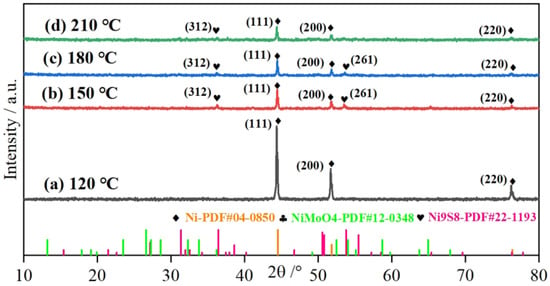
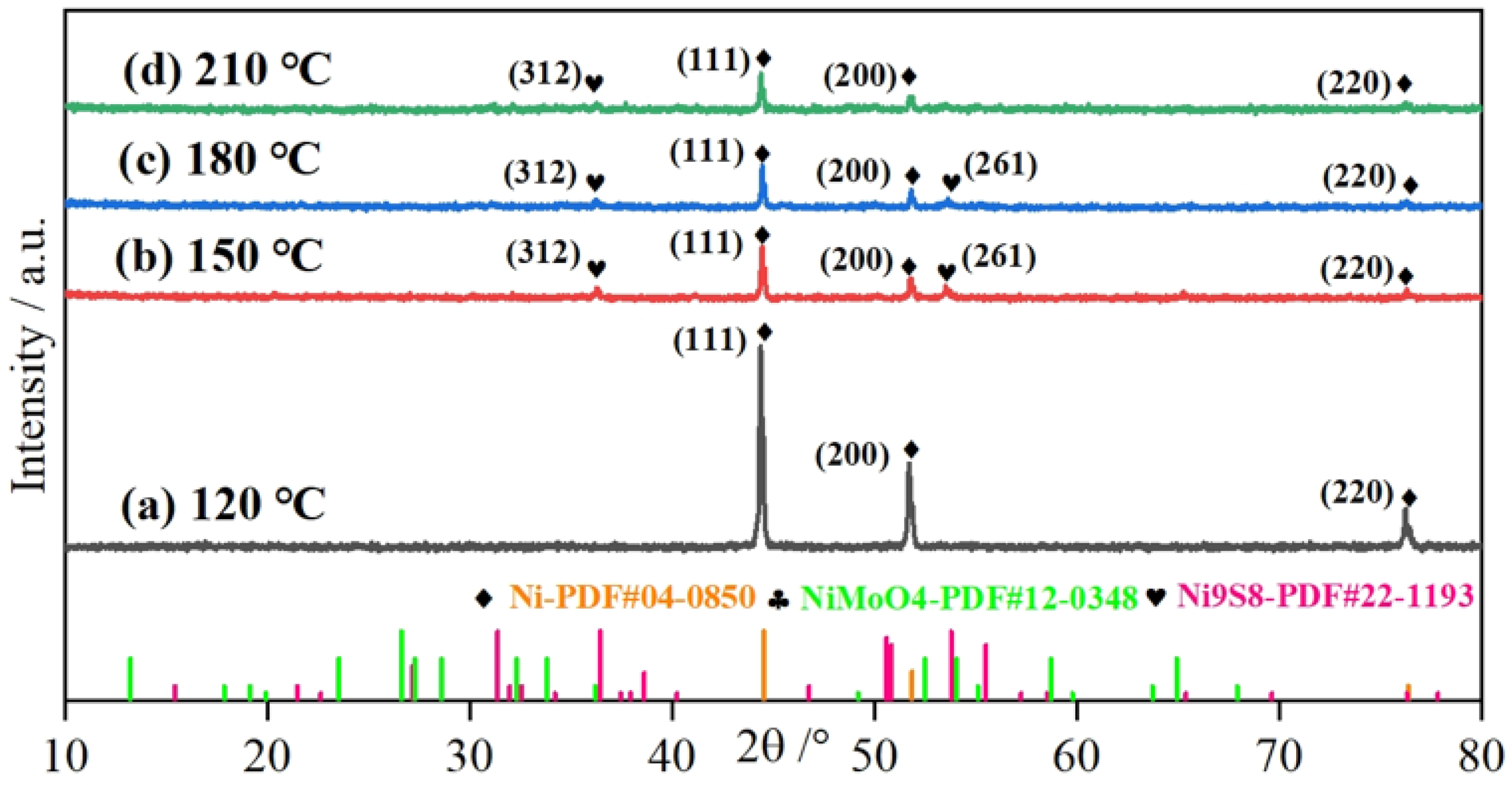
Figure 1 presents the X-ray diffraction (Japan Rikagaku Smartlab SE Panalytical Empyren) patterns of the Ni9S8@NiMoO4/NF electrode material prepared at various sulfurization temperatures. In all patterns, the diffraction peaks at 44.50°, 51.85°, and 76.38° corresponded to the (111), (200), and (220) crystal planes of nickel from the foam nickel substrate (PDF#04-0850). As the sulfidation temperature increased from 150 °C to 210 °C, a pronounced leftward shift of these Ni diffraction peaks was observed. This shift is attributed to lattice expansion caused by the incorporation of sulfur (S), which has a larger atomic radius, into the Ni lattice. According to Bragg’s law (2dsinθ = nλ), the leftward shift in the diffraction angle θ confirms an increase in the interplanar spacing d [17,18]. Simultaneously, new diffraction peaks emerging near 36.42° and 53.4° align with the standard pattern for Ni9S8 (PDF#22-1193), indicating successful phase transformation. This structural evolution underscores the significant impact of temperature on the material’s final crystalline structure and properties [19]. At the low temperature of 120 °C (Figure 1a), the insufficient reaction energy resulted in a lack of distinct Ni9S8 diffraction peaks [20]. At 180 °C, while Ni9S8 formation was achieved, the diffraction peaks for its (312) and (261) crystal planes exhibited weak and broadened intensities, suggesting considerable crystal defects and low crystallinity. Additionally, the atomic size difference between Ni and Mo atoms induced lattice distortion in the NiMoO4 precursor [18]. Increasing the temperature to 210 °C markedly accelerated ion diffusion, significantly enhancing the intensity of the (312) crystallographic plane diffraction peak for Ni9S8. This improvement facilitated structural refinement and increased crystallinity [21,22]. Importantly, the high electronegativity of sulfur leads to strong interactions with Ni atoms, optimizing the material’s electronic structure and increasing its electrochemically active surface area. Furthermore, sulfur’s high affinity enhances the material’s adsorption capacity for water molecules. Collectively, these factors create favorable conditions for improving hydrogen evolution reaction activity [23,24]. It is worth noting that no distinct crystal diffraction peaks of NiMoO4 were observed in any of the diffraction patterns, likely due to its amorphous nature, low concentration, or peak overlap. This indicates that the material is in an amorphous state, a finding consistent with a comparison to the standard pattern (PDF#12-0348) [25].
Figure 1.
XRD patterns of Ni9S8@NiMoO4/NF at different hydrothermal temperatures: (a) at 120 °C, (b) at 150 °C, (c) at 180 °C, and (d) at 210 °C.
2.2. Scanning Electron Microscopy Analysis
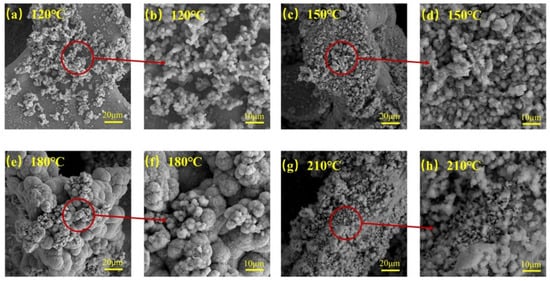
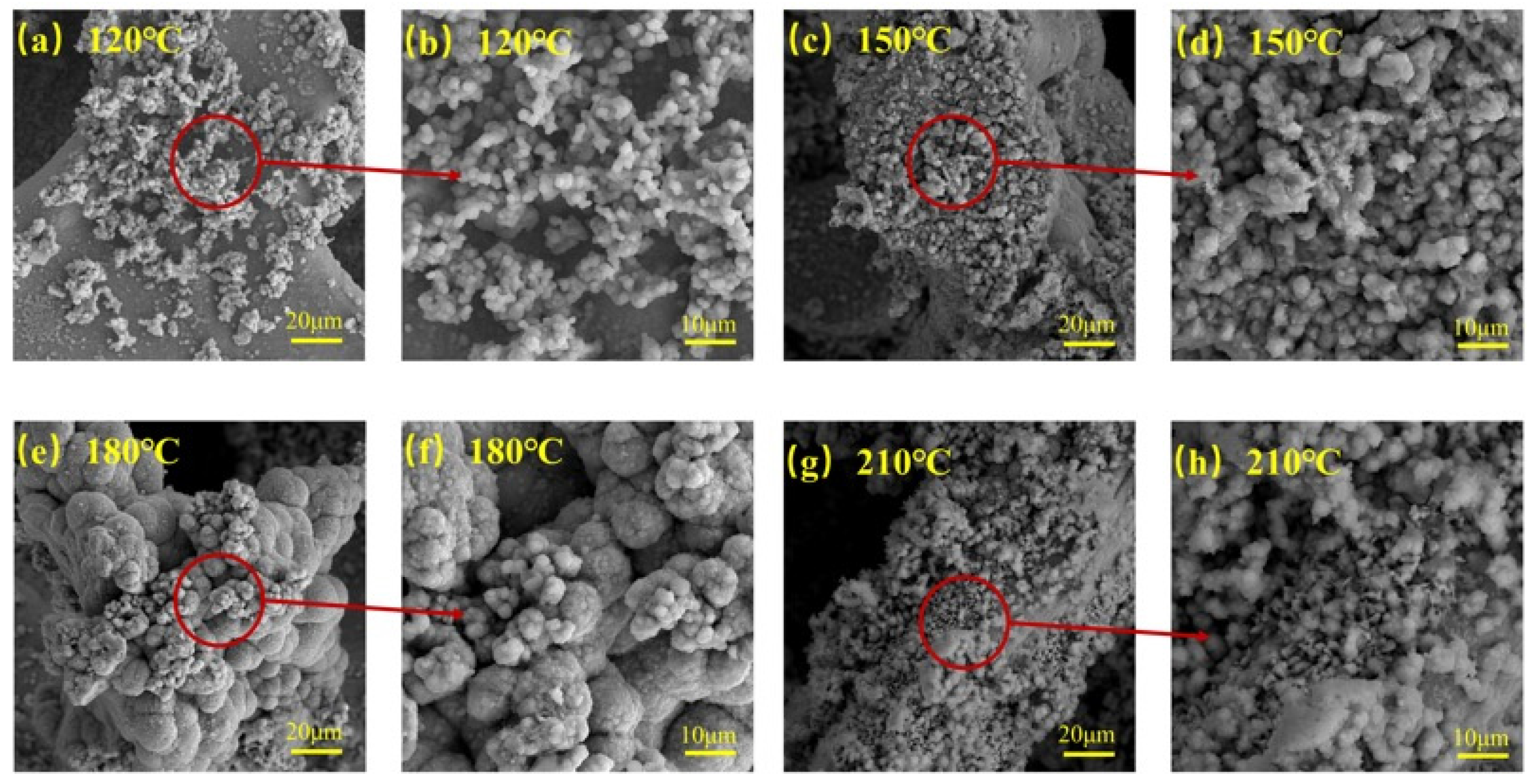
Figure 2 showcases the scanning electron microscopy (SEM) (TESCAN) images of the Ni9S8@NiMoO4/NF electrode sample at various sulfurization temperatures, systematically illustrating the evolution of the material’s microstructure with temperature changes. It is evident that a significant amount of material had been successfully integrated into the porous network structure of the nickel foam (NF) framework. The incorporation of sulfur markedly altered the morphological characteristics of NiMoO4 compared to the precursor. At the low temperature of 120 °C (Figure 2a,b), the overall surface of the sample appeared coarse with a disordered particle arrangement. However, localized enlargements revealed a uniform particle distribution, narrow interstitial spaces, and a relatively smooth surface. X-ray diffraction (XRD) analysis indicates that at this temperature, the reaction between Ni and S is incomplete, preventing the formation of Ni9S8 nanospheres. As the reaction temperature rises, the diffusion rates of Ni, Mo, and S atoms increase, enhancing their mixing probability. This accelerates the gradual formation of Ni9S8 nanospheres on the surfaces of the nanorods (Figure 2c,d), a result that is corroborated by the emergence of Ni9S8 diffraction peaks in the XRD patterns (Figure 2b,d) [26]. At 150 °C, Figure 2c clearly illustrates an increase in particle size and enhanced aggregation, indicating improved crystallinity and density of the material. This enhancement contributes to increased electrical conductivity and electrochemical activity [27,28]. However, the localized magnification in Figure 2d revealed pronounced grain coarsening on the surface. This phenomenon is attributed to the hydrothermal temperature not yet reaching optimal conditions, resulting in suboptimal mechanical strength. Such limitations hinder ion diffusion and migration, ultimately affecting the rate of the hydrogen evolution reaction [29]. Increasing the temperature to 180 °C significantly optimized the sample morphology. As shown in Figure 2e, complete and uniform Ni9S8 nanospheres were formed, effectively coating the NiMoO4 surface and markedly increasing both the surface roughness and specific surface area. The corresponding localized magnification image (Figure 2f) further demonstrated enhanced aggregation of the nanospheres, distinct interfacial features, and a smooth yet slightly textured surface, which together constitute a high-specific-surface-area microstructure [30]. Concurrently, interparticle connectivity improves significantly, forming a more stable three-dimensional conductive network. Compared to the sample synthesized at 150 °C, the 180 °C condition showed a substantial increase in the number of aggregated nanospheres with enhanced structural stability. This development provides continuous pathways for charge transport, facilitating rapid electron transfer while reducing electrical resistance, thereby significantly enhancing overall conductivity [31]. Additionally, the robust interparticle bonding helps maintain structural integrity, preventing the detachment of active material and ensuring catalytic stability during hydrogen evolution reactions [32]. Localized imaging (Figure 2f) clearly illustrates that the Ni9S8 nanospheres possessed moderate thickness and further enhanced surface roughness. This textured structure not only increases the specific surface area but also improves the reactant adsorption capacity, providing additional active sites that accelerate hydrogen evolution kinetics [33]. The inherent electrical conductivity of the nanospheres, combined with their tightly interconnected structure, further optimizes the reaction pathways, facilitating rapid hydrogen evolution. Consequently, the interconnected nanospheric architecture formed at 180 °C, along with its excellent cohesive properties, collectively enhances the material’s electrical conductivity, stability, and catalytic activity [34]. However, as the temperature continued to rise to 210 °C, the material morphology exhibited significant degradation. Figure 2g,h revealed severe agglomeration on the sample surface, with an increasingly complex and disordered structure. While the increase in local roughness may have partially enhanced the number of reaction sites, excessive agglomeration markedly reduced the effective active surface area. This reduction leads to a substantial decline in the material’s surface activity and catalytic performance, potentially triggering structural failure and compromising long-term electrochemical stability [35]. Further imaging indicates that the Ni9S8 nanospheres have largely disappeared, replaced by extensive particle agglomerates (Figure 2h), which signifies irreversible damage to the material’s microstructure at elevated temperatures. In summary, SEM analysis indicates that the Ni9S8@NiMoO4/NF electrode sample synthesized at 180 °C, characterized by a uniform nanospheric structure, exhibits optimal morphology and structure, providing a solid microscopic foundation for its outstanding electrocatalytic performance.
Figure 2.
SEM of Ni9S8@NiMoO4/NF at different hydrothermal temperatures. (a,b) Scanning electron micrographs of Ni9S8@NiMoO4/NF at 120 °C; (c,d) SEM images of Ni9S8@NiMoO4/NF at 150 °C; (e,f) SEM images of Ni9S8@NiMoO4/NF at 180 °C; (g,h) SEM images of Ni9S8@NiMoO4/NF at 210 °C.
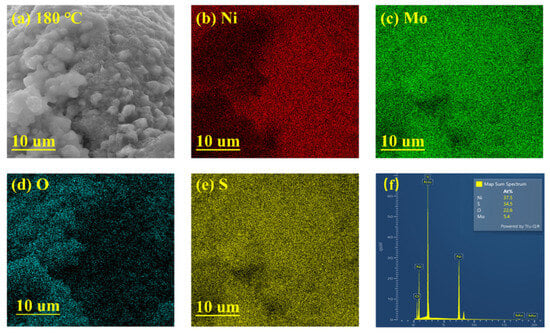
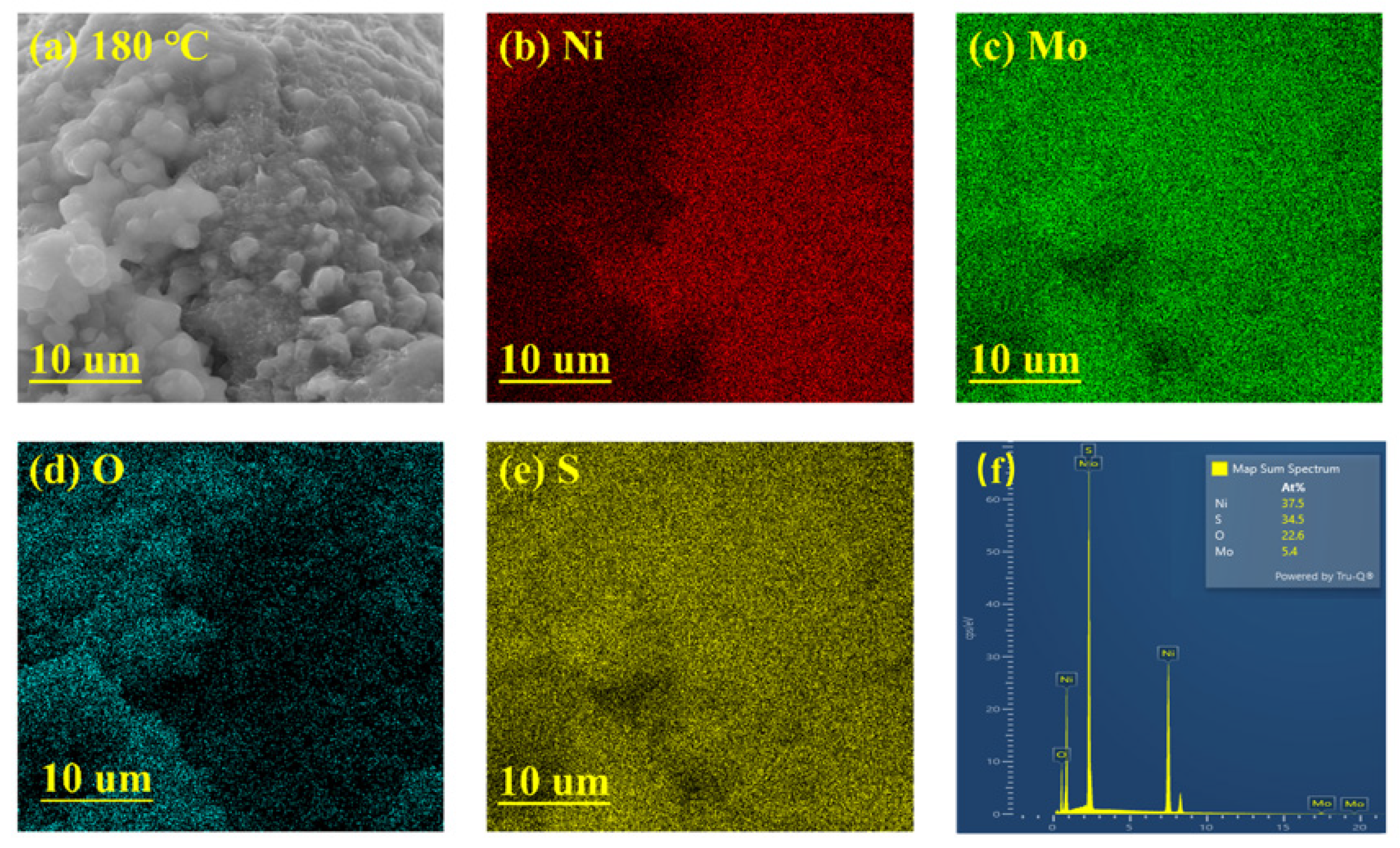
To conduct an in-depth analysis of the elemental composition and spatial distribution of the sample sulfurized at 180 °C, this study employed energy-dispersive X-ray spectroscopy (EDS) (TESCAN) for surface scanning characterization of the Ni9S8@NiMoO4/NF electrode. As illustrated in Figure 3a, the scanning results for the selected region (10 µm) clearly demonstrate the successful detection of all four elements: Ni, S, O, and Mo. The distribution maps for each element, shown in Figure 3b,e, revealed that Ni and S exhibited strong signals with a highly uniform distribution across the scanned area. This confirms the successful formation and uniform coating of the Ni9S8 phase on the NiMoO4 surface. Although the Mo signal was relatively weaker, its distribution covered the entire region, indicating effective incorporation into the composite system. Meanwhile, the O signal primarily originated from the NiMoO4 precursor and potentially from surface-adsorbed species. Quantitative energy dispersive spectroscopy analysis (Figure 3f) further confirmed the elemental composition of the material: Ni constituted 37.5%, S accounted for 32.4%, O made up 22.6%, and Mo comprised 6.4%. This elemental ratio is reasonable given the expected composition, and the high contents of Ni and S directly validate the successful preparation of the Ni9S8@NiMoO4/NF composite material.
Figure 3.
SEM EDS scan map of the Ni9S8@NiMoO4/NF-180 °C sample. (a) SEM image of Ni9S8@NiMoO4/NF within a selected 10 um region; (b) Distribution map of nickel in the Ni9S8@NiMoO4/NF sample at 180 °C. (c) Distribution map of Mo in the 180 °C Ni9S8@NiMoO4/NF sample. (d) Distribution map of oxygen in the Ni9S8@NiMoO4/NF sample at 180 °C. (e) Distribution map of sulfur in the Ni9S8@NiMoO4/NF sample at 180 °C. (f) SEM-EDS elemental distribution map of the Ni9S8@NiMoO4 sample at 180 °C.
A comprehensive analysis revealed that the uniform loading of Ni9S8 on the NiMoO4 surface, along with the synergistic spatial distribution of the constituent elements, collectively created an optimal electrocatalytically active interface. The incorporation of Mo enhances the material’s electronic conductivity, while oxygen likely contributes additional reaction sites. This elemental uniformity and synergistic effect form the structural foundation crucial for improving the catalytic performance of the composite material in the hydrogen evolution reaction (HER). By integrating the findings from scanning electron microscopy (SEM) and energy-dispersive X-ray spectroscopy (EDS), we gain deeper insights into the intrinsic relationships between the material’s microstructure, elemental distribution, and electrocatalytic performance. A systematic analysis of the dominant roles of Ni and S, alongside the synergistic effects of Mo, elucidates the catalytic mechanism of the Ni9S8 composite. This understanding not only provides theoretical support but also establishes a material foundation for its practical applications in energy conversion fields.
2.3. X-Ray Photoelectron Spectroscopy
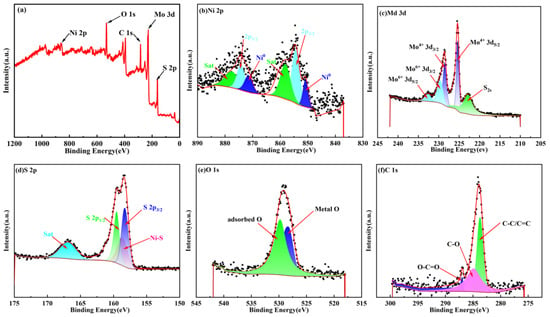
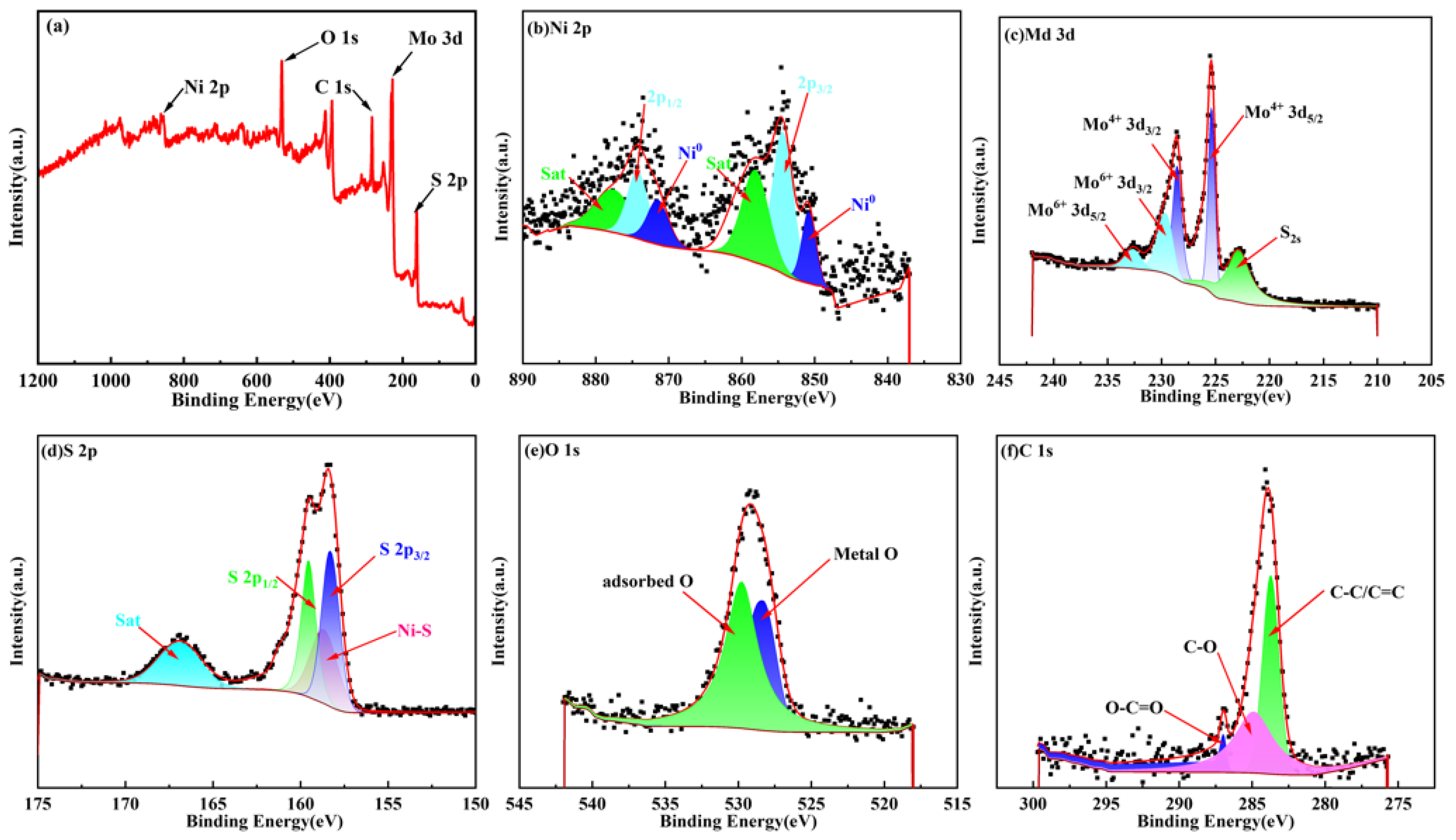
This study utilized X-ray photoelectron spectroscopy (XPS) (Thermo Scientific K-Alpha (Thermo Scientific, Waltham, MA, USA), Shimadzu AXISSUPRA+ (Kratos Analytical Ltd., Manchester, UK)) to analyze the surface elements of the Ni9S8@NiMoO4/NF composite material, shedding light on how its chemical states influence hydrogen evolution reaction (HER) performance. As shown in Figure 4a, the full-spectrum analysis confirmed the presence of Ni, Mo, S, O, and C elements on the sample surface, indicating effective bonding between Ni9S8 and NiMoO4. The synergistic interactions among these elements significantly impact electrocatalytic performance [36]. Specifically, the Ni 2p spectrum (Figure 4b) displayed characteristic peaks for Ni2+ at 854.6 eV and 874.6 eV, along with Ni0 peaks at 850.6 eV and 871.3 eV, and satellite peaks at 878.1 eV and 858.4 eV. These findings suggest that nickel exists in the material both as a sulfide and as zero-valent metal species. The presence of Ni2+ facilitates hydrogen desorption, while Ni0 enhances the material’s conductivity and accelerates electron transport. The satellite peaks further confirm the existence of multiple redox states for nickel within the electrochemical environment [37]. Further analysis of the Mo 3d spectrum (Figure 4c) revealed characteristic peaks for Mo6+ at 232.7 eV and 229.8 eV, and for Mo4+ at 228.7 eV and 225.3 eV. The coexistence of these two valence states indicates that molybdenum plays a crucial role in the catalytic reaction. Mo6+ exhibits strong oxidizing properties, facilitating electron transfer, while Mo4+ contributes to material stability through interactions with nickel [38]. The concurrent detection of S 2s signals in this region suggests minor Mo-S bonding; however, its low abundance and the absence of corresponding phases in X-ray diffraction (XRD) imply that it primarily exists as a surface state. Moreover, the S 2p spectrum (Figure 4d) showed distinct spin-orbit splitting peaks, confirming the formation of Ni-S bonds. This stable bonding structure not only provides abundant active sites for hydrogen evolution reactions, but also lowers the reaction energy barrier, thereby enhancing hydrogen production efficiency [39,40]. The O 1s spectrum (Figure 4e) exhibited peaks corresponding to both adsorbed oxygen and lattice oxygen. The former relates to surface-adsorbed water or hydroxyl species, which facilitate the formation of hydrogen intermediates, while the latter originates from metal–oxygen bonds within NiMoO4. Together, these elements create diverse reaction sites for the catalytic process, effectively enhancing the overall catalytic performance and electrochemical stability [41]. In summary, XPS analysis indicated the formation of stable chemical bonds between Ni9S8 and NiMoO4. The coexistence and synergistic interaction of multiple valence states of Ni, Mo, and S effectively optimize the material’s electronic structure and reaction pathways, providing essential surface chemical insights for future catalyst design and optimization.
Figure 4.
XPS spectra of the Ni9S8@NiMoO4/NF-180 °C sample: (a) full spectrum, (b) Ni 2p, (c) Mo 3d, (d) S 2p, (e) O 1s, and (f) C 1s.
2.4. Electrochemical Performance Analysis
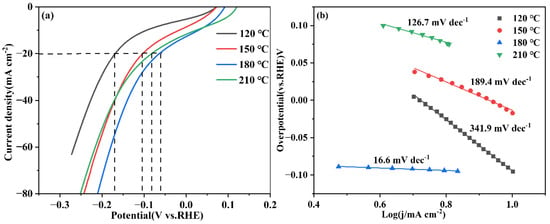
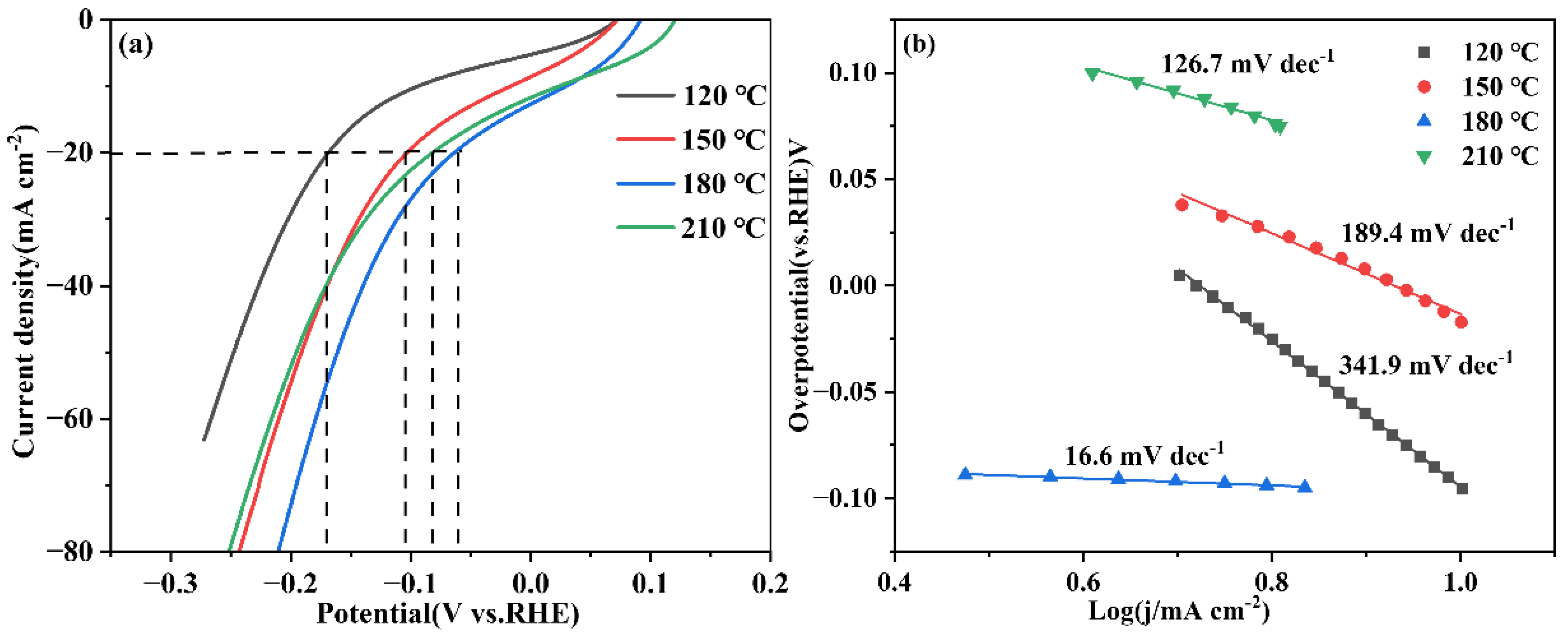
By comparing the polarization curves of Ni9S8@NiMoO4/NF catalysts synthesized at different sulfurization temperatures (with a scanning rate of 5 mV/s), it is clear that the sample prepared at 180 °C demonstrated a significant advantage in catalytic activity. As shown in Figure 5a, this catalyst exhibited exceptional performance in the hydrogen evolution reaction, achieving a low overpotential (η20) of 64.2 mV, which was substantially lower than that of samples synthesized at other temperatures. This finding confirms that 180 °C is the optimal synthesis temperature for this system [42]. Figure 5b further illustrates the Tafel slopes of catalysts synthesized at various temperatures, with the values increasing in the following order: 180 °C < 210 °C < 150 °C < 120 °C. Notably, the 180 °C sample featured a Tafel slope of only 16.6 mV dec−1, which was significantly lower than those of the samples from other temperatures. This indicates that the 180 °C catalyst exhibits faster reaction kinetics, allowing for a higher current density growth at equivalent potentials [43]. This impressive performance can be attributed to the formation of an ideal microstructure at this temperature, where Ni9S8 nanospheres uniformly coat the NiMoO4 surface. This configuration creates a high specific surface area and an abundant pore structure, effectively exposing active sites. Concurrently, the stable Ni-S bonding state enhances electron conductivity and reactivity, significantly lowering the reaction energy barrier and optimizing the hydrogen generation pathway [44]. In summary, the Ni9S8@NiMoO4/NF catalyst synthesized at 180 °C achieved a synergistic enhancement of conductivity and catalytic activity through its optimized microstructure and stable chemical state. These findings provide critical experimental evidence for the controlled preparation and structural optimization of high-performance hydrogen evolution catalysts.
Figure 5.
(a) Polarization curves of the Ni9S8@NiMoO4/NF catalyst at different temperatures; and (b) Tafel curves.
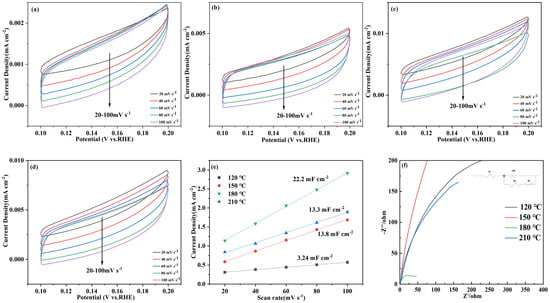
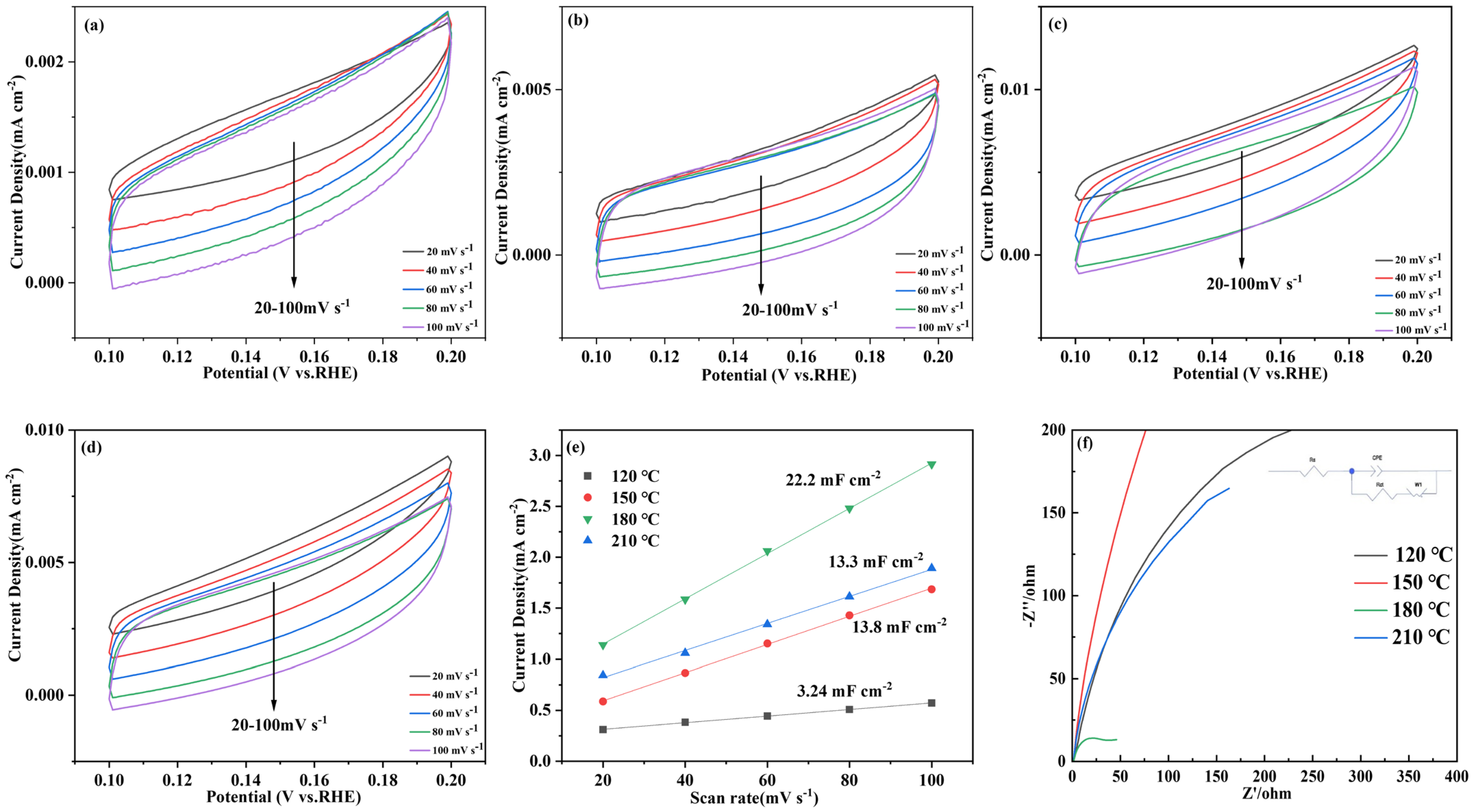
To elucidate the critical influence of calcination temperature on the hydrogen evolution performance of nickel-molybdenum alloys, this study systematically characterized Ni9S8@NiMoO4/NF catalysts synthesized at different temperatures using electrochemical methods. Figure 6 presents the multi-scan rate cyclic voltammetry (CV) curves measured within the non-Faradaic potential range, offering an intuitive representation of the material’s electrochemical active surface area (ECSA) and reaction kinetics. As the scan rates increased, the current density markedly increased across all samples, indicating that the reaction process is significantly dependent on interfacial charge transfer rates. At low scan rates, the current response was relatively flat, suggesting that both diffusion and kinetic steps governed the reaction. Conversely, at high scan rates, the current density rose rapidly, and the CV curves displayed steeper profiles, demonstrating significantly accelerated surface reaction kinetics and the enhanced utilization of active sites. Notably, the capacitive behavior varied among samples synthesized at different temperatures. The sample prepared at 180 °C exhibited the highest current response, with a calculated double-layer capacitance (Cdl) of 22.2 mF cm−2, significantly outperforming those synthesized under other temperature conditions. This indicates that the 180 °C sample has a richer active surface area and superior charge transfer efficiency. Electrochemical impedance spectroscopy (EIS) results corroborated the CV analysis [45]. The Nyquist plot for the 180 °C sample showed the lowest charge transfer resistance, indicating the most unobstructed interfacial electron conduction pathways and the lowest reaction kinetic barrier [46]. This advantage arises from the efficient adsorption and conversion of reaction intermediates at the nickel active sites, whose d-electron structural characteristics reduce hydrogen adsorption free energy, thereby significantly enhancing the hydrogen evolution reaction efficiency. Additionally, sulfur doping exerts a critical regulatory effect on the local electronic structure of nickel [47]. By forming strong covalent Ni-S bonds, sulfur atoms effectively modulate the electron density of nickel active sites and optimize the hydrophilic/hydrophobic properties of the material’s surface. This modification significantly promotes the generation and desorption of hydrogen species (H*) following water molecule dissociation [48]. In the hydrogen evolution reaction, this electronic effect enhances nickel’s adsorption strength for hydrogen species, optimizes the hydrogen adsorption free energy (ΔG-H*), and consequently accelerates the reaction kinetics [49]. Combined analyses of cyclic voltammetry and electrochemical impedance spectroscopy revealed that the Ni9S8@NiMoO4/NF catalyst synthesized at 180 °C exhibited the optimal performance in terms of electrochemical active surface area, charge transfer rate, and interfacial reaction kinetics. Its low Tafel slope further confirms the catalyst’s low reaction energy barrier and higher intrinsic catalytic activity [50,51]. This study systematically elucidates the critical influence of hydrothermal synthesis temperature on the hydrogen evolution performance of the Ni9S8@NiMoO4/NF catalyst, establishing 180 °C as the optimal synthesis parameter. This discovery not only provides direct evidence for understanding the mechanism by which sulfur doping enhances the catalytic performance of transition metal compounds, but also lays a solid experimental and theoretical foundation for the subsequent design and development of highly efficient and stable hydrogen evolution reaction catalysts.
Figure 6.
The cyclic voltammetry curves of Ni9S8@NiMoO4/NF at different sulfur doping temperatures in 1.0 M NaOH solution in the non-Faradaic region at various scan rates, namely (a) 120 °C, (b) 150 °C, (c) 180 °C, and (d) 210 °C, with a scan range of 0.1 V to 0.2 V vs. RHE and scan rates from 20 mV/s to 100 mV/s at 25 °C. (e) The electrochemical active area curves of Ni9S8@NiMoO4/NF catalysts at different sulfur doping temperatures. (f) Impedance spectra of Ni9S8@NiMoO4/NF catalysts at different sulfur doping temperatures.
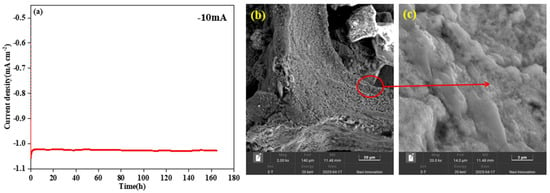
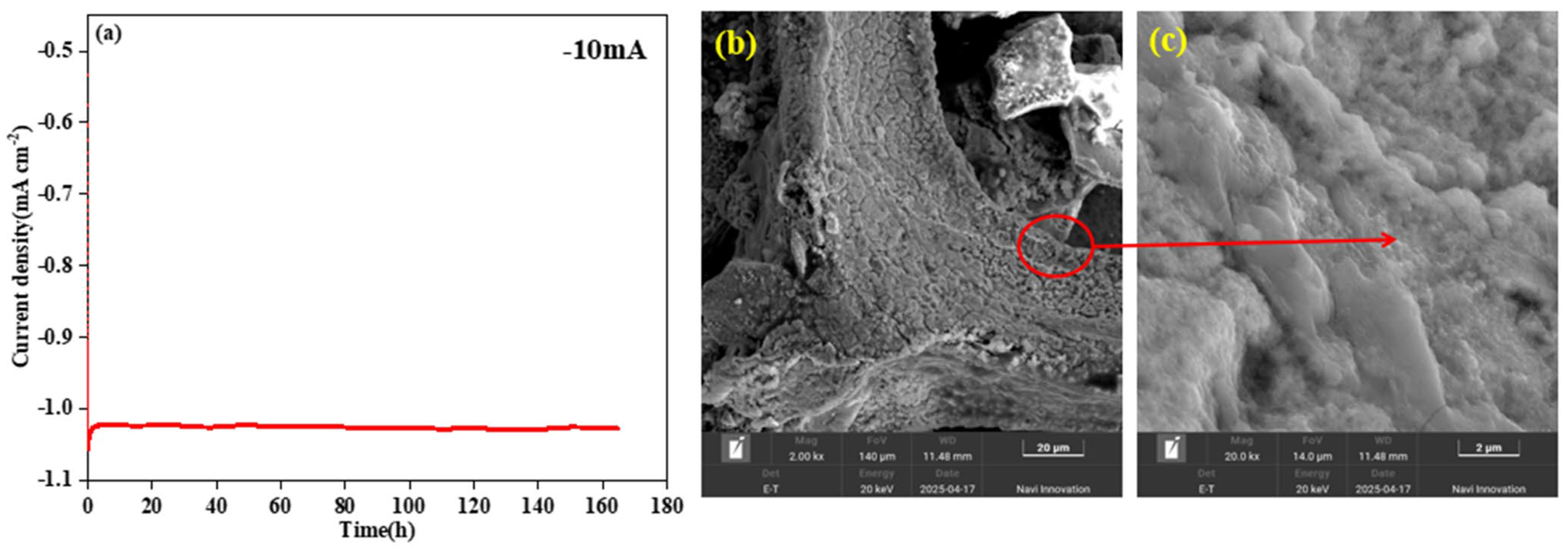
During long-term stability testing, the Ni9S8@NiMoO4/NF catalyst synthesized at 180 °C exhibited remarkable durability. After continuous operation for 165 h at a current density of 10 mA cm−2, its performance parameters showed no significant degradation, with the voltage remaining stable at approximately 1.028 V (as shown in Figure 7a). This stability indicates that the active site structure remained intact during prolonged reaction without noticeable deactivation [52]. These results demonstrate the electrode material’s sustained and stable hydrogen evolution capability under practical operating conditions. Further analysis of post-reaction scanning electron microscopy (SEM) images (Figure 7b) revealed that after 165 h of electrochemical testing, a layered structure formed on the material’s surface [52]. This layer exhibited increased roughness, along with the appearance of cracks and flaking in certain areas. Figure 7c highlights a more uniform nanoscale morphology and higher surface roughness, as well as the development of a distinct pore structure. Such structural features facilitate the exposure of additional active sites, promote the transport of reactants, and enhance gas release, thereby improving electrochemical performance. However, prolonged operation also induces structural alterations, including partial pore collapse or blockage, which may adversely affect the material’s electrochemical activity and conductivity [53]. Despite these changes, the overall structure remained largely intact, with no significant loss of active sites. In summary, the Ni9S8@NiMoO4/NF catalyst synthesized via hydrothermal synthesis at 180 °C demonstrated outstanding performance in terms of activity, stability, and charge transport capability. It represents a promising material for hydrogen evolution reaction catalysts, providing essential theoretical and practical support for the development of hydrogen energy technology.
Figure 7.
(a) Stability profile of the CP chronopotentiometric method for Ni9S8@NiMoO4/NF at 180 °C, (b) SEM image after stability testing, and (c) enlarged section of (b).
3. Materials and Methods
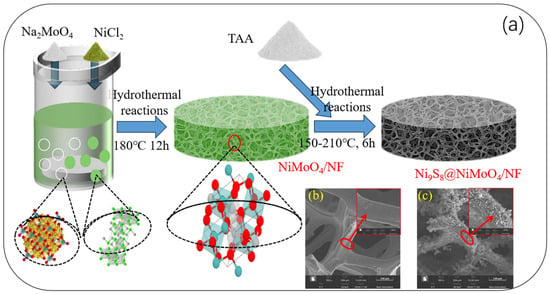
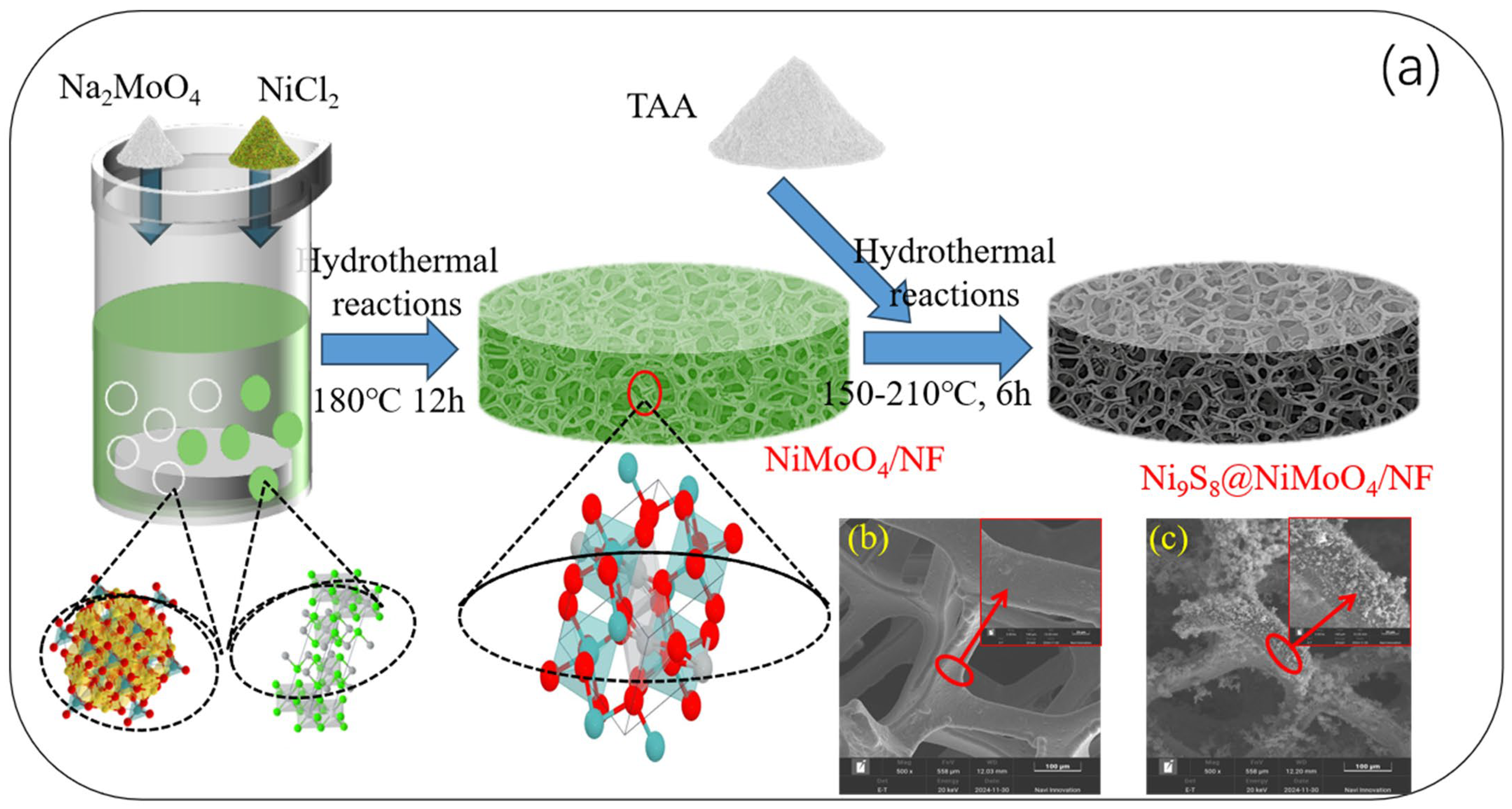
This study reports the two-step hydrothermal synthesis of Ni9S8@NiMoO4/NF composite materials on nickel foam (NF) substrates, achieved via a precursor route followed by sulfur doping. In the first step, 0.475 g NiCl2.6H2O and 0.484 g Na2MoO4.2H2O were dissolved in deionized water with stirring to form a homogeneous precursor solution. Pre-treated NF pieces were immersed in the precursor solution and subjected to hydrothermal treatment at 180 °C for 12 h, during which NiMoO4 formed on NF according to the reaction Na2MoO4 + NiCl2 → NiMoO4 + 2NaCl. After cooling, samples were removed, washed with ethanol and deionized water, and dried at 60 °C for 8 h to yield the NiMoO4/NF precursor. In the second step, the precursor was subjected to sulfur doping by placing it in a reactor together with 0.600 g thioacetamide (TAA). During the secondary hydrothermal treatment, NiMoO4 partially converted to Ni9S8, yielding the Ni9S8@NiMoO4/NF composite with a heterojunction and dopant-induced electronic structure optimization. The final product was washed and dried at 60 °C for 8 h to ensure structural integrity and stability.
The entire process is illustrated in Figure 8a, demonstrating excellent controllability and reproducibility. Scanning electron microscopy (SEM) revealed the material’s morphological evolution: pristine NF exhibited a smooth, porous framework (Figure 8b), providing an ideal substrate for nanomaterial growth. After the initial hydrothermal treatment, the surface supported a large number of uniformly distributed NiMoO4 nanostructures (Figure 8c), highlighting the hydrothermal method’s efficacy in morphology control. Following the sulfur-doping step, the material maintained its overall framework while incorporating the Ni9S8 phase, achieving a synergistic optimization of the electronic structure. This synthetic strategy not only enables the efficient construction of Ni9S8@NiMoO4/NF composites, but also offers new insights for the development of high-performance electrocatalytic electrodes. Future work will focus on further optimizing synthesis parameters to explore energy-conversion applications.
Figure 8.
(a) Experimental preparation diagram, (b) SEM image of NF, and (c) SEM image of the NiMoO4 precursor.
4. Theoretical Hydrogen Analysis Computational Analysis
In the hydrogen evolution reaction during the electrolysis of water, the theoretical yield of hydrogen gas can be calculated using Faraday’s Law. This law states that the amount of charge passing through the electrodes is directly proportional to the quantity of product formed. According to Faraday’s Law of Electrolysis, the formula for the theoretical hydrogen evolution rate is:
Among these: I: Current (A), with a test current density of 20 mA cm−2, and an electrode area of 1 cm2, hence I = 0.02 A; t: Time (s), taken as 10 h (36,000 s); n = 2 (each H2 molecule transfers 2 electrons); F = 96,435 C mol−1;
During the electrolysis of water, the chemical equation for the hydrogen evolution reaction is:
According to the aforementioned stoichiometric relationship, the hydrogen evolution reaction (HER) involves a two-electron transfer process (n = 2), meaning that 2 moles of electrons are consumed for every 1 mole of hydrogen gas (H2) produced. Its molar relationship can be expressed as:
Under conditions of a current density of 20 mA cm−2 (I = 0.02 A), an electrode area of 1 cm2, a reaction time of 10 h (t = 36,000 s), and a Faraday constant F = 96,485 C mol−1, the theoretical hydrogen yield is calculated as follows:
Under standard conditions (0 °C, 1 atm), 1 mole of gas occupies approximately 22.4 L. Therefore, the theoretical volume of hydrogen evolved is:
However, in practical electrocatalytic hydrogen evolution processes, the energy conversion efficiency of the system is constrained by multiple kinetic factors, making it challenging to reach the theoretical upper limit of 100%. Key limiting factors include overpotential caused by reaction kinetic barriers, internal resistance within the electrolyte and system components, and suboptimal catalyst activity and stability. Collectively, these factors lead to the partial dissipation of electrical energy in forms such as heat. Currently, the unit hydrogen energy consumption of industrial-scale water electrolysis systems, such as alkaline electrolyzers, typically ranges between 4.2 and 5.5 kWh Nm−3. In comparison, the minimum energy consumption corresponding to the theoretical thermally neutral voltage for hydrogen production is approximately 3.5 kWh Nm−3. This indicates that the energy efficiency of contemporary industrial electrolysis systems generally falls within the range of 65% to 80%. Consequently, in practical operation, the hydrogen yield typically achieves only 70% to 85% of the theoretical value at ideal Faraday efficiency. Although Faraday efficiency can reach up to 95% under optimized laboratory conditions, the disparity between industrial and theoretical values—as well as between laboratory and industrial scales—highlights significant opportunities for improvement in catalyst design, electrolyzer structural optimization, and system integration. Addressing these challenges is crucial to enhance the overall efficiency and effectiveness of hydrogen production through electrolysis. Therefore, the overpotential values for each sample at a current density of 20 mA cm−2 are summarized in Table 1. These values were determined under ideal conditions, without accounting for energy losses or catalyst deactivation. At this current density, the theoretical hydrogen evolution rate is approximately 0.083 L h−1. Furthermore, the Ni9S8@NiMoO4/NF catalyst synthesized at 180 °C exhibited a lower overpotential. This indicates that the reaction requires less additional energy input, which in turn leads to a higher practical hydrogen evolution efficiency compared to catalysts prepared at other temperatures.
Table 1.
Overpotential at 20 mA/cm2 for Ni9S8@NiMoO4/NF at different temperatures.
The Tafel slope is a critical parameter for assessing the kinetics of the hydrogen evolution reaction (HER). A lower Tafel slope value indicates that a smaller overpotential is required to achieve the same current density, reflecting superior reaction kinetics. Furthermore, the magnitude of the Tafel slope can be used to infer the probable rate-determining step of the reaction: a value around 120 mV dec−1 suggests the Volmer step (H+ + e−→ H*, controlled by hydrogen adsorption); approximately 40 mV dec−1 corresponds to the Heyrovsky step (H* + H+ + e− → H2, controlled by electrochemical desorption); and around 30 mV dec−1 indicates the Tafel step (H* + H* → H2, controlled by chemical recombination). The Tafel slope measured for the Ni9S8@NiMoO4/NF catalyst synthesized at 180 °C was 42 mV dec−1. This value suggests that the HER process follows a Volmer–Heyrovsky mechanism, with the Heyrovsky step being rate-limiting. Among the series of samples tested, this particular catalyst exhibited the smallest Tafel slope and the lowest overpotential, demonstrating optimal reaction kinetics. This enhanced kinetic performance originates from the material’s exceptional bulk and interfacial charge transport capabilities. Although the increase in its double-layer capacitance (Cdl) and electrochemical active surface area (ECSA) was modest compared to other samples, its current density and specific activity were significantly higher. This indicates that the performance improvement is primarily due to an enhancement in intrinsic activity rather than an expansion of surface area. At the electronic structure level, the formation of Ni-S bonds induces charge redistribution, which increases the charge carrier concentration (n) and optimizes carrier mobility (μ). This electronic restructuring promotes metallic-like behavior, substantially boosting the intrinsic electrical conductivity. Consequently, the combined effect of carrier concentration and mobility determines the overall conductivity, creating a crucial bridge between the microscopic electronic structure and the macroscopic catalytic performance. This enhanced conductivity directly improves the efficiency of electron supply to the active sites, thereby governing the intrinsic HER activity and the resulting hydrogen evolution rate.
5. Conclusions
This study successfully synthesized a high-performance hydrogen evolution reaction (HER) catalyst by growing Ni9S8@NiMoO4 nanospheres in situ on a three-dimensional nickel foam (NF) substrate using a simple, controllable two-step hydrothermal method. The composite catalyst leverages both the electronic synergy between the sulfur and nickel species and its distinctive nanosphere architecture. This design not only substantially increases the electrochemical active surface area, offering abundant catalytic sites, but also enhances the electrode/electrolyte interface contact, effectively lowering the interfacial charge transfer resistance. As a result, the hydrogen evolution kinetics are significantly improved. In the 1.0 M NaOH alkaline electrolyte, the Ni9S8@NiMoO4/NF electrode demonstrated outstanding overall performance, requiring an overpotential of only 64.2 mV to achieve a current density of 20 mA cm−2. The electrode exhibited a double-layer capacitance (Cdl) of 22.2 mF cm−2, reflecting its exceptional interfacial charge transfer capability and intrinsic catalytic activity. Moreover, it showed remarkable long-term stability, with no significant activity loss after 165 h of continuous operation at 10 mA cm−2. These superior properties are mainly attributed to the strong electronic interaction between the Ni9S8 and NiMoO4 phases, as well as the highly conductive network and robust mechanical support provided by the nickel foam substrate. In summary, this work not only presents a novel HER catalyst material with high activity and stability, but also offers a feasible strategy for enhancing electrocatalytic performance through interfacial engineering and structural design, showing considerable promise for advancing practical hydrogen energy conversion technologies.
Author Contributions
Conceptualization, Y.D. and Y.C.; methodology, Y.C.; software, Z.G.; validation, Z.G.; formal analysis, Y.C.; investigation, C.X.; resources, Z.Z.; data curation, C.X.; writing—original draft preparation, Y.C.; writing—review and editing, Y.D. and Z.Z.; visualization, J.Y.; supervision, T.F.; project administration, Y.D.; funding acquisition, Y.D.; provided guidance and revised the first draft of the paper, Y.Z. All authors have read and agreed to the published version of the manuscript.
Funding
This research was supported by the 2025 Postgraduate Scientific Research Innovation Project of Hunan University of Technology, grant number CX2507.
Data Availability Statement
The raw data underlying this study are not publicly available since it forms a part of on-going research work. The datasets generated during the current study are available from the corresponding author on reasonable request.
Conflicts of Interest
The authors declare that apart from the aforementioned funding, there are no other conflicts of interest that could have influenced the results of this study. The funding agency had no involvement in the study design, data collection, analysis, interpretation, or preparation of the report.
References
- Tüysüz, H. Alkaline Water Electrolysis for Green Hydrogen Production. Acc. Chem. Res. 2024, 57, 558–567. [Google Scholar] [CrossRef] [Scilit] [PubMed]
- Tang, C.; Chen, Y.; Rao, J.; Guo, H.; Zhou, Y. Solar-to-Hydrogen Conversion Efficiency for Photovoltaic Water Electrolysis to Produce Green Hydrogen. Small 2025, 21, 2502342. [Google Scholar] [CrossRef] [Scilit] [PubMed]
- Peng, L.; Wei, Z. Catalyst Engineering for Electrochemical Energy Conversion from Water to Water: Water Electrolysis and the Hydrogen Fuel Cell. Engineering 2020, 6, 653–679. [Google Scholar] [CrossRef] [Scilit]
- Liu, Y.; Qin, Y.; Yu, D.; Zhuo, H.; Ma, C.; Chen, K. Enhance Water Electrolysis for Green Hydrogen Production with Material Engineering: A Review. Chem. Rec. 2025, 25, e202400258. [Google Scholar] [CrossRef] [Scilit]
- Coskun Avci, A.; Toklu, E. A new analysis of two phase flow on hydrogen production from water electrolysis. Int. J. Hydrogen Energy 2022, 47, 6986–6995. [Google Scholar] [CrossRef] [Scilit]
- Ju, H.; Badwal, S.; Giddey, S. A comprehensive review of carbon and hydrocarbon assisted water electrolysis for hydrogen production. Appl. Energy 2018, 231, 502–533. [Google Scholar] [CrossRef] [Scilit]
- Miller, E.L.; Randolph, K.; Peterson, D.; Rustagi, N.; Vickers, J.W.; Lyubovsky, M.; Cierpik-Gold, K.; Byham, S. (Invited) Addressing Fundamental Materials Challenges in Electrochemical Water Splitting Technologies for Sustainable Hydrogen Production. ECS Meet. Abstr. 2018, MA2018-02, 1595. [Google Scholar] [CrossRef] [Scilit]
- Ahn, S.H.; Choi, I.; Park, H.-Y.; Hwang, S.J.; Yoo, S.J.; Cho, E.; Kim, H.-J.; Henkensmeier, D.; Nam, S.W.; Kim, S.-K.; et al. Effect of morphology of electrodeposited Ni catalysts on the behavior of bubbles generated during the oxygen evolution reaction in alkaline water electrolysis. Chem. Commun. 2013, 49, 9323–9325. [Google Scholar] [CrossRef] [Scilit]
- Yadav, V.; Dileep, N.P.; Nair, N.; Kumar Behura, P.; Shaijumon, M.M. Hydrogen production via alkaline seawater electrolysis using iron-doped nickel diselenide as an efficient bifunctional electrocatalyst. Mater. Today Chem. 2024, 40, 102276. [Google Scholar] [CrossRef] [Scilit]
- Pein, M.; Neumann, N.C.; Venstrom, L.J.; Vieten, J.; Roeb, M.; Sattler, C. Two-step thermochemical electrolysis: An approach for green hydrogen production. Int. J. Hydrogen Energy 2021, 46, 24909–24918. [Google Scholar] [CrossRef] [Scilit]
- Liu, W.; Fu, L.; Yang, S.; Lu, Y.; Li, M.; Zhang, L.; Tang, J. Hydrothermal Synthesis of Co-MoS2 as a Bifunctional Catalyst for Overall Water Splitting. ACS Omega 2025, 10, 15129–15142. [Google Scholar] [CrossRef] [Scilit] [PubMed]
- Abdullah, M.; Alyousef, H.A.; Alotaibi, B.M.; Alrowaily, A.W.; Al-Harbi, N.; Henaish, A.M.A.; Dahshan, A. Hydrothermal synthesis of NiS2@SnS2 nanohybrid for the water splitting application. Mater. Chem. Phys. 2024, 319, 129361. [Google Scholar] [CrossRef] [Scilit]
- Cho, K.H.; Borges, D.D.; Lee, J.S.; Park, J.; Cho, S.J.; Jo, D.; Lee, U.H.; Maurin, G.; Chang, J.-S. Hydrothermal Green Synthesis of a Robust Al Metal-Organic-Framework Effective for Water Adsorption Heat Allocations. ACS Sustain. Chem. Eng. 2022, 10, 7010–7019. [Google Scholar] [CrossRef] [Scilit]
- Liang, K.; Pakhira, S.; Yang, Z.; Nijamudheen, A.; Ju, L.; Wang, M.; Aguirre-Velez, C.I.; Sterbinsky, G.E.; Du, Y.; Feng, Z.; et al. S-Doped MoP Nanoporous Layer Toward High-Efficiency Hydrogen Evolution in pH-Universal Electrolyte. ACS Catal. 2019, 9, 651–659. [Google Scholar] [CrossRef] [Scilit]
- Fan, X.-Z.; Hu, J.-P.; Du, X.; Liu, Z.-Y.; Yue, X.-Z. Sulphur anion induced electronic structure regulation of RuO2 nanodots for efficient electrocatalytic overall water splitting. J. Mater. Sci. Technol. 2025, 231, 77–85. [Google Scholar] [CrossRef] [Scilit]
- Maniyazagan, M.; Shanmugasundaram, E.; Naveenkumar, P.; Yang, H.-W.; Kang, N.; Kang, W.S.; Thambusamy, S.; Kim, S.-J. MOF˗derived sulfur˗doped iron˗nickel bimetallic phosphide nanowires: A bifunctional electrode for hydrogen and oxygen evolution reactions. Int. J. Hydrogen Energy 2024, 81, 774–784. [Google Scholar] [CrossRef] [Scilit]
- Barim, G.; Smock, S.R.; Antunez, P.D.; Glaser, D.; Brutchey, R.L. Phase control in the colloidal synthesis of well-defined nickel sulfide nanocrystals. Nanoscale 2018, 10, 16298–16306. [Google Scholar] [CrossRef] [Scilit]
- Li, Y.; Li, P.; Jiang, J.; Zhao, T.; Xu, G.; Zhang, L. Substrate self-derived porous rod-like NiS/Ni9S8/NF heterostructures as efficient bifunctional electrocatalysts for overall water splitting. Dalton Trans. 2023, 52, 17826–17833. [Google Scholar] [CrossRef] [Scilit]
- Sambathkumar, C.; Ranjithkumar, R.; Ezhil Arasi, S.; Manikandan, A.; Nallaperumal, N.; Kumar, K.; Arivarasan, A.; Devendran, P. Investigations and improvement of Nickel Sulfide modified electrode material from single source precursor for energy storage application. Mater. Sci. Eng. 2021. preprint. [Google Scholar] [CrossRef] [Scilit]
- Dhilipkumar, R.; Jeganathan, C.; Joseph, K.L.V.; Karthikeyan, C.; Karuppuchamy, S. High performing Zn-embedded Ni9S8 nanosphere electrodes for Pseudo-supercapacitors. J. Mater. Sci. Mater. Electron. 2021, 32, 26567–26577. [Google Scholar] [CrossRef] [Scilit]
- Wang, X.; Qu, G.; Hao, S.; Zhao, G.; Zhang, X.; Ma, W.; Xu, X. Improvement of nickel-cobalt-based supercapacitors energy storage performance by modification of elements. J. Colloid Interface Sci. 2021, 602, 712–720. [Google Scholar] [CrossRef] [Scilit]
- Li, A.; Peng, Z.; Fu, X. Simple hydrothermal synthesis of g-C3N4/Ni9S8 composites for efficient photocatalytic H2 evolution. J. Mater. Sci. Mater. Electron. 2021, 32, 21643–21657. [Google Scholar] [CrossRef] [Scilit]
- Pei, Z.; Qin, T.; Tian, R.; Ou, Y.; Guo, X. Construction of an Amethyst-like MoS2@Ni9S8/Co3S4 Rod Electrocatalyst for Overall Water Splitting. Nanomaterials 2023, 13, 2302. [Google Scholar] [CrossRef] [Scilit] [PubMed]
- Wu, M.-S.; Qiu, M.-Z. Nickel molybdate nanorod array as a dual-function electrocatalyst for urea oxidation and hydrogen evolution in urea-assisted water splitting. J. Alloys Compd. 2025, 1027, 180555. [Google Scholar] [CrossRef] [Scilit]
- Calle-Vallejo, F.; Martínez, J.I.; García-Lastra, J.M.; Abad, E.; Koper, M.T.M. Oxygen reduction and evolution at single-metal active sites: Comparison between functionalized graphitic materials and protoporphyrins. Surf. Sci. 2013, 607, 47–53. [Google Scholar] [CrossRef] [Scilit]
- Li, D.J.; Kang, J.; Lee, H.J.; Choi, D.S.; Koo, S.H.; Han, B.; Kim, S.O. High Activity Hydrogen Evolution Catalysis by Uniquely Designed Amorphous/Metal Interface of Core–shell Phosphosulfide/N-Doped CNTs. Adv. Energy Mater. 2018, 8, 1702806. [Google Scholar] [CrossRef] [Scilit]
- You, B.; Tang, M.T.; Tsai, C.; Abild-Pedersen, F.; Zheng, X.; Li, H. Enhancing Electrocatalytic Water Splitting by Strain Engineering. Adv. Mater. 2019, 31, 1807001. [Google Scholar] [CrossRef] [Scilit]
- Zhao, G.; Xing, Y.; Liu, Y.; Wang, X.; Zhang, B.; Mu, L.; Liao, W.; Xu, X. Built-in electric field in bifunctional electrocatalyst (Ni3S2@Ni9S8) for high-efficiency OER and overall water splitting performance. Mater. Today Chem. 2023, 34, 101758. [Google Scholar] [CrossRef] [Scilit]
- Mottakin, M.; Selvanathan, V.; Ariful Islam, M.; Almohamadi, H.; Alharthi, N.H.; Yoshimura, S.; Akhtaruzzaman, M. Synergistic Effect of Allium-like Ni9S8 & Cu7S4 Electrodeposited on Nickel Foam for Enhanced Water Splitting Activity. Chem. —Asian J. 2024, 19, e202300532. [Google Scholar] [CrossRef] [Scilit]
- Li, J.; Zhang, L.; Du, X.; Zhang, X. Co, Mn co-doped Fe9S11@Ni9S8 supported on nickel foam as a high efficiency electrocatalyst for the oxygen evolution reaction and urea oxidation reaction. Dalton Trans. 2022, 51, 10249–10256. [Google Scholar] [CrossRef] [Scilit]
- Chandrasekaran, S.; Li, N.; Zhuang, Y.; Sui, L.; Xiao, Z.; Fan, D.; Aravindan, V.; Bowen, C.; Lu, H.; Liu, Y. Interface charge density modulation of a lamellar-like spatially separated Ni9S8 nanosheet/Nb2O5 nanobelt heterostructure catalyst coupled with nitrogen and metal (M = Co, Fe, or Cu) atoms to accelerate acidic and alkaline hydrogen evolution reactions. Chem. Eng. J. 2022, 431, 134073. [Google Scholar] [CrossRef] [Scilit]
- Wen, Y.; Liu, Y.; Dang, S.; Tian, S.; Li, H.; Wang, Z.; He, D.; Wu, Z.-S.; Cao, G.; Peng, S. High mass loading Ni-decorated Co9S8 with enhanced electrochemical performance for flexible quasi-solid-state asymmetric supercapacitors. J. Power Sources 2019, 423, 106–114. [Google Scholar] [CrossRef] [Scilit]
- Chen, X.; Wang, X.; Zhang, X.; Srinivas, K.; Liu, D.; Zhao, X.; Yu, H.; Wang, B.; Zhang, W.; Chen, Y. Vertical Fe(OH)3/Ni9S8 nanoarrays electrodeposited on stainless steel as binder-free electrocatalyst for highly efficient and stable oxygen evolution reaction. J. Mater. Sci. 2021, 56, 19144–19154. [Google Scholar] [CrossRef] [Scilit]
- Xiong, D.; Li, X.; Bai, Z.; Li, J.; Han, Y.; Li, D. Vertically Aligned Co9S8 Nanotube Arrays onto Graphene Papers as High-Performance Flexible Electrodes for Supercapacitors. Chem.—A Eur. J. 2018, 24, 2339–2343. [Google Scholar] [CrossRef] [Scilit]
- Zhu, C.; Xie, J.; Ding, Y.; Li, Y.; Yang, W.; Lu, H.; Hu, K. Rational design of Mo-doped NixSy/Ni2P heterostructure on nickel foam for high-efficiency hydrogen evolution in alkaline freshwater and seawater media. J. Mater. Sci. 2025, 60, 6628–6641. [Google Scholar] [CrossRef] [Scilit]
- Xiao, Z.; Xiao, G.; Shi, M.; Zhu, Y. Homogeneously Dispersed Co9S8 Anchored on Nitrogen and Sulfur Co-Doped Carbon Derived from Soybean as Bifunctional Oxygen Electrocatalysts and Supercapacitors. ACS Appl. Mater. Interfaces 2018, 10, 16436–16448. [Google Scholar] [CrossRef] [Scilit]
- Lu, F.; Zhou, M.; Li, W.; Weng, Q.; Li, C.; Xue, Y.; Jiang, X.; Zeng, X.; Bando, Y.; Golberg, D. Engineering sulfur vacancies and impurities in NiCo2S4 nanostructures toward optimal supercapacitive performance. Nano Energy 2016, 26, 313–323. [Google Scholar] [CrossRef] [Scilit]
- Sivanantham, A.; Ganesan, P.; Shanmugam, S. Hierarchical NiCo2S4 Nanowire Arrays Supported on Ni Foam: An Efficient and Durable Bifunctional Electrocatalyst for Oxygen and Hydrogen Evolution Reactions. Adv. Funct. Mater. 2016, 26, 4661–4672. [Google Scholar] [CrossRef] [Scilit]
- Yu, L.; Zhang, L.; Wu, H.B.; Lou, X.W. Formation of NixCo3−xS4 Hollow Nanoprisms with Enhanced Pseudocapacitive Properties. Angew. Chem. Int. Ed. 2014, 53, 3711–3714. [Google Scholar] [CrossRef] [Scilit]
- Han, X.; Tao, K.; Wang, D.; Han, L. Design of a porous cobalt sulfide nanosheet array on Ni foam from zeolitic imidazolate frameworks as an advanced electrode for supercapacitors. Nanoscale 2018, 10, 2735–2741. [Google Scholar] [CrossRef] [Scilit]
- Kandula, S.; Shrestha, K.R.; Kim, N.H.; Lee, J.H. Fabrication of a 3D Hierarchical Sandwich Co9S8/α-MnS@N–C@MoS2 Nanowire Architectures as Advanced Electrode Material for High Performance Hybrid Supercapacitors. Small 2018, 14, 1800291. [Google Scholar] [CrossRef] [Scilit] [PubMed]
- Tan, X.; Duan, Z.; Liu, H.; Wu, X.; Cho, Y.-R. Core-shell structured MoS2/Ni9S8 electrocatalysts for high performance hydrogen and oxygen evolution reactions. Mater. Res. Bull. 2022, 146, 111626. [Google Scholar] [CrossRef] [Scilit]
- Yan, Y.; Li, A.; Lu, C.; Zhai, T.; Lu, S.; Li, W.; Zhou, W. Double-layered yolk-shell microspheres with NiCo2S4-Ni9S8-C hetero-interfaces as advanced battery-type electrode for hybrid supercapacitors. Chem. Eng. J. 2020, 396, 125316. [Google Scholar] [CrossRef] [Scilit]
- Liu, F.; Guo, X.; Hou, Y.; Wang, F.; Zou, C.; Yang, H. Hydrothermal combined with electrodeposition construction of a stable Co9S8/Ni3S2@NiFe-LDH heterostructure electrocatalyst for overall water splitting. Sustain. Energy Fuels 2021, 5, 1429–1438. [Google Scholar] [CrossRef] [Scilit]
- Tang, S.; Wang, X.; Zhang, Y.; Courté, M.; Fan, H.J.; Fichou, D. Combining Co3S4 and Ni:Co3S4 nanowires as efficient catalysts for overall water splitting: An experimental and theoretical study. Nanoscale 2019, 11, 2202–2210. [Google Scholar] [CrossRef] [Scilit]
- Zhai, Z.; Li, C.; Zhang, L.; Wu, H.-C.; Zhang, L.; Tang, N.; Wang, W.; Gong, J. Dimensional construction and morphological tuning of heterogeneous MoS2/NiS electrocatalysts for efficient overall water splitting. J. Mater. Chem. A 2018, 6, 9833–9838. [Google Scholar] [CrossRef] [Scilit]
- Yang, Y.; Zhang, W.; Xiao, Y.; Shi, Z.; Cao, X.; Tang, Y.; Gao, Q. CoNiSe2 heteronanorods decorated with layered-double-hydroxides for efficient hydrogen evolution. Appl. Catal. B Environ. 2019, 242, 132–139. [Google Scholar] [CrossRef] [Scilit]
- Dai, Z.; Geng, H.; Wang, J.; Luo, Y.; Li, B.; Zong, Y.; Yang, J.; Guo, Y.; Zheng, Y.; Wang, X.; et al. Hexagonal-Phase Cobalt Monophosphosulfide for Highly Efficient Overall Water Splitting. ACS Nano 2017, 11, 11031–11040. [Google Scholar] [CrossRef] [Scilit]
- Chen, L.; Deng, Z.; Chen, Z.; Wang, X. Building Ni9S8/MoS2 Nanosheets Decorated NiMoO4 Nanorods Heterostructure for Enhanced Water Splitting. Adv. Mater. Interfaces 2021, 8, 2101483. [Google Scholar] [CrossRef] [Scilit]
- Hao, X.; Jiang, K.; Liu, G.; Zhou, S.; Wang, D.; Zhang, Y.; Zhang, T.; Liu, Y.; Gu, P. A multifunctional MoS2/Ni9S8/NF catalyst for synchronous desulfurization and hydrogen evolution by a self-driven system. J. Mater. Chem. A 2024, 12, 23732–23742. [Google Scholar] [CrossRef] [Scilit]
- Yi, P.; Song, Y.; Liu, Z.; Xie, P.; Liang, G.; Liu, R.; Chen, L.; Sun, J. Boosting alkaline urea oxidation with a nickel sulfide/cobalt oxide heterojunction catalyst via interface engineering. Adv. Compos. Hybrid Mater. 2023, 6, 228. [Google Scholar] [CrossRef] [Scilit]
- Ren, T.; Huang, X.; Chen, J.; Wang, G.; Liu, Y.; Bao, F.; Guo, W. Surface-sulphurated nickel–molybdenum alloy film as enhanced electrocatalysts for alkaline overall water splitting. Int. J. Hydrogen Energy 2024, 57, 983–989. [Google Scholar] [CrossRef] [Scilit]
- Huang, Z.; He, L.; Zhang, W.; Huang, W.; Mo, Q.; Yang, L.; Fu, Q.; Gao, Q. Nickel sulfide-oxide heterostructured electrocatalysts: Bi-functionality for overall water splitting and in-situ reconstruction. J. Colloid Interface Sci. 2022, 622, 728–737. [Google Scholar] [CrossRef] [Scilit]

Disclaimer/Publisher’s Note: The statements, opinions and data contained in all publications are solely those of the individual author(s) and contributor(s) and not of MDPI and/or the editor(s). MDPI and/or the editor(s) disclaim responsibility for any injury to people or property resulting from any ideas, methods, instructions or products referred to in the content. |
© 2026 by the authors. Licensee MDPI, Basel, Switzerland. This article is an open access article distributed under the terms and conditions of the Creative Commons Attribution (CC BY) license.