


Abstract
Efficient removal of low-concentration SO2 from flue gas requires adsorbents that balance affinity, selectivity, accessible capacity and stability. Herein, four microporous Ni–O-chain metal–organic frameworks, LIFM-600–603, were constructed from related tetracarboxylate linkers. Their common one-dimensional Ni–O chain provides a rigid, polar inorganic backbone, whereas changes in the linker core, methyl substitution, geometry, and molecular extension regulate chain packing and pore accessibility. LIFM-600 has the largest apparent BET surface area (340.0 m2 g−1); methyl-functionalized LIFM-601 exhibits the highest initial SO2 adsorption enthalpy (approximately 66 kJ mol−1) and the highest SO2/CO2 IAST selectivity at 100 kPa (53.1); ethene-based LIFM-602 has the smallest adsorption-derived pore width (0.33 nm) and strong low-pressure confinement; and linker-extended LIFM-603 retains approximately 94% of the SO2 uptake of LIFM-600 despite an apparent BET surface area of only 127.1 m2 g−1. All four materials adsorb 53.7–57.8 cm3 g−1 SO2 at 298 K and 100 kPa. The principal PXRD reflections were largely retained after 15 days of water immersion and after SO2 adsorption, supporting retention of the main crystalline phases under the tested conditions. Multicomponent breakthrough experiments and Monte Carlo simulations confirm preferential SO2 retention and identify polar Ni–O-chain regions as principal adsorption domains. These results show that linker-controlled packing around a robust common chain can balance confinement, accessible volume, and dynamic transport for selective SO2 removal.
1. Introduction
Sulfur dioxide (SO2), emitted mainly from the combustion of sulfur-containing fuels and energy-intensive industrial processes, is a toxic and corrosive air pollutant associated with acid rain, secondary particulate matter, equipment corrosion, and respiratory disease. Although wet flue-gas desulfurization is effective on a large scale, its substantial consumption of water and reagents and the generation of secondary wastes motivate the development of regenerable solid adsorbents capable of removing SO2 under mild conditions [1].
Metal–organic frameworks (MOFs) are attractive candidates for gas adsorption and separation because their pore dimensions, geometry, and surface chemistry can be adjusted through the rational selection of metal nodes and organic linkers [2]. However, the high polarity and corrosiveness of SO2 can disrupt labile coordination bonds, whereas excessively strong adsorption may hinder adsorbent regeneration. Effective SO2 adsorbents must therefore combine low-pressure affinity and competitive selectivity with accessible pore volume, structural stability, and reversible adsorption [3,4,5,6,7].
Recent work has broadened this picture considerably. Comparative reviews of carbon- and coordination-polymer-based sorbents now assess activated carbons, carbon fibers, biochars and MOFs on a common basis, and conclude that MOFs offer the widest scope for tuning surface chemistry at a given pore architecture, whereas carbons retain advantages in cost and scalability [8]. Assessments of MOFs for ppm-level toxic-gas separation reach a similar conclusion for dilute streams, where low-pressure uptake rather than total capacity governs performance [9]. Against this background, three design directions stand out. The first combines narrow pores with a high density of hydrogen-bond donors: an amino-functionalized bio-MOF built on Ni paddle-wheel units captures trace SO2 with high SO2/CO2 and SO2/N2 selectivity and maintains its dynamic capacity at 50% relative humidity [10]. The second treats ligand functionalization as a systematic variable; in a multivariate UiO-66(Zr) series, amino, hydroxyl and sulfonic groups modify the pore environment, and the amino-functionalized member shows the highest SO2 uptake and IAST SO2/CO2 selectivity, with the improvement retained in breakthrough experiments under dry and humid conditions [11]. The third treats hydrolytic stability as a design criterion in its own right: a hydrolytically stable yttrium framework has been shown to remove trace SO2 from wet flue gas with an efficiency that is essentially unaffected by humidity, even when the pores are filled with water [12]. These studies converge on a single requirement: the pore environment must be tuned at the molecular level while the framework itself remains robust over repeated adsorption–desorption cycles.
Pore-space regulation is central to balancing SO2 affinity, capacity, selectivity, and transport. Larger pores generally provide more accessible volume but weaken overlapping adsorption potentials and allow greater co-adsorption of competing gases. Ultramicropores can strengthen confinement and molecular discrimination, but excessive contraction may limit diffusion and reduce the number of accessible sites [13,14,15,16,17,18]. Linker engineering therefore affects more than nominal pore size: linker length, core geometry, substitution, and conformational freedom collectively determine framework packing, local polarity, pore apertures, and the accessibility of adsorption domains.
Extended nickel–oxygen chains provide a useful platform for separating these effects. Repeated Ni–O connectivity can reinforce the framework, while μ3-OH-containing chain surfaces create polar regions that can interact with SO2. NKU-100, for example, exhibited reversible SO2 binding at accessible Ni2+ sites [19], and pore-space optimization in a robust nickel–organic framework showed that organic-linker modification can tune accessible porosity without replacing the inorganic building unit [20]. Retaining the same one-dimensional Ni–O chain across a material series therefore provides an internal structural control for examining how organic-linker changes regulate pore space and adsorption behavior.
Herein, four Ni-based MOFs, LIFM-600–603, were assembled from a common one-dimensional Ni–O chain and four related tetracarboxylate ligands: 1,2,4,5-tetrakis(4-carboxyphenyl)benzene (H4L1), 1,2,4,5-tetrakis(4-carboxyphenyl)-3,6-dimethylbenzene (H4L2), 1,1,2,2-tetrakis(4-carboxyphenyl)ethene (H4L3), and 4″,5″-bis(4′-carboxy [1,1′-biphenyl]-4-yl)[1,1′:4′,1″:2″,1‴:4‴,1‴′-quinquephenyl]-4,4‴′-dicarboxylic acid (H4L4), respectively. H4L1 provides the parent benzene-centered reference; H4L2 introduces two sterically demanding methyl groups; H4L3 replaces the central benzene with a nonplanar ethene-based core; and H4L4 extends the aromatic skeleton. Single-crystal diffraction, porosity analysis, pure-component adsorption, IAST calculations, multicomponent breakthrough experiments, and Monte Carlo simulations show that these linker changes generate distinct packing and pore environments without altering the common Ni–O-chain motif. The comparison reveals that SO2 removal is governed by a balance among accessible volume, confinement, local polar interactions, and dynamic transport rather than by surface area or pore size alone.
2. Results and Discussion
2.1. Crystal Structures and Stability of LIFM-600–603
Single-crystal X-ray diffraction shows that LIFM-600 and LIFM-601 crystallize in the monoclinic space groups P21/m and P2/m, respectively, whereas LIFM-602 crystallizes in the monoclinic space group P21/m, and LIFM-603 adopts orthorhombic Imma.
In all four frameworks, octahedral Ni2+ centers are coordinated by oxygen atoms from carboxylate groups, bridging μ3-OH groups, and coordinated H2O molecules. Adjacent Ni2+ centers are interconnected through oxygen bridges to form infinite one-dimensional Ni–O chains. These chains are further linked by tetracarboxylate ligands to generate three-dimensional porous frameworks containing one-dimensional rhombic channels. On this basis, the composition of the four compounds is described by the repeat unit [Ni3(μ3-OH)2(H2O)4(Li)]n (i = 1–4), where Li is the fully deprotonated tetracarboxylate ligand. The coordinated water molecules are thereby distinguished from disordered guest solvent, which is not included in this formulation.
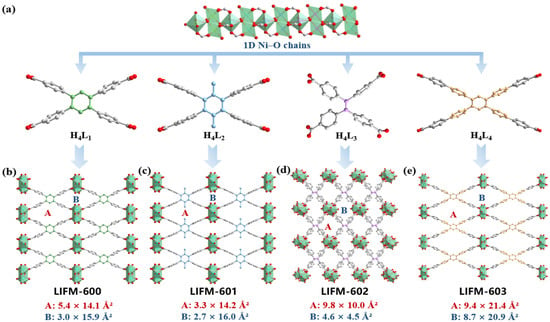
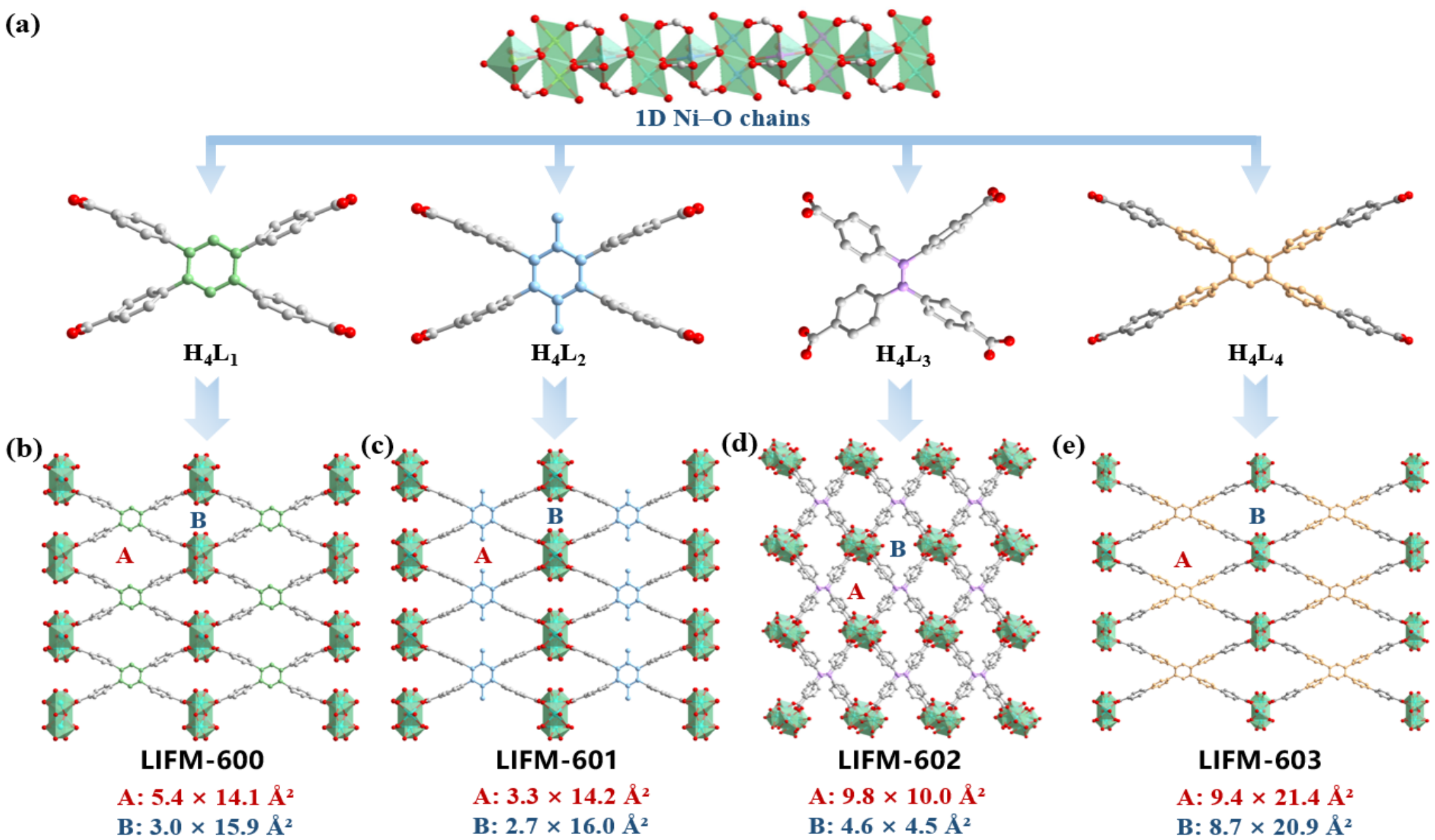
Although the four frameworks share the same Ni–O-chain motif, the linker-dependent chain packing and channel geometries differ substantially (Figure 1). The compact benzene-centered H4L1 defines the reference arrangement in LIFM-600. In LIFM-601, the two methyl substituents introduce local steric crowding and redistribute the accessible pore space. Replacing the central benzene with the tetraphenylethene-type core of H4L3 changes the linker configuration and chain-packing direction, giving LIFM-602 the smallest adsorption-derived pore width. H4L4 extends the aromatic skeleton and produces large crystallographic channel dimensions in LIFM-603; however, this geometric extension does not translate into a larger experimentally accessible surface area or pore volume. The common Ni–O chain thus preserves the inorganic adsorption environment and structural stability, whereas the organic linker controls steric restriction, packing efficiency, and pore accessibility. Additional crystal-packing diagrams are provided in Figure S1.
Figure 1.
(a) The common one-dimensional Ni–O-chain motif and the tetracarboxylate linkers used to construct the LIFM-600–603 series. Linker-specific structural fragments are highlighted in green (H4L1), blue (H4L2), purple (H4L3), and orange (H4L4). (b–e) Crystal structures and pore views of LIFM-600–603, respectively. A and B denote the two channels.
The experimental powder X-ray diffraction (PXRD) patterns exhibit the characteristic reflections expected from the corresponding single-crystal structures (Figures S2–S5), supporting the formation of the targeted crystalline phases. After immersion in water for 15 days, LIFM-600–602 largely retain their principal reflections without appreciable shifts in peak positions. The main reflections of LIFM-603 are also retained, although some relative peak intensities differ (Figure S5). Such intensity variations may reflect preferred orientation, sample packing, or differences in pore-confined guest distributions; the PXRD data alone do not establish their origin. Accordingly, the results support preservation of the principal crystalline phases but do not demonstrate unchanged local coordination environments or pore accessibility after water exposure. PXRD patterns collected after SO2 adsorption also retain characteristic reflections, with some differences from the simulated as-synthesized patterns. These differences may be related to guest removal or adsorption-induced structural responses, but an activated-state unit-cell refinement would be needed to establish a specific structural transformation. SEM images before and after SO2 adsorption are provided in Figure S27. Variable-temperature PXRD patterns are presented in Figures S6–S9, and thermogravimetric curves of activated samples in Figure S10. The initial TGA mass losses are consistent with removal of residual guest species, whereas higher-temperature losses reflect further structural changes and decomposition; quantitative assignments require independently established guest contents.
2.2. Porosity and Gas-Adsorption Properties
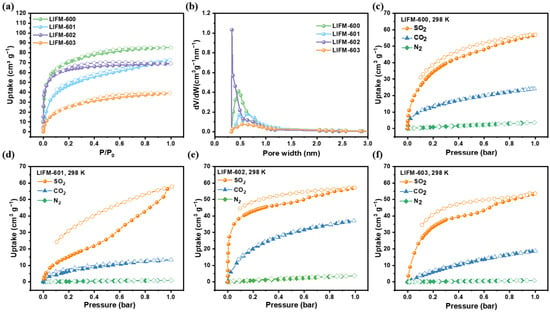
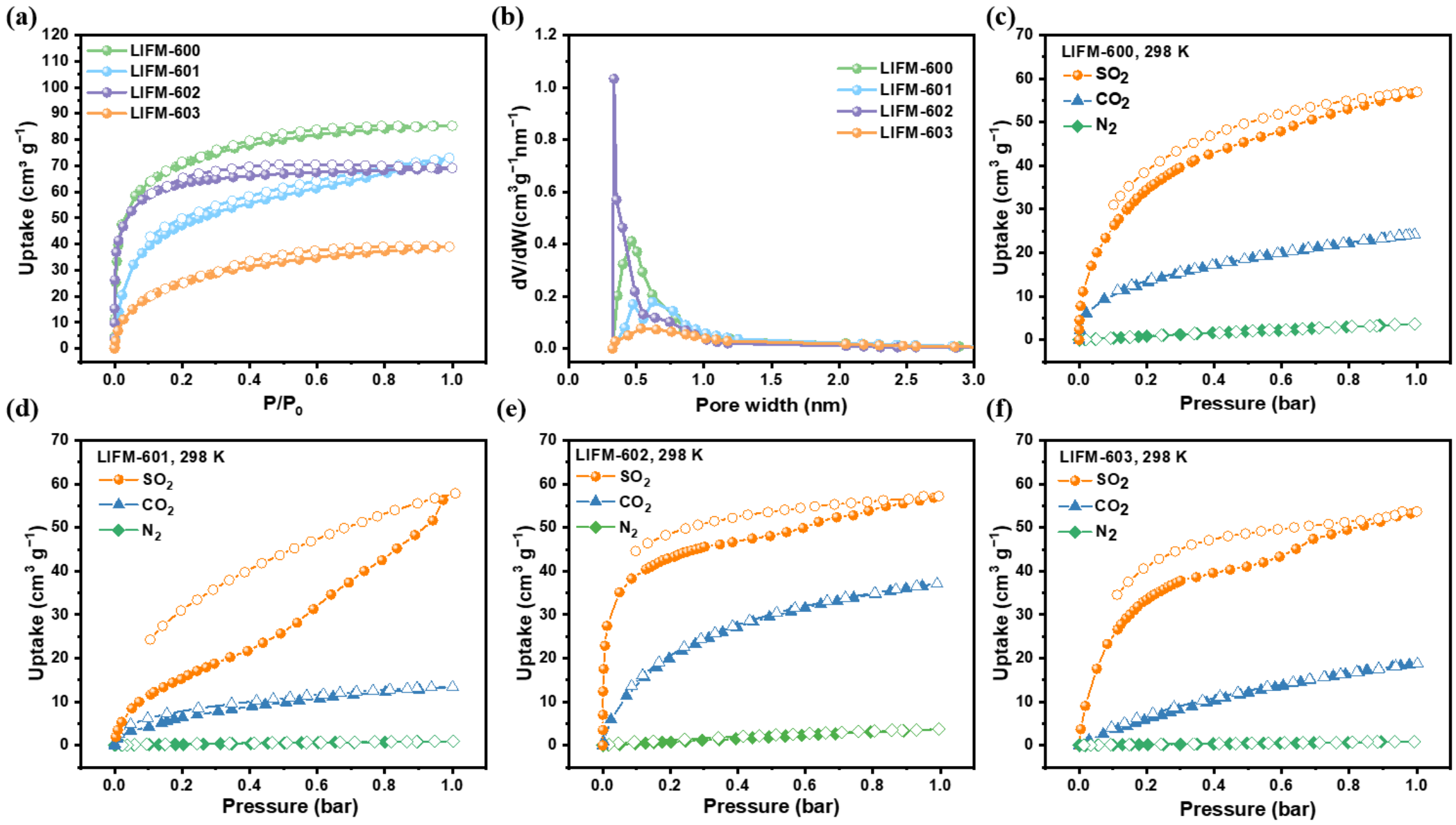
The microporosity of LIFM-600–603 was assessed using CO2 adsorption–desorption measurements at 195 K (Figure 2a). CO2 at 195 K was used because diffusion of N2 at 77 K can be severely restricted in ultramicroporous frameworks; thus, the reported BET values should be regarded as apparent, method-dependent estimates rather than directly interchangeable with standard N2 (77 K) or Ar (87 K) BET surface areas. Ar (87 K) isotherms were not measured in this work, so the CO2-derived values are not cross-validated by an independent Ar-based determination. Compared with CO2 adsorption at 273 K, measurements at 195 K allow a wider relative-pressure range to be accessed under near-atmospheric-pressure conditions, thereby facilitating micropore filling and assessment of accessible microporosity. Previous studies have discussed the applicability and limitations of CO2-derived apparent BET surface areas and the effects of probe-molecule selection and adsorption temperature [21,22]. The apparent BET surface areas are 340.0, 231.6, 310.4, and 127.1 m2 g−1, and the corresponding adsorption-derived pore volumes are 0.16, 0.13, 0.13, and 0.07 cm3 g−1 for LIFM-600–603, respectively (Table S1). NLDFT analysis yields dominant pore widths of approximately 0.46, 0.55, 0.33, and 0.53 nm (Figure 2b); the underlying BET plots are shown in Figures S11–S14.
Figure 2.
(a) CO2 adsorption–desorption isotherms of LIFM-600–603 at 195 K. (b) Corresponding NLDFT pore-size distributions. (c–f) Single-component SO2, CO2, and N2 adsorption–desorption isotherms of LIFM-600–603 at 298 K. Solid and open symbols represent adsorption and desorption, respectively.
Single-component SO2, CO2, and N2 adsorption–desorption isotherms were measured at 298 K (Figure 2c–f). All four frameworks exhibit substantially greater affinity for SO2 than for CO2 or N2, especially in the low-pressure region. At 100 kPa, LIFM-600–603 adsorb approximately 57.0, 57.8, 57.2, and 53.7 cm3 g−1 of SO2, respectively. Notably, LIFM-603 retains approximately 94% of the SO2 uptake of LIFM-600 despite having only approximately 37% of its BET surface area and 44% of its pore volume. This comparison suggests efficient use of the available pore space and shows that gravimetric SO2 uptake is not governed by total surface area alone. Minor adsorption–desorption hysteresis is observed in some SO2 isotherms. Such behavior may arise from adsorption kinetics or guest-dependent framework responses, but the present isotherms do not by themselves demonstrate a reversible breathing transition.
The series therefore provides complementary structural characteristics. LIFM-600 has the largest accessible surface area, LIFM-602 has the smallest adsorption-derived pore width, and LIFM-603 preserves substantial SO2 capacity despite limited accessible porosity. Comparable literature studies likewise show that SO2 uptake and selectivity depend on the combined effects of pore dimensions, pore-surface functionality, and framework stability rather than on surface area alone [23,24,25,26] (Table S3).
2.3. Isosteric Heat of Adsorption and IAST Selectivity
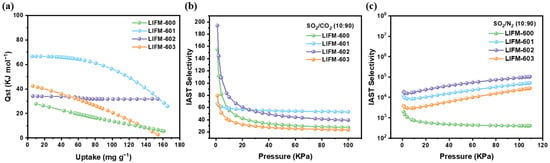
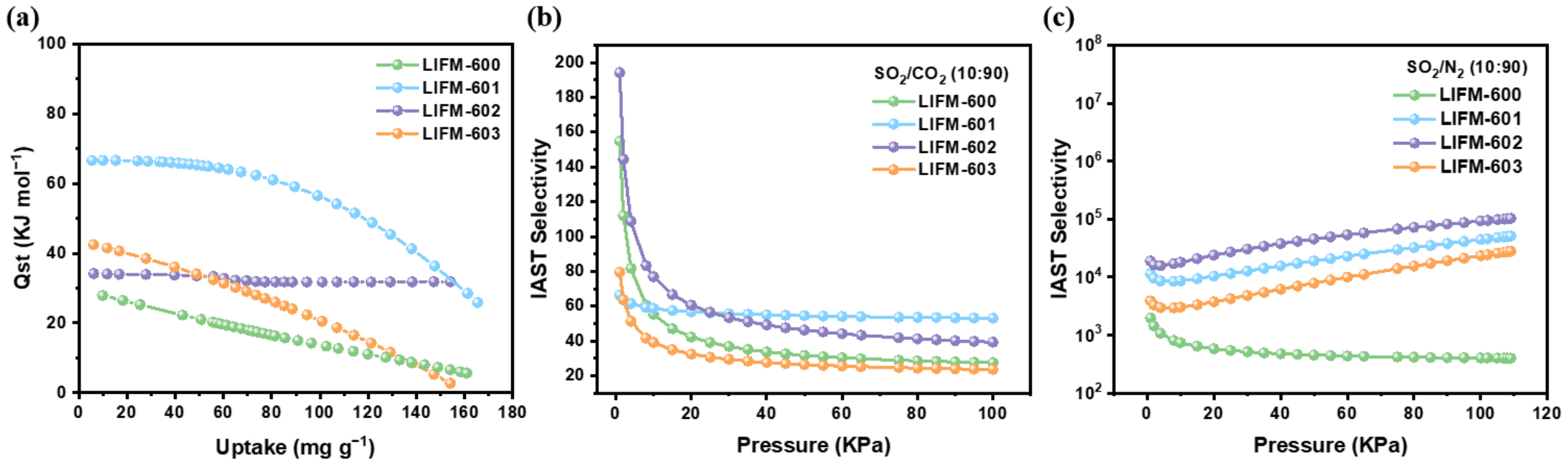
The SO2 adsorption enthalpies distinguish the local adsorption environments created by linker modification (Figure 3a). At low loading, LIFM-601 exhibits the highest Qst value of approximately 66 kJ mol−1, followed by LIFM-603 (approximately 43 kJ mol−1), LIFM-602 (approximately 34 kJ mol−1), and LIFM-600 (approximately 28 kJ mol−1). Qst decreases with loading, as the strongest adsorption sites are occupied first. The high initial value for LIFM-601 is consistent with a distinct local SO2 adsorption environment, but Qst alone does not determine competitive selectivity or dynamic behavior. The virial fitting curves used for the calculation of Qst are provided in Figures S15–S18. For LIFM-600, the initial Qst of approximately 28 kJ mol−1 should not be interpreted as negligible SO2 adsorption: its measured capacity reaches 57.0 cm3 g−1 at 298 K and 100 kPa. Qst characterizes the differential adsorption enthalpy at a given loading, whereas capacity also depends on accessible pore volume and pore filling; the extrapolated initial value remains dependent on the virial fit.
Figure 3.
(a) Isosteric heats of SO2 adsorption for LIFM-600–603. IAST selectivities for (b) SO2/CO2 (10:90, v/v) and (c) SO2/N2 (10:90, v/v) mixtures at 298 K.
Ideal adsorbed solution theory (IAST) calculations for SO2/CO2 = 10:90 (v/v) at 298 K show preferential SO2 adsorption across the investigated pressure range (Figure 3b). LIFM-602 reaches a maximum selectivity of approximately 190 in the low-pressure region, consistent with tight effective confinement. At 100 kPa, the SO2/CO2 selectivities are approximately 27.5, 53.1, 39.0, and 24.0 for LIFM-600–603, respectively; thus, LIFM-601 exhibits the highest equilibrium selectivity at this pressure within the series. The corresponding dual-site Langmuir–Freundlich fitting curves are shown in Figures S19–S22. The 10:90 binary compositions were selected as consistent comparison conditions for evaluating SO2 preference against individual major flue-gas components; they are not intended to reproduce the actual SO2 concentration in flue gas. The more dilute SO2 concentration is evaluated separately in the multicomponent breakthrough test.
The calculated SO2/N2 selectivities are much larger because the measured N2 uptake is close to zero (Figure 3c). These values suggest a strong thermodynamic preference for SO2, but their absolute magnitudes are sensitive to small fitting uncertainties in the N2 isotherms. Taken together, the Qst and IAST results show that adsorption affinity and competitive selectivity are related but not interchangeable: both pore confinement and the adsorption behavior of the competing gas must be considered.
2.4. Dynamic Breakthrough Experiments
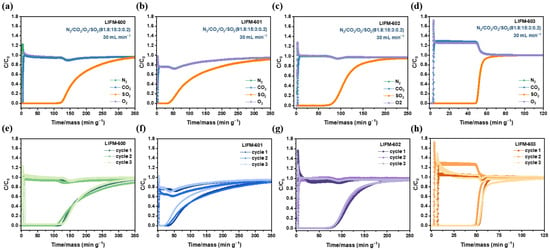
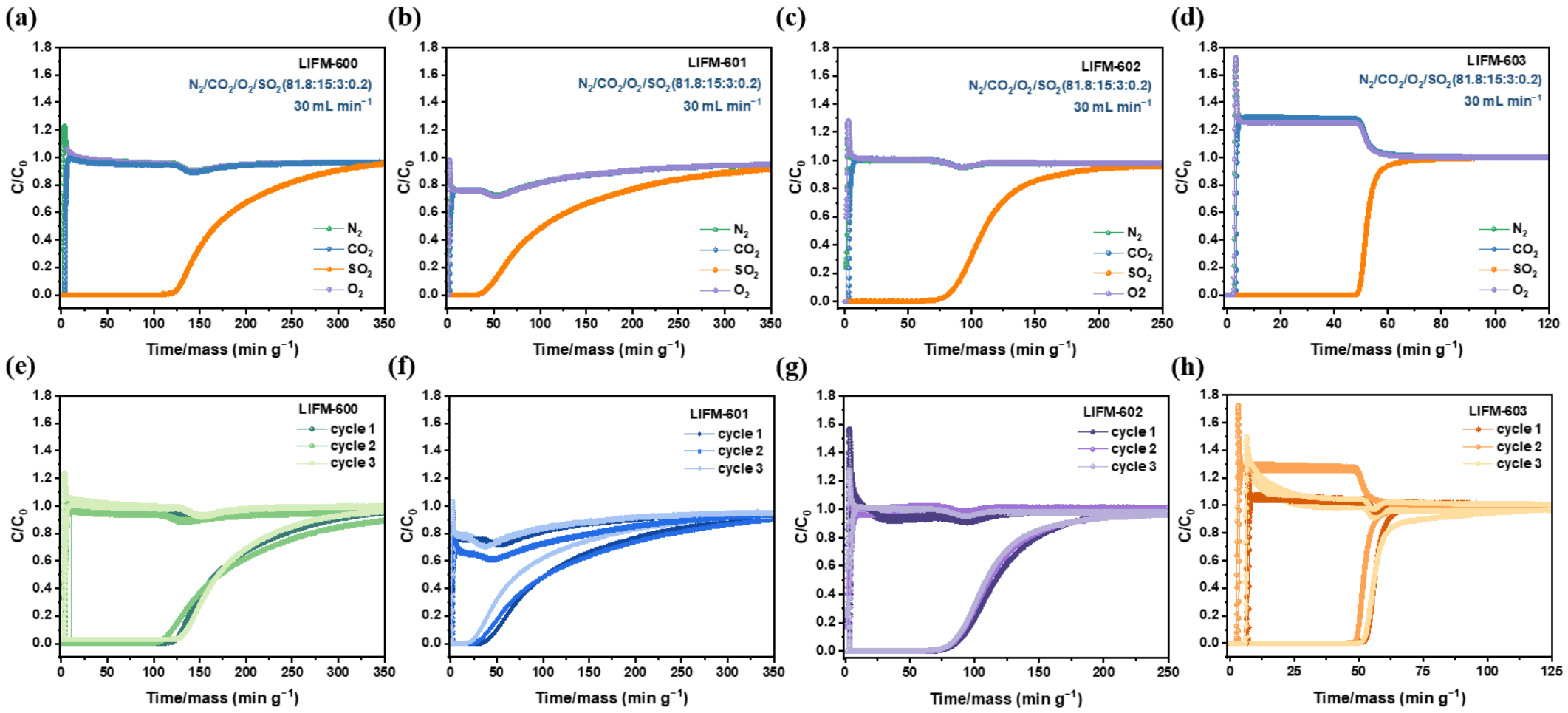
Dynamic breakthrough experiments were conducted using N2/CO2/O2/SO2 = 81.8:15:3:0.2 (v/v/v/v) at 298 K, 1 bar, and a total flow rate of 30 mL min−1 (Figure 4). For all four materials, N2, CO2, and O2 pass through the bed earlier, whereas SO2 exhibits a distinct retention period, confirming preferential SO2 capture under competitive flow conditions. The 0.2 vol% SO2 level corresponds to 2000 ppm, while 15 vol% CO2 and 3 vol% O2 provide a simplified flue-gas-like background. This deliberately controlled dry mixture is not a universal representation of industrial exhaust, whose composition and humidity depend on fuel and process conditions.
Figure 4.
(a–d) Breakthrough curves for N2/CO2/O2/SO2 = 81.8:15:3:0.2 (v/v/v/v) over LIFM-600–603 at 298 K, 1 bar, and a total flow rate of 30 mL min−1. (e–h) Three consecutive breakthrough cycles under identical conditions.
The shapes of the SO2 breakthrough fronts differ among the four frameworks. LIFM-600 and LIFM-603 show relatively sharper fronts, whereas LIFM-601 and LIFM-602 show broader profiles. This qualitative difference indicates that the dynamic response is not identical across the series; however, quantitative attribution to diffusion or mass-transfer resistance would require dedicated kinetic analysis.
Three consecutive breakthrough cycles show generally reproducible profiles for all four materials (Figure 4e–h), supporting regeneration under the applied conditions. In comparison, previously reported Zr-based SO2 adsorbents have been investigated for binary SO2-containing mixtures [23], while pillar-layered Co-MOFs have been examined under dynamic dry and humid flue-gas conditions [24]. Studies of Zr- and Al-based MOFs have also highlighted the importance of narrow pores and surface functionality for low-pressure SO2 uptake [25]. These reports provide relevant benchmarks for material design, but differences in feed composition, humidity, bed loading, and breakthrough criteria preclude a direct quantitative ranking against the present 2000 ppm dry-feed measurements. In particular, the three-cycle reproducibility observed here should not be interpreted as evidence of long-term performance under humid industrial conditions.
2.5. Molecular Simulations and Adsorption Sites
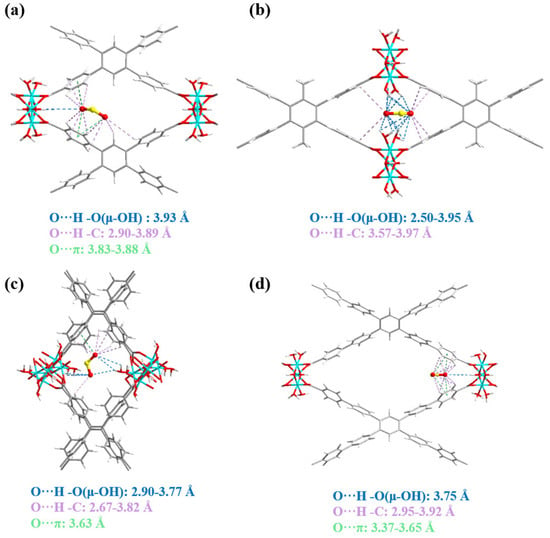
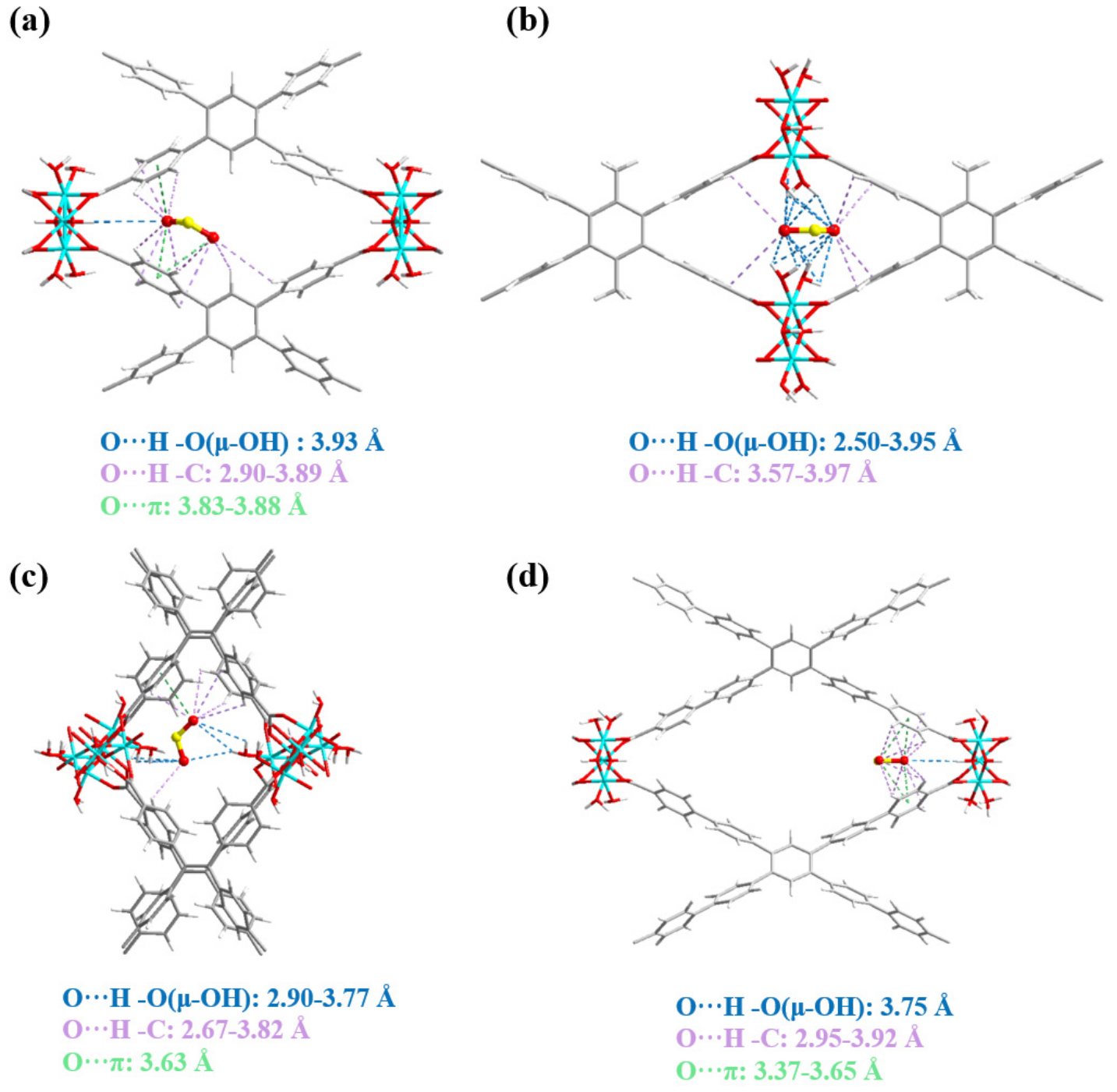
Grand canonical Monte Carlo (GCMC) simulations show that SO2 is preferentially distributed within the one-dimensional channels and near polar regions of the Ni–O chains. Adsorption Locator calculations identify configurations in which SO2 interacts with μ3-OH groups and nearby aromatic C–H groups (Figure 5). Short O(SO2)···H–O contacts are consistent with hydrogen-bonding contributions, whereas longer O···H–C and O···aromatic contacts are more appropriately described as weak host–guest contacts.
Figure 5.
Preferred adsorption configurations of SO2 in (a) LIFM-600, (b) LIFM-601, (c) LIFM-602, and (d) LIFM-603 obtained from Adsorption Locator calculations.
The four frameworks provide similar types of interaction sites, but linker-regulated packing changes their geometry and accessibility. LIFM-601 shows the highest initial Qst, LIFM-602 combines the smallest adsorption-derived pore width with high low-pressure IAST selectivity, and LIFM-603 retains substantial SO2 capacity despite its smaller accessible pore volume. The simulations support the identified local adsorption motifs, while the experimental results show that these motifs operate together with accessible pore volume and dynamic adsorption behavior. The simulated SO2 density distributions are provided in Figures S23–S26.
3. Materials and Methods
3.1. Materials and Physical Measurements
All chemicals were obtained from commercial suppliers and used without further purification. Nickel(II) chloride hexahydrate (NiCl2·6H2O) and the H4L1 and H4L3 linkers were obtained from Shanghai Macklin Biochemical Technology Co., Ltd. (Shanghai, China). Anhydrous lithium hydroxide (LiOH) was obtained from Shanghai Aladdin Biochemical Technology Co., Ltd. (Shanghai, China). N,N-Dimethylacetamide (DMA) and methanol were obtained from Guangdong Guanghua Sci-Tech Co., Ltd. (Shantou, China). The H4L2 and H4L4 linkers were obtained from Shanghai Haohong Scientific Co., Ltd. (Shanghai, China) and Bide Pharmatech Co., Ltd. (Shanghai, China), respectively. Nitric acid (HNO3, 65–68%) was obtained from Guangdong Guangshi Reagent Technology Co., Ltd. (Zhaoqing, China). Single-crystal X-ray diffraction data were collected on an XtaLAB Synergy diffractometer (Rigaku Corporation, Tokyo, Japan) using Cu Kα radiation (λ = 1.54184 Å). Powder X-ray diffraction patterns were recorded on a Rigaku MiniFlex 600 diffractometer (Rigaku Corporation, Tokyo, Japan) using Cu Kα radiation (λ = 1.5406 Å) over 2θ = 2–40° at a scan rate of 2° min−1. Variable-temperature PXRD measurements were performed on an Empyrean diffractometer (Malvern Panalytical, Almelo, The Netherlands). Thermogravimetric analyses were conducted on a NETZSCH STA 449C instrument (NETZSCH-Gerätebau GmbH, Selb, Germany) at 10 °C min−1 under N2. Gas-sorption measurements were performed using a Micromeritics ASAP 2020 analyzer (Micromeritics Instrument Corporation, Norcross, GA, USA). Dynamic breakthrough experiments were conducted using an HP-MC41 gas-separation system (Nanjing Hope Analytical Equipment Co., Ltd., Nanjing, China) coupled with a GC-9860-5CNJ gas chromatograph (Nanjing Hope Analytical Equipment Co., Ltd., Nanjing, China). To evaluate the water stability of LIFM-600–603, the samples were immersed in deionized water at room temperature for 15 days and subsequently analyzed by PXRD. PXRD patterns were also collected after SO2 adsorption to evaluate the structural stability of the frameworks. Scanning electron microscopy was used to compare sample morphologies before and after SO2 adsorption (Figure S27). SEM images were acquired using a TESCAN MAGNA GMH field-emission scanning electron microscope (TESCAN, Brno, Czech Republic) at an accelerating voltage of 5 kV and working distances of approximately 6–7 mm.
3.2. Synthesis, Isolation, and Post-Treatment of LIFM-600–603
LIFM-600–603 were prepared under the same solvothermal conditions using the corresponding tetracarboxylic acid linker. For each synthesis, NiCl2·6H2O (0.3 mmol), H4Li (0.1 mmol), LiOH (8.4 mg), DMA (6 mL), H2O (2 mL), and HNO3 (300 μL) were mixed, sonicated for 30 min, transferred to a Teflon-lined autoclave, and heated at 140 °C for 48 h. The autoclave was cooled naturally to room temperature to yield crystalline products. The linkers were H4L1 = 1,2,4,5-tetrakis(4-carboxyphenyl)benzene (LIFM-600); H4L2 = 1,2,4,5-tetrakis(4-carboxyphenyl)-3,6-dimethylbenzene (LIFM-601); H4L3 = 1,1,2,2-tetrakis(4-carboxyphenyl)ethene (LIFM-602); and H4L4 = 4″,5″-bis(4′-carboxy[1,1′-biphenyl]-4-yl)[1,1′:4′,1″:2″,1‴:4‴,1‴′-quinquephenyl]-4,4‴′-dicarboxylic acid (LIFM-603). The crystalline products were washed three times with DMA and soaked in fresh DMA for 3 days with daily solvent replacement, followed by repeated methanol exchange. The isolated dry masses were 64.1, 67.8, 44.6, and 99.6 mg, corresponding to formal yields of 76.6%, 78.4%, 56.7%, and 87.3%, respectively, based on 0.1 mmol of the corresponding linker and the adopted framework formula. LiOH was added to assist linker deprotonation and influence the coordination-assembly equilibrium; its precise mechanistic role was not independently determined.
3.3. Gas-Adsorption Measurements and Data Analysis
Following the solvent exchange described in Section 3.2, the samples were activated at 423.15 K under dynamic vacuum for 12 h. CO2 adsorption–desorption isotherms were measured at 195 K to evaluate microporosity and derive apparent BET surface areas and NLDFT pore-size distributions. Single-component SO2, CO2, and N2 adsorption–desorption isotherms were measured at 298 K. Isosteric heats of SO2 adsorption were obtained from isotherms measured at 273 and 298 K using virial fitting [27]. Binary SO2/CO2 and SO2/N2 adsorption selectivities were calculated from fitted pure-component isotherms using IAST [28].
3.3.1. Calculation of the Isosteric Heat of Adsorption
A virial-type expression containing the temperature-independent coefficients ai and bj was used to fit the SO2 adsorption isotherms measured at 273 and 298 K simultaneously:
where P is the pressure in Torr, N is the amount adsorbed in mmol g−1, T is the temperature in K, ai and bj are virial coefficients, and m and n are the numbers of coefficients required to describe the isotherms. Coefficients were added only while they provided a statistically meaningful improvement to the fit. The coverage-dependent isosteric heat was then calculated from:
where Qst is the coverage-dependent isosteric heat of adsorption, and R is the universal gas constant.
3.3.2. Calculation of IAST Selectivity
The pure-component SO2, CO2, and N2 isotherms measured at 298 K were fitted using a dual-site Langmuir–Freundlich model:
where N and P are the adsorbed amount and pressure, respectively, and A, b, and c are fitting parameters. The fitted pure-component isotherms were used to calculate the binary SO2/CO2 and SO2/N2 selectivities:
where xi and xj are the adsorbed-phase mole fractions, and yi and yj are the gas-phase mole fractions of components i and j, respectively. Here, i denotes SO2, and j denotes CO2 or N2. The selectivities were calculated for SO2/CO2 and SO2/N2 gas compositions of 10:90 (v/v) at 298 K over the investigated pressure range. The corresponding fits are presented in Figures S19–S22.
3.4. Dynamic Breakthrough Experiments
Dynamic breakthrough experiments were performed at 298 K and 1 bar using a simulated flue-gas mixture containing N2/CO2/O2/SO2 = 81.8:15:3:0.2 (v/v/v/v). Approximately 1.0 g of preactivated adsorbent was packed into a stainless-steel column with an inner diameter of 6 mm and a length of 150 mm. Before each experiment, the sample was activated at 373 K under vacuum for 10 h and purged with He for 2 h. The mixed gas was introduced at a total flow rate of 30 mL min−1. After adsorption, the sample was regenerated under He (30 mL min−1) at 423 K. Three consecutive breakthrough cycles were performed for each material.
3.5. Molecular Simulations
Grand canonical Monte Carlo (GCMC) and canonical Monte Carlo (CMC) simulations were performed using the Sorption and Adsorption Locator modules of Materials Studio 2019, respectively. A 2 × 2 × 2 supercell was used. Partial atomic charges of the LIFM-600–603 frameworks were assigned using the charge-equilibration (QEq) method [29]. The crystallographic structures were geometry-optimized using the Forcite module with the Universal Force Field (UFF) and the Ultra-fine quality setting [30]. The SO2 molecule was optimized using DMol3, and its partial atomic charges were calculated using the electrostatic-potential method [31]. The optimized frameworks were treated as rigid. SO2 probability-density distributions were calculated using the fixed-pressure task at 298 K and a pressure of 100 kPa (fugacity: 99.77 kPa), with 1 × 10⁷ equilibration steps and 1 × 10⁷ production steps. UFF parameters were used for all framework atoms, including Ni. Van der Waals interactions were evaluated by the atom-based method with an 18.5 Å cutoff, and electrostatic interactions were evaluated using Ewald summation. Preferential adsorption configurations were obtained with Adsorption Locator using force-field settings consistent with those used in the GCMC simulations.
4. Conclusions
Four related Ni–O-chain frameworks, LIFM-600–603, demonstrate that linker modification controls experimentally accessible porosity and SO2 separation performance even when the inorganic chain motif is conserved. The apparent CO2-derived BET areas range from 127.1 to 340.0 m2 g−1, while SO2 uptake at 298 K and 100 kPa remains within 53.7–57.8 cm3 g−1. LIFM-601 achieves the highest SO2/CO2 (10:90) IAST selectivity in the series at 100 kPa (53.1), whereas LIFM-603 retains substantial SO2 uptake despite its relatively low experimentally accessible porosity. Competitive breakthrough experiments with 2000 ppm SO2 in a dry N2/CO2/O2 background demonstrate preferential SO2 retention and repeatable operation over three cycles. PXRD measurements after 15 days of water immersion support retention of the principal crystalline phases, although minor intensity changes, particularly for LIFM-603, do not establish complete preservation of porosity or local structure. These findings highlight the importance of jointly considering pore geometry, pore accessibility, and adsorption-site chemistry when designing Ni–O-chain MOFs for SO2 separation.
Supplementary Materials
The following supporting information can be downloaded at: https://www.mdpi.com/article/10.3390/inorganics14110293/s1, Figure S1: Crystal packing diagrams of LIFM-600–603; Figures S2–S5: PXRD patterns of LIFM-600–603, respectively, including simulated, pristine, water-immersed (15 days), and SO2-adsorbed samples; Figures S6–S9: Variable-temperature PXRD patterns of LIFM-600–603, respectively; Figure S10: TGA curves of activated LIFM-600–603; Figures S11–S14: BET plots based on the linear regions of the CO2 adsorption isotherms for LIFM-600–603, respectively; Figures S15–S18: Virial fits to the SO2 adsorption isotherms of LIFM-600–603, respectively, measured at 273 and 298 K; Figures S19–S22: Dual-site Langmuir–Freundlich fits of the experimental SO2, CO2, and N2 adsorption isotherms at 298 K for LIFM-600–603, respectively; Figures S23–S26: Simulated SO2 density distributions in LIFM-600–603, respectively, at 298 K and 100 kPa; Figure S27: SEM images of LIFM-600–603 before and after SO2 adsorption; Table S1: Summary of apparent BET surface areas derived from CO2 adsorption isotherms at 195 K and corresponding porosity parameters; Table S2: Crystallographic data and structure refinement parameters for LIFM-600–603; Table S3: Comparison of the BET surface area, SO2 uptake, surface-area-normalized SO2 uptake, isosteric heat of adsorption, and SO2/CO2 (10:90, v/v) IAST selectivity of representative SO2 adsorbents. The references cited in the Supplementary Materials are included in the main reference list [23,24,25,26,32,33].
Author Contributions
N.C. and H.-T.Z. contributed equally to this work. N.C.: conceptualization, methodology, investigation, data curation, formal analysis, visualization, writing—original draft, writing—review and editing; H.-T.Z.: conceptualization, crystallization, methodology, investigation, data curation, formal analysis; R.-M.L.: investigation, data curation; D.Y.: investigation, formal analysis; L.S.: investigation, data curation, formal analysis; B.F.: investigation; S.-J.W.: supervision, investigation; C.-Y.S.: supervision, funding support, project administration; J.-J.J.: conceptualization, supervision, project administration, writing—review and editing. All authors have read and agreed to the published version of the manuscript.
Funding
This work was supported by the NKRD Program of China (2021YFA1500401) and the National Natural Science Foundation of China (92461302).
Data Availability Statement
The crystallographic data have been deposited at the CCDC under deposition numbers 2592867-2592870.
Conflicts of Interest
The authors declare no conflicts of interest.
References
- Martínez-Ahumada, E.; López-Olvera, A.; Jancik, V.; Sánchez-Bautista, J.E.; González-Zamora, E.; Martis, V.; Williams, D.R.; Ibarra, I.A. MOF materials for the capture of highly toxic H2S and SO2. Organometallics 2020, 39, 883–915. [Google Scholar] [CrossRef] [Scilit]
- Furukawa, H.; Cordova, K.E.; O’Keeffe, M.; Yaghi, O.M. The chemistry and applications of metal–organic frameworks. Science 2013, 341, 1230444. [Google Scholar] [CrossRef] [Scilit] [PubMed]
- Burtch, N.C.; Jasuja, H.; Walton, K.S. Water stability and adsorption in metal–organic frameworks. Chem. Rev. 2014, 114, 10575–10612. [Google Scholar] [CrossRef] [Scilit] [PubMed]
- Savage, M.; Cheng, Y.; Easun, T.L.; Eyley, J.E.; Argent, S.P.; Warren, M.R.; Lewis, W.; Murray, C.; Tang, C.C.; Frogley, M.D.; et al. Selective adsorption of sulfur dioxide in a robust metal–organic framework material. Adv. Mater. 2016, 28, 8705–8711. [Google Scholar] [CrossRef] [Scilit]
- Carter, J.H.; Han, X.; Moreau, F.Y.; da Silva, I.; Nevin, A.; Godfrey, H.G.W.; Tang, C.C.; Yang, S.; Schröder, M. Exceptional adsorption and binding of sulfur dioxide in a robust zirconium-based metal–organic framework. J. Am. Chem. Soc. 2018, 140, 15564–15567. [Google Scholar] [CrossRef] [Scilit] [PubMed]
- Tchalala, M.R.; Bhatt, P.M.; Chappanda, K.N.; Tavares, S.R.; Adil, K.; Belmabkhout, Y.; Shkurenko, A.; Cadiau, A.; Heymans, N.; De Weireld, G.; et al. Fluorinated MOF platform for selective removal and sensing of SO2 from flue gas and air. Nat. Commun. 2019, 10, 1328. [Google Scholar] [CrossRef] [Scilit] [PubMed]
- Smith, G.L.; Eyley, J.E.; Han, X.; Zhang, X.; Li, J.; Jacques, N.M.; Godfrey, H.G.W.; Argent, S.P.; McCormick McPherson, L.J.; Teat, S.J.; et al. Reversible coordinative binding and separation of sulfur dioxide in a robust metal–organic framework with open copper sites. Nat. Mater. 2019, 18, 1358–1365. [Google Scholar] [CrossRef] [Scilit] [PubMed]
- Kong, D.; Lian, L.; Wang, Y.; Hussain, A.; Liu, Y. A review on carbon-based and coordination polymer-based materials for adsorption of SO2 from flue gas. Chem. Eng. J. 2024, 500, 157089. [Google Scholar] [CrossRef] [Scilit]
- Hu, S.; Guo, G.; Zhang, J.; Khan, M.N.; Xu, S.; Yang, F.; Schwandt, B.W.; Hu, Z.; Zou, J. Advanced porous MOF materials and technologies for high-efficiency ppm-level toxic gas separation. Mater. Sci. Eng. R Rep. 2024, 161, 100874. [Google Scholar] [CrossRef] [Scilit]
- Hu, L.; Hu, M.; Zhang, M.; Wang, W.; Jiang, L.; Wu, W.; Lin, D.; Yang, K. A novel amino-functionalized Bio-MOF for trace SO2 adsorption under dry and humid conditions. Sep. Purif. Technol. 2025, 376, 133798. [Google Scholar] [CrossRef] [Scilit]
- Shao, Z.-D.; Wu, P.; Liu, F.; Zhang, Q.-J.; Guo, C.-Y.; Liu, R.-S.; Lu, J.; Ren, X.-M.; Zheng, Y.-M. Tailored SO2 capture in multivariate UiO-66(Zr) MOFs: Experimental insights and theoretical mechanisms. J. Environ. Chem. Eng. 2025, 13, 120101. [Google Scholar] [CrossRef] [Scilit]
- Pang, J.-J.; Yao, Z.-Q.; Huang, H.-L.; Li, L.; Li, Q.-W.; Lu, N.; Song, Z.-H.; Xu, J.; Bu, X.-H. A hydrolytically stable metal–organic framework for simultaneous desulfurization and dehydration of wet flue gas. Angew. Chem. Int. Ed. 2025, 64, e202421681. [Google Scholar] [CrossRef] [Scilit] [PubMed]
- Chen, F.; Lai, D.; Guo, L.; Wang, J.; Zhang, P.; Wu, K.; Zhang, Z.; Yang, Q.; Yang, Y.; Chen, B.; et al. Deep desulfurization with record SO2 adsorption on the metal–organic frameworks. J. Am. Chem. Soc. 2021, 143, 9040–9047. [Google Scholar] [CrossRef] [Scilit] [PubMed]
- Li, W.; Li, J.; Duong, T.D.; Sapchenko, S.A.; Han, X.; Humby, J.D.; Whitehead, G.F.S.; Victórica-Yrezábal, I.J.; da Silva, I.; Manuel, P.; et al. Adsorption of sulfur dioxide in Cu(II)-carboxylate framework materials: The role of ligand functionalization and open metal sites. J. Am. Chem. Soc. 2022, 144, 13196–13204. [Google Scholar] [CrossRef] [Scilit] [PubMed]
- Rodríguez-Albelo, L.M.; López-Maya, E.; Hamad, S.; Ruiz-Salvador, A.R.; Calero, S.; Navarro, J.A.R. Selective sulfur dioxide adsorption on crystal defect sites on an isoreticular metal organic framework series. Nat. Commun. 2017, 8, 14457. [Google Scholar] [CrossRef] [Scilit] [PubMed]
- Brandt, P.; Nuhnen, A.; Lange, M.; Möllmer, J.; Weingart, O.; Janiak, C. Metal–organic frameworks with potential application for SO2 separation and flue gas desulfurization. ACS Appl. Mater. Interfaces 2019, 11, 17350–17358. [Google Scholar] [CrossRef] [Scilit] [PubMed]
- Fan, Y.L.; Zhang, H.P.; Yin, M.J.; Krishna, R.; Feng, X.F.; Wang, L.; Luo, M.B.; Luo, F. High adsorption capacity and selectivity of SO2 over CO2 in a metal–organic framework. Inorg. Chem. 2021, 60, 4–8. [Google Scholar] [CrossRef] [Scilit] [PubMed]
- Zhang, Y.; Chen, Z.; Liu, X.; Dong, Z.; Zhang, P.; Wang, J.; Deng, Q.; Zeng, Z.; Zhang, S.; Deng, S. Efficient SO2 removal using a microporous metal–organic framework with molecular sieving effect. Ind. Eng. Chem. Res. 2020, 59, 874–882. [Google Scholar] [CrossRef] [Scilit]
- Han, Z.; Li, J.; Lu, W.; Wang, K.; Chen, Y.; Zhang, X.; Lin, L.; Han, X.; Teat, S.J.; Frogley, M.D.; et al. A {Ni12}-wheel-based metal–organic framework for coordinative binding of sulphur dioxide and nitrogen dioxide. Angew. Chem. Int. Ed. 2022, 61, e202115585. [Google Scholar] [CrossRef] [Scilit] [PubMed]
- Liu, X.; Li, Y.; Hao, C.; Fan, W.; Liu, W.; Liu, J.; Wang, Y. Optimizing the pore space of a robust nickel–organic framework for efficient C2H2/C2H4 separation. Inorg. Chem. Front. 2023, 10, 824–831. [Google Scholar] [CrossRef] [Scilit]
- Kim, K.C.; Yoon, T.-U.; Bae, Y.-S. Applicability of using CO2 adsorption isotherms to determine BET surface areas of microporous materials. Microporous Mesoporous Mater. 2016, 224, 294–301. [Google Scholar] [CrossRef] [Scilit]
- Islamoglu, T.; Idrees, K.B.; Son, F.A.; Chen, Z.; Lee, S.-J.; Li, P.; Farha, O.K. Are you using the right probe molecules for assessing the textural properties of metal–organic frameworks? J. Mater. Chem. A 2022, 10, 157–173. [Google Scholar] [CrossRef] [Scilit]
- Ren, Y.B.; Xu, H.Y.; Gang, S.Q.; Gao, Y.J.; Jing, X.; Du, J.L. An ultra-stable Zr(IV)-MOF for highly efficient capture of SO2 from SO2/CO2 and SO2/CH4 mixtures. Chem. Eng. J. 2022, 431, 134057. [Google Scholar] [CrossRef] [Scilit]
- Guo, X.Z.; Zhang, X.X.; Zhang, W.; Zhang, J.; Zhu, G.L.; Krishna, R.; Xiong, G.Z.; Lin, B.; Li, L.; Xue, D.M.; et al. Rational engineering of pillar-layered Co-MOFs through the hard–soft acid–base principle: Elucidating highly robust flue gas desulfurization under dynamic dry and humidity. ChemistryEurope 2026, 4, e70264. [Google Scholar] [CrossRef] [Scilit]
- Brandt, P.; Xing, S.H.; Liang, J.; Kurt, G.; Nuhnen, A.; Weingart, O.; Janiak, C. Zirconium and aluminum MOFs for low-pressure SO2 adsorption and potential separation: Elucidating the effect of small pores and NH2 groups. ACS Appl. Mater. Interfaces 2021, 13, 29137–29149. [Google Scholar] [CrossRef] [Scilit] [PubMed]
- Guo, Z.; Li, Y.; Zhang, P.; Cui, J.; Chen, L.; Yang, L.; Wang, J.; Cui, X.; Xing, H. Pillared-layer ultramicroporous material for highly selective SO2 capture from CO2 mixtures. Sep. Purif. Technol. 2022, 295, 121337. [Google Scholar] [CrossRef] [Scilit]
- Nuhnen, A.; Janiak, C. A practical guide to calculate the isosteric heat/enthalpy of adsorption via adsorption isotherms in metal–organic frameworks, MOFs. Dalton Trans. 2020, 49, 10295–10307. [Google Scholar] [CrossRef] [Scilit] [PubMed]
- Myers, A.L.; Prausnitz, J.M. Thermodynamics of mixed-gas adsorption. AIChE J. 1965, 11, 121–127. [Google Scholar] [CrossRef] [Scilit]
- Rappé, A.K.; Goddard, W.A. Charge equilibration for molecular dynamics simulations. J. Phys. Chem. 1991, 95, 3358–3363. [Google Scholar] [CrossRef] [Scilit]
- Rappé, A.K.; Casewit, C.J.; Colwell, K.S.; Goddard, W.A.; Skiff, W.M. UFF, a full periodic table force field for molecular mechanics and molecular dynamics simulations. J. Am. Chem. Soc. 1992, 114, 10024–10035. [Google Scholar] [CrossRef] [Scilit]
- Delley, B. From molecules to solids with the DMol3 approach. J. Chem. Phys. 2000, 113, 7756–7764. [Google Scholar] [CrossRef] [Scilit]
- Liu, S.-C.; Xu, L.; Zhang, L.-P.; Li, C.-X.; Lu, Y.-X.; Li, Y.-T.; Wang, J.; Wang, S.-M.; Yang, Q.-Y. Efficient One-Step SO2 Capture from Industrial Flue Gas via a Scalable Zr-Based Metal–Organic Framework. Dalton Trans. 2026, 55, 5978–5986. [Google Scholar] [CrossRef] [Scilit] [PubMed]
- Dou, S.; Han, P.; Yang, Z.-Z.; He, J.-L.; Zhang, H.; Shao, Z.-D.; Liang, L. Deep Desulfurization at Ambient Conditions Using FJI-H14 MOF with High Capacity and Cyclic Stability. Chem. Eng. J. 2026, 528, 172636. [Google Scholar] [CrossRef] [Scilit]
Disclaimer/Publisher’s Note: The statements, opinions and data contained in all publications are solely those of the individual author(s) and contributor(s) and not of MDPI and/or the editor(s). MDPI and/or the editor(s) disclaim responsibility for any injury to people or property resulting from any ideas, methods, instructions or products referred to in the content. |
© 2026 by the authors. Licensee MDPI, Basel, Switzerland. This article is an open access article distributed under the terms and conditions of the Creative Commons Attribution (CC BY) license.