


Abstract
Infrared small-target detection is commonly implemented as binary pixel-level segmentation and localization but remains challenging because targets occupy very few pixels and are embedded in complex backgrounds. This paper develops the Semantic-Guided Enhanced UIU-Net (SGUIU-Net) as a task-specific extension of U-Net in U-Net (UIU-Net) by combining Dilated Residual U-blocks (RSUs), the Convolutional Block Attention Module (CBAM), Focal–Dice deep supervision, and Semantic-Guided Cross-Attention Fusion (SGCA-Fusion). Experiments are conducted on the 427-image SIRST benchmark and the auxiliary IRSTD-1K and SIRST-V2 datasets. On SIRST, the full model obtains an IoU of 0.7995 ± 0.0011 and an nIoU of 0.7572 ± 0.0012 over three independent runs, improving the matched UIU-Net baseline means by 0.0180 and 0.0057, respectively. The model also improves IoU/nIoU from 0.6379/0.6057 to 0.7125/0.6787 on IRSTD-1K and from 0.7215/0.6832 to 0.7364/0.6937 on SIRST-V2. These gains are accompanied by an increase from 50.54 M to 106.31 M parameters and a decrease from 50.05 to 32.53 FPS at 320 × 320 resolution.
1. Introduction
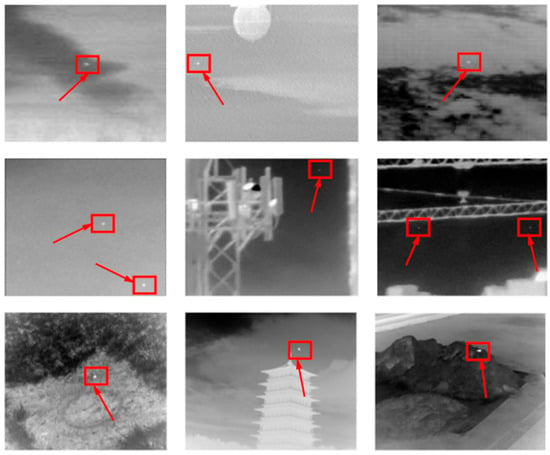
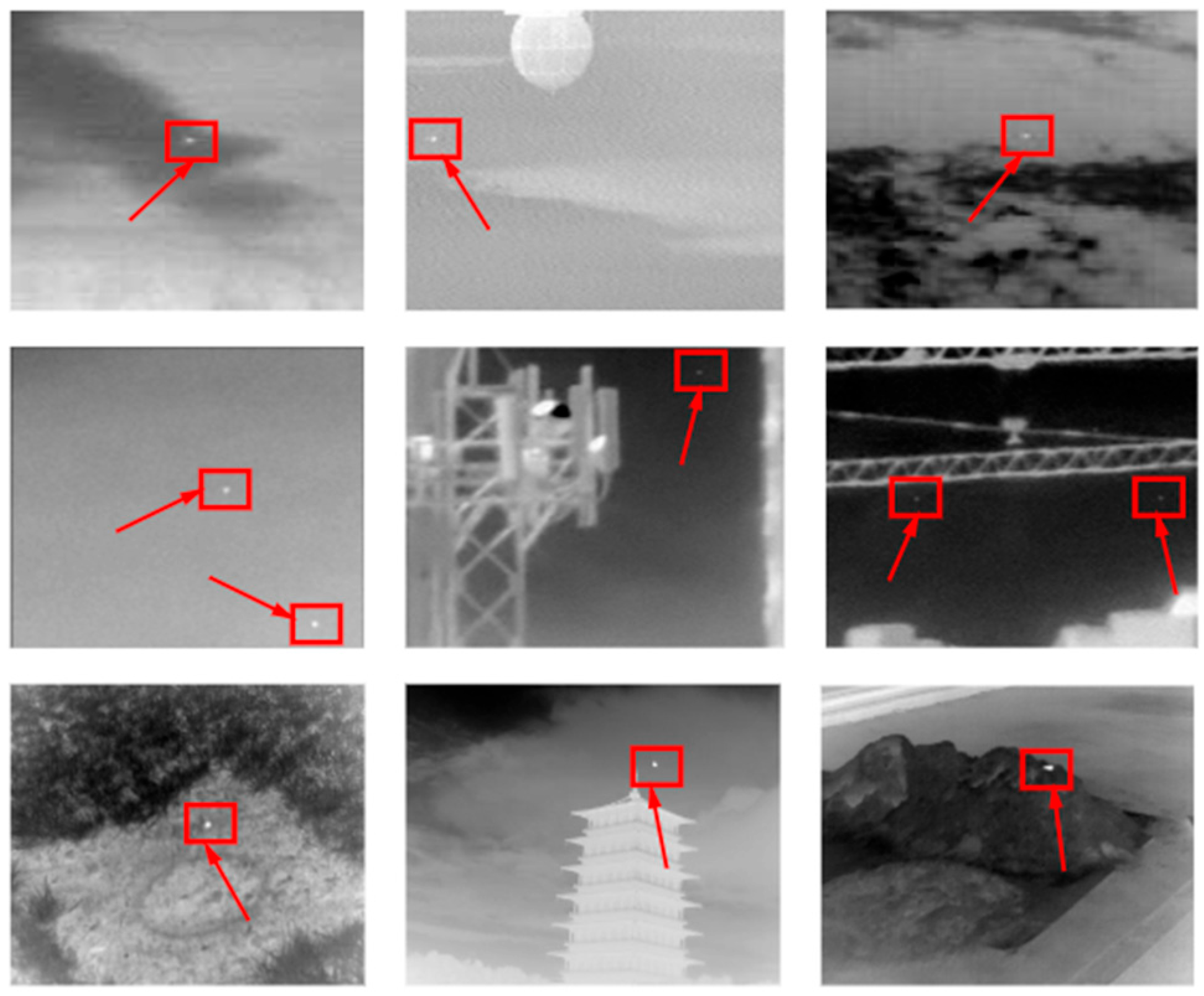
Infrared small-target detection is a key component of infrared imaging and plays an irreplaceable role in military reconnaissance, missile tracking and early warning, maritime search and rescue, aerial surveillance, and related applications. Compared with active radar imaging systems, infrared imaging can operate continuously, both day and night, and under a wide range of weather conditions; it is therefore central to monitoring and early-warning tasks in complex environments. As shown in Figure 1, however, small targets in infrared images typically occupy only a few pixels, have low contrast and a low signal-to-noise ratio, and exhibit weak texture. They are often embedded in strongly textured backgrounds, such as clouds, sea–sky boundaries, and urban structures, making them particularly difficult to detect.
Figure 1.
Infrared target images. Red boxes identify small infrared targets, and red arrows point to their locations.
Infrared small-target detection is generally studied in two settings: single-frame detection and video-sequence detection. This paper focuses on the former. Early methods relied on background or saliency priors to enhance targets, but these priors are prone to failure in complex backgrounds and under noise interference, leading to high false-alarm rates and limited robustness.
Traditional methods mainly include background-suppression approaches, such as max-median filtering [1] and morphological Top-hat filtering [2]; human-visual-system-based contrast methods, such as LCM [3], LIG [4], and MLHM [5]; and low-rank sparse matrix decomposition methods, such as LRSMD [6] and IPIM [7]. Nevertheless, these methods generally suffer from poor adaptability, high false-alarm rates, or substantial computational cost when confronted with complex background clutter, strong edges, and noise.
With the rapid development of deep learning, convolutional neural networks (CNNs) [8], which perform feature extraction and fusion for prediction or classification, have become a dominant approach. Encoder–decoder architectures represented by U-Net [9,10] and its variants combine shallow detail features with deep semantic features through skip connections, substantially improving small-target localization [11,12,13]. In particular, UIU-Net [14] embeds Residual U-blocks (RSUs) to form a “U-Net in U-Net” architecture, enabling efficient multiscale feature aggregation and achieving leading performance on public datasets.
Nevertheless, UIU-Net still faces three major challenges in infrared small-target detection. (1) Limited effective receptive field: infrared targets are physically extremely small, and the spatial regions representing them on feature maps are correspondingly limited. This weakens the model’s ability to suppress spurious background responses and increases the false-alarm rate. (2) Extreme foreground–background imbalance: target pixels account for only a tiny fraction of an image, so training can converge to a solution that labels most regions as background, severely limiting recall for genuine targets. (3) Insufficient fusion of deep semantics and fine details: existing encoder–decoder networks usually fuse shallow and deep features by simple concatenation or addition, without an adaptive selection mechanism. In complex infrared backgrounds, noise-rich shallow details can overwhelm the strong semantic information in deep feature maps. Consequently, when restoring target locations and details, the network may fail to suppress background responses and enhance the features relevant to small targets.
Based on these observations, this paper develops SGUIU-Net, a task-specific enhancement of the UIU-Net backbone that preserves the overall network topology while improving four aspects: (i) receptive-field expansion and contextual modeling; (ii) robust optimization under extreme class imbalance; (iii) background denoising and feature recalibration through deep attention; and (iv) semantic-guided cross-attention fusion (SGCA-Fusion) and suppression of background leakage. Inspired by cross-attention feature fusion [15], the channel-wise gating originally used at the fusion points is upgraded to cross-level semantic-relevance modeling, allowing high-level semantic features to actively select useful details from low-level skip features. The four modifications are summarized as follows:
- (1)
- Dilated RSU (receptive-field expansion): dilated convolutions replace selected standard convolutions/pooling operations in shallow-to-intermediate RSUs, enlarging the effective receptive field and strengthening context without reducing resolution.
- (2)
- Focal–Dice deep supervision (robustness to class imbalance): the loss for the final output combines Focal Loss and Dice Loss to emphasize hard examples and optimize regional overlap, whereas each multiscale side output is supervised with Focal Loss to stabilize gradients and alleviate extreme foreground–background imbalance.
- (3)
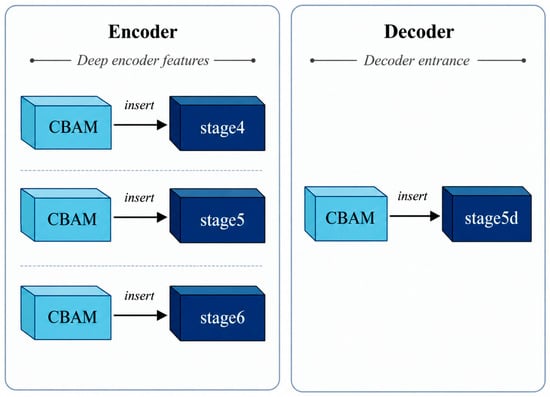
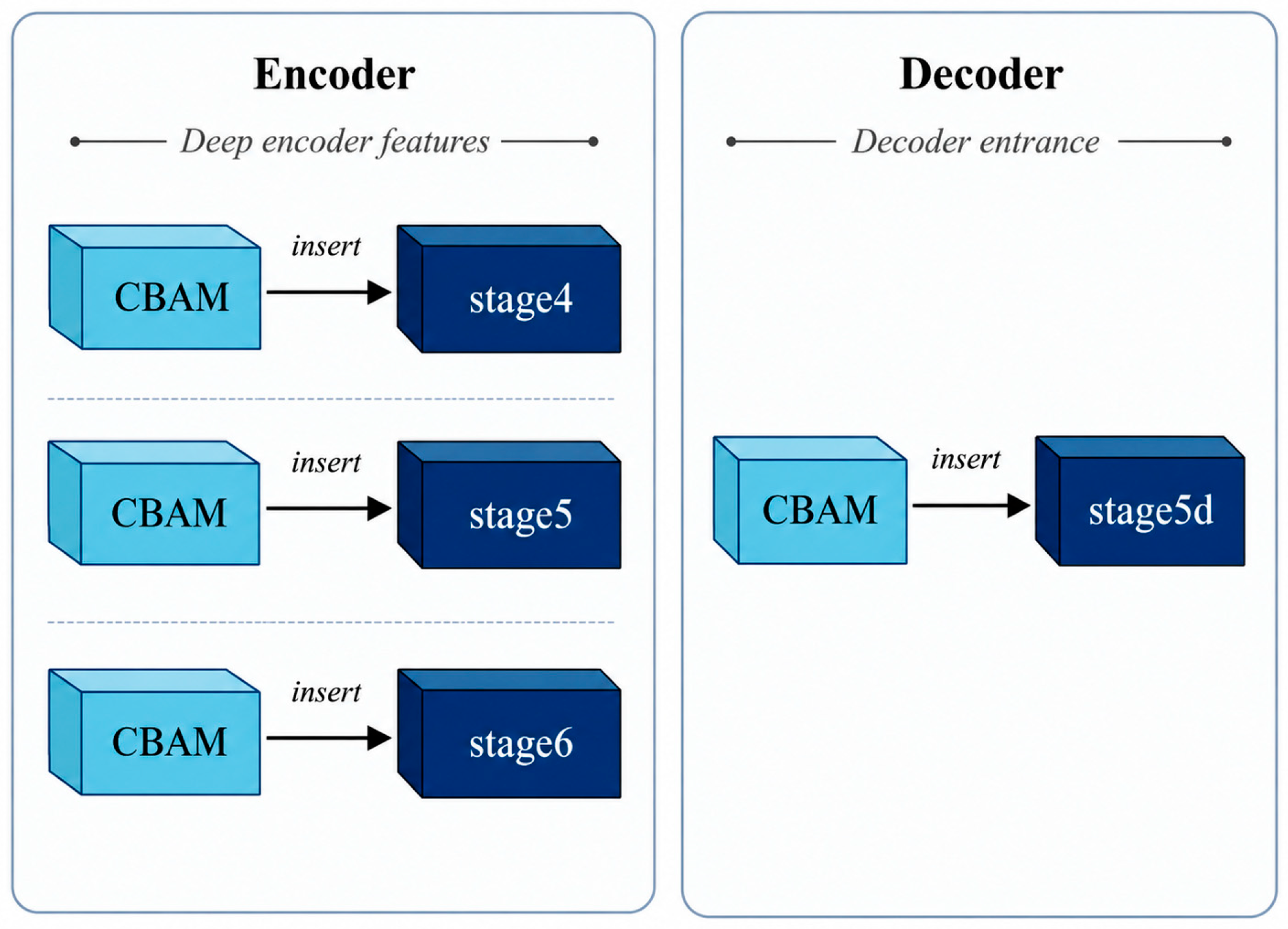
- Deep CBAM (attention-based denoising): CBAM is connected only at stage4/5/6 and stage5d to perform channel–spatial reweighting at semantically rich levels, suppressing spurious background responses with controllable overhead.
- (4)
- SGCA-Fusion (semantic-guided cross-attention fusion): a semantic-guided cross-level attention module is introduced into the AsymBi fusion path for stages 5 through 2. At each fusion point, the high-level decoder feature supplies the Query, and the corresponding encoder skip feature supplies the Key and Value. The module explicitly models semantic relevance between deep and shallow features, adaptively selects low-level details associated with small targets, and suppresses the injection of background noise.
The evaluation compares SGUIU-Net with established methods on the primary SIRST benchmark and evaluates cross-dataset behavior on IRSTD-1K and SIRST-V2. It includes the complete 24 component ablation, fusion-strategy controls, repeated independent runs for six representative configurations, and matched computational profiling.
Related Work and Positioning
CNN-based IRSTD methods learn multiscale target-background representations through encoder–decoder networks. ACM exchanges high-level context and low-level detail through asymmetric contextual modulation [11]; ISNet adds edge-aware and orientation-aware processing to preserve target shape [12]; and DNANet repeatedly fuses and enhances multilevel features through a dense nested attention architecture [13]. UIU-Net further embeds Residual U-blocks within a U-shaped backbone to aggregate local and global context [14]. These methods establish the segmentation-based foundation on which SGUIU-Net is built.
Recent feature-enhancement methods address weak targets and clutter using more explicit guidance. EGPNet combines progressive multiscale feature fusion, edge-guided refinement, and local target amplification [16]. The Local Information Guided Global Integration study proposes LGGNet, which combines a high-frequency-aware encoder, a multiscale context-learning bottleneck, and a lightweight Transformer decoder [17]. MMLNet uses edge, positioning, and detection branches together with mutual-guiding fusion [18]. These designs enhance target shape, position, or context, whereas SGUIU-Net focuses on filtering encoder skip details with decoder semantics inside the UIU-Net fusion path.
Attention-based fusion methods are especially relevant to the present work. MPCNet uses multiscale perception and cross-attention feature fusion to exchange information between multilevel features [15]. It is therefore treated as the closest cross-attention reference in both the conceptual comparison and the controlled fusion experiment. SGCA-Fusion differs in its task-specific information flow: the decoder semantic feature supplies the Query, the aligned and spatially compressed encoder detail feature supplies the Key and Value, and two learned channel gates modulate the refined semantic and attended-detail branches before output fusion. Accordingly, dilated convolution, CBAM, Focal-Dice loss, and cross-attention are treated as established ingredients; the contribution evaluated here is their constrained integration and, in particular, the SGCA semantic-to-detail fusion path.
Recent studies in adjacent remote-sensing tasks further demonstrate how multiscale fusion and attention can preserve weak visual evidence. M2FN combines adaptive features from multiple network layers with complementary attention mechanisms for remote-sensing scene classification, illustrating the value of jointly exploiting hierarchical representations rather than relying on a single semantic level [19]. For remote-sensing small-object detection, WCFPNet couples wavelet convolution with enhanced pyramid pooling and an attention-guided feature pyramid to preserve high-frequency detail and propagate fine-grained cues across scales [20]. Although these studies address scene classification or bounding-box detection rather than pixel-level IRSTD, they provide relevant evidence that multilevel fusion and detail-preserving attention are important when targets or discriminative regions occupy only a small part of the image.
Transformer and frequency-aware attention architectures have also advanced infrared small-target modeling. ISTS-UT uses a U-shaped multiscale architecture in which convolution extracts local saliency while Transformer encoding and decoding model global background relationships and fuse shallow and deep features for pixel-level segmentation [21]. More recently, SWAN integrates Haar wavelet convolution, shifted spatial attention, and residual dual-channel attention to couple frequency-domain target cues with long-range spatial dependencies and adaptive channel recalibration [22]. In contrast, SGUIU-Net retains the nested UIU-Net backbone and confines cross-attention to the encoder–decoder fusion path: decoder semantics form the Query, spatially compressed encoder details form the Key and Value, and dual channel gates regulate the two branches before fusion. This design targets semantic filtering of skip-connected detail rather than replacing the backbone with a Transformer or performing full frequency–spatial reconstruction.
2. Proposed Method
2.1. Network Architecture
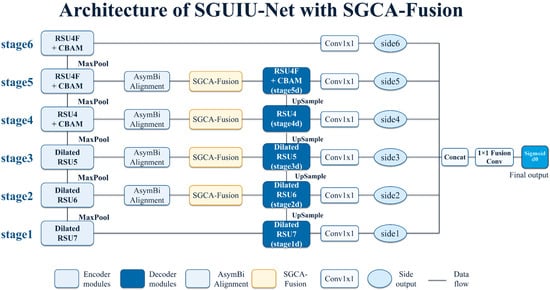
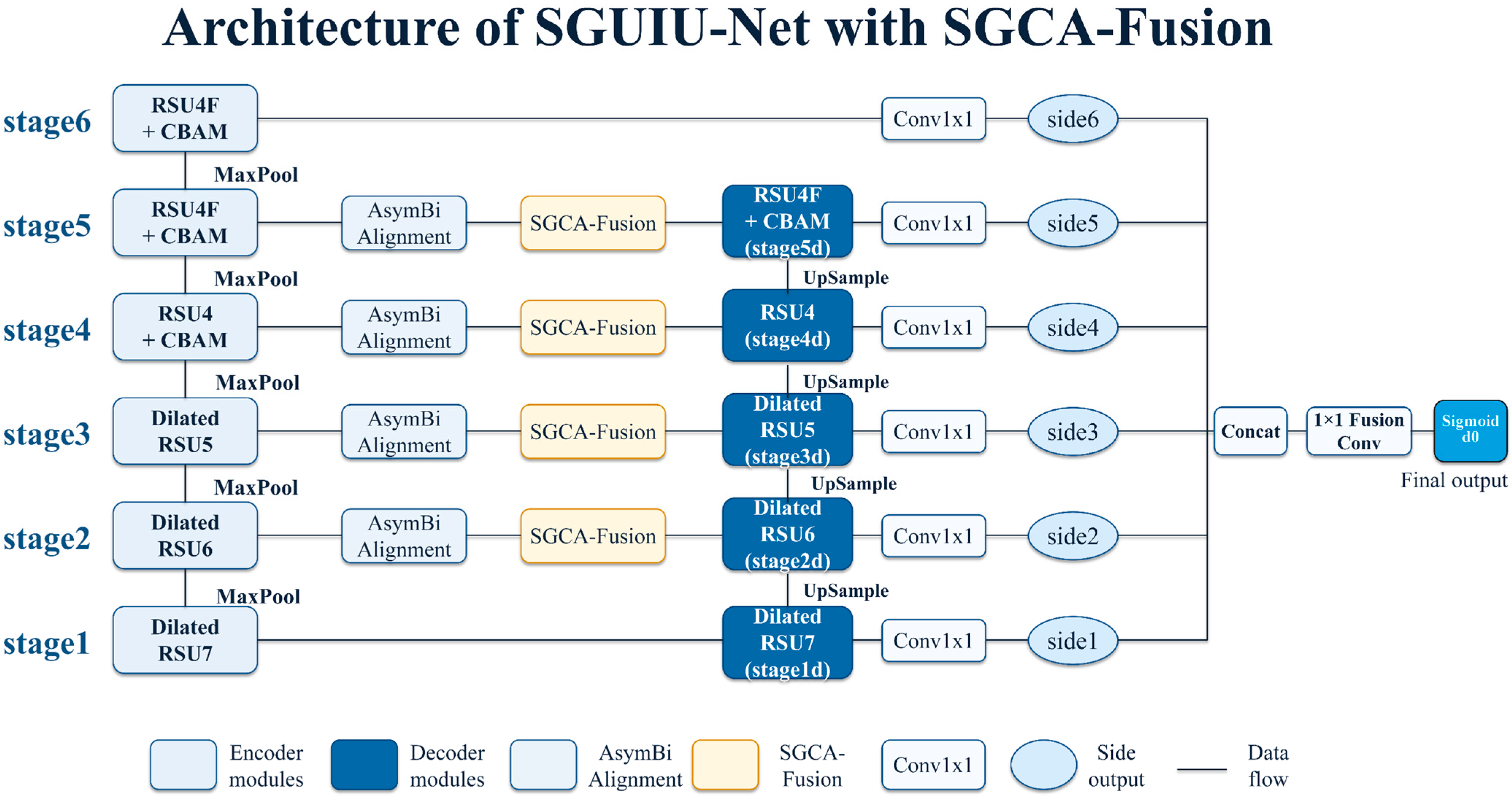
The proposed attention-based infrared small-target detection method is illustrated in Figure 2. It retains the encoder–decoder architecture and multiscale deep-supervision framework of UIU-Net while incorporating Dilated RSUs, deep CBAMs, and SGCA-Fusion. The encoder constructs a feature pyramid through progressive max pooling. The decoder progressively upsamples its features to recover spatial resolution and fuses them with encoder features at the corresponding scales, thereby preserving both the fine details required for small-target localization and the high-level semantics required for discrimination.
Figure 2.
Schematic of the network architecture.
As shown in Figure 2, from stage1 to stage6, the encoder consists sequentially of Dilated RSU7, Dilated RSU6, Dilated RSU5, RSU4+CBAM, RSU4F+CBAM, and RSU4F+CBAM. Stages 1–3 use Dilated RSUs, whereas CBAM is attached to encoder stages 4–6 and decoder stage5d. After AsymBi alignment, SGCA-Fusion is used at stage5d, stage4d, stage3d, and stage2d; the decoder feature supplies the semantic Query and the aligned encoder feature supplies the detail Key and Value. Stage1 is connected directly to stage1d. Stage6 and decoder stages 5d–1d each generate a one-channel side logit through a 1 × 1 convolution. The six side logits are resized to the input resolution, concatenated into a six-channel tensor, fused by a final 1 × 1 convolution into the one-channel logit d0, and then passed through Sigmoid to obtain the final probability map. This explicit side-output fusion is shown in the corrected Figure 2.
The basic convolutional unit in the network is REBNCONV, shown in Figure 3. It is the fundamental operator in each RSU layer and consists of Conv(3 × 3, dilation = d) → BN → ReLU (in-place).
Figure 3.
Basic convolutional unit.
RSU7/6/5/4 and RSU4F use REBNCONV as their basic building block and perform multiscale feature aggregation and reconstruction within each stage through a local U-shaped structure. Because infrared targets are small and strongly dependent on contextual information, dilated convolutions with dilation rates d ∈ {1, 2, 4, 8} are introduced into shallow and intermediate RSUs. This enlarges the effective receptive field without further reducing feature-map resolution and improves discrimination against complex backgrounds, including cloud textures, sea clutter, and urban edges. For a single 3 × 3 dilated convolution, the theoretical receptive-field size in pixels is:
When multiple such convolutions are stacked sequentially within a branch, their theoretical receptive fields accumulate, enabling each layer to observe a broader region:
Combining different dilation rates without additional downsampling provides a large receptive field while preserving high spatial resolution, producing clear benefits for segmentation and small-target detection tasks that require both precise localization and contextual information.
2.2. Attention Module
To strengthen attention to target regions, suppress background interference, and further improve small-target detection, CBAM (Convolutional Block Attention Module) [23] is introduced into the multiscale feature extraction process of SGUIU-Net. CBAM is a lightweight plug-and-play mechanism that adaptively assigns weights to different channels and spatial locations, directing the network toward task-relevant salient features. It sequentially comprises channel attention and spatial attention. Channel attention extracts global context through global average and max pooling, then uses a shared multilayer perceptron (MLP) to estimate the importance of each channel. This highlights channels sensitive to infrared small targets while suppressing channels associated with background noise. Spatial attention applies average and max pooling along the channel dimension to generate a spatial saliency map, helping the network attend to potential target regions in two-dimensional space.
As shown in Figure 2, the RSU modules in the SGUIU-Net backbone progressively extract multiscale features. Shallow features are primarily responsible for recovering edges and localization details, and introducing attention too early may weaken the fine structure of small targets. Deep features contain stronger semantic information and are therefore more suitable for target-related recalibration. Accordingly, CBAMs are attached only to stage4, stage5, stage6, and the decoder entrance stage5d, providing joint channel–spatial denoising with limited computational overhead. Deep CBAM and SGCA-Fusion serve complementary functions: the former recalibrates features at semantically rich stages, whereas the latter aligns semantics across levels and filters skip features during decoding. Together, they suppress background leakage, flatten background responses, and sharpen target peaks. Figure 4 shows the CBAM insertion positions; the exact locations follow the overall architecture in Figure 2.
Figure 4.
CBAM insertion positions in SGUIU-Net.
CBAM applies channel and spatial attention after the RSU output, allowing the network to emphasize infrared small-target responses and suppress irrelevant background responses while preserving multiscale structural information. Because CBAM is used only at semantically rich deep stages and the decoder entrance, detection of small and low-contrast targets is enhanced while parameter count and inference overhead remain controlled.
2.3. Loss Function
To address the extreme foreground–background imbalance in infrared small-target images, the network is trained with deep supervision over the fused output d0 and the six side outputs d1–d6. Let y denote the binary ground-truth mask and let Li denote the loss assigned to output branch di. The total training objective is the weighted sum of the seven branch losses:
Focal Loss [24] supplies the pixel-wise classification term in each branch. For a predicted foreground probability p and a binary label y ∈ {0, 1}, pt denotes the probability assigned to the ground-truth class, while αt is the corresponding class-balancing factor. Their piecewise definitions and the resulting Focal Loss are given by:
Specifically, pt = p and αt = α for a foreground pixel (y = 1), whereas pt = 1 − p and αt = 1 − α for a background pixel (y = 0). This class-dependent form matches the implemented binary Focal Loss.
In Equation (4), α ∈ [0, 1] controls the relative weighting of foreground and background pixels, and γ ≥ 0 is the focusing parameter that downweights well-classified pixels. The branch loss is then defined differently for the fused output and the side outputs: d0 is supervised by the Focal–Dice hybrid loss, whereas d1–d6 are supervised by Focal Loss alone:
The branch weights are set to ω0 = 2 and ω1 = ⋯ = ω6 = 1, giving greater weight to the final fused prediction. The loss hyperparameters are α = 0.25, γ = 2, and μ = 0.5, where μ controls the Dice-loss contribution to the d0 branch. The squared Dice Loss [25] used in Equation (5) is defined as:
In Equation (6), j indexes image pixels and ε = 10−6 is a numerical-stability constant. The squared terms in the denominator match the implemented squared Dice formulation. Consequently, the final output is optimized jointly for hard-pixel classification and regional overlap, while the side outputs provide multiscale Focal-Loss supervision. This loss configuration is evaluated as an independent switch in the complete 24 factorial ablation reported in the complete factorial ablation.
2.4. Semantic-Guided Cross-Attention Fusion (SGCA-Fusion)
In encoder–decoder architectures, shallow skip connections preserve edges, positions, and details, but also contain substantial high-frequency background interference, including cloud patterns, sea waves, thermal noise, and urban building edges. Directly concatenating shallow skip features with upsampled high-level decoder features allows spurious background responses to propagate along the decoding path, increasing false detections and causing nIoU fluctuations. We therefore upgrade channel gating in the fusion path to a Semantic-Guided Cross-Attention Fusion module (SGCA-Fusion). Its core principle is to use high-level decoder semantic features to actively query encoder skip features. The network thus selects target-related low-level details according to semantic relevance across levels rather than merely determining importance channel by channel.
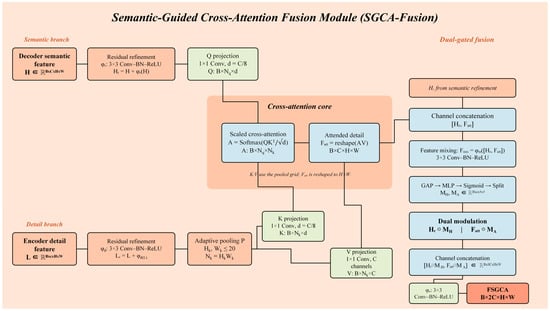
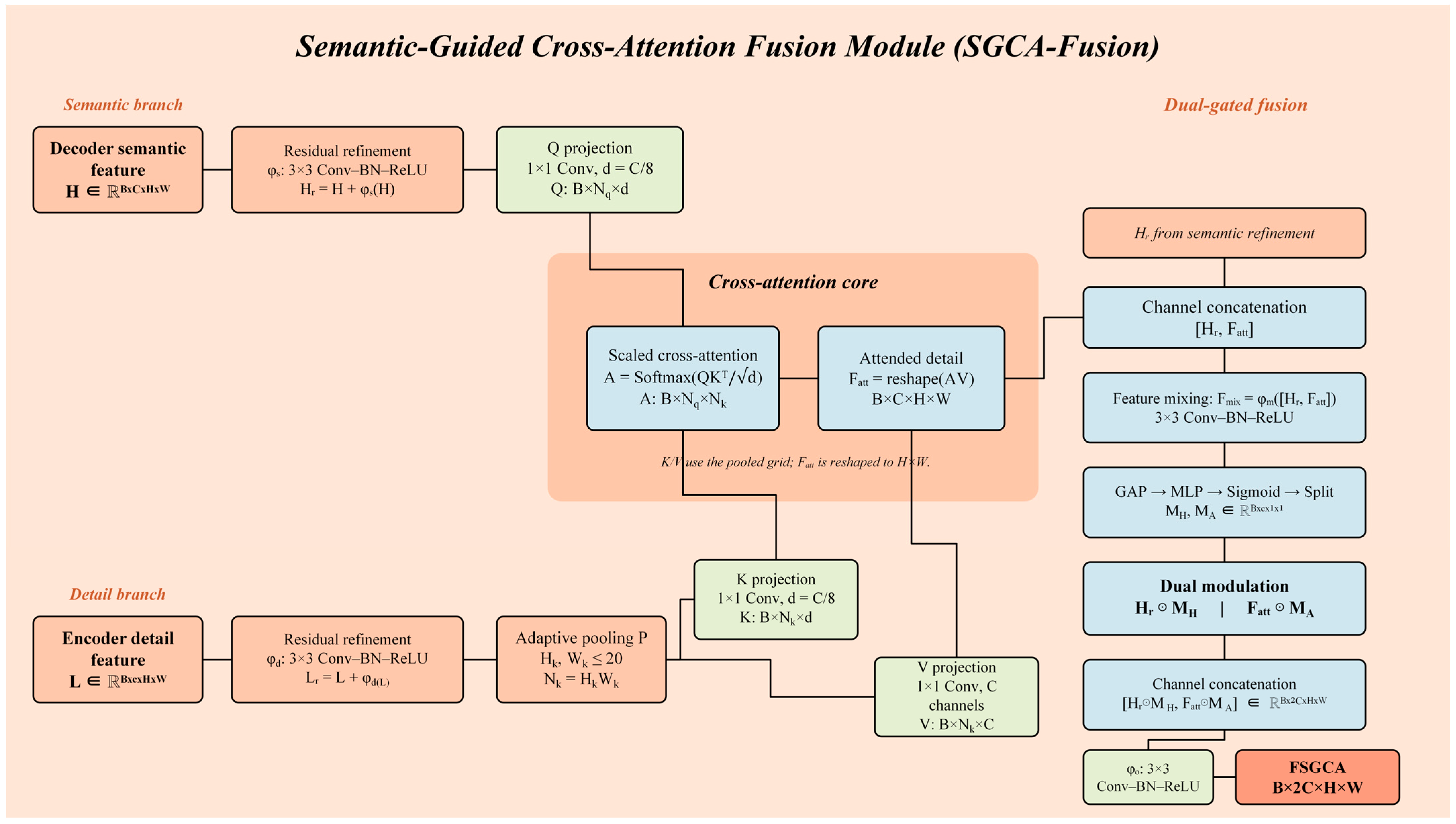
As shown in Figure 5, SGCA-Fusion comprises three main components: the Semantic Branch, the Detail Branch, and the Cross-Attention Core.
Figure 5.
Structure of the SGCA-Fusion module.
Semantic branch: Let H be the aligned decoder semantic feature with shape B × C × H × W. A residual 3 × 3 Conv–BN–ReLU refinement produces Hr. A 1 × 1 projection then constructs the Query Q with projection dimension d = C/8. Q is flattened over the current spatial grid, so Q has shape B × Nq×d with Nq = HW.
Detail branch: Let L be the aligned encoder detail feature with shape B × C × H × W. A residual 3 × 3 Conv–BN–ReLU refinement produces Lr. Before the Key and Value projections, Lr is adaptively pooled only when necessary so that Hk≤20 and Wk≤20. Independent 1 × 1 projections construct K ∈ R{B×N_k×d} and V ∈ R{B×N_k×C}, where Nk = HkWk. Thus, high-resolution Query positions attend to a compressed set of encoder-detail positions.
Here, φs and φd denote the residual refinement operators, P denotes adaptive spatial pooling with Hk, Wk≤20, Wq and Wk project to d = C/8 channels, and Wv projects to C channels. The resulting tensor shapes are Q ∈ R{B×Nq×d}, K ∈ R{B×Nk×d}, and V ∈ R{B×Nk×C}.
The Cross-Attention Core computes scaled semantic-to-detail attention. Unlike a full HW × HW matrix, its second spatial dimension is compressed to Nk:
Each row of A describes which pooled encoder-detail positions are relevant to one decoder-semantic position.
The attended detail tensor is obtained by applying A to V and reshaping it back to the decoder resolution:
Thus, the pooled Key/Value grid controls attention memory without reducing the spatial resolution of the SGCA output.
For gated fusion, the refined semantic feature and attended detail feature are concatenated and locally mixed:
where φm is a 3 × 3 Conv–BN–ReLU block. A global-pooling MLP then produces two channel gates:
MH and MA independently modulate the refined semantic branch and the attended-detail branch.
The SGCA-Fusion output is therefore:
where ⊙ denotes element-wise multiplication, [·] denotes channel-wise concatenation, and φo is the final 3 × 3 Conv–BN–ReLU projection. The corrected Figure 5 now shows the same Q/K/V sources, C/8 projection, K/V pooling, B × Nq × Nk attention matrix, dual gates, and B × 2C × H × W output as the implementation. Because the reconstructed SGCA blocks materially increase the parameter count, their cost is reported explicitly rather than described as negligible.
3. Experiments
3.1. Datasets and Evaluation Metrics
The revised study treats infrared small-target detection as binary pixel-level segmentation/localization: the network predicts a foreground mask, from which target regions are localized. The original 427-image SIRST dataset [26] with the 407/20 split is the primary benchmark for controlled comparison and ablation. IRSTD-1K [12] and SIRST-V2 [27] are the two auxiliary quantitative datasets, each evaluated using its official split. SIRST and SIRST-V2 are kept as distinct datasets throughout the revision.
SIRST [26] contains 427 images and uses the submitted split of 407 training images and 20 test images. The released IRSTD-1K archive associated with ISNet [12] contains 1001 files and follows the official 800/201 training/test lists used in this study. The released SIRST-V2 archive associated with OSCAR [27] contains 1024 files and follows its official 512/256/256 training/validation/test lists. The official split lists released with each dataset are used without reshuffling. Here, a split list (sometimes called an index file) is simply the public text list of image identifiers assigned to training, validation, or testing; it is not an additional experimental setting.
IoU and nIoU are the primary metrics because they are available for the directly comparable SIRST methods. Ground-truth masks are binarized at 0.5, and predicted masks are binarized using the fixed score threshold of 0.55 in the current evaluation scripts. The Intersection-over-Union (IoU) is calculated at the dataset level by aggregating the intersection and union areas over all test images:
Following previous IRSTD segmentation studies [12,14], normalized IoU (nIoU) is computed as the average of image-level IoUs:
The same evaluation implementation and threshold will be used for all controlled experiments. Precision, recall, and F1-score are not added merely to make every table column identical.
3.2. Implementation Details
All models in the controlled SIRST comparison were trained from random initialization for 300 epochs using the same 407-image training split and were evaluated on the identical 20-image test split at an input size of 320 × 320. UIU-Net and SGUIU-Net used Adam with an initial learning rate of 1 × 10⁻⁴ and batch size 8. For MPCNet and EGPNet, the public architectures, method-specific losses, and optimization strategies were retained, while the dataset split, input resolution, 300-epoch training budget, and evaluation implementation were fixed. The prespecified epoch-300 checkpoint was evaluated; the test set was not used for checkpoint selection. The confirmed server environment uses one NVIDIA GeForce RTX 3090 GPU, PyTorch 1.11.0+cu113, and CUDA 11.3. Runtime profiling was performed separately with batch size 1, 50 warm-up iterations, and 200 timed iterations.
The original UIU-Net implementation is preserved as the baseline. Dilated RSU, deep CBAM, SGCA-Fusion, and the loss mode are independently switchable. Every reported result must be traceable to a configuration file, seed, checkpoint, raw per-image output, and aggregate metric file.
3.3. Comparison with State-of-the-Art Methods
3.3.1. Quantitative Comparison
The primary benchmark is the original 427-image SIRST dataset using the submitted 407/20 training/test split. This corrects the dataset name in the submitted manuscript: the UIU-Net result and the historical ‘uiunet427’ checkpoints belong to SIRST rather than SIRST-V2. Classic model-driven and data-driven methods are retained for continuity. To strengthen the comparison with recent approaches, the publicly available implementations of MPCNet [15] and EGPNet [16] were trained from random initialization for 300 epochs on the same 407-image SIRST training split and evaluated on the identical 20-image test split using the unified IoU/nIoU implementation. These values are locally trained results under the controlled SIRST protocol and are not copied from results reported on other dataset versions in the original papers. LGGNet [17] and MMLNet [18] remain in Related Work because directly comparable local evaluations under this exact SIRST protocol are not available.
Table 1 retains the values reported in the submitted comparison for the established methods and adds local evaluations of two recent publicly available networks. MPCNet [15] obtains 0.7256 IoU and 0.7043 nIoU, while EGPNet [16] obtains 0.7172 IoU and 0.6853 nIoU on the SIRST 407/20 protocol. SGUIU-Net reaches 0.7995 ± 0.0011 IoU and 0.7572 ± 0.0012 nIoU, exceeding MPCNet by 0.0739 IoU and 0.0529 nIoU and EGPNet by 0.0823 IoU and 0.0719 nIoU. The UIU-Net row is the published reference result, whereas the SGUIU-Net row reports the mean ± standard deviation over three independent runs. Relative to the published UIU-Net values of 0.7825 and 0.7515, the SGUIU-Net gains are 0.0170 IoU and 0.0057 nIoU. The matched repeated-run baseline used for controlled ablation is reported separately as A0 in Table 2.
Table 1.
Quantitative comparison on the SIRST dataset using the 407/20 split. The best results are shown in bold.
Table 2.
Complete factorial ablation study on SIRST (407/20 split).
IoU and nIoU have not been interchanged. Aggregate IoU can exceed mean image-level nIoU when larger or easier targets contribute more pixels to the aggregate, whereas nIoU can exceed IoU for other methods because the two statistics weight test images differently.
3.3.2. PR-Curve Comparison
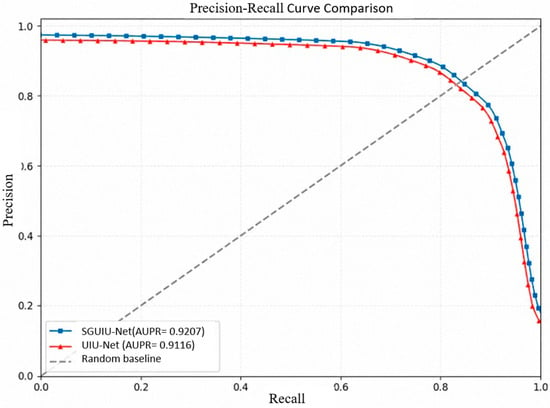
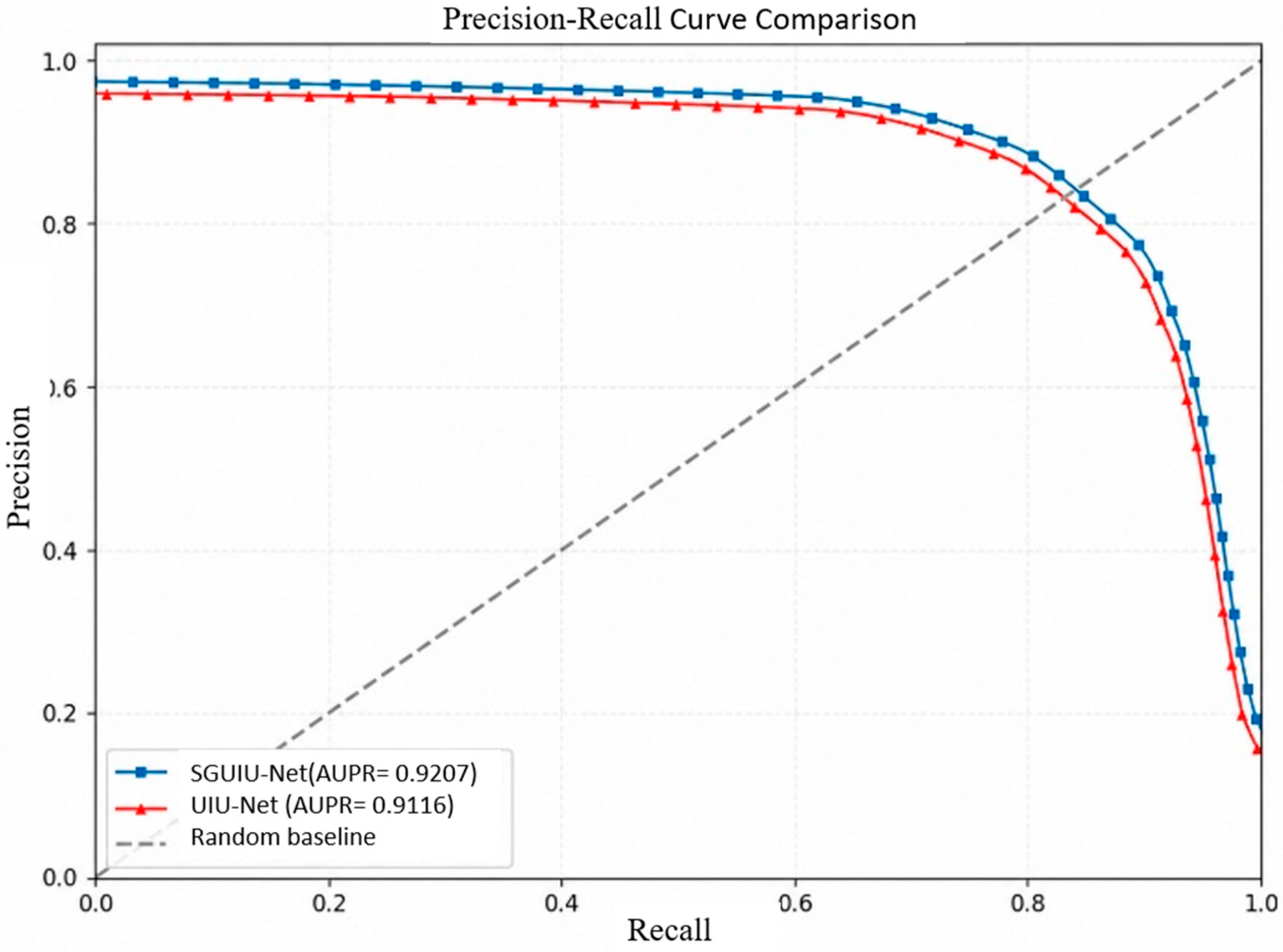
IoU and nIoU summarize performance at the fixed decision threshold, whereas a precision–recall curve shows how the balance between missed targets and false alarms changes across thresholds. We therefore sweep the decision threshold over the pixel-level probability maps of the primary SIRST test split and compare UIU-Net with SGUIU-Net in Figure 6.
Figure 6.
Pixel-level precision–recall curves on the primary SIRST test split.
The SGUIU-Net curve lies above the UIU-Net curve over most of the evaluated range, and AUPR increases from 0.9116 to 0.9207, an absolute gain of 0.0091. This result indicates a better pixel-level precision–recall trade-off across thresholds and is consistent with the higher IoU and nIoU reported in Table 1 and Table 2.
3.3.3. ROC-Curve Comparison
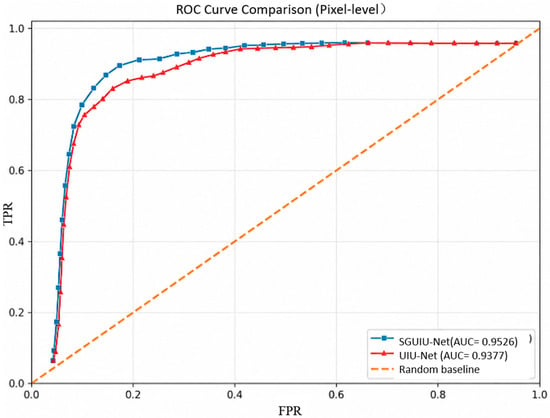
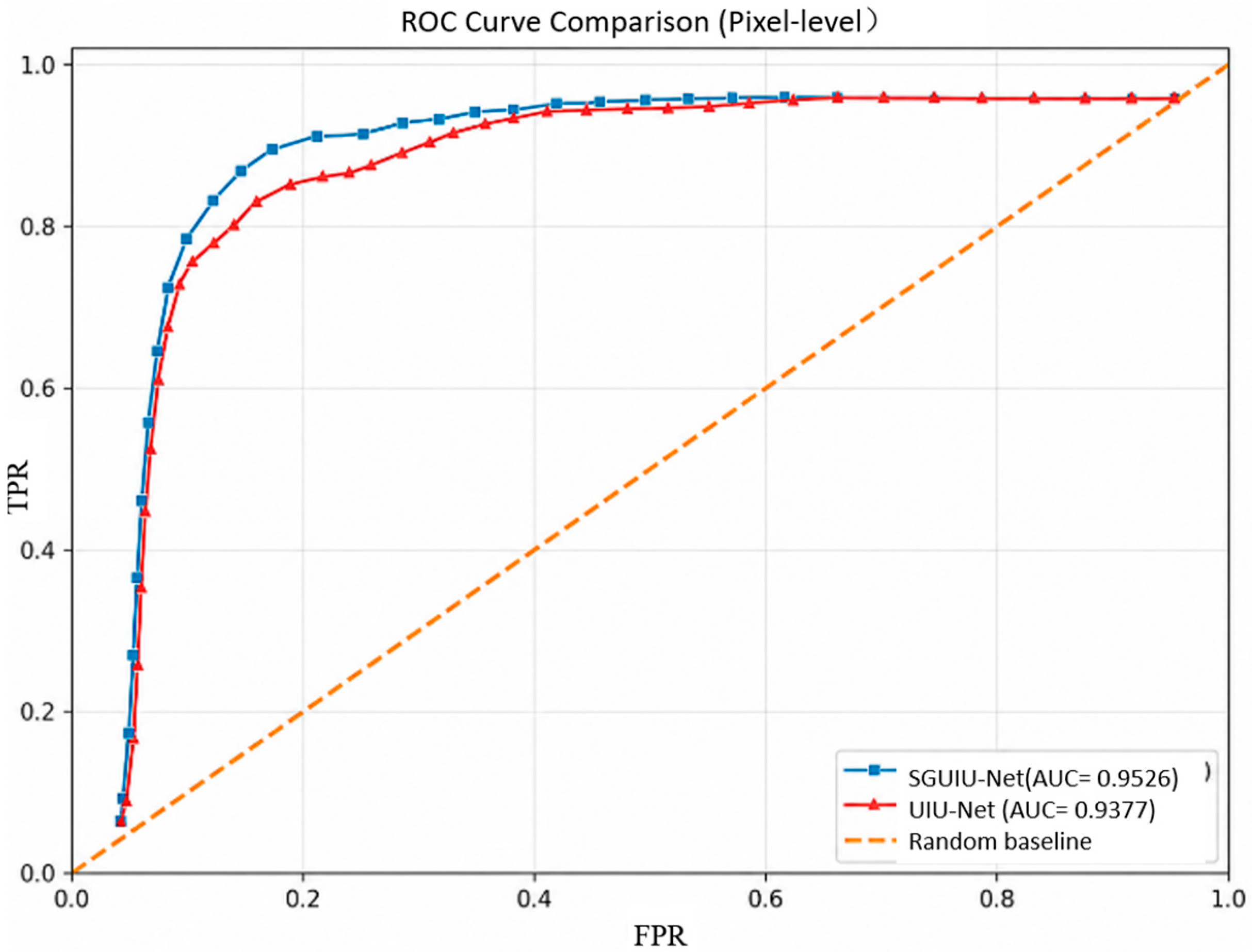
To examine false-alarm control across thresholds, Figure 7 reports the pixel-level receiver operating characteristic curves on the same SIRST test split. The false-positive rate is shown on the horizontal axis and the true-positive rate on the vertical axis.
Figure 7.
Pixel-level ROC curves on the primary SIRST test split.
SGUIU-Net produces a curve closer to the upper-left region and increases AUC from 0.9377 to 0.9526, an absolute gain of 0.0149. Thus, across the evaluated thresholds, the proposed model reaches a higher true-positive rate for a given false-positive rate than the UIU-Net baseline.
3.4. Ablation Study
The ablation is organized as one complete 24 factorial table with independent switches for SGCA-Fusion, Dilated RSU, Focal-Dice loss, and deep CBAM. A0, A8, A9, A10, A12, and A15 are reported as mean ± standard deviation over three independent training runs. The remaining configurations are reported from one completed run and are used as descriptive controls rather than repeated-run estimates.
The single-module configurations show different effects. Relative to the repeated baseline mean A0 (0.7815 IoU and 0.7515 nIoU), Dilated RSU (A1), Focal-Dice loss (A2), and deep CBAM (A3) increase IoU by 0.0020, 0.0052, and 0.0023, respectively, while SGCA alone (A8) reaches 0.7871 ± 0.0021 IoU and 0.7524 ± 0.0023 nIoU. Among the non-SGCA two-module settings, A6 gives the strongest result (0.7875 IoU and 0.7563 nIoU), indicating that Focal-Dice and deep CBAM are complementary under this setting.
The factorial results are not additive. A7 reduces IoU to 0.7735 when Dilated RSU, Focal-Dice, and deep CBAM are combined without SGCA. Among the repeated SGCA configurations, A10 obtains 0.7862 ± 0.0013 IoU but only 0.7429 ± 0.0016 nIoU, and A12 obtains 0.7903 ± 0.0013 IoU with 0.7514 ± 0.0015 nIoU. Adding deep CBAM in A13 and A14 raises both metrics relative to these weaker partial combinations. The complete model A15 gives the best overall result, 0.7995 ± 0.0011 IoU and 0.7572 ± 0.0012 nIoU. The small standard deviations show that the observed pattern is reproducible across the three selected seeds, while the mixed partial combinations indicate configuration-dependent module interactions.
3.5. Comparison of Fusion Strategies
Table 3 compares direct fusion, the closest reproducible Reference [15]-style control, and SGCA-Fusion under the same backbone, loss, training, and evaluation settings. A dash denotes that Q/K/V construction or compression is not applicable to direct fusion; ‘No’ indicates that gating is a meaningful option but is intentionally absent.
Table 3.
Minimum comparison of fusion strategies on SIRST.
Direct fusion obtains 0.7845 IoU and 0.7423 nIoU. The Reference [15]-style control improves these values to 0.7946 and 0.7527, confirming the benefit of learned cross-level relevance over direct feature fusion. SGCA-Fusion reaches 0.7995 IoU and 0.7572 nIoU, gains of 0.0150/0.0149 over direct fusion and 0.0049/0.0045 over the Reference [15]-style control. Because the two controls are single-run results, these differences are interpreted as descriptive evidence rather than a formal significance test.
3.6. Cross-Dataset Generalization
IRSTD-1K and SIRST-V2 are the two auxiliary quantitative datasets. UIU-Net and SGUIU-Net are evaluated using the official split of each dataset, and the reported baseline and improved-model rows follow the model identities confirmed by the author. The same IoU and nIoU definitions are used for both models within each dataset. MPCNet was locally evaluated with the unified metric implementation. The IRSTD-1K EGPNet values are taken from its original paper, whereas EGPNet on SIRST-V2 was trained for 200 epochs and evaluated using the best checkpoint at epoch 192.
On IRSTD-1K, SGUIU-Net improves IoU from 0.6379 to 0.7125 and nIoU from 0.6057 to 0.6787, corresponding to absolute gains of 0.0746 and 0.0730. On SIRST-V2, IoU increases from 0.7215 to 0.7364 and nIoU from 0.6832 to 0.6937, gains of 0.0149 and 0.0105. The positive changes on both auxiliary datasets support transfer beyond the primary SIRST split, although the much larger improvement on IRSTD-1K shows that the magnitude of the benefit depends on the dataset. Among the added comparators, MPCNet obtains 0.6555/0.6471 on IRSTD-1K and 0.6381/0.8230 on SIRST-V2, while EGPNet obtains 0.6662/0.6800 and 0.6493/0.7816, respectively. SGUIU-Net achieves the highest IoU on both auxiliary datasets; the higher SIRST-V2 nIoU values of MPCNet and EGPNet reflect the greater influence of image-wise averaging, including correctly predicted empty images.
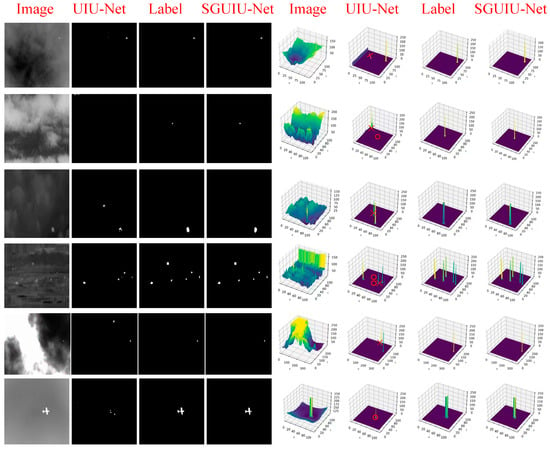
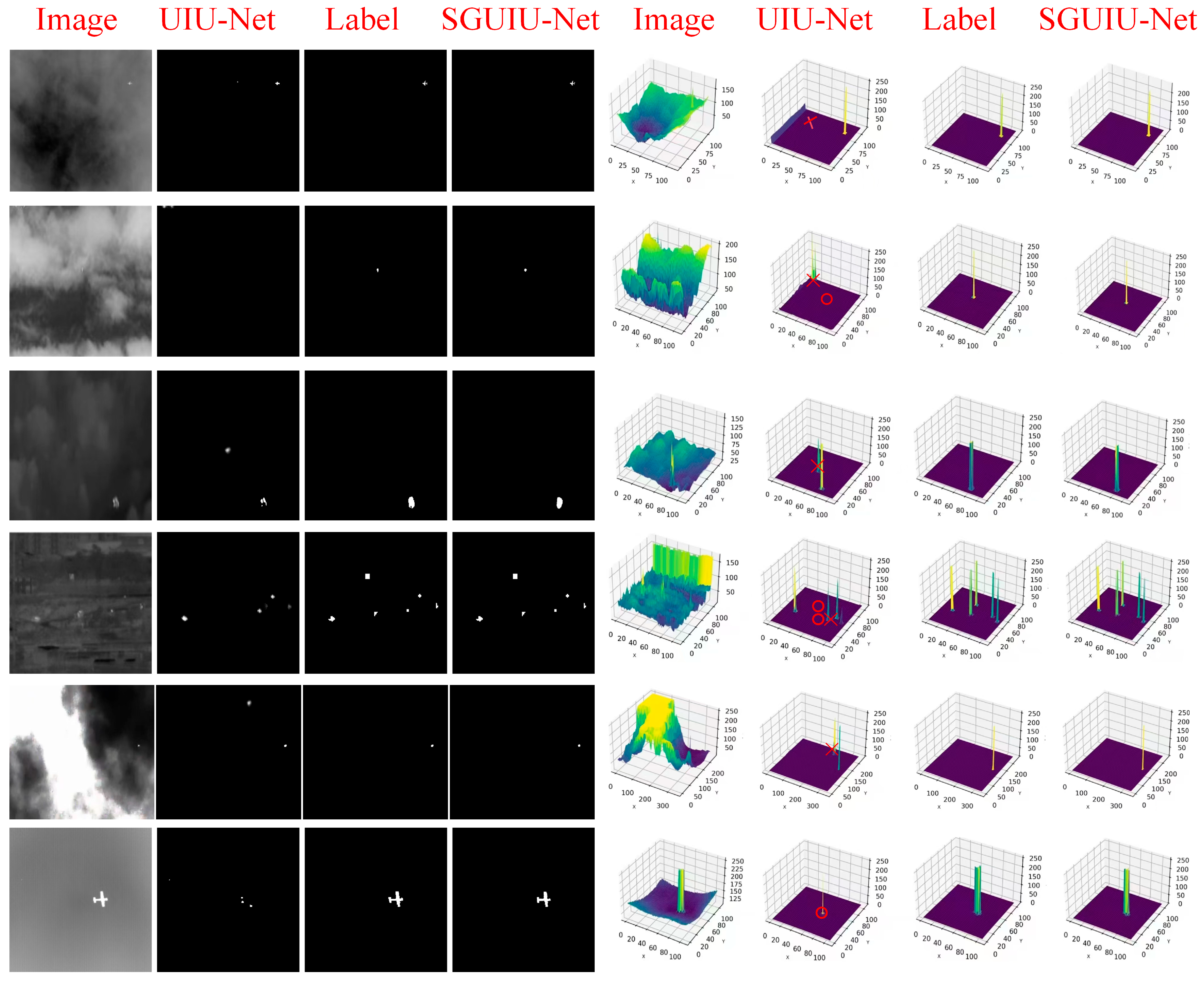
Figure 8 compares the binary predictions and response surfaces of UIU-Net and SGUIU-Net on representative samples from IRSTD-1K and SIRST-V2. UIU-Net retains several isolated background peaks or misses weak target responses in difficult scenes, whereas SGUIU-Net generally produces cleaner masks and target peaks that are closer to the ground-truth locations. These examples provide qualitative context for the positive auxiliary-dataset results in Table 4; they are illustrative rather than a substitute for the quantitative evaluation.
Figure 8.
Two-dimensional predictions and three-dimensional response visualization in representative complex scenes: UIU-Net versus SGUIU-Net. Response-surface colors indicate relative intensity (purple, low; green to yellow, high); red circles mark missed targets, red crosses mark false-positive responses, and yellow lines mark true-target positions.
Table 4.
Quantitative evaluation on the two auxiliary datasets using their official splits.
3.7. Computational Complexity and Runtime Analysis
Table 5 reports matched computational complexity and runtime. Efficiency is measured at an input size of 320 × 320 and batch size 1, with 50 warm-up iterations and 200 timed iterations on an NVIDIA GeForce RTX 3090. Parameters are counted from the instantiated model. Computational cost uses the one-operation-per-multiply-accumulate convention (GMACs). Peak allocated GPU memory, model-only latency, and FPS are measured under the same profiling protocol for all configurations.
Table 5.
Matched computational complexity and runtime analysis.
Dilated RSU leaves the parameter count unchanged at 50.54 M and increases computation from 84.87 to 86.57 GMACs, with a modest reduction from 50.05 to 47.76 FPS. Deep CBAM adds 0.13 M parameters and increases the cost to 88.42 GMACs, 541.63 MB peak memory, and 44.19 FPS. SGCA-Fusion accounts for most of the additional overhead: the SGCA-only model has 106.18 M parameters, 109.64 GMACs, 752.52 MB peak memory, and 35.89 FPS.
Table 6 summarizes the stage-level SGCA dimensions and memory profile. The full model contains 106.31 M parameters and requires 121.64 GMACs. Relative to UIU-Net, peak allocated memory rises from 517.00 to 794.50 MB and latency from 19.98 to 30.74 ms, while throughput decreases from 50.05 to 32.53 FPS. Thus, the accuracy improvement is obtained at a measurable computational cost rather than with negligible overhead. The latency and FPS values are internally consistent under batch-one inference (FPS ≈ 1000/latency).
Table 6.
SGCA tensor dimensions and stage-level memory profile for a 320 × 320 input.
Peak memory is the maximum allocated GPU memory recorded by torch.cuda.max_memory_allocated() during the forward computation of each SGCA stage, measured with batch size 1 and a 320 × 320 input on the same GPU.
The C/8 projection and 20 × 20 K/V pooling cap the Key/Value length at 400 positions. Consequently, the attention matrix grows from B × 400 × 400 at stage5 to B × 25,600 × 400 at stage2 rather than B × 25,600 × 25,600. Peak allocated memory increases from 542 MB at stage5 to 715 MB at stage2 as the Query resolution increases, while remaining below the 794.50 MB peak measured for the complete model. These measurements explain how high-resolution fusion remains feasible under the stated profiling setting.
4. Discussion
4.1. Cross-Dataset Generalization and Recent Comparisons
The matched SIRST ablation shows that the complete model improves the repeated UIU-Net baseline from 0.7815 to 0.7995 IoU and from 0.7515 to 0.7572 nIoU. The main comparison further includes locally trained evaluations of MPCNet [15] and EGPNet [16] under the same 300-epoch SIRST protocol and unified metric implementation; SGUIU-Net obtains higher IoU and nIoU than both recent comparators. Positive gains are also obtained on IRSTD-1K and SIRST-V2, but their magnitudes differ substantially. The 0.0746 IoU gain on IRSTD-1K is much larger than the 0.0149 gain on SIRST-V2, so the results support cross-dataset usefulness without implying a dataset-independent improvement of fixed magnitude. LGGNet [17] and MMLNet [18] provide additional recent context in Related Work but are not assigned values from different dataset versions or protocols. On the primary SIRST test split, the AUPR increases from 0.9116 to 0.9207 and the pixel-level ROC AUC from 0.9377 to 0.9526, providing threshold-sweep evidence consistent with the fixed-threshold IoU and nIoU results.
4.2. SGCA-Fusion Versus Conventional Cross-Attention
The fusion controls separate SGCA’s information flow from cross-attention in general. Direct fusion provides no learned semantic-to-detail relevance and gives the weakest result. The Reference [15]-style control improves both metrics, while SGCA adds a decoder-semantic Query, compressed encoder-detail Key/Value tensors, branch refinement, and dual gated output fusion within the UIU-Net skip path. Its gains of 0.0049 IoU and 0.0045 nIoU over the Reference [15]-style control support this task-specific design, but do not establish cross-attention itself as a new operation.
4.3. Module Complementarity and SGCA Degradation
The ablation reveals both complementarity and interference. Focal-Dice gives the largest single-module IoU gain, whereas the Focal-Dice plus deep-CBAM pair gives the strongest non-SGCA two-module result. SGCA alone improves IoU but only slightly changes nIoU. Its benefit becomes clearer when combined with deep CBAM: A13 and A14 recover the weaker behavior observed in A10 and A12, and the complete A15 configuration gives the best overall result. This pattern is consistent with deep feature recalibration reducing noisy detail before semantic-guided fusion, but the ablation does not isolate feature-map noise directly; this explanation is therefore treated as a mechanism consistent with the results rather than a proven cause.
4.4. Stability, Computational Cost, and Accuracy–Efficiency Trade-Off
Across the six repeated configurations, the IoU standard deviations range from 0.0011 to 0.0023 and the nIoU standard deviations from 0.0012 to 0.0032. The full model has standard deviations of 0.0011 IoU and 0.0012 nIoU, indicating stable performance across the three selected seeds. The accuracy gain is accompanied by substantial overhead: parameter count increases by 55.77 M, GMACs by 36.77, peak memory by 277.50 MB, and latency by 10.76 ms, while FPS decreases by 17.52. The compressed K/V grid prevents quadratic attention over the full high-resolution spatial grid, but SGCA remains the dominant source of added parameters and memory.
4.5. Limitations
Several limitations remain. Only six representative ablation configurations were repeated across three seeds; the other factorial and fusion-control rows are single-run observations. The recent-method comparison trains MPCNet and EGPNet under the same 300-epoch SIRST protocol, but it does not exhaustively include every recently published architecture. Part of the original implementation was lost, so the reconstructed C/8 projection and 20 × 20 K/V pooling are stated as documented reconstruction choices rather than recovered historical facts. Finally, SGCA approximately doubles the parameter count and reduces throughput, which may restrict deployment on resource-constrained devices.
5. Conclusions
This work reconstructs SGUIU-Net as a configurable UIU-Net extension containing Dilated RSUs, deep-stage CBAM, Focal-Dice deep supervision, and SGCA-Fusion. On SIRST, the complete model achieves 0.7995 ± 0.0011 IoU and 0.7572 ± 0.0012 nIoU over three independent runs, improving the matched repeated UIU-Net baseline by 0.0180 and 0.0057. The model also improves both metrics on IRSTD-1K and SIRST-V2. The factorial ablation shows that the components are not simply additive: partial SGCA combinations can underperform, whereas the complete configuration gives the strongest result. SGCA’s compressed semantic-to-detail attention is feasible at high resolution, but increases the full model to 106.31 M parameters and reduces throughput to 32.53 FPS. The PR and ROC analyses further increase AUPR from 0.9116 to 0.9207 and AUC from 0.9377 to 0.9526 on the primary SIRST test split.
Author Contributions
Conceptualization, X.L. and L.S.; methodology, X.L., L.S. and Z.H.; software, L.S. and Z.H.; validation, L.W., Y.Z. (Yu Zhai) and B.L.; formal analysis, X.L., L.S. and Z.H.; investigation, L.S., Z.H. and L.W.; resources, X.L. and Y.Z. (Yaoxia Zhao); data curation, L.S. and Y.Z. (Yu Zhai); writing—original draft preparation, X.L. and L.S.; writing—review and editing, X.L., Z.H., L.W., Y.Z. (Yu Zhai), B.L. and Y.Z. (Yaoxia Zhao); visualization, L.S. and Z.H.; supervision, X.L. and Y.Z. (Yaoxia Zhao); project administration, X.L.; funding acquisition, X.L. and Y.Z. (Yaoxia Zhao). All authors have read and agreed to the published version of the manuscript.
Funding
This research was supported by the Shanxi Provincial Basic Research Program (Industry Development Category) Jointly-Funded Project (No. 202503011212008) and the Defense Industrial Technology Development Program (No. JCKY2024209C006).
Data Availability Statement
The original 427-image SIRST dataset is used as the primary benchmark with the 407/20 split. IRSTD-1K and SIRST-V2 are used as auxiliary quantitative datasets with their official splits. The dataset sources are cited in Refs. [12,26,27], and the official released split lists were used without reshuffling; preprocessing and evaluation settings are reported in Section 3.1 and Section 3.2. No new dataset was created in this study.
Conflicts of Interest
The authors declare no conflict of interest.
References
- Xu, Y.; Zhang, J. Real-time detection algorithm for small space targets based on max-median filter. J. Inf. Comput. Sci. 2014, 11, 1047–1055. [Google Scholar] [CrossRef] [Scilit]
- Wu, W.; Peng, J.X.; Wang, H.H. Characteristics analysis and detection of small target in infrared image sequences. Infrared Laser Eng. 2002, 31, 146–149. [Google Scholar]
- Chen, C.L.P.; Li, H.; Wei, Y.; Xia, T.; Tang, Y.Y. A local contrast method for small infrared target detection. IEEE Trans. Geosci. Remote Sens. 2014, 52, 574–581. [Google Scholar] [CrossRef] [Scilit]
- Zhang, H.; Zhang, L.; Yuan, D.; Chen, H. Infrared small target detection based on local intensity and gradient properties. Infrared Phys. Technol. 2018, 89, 88–96. [Google Scholar] [CrossRef] [Scilit]
- Nie, J.; Qu, S.; Wei, Y.; Zhang, L.; Deng, L. An infrared small target detection method based on multiscale local homogeneity measure. Infrared Phys. Technol. 2018, 90, 186–194. [Google Scholar] [CrossRef] [Scilit]
- Zheng, C.Y.; Li, H. Small infrared target detection based on low-rank and sparse matrix decomposition. Appl. Mech. Mater. 2013, 239–240, 214–218. [Google Scholar] [CrossRef] [Scilit]
- Gao, C.; Meng, D.; Yang, Y.; Wang, Y.; Zhou, X.; Hauptmann, A.G. Infrared patch-image model for small target detection in a single image. IEEE Trans. Image Process. 2013, 22, 4996–5009. [Google Scholar] [CrossRef] [Scilit] [PubMed]
- LeCun, Y.; Bottou, L.; Bengio, Y.; Haffner, P. Gradient-based learning applied to document recognition. Proc. IEEE 1998, 86, 2278–2324. [Google Scholar] [CrossRef] [Scilit]
- Ronneberger, O.; Fischer, P.; Brox, T. U-Net: Convolutional networks for biomedical image segmentation. In International Conference on Medical Image Computing and Computer-Assisted Intervention; Springer: Cham, Switzerland, 2015; pp. 234–241. [Google Scholar] [CrossRef] [Scilit]
- Zhou, Z.; Siddiquee, M.M.R.; Tajbakhsh, N.; Liang, J. UNet++: A nested U-Net architecture for medical image segmentation. In Deep Learning in Medical Image Analysis and Multimodal Learning for Clinical Decision Support; Springer: Cham, Switzerland, 2018; pp. 3–11. [Google Scholar] [CrossRef] [Scilit] [PubMed]
- Dai, Y.; Wu, Y.; Zhou, F.; Barnard, K. Asymmetric contextual modulation for infrared small target detection. In Proceedings of the 2021 IEEE Winter Conference on Applications of Computer Vision (WACV), Waikoloa, HI, USA, 5–9 January 2021; pp. 950–959. [Google Scholar]
- Zhang, M.; Zhang, R.; Yang, Y.; Bai, H.; Zhang, J.; Guo, J. ISNet: Shape matters for infrared small target detection. In Proceedings of the 2022 IEEE/CVF Conference on Computer Vision and Pattern Recognition (CVPR), New Orleans, LA, USA, 18–24 June 2022; pp. 877–886. [Google Scholar]
- Li, B.; Xiao, C.; Wang, L.; Wang, Y.; Lin, Z.; Li, M.; An, W.; Guo, Y. Dense nested attention network for infrared small target detection. IEEE Trans. Image Process. 2023, 32, 1745–1758. [Google Scholar] [CrossRef] [Scilit] [PubMed]
- Wu, X.; Hong, D. UIU-Net: U-Net in U-Net for infrared small object detection. IEEE Trans. Image Process. 2023, 32, 364–376. [Google Scholar] [CrossRef] [Scilit] [PubMed]
- Zhang, Y.; Bao, W.; Yang, Y.; Wan, W.; Xiao, Q.; Zou, X. MPCNet: Multiscale perception and cross-attention feature fusion network for infrared small target detection. IEEE Trans. Geosci. Remote Sens. 2026, 64, 5000915. [Google Scholar] [CrossRef] [Scilit]
- Li, Q.; Zhang, M.; Yang, Z.; Yuan, Y.; Zhang, W. Edge-guided perceptual network for infrared small target detection. IEEE Trans. Geosci. Remote Sens. 2024, 62, 5643510. [Google Scholar] [CrossRef] [Scilit]
- Li, Q.; Mao, Q.; Liu, W.; Wang, J.; Wang, W.; Wang, B. Local information guided global integration for infrared small target detection. In Proceedings of the 2024 IEEE International Conference on Acoustics, Speech and Signal Processing (ICASSP), Seoul, Republic of Korea, 14–19 April 2024; pp. 4425–4429. [Google Scholar] [CrossRef] [Scilit]
- Li, Q.; Zhang, W.; Lu, W.; Wang, Q. Multibranch mutual-guiding learning for infrared small target detection. IEEE Trans. Geosci. Remote Sens. 2025, 63, 5605710. [Google Scholar] [CrossRef] [Scilit]
- Zheng, H.; Song, T.; Gao, C.; Guo, T. M2FN: A multilayer and multiattention fusion network for remote sensing image scene classification. IEEE Geosci. Remote Sens. Lett. 2022, 19, 6511805. [Google Scholar] [CrossRef] [Scilit]
- Li, H.; Song, T. Remote sensing small object detection network based on wavelet-convolution and fine-grained preservation. Information 2026, 17, 609. [Google Scholar] [CrossRef] [Scilit]
- Zhang, Y.; Li, J.; Lei, Z. ISTS-UT: Infrared Small Target Segmentation with U-Shaped Transformer. In Proceedings of the 2025 8th International Conference on Robotics, Control and Automation Engineering (RCAE), Xi’an, China, 24–26 October 2025; pp. 1067–1071. [Google Scholar] [CrossRef] [Scilit]
- Zhao, J.; Jing, Y.; Yuan, S.; Zhang, T.; Wang, Y.; Cui, G. SWAN: Synergistic wavelet-attention network for infrared small target detection. IEEE Trans. Geosci. Remote Sens. 2026, 64, 5637817. [Google Scholar] [CrossRef] [Scilit]
- Woo, S.; Park, J.; Lee, J.-Y.; Kweon, I.S. CBAM: Convolutional block attention module. In Computer Vision—ECCV 2018; Springer: Cham, Switzerland, 2018; pp. 3–19. [Google Scholar] [CrossRef] [Scilit]
- Lin, T.-Y.; Goyal, P.; Girshick, R.; He, K.; Dollár, P. Focal loss for dense object detection. In Proceedings of the IEEE International Conference on Computer Vision (ICCV), Venice, Italy, 22–29 October 2017; pp. 2999–3007. [Google Scholar] [CrossRef] [Scilit]
- Sudre, C.H.; Li, W.; Vercauteren, T.; Ourselin, S.; Cardoso, M.J. Generalised Dice overlap as a deep learning loss function for highly unbalanced segmentations. In Deep Learning in Medical Image Analysis and Multimodal Learning for Clinical Decision Support; Springer: Cham, Switzerland, 2017; pp. 240–248. [Google Scholar] [CrossRef] [Scilit] [PubMed]
- Wang, H.; Zhou, L.; Wang, L. Miss detection vs. false alarm: Adversarial learning for small object segmentation in infrared images. In Proceedings of the 2019 IEEE/CVF International Conference on Computer Vision (ICCV), Seoul, Republic of Korea, 27 October–2 November 2019; pp. 8509–8518. [Google Scholar] [CrossRef] [Scilit]
- Dai, Y.; Li, X.; Zhou, F.; Qian, Y.; Chen, Y.; Yang, J. One-stage cascade refinement networks for infrared small target detection. IEEE Trans. Geosci. Remote Sens. 2023, 61, 5000917. [Google Scholar] [CrossRef] [Scilit]
- Qin, Y.; Li, B. Effective infrared small target detection utilizing a novel local contrast method. IEEE Geosci. Remote Sens. Lett. 2016, 13, 1890–1894. [Google Scholar] [CrossRef] [Scilit]
- Zhang, L.; Peng, Z. Infrared small target detection based on partial sum of the tensor nuclear norm. Remote Sens. 2019, 11, 382. [Google Scholar] [CrossRef] [Scilit]
- Dai, Y.; Wu, Y. Reweighted infrared patch-tensor model with both nonlocal and local priors for single-frame small target detection. IEEE J. Sel. Top. Appl. Earth Obs. Remote Sens. 2017, 10, 3752–3767. [Google Scholar] [CrossRef] [Scilit]
- Deng, H.; Sun, X.; Liu, M.; Ye, C.; Zhou, X. Infrared small-target detection using multiscale gray difference weighted image entropy. IEEE Trans. Aerosp. Electron. Syst. 2016, 52, 60–72. [Google Scholar] [CrossRef] [Scilit]
- Wang, X.; Peng, Z.; Zhang, P.; He, Y. Infrared small target detection via nonnegativity-constrained variational mode decomposition. IEEE Geosci. Remote Sens. Lett. 2017, 14, 1700–1704. [Google Scholar] [CrossRef] [Scilit]
- Zhao, M.; Cheng, L.; Yang, X.; Feng, P.; Liu, L.; Wu, N. TBC-Net: A real-time detector for infrared small target detection using semantic constraint. arXiv 2020, arXiv:2001.05852. [Google Scholar]



Disclaimer/Publisher’s Note: The statements, opinions and data contained in all publications are solely those of the individual author(s) and contributor(s) and not of MDPI and/or the editor(s). MDPI and/or the editor(s) disclaim responsibility for any injury to people or property resulting from any ideas, methods, instructions or products referred to in the content. |
© 2026 by the authors. Licensee MDPI, Basel, Switzerland. This article is an open access article distributed under the terms and conditions of the Creative Commons Attribution (CC BY) license.