


Abstract
Lensless coded ptychography (CP) acquires multiple intensity measurements by translating either the object or the coded sensor, and reconstructs high-resolution, large field-of-view images via iterative phase retrieval. However, conventional CP suffers from slow reconstruction due to two limitations. First, periodic uniform scanning requires dense measurements to maintain sufficient measurement diversity, resulting in a large number of raw measurements and a high computational burden for iterative phase retrieval. Second, random initialization leads to slow convergence and increases the risk of stagnation in local minima. To address these limitations, we propose a joint optimization of the sampling strategy and initialization for accelerated reconstruction. Specifically, a continuous non-uniform scanning strategy preserves measurement diversity while reducing the number of required measurements. In addition, a low-resolution regularized ptychographic iterative engine (rPIE)-based initialization provides a more accurate starting point and accelerates the convergence of iterative phase retrieval. Both simulations and experiments demonstrate that the proposed approach achieves approximately three-fold faster convergence while maintaining high reconstruction fidelity. The proposed approach offers an effective solution for high-throughput imaging applications, including digital pathology and label-free quantitative phase imaging.
1. Introduction
Quantitative phase imaging (QPI) is a label-free microscopy technique that reconstructs the complex object via phase retrieval [1,2]. Conventional lens-based QPI systems are fundamentally limited by numerical aperture and camera sampling, making it difficult to simultaneously achieve large field-of-view and high-resolution [3,4,5]. Although recent lens-based computational imaging systems have demonstrated simultaneous large field-of-view and high-resolution imaging through advanced optical designs and computational reconstruction algorithms [6,7], these systems generally rely on sophisticated objective lenses, complex optical configurations, and precise alignment, resulting in increased hardware complexity and system cost. In contrast, lensless coded ptychography (CP) [8] eliminates the need for imaging optics, offering a compact, low-cost, and mechanically simple imaging architecture while maintaining high-resolution imaging over a large field-of-view. In a typical CP implementation, the specimen is illuminated by a coherent plane wave, and multiple intensity measurements are acquired by laterally translating the coded sensor or the specimen. The high-resolution complex wavefront of the specimen is then reconstructed via iterative phase retrieval [9]. Benefiting from advances in coherent light sources [10,11], CP has attracted increasing attention in high-throughput digital pathology [12], two- and three-dimensional QPI [8,13], and long-term cellular growth monitoring [14].
Despite its advantages, conventional CP remains limited by reconstruction efficiency and robustness. Data acquisition typically relies on uniform-step-size periodic scanning [15,16,17], which produces redundant measurements and increases the computational burden of iterative reconstruction. Moreover, widely used ptychographic iterative engine (PIE)-based reconstruction algorithms [18] often suffer from slow convergence and are prone to stagnation in local minima, especially under noisy conditions, leading to degraded reconstruction quality.
To address these limitations, substantial efforts have been devoted to improving scanning strategy and accelerating reconstruction. For example, Guo et al. proposed a fly-scan method that enables randomized scanning via active micro-vibration [19], further improving acquisition efficiency through rolling-shutter distortion correction. Wang et al. developed an accurate and robust position estimation strategy [20], in which diffraction patterns acquired away from the scan center are used as references to improve position estimation accuracy. To accelerate convergence, Song et al. proposed an initialization strategy by upsampling the averaged measurements [21]. Jiang et al. introduced a temporal similarity constraint that uses the previous reconstruction as the initial guess for the current frame, significantly accelerating convergence [14]. Despite these advances, conventional CP still suffers from inefficient sampling and slow convergence. Periodic scanning inherently introduces redundant measurements and limited sampling diversity, increasing the computational burden of iterative reconstruction. Moreover, widely used PIE-based algorithms, including extended ptychographic iterative engine (ePIE) [22], regularized ptychographic iterative engine (rPIE) [23], and momentum accelerated ptychographic iterative engine (mPIE) [23], typically rely on heuristic initial estimates, which may result in slow convergence or stagnation in local minima.
In this work, we propose a fast and robust lensless coded ptychography framework by jointly optimizing the sampling strategy and reconstruction algorithm. The main contributions are as follows. First, a non-uniform scanning strategy with progressively increasing step sizes is introduced, maintaining sufficient measurement diversity while reducing redundant measurements. Second, a low-resolution regularized ptychographic iterative engine (rPIE)-based initialization strategy is developed to jointly estimate the object and coded surface, providing a physically consistent initial estimate and improving convergence stability. Third, a momentum-accelerated PIE scheme is integrated to exploit historical gradient information, reducing the number of iterations and mitigating stagnation at local minima. Both simulations and experiments demonstrate that the proposed framework enables faster and more stable reconstruction, showing potential for high-throughput applications such as digital pathology and label-free quantitative phase imaging.
2. Sampling and Initial Guess Optimization
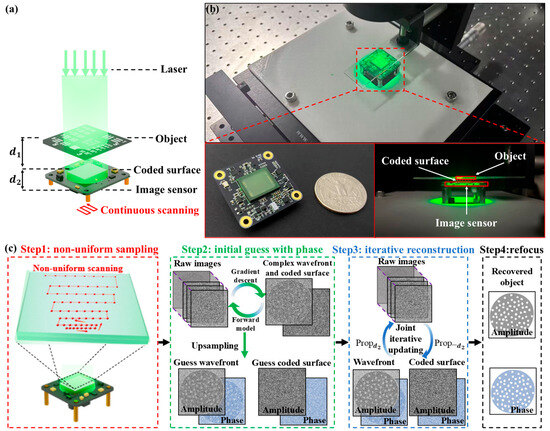
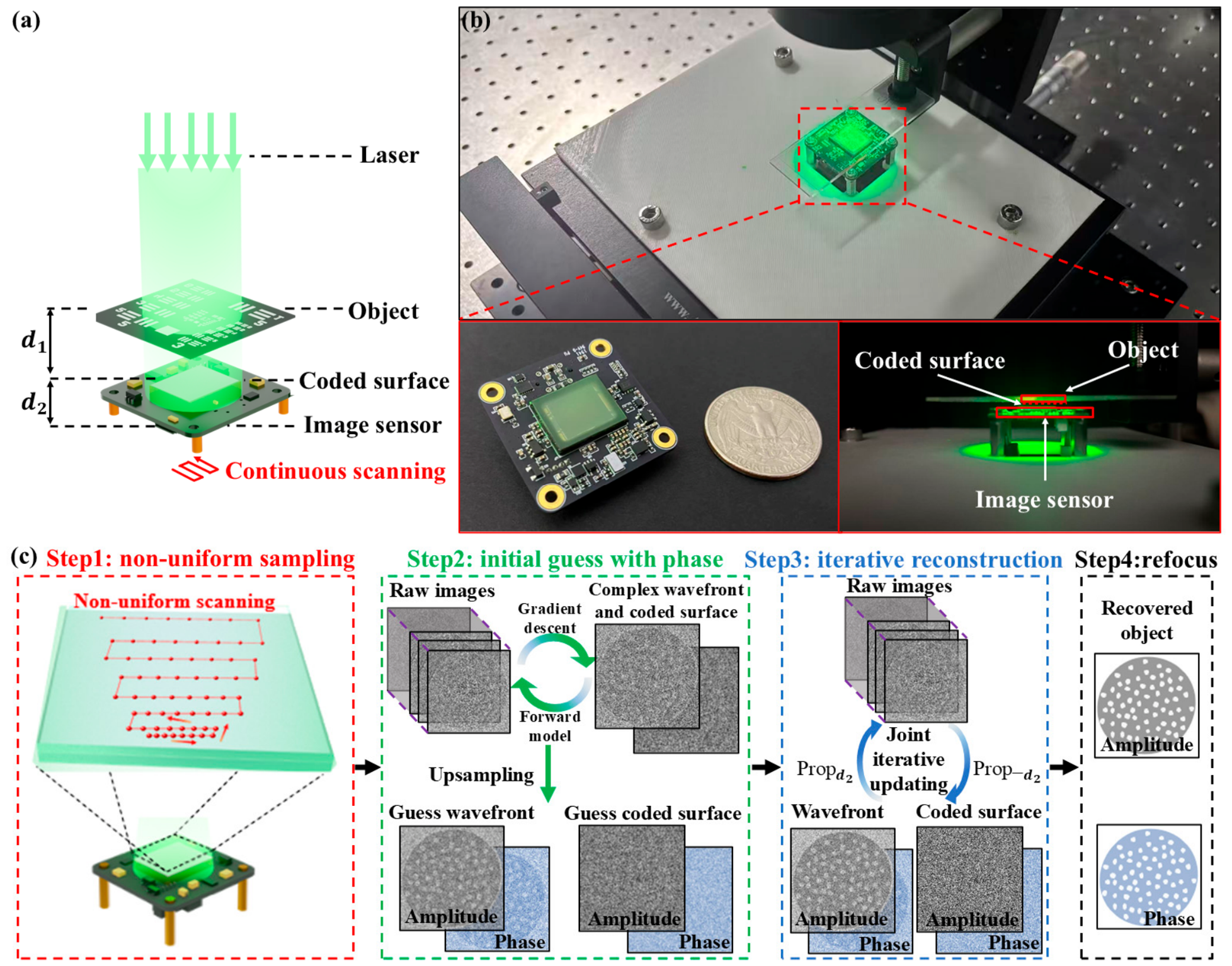
Figure 1a,b shows the schematic diagram and experimental setup of the proposed approach. The system geometry consists of three planes, as follows: the sample plane , the coded surface plane , and the detector plane . A fiber-coupled laser illuminates the object, and the object wavefield propagates a distance to the coded surface plane, where it is modulated by the coded surface. The modulated wavefield then propagates a distance to the detector plane for intensity measurement. The forward imaging model is expressed as follows:
where denotes the object wavefield at the coded surface plane, and denotes the complex transmission profile of the coded surface. is the convolution kernel for free space propagation. denotes point-wise multiplication, denotes convolution, and “” represents M by M down-sampling.
Figure 1.
Overview of the proposed lensless coded ptychography framework. (a) Schematic of the imaging system. (b) Experimental setup. (c) Workflow of the proposed data acquisition and reconstruction process.
Unlike conventional CP, which employs uniform step size scanning and results in highly redundant measurements, we adopt a non-uniform scanning strategy in which the coded sensor is translated row by row with a gradually increasing step size following an arithmetic progression, as shown in Figure 1c.
where and denote the current and previous step sizes, respectively, and is a constant. This strategy continuously varies the overlap ratio between adjacent measurements, thereby increasing measurement diversity while maintaining sufficient redundancy for stable phase retrieval. The gradually increasing scanning step size maintains sufficient spatial redundancy while enhancing spatial-frequency diversity, thereby improving measurement efficiency. The parameter determines the rate of step size increase and is selected according to the imaging configuration to balance reconstruction stability and acquisition efficiency.
To address slow convergence and potential stagnation at local minima in conventional PIE-based reconstruction, we introduce a low-resolution rPIE-based initialization strategy. The overall reconstruction procedure is illustrated in Figure 1c, which consists of sequential initialization, iterative phase retrieval, and numerical propagation steps. In the second step, a joint optimization of the object and coded surface is first performed in the low-resolution domain to obtain a coarse estimate containing both amplitude and phase information. This estimate is then upsampled to the high-resolution domain via Fourier-domain zero-padding and used as the initial estimate for subsequent reconstruction. Compared with conventional intensity-averaged initialization, the proposed approach provides a more physically consistent starting point, thereby reducing early-stage oscillations, improving convergence and reconstruction stability. In the third step, iterative phase retrieval is performed using the optimized initial estimate. Finally, in the fourth step, the recovered complex object wavefield at the coded surface plane is numerically propagated back to the sample plane to obtain the quasi-in-focus image.
3. Rapid Reconstruction for Coded Ptychography
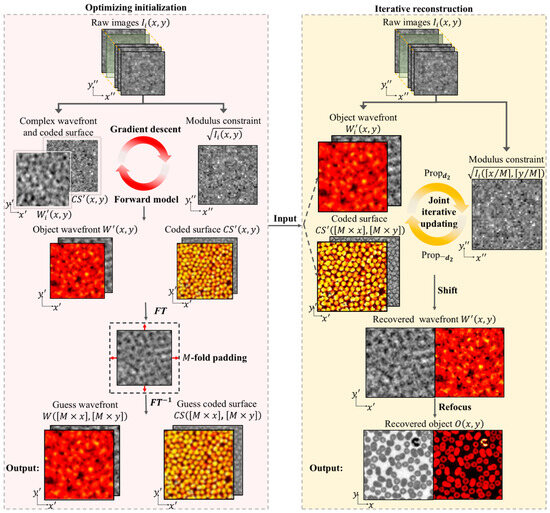
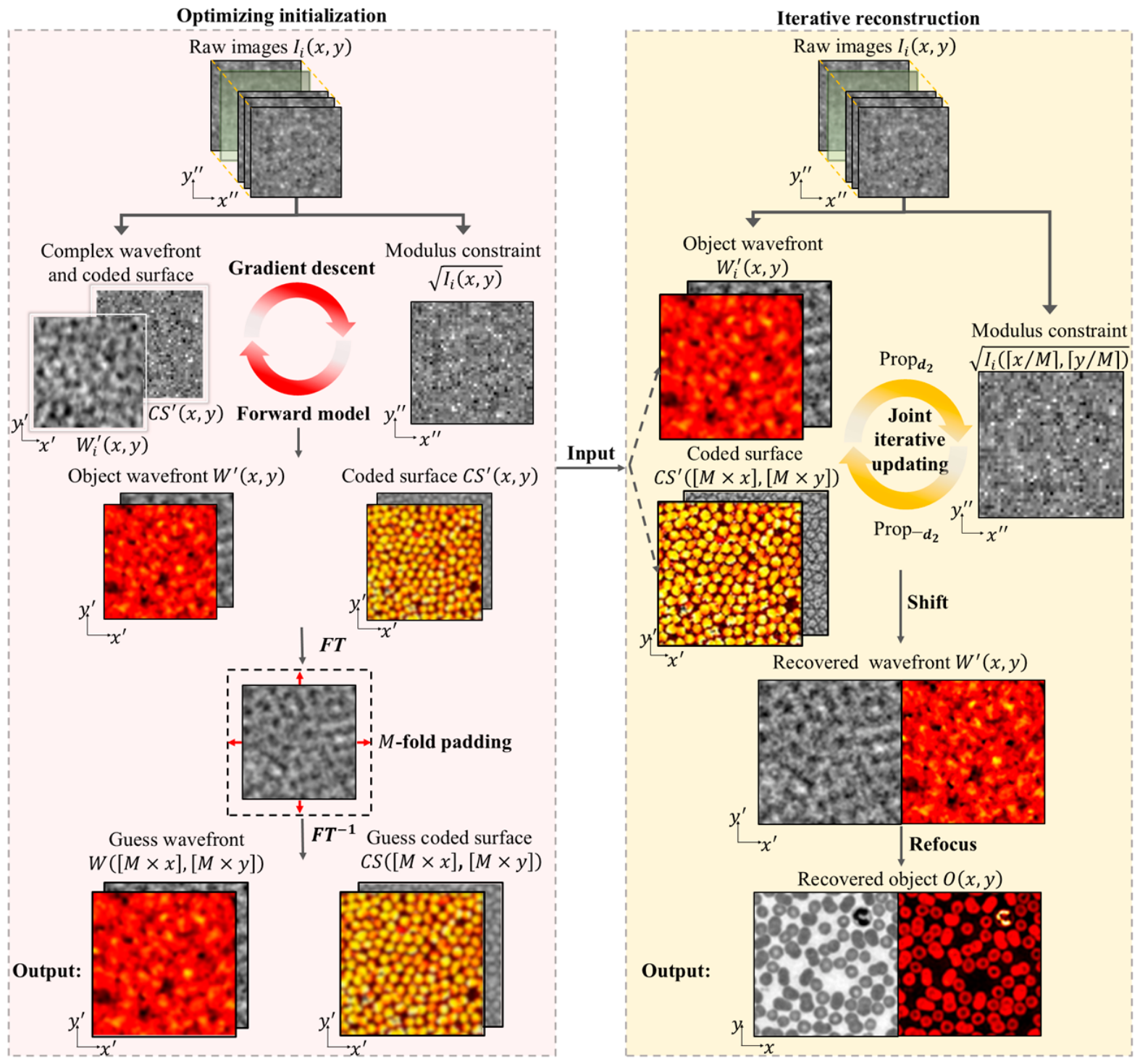
The proposed fast reconstruction procedure is illustrated in Figure 2 and consists of two stages, as follows: initialization and iterative reconstruction. In the initialization stage, all raw diffraction measurements are input into a low-resolution rPIE-based framework to obtain low-resolution estimates of the object wavefront and coded surface profile. These estimates are then upsampled to the high-resolution domain by a factor of M [8,24] (see Supplement S1). The resulting high-resolution estimates serve as the initial guesses for subsequent iterative reconstruction.
Figure 2.
Fast reconstruction procedure of the proposed framework. (Left panel): workflow of the initialization optimizing process. (Right panel): iterative reconstruction procedure.
During the iterative reconstruction stage, The upsampled object wavefront and coded surface profile are iteratively updated using the rPIE algorithm [23]:
where represents the updated object exit wavefront, while refers to the original object exit wavefront, and are adaptive parameters.
The recovered shifted object exit wavefront are then translated according to the displacement :
To further accelerate convergence, a momentum-based strategy is incorporated into the iterative update of . The object and coded surface are first updated without momentum for a predefined number of measurements . In our implementation, , and momentum is activated after every 10 iterative updates. Once momentum is enabled, a velocity map for the object, is computed as follows:
where, , and denotes the momentum coefficient, which can be interpreted as the friction of the ptychographic error landscape. In our implementation, .
A damped momentum term is then applied to the updated object estimate, as follows:
and the same momentum strategy is applied to the coded surface update.
These update steps are iterated until convergence. Finally, the recovered object exit wavefront is back-propagated to the object plane to obtain the complex object wavefield.
4. Results
To validate the effectiveness of the proposed framework, we conduct a series of simulations. Standard test images from the USC-SIPI image database [25] are used as the ground-truth amplitude and phase distributions (see Supplement). Unless otherwise stated, all simulations are performed using an upsampling factor of , 144 raw diffraction measurements, an illumination wavelength of 405 nm, and a maximum iterations number of 70.
The parameter in Equation (2) plays a critical role in reconstruction performance. Its value needs to balance the constraints of adjacent spot overlap and spatial sampling diversity. Supplement S2 shows the reconstruction results obtained with different values. The reconstruction quality is quantitatively evaluated using the structural similarity index measure (SSIM) [26], as shown in Figure S2d,e, where the optimal performance is achieved at . This value is used in all subsequent simulations and experiments. We further evaluate the effectiveness of the proposed low-resolution rPIE-based initialization in Supplement S3. Compared with conventional intensity-averaged initialization, the proposed approach provides a more physically consistent starting point, reducing early-stage oscillations and improving convergence speed, stability, and final reconstruction quality.
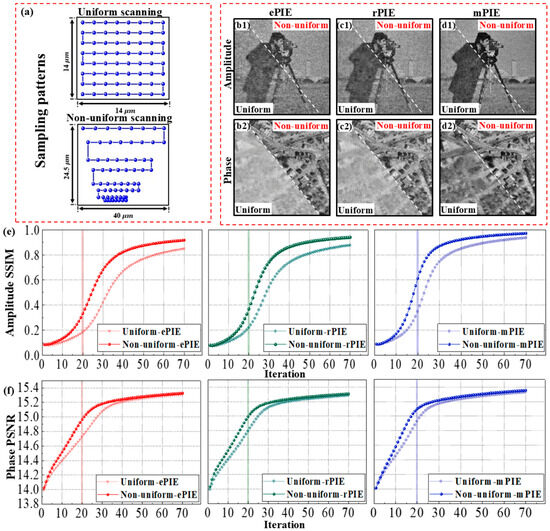
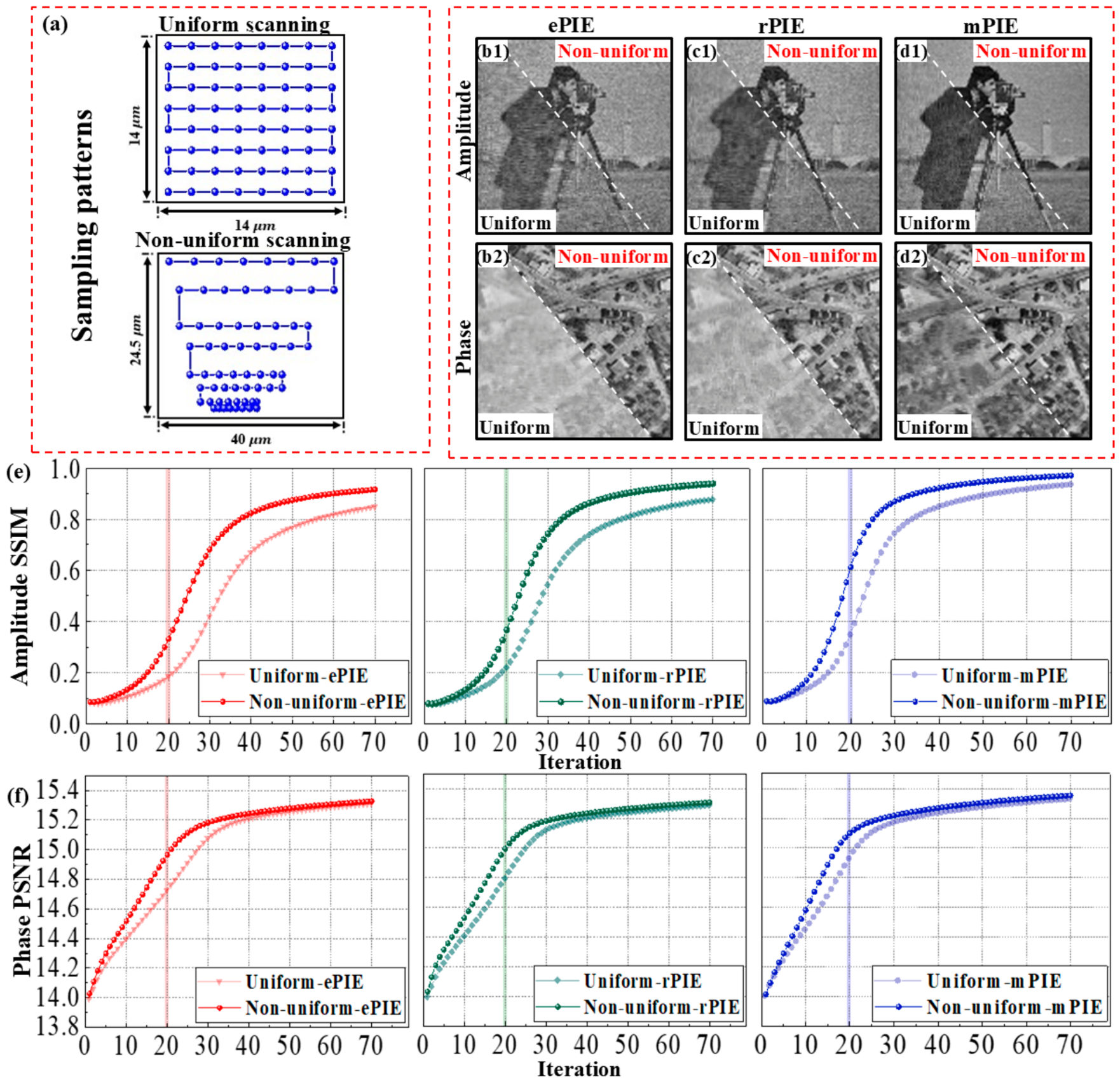
Figure 3 compares the conventional uniform scanning scheme with the proposed non-uniform scanning strategy, with the corresponding scan trajectories shown in Figure 3a. To ensure a fair comparison, both scanning strategies employ the same number of diffraction measurements, differing only in the distribution of the scanning positions. Figure 3b1,b2,c1,c2,d1,d2 shows the recovered amplitude and phase using ePIE, rPIE, and mPIE, respectively. Compared with the conventional scanning strategy, the proposed approach achieves higher reconstruction fidelity. In addition, the proposed approach accelerates iterative reconstruction convergence and mitigates stagnation at local minima. Quantitative comparisons in Figure 3e,f further demonstrate the superiority of the proposed approach.
Figure 3.
Reconstruction results under different scanning strategies. (a) Comparison of reconstructed amplitude and phase obtained using the conventional uniform scanning scheme and the proposed non-uniform scanning strategy with ePIE (b1,b2), rPIE (c1,c2), and mPIE (d1,d2) reconstruction algorithms. (e) Amplitude SSIM and (f) phase PSNR as functions of iteration number for the two scanning strategies.
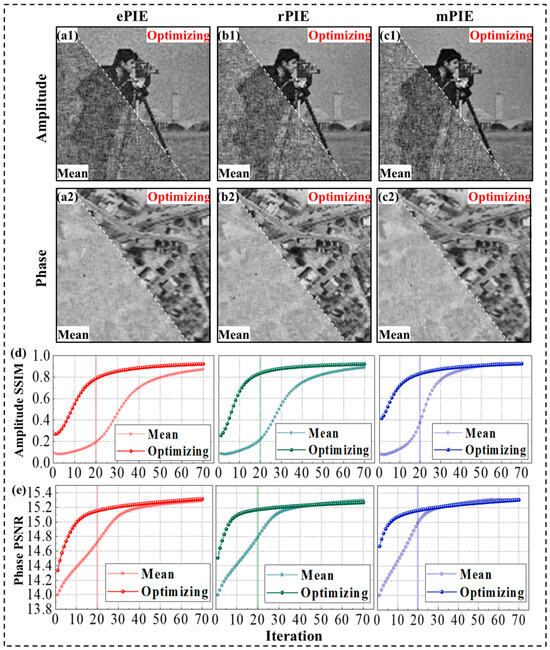
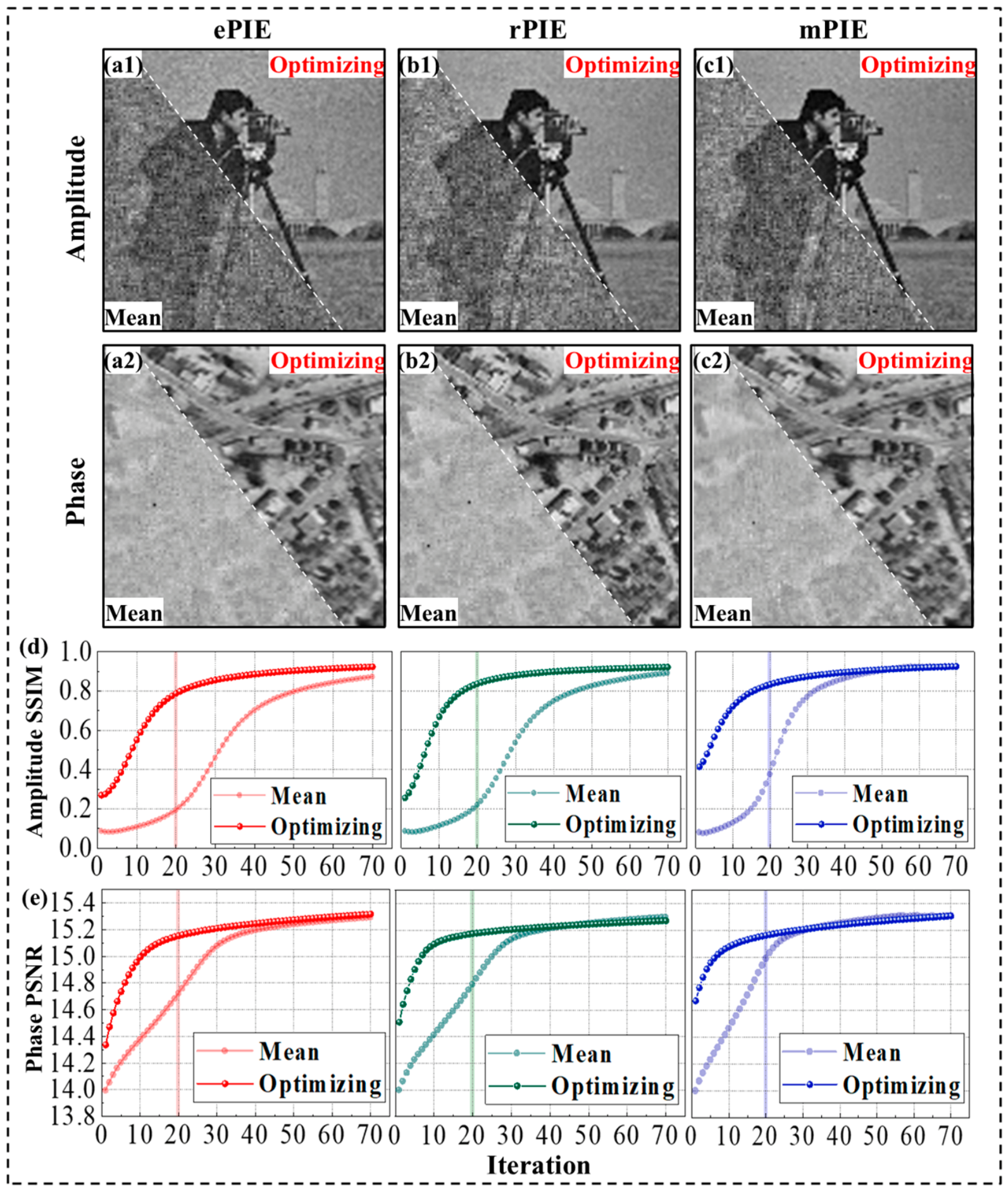
Next, we evaluate the contribution of the proposed low-resolution rPIE-based initialization strategy. Figure 4a–c presents the reconstruction results with the proposed low-resolution rPIE-based initialization and conventional intensity-averaged initialization using three phase retrieval algorithms. The low-resolution rPIE-based initialization consistently yields higher reconstruction fidelity under the same number of iterations. Convergence behavior is further quantified using SSIM and peak signal-to-noise ratio (PSNR), as shown in Figure 4d,e. Both initialization strategies are evaluated using the same number of diffraction measurements. The intensity-averaged initialization eventually converges after approximately 30 iterations, whereas the low-resolution rPIE-based initialization achieves comparable reconstruction quality in about one-third of the iterations, corresponding to a ~3-fold acceleration. This improvement is attributed to a more physically consistent initial estimate, which stabilizes the optimization trajectory and reduces stagnation at local minima.
Figure 4.
Comparison of initialization strategies. Reconstructed amplitude and phase obtained with the low-resolution rPIE-based initialization and intensity-averaged initialization using ePIE (a1,a2), rPIE (b1,b2), and mPIE (c1,c2) reconstruction algorithms. (d) Amplitude SSIM and (e) phase PSNR as a function of iteration number for the two methods.
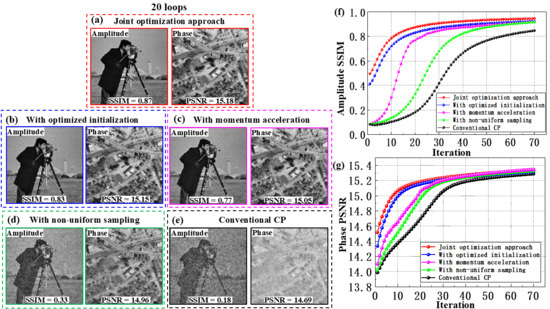
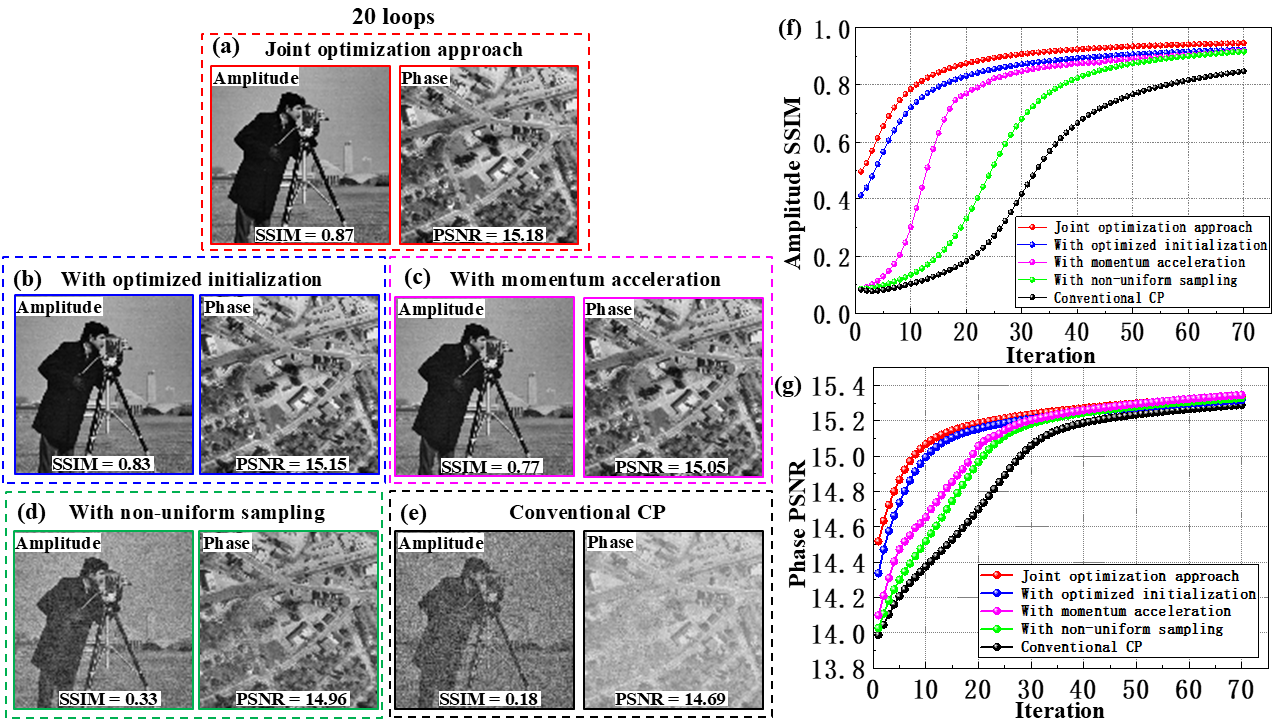
Finally, we quantify the contribution of each module to the overall algorithm via ablation experiments. Figure 5a–e presents the reconstruction results of the joint optimization approach, low-resolution rPIE-based initialization, momentum acceleration, non-uniform sampling, and the conventional CP in sequence; Figure 5f,g further performs quantitative comparative analysis using SSIM and PSNR. Experimental results demonstrate that applying only low-resolution rPIE-based initialization, momentum acceleration, or non-uniform sampling yields limited performance gains. The joint optimization approach combining all three modules achieves complementary advantages, outperforming any single module significantly in both convergence speed and reconstruction fidelity, which fully validates the design philosophy of synergistic enhancement among multiple modules.
Figure 5.
(a) Reconstruction result of the joint optimization approach. (b) Reconstruction result with low-resolution rPIE-based initialization only. (c) Reconstruction result with momentum acceleration only. (d) Reconstruction result with non-uniform sampling only. (e) Reconstruction result of the conventional CP. (f) SSIM curves of recovered amplitude against iteration number for different modules. (g) PSNR curves of recovered phase against iteration number for different modules.
To further validate the proposed approach, experiments were conducted on the CP system shown in Figure 1b. A motorized translation stage enables planar scanning of the coded sensor, and measurements are acquired using the proposed continuous non-uniform sampling strategy. A 405 nm laser is used for the USAF resolution target, while a 520 nm laser is used for the H&E-stained human cancer specimen. The H&E-stained human cancer specimen was commercially obtained as a de-identified teaching slide for educational and research purposes. The wavelengths are selected for sample-dependent optimization. The 405 nm laser is chosen to reliably characterize the system’s ultimate resolution limited by diffraction, while the 520 nm laser provides better spectral matching and higher contrast for imaging H&E-stained tissue microstructures. We use a Sony IMX226 monochromatic image sensor with a pixel size of 1.85 μm and a resolution of 3000 × 4000 pixels. Other reconstruction parameters are detailed in the Supplementary Materials. Reference reconstructions are obtained using 576 raw measurements, whereas all comparison results are reconstructed using 288 measurements.
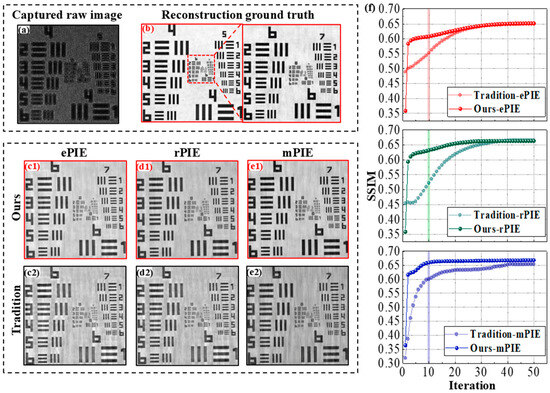
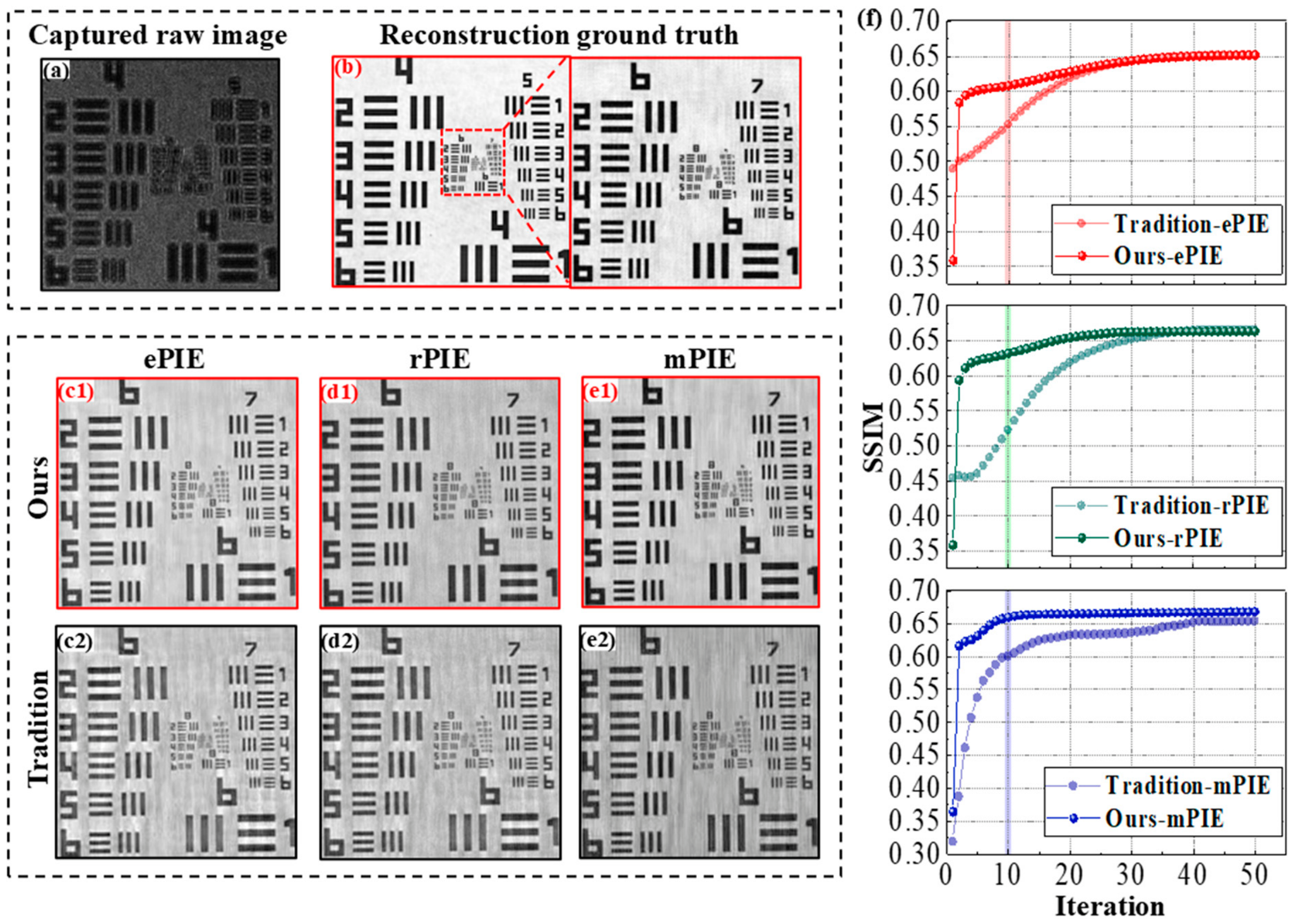
Figure 6 experimentally validates the effectiveness of the proposed framework using a USAF resolution target. The raw measurement is shown in Figure 6a, and the reference reconstruction using 576 measurements is shown in Figure 6b, demonstrating a half-pitch resolution of approximately 0.69 μm. Figure 6c1–e2 presents the reconstruction results of the proposed approach and conventional CP, respectively, with the ePIE, rPIE, and mPIE reconstruction algorithms. In all cases, the proposed approach achieves higher reconstruction fidelity and better preserves structural details. The corresponding SSIM curves in Figure 6f further demonstrate faster convergence with the same number of iterations.
Figure 6.
Experimental reconstruction comparison using a USAF resolution target. (a) Raw image. (b) Reference reconstruction obtained from 576 raw measurements. Reconstruction results using ePIE (c1,c2), rPIE (d1,d2), mPIE (e1,e2) based on 288 raw measurements. Each subfigure compares two strategies under the three phase retrieval algorithms. (f) Quantitative SSIM curves as a function of iteration number.
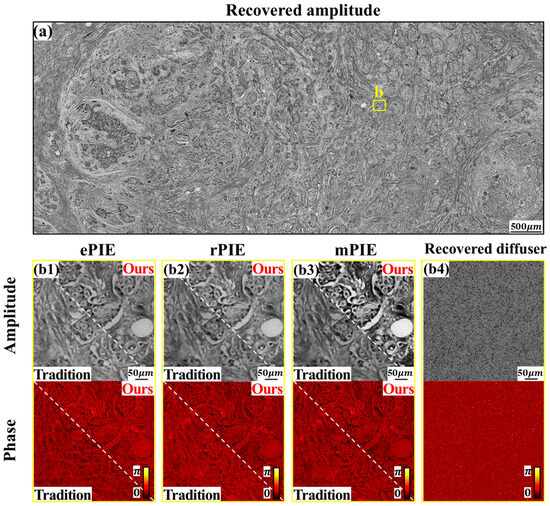
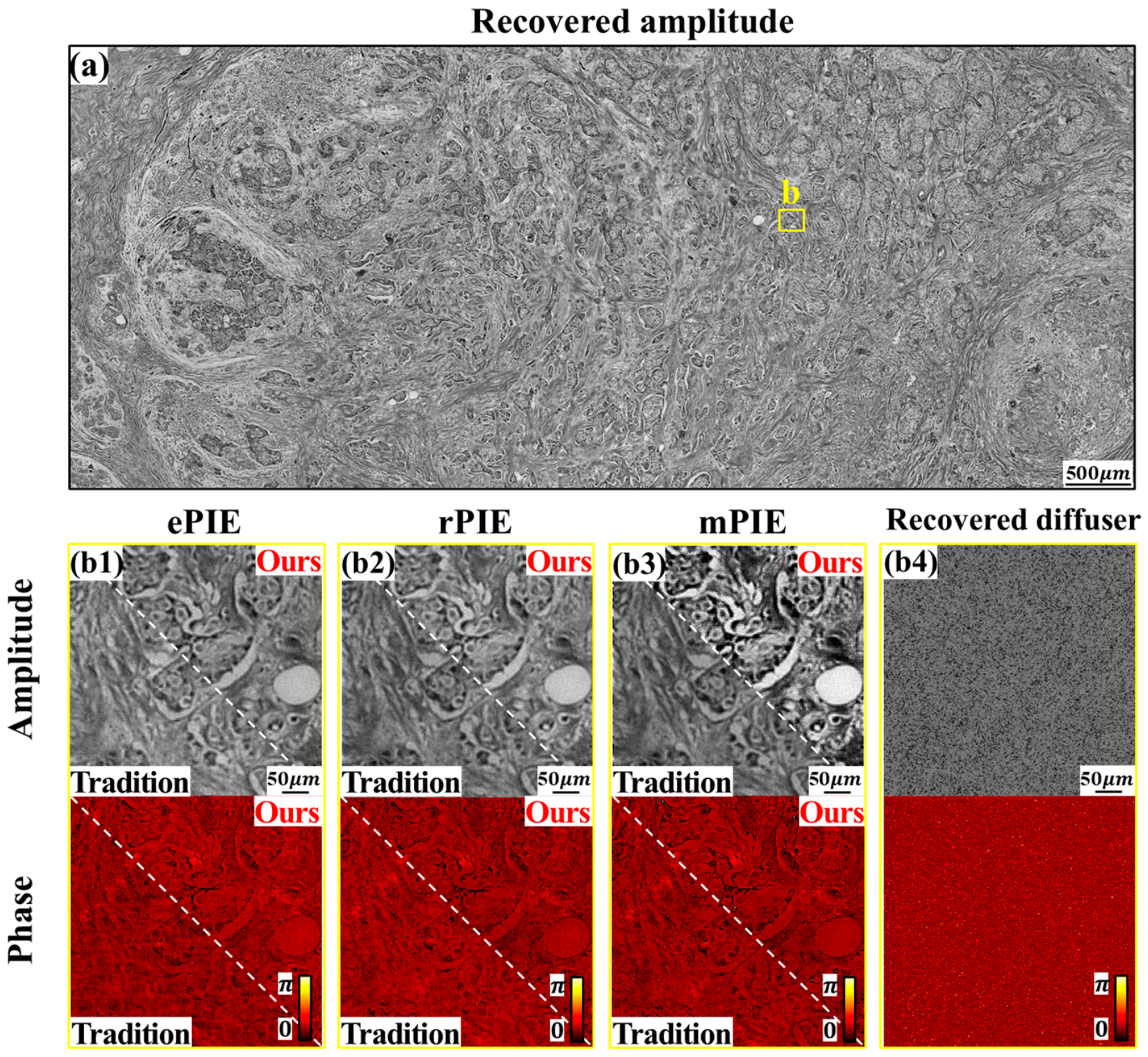
Finally, we demonstrate that the proposed approach enables high-resolution imaging with a large field-of-view. An H&E-stained human cancer tissue is used in this experiment. Figure 7a presents the recovered full-field amplitude of the sample. Figure 7b1–b3 shows magnified amplitude and phase reconstructions of the highlighted regions in Figure 7a obtained using the proposed approach and the conventional CP, while the recovered coded surface profile is shown in Figure 7b4. Furthermore, the computational efficiency of the proposed approach and conventional CP is benchmarked on the same GPU platform using 288 measurements with a resolution of 800 × 800 pixels. The proposed approach converges within 10 iterations, with an overall runtime of 113 s including both the initialization and iterative phase retrieval process. In contrast, conventional CP requires 20 iterations to achieve comparable reconstruction convergence under identical parameters, with a total runtime of 222 s, demonstrating the significant acceleration achieved by the proposed approach.
Figure 7.
Experimental validation using an H&E-stained human cancer smear. (a) The recovered amplitude of the sample; (b1–b3) Magnified amplitude and phase reconstruction results of the highlighted regions in (a). (b4) Recovered amplitude and phase of coded surface.
5. Discussion and Conclusions
The proposed joint optimization framework improves the reconstruction efficiency of lensless coded ptychography by integrating a continuous non-uniform scanning strategy with a low-resolution rPIE-based initialization method. Unlike conventional approaches that primarily accelerate reconstruction by modifying iterative algorithms, the proposed framework jointly optimizes both the data acquisition and reconstruction stages, reducing measurement redundancy while improving the quality of the initial estimate. Consequently, faster convergence is achieved without sacrificing reconstruction accuracy. Both simulation and experimental results demonstrate that the proposed framework consistently outperforms conventional uniform scanning with intensity-averaged initialization in terms of reconstruction fidelity and convergence performance.
From the perspective of data acquisition, the scanning trajectory determines the diversity of spatial-frequency information and the stability of phase retrieval. Conventional raster scanning employs a fixed overlap ratio, leading to substantial redundancy because adjacent diffraction patterns contain highly correlated information. Previous studies have improved acquisition efficiency through random scanning, and motionless coded ptychography. However, these methods generally require additional hardware or complex calibration procedures. In contrast, the proposed continuous non-uniform scanning strategy only modifies the scan interval while preserving the existing optical configuration, thereby increasing spatial-frequency diversity without increasing system complexity. As demonstrated in Figure 5, Figure 6 and Figure 7, this strategy achieves improved reconstruction quality under the same imaging conditions. In addition, the low-resolution rPIE-based initialization provides a more physically consistent estimate of the object and coded surface than conventional intensity-averaged initialization, effectively reducing the search space of subsequent optimization. The convergence curves in Figure 4 confirm that the proposed initialization substantially accelerates convergence while maintaining reconstruction accuracy.
Compared with existing acceleration methods, the primary advantage of the proposed framework lies in the joint optimization of multiple stages of the imaging pipeline rather than improving a single component. Previous studies have mainly focused on optimizing either the iterative algorithm, the scanning trajectory, or the initialization strategy independently. By integrating continuous non-uniform scanning, low-resolution rPIE-based initialization, and momentum-assisted reconstruction into a unified framework, the proposed method fully exploits the complementary advantages of these strategies. The ablation experiments further demonstrate that each individual optimization provides only limited performance improvement, whereas their combination achieves the highest reconstruction fidelity and the fastest convergence, highlighting the effectiveness of collaborative optimization across the entire imaging process.
Despite these advantages, the proposed approach involves additional optimization parameters and requires accurate displacement estimation, which may limit further improvements in convergence efficiency and introduce position-related errors [27,28,29,30,31,32,33]. In practical experiments, scan positions inevitably deviate from their nominal values because of translation-stage inaccuracies and mechanical fluctuations. To mitigate the influence of positioning errors, the proposed framework employs a cross-correlation-based position correction strategy, in which the actual scanning positions are estimated directly from the recorded intensity measurements and further refined using a sub-pixel image registration algorithm [20,34]. Consequently, the reconstruction is performed using the corrected scanning positions rather than the nominal stage coordinates, effectively compensating for moderate positioning errors under the current experimental conditions.
In summary, this work introduces a continuous non-uniform scanning strategy and a low-resolution rPIE-based initialization approach to accelerate reconstruction in lensless coded ptychography. The proposed framework improves reconstruction efficiency while maintaining high image fidelity. Experimental results demonstrate that continuous non-uniform scanning reduces measurement redundancy and accelerates reconstruction compared with conventional uniform scanning. Moreover, the optimized initialization consistently improves convergence speed and reconstruction robustness compared with conventional intensity-averaged initialization. Under the same measurement budget, the proposed framework reduces the required number of reconstruction iterations by approximately 50% while recovering finer structural details, indicating that the improvement is achieved through enhanced convergence efficiency rather than a reduction in the amount of acquired data. This proposed approach has potential for high-throughput applications such as digital pathology.
Supplementary Materials
The following supporting information can be downloaded at: https://www.mdpi.com/article/10.3390/photonics13090828/s1, Figure S1: Initialization and iterative reconstruction process; Figure S2: Influence of the step-size variation factor α on reconstruction performance; Figure S3: Optimized initialization improves initial estimates of both the object wavefront and the coded surface; Figure S4: Robustness evaluation against Gaussian noise for the proposed method and conventional CP.
Author Contributions
The Conceptualization, L.Y., Y.L., S.J. and P.Y.; methodology, L.Y., Y.L. and S.J.; software, P.Y. and L.J.; validation, P.Y.; formal analysis, P.Y.; investigation, P.Y. and L.J.; resources, P.Y. and L.J.; data curation, P.Y.; writing—original draft preparation, P.Y.; writing—review and editing, L.Y., Y.L. and S.J.; visualization, P.Y., C.Z., Y.C., T.W., K.Z., B.X. and X.Z.; supervision, L.Y., Y.L. and S.J.; project administration, L.Y., Y.L. and S.J.; funding acquisition, L.Y., Y.L. and S.J. All authors have read and agreed to the published version of the manuscript.
Funding
This research was funded by the National Natural Science Foundation of China (62405360), the Key Research and Development Program of Shaanxi Province (2025SF-YBXM-469), the Zhejiang Provincial Natural Science Foundation of China (LR25F050003), Fundamental Research Funds for the Provincial Universities of Zhejiang (GK269910299001-034) and Xinmiao Project of Zhejiang Provincial Applied Basic Research Program (2026XMHD026).
Data Availability Statement
The authors will supply the relevant data in response to reasonable requests.
Conflicts of Interest
The authors declare no conflicts of interest. The funders had no role in the design of the study; in the collection, analyses, or interpretation of data; in the writing of the manuscript; or in the decision to publish the results.
References
- Marrison, J.; Räty, L.; Marriott, P.; O’Toole, P. Ptychography—A label free, high-contrast imaging technique for live cells using quantitative phase information. Sci. Rep. 2013, 3, 2369. [Google Scholar] [CrossRef] [Scilit]
- Ou, X.; Horstmeyer, R.; Yang, C.; Zheng, G. Quantitative phase imaging via Fourier ptychographic microscopy. Opt. Lett. 2013, 38, 4845–4848. [Google Scholar] [CrossRef] [Scilit]
- Miccio, L.; Memmolo, P.; Ferraro, P. New horizons in QPI through physics-informed aberration correction learning. Adv. Photonics 2026, 8, 020501. [Google Scholar] [CrossRef] [Scilit]
- Zheng, C.; Wang, T.; Li, Z.; Sun, R.; Yang, D.; Wang, S.; Ouyang, B.; Liu, F.; Xiang, M.; Hao, Q. Quantitative phase imaging based on Fourier ptychographic microscopy: Advances, applications, and perspectives. Adv. Imaging 2025, 2, 032001. [Google Scholar] [CrossRef] [Scilit]
- Wang, S.; Dong, B.; Xiong, J.; Liu, L.; Shan, M.; Koch, A.W.; Gao, S. Phase manipulating Fresnel lenses for wide-field quantitative phase imaging. Opt. Lett. 2025, 50, 2683–2686. [Google Scholar] [CrossRef] [Scilit]
- Zheng, Y.; Zhang, H.-R.; Li, X.-W.; Zhao, Y.-R.; Li, Z.-S.; Hou, Y.-H.; Liu, C.; Wang, Q.-H. Fast-zoom and high-resolution sparse compound-eye camera based on dual-end collaborative optimization. Opto-Electron. Adv. 2025, 8, 240285. [Google Scholar] [CrossRef] [Scilit]
- Wang, D.; Huang, Q.; Liu, C.; Zheng, Y.; Lin, Y.-C.; Lin, F.-C.; Li, Y.-L.; Zheng, X.-R.; Zheng, Y.-W.; Xie, X.; et al. A 0.18 cubic centimeter 3D meta-holographic zoom micro-projector. Nat. Commun. 2025, 16, 10735. [Google Scholar] [CrossRef] [Scilit]
- Jiang, S.; Zhu, J.; Song, P.; Guo, C.; Bian, Z.; Wang, R.; Huang, Y.; Wang, S.; Zhang, H.; Zheng, G. Wide-field, high-resolution lensless on-chip microscopy via near-field blind ptychographic modulation. Lab Chip 2020, 20, 1058–1065. [Google Scholar] [CrossRef] [Scilit]
- Bauschke, H.H.; Combettes, P.L.; Luke, D.R. Phase retrieval, error reduction algorithm, and Fienup variants: A view from convex optimization. J. Opt. Soc. Am. A 2002, 19, 1334–1345. [Google Scholar] [CrossRef] [Scilit]
- Gardner, D.F.; Tanksalvala, M.; Shanblatt, E.R.; Zhang, X.; Galloway, B.R.; Porter, C.L.; Karl, R., Jr.; Bevis, C.; Adams, D.E.; Kapteyn, H.C. Subwavelength coherent imaging of periodic samples using a 13.5 nm tabletop high-harmonic light source. Nat. Photonics 2017, 11, 259–263. [Google Scholar] [CrossRef] [Scilit]
- Li, P.; Allain, M.; Grünewald, T.A.; Rommel, M.; Campos, A.; Carbone, D.; Chamard, V. 4th generation synchrotron source boosts crystalline imaging at the nanoscale. Light Sci. Appl. 2022, 11, 73. [Google Scholar] [CrossRef] [Scilit]
- You, R.; Chen, J.; Wang, Y.; Zhang, Z.; Sun, Y.; Song, B.; Loy, D.A.; Ji, Z.; Hong, Z.; Liang, R. Cost-effective motionless color coded ptychography for high-throughput biomedical imaging. ACS Photonics 2025, 12, 3236–3244. [Google Scholar] [CrossRef] [Scilit]
- Chowdhury, S.; Chen, M.; Eckert, R.; Ren, D.; Wu, F.; Repina, N.; Waller, L. High-resolution 3D refractive index microscopy of multiple-scattering samples from intensity images. Optica 2019, 6, 1211–1219. [Google Scholar] [CrossRef] [Scilit]
- Jiang, S.; Guo, C.; Bian, Z.; Wang, R.; Zhu, J.; Song, P.; Hu, P.; Hu, D.; Zhang, Z.; Hoshino, K. Ptychographic sensor for large-scale lensless microbial monitoring with high spatiotemporal resolution. Biosens. Bioelectron. 2022, 196, 113699. [Google Scholar] [CrossRef] [Scilit]
- Li, M.; Bian, L.; Zhang, J. Multi-slice coded coherent diffraction imaging. Opt. Lasers Eng. 2022, 151, 106929. [Google Scholar] [CrossRef] [Scilit]
- Ma, R.; Li, Y.; Jia, H.; Shi, Y.; Xie, X.; Huang, T. Optical information hiding with non-mechanical ptychography encoding. Opt. Lasers Eng. 2021, 141, 106569. [Google Scholar] [CrossRef] [Scilit]
- Wen, X.; Li, Y.; Zhou, X.; Ji, Y.; Zhou, K.; Liu, S.; Chi, D.; Jia, D.; Liu, Z. Phase retrieval with dynamic linear combination in multiple intensity measurements. Opt. Lasers Eng. 2022, 159, 107200. [Google Scholar] [CrossRef] [Scilit]
- Rodenburg, J.M.; Faulkner, H.M. A phase retrieval algorithm for shifting illumination. Appl. Phys. Lett. 2004, 85, 4795–4797. [Google Scholar] [CrossRef] [Scilit]
- Guo, C.; Huang, Y.; Han, R.; Wang, R.; Zhao, Q.; Jiang, S.; Song, P.; Shao, X.; Zheng, G. Fly-scan high-throughput coded ptychographic microscopy via active micro-vibration and rolling-shutter distortion correction. Opt. Express 2024, 32, 8778–8790. [Google Scholar] [CrossRef] [Scilit]
- Wang, T.; Song, P.; Jiang, S.; Wang, R.; Yang, L.; Guo, C.; Zhang, Z.; Zheng, G. Remote referencing strategy for high-resolution coded ptychographic imaging. Opt. Lett. 2023, 48, 485–488. [Google Scholar] [CrossRef] [Scilit]
- Song, P.; Guo, C.; Jiang, S.; Wang, T.; Hu, P.; Hu, D.; Zhang, Z.; Feng, B.; Zheng, G. Optofluidic ptychography on a chip. Lab Chip 2021, 21, 4549–4556. [Google Scholar] [CrossRef] [Scilit]
- Maiden, A.M.; Rodenburg, J.M. An improved ptychographical phase retrieval algorithm for diffractive imaging. Ultramicroscopy 2009, 109, 1256–1262. [Google Scholar] [CrossRef] [Scilit]
- Maiden, A.; Johnson, D.; Li, P. Further improvements to the ptychographical iterative engine. Optica 2017, 4, 736–745. [Google Scholar] [CrossRef] [Scilit]
- Batey, D.; Edo, T.; Rau, C.; Wagner, U.; Pešić, Z.; Waigh, T.; Rodenburg, J. Reciprocal-space up-sampling from real-space oversampling in X-ray ptychography. Phys. Rev. A 2014, 89, 043812. [Google Scholar] [CrossRef] [Scilit]
- Weber, A.G. The USC-SIPI Image Database: Version 5. Available online: http://sipi.usc.edu/database/ (accessed on 10 June 2026).
- Wang, Z.; Bovik, A.C.; Sheikh, H.R.; Simoncelli, E.P. Image quality assessment: From error visibility to structural similarity. IEEE Trans. Image Process. 2004, 13, 600–612. [Google Scholar] [CrossRef] [Scilit] [PubMed]
- Beckers, M.; Senkbeil, T.; Gorniak, T.; Giewekemeyer, K.; Salditt, T.; Rosenhahn, A. Drift correction in ptychographic diffractive imaging. Ultramicroscopy 2013, 126, 44–47. [Google Scholar] [CrossRef] [Scilit]
- Guizar-Sicairos, M.; Fienup, J.R. Phase retrieval with transverse translation diversity: A nonlinear optimization approach. Opt. Express 2008, 16, 7264–7278. [Google Scholar] [CrossRef] [Scilit]
- Liu, S.; Xu, Z.; Zhang, X.; Chen, B.; Wang, Y.; Tai, R. Position-guided ptychography for vibration suppression with the aid of a laser interferometer. Opt. Lasers Eng. 2023, 160, 107297. [Google Scholar] [CrossRef] [Scilit]
- Maiden, A.; Humphry, M.; Sarahan, M.; Kraus, B.; Rodenburg, J. An annealing algorithm to correct positioning errors in ptychography. Ultramicroscopy 2012, 120, 64–72. [Google Scholar] [CrossRef] [Scilit]
- Tripathi, A.; McNulty, I.; Shpyrko, O.G. Ptychographic overlap constraint errors and the limits of their numerical recovery using conjugate gradient descent methods. Opt. Express 2014, 22, 1452–1466. [Google Scholar] [CrossRef] [Scilit]
- Yang, W.; Sha, H.; Cui, J.; Mao, L.; Yu, R. Local-orbital ptychography for ultrahigh-resolution imaging. Nat. Nanotechnol. 2024, 19, 612–617. [Google Scholar] [CrossRef] [Scilit]
- Zhang, F.; Peterson, I.; Vila-Comamala, J.; Diaz, A.; Berenguer, F.; Bean, R.; Chen, B.; Menzel, A.; Robinson, I.K.; Rodenburg, J.M. Translation position determination in ptychographic coherent diffraction imaging. Opt. Express 2013, 21, 13592–13606. [Google Scholar] [CrossRef] [Scilit]
- Guizar-Sicairos, M.; Thurman, S.T.; Fienup, J.R. Efficient subpixel image registration algorithms. Opt. Lett. 2008, 33, 156–158. [Google Scholar] [CrossRef] [Scilit]
Disclaimer/Publisher’s Note: The statements, opinions and data contained in all publications are solely those of the individual author(s) and contributor(s) and not of MDPI and/or the editor(s). MDPI and/or the editor(s) disclaim responsibility for any injury to people or property resulting from any ideas, methods, instructions or products referred to in the content. |
© 2026 by the authors. Licensee MDPI, Basel, Switzerland. This article is an open access article distributed under the terms and conditions of the Creative Commons Attribution (CC BY) license.