


Abstract
In this paper, we systematically investigate the near-field radiative heat transfer in a two-body system described by the Lorentz model. Under a finite temperature difference between the upper and lower plates, we explore the evolution of radiative heat transfer by tuning the longitudinal and transverse optical phonon frequencies. Our results show that the near-field radiative heat flux can exceed the blackbody radiation limit by several orders of magnitude. Both the longitudinal and transverse phonon frequencies serve as effective control knobs, enabling broadband modulation of the spectral heat transfer. Furthermore, mirror-symmetric modulation of these phonon frequencies in both plates significantly enhances the tunability of the near-field heat transfer. The findings obtained in this study provide valuable theoretical insights and a fundamental reference framework for designing actively tunable near-field thermal devices based on similar material platforms.
1. Introduction
Near-field thermal radiation refers to the phenomenon of near-field heat transfer between objects when the spacing between them is equal to or less than the characteristic wavelength, and the radiative heat transfer between them occurs far beyond the limit of black-body radiation due to the tunnelling effect of the evanescent waves [1]. Utilizing this effect, near-field thermal radiation provides a theoretical basis and design inspiration for many emerging thermal technologies, such as near-field radiative thermal diodes [2], near-field thermophotovoltaics [3], thermal rectifiers [4], electroluminescent cooling [5], and heat-assisted magnetic recording technology [6], finding concrete applications in various fields. Based on this, researchers are exploring various structures, materials, and mechanisms to achieve the enhancement and manipulation of near-field thermal radiation. Researchers recognize that when the dimensions of an object are comparable to the characteristic wavelength, interference effects make near-field thermal radiation dependent on the size and shape of the object. Therefore, the phenomenon of near-field thermal radiation in various micro-nanostructures has attracted widespread attention. For example, near-field thermal radiation phenomena in various micro/nanostructures, such as coaxial cylindrical structures [7], heterostructures [8], charged parallel plate structures [9], metal plate structures [10], metamaterial structures [11], and photonic crystal multilayer structures [12], have been reported. Furthermore, the microstructures of various materials, including two-dimensional atomic crystal materials [13], Weyl semimetal materials [14], calcite [15], phase-change materials [16], and near-zero refractive index materials [17], have been extensively discussed for their potential role in enhancing near-field thermal radiation due to the positive effects of material properties. In particular, hyperbolic materials represented by hBN have attracted widespread attention in the field of near-field thermal radiation research due to their excellent optoelectronic properties and the ability to excite hyperbolic phonon polaritons, leading to the emergence of many intriguing phenomena. The enhancement mechanisms of near-field thermal radiation in structures such as uniaxial hBN hyperbolic films [18], biaxial hyperbolic α-MoO3 films [19], and their composite structures have been investigated in depth in recent years. In terms of mechanisms, inducing various optical effects in microstructures is an effective means to achieve near-field thermal radiation. Among these optical effects, the excitation of plasmons is widely recognized as a means to significantly enhance near-field thermal radiation, surpassing the blackbody limit by orders of magnitude, which has sparked widespread interest among researchers. Beyond conventional surface phonon polaritons and plasmon polaritons, recent breakthroughs have revealed that anisotropic polariton dispersion provides unprecedented freedom for thermal regulation. For instance, polariton topological transitions in hyperbolic media have been exploited to achieve broadband enhancement of radiative heat transfer and hysteresis-like modulation of the heat flux [20]. Shear polaritons in low-symmetry crystals introduce strong in-plane anisotropy, enabling twist-angle control of near-field energy transfer [21]. Heterostructures combining black phosphorus and hexagonal boron nitride exhibit photon tunneling reconstitution, where the coupling between anisotropic plasmonic and phononic modes creates extraordinary transmission channels that actively modulate the near-field heat flux [22]. In addition, phase-change materials such as VO2 have been utilized to achieve active switching of near-field heat transfer through the metal-insulator transition [16]. These studies collectively demonstrate that active polariton control, rather than passive material selection, is the key to achieving high-performance, dynamically switchable near-field thermal radiation. Inspired by these insights, our work adopts the Lorentz model as a minimal yet universal platform to systematically probe how intrinsic phonon frequencies govern polariton-mediated heat transfer, independent of specific material details. This has been demonstrated by numerous studies both theoretically and experimentally. For instance, surface plasmon polaritons or surface phonon polaritons excited in isotropic materials such as metals or polar materials can significantly enhance photon tunneling, thereby creating conditions for the enhancement of near-field thermal radiation. It should be noted that this enhancement often occurs within a narrow band range around the resonance frequency of surface excitations. Furthermore, hyperbolic materials not only can excite hyperbolic phonon polaritons but can also excite them over a broad frequency range. This not only provides a more diverse means to achieve a significant enhancement of near-field radiative heat transfer but also enriches the pathways for near-field radiative heat exchange. On this basis, the combination of hyperbolic materials and two-dimensional plasmonic materials has also attracted attention. The coupling between hyperbolic phonon polaritons and surface plasmon polaritons can lead to even more intriguing near-field radiative heat transfer phenomena. A breakthrough is expected to achieve enhanced near-field radiation. Of course, in addition to surface plasmon polaritons and surface phonon polaritons, other mechanisms such as optical Tamm states [23], topological interface states [24], have been reported as alternative approaches to achieve enhanced near-field thermal radiation.
While a variety of near-field thermal radiation enhancement schemes have provided rich and feasible references for the application of near-field thermal radiation in thermal functional devices, researchers have also recognized the significance of further achieving flexible control over near-field thermal radiation based on this foundation. Accurate control of the near-field radiation spectrum and energy is of great practical significance for achieving dynamically controllable thermal functional devices based on near-field thermal radiation. In response to this demand, on the one hand, researchers are attempting to manipulate near-field thermal radiation by altering the interlocking angles of anisotropic materials or by constructing various shapes to achieve artificial anisotropy [25,26,27]; on the other hand, various approaches have been proposed, such as photonic crystal structures and plate structures dynamically controlled by a magnetic field, as well as Dirac semimetal schemes dynamically controlled by an external electric field [28,29,30]. Particularly noteworthy is the significant advantage of graphene in the dynamic control of near-field heat radiation due to its dynamically tunable electrical conductivity characteristics. For example, He et al. conducted a study on the modulation of near-field radiative heat transfer between two graphene grating arrays by employing mechanical rotation and an external magnetic field [31]. Shi et al. proposed an efficient control scheme for near-field radiation heat transfer based on mode mismatching in graphene plasmon resonance. They achieved a higher modulation depth of near-field radiative heat transfer energy than other known experimental methods by breaking the symmetry of resonant modes through changing the Fermi levels of the emitter or receiver [32].
Various approaches have been proposed for modulating near-field heat transfer, including grating-based structures [33], hyperbolic metamaterials [34], nanowire arrays [35,36], and graphene-based systems [37,38]. However, these studies are typically material-specific and do not provide a general parametric understanding of the underlying phonon-mediated mechanisms.
Despite extensive efforts to enhance and manipulate near-field thermal radiation, the majority of existing studies remain confined to specific material platforms or pre-designed microstructures, with limited attention paid to systematic parametric investigations grounded in fundamental theoretical frameworks. Recent advances in polariton engineering, including topological transition effects in hyperbolic media [20], shear polaritons in low-symmetry Bravais crystals [21], and photon tunneling reconstitution in black phosphorus/hexagonal boron nitride heterostructures [22], have unveiled versatile pathways for tailoring near-field energy transfer. Nevertheless, a unified theoretical model that quantitatively links the modulation behavior to intrinsic phonon parameters is still lacking. To address this gap, we present a systematic theoretical study of near-field radiative heat transfer in a two-body system governed by the Lorentz model. By modulating the longitudinal and transverse optical phonon frequencies under both single-plate and mirror-symmetric configurations, we elucidate the underlying mode-coupling physics and establish a generic theoretical framework that can serve as a reference platform for designing actively tunable near-field thermal devices. More importantly, our analysis provides predictive physical trends that are expected to be observable in realistic material systems. For instance, the predicted phonon-frequency modulation effects can be realized through metasurface engineering, where effective Lorentz-type responses can be artificially designed by tailoring the geometric parameters of subwavelength resonators. Such an approach bridges the gap between theoretical predictions and experimental implementations, offering a feasible pathway to verify the predicted phenomena in practical polar dielectric platforms, including cubic boron nitride and other polar crystals.
2. Theoretical Model and Method
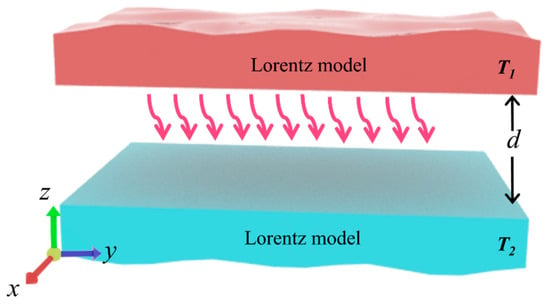
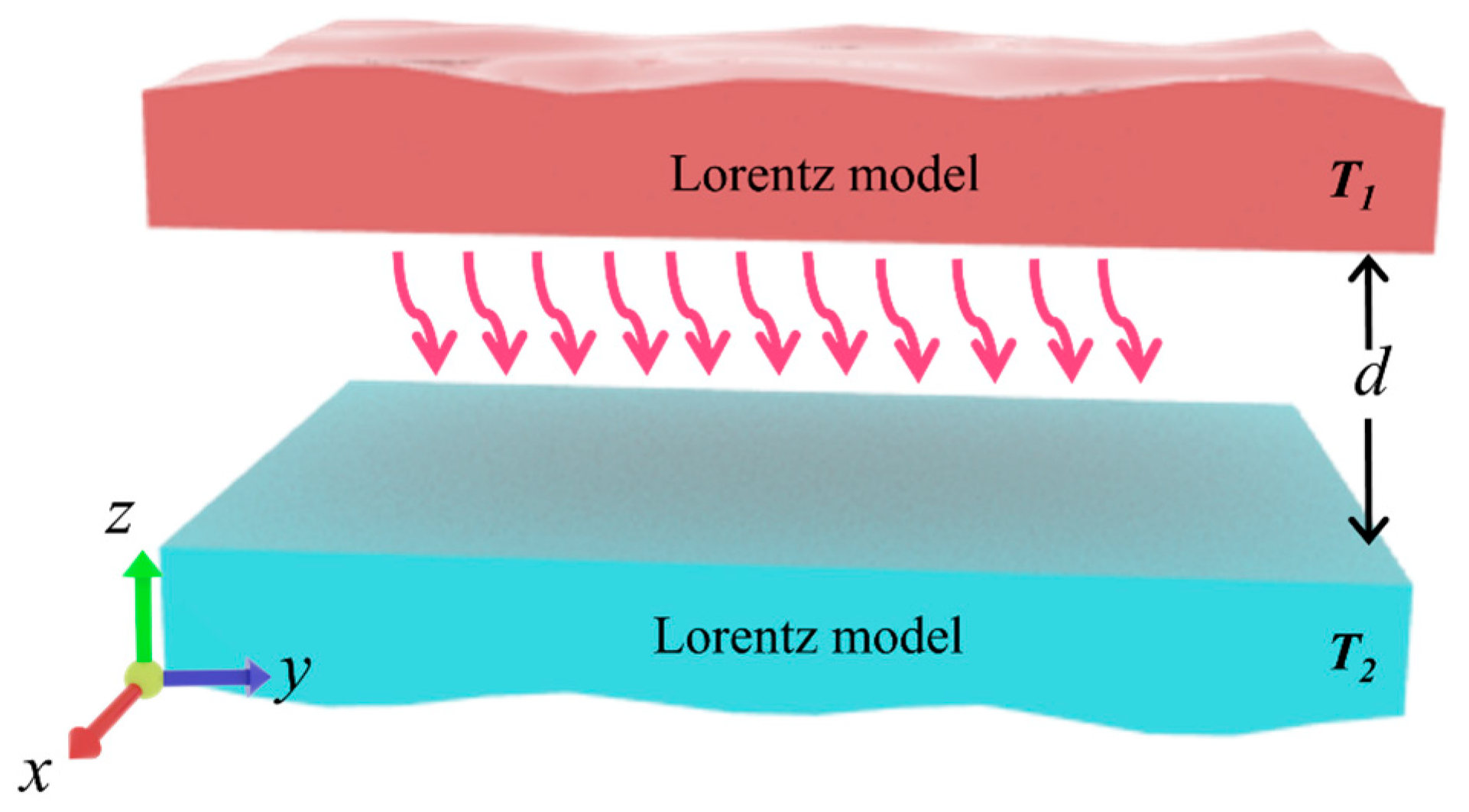
We consider the structure as shown in Figure 1, where two plates satisfying the Lorentz theory model are placed in parallel with a fixed gap, thus forming a near-field radiative heat transfer system based on the two-body Lorentz theory model. object 1 and object 2 are two semi-infinite plates separated by a vacuum gap with a thickness of . We set the vacuum gap distance as . The temperatures of object 1 and object 2 are set to and , respectively.
Figure 1.
A near-field radiative heat transfer system composed of two Lorentzian materials with a vacuum gap .
Using the fluctuation-dissipation theorem and the vectorial Green’s function, we can calculate the near-field net radiative heat flux [39]:
here, is the in-plane wave vector, and is the average energy of a Planck’s oscillator as a function of angular frequency ω at temperature . represents the energy transmission coefficient contributions from both propagating and evanescent modes and can be expressed as
here, and (; ) are the reflection and transmission coefficients for TE (s-polarized) and TM (p-polarized) modes, respectively, in dielectric slab i. For the transverse and reflectance coefficients of the Lorentz model dielectric material, incident from vacuum, they can be expressed as
where is the out-of-plane wave vector for the dielectric plate , and is the corresponding dielectric constant for the slab, which can be expressed as
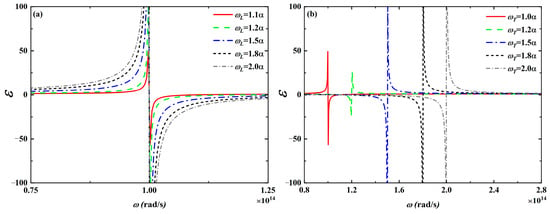
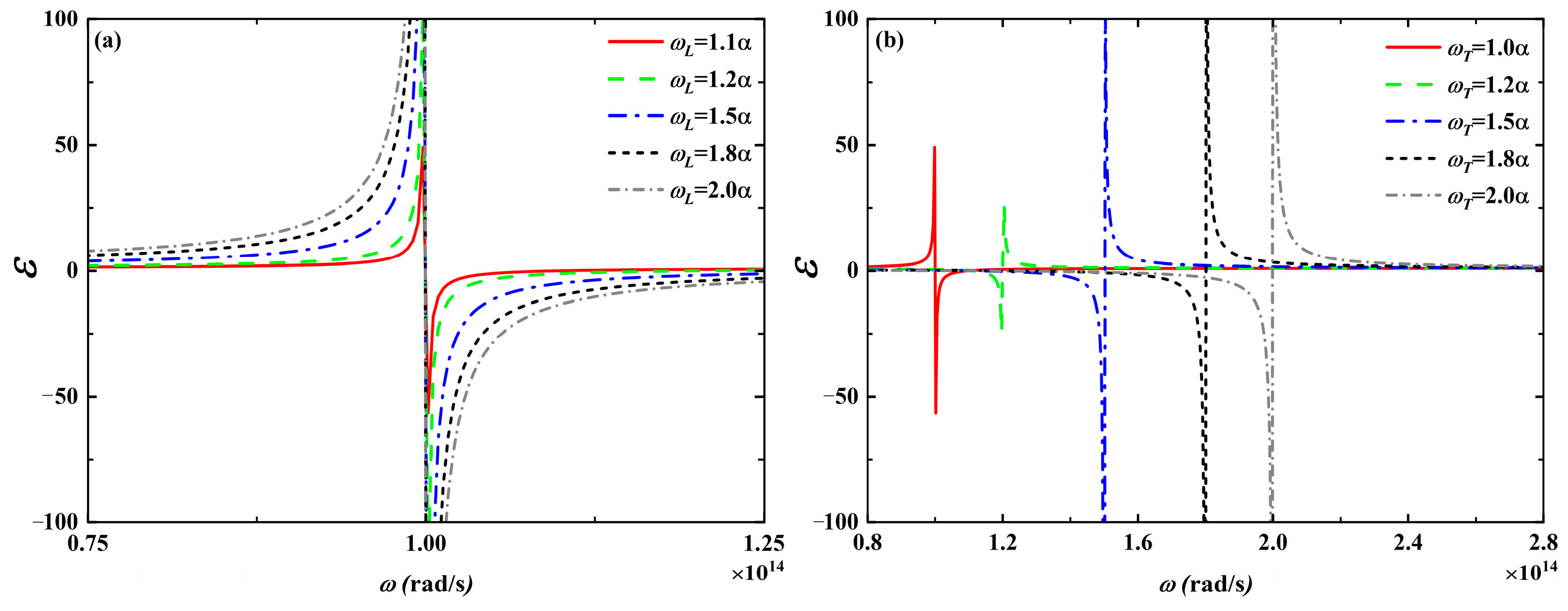
where is the high-frequency dielectric constant, is the longitudinal optical phonon frequency, is the transverse optical phonon frequency, and is the phonon damping. Definition . Here, we set the initial fundamental parameters of the Lorentz theory model as follows: , , , . The chosen Lorentz parameters with and are representative of polar dielectric materials, whose optical phonon frequencies lie in the terahertz range. We emphasize that and are treated as theoretical control variables for parametric sweeps. In realistic systems, their effective values may be engineered through material selection, compositional alloying, strain, temperature tuning, or heterostructure design. In this paper, the longitudinal and transverse optical phonon frequencies of the upper and lower plates are set to their initial parameters unless otherwise specified. To validate the physical relevance of the Lorentz model parameters employed in this work, we take cBN as a representative polar dielectric material. The longitudinal optical phonon frequency , transverse optical phonon frequency , high-frequency dielectric constant , and phonon damping of cBN are adopted from experimental and first-principles literature. These realistic parameters allow us to directly demonstrate the heat transfer characteristics achievable in a practical material system. Importantly, our parameter space is not restricted to naturally occurring materials. Advances in metasurface engineering now enable the construction of artificial structures with effective Lorentz-type dielectric responses, where the effective phonon frequencies can be tailored by designing the geometric parameters of subwavelength resonators. This provides a viable route to realize the predicted phonon-frequency modulation effects in experimentally accessible platforms, bridging the gap between theoretical predictions and practical implementations across a broad range of polar dielectric systems. To investigate the influence of longitudinal and transverse phonon frequencies on the optical response of materials, we plotted the frequency-dependent real part of the main diagonal dielectric function for different longitudinal and transverse phonon frequencies, as shown in Figure 2. It is evident from the graph that the real part of the main diagonal dielectric constant increases with the increase in the longitudinal optical phonon frequency. Furthermore, the increase in the transverse optical phonon frequency results in a varying degree of blue shift in the peak of the dielectric function. Simultaneously, the polarization direction of the dielectric response undergoes a change.
Figure 2.
Variation in the real part of the dielectric constant with angular frequency for different longitudinal phonon frequencies (a) and transverse phonon frequencies (b).
This work is built upon the framework of the Lorentz theory model. However, by incorporating profound insights gained over the past few decades in the realm of microstructure metamaterials, we can actualize this theoretical model by applying it to the specific structures of meta-surfaces or metamaterials. Based on this practical model, it holds significant practical relevance in terms of both dynamic adjustability and feasibility. In this study, we are currently approaching the subject solely from a theoretical standpoint. Numerical simulations and device design aspects are anticipated to be elucidated in subsequent phases of our research.
3. Results and Discussions
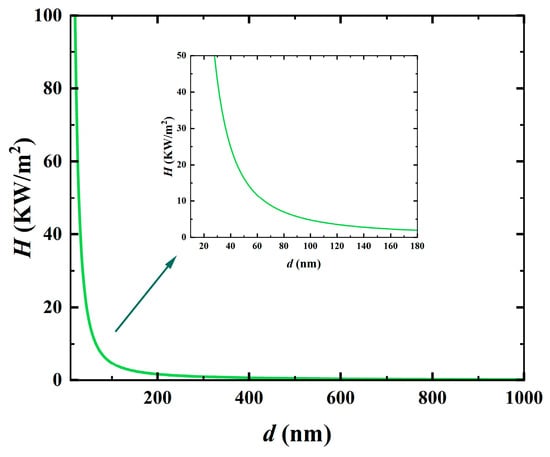
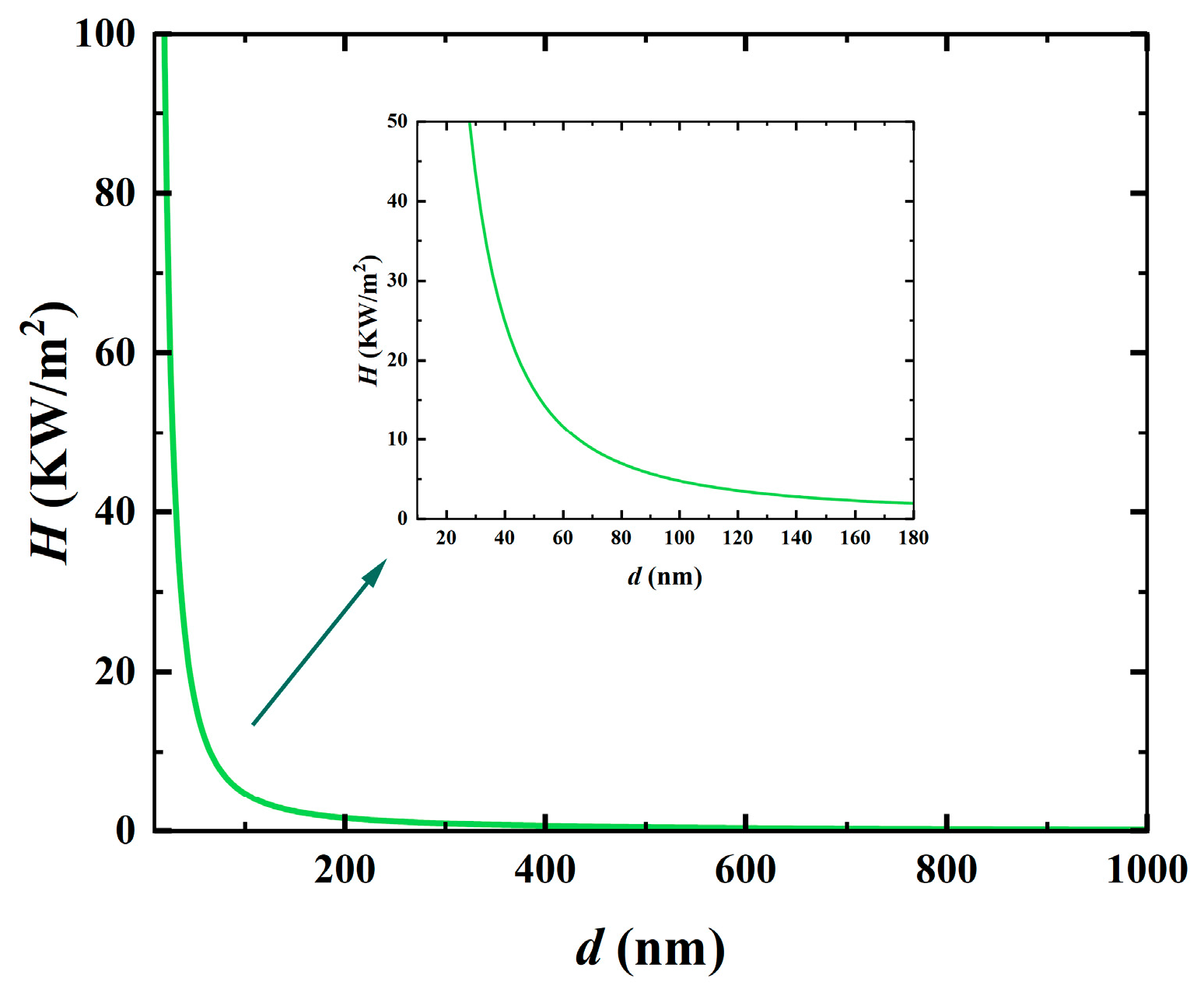
We have also calculated the distance-dependent net radiative heat flux for cBN structures using the realistic material parameters listed in Section 2, and the results are included in the inset of Figure 3 for comparison with the Lorentz model predictions. These calculations demonstrate that our adopted phonon frequencies and permittivity parameters are not purely arbitrary. The Lorentz parameters of cBN, including its longitudinal and transverse optical phonon frequencies, are taken from experimental and first-principles literature, thereby validating the physical relevance of our theoretical framework. The tunable variations of and in our parametric sweeps are intended to explore the general physical trends of phonon-frequency splitting on near-field thermal radiation. Such modulations are experimentally feasible through isotope engineering, strain engineering, or epitaxial lattice modification, as widely demonstrated for polar crystals such as cBN. Beyond naturally occurring materials, metasurface engineering offers a versatile platform for constructing artificial structures with effective Lorentz-type dielectric responses, where the effective phonon frequencies can be tailored by designing the geometric parameters of subwavelength resonators. This provides an experimentally viable route to realize the predicted phonon-modulation effects across a broad range of polar dielectric systems.
Figure 3.
Distance-dependent net radiative heat flux for cBN structures as a function of vacuum gap distance . The inset shows the enlarged view of the curve for small separation distances.
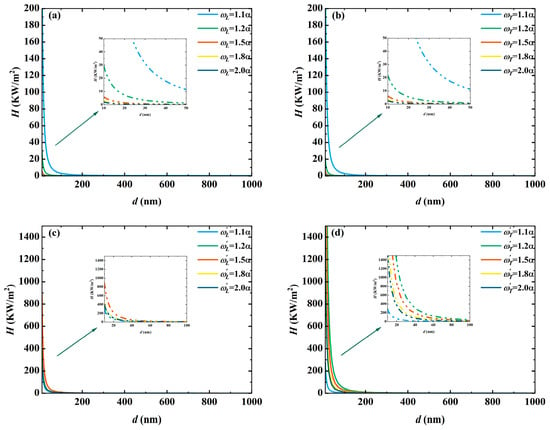
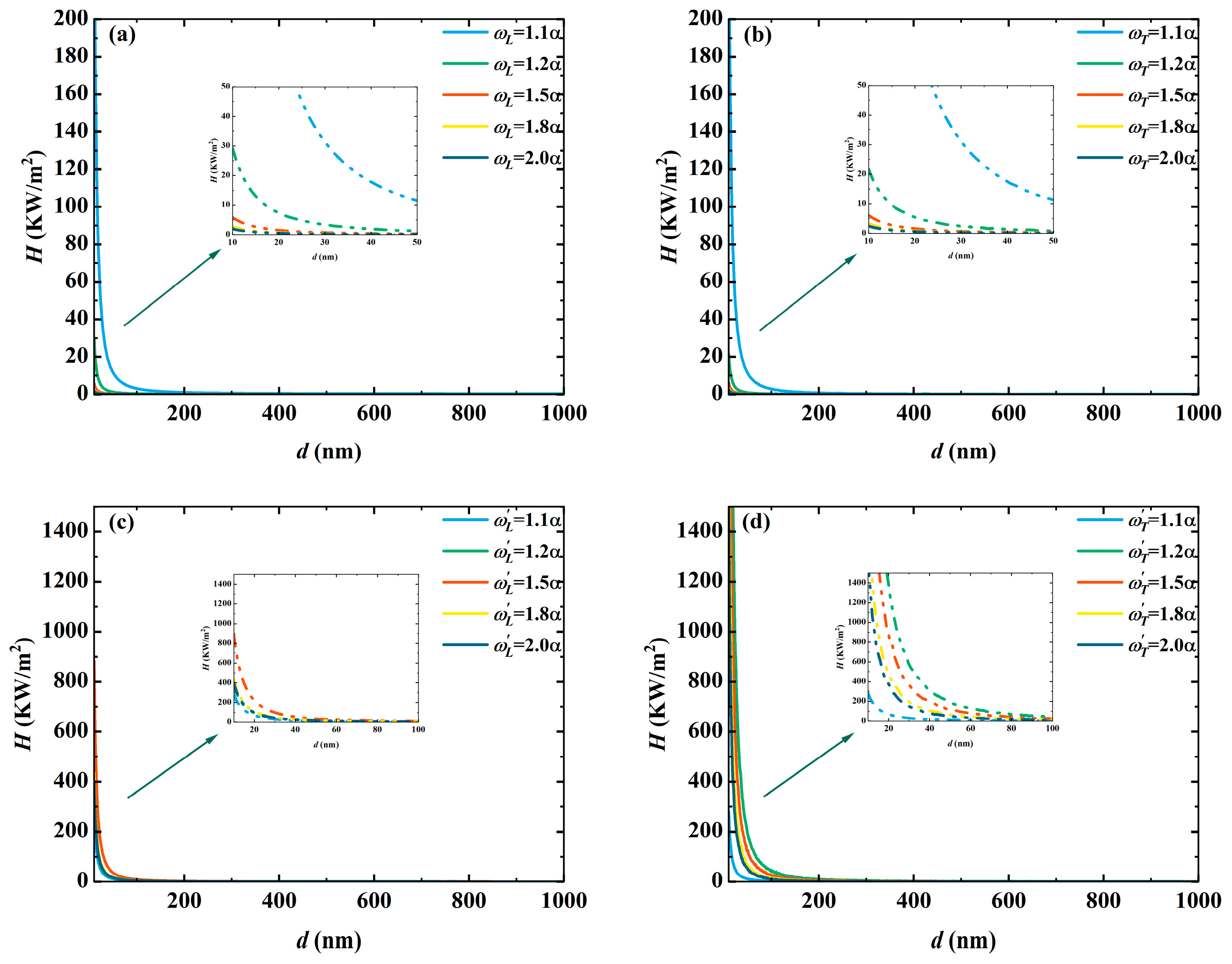
To further quantify the modulation of near-field radiative heat flux by phonon resonance frequencies, we calculated the Net radiative heat flux as a function of separation distance d for various and , as shown in Figure 4. Figure 4a,b correspond to asymmetric configurations where only the upper plate is modulated, while Figure 4c,d correspond to symmetric configurations where both plates are modulated in a mirror-symmetric manner. In all cases, the heat flux decays monotonically with increasing , due to the exponential attenuation of evanescent-wave tunneling. Notably, the modulation amplitude is substantially stronger in symmetric configurations than in asymmetric ones. For example, increasing in the symmetric case Figure 4c causes a much larger reduction in heat flux than in the asymmetric case Figure 4a. Similarly, symmetric modulation of Figure 4d yields a more pronounced suppression than its asymmetric counterpart Figure 4b. This difference arises because symmetric modulation induces concurrent blue shifts in the dielectric function in both plates, rapidly aggravating the resonance mismatch between the surface phonon polariton modes and thereby weakening photon tunneling. In contrast, asymmetric modulation alters the optical response of only one plate, allowing partial mode overlap and resulting in a relatively moderate change in heat flux. Furthermore, a lower or consistently yields a higher near-field heat flux in both configurations, while increasing the resonance frequency progressively suppresses heat transfer. This trend holds across the entire range from to 1000 nm, confirming that both phonon frequencies serve as effective tuning parameters. The monotonic decay also justifies our choice of d = 10 nm for subsequent spectral analyses, where the near-field enhancement is most pronounced.
Figure 4.
Net radiative heat flux versus vacuum gap distance under different phonon frequencies: (a,b) asymmetric structures for longitudinal and transverse phonon frequencies; (c,d) symmetric structures for longitudinal and transverse phonon frequencies. The inset shows the enlarged view of the curve for small separation distances.
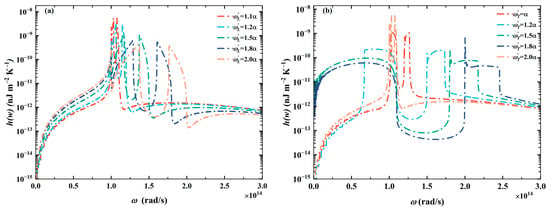
In the previous section, we discussed the impact of the vacuum gap size on the near-field radiative heat flux under the initial Lorentz parameter conditions. However, the configuration of the longitudinal and transverse phonon frequency parameters in the Lorentz theory model also has a significant influence on the optical response of the theoretical model medium. By examining the longitudinal and transverse phonon frequencies in the Lorentz theory model, we can achieve control over near-field radiative heat transfer between theoretical model media. In order to investigate the physical mechanism of the effect of longitudinal optical phonon frequency on the transmission of near-field thermal radiation. We draw the spectral transmission coefficients of the upper parallel plate at different longitudinal phonon frequencies, as shown in Figure 5a. It is evident that, with the increase in the longitudinal optical phonon frequency, the peaks and valleys on the right side of the spectral transmission coefficient experience a blue shift, while the overall spectral transmission coefficient gradually decreases. This is attributed to the increase in the longitudinal optical phonon frequency, which alters the dielectric response of the Lorentz model. As the frequency of the longitudinal optical phonon increases, the value of the dielectric constant will also increase, expanding the negative region of the dielectric constant into a larger frequency domain. Furthermore, we investigated the influence of different parameter values of the transverse optical phonon frequency in the upper parallel plate on the near-field radiative heat transfer in the two-body system, as shown in Figure 5b. As the transverse optical phonon frequency increases, the overall spectral transmission coefficient decreases, while the positions of the peaks and valleys gradually blue-shift. This is attributed to the coupling of modes between the upper and lower plates. We varied the transverse optical phonon frequency of the upper plate, resulting in a blue shift in the dielectric constant. At the same time, the sign of the dielectric constant is reversed. This led to a blue shift in the peaks and valleys of the spectral heat transfer coefficient. Therefore, we believe that the parameter settings of longitudinal and transverse phonon frequencies in the Lorentz theory model can enable parametric modulation of near-field radiative heat transfer in this two-body system. Since the frequency range of the bright line is , in order to facilitate the comparison with Figure 5a,b, the remaining plots use only the most varied frequency ranges.
Figure 5.
Spectral heat flux as a function of frequency for different (a) and (b) with varied values on the upper plate.
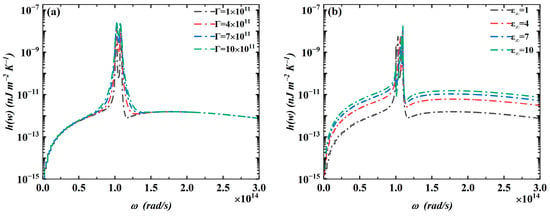
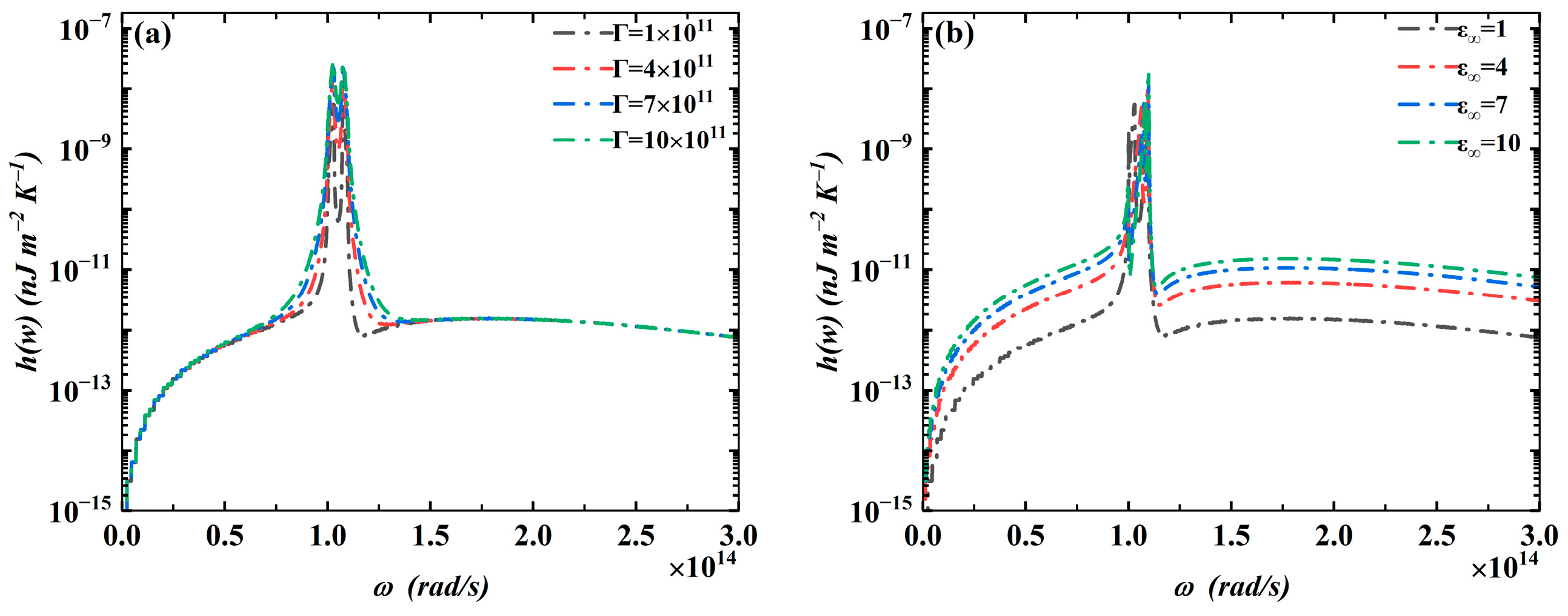
To verify that our main conclusions are not qualitatively affected by other Lorentz model parameters, we have examined the influence of the phonon damping coefficient and the high-frequency dielectric constant on the spectral heat flux (Figure 6). Variations in mainly affect the linewidth and peak height, while the peak positions remain unchanged. Similarly, modifies the overall magnitude of the dielectric response but does not shift the resonance positions, which are strictly determined by and . Therefore, neither parameter qualitatively alters our central conclusions on the frequency-tuning behavior.
Figure 6.
Spectral heat flux as a function of angular frequency for different values of (a) the phonon damping coefficient and (b) the high-frequency dielectric constant . Other parameters are fixed at their initial values.
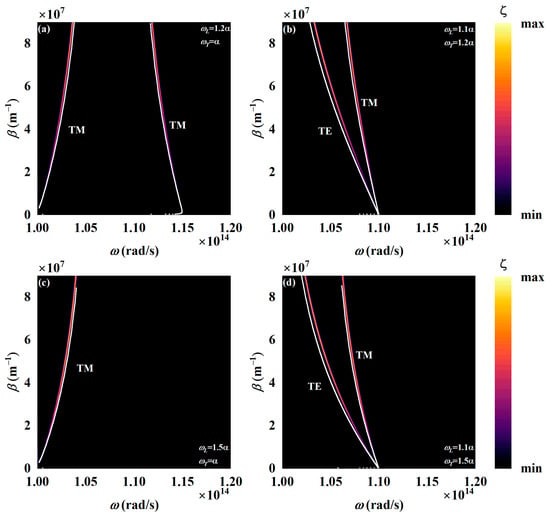
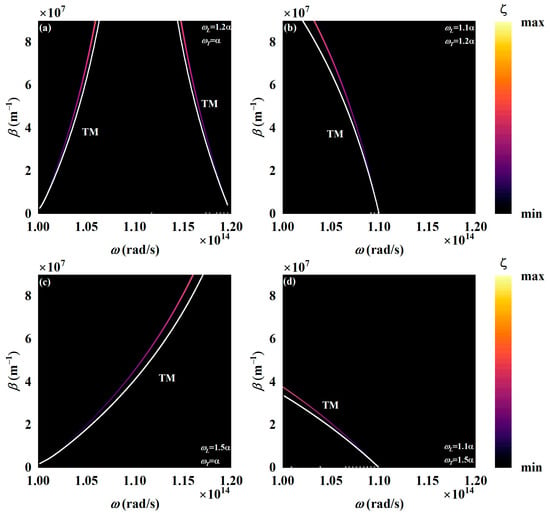
In Figure 7, the bright curves marked TM and TE represent the resonant tunneling bands of the transverse-magnetic (p-polarized) and transverse-electric (s-polarized) modes, respectively. For the planar Lorentz slab system, the TM mode carries an electric field component perpendicular to the vacuum gap, which efficiently couples with optical lattice vibrations of polar dielectrics to excite surface phonon polaritons (SPhPs). This TM-dominated coupling is responsible for the near-field photon tunneling and the spectral heat flux peaks observed in Figure 5. In contrast, the TE mode lacks an out-of-plane electric field, resulting in negligible phonon coupling and producing only faint transmission signals when the transverse phonon frequency varies (Figure 7b,d). When only the longitudinal phonon frequency of the upper plate is tuned (Figure 7a,c), the spacing between the two TM bright bands expands significantly, accounting for the enlarged separation of the dual spectral heat flux peaks in Figure 5a. Moreover, the right TM band undergoes a much larger frequency shift, explaining the pronounced variation in the high-frequency spectral peak. For modulation of the transverse phonon frequency (Figure 7b,d), both TM bands exhibit a mild blue shift with limited spacing change, consistent with the slight peak shifts observed in Figure 5b. The TE mode contributes negligibly to the total radiative heat flux, confirming that all core modulation behaviors originate from the dispersion evolution of TM phonon polaritons.
Figure 7.
Keeping constant, the function of wave vector and frequency of the energy transmission coefficient values on the upper plate (a,c). At a fixed , the function of wave vector and frequency of the energy transmission coefficient values on the upper plate (b,d). (We have verified that the energy transmission coefficient vanishes outside the displayed wavevector range, and thus the plotted range captures all non-negligible contributions from the evanescent modes).
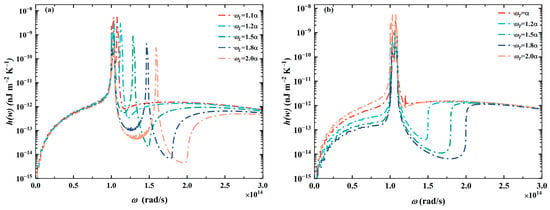
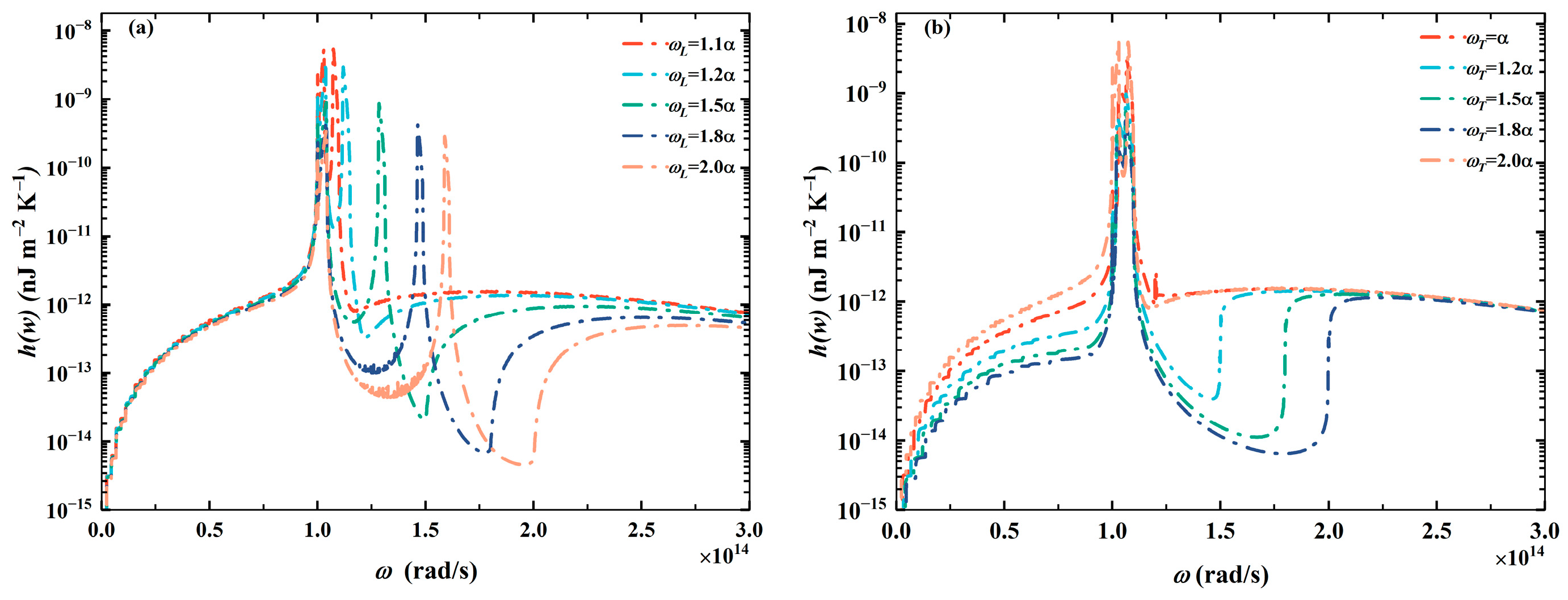
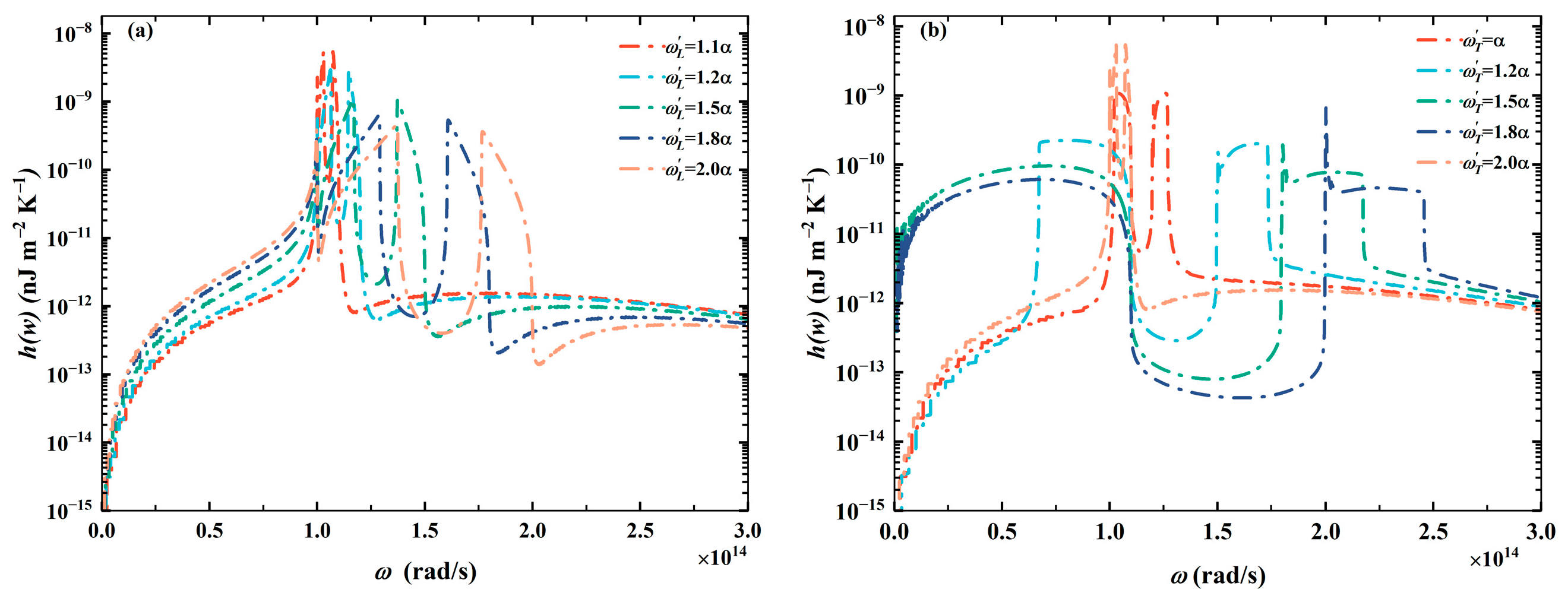
In addition, we also investigated the variation in near-field radiative heat transfer by simultaneously mirroring the changes in transverse optical phonon frequency for upper and lower plates with a certain temperature difference, as illustrated in Figure 8b. From the graph, we can observe that with an increase in the transverse optical phonon frequency in the two parallel plates satisfying the Lorentz theory model, the peaks of the spectral function gradually flatten, and the spacing between the two peaks also increases. This indicates that simultaneously increasing the transverse optical phonon frequency between the two parallel plates will result in a significantly larger heat flux across the two-body heat transfer model over a wide frequency range. Ultimately, this leads to a substantial enhancement of the radiative heat flux in the Lorentz theory model. Furthermore, we observe that, compared to altering the longitudinal optical phonon frequency of the upper and lower plates, changes in the transverse optical phonon frequency can generate a smooth and relatively strong spectral heat flux within a given frequency range. Simultaneously, within a certain frequency range, there will be a stable region of low heat flux. Therefore, we can hypothesize that by considering a scenario where the upper and lower plates have relatively high transverse phonon frequencies, adjusting the angular frequency range can lead to an increase or decrease in heat flux, akin to a switch-like effect. Based on the above discussion, we believe that the coupling effect between the upper and lower plates will lead to more pronounced variations in near-field heat transfer caused by changes in longitudinal and transverse optical phonon frequencies.
Figure 8.
Spectral heat flux as a function of frequency for different (a) and (b) with varied values on both upper and lower plates.
In the previous section, we have discussed how the longitudinal and transverse phonon frequencies in a single Lorentz theory model plate can regulate near-field heat transfer in a two-body system. Next, we further investigate the influence of the longitudinal optical phonon frequency and transverse optical phonon frequency in the Lorentz model on near-field thermal radiation transmission. We consider the simultaneous mirror modulation of the longitudinal optical phonon frequency in upper and lower plates with a temperature difference to investigate the variation in near-field thermal radiation, as illustrated in Figure 9a. It is evident that with the increase in the longitudinal optical phonon frequency of the two parallel plates, the overall spectral function undergoes a blue shift. Simultaneously, the spacing between the two peaks of the spectral function continuously increases. Compared to the scenario of altering the longitudinal optical phonon frequency for a single plate, mirroring the change in the longitudinal optical phonon frequency between two parallel plates intensifies the effect of the variation in the longitudinal optical phonon frequency. From the graph, it can be observed that as the longitudinal optical phonon frequency between the two parallel plates changes, the two peak magnitudes of its spectral function are roughly similar and mainly situated in the larger spectral function region. This is attributed to the mode coupling between the two parallel plates, enhancing the near-field heat transfer between them.
Figure 9.
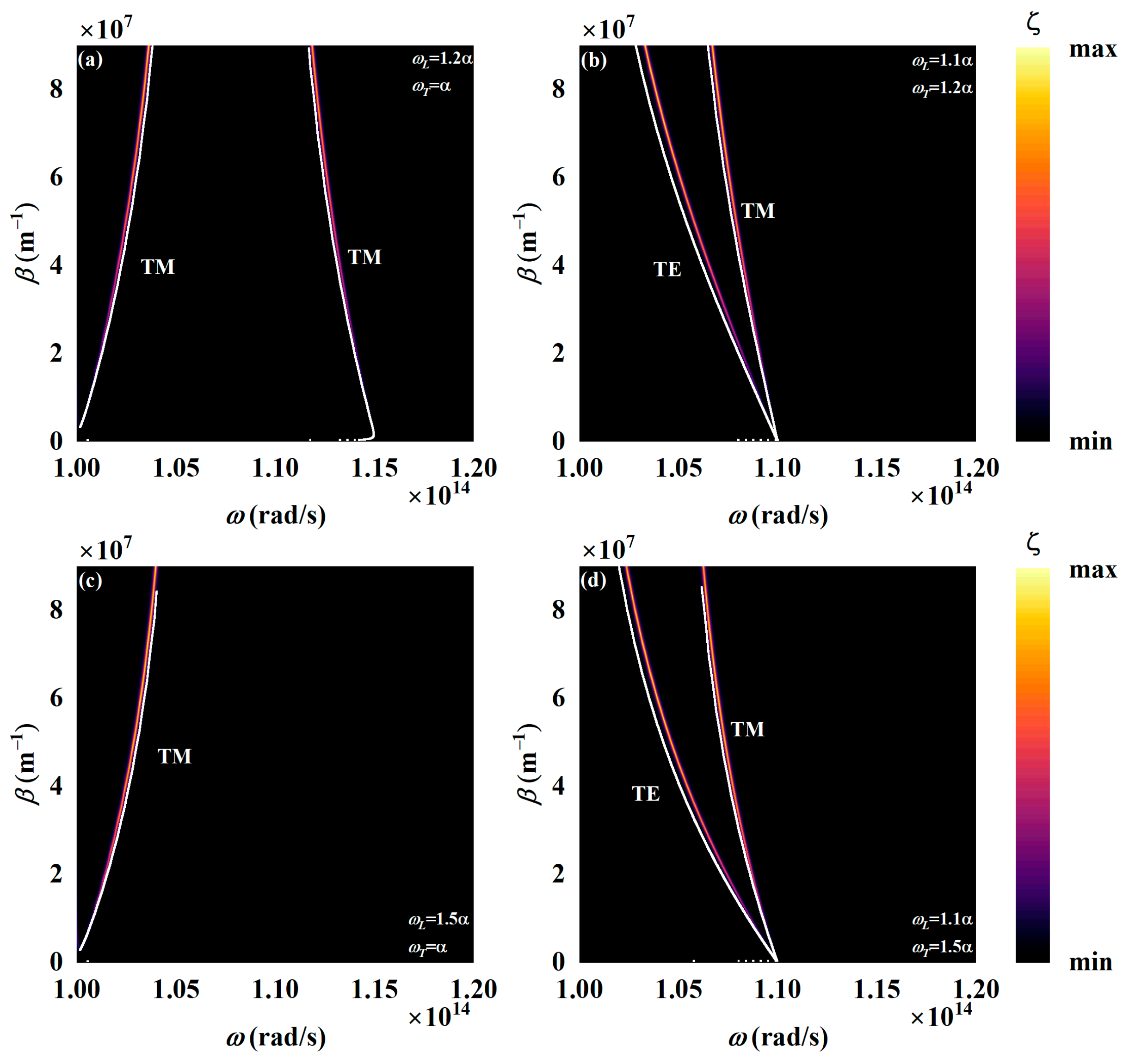
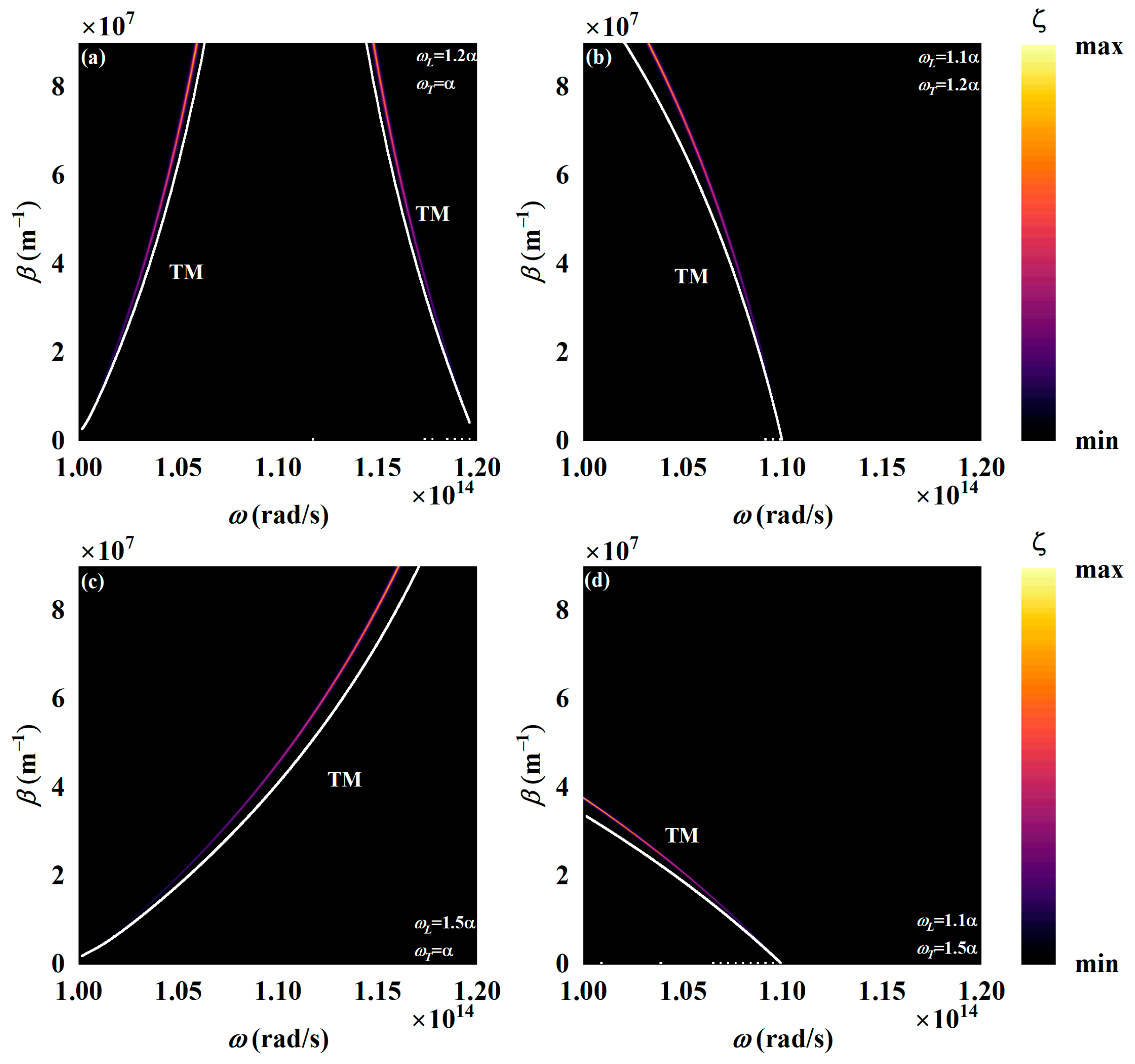
Keeping constant, the function of wave vector and frequency of the energy transmission coefficient values on both upper and lower plates (a,c). At a fixed , the function of wave vector and frequency of the energy transmission coefficient values on both upper and lower plates (b,d).
Figure 9 presents the wavevector-frequency dispersion diagrams of the energy transmission coefficient under mirror-symmetric phonon frequency modulation. Only TM-polarized resonant bright bands are prominently observed, while TE-mode signals remain nearly undetectable. The mirror-symmetric tuning scheme introduces strong hybridization and coupling between surface phonon polaritons (SPhPs) excited at the two slab-vacuum interfaces, which significantly reshapes the TM dispersion curves and amplifies the spectral modulation effects compared with the single-plate case shown in Figure 7. When fixing and synchronously increasing of both plates (Figure 9a,c), the separation between the two TM bright bands expands far more dramatically than in the single-slab case, accompanied by a reduced slope of the left band. This dispersion evolution explains the enlarged peak spacing and partial spectral overlap observed in Figure 8a, originating from the symmetric-antisymmetric coupling of TM SPhPs across the vacuum gap. For fixed and mirror-varied (Figure 9b,d), the coupled TM bands exhibit overall blue shifts with continuously decreasing dispersion slopes and significantly widened band separation. These features account for the flattened, broadband spectral heat flux distribution and the switch-like thermal transport behavior observed in Figure 8b.
In contrast, the TE mode lacks an out-of-plane electric field component and thus cannot efficiently couple with optical lattice vibrations. Mirror-symmetric modulation further suppresses its already weak evanescent tunneling. Consequently, all dominant near-field thermal transport manipulation originates exclusively from the tailored dispersion of coupled TM SPhPs.
4. Conclusions
In conclusion, we have demonstrated that the longitudinal and transverse phonon frequencies in the Lorentz model serve as highly effective tuning knobs for manipulating both the magnitude and spectral distribution of near-field radiative heat transfer. Supplementary calculations further confirm that the Net radiative heat flux decreases monotonically with increasing separation distance, and that a lower resonance frequency yields a higher near-field heat flux across the entire investigated distance range. The mirror-symmetric modulation scheme further enhances the mode coupling between the two plates, leading to pronounced spectral shifts and switch-like heat flux behavior. Our findings not only provide a rigorous theoretical benchmark for interpreting experiments on polar dielectric materials but also offer a versatile design blueprint for functional near-field thermal devices, including thermal modulators, switches, and rectifiers, based on phonon-frequency engineering. Extending the present two-resonance Lorentz model to multi-resonance frameworks, which would represent materials with multiple phonon branches, constitutes a promising direction for future work.
Author Contributions
Conceptualization, Q.M. and W.H.; methodology, Q.M.; software, J.W.; validation, J.W., R.Y. and S.Y.; formal analysis, J.W. and W.H.; investigation, Q.M.; writing—original draft preparation, J.W. and Q.M.; writing—review and editing, J.W. and Q.M.; supervision, W.H.; project administration, W.H. All authors have read and agreed to the published version of the manuscript.
Funding
This work is partially supported by the National Natural Science Foundation of China (Grant No. 62375084), the National Students’ Platform for Innovation and Entrepreneurship Training Program (Grant No. 202510542084), and the Chongqing Municipal Natural Science Foundation (Grant No. CSTB2022NSCQ-MSX0192).
Data Availability Statement
The data that support the findings of this study are available from the corresponding author upon reasonable request.
Conflicts of Interest
The authors declare no conflict of interest.
References
- Polder, D.; Van Hove, M. Theory of Radiative Heat Transfer between Closely Spaced Bodies. Phys. Rev. B 1971, 4, 3303. [Google Scholar] [CrossRef] [Scilit]
- Hu, Y.; Liu; Yang, B.; Shi, K.; Antezza, M.; Wu, X.; Sun, Y. High-rectification near-field radiative thermal diode using Weyl semimetals. Phys. Rev. Mater. 2023, 7, 035201. [Google Scholar] [CrossRef] [Scilit]
- Zhang, J.; Hu, Y.; Han, Q.; Liu, H.; Sun, Y.; Wu, X. Optical axis-driven modulation of near-field radiative heat transfer between two calcite parallel structures. Phys. Chem. Chem. Phys. 2022, 24, 22102–22108. [Google Scholar] [CrossRef] [Scilit] [PubMed]
- Liu, Y.; Caratenuto, A.; Zheng, Y. GST-VO2-based near-field multistage radiative thermal rectifier. Opt. Mater. Express 2022, 12, 2135–2144. [Google Scholar] [CrossRef] [Scilit]
- Zhou, C.; Zhang, Y.; Qu, L.; Yi, H. Near-field negative electroluminescent cooling via nanoparticle doping. J. Quant. Spectrosc. Radiat. Transf. 2020, 245, 106889. [Google Scholar] [CrossRef] [Scilit]
- Rottmayer, R.E.; Batra, S.; Buechel, D.; Challener, W.A.; Hohlfeld, J.; Kubota, Y. Heat-Assisted Magnetic Recording. IEEE Trans. Magn. 2006, 42, 2417. [Google Scholar] [CrossRef] [Scilit]
- Barura, C.G.A.; Ben-Abdallah, P.; Messina, R. Coupling between conduction and near-field radiative heat transfer in tip–plane geometry. Appl. Phys. Lett. 2022, 121, 141101. [Google Scholar] [CrossRef] [Scilit]
- Lu, L.; Zhang, B.; Ou, H.; Li, B.; Zhou, K.; Song, J.; Luo, Z.; Cheng, Q. Enhanced Near-Field Radiative Heat Transfer between Graphene/hBN Systems. Small 2022, 18, 2108032. [Google Scholar] [CrossRef] [Scilit] [PubMed]
- Luo, M.; Zhu, J.; Biehs, S.-A.; Zhao, J.; Liu, L. Residual surface charge mediated near-field radiative energy transfer: A topological insulator analog. Mater. Today Phys. 2023, 31, 100984. [Google Scholar] [CrossRef] [Scilit]
- Xu, J.-B.; Läuger, K.; Möller, R.; Dransfeld, K.; Wilson, I.H. Heat transfer between two metallic surfaces at small distances. J. Appl. Phys. 1994, 76, 7209–7216. [Google Scholar] [CrossRef] [Scilit]
- Song, J.; Cheng, Q.; Lu, L.; Li, B.; Zhou, K.; Zhang, B.; Luo, Z.; Zhou, X. Magnetically Tunable Near-Field Radiative Heat Transfer in Hyperbolic Metamaterials. Phys. Rev. Appl. 2020, 13, 024054. [Google Scholar] [CrossRef] [Scilit]
- He, M.; Qi, H.; Ren, Y.; Zhao, Y.; Antezza, M. Magnetoplasmonic manipulation of nanoscale thermal radiation using twisted graphene gratings. Int. J. Heat Mass Transf. 2020, 150, 119305. [Google Scholar] [CrossRef] [Scilit]
- Pérez-Rodríguez, J.E.; Pirruccio, G.; Esquivel-Sirvent, R. Revisiting the Surface Impedance and Effective Medium Models Applied to Near-Field Radiative Heat Transfer. Phys. Status Solidi B 2020, 257, 1900498. [Google Scholar] [CrossRef] [Scilit]
- Luo, M.; Xu, Y.; Xiao, Y.; Yu, G. Strong nonreciprocal thermal radiation by optical Tamm states in Weyl semimetallic photonic multilayers. Int. J. Therm. Sci. 2023, 183, 107851. [Google Scholar] [CrossRef] [Scilit]
- Salihoglu, H.; Xu, X. Near-field radiative heat transfer enhancement using natural hyperbolic material. J. Quant. Spectrosc. Radiat. Transf. 2019, 222–223, 115–121. [Google Scholar] [CrossRef] [Scilit]
- Ito, K.; Nishikawa, K.; Miura, A.; Toshiyoshi, H.; Iizuka, H. Dynamic Modulation of Radiative Heat Transfer beyond the Blackbody Limit. Nano Lett. 2017, 17, 4347–4353. [Google Scholar] [CrossRef] [Scilit] [PubMed]
- Zhang, J.; Liu, H.; Yang, B.; Hu, Y.; Sun, Y.; Wu, X. Epsilon-near-zero characteristics of near-field radiative heat transfer between α-MoO3 slabs. Phys. Chem. Chem. Phys. 2023, 25, 1133–1138. [Google Scholar] [CrossRef] [Scilit] [PubMed]
- Zhang, J.; Yang, B.; Yu, K.; Zhang, K.; Liu, H.; Wu, X. Substrate effects on the near-field radiative heat transfer between two hBN films. AIP Adv. 2023, 13, 045315. [Google Scholar] [CrossRef] [Scilit]
- Liu, H.; Yu, K.; Zhang, K.; Ai, Q.; Xie, M.; Wu, X. Effect of substrate on the near-field radiative heat transfer between α-MoO3 films. Int. J. Heat Mass Transf. 2023, 210, 124206. [Google Scholar] [CrossRef] [Scilit]
- Shi, Y.C.; Wu, H.B.; Xu, K.; Ding, W.; Zhao, M.X.; Wu, R.X. Simultaneous excitation of electric and magnetic surface polaritons in a hyperbolic metasurface. Chin. Opt. Lett. 2026, 24, 033603. [Google Scholar] [CrossRef] [Scilit]
- Zhou, C.-L.; Tang, G.; Zhang, Y.; Antezza, M.; Yi, H.-L. Radiative heat transfer in a low-symmetry Bravais crystal. Phys. Rev. B 2022, 106, 155404. [Google Scholar] [CrossRef] [Scilit]
- Afzal, A.M.; Javed, Y.; Shad, N.A.; Iqbal, M.Z.; Dastgeer, G.; Sajid, M.M.; Mumtaz, S. Tunneling-based rectification and photoresponsivity in black phosphorus/hexagonal boron nitride/rhenium diselenide van der Waals heterojunction diode. Nanoscale 2020, 12, 3455–3468. [Google Scholar] [CrossRef] [Scilit] [PubMed]
- Wu, J.; Sun, Y.; Wu, F.; Wu, B.; Wu, X. Enhancing nonreciprocal thermal radiation in Weyl semimetals based on optical Tamm states by integrating with photonic crystals. Wave Random Complex Media 2026, 35, 13175–13184. [Google Scholar] [CrossRef] [Scilit]
- Wu, J.; Wu, B.; Wang, Z.; Wu, X. The enhanced nonreciprocal radiation with topological interface states. Opt. Laser Technol. 2023, 158, 108907. [Google Scholar] [CrossRef] [Scilit]
- Wu, X.; Fu, C.; Zhang, Z. Special Section Guest Editorial: Thermal Photonics in Energy. J. Photon. Energy 2019, 9, 032702. [Google Scholar] [CrossRef] [Scilit]
- Zhang, Y.; Yi, H.; Tan, H. Near-Field Radiative Heat Transfer between Black Phosphorus Sheets via Anisotropic Surface Plasmon Polaritons. ACS Photonics 2018, 5, 3739–3747. [Google Scholar] [CrossRef] [Scilit]
- He, M.; Qi, H.; Ren, Y.; Zhao, Y.; Antezza, M. Active control of near-field radiative heat transfer by a graphene-gratings coating-twisting method. Opt. Lett. 2020, 45, 2914–2917. [Google Scholar] [CrossRef] [Scilit] [PubMed]
- Moncada-Villa, E.; Cuevas, J.C. Near-field radiative heat transfer between one-dimensional magnetophotonic crystals. Phys. Rev. B 2021, 103, 075432. [Google Scholar] [CrossRef] [Scilit]
- Moncada-Villa, E.; Cuevas, J.C. Magnetic field effects in the near-field radiative heat transfer between planar structures. Phys. Rev. B 2020, 101, 085411. [Google Scholar] [CrossRef] [Scilit]
- Xu, G.; Sun, J.; Mao, H.; Cao, Z.; Ma, X. Modulating Near-Field Radiative Heat Transfer through Thin Dirac Semimetal Films. Nanoscale Microscale Thermophys. Eng. 2021, 25, 101–115. [Google Scholar] [CrossRef] [Scilit]
- Wang, J.X.; Xu, Z.G.; Zhang, F.Q. Near field radiative heat transfer in twisted bilayer graphene grating structures based on magnetic modulation. J. Quant. Spectrosc. Radiat. Transf. 2025, 333, 109328. [Google Scholar] [CrossRef] [Scilit]
- Shi, K.; Chen, Z.; Xing, Y.; Yang, J.; Xu, X.; Evans, J.S.; He, S. Near-Field Radiative Heat Transfer Modulation with an Ultrahigh Dynamic Range through Mode Mismatching. Nano Lett. 2022, 22, 7753–7760. [Google Scholar] [CrossRef] [Scilit] [PubMed]
- Biehs, S.A.; Rousseau, E.; Ben-Abdallah, P. Near-field heat transfer between two metallic gratings. Int. J. Heat Mass Transf. 2021, 171, 121124. [Google Scholar] [CrossRef] [Scilit]
- Liu, X.L.; Zhang, R.Z.; Zhang, Z.M. Near-field thermal radiation between hyperbolic metamaterials: Graphite and carbon nanotubes. Phys. Rev. Appl. 2013, 103, 213102. [Google Scholar] [CrossRef] [Scilit]
- Hu, L.; Narayanaswamy, A. Radiative heat transfer between two spheres. Int. J. Heat Mass Transf. 2014, 73, 389–398. [Google Scholar] [CrossRef] [Scilit]
- Basu, S.; Francoeur, M. Near-field radiative heat transfer between doped silicon nanowire arrays. Int. J. Therm. Sci. 2018, 130, 192–199. [Google Scholar]
- Ilic, O.; Jablan, M.; Joannopoulos, J.D.; Celanovic, I.; Soljacic, M. Near-field thermal radiation transfer between two graphene sheets. ACS Photonics 2015, 2, 1320–1326. [Google Scholar]
- Otey, C.R.; Lau, W.T.; Fan, S. Thermal rectification through vacuum. Appl. Phys. Lett. 2014, 104, 251911. [Google Scholar]
- Lim, M.; Lee, S.S.; Lee, B.J. Near-field thermal radiation between graphene-covered doped silicon plates. Opt. Express 2013, 21, 22173–22185. [Google Scholar] [CrossRef] [Scilit] [PubMed]
Disclaimer/Publisher’s Note: The statements, opinions and data contained in all publications are solely those of the individual author(s) and contributor(s) and not of MDPI and/or the editor(s). MDPI and/or the editor(s) disclaim responsibility for any injury to people or property resulting from any ideas, methods, instructions or products referred to in the content. |
© 2026 by the authors. Licensee MDPI, Basel, Switzerland. This article is an open access article distributed under the terms and conditions of the Creative Commons Attribution (CC BY) license.