


Abstract
We propose a gold-graphene-vanadium dioxide (VO2) hybrid metasurface capable of reversibly switching among three operational modes in the terahertz regime. The device achieves flexible polarization control by combining the insulator-to-metal phase transition of VO2 with the electrical tunability of graphene. Simulation results reveal three distinct behaviors depending on the biasing conditions of the materials. With graphene held at a chemical potential of 0 eV and VO2 in the insulating state, the metasurface acts as a linear-to-linear polarization converter. The polarization conversion ratio (PCR) exceeds 0.9 over the frequency range from 5.5 to 8.6 THz. When the graphene chemical potential is raised to 0.9 eV while VO2 remains insulating, the metasurface switches to linear-to-circular conversion. Notably, the handedness of the outgoing wave depends on the polarization of the incoming signal. Over the 6.45–8.36 THz band, the axial ratio (AR) remains below 3 dB. A third functional state emerges when VO2 switches to its metallic phase. In this state, the device simply operates as a broadband co-polarized reflector, covering the terahertz communication band from 0.1 to 10 THz. This switchable, multifunctional behavior should prove useful for terahertz communications, polarization imaging, and sensing applications.
1. Introduction
The terahertz frequency band, with its submillimeter wavelengths and ultra-wide absolute bandwidth of several THz, shows great potential for integrating communication and sensing and for achieving ultra-high-speed transmission, making it a key candidate technology for 6G [1]. However, practical applications still face challenges regarding material and device performance. Materials with satisfactory performance in this frequency band are scarce, and existing materials often fail to meet the requirements of practical applications [2]. To address this, terahertz metasurface technology has emerged as an effective solution [3,4,5,6]. Terahertz metasurfaces, composed of subwavelength artificial microstructure arrays, enable flexible manipulation of the amplitude, phase, polarization, and wavefront of electromagnetic waves on a two-dimensional plane, and have been widely employed in functional devices such as polarization conversion, beam steering, absorbers, and sensing detection [7,8,9]. It is noteworthy that the application scenarios of metasurfaces are not limited to free-space wavefront manipulation. In on-chip integrated systems, metasurfaces have been utilized to control the propagation paths and wavefront distributions of spoof surface plasmon polaritons, enabling multichannel signal processing functionalities [10]; in the field of nonlinear optics, metasurfaces have achieved efficient nonlinear holographic display and multifunctional wavefront manipulation through spin–orbit interaction [11]. These extensions across different application scenarios fully demonstrate the great potential of metasurfaces as a versatile electromagnetic modulation platform. Most existing studies on terahertz metasurface devices are still limited to the mid- and low-frequency bands. The high-frequency window important for broadband dynamic modulation in 6G remains an area requiring further exploration [12,13,14]. Earlier metasurface work has tended to focus on single functions [15,16,17], which cannot meet the demands of modern systems for multifunctionality and simultaneous multidimensional modulation. Therefore, multifunctional and robust metasurfaces have become an important research direction.
Tunable materials and phase-change materials, by virtue of their tunable electrical, thermal, or optical properties, enable dynamic control over electromagnetic responses, providing a route for multifunctional modulation [18,19]. One effective strategy is to combine tunable materials with phase-change materials [20,21]. Integrating both onto the same metasurface platform provides a clear path to multifunctionality. Consequently, the idea has attracted considerable attention [22]. The central advantage lies in material synergy: designers are no longer limited to just one set of properties; instead, the distinct behaviors of each layer work together. This enables functions that conventional designs struggle to deliver [23]. Beyond theoretical considerations, switching to this combination helps overcome the bottlenecks that have hindered the practical application of high-performance terahertz metasurfaces [24,25]. Meanwhile, alternative approaches based on all-silicon platforms and mechanical rotation have also been explored, such as a reconfigurable all-silicon terahertz chiral metasurface integrating phase-induced chirality with Moiré engineering [26], and a twisted bilayer metadevice for on-demand terahertz polarization filtering [27].
In recent years, metasurface designs for terahertz polarization control based on graphene and VO2 have steadily emerged [28]. A VO2-graphene hybrid metasurface structure was proposed [29]. By exploiting the phase transition and Fermi-level tunability, multi-frequency absorption was achieved at 0.89, 1.78, and 3.31 THz, along with linear-to-circular polarization conversion over the 0.64–1.28 THz and 1.54–1.85 THz bands. A bifunctional switchable metamaterial device relying on VO2 and photosensitive silicon was proposed [30]. In its metallic state, broadband absorption was achieved from 0.78 to 1.81 THz, while in the insulating state, broadband linear-to-linear polarization conversion was enabled between 0.51 and 1.45 THz. That same year, a VO2 thin-film-assisted terahertz metasurface was described [31]. With the film in the metallic phase, broadband absorption was observed to cover 1.41–2.69 THz; once switched to the insulating state, linear-to-linear conversion was realized across 0.71–2.72 THz. A hybrid bifunctional design using both graphene and VO2 was proposed [32]. Depending on the material state, the metasurface could be configured to act as either an ultra-broadband absorber from 1.43 to 8.96 THz or a broadband linear-to-circular polarization converter over 1.24–3.57 THz. Beyond hybrid material systems, all silicon diatomic metasurfaces have also been exploited for bifunctional polarization conversion. More recently, a different approach was taken by applying a tandem neural network to optimize a reflective metasurface polarization converter [33]. The resulting design achieved linear-to-linear conversion efficiency above 80% across 0.8–1.5 THz and maintained good performance under oblique incidence up to 50°. Taken together, these efforts point to steady progress in tunable terahertz metasurfaces. These works demonstrate the unique advantages of all-dielectric designs combined with mechanical tuning, providing complementary strategies to the electrically controlled hybrid material scheme presented in this work. Yet most switchable designs so far offer only two functions, and their polarization conversion is largely confined to frequencies below 5 THz. Designs that integrate more functions into a single dynamically reconfigurable metasurface remain few. This lack of integration remains a key obstacle to practical multifunctional high-frequency terahertz communication systems.
This work proposes a reconfigurable metasurface built from VO2 and graphene to address the issue outlined above. The design features three operating modes. The metasurface can deliver broadband co-polarized reflection from 0.1 to 10 THz. It also supports high-efficiency linear-to-linear polarization conversion between 5.5 and 8.6 THz, along with broadband linear-to-circular output over 6.45–8.36 THz. The phase transition of VO2 from insulator to metal serves as the primary switch [34,35,36]. When VO2 remains insulating, it is largely transparent to terahertz waves, allowing polarization conversion to occur. Once it becomes metallic, the layer becomes highly reflective and that conversion path is suppressed. Graphene provides a different type of control. Its chemical potential is electrically tunable, which provides continuous adjustment [37,38]. Changing the bias voltage switches the metasurface between linear-to-linear and linear-to-circular operation. Therefore, the two materials work synergistically. VO2 sets the on/off state for polarization conversion, while graphene decides which conversion type is active. Thus, within a single structure, the metasurface can achieve multifunctional, dynamically tunable terahertz polarization modulation [39]. Electromagnetic resonance analysis is used to clarify the physical mechanisms involved in the two operating regimes [40]. The practical performance of the metasurface is also examined, including its tolerance to fabrication imperfections and its stability under varying incidence angles [41].
2. Structure Design
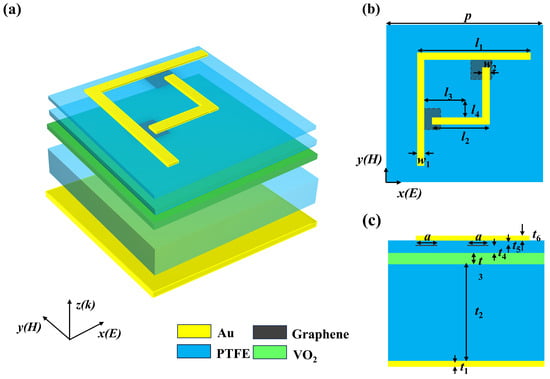
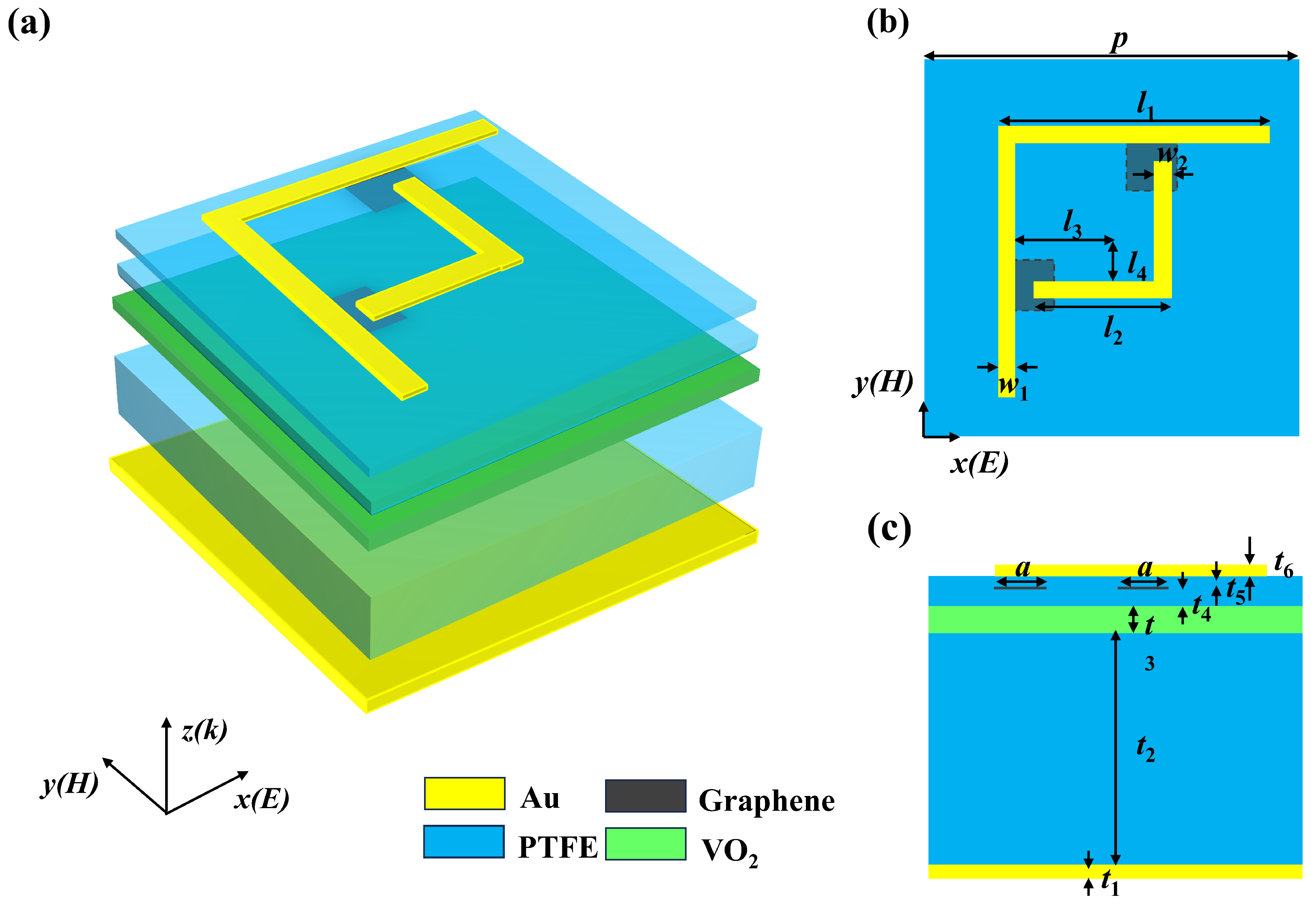
The unit cell structure of the proposed graphene-VO2 hybrid multifunctional metasurface is illustrated in Figure 1. Along the –z direction (the direction of incident wave propagation), the structure consists of seven vertically stacked layers. From top to bottom, these are the double equal-arm L-shaped gold resonator; the upper PTFE dielectric spacer layer; the patterned graphene periodic array; the middle PTFE dielectric spacer layer; the VO2 layer serving as the phase-change functional layer; the lower PTFE dielectric spacer layer; and the bottom gold ground plane. The PTFE material has a relative permittivity of 2.1 and a loss tangent of 0.0002 [42], exhibiting excellent low-loss properties and stability across the entire terahertz band.
Figure 1.
Schematic of terahertz multifunctional metasurface unit cell: (a) 3D schematic; (b) top view; (c) side view.
Through full-wave simulation optimization, the key geometric parameters of the unit cell are determined as follows: period p = 11 μm; bottom gold ground layer thickness t1 = 0.2 μm; thicknesses of the lower, middle, and upper PTFE dielectric layers t2 = 4 μm, t4 = 0.3 μm, and t5 = 0.1 μm, respectively, VO2 phase-change layer thickness t3 = 0.6 μm; gold resonator structure thickness t6 = 0.1 μm. For the double equal-arm L-shaped resonator, the larger structure has arm length l1 = 8 μm and line width w1 = 0.5 μm, while the smaller structure has arm length l2 = 4 μm (exactly half of l1) and line width w2 = 0.5 μm. The patterned graphene square patch has a side length a = 1.5 μm. The distances from the center of the square patch to the larger and smaller L-shaped resonators are l3 = 2.75 μm and l4 = 1.25 μm, respectively, and the gap between the two L-shaped resonators is b = 0.5 μm.
At room temperature (T = 293 K) in the terahertz band, graphene is set at the Dirac point (μc = 0 eV) in the full-wave simulation. Its surface conductivity is described by the complete Kubo formula covering both intraband and interband transitions [43], ensuring calculation accuracy under zero doping. The total surface conductivity σg is the sum of the intraband contribution σintra and the interband contribution σinter, as given by Equation (1). The intraband conductivity σintra, which dominates in the terahertz regime due to electron-photon scattering within the same band, is given by Equation (2). The interband conductivity σinter, accounting for interband transitions, is given by Equation (3). The three formulas are as follows:
where ω is the angular frequency, i is the imaginary unit, Γ = 1/(2 τ) is the scattering rate, μc is the chemical potential, kB is Boltzmann’s constant, ℏ is the reduced Planck constant, T = 293 K is the temperature, and e is the elementary charge. The carrier relaxation time τ is fixed at 0.1 ps, which is the optimal value determined via parameter optimization in this work.
The chemical potential of graphene μc can be dynamically tuned from 0 to 1 eV by an external gate voltage Vg, following the parallel-plate capacitor model. The relationship between μc and Vg is given by [44]:
where vF = 1.0 × 10⁶ m/s is the Fermi velocity of graphene, ε0 is the vacuum permittivity, εd is the relative permittivity of the dielectric layer, d is the thickness of the dielectric layer, and VD is the Dirac point voltage (set to 0 V here). The other symbols (ħ, e) retain their previous definitions.
VO2 is a prototypical insulator–metal phase-change material, exhibiting a critical phase transition at Tc ≈ 341 K (68 °C). Across this transition, its permittivity and electrical conductivity change significantly and reversibly [45], which enables the dynamic switching of metasurface functionalities. Within the terahertz band, the dielectric properties of VO2 are described by the Drude model [46], and the frequency-dependent permittivity follows Equation (5):
where ε∞ = 12 is the high-frequency limit permittivity, ω is the angular frequency, i is the imaginary unit, γ = 5.75 × 10¹³ rad/s is the carrier collision frequency, and ωp (σ) is the conductivity-dependent plasma frequency, which satisfies ωp2 (σ) = (σ/σ0)ωp2 (σ0). Here, the reference conductivity σ0 = 3 × 10⁵ S/m corresponds to the reference plasma frequency ωp (σ0) = 1.4 × 10¹⁵ rad/s.
Below the critical temperature (T < Tc), VO2 exhibits a conductivity of σ = 20 S/m, behaving as a low-loss dielectric. In the metallic state (T > Tc), σ = 2 × 10⁵ S/m, and VO2 exhibits metal-like properties [47]. Owing to the temperature-insensitive nature of graphene’s conductivity within VO2’s operational range, the metasurface maintains stable performance when transitioning between its various functional modes [48].
The frequency domain solver of CST Microwave Studio is employed to perform full-wave simulations for analyzing the electromagnetic response characteristics of the designed metasurface. In the simulation setup, unit cell boundaries are assigned along the x- and y-axes to replicate the infinite periodic nature of the metasurface, while open boundaries are assigned along the z-axis to represent infinite free space, thereby preventing boundary reflections from affecting the accuracy of the results. To investigate the metasurface’s performance within the terahertz communication band, the incident wave is configured as a linearly polarized plane wave propagating along the –z-axis.
3. Results and Discussion
3.1. Broadband Linear Polarization Conversion Characteristics in the Insulating State of VO2
When VO2 is in the insulating state and the graphene chemical potential is set to μc = 0 eV, the composite metasurface can operate as an efficient linear-to-linear polarization converter. Its polarization conversion performance is quantitatively characterized by the polarization conversion ratio (PCR) [49]. The PCR is defined as the ratio of the cross-polarized reflected power to the total reflected power. Specifically, for a TE wave (x-polarized) and a TM wave (y-polarized), the PCR can be expressed as [50]:
where rxx and ryy are the co-polarized reflection coefficients, and rxy and ryx are the cross-polarized ones. The first subscript denotes the polarization direction of the reflected wave, and the second subscript denotes the polarization direction of the incident wave.
Owing to the rotational symmetry of the unit cell along the x and y directions, the metasurface exhibits inherent polarization insensitivity under normal incidence [51]; consequently, the electromagnetic responses for TE and TM modes are completely degenerate.
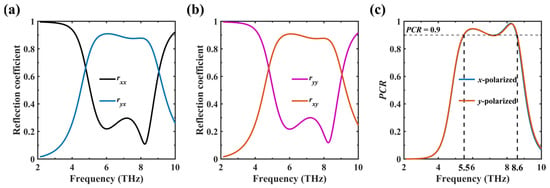
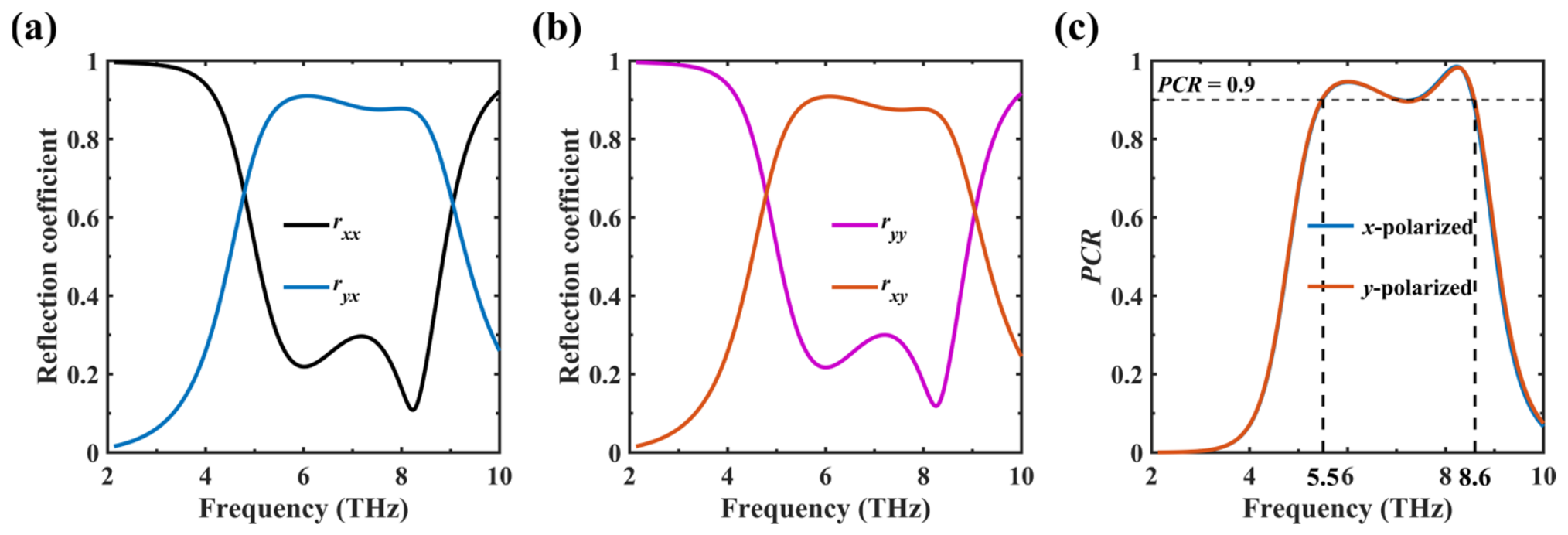
As shown in Figure 2a,b, the co-polarized and cross-polarized reflection coefficients for the two polarization directions are respectively equal (rxx = ryy, rxy = ryx), and thus the subsequent PCR analysis can be simplified to a single polarization direction.
Figure 2.
(a) Reflection coefficients for TE incident wave; (b) reflection coefficients for TM incident wave; (c) PCR obtained under TE incidence.
The simulation results are presented in Figure 2c. In the frequency range of 5.5–8.6 THz, the metasurface maintains a PCR above 90%, demonstrating efficient cross-polarization conversion and achieving broadband linear polarization conversion. At 8.22 THz, the PCR approaches 100%, indicating a near-perfect polarization conversion effect.
To elucidate the broadband linear polarization conversion mechanism of the proposed double equal-arm L-shaped metasurface, the near-field magnetic field and surface current distributions at two characteristic frequencies are analyzed, and the polarization modulation mechanism is interpreted based on dipole resonance theory [52,53].
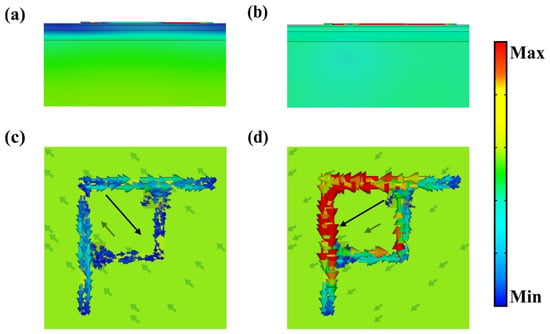
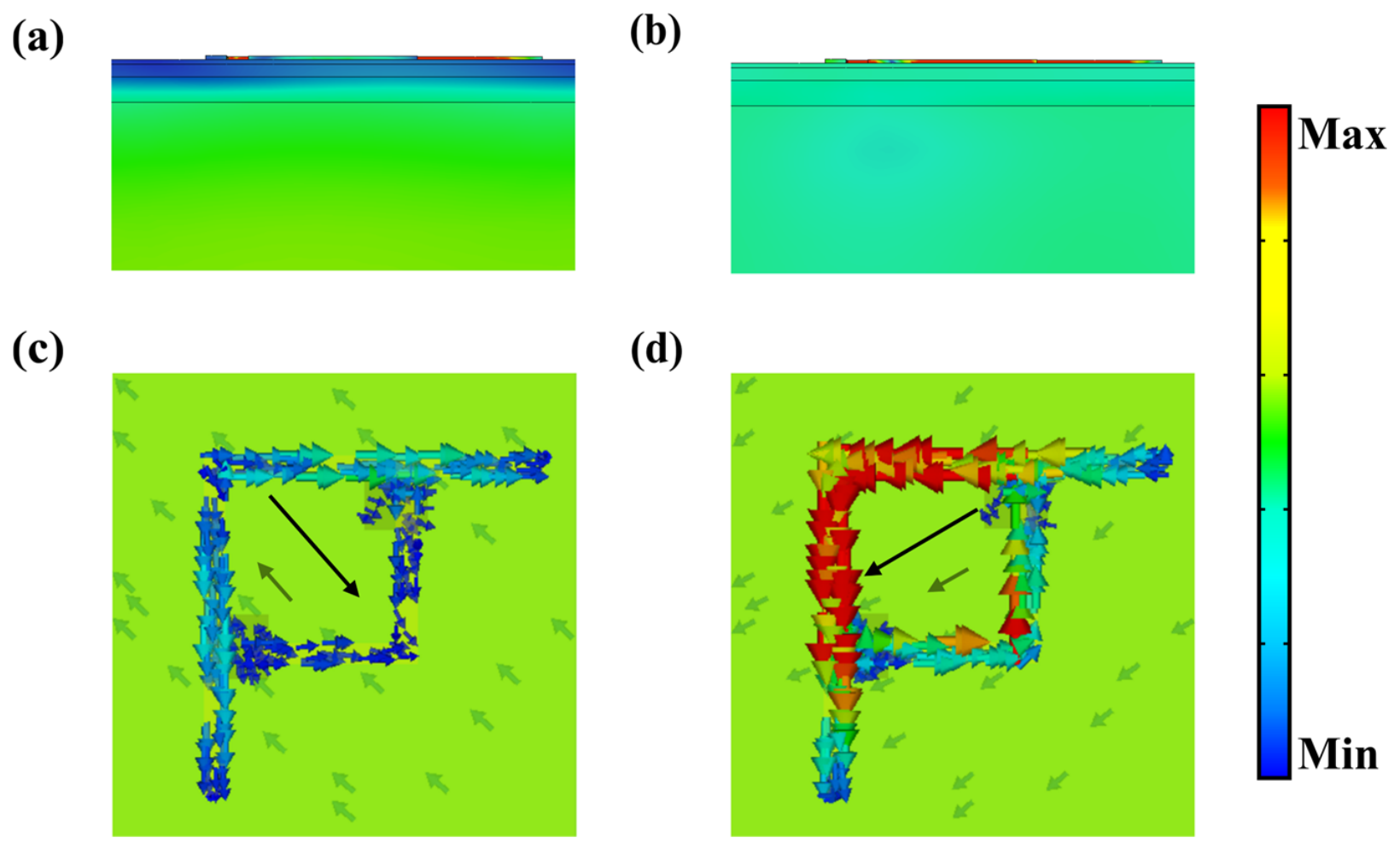
As shown in Figure 3a,c at 6.5 THz, the magnetic field is mainly concentrated in the top resonant layer, the VO2 layer, and the bottom PTFE layer. The top current flows toward the lower-right, and the bottom gold ground layer current flows toward the upper-left, thereby forming an antiparallel current pair that excites a magnetic resonance. In contrast, as shown in Figure 3b,d at 8.22 THz, the magnetic field is distributed throughout the structure except for the bottom gold ground layer, and both the top and bottom currents flow toward the lower-left direction, forming a co-directional current pair that excites an electric resonance. Both resonances radiate x- and y-polarized electric fields into the far field. A phase delay introduced by the structure ensures that these radiated fields interfere destructively with the background reflected electric field, thereby suppressing the incident polarization component and enabling polarization conversion [54,55].
Figure 3.
Magnetic field and surface current distributions of the metasurface under linear-to-linear polarization conversion mode: (a,c) at 6.5 THz; (b,d) at 8.22 THz.
3.2. Broadband Circular Polarization Output Characteristics Controlled by Graphene in the Insulating State of VO2
In the insulating state of VO2, increasing the graphene chemical potential to μc = 0.9 eV via an external gate voltage significantly enhances its surface conductivity, thereby establishing strong near-field coupling between the square graphene patch and the double equal-arm L-shaped gold resonator [56,57]. This enables the metasurface to switch from linear polarization conversion mode to linear-to-circular polarization conversion mode, producing broadband circular polarization output in the 6.45–8.36 THz band.
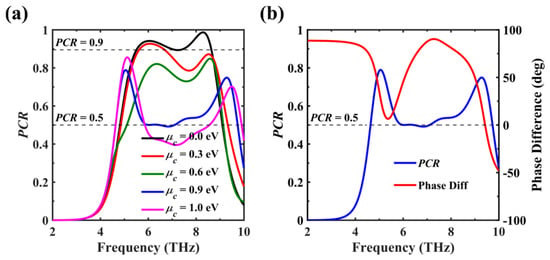
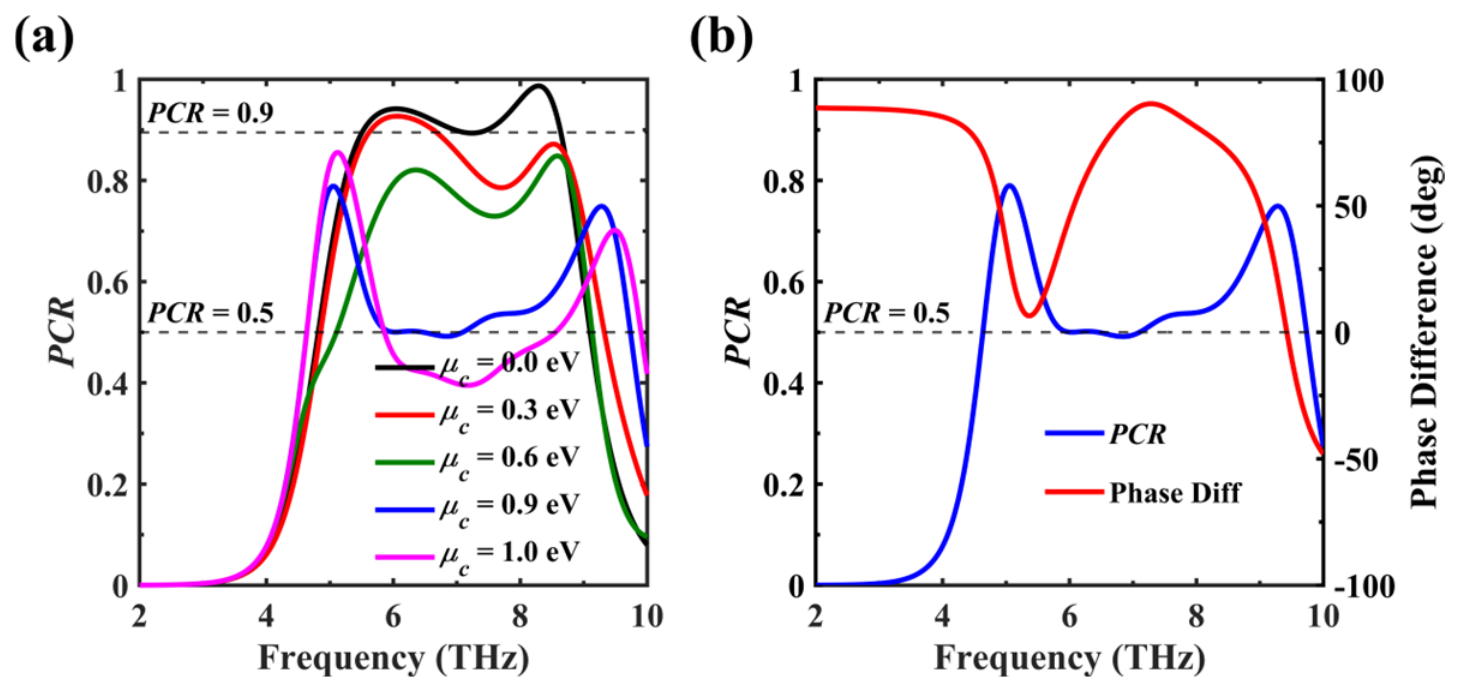
The simulation results are shown in Figure 4a. As μc increases, the PCR of the linearly polarized incident wave within the target band shows a monotonically decreasing trend. When μc = 0.9 eV, the PCR stabilizes at approximately 0.5 in the 6.45–8.36 THz band. At this point, the amplitudes of the orthogonal and co-polarized components of the outgoing wave are equal, satisfying the amplitude matching condition for linear-to-circular polarization conversion. Meanwhile, as shown in Figure 4b, within this band, the phase difference between the two orthogonal polarization components remains stable above 70.84° and below 100°, covering a relatively wide frequency range. The combination of these amplitude and phase conditions indicates the possibility of effective linear-to-circular polarization conversion, which is further confirmed through the axial ratio and ellipticity analysis presented below [58].
Figure 4.
(a) PCR as a function of graphene chemical potential μc in the insulating state of VO2; (b) phase difference between the reflection coefficients ryx and rxx and the corresponding PCR at μc = 0.9 eV.
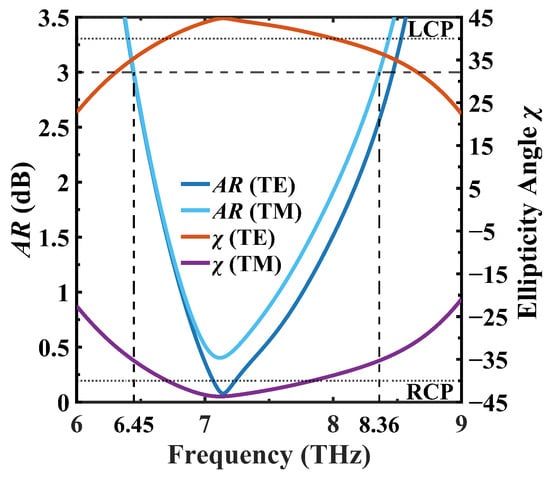
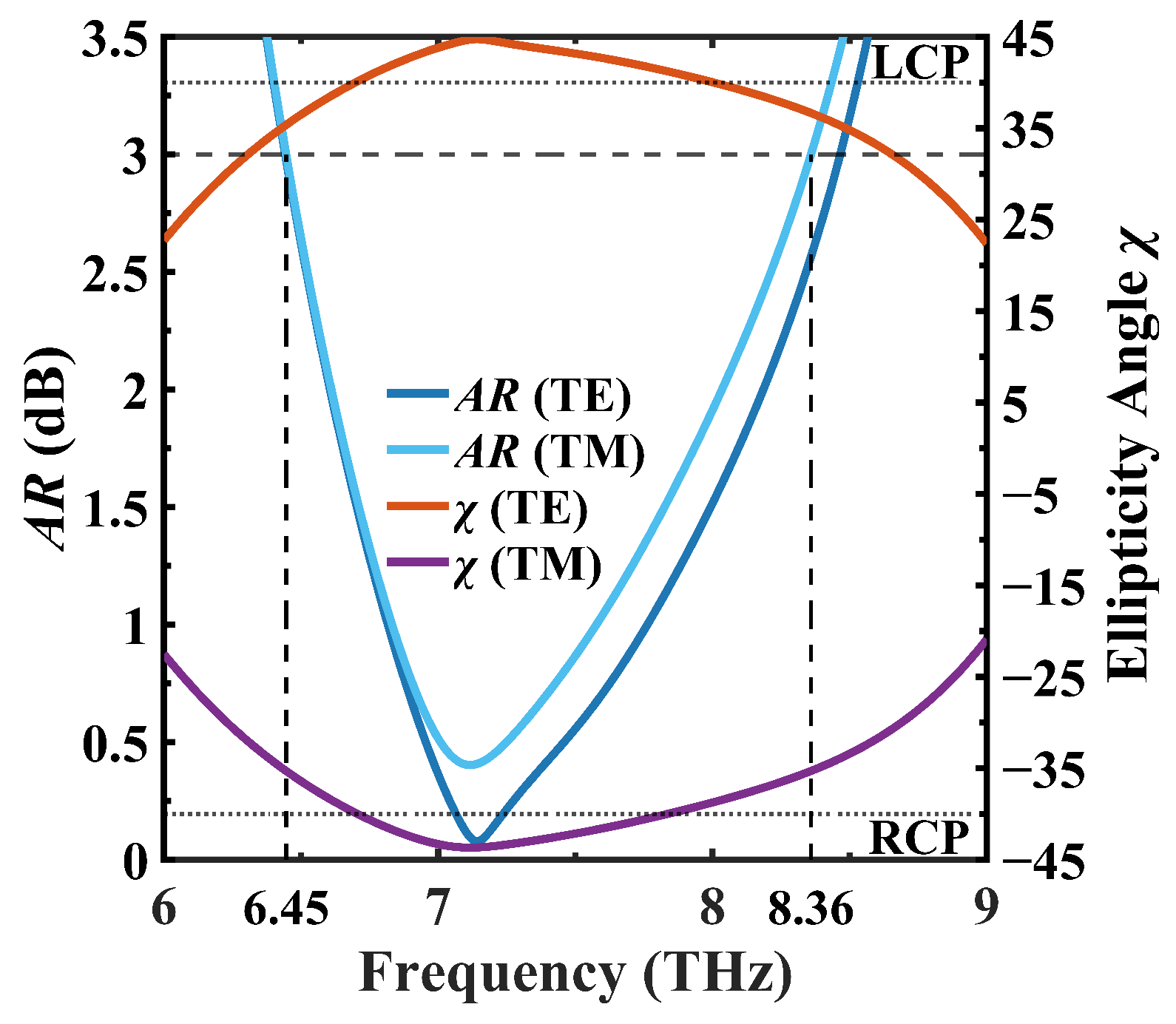
The circular polarization control performance of the metasurface is quantitatively characterized by two core parameters: the axial ratio (AR) and the ellipticity angle (χ). AR is a key evaluation index for circular polarization conversion purity, defined as the amplitude ratio of the major axis to the minor axis of the elliptically polarized wave. In both academic and engineering fields, AR ≤ 3 dB is commonly used as the criterion for defining the effective circular polarization operating bandwidth. Taking a TE wave as an example, the AR is calculated using [59]:
where rxx and ryx are the complex reflection coefficients for co-polarization and cross-polarization under TE incidence, respectively, and Δφ = arg (ryx) − arg (rxx) is the phase difference.
Since the AR cannot distinguish the handedness of the circularly polarized wave, χ is further introduced to fully characterize the polarization state. χ ranges from −45° to 45°, with ±45° corresponding to ideal right-handed and left-handed circular polarization, respectively [60]. Taking a TE wave as an example, the expression of χ in terms of the reflection coefficients under TE incidence is given by [61]:
where Δδ = φy − φx is the phase retardation of the y-component relative to the x-component.
The AR and χ obtained from simulation calculations are shown in Figure 5. In the range of 6.45–8.36 THz, AR ≤ 3 dB (|χ| ≥ 35°), indicating that the metasurface exhibits effective circular polarization, thereby achieving stable broadband output [62,63]. Notably, the output circular polarization state is determined by the incident wave polarization. TE wave incidence yields left-handed circular polarization (LCP), while TM wave incidence yields right-handed circular polarization (RCP).
Figure 5.
AR and χ for TE and TM wave incidence under circular polarization conversion operation.
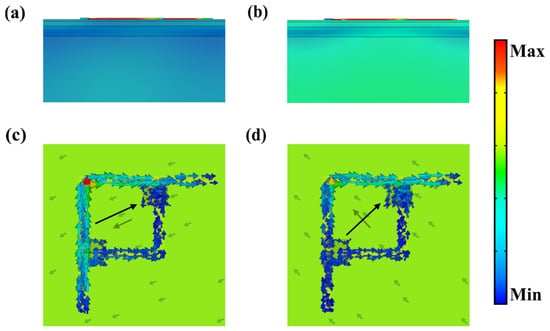
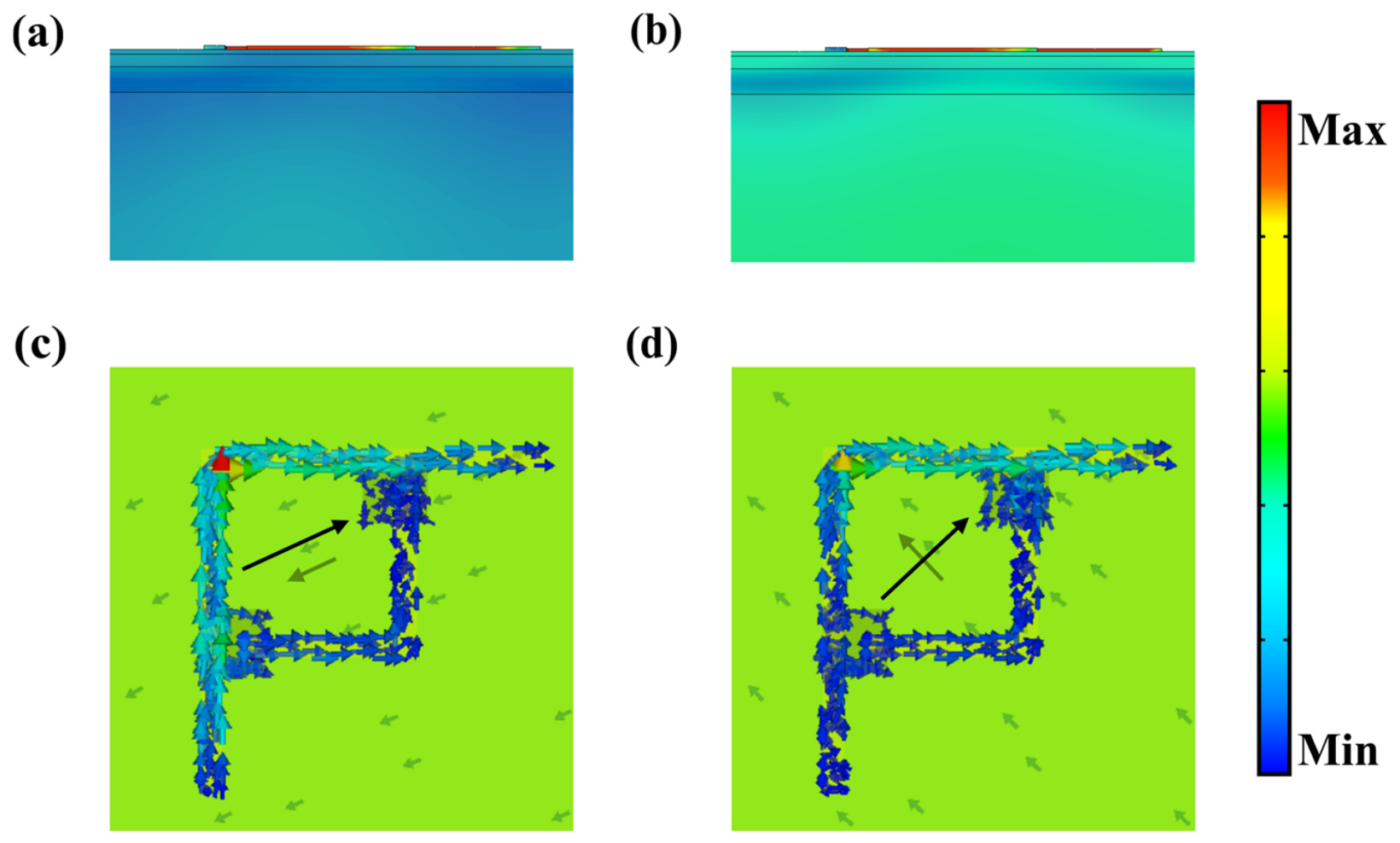
To understand the circular polarization generation mechanism, the near-field behavior at 6.5 THz and 8.22 THz is examined, focusing on magnetic field and surface current distributions. The magnetic field distributions are shown in Figure 6a,b. At both frequencies, the magnetic field is distributed across the entire structure, though it does not penetrate the bottom gold ground layer. The surface currents are presented in Figure 6c,d. At 6.5 THz, the current on the top resonant layer flows toward the upper-right. Meanwhile, the current on the bottom gold ground layer flows toward the lower-left. These two currents are antiparallel, generating a magnetic dipole and exciting a magnetic resonance. This resonance radiates x- and y-polarized electric fields into the far field, where they interfere destructively with the background reflected field.
Figure 6.
Magnetic field and surface current distributions of the metasurface under linear-to-circular polarization conversion mode: (a,c) at 6.5 THz; (b,d) at 8.22 THz.
At 8.22 THz, the current on the top resonant layer flows toward the upper-right, while the current on the bottom gold ground layer flows toward the upper-left. The antiparallel x-components generate a magnetic dipole and excite a y-oriented magnetic resonance, whereas the parallel y-components form an electric dipole and excite a y-oriented electric resonance. The combined resonance radiates x- and y-polarized electric fields into the far field, where they interfere destructively with the background reflected field. Tuning the graphene conductivity adjusts the balance between the x- and y-directed currents, enabling equal amplitudes with a 90° phase offset and thus satisfying the condition for circular polarization [64].
3.3. Broadband Co-Polarized Reflection Characteristics in the Metallic State of VO2
When the ambient temperature rises to the phase transition critical temperature of VO2 (68 °C), VO2 undergoes a reversible insulator-to-metal phase transition, and the composite metasurface switches to broadband co-polarized reflection mode. Taking a TE wave incidence as an example, the co-polarized reflectivity Rxx of the metasurface can be expressed based on energy conservation as the difference between unity and the sum of absorptance, transmittance, and cross-polarized reflectivity:
Due to the shielding effect of the bottom gold ground layer, the transmittance T of the structure is approximately 0. Therefore, the co-polarized reflectivity can be simplified as [65]:
where Rxx = |rxx|2 and Ryx = |ryx|2 denote the co-polarized and cross-polarized reflected power, respectively. A denotes absorptance.
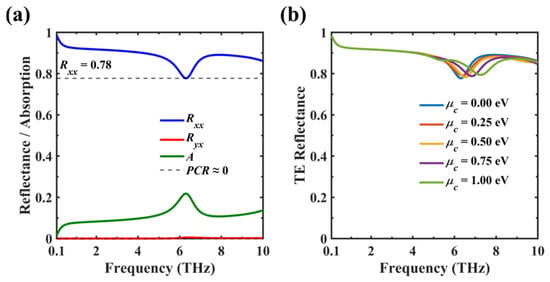
The simulation results are shown in Figure 7a. When VO2 remains in the metallic state, the metasurface maintains stable co-polarized reflection from 0.1 to 10 THz. The minimum reflectance is 0.78 and the average value is 0.89. Across the whole band, the cross-polarized reflectance Ryx remains under 0.1, and the corresponding PCR remains near zero. Consequently, the metasurface produces almost no polarization conversion. Instead, the incident energy is reflected largely in the same polarization state. A local dip appears in the reflectance spectrum, which arises from the coupling between metallic VO2 and the double equal-arm L-shaped gold resonator, corresponding to an electromagnetic resonance absorption peak. Overall, the metasurface operates in a low-loss regime and satisfies the requirements of reflective devices in terahertz communication and imaging systems. Figure 7b reveals an additional point: changing the graphene chemical potential μc from 0 eV to 0.9 eV induces a blueshift. Over the full 0.1 to 10 THz range, the co-polarized reflectivity changes by less than 0.01. Thus, the mode remains stable.
Figure 7.
In the co-polarized reflection mode: (a) frequency-dependent Rxx, Ryx, A, and PCR for TE wave incidence; (b) TE-wave reflectivity Rxx as a function of graphene chemical potential μc.
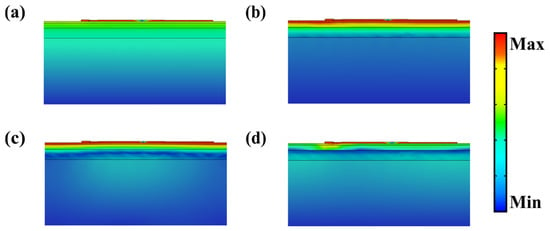
The broadband co-polarized reflection achieved here results from the high reflectivity of VO2 in its metallic state. As shown in Figure 8, at 2, 4, 6, and 8 THz, the electric field is predominantly confined above the VO2 layer. Metallic VO2 blocks electromagnetic waves from penetrating the VO2 layer to reach the underlying gold ground layer, thereby disrupting the original Fabry–Pérot cavity [66]. Although the double L-shaped structure continues to generate orthogonal electric field components under incident illumination, the collapse of the Fabry–Pérot cavity modifies the phase modulation required for polarization rotation. As a result, cross-polarized reflection is suppressed, and the response remains predominantly co-polarized.
Figure 8.
Electric field distributions at (a) 2 THz, (b) 4 THz, (c) 6 THz, and (d) 8 THz, showing field confinement above the metallic VO2 layer.
3.4. Robustness Analysis
Two factors may affect the practical performance of the proposed metasurface: incident angle variation and fabrication precision inherent in microfabrication and nanofabrication. Robustness is evaluated under two realistic constraints: the typical ±10% tolerance of standard fabrication processes, and the incident angle range encountered in terahertz systems, which normally ranges from 0° to 30° [67,68].
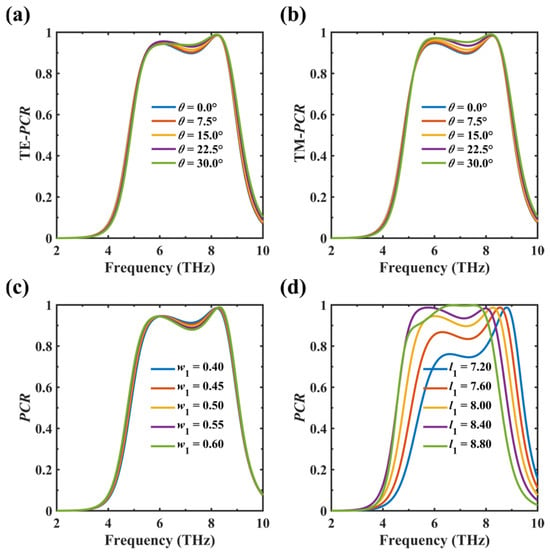
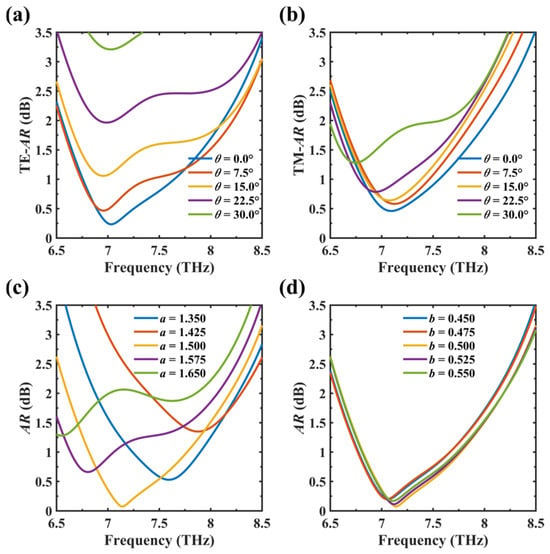
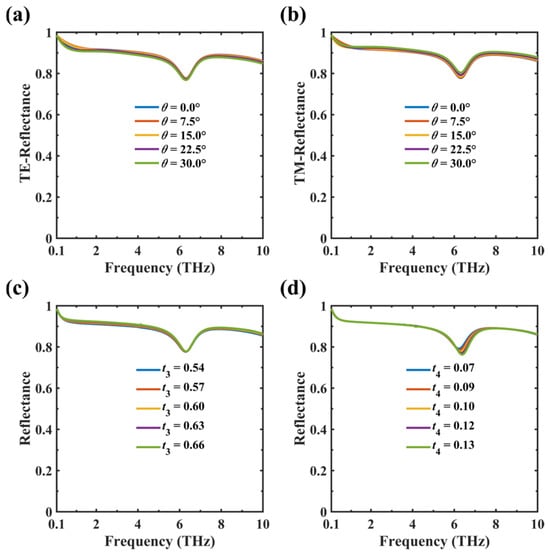
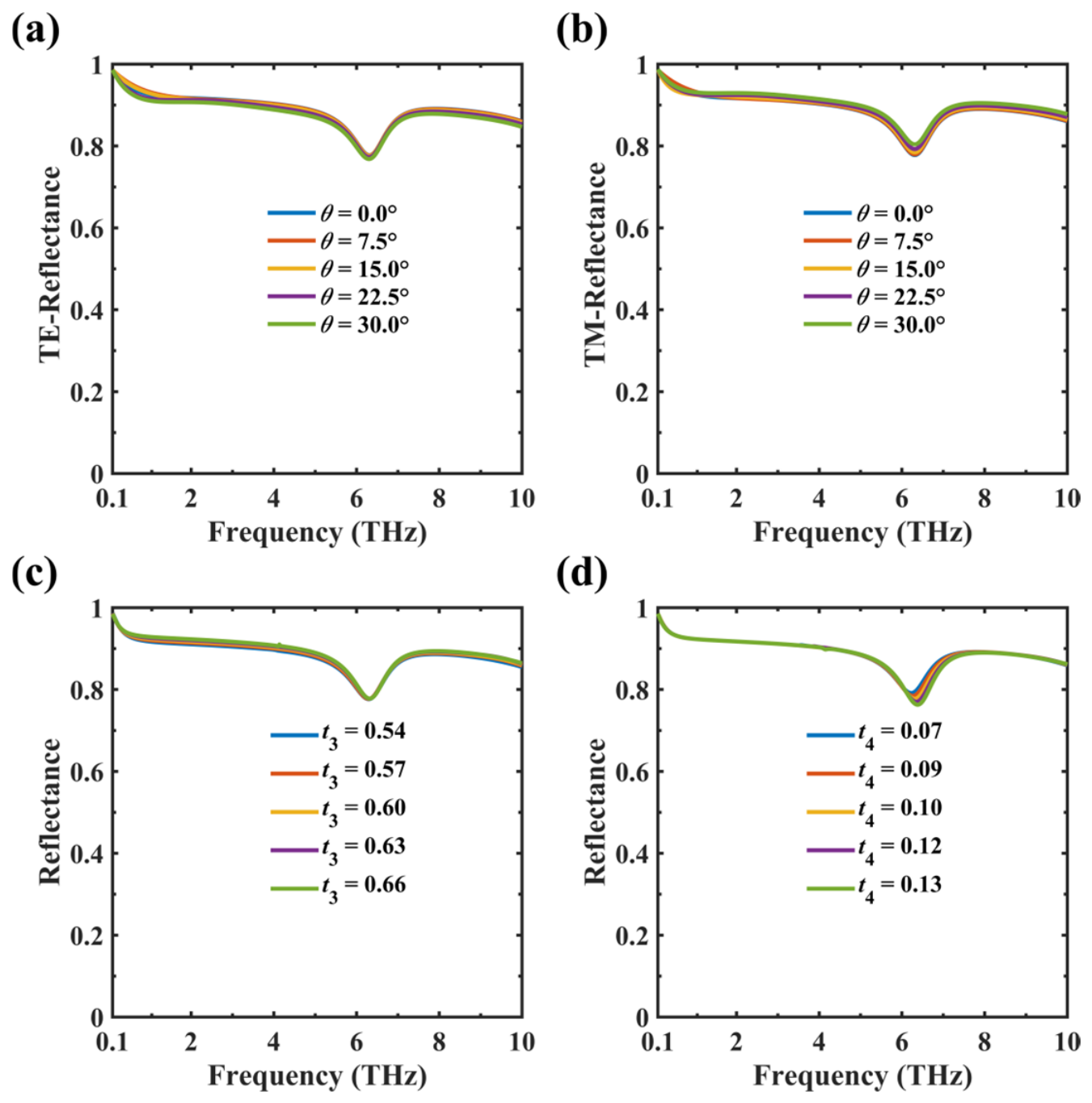
The evaluation results for varying incident angles are shown in Figure 9a,b, Figure 10a,b and Figure 11a,b. Over the full range from 0° to 30°, both PCR and R remain stable under TE and TM incidence, with no significant drift in key performance metrics. Specifically, PCR increases slightly with increasing incident angle, while R decreases slightly with angle under TE incidence but increases slightly under TM incidence. As for AR, it increases with incident angle, yet remains below 3 dB within the main operating frequency band. It should be noted, however, that when the incident angle reaches 30° under TE polarization, AR exceeds 3 dB in some frequency bands; nevertheless, by appropriately increasing the chemical potential, AR can be effectively reduced and brought back below 3 dB within the target frequency range. The above angular tolerance indicates that the device can operate reliably in all three modes even when normal incidence cannot be strictly maintained.
Figure 9.
PCR versus frequency in linear polarization mode for (a) different TE incidence angles, (b) different TM incidence angles, (c) different TE line widths w1, and (d) different TE arm lengths l1.
Figure 10.
AR versus frequency in circular polarization mode for (a) different TE incidence angles, (b) different TM incidence angles, (c) different TE parameter a values, and (d) different TE parameter b values.
Figure 11.
R versus frequency in co-polarized reflection mode for (a) different TE incidence angles, (b) different TM incidence angles, (c) different TE VO2 layer thicknesses t3, and (d) different TE PTFE layer thicknesses t4.
The effects of fabrication errors on the linear polarization conversion mode are also examined, with the corresponding results shown in Figure 9b,c. The line width w1 is swept from 0.4 to 0.6 μm. Over that entire interval, the PCR exhibits almost no variation. A dip appears near 7.22 THz, but even there the drop remains minor as w1 increases slightly. Subsequently, l1 is varied from 7.2 to 8.8 μm. A larger l1 shifts the PCR upward. The bandwidth shrinks only slightly when l1 departs from the nominal design value. Even with l1 reduced to 7.2 μm, the PCR remains above 0.7. Thus, the metasurface remains functional even under fairly extreme fabrication tolerances.
The influence of structural parameters on circular polarization is also examined, focusing on the square graphene patch side length a and the L-shaped structure gap b, and their effects on the AR. As shown in Figure 10b,c, moving a away from its optimal value of 1.5 μm increases the AR. Increasing a causes a redshift in the operating band, while decreasing a produces a blueshift. Yet even with these spectral shifts, the AR stays under 3 dB across most of the 6.45–8.36 THz band. The gap b exhibits a different behavior. The AR is hardly responsive to changes in b. The only noticeable effect is a mild redshift when b deviates from its design value, while the circular polarization conversion performance itself remains almost unchanged.
For the broadband co-polarized reflection mode in the metallic state of VO2, as shown in Figure 11b,c, when t3 increases within the tolerance range, Rxx increases slightly, while the co-polarized reflection remains almost unaffected. When t4 increases within the tolerance range, the reflection spectrum undergoes a blueshift, and the minimum value of Rxx decreases slightly, with a variation of less than 0.03. Overall, the influence of variations in t4 on the co-polarized reflection characteristic remains negligible.
3.5. Performance Comparison
As shown in Table 1, the proposed metasurface is compared with related tunable terahertz metasurfaces in terms of material system, functionality, operating band, and key performance. Most reported designs offer only one or two functionalities. For example, some designs provide only a single polarization conversion band, while others, despite achieving two or three functionalities, exhibit their operating bands distributed across widely separated spectral ranges. Moreover, the polarization conversion bands of these existing designs are predominantly confined below 5 THz, with only a few absorption bands extending to higher frequencies. In contrast, our graphene-VO2 hybrid metasurface integrates three dynamically switchable functionalities within a single reflective device, all situated in the high-frequency terahertz window above 5.5 THz. Notably, the operating bands of these three functionalities exhibit strong spectral overlap. This overlap, combined with the dual-regulation capability of VO2 (binary switching) and graphene (continuous electrical tuning), allows the metasurface to generate on-demand TE, TM, LCP, and RCP output states under linearly polarized incidence within the same frequency band. Such a level of integration and flexibility is expected to play a practical role in terahertz communication applications.
Table 1.
The comparison of the designed metasurface with previous studies that have a similar focus.
3.6. Fabrication Feasibility and Practical Limitations
Although the present work is mainly based on numerical simulations, the proposed graphene-VO2 hybrid metasurface can be practically implemented using high-resolution micro/nanofabrication techniques. A possible fabrication route consists of seven main steps, which are described as follows. (a) A continuous bottom Au ground layer can be deposited on a cleaned supporting substrate by electron-beam evaporation or magnetron sputtering, together with Cr/Au alignment marks for subsequent multilayer alignment [69]. (b) A PTFE-like low-loss fluoropolymer layer, such as Teflon-AF or CYTOP, can be spin-coated and cured at low temperature to form the lower dielectric spacer [70]. (c) The continuous VO2 layer can be prepared separately on a compatible carrier substrate and then transferred, laminated, or low-temperature bonded onto the lower fluoropolymer spacer, avoiding the high-temperature process typically required for VO2 film preparation [71]. (d) The middle PTFE-like dielectric spacer can be formed on the integrated VO2 layer by controlled spin coating and low-temperature curing [72]. (e) CVD-grown graphene can be transferred onto the middle dielectric spacer [73], and the graphene square patches can then be defined by lithography followed by a short, low-power oxygen plasma etch [74], which removes the monolayer while limiting the simultaneous etching of the underlying fluoropolymer; the associated thinning of the middle spacer remains within the ±10% fabrication tolerance analyzed in Section 3.4. In the same lithographic step, each patch is connected to a grid of bias lines routed through the weak-field regions between adjacent unit cells, with contact windows opened at the array periphery after the upper spacer is formed. (f) An ultrathin upper PTFE-like fluoropolymer spacer, corresponding to the 0.1 μm spacer in the proposed structure, can be formed using a diluted fluoropolymer solution and controlled spin-coating conditions [75]. (g) Finally, the top double equal-arm L-shaped Au resonators can be fabricated by electron-beam lithography, metal evaporation, and lift-off [76], with a 2–5 nm Ti adhesion layer and a controlled evaporation temperature to protect the ultrathin upper spacer. The designed 0.5 μm line width is compatible with high-resolution electron-beam lithography.
While it is true that the above process provides a possible fabrication route, several experimental challenges remain in practical implementation. The thickness uniformity of the submicron PTFE-like spacers, especially the 0.1 μm upper spacer, needs careful control because it affects the coupling between graphene and the top Au resonators. The transfer and patterning of graphene may introduce wrinkles, residues, or edge defects, and residual doping from the fluoropolymer interface may shift the Dirac point, requiring a small gate voltage to restore the designed chemical potential. The integration of the continuous VO2 layer is another critical step: the relatively thick (0.6 μm) film is more prone to cracking during transfer, and the completeness of its phase transition should be verified. The multilayer alignment accuracy, the fabrication quality of the 0.5 μm-wide Au resonators, and the practical accessibility of the gate voltage should also be considered.
Beyond fabrication, the practical operation of the three modes requires proper control of VO2 and graphene. The VO2 phase transition can be triggered by a heating stage, an applied voltage, or a pulsed laser [77]. The graphene chemical potential is tuned via gate voltage; using an ion-gel or high-k dielectric material keeps the required voltage within a few volts to several tens of volts, ensuring that the device can be driven by standard laboratory equipment. The three modes are switched as follows: heating VO2 to the metallic state yields the co-polarized reflection mode; cooling VO2 to the insulating state with zero gate voltage yields the LTL conversion mode; keeping VO2 insulating and applying a gate bias (μc ≈ 0.9 eV) yields the LTC conversion mode. All switching operations are reversible and can be performed without structural modification.
Overall, for 6G terahertz communications, since the LTL mode (5.5–8.6 THz) and the LTC mode (6.45–8.36 THz) exhibit significant spectral overlap, the device enables on-demand polarization switching within the same frequency band in a single reflection. When the device operates in the LTL mode, a TE incident wave is converted to TM output (cross-polarization). When switched to the LTC mode, a TE incident wave is converted to LCP output, and a TM incident wave is converted to RCP output, thereby covering full polarization control including both linear and circular polarizations. This capability of achieving multiple polarization states on demand through electrical switching within the same frequency band makes the device suitable for reconfigurable front-ends and intelligent reflecting surfaces. For polarization-resolved imaging and sensing, the multi-state polarization switching enhances imaging contrast and material identification sensitivity for anisotropic targets in biomedical detection and pharmaceutical analysis. Moreover, the “continuous tuning + binary switching” paradigm can be extended to other two-dimensional materials (e.g., MoS2, black phosphorus) and other phase-change materials (e.g., Ge2Sb2Te5) [78]. The reflective metasurface architecture can be adapted to different frequency regimes, such as microwave, millimeter-wave, or infrared, by scaling the geometric parameters proportionally.
4. Conclusions
In summary, a VO2- and graphene-based metasurface is proposed to tailor terahertz wave polarization states and achieve dynamic state switching. Based on the insulator–metal phase transition of VO2 and the electrical tunability of graphene, the designed metasurface enables fully reversible switching between three distinct operation modes for terahertz wave incidence. The three functions are: broadband co-polarized reflection, high-efficiency linear-to-linear polarization conversion, and broadband linear-to-circular polarization conversion. Simulation results show that the metasurface exhibits broadband co-polarized reflection when VO2 is in the metallic state. The average reflectance of the metasurface remains above 0.89 across the 0.1–10 THz frequency band. Furthermore, the metasurface achieves linear-to-linear polarization conversion when VO2 is in the insulating state and the chemical potential of graphene is set to 0 eV. The PCR of the metasurface exceeds 0.9 in the 5.5–8.6 THz frequency range. Finally, increasing the graphene chemical potential to 0.9 eV while maintaining VO2 in the insulating state enables the metasurface to perform linear-to-circular polarization conversion, for which the output handedness depends on the incident polarization, resulting in an AR below 3 dB from 6.45 to 8.36 THz. Through the analysis of incident angle and structural parameter tuning, the structure exhibits excellent robustness over a wide range of incident angles and under typical fabrication tolerances. This work provides a new perspective for the design of multifunctional, dynamically switchable terahertz micro-nano metasurfaces.
Author Contributions
Y.W.: Conceptualization, Data curation, Formal analysis, Investigation, Methodology, Validation, Visualization, Writing—original draft. Y.G.: Conceptualization, Methodology, Project administration, Supervision, Validation, Visualization, Writing—review & editing. Y.F.: Visualization, Data curation, Validation. M.G.: Formal analysis, Investigation. J.S.: Investigation, Data curation. All authors have read and agreed to the published version of the manuscript.
Funding
This research was funded by Natural Science Foundation of Heilongjiang Province (JJ2026PL0622).
Data Availability Statement
The original contributions presented in this study are included in the article. Further inquiries can be directed to the corresponding author.
Conflicts of Interest
The authors declare that they have no known competing financial interests or personal relationships that could have appeared to influence the work reported in this paper.
References
- Jiang, W.; Zhou, Q.; He, J.; Habibi, M.A.; Melnyk, S.; El-Absi, M.; Han, B.; Di Renzo, M.; Schotten, H.D.; Luo, F.L.; et al. Terahertz communications and sensing for 6G and beyond: A comprehensive review. IEEE Commun. Surv. Tutor. 2024, 26, 2326–2381. [Google Scholar] [CrossRef] [Scilit]
- Zhu, H.; Wang, K.; Qiu, Y.; Liu, G.; Mou, J. A review of terahertz metamaterials and applications. J. Telem. Track. Command 2021, 42, 18–35. [Google Scholar]
- Ferguson, B.; Zhang, X.-C. Materials for terahertz science and technology. Nat. Mater. 2002, 1, 26–33. [Google Scholar] [CrossRef] [Scilit] [PubMed]
- Tian, H.W.; Shen, H.Y.; Zhang, X.G.; Li, X.; Jiang, W.X.; Cui, T.J. Terahertz metasurfaces: Toward multifunctional and programmable wave manipulation. Front. Phys. 2020, 8, 584077. [Google Scholar] [CrossRef] [Scilit]
- Wang, Y.; Zhang, X.; Wang, Y.; Liu, Y.; Li, J.; Chen, X.; Cui, Z.; Burokur, S.N.; Zhang, J.; Zhao, X.; et al. Recent advances in metasurfaces: From THz biosensing to microwave wireless communications. Research 2025, 8, 0820. [Google Scholar] [CrossRef] [Scilit] [PubMed]
- He, J.; He, X.; Dong, T.; Wang, S.; Fu, M.; Zhang, Y. Recent progress and applications of terahertz metamaterials. J. Phys. D Appl. Phys. 2022, 55, 123002. [Google Scholar] [CrossRef] [Scilit]
- Liu, M.-S.; Zhou, H.-P.; Zhang, D.-Q.; Fang, B.; Pan, G.-M.; Jin, Z.-W.; Hong, Z.; Shu, F.-Z. Dynamically tunable multiple quasi-bound states in the continuum based on the phase-change metasurface. Photonics Res. 2026, 14, 1348. [Google Scholar] [CrossRef] [Scilit]
- Lian, M.; Su, Y.; Liu, K.; Zhang, S.; Chen, X.; Ren, H.; Xu, Y.; Chen, J.; Tian, Z.; Cao, T. Nonvolatile switchable broadband polarization conversion with wearable terahertz chalcogenide metamaterials. Adv. Opt. Mater. 2023, 11, 2202439. [Google Scholar] [CrossRef] [Scilit]
- Wang, B.-X.; Zhou, W.; Zhao, Q.; Wang, H.; Zhang, Y.; Zhang, D.-Q.; Shu, F.-Z.; Yang, G.; Wu, L. Ge2Sb2Te5-based multifunctional reconfigurable terahertz metamaterials with joint polarization control. Laser Photonics Rev. 2026, 20, e02941. [Google Scholar] [CrossRef] [Scilit]
- Wu, M.; He, X.; Lu, G.; Zhang, Y.; Geng, Z.; Liu, H.; Zhang, K. On-Chip Multi-Channel Wavefront Manipulation of Spoof Surface Waves with Structural Heterogeneous Metasurfaces. Laser Photonics Rev. 2026, 20, 2501634. [Google Scholar] [CrossRef] [Scilit]
- Hu, Z.; Li, K.; Li, C.; Chen, Y.; Ma, Q.; Maier, S.A.; Liu, C.; Ren, H.; Li, G. Spin-orbit interaction enabled nonlinear metasurface holography. Adv. Mater. 2026, 38, e21229. [Google Scholar] [CrossRef] [Scilit] [PubMed]
- Chowdhury, A.R.; Hasan, M.S.; Baki, A.K.M. High efficiency & ultra-wideband polarization rotator metasurface for THz waves. Opt. Commun. 2025, 588, 131931. [Google Scholar] [CrossRef] [Scilit]
- Nguyen, T.Q.H.; Nguyen, T.M.; Nguyen, H.Q. High efficient bi-functional metasurface with linear polarization conversion and asymmetric transmission for terahertz region. J. Opt. 2025, 27, 015104. [Google Scholar] [CrossRef] [Scilit]
- Fu, C.; Wang, X.; Zhu, Y.; Ma, M.; Lv, M.; Fan, W.; Han, L. A multifunctional terahertz metasurface with absorption and polarization conversion based on vanadium dioxide and photoconductive silicon. Plasmonics 2025, 20, 10157–10173. [Google Scholar] [CrossRef] [Scilit]
- Grady, N.K.; Heyes, J.E.; Chowdhury, D.R.; Zeng, Y.; Reiten, M.T.; Azad, A.K.; Taylor, A.J.; Dalvit, D.A.R.; Chen, H.-T. Terahertz metamaterials for linear polarization conversion and anomalous refraction. Science 2013, 340, 1304–1307. [Google Scholar] [CrossRef] [Scilit] [PubMed]
- Cong, L.; Cao, W.; Zhang, X.; Tian, Z.; Gu, J.; Singh, R.; Han, J.; Zhang, W. A perfect metamaterial polarization rotator. Appl. Phys. Lett. 2013, 103, 171107. [Google Scholar] [CrossRef] [Scilit]
- Chen, H.-T.; Taylor, A.J.; Yu, N. A review of metasurfaces: Physics and applications. Rep. Prog. Phys. 2016, 79, 076401. [Google Scholar] [CrossRef] [Scilit] [PubMed]
- Ju, C.; Zhang, D.-Q.; Ma, Y.-B.; Wang, Y.; Fang, B.; Pan, G.-M.; Jin, Z.-W.; Hong, Z.; Chen, M.-M.; Lin, C.-Y.; et al. Thermally tunable quasi-bound state in the continuum and electromagnetically induced transparency analogue based on the hybrid phase-change metasurfaces. ACS Appl. Mater. Interfaces 2026, 18, 36141–36150. [Google Scholar] [CrossRef] [Scilit] [PubMed]
- Wang, C.; Liu, M.-S.; Zhang, D.-Q.; Jin, Z.-W.; Pan, G.-M.; Fang, B.; Hong, Z.; Shu, F.-Z. Active control of the toroidal dipole and quasi-bound state in the continuum based on the symmetric and asymmetric hybrid dumbbell aperture arrays. Photonics Res. 2025, 13, 1534. [Google Scholar] [CrossRef] [Scilit]
- Guo, H.; Chen, B.; Li, Y.; Li, W.; Yang, S.; Wang, S.; Zhu, W.; Wu, J.; Ma, H.; Zhang, X.; et al. Broadband, transmissive, and cascadable terahertz programmable metasurface. ACS Nano 2025, 19, 21660–21668. [Google Scholar] [CrossRef] [Scilit] [PubMed]
- Meng, F.; Zhang, L.; Jia, Y.; Gao, Y. Perfect absorption and polarization conversion metasurface based on graphene and vanadium dioxide. Phys. Scr. 2025, 100, 095522. [Google Scholar] [CrossRef] [Scilit]
- Liu, Y.; Hu, L.; Liu, M. Graphene and vanadium dioxide-based terahertz absorber with switchable multifunctionality for band selection applications. Nanomaterials 2024, 14, 1200. [Google Scholar] [CrossRef] [Scilit] [PubMed]
- Yang, J.; Wang, Y.; Xie, Z.; Jue, X.; Han, D.; Li, S.; Chen, J. Broadband frequency multiplexing terahertz metasurface with switchable holography and absorption. Opt. Lasers Eng. 2026, 196, 109384. [Google Scholar] [CrossRef] [Scilit]
- Chen, K.; Wang, Z.; Guan, M.; Cheng, S.; Ma, H.; Yi, Z.; Li, B. Tunable ultra-wideband VO2–graphene hybrid metasurface terahertz absorption devices based on dual regulation. Photonics 2025, 12, 987. [Google Scholar] [CrossRef] [Scilit]
- Wang, G.; Chu, M.; Jiang, J.; Jia, Y.; Liu, J.; Yu, H.; Meng, H.; Shi, W. A dynamically reconfigurable terahertz metasurface enabled by hybrid Ge2Sb2Te5 and VO2 phase-change materials. Phys. Chem. Chem. Phys. 2026, 28, 3423–3433. [Google Scholar] [CrossRef] [Scilit] [PubMed]
- Li, H.; Li, G.; Deng, Z.; Xu, W.; Xu, H.; Li, J.; Song, C.; Qiu, F.; Zhang, Y.; Ren, Y.; et al. Multifunctional all-silicon terahertz chiral metasurfaces via integrated Moiré and spin-decoupled phase engineering. Laser Photonics Rev. 2026, 20, e03260. [Google Scholar] [CrossRef] [Scilit]
- Li, H.; Zhao, C.; Xu, W.; Li, J.; Zheng, C.; Tan, Q.; Song, C.; Xu, H.; Shen, Y.; Yao, J. Twisted bilayer meta-device for on-demand terahertz polariza-tion filtering. Photonics Res. 2025, 13, 1116–1129. [Google Scholar] [CrossRef] [Scilit]
- He, X.; Wu, M.; Lu, G.; Zhang, Y.; Geng, Z.; Qu, Y. On-chip multidimensional dynamic manipulation of terahertz spoof surface waves based on graphene metasurfaces. Photonics Res. 2025, 13, 3511–3521. [Google Scholar] [CrossRef] [Scilit]
- Cao, M.; Wang, J.; Yuen, M.M.F.; Yan, D. Realization of multifunctional metamaterial structure based on the combination of vanadium dioxide and graphene. Nanomaterials 2022, 12, 2883. [Google Scholar] [CrossRef] [Scilit] [PubMed]
- Dong, T.; Zhang, Y.; Li, Y.; Tang, Y.; He, X. Dual-function switchable terahertz metamaterial device with dynamic tuning characteristics. Results Phys. 2023, 45, 106246. [Google Scholar] [CrossRef] [Scilit]
- Wei, H.; Ge, H.; Zhao, T.; Sharma, S.; Petru, M.; Dwivedi, S.P.; Kumar, A.; Abbas, M. Vanadium dioxide thin films-assisted terahertz meta-surface for simultaneous absorption, polarization conversion bi-functional switching, and wavefront operation. Results Phys. 2023, 53, 106970. [Google Scholar] [CrossRef] [Scilit]
- Liu, G.; Yang, R.; Zhu, C.; Fan, Z. Bi-functional meta-surfaces for ultra-wideband absorption and broadband polarization conversion. IEEE Photonics Technol. Lett. 2024, 36, 1065–1068. [Google Scholar] [CrossRef] [Scilit]
- Liang, L.; Xue, W.; Zhang, Y. Design and optimization for metasurface polarization converter via tandem neural networks. Acta Opt. Sin. 2025, 45, 1420024. [Google Scholar]
- Liu, M.; Hwang, H.Y.; Tao, H.; Strikwerda, A.C.; Fan, K.; Keiser, G.R.; Sternbach, A.J.; West, K.G.; Kittiwatanakul, S.; Lu, J.; et al. Terahertz-field-induced insulator-to-metal transition in vanadium dioxide metamaterial. Nature 2012, 487, 345–348. [Google Scholar] [CrossRef] [Scilit] [PubMed]
- Zhang, D.-Q.; Tao, Y.; Pan, G.-M.; Jin, Z.-W.; Fang, B.; Hong, Z.; Shu, F.-Z. Switchable transmissive and reflective metadevices based on the phase transition of vanadium dioxide. Opt. Lett. 2022, 47, 6073–6076. [Google Scholar] [CrossRef] [Scilit] [PubMed]
- Ding, F.; Zhong, S.; Bozhevolnyi, S.I. Vanadium dioxide integrated metasurfaces with switchable functionalities at terahertz frequencies. Adv. Opt. Mater. 2018, 6, 1701204. [Google Scholar] [CrossRef] [Scilit]
- Zhou, Q.; Liu, P.; Bian, L.-A.; Liu, H.; Liu, C.; Chen, G. Controlling enhanced absorption in graphene metamaterial. Opt. Commun. 2018, 413, 310–316. [Google Scholar] [CrossRef] [Scilit]
- Lee, H.; Paeng, K.; Kim, I.S. A review of doping modulation in graphene. Synth. Met. 2018, 244, 36–47. [Google Scholar] [CrossRef] [Scilit]
- Zhu, J.; Chen, X. Three-frequency optical switch with dynamically tunable and polarimetric insensitive multifunctional device. Phys. E Low-Dimens. Syst. Nanostruct. 2025, 173, 116297. [Google Scholar] [CrossRef] [Scilit]
- Wang, S.; Huang, H.; Su, H.; Xu, G.; Wang, C.; Li, Q.; Han, L. A study on the electromagnetic mechanism of a flexible terahertz toroidal dipole metasurfaces. Mater. Res. Express 2024, 11, 035801. [Google Scholar] [CrossRef] [Scilit]
- Ye, H.; Zhang, Y. Design of polarization convert metasurface element with high angle stability. Opt. Express 2024, 32, 17103–17115. [Google Scholar] [CrossRef] [Scilit] [PubMed]
- Zou, M.; Su, M.; Yu, H. Ultra-broadband and wide-angle terahertz polarization converter based on symmetrical anchor-shaped metamaterial. Opt. Mater. 2020, 107, 110062. [Google Scholar] [CrossRef] [Scilit]
- Qureshi, U.U.R.; Basir, S.; Mallek, F.; Hamam, H. Polarization and incident angle independent multifunctional tunable terahertz metasurface based on graphene. Sci. Rep. 2024, 14, 5118. [Google Scholar] [CrossRef] [Scilit] [PubMed]
- Huang, J.; Fu, T.; Li, H.; Shou, Z.; Gao, X. A reconfigurable terahertz polarization converter based on metal-graphene hybrid metasurface. Chin. Opt. Lett. 2020, 18, 013102. [Google Scholar] [CrossRef] [Scilit]
- Gavdush, A.A.; Zhelnov, V.A.; Dolganov, K.B.; Bogutskii, A.A.; Garnov, S.V.; Burdanova, M.G.; Ponomarev, D.S.; Shi, Q.; Zaytsev, K.I.; Komandin, G.A. Insulator–metal transition in VO2 film on sapphire studied by broadband dielectric spectroscopy. Sci. Rep. 2025, 15, 3500. [Google Scholar] [CrossRef] [Scilit] [PubMed]
- Li, J.; Zhang, Y.; Li, J.; Li, J.; Yang, Y.; Huang, J.; Ma, C.; Ma, Z.; Zhang, Z.; Liang, L.; et al. Frequency-switchable VO2-based coding metasurfaces at the terahertz band. Opt. Commun. 2020, 458, 124744. [Google Scholar] [CrossRef] [Scilit]
- Ma, S.; Mi, X.; Bian, X. Bifunctional terahertz metamaterial device with switchable properties between transmission and broadband absorption. Photonics Nanostruct.-Fundam. Appl. 2024, 62, 101317. [Google Scholar] [CrossRef] [Scilit]
- Xiao, G.; Lai, Z.; Yang, H.; Liu, X.; Wang, B. Tunable broadband metamaterial absorber with voltage and temperature modulation. Opt. Commun. 2024, 553, 130129. [Google Scholar] [CrossRef] [Scilit]
- Li, N.; Mei, J.; Gong, D.; Shi, Y. Broadband and tunable terahertz polarization converter based on graphene composite metasurface. Opt. Commun. 2022, 521, 128581. [Google Scholar] [CrossRef] [Scilit]
- Xu, K.-K.; Xiao, Z.-Y.; Tang, J.-Y. Linearly polarized converters for reflected and transmitted waves based on double-split ring resonator. Plasmonics 2017, 12, 1869–1874. [Google Scholar] [CrossRef] [Scilit]
- Zhao, Z.; Zhao, H.; Ako, R.T.; Nickl, S.; Sriram, S. Polarization-insensitive terahertz spoof localized surface plasmon-induced transparency based on lattice rotational symmetry. Appl. Phys. Lett. 2020, 117, 011105. [Google Scholar] [CrossRef] [Scilit]
- Luo, J.; Shi, X.; Luo, X.; Hu, F.; Li, G. Broadband switchable terahertz half-/quarter-wave plate based on metal-VO2 metamaterials. Opt. Express 2020, 28, 30861–30870. [Google Scholar] [CrossRef] [Scilit] [PubMed]
- Huang, R.; Shi, S.; Sun, M.; Yang, R.; Lin, Y.; Wu, M.; Zhang, M.; Maksimenko, S.; He, X. Dynamic wavefront manipulation enabled with VO2-based reflective terahertz metasurfaces. Nanomaterials 2026, 16, 338. [Google Scholar] [CrossRef] [Scilit] [PubMed]
- Jia, Y.; Wang, G.; Zhang, X.; Li, M.; Miao, F.; Gao, Y. Terahertz multi-band absorber and dual-bandwidth polarization converter based on VO2 and graphene. Results Phys. 2023, 53, 107006. [Google Scholar] [CrossRef] [Scilit]
- Zhang, X.; Wang, G.; Liu, J.; Zuo, S.; Li, M.; Yang, S.; Jia, Y.; Gao, Y. A switchable and tunable multifunctional terahertz polarization converter based on a graphene metasurface. Phys. Chem. Chem. Phys. 2023, 25, 31948–31959. [Google Scholar] [CrossRef] [Scilit] [PubMed]
- Heidari, S.; Nozhat, N. Broadband multifunctional polarization converter based on graphene and vanadium dioxide metasurfaces along with analytical methods. Sci. Rep. 2025, 15, 15856. [Google Scholar] [CrossRef] [Scilit] [PubMed]
- Tang, B.; Ren, Y. Tunable and switchable multi-functional terahertz metamaterials based on a hybrid vanadium dioxide–graphene integrated configuration. Phys. Chem. Chem. Phys. 2022, 24, 8408–8414. [Google Scholar] [CrossRef] [Scilit] [PubMed]
- Wang, X.; Xiao, Z.; Zheng, Q. Switchable and tunable broadband terahertz absorption, linear polarization conversion and linear to circular polarization based on graphene–vanadium dioxide metamaterials. Opt. Mater. 2024, 150, 115238. [Google Scholar] [CrossRef] [Scilit]
- Lin, B.-Q.; Lv, L.-T.; Guo, J.-X.; Wang, Z.-L.; Huang, S.-Q.; Wang, Y.-W. Ultra-wideband linear-to-circular polarization conversion metasurface. Chin. Phys. B 2020, 29, 104205. [Google Scholar] [CrossRef] [Scilit]
- Gil, J.J. Polarimetric characterization of light and media: Physical quantities involved in polarimetric phenomena. Eur. Phys. J.-Appl. Phys. 2007, 40, 1–47. [Google Scholar]
- Zhou, Q.; Li, Y.; Li, Y.; Yao, N.; Huang, Z. High efficiency of broadband transmissive metasurface terahertz polarization converter. Chin. Phys. B 2023, 32, 024201. [Google Scholar] [CrossRef] [Scilit]
- Du, Y.; Huang, R.; Zhang, C.; Zhang, X. Reflective ultra-wideband dual-band linear-to-circular polarization converter based on metasurface. Opt. Rev. 2023, 30, 531–536. [Google Scholar] [CrossRef] [Scilit]
- Hayat, B.; Zhang, J.; Majeed, A.; Ishfaq, M.; Khan, A.; Ahmad, S. A low profile wideband linear to circular polarization converter metasurface with wide axial ratio and high ellipticity. Electronics 2024, 13, 352. [Google Scholar] [CrossRef] [Scilit]
- Li, W.; Sun, J.; Su, C.; Gao, P.; Wang, X.; Liu, X.; Xia, F.; Zhang, K.; Dong, L.; Yun, M. Dual-pattern broadband polarization converter in THz band based on graphene and VO2 hybrid metasurface. Results Phys. 2023, 53, 107021. [Google Scholar] [CrossRef] [Scilit]
- Zou, W.; Zhong, C.; Hong, L.; Lei, J.; Shen, Y.; Deng, X.; Chen, J.; Guo, T. Switchable vanadium dioxide metasurface for terahertz ultra-broadband absorption and reflective polarization conversion. Micromachines 2024, 15, 967. [Google Scholar] [CrossRef] [Scilit] [PubMed]
- Zhao, J.; Pang, S.; Zhou, J. Matching the dual functions of vanadium dioxide metasurfaces through switchable Fabry-Pérot structure. Opt. Mater. 2023, 146, 114600. [Google Scholar] [CrossRef] [Scilit]
- Jenkins, R.P.; Campbell, S.D.; Werner, D.H. Establishing exhaustive metasurface robustness against fabrication uncertainties through deep learning. Nanophotonics 2021, 10, 4497–4509. [Google Scholar] [CrossRef] [Scilit]
- Fu, Y.-N.; Zhang, X.-Q.; Zhao, G.-Z.; Li, Y.-H.; Yu, J.-Y. A broadband polarization converter based on resonant ring in terahertz region. Acta Phys. Sin. 2017, 66, 180701. [Google Scholar] [CrossRef] [Scilit]
- Ako, R.T.; Lee, W.S.L.; Bhaskaran, M.; Sriram, S.; Withayachumnankul, W. Broadband and wide-angle reflective linear polarization converter for terahertz waves. APL Photonics 2019, 4, 096104. [Google Scholar] [CrossRef] [Scilit]
- Ding, S.-J.; Wang, P.-F.; Zhang, D.W.; Wang, J.-T.; Lee, W.W. A novel structural amorphous fluoropolymer film with an ultra-low dielectric constant. Mater. Lett. 2001, 49, 154–159. [Google Scholar] [CrossRef] [Scilit]
- Afshani, A.; Xiang, W.; Djerafi, T.; Chaker, M. Vanadium dioxide thin films integrated with printed circuit board enables low-cost, reconfigurable millimeter-wave devices. Commun. Eng. 2025, 4, 174. [Google Scholar] [CrossRef] [Scilit] [PubMed]
- Cheng, X.; Caironi, M.; Noh, Y.-Y.; Wang, J.; Newman, C.; Yan, H.; Facchetti, A.; Sirringhaus, H. Air stable cross-linked Cytop ultrathin gate dielectric for high yield low-voltage top-gate organic field-effect transistors. Chem. Mater. 2010, 22, 1559–1566. [Google Scholar] [CrossRef] [Scilit]
- Li, X.; Cai, W.; An, J.; Kim, S.; Nah, J.; Yang, D.; Piner, R.; Velamakanni, A.; Jung, I.; Tutuc, E.; et al. Large-area synthesis of high-quality and uniform graphene films on copper foils. Science 2009, 324, 1312–1314. [Google Scholar] [CrossRef] [Scilit] [PubMed]
- Rufino, F.C.; Pascon, A.M.; Espindola, L.C.; Cioldin, F.H.; Larrudé, D.R.; Diniz, J.A. Definition of CVD graphene micro ribbons with lithography and oxygen plasma ashing. Carbon Trends 2021, 4, 100056. [Google Scholar] [CrossRef] [Scilit]
- Walser, M.P.; Kalb, W.L.; Mathis, T.; Batlogg, B. Low-voltage organic transistors and inverters with ultra-thin fluoropolymer gate dielectric. Appl. Phys. Lett. 2009, 95, 233301. [Google Scholar] [CrossRef] [Scilit]
- Chen, Y. Nanofabrication by electron beam lithography and its applications: A review. Microelectron. Eng. 2015, 135, 57–72. [Google Scholar] [CrossRef] [Scilit]
- Liu, M.; Wei, R.; Taplin, J.; Zhang, W. Terahertz metasurfaces exploiting the phase transition of vanadium dioxide. Materials 2023, 16, 7106. [Google Scholar] [CrossRef] [Scilit] [PubMed]
- Li, Y.; Pan, Y.; Chen, F.; Cheng, S.; Yang, W.; Wang, B.; Yi, Z. Efficient terahertz sensor and modulator in patterned black phosphorus metasurface based on double plasmon-induced transparency. Plasmonics 2024, 19, 711–719. [Google Scholar] [CrossRef] [Scilit]

Disclaimer/Publisher’s Note: The statements, opinions and data contained in all publications are solely those of the individual author(s) and contributor(s) and not of MDPI and/or the editor(s). MDPI and/or the editor(s) disclaim responsibility for any injury to people or property resulting from any ideas, methods, instructions or products referred to in the content. |
© 2026 by the authors. Licensee MDPI, Basel, Switzerland. This article is an open access article distributed under the terms and conditions of the Creative Commons Attribution (CC BY) license.