


Abstract
Photon-counting constitute a promising technology for ultra-weak signal satellite communications. Considering the Poisson shot noise impairment, atmospheric turbulence fading, and multi-user interference, in this paper, a meta-learning-driven photon-counting multi-user single-input multiple-output (MU-SIMO) scheme is developed and analyzed. Referred to as meta-learning-driven signal detection (Meta-SD), this scheme can achieve rapid convergence with limited samples and significantly improve system detection performance. Simulation results demonstrate that the proposed meta-learning scheme outperforms the mean square error based signal detection (MSE-SD) baseline, in terms of detection accuracy, robustness to signal-dependent Poisson shot noise, convergence speed, and generalization to few-shot detection tasks with previously untrained signal classes. Specifically, Meta-SD achieves nearly a tenfold reduction in BER, compared with the derived MSE-SD benchmark, in a MU-SIMO scenario at dBJ.
1. Introduction
Free-space optical (FSO) systems are an attractive scheme for satellite communications, owing to their large bandwidth, high power efficiency, and immunity to electromagnetic interference [1]. However, FSO links are vulnerable to scintillation induced by atmospheric turbulence and attenuation over long transmission distances, both of which can significantly reduce the received optical power. In the low-optical-power regime, photon-counting communication based on highly sensitive photon counters provides a promising solution for reliable information recovery, whereas conventional optical receivers may suffer from limited sensitivity [2]. By introducing the spatial domain as an additional degree of freedom, multi-user multiple-input multiple-output (MIMO) technology can provide spatial diversity and improve the throughput of photon-counting systems [3,4]. Nevertheless, the performance of multi-user photon-counting MIMO systems relies on reliable signal detection under multi-user interference and atmospheric turbulence.
For photon-counting systems, a variety of model-driven detection schemes have been developed, including the generalized maximum likelihood sequence estimation proposed by Chatzidiamantis et al. [5], the maximum likelihood (ML) detection method proposed by Wang et al. for non-line-of-sight scattering systems [6], and the linear minimum mean-square error (MMSE) receiver design for MIMO scenarios [3,7]. These model-driven methods provide important baselines for photon-counting signal detection. However, multi-user photon-counting MIMO systems face key challenges from signal-dependent shot noise (SDSN). Compared with the signal-independent additive white Gaussian noise (AWGN) model commonly used in traditional radio frequency (RF) systems, the shot-noise-limited optical system usually has the characteristics of a Poisson counting process (PCP). Specifically, the received photon counts follow a Poisson distribution, whose conditional mean and conditional variance are jointly determined by the transmitted symbols, instantaneous channel gains, and background light [8]. Consequently, the noise exhibits inherent signal dependence and cannot be generally modeled as AWGN that is independent of the signal with constant variance. If detectors based on the AWGN assumption are directly employed, their Euclidean distance metric or constant-variance Gaussian likelihood overlooks the discrete, non-negative, asymmetric, and heteroscedastic characteristics of photon counts, leading to severe model mismatch, particularly under weak-light and low-count conditions. Furthermore, linear methods such as MMSE rely primarily on second-order statistics and generally fail to fully exploit the complete Poisson likelihood. In the presence of multi-user interference, time-varying or unknown channels, and Poisson shot noise, the optimal decision rule is inherently non-linear, which significantly limits the performance of linear detectors, thereby motivating the design of Poisson-model-based and adaptive detection paradigms.
Data-driven methods provide a promising direction for developing such adaptive non-linear detectors Poisson-model-based and adaptive detectors, since they can learn complex nonlinear mappings that are difficult to characterize analytically. In recent years, data-driven deep learning (DL) technology has been used to overcome the limitations of model-driven detectors and has shown higher detection and estimation performance. Ye et al. [9] used deep learning for end-to-end processing in orthogonal frequency division multiplexing (OFDM) systems and effectively recovered the transmitted signal without explicit channel estimation. The study by He et al. [10] further demonstrated that by integrating trainable parameters into MIMO detection algorithms, model-driven deep learning techniques can surpass traditional iterative detectors. In order to extend these deep learning-based paradigms to the optical domain, Zhao et al. [11] proposed a channel estimation method based on deep learning for wireless ultraviolet MIMO systems. By using a convolutional neural network (CNN), the proposed framework extracted high-dimensional features of channel state information and improved channel estimation performance in scattering and turbulence environments. However, traditional deep learning models usually rely on large-scale labeled datasets, which makes them prone to problems of reduced robustness and insufficient generalization ability under the condition of limited samples in atmospheric turbulence.
As a learning-to-learn technology, meta-learning uses prior knowledge to achieve rapid adaptation to new tasks [12,13]. In particular, optimization-based meta-learning algorithms, such as model-agnostic meta-learning (MAML) and Reptile, provide a promising method for few-shot adaptation in complex communication environments by learning initial parameters with strong generalization ability [14,15]. Therefore, while retaining the strong fitting ability of the data-driven method, meta-learning gives the model the ability to adapt quickly with few samples and maintain excellent accuracy. Specifically, during practical deployment, the meta-learning detector utilizes merely a few samples to rapidly infer the current channel and background noise states, thereby dynamically adjusting its non-linear decision boundaries to precisely match the true Poisson likelihood. This mechanism enables the model to fully accommodate the inherent characteristics of photon-counting data, including its discreteness, non-negativity, and signal-dependent variance. Consequently, under stringent conditions characterized by weak light and limited adaptation data, the meta-learning approach effectively overcomes the severe model mismatch inherent in conventional fixed AWGN or linear detectors, achieving superior detection performance and robust cross-scenario generalization.
Against this background, we study the meta-learning-driven signal detection in photon-counting multi-user single-input multiple-output (MU-SIMO) systems under atmospheric turbulence. More explicitly, our main contributions are summarized as follows:
- (1)
- Task reformulation and neural network architecture design of a customized MU-SIMO signal detection framework for Poisson shot noise channels:We develop a signal detection framework for optical MU-SIMO detection by applying the Reptile meta-learning algorithm. We reformulate the detection problem into a few-shot multi-class classification task and introduce a learning rate decay strategy to stabilize the meta-training, instead of directly applying the general meta-learning model. This alleviates the gradient instability problem associated with discrete and signal-dependent Poisson shot noise. These targeted improvements significantly enhance the efficiency of few-shot learning, convergence performance, and robustness.
- (2)
- System-level integration and performance evaluation of the proposed Meta-SD:Building on the customized detection framework in our previous contribution, we integrate the proposed detector into a turbulence-impaired photon-counting MU-SIMO system and establish the meta-learning-driven signal detection (Meta-SD) scheme. At the system level, Meta-SD leverages the learned prior knowledge to rapidly adapt, with only a few labeled samples, to practical channel and noise variations caused by atmospheric turbulence, background light, and imperfect CSI. Simulation results show that Meta-SD achieves faster convergence, higher detection accuracy, and stronger robustness than the mean square error based signal detection (MSE-SD) baseline and other benchmark methods, especially under strong turbulence and imperfect CSI.
- (3)
- Theoretical derivation of a model-driven MSE-SD baseline for multi-user photon-counting MIMO detection under signal-dependent Poisson shot noise:AWGN-based detection is mismatched with the signal-dependent Poisson counting statistics, limiting linear receiver performance in photon-counting systems. We derive the closed-form MMSE detection expression for M-PAM modulated photon-counting MU-SIMO systems operating under Possion shot noise channels, providing a proposed model-driven MSE-SD baseline for performance comparison.
Extensive simulation results show that the proposed Meta-SD scheme has higher detection accuracy and better generalization ability than the MSE-SD baseline methods, especially in strong turbulence. Specifically, in a typical multi-user configuration with , Meta-SD achieves a bit error rate (BER) reduction of nearly tenfold compared to the derived MSE-SD benchmark.
The rest of this article is organized as follows. Section 2 introduces the system model of the multi-user photon-counting MU-SIMO communication system. In Section 3, the proposed Meta-SD strategy and the derivation of the model-driven MSE-SD benchmark are described in detail. Section 4 provides extensive simulation results, and Section 5 concludes the paper.
2. System Model
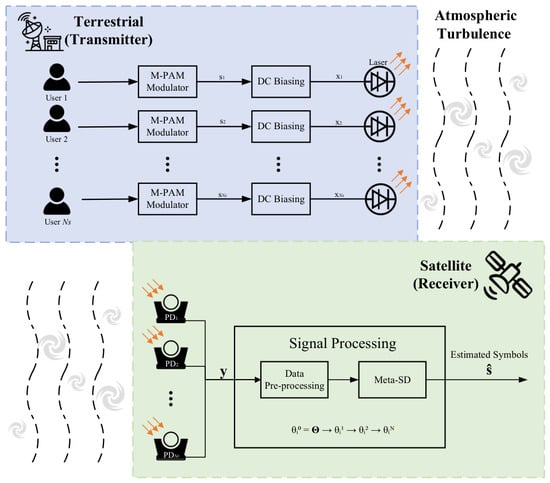
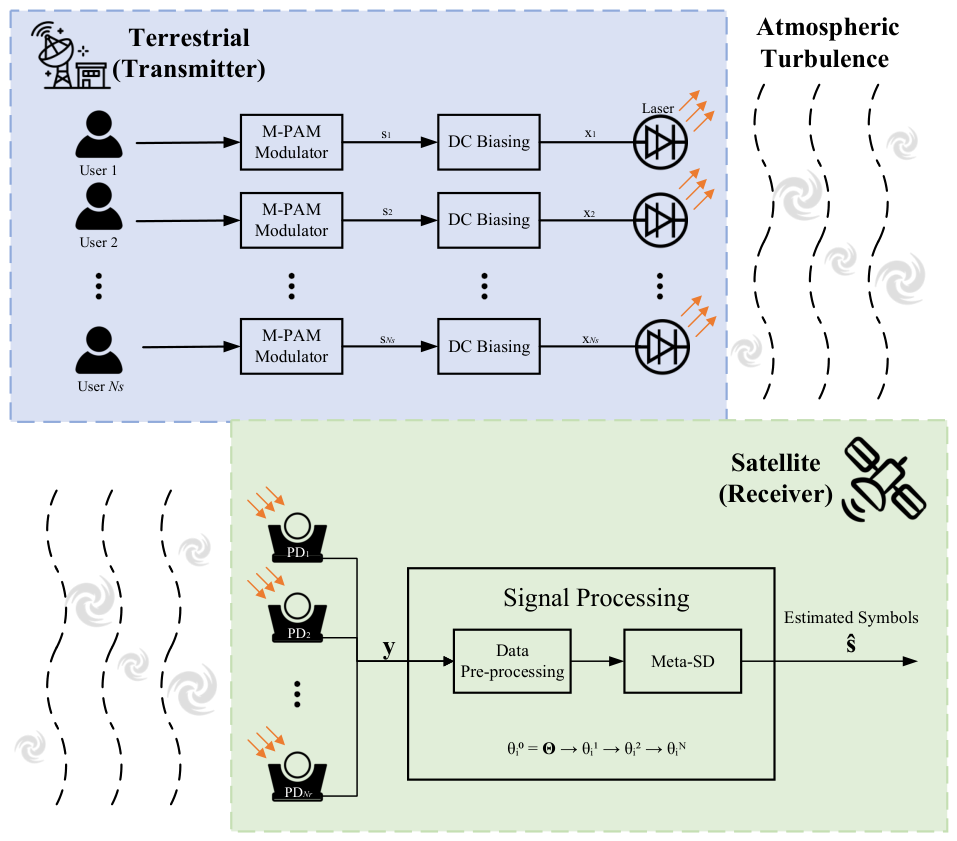
As shown in Figure 1, we consider a photon-counting multi-user single-input multiple-output (MU-SIMO) uplink satellite communication system. Specifically, users on the ground send data in the same time slot and frequency band. Each user uses a single laser to emit a highly directional optical beam. At the satellite, photon-counting detectors (PDs) are deployed to receive optical signals.
Figure 1.
Block diagram of the proposed meta-learning-driven photon-counting MU-SIMO uplink communication system.
2.1. Optical Transmitter
At the transmitter side, the binary data of the k-th user are modulated into M-PAM symbols, denoted as , with equal probability . The modulated signal vector for all users is expressed as . To satisfy the non-negativity requirement of optical intensity, a fixed direct-current (DC) bias vector is added to the modulated signals before transmission. Hence, the transmitted optical signal vector is expressed as
where denotes the number of photons per transmitted optical symbol, is the photoelectric conversion efficiency, P is the power set by the laser, f is the optical frequency, T is the symbol duration, and h is Planck’s constant. Moreover, to ensure that the laser device operates within its linear region and satisfies the peak power constraint, the DC bias for the k-th user should satisfy
The transmitted optical signals propagate through the atmospheric turbulence channel and arrive at the receiver. At the receiver, photon-counting detection is adopted.
2.2. Poisson Atmospheric Channel Model
In FSO communication systems, weather-induced scattering and atmospheric turbulence arising from refractive index fluctuations of the transmission medium lead to random fluctuations in the optical signal intensity, which significantly affect system stability and reliability. To characterize turbulence-induced fading over a wide range of conditions, from weak to strong turbulence, the Gamma-Gamma distribution is widely adopted [16]. In this model, the normalized fading intensity I is modeled as the product of two statistically independent Gamma random variables, which represent the effects of large-scale and small-scale turbulent eddies, i.e., . Consequently, the probability density function (PDF) of the fading intensity I is given by
where represents the standard Gamma function, and is the modified Bessel function of the second kind with order . The parameters and are the effective numbers of small-scale and large-scale eddies, respectively, and are directly related to the atmospheric conditions. These parameters can be calculated as
where denotes the Rytov variance, represents the refractive-index structure parameter, k is the optical wavenumber, and d represents the transmission distance between the transmitter and the receiver. Furthermore, the scintillation index (S.I.), which is used to quantify the fading severity, is given by .
In addition to the channel fading, the receiver is subjected to noise. Unlike the signal-independent additive white Gaussian noise (AWGN) model common in RF systems, the noise characteristics of photon-counting receivers in weak-signal environments are characterized by a discrete-time Poisson (DTP) model [17], where the shot noise variance scales proportionally with the received signal intensity. Furthermore, the receiver inevitably captures background radiation and dark currents, both of which are also modeled as Poisson processes [18].
At the receiver, the expected received photon count at the i-th detector, denoted by , is expressed as
where is the channel vector representing the equivalent channel gains from all transmitters to the i-th detector, and denotes the expected photon count induced by background noise and dark current.
With as the parameter, the received photon count at the i-th detector, denoted by , is modeled as a Poisson random variable. By substituting into the Poisson PMF, its conditional probability mass function (PMF) is formulated as
Finally, the received photon counts from all PDs form the received signal vector . This vector is then fed into the signal detection module to recover the transmitted data.
3. Proposed Meta-Learning-Driven Signal Detection Receiver
In this context, this section first introduces the proposed meta-learning-driven signal detector, referred to as Meta-SD in the following. Specifically, the architecture of the Meta-SD neural detector and its meta-learning training procedure are presented.
3.1. Network Architecture of Meta-SD
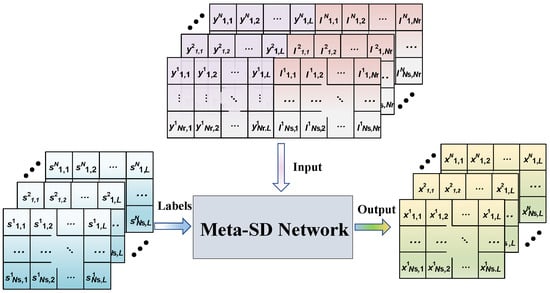
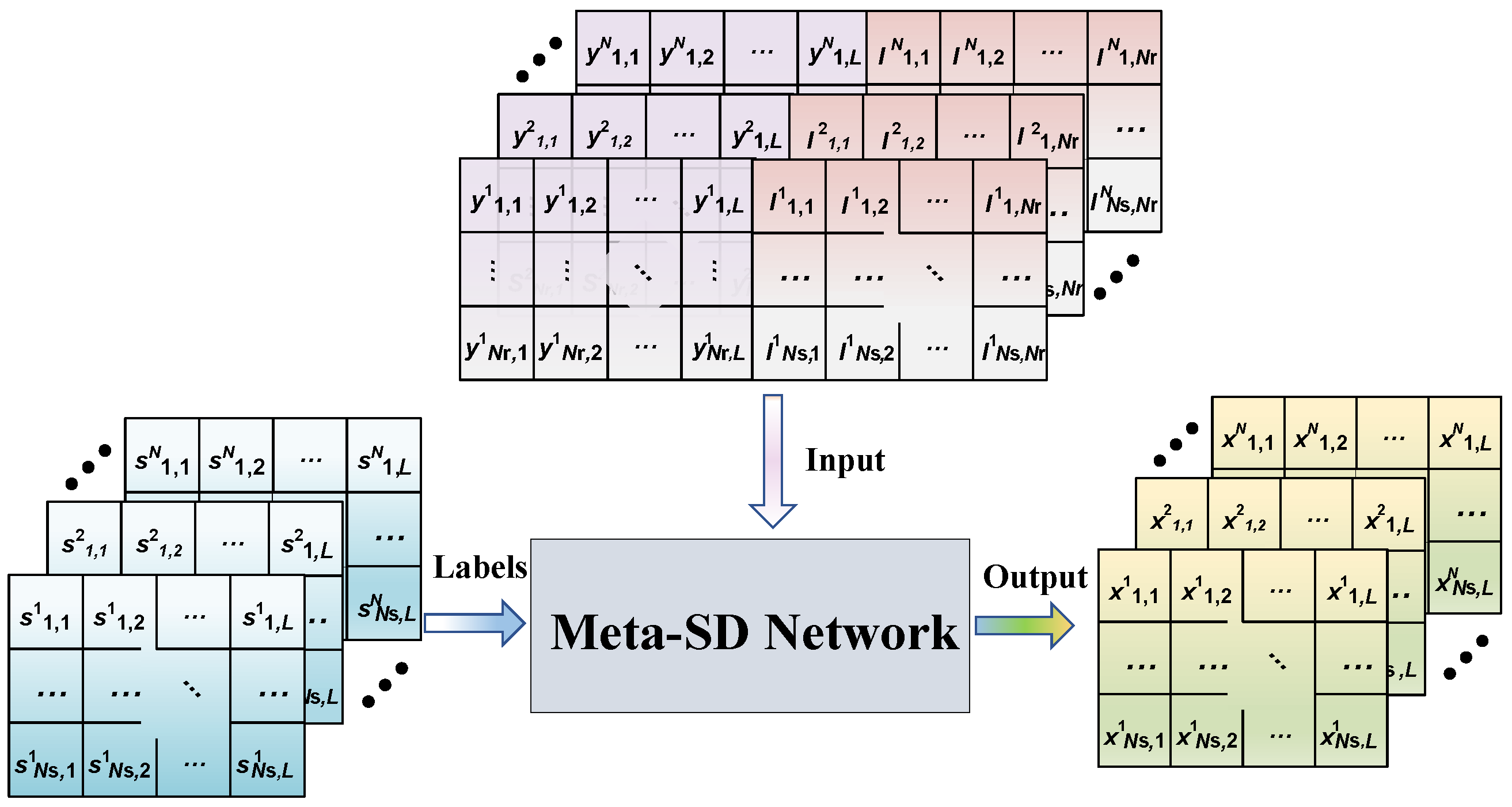
Data representation: Before training the proposed Meta-SD network, the received photon-count signals and the corresponding channel state information are pre-processed to form the input tensors of the fully connected neural network. Specifically, the pre-processing module concatenates the received photon-count vector and the elements of the channel matrix to form a composite input vector . Subsequently, these composite vectors are stacked to construct the input feature tensor , where denotes the batch size. The labels for the Meta-SD network are generated from the transmitted symbol vector , with elements drawn from the M-PAM constellation . Each transmitted symbol vector is mapped to its corresponding constellation index vector to form the labels of the classification problem. The labels are then stacked to form the label tensor , which corresponds to the input tensor , as illustrated in Figure 2.
Figure 2.
Illustration of the input and output data representation for the Meta-SD network.
Network structure: In the Meta-SD algorithm, a fully connected neural network (FCNN) is adopted as the base architecture, where multiple hidden layers are employed to enhance the representation capability of the model. The base network consists of an input layer, several hidden layers, and an output layer. Given the output vector of the previous layer, each layer computes an affine transformation followed by a nonlinear activation function. Specifically, a rectified linear unit (ReLU) is employed in the hidden layers to improve the nonlinear representation capability of the network and mitigate the vanishing-gradient problem. At the output layer, the network produces the outputs used for subsequent symbol decision.
The parameters of the base network are trained iteratively. During forward propagation, each layer computes its output based on current weights and biases to generate predictions. A loss function is evaluated to measure the discrepancy between the predictions and the target labels, and the network parameters are subsequently updated via gradient descent based on back-propagated gradients.
Based on the input-output design described above and extensive experimental validation, the finalized architecture of the Meta-SD base network comprises an input layer of size , four hidden layers with neurons respectively, and an output layer designed according to the adopted output representation, which serves as the base network for the subsequent meta-learning training procedure.
3.2. Reptile-Based Meta-Training Mechanism
For the Meta-SD base network described above, the Reptile algorithm is employed as a parameter-initialization-based meta-learning approach. Reptile can be regarded as a special case of the MAML algorithm, which can be used to avoid the calculation of higher-order derivatives. In the MAML framework, updating parameter initialization requires calculating the second-order derivatives of the loss function. In contrast, Reptile directly treats the difference between a task-specific parameter estimate and the initial parameter as a first-order approximation of the gradient. This significantly reduces the computational burden and enables low-complexity detection of photon-counting MIMO signals.
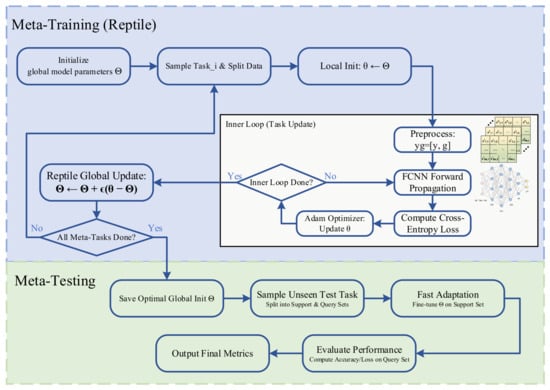
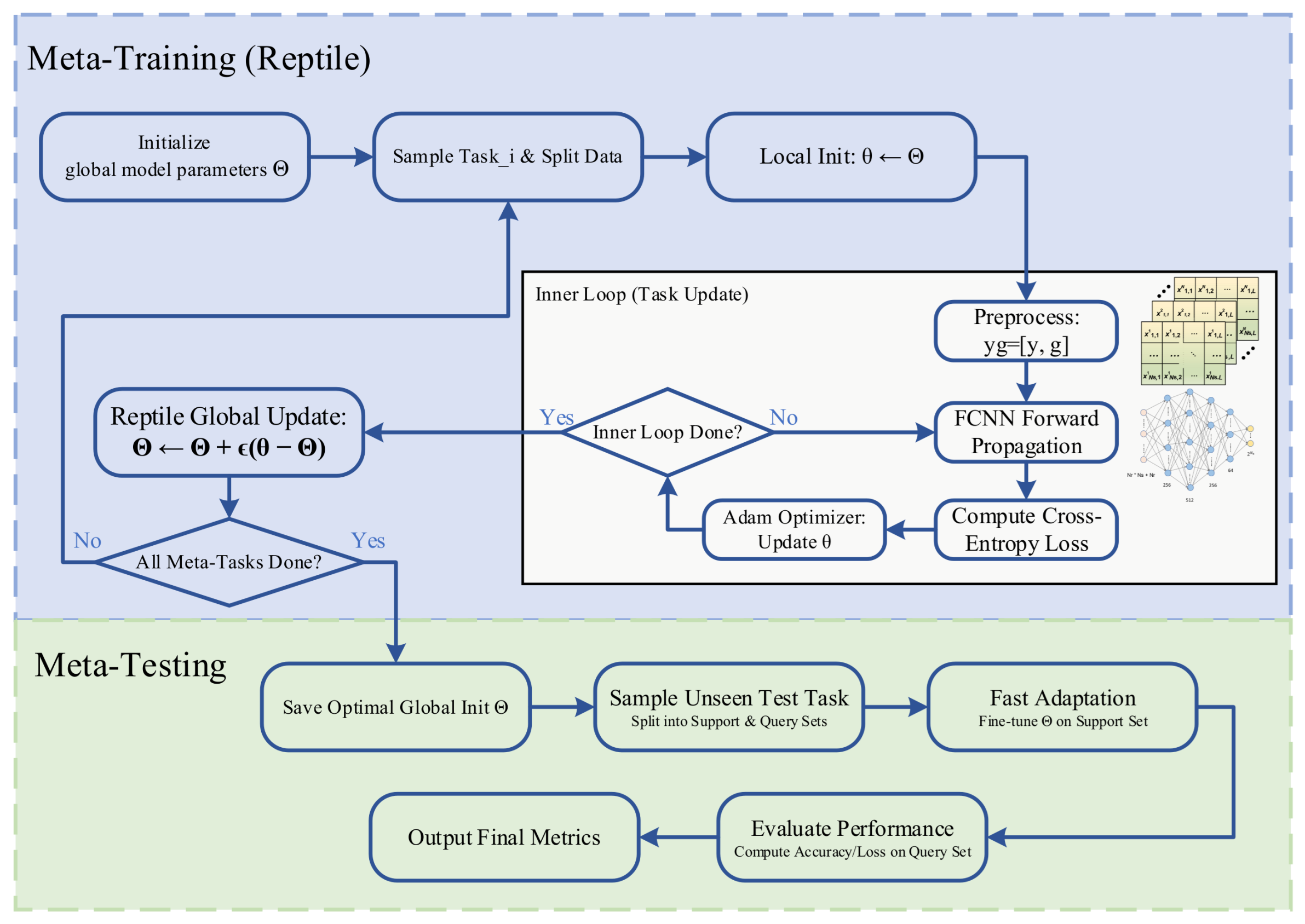
The Reptile algorithm runs through two nested stages: an inner loop and an outer loop. In the inner loop, a mini-batch of data is randomly sampled for each task, and the gradient is calculated by the gradient-based optimization method and the parameters are updated to perform multiple internal updates. Then, the parameter update increment of each task is calculated as the difference between the current model parameters and the updated parameters of the inner loop. Repeat the process until the specified number of inner-loop iterations is completed. Finally, in the outer loop, the previously calculated increments are used to perform global updates across all tasks to update the global model parameters. The detailed training steps of the Meta-SD scheme are shown in pseudo-code form in Algorithm 1, and the specific process is shown in Figure 3.
| Algorithm 1 Meta-SD signal detection training procedure. |
|
Figure 3.
Detailed training procedure of the proposed Meta-SD scheme based on the Reptile algorithm.
The design of the meta-training procedure is crucial for generalization to new tasks. As discussed previously, the MIMO signal detection task is formulated as a multi-class classification problem. Therefore, the cross-entropy loss function is adopted to measure the classification loss during backpropagation. Moreover, setting an appropriate learning rate is essential for the optimization process. To accelerate training while maintaining convergence stability, a dynamic learning rate strategy is adopted in the Meta-SD network, expressed as , where serves as an adjustment factor, is the total number of training epochs, and and are predefined constants, set to and in the Meta-SD network. Specifically, a relatively large learning rate is adopted at the initial stage to accelerate optimization, while the learning rate gradually decays as the iterations proceed to ensure stability. Through this training mechanism, the meta-learner aims to find the shared initial model parameters for fast adaptation. Consequently, when encountering a new task, such as a task from the query set of a testing task, the optimized model requires only a few gradient steps from this initialization to achieve fast self-learning and high-accuracy signal detection.
4. MSE-SD: A Model-Driven Baseline for Meta-SD
After presenting the architecture and meta-learning training procedure of the proposed Meta-SD detector, this section derives a model-driven MSE-based signal detector under Poisson noise channels. In addition to serving as a benchmark for comparison with the proposed Meta-SD scheme, the derived detector also provides a low-complexity and training-free alternative when the system operates with reliable CSI and accurate model assumptions. The resulting detector is referred to as MSE-SD in the following.
It should be noted that the considered detection framework operates in a few-shot setting, where the noise follows a discrete, signal-dependent Poisson distribution. Unlike generic model-driven methods predicated on Gaussian noise assumptions, or conventional deep learning approaches that require large-scale datasets, the MSE-SD derived below is tailored specifically for this Poisson environment. Consequently, it provides a more representative baseline for this specific domain and serves as the primary comparative scheme in the subsequent simulations.
To reduce the computational complexity, a linear detector based on the MMSE criterion is employed by designing a detection matrix . The objective is to minimize the mean-square error between the detected signal and the transmitted M-PAM symbol vector , which is formulated as
where is the autocorrelation matrix of the received photon-electrons vector, and is the cross-correlation matrix between the received photon-electrons vector and the transmitted symbol vector.
Since the transmitted symbols in are independent and uniformly distributed, the symbol vector satisfies and .
Based on the Poisson distribution of with the conditional mean given in Equation (4), its conditional second-order moment is given by
Substituting these statistical properties into Equation (10), the unconditional second-order moment of is simplified as
To reduce the computational complexity of matrix inversion, the off-diagonal elements of are ignored. Thus, can be approximated as a diagonal matrix
where denotes the channel matrix of size . Furthermore, using the law of total expectation, the cross-correlation matrix is derived as
By setting the derivative of with respect to to zero, we have
which yields the optimal detection matrix under the MMSE criterion as
Therefore, in the Poisson shot-noise photon-counting MIMO system, the MSE-SD algorithm can be expressed as
where denotes the hard-decision operator over the constellation set.
5. Simulation Results and Discussion
In this section, we evaluate the performance of the proposed Meta-SD in a photon-counting MU-SIMO communication system. The system parameters are configured in accordance with the models described in [7,19]. To characterize the signal and noise intensities in a more physically intuitive manner for system performance evaluation, we adopt the average transmitted signal energy per symbol and the equivalent background noise energy per symbol as the primary metrics. They are expressed as and , where P represents the laser transmit power, denotes the equivalent background optical power, and T is the symbol duration. Specifically, the wavelength of the monochromatic laser at the transmitter is set to . The photoelectric conversion efficiency is , and the background radiation energy per symbol is initially set to . The atmospheric turbulence channel is modeled using a Gamma-Gamma distribution, and the modulation format is M-PAM.
To evaluate the attainable performance under various conditions, three turbulence regimes are considered: strong turbulence (ST) (), medium turbulence (MT) (), and weak turbulence (WT) (, ) [20].
In the following meta-learning scenario, the dataset is partitioned into multiple meta-tasks using an N-way K-shot configuration. Specifically, each meta-task represents a few-shot multi-class signal detection problem. Furthermore, to ensure the representativeness of the performance evaluation, the meta-training and meta-testing sets are strictly partitioned, ensuring that the data evaluated in the testing set has never appeared during the prior training process.
5.1. Benefit 1: Detection Accuracy
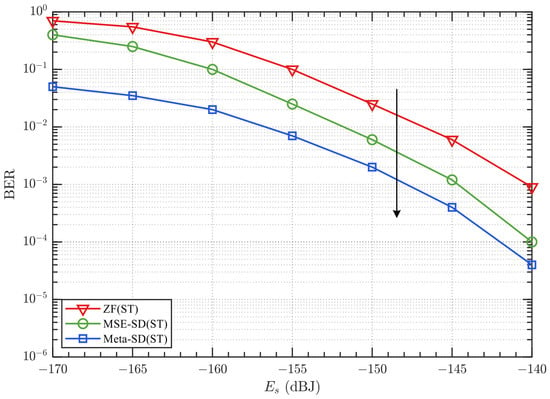
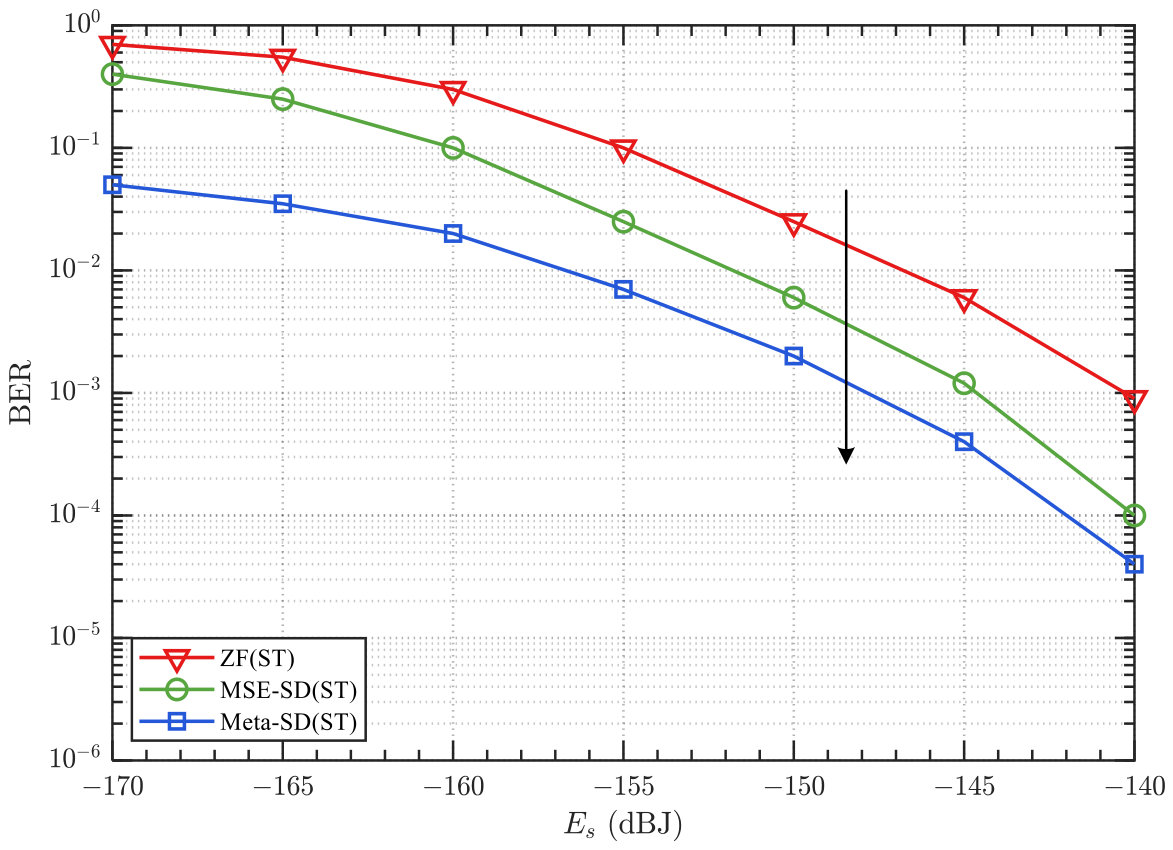
First, we consider a scenario in which the receiver has perfect knowledge of the channel matrix. The system comprises users and PDs at the base station under strong turbulence. To evaluate the proposed Meta-SD scheme, we compare it with the conventional zero-forcing (ZF) detector and the MSE-SD benchmark designed for Poisson shot noise.
Figure 4 shows the BER performance of the three schemes versus . The results demonstrate that Meta-SD outperforms the MSE-SD benchmark, while the ZF detector performs poorly due to the high noise. Specifically, at , the BER of MSE-SD is approximately , whereas that of Meta-SD reaches the level.
Figure 4.
BER performance comparison of ZF, MSE-SD, and Meta-SD under strong turbulence (ST).
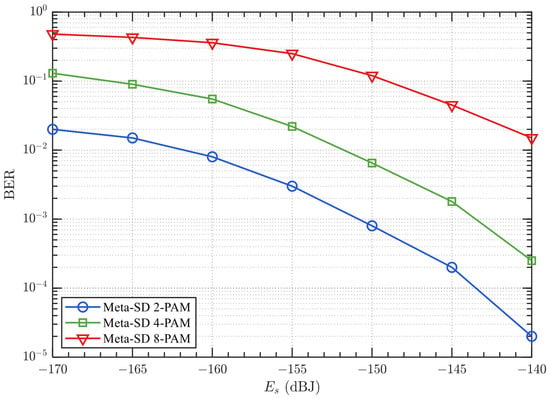
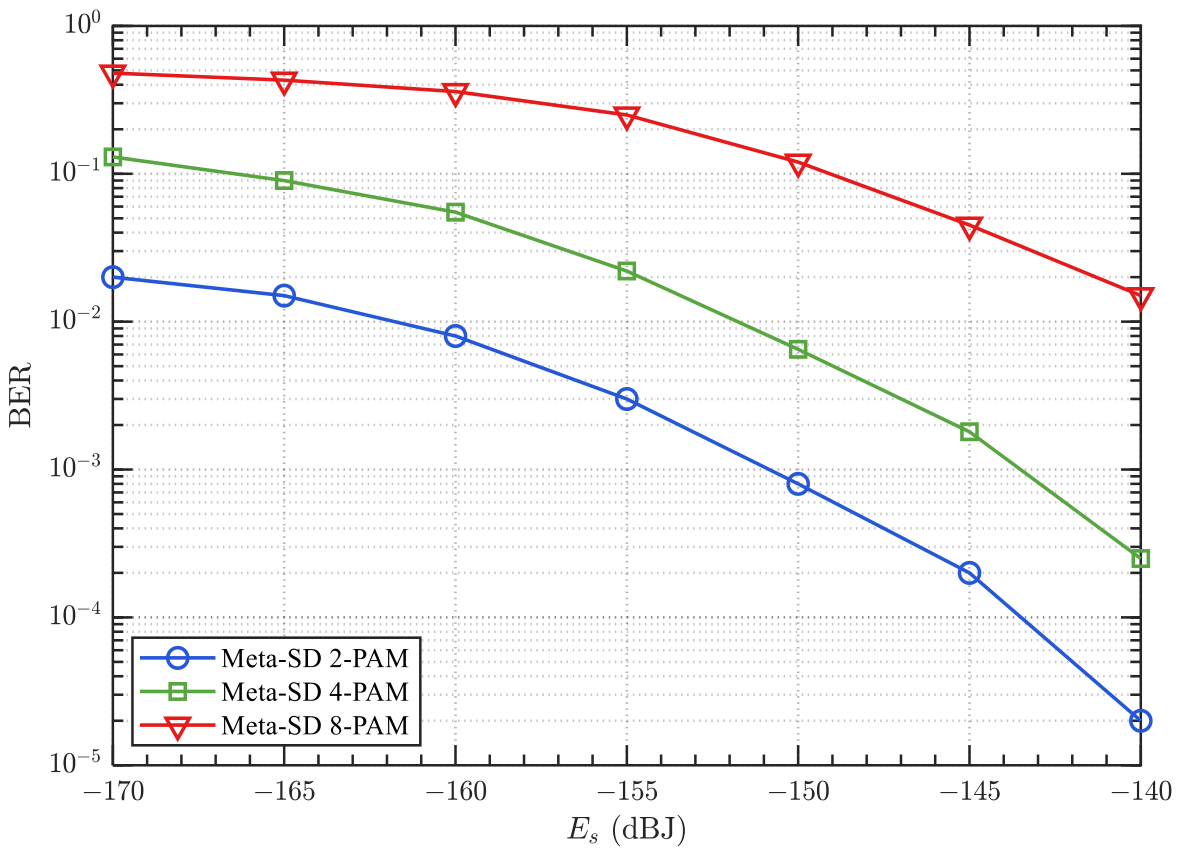
To examine the impact of the modulation order, Figure 5 presents the BER performance of the proposed Meta-SD under 2-PAM, 4-PAM, and 8-PAM. Under the same system configuration and normalized symbol energy, the BER increases with the PAM order. This is because the joint detection problem for two users is formulated as a multi-class classification task, in which 2-PAM, 4-PAM, and 8-PAM correspond to 4, 16, and 64 joint classes, respectively. Additionally, higher-order PAM leads to a smaller Euclidean distance between adjacent constellation points, and the signal-dependent Poisson shot noise further increases the overlap between classes. Therefore, the degradation from 4-PAM to 8-PAM is more severe than that from 2-PAM to 4-PAM. Nevertheless, the BER of 8-PAM still decreases as increases, indicating that Meta-SD is applicable to higher-order PAM scenarios.
Figure 5.
BER performance of the proposed Meta-SD under different PAM orders in the two-user photon-counting MIMO system.
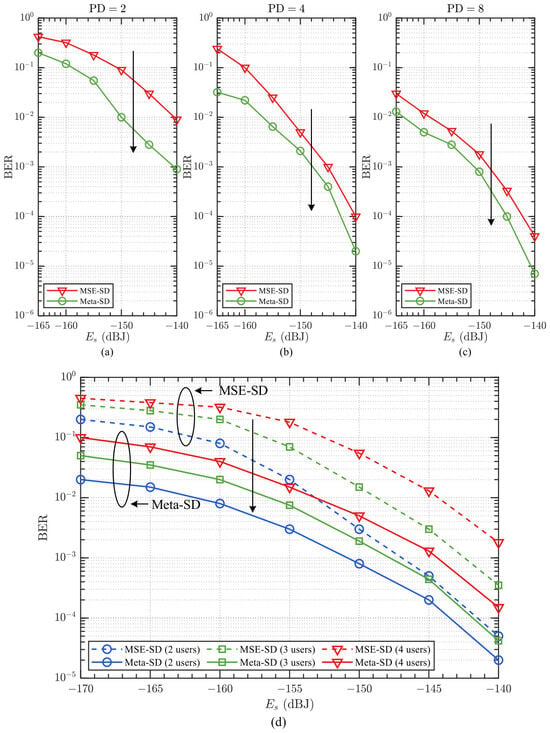
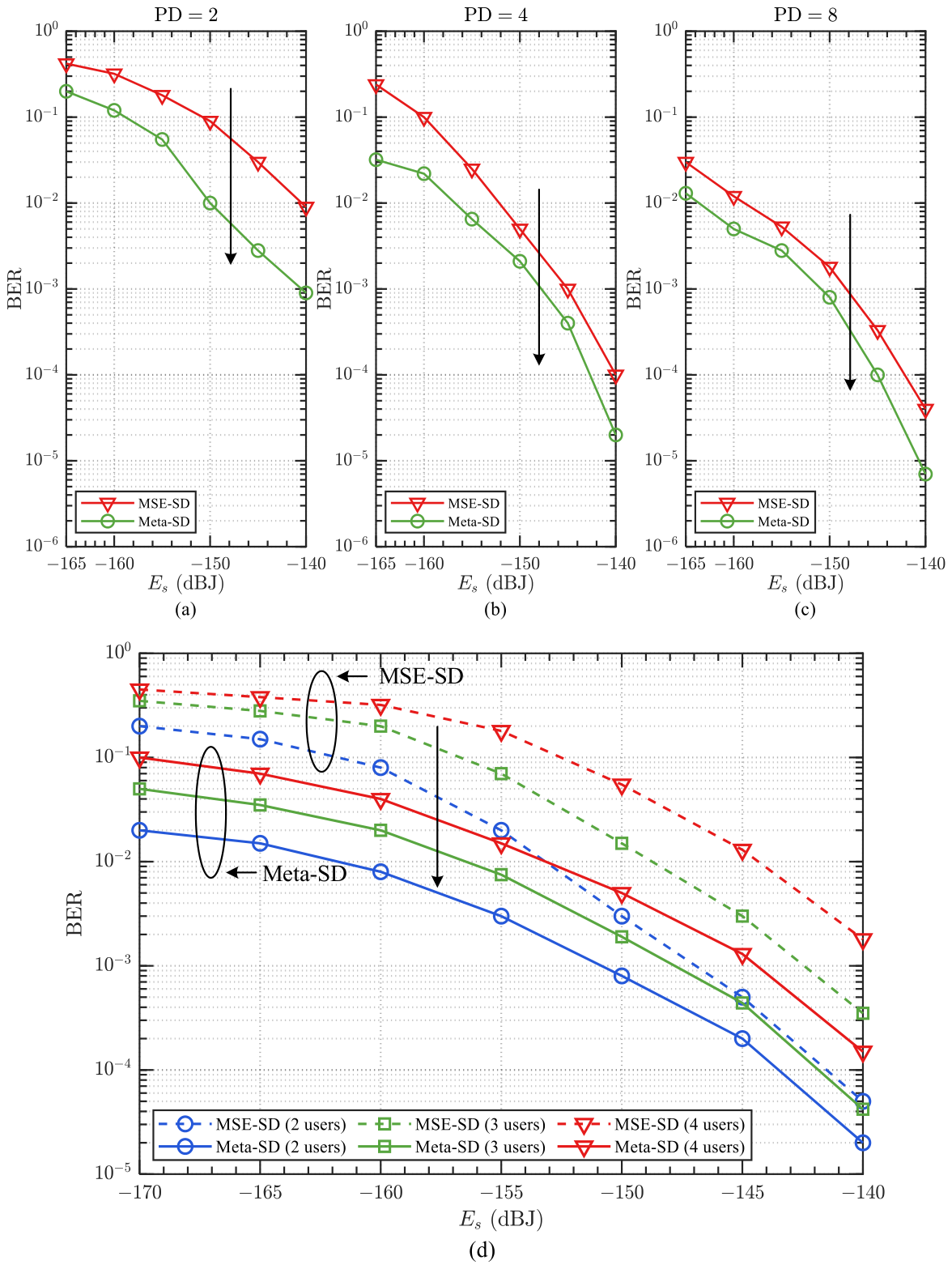
Figure 6 examines the achievable spatial diversity gain and multi-user scalability under different configurations. First, for the spatial diversity gain, the BER performance is evaluated with different numbers of receiver PDs ( and 8) under strong turbulence with . The results show that increasing the number of PDs enhances the diversity gain. For and , Meta-SD achieves a BER of , while MSE-SD remains around . When the number of PDs at the receiver increases to , the BER of Meta-SD approaches , while the BER of MSE-SD only remains close to .
Figure 6.
BER performance comparison between Meta-SD and MSE-SD under different system configurations: (a) PD = 2; (b) PD = 4; (c) PD = 8; and (d) different numbers of users (2, 3, and 4 users).
To evaluate the scalability, Figure 6d further considers different multi-user scenarios, varying the number of users from 2 to 4 under medium turbulence channels. As the number of users increases, multi-user interference increases, yet Meta-SD consistently maintains a stable advantage over MSE-SD. For example, at , Meta-SD in the 4-user scenario achieves a BER of , which is nearly an order of magnitude lower than that of MSE-SD. At , Meta-SD in the 2-user scenario achieves a BER close to , while the BER of MSE-SD is as high as . This shows that Meta-SD can effectively utilize spatial diversity, improve system performance by increasing the number of PDs at the receiver, and consistently maintain an advantage in multi-user scenarios.
5.2. Benefit 2: Robustness
In this subsection, we prove the robustness of the proposed Meta-SD scheme under various harsh channel and environmental conditions. In the case of atmospheric turbulence, fluctuating background radiation, and inaccurate CSI estimation, the system can still maintain its performance superiority, thus demonstrating its high stability and strong robustness against environmental disturbances.
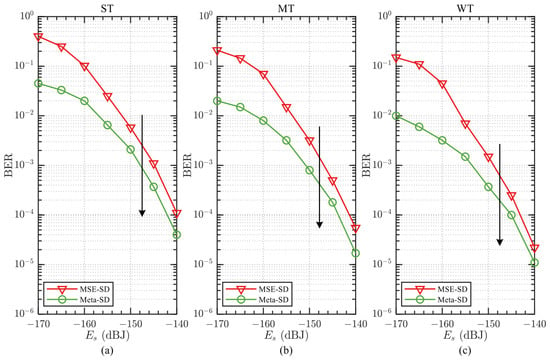
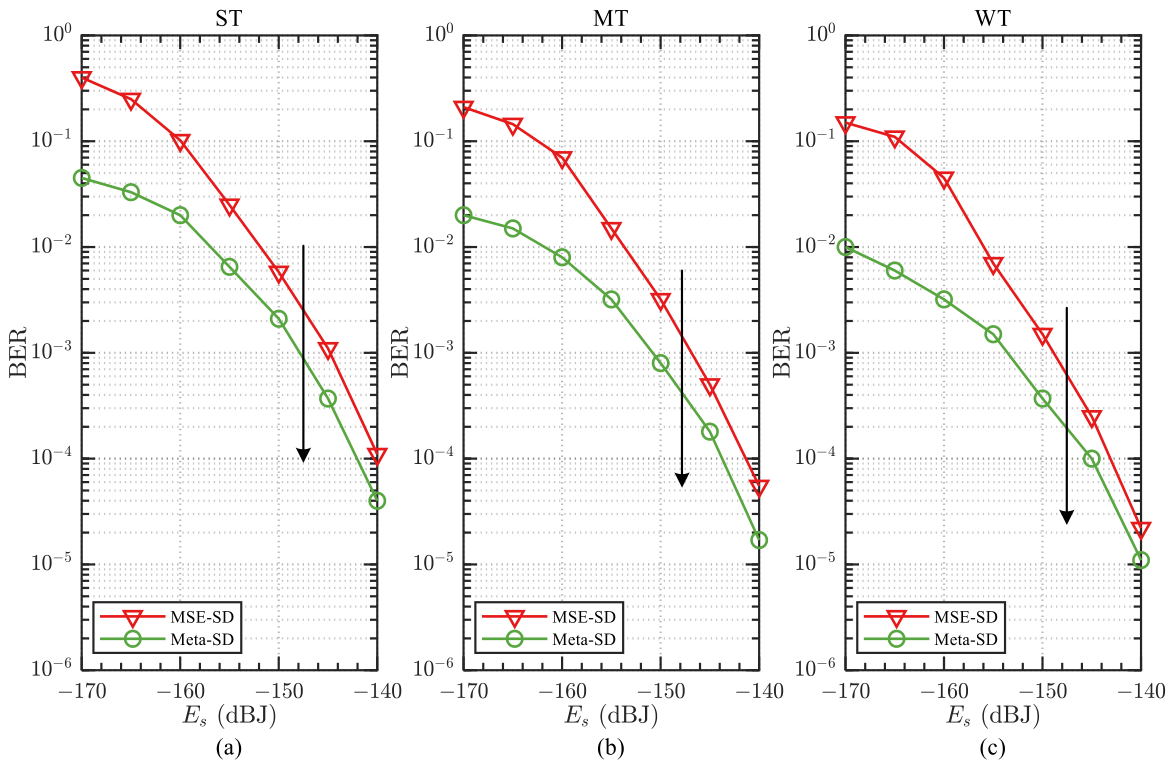
In order to evaluate the adaptability of the system to different turbulence intensities, Figure 7 compares the BER performance of Meta-SD and MSE-SD under strong turbulence, medium turbulence, and weak turbulence. Under all three turbulence conditions, the performance of Meta-SD is consistently better than that of MSE-SD. In a specific range, Meta-SD under strong turbulence achieves even higher detection accuracy than MSE-SD under medium turbulence. It is worth noting that under strong turbulence, Meta-SD shows more significant advantages than MSE-SD, indicating that it has better adaptability in severe channel environments.
Figure 7.
BER performance comparison between Meta-SD and MSE-SD under different turbulence conditions: (a) strong turbulence (ST); (b) medium turbulence (MT); and (c) weak turbulence (WT).
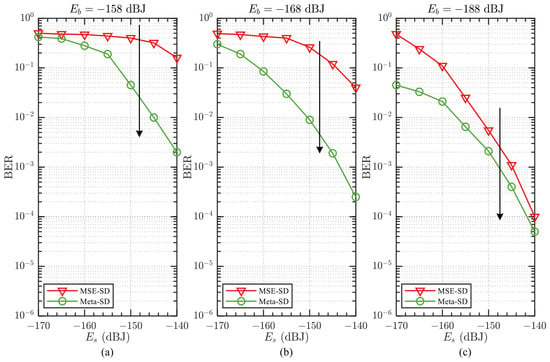
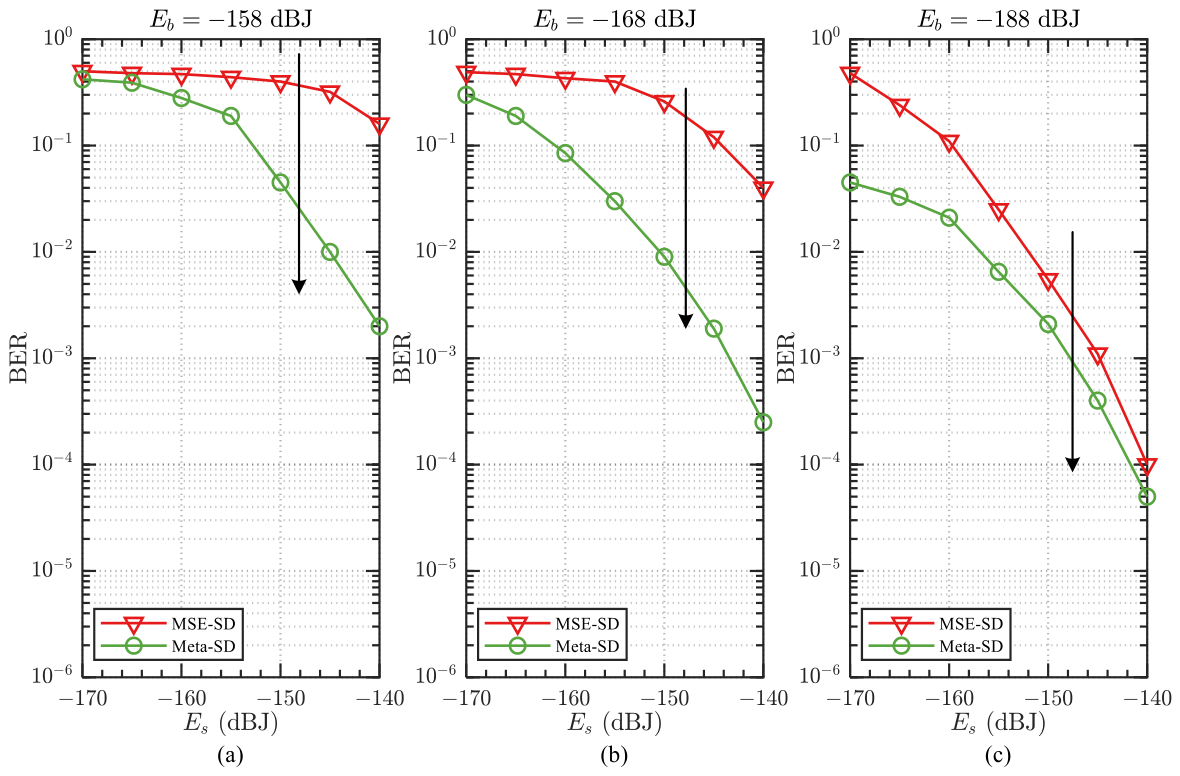
Background radiation is a key factor limiting the performance of photon-counting systems. In order to investigate its influence on the proposed Meta-SD and MSE-SD schemes, Figure 8 compares their BER performance under strong turbulence under different values. When the background radiation is significantly stronger than the signal (), the performance of the two schemes is both poor, and the BER remains near . With the decrease of , the BER of the two schemes decreases steadily. Specifically, when and , Meta-SD achieves a BER of the order of , while MSE-SD remains above . As further decreases to , Meta-SD reaches the order of , while MSE-SD improves to the order of .
Figure 8.
BER performance comparison between Meta-SD and MSE-SD under different background noise levels: (a) ; (b) ; and (c) .
It is worth noting that the advantage of Meta-SD over MSE-SD becomes more significant under severer background noise. Compared with MSE-SD, Meta-SD achieves a two-order-of-magnitude BER reduction under severe background noise (). On the contrary, under weak background noise (), the performance gap between the two detectors is narrowed because both detectors are close to their performance limits under low-noise conditions. These results show that Meta-SD maintains robust and noise-resilient performance under noise-dominated conditions.
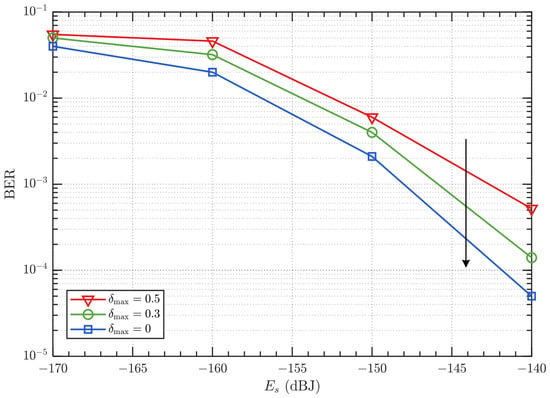
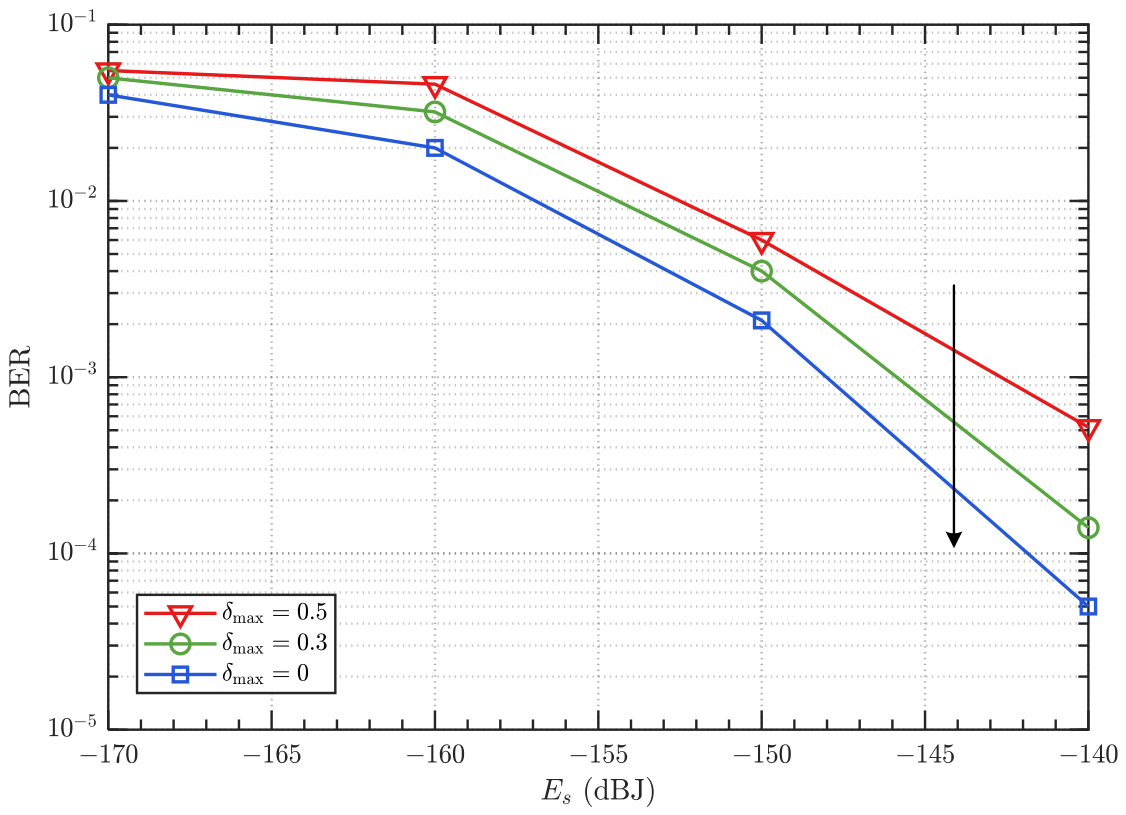
The simulation results presented in Figure 4, Figure 5, Figure 6, Figure 7 and Figure 8 were obtained under perfect CSI conditions. However, acquiring perfect CSI is often impractical due to factors such as feedback channel noise and quantization errors. Therefore, it is necessary to investigate the system performance under imperfect CSI. In this study, the estimated atmospheric turbulence channel is modeled as , where the estimation error is independently and uniformly distributed over the interval . Here, represents the maximum error percentage, and corresponds to perfect CSI. To verify the robustness of the proposed Meta-SD scheme against CSI inaccuracies, Figure 9 evaluates the impact of different levels of imperfect CSI on performance over a representative atmospheric turbulence channel. As shown in Figure 9, although the system performance degrades as increases, it still maintains reliable detection capability. For example, when and , the BER can remain below , which shows the anti-interference capability and robustness of the proposed Meta-SD scheme under imperfect CSI.
Figure 9.
BER performance of Meta-SD under imperfect CSI.
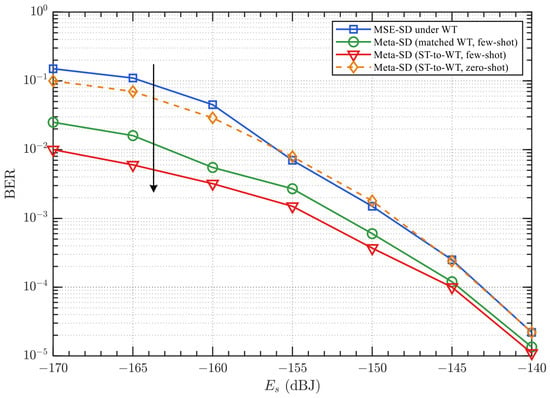
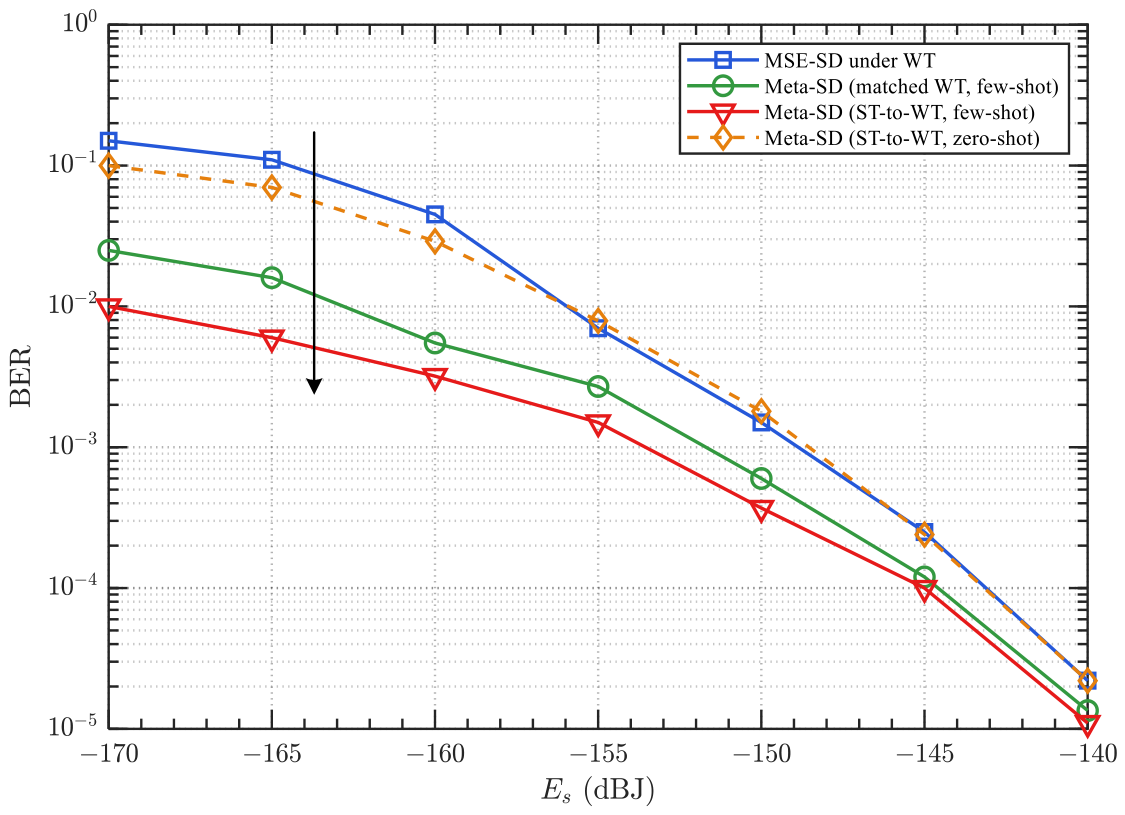
To further evaluate the robustness of Meta-SD against channel mismatch, Figure 10 compares the BER performance of Meta-SD and MSE-SD when Meta-SD is meta-trained under strong turbulence and tested under weak turbulence. In the few-shot setting, following the standard meta-learning procedure, Meta-SD is fine-tuned using a small number of adaptation samples from the weak turbulence condition, achieving favorable BER performance and consistently outperforming the MSE-SD baseline. In the more stringent zero-shot setting, the model meta-trained under strong turbulence is deliberately tested directly under weak turbulence without fine-tuning. It still provides a modest advantage over MSE-SD in the high-noise region. This may be because strong turbulence and weak turbulence follow the same physical signal model and Gamma–Gamma channel model, enabling meta-learning to acquire generalizable learning strategies and knowledge. These results demonstrate its robustness of Meta-SD against channel mismatch.
Figure 10.
BER performance comparison under channel mismatch with few-shot and zero-shot adaptation.
5.3. Benefit 3: Convergence and Generalization
In this subsection, we analyze the convergence speed and generalization capability of the proposed Meta-SD scheme. First, we evaluate the reduction of the loss function in the training phase, and then show the detection performance under the previously untrained signal classes, demonstrating its rapid adaptation and generalization capability to new tasks.
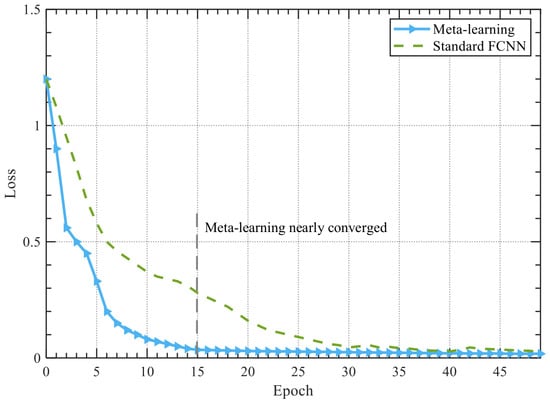
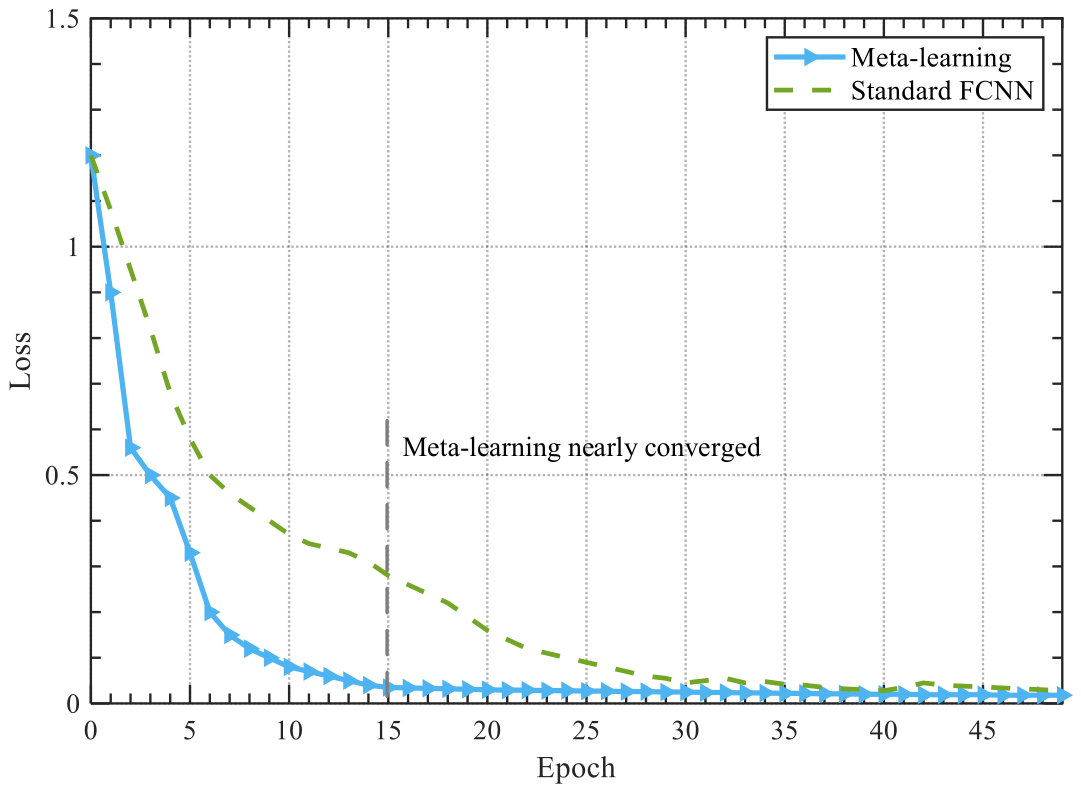
Convergence analysis. In order to evaluate the convergence performance of the proposed scheme, Figure 11 shows the variation of the loss function of Meta-SD in the training phase. As the number of epochs increases, the loss value of Meta-SD decreases steadily and converges to a stable value. Specifically, the loss value is close to zero and remains stable after about 15 epochs, indicating that the algorithm is close to convergence. In addition, compared with the standard FCNN benchmark using direct fully connected neural networks, the proposed Meta-SD shows a significantly faster convergence speed. The standard FCNN baseline begins to converge around the 35th epoch, while the Meta-SD converges by the 15th epoch. This reflects the advantages of meta-learning over conventional deep learning, as meta-learners can exploit the prior knowledge of multiple task samples in the training set and find the optimal parameters for rapid adaptation, thereby improving learning efficiency and achieving rapid network convergence.
Figure 11.
Loss convergence curves of Meta-SD and the FCNN benchmark in the training phase.
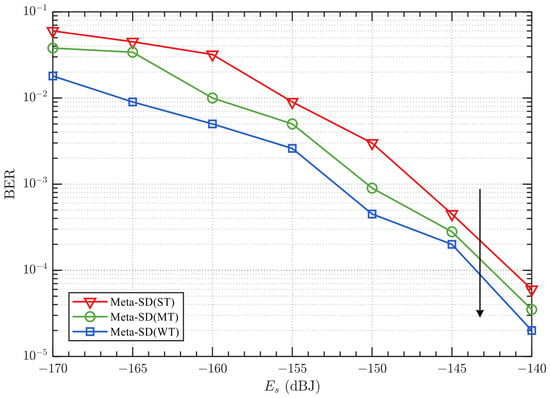
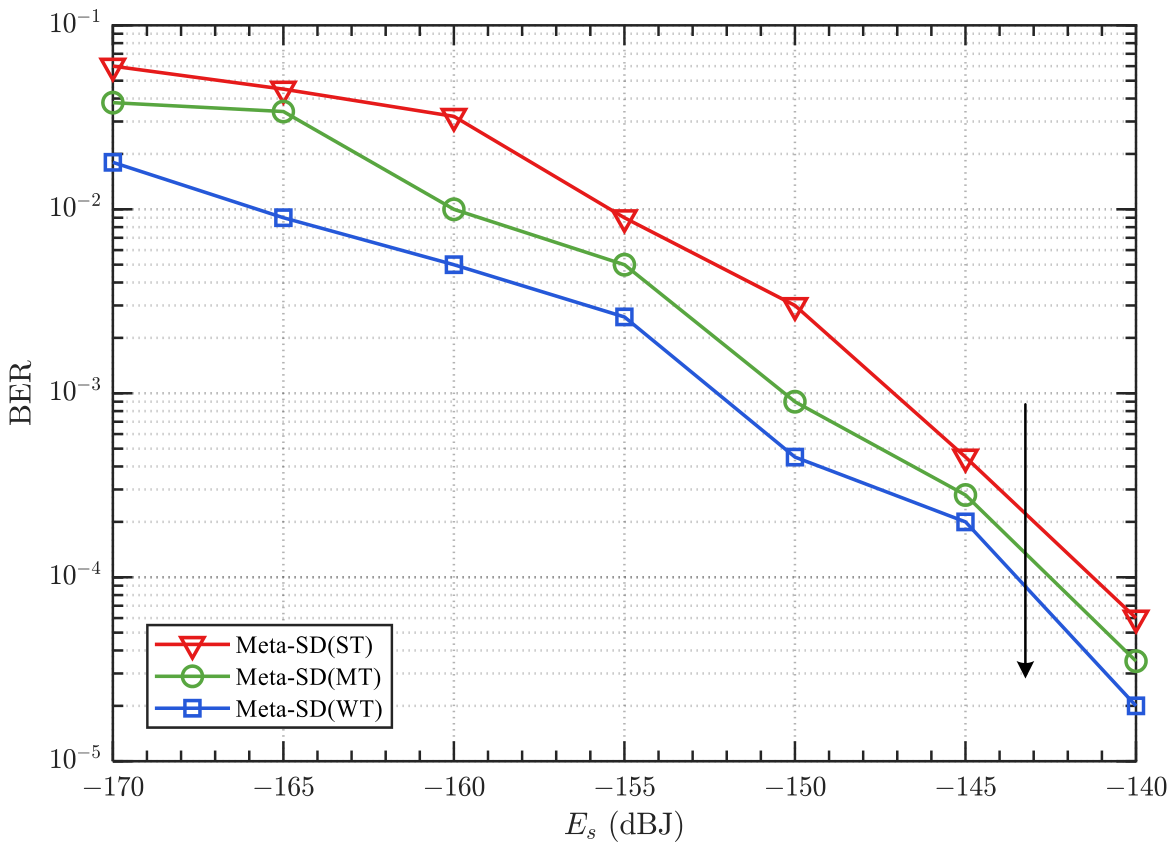
Generalization Capability. In this study, the number of users is set to 2, and the modulation format is 2-PAM. Under this configuration, the signal detection problem can be expressed as a four-class classification problem, and the corresponding labels are 0001, 1000, 0010, and 0100. Three classes of data corresponding to labels 0001, 0010, and 0100 are selected as the training set , while the remaining class corresponding to label 1000 is selected as the test set . As shown in Figure 12, Meta-SD shows strong adaptability to new tasks and can accurately detect signal samples from previously untrained classes. Even in this previously untrained scenario, the proposed scheme still maintains robust and high-precision signal detection performance under different turbulence conditions.
Figure 12.
Generalization performance of Meta-SD under strong turbulence (ST), medium turbulence (MT), and weak turbulence (WT).
6. Conclusions
In this paper, a Meta-SD scheme is proposed for photon-counting MU-SIMO systems under nonlinear Poisson shot noise. Under various challenging conditions considered in the simulation, Meta-SD always outperforms MSE-SD. In addition, it also exhibits excellent generalization and robustness. Using the few-shot learning paradigm, it can quickly adapt to previously untrained signal classes with very little training data. The simulation results verify the effectiveness of the proposed Meta-SD scheme.
Author Contributions
Conceptualization, Y.C., R.G. and X.Z.; methodology, Y.C.; software, Y.C.; validation, Y.C., R.G. and J.Z.; formal analysis, Y.C.; investigation, Y.C. and R.G.; resources, L.Z., J.H., A.P. and X.Z.; data curation, Y.C. and R.G.; writing—original draft preparation, Y.C.; writing—review and editing, Y.C., R.G., J.Z., L.Z., J.H. and X.Z.; visualization, Y.C.; supervision, X.Z., L.Z., J.H. and A.P.; project administration, X.Z., L.Z., J.H. and A.P.; funding acquisition, X.Z., L.Z. and J.H. All authors have read and agreed to the published version of the manuscript.
Funding
This research was funded by the Cultivation Project of Shanghai Research Center for Quantum Sciences (grant number LZPY2024), the Science and Technology Commission of Shanghai Municipality (Shanghai Sci. & Tech. Major Project, grant number 2019SHZDZX01), the National Natural Science Foundation of China (grant number 62571137), and the Natural Science Foundation of Shanghai (grant number 24ZR1407100).
Institutional Review Board Statement
Not applicable.
Informed Consent Statement
Not applicable.
Data Availability Statement
The data that support the findings of this study are available from the corresponding authors upon reasonable request.
Conflicts of Interest
The authors declare no conflicts of interest.
References
- Chow, C.W. Recent advances and future perspectives in optical wireless communication, free space optical communication and sensing for 6G. J. Light. Technol. 2024, 42, 3972–3980. [Google Scholar] [CrossRef] [Scilit]
- Xu, J.; Zhang, Y. Underwater wireless optical communications: From the lab tank to the real sea. J. Light. Technol. 2025, 43, 1644–1651. [Google Scholar] [CrossRef] [Scilit]
- Ge, H.; Zhou, X.; Chen, Y.; Zhang, J.; Ni, W.; Wang, X.; Zheng, L. Shot-noise-limited photon-counting precoding scheme for MIMO ultraviolet communication in atmospheric turbulence. Opt. Express 2023, 31, 426–441. [Google Scholar] [CrossRef] [Scilit] [PubMed]
- Shi, J.; Liu, Y.; Luo, Z.; Li, Z.; Shen, C.; Zhang, J. Simplified neural network with physics-informed module in MIMO visible light communication systems. J. Light. Technol. 2024, 42, 57–68. [Google Scholar] [CrossRef] [Scilit]
- Chatzidiamantis, N.D.; Karagiannidis, G.K.; Uysal, M. Generalized maximum-likelihood sequence detection for photon-counting free space optical systems. IEEE Trans. Commun. 2010, 58, 3381–3385. [Google Scholar] [CrossRef] [Scilit]
- Wang, G.; Gong, C.; Xu, Z. Signal characterization for multiple access non-line of sight scattering communication. IEEE Trans. Commun. 2018, 66, 4138–4154. [Google Scholar] [CrossRef] [Scilit]
- Gong, C.; Xu, Z. LMMSE SIMO receiver for short-range non-line-of-sight scattering communication. IEEE Trans. Wirel. Commun. 2015, 14, 5338–5349. [Google Scholar] [CrossRef] [Scilit]
- Zhou, X.; Lin, Z.; Gu, R.; Ni, W.; Jamalipour, A. A new meta-learning framework for estimating atmospheric turbulence and phase noise in optical satellite Internet of Things systems. IEEE Internet Things J. 2024, 11, 11190–11201. [Google Scholar] [CrossRef] [Scilit]
- Ye, H.; Li, G.Y.; Juang, B.-H.F. Power of deep learning for channel estimation and signal detection in OFDM systems. IEEE Wirel. Commun. Lett. 2017, 7, 114–117. [Google Scholar] [CrossRef] [Scilit]
- He, H.; Wen, C.-K.; Jin, S.; Li, G.Y. Model-driven deep learning for MIMO detection. IEEE Trans. Signal Process. 2020, 68, 1702–1715. [Google Scholar] [CrossRef] [Scilit]
- Zhao, T.; Sun, Y.; Lü, X.; Zhang, S. Deep learning-based channel estimation for wireless ultraviolet MIMO communication systems. Optoelectron. Lett. 2024, 20, 35–41. [Google Scholar] [CrossRef] [Scilit]
- Hospedales, T.; Antoniou, A.; Micaelli, P.; Storkey, A. Meta-learning in neural networks: A survey. IEEE Trans. Pattern Anal. Mach. Intell. 2021, 44, 5149–5169. [Google Scholar] [CrossRef] [Scilit] [PubMed]
- Vettoruzzo, A.; Bouguelia, M.-R.; Vanschoren, J.; Rögnvaldsson, T.; Santosh, K.C. Advances and challenges in meta-learning: A technical review. IEEE Trans. Pattern Anal. Mach. Intell. 2024, 46, 4763–4779. [Google Scholar] [CrossRef] [Scilit] [PubMed]
- Finn, C.; Abbeel, P.; Levine, S. Model-agnostic meta-learning for fast adaptation of deep networks. In Proceedings of the 34th International Conference on Machine Learning, Sydney, Australia, 6–11 August 2017; pp. 1126–1135. [Google Scholar]
- Nichol, A.; Achiam, J.; Schulman, J. On first-order meta-learning algorithms. arXiv 2018, arXiv:1803.02999. [Google Scholar]
- Wilson, S.G.; Brandt-Pearce, M.; Cao, Q.; Leveque, J.H. Free-space optical MIMO transmission with Q-ary PPM. IEEE Trans. Commun. 2005, 53, 1402–1412. [Google Scholar] [CrossRef]
- Chen, Y.; Zhou, X.; Ni, W.; Hossain, E.; Wang, X. Optimal power allocation for multiuser photon-counting underwater optical wireless communications under Poisson shot noise. IEEE Trans. Commun. 2023, 71, 2230–2245. [Google Scholar] [CrossRef] [Scilit]
- Huang, J.; Wen, G.; Dai, J.; Zhang, L.; Wang, J. Channel model and performance analysis of long-range deep sea wireless photon-counting communication. Opt. Commun. 2020, 473, 125989. [Google Scholar] [CrossRef] [Scilit]
- Gong, C.; Xu, Z. Temporal spectrum sensing for optical wireless scattering communications. J. Light. Technol. 2015, 33, 3890–3900. [Google Scholar] [CrossRef] [Scilit]
- Zhou, X.; Wei, C.; Shen, D.; Xu, C.; Wang, L.; Yu, X. A shot noise limited quantum iterative massive MIMO system over Poisson atmospheric channels. In Proceedings of the ICC 2019—2019 IEEE International Conference on Communications (ICC), Shanghai, China, 20–24 May 2019; pp. 1–6. [Google Scholar]
Disclaimer/Publisher’s Note: The statements, opinions and data contained in all publications are solely those of the individual author(s) and contributor(s) and not of MDPI and/or the editor(s). MDPI and/or the editor(s) disclaim responsibility for any injury to people or property resulting from any ideas, methods, instructions or products referred to in the content. |
© 2026 by the authors. Licensee MDPI, Basel, Switzerland. This article is an open access article distributed under the terms and conditions of the Creative Commons Attribution (CC BY) license.