


Abstract
Underwater wireless optical communication (UWOC) has emerged as a key technology for high-speed, low-latency data transmission in aquatic environments, enabling applications in autonomous underwater vehicles (AUVs), remotely operated vehicles (ROVs), subsea sensor networks, and the Internet of Underwater Things (IoUT). This paper reviews photodetector technologies that shape UWOC system performance, covering both mature and emerging detector classes. We discuss the operating principles, key parameters, and practical trade-offs of photomultiplier tubes (PMTs), p-i-n photodiodes (PINs), avalanche photodiodes (APDs), single-photon avalanche diodes (SPADs), and silicon photomultipliers (SiPMs/MPPCs). We also present emerging photodetector technologies, including perovskite-based structures, SiC photoelectrochemical devices, scintillating optical fibers, and photovoltaic solar cells. A comparative analysis of reported UWOC experiments reveals a clear sensitivity–bandwidth trade-off among detector technologies: PIN-based receivers achieve the highest data rates (up to 25 Gbps) but are generally restricted to short-range links, whereas SPAD- and SiPM-based receivers provide sensitivities below −80 dBm and support transmission distances exceeding 200 m, at the cost of moderate data rates. The findings indicate that SiPM/MPPC arrays currently offer the most promising compromise between sensitivity and data rate for long-range UWOC applications.
1. Introduction
Underwater wireless communication plays a crucial role in autonomous underwater vehicle applications, including tactical surveillance, environmental monitoring, and offshore exploration. The exploration and monitoring of marine environments require reliable data transmission capabilities; however, the underwater channel poses considerable challenges for wireless communication due to strong attenuation, multipath propagation, and environmental variability [1,2]. Historically, underwater signaling relied primarily on acoustic methods, with early concepts dating back to Leonardo da Vinci in 1490. Despite their long-standing use, modern underwater applications increasingly demand higher bandwidth, lower latency, and improved real-time data transfer, thereby driving the development of radio frequency (RF) and optical data links. Today, underwater communication is dominated by acoustic and RF technologies [3].
Acoustic systems can transmit over distances from several kilometers to several hundred kilometers under favorable conditions. For this reason, they remain indispensable for applications that require extended coverage. However, their practical usefulness is limited by low data rates, narrow bandwidth, high latency, and susceptibility to multipath fading and environmental interference [4].
On the other hand, RF links can operate in the Extremely Low Frequency (ELF) and Low Frequency (LF) bands, where attenuation is less severe, albeit at the cost of very limited bandwidth and data rates. At higher frequencies, especially in the MHz-to-GHz range, electromagnetic waves are attenuated so strongly that the effective communication range is reduced to only a few meters [5]. As a result, RF links are generally restricted to highly localized, short-range underwater applications.
The limitations of acoustic and RF systems make UWOC technology a very promising tool [6]. It offers high bandwidth, low latency, and the potential for energy-efficient data transmission. Obtaining data rates of up to several Gbps over distances of hundreds of meters is attractive for data-intensive applications such as real-time video transmission, underwater sensor networks, and AUV communications [7]. The inherently directional nature of optical beams also provides a degree of physical-layer security by limiting the spatial extent of eavesdropping opportunities compared with omnidirectional acoustic signals [8]. However, the achievable range and link reliability of optical links are also limited by factors such as absorption, scattering, and water turbidity. A comparative overview of underwater communication technologies is presented in Table 1.
Table 1.
Typical performance parameters of current underwater wireless communication technologies [9,10,11,12]. Values correspond to reported experimental systems and do not correspond to fundamental limits.
Figure 1 illustrates an optical communication network with several maritime platforms, including surface ships, submarine sensor nodes (SSNs), remotely operated vehicles, and autonomous underwater vehicles. The surface vessel acts as a supervisory or relay platform, with underwater nodes forming a multipoint sensor network to communicate, coordinate, and synchronize autonomous underwater vehicles and distributed sensing units. Although UWOC provides high-speed, low-latency data links, its practical deployment faces several challenges, e.g., link geometry, platform alignment, and water reservoir properties.
Figure 1.
Generic architecture of the UWOC system showing optical links between a surface vessel, AUVs, ROVs, and SSNs. The scheme illustrates a multipoint underwater sensor network in which nodes communicate via optical links operating in the blue-green optical window to enable high-speed, low-latency communication.
Absorption and scattering of optical radiation are the critical water properties governing UWOC operation. In general, water has low optical absorption in the blue-to-green wavelength range; however, the attenuation level depends on the type of water body (Figure 2). For example, the lowest absorption coefficients occur at around 420–460 nm (blue light) in seawater and at around 540–550 nm (green light) in coastal water [13,14]. As a result, blue light penetrates deepest in open-ocean seawater, while in coastal areas, green light is more effective. Absorption refers to the irreversible conversion of optical energy into heat caused by pure water molecules, phytoplankton, and dissolved organic matter [15].
Figure 2.
Penetration depth of optical radiation in seawater: (a) in the open ocean, (b) in coastal regions [16].
Scattering by suspended particles deflects photons from their original path, inducing beam broadening and intersymbol interference at the receiver. In addition to absorption and scattering, underwater optical links are also affected by turbulence, which results from temperature and salinity variations that produce refractive-index fluctuations. These fluctuations may cause scintillation, beam wandering, and intensity fading at the receiver, thereby degrading link stability and overall communication performance.
Reliable UWOC system design therefore requires comprehensive channel modeling that accounts for different water types, dynamic turbulence, and beam-wander characteristics.
Figure 3 presents an example of a UWOC configuration. The transmitter subsystem comprises a modulator, a driver circuit, a light source (light-emitting diode, LED, or laser diode, LD), and collimating optics.
Figure 3.
Schematic of a typical UWOC link.
The optical signal propagates through the aquatic channel, subject to absorption, scattering, and turbulence. At the receiver, the incident light is collected by the receiving optics, passed through a spectral filter, and then focused onto the photodetector surface. The radiation is spectrally filtered to minimize the influence of background light. The resulting detector signal (current) is amplified by a transimpedance amplifier (TIA), demodulated, and finally delivered as the recovered data output.
The optical transmitter is one of the key subsystems determining the achievable data rate, communication range, power efficiency, and robustness of a UWOC link. It employs optical sources operating in the 420–570 nm wavelength range to exploit the low-absorption window of water, where scattering losses are also comparatively reduced.
Several review articles describe the different configurations of the UWOC transmitters; this topic will therefore not be discussed in further depth here. However, LEDs and LDs are the most commonly used sources. These sources differ substantially in beam divergence, modulation bandwidth, spectral width, optical power density, cost, and alignment requirements. LEDs generally exhibit large beam divergence angles, low cost, simpler driving electronics, and higher tolerance to pointing errors. Laser diodes, by contrast, offer a much narrower beam, higher radiance, a narrower emission spectrum, and a larger modulation bandwidth; these characteristics make laser diodes more suitable for high-speed, longer-distance line-of-sight UWOC links [17].
The future performance of UWOC systems depends on the development of blue–green optical sources. The most promising directions include high-power, high-bandwidth laser diodes, vertical-external-cavity surface-emitting lasers (VECSELs) with excellent beam quality, LED arrays for robust short-range communication, and multi-emitter MIMO architectures. UWOC transmitters will likely combine a wavelength-optimized source with high modulation capability, efficient beam shaping, and, where applicable, spatial diversity to balance data rate, range, power consumption, and alignment tolerance.
The second crucial component of the UWOC system is the photoreceiver, comprising receiving optics, a detector, a low-noise preamplifier, a demodulator, and signal processing circuits. A photodetector must provide high sensitivity within the water-transmission spectrum, a fast response time, and low noise. The main photodetector technologies employed in UWOC systems include photomultiplier tubes, photodiodes (PIN and APD types), single-photon avalanche diodes (SPADs), and silicon photomultipliers (Figure 4).
Figure 4.
Photodetectors used in underwater wireless optical communications.
Additionally, emerging detector concepts—including perovskite-based structures, photoelectrochemical devices, scintillating optical fibers, and photovoltaic cells—are being developed to meet the specific requirements for IoUT applications.
2. Photodetectors Employed in UWOC Systems
This section reviews the key parameters and practical trade-offs of the main photodetector technologies used in UWOC receivers, including photomultiplier tubes, PIN photodiodes, avalanche photodiodes, single-photon avalanche diodes, and silicon photomultipliers, before discussing emerging detector concepts in Section 2.6.
2.1. Photomultiplier Tubes
PMTs are a class of highly sensitive photodetectors widely used in UWOC. They offer several important advantages, e.g., high internal gain—typically 105–107 for standard dynode devices—with wideband variants intentionally reducing gain to 103–104 to achieve a broader bandwidth. Additionally, PMT gain produces no excess noise factor, which is beneficial at very low signal levels. The gain can also be tuned to adapt to the irradiation level caused by varying distance, turbidity, or platform motion. Furthermore, PMTs achieve low dark count rates at room temperature.
Standard bialkali PMTs cover a spectral range of approximately 300–650 nm; the exact lower limit depends on the window material. Peak quantum efficiency is around 27% at 390 nm, though the device retains substantial sensitivity across the blue-green transmission window of water relevant for UWOC [18]. Large-aperture PMTs (e.g., 51 mm photocathode diameter) tolerate beam misalignment well and can be arranged in arrays for spatial diversity reception in Multiple-Input-Multiple-Output UWOC links. In contrast, wideband PMTs designed for high-speed operation use a smaller active area (e.g., 10 mm), which limits their misalignment tolerance and requires a well-aligned optical path.
PMT-based receivers can operate in two modes. In analog mode, the anode current is proportional to the received optical power. This mode offers a wider dynamic range and is suitable for high-speed links. In photon-counting (PCM) mode, the receiver detects and counts individual photon pulses, providing a superior signal-to-noise ratio (SNR) at very low photon flux. It is well-suited to pulse-position modulation (PPM), where information is encoded in photon arrival times rather than pulse amplitudes.
As the received optical power increases, the output waveform transitions from discrete pulses, through an intermediate regime, to a quasi-analog signal. This transition requires adapting the detection algorithm and threshold settings, which complicates receiver design in dynamic UWOC channels.
PMTs have been used in UWOC receivers in three main roles: as wideband analog detectors for high-speed links, as photon-counting receivers for ultra-sensitive low-power communication, and as large-area detectors or arrays for improved alignment tolerance [19]. The intrinsic 3 dB bandwidth of a PMT typically ranges from 100 MHz to 1 GHz, depending on the device type. The noise statistics of PMTs are reasonably well characterized across different operating regimes, with Poisson and generalized extreme value (GEV)-based models proposed for bit-error-rate (BER) prediction and system design [20].
PMT-based receivers also have significant drawbacks. They require a high bias voltage of 500 V to 2 kV. This voltage must be very stable because the PMT gain is strongly dependent on the supply voltage. Even a small voltage ripple causes gain variation. The voltage converter needed to generate this voltage also introduces electromagnetic interference. PMTs are mechanically fragile due to their glass vacuum envelope, and standard linear-focused dynode types require magnetic shielding. Fine-mesh and multi-channel-plate (MCP)-type PMTs are more tolerant of magnetic fields. Excessive illumination can permanently damage the photocathode, so protective attenuation or optical filtering must be included. Further limitations include a restricted dynamic range due to photon pile-up at high flux, after-pulsing from residual-gas ionization (which degrades BER in photon-counting mode), and high cost. Moreover, their bulky size complicates integration into compact AUV or ROV platforms. The main research challenges are adaptive detection across operating regimes, suppression of optical noise caused by scattering, dynamic gain control, and the development of compact, robust PMT receiver modules [21].
2.2. PIN Photodiodes
PIN photodiodes represent a fundamentally different design compromise—favoring simplicity, high bandwidth, and seamless integration with standard analog front-end electronics. Although widely used in optical communication systems owing to their low cost and ease of implementation, PIN photodiodes exhibit limited sensitivity, making them unsuitable for long-range UWOC links where received optical power is extremely low. Nevertheless, they remain highly attractive for short-range and high-speed UWOC applications, owing to their fast response, strictly linear output, low biasing requirements, and natural compatibility with TIA-based receiver architectures [22].
Among the key parameters of PIN photodiodes, responsivity in the blue-green window is particularly important. Silicon PIN photodiodes achieve approximately 0.15–0.30 A/W at 450–520 nm—significantly lower than their near-infrared peak of 0.5–0.6 A/W. In terms of bandwidth, PIN photodiodes outperform other photodetector types used in UWOC, with values ranging from 150 MHz to over 25 GHz [23,24]. This performance comes with a fundamental trade-off: high-bandwidth devices require small active areas (~0.1–1 mm2), which reduces light collection efficiency and alignment tolerance in real underwater deployments.
Because PIN photodiodes lack internal gain, their sensitivity is primarily limited by the thermal noise of the TIA feedback resistor rather than by shot noise [22]. Unlike APDs and PMTs, they therefore have no detector-level amplification to improve SNR. Consequently, extending the communication range can only be achieved by increasing the transmitter power, optimizing the TIA design, or reducing the detection bandwidth. As a result, PIN photodiodes are generally less suitable for long-range UWOC links.
On the other hand, the absence of avalanche gain means the photocurrent is strictly linear with respect to optical power, with no excess noise. This linearity makes PIN receivers well-suited for high-order modulation formats [24,25]. PIN photodiodes can also be arranged in arrays to enable spatial diversity techniques, thereby enhancing resilience to beam misalignment and turbulence-induced fading.
2.3. APD Photodiodes
To increase sensitivity and extend the range of optical links, especially at very low received signal power levels, APDs are used in UWOC systems. Dedicated Si APDs with optimized antireflection coatings and junction profiles achieve a quantum efficiency of 60–90% at 420–530 nm, making blue-enhanced variants such as the Hamamatsu S8664 and S16453 series, as well as the Excelitas C30703, well matched to underwater deployments [26,27,28]. In linear-mode operation, Si APDs support an avalanche gain M of up to 100–1000, significantly exceeding the gain achievable with InGaAs or Ge APDs, which are typically limited to M ≈ 10–40. This advantage stems from silicon’s low ionization coefficient ratio (k ≈ 0.02), which simultaneously reduces excess noise and enables a gain-bandwidth product (GB) of approximately 100–340 GHz.
The 3 dB bandwidth of an APD is inversely related to gain, with both parameters governed by GB. At a typical UWOC operating point of M ≈ 50, dedicated wideband modules such as the Thorlabs APD210 and APD410 provide a usable bandwidth of approximately 1 GHz [29]. In contrast, larger-area devices—such as the Hamamatsu S8664-30K with a 3 mm active diameter and junction capacitance of approximately 22 pF—exhibit a reduced bandwidth of around 140 MHz, though with improved misalignment tolerance and angular acceptance. This bandwidth–active-area trade-off is therefore a key design constraint when selecting an APD for a given UWOC link geometry.
At the optimal gain setting, the receiver operates near the shot-noise limit—the best sensitivity achievable in direct-detection systems. Compared to PIN-based receivers, this translates to a sensitivity improvement of typically 5–10 dB, with a noise-equivalent power as low as 2.5 fW/√Hz for optimized modules such as the Thorlabs APD440A2—though such ultra-low-noise devices typically trade off bandwidth (limited to ~100 kHz) for sensitivity, and are therefore better suited to low-speed or power-monitoring applications than to high-data-rate UWOC links [30]. Furthermore, APD gain can be controlled by adjusting the bias voltage, enabling the receiver to maintain adequate sensitivity across a wide range of received optical power levels, regardless of variations in link distance, water turbidity, or platform movement.
Compared to PMTs, Si APDs are mechanically robust, solid-state devices that are insensitive to vibration, orientation, and external magnetic fields. With supply voltages of only 200–300 V, they eliminate the need for high-voltage power supplies and magnetic shielding, while remaining fully compatible with standard TIA-based receiver architectures.
2.4. SPAD Detectors
SPADs represent a special class of APDs specifically designed to operate in Geiger mode (single-photon counting mode), i.e., above the breakdown voltage. Unlike conventional linear-mode APDs, which are not capable of stable operation in this regime, SPADs incorporate dedicated structural features, such as guard rings, together with external quenching circuits, that jointly enable single-photon detection [31].
The binary digital output of a SPAD is directly compatible with standard CMOS logic, eliminating the need for a transimpedance amplifier (TIA) and simplifying the receiver front-end while lowering power consumption. For battery-powered underwater vehicles, this is a significant practical advantage.
Under weak-signal conditions, a SPAD receiver does not measure a continuous photocurrent but instead counts individual photon-detection events, which makes it suitable for long-distance, low-power applications where high sensitivity is more important than high analog bandwidth. For example, sensitivities as low as −84.5 dBm have been demonstrated using SPAD-based UWOC receivers [32].
However, after each detected photon, the SPAD must wait for a period before it becomes sensitive to further photons. At higher photon fluxes, dead time causes a nonlinear response and limits the maximum achievable count rate. The dead time also introduces two distinct impairments. First, photons arriving during the dead time within a symbol are lost—this is known as blocking loss. Second, if a dead time begins near the end of one symbol, it can suppress detection at the start of the next, causing intersymbol interference (ISI) [33]. A passive quenching configuration introduces a dead time of roughly 100 ns to 1 μs after each detection event; an active quenching configuration, by contrast, reduces this significantly, to as little as 1–10 ns [34]. At high received optical power, the SPAD response becomes nonlinear, and the detector saturates. PIN and APD receivers, by contrast, maintain a linear response over a much wider input power range. Dark count rate (DCR) also degrades performance. Increasing the bias voltage above breakdown improves photon detection efficiency but raises DCR due to thermal excitation, tunneling, and after-pulsing. In UWOC specifically, solar background radiation in shallow water and bioluminescence at all depths generate photon counts that are indistinguishable from the signal. Under these conditions, background-induced shot noise, rather than DCR, becomes the dominant factor limiting sensitivity.
Furthermore, a single SPAD lacks photon-number resolution—it cannot distinguish whether one or several photons arrived simultaneously. This fundamentally limits the direct use of amplitude-modulated formats and requires sophisticated reconstruction algorithms at the receiver.
2.5. SiPM (MPPC) Detectors
While a single SPAD provides the highest sensitivity, its small active area and limited count rate restrict practical throughput; the silicon photomultiplier (SiPM) addresses these limitations. SiPMs, also known as multi-pixel photon counters (MPPCs), combine near-photon-counting sensitivity with a compact solid-state form factor and a relatively low operating voltage (~25–70 V), making them practical alternatives to photomultiplier tubes (PMTs).
Each device consists of an array of 100 to more than 10,000 parallel SPAD microcells, each operating in Geiger mode and providing a gain of 105–107. The outputs of all microcells are summed, yielding a quasi-linear combined response compatible with advanced modulation formats.
Compared with PMTs, SiPMs are compact, mechanically robust, magnetic-field-insensitive, and offer a significant cost advantage. Their large active area facilitates optical collection and increases tolerance to beam divergence and pointing errors, which is particularly beneficial in UWOC deployments. The typical modulation bandwidth of a SiPM is approximately 4 MHz, which limits the data rate to tens or hundreds of Mbps under normal conditions [35]. At high photon fluxes, individual microcell dead times cause nonlinearity in the detector response.
Additionally, optical crosstalk between microcells increases the effective dark count rate. The total dark count rate of a SiPM is high (typically 105–106 Hz/mm2) because it is the sum of dark counts from all microcells [36]. In shallow-water UWOC, where solar background radiation is strong, this can limit receiver sensitivity. Furthermore, the breakdown voltage exhibits a temperature dependence of approximately 20–60 mV/°C, leading to drift in both the gain and the dark count rate. To compensate, active voltage regulation or temperature stabilization must be implemented, increasing the complexity of the receiver design. Despite these limitations, SiPMs are well-suited to UWOC systems requiring high sensitivity, including long-range links and IoUT applications where low transmit power is essential.
2.6. Emerging Photodetector Technologies
The conventional photodetector technologies discussed above represent mature solutions widely deployed in UWOC setups. However, growing demands for miniaturization, environmental robustness in underwater environments, and cost reduction are driving intensive research into emerging photodetector technologies. Three of the most actively studied emerging detector technologies for UWOC applications are illustrated in Figure 5.
Figure 5.
Emerging photodetector technologies for underwater wireless optical communication.
CsPbBr3 perovskites are promising candidates for optical detectors in UWOC systems because their spectral response (bandgap ~2.3 eV) closely matches the green transmission window relevant to coastal and turbid waters, combined with a high absorption rate and high carrier mobility [37]. An example CsPbBr3 photodetector was demonstrated with a rise time of 82 ns, a fall time of 710 ns, a noise level of 4.3 × 10⁻¹⁴ A·Hz−1/2, and a responsivity of 0.317 A/W [38]. Compared to commercial silicon ones, perovskite offers better signal stability due to its lower susceptibility to ambient light interference, leading to lower background noise. However, at higher data rates, BER degrades due to the long fall time, indicating the need to reduce this parameter and to implement advanced coding methods.
Two-dimensional halide perovskite-based photodetectors with broadband response, intrinsic water resistance, and high detectivity have also been developed, providing a responsivity of 3.27 A/W, a peak external quantum efficiency of 630%, a high detectivity of up to 1.35 × 10¹² Jones, and rise and fall times of 0.35 ms/0.54 ms—slower than the nanosecond-scale CsPbBr3 example above, but still adequate for lower-speed sensing and signaling applications [39]. Despite these promising properties, the practical deployment of lead-containing perovskite photodetectors in underwater environments raises two important concerns. First, although this particular 2D architecture was specially engineered to improve moisture resistance, halide perovskites remain generally susceptible to degradation upon exposure to moisture and water, and long-term reliability in marine conditions still requires adequate encapsulation. Second, the presence of lead poses considerable environmental and toxicological risks. This concern is particularly significant in open-water deployments. These challenges are motivating research into lead-free perovskite alternatives and improved encapsulation strategies.
Photoelectrochemical (PEC) photodetectors enable real-time operation in aquatic environments without an external power supply, representing a significant advantage for underwater deployments [40,41]. Unlike conventional photodetectors that require hermetic sealing to prevent moisture ingress, PEC devices inherently require contact with a liquid electrolyte to operate; water is not an obstacle but a functional component of the detection mechanism, which makes them uniquely suited to underwater environments, where the surrounding seawater itself serves as the electrolyte.
The chemical stability of SiC further supports long-term deployment: it is resistant to corrosion in seawater, tolerates wide pH ranges and temperature variations, and does not require protective encapsulation. Their spectral responsivity is selectively confined to the ultraviolet range, effectively eliminating interference from visible and near-UV components of solar radiation (a property known as solar blindness) and removing the need for optical filters even in shallow-water deployments with strong ambient light. The specific SiC/Au heterojunction architecture exploits localized surface plasmon resonance of gold nanoparticles to enhance light absorption and carrier extraction, contributing to the high external quantum efficiency (EQE) values reported. Currently developed SiC-based PEC photodetectors operate at 375 nm with rise/fall times of 86.5/170.95 ms, a responsivity of 1244.95 mA/W, a detectivity of 6.35 × 10¹¹ Jones, and an EQE of 412.45% [42]. They also exhibit wide pH tolerance and high long-term operational stability in full aquatic environments, making them particularly suitable for ocean exploration and environmental monitoring applications [43]. However, their response times, typically on the order of 10–100 ms, impose a fundamental limitation on high-data-rate UWOC and confine these devices to low-rate applications relative to conventional silicon photodetectors. It should be noted that the UV spectral response of SiC-based PEC photodetectors does not align with the blue-green transmission window of seawater, limiting their applicability to short-range UWOC links or environmental monitoring scenarios rather than to conventional long-distance communication systems.
Large-area photodetector technologies have growing importance in IoUT [44]. The limited active area of conventional devices currently constitutes a principal constraint on the development of this technology. The demanding nature of underwater conditions, the need for pointing, acquisition, and tracking (PAT) units, and the requirement to serve large numbers of mobile nodes have jointly motivated research into large-area photodetectors capable of high modulation rates. High-sensitivity detectors such as PMTs [45], SPADs [46], and SiPMs [47], also referred to as MPPCs [35], have been demonstrated in long-distance UWOC, though each presents distinct practical limitations. Their common challenge is susceptibility to saturation under varying operating conditions, including short-range links, fluctuating background radiation, and networks with large transmitter power discrepancies. Addressing these issues to achieve high system availability and reliability remains an active area of research [48,49,50,51,52,53].
Scintillating optical fibers represent one promising approach to large-area detection. These fibers absorb incident light and re-emit it at a longer wavelength; the emitted light then propagates through the fiber core to the detector end [54,55]. The first application of scintillating fibers in free-space optical (FSO) communication was reported in [56].
The key advantage of this technology is the ability to fabricate large-area photoreceivers of varied shapes with fast response times, at potentially lower cost and shorter development time than high-format semiconductor detectors [57,58,59,60]. This makes scintillating fibers particularly relevant for non-line-of-sight (NLOS) configurations, where they can substantially reduce PAT requirements. A photoreceiver with an active area of several tens of cm2, based on UV-on-blue plastic scintillating optical fibers, providing a modulation bandwidth of 86.13 MHz, was demonstrated in [50].
Solar-cell technology can be used in dual-function receivers, enabling simultaneous optical energy harvesting and information reception. This virtue makes them particularly attractive for Simultaneous Wireless Information and Power Transfer (SWIPT) and low-data-rate IoUT sensor applications. This dual functionality is particularly attractive for energy-constrained underwater deployments, where neither battery replacement nor tethered power delivery is practical [61,62,63,64,65]. A key practical advantage of solar cell receivers is their large active area. It significantly relaxes the pointing and alignment requirements compared to small-aperture photodiodes, which is particularly beneficial for mobile or drifting underwater platforms. The bandwidth of PV/solar cell receivers is generally lower than that of dedicated photodiodes, limiting their use to moderate data rates; however, their large active area, low cost, mechanical flexibility, and dual energy/data functionality make them well-suited for IoUT sensor nodes operating in low-duty-cycle or energy-harvesting modes.
3. Detector Case Study in UWOC
The photodetectors discussed, with their distinct operating principles, gain mechanisms, and noise characteristics, have practical implications for the performance of UWOC systems. Parameters such as sensitivity, bandwidth, dead time, dynamic range, and biasing complexity directly determine achievable transmission distance, supported data rate, alignment tolerance, and receiver architecture. The following section, therefore, examines how these properties translate into practical UWOC implementations.
3.1. PMT Detector
Early experimental work demonstrated the practical usefulness of PMTs in underwater optical links. Cox developed a 405 nm laser-diode-based underwater optical communication system with a PMT receiver [66]. The system achieved 500 kbps with return-to-zero (RZ) modulation and 1 Mbps with non-return-to-zero (NRZ) modulation in a controlled water-tank environment. This work is historically significant, extending PMT-based detection from laboratory photon-detection experiments to practical underwater optical data transmission.
In recent years, PMTs have increasingly been used in long-range and high-sensitivity UWOC demonstrations. Fei et al. reported a wideband UWOC system that used a 450 nm laser diode and a commercial PMT receiver, achieving a transmission distance of 100.6 m at a data rate of 3 Gbps [19]. The authors also demonstrated that the PMT’s relatively large effective area improved tolerance to link misalignment, a benefit particularly relevant for long-range underwater links. This system thus combined long transmission distance, gigabit-class data rate, and relaxed alignment requirements in a single PMT-based receiver architecture.
A major issue in PMT-based UWOC receivers is that the PMT output waveform is highly dependent on the received optical power. Liu et al. proposed detection methods based on the GEV value distribution that provide accurate performance across three operating regimes of the PMT: photon-counting (low power), transition (medium power), and quasi-continuous (high power) [20]. These methods were shown to outperform conventional Poisson- and Gaussian-based maximum-likelihood PMT under varying received optical power, data rate, sampling rate, and background optical conditions [67]. This issue is particularly important in practical UWOC systems, where the channel is highly dynamic, and the received signal power may vary over several orders of magnitude due to factors such as attenuation, turbulence, beam wander, terminal vibration, and changes in link distance.
Another important tool is the use of analog-mode PMTs for weak-signal detection. Ge et al. proposed a weak-signal detection method for OOK-modulated UWOC systems based on analog-mode PMTs, addressing the challenge of pulse overlap [68]: when the received light is very weak, the PMT generates short electrical pulses in response to individual photons, but as more photons arrive, these pulses begin to overlap, making it difficult for conventional methods to count them correctly. Traditional approaches either count pulse peaks or measure signal amplitude, both of which become unreliable when pulses overlap. To address this issue, the authors proposed the pulse width counting (PWC) method, in which the duration of the signal above a fixed threshold is measured rather than the number of detected pulses. The key advantage lies in the monotonic decrease in total pulse width as two pulses begin to overlap, in contrast to the abrupt drop in the number of detected peaks from two to one. This sudden drop introduces counting errors in peak-based methods. The PWC method avoids this issue by relying on a continuously varying quantity. They tested the system in a 7 m water tank and achieved a data rate of 10 Mbps with a sensitivity of −71.5 dBm, meaning the system could work correctly even with an extremely weak received signal. Compared to the conventional methods, the PWC method required 1.1 dB less optical power than pulse peak counting and 3.8 dB less than pulse amplitude detection—the lower the required power, the better the system performance. Their results show that analog-mode PMT can be used to build highly sensitive UWOC receivers, provided the signal-detection algorithm accounts for the PMT’s behavior under low-light conditions, particularly the tendency for pulses to overlap at higher photon arrival rates.
PMTs are also relevant to photon-counting UWOC architectures, especially when receiver sensitivity and photon efficiency are critical. Photon-counting reception is naturally compatible with pulse-position modulation, because information is encoded in the temporal position of photon arrivals rather than only in signal amplitude. For example, photon-counting UWOC systems using PPM have demonstrated very high photon efficiency, enabling reliable operation under extremely low received signal levels [69]. Such results indicate that photon-counting reception, including PMT-based implementations, can be useful for long-range links, highly attenuating water channels, and applications with severely limited optical power budgets.
PMT arrays have also been investigated for MIMO-UWOC and spatial-diversity reception. In such systems, several PMTs can be used to increase the effective collection area, relax pointing requirements, or support spatially distributed signal acquisition. Li et al. proposed a photon-counting scheme for MIMO UWOC with arrayed PMTs that is particularly relevant for long-range links and systems operating under low photon flux [69]. This approach is especially attractive in underwater environments because spatial diversity can mitigate fading, misalignment, and local fluctuations in received intensity caused by scattering or turbulence.
3.2. PIN Photodiode
Experimental studies confirm that PIN photodiodes can be used with both laser-diode and LED transmitters. For example, Wang et al. demonstrated a UWOC system using a 450 nm laser diode, a Field-Programmable Gate Array (FPGA)- implemented quadrature amplitude modulation (16-QAM), and a 150 MHz PIN-based receiver. The system achieved a data rate of 50 Mbps over a 3 m underwater path, demonstrating that relatively simple PIN-based receivers can support digitally modulated UWOC links under moderate transmission distance and channel loss conditions [23].
PINs can also be employed in receiver diversity architectures, where multiple detector elements capture the same optical signal across different spatial paths to improve robustness against channel fluctuations and extend spatial coverage. For example, Li et al. demonstrated an underwater visible-light communication system using a blue LED transmitter and an integrated PIN array [70]. The signals from all elements were combined with equal weights (equal-gain combining), effectively increasing the receiving area and improving tolerance to beam displacement. Using quadrature amplitude modulation—discrete multitone (QAM-DMT) modulation, their system achieved data rates above 1 Gbps after 1.2 m of underwater transmission, with an 11 cm alignment tolerance over a 25 cm spot diameter.
Fei et al. reported a high-speed UWOC link using a single 450 nm laser diode and a PIN photoreceiver [25]. The transmitted data were split into many parallel streams and sent over multiple frequency subchannels using DMT modulation. With this approach, data rates of 16.6 Gbps over 5 m, 13.2 Gbps over 35 m, and 6.6 Gbps over 55 m were achieved in tap water. These results show that multi-Gbps PIN-based UWOC links are possible when detector bandwidth, transmitter modulation bandwidth, optical alignment, water attenuation, and digital equalization are jointly optimized.
3.3. APD Photodiode
APD photodiodes were employed in several experiments: Oubei et al. demonstrated 2.3 Gbps OOK-NRZ transmission over 7 m using a 520 nm laser diode [7], and Shen et al. extended the link to 20 m at 1.5 Gbps using a 450 nm laser [71]. Liu et al. pushed the transmission distance to 34.5 m at 2.70 Gbps using a green laser diode with NRZ-OOK modulation and a commercial APD detection module [72].
The sensitivity advantage of linear-mode APDs becomes particularly evident at longer distances. Lyu et al. demonstrated a 42 m UWOC link using spread spectrum technology with an APD photoreceiver, achieving a receiver sensitivity of −30.5 dBm at the forward error correction (FEC) threshold [73]. Zhang and Zhou demonstrated a real-time LED-based UWOC system that achieved 135 Mbps at 10 m using a single APD, with a large photosensitive area selected to facilitate receiver alignment at the cost of increased junction capacitance (22 pF) [74].
3.4. SPAD Detector
An important practical issue in photon-counting UWOC is clock and data recovery. Since the SPAD output is not a smooth analog waveform but a random sequence of narrow electrical pulses, the receiver must determine the correct time slots to recover the transmitted data. Yan et al. proposed a method for directly recovering clock and data from discrete photon pulses generated by a SPAD receiver [75]. Their experiment showed that, with an average of only 10 photons per time slot, a photon-counting UWOC system could achieve a baud rate of 1 Mbps with a BER of 3.51 × 10⁻⁴. This result shows that SPAD receivers can support reliable underwater communication even when the received signal comprises only a few photons.
More recent work has also introduced signal-processing and machine-learning methods to improve SPAD-based UWOC receivers. Yang et al. proposed a deep learning-based method for recovering the time-slot synchronization clock from the discrete single-photon pulse sequence produced by a SPAD [76]. In this approach, a neural network learns the hidden timing information in random photon pulses and uses it to reconstruct the clock required for data recovery. Their experimental results showed that, with an average of eight photons per time slot, a 1 Mbps photon-counting UWOC link could achieve a BER of 5.35 × 10⁻⁴. This example shows that advanced digital processing can help overcome some of the practical difficulties of photon-counting reception.
A particularly interesting development is the use of a single SPAD receiver with orthogonal frequency-division multiplexing (OFDM) modulation. Traditionally, high-order modulation has been considered difficult for a single SPAD because the device produces only photon-counting pulses and is strongly affected by dead time. However, Lyu et al. demonstrated that, by summing photon counts over appropriate time intervals and using OFDM signal processing, a single SPAD receiver can detect QPSK-OFDM (quadrature phase shift keying, QPSK) and 16-QAM-OFDM) signals in a UWOC experiment. The reported receiver sensitivities were as high as −84.5 dBm for QPSK-OFDM and −77.8 dBm for 16-QAM-OFDM, corresponding to fewer than 68 and 390 photons per symbol, respectively. These results indicate that single-SPAD receivers can offer a compact, highly sensitive alternative to SPAD arrays in certain long-distance UWOC and IoUT scenarios.
3.5. MPPC Detector
SPAD arrays—such as SiPM/MPPC devices—follow a different detection paradigm. Each pixel exhibits a nonlinear response governed by its individual dead time; the statistically averaged aggregate output nonetheless approximates a quasi-linear character over a practical operating range. This property, combined with the parallel structure of OFDM, which extends the effective symbol duration and alleviates dead-time constraints, makes MPPC receivers well-suited to spectrally efficient modulation formats such as OFDM with high-order QAM subcarriers. In addition, the high sensitivity of MPPC receivers enables operation at extremely low light levels, relaxing the pointing and alignment requirements of UWOC links [33,77].
Beyond supporting advanced modulation formats, MPPC-based receivers enable the use of low-cost light sources. Their high sensitivity, combined with energy-efficient schemes such as pulse-position modulation, enables reliable operation at very low received optical power levels, making them attractive for long-range UWOC systems. For example, transmission distances of 50 m and 100 m were experimentally demonstrated at data rates of 16.78 Mbps and 8.39 Mbps, respectively, using a 50 m-long swimming pool with a folded optical path [78].
Real-time implementations have also been reported: a duplex UWOC system operating in the same pool environment employed blue and green light sources together with high-sensitivity MPPC, using 4-QAM OFDM modulation and convolutional coding implemented on a FPGA platform [79]. Despite these advances, a key limitation of MPPC receivers remains their relatively narrow bandwidth, typically on the order of a few MHz (≈4 MHz), which necessitates the use of multi-carrier modulation or advanced digital signal processing to achieve higher effective data rates [35].
3.6. Perovskite Detector
A cost-efficient UWOC system with CsPbBr3 perovskites, achieving a data rate of 6.25 Mbps, was described in [38]. The system operates at 488 nm and was tested in a seawater channel at a distance of 30 cm. The detector works in photovoltaic mode with a TIA amplifier and registers optical signals in OOK format. A related but improved design is described in [80]. Introducing a carbon-copper (C-Cu) composite electrode into CsPbBr3-based photodetectors, the authors achieved a shortened fall time and increased bandwidth, enabling a data rate of 20 Mbps in a prototype UWOC system.
3.7. Photoelectrochemical Photodetectors
Application tests of SiC/Au PEC photodetectors in UWOC were performed under laboratory conditions, demonstrating simple data transmission at a low data rate. Validation results of the constructed UWOC system were presented in [42]. The UV light (375 nm) was first modulated using a shutter to determine the maximum achievable modulation rate. The binary ASCII code corresponding to the string “SiC” was then converted to OOK format and successfully registered by the PEC photodetector, with the received current signals matching the original binary data.
The CuS PEC detector for UWOC was also tested for the transmission of ASCII character codes in seawater [81]. A transimpedance amplifier (TIA) converted the detector’s output signal, which an FPGA then processed and transmitted via an RS232 serial port. Because of the detector’s relatively slow response time (∼100 ms), the usable communication bandwidth was limited to ∼10 Hz.
3.8. Solar Cell
Flexible copper indium gallium selenide (CIGS) solar cells, which have recently been demonstrated as photodetectors, marking the first reported use of a flexible photovoltaic device in an underwater optical communication link [82]. Their conformable, cut-to-size form factor enables integration onto curved or irregular surfaces of submerged vehicles and sensor housings. In experiments over a 7 m underwater channel, the flexible CIGS receiver achieved data rates of 32 Mbps and 25 Mbps for flat and bent configurations, respectively, under a reverse bias of 14.7 V; at a lower received power of −4 dBm, a data rate of 6 Mbit/s was still maintained below the FEC limit. Most previous studies on PV cell-based UWOC have reported data throughputs of up to tens of Mbps; for example, organic PV cells were used to receive 34.2 Mbps signals transmitted by a red laser over a 1 m free-space optical link [61]. Higher data rates are achievable with series-connected solar arrays: a 3 × 3 array with reverse bias reached a −20 dB bandwidth of 63.4 MHz and a data rate of 150 Mbps over a 35 m underwater channel with frequency-domain equalization. A prototype UWOC system (AquaE-lite) using thin-film a-Si solar cells capable of detecting radiation at 1 μW/cm2 achieved 1.2 Mbps over a 15 m air channel and 1 Mbps over 20 m, with OFDM signals also demonstrated through 2.4 m of turbid water in direct sunlight [83].
3.9. Scintillating Optical Fibers
Scintillating fibers for UWOC systems have already been tested under field conditions, e.g., in [48]. That setup used the color-converting fibers (BCF-92) that receive 450 nm light and transmit 492 nm light. The variable-gain photoreceiver with an APD detected the transmitted signal, achieving data rates of 250 Mbps with OOK modulation and 125 Mbps with a PPM scheme. A second implementation used a plastic scintillating fiber (BCF-10) to convert ultraviolet light into blue light, operating at an 86.13 MHz bandwidth and achieving a high data rate of 250 Mbps. Using NRZ-OOK coding, a BER of 2.2 × 10⁻³ was achieved over a water channel spanning 1.15 m. To increase the detection area to up to 36 cm2, an arrayed configuration of scintillating fibers was constructed, with the converted light focused onto a Si-based APD [49].
3.10. Detectors in Commercial UWOC Systems
The transition of UWOC technology from laboratory demonstrations to commercially ready products is ongoing, but the number of companies producing such systems remains limited. Attempts were made to obtain information about the photodetectors used in these devices, but all such efforts were unsuccessful. Direct inquiries were also sent to the manufacturers. However, the responses received pertained to the technology’s industrial confidentiality. Only one mention of the detector integrated into a commercial UWOC device was found.
Sonardyne (UK, Yateley) offers the BlueComm 200 UV, an underwater optical communications modem designed for operation to depths of up to 4000 m. The system comprises an LED array transmitter operating at a peak wavelength of 450 nm with a total optical power of 6 W and a PMT receiver providing the high sensitivity required for long-range operation under low background irradiance (Figure 6).
Figure 6.
Photograph of a commercial BlueCommTM 200 system [84].
The receiver provides a 180° hemispherical field of view, which substantially relaxes pointing and alignment requirements compared with narrow-beam laser-based systems. Data rates of up to 12.5 Mbps are supported over ranges of up to 150 m. Due to the PMT’s sensitivity to electromagnetic interference, the transmitter and receiver modules are housed in separate pressure housings. The BlueComm 200 UV is targeted at subsea infrastructure inspection, ROV and AUV operations, and data harvesting in deep-water environments where acoustic links are bandwidth-limited.
4. UWOC Detector Comparison
The experimental studies discussed above demonstrate that the achievable performance of UWOC systems depends strongly on the photodetector technology, modulation format, transmitter power, and propagation distance. Because the reported results span very different operating regimes, Table 2 summarizes representative UWOC systems to illustrate the trade-off between transmission distance and achievable data rate for different photodetector technologies and modulation schemes.
Table 2.
Comparison of transmission distance and achievable data rates in recent UWOC systems.
Although the 450–520 nm range represents the preferred operating window for most water types, the 680 nm VCSEL result in Table 2 highlights that highly turbid environments may favor longer wavelengths where scattering losses are comparatively reduced.
MPPC is Hamamatsu’s trade name for silicon photomultipliers (SiPMs). Both terms refer to arrays of Geiger-mode avalanche photodiode microcells connected in parallel, where each microcell operates as an independent single-photon avalanche detector. Therefore, MPPC should not be treated as a separate photodetector class, but rather as a manufacturer-specific implementation of the SiPM concept.
The choice of photodetector technology fundamentally governs the trade-off between transmission distance and achievable data rate in UWOC systems. PIN-based receivers offer the highest transmission speeds but have the lowest sensitivity, resulting in the shortest link ranges. Photodetectors with higher sensitivity—PMT, APD, SPAD, and SiPM—enable transmission distances exceeding 100 m, though often at the cost of lower data rates.
Table 3 lists the five main types of photodetectors used in UWOC systems: PMTs, PINs, APDs, SPADs, and SiPMs/MPPCs. Each of these detector types has a different detection mechanism, sensitivity, and power-supply complexity.
Table 3.
Virtues of UWOC photodetectors.
Figure 7 presents a detector-level comparison of sensitivity and data-rate ranges achievable with the main photodetector’s technologies used in UWOC systems.
Figure 7.
Comparison of sensitivity and data rate ranges in UWOC systems for PIN photodiodes, APDs, SiPM/MPPC arrays, single SPAD detectors, and PMTs.
The reasons for these system-level observations become clear from a direct analysis of the internal characteristics of each photodetector’s technology. As shown in Figure 7, the photodetectors are clearly classified by sensitivity: single-chip SPAD photodetectors achieve sensitivity between −90 dBm and −80 dBm, followed by PMTs (−85 to −70 dBm), SiPM/MPPC arrays (−80 to −60 dBm), APDs (−60 to −40 dBm), and p-i-n photodiodes (−30 to −20 dBm). It should be noted that all sensitivity values cited here are system-level measurements derived from specific experimental configurations. They reflect the combined influence of the detector technology, modulation format, coding gain (where applicable), received background illumination level, and BER threshold used in each study. These values should not be interpreted as universal detector specifications; direct comparisons across studies with different measurement conditions should be made with care.
However, this sensitivity advantage comes at the cost of the supported data-rate range: PINs cover the widest range, extending to several Gbps, while single SPADs are limited to approximately 50 Mbps. PMTs, despite their high sensitivity, can also reach Gbps-level data rates but remain impractical for many deployments due to their large physical size and high operating voltage. SiPM/MPPC arrays emerge as the most promising compromise, offering sensitivity far exceeding that of APDs while still supporting data rates up to several Gbps. It should be noted, however, that Gbps-level data rates with SiPM/MPPC receivers have so far been demonstrated only under exceptional conditions—specifically, using a high-power transmitter formed by beam-combining eight cascaded laser diodes with a total output power exceeding 26 W, combined with a nonlinear equalizer based on an artificial neural network. Under typical operating conditions, the achievable data rate of SiPM/MPPC-based receivers ranges from tens to hundreds of Mbps. Accordingly, the choice of receiver technology must be carefully matched to the specific distance, data rate, and power budget requirements of the target UWOC application.
5. Conclusions
This paper reviews photodetector technologies for underwater wireless optical communication, ranging from mature, commercially deployed detectors to emerging concepts currently under laboratory investigation. The analysis of conventional photodetector technologies reveals a fundamental trade-off between sensitivity and data rate. PIN photodiodes support the highest data rates, exceeding 25 Gbps in some configurations, but their lack of internal gain limits them to short-range, high-power links. APDs provide a 5–10 dB sensitivity improvement over PINs through avalanche gain, enabling multi-Gbps transmission over tens of meters, and are the most widely used high-performance detectors in current UWOC systems. Although PMTs achieve the highest sensitivity among analog detectors and support data rates up to several Gbps, their bulk, high operating voltage, and mechanical fragility limit their deployment in compact or mobile underwater platforms.
Single-photon detectors—SPADs and SiPMs/MPPCs—extend the sensitivity range to the quantum limit, enabling reliable operation at received optical powers below −80 dBm and communication over distances exceeding 200 m. SPADs work best in low-power IoUT applications where very few photons reach the receiver. SiPM/MPPC arrays, on the other hand, combine high sensitivity with a response that supports advanced modulation formats, making them currently the best balance between sensitivity and data rate. It should be noted, however, that Gbps-class data rates with SiPM receivers have been demonstrated only under exceptional transmitter power conditions; under typical operating conditions, data rates of tens to hundreds of Mbps are more representative.
Among emerging technologies, perovskite-based photodetectors show strong spectral compatibility with the blue-green transmission window of seawater and high responsivity, but face challenges related to moisture-induced degradation and lead toxicity that must be resolved before open-water deployment.
SiC photoelectrochemical detectors are uniquely suited to aquatic environments, operating without an external power supply and exploiting seawater as a functional electrolyte; however, their UV-only spectral response and slow response times currently restrict them to low-rate applications and environmental monitoring.
Scintillating optical fibres enable large-area photoreceivers with bandwidths exceeding 80 MHz, offering a practical path toward relaxed pointing and alignment requirements in NLOS configurations.
Photovoltaic and solar cell receivers support simultaneous energy harvesting and data reception, making them attractive for energy-autonomous IoUT sensor nodes, though at data rates typically limited to tens or hundreds of Mbps.
The comparative analysis presented in this work demonstrates that no single detector technology is optimal across all UWOC scenarios. The selection must be guided by the specific requirements of the target application, including transmission distance, data rate, power budget, platform size, and environmental conditions. Future progress in UWOC will likely require co-optimization of detector technology, modulation format, signal processing, and optical front-end design, combined with advances in compact, low-power receiver architectures suitable for integration into autonomous underwater platforms.
Author Contributions
Methodology Z.B. and J.M.; validation Z.B. and J.M.; formal analysis J.M. and Z.B.; investigation J.M.; data curation Z.B. and J.M.; writing—original draft preparation Z.B. and J.M.; writing—review and editing Z.B. and J.M.; visualization Z.B. and J.M.; supervision Z.B.; project administration J.M.; funding acquisition J.M. All authors have read and agreed to the published version of the manuscript.
Funding
This research received no external funding.
Institutional Review Board Statement
Not applicable.
Informed Consent Statement
Not applicable.
Data Availability Statement
The data presented in this study are available upon request from the corresponding author.
Acknowledgments
During the preparation of this manuscript, the authors used [ChatGPT in auto mode, model GPT-4o, and Google (Gemini) nano banana 2] to draw only the background for Figure 1, Figure 2 and Figure 3. The authors have reviewed and edited the output and take full responsibility for the content of this publication.
Conflicts of Interest
The authors declare no conflicts of interest.
References
- Kaushal, H.; Kaddoum, G. Underwater Optical Wireless Communication. IEEE Access 2016, 4, 1518–1547. [Google Scholar] [CrossRef] [Scilit]
- Schirripa Spagnolo, G.; Cozzella, L.; Leccese, F. Underwater Optical Wireless Communications: Overview. Sensors 2020, 20, 2261. [Google Scholar] [CrossRef] [Scilit] [PubMed]
- Chang, Y. A Comprehensive Review of Underwater Optical, Acoustic, and Electromagnetic Communication. Appl. Comput. Eng. 2025, 145, 197–202. [Google Scholar] [CrossRef] [Scilit]
- Saeed, N.; Celik, A.; Al-Naffouri, T.Y.; Alouini, M.-S. Underwater Optical Wireless Communications, Networking, and Localization: A Survey. Ad Hoc Netw. 2019, 94, 101935. [Google Scholar] [CrossRef] [Scilit]
- Che, X.; Wells, I.; Dickers, G.; Kear, P.; Gong, X. Re-Evaluation of RF Electromagnetic Communication in Underwater Sensor Networks. IEEE Commun. Mag. 2010, 48, 143–151. [Google Scholar] [CrossRef] [Scilit]
- Joseph, L.; Anandan, S. A Review on Feasible and Reliable Underwater Wireless Optical Communication System for Achieving High Data Rate and Longer Transmission Distance. Int. J. Electron. Telecommun. 2022, 68, 815–823. [Google Scholar] [CrossRef] [Scilit]
- Oubei, H.M.; Li, C.; Park, K.-H.; Ng, T.K.; Alouini, M.-S.; Ooi, B.S. 23 Gbit/s Underwater Wireless Optical Communications Using Directly Modulated 520 Nm Laser Diode. Opt. Express 2015, 23, 20743. [Google Scholar] [CrossRef] [Scilit] [PubMed]
- Zeng, Z.; Fu, S.; Zhang, H.; Dong, Y.; Cheng, J. A Survey of Underwater Optical Wireless Communications. IEEE Commun. Surv. Tutor. 2017, 19, 204–238. [Google Scholar] [CrossRef] [Scilit]
- Huang, J.; Diamant, R. Adaptive Modulation for Long-Range Underwater Acoustic Communication. IEEE Trans. Wirel. Commun. 2020, 19, 6844–6857. [Google Scholar] [CrossRef] [Scilit]
- Gussen, C.M.G.; Diniz, P.S.R.; Campos, M.L.R.; Martins, W.A.; Costa, F.M.; Gois, J.N. A Survey of Underwater Wireless Communication Technologies. J. Commun. Inf. Syst. 2016, 31, 242–255. [Google Scholar] [CrossRef] [Scilit]
- Wang, H.; Sun, Z.; Guo, H.; Wang, P.; Akyildiz, I.F. Designing Acoustic Reconfigurable Intelligent Surface for Underwater Communications. IEEE Trans. Wirel. Commun. 2023, 22, 8934–8948. [Google Scholar] [CrossRef] [Scilit]
- Heocharidis, T.; Kavallieratou, E. Underwater Communication Technologies: A Review. Telecommun. Syst. 2025, 88, 54. [Google Scholar] [CrossRef] [Scilit]
- Leccese, F.; Schirripa Spagnolo, G. State-of-the-Art and Perspectives of Underwater Optical Wireless Communications. ACTA IMEKO 2021, 10, 25. [Google Scholar] [CrossRef] [Scilit]
- Gkoura, L.K.; Roumelas, G.D.; Nistazakis, H.E.; Sandalidis, H.G.; Vavoulas, A.; Tsigopoulos, A.D.; Tombras, G.S. Underwater Optical Wireless Communication Systems: A Concise Review. In Turbulence Modelling Approaches—Current State, Development Prospects, Applications; InTech: Norderstedt, Germany, 2017. [Google Scholar]
- Cai, R.; Zhang, M.; Dai, D.; Shi, Y.; Gao, S. Analysis of the Underwater Wireless Optical Communication Channel Based on a Comprehensive Multiparameter Model. Appl. Sci. 2021, 11, 6051. [Google Scholar] [CrossRef] [Scilit]
- OceanExplorer. Available online: https://oceanexplorer.noaa.gov/wp-content/uploads/2025/04/light-and-color-fact-sheet.pdf (accessed on 17 May 2026).
- Tian, R.; Wang, T.; Shen, X.; Zhu, R.; Jiang, L.; Lu, Y.; Lu, H.; Song, Y.; Zhang, P. 108 m Underwater Wireless Optical Communication Using a 490 Nm Blue VECSEL and an AOM. Sensors 2024, 24, 2609. [Google Scholar] [CrossRef] [Scilit] [PubMed]
- PMT R9980. Available online: https://www.hamamatsu.com/content/dam/hamamatsu-photonics/sites/documents/99_SALES_LIBRARY/etd/R9980_TPMH1341E.pdf (accessed on 17 July 2026).
- Fei, C.; Wang, Y.; Du, J.; Chen, R.; Lv, N.; Zhang, G.; Tian, J.; Hong, X.; He, S. 100-m/3-Gbps Underwater Wireless Optical Transmission Using a Wideband Photomultiplier Tube (PMT). Opt. Express 2022, 30, 2326. [Google Scholar] [CrossRef] [Scilit] [PubMed]
- Liu, W.; Zhang, L.; Huang, N.; Xu, Z. Wide Dynamic Range Signal Detection for Underwater Optical Wireless Communication Using a PMT Detector. Opt. Express 2023, 31, 25267. [Google Scholar] [CrossRef] [Scilit] [PubMed]
- Hamza, T.; Khalighi, M.-A.; Bourennane, S.; Leon, P.; Opderbecke, J. On the Suitability of Employing Silicon Photomultipliers for Underwater Wireless Optical Communication Links. In Proceedings of the 2016 10th International Symposium on Communication Systems, Networks and Digital Signal Processing (CSNDSP), Prague, Chech Republic, 20–22 July 2016; pp. 1–5. [Google Scholar]
- Rogalski, A.; Bielecki, Z. Detection of Optical Signals; CRC Press: New York, NY, USA, 2022; ISBN 9781003263098. [Google Scholar]
- Wang, J.; Tian, C.; Yang, X.; Shi, W.; Niu, Q.; Aaron Gulliver, T. Underwater Wireless Optical Communication System Using a 16-QAM Modulated 450-Nm Laser Diode Based on an FPGA. Appl. Opt. 2019, 58, 4553. [Google Scholar] [CrossRef] [Scilit] [PubMed]
- Li, C.-Y.; Lu, H.-H.; Tsai, W.-S.; Wang, Z.-H.; Hung, C.-W.; Su, C.-W.; Lu, Y.-F. A 5 m/25 Gbps Underwater Wireless Optical Communication System. IEEE Photonics J. 2018, 10, 7904909. [Google Scholar] [CrossRef] [Scilit]
- Fei, C.; Hong, X.; Zhang, G.; Du, J.; Gong, Y.; Evans, J.; He, S. 166 Gbps Data Rate for Underwater Wireless Optical Transmission with Single Laser Diode Achieved with Discrete Multi-Tone and Post Nonlinear Equalization. Opt. Express 2018, 26, 34060. [Google Scholar] [CrossRef] [Scilit] [PubMed]
- Si APD S8664 Series. Available online: https://www.hamamatsu.com/content/dam/hamamatsu-photonics/sites/documents/99_SALES_LIBRARY/ssd/s8664_series_kapd1012e.pdf (accessed on 17 July 2026).
- Si APD S16453 Series. Available online: https://www.hamamatsu.com/content/dam/hamamatsu-photonics/sites/documents/99_SALES_LIBRARY/ssd/s16453_series_kapd1086e.pdf (accessed on 17 July 2026).
- Si APD C30703FH-200. Available online: https://www.excelitas.com/product/c30703fh-200-si-apd-10x10mm-flatpack-without-glued-window (accessed on 17 July 2026).
- APD APD100. Available online: https://www.meetoptics.com/detection-devices/photodetectors/avalanche-photodiode-detector/s/thorlabs/p/APD210 (accessed on 17 July 2026).
- Free-Space Si Avalanche Photodetectors. Available online: https://www.thorlabs.com/free-space-si-avalanche-photodetectors?tabName=Overview (accessed on 17 July 2026).
- Cova, S.; Ghioni, M.; Lacaita, A.; Samori, C.; Zappa, F. Avalanche Photodiodes and Quenching Circuits for Single-Photon Detection. Appl. Opt. 1996, 35, 1956. [Google Scholar] [CrossRef] [Scilit] [PubMed]
- Lyu, W.; Li, X.; Zhang, Y.; Guan, X.; Zhang, Z.; Xu, J. Experimental Demonstration of Underwater Wireless Optical OFDM Communication System with a Single SPAD Receiver. Opt. Commun. 2022, 508, 127767. [Google Scholar] [CrossRef] [Scilit]
- Wang, J.; Yang, X.; Lv, W.; Yu, C.; Wu, J.; Zhao, M.; Qu, F.; Xu, Z.; Han, J.; Xu, J. Underwater Wireless Optical Communication Based on Multi-Pixel Photon Counter and OFDM Modulation. Opt. Commun. 2019, 451, 181–185. [Google Scholar] [CrossRef] [Scilit]
- Gallivanoni, A.; Rech, I.; Ghioni, M. Progress in Quenching Circuits for Single Photon Avalanche Diodes. IEEE Trans. Nucl. Sci. 2010, 57, 3815–3826. [Google Scholar] [CrossRef] [Scilit]
- Shen, J.; Wang, J.; Chen, X.; Zhang, C.; Kong, M.; Tong, Z.; Xu, J. Towards Power-Efficient Long-Reach Underwater Wireless Optical Communication Using a Multi-Pixel Photon Counter. Opt. Express 2018, 26, 23565. [Google Scholar] [CrossRef] [Scilit] [PubMed]
- Gundacker, S.; Heering, A. The Silicon Photomultiplier: Fundamentals and Applications of a Modern Solid-State Photon Detector. Phys. Med. Biol. 2020, 65, 17TR01. [Google Scholar] [CrossRef] [Scilit] [PubMed]
- Zhang, H.; Liu, X.; Dong, J.; Yu, H.; Zhou, C.; Zhang, B.; Xu, Y.; Jie, W. Centimeter-Sized Inorganic Lead Halide Perovskite CsPbBr3 Crystals Grown by an Improved Solution Method. Cryst. Growth Des. 2017, 17, 6426–6431. [Google Scholar] [CrossRef] [Scilit]
- Wei, J.; Deng, Y.; Fei, J.; Yang, T.; Chen, P.; Zhu, L.; Huang, Z. Solution-Processed CsPbBr3 Perovskite Photodetectors for Cost-Efficient Underwater Wireless Optical Communication System. Micromachines 2024, 15, 1185. [Google Scholar] [CrossRef] [Scilit] [PubMed]
- Yu, D.; Cao, F.; Gu, Y.; Han, Z.; Liu, J.; Huang, B.; Xu, X.; Zeng, H. Broadband and Sensitive Two-Dimensional Halide Perovskite Photodetector for Full-Spectrum Underwater Optical Communication. Nano Res. 2021, 14, 1210–1217. [Google Scholar] [CrossRef] [Scilit]
- Zhang, B.; Wang, J.; Liu, G.; Weiss, C.M.; Liu, D.; Chen, Y.; Xia, L.; Zhou, P.; Gao, M.; Liu, Y.; et al. A Strongly Coupled Ru–CrOx Cluster–Cluster Heterostructure for Efficient Alkaline Hydrogen Electrocatalysis. Nat. Catal. 2024, 7, 441–451. [Google Scholar] [CrossRef] [Scilit]
- Zhang, J.; Jiao, S.; Wang, D.; Gao, S.; Wang, J.; Zhao, L. Nano Tree-like Branched Structure with α-Ga2O3 Covered by γ-Al2O3 for Highly Efficient Detection of Solar-Blind Ultraviolet Light Using Self-Powered Photoelectrochemical Method. Appl. Surf. Sci. 2021, 541, 148380. [Google Scholar] [CrossRef] [Scilit]
- Dong, R.; Wang, H.; Zhang, J.; Yin, H.; Liu, G.; Orwat, B.; Luszczynska, B.; Li, W.; Zhang, D.; He, H.; et al. Self-Powered SiC-Based Photoelectrochemical Ultraviolet Photodetectors for Robust Underwater Optical Communication Against Full Aquatic Environments. Adv. Sci. 2026, 13, e13939. [Google Scholar] [CrossRef] [Scilit] [PubMed]
- Zou, B.; Yang, Y.; Wang, H.; Li, W.; Wang, L.; Gao, F.; Zhang, D.; Gloginjić, M.; Erić, M.; Petrović, S.; et al. High-Responsivity Self-Powered Photoelectrochemical UV Photodetector Based on Integrated Self-Supporting SiC/ZnS Heterojunction Nanowire Arrays. Small 2025, 21, 2406308. [Google Scholar] [CrossRef] [Scilit] [PubMed]
- Guo, Y.; Kong, M.; Alkhazragi, O.; Sait, M.A.; Kang, C.H.; Ashry, I.; Yang, Q.; Ng, T.K.; Ooi, B.S. Current Trend in Optical Internet of Underwater Things. IEEE Photonics J. 2022, 14, 7350414. [Google Scholar] [CrossRef] [Scilit]
- Zhang, H.; Dong, Y.; Hui, L. On the Capacity of Downlink Underwater Wireless Optical MIMO Systems with Random Sea Surface. IEEE Commun. Lett. 2015, 19, 2166–2169. [Google Scholar] [CrossRef] [Scilit]
- Hu, S.; Mi, L.; Zhou, T.; Chen, W. 3588 Attenuation Lengths and 332 Bits/Photon Underwater Optical Wireless Communication Based on Photon-Counting Receiver with 256-PPM. Opt. Express 2018, 26, 21685. [Google Scholar] [CrossRef] [Scilit] [PubMed]
- Khalighi, M.-A.; Hamza, T.; Bourennane, S.; Leon, P.; Opderbecke, J. Underwater Wireless Optical Communications Using Silicon Photo-Multipliers. IEEE Photonics J. 2017, 9, 7905310. [Google Scholar] [CrossRef] [Scilit]
- Guo, Y.; Kong, M.; Sait, M.; Marie, S.; Alkhazragi, O.; Ng, T.K.; Ooi, B.S. Compact Scintillating-Fiber/450-Nm-Laser Transceiver for Full-Duplex Underwater Wireless Optical Communication System under Turbulence. Opt. Express 2022, 30, 53. [Google Scholar] [CrossRef] [Scilit] [PubMed]
- Kang, C.H.; Trichili, A.; Alkhazragi, O.; Zhang, H.; Subedi, R.C.; Guo, Y.; Mitra, S.; Shen, C.; Roqan, I.S.; Ng, T.K.; et al. Ultraviolet-to-Blue Color-Converting Scintillating-Fibers Photoreceiver for 375-Nm Laser-Based Underwater Wireless Optical Communication. Opt. Express 2019, 27, 30450. [Google Scholar] [CrossRef] [Scilit] [PubMed]
- Sait, M.; Trichili, A.; Alkhazragi, O.; Alshaibaini, S.; Ng, T.K.; Alouini, M.-S.; Ooi, B.S. Dual-Wavelength Luminescent Fibers Receiver for Wide Field-of-View, Gb/s Underwater Optical Wireless Communication. Opt. Express 2021, 29, 38014. [Google Scholar] [CrossRef] [Scilit] [PubMed]
- Kong, M.; Kang, C.H.; Alkhazragi, O.; Sun, X.; Guo, Y.; Sait, M.; Holguin-Lerma, J.A.; Ng, T.K.; Ooi, B.S. Survey of Energy-Autonomous Solar Cell Receivers for Satellite–Air–Ground–Ocean Optical Wireless Communication. Prog. Quantum Electron. 2020, 74, 100300. [Google Scholar] [CrossRef] [Scilit]
- Kong, M.; Sun, B.; Sarwar, R.; Shen, J.; Chen, Y.; Qu, F.; Han, J.; Chen, J.; Qin, H.; Xu, J. Underwater Wireless Optical Communication Using a Lens-Free Solar Panel Receiver. Opt. Commun. 2018, 426, 94–98. [Google Scholar] [CrossRef] [Scilit]
- Trichili, A.; Ben Issaid, C.; Ooi, B.S.; Alouini, M.-S. A CNN-Based Structured Light Communication Scheme for Internet of Underwater Things Applications. IEEE Internet Things J. 2020, 7, 10038–10047. [Google Scholar] [CrossRef] [Scilit]
- Mangeret, R.; Farenc, J.; Ai, B.; Destruel, P.; Puretolas, D.; Casanovas, J. Optical Detection of Partial Discharges Using Fluorescent Fiber. IEEE Trans. Electr. Insul. 1991, 26, 783–789. [Google Scholar] [CrossRef] [Scilit]
- Farenc, J.; Mangeret, R.; Boulanger, A.; Destruel, P.; Lescure, M. A Fluorescent Plastic Optical Fiber Sensor for the Detection of Corona Discharges in High Voltage Electrical Equipment. Rev. Sci. Instrum. 1994, 65, 155–160. [Google Scholar] [CrossRef] [Scilit]
- Peyronel, T.; Quirk, K.J.; Wang, T.S.C.; Tiecke, T.G. A Luminescent Detector for Free-Space Optical Communication (Conference Presentation). In Proceedings of the Free-Space Laser Communication and Atmospheric Propagation XXIX; Hemmati, H., Boroson, D.M., Eds.; SPIE: Bellingham, WA, USA, 2017; p. 19. [Google Scholar]
- Kang, C.H.; Dursun, I.; Liu, G.; Sinatra, L.; Sun, X.; Kong, M.; Pan, J.; Maity, P.; Ooi, E.-N.; Ng, T.K.; et al. High-Speed Colour-Converting Photodetector with All-Inorganic CsPbBr3 Perovskite Nanocrystals for Ultraviolet Light Communication. Light Sci. Appl. 2019, 8, 94. [Google Scholar] [CrossRef] [Scilit] [PubMed]
- Min, J.-W.; Priante, D.; Tangi, M.; Liu, G.; Kang, C.H.; Prabaswara, A.; Zhao, C.; Al-Maghrabi, L.; Alaskar, Y.; Albadri, A.M.; et al. Unleashing the Potential of Molecular Beam Epitaxy-Grown AlGaN-Based Ultraviolet-Spectrum Nanowire Devices. J. Nanophotonics 2018, 12, 043511. [Google Scholar] [CrossRef] [Scilit]
- Sang, L.; Liao, M.; Sumiya, M. A Comprehensive Review of Semiconductor Ultraviolet Photodetectors: From Thin Film to One-Dimensional Nanostructures. Sensors 2013, 13, 10482–10518. [Google Scholar] [CrossRef] [Scilit] [PubMed]
- Chen, H.; Liu, K.; Hu, L.; Al-Ghamdi, A.A.; Fang, X. New Concept Ultraviolet Photodetectors. Mater. Today 2015, 18, 493–502. [Google Scholar] [CrossRef] [Scilit]
- Kim, S.-M.; Won, J.-S.; Nahm, S.-H. Simultaneous Reception of Solar Power and Visible Light Communication Using a Solar Cell. Opt. Eng. 2014, 53, 046103. [Google Scholar] [CrossRef] [Scilit]
- Wang, Z.; Tsonev, D.; Videv, S.; Haas, H. Towards Self-Powered Solar Panel Receiver for Optical Wireless Communication. In Proceedings of the 2014 IEEE International Conference on Communications (ICC), Sydney, NSW, Australia, 10–14 June 2014; pp. 3348–3353. [Google Scholar]
- Shin, W.-H.; Yang, S.-H.; Kwon, D.-H.; Han, S.-K. Self-Reverse-Biased Solar Panel Optical Receiver for Simultaneous Visible Light Communication and Energy Harvesting. Opt. Express 2016, 24, A1300. [Google Scholar] [CrossRef] [Scilit] [PubMed]
- Kim, S.-M.; Won, J.-S. Simultaneous Reception of Visible Light Communication and Optical Energy Using a Solar Cell Receiver. In Proceedings of the 2013 International Conference on ICT Convergence (ICTC), Jeju, Republic of Korea, 14–16 October 2013; pp. 896–897. [Google Scholar]
- Zhang, S.; Tsonev, D.; Videv, S.; Ghosh, S.; Turnbull, G.A.; Samuel, I.D.W.; Haas, H. Organic Solar Cells as High-Speed Data Detectors for Visible Light Communication. Optica 2015, 2, 607. [Google Scholar] [CrossRef] [Scilit]
- Cox, W.C., Jr. A 1 Mbps Underwater Communication System Using a 405 nm Laser Diode and Photomultiplier Tube. Master’s Thesis, North Carolina State University, Raleigh, NC, USA, 2008. [Google Scholar]
- Li, J.; Ye, D.; Fu, K.; Wang, L.; Piao, J.; Li, C.; Wang, Y. Photon-Counting Schemes for MIMO Underwater Wireless Optical Communication with Arrayed PMTs. Appl. Opt. 2022, 61, 403. [Google Scholar] [CrossRef] [Scilit] [PubMed]
- Ge, W.; Song, G.; Qin, S.; Zhang, Y.; Du, Z.; Xu, J. Weak Signal Detection Based on Pulse Width Counting Method for Underwater Wireless Optical Communication with an Analog Mode PMT Detector. Opt. Express 2024, 32, 23404. [Google Scholar] [CrossRef] [Scilit] [PubMed]
- Han, X.; Li, P.; Li, G.; Chang, C.; Jia, S.; Xie, Z.; Liao, P.; Nie, W.; Xie, X. Demonstration of 12.5 Mslot/s 32-PPM Underwater Wireless Optical Communication System with 0.34 Photons/Bit Receiver Sensitivity. Photonics 2023, 10, 451. [Google Scholar] [CrossRef] [Scilit]
- Li, J.; Wang, F.; Zhao, M.; Jiang, F.; Chi, N. Large-Coverage Underwater Visible Light Communication System Based on Blue LED Employing Equal Gain Combining with Integrated PIN Array Reception. Appl. Opt. 2019, 58, 383. [Google Scholar] [CrossRef] [Scilit] [PubMed]
- Shen, C.; Guo, Y.; Oubei, H.M.; Ng, T.K.; Liu, G.; Park, K.-H.; Ho, K.-T.; Alouini, M.-S.; Ooi, B.S. 20-Meter Underwater Wireless Optical Communication Link with 15 Gbps Data Rate. Opt. Express 2016, 24, 25502. [Google Scholar] [CrossRef] [Scilit] [PubMed]
- Liu, X.; Yi, S.; Zhou, X.; Fang, Z.; Qiu, Z.-J.; Hu, L.; Cong, C.; Zheng, L.; Liu, R.; Tian, P. 345 m Underwater Optical Wireless Communication with 270 Gbps Data Rate Based on a Green Laser Diode with NRZ-OOK Modulation. Opt. Express 2017, 25, 27937–27947. [Google Scholar] [CrossRef] [Scilit] [PubMed]
- Lyu, W.; Zhao, M.; Chen, X.; Yang, X.; Qiu, Y.; Tong, Z.; Xu, J. Experimental Demonstration of an Underwater Wireless Optical Communication Employing Spread Spectrum Technology. Opt. Express 2020, 28, 10027. [Google Scholar] [CrossRef] [Scilit] [PubMed]
- Zhang, M.; Zhou, H. Real-Time Underwater Wireless Optical Communication System Based on LEDs and Estimation of Maximum Communication Distance. Sensors 2023, 23, 7649. [Google Scholar] [CrossRef] [Scilit] [PubMed]
- Yan, Q.; Li, Z.; Hong, Z.; Zhan, T.; Wang, Y. Photon-Counting Underwater Wireless Optical Communication by Recovering Clock and Data From Discrete Single Photon Pulses. IEEE Photonics J. 2019, 11, 7905815. [Google Scholar] [CrossRef] [Scilit]
- Yang, H.; Yan, Q.; Wang, M.; Wang, Y.; Li, P.; Wang, W. Synchronous Clock Recovery of Photon-Counting Underwater Optical Wireless Communication Based on Deep Learning. Photonics 2022, 9, 884. [Google Scholar] [CrossRef] [Scilit]
- Shen, J.; Wang, J.; Yu, C.; Chen, X.; Wu, J.; Zhao, M.; Qu, F.; Xu, Z.; Han, J.; Xu, J. Single LED-Based 46-m Underwater Wireless Optical Communication Enabled by a Multi-Pixel Photon Counter with Digital Output. Opt. Commun. 2019, 438, 78–82. [Google Scholar] [CrossRef] [Scilit]
- Zhao, M.; Li, X.; Chen, X.; Tong, Z.; Lyu, W.; Zhang, Z.; Xu, J. Long-Reach Underwater Wireless Optical Communication with Relaxed Link Alignment Enabled by Optical Combination and Arrayed Sensitive Receivers. Opt. Express 2020, 28, 34450. [Google Scholar] [CrossRef] [Scilit] [PubMed]
- Wang, H.; Wang, L.; Wu, X.; Peng, H.; Liao, W.; Cai, C.; Song, G.; Du, Z.; Zhang, Z.; Fei, L.; et al. A Real-Time MPPC-Based Duplex UWOC System. J. Light. Technol. 2025, 43, 8737–8746. [Google Scholar] [CrossRef] [Scilit]
- Deng, Y.; Huang, Z.; Zhu, H.; Fei, J.; Tang, C.; Ren, X.; Ding, L.; Zhu, L. Enhanced Bandwidth of Blue-Green-Light CsPbBr3 Perovskite Photodetectors toward Underwater Wireless Optical Communication. Laser Photon. Rev. 2025, 19, e01332. [Google Scholar] [CrossRef] [Scilit]
- Huang, Q.; Du, C.; Yuan, S.; Xu, G.; Wang, D.; Ji, W.; Cao, W.; Qi, F.; Pu, Y.; Zhang, N.; et al. Copper Sulfide Based Self-Powered Photoelectrochemical Detectors for Optical Communication in Seawater. J. Mater. Chem. C Mater. 2026, 14, 12708–12717. [Google Scholar] [CrossRef] [Scilit]
- Wang, R.; Wang, H.; Song, G.; Cheng, J.; Qing, S.; Ma, X.; Deng, N.; Chen, L.-K.; Xu, J. Underwater Wireless Optical Communication Based on Flexible CIGS Solar Cells. IEEE Photonics Technol. Lett. 2026, 38, 65–68. [Google Scholar] [CrossRef] [Scilit]
- Kong, M.; Lin, J.; Kang, C.H.; Shen, C.; Guo, Y.; Sun, X.; Sait, M.; Weng, Y.; Zhang, H.; Ng, T.K.; et al. Toward Self-Powered and Reliable Visible Light Communication Using Amorphous Silicon Thin-Film Solar Cells. Opt. Express 2019, 27, 34542. [Google Scholar] [CrossRef] [Scilit] [PubMed]
- Sonardyne. Available online: https://www.sonardyne.com/offer/communications (accessed on 17 May 2026).
- Chen, X.; Yang, X.; Tong, Z.; Dai, Y.; Li, X.; Zhao, M.; Zhang, Z.; Zhao, J.; Xu, J. 150 m/500 Mbps Underwater Wireless Optical Communication Enabled by Sensitive Detection and the Combination of Receiver-Side Partial Response Shaping and TCM Technology. J. Light. Technol. 2021, 39, 4614–4621. [Google Scholar] [CrossRef] [Scilit]
- Dai, Y.; Chen, X.; Yang, X.; Tong, Z.; Du, Z.; Lyu, W.; Zhang, C.; Zhang, H.; Zou, H.; Cheng, Y.; et al. 200-m/500-Mbps Underwater Wireless Optical Communication System Utilizing a Sparse Nonlinear Equalizer with a Variable Step Size Generalized Orthogonal Matching Pursuit. Opt. Express 2021, 29, 32228. [Google Scholar] [CrossRef] [Scilit] [PubMed]
- Chi, N.; Zhao, Y.; Shi, M.; Zou, P.; Lu, X. Gaussian Kernel-Aided Deep Neural Network Equalizer Utilized in Underwater PAM8 Visible Light Communication System. Opt. Express 2018, 26, 26700. [Google Scholar] [CrossRef] [Scilit] [PubMed]
- Zhao, Y.; Zou, P.; Chi, N. 3.2 Gbps Underwater Visible Light Communication System Utilizing Dual-Branch Multi-Layer Perceptron-Based Post-Equalizer. Opt. Commun. 2020, 460, 125197. [Google Scholar] [CrossRef] [Scilit]
- Fei, C.; Hong, X.; Zhang, G.; Du, J.; Wang, Y.; He, S. Improving the Performance of Long Reach UOWC With Multiband DFT-Spread DMT. IEEE Photonics Technol. Lett. 2019, 31, 1315–1318. [Google Scholar] [CrossRef] [Scilit]
- Yang, Y.; Fan, L.; He, F.; Song, Y.; Duan, Z.; Zhu, Y.; Li, B. Long-Distance Underwater Optical Wireless Communication with PPLN Wavelength Conversion. In Proceedings of the 24th National Laser Conference & Fifteenth National Conference on Laser Technology and Optoelectronics; Yang, Y., Zhu, J., Chen, W., Wang, P., Qiu, J., Zhang, Z., Zhong, M., Eds.; SPIE: Bellingham, WA, USA, 2020; p. 106. [Google Scholar]
- Wang, J.; Lu, C.; Li, S.; Xu, Z. 100 m/500 Mbps Underwater Optical Wireless Communication Using an NRZ-OOK Modulated 520 Nm Laser Diode. Opt. Express 2019, 27, 12171–12181. [Google Scholar] [CrossRef] [Scilit] [PubMed]
- Sabbagh, A.G. Long-Range Underwater Optical Wireless Communication Systems in Turbulent Conditions. Opt. Express 2023, 31, 21311. [Google Scholar] [CrossRef] [Scilit] [PubMed]
- Dong, X.; Zhang, K.; Sun, C.; Zhang, J.; Zhang, A.; Wang, L. Towards 250-m Gigabits-per-Second Underwater Wireless Optical Communication Using a Low-Complexity ANN Equalizer. Opt. Express 2025, 33, 2321. [Google Scholar] [CrossRef] [Scilit] [PubMed]
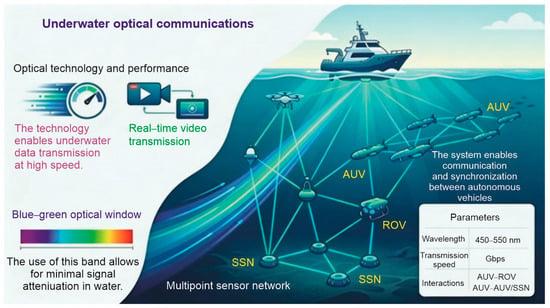
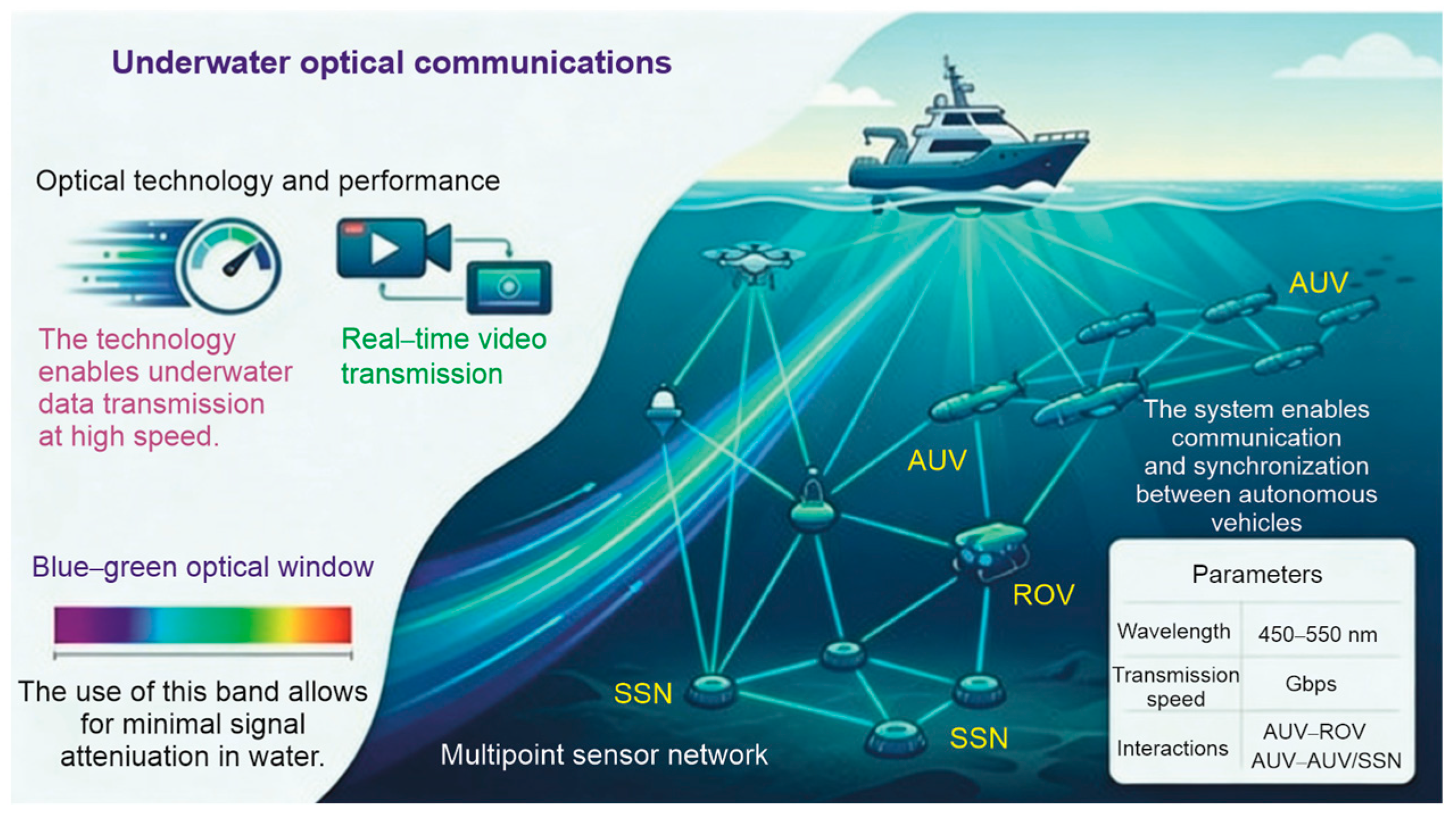
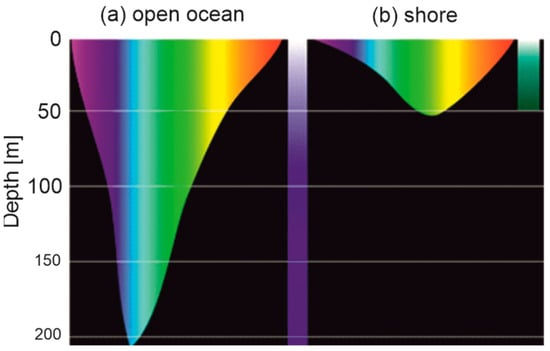
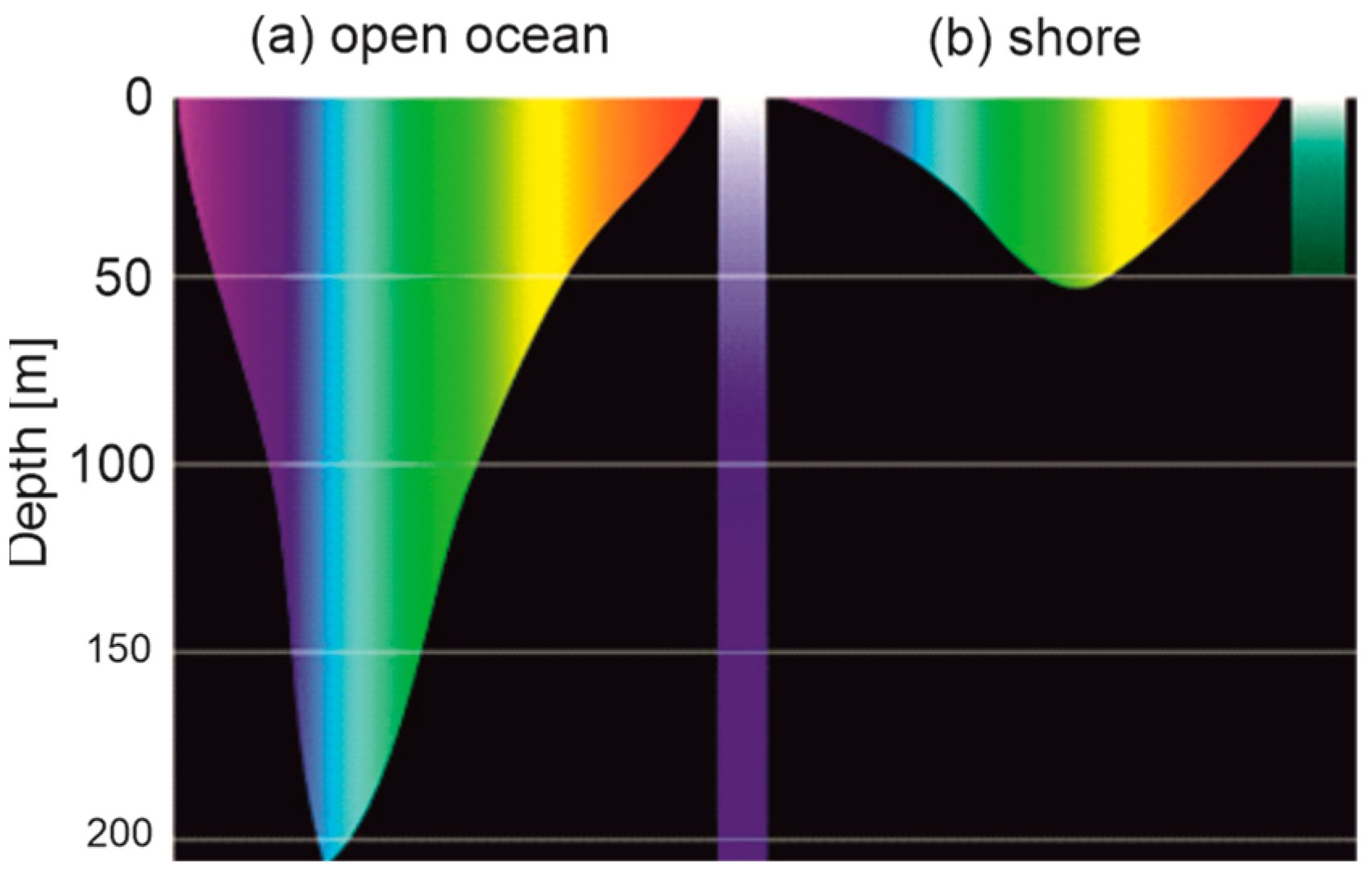
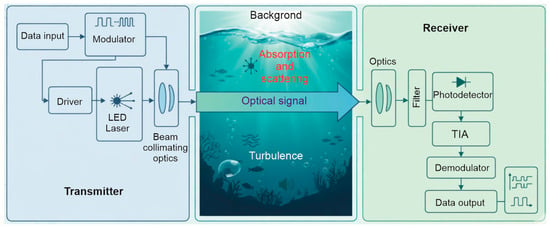
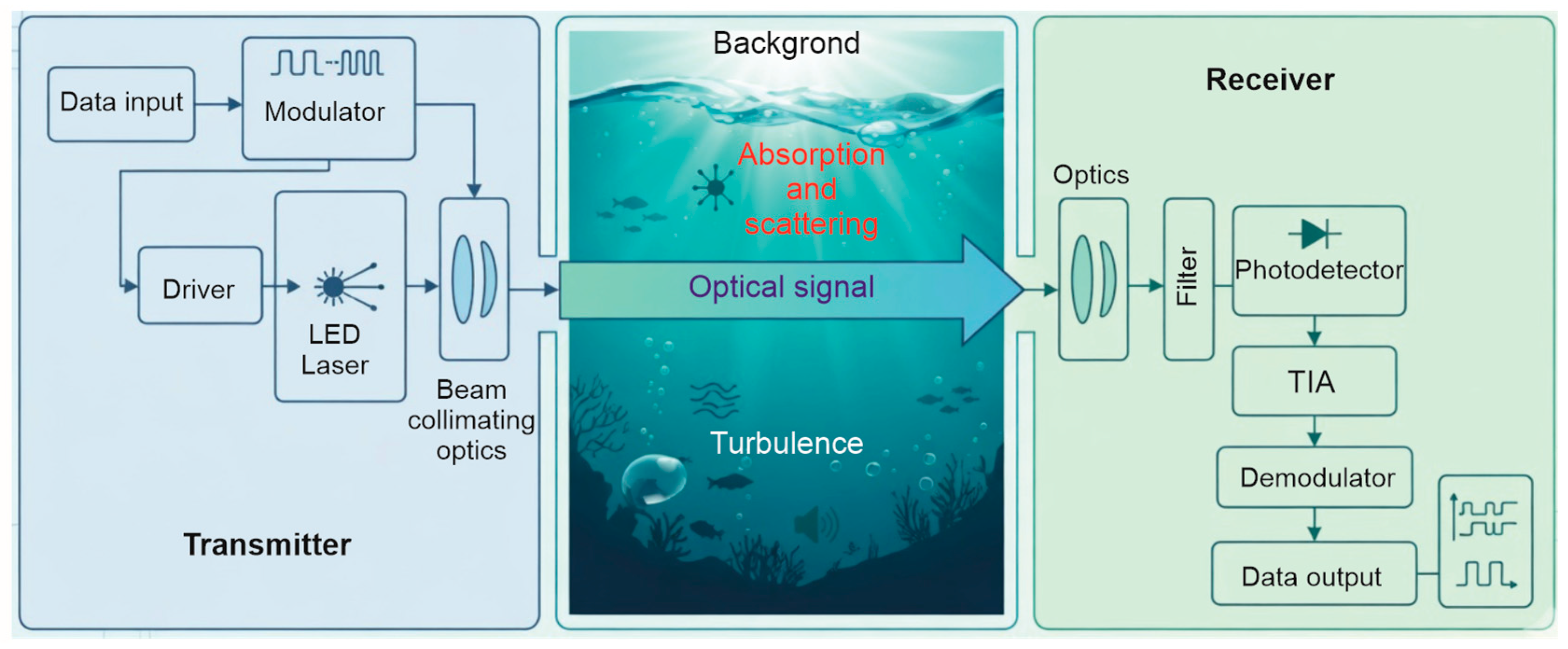
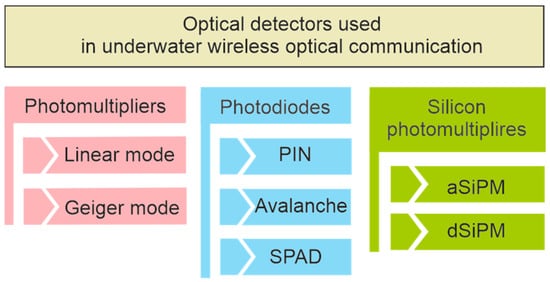
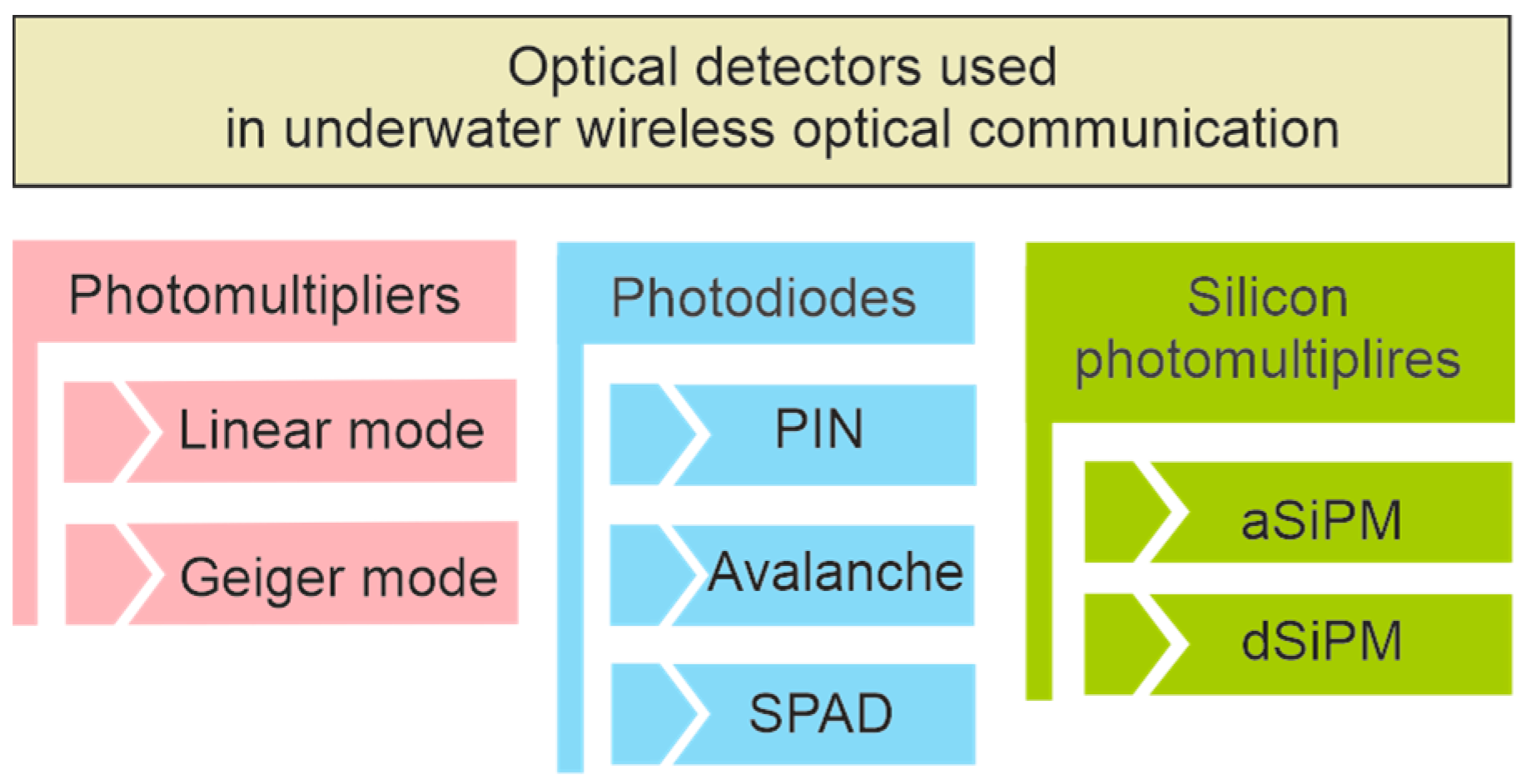
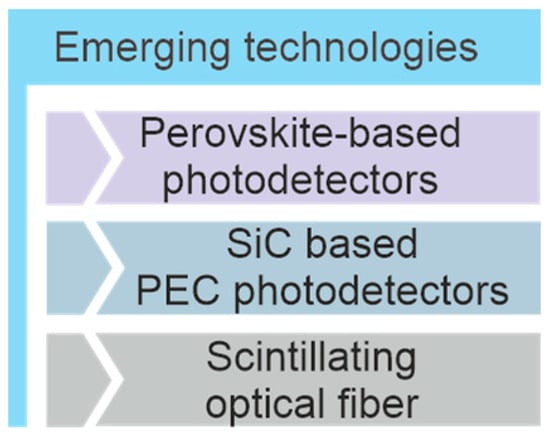
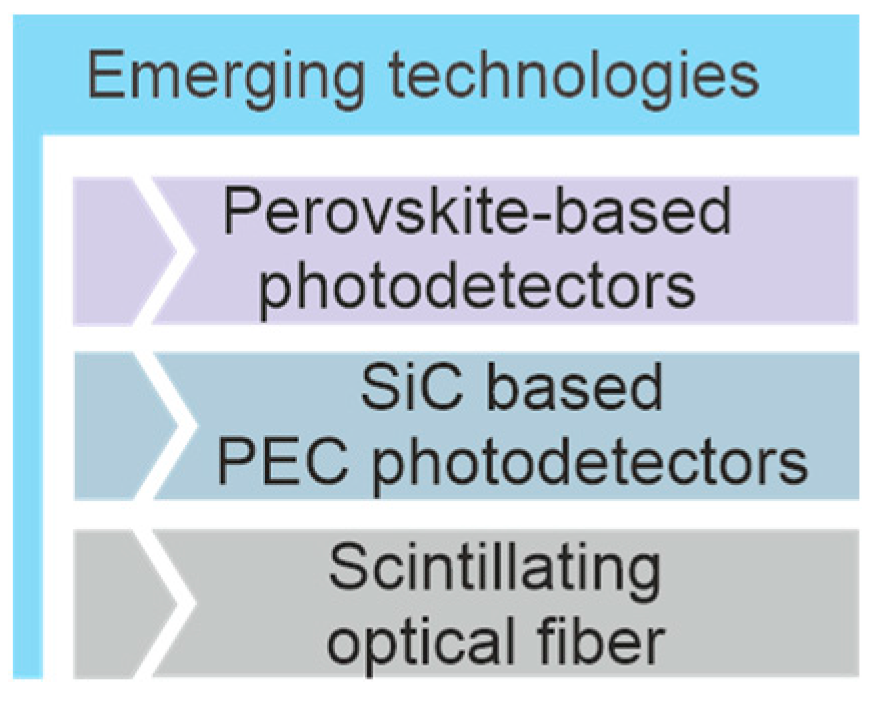
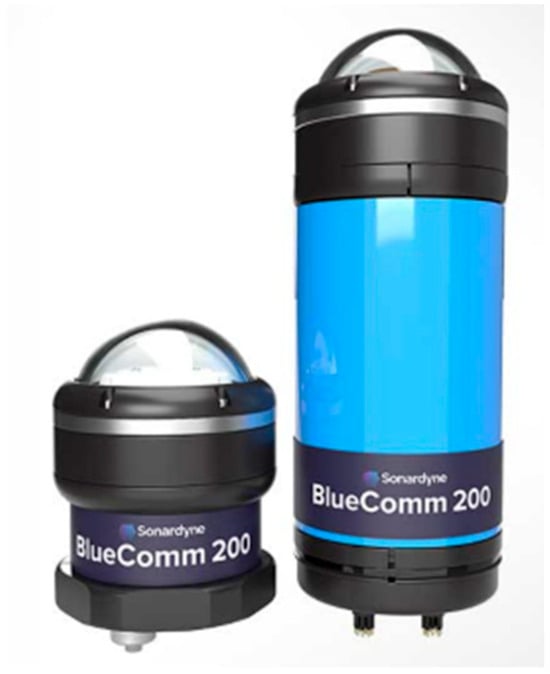
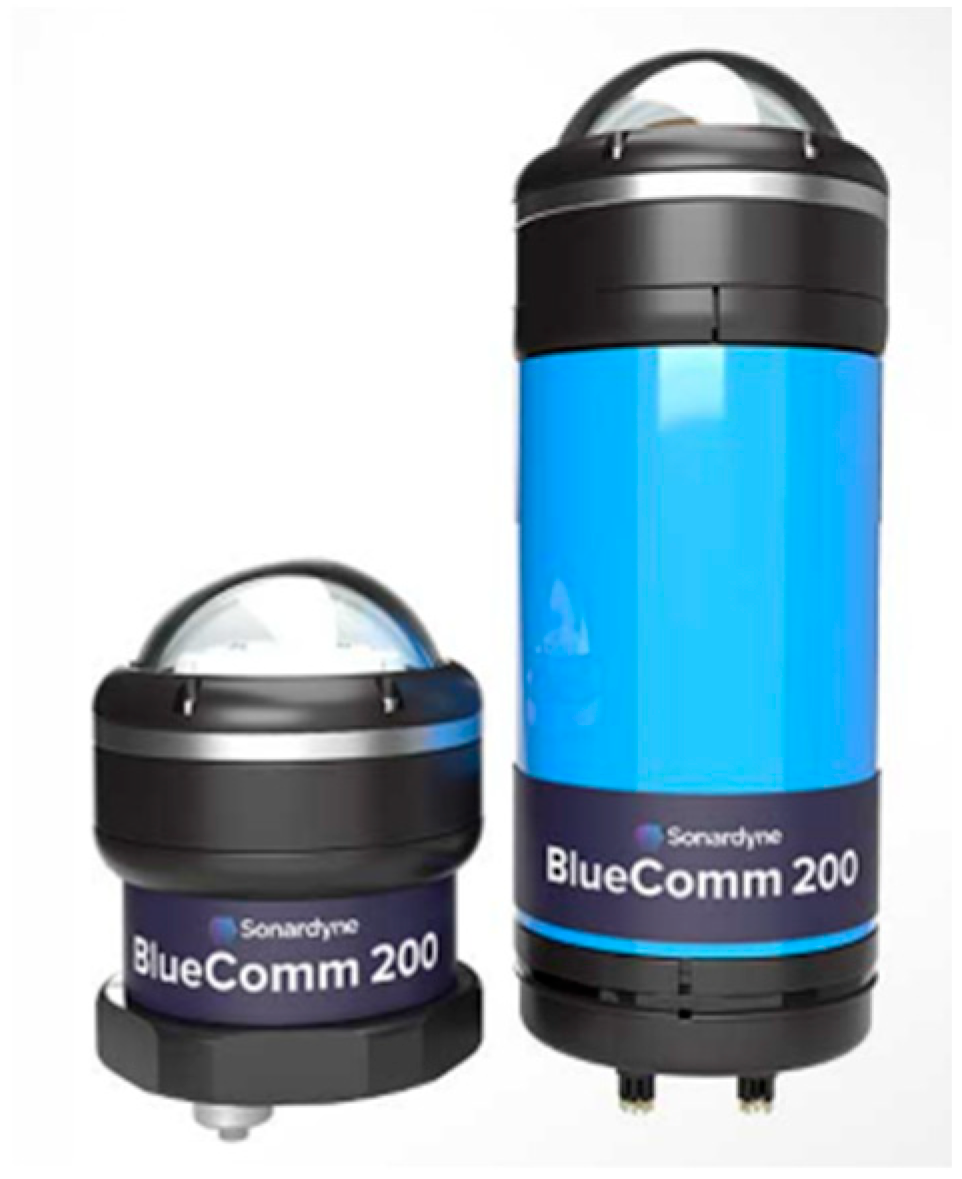
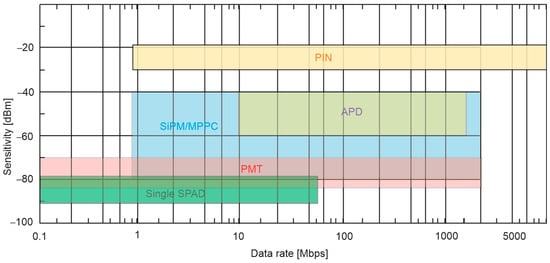
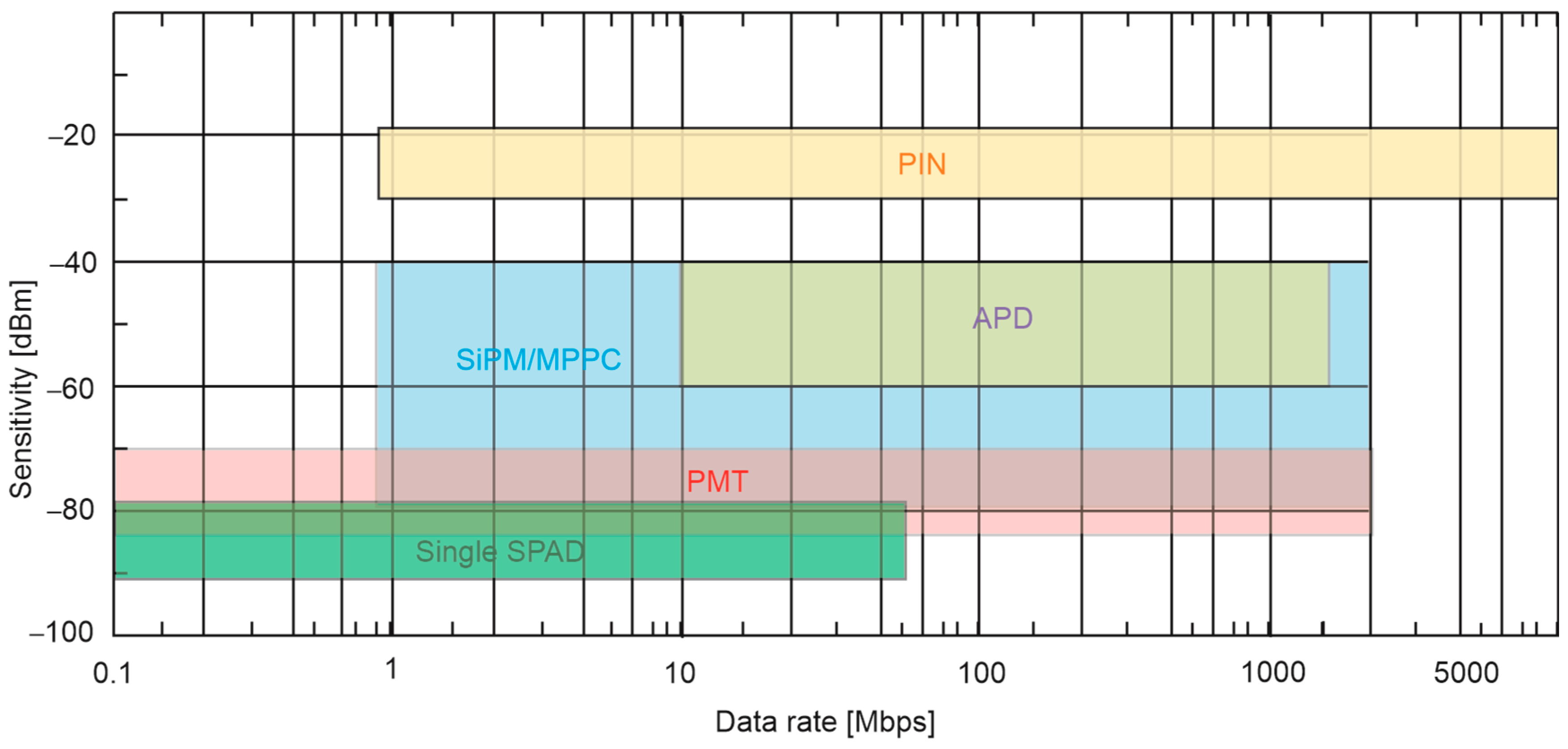

Disclaimer/Publisher’s Note: The statements, opinions and data contained in all publications are solely those of the individual author(s) and contributor(s) and not of MDPI and/or the editor(s). MDPI and/or the editor(s) disclaim responsibility for any injury to people or property resulting from any ideas, methods, instructions or products referred to in the content. |
© 2026 by the authors. Licensee MDPI, Basel, Switzerland. This article is an open access article distributed under the terms and conditions of the Creative Commons Attribution (CC BY) license.