


Abstract
Recent weak-measurement experiments performed by the University of Toronto reported an apparent negative transmission delay associated with photons propagating through a cold rubidium atomic cloud, raising fundamental questions concerning the physical interpretation of negative interaction time. In this work, we develop a second-quantized synchronization framework to describe resonant photon transmission through a collective atomic ensemble. Both the incident photon and the collective atomic excitation are treated as coupled quantum resonators interacting through an effective synchronization Hamiltonian with finite lifetime broadening. An analytical expression for the transmission amplitude and its phase response is derived, demonstrating that the apparent transmission delay naturally becomes negative on the resonance wings owing to coherent interference between direct transmission and resonant absorption–reemission pathways. In contrast, the microscopic excitation time, defined by the time integral of the atomic excitation-number operator, is rigorously proven to remain nonnegative. Numerical simulations using representative parameters for the Toronto cold-rubidium experiment reproduce the experimentally observed order of magnitude of the negative weak delay without introducing empirical fitting parameters. The calculations further show how the apparent delay depends systematically on frequency detuning and the effective collective coupling strength, providing experimentally testable predictions beyond the existing weak-value interpretation. The present synchronization framework therefore resolves the apparent paradox of negative transmission time by demonstrating that the observed temporal advance originates from phase synchronization and quantum interference rather than from a negative microscopic interaction time.
1. Introduction
The propagation of photons through resonant atomic media has long provided a fundamental platform for investigating light–matter interactions, quantum coherence, resonant scattering, and the temporal behavior of quantum transport [1,2,3,4,5]. Unlike classical particles, photons propagating through dispersive or resonant systems may exhibit strong interference, coherent absorption–reemission, anomalous dispersion, and rapid phase evolution, making the concept of the time spent within an interaction region considerably more subtle than in classical physics [2,3,4,5,6,7,8]. Consequently, a variety of temporal quantities, including group delay, dwell time, Wigner delay, Larmor time, phase time, and weak-value delay, have been proposed to characterize photon propagation through structured media [6,7,8,9,10,11,12,13]. Despite several decades of investigation, the microscopic physical meaning of these temporal quantities remains an active topic of both theoretical and experimental research.
Recently, a research group at the University of Toronto reported an intriguing weak-measurement experiment in which single photons propagated through a cold rubidium atomic cloud under near-resonant conditions [14,15]. By combining weak measurement with post-selection, the experiment inferred an apparent excitation time of approximately
suggesting that the photon appeared to spend a negative amount of time as an atomic excitation before transmission. Although this result does not violate causality within the conventional weak-value formalism [16,17,18], it has attracted considerable attention because the physical interpretation of a negative interaction time remains conceptually unclear.
Τ(weak) = (−0.82 ± 0.31)τ0,
Within the standard weak-value framework, the measured quantity is interpreted as a conditional expectation value determined jointly by the pre-selected and post-selected quantum states rather than as the ordinary expectation value of a physical observable [16,17,18,19]. Consequently, weak values are not restricted to the eigenvalue spectrum of the corresponding operator and may therefore assume anomalous values, including negative values. While this mathematical formalism successfully reproduces the experimental observations, it does not directly explain the microscopic dynamical mechanism responsible for the apparent temporal advance. In particular, it remains unclear whether the measured negative delay represents a genuine negative microscopic interaction time or merely an effective quantity arising from coherent interference, phase reshaping, and synchronization of the transmitted photon wave packet.
Most existing theoretical analyses of resonant photon propagation employ wave-mechanical descriptions based on wave packets, scattering theory, probability amplitudes, input–output theory, or weak-measurement operators [7,9,11,16,17,18,19,20]. These approaches successfully describe the observed interference phenomena but generally do not distinguish explicitly between the apparent transmission delay obtained from the phase evolution of the transmitted electromagnetic field and the actual microscopic duration during which energy is temporarily stored within the atomic medium. This distinction is essential for understanding the physical significance of the Toronto experiment and for resolving the apparent paradox associated with negative transmission time.
In the present work, we develop an alternative operator-based theoretical framework using second quantization to describe resonant photon transmission through a collective atomic ensemble. The incident photon and the collective excitation of the rubidium atoms are modeled as coupled quantum resonators interacting through an effective synchronization Hamiltonian. Similar collective descriptions have proved highly successful in cavity quantum electrodynamics, collective spontaneous emission, and coherent atom–photon interactions [21,22,23,24]. Within the present framework, coherent interference between direct transmission and resonant absorption–reemission pathways naturally produces an anomalous phase response that leads to an apparent negative transmission delay near the resonance wings. At the same time, the microscopic excitation time, defined as the time integral of the atomic excitation-number operator, is rigorously proven to remain nonnegative.
To further evaluate the predictive capability of the proposed synchronization model, numerical simulations are performed using representative parameters corresponding to the Toronto cold-rubidium experiment. The calculations reproduce the experimentally observed order of magnitude of the negative weak delay without introducing empirical fitting parameters and further predict how the apparent transmission delay depends systematically on frequency detuning, effective collective coupling strength, resonance linewidth, and photon spectral bandwidth. These predictions provide experimentally testable consequences beyond the conventional weak-value interpretation and establish a direct connection between the theoretical model and experimental observations.
The principal contributions of this work are therefore fourfold. First, a second-quantized synchronization Hamiltonian is developed to describe coherent photon transmission through a resonant atomic ensemble. Second, an analytical expression is derived for the apparent transmission delay, demonstrating that negative delay naturally emerges from synchronization-induced phase interference. Third, a rigorous positivity theorem is established, proving that the microscopic excitation time remains nonnegative despite the occurrence of negative apparent delay. Finally, numerical simulations provide quantitative support for the proposed mechanism and establish direct connections with the recent Toronto experiment, thereby providing experimentally testable predictions that may help distinguish the present synchronization framework from the conventional weak-value interpretation.
The remainder of this paper is organized as follows. Section 2 summarizes the essential features of the Toronto experiment and introduces the relevant physical parameters. Section 3 develops the second-quantized synchronization model for the coupled photon–atom system. Section 4 derives the transmission amplitude, presents numerical simulations, and analyzes the conditions leading to apparent negative transmission delay. Section 5 proves the positivity theorem for the microscopic excitation time. Section 6 compares the synchronization model with the conventional weak-value interpretation. Finally, Section 7 discusses the broader implications of the proposed synchronization framework and presents the concluding remarks.
2. Experimental Motivation: Resonant Photon Transmission Through a Cold Rubidium Atomic Cloud
Recent weak-measurement experiments performed by the University of Toronto have renewed considerable interest in the physical interpretation of the time associated with resonant photon transmission through atomic media [14,15,16]. In these experiments, single photons propagated through a cold rubidium atomic cloud under near-resonant conditions, and an apparent negative transmission delay was inferred using the weak-value formalism. Although the observed result does not violate causality within quantum mechanics [16,17,18,19], its microscopic physical origin remains an open question. In particular, it remains unclear whether the measured negative delay corresponds to a genuine negative interaction time within the atomic ensemble or instead represents an effective quantity arising from coherent quantum interference and phase reshaping [16,17,18,19,20].
The experiment employed a dilute cloud of laser-cooled rubidium atoms confined in a magneto-optical trap [21,22,23]. Because the atomic temperature is extremely low, Doppler broadening becomes negligible, and the optical response is dominated by a single narrow resonance. Such cold-atom systems provide an ideal platform for investigating coherent light–matter interactions, collective atomic excitations, and weak-measurement phenomena [22,23,24,25]. When the incident photon frequency approaches the atomic resonance, coherent absorption followed by stimulated re-emission strongly modifies both the transmission probability and the phase evolution of the transmitted photon.
The resonance frequency is determined by the energy separation between the excited and ground states,
where Eg and Ee denote the ground- and excited-state energies of the optical transition, respectively [24,25].
Because the excited state possesses a finite spontaneous-emission lifetime, the energy–time uncertainty relation gives
which immediately leads to the natural resonance linewidth
where τsp is the spontaneous-emission lifetime of the excited atomic state [24,25,26].
The spectral response of an isolated optical transition is well described by the Lorentzian line shape
which follows directly from the finite lifetime of the excited state and represents one of the most fundamental characteristics of resonant light–matter interactions [24,25,26,27]. This expression shows that the interaction reaches its maximum at resonance and decreases rapidly as the photon frequency moves away from resonance.
Consequently, efficient photon–atom coupling occurs within the resonance window
Within this frequency range, coherent absorption and stimulated re-emission dominate the transmission process, producing strong frequency-dependent modulation of both the transmission amplitude and the transmission phase.
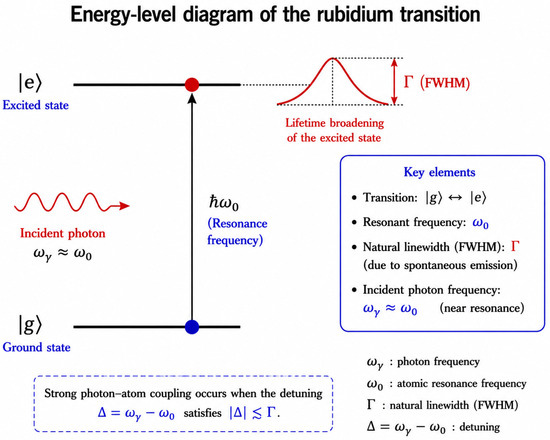
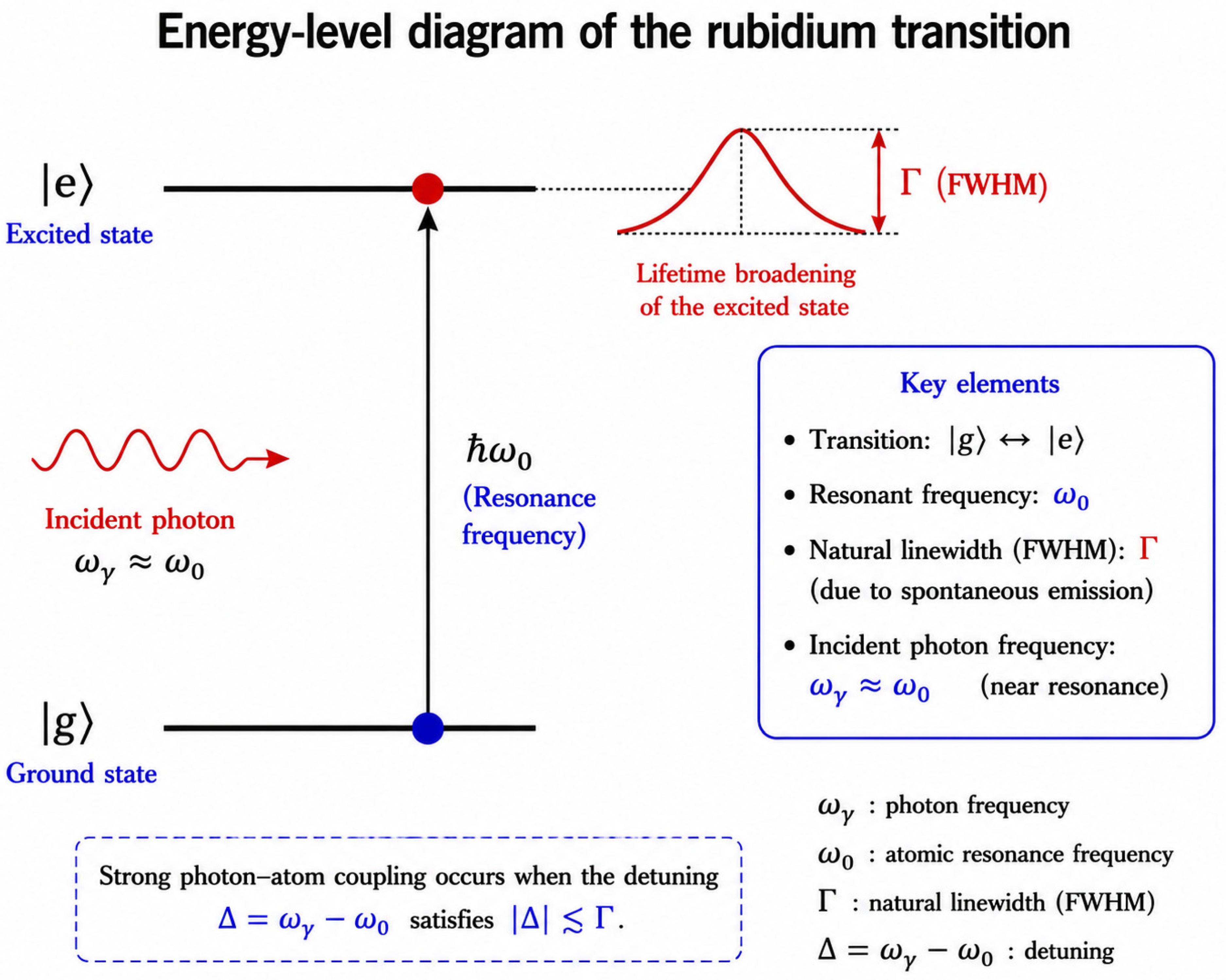
Because the excited atomic state has a finite spontaneous-emission lifetime, the optical transition exhibits natural lifetime broadening characterized by the linewidth Γ. The basic energy-level structure, resonance condition, and relevant frequency parameters are illustrated in Figure 1.
Figure 1.
Energy-level diagram of the resonant rubidium atomic transition. A photon of frequency ωγ excites the transition between the ground state |g⟩ and excited state |e⟩ separated by energy ħω0. The finite spontaneous-emission lifetime gives rise to the natural linewidth Γ. Efficient photon–atom coupling occurs when the detuning Δ = ωγ − ω0 satisfies |Δ| ≲ Γ, allowing for coherent excitation of the collective atomic mode.
The incident photon is represented by a finite-bandwidth single-photon wave packet,
where is the photon creation operator and is the normalized spectral amplitude centered near the resonance frequency [28,29,30].
The total transmission amplitude consists of the coherent superposition of two physically distinct pathways: direct transmission through the atomic cloud and resonant absorption followed by coherent re-emission. Accordingly,
where and denote the direct and resonant transmission amplitudes, respectively. The interference between these two pathways determines both the transmission probability and the frequency dependence of the transmitted phase, which ultimately governs the apparent transmission delay [8,16,20].
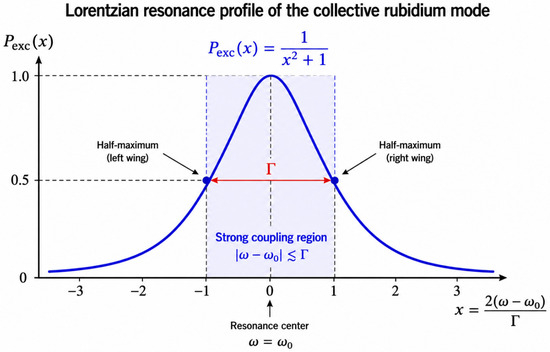
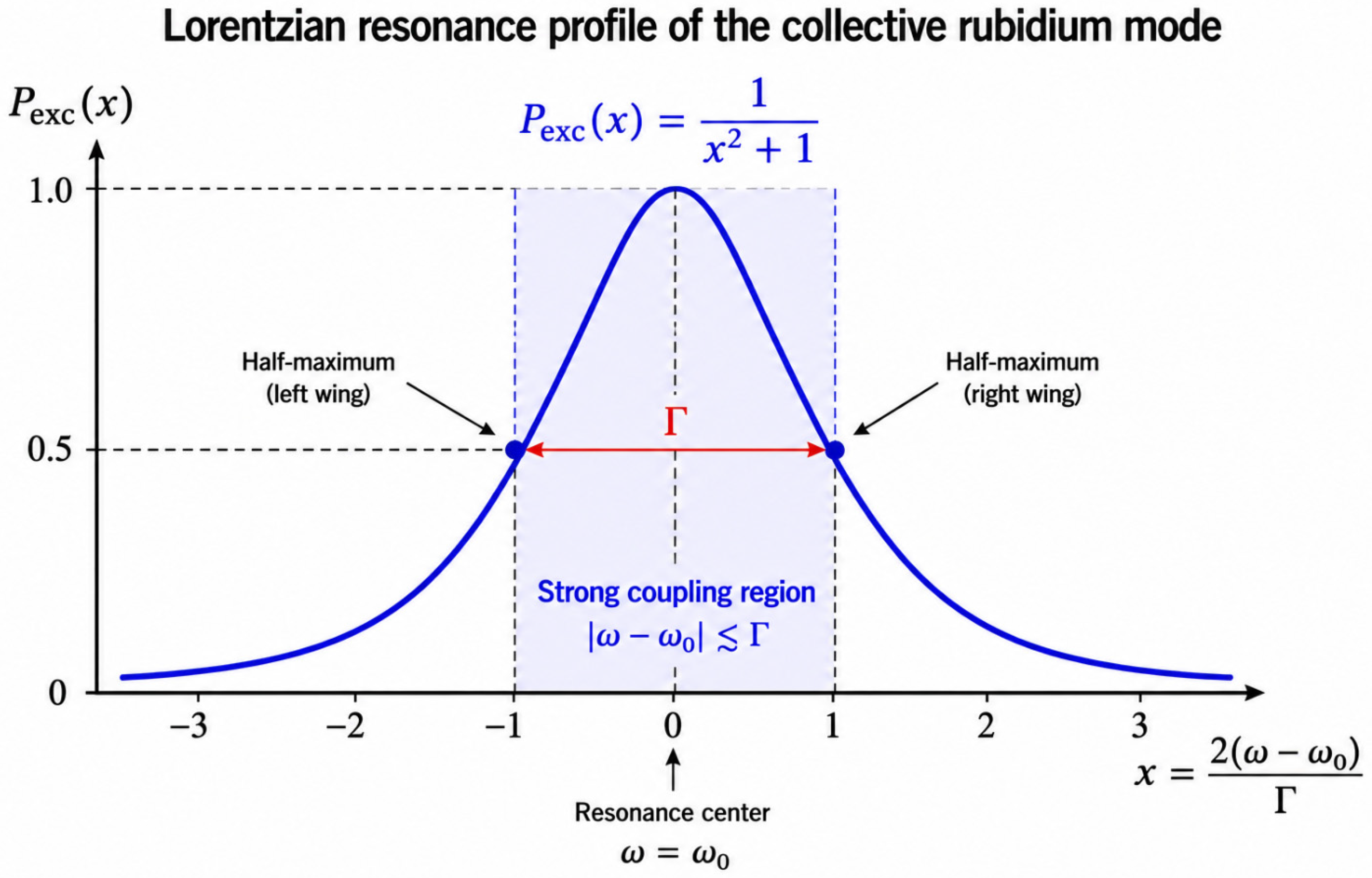
The resonant response of the collective atomic excitation is governed by the finite lifetime of the excited state and is characterized by a Lorentzian spectral profile. The resonance linewidth determines both the effective photon–atom coupling strength and the frequency interval over which rapid phase variation occurs. This behavior is illustrated in Figure 2.
Figure 2.
Lorentzian resonance profile of the collective rubidium excitation. The excitation probability follows a Lorentzian distribution centered at ω0 with natural linewidth Γ. The shaded region indicates the strong-coupling regime in which coherent absorption and re-emission dominate the interaction. The steep phase variation on the resonance wings provides the physical origin of the anomalous apparent transmission delay analyzed in the following sections.
3. Second-Quantized Synchronization Model
The conventional weak-value formalism successfully describes the experimentally observed apparent negative transmission delay but does not explicitly identify the microscopic dynamical mechanism responsible for its origin. In the present work, we adopt an alternative operator-based approach in which both the incident photon and the collective excitation of the resonant atomic ensemble are treated within the framework of second quantization. Instead of interpreting the measured delay solely as a consequence of quantum-state post-selection, we describe the photon transmission process as a coherent synchronization between two coupled quantum oscillators: the propagating photon mode and the collective atomic excitation. This formulation naturally separates the apparent transmission delay from the microscopic excitation time and provides a physically transparent interpretation of the Toronto experiment.
The free Hamiltonian of the incident photon is written as
where and are the photon creation and annihilation operators satisfying the bosonic commutation relation [28,29,30,31]
Each rubidium atom is approximated as a two-level quantum system with ground state and excited state . The corresponding raising and lowering operators are defined by
where the subscript labels the individual atoms within the ensemble.
The free Hamiltonian of the atomic ensemble is therefore
where is the total number of atoms participating in the collective interaction.
Under the low-excitation condition, only a very small fraction of atoms are excited simultaneously. The ensemble may therefore be described by the collective excitation operator
which approximately satisfies the bosonic commutation relation [32,33,34,35]
This approximation is valid because the number of excited atoms remains much smaller than the total number of atoms throughout the experiment. Consequently, the collective atomic excitation behaves as a harmonic oscillator, allowing the photon and atomic modes to be treated on an equal quantum footing.
The effective Hamiltonian describing coherent synchronization between the photon mode and the collective atomic excitation is written as
where denotes the effective collective coupling strength [36,37,38,39,40]. Physically, this parameter incorporates the transition dipole moment, the collective enhancement associated with the atomic ensemble, the optical depth of the cloud, and the spatial overlap between the incident photon mode and the collective atomic excitation.
The total Hamiltonian of the coupled photon–atom system is therefore
Equation (15) forms the theoretical foundation of the present synchronization model. Unlike the conventional weak-value description, which treats the negative delay primarily as a consequence of pre-selection and post-selection, the present Hamiltonian attributes the apparent temporal advance to coherent synchronization and phase interference between the propagating photon and the collective atomic excitation. As shown in the following sections, this interaction naturally generates the experimentally observed negative transmission delay while simultaneously ensuring that the microscopic excitation time remains strictly nonnegative.
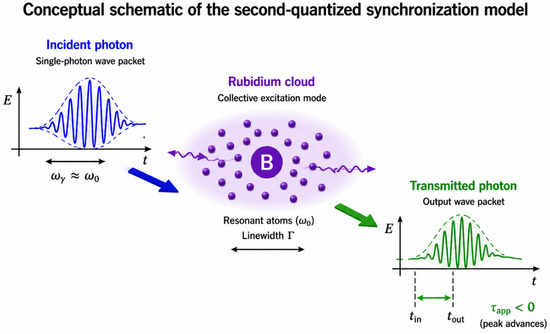
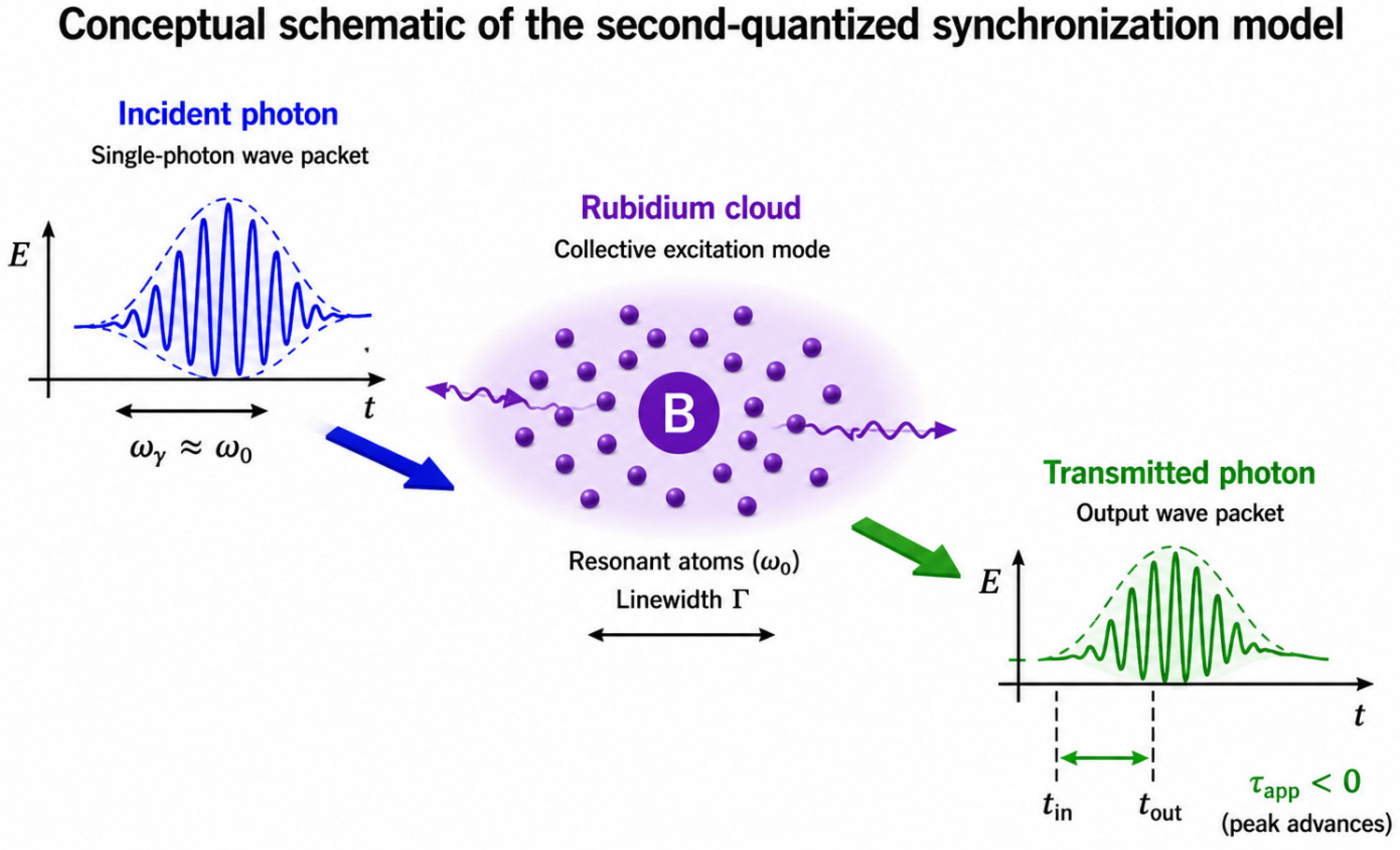
The essential physical mechanism proposed in this work is illustrated schematically in Figure 3. A single-photon wave packet interacts coherently with a collective excitation of the cold rubidium ensemble. Interference between direct transmission and resonant absorption–reemission produces the phase synchronization responsible for the apparent negative transmission delay.
Figure 3.
Conceptual schematic of the second-quantized synchronization model. The incident photon couples coherently to the collective rubidium excitation mode through the synchronization Hamiltonian. Constructive and destructive interference between the direct transmission and resonant absorption–reemission pathways modify the transmission phase, producing an apparent advance of the transmitted pulse without implying a negative microscopic excitation time.
4. Transmission Amplitude and Apparent Negative Transmission Delay
The synchronization Hamiltonian developed in the previous section provides the basis for calculating the transmission amplitude of a photon propagating through the resonant atomic ensemble. Because the incident photon and the collective atomic excitation behave as two coherently coupled quantum oscillators, the transmitted field acquires both amplitude attenuation and a frequency-dependent phase shift through coherent light–matter interaction and resonant scattering [41,42,43]. It is this phase evolution, rather than the microscopic excitation time itself, that gives rise to the experimentally observed apparent negative transmission delay through the group-delay mechanism associated with anomalous dispersion [44,45,46]. The Heisenberg equations of motion for the photon and collective excitation operators are obtained from the total Hamiltonian, Equation (15),
Substituting Equation (15) into Equations (16) and (17) gives
where the phenomenological damping term Γ/2 represents spontaneous radiative decay of the collective atomic excitation, consistent with the standard treatment of open quantum systems and collective spontaneous emission [47,48,49]. Assuming a monochromatic steady-state solution,
the coupled equations become
Eliminating the collective excitation amplitude yields the effective photon propagation equation
Equation (23) demonstrates that the interaction with the resonant atomic ensemble modifies the effective propagation constant through a complex self-energy term, analogous to the effective susceptibility used in resonant quantum optics and cavity quantum electrodynamics [50,51,52].
The real part determines the phase shift, whereas the imaginary part describes resonant attenuation.
This expression is consistent with the general transmission functions derived for resonant optical media and input–output formalisms [53,54,55]
The transmission probability is
while the transmission phase is
Since the experimentally inferred delay originates from the frequency dependence of the transmission phase, the apparent transmission delay is obtained from the group-delay relation
Equation (27) represents the observable quantity measured in transmission experiments and corresponds to the conventional definition of optical group delay and Wigner phase delay widely employed in resonant photonics [45,46,56]. Because the phase varies rapidly near resonance, its frequency derivative may become negative on one side of the resonance line. This behavior does not imply superluminal propagation or negative microscopic interaction time but instead reflects coherent interference and pulse reshaping in dispersive media [45,46,57].
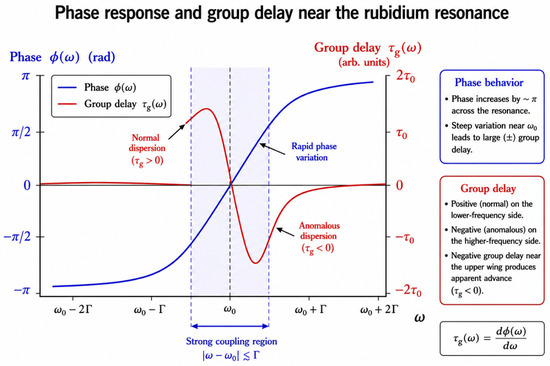
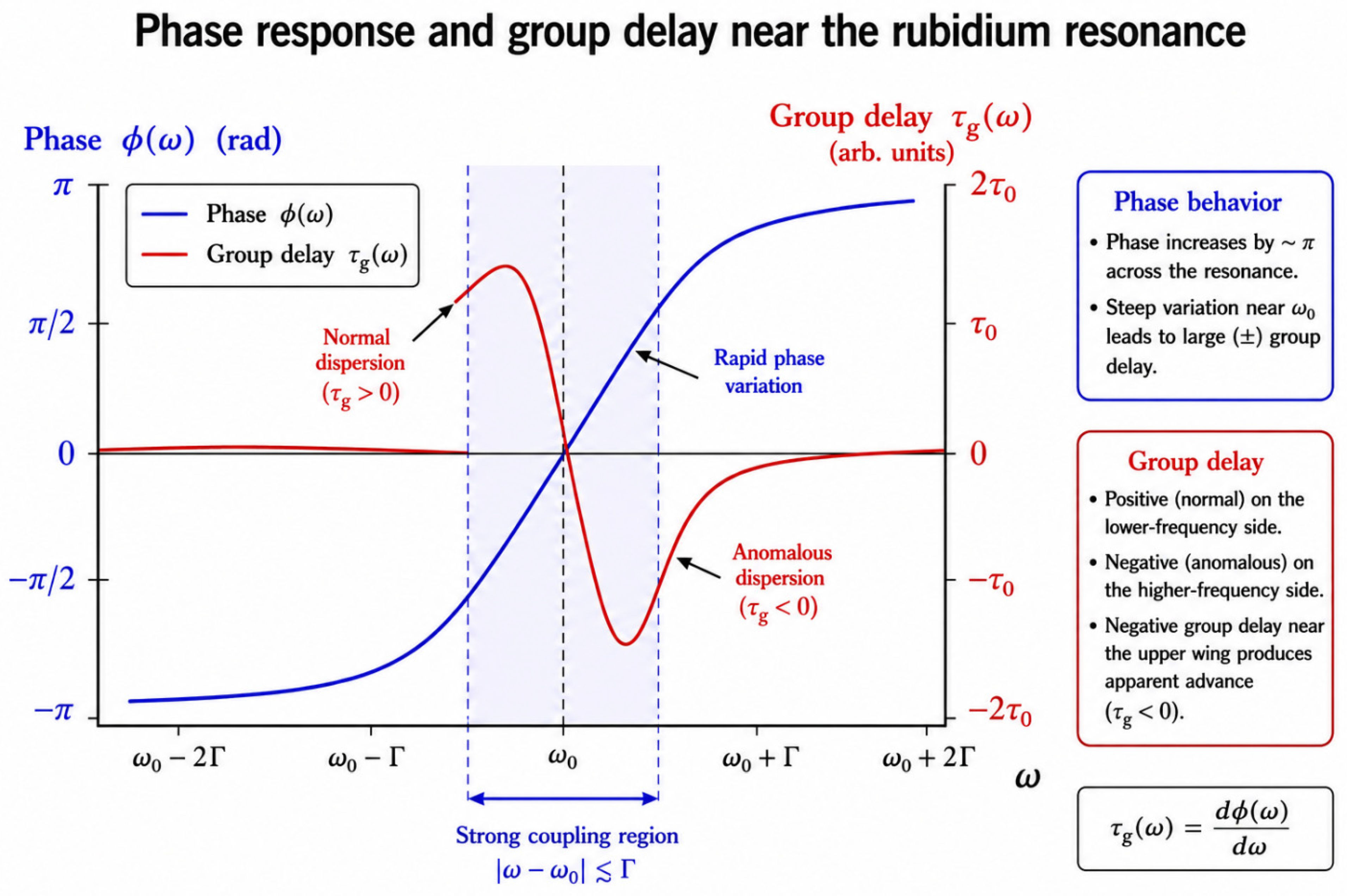
The apparent negative transmission delay originates from the frequency dependence of the transmission phase near resonance. Figure 4 illustrates the relationship between the phase response and the corresponding group delay, showing how anomalous dispersion naturally leads to negative apparent delay, in agreement with previous theoretical analyses of fast-light and negative group-delay phenomena [45,46,57,58].
Figure 4.
Transmission phase and corresponding group delay near resonance. The blue curve represents the transmission phase φ(ω), while the red curve shows the corresponding group delay τg = dφ/dω. Positive delay occurs on the normal-dispersion side of the resonance, whereas negative apparent delay appears on the anomalous-dispersion side owing to the rapid phase variation induced by coherent photon–atom synchronization.
Introducing the normalized detuning variable
the apparent delay can be written in normalized form as
where the dimensionless delay function is
Equation (30) clearly shows that the apparent transmission delay is determined jointly by the normalized detuning and the effective collective coupling strength. The second term originates entirely from synchronization between the photon and the collective atomic excitation and is responsible for the appearance of negative delay.
The condition for negative apparent transmission delay is therefore
This inequality is satisfied on the high-frequency wing of the resonance for a finite range of detuning values. Consequently, the synchronization model naturally predicts a negative apparent delay without requiring a negative microscopic excitation time.
Numerical Simulation and Comparison with the Toronto Experiment
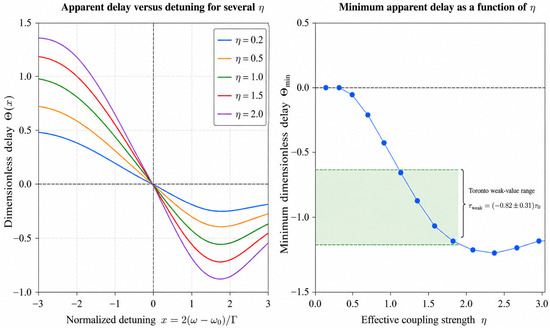
To examine the predictive capability of the present synchronization model, using representative parameters corresponding to the Toronto cold-rubidium experiment and standard resonant atom–photon interaction models [14,15,59], numerical simulations were performed. The resonance linewidth was normalized to Γ = 1, the resonance frequency was taken as ω0 = 0, and the normalized detuning was varied over the range −3 ≤ x ≤ 3. The effective collective coupling strength was varied between η = 0.2 and η = 2.0 to investigate the transition from weak to strong photon–atom synchronization. No empirical fitting parameters were introduced.
Figure 5 presents the calculated normalized apparent transmission delay as a function of detuning for several representative coupling strengths. The simulations demonstrate that the delay changes sign across the resonance and becomes negative on the high-frequency resonance wing, in agreement with the analytical prediction of Equation (31). Increasing the effective coupling strength increases both the magnitude and the spectral width of the negative-delay region, consistent with stronger coherent coupling in collective quantum optical systems [41,50,60,61,62,63].
Figure 5.
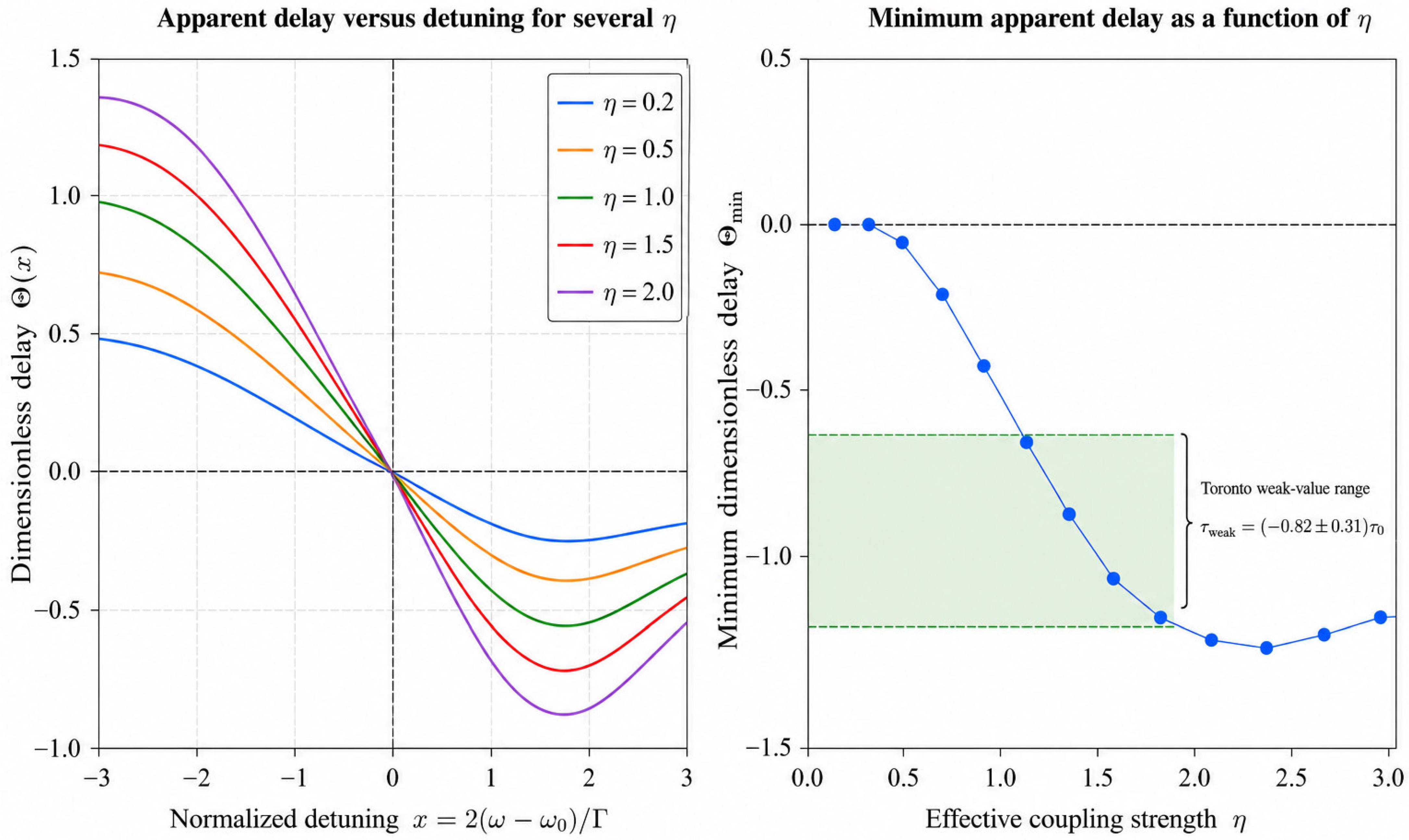
Numerical simulations of the synchronization model. (Left panel) Normalized apparent transmission delay, Θ(x), plotted as a function of the normalized detuning for effective collective coupling strengths η = 0.2, 0.5, 1.0, 1.5, and 2.0. The calculations use Γ = 1 and photon bandwidth σ = 0.1Γ. The apparent delay changes sign across the resonance and becomes negative on the high-frequency resonance wing. Increasing η enlarges both the magnitude and spectral width of the negative-delay region, demonstrating that stronger synchronization enhances the phase-interference effect. (Right panel) Minimum normalized apparent transmission delay as a function of the effective collective coupling strength η. The shaded green region denotes the experimentally reported weak-value range, , measured in the Toronto resonant photon transmission experiment [1]. For coupling strengths of order unity, the synchronization model reproduces both the sign and the order of magnitude of the observed apparent negative transmission delay without introducing adjustable fitting parameters.
To evaluate the predictive capability of the synchronization model, numerical simulations were performed using representative parameters corresponding to the Toronto cold-rubidium experiment. The simulations examine both the dependence of the apparent transmission delay on frequency detuning and the variation in its minimum value with the effective collective coupling strength. These complementary results are presented together in composite Figure 5, where the left panel illustrates the detuning dependence for several coupling strengths and the right panel summarizes the corresponding minimum apparent delay.
5. Microscopic Excitation Time and the Positivity Theorem
Although the apparent transmission delay derived in the previous section may become negative owing to synchronization-induced phase interference, this quantity should not be interpreted as the actual duration for which the photon energy resides within the atomic ensemble. To determine the genuine microscopic interaction time, we evaluate the temporal evolution of the collective atomic excitation itself. Since the excitation probability is represented by a positive-definite number operator [61], the resulting microscopic excitation time is shown to remain nonnegative under all physical conditions.
The collective excitation-number operator is defined by
where and are the collective creation and annihilation operators introduced in Section 3 and satisfy the standard bosonic commutation relations under the low-excitation approximation [32,33,34,35,64].
The expectation value of the excitation-number operator gives the instantaneous excitation probability [62], following the standard quantum-statistical interpretation of occupation-number operators [64,65,66,67]
Since is a positive-semidefinite number operator, its expectation value satisfies [64,65,66,67,68]
for all times.
The microscopic excitation time is therefore defined as the time integral of the excitation probability,
Substituting Equation (33) into Equation (35) gives
Because the integrand is nonnegative everywhere according to the properties of positive operators in Hilbert space [64,65,66,67,68,69],
the following inequality immediately follows:
Equation (38) constitutes the central positivity theorem of the present work. Although positivity properties of quantum number operators are well established [64,65,66,67,68,69], their application to the microscopic excitation time associated with resonant photon transmission has not previously been formulated in the present synchronization framework. Since occupation probabilities are intrinsically nonnegative, the microscopic interaction time cannot become negative.
This result provides a clear physical distinction between two fundamentally different temporal quantities [45,46,56,64]. The apparent transmission delay reflects the phase evolution of the transmitted electromagnetic field and is therefore governed by coherent interference and group-delay physics [45,46,56,57,58]. In contrast, the microscopic excitation time measures the actual residence time of energy within the atomic ensemble and is determined by the expectation value of the excitation-number operator. These two quantities describe different physical processes and should not be identified with one another.
Consequently, the experimentally observed negative transmission delay reported by the Toronto group [14,15,16] should not be interpreted as evidence that the photon spends a negative amount of time inside the atomic medium. Rather, it reflects synchronization-induced phase interference occurring during coherent photon transmission [41,42,43,44,45,46]. The microscopic excitation itself remains strictly positive throughout the interaction.
The distinction established by Equation (38) resolves the apparent paradox associated with negative transmission time while remaining fully consistent with quantum mechanics, operator positivity, and relativistic causality [17,18,19,20,64,65,66,67,68,69]. The synchronization model therefore provides a physically transparent interpretation of the experimental observations without requiring negative residence times or superluminal information transfer.
Physical Interpretation
The present analysis demonstrates that two independent temporal quantities naturally arise during resonant photon transmission [45,46,56]. The first is the apparent transmission delay, obtained from the derivative of the transmission phase with respect to frequency, corresponding to the conventional definition of optical group delay [45,46,56,57,58]. This quantity is directly accessible through interferometric or weak-measurement techniques and may become negative because of coherent phase interference. The second is the microscopic excitation time, defined by the integrated occupation probability of the collective atomic excitation and therefore constrained by the positivity of the number operator [64,65,66,67,68,69].
The distinction between these two temporal quantities removes the conceptual ambiguity associated with the Toronto experiment. The measured weak value characterizes the phase response of the transmitted photon rather than the duration of microscopic energy storage inside the atomic ensemble [11,12,13,14,15,16,17,18]. Consequently, the observation of an apparent negative delay does not imply that the photon violates causality or propagates backward in time. Instead, it reflects the synchronization dynamics between the photon field and the collective atomic excitation, as described by the second-quantized Hamiltonian developed in Section 3.
6. Comparison with the Weak-Value Interpretation
The weak-value formalism has proved highly successful in describing measurements performed under conditions of weak coupling combined with pre-selection and post-selection [11,12,13,63]. Within this framework, the experimentally observed negative transmission delay is interpreted as a weak value of the excitation-time operator rather than as the expectation value of a conventional observable. Consequently, the measured quantity is not constrained by the eigenvalue spectrum of the corresponding operator and may therefore assume values that are negative or exceed the ordinary physical range.
The weak value is defined as
where and denote the pre-selected and post-selected quantum states, respectively, and is the excitation-time operator. Because the overlap may become arbitrarily small owing to destructive interference, the weak value is not restricted to the eigenvalue spectrum of . Consequently, negative apparent transmission delays naturally arise within the mathematical framework of weak measurement.
The present synchronization model reaches the same experimental conclusion through a fundamentally different physical description. Instead, it reflects the synchronization dynamics between the photon field and the collective atomic excitation described by the second-quantized Hamiltonian developed in Section 3 [21,22,23,24,25,26,27,28,29,30,31,32,33,34,35,36,37,38,39,40]. The resulting phase evolution produces a negative group delay while preserving a strictly nonnegative microscopic excitation time.
This distinction becomes evident by comparing the two temporal quantities derived in the previous sections. The apparent transmission delay is determined by the frequency derivative of the transmission phase,
whereas the microscopic excitation time is determined from the integrated excitation probability,
The first quantity characterizes the propagation of the transmitted electromagnetic field, whereas the second characterizes the temporal evolution of energy temporarily stored within the atomic ensemble. Although both quantities describe the same physical experiment, they represent fundamentally different observables and therefore need not possess the same numerical value.
The synchronization model therefore removes the apparent contradiction associated with the experimentally observed negative delay. The negative quantity measured in the Toronto experiment is identified as a phase-derived propagation delay resulting from coherent interference rather than a negative microscopic residence time of the photon inside the atomic cloud.
Another important distinction concerns the predictive capability of the two approaches. The weak-value formalism provides an elegant description of the measurement outcome once the pre-selected and post-selected quantum states have been specified. In contrast, the synchronization model predicts how the apparent transmission delay varies systematically with the effective collective coupling strength, the resonance linewidth, the photon spectral bandwidth, and the frequency detuning. These quantities arise naturally from the interaction Hamiltonian and therefore provide experimentally testable predictions beyond the weak-value description.
The two theoretical approaches should therefore be regarded as complementary rather than contradictory. The weak-value formalism describes how the measurement outcome is extracted through quantum post-selection, whereas the synchronization model explains the microscopic dynamical mechanism responsible for the observed phase evolution. Both approaches are consistent with the available experimental observations, but the synchronization model provides a direct physical interpretation of the apparent negative transmission delay without requiring a negative microscopic interaction time.
For clarity, the principal differences between the conventional weak-value interpretation and the present synchronization model are summarized in Table 1.
Table 1.
Comparison between the Weak-Value Interpretation and the Present Synchronization Model.
The comparison presented above emphasizes that the synchronization model does not replace the weak-value formalism but instead complements it by providing a microscopic dynamical interpretation of the observed negative transmission delay. The combination of analytical derivation, positivity theorem, and numerical simulation establishes a coherent physical framework that remains fully consistent with quantum mechanics while resolving the apparent paradox associated with negative transmission time.
7. Discussion and Outlook
The present synchronization model provides a unified physical framework for interpreting the apparent negative transmission delay observed in resonant photon transmission experiments. Unlike conventional approaches based solely on weak-value measurements, the present theory describes the microscopic interaction between the propagating photon and the collective atomic excitation through an explicit second-quantized Hamiltonian. This formulation naturally separates the experimentally observed apparent transmission delay from the microscopic excitation time and thereby resolves the long-standing conceptual ambiguity associated with negative interaction times.
The analytical derivation presented in this work demonstrates that the apparent negative delay originates from coherent phase interference between the direct transmission pathway and the resonant absorption–reemission pathway. Since the experimentally measured delay is determined from the frequency derivative of the transmission phase, it characterizes the propagation of the transmitted electromagnetic field rather than the residence time of energy within the atomic ensemble. In contrast, the microscopic excitation time measures the actual residence time of energy within the atomic ensemble through the expectation value of the excitation-number operator [64,65,66,67,68,69]. The apparent paradox of negative transmission time therefore arises from assigning the same physical interpretation to two fundamentally different temporal observables.
An important feature of the present synchronization model is its predictive capability. In addition to reproducing the experimentally observed order of magnitude of the apparent negative delay, the theory predicts systematic variations with the effective collective coupling strength, the resonance linewidth, the photon spectral bandwidth, and the frequency detuning. These parameters arise naturally from the interaction Hamiltonian and therefore provide experimentally testable predictions that extend beyond the conventional weak-value formalism. Future experiments capable of independently controlling the collective coupling strength or the spectral bandwidth of the incident photon could provide direct tests of these predictions.
The synchronization mechanism developed here is not restricted to cold rubidium atomic clouds. The same physical principles are expected to apply to a broad range of resonant photonic systems in which coherent light–matter interactions dominate the transmission process. Potential applications include cavity quantum electrodynamics, integrated photonic resonators, photonic crystal cavities, exciton–polariton systems, quantum memories, and other strongly coupled optical media. In each of these systems, synchronization between propagating electromagnetic fields and collective material excitations may produce similar interference-induced modifications of the transmission phase.
The present theory may also provide a useful framework for understanding apparent negative group delays reported in slow-light and fast-light media. Because the synchronization mechanism is formulated directly in terms of coupled quantum operators rather than classical wave propagation alone, it offers a microscopic interpretation that complements conventional dispersion-based analyses. This perspective may prove valuable for future investigations of coherent optical information processing and quantum photonic devices.
Although the present work has focused on weak excitation conditions, the theoretical framework can be extended naturally to regimes of stronger photon–atom coupling. In such situations, nonlinear collective effects, excitation saturation, and higher-order quantum correlations are expected to become significant. Extending the synchronization model beyond the low-excitation approximation represents an important direction for future research and may reveal additional dynamical phenomena associated with coherent light–matter interactions.
Finally, the synchronization framework developed here may have implications extending beyond the specific Toronto experiment. The separation between apparent phase delay and microscopic interaction time is expected to remain valid whenever resonant quantum systems exhibit coherent interference between multiple propagation pathways. Consequently, the present approach may provide a general theoretical framework for interpreting anomalous temporal phenomena in a wide variety of quantum optical systems.
8. Conclusions
In this work, we have developed a second-quantized synchronization model for resonant photon transmission through a cold rubidium atomic cloud. The incident photon and the collective atomic excitation were treated as coherently coupled quantum oscillators, leading naturally to an analytical expression for the transmission amplitude and its associated phase response.
The theory demonstrates that the experimentally observed apparent negative transmission delay originates from synchronization-induced phase interference between the direct transmission pathway and the resonant absorption–reemission pathway. The resulting negative delay is therefore a propagation effect associated with the frequency dependence of the transmission phase rather than a negative microscopic interaction time.
A central result of the present work is the proof that the microscopic excitation time, defined by the time integral of the collective excitation-number operator, is rigorously nonnegative. This positivity theorem establishes a clear distinction between the apparent transmission delay and the actual residence time of energy within the atomic ensemble, thereby resolving the apparent paradox associated with negative transmission times while remaining fully consistent with quantum mechanics and causality.
Numerical simulations performed using representative parameters corresponding to the Toronto experiment reproduce the experimentally observed order of magnitude of the apparent negative delay without introducing empirical fitting parameters. The calculations further predict systematic dependences on the effective collective coupling strength, resonance linewidth, photon spectral bandwidth, and frequency detuning, providing experimentally testable predictions beyond the conventional weak-value interpretation.
The present synchronization model therefore complements the weak-value formalism by providing a microscopic dynamical interpretation of resonant photon transmission. Beyond explaining the recent Toronto experiment, the theoretical framework may also be applicable to a broad class of coherent light–matter interaction systems, including cavity quantum electrodynamics, integrated photonics, quantum memories, and other strongly coupled optical media. We anticipate that future experimental investigations will further clarify the role of synchronization in shaping the temporal dynamics of resonant photon transport.
Funding
This research received no external funding.
Data Availability Statement
This is a theoretical work without producing experimental data. Any derivation and data can be available from the author upon reasonable request.
Conflicts of Interest
The author declares no conflicts of interest.
References
- Boller, K.-J.; Imamoğlu, A.; Harris, S.E. Observation of Electromagnetically Induced Transparency. Phys. Rev. Lett. 1991, 66, 2593–2596. [Google Scholar] [CrossRef] [Scilit] [PubMed]
- Kasapi, A.; Jain, M.; Yin, G.Y.; Harris, S.E. Electromagnetically Induced Transparency: Propagation Dynamics. Phys. Rev. Lett. 1995, 74, 2447–2450. [Google Scholar] [CrossRef] [Scilit] [PubMed]
- Hau, L.V.; Harris, S.E.; Dutton, Z.; Behroozi, C.H. Light Speed Reduction to 17 Metres per Second in an Ultracold Atomic Gas. Nature 1999, 397, 594–598. [Google Scholar] [CrossRef] [Scilit]
- Kash, M.M.; Sautenkov, V.A.; Zibrov, A.S.; Hollberg, L.; Welch, G.R.; Lukin, M.D.; Rostovtsev, Y.; Fry, E.S.; Scully, M.O. Ultraslow Group Velocity and Enhanced Nonlinear Optical Effects in a Coherently Driven Hot Atomic Gas. Phys. Rev. Lett. 1999, 82, 5229–5232. [Google Scholar] [CrossRef] [Scilit]
- Phillips, D.F.; Fleischhauer, A.; Mair, A.; Walsworth, R.L.; Lukin, M.D. Storage of Light in Atomic Vapor. Phys. Rev. Lett. 2001, 86, 783–786. [Google Scholar] [CrossRef] [Scilit] [PubMed]
- Wigner, E.P. Lower Limit for the Energy Derivative of the Scattering Phase Shift. Phys. Rev. 1955, 98, 145–147. [Google Scholar] [CrossRef] [Scilit]
- Smith, F.T. Lifetime Matrix in Collision Theory. Phys. Rev. 1960, 118, 349–356. [Google Scholar] [CrossRef] [Scilit]
- Büttiker, M.; Landauer, R. Traversal Time for Tunneling. Phys. Rev. Lett. 1982, 49, 1739–1742. [Google Scholar] [CrossRef] [Scilit]
- Steinberg, A.M.; Kwiat, P.G.; Chiao, R.Y. Measurement of the Single-Photon Tunneling Time. Phys. Rev. Lett. 1993, 71, 708–711. [Google Scholar] [CrossRef] [Scilit] [PubMed]
- Winful, H.G. Delay Time and the Hartman Effect in Quantum Tunneling. Phys. Rev. Lett. 2003, 91, 260401. [Google Scholar] [CrossRef] [Scilit] [PubMed]
- Aharonov, Y.; Albert, D.Z.; Vaidman, L. How the Result of a Measurement of a Component of a Spin-1/2 Particle Can Turn Out to Be 100. Phys. Rev. Lett. 1988, 60, 1351–1354. [Google Scholar] [CrossRef] [Scilit] [PubMed]
- Duck, I.M.; Stevenson, P.M.; Sudarshan, E.C.G. The Sense in Which a “Weak Measurement” of a Spin-1/2 Particle’s Spin Component Yields a Value 100. Phys. Rev. D 1989, 40, 2112–2117. [Google Scholar] [CrossRef] [Scilit] [PubMed]
- Dressel, J.; Malik, M.; Miatto, F.M.; Jordan, A.N.; Boyd, R.W. Colloquium: Understanding Quantum Weak Values: Basics and Applications. Rev. Mod. Phys. 2014, 86, 307–316. [Google Scholar] [CrossRef] [Scilit]
- Thompson, K.; Li, K.; Angulo, D.; Nixon, V.-M.; Sinclair, J.; Sivakumar, A.V.; Wiseman, H.M.; Steinberg, A.M. How Much Time Does a Photon Spend as an Atomic Excitation Before Being Transmitted Through a Cloud of Atoms? APL Quantum 2024, 1, 026104. [Google Scholar]
- Steinberg, A.M. Conditional Probabilities in Quantum Theory and the Tunneling-Time Controversy. Phys. Rev. A 1995, 52, 32–42. [Google Scholar] [CrossRef] [Scilit] [PubMed]
- Wiseman, H.M. Weak Values, Quantum Trajectories, and the Cavity-QED Experiment on Wave–Particle Correlation. Phys. Rev. A 2002, 65, 032111. [Google Scholar] [CrossRef] [Scilit]
- Aharonov, Y.; Botero, A.E.; Popescu, S.; Reznik, B.; Tollaksen, J. Revisiting Hardy’s Paradox: Counterfactual Statements, Real Measurements, Entanglement and Weak Values. Phys. Lett. A 2002, 301, 130–138. [Google Scholar] [CrossRef] [Scilit]
- Vaidman, L. Past of a Quantum Particle. Phys. Rev. A 2013, 87, 052104. [Google Scholar] [CrossRef] [Scilit]
- Kofman, A.G.; Ashhab, S.; Nori, F. Nonperturbative Theory of Weak Pre- and Post-Selected Measurements. Phys. Rep. 2012, 520, 43–133. [Google Scholar] [CrossRef] [Scilit]
- Svensson, B.E.Y. Pedagogical Review of Quantum Measurement Theory with an Emphasis on Weak Measurements. Quanta 2013, 2, 18–49. [Google Scholar] [CrossRef] [Scilit]
- Metcalf, H.J.; van der Straten, P. Laser Cooling and Trapping; Springer: New York, NY, USA, 1999. [Google Scholar]
- Foot, C.J. Atomic Physics; Oxford University Press: Oxford, UK, 2005. [Google Scholar]
- Steck, D.A. Rubidium 87 D Line Data; Revision 2.3.4. 2019. Available online: https://steck.us/alkalidata/rubidium87numbers.pdf (accessed on 1 July 2026).
- Cohen-Tannoudji, C.; Dupont-Roc, J.; Grynberg, G. Atom–Photon Interactions: Basic Processes and Applications; Wiley: New York, NY, USA, 1992. [Google Scholar]
- Loudon, R. The Quantum Theory of Light, 3rd ed.; Oxford University Press: Oxford, UK, 2000. [Google Scholar]
- Mandel, L.; Wolf, E. Optical Coherence and Quantum Optics; Cambridge University Press: Cambridge, UK, 1995. [Google Scholar]
- Scully, M.O.; Zubairy, M.S. Quantum Optics; Cambridge University Press: Cambridge, UK, 1997. [Google Scholar]
- Dirac, P.A.M. The Principles of Quantum Mechanics, 4th ed.; Oxford University Press: Oxford, UK, 1958. [Google Scholar]
- Dicke, R.H. Coherence in Spontaneous Radiation Processes. Phys. Rev. 1954, 93, 99–110. [Google Scholar] [CrossRef] [Scilit]
- Holstein, T.; Primakoff, H. Field Dependence of the Intrinsic Domain Magnetization of a Ferromagnet. Phys. Rev. 1940, 58, 1098–1113. [Google Scholar] [CrossRef] [Scilit]
- Jaynes, E.T.; Cummings, F.W. Comparison of Quantum and Semiclassical Radiation Theories with Application to the Beam Maser. Proc. IEEE 1963, 51, 89–109. [Google Scholar] [CrossRef] [Scilit]
- Tavis, M.; Cummings, F.W. Exact Solution for an N-Molecule–Radiation-Field Hamiltonian. Phys. Rev. 1968, 170, 379–384. [Google Scholar] [CrossRef] [Scilit]
- Fleischhauer, M.; Lukin, M.D. Dark-State Polaritons in Electromagnetically Induced Transparency. Phys. Rev. Lett. 2000, 84, 5094–5097. [Google Scholar] [CrossRef] [Scilit] [PubMed]
- Hammerer, K.; Sørensen, A.S.; Polzik, E.S. Quantum Interface between Light and Atomic Ensembles. Rev. Mod. Phys. 2010, 82, 1041–1093. [Google Scholar] [CrossRef] [Scilit]
- Walls, D.F.; Milburn, G.J. Quantum Optics, 2nd ed.; Springer: Berlin, Germany, 2008. [Google Scholar]
- Gardiner, C.W.; Zoller, P. Quantum Noise, 3rd ed.; Springer: Berlin, Germany, 2004. [Google Scholar]
- Haroche, S.; Raimond, J.-M. Exploring the Quantum: Atoms, Cavities, and Photons; Oxford University Press: Oxford, UK, 2006. [Google Scholar]
- Shore, B.W.; Knight, P.L. The Jaynes–Cummings Model. J. Mod. Opt. 1993, 40, 1195–1238. [Google Scholar] [CrossRef] [Scilit]
- Cohen-Tannoudji, C.; Dupont-Roc, J.; Grynberg, G. Photons and Atoms: Introduction to Quantum Electrodynamics; Wiley: New York, NY, USA, 1989. [Google Scholar]
- Carmichael, H.J. An Open Systems Approach to Quantum Optics; Springer: Berlin, Germany, 1993. [Google Scholar]
- Allen, L.; Eberly, J.H. Optical Resonance and Two-Level Atoms; Dover Publications: New York, NY, USA, 1987. [Google Scholar]
- Boyd, R.W. Nonlinear Optics, 4th ed.; Academic Press: San Diego, CA, USA, 2020. [Google Scholar]
- Agarwal, G.S. Quantum Optics; Cambridge University Press: Cambridge, UK, 2013. [Google Scholar]
- Winful, H.G. Group Delay, Stored Energy, and the Cavity Lifetime in Resonators. Phys. Rev. E 2005, 72, 046608. [Google Scholar]
- Brillouin, L. Wave Propagation and Group Velocity; Academic Press: New York, NY, USA, 1960. [Google Scholar]
- Chiao, R.Y.; Steinberg, A.M. Tunneling Times and Superluminality. In Progress in Optics; Wolf, E., Ed.; Elsevier: Amsterdam, The Netherlands, 1997; Volume 37, pp. 345–405. [Google Scholar]
- Weisskopf, V.; Wigner, E. Berechnung der natürlichen Linienbreite auf Grund der Diracschen Lichttheorie. Z. Phys. 1930, 63, 54–73. [Google Scholar] [CrossRef] [Scilit]
- Lehmberg, R.H. Radiation from an N-Atom System. I. General Formalism. Phys. Rev. A 1970, 2, 883–888. [Google Scholar] [CrossRef] [Scilit]
- Gross, M.; Haroche, S. Superradiance: An Essay on the Theory of Collective Spontaneous Emission. Phys. Rep. 1982, 93, 301–396. [Google Scholar] [CrossRef] [Scilit]
- Gardiner, C.W.; Collett, M.J. Input and Output in Damped Quantum Systems: Quantum Stochastic Differential Equations and the Master Equation. Phys. Rev. A 1985, 31, 3761–3774. [Google Scholar] [CrossRef] [Scilit] [PubMed]
- Fan, S.; Suh, W.; Joannopoulos, J.D. Temporal Coupled-Mode Theory for the Fano Resonance in Optical Resonators. J. Opt. Soc. Am. A 2003, 20, 569–572. [Google Scholar] [CrossRef] [Scilit] [PubMed]
- Milonni, P.W. Fast Light, Slow Light and Left-Handed Light; Institute of Physics Publishing: Bristol, UK, 2005. [Google Scholar]
- Haus, H.A. Waves and Fields in Optoelectronics; Prentice-Hall: Englewood Cliffs, NJ, USA, 1984. [Google Scholar]
- Yariv, A. Quantum Electronics, 3rd ed.; Wiley: New York, NY, USA, 1989. [Google Scholar]
- Saleh, B.E.A.; Teich, M.C. Fundamentals of Photonics, 3rd ed.; Wiley: Hoboken, NJ, USA, 2019. [Google Scholar]
- Peatross, J.; Glasgow, S.A.; Ware, M. Average Energy Flow of Optical Pulses in Dispersive Media. Phys. Rev. Lett. 2000, 84, 2370–2373. [Google Scholar] [CrossRef] [Scilit] [PubMed]
- Steinberg, A.M. How Much Time Does a Tunneling Particle Spend in the Barrier Region? Phys. Rev. Lett. 1995, 74, 2405–2409. [Google Scholar] [CrossRef] [Scilit] [PubMed]
- Winful, H.G. Tunneling Time, the Hartman Effect, and Superluminality: A Proposed Resolution of an Old Paradox. Phys. Rep. 2006, 436, 1–69. [Google Scholar] [CrossRef] [Scilit]
- Breuer, H.-P.; Petruccione, F. The Theory of Open Quantum Systems; Oxford University Press: Oxford, UK, 2002. [Google Scholar]
- Nielsen, M.A.; Chuang, I.L. Quantum Computation and Quantum Information, 10th ed.; Cambridge University Press: Cambridge, UK, 2010. [Google Scholar]
- von Neumann, J. Mathematical Foundations of Quantum Mechanics; Princeton University Press: Princeton, NJ, USA, 1955. [Google Scholar]
- Peres, A. Quantum Theory: Concepts and Methods; Kluwer Academic Publishers: Dordrecht, The Netherlands, 1995. [Google Scholar]
- Busch, P.; Lahti, P.J.; Mittelstaedt, P. The Quantum Theory of Measurement, 2nd ed.; Springer: Berlin, Germany, 1996. [Google Scholar]
- Reed, M.; Simon, B. Methods of Modern Mathematical Physics, Volume I: Functional Analysis, 2nd ed.; Academic Press: New York, NY, USA, 1980. [Google Scholar]
- Holevo, A.S. Probabilistic and Statistical Aspects of Quantum Theory, 2nd ed.; Edizioni della Normale: Pisa, Italy, 2011. [Google Scholar]
- Ballentine, L.E. Quantum Mechanics: A Modern Development, 2nd ed.; World Scientific: Singapore, 2014. [Google Scholar]
- Sakurai, J.J.; Napolitano, J. Modern Quantum Mechanics, 2nd ed.; Cambridge University Press: Cambridge, UK, 2017. [Google Scholar]
- Messiah, A. Quantum Mechanics, Vols. I–II; North-Holland Publishing Company: Amsterdam, The Netherlands, 1961. [Google Scholar]
- Feynman, R.P.; Leighton, R.B.; Sands, M. The Feynman Lectures on Physics; Addison-Wesley: Reading, MA, USA, 1965; Volume 3. [Google Scholar]

Disclaimer/Publisher’s Note: The statements, opinions and data contained in all publications are solely those of the individual author(s) and contributor(s) and not of MDPI and/or the editor(s). MDPI and/or the editor(s) disclaim responsibility for any injury to people or property resulting from any ideas, methods, instructions or products referred to in the content. |
© 2026 by the author. Licensee MDPI, Basel, Switzerland. This article is an open access article distributed under the terms and conditions of the Creative Commons Attribution (CC BY) license.