


Abstract
Conventional quasi-bound state in the continuum (quasi-BIC) terahertz (THz) metasurfaces usually operate at fixed resonance frequencies and lack electrically controlled dynamic tunability. To address this limitation, we propose two schemes for realizing liquid-crystal-integrated quasi-BIC THz metasurfaces by exploiting the electrically tunable refractive index of liquid crystals in the THz regime. A microfluidic multilayer architecture combining a liquid-crystal functional layer with a silicon (Si)-based metasurface is constructed, in which the transition from an ideal BIC to a quasi-BIC is realized through two distinct mechanisms: pixelated control of the liquid-crystal orientation and geometric symmetry breaking of the Si resonators. Cartesian multipole decomposition reveals that the resonances in both configurations are dominated by magnetic dipole modes. The effects of the liquid-crystal orientation angle and key geometric parameters on the resonance frequency, peak absorptance, and quality factor are systematically investigated. Numerical results demonstrate continuous tuning of the terahertz resonance through variation in the liquid-crystal orientation angle, corresponding to electrically driven liquid-crystal reorientation in practical devices. The sensing performance of the optimized Si-resonator-based configuration is further evaluated, achieving a refractive index sensitivity of 117 GHz RIU−1 and a figure of merit (FOM) of 146.25. This work overcomes the fixed-frequency limitation of conventional static quasi-BIC metasurfaces and provides a feasible route toward electrically reconfigurable terahertz microfluidic sensing devices with tunable operating frequencies.
1. Introduction
Terahertz radiation generally refers to electromagnetic waves spanning approximately 0.1–10 THz between the microwave and infrared regions. Its low photon energy, non-ionizing nature, appreciable penetration through many nonpolar dielectric materials, and sensitivity to molecular rotations, lattice vibrations, and weak intermolecular interactions make terahertz technology attractive for nondestructive testing, biomedical analysis, food and pharmaceutical quality control, environmental monitoring, and chemical identification [1,2,3,4,5]. Volatile organic compounds (VOCs) are widely encountered in industrial emissions, indoor environments, and exhaled breath. They may present environmental and health risks, while selected VOCs can also serve as potential biomarkers of physiological and pathological processes [6,7]. Because different VOCs exhibit distinct complex permittivities, refractive indices, and absorption responses in the terahertz region, terahertz spectroscopy offers a potential route to their label-free identification. D’Arco et al. systematically characterized the liquid-phase terahertz optical properties of representative VOCs, including benzene, toluene, p-xylene, and styrene, and demonstrated distinguishable refractive index and absorption responses [8]. Waveguide-enhanced configurations have also been explored to increase the effective interaction length between gaseous VOCs and terahertz waves [9]. Nevertheless, the interaction between trace analytes and terahertz radiation is generally weak, and the dielectric perturbation induced by a low analyte concentration can be difficult to resolve. In liquid-phase measurements, the strong terahertz absorption of water further attenuates the resonant response and reduces the signal-to-noise ratio. Enhancing local fields, increasing the effective light–matter interaction, and mitigating liquid-background attenuation are, therefore, central requirements for high-performance terahertz sensing.
Artificial electromagnetic metamaterials and metasurfaces consist of periodic or quasi-periodic arrays of subwavelength resonators. Through structural engineering, they can tailor local electric and magnetic fields, surface currents, radiative losses, and effective impedance, thereby producing strong field confinement and spectrally selective resonances [10,11,12,13]. In contrast with naturally occurring materials, these engineered structures can concentrate terahertz energy within regions far smaller than the free-space wavelength, converting small dielectric perturbations into measurable changes in resonance frequency, amplitude, or linewidth. Beyond passive field confinement, liquid-crystal-tuned nanocavities have also demonstrated dynamic control of emission and polarization states, highlighting the broader reconfigurability of liquid-crystal-integrated resonant photonic platforms [14]. Integrating metasurfaces with microfluidic systems further enables microliter- or nanoliter-scale liquid samples to be delivered directly into electromagnetic hot spots, improving analyte–field overlap while reducing sample consumption. Hu et al. integrated a metal–dielectric metal metamaterial absorber with a microfluidic channel, placing the analyte within the strongly localized terahertz field and thereby enhancing its refractive index response [10]. Multichannel layouts, alignment of fluidic regions with electric field hot spots, multiresonant structures, and Fabry–Perot-assisted cavities have subsequently been investigated to improve liquid-phase terahertz sensing [11,13,15], with applications extending to microorganisms, antibiotics, and biological specimens [16,17]. A microscale channel does not eliminate the intrinsic terahertz absorption of water; rather, it reduces the liquid thickness and propagation length while confining a limited sample volume to the field-enhanced region. The combination of microfluidics and high-Q metasurfaces can, therefore, provide low sample consumption, enhanced field overlap, and reduced background attenuation, making it a promising platform for label-free detection of organic and biomolecular analytes in aqueous environments. These requirements motivate the combination of high-Q resonant mechanisms, including BICs [18], with actively reconfigurable platforms. In this context, liquid-crystal-integrated meta-waveguides have demonstrated dynamic spectral modulation, confirming the feasibility of using liquid-crystal anisotropy to actively control resonant electromagnetic responses [19].
Among the mechanisms available for producing narrowband metasurface resonances, BICs have attracted particular interest because of their suppressed radiative loss [18,20,21,22,23,24]. A BIC is a spatially localized eigenmode whose frequency lies within the radiation continuum. Its formation is generally associated with symmetry protection or destructive interference between different radiation channels. In an ideal lossless system, a BIC is completely decoupled from free-space radiation, causing its radiative linewidth to approach zero and its theoretical quality factor to diverge. Because an ideal BIC cannot be directly accessed from the far field, a small perturbation—such as geometric displacement, dimensional imbalance, refractive index asymmetry, or oblique incidence—is commonly introduced to open a controlled radiation channel and convert the BIC into a quasi-BIC [20,24]. The resulting mode typically exhibits a narrow Fano-type spectral profile, a high Q-factor, and pronounced near-field localization. Its radiative Q-factor often follows an inverse-square dependence on the symmetry-breaking parameter. The physical origins of BICs and quasi-BICs can also be interpreted through multipole decomposition, in which interference and radiation cancellation among electric dipoles, magnetic dipoles, toroidal dipoles, and higher-order multipoles determine the coupling of the mode to the far field. These properties make quasi-BIC resonances highly responsive to small changes in the surrounding dielectric environment and provide a physical basis for improving the frequency resolution and FOM of terahertz sensors.
Terahertz quasi-BICs have consequently been investigated for thin-film, biomolecular, and refractive-index sensing [25,26,27,28,29,30,31,32,33]. Srivastava et al. used a flexible terahertz quasi-BIC metasurface to detect a dielectric film with a thickness of only 7 nm, demonstrating the pronounced amplification of nanoscale dielectric perturbations provided by strong field confinement and low radiative loss [25]. Subsequent studies have employed toroidal-dipole BICs, magnetic-dipole-dominated all-dielectric metasurfaces, higher-order multipolar modes, and multiple quasi-BIC resonances to improve sensitivity, the Q-factor, and the FOM. Compared with broadband or low-Q resonances, the narrow linewidth of a quasi-BIC facilitates the resolution of small resonance shifts, while its enhanced near field increases overlap with the analyte. The degree of asymmetry must, nevertheless, be carefully optimized. Extremely weak symmetry breaking may produce a high Q-factor but insufficient external coupling, whereas excessive asymmetry increases radiation leakage and broadens the resonance. High-performance quasi-BIC sensing, therefore, requires a balance among radiative coupling, material absorption, analyte location, and modal field distribution.
Despite their high spectral resolution, most reported terahertz quasi-BIC devices rely on geometrical asymmetries that are fixed after fabrication. Their resonance frequencies, radiative losses, coupling strengths, and operating bands, therefore, cannot normally be adjusted continuously, limiting their adaptability to different analytes, refractive index ranges, and multiband sensing tasks. Active materials, including graphene, phase-change media, flexible dielectrics, and liquid crystals, have been introduced into terahertz BIC or high-Q metasurfaces to enable reconfigurable responses [34,35,36,37,38,39,40]. Liquid crystals are particularly attractive because of their pronounced terahertz birefringence, electrically controllable molecular orientation, continuously variable dielectric tensor, and relatively low driving power. They can modulate the effective refractive index, resonance frequency, phase, and polarization response without altering the physical dimensions of the resonator. Liquid-crystal-integrated dielectric resonators have accordingly been used to tune terahertz absorption bands and narrowband resonances. Xu et al. further demonstrated active control of a terahertz quasi-BIC and asymmetric transmission in a liquid-crystal-integrated metasurface, directly establishing the feasibility of combining liquid-crystal reorientation with control of a BIC radiation channel [40]. However, most liquid-crystal-based terahertz devices have focused on absorption modulation, polarization conversion, and beam shaping. The use of pixelated liquid-crystal orientation to create a controllable in-plane refractive index asymmetry within a single unit cell, dynamically excite a quasi-BIC, and integrate the resulting mode with microfluidic refractive index sensing remains insufficiently explored.
In this work, we propose two configurations of liquid-crystal-integrated quasi-BIC terahertz metasurfaces: one based on liquid-crystal-induced refractive index asymmetry for quasi-BIC excitation, and the other based on a geometrically asymmetric Si quasi-BIC metasurface assisted by electrically tunable liquid crystals. The physical origins and resonance mechanisms of the dual-absorption peaks in both configurations are systematically clarified. The effects of key structural parameters on the resonant absorption characteristics of the Si-based metasurface are quantitatively analyzed, and the dynamic tuning behavior of the quasi-BIC absorption peaks through variation in the liquid-crystal molecular orientation angle is further investigated. On this basis, the refractive-index-sensing performance of the tunable Si-based metasurface sensor is comprehensively evaluated. This configuration achieves a refractive index sensitivity of 117 GHz RIU−1 and an FOM of 146.25.
2. Structure Design and Numerical Model
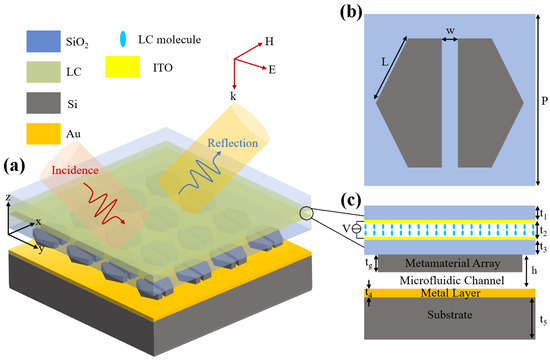
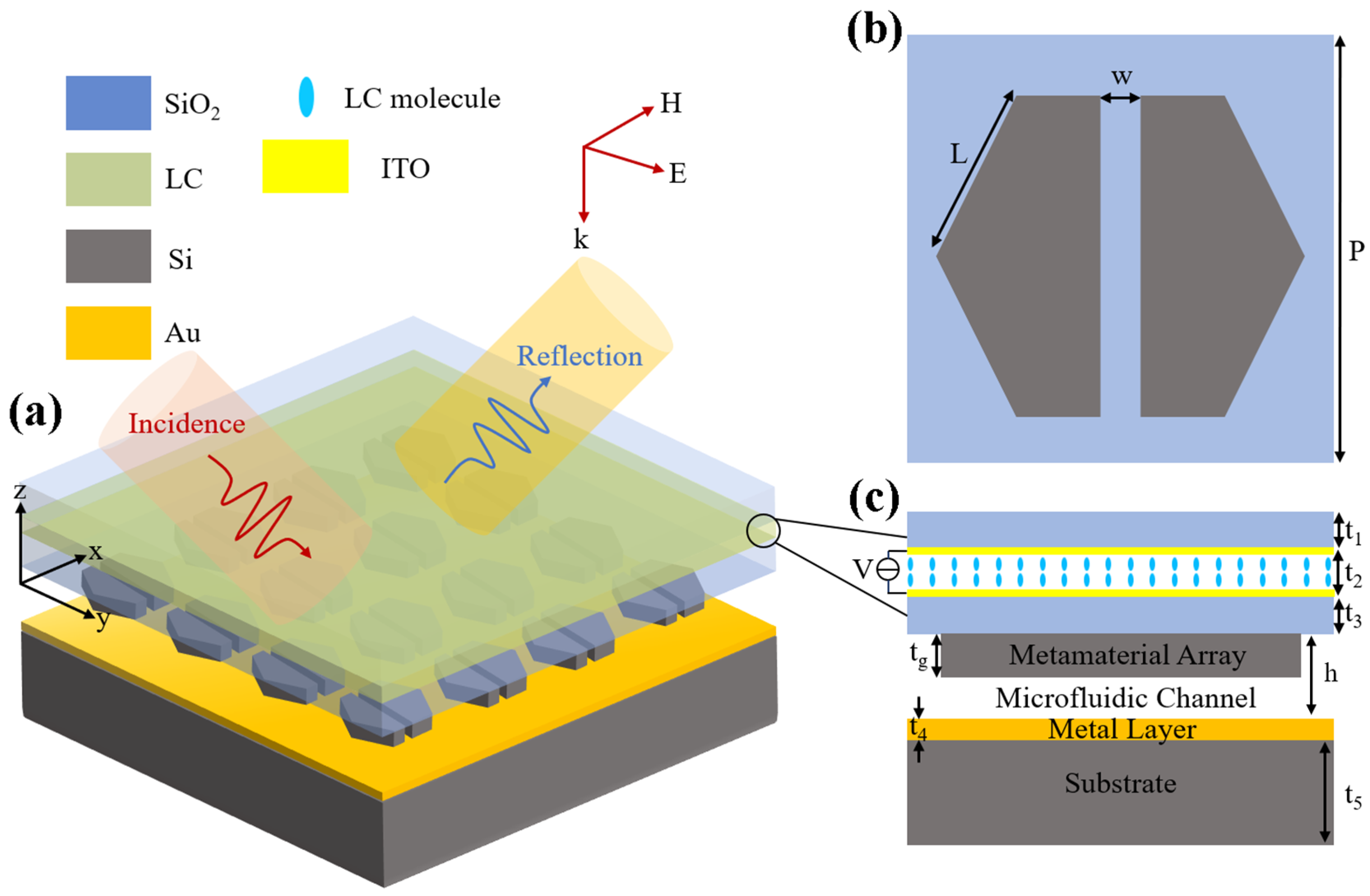
In this work, a Si-based liquid-crystal-integrated quasi-BIC terahertz metasurface sensor with electrically controlled liquid-crystal tuning is designed. The overall three-dimensional configuration of the sensor is shown in Figure 1a. Similar to conventional microfluidic metasurface sensors, the proposed device adopts a vertically stacked multilayer architecture consisting of five functional layers arranged along the z-axis from top to bottom: a composite cover layer, a Si metasurface layer, a microfluidic channel layer, a gold (Au) reflective layer, and a Si substrate. The top composite cover layer has a quartz (SiO2)–liquid crystal–SiO2 sandwich configuration, in which the liquid-crystal layer is fully enclosed between two SiO2 dielectric layers. This structure provides a stable optical cavity for electrically controlled reorientation of the liquid-crystal molecules. The incident terahertz wave propagates normally along the −z direction, sequentially passing through the composite cover layer, the Si metasurface layer, and the microfluidic channel before being fully reflected by the bottom Au layer. The electric field of the incident wave is polarized along the y-axis.
Figure 1.
(a) Three-dimensional schematic of the sensor; (b) unit-cell resonant structure of the metasurface sensor; and (c) side view of the sensor.
Figure 1b shows the unit-cell geometry of the Si metasurface and the definition of the relevant structural parameters. The metasurface consists of a periodic array of unit cells with an in-plane period of P. The core resonator in each unit cell is a regular hexagonal Si dielectric resonator with a side length of L. A strip-shaped hollow slot with a width of w = 10 μm is introduced along a fixed direction near the center of the hexagonal resonator. This asymmetric slot provides the symmetry-breaking condition required for the excitation of the quasi-BIC mode. Figure 1c presents the cross-sectional view of the device in the x–z plane and specifies the thicknesses of the functional layers. In the composite cover layer, the upper and lower SiO2 layers have thicknesses of t1 = 15 μm and t3 = 15 μm, respectively, while the intermediate liquid-crystal layer has a thickness of t2 = 20 μm. The thickness of the Si metasurface layer is tg = 20 μm, the Au reflective layer is t4 = 200 nm, the Si substrate is t5 = 200 μm thick, and the height of the microfluidic channel is h = 50 μm. Table 1 summarizes all geometrical and structural parameters of the sensor.
Table 1.
Geometric parameters and nominal values used in the numerical model of the proposed liquid-crystal-integrated quasi-BIC terahertz metasurface sensor.
The numerical simulations were performed using the electromagnetic waves on the frequency domain interface in COMSOL Multiphysics 6.2. A single metasurface unit cell was modeled to represent an infinite two-dimensional periodic array. Floquet periodic boundary conditions were imposed on the two pairs of opposite lateral boundaries in the x and y directions. Under normal incidence, the tangential components of the Floquet wave vector were set to kx = ky = 0, corresponding to zero phase shift between adjacent unit cells. A y-polarized plane wave was normally incident along the negative z direction. A perfectly matched layer (PML) was placed above the SiO2 cover layer to absorb outgoing electromagnetic waves and suppress artificial reflections from the outer boundary. The relative permittivities of SiO2 and Si were set to 3.9 and 11.9, respectively. The gold layer was described using the frequency-dependent Lorentz–Drude model for Au reported by Rakić et al. [41], as implemented in the COMSOL Multiphysics material library.
The liquid crystal was modeled as a uniaxial anisotropic dielectric medium. Its director was assumed to rotate within the x–y plane, and the angle between the liquid-crystal director and the x-axis was defined as θ. Accordingly, θ = 0°corresponds to the director being parallel to the x-axis, whereas θ = 90°corresponds to the director being parallel to the y-axis. The electrically induced liquid-crystal reorientation was represented by parametrically varying θ. Consistent with the material settings used in COMSOL, the orientation-dependent refractive index tensor was expressed as
where ne = 1.74 and no = 1.522 are the extraordinary and ordinary refractive indices of the liquid crystal, respectively [39].
3. Results and Discussions
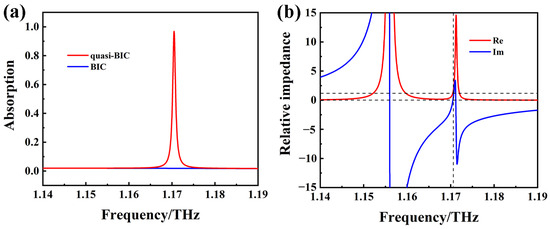
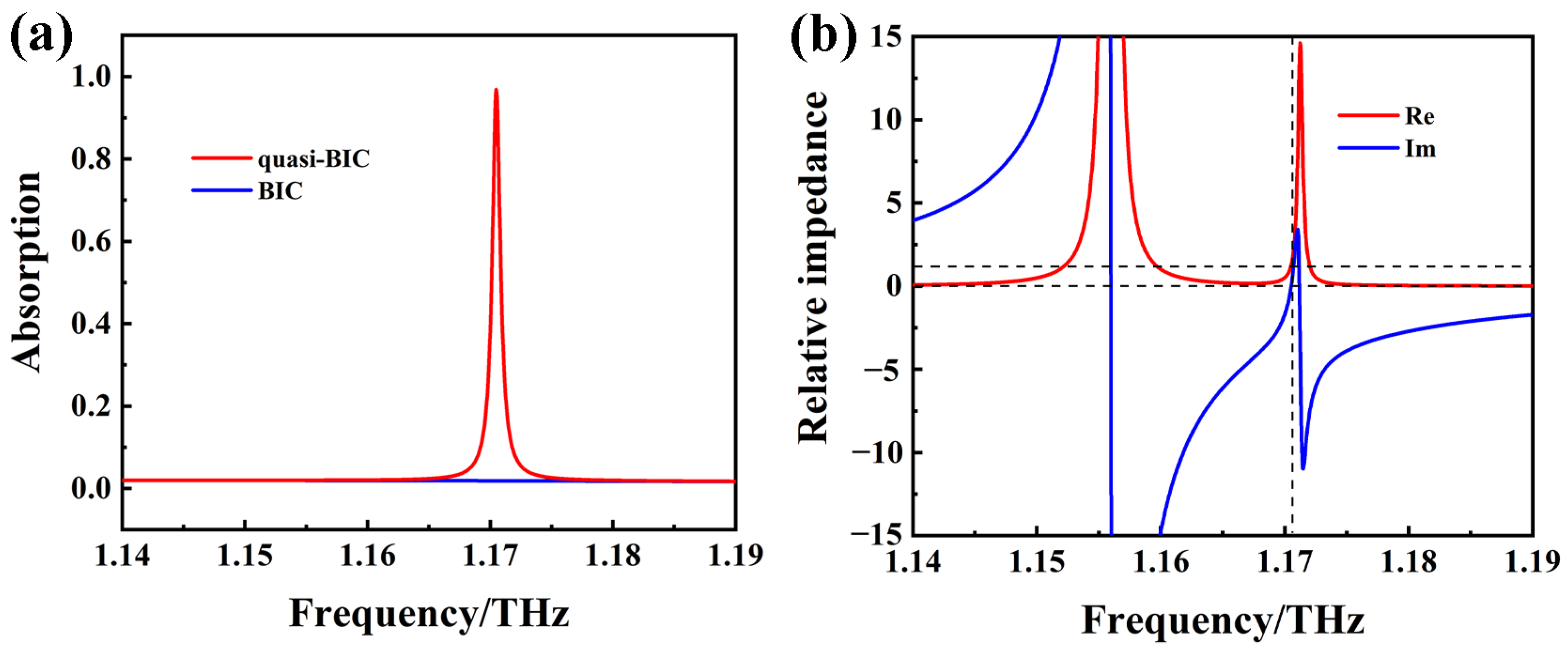
When the strip-shaped hollow slot is centered (m = 0), the in-plane symmetry is preserved, and no observable resonant absorption appears because the ideal BIC remains inaccessible from the far field. A lateral displacement of the slot breaks the structural symmetry and produces a radiatively accessible quasi-BIC, resulting in a near-unity absorption peak at 1.1705 THz, as shown in Figure 2a. At this resonance, the real and imaginary parts of the normalized effective input impedance approach 1 and 0, respectively, indicating effective impedance matching with free space and accounting for the near-perfect absorptance shown in Figure 2b [18,21,27,28,42].
Figure 2.
(a) Absorption spectra of the sensor in the BIC and quasi-BIC states; (b) simulated effective impedance of the sensor.
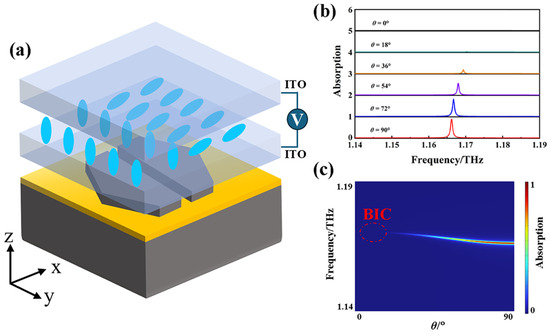
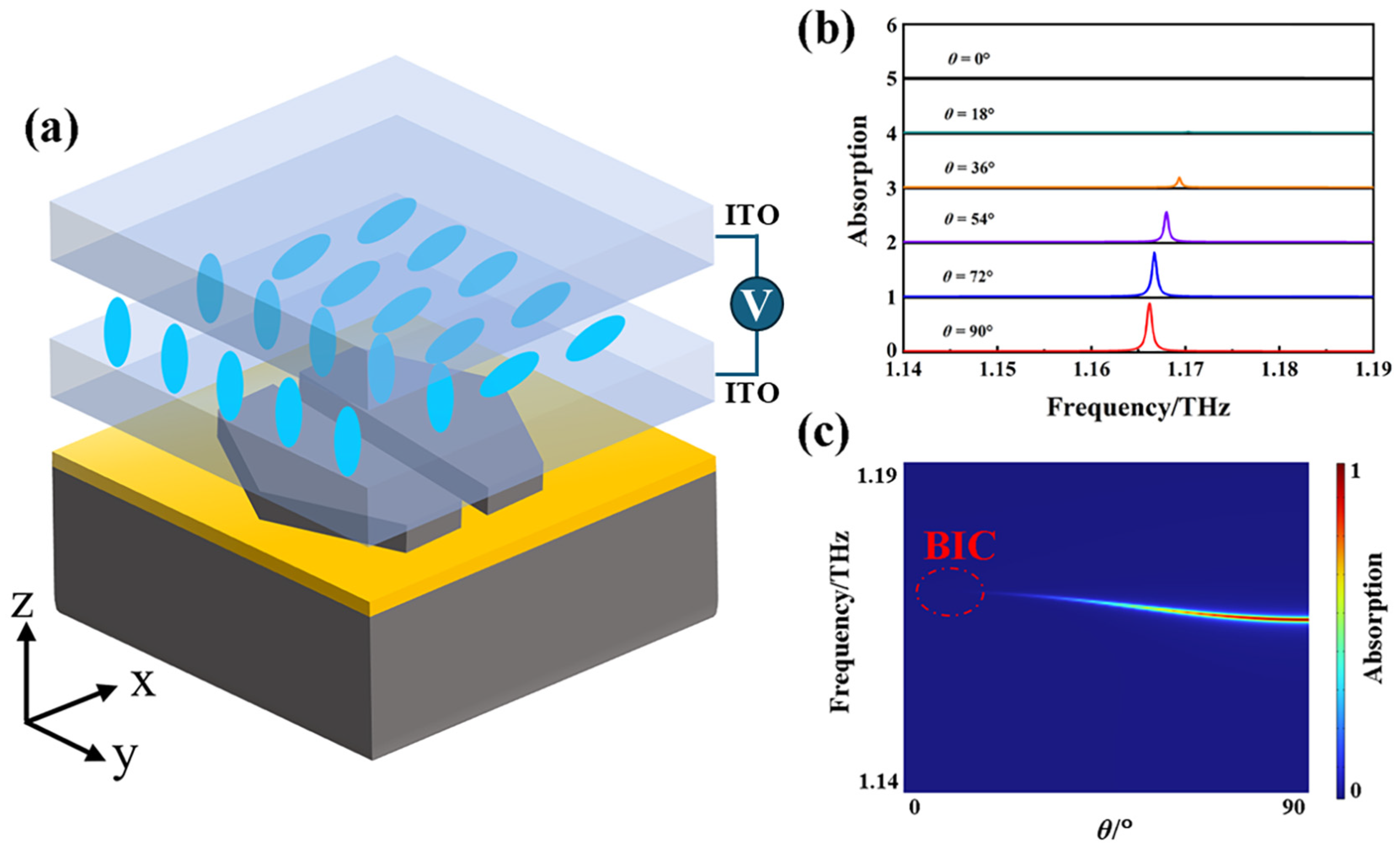
To obtain a high-Q quasi-BIC resonant absorption peak, this work proposes a dynamic symmetry-breaking strategy based on pixelated liquid-crystal orientation control, rather than relying on conventional static geometric asymmetry. Specifically, the liquid-crystal layer corresponding to a single resonant unit cell is pixelated into two subregions whose molecular orientation angles can be independently controlled. As a result, the composite cover layer within one unit cell exhibits two distinct effective refractive index distributions. This in-plane refractive index asymmetry is equivalent to breaking the intrinsic symmetry of the metasurface resonator, thereby enabling a controllable transition from an ideal BIC to a quasi-BIC mode [29,35].
Figure 3a illustrates the pixelated liquid-crystal orientation control scheme in the composite cover layer of the metasurface unit cell. In this design, the molecular orientation angle in one subregion of the liquid-crystal layer is fixed at 0°, whereas the orientation angle θ in the other subregion is used as a tunable variable. The angle θ is, therefore, defined as the asymmetry control parameter in this scheme. Figure 3b shows the evolution of the absorption spectra as the liquid-crystal orientation angle θ increases from 0° to 90°. At θ = 0°, the refractive index distribution is symmetric, and no pronounced resonance is observed. Increasing θ strengthens the in-plane refractive index asymmetry, leading to an increase in peak absorptance and a pronounced redshift of the resonance. The two-dimensional map in Figure 3c further shows that the full-width at half-maximum (FWHM) broadens with increasing θ.
Figure 3.
(a) Three-dimensional structure of the sensor based on liquid-crystal-induced refractive index asymmetry in the metasurface; (b) one-dimensional absorption spectra of the sensor under different asymmetry parameters θ; and (c) two-dimensional absorption map of the sensor as a function of the asymmetry parameter θ.
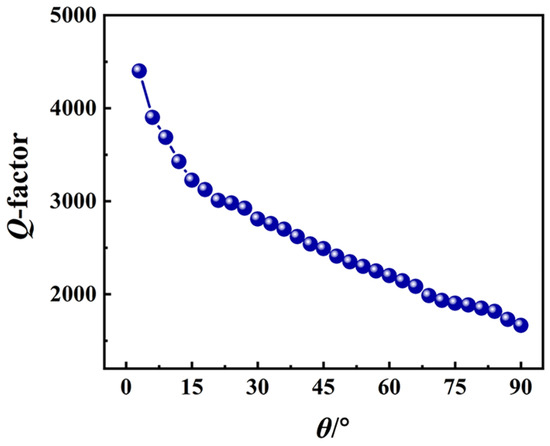
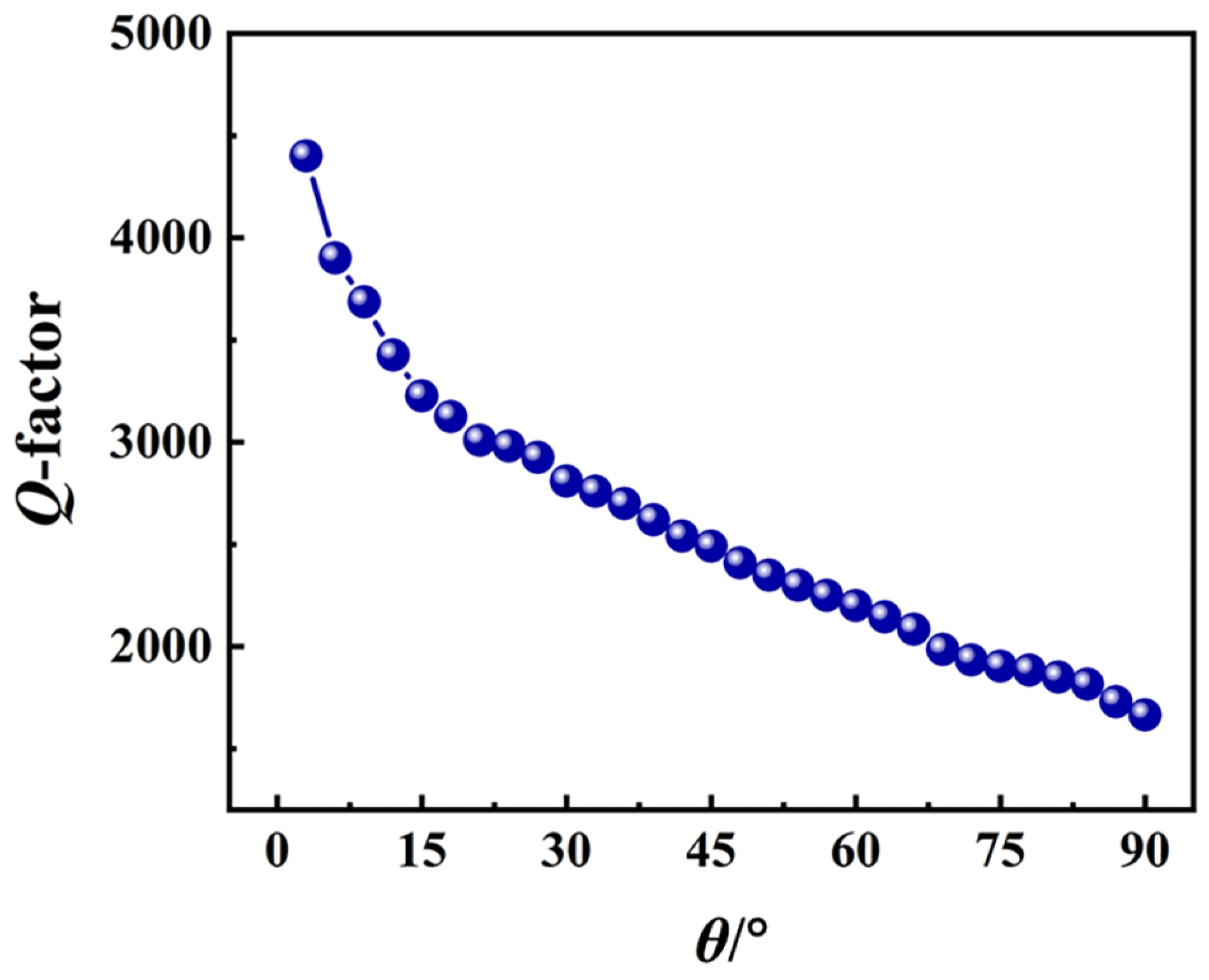
Accordingly, the Q-factor decreases monotonically, as shown in Figure 4, because the enhanced asymmetry increases radiative leakage.
Figure 4.
Dependence of the Q-factor of the quasi-BIC resonance on the liquid-crystal asymmetry parameter θ.
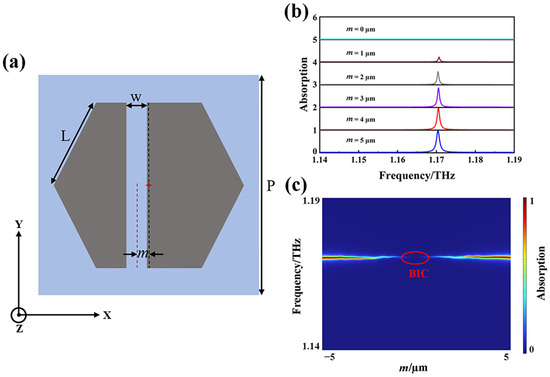
With the molecular orientation angle of the liquid crystal in the top composite cover layer fixed at 0°, geometric asymmetry is introduced by laterally shifting the strip-shaped hollow slot in the regular hexagonal resonator along the x-axis. The displacement is defined as the asymmetry parameter m, and the corresponding structural schematic is shown in Figure 5a. Figure 5b shows the absorption spectra as m varies from 0 to 5 μm. No pronounced resonance is observed at m = 0, whereas increasing m produces a progressively stronger quasi-BIC absorption peak. The two-dimensional map in Figure 5c shows that the response is symmetric with respect to m = 0; therefore, the resonance characteristics are primarily determined by the magnitude |m|. Both the peak absorptance and FWHM increase with |m|.
Figure 5.
(a) Two-dimensional structure of the resonant unit with symmetry breaking in the Si metasurface; (b) one-dimensional absorption spectra of the sensor under different asymmetry parameters m; and (c) two-dimensional absorption map of the sensor as a function of the asymmetry parameter m.
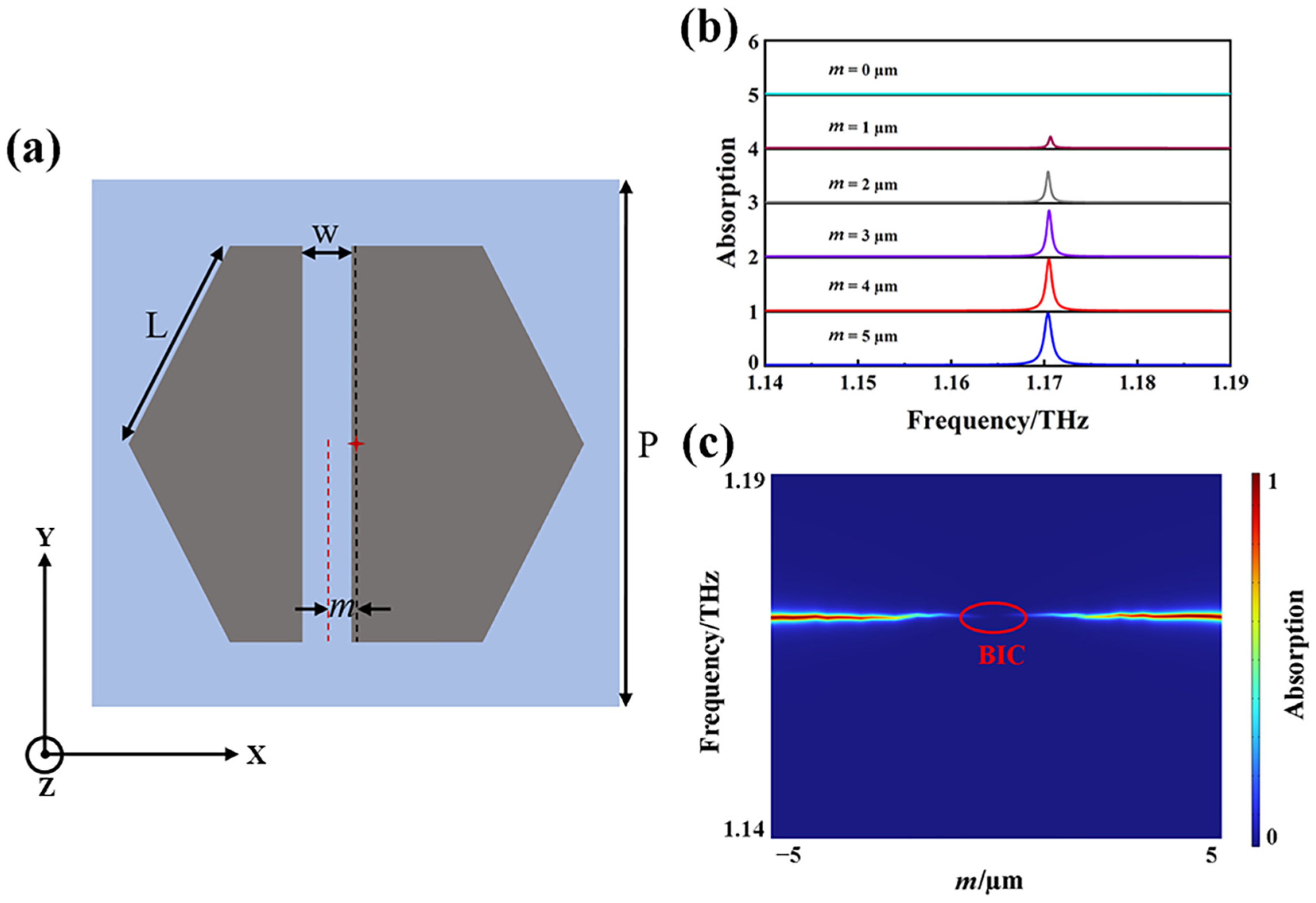
The dependence of the resonance characteristics on |m| is summarized in Figure 6. As shown in Figure 6a, the Q-factor decreases symmetrically with increasing |m|, whereas the resonance frequency changes only slightly from approximately 1.1707 to 1.1703 THz, as shown in Figure 6b. In contrast, the FWHM increases substantially with |m|, as shown in Figure 6c, indicating that the reduction in the Q-factor mainly originates from linewidth broadening rather than the small frequency shift. Figure 6d further shows that the peak absorptance increases with |m|. These results reveal a trade-off between external coupling and spectral confinement: stronger asymmetry enhances resonant excitation but simultaneously increases radiative loss and broadens the resonance.
Figure 6.
Dependence of the quasi-BIC resonance characteristics on the geometric asymmetry parameter m. (a) Q-factor as a function of m; (b) resonance frequency, (c) FWHM, and (d) peak absorptance as functions of |m|.
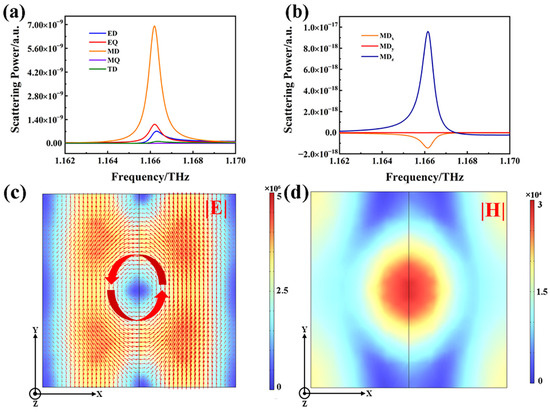
To clarify the physical origins and resonance mechanisms of the two quasi-BIC resonant absorption peaks, systematic multipole scattering decomposition was performed for the two resonant modes in a Cartesian coordinate system. The contributions of different multipolar components to the far-field scattering power were quantitatively evaluated. For the quasi-BIC resonant absorption peak excited by the in-plane refractive index asymmetry introduced through pixelated liquid-crystal orientation control, the corresponding multipole decomposition results are shown in Figure 7a. The quantitative analysis indicates that the MD makes the dominant contribution to the far-field scattering power of this resonant mode. The MD component was further decomposed along the x-, y-, and z-axes, as shown in Figure 7b. The results reveal that the effective MD component is mainly oriented along the z-axis.
Figure 7.
Multipole analysis and electromagnetic field distributions of the quasi-BIC mode induced by liquid-crystal refractive index asymmetry. (a) Multipole decomposition of the scattering power of the quasi-BIC mode under refractive index symmetry breaking in the liquid-crystal-integrated metasurface; (b) scattering contributions of the MD components along the x-, y-, and z-directions; (c) electric-field distribution in the x–y plane of the liquid-crystal layer; and (d) magnetic-field distribution in the x–y plane of the liquid-crystal layer.
To further support the quantitative results of the multipole decomposition and verify the physical nature of the resonant mode on the liquid-crystal metasurface, the electromagnetic field distributions in the liquid-crystal layer were simulated, as shown in Figure 7c,d. Figure 7c presents the electric-field distribution in the x–y plane of the liquid-crystal layer, where the red arrows indicate the spatial orientation of the displacement current vectors. A counterclockwise closed displacement current loop can be clearly observed at the interface between the two liquid-crystal subregions with asymmetric refractive index distributions within the unit cell. According to classical electromagnetic theory, such a circulating displacement current induces a magnetic dipole with its magnetic moment oriented along the z-axis, which agrees well with the multipole decomposition results. Figure 7d shows the magnetic field magnitude distribution in the x–y plane of the liquid-crystal layer, directly revealing the characteristic field profile of a magnetic dipole within the metasurface resonator. These results further confirm that the quasi-BIC mode is predominantly excited by a z-oriented magnetic dipole.
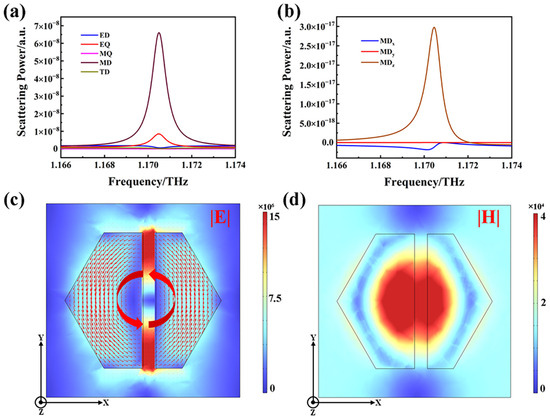
For the second configuration, symmetry is maintained through the in-plane displacement m of the strip-shaped hollow slot in the Si resonator, while keeping the liquid-crystal molecular orientation angle uniform. The corresponding multipole scattering decomposition results are shown in Figure 8a. The quantitative analysis shows that the MD makes the dominant contribution to the far-field scattering power of this resonant mode, indicating a resonance origin consistent with that of the quasi-BIC mode induced by pixelated liquid-crystal orientation control. The magnetic dipole moment of this resonance was further decomposed into its x-, y-, and z-directional components, as shown in Figure 8b. The results clearly show that the effective contribution of the magnetic dipole moment is also mainly oriented along the z-axis.
Figure 8.
Multipole decomposition and field distributions of the quasi-BIC mode induced by structural symmetry breaking on the Si metasurface. (a) Multipole decomposition of the scattering power of the quasi-BIC mode; (b) scattering contributions of the MD components along the x-, y-, and z-directions; (c) electric field distribution on the x–y plane of the sensor; and (d) magnetic field distribution on the x–y plane of the sensor.
To further support the multipole decomposition results and verify the physical nature of the resonant mode on the Si-based metasurface, the electromagnetic field distributions within the resonant unit were analyzed. Figure 8c shows the electric field distribution in the x–y plane of the Si metasurface, where the red arrows indicate the spatial orientation of the displacement current vectors. Similar to the resonance mechanism induced by liquid-crystal refractive index asymmetry, when the in-plane symmetry of the Si metasurface unit is broken by tuning the asymmetry parameter m, a counterclockwise closed displacement current loop is formed in the central region of the resonant unit. According to classical electromagnetic theory, such a circulating displacement current induces a magnetic dipole with its magnetic moment oriented along the z-axis, which agrees well with the multipole decomposition results. Figure 8d presents the magnetic field magnitude distribution in the x–y plane of the Si metasurface, revealing the characteristic field profile of a magnetic dipole within the resonant unit. These results confirm that the quasi-BIC mode is predominantly excited by a z-oriented magnetic dipole.
To clarify the parameter-dependent modulation behavior of the quasi-BIC resonance and provide guidance for device optimization, three representative geometric parameters were considered according to their distinct physical roles. The displacement parameter m directly determines the degree of in-plane symmetry breaking and, therefore, governs the transition from an ideal BIC to a quasi-BIC, as well as the associated radiative leakage, resonance linewidth, and Q-factor. Its influence is systematically analyzed in Figure 5 and Figure 6. Based on the trade-off between strong resonant absorption and a relatively high Q-factor, m = 4 μm was selected for the subsequent parametric analysis.
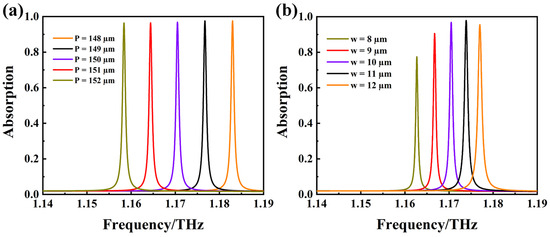
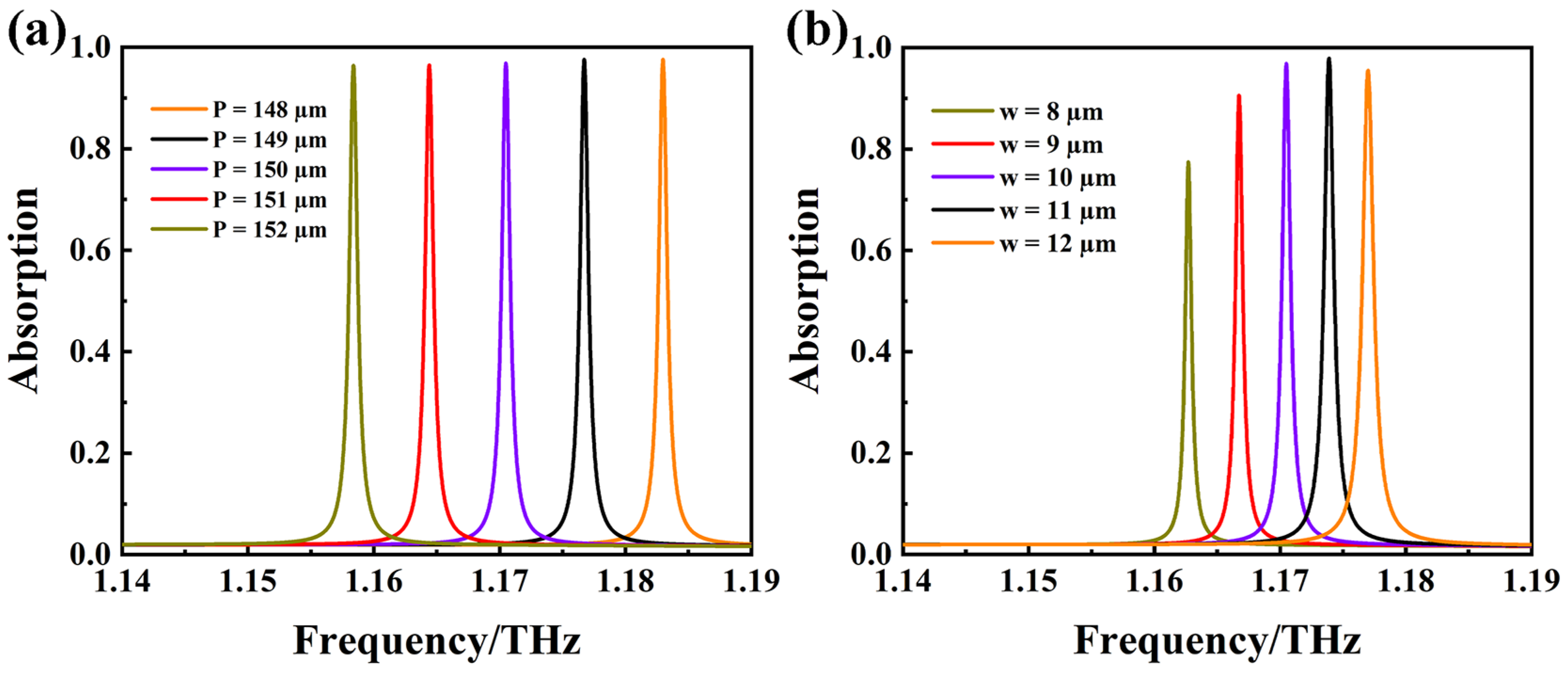
With m fixed, the unit-cell period P and hollow-slot width w were selected as representative parameters for further spectral optimization because they regulate different aspects of the resonant response. The period P determines the effective in-plane resonant scale and lattice coupling of the periodic array and, therefore, provides an efficient means of tuning the operating frequency without altering the symmetry-breaking mechanism. In contrast, the slot width w directly modifies the local resonant geometry, electromagnetic coupling, and penetration of the enhanced near field into the microfluidic channel. Consequently, w affects both the spectral position and peak absorptance of the quasi-BIC resonance and is closely related to the field–analyte interaction. All other structural parameters, including the layer thicknesses, were held constant to isolate the individual effects of P and w. The corresponding resonant absorption characteristics are shown in Figure 9.
Figure 9.
Absorption spectra of the sensor under different structural parameters: (a) unit-cell period P of the sensor and (b) hollow-slot width w.
Figure 9a presents the influence of the in-plane unit-cell period P on the resonant absorption characteristics while the other structural parameters remain unchanged. As P increases, the quasi-BIC absorption peak undergoes a pronounced redshift, whereas the peak absorptance and FWHM remain nearly unchanged. Within the investigated parameter range, increasing P enlarges the effective in-plane resonant scale and optical path of the periodic unit, thereby shifting the resonance toward a longer wavelength and, consequently, a lower frequency. The nearly unchanged peak absorptance and linewidth indicate that variation in P primarily controls the spectral position of the resonance without significantly altering its coupling strength or radiative loss.
Figure 9b shows the effect of the strip-shaped hollow-slot width w on the resonant absorption characteristics. With an increasing w, the resonance frequency exhibits a pronounced blueshift, although the rate of frequency shift gradually decreases at larger values of w. Meanwhile, the peak absorptance increases monotonically. Increasing the slot width changes the effective resonant geometry and dielectric loading of the Si resonator and facilitates greater penetration of the resonant near field through the hollow region into the adjacent microfluidic channel. This modification strengthens the electromagnetic interaction between the resonant mode and the medium inside the channel and alters the coupling and dissipation conditions of the quasi-BIC mode, thereby producing both the observed frequency shift and the increase in peak absorptance.
The modulation trends induced by P and w are consistent with the characteristics of the z-oriented magnetic-dipole-dominated resonance identified by the multipole and field distribution analyses. These results demonstrate that the unit-cell period and hollow-slot width provide complementary degrees of freedom for controlling the spectral position, resonant coupling, and field–analyte interaction of the quasi-BIC mode, thereby offering sufficient design flexibility for tailoring the sensor to different operating frequency ranges and sensing requirements.
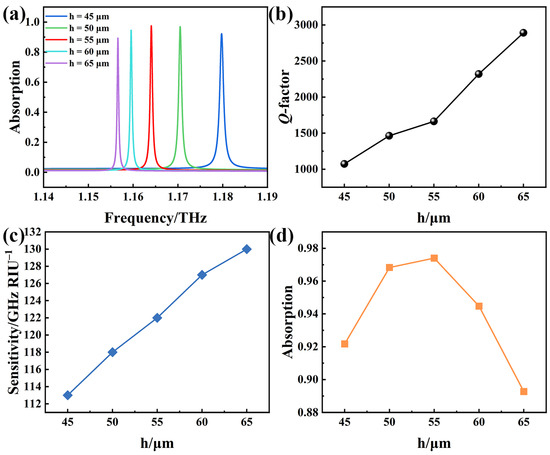
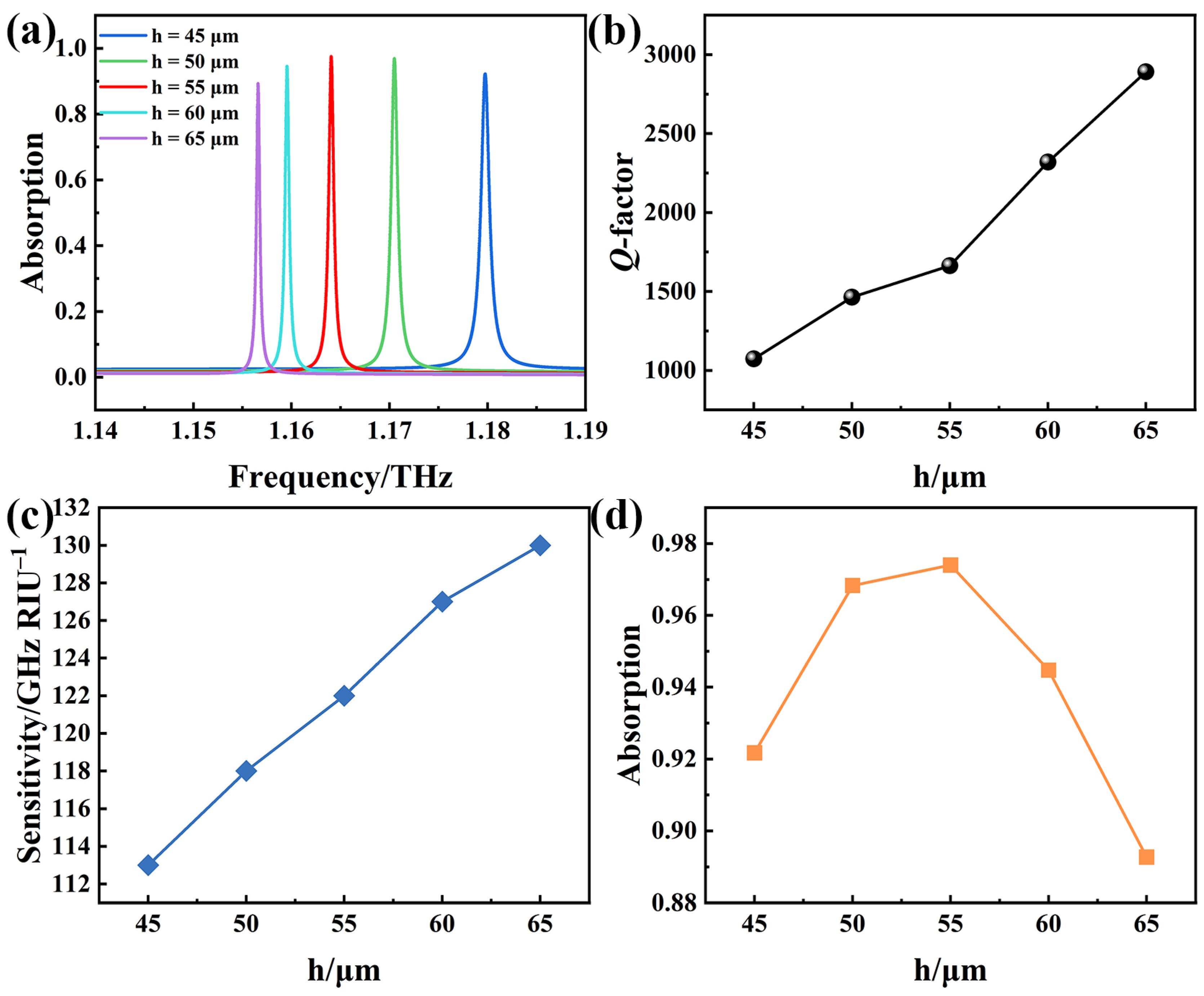
To clarify the design basis for the microfluidic channel height, the effect of h on the resonance characteristics and sensing performance was systematically investigated, as shown in Figure 10. In this work, the analyte is considered to be a liquid-phase VOC sample introduced directly into the microfluidic channel. Gas-phase VOCs and VOCs dissolved in an aqueous solution are not considered in the present numerical model. Figure 10a presents the absorption spectra obtained as the channel height h is varied from 45 to 65 μm. With increasing h, the quasi-BIC resonance exhibits a continuous redshift. This behavior arises because a thicker analyte layer increases the effective optical path length and the fraction of the resonant field interacting with the liquid medium, thereby increasing the effective modal refractive index and shifting the resonance toward lower frequencies. As shown in Figure 10b, the Q-factor increases monotonically with the channel height, from approximately 1100 at h = 45 μm to approximately 2900 at h = 65 μm. This increase indicates a progressive narrowing of the resonant linewidth as the channel height modifies the coupling and phase accumulation within the multilayer resonant cavity. Figure 10c shows that the refractive index sensitivity also increases from approximately 113 to 130 GHz RIU−1, which can be attributed to the enhanced spatial overlap between the quasi-BIC near field and the analyte as the liquid layer becomes thicker. In contrast, the peak absorptance exhibits a nonmonotonic dependence on h, as shown in Figure 10d. It initially increases from approximately 0.92 at h = 45 μm to a maximum of approximately 0.97 at h = 55 μm and subsequently decreases as h is further increased. This trend suggests that the impedance-matching condition between the metasurface and free space is closest to optimum near h = 55 μm, whereas an excessively thick channel detunes the resonant cavity and weakens the absorption amplitude. Although h = 55 μm provides a slightly higher peak absorptance, h = 50 μm was retained as the nominal channel height because it already provides near-unity absorption, a high Q-factor, and a sensitivity of approximately 118 GHz RIU−1, while reducing the required liquid volume and limiting the propagation distance and additional background absorption of lossy liquid samples. Therefore, h = 50 μm represents a practical compromise among resonant absorption, sensing performance, sample consumption, and liquid loss considerations rather than the absolute numerical optimum.
Figure 10.
Effect of the microfluidic channel height h on the resonance and sensing performance of the proposed metasurface sensor. (a) Absorption spectra at different channel heights; (b) Q-factor, (c) refractive index sensitivity, and (d) peak absorptance as functions of h.
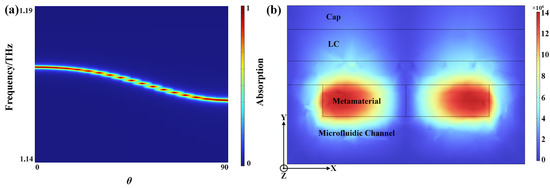
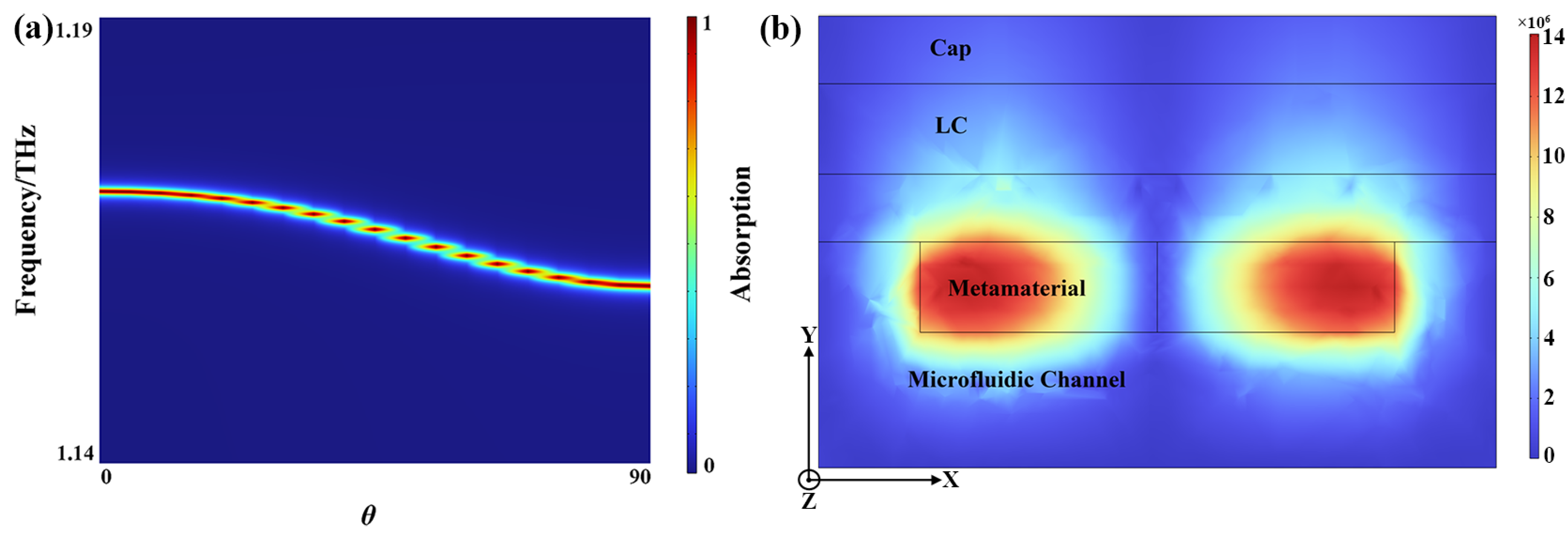
The modulation of the quasi-BIC resonant absorption characteristics of the Si-based metasurface by the liquid-crystal molecular orientation angle in the top composite cover layer is shown in Figure 11a. The spectral evolution indicates that, as the liquid-crystal orientation angle increases continuously from 0° to 90°, the center frequency of the quasi-BIC resonant absorption peak undergoes a pronounced and continuous redshift. Over the entire tuning range, both the peak absorptance and FWHM remain nearly unchanged, confirming the low loss and highly stable nature of this electrically controlled liquid-crystal-tuning scheme. This enables high-quality dynamic tuning of the quasi-BIC resonance without degrading the resonant mode.
Figure 11.
Liquid-crystal-tuning characteristics and cross-sectional field distribution of the proposed metasurface sensor. (a) Two-dimensional absorption map as a function of the liquid-crystal molecular orientation angle θ; (b) cross-sectional electric field magnitude distribution at the quasi-BIC resonance, showing the spatial overlap of the enhanced field with the liquid-crystal layer and microfluidic channel.
Further analysis shows that the frequency shift of the resonant peak is not linearly dependent on the liquid-crystal orientation angle. This nonlinear tuning behavior originates from the intrinsic optical anisotropy of liquid crystals. As typical uniaxial anisotropic media, liquid crystals exhibit a dielectric tensor that rotates with the molecular orientation angle. Consequently, the effective refractive index along the polarization direction of the incident wave follows a cosine-squared angular dependence rather than a linear relationship. This angular dependence ultimately leads to the nonlinear evolution of the resonance frequency with the orientation angle. The same physical mechanism also explains the nonlinear frequency shift observed in the pixelated liquid-crystal orientation control scheme, thereby providing a unified interpretation of the liquid-crystal-tuning behavior throughout this work.
To further clarify the interaction between the resonant field and the analyte in the microfluidic channel, Figure 11b presents the cross-sectional electric field magnitude distribution at the quasi-BIC resonance. The electric field is predominantly confined within and around the Si resonators, with pronounced enhancement near the resonator edges and interfaces. A non-negligible portion of the enhanced near field penetrates into the adjacent microfluidic channel, producing direct spatial overlap between the resonant field and the liquid analyte. Meanwhile, the field extending into the liquid-crystal layer enables effective modulation of the resonant mode through electrically controlled liquid-crystal reorientation. Changes in the complex refractive index of the liquid analyte perturb the electromagnetic energy stored in the field overlap region, thereby producing measurable variations in the resonance frequency and absorption amplitude. This cross-sectional field distribution confirms that the sensing response arises from the combined high-Q field confinement of the quasi-BIC mode and the enhanced interaction between the evanescent field and the analyte.
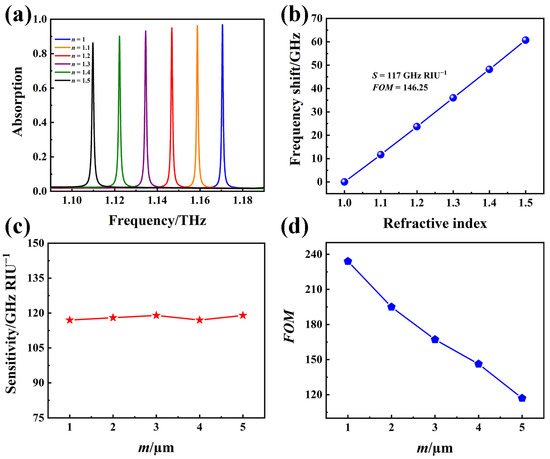
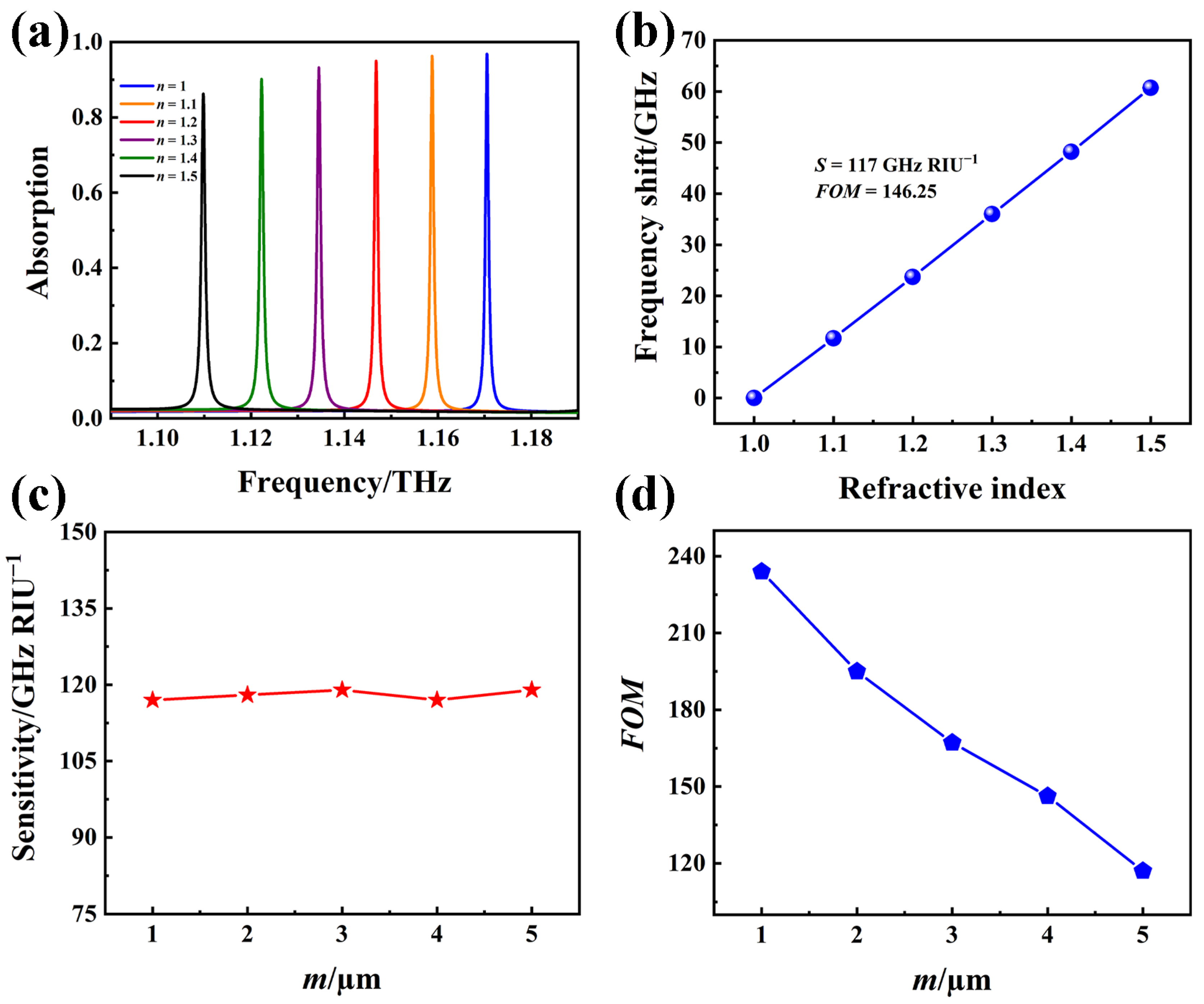
To systematically evaluate the refractive index sensing performance of the electrically tunable liquid-crystal-assisted quasi-BIC Si metasurface sensor, the refractive index environment of the analyte in the microfluidic channel was varied, and the sensitivity and FOM of the device were quantitatively analyzed. Figure 12a shows the evolution of the absorption spectra of the tunable metasurface sensor when the liquid-crystal molecular orientation angle is fixed at 0°, and the geometric asymmetry parameter of the metasurface resonator is set to m = 4 μm. As the refractive index n of the analyte in the microfluidic channel increases from 1.0 to 1.5, the quasi-BIC resonant absorption peak exhibits a continuous redshift, with the resonance frequency shifting from 1.17 to 1.11 THz. Meanwhile, the peak absorptance decreases monotonically from 98% to 88%.
Figure 12.
Refractive-index-sensing performance of the sensor. (a) Absorption spectra of the sensor in different refractive index environments in the microfluidic channel; (b) relationship between the resonance frequency shift and the refractive index; (c) relationship between the asymmetry parameter m and the sensing sensitivity; and (d) relationship between the asymmetry parameter m and the FOM.
Figure 12b presents the resonance frequencies corresponding to different analyte refractive indices in the microfluidic channel. The resonance frequency shows a pronounced redshift with an increasing analyte refractive index, and the two parameters exhibit a strong linear correlation. Based on this linear relationship, the refractive index of the analyte in the microfluidic channel can be accurately retrieved from the resonance frequency shift, providing a theoretical basis for high-sensitivity refractive index sensing. Linear fitting gives a refractive index sensitivity of 117 GHz RIU−1 and a corresponding FOM of 146.25 for the proposed metasurface sensor. In addition, the monotonic variation in the peak absorptance with the analyte refractive index provides an additional sensing dimension for intensity-based refractive index detection.
Figure 12c shows the dependence of the sensing sensitivity on the geometric asymmetry parameter m. Over the entire tuning range of m, the refractive index sensitivity remains nearly unchanged and is stably maintained around 117 GHz RIU−1. Figure 12d presents the relationship between m and the FOM of the resonant absorption peak. The results show that the FOM decreases monotonically as m increases. This behavior arises because changing m has no significant effect on the sensing sensitivity, whereas the FWHM of the resonant absorption peak broadens monotonically with increasing m, as shown in Figure 5. According to the definition FOM = S/FWHM, when the sensitivity remains nearly constant, the broadening of the FWHM directly leads to a decrease in the FOM, which agrees well with the simulated results. Notably, the investigated refractive index range of n = 1.0–1.5 overlaps with the real refractive index range reported for representative liquid VOCs, including benzene, toluene, and p-xylene, in the terahertz regime [8]. This overlap indicates that the proposed sensor operates within a dielectric range relevant to common VOC liquids and supports its potential application in VOC-related refractive index sensing.
In addition to the sensitivity and FOM, the linewidth-limited frequency resolution and refractive index resolution were evaluated using the resonance parameters. According to FOM = S/FWHM, the sensitivity of 117 GHz RIU−1 and the FOM of 146.25 RIU−1 correspond to a resonance linewidth of approximately 0.80 GHz. At a resonance frequency of approximately 1.1705 THz, the FWHM is approximately 0.80 GHz, and the corresponding Q-factor is approximately 1.46 × 10³.
Using one resonance linewidth as a conservative frequency resolution criterion, the linewidth-limited refractive index resolution can be estimated as
yielding approximately 6.84 × 10⁻³ RIU. This value represents a conservative theoretical resolution derived from the simulated resonance linewidth rather than an experimentally determined limit of detection. The practical detection limit would additionally depend on the instrumental frequency resolution, spectral noise, frequency stability, peak-fitting uncertainty, and measurement repeatability of the terahertz system.
To systematically evaluate the performance level of the proposed device, representative quasi-BIC, actively tunable, liquid-crystal-integrated, and microfluidic terahertz sensors were compared. Because the comparison involves both quantitative sensing metrics and qualitative device characteristics, the results are presented in two complementary tables. Table 2 summarizes the operating frequency, sensitivity, Q-factor, FWHM, FOM, and liquid compatibility, whereas Table 3 compares the structure type, detection target, tunability, and experimental validation.
Table 2.
Comparison of the operating frequency and sensing performance of the proposed sensor with representative terahertz sensors reported in the literature.
Table 3.
Comparison of the structural configuration, detection target, tunability, and experimental validation of representative terahertz sensors.
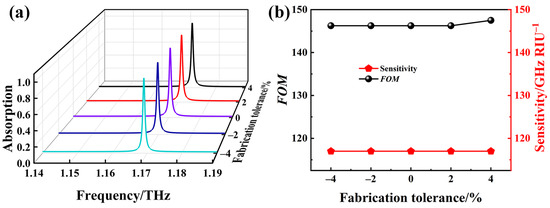
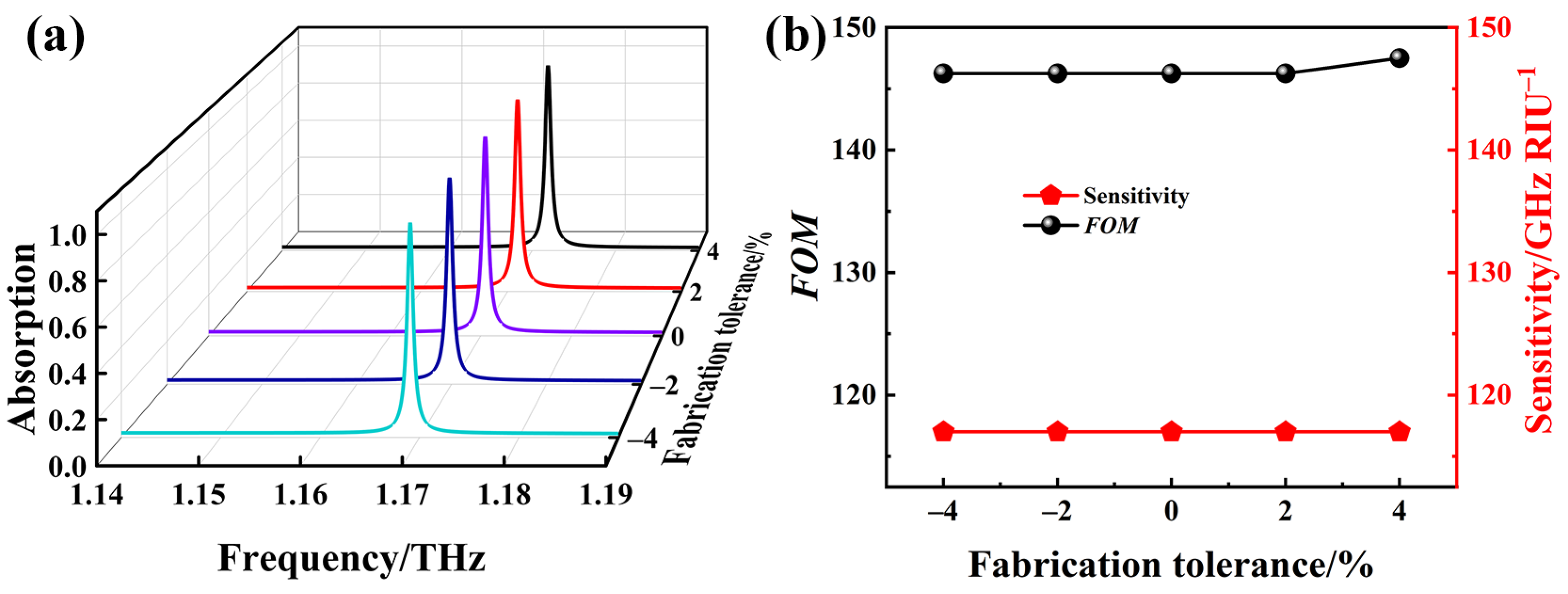
To evaluate the robustness of the proposed metasurface sensor against fabrication deviations in the strip-shaped hollow-slot width, a relative tolerance η was introduced into the nominal width w0. The perturbed slot width was defined as wη = w0(1 + η), where w0 = 10 μm and η was varied from −4% to 4%. As shown in Figure 13a, the absorption spectra obtained under different fabrication tolerances nearly overlap. No appreciable resonance frequency shift is observed, and the quasi-BIC absorption peak remains narrow and well defined over the entire tolerance range. This result indicates that small variations in the hollow-slot width have only a limited influence on the effective resonance condition and electromagnetic field confinement of the metasurface. Figure 13b further presents the refractive-index sensitivity and FOM under different fabrication tolerances. The sensitivity remains nearly constant at approximately 117 GHz RIU−1, while the FOM varies only slightly from approximately 146 to 148. The small variation in FOM is mainly associated with minor changes in the resonance linewidth rather than a change in the sensing slope. These results demonstrate that fabrication deviations of up to ±4% in the hollow-slot width do not significantly affect the resonance frequency or sensing performance, confirming the good fabrication tolerance and robustness of the proposed metasurface sensor.
Figure 13.
Fabrication tolerance analysis with respect to the strip-shaped hollow-slot width w. (a) Absorption spectra under relative deviations in w ranging from −4% to 4%; (b) corresponding refractive index sensitivity and FOM under different fabrication tolerances.
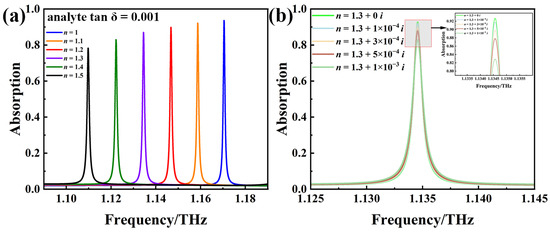
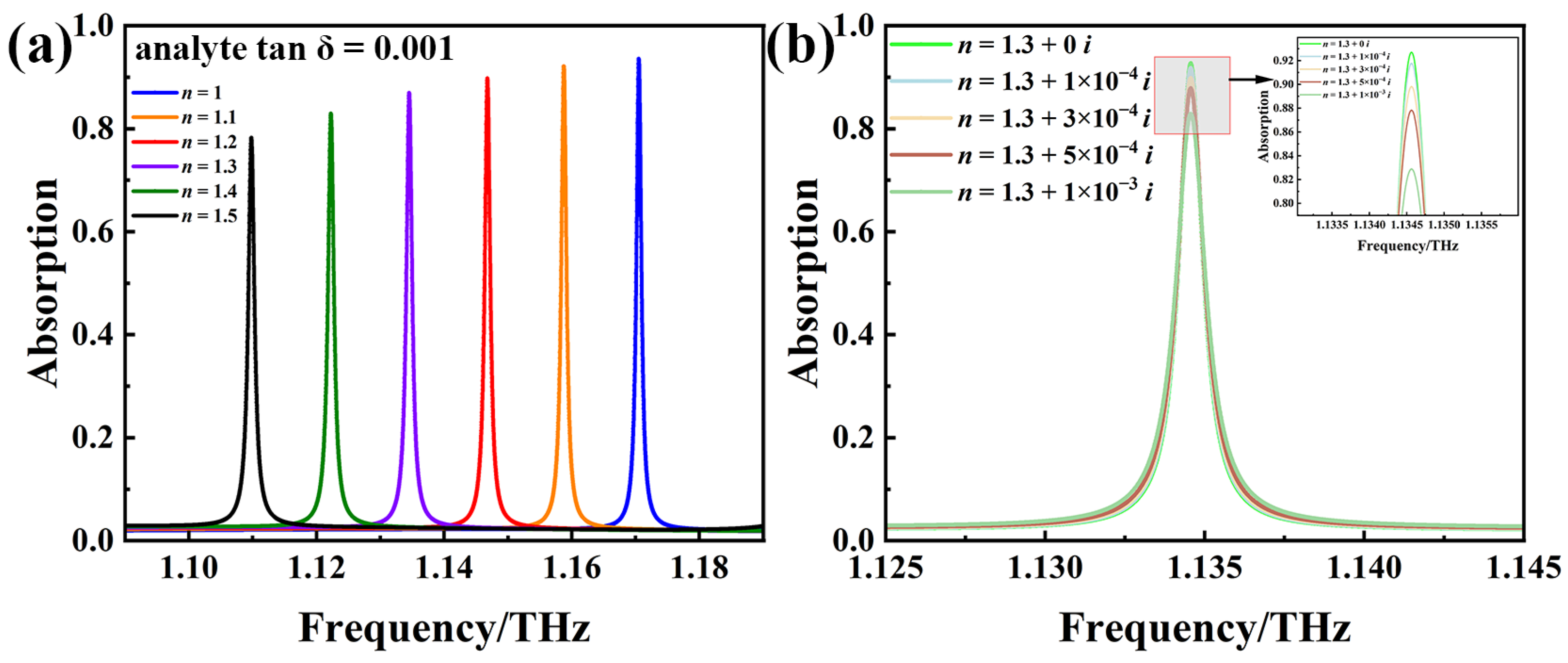
The preceding refractive-index-sensing analysis considered an idealized lossless analyte. However, liquid-phase analytes generally exhibit both refractive dispersion and absorption loss in the terahertz regime. To evaluate the influence of analyte loss on the sensing response, the analyte was further modeled using a complex refractive index, , where n0 is the real refractive index, and κ is the extinction coefficient. Figure 14a shows the simulated absorption spectra as the real part of the analyte refractive index increases from 1.0 to 1.5, while the dielectric loss tangent is fixed at tan δ = 0.001. The quasi-BIC resonance maintains a continuous redshift over the entire refractive-index range, and the resonant peaks remain clearly distinguishable after the absorption loss is introduced. This result confirms that the frequency-shift-based sensing mechanism remains effective for weakly lossy liquid analytes. To independently examine the effect of the extinction coefficient, the real part of the refractive index was fixed at n0 = 1.3, while κ was varied from 0 to 1 × 10⁻³, as shown in Figure 14b. The resonance frequency remains nearly unchanged with increasing κ, whereas the peak absorptance exhibits a slight decrease. No appreciable variation in the resonance linewidth is observed within the investigated weak loss range. These results indicate that the real part of the complex refractive index predominantly determines the resonance frequency shift, whereas the extinction coefficient mainly affects the resonant absorption amplitude under the present conditions.
Figure 14.
Influence of analyte absorption loss on the sensing response. (a) Absorption spectra for different real refractive indices at a fixed dielectric loss tangent of tan δ = 0.001; (b) absorption spectra at n0 = 1.3 for different extinction coefficients κ; the inset shows an enlarged view of the resonance peaks.
Therefore, analytes with similar real refractive indices but different absorption losses may, in principle, be differentiated by jointly considering the resonance frequency and peak absorptance. Nevertheless, the relatively small amplitude differences observed in the present loss range indicate that reliable identification of specific VOCs would require their experimentally measured frequency-dependent complex refractive indices and an adequate experimental signal-to-noise ratio.
4. Conclusions
In this work, two alternative configurations of liquid-crystal-integrated quasi-BIC terahertz metasurfaces were investigated. In the first configuration, the quasi-BIC resonance was excited through pixelated liquid-crystal-induced refractive index asymmetry. In the second configuration, the quasi-BIC was generated by geometric symmetry breaking of the Si resonator, while liquid-crystal reorientation provided continuous electrical tuning of the resonance frequency. Both configurations support high-Q resonances dominated by z-oriented magnetic dipole modes. The sensing performance was evaluated using the optimized Si-resonator-based configuration, which achieved a refractive index sensitivity of 117 GHz RIU−1 and an FOM of 146.25. These results demonstrate the design flexibility of liquid-crystal-integrated quasi-BIC metasurfaces and provide a feasible route toward electrically tunable terahertz microfluidic sensing.
Author Contributions
Conceptualization, B.Z., C.D. and B.W.; methodology, B.W. and Q.L.; software, B.W. and C.D.; validation, B.Z., C.D. and Q.L.; formal analysis, B.W. and Q.L.; investigation, B.Z. and C.D.; resources, B.Z. and C.D.; data curation, B.W. and Q.L.; writing—original draft preparation, B.W.; writing—review and editing, B.Z., Q.L. and C.D.; visualization, B.W. and B.Z.; supervision, B.Z. and Q.L.; project administration, B.Z., C.D. and Q.L.; funding acquisition, B.Z. and Q.L. All authors have read and agreed to the published version of the manuscript.
Funding
This work was supported by the Yangtze River Delta Innovation and Entrepreneurship Joint Carrier Demonstration Project (23002430100), the Fundamental Research Funds for the Central Universities (JUSRP202501031, JUSRP202601019), the Wuxi Science and Technology Development Fund Project (K20241036), the National Natural Science Foundation of China (61903159), and the Natural Science Foundation of Jiangsu Province (BK20190617).
Data Availability Statement
The data that support the findings of this study are available from the first author or corresponding authors upon reasonable request.
Conflicts of Interest
The authors declare no conflicts of interest.
References
- Siegel, P.H. Terahertz technology in biology and medicine. IEEE Trans. Microw. Theory Tech. 2004, 52, 2438–2447. [Google Scholar] [CrossRef] [Scilit]
- Yang, X.; Zhao, X.; Yang, K.; Liu, Y.; Liu, Y.; Fu, W.; Luo, Y. Biomedical applications of terahertz spectroscopy and imaging. Trends Biotechnol. 2016, 34, 810–824. [Google Scholar] [CrossRef] [Scilit] [PubMed]
- Fu, X.; Liu, Y.; Chen, Q.; Fu, Y.; Cui, T.J. Applications of terahertz spectroscopy in the detection and recognition of substances. Front. Phys. 2022, 10, 869537. [Google Scholar] [CrossRef] [Scilit]
- Wang, W.; Sun, K.; Xue, Y.; Lin, J.; Fang, J.; Shi, S.; Zhang, S.; Shi, Y. A review of terahertz metamaterial sensors and their applications. Opt. Commun. 2024, 556, 130266. [Google Scholar] [CrossRef] [Scilit]
- Cao, L.; Jia, S.; Meng, F.; Richter, M.; Loth, Y.; Wigger, A.K.; Yang, C.; Zhang, L.; Bolívar, P.H.; Roskos, H.G. Terahertz metamaterial sensors: Design theory, optimization approach, and advancements in biosensing applications. Adv. Mater. Technol. 2025, 10, 2401358. [Google Scholar]
- Galstyan, V.; D’Arco, A.; Di Fabrizio, M.; Poli, N.; Lupi, S.; Comini, E. Detection of volatile organic compounds: From chemical gas sensors to terahertz spectroscopy. Rev. Anal. Chem. 2021, 40, 33–57. [Google Scholar] [CrossRef] [Scilit]
- Moura, P.C.; Raposo, M.; Vassilenko, V. Breath volatile organic compounds (VOCs) as biomarkers for the diagnosis of pathological conditions: A Review. Biomed. J. 2023, 46, 100623. [Google Scholar] [CrossRef] [Scilit] [PubMed]
- D’Arco, A.; Fabrizio, M.D.; Dolci, V.; Marcelli, A.; Petrarca, M.; Ventura, G.D.; Lupi, S. Characterization of volatile organic compounds (VOCs) in their liquid-phase by terahertz time-domain spectroscopy. Biomed. Opt. Express 2020, 11, 1–7. [Google Scholar] [PubMed]
- Lu, J.-Y.; You, B.; Wang, J.-Y.; Jhuo, S.-S.; Hung, T.-Y.; Yu, C.-P. Volatile gas sensing through terahertz pipe waveguide. Sensors 2020, 20, 6268. [Google Scholar] [CrossRef] [Scilit] [PubMed]
- Hu, X.; Xu, G.; Wen, L.; Wang, H.; Zhao, Y.; Zhang, Y.; Cumming, D.R.S.; Chen, Q. Metamaterial absorber integrated microfluidic terahertz sensors. Laser Photonics Rev. 2016, 10, 962–969. [Google Scholar] [CrossRef] [Scilit]
- Zhang, R.; Chen, Q.; Liu, K.; Chen, Z.; Li, K.; Zhang, X.; Xu, J.; Pickwell-MacPherson, E. Terahertz microfluidic metamaterial biosensor for sensitive detection of small-volume liquid samples. IEEE Trans. Terahertz Sci. Technol. 2019, 9, 209–214. [Google Scholar] [CrossRef]
- Dong, C.; Wang, J.; Huang, B.; Wu, W.; Zhou, Y.; Wang, W.; Yang, B.; Wu, J.; Qiu, T.; Xia, J. High–efficiency near-infrared beam steering enabled by a CMOS-driven liquid-crystal metasurface. Nano Lett. 2026, 26, 6341–6348. [Google Scholar] [CrossRef] [Scilit] [PubMed]
- Chen, M.; Singh, L.; Xu, N.; Singh, R.; Zhang, W.; Xie, L. Terahertz sensing of highly absorptive water-methanol mixtures with multiple resonances in metamaterials. Opt. Express 2017, 25, 14089–14097. [Google Scholar] [CrossRef] [Scilit] [PubMed]
- Dong, C.; Chua, M.R.; Veetil, R.M.; Do, T.T.H.; Ding, L.; Sharma, D.K.; Xia, J.; Paniagua-Domínguez, R. Dynamic control of momentum-polarization photoluminescence states with liquid-crystal-tuned nanocavities. Adv. Opt. Mater. 2026, 14, e03022. [Google Scholar] [CrossRef] [Scilit]
- Zhang, Y.; Jia, K.; Ge, H.; Ji, X.; Jiang, Y.; Bu, Y.; Zhang, Y.; Sun, Q. A novel terahertz metamaterial microfluidic sensing chip for ultra-sensitive detection. Nanomaterials 2024, 14, 1150. [Google Scholar] [CrossRef] [Scilit] [PubMed]
- Park, S.J.; Hong, J.T.; Choi, S.J.; Kim, H.S.; Park, W.K.; Han, S.T.; Park, J.Y.; Lee, S.; Kim, D.S.; Ahn, Y.H. Detection of microorganisms using terahertz metamaterials. Sci. Rep. 2014, 4, 4988. [Google Scholar] [CrossRef] [Scilit] [PubMed]
- Xie, L.; Gao, W.; Shu, J.; Ying, Y.; Kono, J. Extraordinary sensitivity enhancement by metasurfaces in terahertz detection of antibiotics. Sci. Rep. 2015, 5, 8671. [Google Scholar] [CrossRef] [Scilit] [PubMed]
- Friedrich, H.; Wintgen, D. Interfering resonances and bound states in the continuum. Phys. Rev. A 1985, 32, 3231–3242. [Google Scholar] [CrossRef] [Scilit]
- Dong, C.; Zhou, Z.; Gu, X.; Zhang, Y.; Tong, G.; Wu, Z.; Zhang, H.; Wang, W.; Xia, J.; Wu, J.; et al. Dynamic spectral modulation on meta-waveguides utilizing liquid crystal. Adv. Sci. 2023, 10, 2304116. [Google Scholar] [CrossRef] [Scilit]
- Hsu, C.W.; Zhen, B.; Stone, A.D.; Joannopoulos, J.D.; Soljačić, M. Bound states in the continuum. Nat. Rev. Mater. 2016, 1, 16048. [Google Scholar] [CrossRef] [Scilit]
- Miroshnichenko, A.E.; Flach, S.; Kivshar, Y.S. Fano resonances in nanoscale structures. Rev. Mod. Phys. 2010, 82, 2257–2298. [Google Scholar] [CrossRef] [Scilit]
- Koshelev, K.; Bogdanov, A.; Kivshar, Y. Meta-optics and bound states in the continuum. Sci. Bull. 2019, 64, 836–842. [Google Scholar] [CrossRef] [Scilit]
- Sadrieva, Z.; Frizyuk, K.; Petrov, M.; Kivshar, Y.; Bogdanov, A. Multipolar origin of bound states in the continuum. Phys. Rev. B 2019, 100, 115303. [Google Scholar] [CrossRef] [Scilit]
- Zhao, X.; Chen, C.; Kaj, K.; Hammock, I.; Huang, Y.; Averitt, R.D.; Zhang, X. Terahertz investigation of bound states in the continuum of metallic metasurfaces. Optica 2020, 7, 1548–1554. [Google Scholar] [CrossRef] [Scilit]
- Srivastava, Y.K.; Ako, R.T.; Gupta, M.; Bhaskaran, M.; Sriram, S.; Singh, R. Terahertz sensing of 7 nm dielectric film with bound states in the continuum metasurfaces. Appl. Phys. Lett. 2019, 115, 151105. [Google Scholar] [CrossRef] [Scilit]
- Chen, X.; Fan, W.; Yan, H. Toroidal dipole bound states in the continuum metasurfaces for terahertz nanofilm sensing. Opt. Express 2020, 28, 17102–17112. [Google Scholar] [CrossRef] [Scilit] [PubMed]
- Wang, Y.; Han, Z.; Du, Y.; Qin, J. Ultrasensitive terahertz sensing with high-Q toroidal dipole resonance governed by bound states in the continuum in all-dielectric metasurface. Nanophotonics 2021, 10, 1295–1307. [Google Scholar] [CrossRef] [Scilit]
- Liu, X.; Li, F.; Li, Y.; Tang, T.; Liao, Y.; Lu, Y.; Wen, Q. Terahertz metasurfaces based on bound states in the continuum (BIC) for high–sensitivity refractive index sensing. Optik 2022, 261, 169248. [Google Scholar] [CrossRef] [Scilit]
- Yin, W.; Shen, Z.; Li, S.; Cui, Y.; Gao, F.; Hao, H.; Zhang, L.; Chen, X. THz absorbers with an ultrahigh Q-factor empowered by the quasi-bound states in the continuum for sensing application. Opt. Express 2022, 30, 32162–32173. [Google Scholar] [CrossRef] [Scilit] [PubMed]
- Wang, M.; Zhao, X.; Zhao, R.; Lu, G. Dual resonance based on quasi-bound states in continuum in the all-dielectric terahertz metasurface and its application in sensing. Results Phys. 2023, 49, 106518. [Google Scholar] [CrossRef] [Scilit]
- Fan, J.; Li, Z.; Xue, Z.; Xing, H.; Lu, D.; Xu, G.; Gu, J.; Han, J.; Cong, L. Hybrid bound states in the continuum in terahertz metasurfaces. Opto-Electron. Sci. 2023, 2, 230006. [Google Scholar] [CrossRef] [Scilit]
- Saadatmand, S.B.; Ahmadi, V.; Hamidi, S.M. Quasi-BIC based all-dielectric metasurfaces for ultra-sensitive refractive index and temperature sensing. Sci. Rep. 2023, 13, 20625. [Google Scholar] [CrossRef] [Scilit] [PubMed]
- Maleki, J.; Fathi, D. Advanced terahertz refractive index sensor in all-dielectric metasurface utilizing second order toroidal quasi-BIC modes for biochemical environments. Sci. Rep. 2024, 14, 24479. [Google Scholar] [CrossRef] [Scilit] [PubMed]
- Chen, X.; Fan, W. Tunable bound states in the continuum in all-dielectric terahertz metasurfaces. Nanomaterials 2020, 10, 623. [Google Scholar] [CrossRef] [Scilit] [PubMed]
- Han, S.; Cong, L.; Srivastava, Y.K.; Qiang, B.; Rybin, M.V.; Kumar, A.; Jain, R.; Lim, W.X.; Achanta, V.G.; Prabhu, S.S.; et al. All-dielectric active photonics driven by bound states in the continuum. Adv. Mater. 2019, 31, 1901921. [Google Scholar] [CrossRef] [Scilit]
- Tan, T.C.; Srivastava, Y.K.; Ako, R.T.; Wang, W.; Bhaskaran, M.; Sriram, S.; Al-Naib, I.; Plum, E.; Singh, R. Active control of nanodielectric-induced THz quasi-BIC in flexible metasurfaces: A platform for modulation and sensing. Adv. Mater. 2021, 33, 2100836. [Google Scholar] [CrossRef] [Scilit]
- Xu, J.; Yang, R.; Fan, Y.; Fu, Q.; Zhang, F. A review of tunable electromagnetic metamaterials with anisotropic liquid crystals. Front. Phys. 2021, 9, 633104. [Google Scholar] [CrossRef] [Scilit]
- Zhou, S.; Shen, Z.; Kang, R.; Ge, S.; Hu, W. Liquid crystal tunable dielectric metamaterial absorber in the terahertz range. Appl. Sci. 2018, 8, 2211. [Google Scholar] [CrossRef] [Scilit]
- Yang, C.-S.; Lin, C.-J.; Pan, R.-P.; Que, C.T.; Yamamoto, K.; Tani, M.; Pan, C.-L. The complex refractive indices of the liquid crystal mixture E7 in the terahertz frequency range. J. Opt. Soc. Am. B 2010, 27, 1866–1873. [Google Scholar] [CrossRef] [Scilit]
- Xu, S.-T.; Fan, J.; Xue, Z.; Sun, T.; Li, G.; Li, J.; Lu, D.; Cong, L. Active control of terahertz quasi-BIC and asymmetric transmission in a liquid-crystal–integrated metasurface. Photonics Res. 2024, 12, 2207–2213. [Google Scholar] [CrossRef] [Scilit]
- Rakić, A.D.; Djurišić, A.B.; Elazar, J.M.; Majewski, M.L. Optical properties of metallic films for vertical-cavity optoelectronic devices. Appl. Opt. 1998, 37, 5271–5283. [Google Scholar] [CrossRef] [Scilit] [PubMed]
- Romano, S.; Mangini, M.; Penzo, E.; Cabrini, S.; De Luca, A.C.; Rendina, I.; Mocella, V.; Zito, G. Ultrasensitive surface refractive index imaging based on quasi-bound states in the continuum. ACS Nano 2020, 14, 15417–15427. [Google Scholar] [CrossRef] [Scilit] [PubMed]
- Jadeja, R.; Surve, J.; Parmar, T.; Patel, S.; Al-Zahrani, F. Detection of peptides employing a THz metasurface based sensor. Diam. Relat. Mater. 2023, 132, 109675. [Google Scholar] [CrossRef] [Scilit]
- Wang, G.; Lang, T.; Hong, Z. Metallic metamaterial terahertz sensors for simultaneous measurement of temperature and refractive index. Appl. Opt. 2020, 59, 5385–5390. [Google Scholar] [CrossRef] [Scilit]
- Yang, J.; Lin, Y. Design of tunable terahertz metamaterial sensor with single- and dual-resonance characteristic. Nanomaterials 2021, 11, 2212. [Google Scholar] [CrossRef] [Scilit] [PubMed]
- Shen, Y.; Wang, J.; Sheng, H.; Li, X.; Yang, J.; Liu, H.; Liu, D. Double-strip array-based metasurfaces with BICs for terahertz thin membrane detection. Micromachines 2024, 15, 43. [Google Scholar] [PubMed]
- Men, K.; Lian, Z.; Tu, H.; Zhao, H.; Wei, Q.; Jin, Q.; Mao, C.; Wei, F. An all-dielectric metamaterial terahertz biosensor for cytokine detection. Micromachines 2024, 15, 53. [Google Scholar] [CrossRef] [Scilit] [PubMed]

Disclaimer/Publisher’s Note: The statements, opinions and data contained in all publications are solely those of the individual author(s) and contributor(s) and not of MDPI and/or the editor(s). MDPI and/or the editor(s) disclaim responsibility for any injury to people or property resulting from any ideas, methods, instructions or products referred to in the content. |
© 2026 by the authors. Licensee MDPI, Basel, Switzerland. This article is an open access article distributed under the terms and conditions of the Creative Commons Attribution (CC BY) license.