1. Introduction
Visible light communication (VLC), as an important branch of optical wireless communication (OWC), has attracted increasing attention as a promising indoor wireless access technology for next-generation communication systems. By leveraging widely deployed LED lighting infrastructure, VLC provides high-capacity data transmission while simultaneously supporting indoor illumination. Compared with conventional radio-frequency (RF) wireless systems, VLC offers abundant unlicensed optical spectrum, immunity to electromagnetic interference, enhanced physical-layer security, and the dual functionality of communication and lighting [
1,
2,
3,
4,
5,
6,
7]. These features make VLC particularly suitable for dense indoor scenarios such as offices, hospitals, shopping centers, and smart homes, where reliable, energy-efficient, and spectrum-efficient wireless connectivity is increasingly required.
Despite these advantages, practical VLC systems depend heavily on reliable line-of-sight (LoS) optical paths. In indoor environments, user mobility, human-body shadowing, furniture, and temporary obstacles may partially or completely block the optical link, causing sharp decreases in received power, reduced data rate, increased outage probability, and interrupted service continuity [
8,
9,
10]. Therefore, improving robustness under random optical blockage is a key challenge, especially when continuous connectivity, stable QoS, and illumination-compatible access are required in dynamic environments.
Hybrid VLC/RF communication has been proposed as an effective solution to improve reliability. In such architectures, VLC serves as the primary high-capacity interface, while RF provides complementary coverage when VLC links fail or cannot satisfy QoS [
11,
12,
13]. This combination leverages VLC throughput and RF NLoS robustness to maintain service continuity. However, challenges remain in coordinating optical access, RF backup usage, blockage-aware reliability, and illumination constraints within a unified resource allocation framework. In particular, uncontrolled RF fallback may overload the limited RF bandwidth and degrade service quality.
Previous works have explored resource allocation in VLC and hybrid VLC/RF networks, including power control, user association, load balancing, interference management, optical OFDM, NOMA, and multi-LED user grouping [
14,
15,
16,
17,
18,
19,
20,
21,
22,
23]. For hybrid VLC/RF networks, prior studies mainly focus on link switching, load balancing, energy efficiency, and system-level performance [
9,
24,
25,
26].
Recent studies have further investigated blockage-aware hybrid RF/VLC systems from analytical and learning-based perspectives. Shaik et al. [
27] analyzed a dual-hop hybrid RF-VLC system under human blockages, derived closed-form outage and error-rate expressions, and employed a deep learning-based detector to track dynamic channel variations. Palitharathna et al. [
28] proposed a SLIPT-enabled hybrid VLC/RF system for indoor IoT applications, using a lightweight neural-network-based approach for blockage prediction, beamforming, and time-allocation optimization. These studies demonstrate analytical and machine learning techniques for blockage-aware hybrid RF/VLC systems.
However, their focus differs from the resource allocation problem considered here. The former emphasizes performance analysis and deep learning-based signal detection under blockages, whereas this work focuses on interpretable, low-complexity risk-aware resource allocation with explicit blockage and RF load modeling. Specifically, we investigate a downlink hybrid VLC/RF resource allocation framework that jointly considers blockage-risk-aware VLC association, RF fallback load control, and working-plane illumination feasibility without relying on neural-network inference or offline training.
Although hybrid VLC/RF communication has been studied from link switching, load balancing, performance analysis, and learning-based blockage mitigation perspectives, several issues remain insufficiently addressed for practical indoor downlink resource allocation. First, many schemes rely on fixed thresholds or instantaneous channel quality, which may not reflect probabilistic optical blockage [
9,
10,
24]. Second, excessive RF fallback under severe blockage can overload the bandwidth-limited RF link, degrading per-user service. Third, user association and power allocation are often treated separately, although they are strongly coupled. Fourth, illumination constraints are not always explicitly integrated into communication-oriented resource allocation, risking infeasible lighting conditions [
1,
14,
16]. Therefore, a risk-aware and illumination-constrained framework is needed for joint VLC/RF association, RF load, power allocation, blockage uncertainty, QoS, and indoor lighting feasibility.
Existing hybrid VLC/RF studies mainly treat RF as a passive backup interface. However, under severe random blockage, RF fallback may itself be a bottleneck due to limited bandwidth and multiple users. This RF-fallback-induced congestion has not been sufficiently addressed in blockage-aware resource allocation. The interaction among blockage risk, RF backup load, user association, power allocation, and illumination feasibility remains underexplored.
Different from conventional threshold-based switching, the proposed scheme introduces a risk-aware VLC service utility to capture the reliability of each LED-user link under random blockage. Unlike learning-based blockage detection studies [
27,
28], the proposed method does not require offline training or neural-network inference, constructing explicit risk- and load-aware utility functions to guide VLC/RF association and power allocation under illumination constraints.
Unlike prior studies that treat RF as passive, this work explicitly models RF fallback congestion as a reliability bottleneck and embeds blockage-risk evaluation, RF backup load control, and illumination feasibility into a unified allocation framework. Association considers blockage uncertainty, selectively activating RF backup when VLC is unreliable or QoS is unmet, and controlling RF load to maintain service quality. Illumination feasibility is embedded in allocation rather than post-validation, enabling practical communication–illumination co-design.
Motivated by the above, this paper investigates a hybrid VLC/RF indoor network under random optical blockage and working-plane illumination constraints. A risk-aware illumination-constrained resource allocation scheme is proposed to improve reliability and throughput while preserving indoor lighting feasibility. The main contributions are summarized as follows:
A unified hybrid VLC/RF indoor system model considering Lambertian optical propagation, random blockage, RF backup, QoS, and working-plane illumination.
A risk-aware joint user association and power allocation scheme that incorporates optical blockage risk and controls RF fallback to maintain service quality.
An illumination-constrained feasibility adjustment mechanism to balance system throughput, outage, energy efficiency, and illumination compliance.
Extensive simulations demonstrate that the proposed scheme outperforms VLC-only, threshold-based hybrid switching, and illumination-unaware schemes in outage, sum rate, energy efficiency, illumination compliance, and RF service quality.
The remainder of the paper is organized as follows.
Section 2 presents the hybrid VLC/RF system model.
Section 3 formulates the risk-aware association and power allocation problem.
Section 4 describes the proposed scheme.
Section 5 presents simulation results.
Section 6 discusses findings, limitations, and future work.
Section 7 concludes the paper.
2. System Model of the Hybrid VLC/RF Indoor Network
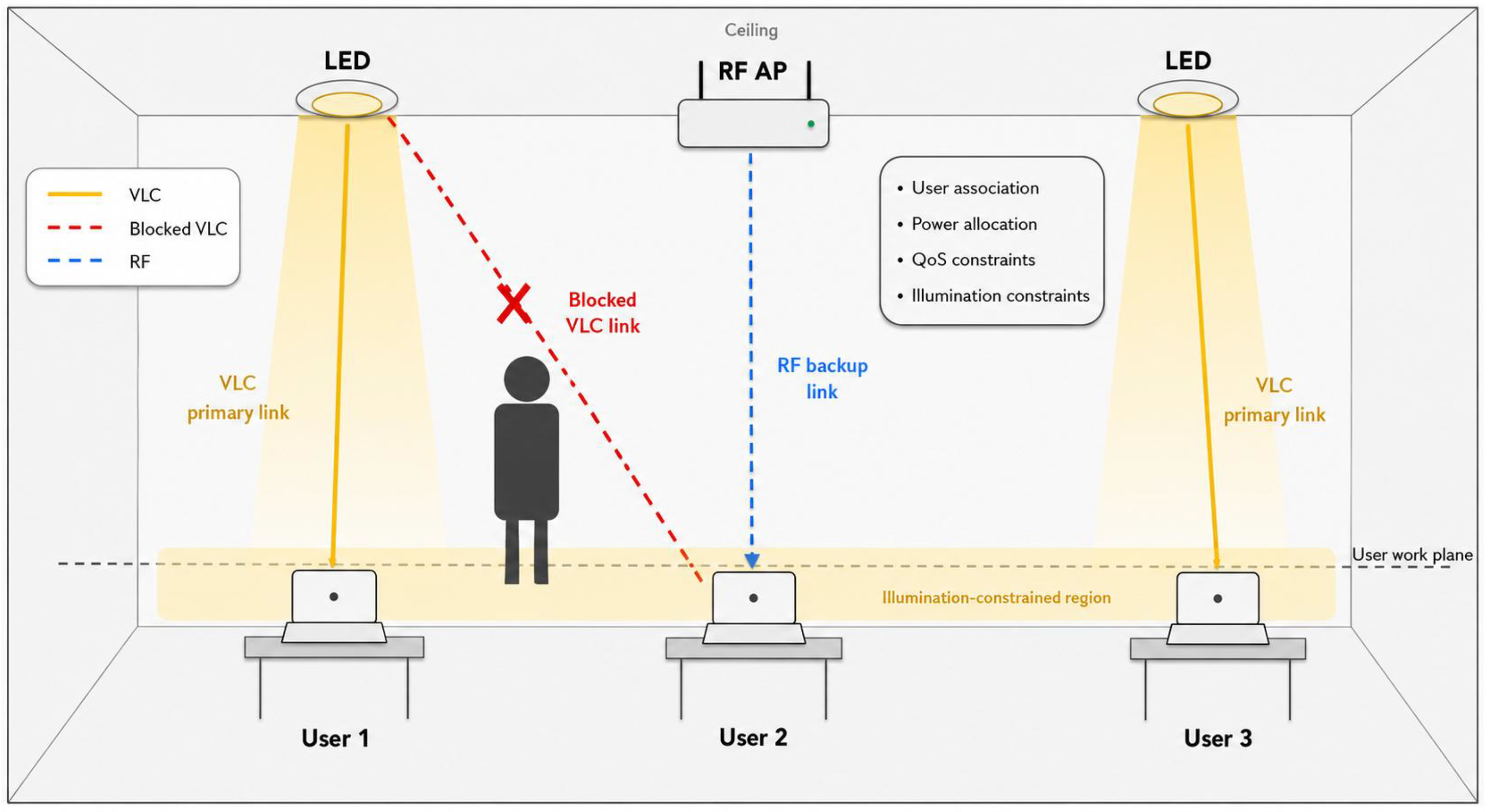
Figure 1 illustrates the considered hybrid VLC/RF indoor network under random optical blockage and working-plane illumination constraints. Ceiling-mounted LEDs provide both indoor illumination and VLC downlink transmission, while an RF access point (AP) acts as a bandwidth-limited backup interface when the optical line-of-sight (LoS) link is blocked or cannot satisfy the quality-of-service (QoS) requirements. Therefore, the system model needs to jointly characterize VLC propagation, random blockage, RF backup transmission, illumination feasibility, and user-achievable rates.
2.1. Indoor Hybrid VLC/RF Network Architecture
We consider an indoor hybrid VLC/RF downlink system deployed in a rectangular room. Let denote the set of LED luminaires and denote the set of users. The LEDs are installed on the ceiling and provide both illumination and VLC transmission. Users are randomly distributed on a horizontal working plane and are equipped with photodetectors (PDs) for VLC reception and RF transceivers for backup RF communication.
Each user is served either by one LED through VLC or by the RF AP, depending on the optical channel condition, blockage state, resource availability, QoS requirement, and RF backup load. VLC is preferred when the optical link is available and can provide sufficient data rate, whereas RF is activated when the VLC link is blocked or severely degraded. Since the RF bandwidth is shared by RF-associated users, excessive RF fallback may reduce the per-user RF rate. This motivates a resource allocation design that jointly considers VLC blockage risk, RF backup load, and illumination feasibility.
2.2. VLC Channel Model
The VLC channel is modeled using the LoS Lambertian optical propagation model. The direct current (DC) channel gain between LED
and user
is expressed as
where
m is the Lambertian emission order,
is the physical area of the PD,
is the distance between LED
i and user
k,
and
denote the irradiance angle and incidence angle, respectively,
is the optical filter gain, and
is the optical concentrator gain. The concentrator gain is expressed as
where
n is the refractive index of the optical concentrator and
is the receiver field-of-view (FOV).
Assuming intensity modulation and direct detection (IM/DD), the received electrical signal-to-noise ratio (SNR) from LED
i to user
k is expressed as
where
is the PD responsivity,
denotes the optical communication power allocated by LED
i to user
k, and
is the VLC noise variance.
2.3. Random Optical Blockage Model
In practical indoor environments, the optical LoS path may be blocked by user mobility, human-body shadowing, furniture, or temporary obstacles. To characterize this effect, a binary blockage variable
is introduced for the link between LED
i and user
k, where
indicates that the VLC link is blocked and
indicates that the LoS link is available. The blockage state is modeled as a Bernoulli random variable:
where
denotes the blockage probability of the VLC link between LED
i and user
k.
This Bernoulli blockage model provides a tractable baseline approximation for describing random LoS availability at the link level. Although independent blockage events are assumed for analytical simplicity, practical indoor blockages may exhibit temporal continuity and spatial correlation due to user mobility, body orientation, human walking trajectories, and obstacle layout. The adopted model enables system-level Monte Carlo evaluation and allows the impact of blockage probability on VLC/RF association and resource allocation to be explicitly characterized. More complex correlated, Markovian, or mobility-aware blockage models can be incorporated in future extensions [
27,
28].
The effective VLC channel gain under random blockage is then expressed as
Accordingly, the blockage-affected VLC SNR can be written as
2.4. RF Backup Channel Model
The RF link is modeled as a complementary backup channel with distance-dependent path loss and small-scale fading. The RF channel gain between the RF AP and user
k is expressed as
where
represents the large-scale path-loss component and
denotes the small-scale fading coefficient. The large-scale path loss is modeled as
where
is the reference channel gain at a unit distance,
is the distance between the RF AP and user
k, and
is the RF path-loss exponent.
The corresponding RF SNR is given by
where
is the RF transmit power allocated to user
k and
is the RF noise power.
The RF backup link is modeled as noise-limited in the considered single-room scenario with one RF AP. This assumption allows the analysis to focus on RF bandwidth sharing and fallback-load control. In dense multi-AP RF deployments, co-channel RF interference may further affect the RF backup service quality and can be incorporated into future extensions.
The RF AP serves users whose VLC links are blocked or cannot provide sufficient service quality. Since the RF bandwidth is shared by all RF-associated users, the simultaneous fallback of many users may create a new bottleneck at the RF interface. This load-dependent RF service capability is therefore considered in the subsequent VLC/RF association and resource allocation design.
2.5. Illumination Model and Constraints
In addition to data transmission, the LED luminaires must satisfy indoor illumination requirements. Let
denote the set of discrete evaluation points on the working plane. Based on the Lambertian radiation model commonly used for indoor VLC illumination analysis [
1,
14,
16], the illuminance contribution from LED
i to grid point
is given by
where
denotes the optical power component used for illumination,
is the distance between LED
i and grid point
g, and
and
are the corresponding irradiance and incidence angles. Differing from the VLC channel gain in Equation (1), this expression characterizes the optical illuminance on the working plane and therefore does not include the PD area, optical filter gain, or optical concentrator gain.
The total illuminance at grid point
g is obtained by summing the contributions from all LEDs:
To ensure proper indoor lighting conditions, the illuminance on the working plane must satisfy
where
and
denote the minimum and maximum allowable illuminance levels, respectively.
This illumination model focuses on working-plane illuminance feasibility, which is the primary lighting constraint considered in this communication-oriented resource allocation problem. Other lighting-quality metrics, such as illuminance uniformity, flicker, color temperature, and color rendering index, are not explicitly modeled in this study and can be further incorporated when more detailed lighting-design requirements are considered.
Each LED has a limited optical power budget shared by illumination and VLC communication:
where
denotes the optical power available for VLC data transmission. The user-level VLC communication power satisfies
Thus, reserving more optical power for illumination reduces the remaining communication power budget, creating a direct tradeoff between communication performance and lighting feasibility.
2.6. Achievable Rate and Outage Definitions
For system-level resource allocation and performance comparison, a Shannon-like rate approximation is adopted for the IM/DD-based VLC link. This approximation is used to evaluate the achievable-rate trends under different VLC/RF association and power allocation decisions. Although the exact capacity of practical IM/DD VLC systems depends on optical intensity constraints, modulation formats, and non-negativity requirements, the Shannon-like expression provides a tractable and commonly used metric for comparing system-level resource allocation schemes. The achievable data rate from LED
i to user
k is expressed as
where
is the VLC bandwidth and
denotes the number of users sharing the VLC bandwidth of LED
i.
Similarly, the achievable RF data rate of user
k is given by
where
denotes the RF bandwidth and
denotes the number of users served by the RF AP. This expression explicitly reflects the load-dependent nature of the RF backup link.
The achieved rate of user
k after VLC/RF association is denoted by
:
where
and
denote the VLC and RF association indicators, respectively. An outage event occurs when
falls below the minimum QoS requirement
:
The overall outage probability is calculated as
where
T is the number of Monte Carlo trials, and
denotes the outage indicator of user
k in the
t-th trial.
3. Risk-Aware User Association and Power Allocation Problem
3.1. Decision Variables
Based on the hybrid VLC/RF indoor network model described in
Section 2, each user can be served either by one LED through the VLC link or by the RF AP through the backup RF link. Let
denote the set of users and
denote the set of LED transmitters.
The VLC association variable is defined as
Similarly, the RF association variable is defined as
Each user is served by either one VLC link or the RF backup link, which gives
Let
denote the optical communication power allocated by LED
i to user
k, and let
denote the RF transmit power allocated by the RF AP to user
k. The number of users associated with the RF AP is denoted by
Since the RF bandwidth is shared by all RF-associated users,
directly affects the service quality of the RF backup link.
The achieved rate of user
k under the hybrid VLC/RF association decision is expressed as
where
and
are defined in
Section 2.
The resource allocation problem jointly determines the association variables and the power allocation variables . Different from a conventional sum-rate-oriented formulation, the proposed formulation considers optical blockage risk, RF backup load, and the power coupling between VLC communication and illumination.
3.2. Risk-Adjusted VLC Service Rate and Load-Aware RF Utility
In hybrid VLC/RF indoor networks, maximizing the instantaneous VLC rate alone may lead to unreliable association decisions. A VLC link with a high instantaneous rate can still be risky if it has a high blockage probability. Therefore, a risk-adjusted effective VLC service rate is introduced to capture both the expected VLC throughput and the potential reliability loss caused by optical blockage.
For the link between LED
i and user
k, the risk-adjusted VLC service rate is defined as
where
, and
is the risk-awareness factor. The first term represents the expected VLC service rate under random blockage, while the second term penalizes VLC links that are more likely to become unreliable or fail to satisfy the minimum QoS requirement. When
, the expression reduces to the expected-rate-based VLC utility. A larger
gives more weight to reliability protection under optical blockage.
The RF link is used as a backup interface and is not affected by optical blockage. However, the RF backup link is bandwidth-limited and shared by all RF-associated users. Therefore, assigning too many users to the RF AP may reduce the per-user RF service quality. To reflect this effect, a load-aware RF utility is introduced as
where
is the RF load-awareness factor. When
, the RF utility reduces to the original RF achievable rate
. A larger
gives a stronger penalty to excessive RF fallback, which helps prevent the RF backup link from becoming overloaded.
The risk- and load-aware effective throughput of user
k is then given by
This formulation allows the association decision to consider not only the achievable data rate, but also the reliability risk caused by random optical blockage and the load condition of the RF backup link. As a result, a VLC link is preferred only when it can provide a sufficient rate with an acceptable blockage risk, while the RF link is activated selectively when the VLC link becomes unreliable or cannot satisfy the required QoS without overloading the RF backup interface.
3.3. Optimization Objective
The objective of this work is to maximize the total risk- and load-aware effective throughput of the hybrid VLC/RF indoor network while satisfying QoS, power, and illumination constraints. The optimization objective is formulated as
Compared with raw sum-rate maximization, this objective discourages assigning users to VLC links that have high blockage risk, even if their instantaneous VLC rate is high. It also discourages excessive fallback to the bandwidth-limited RF link when the RF backup load becomes high. Therefore, the formulation is more suitable for blockage-prone indoor hybrid VLC/RF networks where service continuity, RF backup load, and illumination feasibility should be jointly considered.
3.4. Constraints
The optimization problem is subject to association, power, QoS, and illumination constraints.
First, the VLC and RF association variables are binary:
Each user can be associated with only one serving interface:
Second, the VLC communication power allocated by each LED is limited by its available optical communication power budget after reserving the illumination-related power:
where
represents the maximum communication power available at LED
i after satisfying the illumination power requirement. According to the communication–illumination power coupling described in
Section 2, this available communication power can be updated when the illumination-related optical power changes. Similarly, the total RF transmit power is constrained by
The allocated communication powers are non-negative:
Third, the achieved rate of each user should satisfy the same minimum QoS requirement used in the outage definition in Equation (18). In the optimization problem, this QoS requirement is imposed on the actual achieved rate , while the objective function uses the risk- and load-aware effective throughput to guide robust association and power allocation decisions.
Finally, the VLC transmitters must maintain sufficient illumination on the working plane. The illumination feasibility requirement follows the working-plane lighting constraint defined in Equation (12). This constraint ensures that communication-oriented VLC power allocation does not violate the indoor lighting requirement.
3.5. Complete Problem Formulation
For completeness, the final problem formulation collects the association, power, QoS, and illumination constraints, where the QoS and illumination requirements follow the outage definition in Equation (18) and the working-plane illumination constraint in Equation (12), respectively.
The risk-aware illumination-constrained user association and power allocation problem can be formulated as
Problem is a mixed-integer non-convex optimization problem. The binary association variables introduce combinatorial complexity, while the achievable rate expressions are nonlinear functions of the VLC and RF power allocation variables. In addition, the objective function contains a blockage-risk-dependent VLC service term and an RF-load-dependent backup utility term. The illumination constraint further couples the available VLC communication power with the lighting function of the LED infrastructure. Therefore, solving through exhaustive search or global optimization becomes computationally expensive as the number of users increases. To address this issue, a low-complexity risk-aware illumination-constrained resource allocation scheme with RF backup load control is proposed in the next section.
4. Proposed Risk-Aware Illumination-Constrained Resource Allocation Scheme
4.1. Design Principle
The risk-aware user association and power allocation problem formulated in
Section 3 is a mixed-integer non-convex optimization problem. The binary VLC/RF association variables introduce combinatorial complexity, while the achievable rates are nonlinear functions of the VLC and RF power allocation variables. In addition, the VLC link reliability is affected by random optical blockage, the RF backup link is bandwidth-limited and load-dependent, and the communication-oriented optical power allocation must satisfy the working-plane illumination constraints. Therefore, directly solving the original problem through exhaustive search or global optimization is computationally expensive, especially when the number of users increases.
To obtain a practical solution, we propose a low-complexity risk-aware illumination-constrained resource allocation scheme with RF backup load control. The proposed scheme follows three design principles. First, a VLC link should be selected not only according to its achievable data rate, but also according to its blockage risk. A link with a high instantaneous VLC rate may still be unreliable if its blockage probability is high. Second, the RF link should be activated selectively as a backup when the VLC link is unreliable or cannot satisfy the QoS requirement. Since the RF bandwidth is shared by RF-associated users, excessive RF fallback should be avoided to preserve the service quality of the RF backup link. Third, VLC power allocation should be performed under the communication–illumination power coupling, because increasing the illumination-related optical power reduces the remaining VLC communication power budget.
Accordingly, the proposed scheme decomposes the original problem into three sequential steps: risk- and load-aware VLC/RF user association, power allocation for fixed association, and illumination feasibility adjustment. In the first step, each user selects either the most suitable VLC link or the RF backup link according to the risk-adjusted VLC service rate and the load-aware RF utility. In the second step, VLC and RF transmission powers are allocated under the obtained association decision. In the third step, the illuminance distribution on the working plane is checked and adjusted to ensure that the final allocation remains feasible from both communication and lighting perspectives.
The proposed decomposition is motivated by the different functional roles and coupling relationships of the involved variables. User association mainly determines the access interface and the load distribution between VLC and RF links. Power allocation then refines the service rate under a fixed association pattern by redistributing the available VLC and RF transmit powers. Illumination feasibility adjustment is finally performed because the lighting requirement directly constrains the available VLC communication power budget. Therefore, the original mixed-integer non-convex problem is decomposed into association, power allocation, and illumination feasibility adjustment, which provides a practical low-complexity solution while preserving the dominant coupling relationships among blockage risk, RF backup load, channel quality, QoS feasibility, and illumination constraints.
It should be emphasized that this decomposition does not aim to obtain a globally optimal solution. Instead, it is designed to provide a transparent and computationally efficient resource allocation procedure for practical indoor hybrid VLC/RF networks. By separately handling access selection, power distribution, and lighting feasibility while keeping their coupling relationships in the utility and adjustment rules, the proposed scheme can reduce the search complexity and still capture the main system-level tradeoffs among reliability, throughput, RF backup usage, and illumination compliance.
The relationship between the proposed heuristic procedure and the original problem can be further explained as follows. Problem jointly optimizes the binary association variables and the continuous power allocation variables under QoS, power-budget, RF-load, and illumination constraints. A direct global solution would require a joint search over all VLC/RF association patterns and continuous power variables, which becomes computationally prohibitive as K increases. Therefore, the proposed algorithm approximates by preserving its dominant decision structure in a sequential manner. The risk- and load-aware association step corresponds to the optimization of , where the VLC utility reflects the blockage-risk-dependent service term and the RF utility reflects the RF-load-dependent backup term in the objective function. The power allocation step then optimizes under the fixed association pattern and the available transmit-power budgets. Finally, the illumination feasibility adjustment enforces the working-plane lighting constraint by updating the VLC communication power budget according to the illumination requirement.
Therefore, the proposed method should be regarded as a structure-preserving heuristic rather than a relaxation-based globally optimal solver. It does not provide a theoretical guarantee of global optimality, convergence to the global optimum, or approximation ratio. Nevertheless, each step is directly associated with one group of variables or constraints in , and the final allocation is checked against the QoS and illumination feasibility requirements. This design provides a practical balance between computational tractability and system performance, which is suitable for online or repeated resource allocation in indoor hybrid VLC/RF networks.
4.2. Risk- and Load-Aware VLC/RF User Association
For each user, the association decision is made by comparing the risk-adjusted service capability of the VLC links and the load-aware service capability of the RF backup link. Since multiple LEDs may provide VLC coverage, the risk-adjusted VLC service rate is evaluated for each LED-user pair. Following the formulation in
Section 3, the risk-aware VLC utility between LED
i and user
k is written as
where
is defined in Equation (25). This avoids repeating the same risk-adjusted rate expression and emphasizes that the association utility directly follows the risk-aware service rate introduced in the problem formulation. A larger
makes the association decision more conservative with respect to optical blockage.
The risk-awareness factor controls the sensitivity of the VLC association decision to optical blockage. A small value of makes the association rule closer to an expected-rate-based selection, while a larger value imposes a stronger penalty on VLC links with high blockage probability or insufficient QoS support. Therefore, determines the tradeoff between exploiting high-rate VLC links and avoiding unreliable optical links under random blockage. In practical implementation, can be selected according to the required reliability level of the indoor service scenario. A reliability-sensitive scenario may use a larger , whereas a throughput-oriented scenario may adopt a smaller value.
For user
k, the best candidate VLC link is selected as
and the corresponding maximum VLC utility is given by
The RF link is not affected by optical blockage, but it is shared by all RF-associated users. Therefore, its utility should reflect not only the RF achievable rate but also the current RF backup load. Let
denote the current number of users associated with the RF AP. The load-aware RF utility of user
k is defined as
where
is the RF load-awareness factor. When
, the RF utility reduces to the original RF achievable rate. When
increases, assigning additional users to the RF AP becomes less attractive if the RF backup link is already heavily loaded. This design prevents excessive RF fallback and helps maintain the service quality of RF-associated users.
The RF load-awareness factor controls the strength of the penalty imposed on RF backup loading. When is small, the algorithm tends to use the RF link more aggressively as a backup interface for blockage-affected users. When is large, the algorithm becomes more conservative in assigning users to the RF AP, thereby reducing the risk of RF backup congestion. Thus, regulates the tradeoff between service continuity through RF fallback and the service quality of RF-associated users. In this work, is introduced to reflect the practical fact that the RF backup link has limited bandwidth and should not be treated as an unlimited fallback resource.
The initial association decision is then determined by comparing the best risk-aware VLC utility and the load-aware RF utility. If the best VLC link provides a higher utility and can satisfy the minimum QoS requirement, user
k is associated with LED
. Otherwise, the user is assigned to the RF AP when the load-aware RF utility is more favorable. The association rule is expressed as
and the RF association variable is given by
After each user association decision, is updated according to the current RF-associated user set. In this way, the RF utility of subsequent users reflects the updated RF backup load. This association rule keeps users on VLC when the optical link provides sufficient rate with acceptable blockage risk, while using RF as a controlled backup interface when VLC becomes unreliable or QoS-insufficient. Therefore, the proposed association mechanism improves service continuity without overloading the bandwidth-limited RF backup link.
4.3. Power Allocation for Fixed User Association
After the user association variables
are determined, power allocation is performed under the fixed association decision. The VLC-associated user set of LED
i is defined as
The RF-associated user set is defined as
For VLC-associated users, a risk-aware channel-compensation power allocation rule is adopted. The purpose is to provide additional support to users with weak channel conditions or higher blockage risk, while avoiding exhaustive optimization. The VLC allocation weight for user
k associated with LED
i is defined as
where
is a small positive constant used to avoid division by zero. Compared with a conventional channel-compensation weight, this expression increases the allocation priority of blockage-prone users through the factor
. Therefore, the same risk-awareness factor
is used consistently in both association and power allocation. In the association stage,
penalizes unreliable VLC links with high blockage probability. In the power allocation stage, it provides additional power support to users that are more vulnerable to blockage and channel degradation. This consistent use of
enables the proposed scheme to incorporate blockage awareness into both access selection and power distribution.
Then, the VLC communication power allocated by LED
i to user
k is given by
Here,
denotes the available VLC communication power budget of LED
i after reserving the illumination-related optical power.
For RF-associated users, the RF allocation weight is defined as
The RF transmit power allocated to user
k is then given by
The above proportional allocation strategy does not claim global optimality. Instead, it provides a transparent and low-complexity rule that jointly considers channel quality, blockage risk, and RF backup usage. The use of channel-compensation weights helps support users with weaker VLC or RF channel conditions, while the blockage-aware factor in the VLC weight further reflects the reliability requirement under random optical blockage. This design is consistent with the objective of providing a practical resource allocation scheme rather than an exhaustive optimization solver.
After the initial power allocation, the achieved rate of each user is checked against the minimum QoS requirement. If a VLC-associated user still cannot satisfy the minimum rate requirement, the algorithm attempts to reassign this user to the RF AP only when the RF link can support the required service and the RF backup load remains acceptable. This reassociation rule avoids blindly transferring all QoS-insufficient VLC users to the RF AP, which would otherwise aggravate RF backup congestion. After such reassociation, the VLC and RF power allocation processes are repeated.
4.4. Illumination Feasibility Adjustment
Since VLC transmitters simultaneously provide communication and illumination, the communication-oriented resource allocation must be checked against the working-plane lighting constraints. After the initial user association and power allocation, the illuminance at each grid point is evaluated as
If the illumination constraint defined in Equation (12) is satisfied for all grid points on the working plane, the current association and power allocation are accepted. Otherwise, illumination feasibility adjustment is performed.
When the illuminance at some grid points is lower than the minimum required level
, the illumination-related optical power should be increased within the allowed power range. The illumination compensation factor is calculated as
Then, the illumination power of LED
i is adjusted as
where
denotes the maximum allowable illumination power of LED
i.
After illumination adjustment, the available VLC communication power budget is updated according to the remaining optical power of each LED:
If more optical power is reserved for illumination, the available communication power of the corresponding LED decreases. Therefore, the VLC power allocation should be recomputed under the updated communication power budget.
When the illuminance at some grid points exceeds the maximum allowable level , the illumination-related optical power is reduced within the feasible range while ensuring that the minimum illuminance requirement remains satisfied. This prevents excessive illumination while maintaining acceptable lighting quality on the working plane.
The illumination feasibility adjustment is essential because a communication-only allocation may improve the data rate but violate practical indoor lighting requirements. By explicitly incorporating this step, the proposed scheme preserves the dual functionality of the VLC infrastructure and ensures that the final solution remains feasible from both communication and illumination perspectives.
The parameters and are used to adjust the operating preference of the proposed scheme. Specifically, controls the degree of blockage-risk awareness in VLC association and power allocation, while controls the degree of RF load awareness in backup-link selection. These two parameters do not change the structure of the algorithm, but they affect the balance among VLC reliability, RF fallback usage, outage performance, and RF-associated user service quality. In the simulation study, fixed values of and are used for all compared scenarios after preliminary sensitivity checking, so the performance comparison among different schemes remains consistent and fair.
4.5. Algorithm Summary
The overall procedure of the proposed risk-aware illumination-constrained resource allocation scheme is summarized in Algorithm 1. The algorithm consists of three main stages: risk- and load-aware VLC/RF user association, power allocation for fixed association, and illumination feasibility adjustment.
| Algorithm 1 Risk-Aware Illumination-Constrained Resource Allocation with RF Load Control |
Require: User set , LED set , illumination grid set , VLC/RF channel gains, blockage probabilities, power budgets, risk-awareness factor , RF load-awareness factor , QoS threshold , illumination bounds and Ensure: Association variables and , VLC power allocation , RF power allocation
- 1:
Initialize , , , and . - 2:
Initialize the RF-associated user number . - 3:
Compute and according to the VLC and RF channel models. - 4:
Step 1: Risk- and load-aware VLC/RF user association - 5:
for each user do - 6:
Compute for all LEDs . - 7:
Select the best VLC candidate . - 8:
Compute the load-aware RF utility . - 9:
if and then - 10:
Set and . - 11:
else - 12:
Set for all and . - 13:
Update . - 14:
end if - 15:
end for - 16:
Step 2: Power allocation for fixed association - 17:
for each LED do - 18:
Construct . - 19:
Compute for all . - 20:
Allocate according to the normalized VLC allocation weights. - 21:
end for - 22:
Construct . - 23:
Compute for all . - 24:
Allocate according to the normalized RF allocation weights. - 25:
Compute the achieved rate for each user. - 26:
for each VLC-associated user k with do - 27:
Reassign user k to the RF AP if the RF link can support the service requirement and the RF backup load remains acceptable. - 28:
end for - 29:
Recompute VLC and RF power allocation after QoS-driven reassociation. - 30:
Step 3: Illumination feasibility adjustment - 31:
Evaluate the illuminance for all grid points . - 32:
if illumination constraints are satisfied for all then - 33:
Accept the current association and power allocation. - 34:
else - 35:
Adjust the illumination-related optical power within the feasible power range. - 36:
Update the available VLC communication power budget. - 37:
Recompute VLC power allocation and achieved user rates. - 38:
for each VLC-associated user k with do - 39:
Reassign user k to the RF AP if RF resources and RF load condition are acceptable. - 40:
end for - 41:
Recompute the final VLC and RF power allocation. - 42:
end if - 43:
Compute the final user rates, outage indicators, RF-associated user number, and illumination distribution. - 44:
return, , , and .
|
4.6. Complexity Analysis
The proposed scheme avoids exhaustive search over all possible VLC/RF association patterns. In the risk- and load-aware association phase, the VLC utility is computed for each LED–user pair, resulting in a complexity of . The load-aware RF utility is computed for each user with an update of the current RF-associated user number, which requires operations. Therefore, the total complexity of the association phase is .
In the power allocation phase, VLC power allocation is performed for the users associated with each LED, while RF power allocation is performed for the users associated with the RF AP. Since each user is associated with either one LED or the RF AP, the overall power allocation complexity is linear with respect to the number of users, which can be written as after the association decision is fixed.
The illumination feasibility check evaluates the illuminance over grid points by considering the contribution from all LEDs. Therefore, the complexity of the illumination feasibility check is . If illumination adjustment is required, the VLC power allocation and QoS checking steps are repeated. Since these operations are still linear in the number of users, the adjustment step does not change the polynomial order of the algorithm.
Therefore, the overall computational complexity of the proposed algorithm can be expressed as
This complexity is significantly lower than exhaustive association search, which requires checking possible association patterns because each user may be associated with one of the L LEDs or the RF AP. Hence, the proposed scheme is suitable for practical hybrid VLC/RF indoor network control, especially when the number of users increases.
It should be noted that the proposed scheme is designed as a low-complexity heuristic rather than a globally optimal solver. Although an exhaustive search can theoretically obtain the optimal user association pattern by enumerating all possible VLC/RF association combinations, its computational complexity increases exponentially with the number of users. Therefore, exhaustive search is impractical for dense indoor hybrid VLC/RF networks. The proposed scheme aims to achieve a practical tradeoff between system performance and computational complexity through risk-aware utility evaluation, RF backup load control, low-complexity power allocation, and illumination feasibility adjustment.
The rationale of the proposed heuristic design is that it preserves the dominant decision factors of the original problem while avoiding exponential search complexity. The risk-aware VLC utility captures the impact of optical blockage on link reliability, the load-aware RF utility reflects the congestion risk of the shared RF backup interface, the proportional power allocation rule provides a low-complexity way to support users with weak channel or high blockage risk, and the illumination feasibility adjustment ensures that the final solution satisfies practical lighting constraints. Therefore, although the proposed scheme does not guarantee global optimality, it is suitable for system-level resource control in practical next-generation indoor optical wireless communication scenarios. This clarification was added to avoid overstating the optimality of the proposed heuristic; the performance advantage of the proposed scheme is instead verified through Monte Carlo simulations, parameter sensitivity analysis, and runtime scalability evaluation in
Section 5.
5. Results
5.1. Simulation Setup
The main simulation parameters are summarized in
Table 1. Unless otherwise specified, users are randomly distributed on the working plane, and Monte Carlo simulations are performed under different optical blockage probabilities, user numbers, and illumination requirements.
The risk-awareness factor and the RF load-awareness factor are used to control the tradeoff between VLC reliability protection and RF backup load suppression. A larger makes the association decision more conservative with respect to optical blockage, while a larger penalizes excessive RF fallback more strongly. In the simulations, these parameters are selected through preliminary sensitivity tests to avoid overly aggressive RF fallback while maintaining QoS feasibility. Unless otherwise specified, the same parameter setting is used for all evaluated scenarios of the proposed scheme.
5.2. Illuminance Distribution Validation
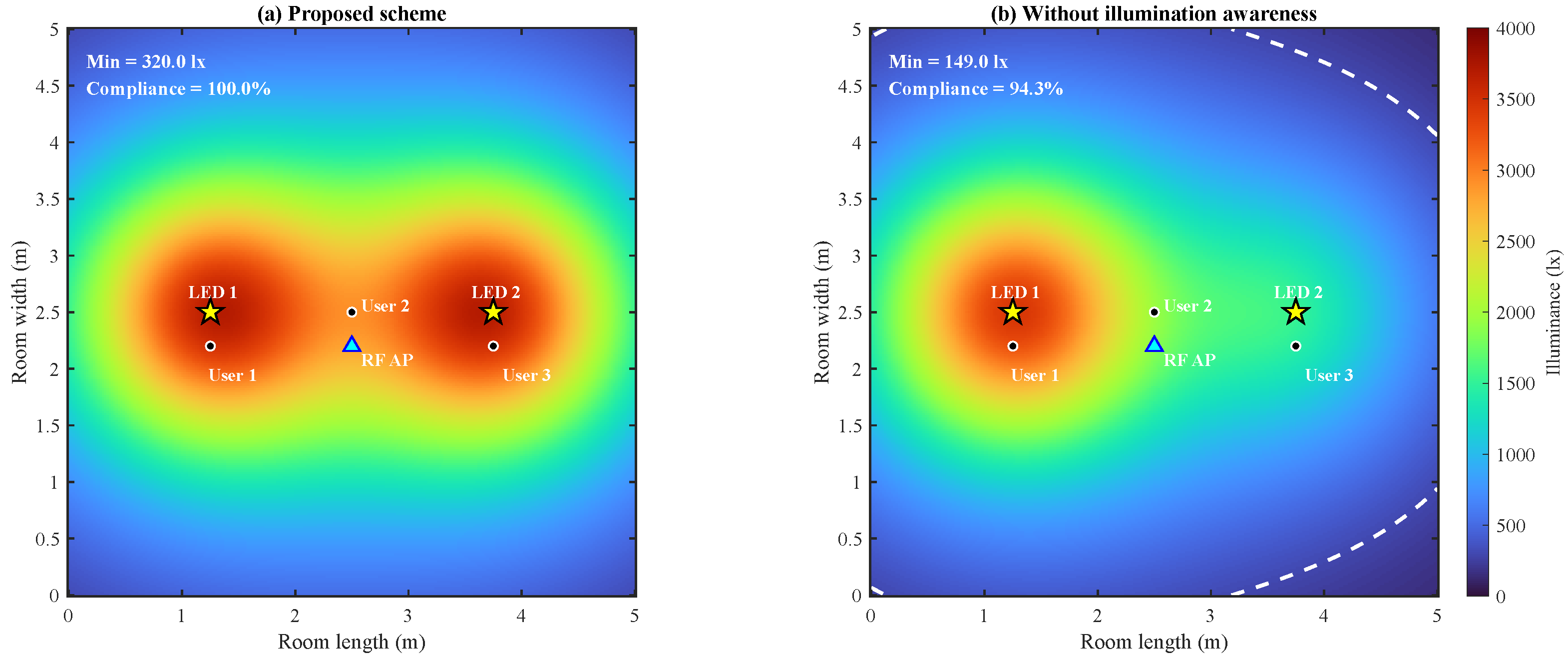
Figure 2 compares the illuminance distribution on the working plane under the proposed scheme and the illumination-unaware hybrid scheme. As shown in
Figure 2a, the proposed scheme maintains the illuminance above the required threshold over the entire working plane. The minimum illuminance reaches approximately
lx, and the illumination compliance ratio reaches
. This confirms that the proposed illumination feasibility adjustment can effectively preserve the indoor lighting requirement while supporting hybrid VLC/RF communication.
In contrast,
Figure 2b shows that the illumination-unaware hybrid scheme produces low-illumination regions on the working plane. The minimum illuminance decreases to approximately
lx, and the illumination compliance ratio is reduced to
. This indicates that communication-oriented resource allocation without illumination awareness may improve transmission performance but cannot always guarantee the required lighting condition. Therefore, incorporating illumination feasibility into hybrid VLC/RF resource allocation is necessary for practical indoor deployment.
5.3. Outage Probability Under Optical Blockage
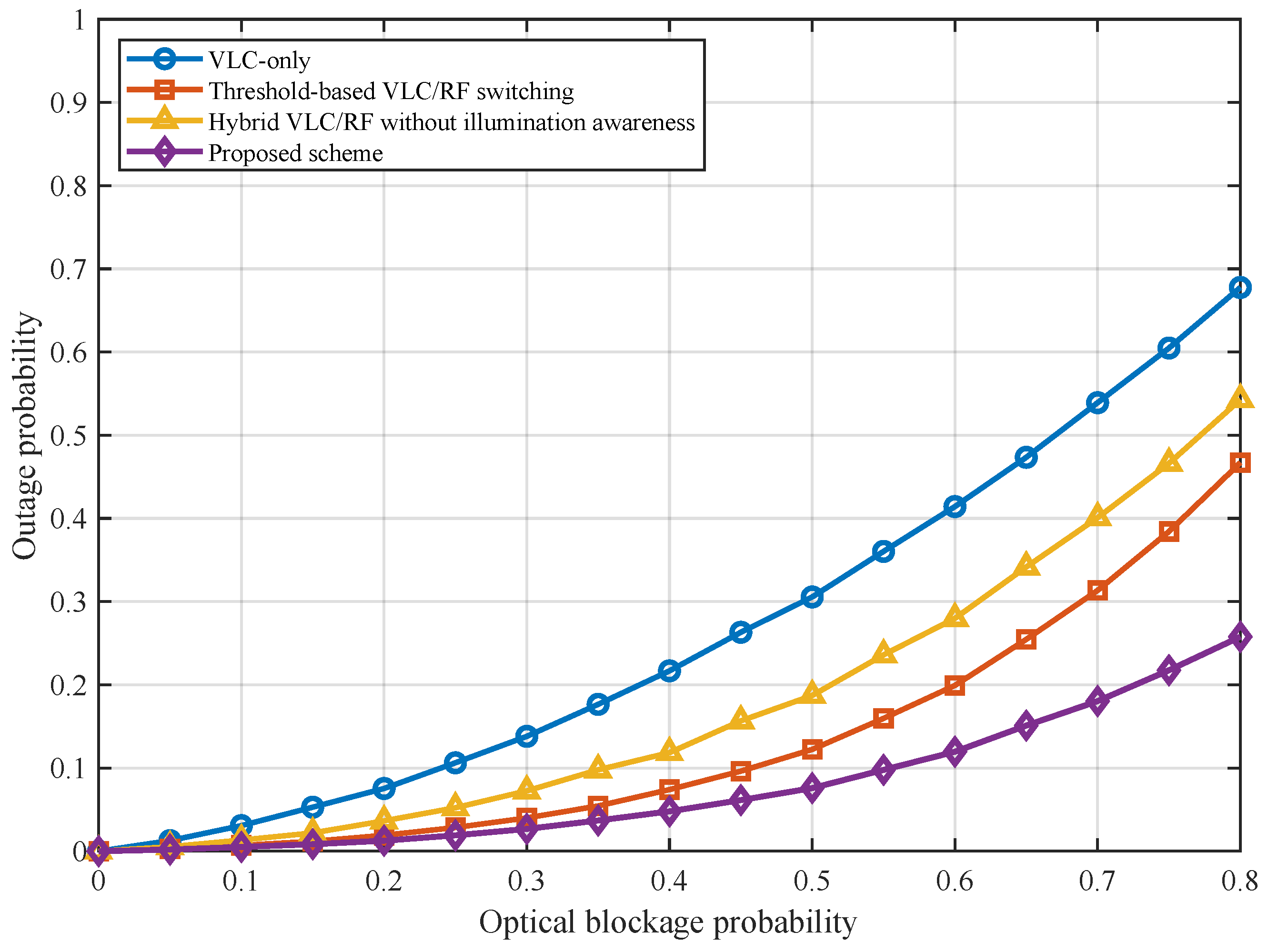
Figure 3 shows the outage probability versus the optical blockage probability under different transmission schemes. As the blockage probability increases from 0 to
, the outage probability of all schemes increases because VLC links become more likely to suffer from LoS obstruction and severe channel degradation. The VLC-only scheme exhibits the highest outage probability, since it cannot provide alternative connectivity when the optical link is blocked.
When the blockage probability is , the outage probability of the VLC-only scheme is approximately , while the threshold-based VLC/RF switching scheme and the illumination-unaware hybrid scheme achieve outage probabilities of approximately and , respectively. In comparison, the proposed scheme reduces the outage probability to approximately . This corresponds to an outage reduction of about compared with the VLC-only scheme and about compared with the threshold-based switching scheme.
When the blockage probability further increases to , the outage probability of the VLC-only scheme increases to approximately . The threshold-based switching scheme and the illumination-unaware hybrid scheme achieve outage probabilities of approximately and , respectively, while the proposed scheme maintains the outage probability at approximately . Therefore, under severe blockage conditions, the proposed scheme reduces outage probability by approximately compared with VLC-only transmission, compared with threshold-based switching, and compared with the illumination-unaware hybrid scheme. These results demonstrate that the proposed risk-aware VLC/RF association strategy can improve link reliability by keeping users on VLC when the optical link is reliable and selectively activating RF backup when VLC becomes blocked or insufficient.
5.4. Sum Rate Performance
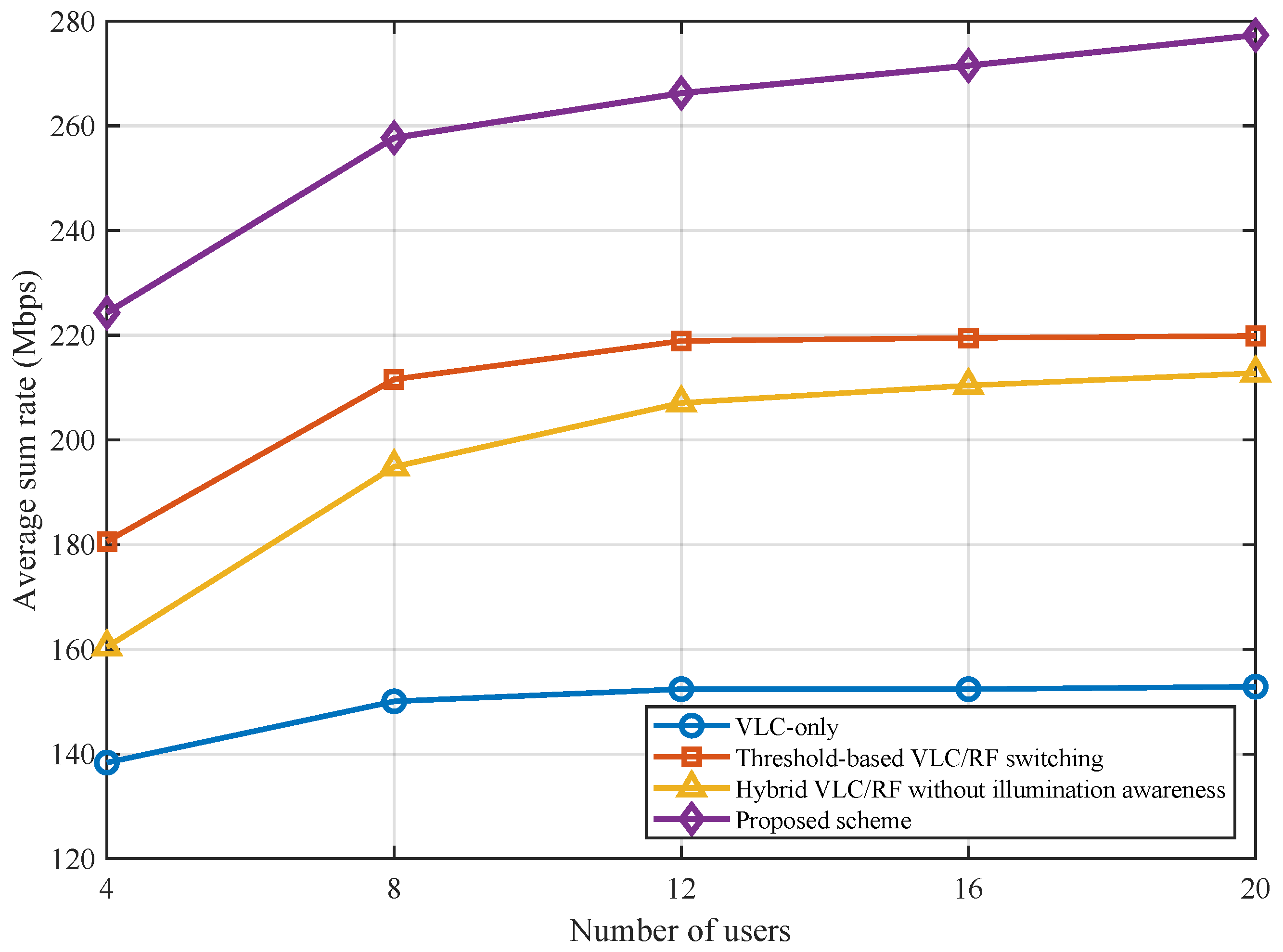
Figure 4 shows the average sum rate versus the number of users under different transmission schemes. As the number of users increases, the average sum rate of all schemes initially increases because more users contribute to the total system throughput. However, the growth gradually becomes saturated when the number of users becomes large, since the available VLC and RF bandwidth and power resources need to be shared among more users.
For the VLC-only scheme, the average sum rate increases only slightly from approximately 138 Mbps when to approximately 153 Mbps when . This limited improvement is caused by the lack of RF fallback under optical blockage. The threshold-based VLC/RF switching scheme improves the sum rate from approximately 180 Mbps to 220 Mbps as the number of users increases from 4 to 20. The illumination-unaware hybrid scheme achieves a sum rate of approximately 161 Mbps at and approximately 214 Mbps at .
In contrast, the proposed risk-aware scheme consistently achieves the highest average sum rate. Specifically, the proposed scheme achieves approximately 224 Mbps, 258 Mbps, 266 Mbps, 272 Mbps, and 277 Mbps when the number of users is 4, 8, 12, 16, and 20, respectively. When , the proposed scheme improves the average sum rate by approximately compared with the VLC-only scheme, compared with the threshold-based switching scheme, and compared with the illumination-unaware hybrid scheme. These improvements show that the proposed joint association and power allocation strategy can better utilize the complementary advantages of VLC and RF links while maintaining illumination feasibility.
5.5. Energy Efficiency Performance
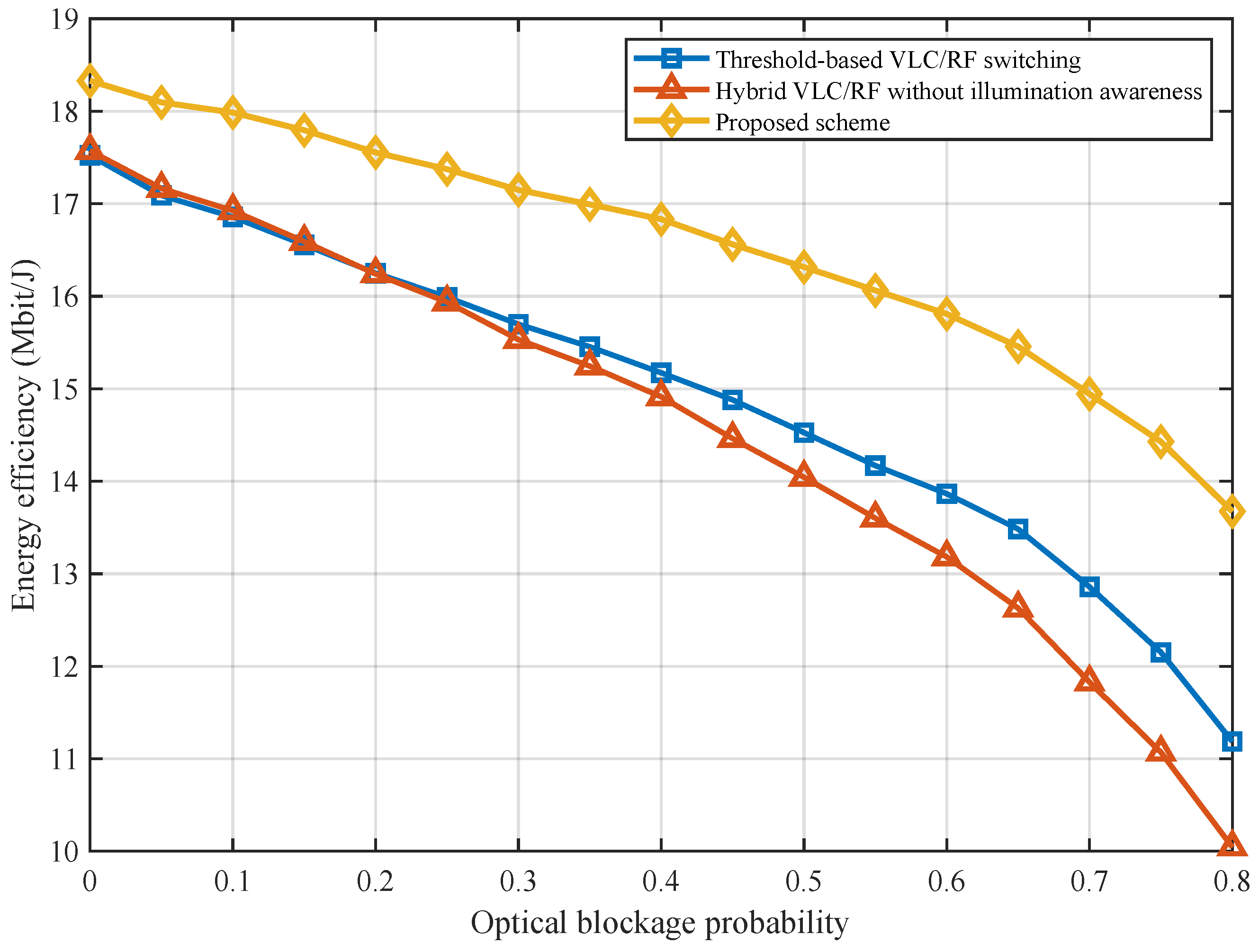
Figure 5 shows the energy efficiency versus the optical blockage probability under different hybrid transmission schemes. The energy efficiency
is evaluated as the ratio between the achieved system sum rate and the total consumed communication and illumination power. As the optical blockage probability increases, the energy efficiency of all schemes gradually decreases because more users experience VLC link degradation and the system needs to rely more frequently on RF backup transmission.
At a blockage probability of 0, the proposed scheme achieves an energy efficiency of approximately Mbit/J, while the threshold-based VLC/RF switching scheme and the illumination-unaware hybrid scheme achieve approximately Mbit/J and Mbit/J, respectively. As the blockage probability increases to , the energy efficiency of the proposed scheme remains around Mbit/J, while the threshold-based switching scheme and the illumination-unaware hybrid scheme decrease to approximately Mbit/J and Mbit/J, respectively.
Under severe blockage conditions, when the blockage probability reaches , the proposed scheme still achieves approximately Mbit/J. In contrast, the threshold-based switching scheme decreases to approximately Mbit/J, and the illumination-unaware hybrid scheme further decreases to approximately Mbit/J. Therefore, at a blockage probability of , the proposed scheme improves energy efficiency by approximately compared with the threshold-based switching scheme and approximately compared with the illumination-unaware hybrid scheme. These results indicate that the proposed scheme can reduce inefficient RF fallback and improve power utilization under random optical blockage.
5.6. Impact of Minimum Illuminance Requirement
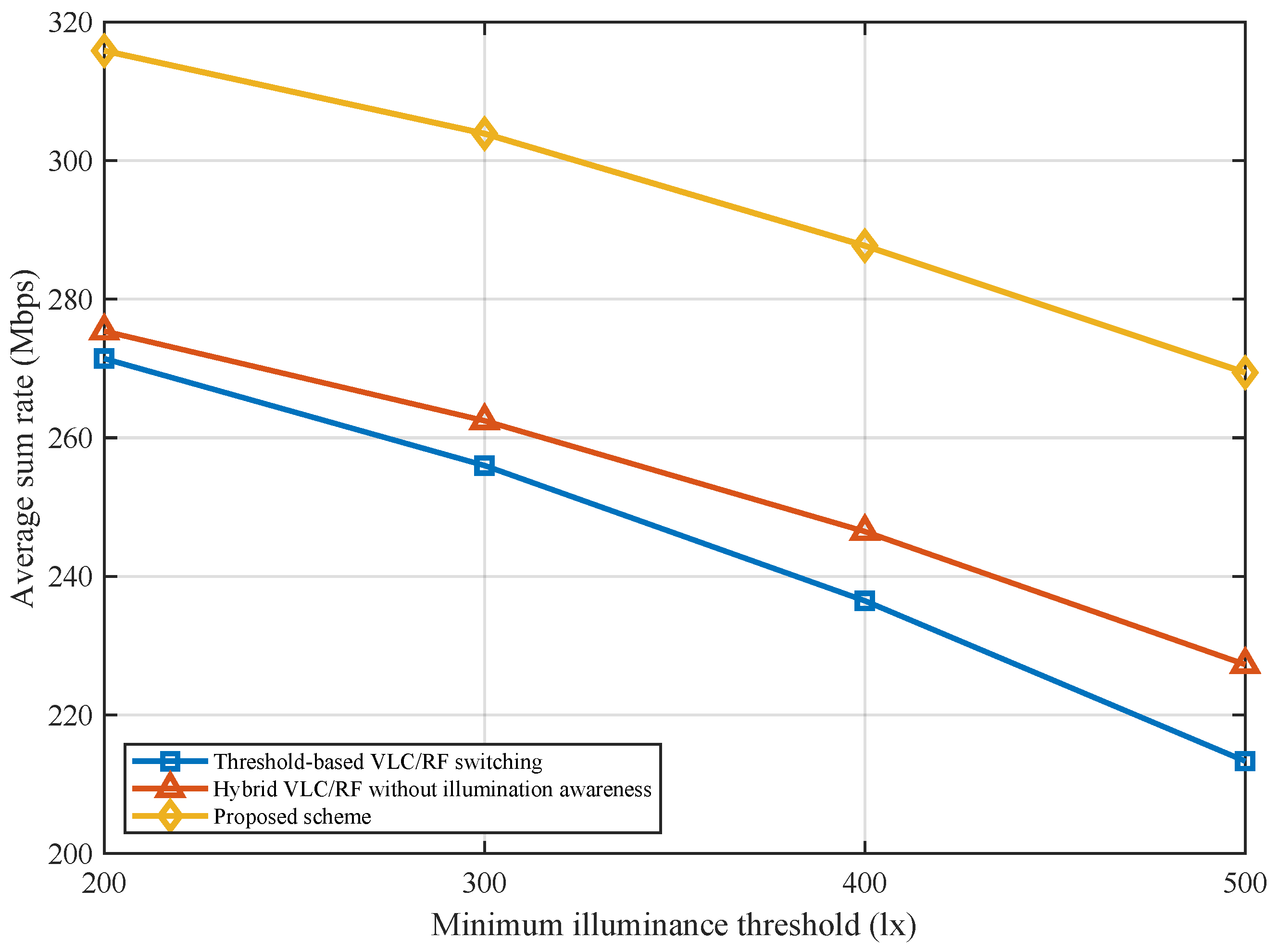
Figure 6 shows the average sum rate versus the minimum illuminance threshold
under different hybrid transmission schemes. As
increases from 200 lx to 500 lx, the average sum rate of all schemes decreases. This is because a stricter illumination requirement reserves more optical power for lighting, thereby reducing the remaining optical power and flexibility available for VLC data transmission.
When lx, the proposed scheme achieves an average sum rate of approximately 317 Mbps, while the threshold-based VLC/RF switching scheme and the illumination-unaware hybrid scheme achieve approximately 272 Mbps and 276 Mbps, respectively. When lx, the proposed scheme still achieves approximately 304 Mbps, outperforming the threshold-based switching scheme and the illumination-unaware hybrid scheme, which achieve approximately 256 Mbps and 263 Mbps, respectively.
As the illumination requirement becomes stricter, the performance gap remains significant. When lx, the average sum rate of the proposed scheme is approximately 270 Mbps, while those of the threshold-based switching scheme and the illumination-unaware hybrid scheme are approximately 213 Mbps and 228 Mbps, respectively. Therefore, under the strict illumination threshold of 500 lx, the proposed scheme improves the average sum rate by approximately compared with threshold-based switching and approximately compared with the illumination-unaware hybrid scheme. These results confirm that the proposed framework can better balance communication throughput and indoor lighting requirements by adjusting the available VLC communication power under illumination constraints.
5.7. RF Backup Load and Service Quality
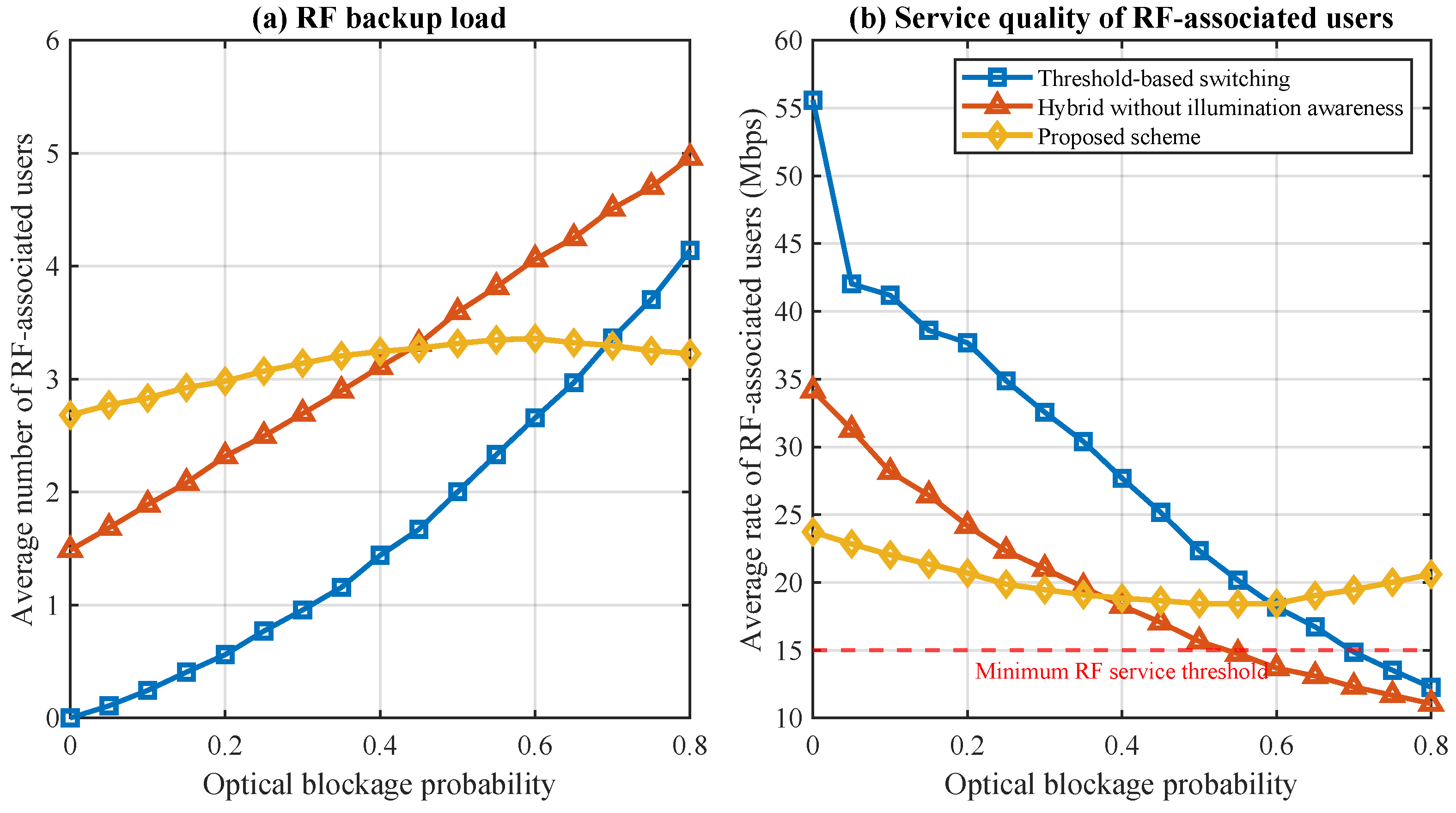
Figure 7 further analyzes the RF backup load and the service quality of RF-associated users under different optical blockage probabilities. This experiment is used to explain why the proposed scheme can maintain better reliability and resource efficiency in hybrid VLC/RF indoor networks. Different from only observing the overall outage probability or sum rate, this result shows the internal RF backup behavior of different schemes when VLC links become increasingly blocked. For this RF backup service-quality analysis, a minimum RF service threshold of 15 Mbps is used to evaluate whether the RF backup interface can still provide acceptable per-user service under different blockage probabilities. This threshold is used only for analyzing the internal RF backup behavior and is distinguished from the overall QoS threshold used for outage evaluation.
As shown in
Figure 7a, the average number of RF-associated users increases with the optical blockage probability for all hybrid schemes. For the threshold-based switching scheme, the number of RF-associated users increases rapidly when the blockage probability becomes large, because users are directly switched to the RF AP once the VLC link quality falls below the predefined threshold. The illumination-unaware hybrid scheme also shows a continuous increase in RF-associated users, indicating that more users are offloaded to the RF link as the optical channel becomes unreliable. However, excessive RF fallback may cause RF resource congestion, especially because the RF bandwidth is limited in the considered hybrid VLC/RF system.
In contrast, the proposed scheme keeps the number of RF-associated users within a more stable range. Although more users need RF support when the blockage probability increases, the proposed scheme does not simply transfer all blockage-affected users to the RF AP. Instead, it controls RF fallback according to the service capability of the hybrid network. This behavior helps avoid overloading the RF backup link and preserves the complementary role of RF transmission.
Figure 7b shows the average rate of RF-associated users. For the threshold-based switching scheme and the illumination-unaware hybrid scheme, the average RF-associated user rate decreases significantly as the blockage probability increases. This is mainly caused by the rapid growth in RF-associated users, which forces more users to share the limited RF bandwidth. When the blockage probability becomes high, the RF-associated user rate of these benchmark schemes falls close to or below the minimum RF service threshold, indicating that excessive RF fallback may degrade the actual service quality of the backup link.
By comparison, the proposed scheme maintains the average rate of RF-associated users at a more stable level and keeps it around or above the minimum RF service threshold over the considered blockage probability range. This result shows that the proposed resource allocation scheme can control the RF backup load and maintain the service quality of RF-associated users under random optical blockage. Therefore, the proposed framework improves not only the overall outage and sum-rate performance, but also the internal stability of the RF backup interface.
5.8. Parameter Sensitivity and Ablation Analysis
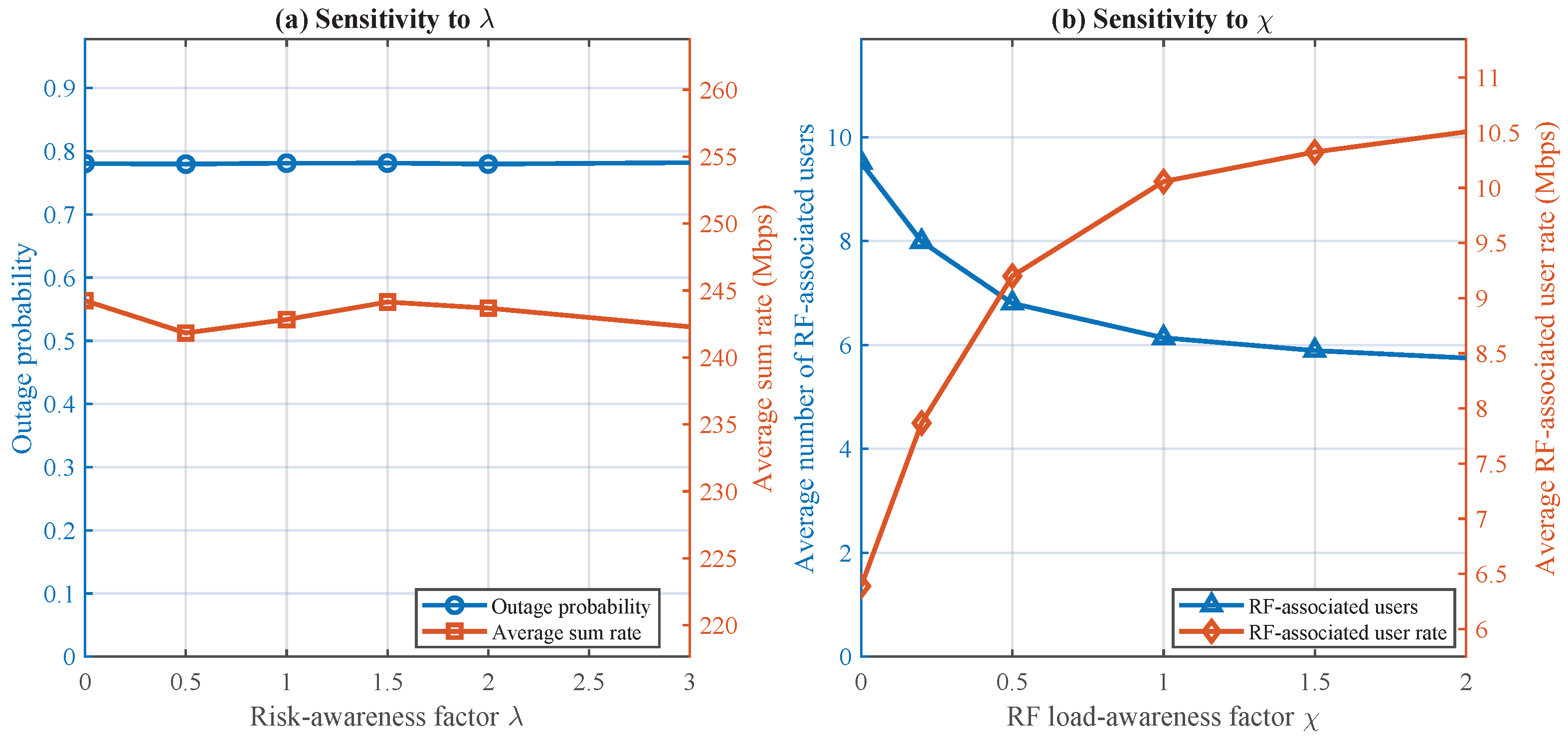
To further evaluate the robustness of the proposed resource allocation framework, the effects of the risk-awareness factor and the RF load-awareness factor are analyzed. These two parameters control different aspects of the proposed scheme. Parameter determines the sensitivity of VLC association and power allocation to optical blockage risk, while determines the strength of the penalty imposed on RF backup loading. Therefore, parameter sensitivity analysis is important for verifying whether the proposed scheme can maintain stable performance under different parameter settings.
In addition to parameter robustness, cases
and
are regarded as two ablation variants of the proposed scheme. Specifically,
represents the removal of blockage-risk awareness, and
represents the removal of RF load control. Therefore,
Figure 8 not only shows parameter sensitivity but also demonstrates the individual contribution of these two key components.
Figure 8a shows the impact of
on outage probability and average sum rate. When
is too small, the association decision becomes closer to an expected-rate-based selection, and the algorithm may still select VLC links with high blockage probability. As a result, the outage probability remains relatively high. As
increases to a moderate range, unreliable VLC links are penalized more strongly, and the outage probability decreases while the average sum rate remains stable. However, when
becomes too large, the algorithm may become overly conservative with respect to VLC usage, which can reduce the exploitation of high-capacity VLC links and slightly degrade the average sum rate.
Figure 8b shows the impact of
on RF backup load and the average rate of RF-associated users. When
is too small, the RF AP is used more aggressively as a fallback interface, resulting in more RF-associated users and possible RF congestion. As
increases to a moderate value, the RF backup load is effectively controlled, and the average rate of RF-associated users can be maintained at a more stable level. When
is too large, RF fallback becomes overly conservative, which may reduce the flexibility of the hybrid VLC/RF system in supporting blockage-affected users. Therefore, moderate values of
and
provide a practical balance among VLC reliability, RF backup usage, outage performance, and RF-associated user service quality.
This analysis demonstrates that both risk-awareness and RF load control are essential components of the proposed framework. The ablation variants highlight that removing either or degrades system performance, confirming the effectiveness of each design element.
5.9. Runtime and Scalability Evaluation
To complement the theoretical complexity analysis in
Section 4, the practical runtime of the proposed algorithm is further evaluated under different numbers of users. The average execution time is measured over repeated Monte Carlo realizations using the same simulation environment and parameter settings as those in
Table 1. The purpose of this experiment is to verify whether the proposed low-complexity heuristic remains scalable when the user number increases.
As shown in
Table 2, the execution time of the proposed scheme increases moderately with the number of users. This trend is consistent with the theoretical complexity analysis, where the dominant computational cost is associated with the LED-user utility evaluation and the illumination feasibility check. Since the proposed scheme avoids exhaustive enumeration over all possible VLC/RF association patterns, it remains suitable for repeated resource allocation in practical indoor hybrid VLC/RF networks.
6. Discussion
The simulation results show that the proposed risk-aware illumination-constrained resource allocation framework can improve the reliability and resource efficiency of hybrid VLC/RF indoor networks under random optical blockage. Different from communication-only allocation strategies, the proposed scheme jointly considers blockage risk, VLC/RF association, RF backup load, power allocation, and working-plane illumination feasibility. This joint consideration is important for practical VLC deployment because it ensures a more balanced tradeoff between communication performance and lighting quality.
The Bernoulli blockage model adopted in this work provides a tractable baseline to capture the randomness of LoS availability. While independent blockage events are assumed for simplicity, in practical indoor environments, optical blockages may exhibit temporal continuity and spatial correlation due to user mobility patterns, body orientation, and obstacle layout. This model allows for a system-level evaluation of blockage probability impacts on VLC/RF association and resource allocation, while more complex correlated or mobility-aware models can be incorporated in future work [
27,
28].
The illuminance distribution results confirm the necessity of incorporating illumination feasibility into the resource allocation process. The proposed scheme maintains a illumination compliance ratio on the working plane, while the illumination-unaware hybrid scheme fails to satisfy the required lighting condition in some regions. This indicates that communication-oriented power allocation alone may lead to locally insufficient illumination, even if the communication performance appears acceptable overall.
The outage probability results demonstrate the reliability advantage of the proposed risk-aware VLC/RF association strategy. Under severe blockage conditions with a blockage probability of , the proposed scheme reduces the outage probability to approximately , which is lower than those of the VLC-only scheme, the threshold-based VLC/RF switching scheme, and the illumination-unaware hybrid scheme. This improvement is mainly achieved because the proposed scheme does not select VLC links solely based on instantaneous channel quality but also incorporates blockage risk and RF load awareness.
The sum rate results further show that the proposed scheme can better exploit the complementary characteristics of VLC and RF links. When the number of users reaches 20, the proposed scheme achieves an average sum rate of approximately 277 Mbps, which is higher than the benchmark schemes. This result indicates that the RF link should not simply be used as a fixed alternative to VLC. Instead, it should be activated only when the VLC link becomes unreliable or cannot satisfy the required QoS. Such selective activation improves overall throughput without unnecessarily overloading the RF backup.
The RF backup load analysis further explains the internal mechanism behind the reliability and throughput improvements. Conventional threshold-based switching tends to transfer more users to the RF AP as the optical blockage probability increases. Although this reactive strategy can provide backup connectivity, excessive RF fallback may overload the RF interface and reduce the average rate of RF-associated users. In contrast, the proposed scheme keeps the number of RF-associated users within a more stable range and controls the fallback based on available resources.
Several physical-layer assumptions are made to simplify the analysis: (i) the Shannon-based rate formula for IM/DD VLC links approximates the achievable rate under Gaussian noise; (ii) the RF link is assumed to be noise-limited, neglecting inter-cell interference; (iii) the illumination model only considers basic Lambertian propagation and working-plane illuminance, without including color rendering, uniformity, or flicker. These simplifications enable the focus to remain on evaluating the proposed risk-aware resource allocation, while their impact can be analyzed in future experimental or more detailed simulation studies.
The energy efficiency results also verify the benefit of the proposed resource allocation strategy. As the blockage probability increases, all schemes suffer from performance degradation because more users experience VLC link interruption or channel deterioration. However, the proposed scheme maintains better energy efficiency than the benchmark schemes. This is because it reduces inefficient RF fallback and allocates VLC/RF power according to both channel quality and blockage risk. In addition, the illumination-feasible power allocation ensures that energy is not wasted on over-lighting.
The results under different minimum illuminance thresholds further reveal the communication–illumination tradeoff in VLC-based indoor systems. A stricter illumination requirement reserves more optical power for lighting, which reduces the flexibility of VLC communication power allocation. Therefore, the average sum rate decreases as the minimum illuminance threshold increases. Nevertheless, the proposed scheme still maintains a higher sum rate than the benchmark schemes under different illumination requirements.
Overall, the proposed framework provides a practical tradeoff among communication reliability, system throughput, energy efficiency, RF backup service quality, and illumination feasibility. Different from a simple combination of VLC/RF switching and illumination checking, the proposed framework couples blockage-risk evaluation, RF backup load control, and illumination-feasibility adjustment within a unified resource allocation procedure. It should also be noted that the proposed algorithm is designed as a low-complexity heuristic rather than a global optimal solver. Although exhaustive search can theoretically find the optimal solution, its computational complexity grows exponentially with the number of users, making the proposed scheme more practical for multi-user indoor VLC/RF systems.
7. Conclusions
This paper investigated a risk-aware illumination-constrained resource allocation framework for hybrid VLC/RF indoor networks under random optical blockage. A unified system model was developed by jointly considering Lambertian optical propagation, random optical blockage, RF backup transmission, QoS requirements, and working-plane illumination constraints. Based on this model, a joint user association and power allocation problem was formulated, and a low-complexity resource allocation scheme was proposed by incorporating risk-adjusted VLC service utility, load-aware RF backup utility, and illumination feasibility adjustment. The proposed scheme can selectively activate RF backup while avoiding excessive RF fallback and preserving the required lighting level.
The simulation results demonstrated that the proposed scheme improves communication reliability, system throughput, energy efficiency, RF backup service quality, and illumination feasibility. Under severe blockage conditions, the proposed scheme reduced the outage probability to approximately , compared with for VLC-only transmission and for threshold-based VLC/RF switching. For a 20-user network, the proposed scheme achieved an average sum rate of approximately 277 Mbps. In addition, the proposed scheme maintained a illumination compliance ratio on the working plane and achieved higher energy efficiency than the benchmark schemes. The RF backup load analysis further showed that the proposed scheme can control the number of RF-associated users and maintain the service quality of RF-associated users under increasing blockage probability.
Future work will further extend the current framework by considering more realistic blockage and mobility models, such as temporally correlated blockage, spatially correlated human shadowing, and dynamic user movement. In addition, more practical RF interference models, multi-cell VLC/RF coexistence, and adaptive parameter selection for risk-awareness and RF load control can be investigated to improve robustness in larger and more dynamic indoor environments.