1. Introduction
In recent years, metasurfaces have attracted widespread attention owing to their planar architecture and their remarkable capability for manipulating light properties at the subwavelength scale, offering a promising route toward ultracompact and highly integrated photonic systems [
1,
2]. By enabling precise and flexible control of light, metasurfaces have facilitated the realization of a variety of planar optical components, such as polarization converters, metalenses, and holograms [
3,
4,
5,
6,
7]. Compared with conventional optical elements, metasurfaces exhibit significant advantages in terms of structural compactness and functional versatility. As research continues to advance, multifunctional metasurfaces capable of simultaneously controlling multiple degrees of freedom have been extensively developed [
8,
9,
10,
11]. In particular, the synergistic manipulation of polarization and phase has emerged as an effective strategy for enhancing the functionality and information capacity of metasurface-based systems [
12,
13,
14,
15]. By exploiting anisotropic responses and phase modulation, multiple optical functionalities, such as polarization multiplexing and multi-channel information encoding, can be integrated within a single platform [
16,
17,
18,
19].
Among these, multifunctional metalenses, as representative implementations of metasurface-based wavefront engineering, provide an effective platform for parallel optical manipulation and multidimensional information processing [
20,
21,
22,
23]. By encoding multiple phase profiles into a single metasurface, functionalities such as beam splitting, multi-plane imaging, and multifocal focusing can be simultaneously realized, thereby enhancing the functional density of optical systems [
24,
25,
26,
27,
28]. In particular, multifocal metalenses, which enable the generation of multiple focal spots at predefined spatial locations, have attracted increasing interest for applications in parallel imaging, optical information processing, and integrated photonics [
29,
30,
31,
32]. To realize such functionalities, various design strategies have been proposed, including spatial-domain multiplexing approaches and polarization-dependent phase encoding schemes [
33,
34,
35,
36]. The former introduces distinct functional responses into different spatial regions, whereas the latter exploits polarization-dependent phase modulation to enable multifunctional integration at the same spatial location. These approaches allow multiple focusing behaviors to be incorporated within a single metasurface platform and provide additional degrees of freedom for tailoring the spatial distribution and optical properties of focal spots. Despite these advances, multifunctional multifocal metalenses still face several challenges, including reduced effective aperture utilization and decreased focusing efficiency caused by spatial multiplexing, as well as the limited polarization-manipulation capability of many polarization-dependent approaches that mainly rely on static polarization-selective responses or phase-only modulation. Although cascaded and bilayer metasurface architectures have recently demonstrated enhanced flexibility for multifunctional optical manipulation through additional interlayer coupling and anisotropic optical responses [
24,
37,
38,
39,
40,
41], most previously reported designs do not provide a deterministic polarization-rotation relationship between the incident and output polarization states under fixed structural parameters. As a result, simultaneously achieving controllable multifocal manipulation and stable polarization rotation within a compact bilayer metasurface platform remains challenging.
In this work, a polarization-tunable multifocal metalens is proposed based on a bilayer metasurface with integrated polarization rotation functionality. By treating the interlayer rotation angle difference as a key degree of freedom, a rigorous theoretical model is established. A bilayer metasurface composed of hydrogenated amorphous silicon (a-Si:H) is designed, where each unit cell consists of two half-wave plate-like a-Si:H rectangular nanopillars separated by a glass spacer. At the operating wavelength, an arbitrary input polarization state with a well-defined azimuthal orientation (namely linearly and elliptically polarized light) can be continuously rotated, with the rotation angle directly determined by the interlayer rotation difference. For circularly polarized light, it merely introduces a geometric phase factor without altering the spin direction of the polarization state. When the rotation difference is fixed, the major angle of the output polarization maintains a deterministic relationship with that of the incident light, equal to twice the interlayer rotation difference. Furthermore, by introducing a tailored propagation phase profile, the independent manipulation of polarization and phase is achieved. Leveraging this capability, a polarization-tunable multifocal metalens is designed and verified. By varying the incident polarization angle and employing analyzers with different orientations, it is demonstrated that the polarization states of focal spots at the same spatial positions can be dynamically switched. Compared with previously reported multifunctional bilayer metasurfaces, the proposed design enables simultaneous polarization rotation and polarization-dependent multifocal manipulation through the interlayer rotation angle difference, providing enhanced polarization controllability and multifunctional integration capability within a compact architecture.
2. Results and Discussion
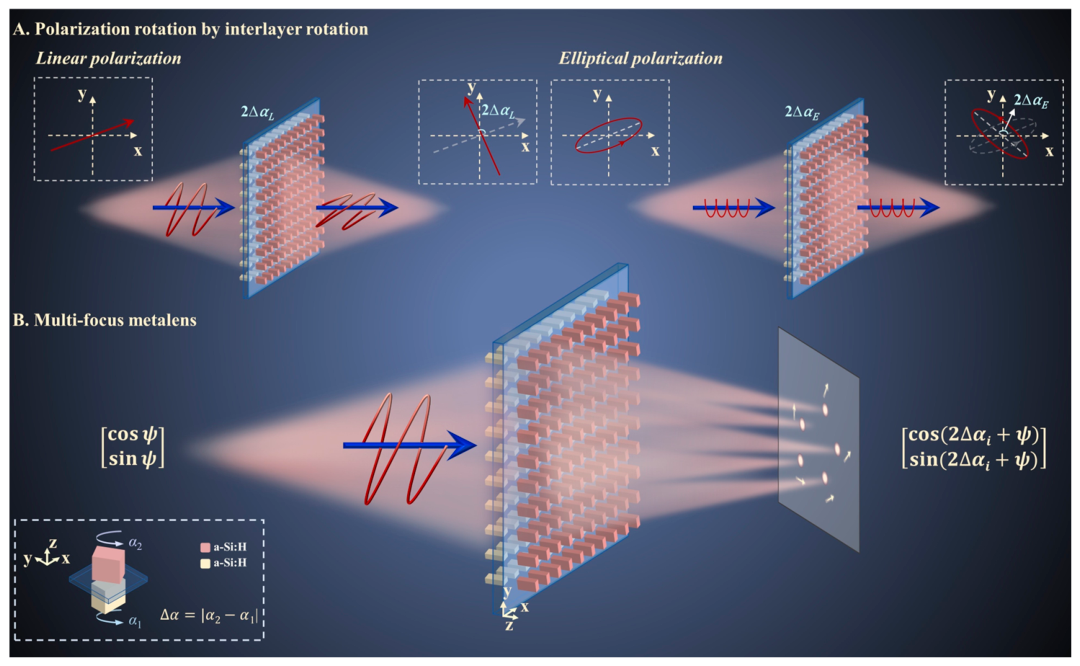
Figure 1 schematically illustrates the proposed bilayer cascaded metasurface that consists of two half-wave plate-like rectangular nanopillars separated by a glass spacer. Upon incidence of linear or elliptical polarizations, the transmitted light polarization will be rotated by a fixed angle that is solely determined by the interlayer rotation difference. By further incorporating multiple nanopillars with carefully engineered phase delays and interlayer rotation differences, a multifocal metalens can be realized, enabling the generation of multiple focused beams with distinct polarization states. Toward the goal, we first conduct a theoretical analysis using the Jones matrix formalism. For a rectangular nanopillar with a phase retardation of π between its fast and slow axes, the corresponding Jones matrix can be expressed as:
where |t
xx|(|t
yy|) and φ
xx(φ
xx + π) denote the transmission amplitudes and phases along the x (y) axis, respectively, R represents the rotation matrix, and α is the angle between the fast axis of the nanopillar and the x-axis. In general, the transmission amplitudes are assumed to be unity, i.e., |t
xx| = |t
yy| = 1, under which the nanopillar can be regarded as a nano half-wave plate (nano-HWP). In the proposed design, both metasurface layers consist of nano-HWPs. The Jones matrices and rotation angles of the upper and lower nanopillars are denoted as J
1, J
2 and α
1, α
2, respectively. Accordingly, the overall Jones matrix of the bilayer metasurface can be written as:
where φ
xx1 + φ
yy1 represents the accumulated transmitted phase, and α
2 − α
1 denotes the rotation angle difference between the two layers, which serves as a critical degree of freedom in the present design. For convenience, this rotation difference is denoted as ∆α, and the simplified expression of the bilayer metasurface is derived to be:
To provide a more intuitive description of the polarization rotation capability, the Poincaré sphere is employed for further analysis. Any polarization state can be represented as a point on the Poincaré sphere with coordinates (2χ, 2ψ), where χ and ψ denote the ellipticity and the orientation angle of the polarization state, respectively. Accordingly, the Jones vector of an arbitrary incident polarization ξ can be expressed as:
The light transmitting through the proposed bilayer metasurface can be written as:
According to Equations (4) and (5), the transmitted light retains the same ellipticity χ, while its orientation angle is rotated to ψ + 2∆α. This indicates that the polarization state undergoes a rotation with an angle equal to twice the nanopillars’ rotation difference. Meanwhile, the spin state and ellipticity remain unchanged during propagation. Notably, when the incident light is circularly polarized (taking left-handed circular polarization as an example, i.e., χ = π/4), the transmitted field can be expressed as:
It can be observed from Equation (6) that only the transmitted phase is modified, carrying contributions from both the nanopillar geometry and the interlayer rotation difference, while the polarization state remains unchanged. Therefore, as described by Equation (5), for polarization states with a well-defined azimuthal orientation, the incident polarization is rotated after passing through the designed bilayer metasurface. Moreover, the azimuthal angle of the output light maintains a relationship of exactly twice the rotation angle between the two layers with respect to that of the input.
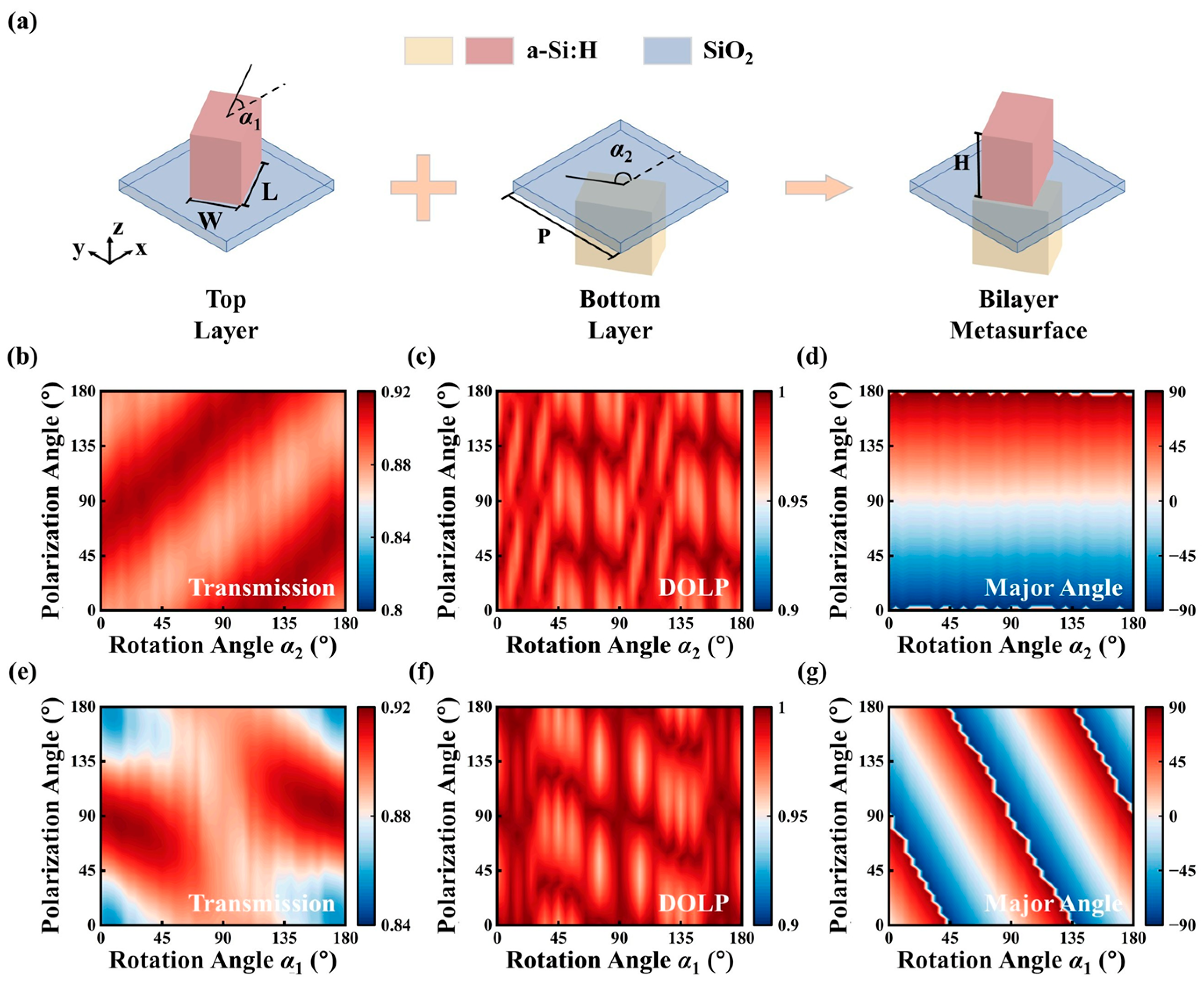
Simulations of the proposed bilayer metasurface are subsequently performed using the finite-difference time-domain (FDTD) method. Hydrogenated amorphous silicon (a-Si:H) is selected as the material for the nanopillars due to its high refractive index and low absorption loss at a selected operating wavelength of 690 nm. The unit cell of the bilayer metasurface consists of a dielectric–glass–dielectric stack from top to bottom, as illustrated in
Figure 2a. The lattice period is set to 280 nm, the nanopillar height to 340 nm, and the spacer thickness to 350 nm. In the simulations, periodic boundary conditions were applied along the x- and y-directions, while perfectly matched layer (PML) boundary conditions were employed along the z-direction. The simulation region in the lateral direction consisted of a single unit-cell period. Along the propagation direction, the incident source and field monitor were positioned approximately one wavelength below and above the bilayer metasurface, respectively, to ensure sufficient propagation space and stable field evolution within the simulation domain. A nonuniform mesh with a mesh accuracy of 2 was adopted, and a local mesh-refinement region with a minimum mesh size of 5 nm was applied around the bilayer metasurface to accurately resolve the nanostructure geometry. The simulation time was set to 5000 fs, and the auto shutoff threshold was set to 10
−5 to ensure numerical convergence. According to the theoretical analysis, both layers are designed as half-wave plate-like rectangular nanopillars. By sweeping the length (L) and width (W) of the nanopillars, the optimized geometric parameters for polarization rotation are obtained as L = 146 nm and W = 98 nm. Since the objective is to verify polarization rotation, identical geometrical dimensions are adopted for the nanopillars in both layers.
After determining the geometric parameters of the nanopillars, the polarization rotation functionality is further verified. According to the theoretical analysis, under both linearly and elliptically polarized illumination, the bilayer metasurface can rotate the incident polarization state by an angle equal to twice the interlayer rotation difference. Taking linearly polarized light as an example, where the ellipticity χ = 0, substitution into Equation (5) yields a transmitted field that remains linearly polarized with its principal axis rotated to 2∆α + ψ, corresponding to a counterclockwise rotation of 2∆α relative to the incident polarization. When the rotation difference is fixed at 45°, the output polarization angle becomes 90° + ψ, indicating that any incident linear polarization is converted into its orthogonal counterpart after transmission through the metasurface. In the numerical simulations, when the bilayer nanopillars are synchronously rotated with a fixed rotation difference of 45°, the transmission, degree of linear polarization (DOLP), and output polarization major angle under arbitrarily linearly polarized incidence are shown in
Figure 2b–d. Here, DOLP serves as a key parameter for characterizing linear polarization, defined as DOLP = 1 − 2 × γ/(1 + γ2), where γ represents the ratio of the major to minor axes of the polarization ellipse. A DOLP value of 1 corresponds to perfectly linearly polarized light, while a value of 0 indicates circular polarization. As observed in
Figure 2b,c, the transmitted light exhibits both high efficiency and strong linear polarization. Owing to the fixed 45° rotation difference during synchronous rotation, the output major angle in
Figure 2d consistently maintains a 90° offset relative to the incident polarization. Moreover, once the rotation difference is fixed, synchronous rotation of the two layers does not alter the polarization state of the transmitted light. Subsequently, when the interlayer rotation angle difference is continuously varied, the output polarization major angle exhibits a linear dependence with a double-period characteristic under a fixed linearly polarized incidence. In the simulations, by fixing α
1 = 0 and varying α
2, the transmitted light remains highly efficient and linearly polarized, as shown in
Figure 2e,f. The corresponding polarization angle in
Figure 2g demonstrates a clear double-period linear relationship with respect to the rotation difference.
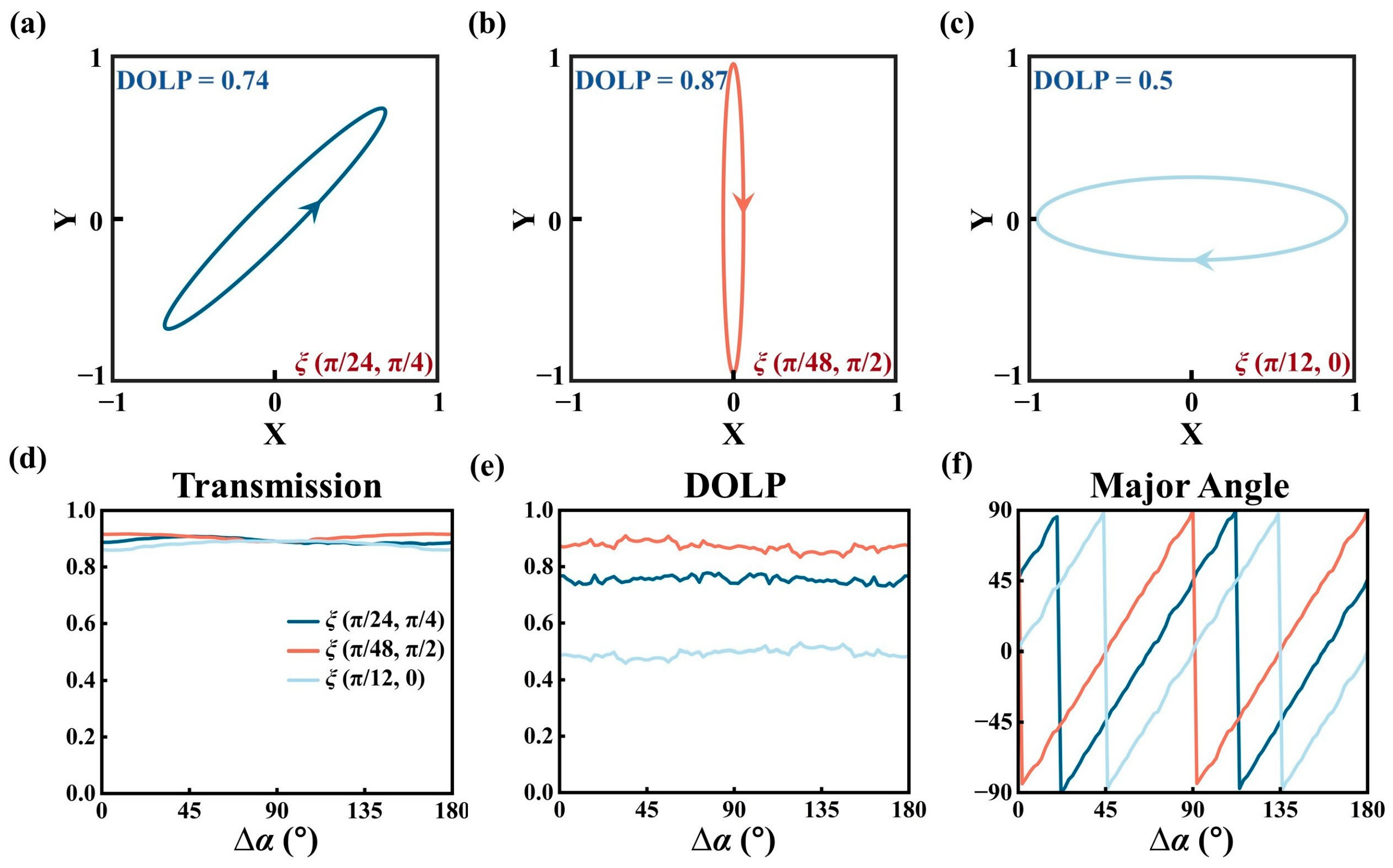
In addition, the transmission properties under circularly and elliptically polarized incidences are also investigated. Three elliptically polarized beams with different ellipticities and orientation angles are selected, characterized by ξ (π/24, π/4), (b) ξ (π/48, π/2), (c) ξ (π/12, 0), respectively. The corresponding polarization ellipses are shown in
Figure 3a–c, with degrees of linear polarization (DOLP) of 0.74, 0.87, and 0.5. These elliptically polarized beams are individually incident onto the metasurface, and the transmitted fields are characterized in terms of transmission, DOLP, and polarization major angle as functions of the interlayer rotation difference. The simulation results are presented in
Figure 3d–f. As shown in
Figure 3d, the bilayer metasurface exhibits high transmission efficiency for all three incident polarization states. From the DOLP distributions in
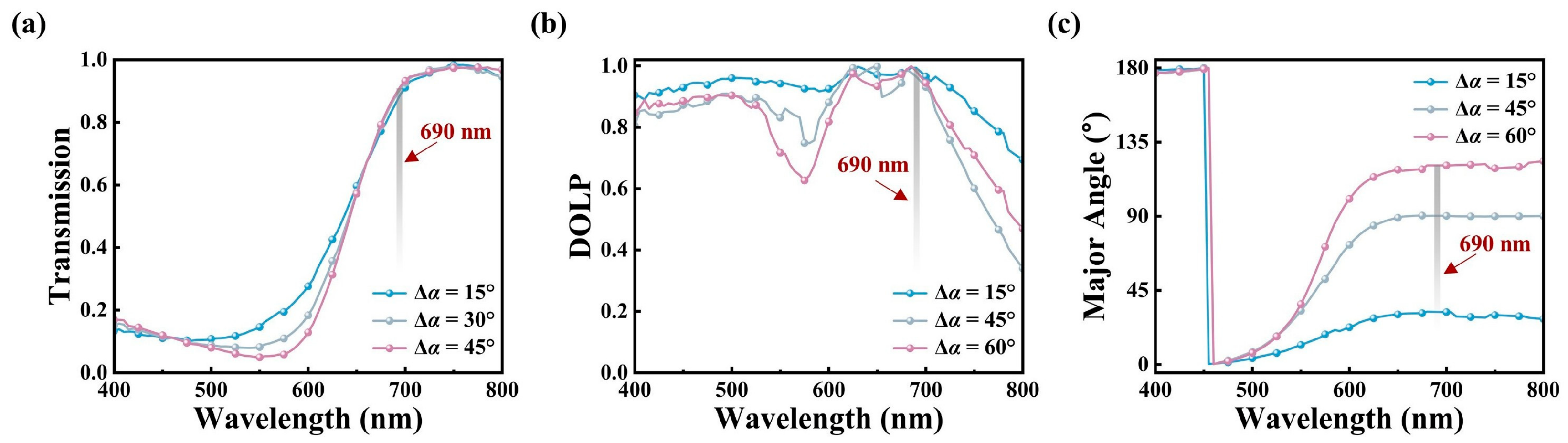
Figure 3e, it can be observed that the DOLP of the transmitted light remains nearly identical to that of the incident light and shows negligible variation with the rotation difference. Although the three incident polarization states possess different orientation angles, resulting in distinct absolute values of the output polarization orientation under varying rotation differences, their evolution trends are consistent. Specifically, the output polarization orientation maintains a deterministic relationship with the incident polarization, following a rotation of 2∆α, in agreement with the theoretical prediction described by Equation (5). These results confirm that the proposed bilayer metasurface enables robust polarization rotation for both linear and elliptical polarization states, offering a novel strategy for polarization control in photonic devices. In addition, detailed investigations were carried out on the broadband response, spacer-layer thickness dependence, and alignment tolerance of the proposed bilayer metasurface. Spectral analyses of the transmitted optical fields over the wavelength range from 400 to 700 nm reveal that the metasurface operates efficiently only within a relatively narrow spectral window around the designed wavelength. A comprehensive discussion of the spectral characteristics is provided in
Appendix A. Subsequently, the influence of the SiO
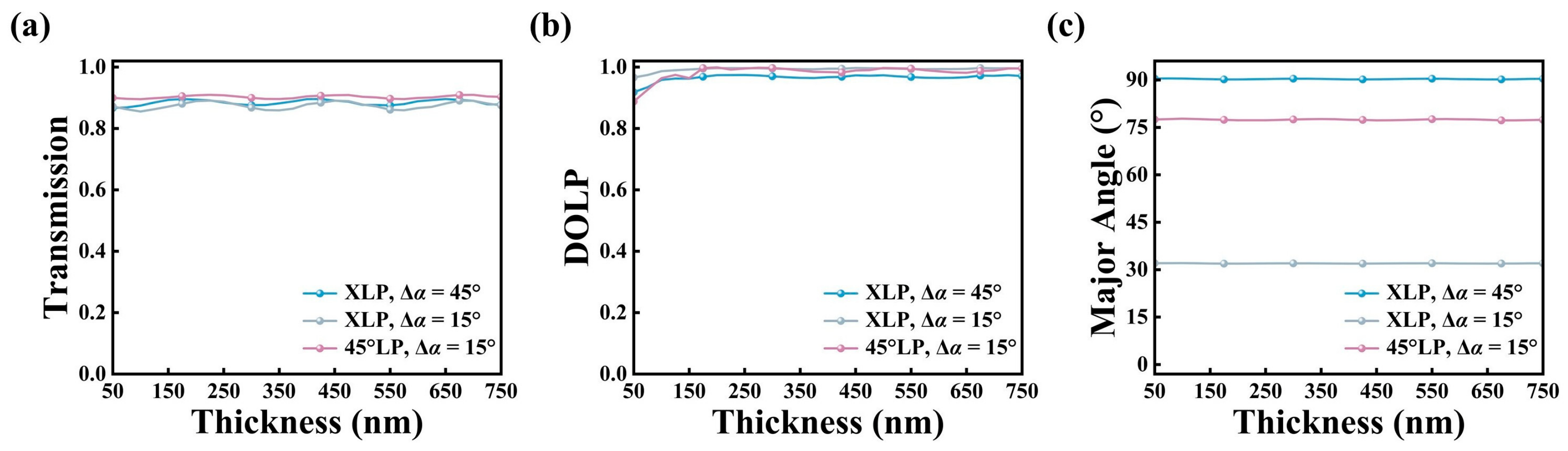
2 spacer-layer thickness on the metasurface performance was systematically examined. The results demonstrate that a spacer thickness of 350 nm lies within the weak interlayer-coupling regime, thereby effectively suppressing undesired coupling effects between the upper and lower meta-atoms during optical-field manipulation. Detailed analyses and corresponding simulation results are presented in
Appendix B.
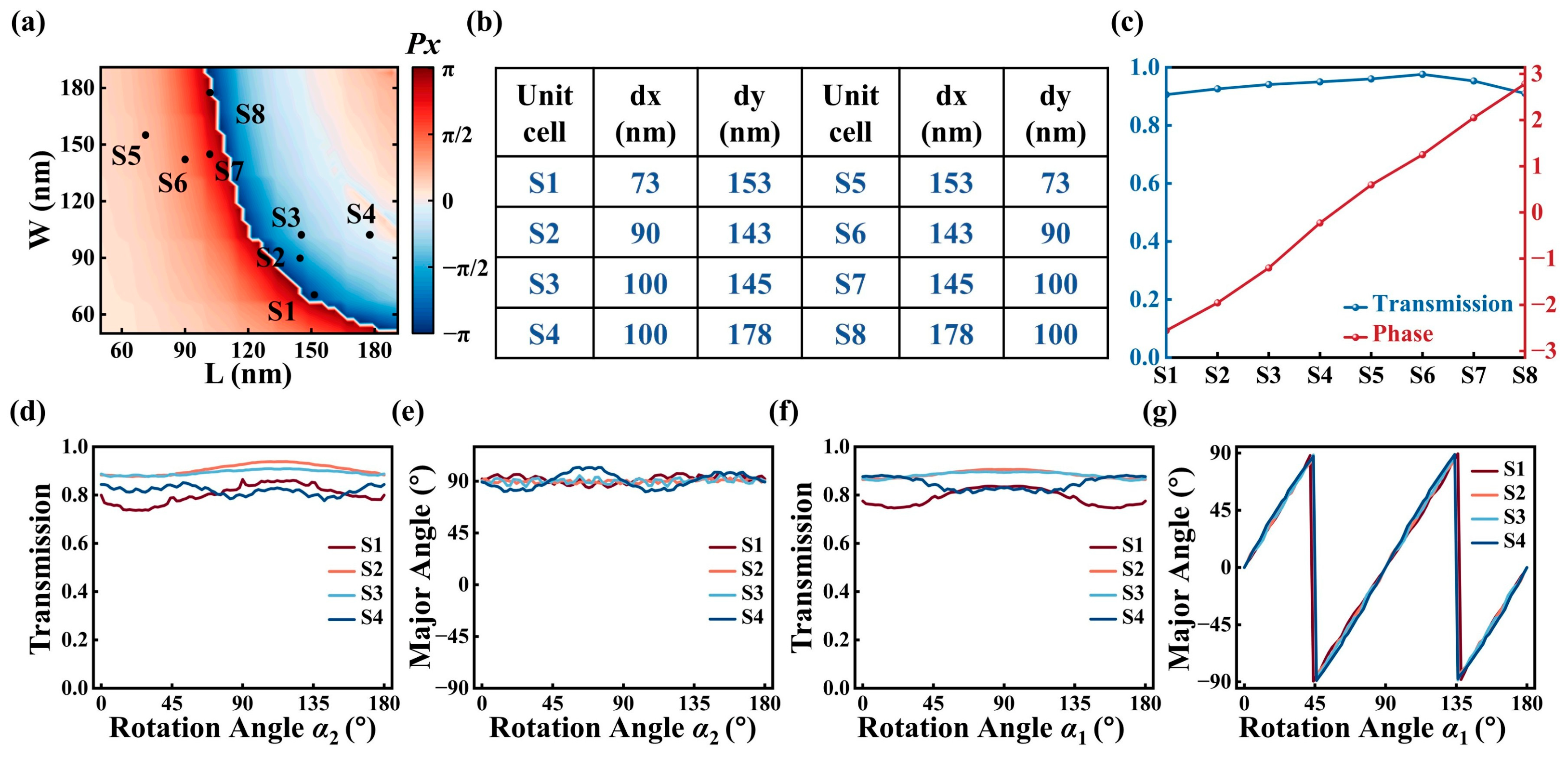
Furthermore, as indicated by Equation (5), by selecting a series of meta-atoms that provide a constant phase gradient and complete 2π phase coverage, phase modulation can be achieved in addition to polarization rotation. In the simulations, the phase response is obtained by sweeping the nanopillar dimensions (L, W), as shown in
Figure 4a. Eight representative nanopillars (s1–s8), marked by black dots, are selected to realize phase control, and their detailed geometrical parameters are presented in
Figure 4b. The corresponding transmission and phase responses under x-polarized incidence are shown in
Figure 4c, demonstrating high transmission efficiency and a linear phase increment with a step of π/4. The polarization rotation capability of these unit cells is then verified. Since all selected nanopillars exhibit a π phase difference between their principal axes, only four consecutive unit cells need to be examined. Taking s1–s4 as examples, numerical simulations are performed under x-polarized incidence using two approaches: synchronous rotation with a fixed rotation difference of 45°, and continuous variation in the rotation difference. The corresponding results are presented in
Figure 4d–g. Specifically,
Figure 4d,e show the transmission and output polarization major angles for synchronous rotation, while
Figure 4f,g present the results for continuously varying rotation angle differences. These results confirm that the bilayer metasurface composed of these nanopillars enables polarization rotation in addition to phase modulation.
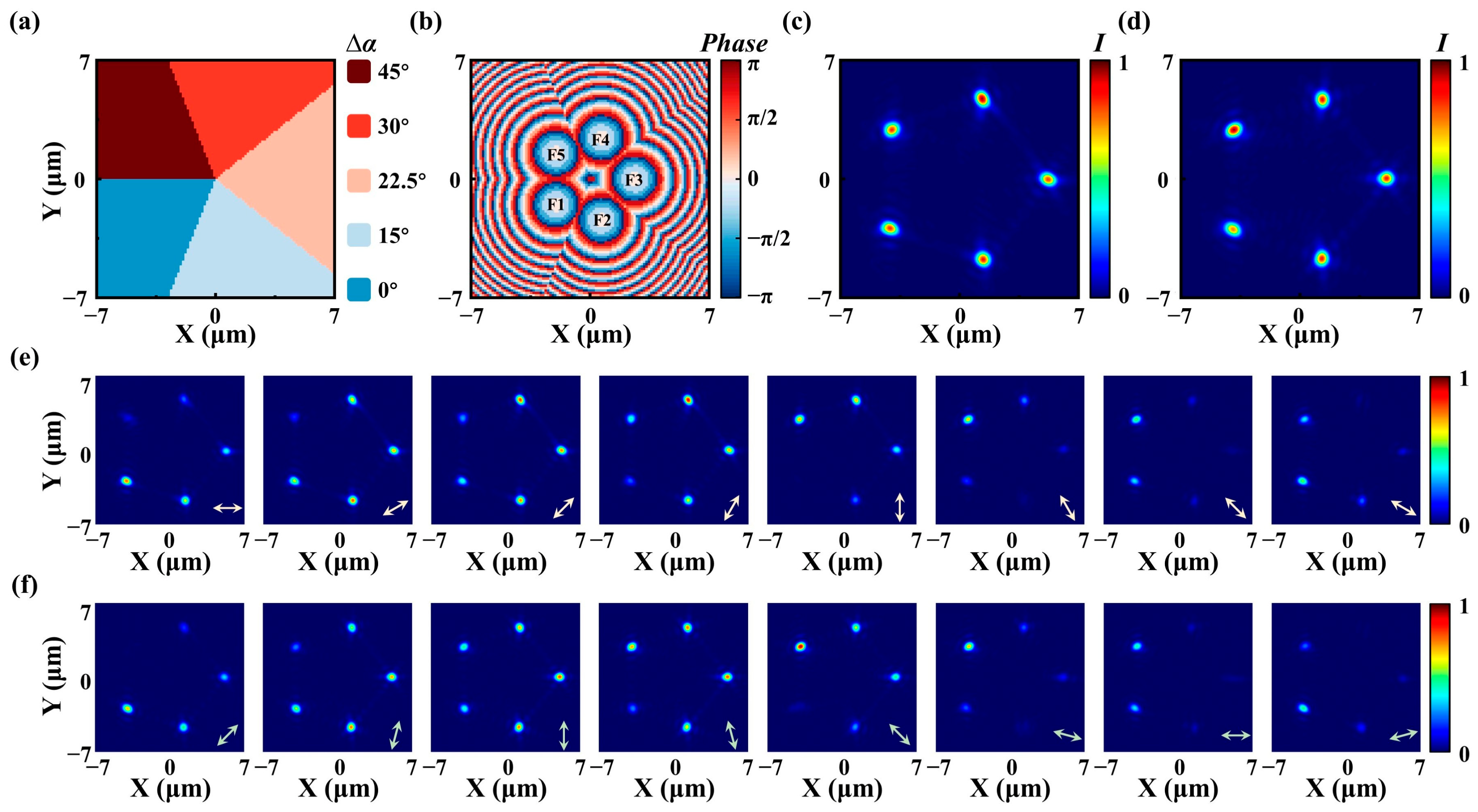
Based on the independent manipulation of polarization rotation and phase enabled by the bilayer metasurface, a polarization-dynamically tunable multifocal metalens is further designed. The detailed design procedure is described as follows. The bilayer metasurface region is divided into five areas with an equal number of nanopillars, and the interlayer rotation angle differences in these regions are arranged as shown in
Figure 5a, corresponding to 0°, 15°, 22.5°, 30°, and 45°, respectively. For normally incident light, the required focusing phase profile can be expressed as:
where x, y denote the spatial coordinates of the nanopillars, λ is the incident wavelength, f is the focal length, (x
0, y
0) represents the focal position. In the simulations, both the upper and lower metasurfaces are designed with 100 × 100 pixels, corresponding to a physical size of 28 × 28 μm
2. The focal length is set to f = 10 μm, and the radius of the metalens is R = 14 μm. Five focal spots, denoted as F1–F5, are predefined at positions (−4, −3), (1.5, −4.75), (5, 0), (1.5, 4.75) and (−4, 3) (in μm), respectively, to facilitate observation within the field of view. The required phase profile for multifocal focusing is calculated using Equation (7) and matched with the discrete phase responses provided by the selected meta-atoms. The resulting phase distribution is shown in
Figure 5b, completing the design of the metasurface array for multifocal focusing.
In the numerical verification, x-polarized and 45° linearly polarized light are employed to evaluate the multifocal focusing performance and polarization tunability of the proposed metalens. The simulated intensity distributions at the focal plane are presented in
Figure 5c and
Figure 5d, respectively. Under both incident conditions, five well-defined focal spots are clearly formed at the designed positions. However, the polarization states associated with each focal spot cannot be directly identified from the intensity distributions alone. To further analyze the polarization characteristics, analyzers with different orientations are inserted into the output path, and the polarization states are determined based on the intensity variations in the focal spots. The corresponding results are shown in
Figure 5e,f. Under x-polarized incidence, according to the predefined rotation angle distribution, focal spot F1 exhibits x-polarization, while F5 corresponds to y-polarization. When a 0° analyzer is inserted, the intensity of F1 remains unchanged, whereas the intensities of F2–F5 gradually decrease, with F5 becoming nearly invisible. Conversely, inserting a 90° analyzer leads to the opposite behavior, confirming that F1 and F5 carry x- and y-polarized light, respectively. When a 45° analyzer is employed, focal spot F3 exhibits the highest intensity, whereas it disappears when the analyzer is rotated to 135°, indicating that F3 carries 45° linear polarization. The polarization states of the remaining focal spots can be determined in a similar manner. A similar analysis is performed for the 45° linearly polarized incidence. Notably, when the incident polarization changes from x-polarization to 45° linear polarization, the polarization states associated with the focal spots at the same spatial positions are correspondingly rotated. For example, focal spot F1 exhibits maximum intensity under a 0° analyzer for x-polarized incidence, confirming its x-polarized characteristic. Under 45° linearly polarized incidence, however, its intensity is significantly suppressed under a 0° analyzer and reaches a maximum under a 45° analyzer. By analyzing the intensity evolution of all focal spots with different analyzer orientations under different incident polarization states, it is confirmed that the polarization information carried by each focal spot can be dynamically tuned. Therefore, the polarization states of focal spots at fixed spatial locations can be flexibly switched solely by adjusting the polarization angle of the incident light.
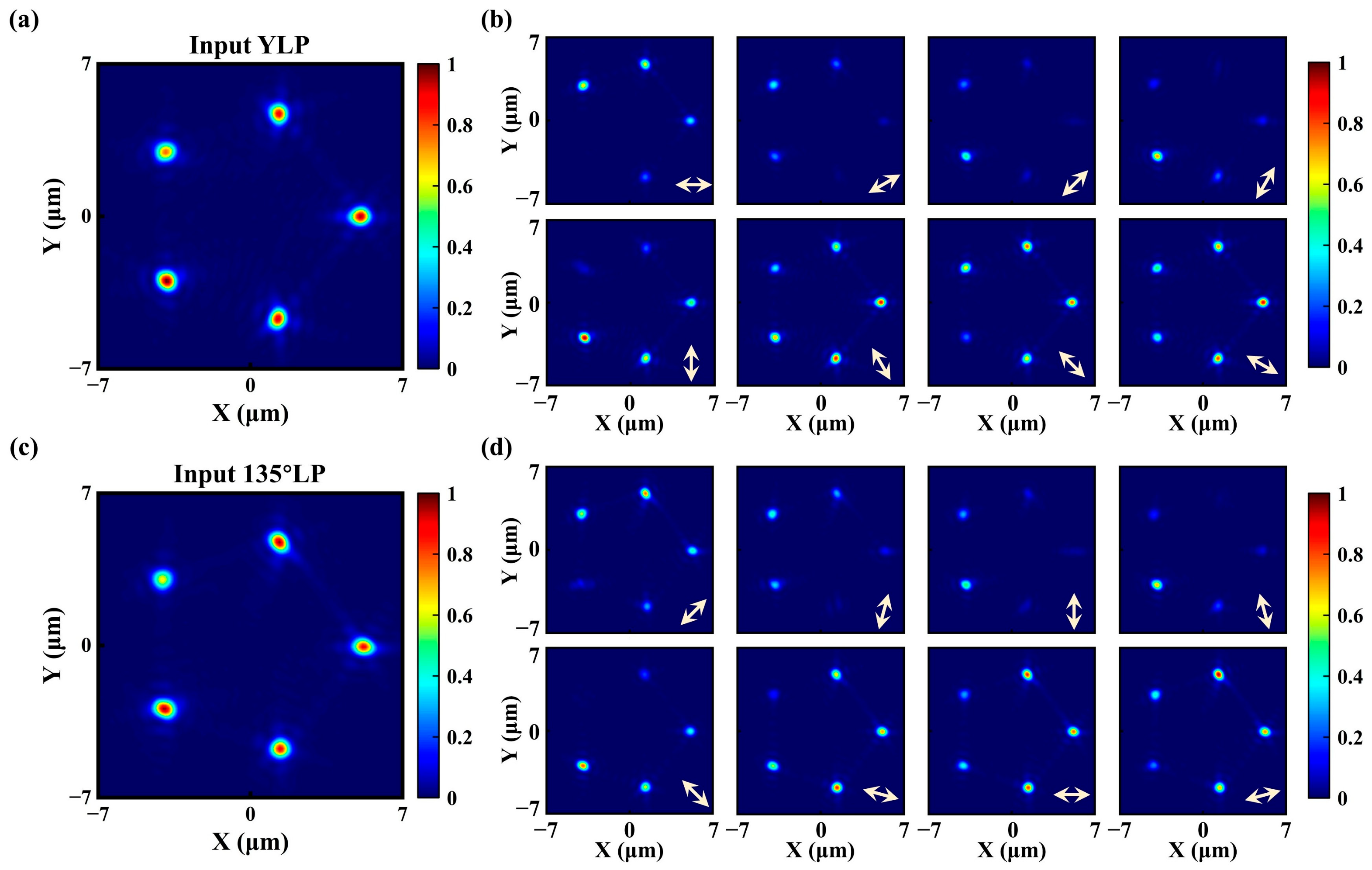
Furthermore, y-linearly polarized (YLP) and 135° linearly polarized (135°LP) light are considered to verify the polarization states of focal spots at the same spatial locations under different incident conditions. The incident polarization is set to YLP and 135°LP, and the corresponding results are shown in
Figure 6. Similarly, both cases produce five well-defined focal spots at the designed positions at the focal plane, as shown in
Figure 6a,c. When analyzers with different orientations are inserted into the output path, the focal spot intensities exhibit distinct modulation behaviors, as illustrated in
Figure 6b,d. Taking focal spot F2 as an example, it carries polarization angles of 30° and 75° under x-polarized and 45° linearly polarized incidence, respectively, as discussed in the main text. Under YLP and 135°LP, F2 exhibits polarization angles of 120° and 165°, respectively, as evidenced by the results in
Figure 6b,d. To further quantitatively evaluate the polarization selectivity and polarization-carrying capability of the proposed bilayer metasurface, the polarization purity and extinction ratio (ER) at each focal spot were additionally calculated. The detailed definitions, numerical results, and corresponding analyses are provided in
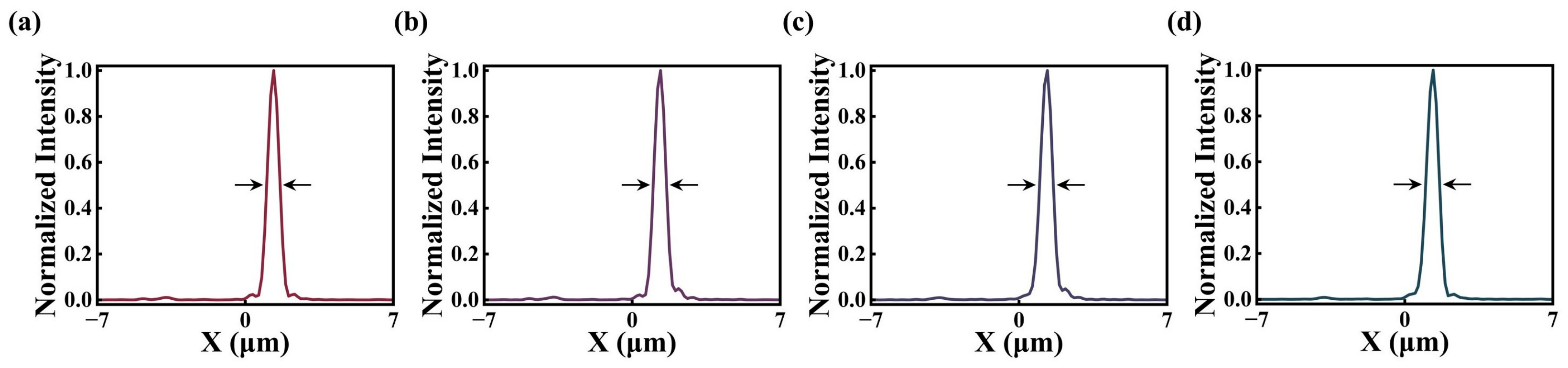
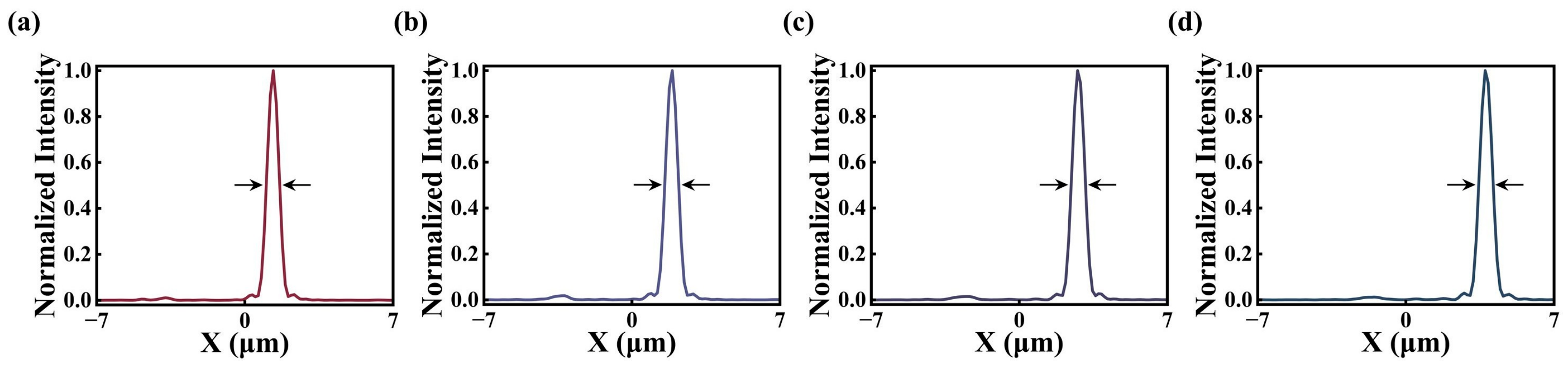
Appendix C. The obtained results confirm that the target polarization component remains dominant at all focal spots under different incident polarization conditions. In addition, the focusing performance of the proposed metalens is systematically evaluated through the full width at half maximum (FWHM) and focusing efficiency under different incident polarization states, as presented in
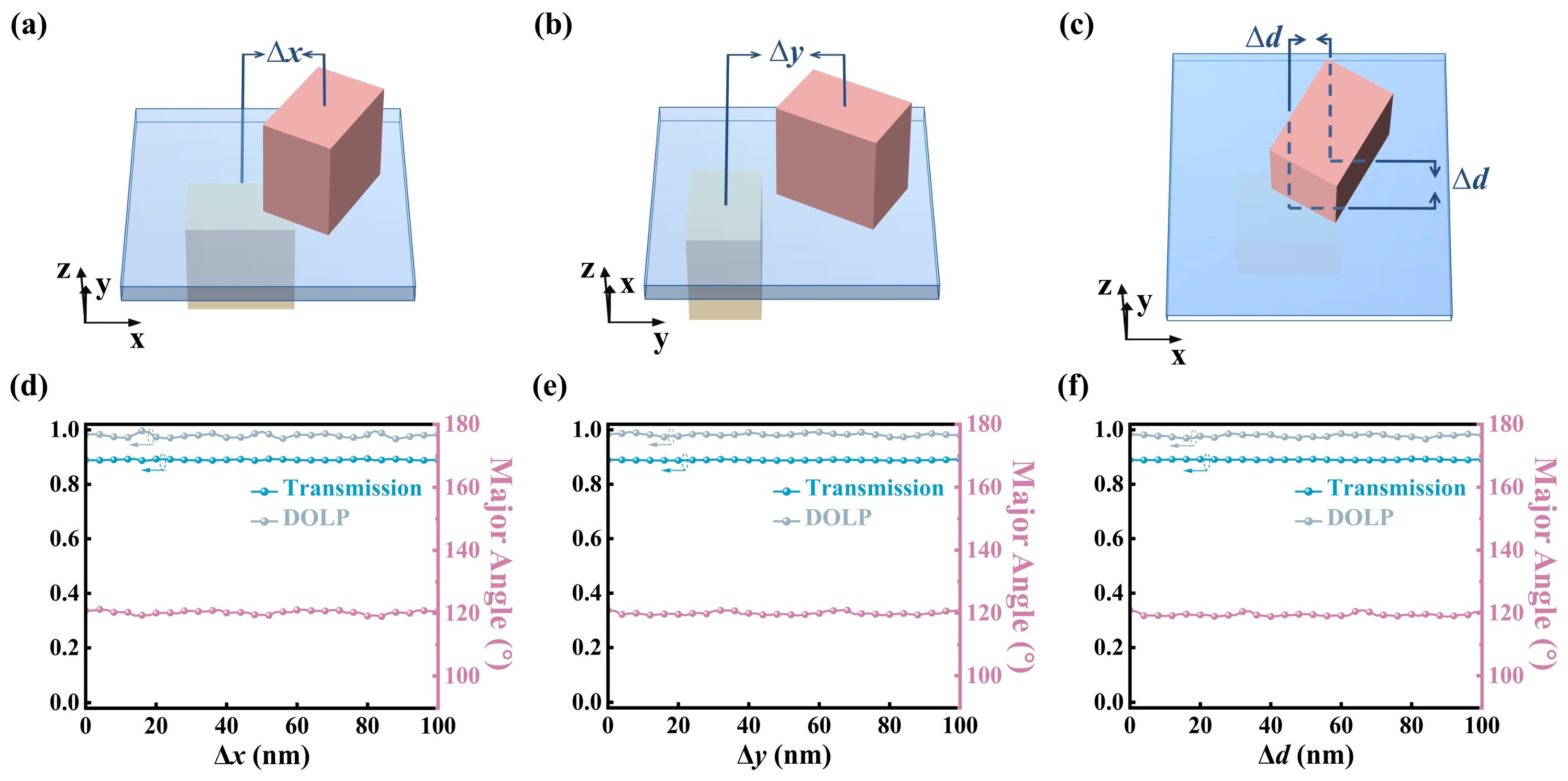
Appendix D. The calculated results indicate that both the FWHM and focusing efficiency remain relatively stable under different polarization incidences, demonstrating the robustness of the focusing performance. Furthermore, the lateral alignment tolerance of the bilayer metasurface under practical fabrication conditions is investigated. The results indicate that the metasurface can still maintain high-quality polarization-rotation performance when the relative lateral misalignment remains below 100 nm. A detailed discussion of the alignment-tolerance analysis is provided in
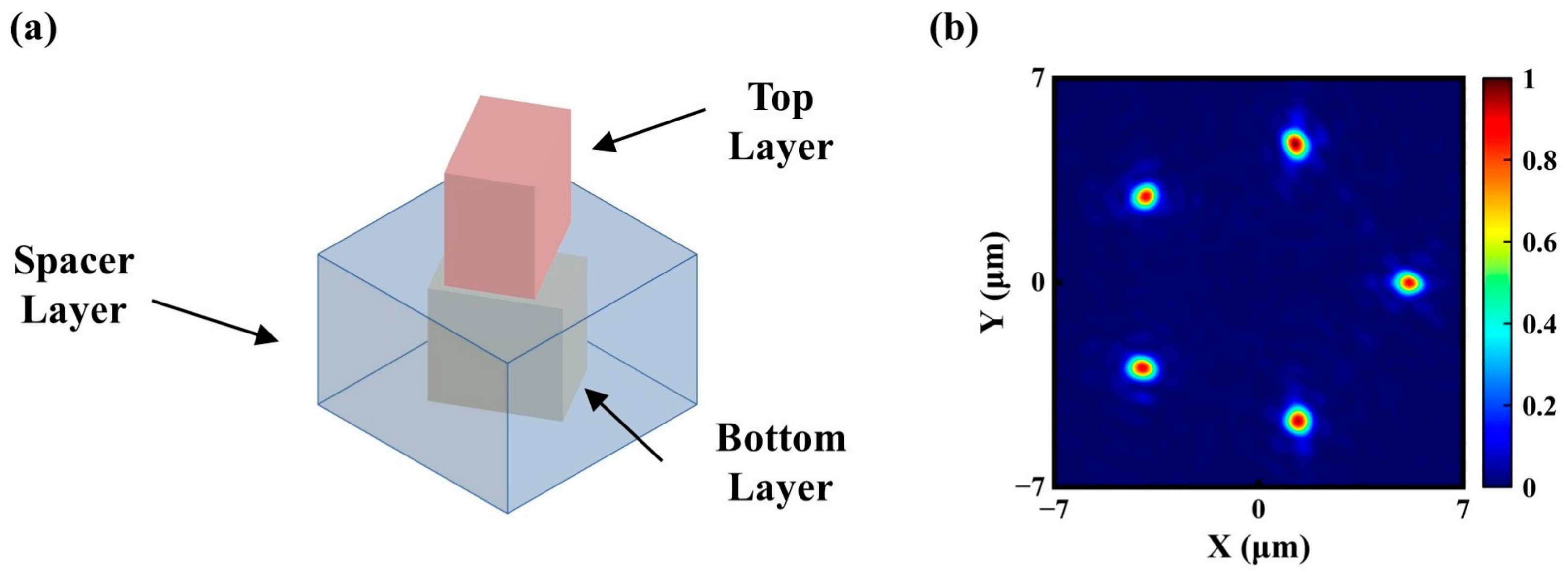
Appendix E. Practical fabrication considerations of the bilayer metasurface are also taken into account. Owing to the relatively high fabrication complexity of the bilayer architecture, the bottom-layer nanostructures are designed to be embedded within the glass substrate, while the top-layer nanostructures are deposited on the glass spacer during fabrication. Corresponding simulation studies are further carried out to evaluate the feasibility of this fabrication strategy, and the detailed schematic illustrations and simulation results are provided in
Appendix F. Collectively, these results further verify the generality and robustness of the proposed bilayer polarization-rotating metasurface for realizing polarization-tunable multifocal metalenses. The proposed design provides a promising strategy for multifunctional optical-device integration and advanced multidimensional light-field manipulation.