


Abstract
We study a 1D model of a diffraction-mediated self-structuring instability which can occur when a Bose–Einstein condensate is illuminated by a pump laser and its reflection from a single feedback mirror. We carry out a linear stability analysis and, using numerical simulations, investigate the dynamics of the self-structuring process. Two dynamical regimes are identified: one in which the system behaves as a continuous space-time crystal oscillating between two states (one spatially uniform and one spatially periodic) and another where many condensate momentum states are involved and the condensate density develops chevrons which form and disperse quasi-periodically. We show the dependence of the pattern modulation depth and pattern formation time on pump saturation parameter and compare the simulation results with analytical expressions derived from a quantum Hamiltonian Mean Field model. The results show that this system offers a route to the first experimental realisation of the quantum Hamiltonian Mean Field model and of a continuous space-time crystal with a tunable spatial period.
1. Introduction
Spontaneous, self-organised patterns produced via a combination of optical diffraction and nonlinearity have been predicted and observed in a range of media [1,2,3,4,5,6,7,8,9,10] including hot atomic vapours [1,2,3,4,5,6,11,12,13]. There has been significant recent interest in self-organizing behaviour involving cold thermal gases and Bose–Einstein Condensates (BECs) interacting with counterpropagating optical beams in free space [14,15] or with one or more modes of an optical cavity [16,17,18,19,20,21]. These studies have produced a wide range of interesting nonlinear and quantum phenomena, e.g., collective atomic recoil lasing (CARL) [16,22], Dicke superradiance [23] and supersolid formation [24,25,26]. In contrast to pattern formation in hot vapours, where the origin of the optical nonlinearity is electronic or magnetic internal atomic states, optical nonlinearity in cold thermal gases and BECs is due to centre-of-mass motion of the atoms under the mechanical action of light, specifically optical dipole forces. This optomechanical self-structuring has also been studied experimentally and theoretically for a cold thermal gas in a single mirror feedback (SMF) configuration [27,28], with diffraction of light providing spatial coupling between different parts of the atomic gas. The existence of an optomechanical self-structuring instability in a BEC was predicted in [29,30,31]. Here we present a derivation of the conditions under which an instability leading to optomechanical self-structuring in a BEC with SMF can occur and study the dynamical behaviour of the BEC and optical fields produced by the instability in both real space and momentum space. The BEC-SMF system can be mapped onto the quantum Hamiltonian Mean Field (HMF) model and thus provides an experimental pathway to realise this archetypical model for long-range coupling in statistical physics [32].
2. Model
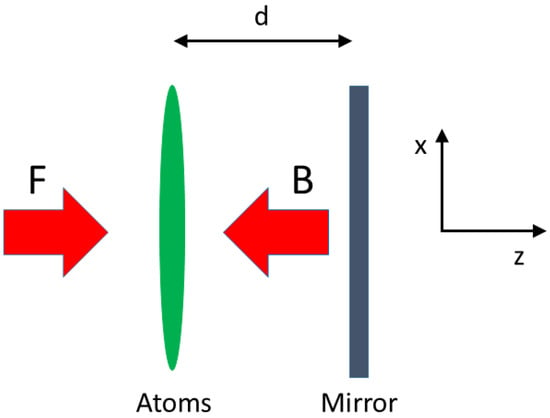
We investigate a system consisting of a BEC interacting with an optical field via a single mirror feedback (SMF) as shown schematically in Figure 1. In this BEC-SMF system, coupling between atoms arises due to diffraction of light, involves many transverse optical modes and optical forces directed perpendicular to the propagation direction of the optical fields.
Figure 1.
Schematic diagram of the single mirror feedback (SMF) configuration showing a BEC interacting with a forward propagating optical field (F) and a backward propagating optical field (B) reflected from a mirror of reflectivity, R, at a distance d from the BEC.
The model we use to describe the BEC-SMF system was originally studied in [29]. We consider a BEC with negligible atomic collisions and describe the evolution of the BEC wavefunction, with the Schrödinger equation:
where and are dimensionless time and space variables, is a critical transverse wavenumber, and are the optical pump wavenumber and wavelength respectively, d is the distance from the BEC to the mirror, is the decay rate of the atomic transition, is a dimensionless recoil frequency, and m is the atomic mass. The variable is the atomic saturation parameter due to the forward and backward optical fields where , , , are the intensities of the forward (F) and backward (B) fields respectively. is the saturation intensity on resonance, is a dimensionless detuning parameter where is the difference between the optical field frequency, , and the atomic transition frequency, . It has been assumed that and that consequently so that the atoms remain in their ground internal energy state. In addition, longitudinal grating effects due to interference between the counterpropagating optical fields are neglected. As we are primarily interested in the interaction between the BEC and the optical field, we neglect atomic collisions, effectively assuming negligible BEC scattering length.
In order to describe the optical field in the BEC we assume that the BEC is sufficiently thin that diffraction can be neglected, so that the forward field transmitted through it is
where is the scaled pump saturation parameter, is the optical thickness of the BEC at resonance and is the local BEC density, which for a BEC of uniform density is normalised to .
The backward field, B, at the BEC completes the feedback loop. As the field propagates a distance from the BEC to the mirror and back, optical diffraction plays a critical role by converting phase modulations to amplitude modulations and consequently optical dipole forces. The relation between the Fourier components of the forward and backward fields at the BEC is
where R is the mirror reflectivity, q is the transverse wavenumber and .
3. Self-Structuring Instability
We now show that the BEC-SMF system exhibits a self-structuring instability where the optical fields and BEC density spontaneously develop spatially periodic modulations. To do this, we first rewrite Equation (1) in terms of a transformed wavefunction variable, , where , so that
We now assume that the reflected optical field and the BEC wavefunction consist of a spatially uniform component and a small, time-dependent component which is also a function of the transverse coordinate, , so that
Consequently the BEC density and saturation parameter are
where terms higher than first-order in time and space-dependent quantities have been neglected.
Substituting Equations (5) and (8) in Equation (4) gives
which after Fourier transforming with respect to becomes
where is a dimensionless transverse wavenumber. To calculate , we first find the optical field transmitted through the BEC, by substituting for in Equation (2) using Equation(7), which results in
where
We can now use this to calculate the reflected field using Equation (6), where
and
so from Equation (6)
where
Fourier transforming Equation (7) and using Equation (18), the evolution of the Fourier component of the BEC density, is described by
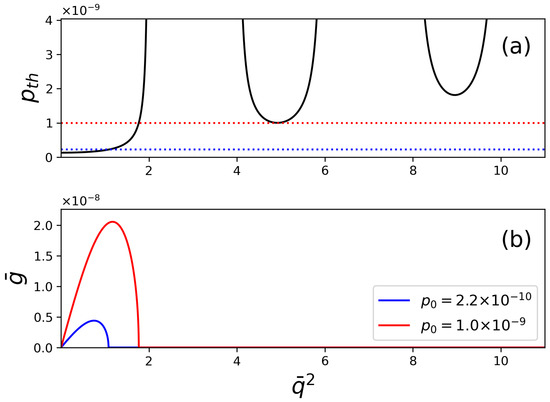
Assuming then the instability threshold will occur when , i.e., when the pump saturation parameter has the threshold value
Due to the periodicity of the sine function, this threshold will have multiple minima. The lowest threshold,
occurs when , i.e., , as shown in Figure 2.
The dimensionless growth rate of the instability, , is
The expressions for the threshold condition, Equation (20), and instability growth rate, Equation (22), were derived in [29] using an alternative approach. Note that the threshold in Equation (21) is independent of detuning, which implies that the real pump intensity will increase quadratically with detuning. The growth rate depends quadratically on the length scale selected by adjusting the mirror distance, d, and otherwise only on the distance to threshold.
The physical origin of the instability are BEC density modulations. As the BEC acts a refractive optical element, and the local refractive index of the BEC is proportional to its local density, density modulations result in refractive index modulations. The refractive index modulation with spatial frequency produces a phase modulation in with spatial frequency which is in turn converted into an intensity modulation of B (see Equation (3)) during the propagation and diffraction of the optical field between the BEC and the mirror via the Talbot effect [33]. The intensity gradients produced by the intensity modulation in B then produce optical dipole forces which reinforce the density modulation, with spatial frequency , resulting in positive feedback which leads to instability of the initial homogeneous state and results in BEC density and optical intensity modulations with spatial frequency .
4. Self-Structuring Dynamics
In order to investigate the dynamical behaviour of the BEC-SMF system, we solve Equations (1)–(3) numerically for different pump saturation parameters (i.e., pump intensities). We consider the case where , , and . In these simulations, a small periodic density modulation with spatial period is applied to the BEC density, i.e., , where .
The character of the system evolution is dependent on how far the system is driven above threshold. As in [32], we consider two cases: weak driving, where the pump saturation parameter, , marginally exceeds the threshold value (i.e., ), and strong driving, where significantly exceeds (i.e., ).
4.1. Weak Driving ()
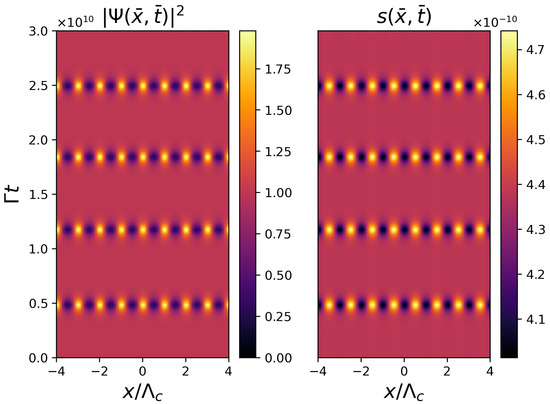
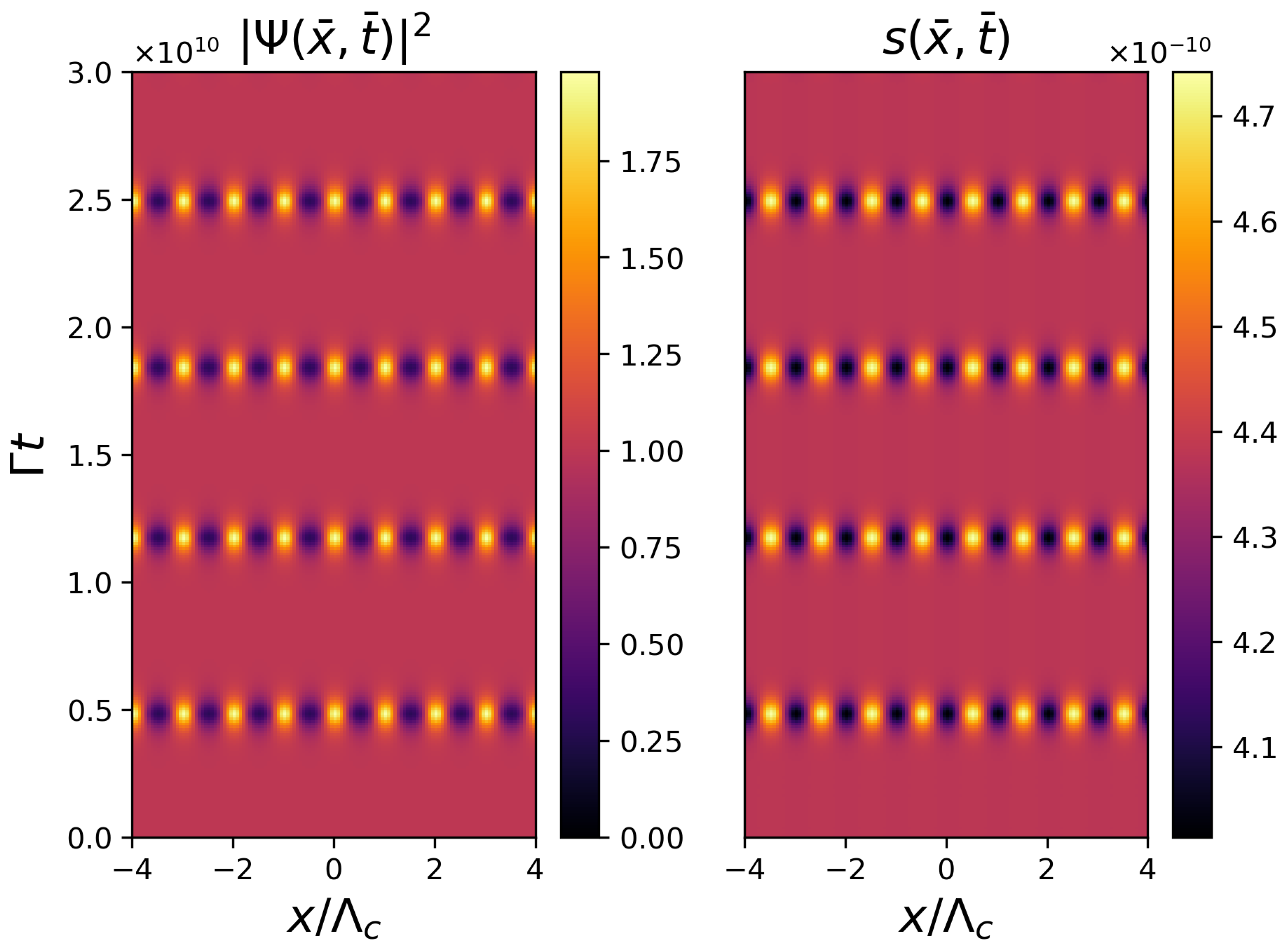
Figure 3 shows the spatio-temporal evolution of the BEC density and optical saturation parameter (i.e., intensity) at the BEC when the pump saturation parameter , which is slightly above the instability threshold (see blue dotted line in Figure 2a).
Figure 3.
Spatio-temporal evolution of the BEC density and optical saturation parameter (i.e., intensity) at the BEC for a case of weak driving when the pump saturation parameter .
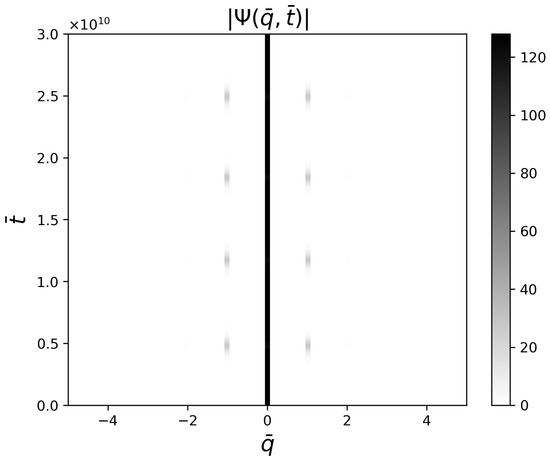
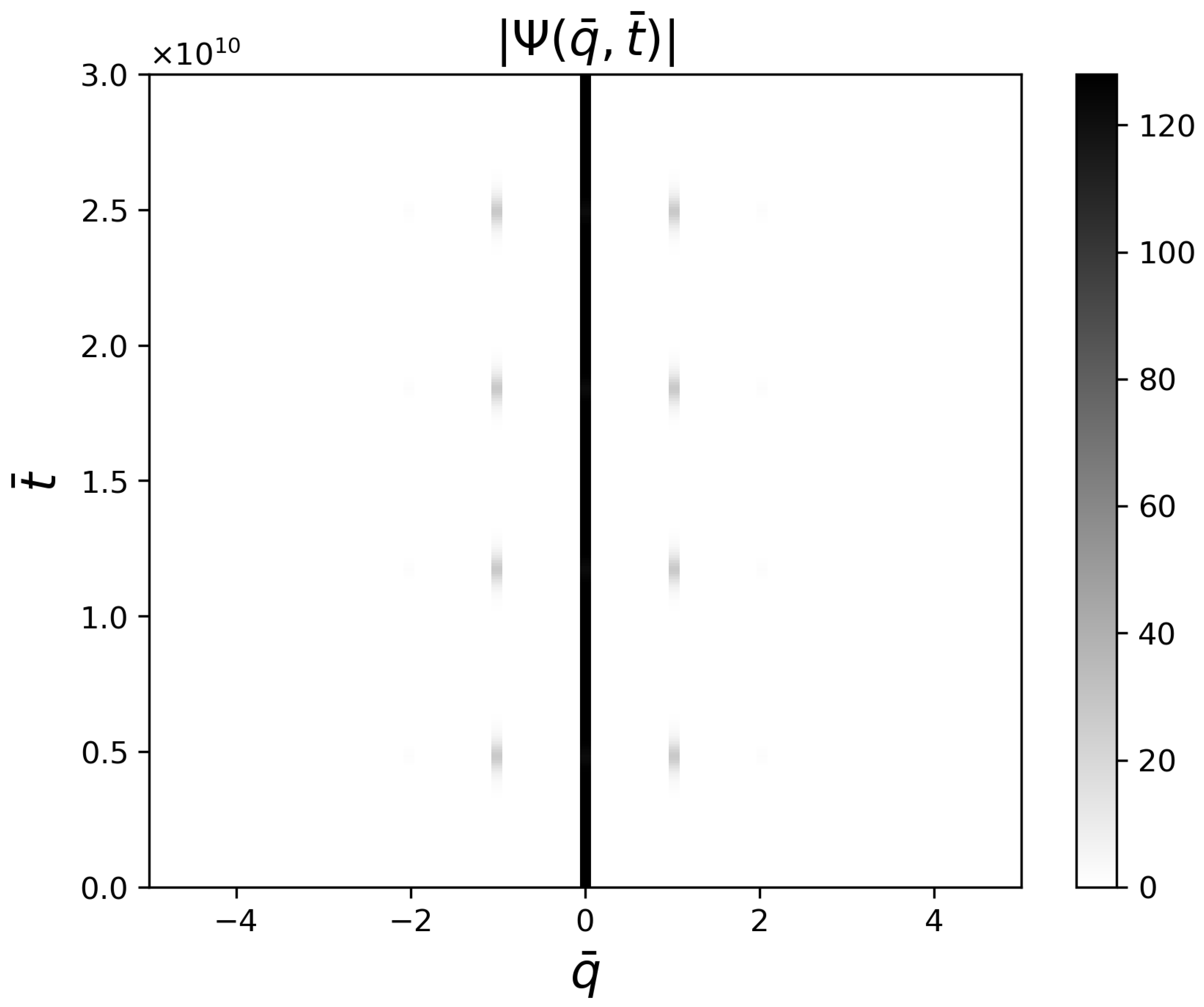
It can be seen that the BEC density and optical intensity, both initially spatially homogeneous, spontaneously develop spatially periodic modulations with spatial period . The maxima in atomic density lie at positions of minima in optical intensity. This is due to the fact that the interaction involves optical dipole forces and the pump field is blue-detuned from atomic resonance (). For red-detuning (), maxima of atomic density would lie on maxima of optical intensity [29]. The spatial width of the density and intensity modulations are similar, with the intensity modulations being slightly wider due to the effect of diffraction as the field propagates between the BEC and the feedback mirror. Moreover, the system displays a temporal periodicity, oscillating between the spatially homogeneous state and the spatially periodic state. The system therefore behaves as a continuous space-time crystal, spontaneously developing spatial and temporal periodicity [34]. Figure 4 shows the temporal evolution of the BEC momentum distribution. It can be seen that the dynamics of the system involves only momentum states where , i.e., with momentum . The system evolves by periodically oscillating between 2 states: the state (spatially homogeneous) and i.e., , spatially periodic [32]. An interesting feature of the BEC-SMF system is that the spatial period of the pattern () depends on the distance between the BEC and the mirror (d). The size of the patterns observed in Figure 3 can therefore be tuned by varying d. Consequently, the BEC-SMF system in the weak-driving regime offers the possibility of realising a continuous space-time crystal with a spatial period which is tunable rather than fixed as in [34].
Figure 4.
Evolution of the BEC momentum distribution for a case of weak driving where the pump saturation parameter .
4.2. Strong Driving ()
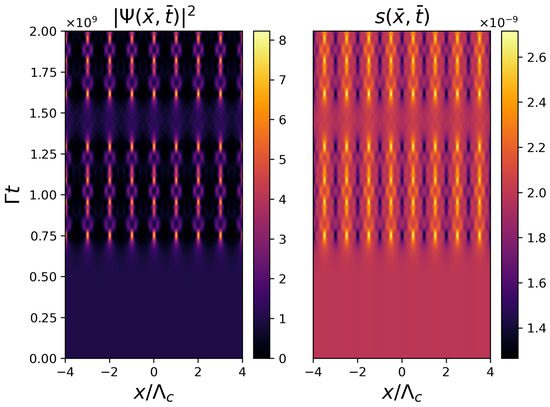
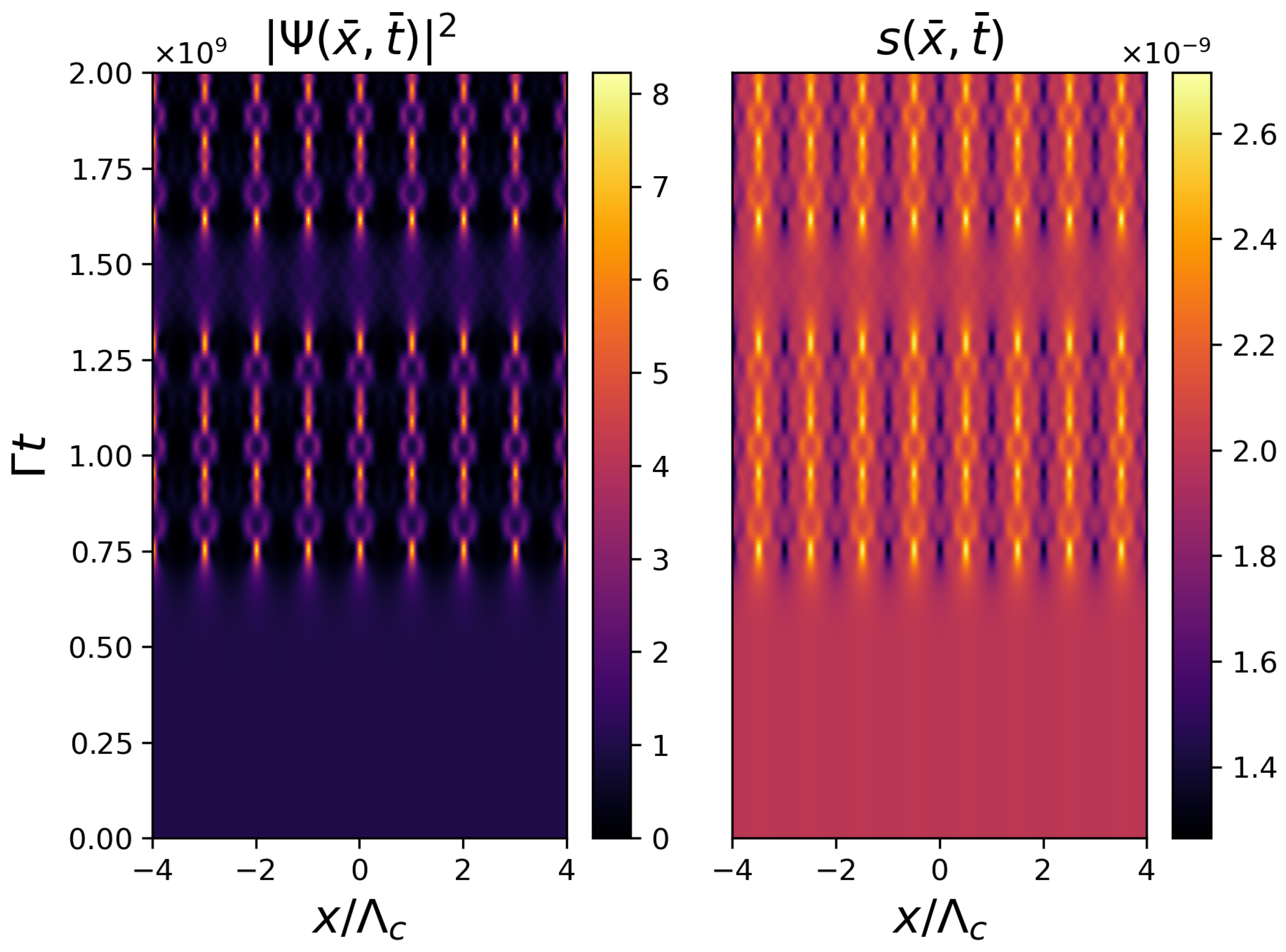
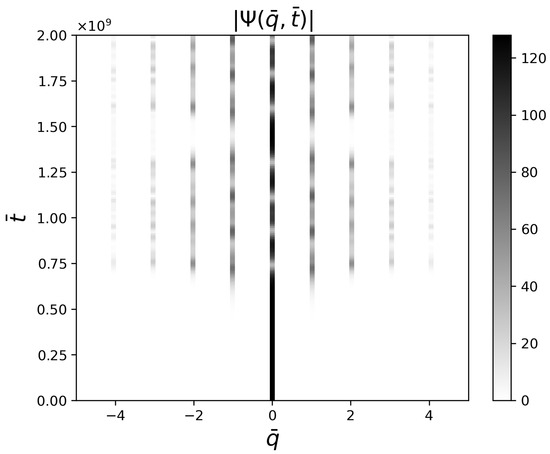
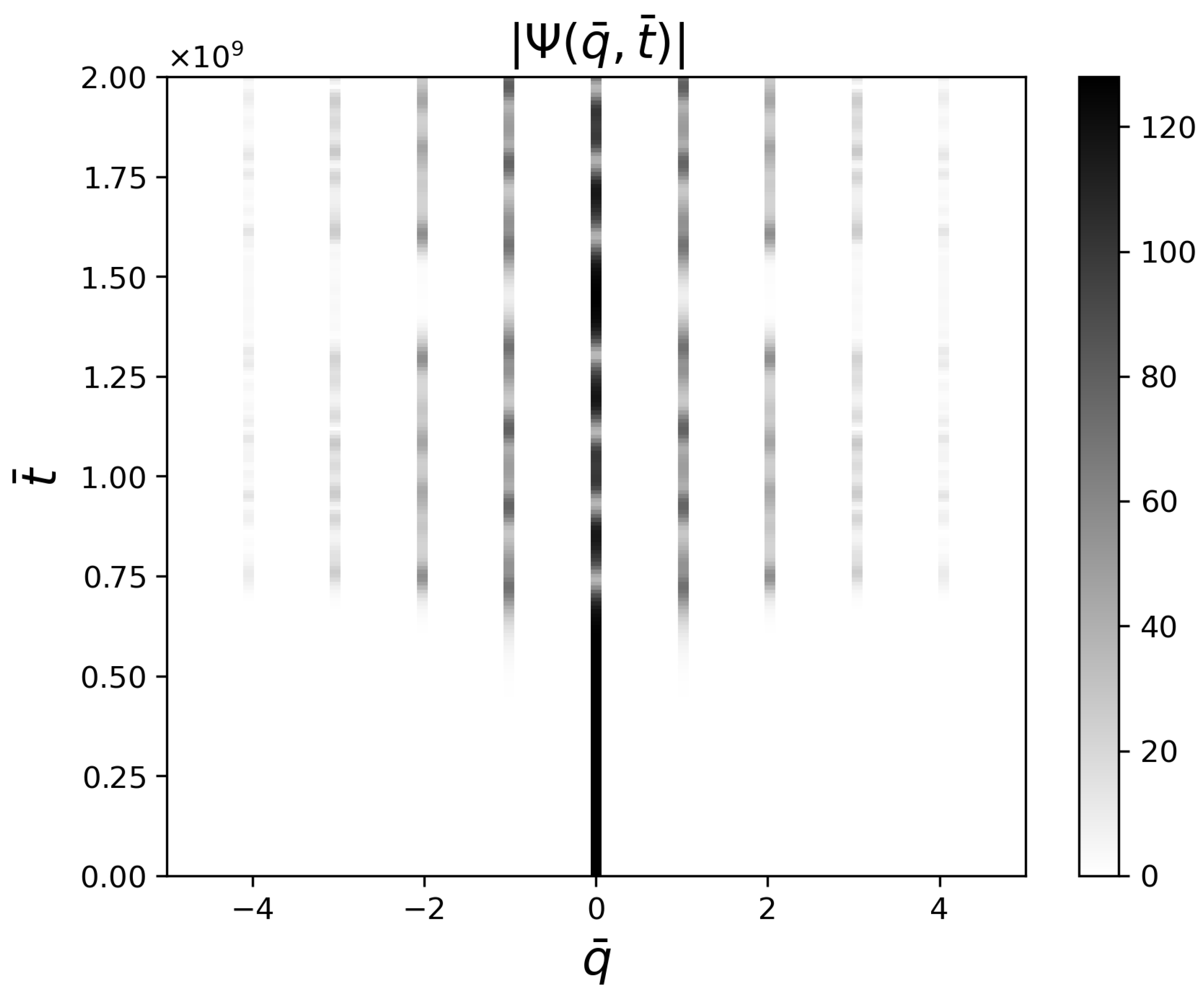
Figure 5 shows the spatio-temporal evolution of the BEC density and optical saturation parameter (i.e., intensity) at the BEC when the pump saturation parameter , which is significantly above the instability threshold (see red dotted line in Figure 2a). It can be seen that in this case the BEC density and optical intensity spontaneously develop more complex spatially periodic modulations or “chevrons” [35] with spatial period which after their initial development display quasi-periodicity in time. The spatial distributions of the atomic density and optical intensity are again similar, with the maxima in atomic density lying at positions of minima in optical intensity. Diffractive spreading of modulations in optical intensity is more pronounced than in the weak driving regime (Figure 3) due to the narrowness of the peaks in BEC density which form in the strong driving regime. Figure 6 shows the temporal evolution of the BEC momentum distribution in this case. It can be seen that the dynamics of the system now involves several different momentum states where .
Figure 5.
Spatio-temporal evolution of the BEC density and optical saturation parameter (i.e., intensity) at the BEC for a case of strong driving where when the pump saturation parameter .
Figure 6.
Evolution of the BEC momentum distribution for a case of strong driving where when the pump saturation parameter .
In contrast to the case of weak driving, the dynamics in the case of strong driving cannot be described in terms of a two-state model [32].
Note from Figure 2 that if the pump saturation parameter, , were to be increased above then a second instability “balloon” would develop around , followed by a third one around . The evolution of the system is still dominated by the patterns with the lowest threshold around but in general will become more complex and sensitive to initial conditions. A full analysis of this scenario will be the subject of a separate study.
A useful measure of the degree of spatial modulation in the BEC is the magnitude of the Fourier component of the BEC density at spatial frequency , i.e.,
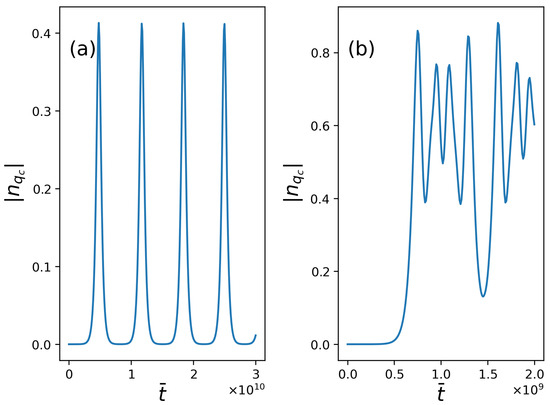
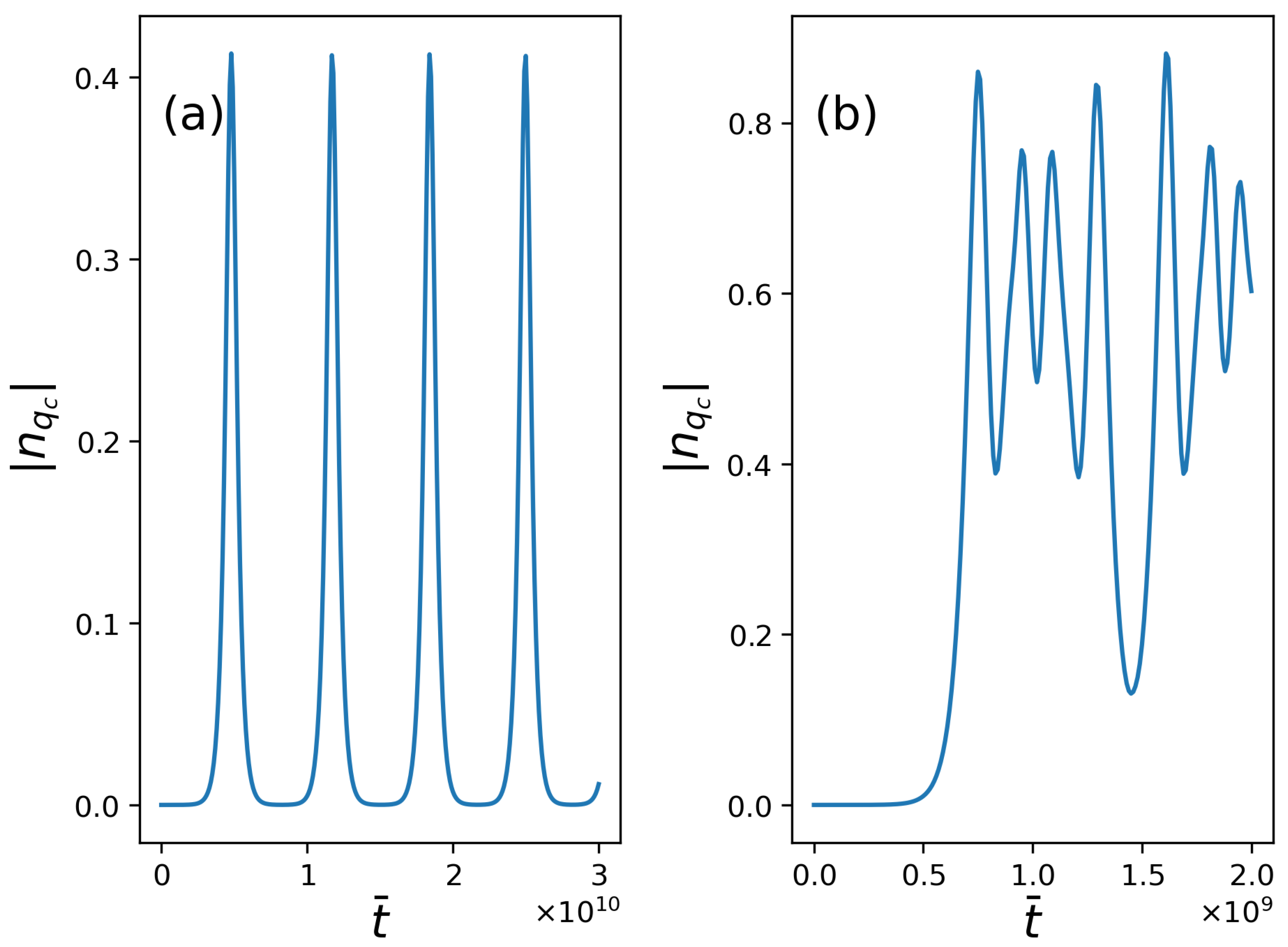
where is the length of the domain in the simulation. Figure 7 shows the evolution of when and , corresponding to Figure 3 and Figure 5, respectively. It can be seen from Figure 7a that in the weak driving regime, oscillates periodically in time, whereas from Figure 7b, in the weak driving regime grows exponentially before performing quasi-periodic oscillations.
Figure 7.
Plot of against when (a) , (b) .
In [32], it was shown that the BEC-SMF model could be mapped onto the quantum HMF model. A consequence of this is that in the weak-driving limit, assuming that is spatially periodic with period in (period in x), then can be expressed analytically as
where
and . Equation (24) describes each oscillation period of shown in Figure 7a [32].
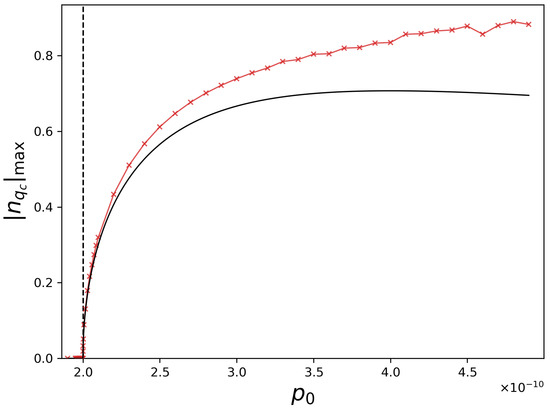
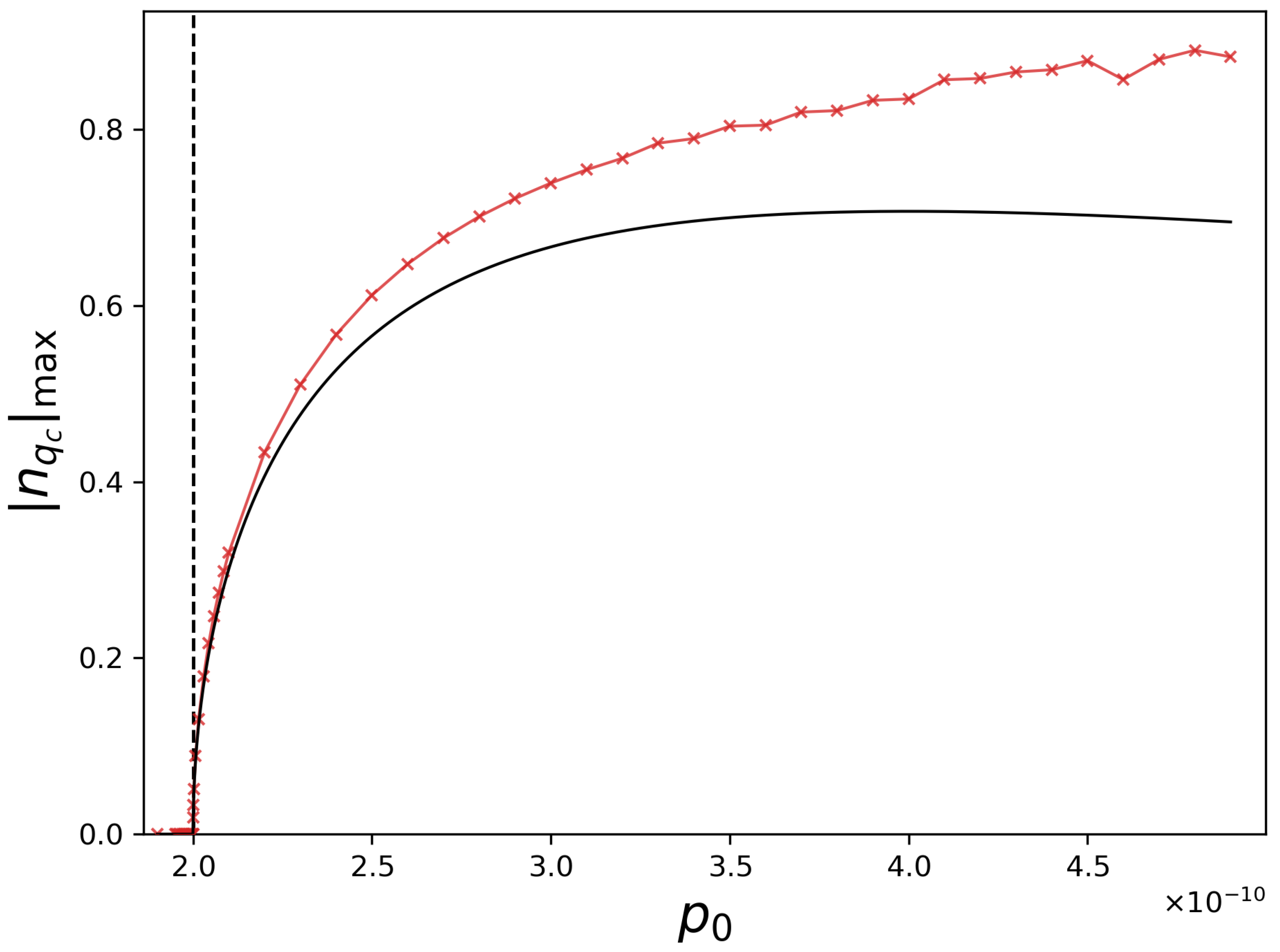
Figure 8 shows the maximum value of plotted against . It can be seen that the maximum value of scales with distance from threshold , similar to the mean-field Ising model [36]. The figure shows that for values just above threshold, where the weak-driving limit applies and the interaction involves only 2 spatial modes, the value of is in good agreement with the value predicted by the analytical expression Equation (24). As increases, the agreement between the simulation results and that predicted by Equation (24) begin to diverge as the system is driven more strongly, with more spatial modes participating in the interaction and the assumptions made in deriving Equation (24) becoming invalid.
Figure 8.
Maximum density modulation amplitude, versus pump saturation parameter . Red crosses: Maximum magnitude of the first-harmonic density component, calculated from simulations [cf. Equation (23)]. Black solid line: analytic prediction for from the two-mode (first-harmonic) theory, . The vertical dashed line indicates the instability threshold (Equation (21)).
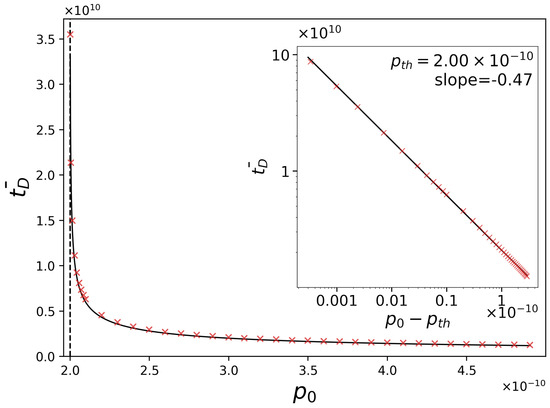
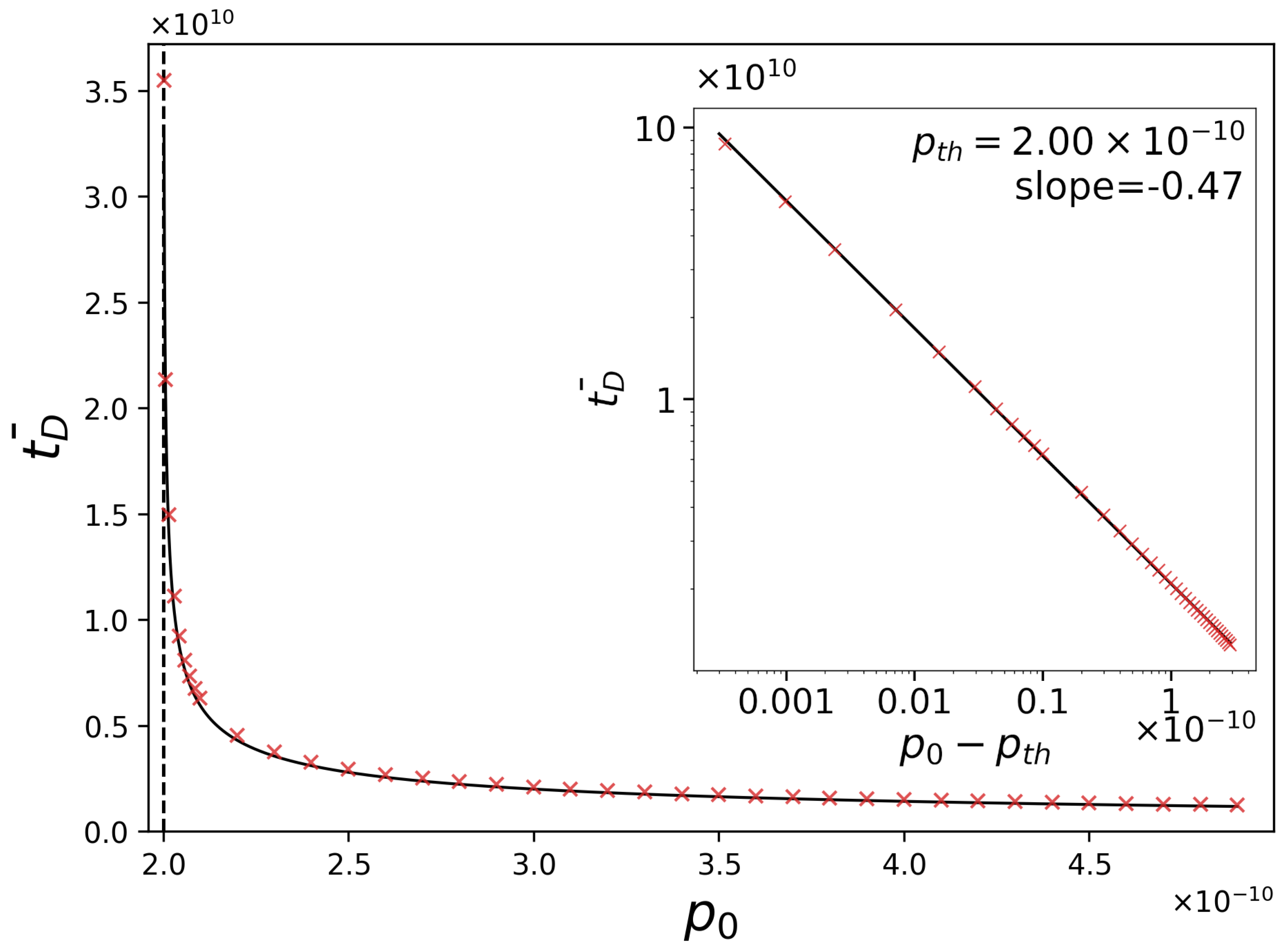
As the linear growth rate of the instability also depends on pump saturation parameter, (see Equation (22)), then the time for the spatial modulation amplitude, , to reach its maximum value will also depend on . Figure 9 shows the dependence of the delay time, , i.e., the time required for to grow to , on . It shows that the values of from the simulations agree well with the analytical expression in Equation (25). Although Equation (25) was derived assuming weak driving, with only two spatial modes participate in the interaction, Figure 9 shows that it also provides an accurate prediction of significantly above threshold.
Figure 9.
Delay time, versus pump saturation parameter . Red crosses: delay times extracted from numerical simulations, defined as the time taken for the density modulation amplitude, , to reach its maximum value. Black solid line: analytical prediction for the delay time, , from Equation (25). The vertical dashed line indicates the instability threshold . Inset: log–log plot of , versus . The threshold is determined by scanning and selecting the value that minimises the residual sum of squares of a linear fit in log–log space. The resulting fit yields a slope and threshold , with uncertainties obtained from the fit covariance.
5. Conclusions
We have studied a 1D model of a diffraction-mediated self-structuring instability which can occur when a BEC is illuminated by a pump laser and its reflection from a single feedback mirror. We performed a linear stability analysis of the model and derived expressions for the threshold value of the pump saturation parameter and the instability growth rate. Using numerical simulation of the BEC-SFM system, we investigated the dynamics of the self-structuring and demonstrated the existence of two different regimes: weak driving and strong driving. For weak driving, the system behaves as a continuous space-time crystal oscillating between two states (spatially uniform and periodic), whereas for strong driving, many BEC momentum states are excited and the BEC density develops chevrons which form and disperse quasi-periodically. Our simulations showed the dependence of the pattern modulation depth and pattern formation time on pump saturation parameter, . We compared these simulation results with analytical expressions derived from the quantum HMF model in the weak driving regime [32]. We found excellent agreement in the dependence of pattern modulation depth on for the case of weak driving, and in the dependence of pattern formation time on for both weak driving and strong driving. The results presented show that the BEC-SMF system offers a route to the first experimental realisation of the quantum Hamiltonian Mean Field model, one of the fundamental models involving long-range coupling in statistical physics [32], and of a continuous space-time crystal with a tunable spatial period.
Extending the model presented here to two spatial dimensions will allow a wider range of pattern geometries and structures to be investigated [30,31].
Author Contributions
Simulations—G.R.M.R. and K.O.; Analysis—G.R.M.R., K.O., G.-L.O. and T.A.; Writing, reviewing and editing—G.R.M.R., K.O., G.-L.O. and T.A. All authors have read and agreed to the published version of the manuscript.
Funding
This research was funded by the Engineering & Physical Sciences Research Council (EPSRC) via grant number UKRI 2897. K.O-D. is supported by the EPSRC Centre for Doctoral Training in Applied Quantum Technologies (CDT-AQT).
Data Availability Statement
All data underpinning this publication are openly available from the University of Strathclyde KnowledgeBase at https://doi.org/10.15129/251cc418-b54a-4f70-8b5f-be62484f32ce, accessed on 8 April 2026.
Conflicts of Interest
The authors declare no conflicts of interest.
References
- Cross, M.C.; Hohenberg, P.C. Pattern formation outside of equilibrium. Rev. Mod. Phys. 1993, 65, 851. [Google Scholar] [CrossRef] [Scilit]
- Grynberg, G.; Le Bihan, E.; Verkerk, P.; Simoneau, P.; Leite, J.R.; Bloch, D.; Le Boiteux, S.; Ducloy, M. Observation of instabilities due to mirrorless four-wave mixing oscillation in sodium. Opt. Commun. 1988, 67, 363–366. [Google Scholar] [CrossRef] [Scilit]
- Lippi, G.; Ackemann, T.; Hoffer, L.; Lange, W. Transverse structures in a sodium-filled Fabry-Pérot resonator—I. Experimental results: Symmetries and the role of the incoupling conditions. Chaos Solitons Fractals 1994, 4, 1409–1431. [Google Scholar] [CrossRef] [Scilit]
- Lippi, G.; Ackemann, T.; Hoffer, L.; Lange, W. Transverse structures in a sodium-filled Fabry-Pérot resonator—II. Interpretation of experimental results. Chaos Solitons Fractals 1994, 4, 1433–1449. [Google Scholar] [CrossRef] [Scilit]
- Giusfredi, G.; Valley, J.; Pon, R.; Khitrova, G.; Gibbs, H. Optical instabilities in sodium vapor. J. Opt. Soc. Am. B 1988, 5, 1181–1192. [Google Scholar] [CrossRef] [Scilit]
- Firth, W. Spatial instabilities in a Kerr medium with single feedback mirror. J. Mod. Opt. 1990, 37, 151–153. [Google Scholar] [CrossRef] [Scilit]
- Arecchi, F.T.; Boccaletti, S.; Ramazza, P.L. Pattern formation and competition in nonlinear optics. Phys. Rep. 1999, 318, 1–83. [Google Scholar] [CrossRef] [Scilit]
- Lugiato, L.A. Transverse nonlinear optics: Introduction and review (Editorial to special issue: Nonlinear optical structures, patterns, chaos). Chaos Solitons Fractals 1994, 4, 1251–1258. [Google Scholar] [CrossRef] [Scilit]
- Rosanov, N.N. Transverse patterns in wide-aperture nonlinear optical systems. In Progress in Optics; Elsevier: Amsterdam, The Netherlands, 1996; Volume XXXV, pp. 1–60. [Google Scholar]
- Barbay, S.; Kuszelewicz, R.; Tredicce, J.R. Cavity Solitons in VCSEL Devices. Adv. Opt. Technol. 2011, 2011, 628761. [Google Scholar] [CrossRef] [Scilit]
- Grynberg, G.; Maître, A.; Petrossian, A. Flowerlike patterns generated by a laser beam transmitted through a rubidium cell with a single feedback mirror. Phys. Rev. Lett. 1994, 72, 2379–2382. [Google Scholar] [CrossRef] [Scilit]
- Ackemann, T.; Lange, W. Non- and nearly hexagonal patterns in sodium vapor generated by single-mirror feedback. Phys. Rev. A 1994, 50, R4468–R4471. [Google Scholar] [CrossRef] [Scilit]
- Ackemann, T.; Lange, W. Optical pattern formation in alkali metal vapors: Mechanisms, phenomena and use. Appl. Phys. B 2001, 72, 21–34. [Google Scholar] [CrossRef] [Scilit]
- Greenberg, J.A.; Schmittberger, B.L.; Gauthier, D. Bunching-induced optical nonlinearity and instability in cold atoms. Opt. Exp. 2011, 19, 22535. [Google Scholar] [CrossRef] [Scilit] [PubMed]
- Schmittberger, B.L.; Gauthier, D.J. Spontaneous emergence of free-space optical and atomic patterns. New J. Phys. 2016, 18, 10302. [Google Scholar] [CrossRef] [Scilit]
- Kruse, D.; von Cube, C.; Zimmermann, C.; Courteille, P.W. Observation of lasing mediated by collective atomic recoil. Phys. Rev. Lett. 2003, 91, 183601. [Google Scholar] [CrossRef] [Scilit]
- Ritsch, H.; Domokos, P.; Brennecke, F.; Esslinger, T. Cold atoms in cavity-generated dynamical optical potentials. Rev. Mod. Phys. 2013, 85, 553–601. [Google Scholar] [CrossRef] [Scilit]
- Mivehvar, F.; Piazza, F.; Donner, T.; Ritsch, H. Cavity QED with quantum gases: New paradigms in many-body physics. Adv. Phys. 2021, 70, 1–153. [Google Scholar] [CrossRef] [Scilit]
- Kollar, A.J.; Papageorge, A.T.; Vaidya, V.D.; Guo, Y.; Keeling, J.; Lev, B.L. Supermode-density-wave-polariton condensation with a Bose–Einstein condensate in a multimode cavity. Nat. Commun. 2017, 8, 14386. [Google Scholar] [CrossRef] [Scilit]
- Kroeze, R.M.; Guo, Y.; Vaidya, V.D.; Keeling, J.; Lev, B.L. Spinor self-ordering of a quantum gas in a cavity. Phys. Rev. Lett. 2018, 121, 163601. [Google Scholar] [CrossRef] [Scilit]
- Guo, Y.; Kroeze, R.M.; Marsh, B.P.; Gopalakrishnan, S.; Keeling, J.; Lev, B.L. An optical lattice with sound. Nature 2021, 599, 211. [Google Scholar] [CrossRef] [Scilit]
- Robb, G.; Piovella, N.; Ferraro, A.; Bonifacio, R.; Courteille, P.W.; Zimmermann, C. Collective atomic recoil lasing including friction and diffusion effects. Phys. Rev. A 2004, 69, 041403. [Google Scholar] [CrossRef] [Scilit]
- Baumann, K.; Guerlin, C.; Brennecke, F.; Esslinger, T. Dicke quantum phase transition with a superfluid gas in an optical cavity. Nature 2010, 464, 1301–1306. [Google Scholar] [CrossRef] [Scilit] [PubMed]
- Mottl, R.; Brennecke, F.; Baumann, K.; Landig, R.; Donner, T.; Esslinger, T. Roton-type mode softening in a quantum gas with cavity-mediated long-range interactions. Science 2012, 336, 1570–1573. [Google Scholar] [CrossRef] [Scilit] [PubMed]
- Schuster, S.; Wolf, P.; Ostermann, S.; Slama, S.; Zimmermann, C. Supersolid properties of a Bose-Einstein condensate in a ring resonator. Phys. Rev. Lett. 2020, 124, 143602. [Google Scholar] [CrossRef] [Scilit]
- Léonard, J.; Morales, A.; Zupancic, P.; Esslinger, T.; Donner, T. Supersolid formation in a quantum gas breaking a continuous translational symmetry. Nature 2017, 543, 87–90. [Google Scholar] [CrossRef] [Scilit]
- Labeyrie, G.; Tesio, E.; Gomes, P.M.; Oppo, G.L.; Firth, W.J.; Robb, G.R.; Arnold, A.S.; Kaiser, R.; Ackemann, T. Optomechanical self-structuring in a cold atomic gas. Nat. Photonics 2014, 8, 321–325. [Google Scholar] [CrossRef] [Scilit]
- Tesio, E. Theory of Self-Organisation in Cold Atoms. Ph.D. Thesis, University of Strathclyde, Glasgow, UK, 2014. [Google Scholar]
- Robb, G.; Tesio, E.; Oppo, G.L.; Firth, W.; Ackemann, T.; Bonifacio, R. Quantum threshold for optomechanical self-structuring in a Bose-Einstein condensate. Phys. Rev. Lett. 2015, 114, 173903. [Google Scholar] [CrossRef] [Scilit]
- Zhang, Y.C.; Walther, V.; Pohl, T. Long-range interactions and symmetry breaking in quantum gases through optical feedback. Phys. Rev. Lett. 2018, 121, 073604. [Google Scholar] [CrossRef] [Scilit]
- Zhang, Y.C.; Walther, V.; Pohl, T. Self-bound droplet clusters in laser-driven Bose-Einstein condensates. Phys. Rev. A 2021, 103, 023308. [Google Scholar] [CrossRef] [Scilit]
- Robb, G.; Walker, J.; Oppo, G.L.; Ackemann, T. Long-range interactions in a quantum gas mediated by diffracted light. Phys. Rev. Res. 2023, 5, L032004. [Google Scholar] [CrossRef] [Scilit]
- Talbot, H.I. Facts relating to optical science. No. III. London Edinburgh Dublin Philos. Mag. J. Sci. 1836, 9, 1–4. [Google Scholar] [CrossRef] [Scilit]
- Zhao, H.; Smalyukh, I. Space-time crystals from particle-like topological solitons. Nat. Mater. 2025, 24, 1802–1811. [Google Scholar] [CrossRef] [Scilit]
- Plestid, R.; Mahon, P.; O’Dell, D.H.J. Violent relaxation in quantum fluids with long-range interactions. Phys. Rev. E 2018, 98, 012112. [Google Scholar] [CrossRef] [Scilit]
- Als-Nielsen, J.; Birgeneau, R.J. Mean field theory, the Ginzburg criterion, and marginal dimensionality of phase transitions. Am. J. Phys. 1977, 45, 554–560. [Google Scholar] [CrossRef] [Scilit]
Disclaimer/Publisher’s Note: The statements, opinions and data contained in all publications are solely those of the individual author(s) and contributor(s) and not of MDPI and/or the editor(s). MDPI and/or the editor(s) disclaim responsibility for any injury to people or property resulting from any ideas, methods, instructions or products referred to in the content. |
© 2026 by the authors. Licensee MDPI, Basel, Switzerland. This article is an open access article distributed under the terms and conditions of the Creative Commons Attribution (CC BY) license.