


Abstract
We report the generation of sub-50 fs mid-infrared (MIR) pulses using a fiber-integrated system comprising a several-centimeters-long chalcogenide (As2S3) fiber and a fluoride (ZBLAN) fiber. Initially, 127 fs pulses at 2.8 µm are generated via the soliton self-frequency shift in the fluoride fiber. These pulses are then coupled into the As2S3 fiber, which provides substantial normal dispersion at this wavelength, enabling temporal stretching to achieve pulse durations of 1.02 ps (8 cm), 2.06 ps (15 cm), and 4.45 ps (24 cm), corresponding to a maximum stretch factor of approximately 35. Simultaneously, the pulses undergo significant spectral broadening via self-phase modulation during this process. Subsequent nonlinear compression within an optimized ZBLAN fiber yields compressed pulses as short as 46 fs, representing a compression ratio of approximately 63%. This work represents, for the first time, picosecond stretching and sub-50 fs nonlinear compression in a fiber-integrated architecture at 2.8 μm, establishing a critical component for future all-fiber MIR-chirped pulse amplification systems.
1. Introduction
The generation of sub-50 fs pulses at 2.8 µm marks a significant milestone in ultrafast optics research. These ultrashort pulses are essential for probing ultrafast electron dynamics and chemical bond formation on femtosecond timescales, enabling the direct real-time observation of quantum-level processes [1]. Their applications span a wide range of fields, including molecular spectroscopy [2], high-precision laser surgery [3], laser micro-welding [4], and reactive-ion etching [5].
Traditionally, the generation of MIR femtosecond pulses has relied on bulky optical parametric oscillators, mode-locked lasers, or other free-space setups [6,7,8]. While these approaches have been successful in generating ultrashort pulses, they suffer from significant drawbacks, including design complexity, limited stability, and poor scalability [9]. In contrast, fiber-integrated systems offer a more compact and robust alternative by leveraging the inherent properties of fibers to achieve alignment-free operation. Among various approaches, the soliton self-frequency shift (SSFS) mechanism provides a promising route to generate near Fourier transform-limited (FTL) MIR femtosecond pulses directly within fibers. However, several challenges persist. In particular, the limitations in spectral bandwidth constrain effective manipulation of pulse temporal characteristics, and methods of achieving controllable spectral broadening followed by further compression remain difficult. This is primarily because integrating dedicated, fiber-compatible components for stretching and compression introduces significant design complexity. Although Wu et al. first reported the watt-level 2.8 μm picosecond pulse from an all-fiber Er: ZBLAN amplifier via a homemade fluoride fiber-based side-pump combiner, the pulse duration was limited to the picosecond scale, due to the negative dispersion of the gain fiber [10]. Similarly, Luo et al. demonstrated the first watt-level, all-fiber femtosecond laser at 2.8 µm through amplification-induced self-compression, a process that critically depends on precise gain fiber length design [11,12]. While nonlinear pulse compression using self-phase modulation (SPM) in a fiber for spectral broadening followed by dispersion compensation [13] is a well-established technique in free-space systems (e.g., Offner and Martinez types [14,15]) and compressors (e.g., grating or prism pairs [16]), its implementation within all-fiber MIR systems remains challenging. Recent efforts have attempted to overcome these limitations through the use of fibers themselves as nonlinear or dispersive elements. For instance, Woodward et al. demonstrated the use of an 8 cm long step-index As2S3 fiber for spectral broadening. However, such approaches still rely heavily on free-space components for both the seed laser and compression stages, introducing significant design complexity [17]. To further explore alternative grating-free and fiber-compatible platforms, Er-doped ZBLAN fiber with large anomalous dispersion as the stretcher and germanium rods with normal dispersion as the compressor were successfully demonstrated by Zhou et al. [18]. In addition, hollow-core fibers filled with noble gas have also achieved impressive compression results [19].
Critically, however, none of these prior demonstrations have achieved a fiber-integrated system. They consistently rely on critical free-space components for stretching and compression, which reintroduces complexity and compromises the inherent stability of a fiber-integrated architecture. This inherent limitation highlights the need for a truly integrated approach that seamlessly combines a MIR pulse stretcher and compressor within a single, fiber-integrated platform.
In this work, we demonstrate a fiber-integrated system for generating sub-50 fs MIR pulses, comprising several centimeters-long As2S3 fiber seamlessly spliced to a ZBLAN fiber. In this configuration, 127 fs pulses at 2.8 μm, generated via SSFS from a 2 μm pump source, are first temporally stretched and spectrally broadened through SPM in the normally dispersive (As2S3) fiber. This achieves a stretch factor of up to ~35. Subsequent nonlinear compression in the anomalously dispersive ZBLAN fiber yields pulses as short as 46 fs, corresponding to a compression ratio of ~63%. To the best of our knowledge, this work represents the first demonstration of a fiber-integrated pulse stretcher and compressor at 2.8 μm, establishing a critical milestone toward compact, high-power, all-fiber MIR-chirped pulse amplification (CPA) systems.
2. Experimental Section
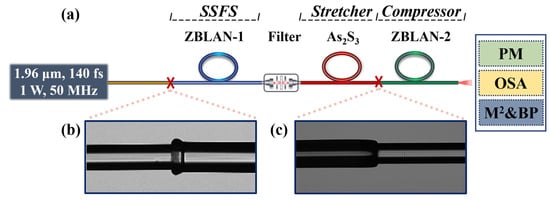
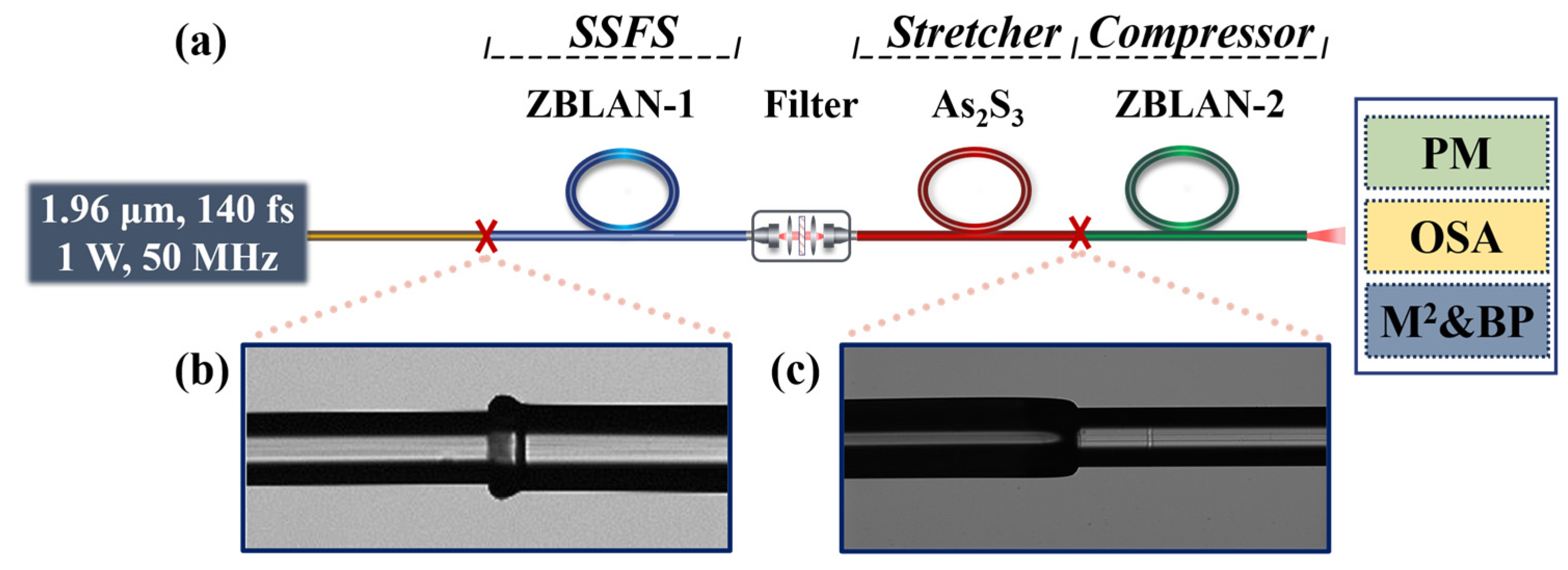
The experimental setup is illustrated in Figure 1. A home-built femtosecond fiber laser (central wavelength: 1.96 μm, pulse duration: 140 fs, repetition rate: 50 MHz) served as the pump source. The SM-1950 fiber (Nufern, East Granby, CT, USA) acts as a transition pigtail fiber and is then fusion-spliced to an 8 m long ZBLAN-1 fiber (Le Verre Floure, Brittany, France). A specialized splicing technique was employed to protect the end facet of the ZBLAN fiber and to ensure proper mode-field matching between the two dissimilar fibers. The splicing point loss is defined as [20]:
where Pin and Pout denote the optical powers measured before and after the splice point, respectively; α is the fiber attenuation coefficient; and L is the fiber length. The insertion loss of the splice point was measured in the vicinity of 0.15 dB at 1.55 μm using a continuous-wave source [21]. In the ZBLAN-1 fiber, the pulses experienced SSFS, generating 127 fs pulses at 2.8 μm. The SSFS detailed parameters critical to the SSFS process were determined based on our previous study [22,23]. The output end of the ZBLAN-1 fiber was angle-cleaved at 8° to suppress back reflections. A custom free-space coupling module was employed to select the desired 2.8 μm soliton and filter out unwanted higher-order components. This module consists of a bandpass filter (MIROC, Hangzhou, China, BP2780, passband: 2.6–2.9 μm) positioned between two different aspherical ZnSe lenses (f = 6 mm and 12.5 mm, Edmund optics, Barrington, IL, USA). The first lens collimates the generated solitons, while the second lens focuses the 2.8 μm soliton into the stretching fiber. The stretcher is made from a small section of As2S3 fiber (IR-flex, Danville, VA, USA). Robust alignment is ensured by equipping the ZBLAN-1 fiber output port and the As2S3 fiber receiving port with FC/PC connectors, which are interfaced with the integrated coupling module. The overall coupling efficiency of this stage is approximately 52%, including losses from lenses, filter, and parameter mismatch between fibers. Finally, a piece of ZBLAN-2 fiber (Fiberlabs, Fujimino-shi, Japan) is fusion-spliced to the As2S3 fiber to serve as the compressor. Owing to the significant difference in the glass transition temperatures of the two fibers, an asymmetric fiber fusion splicing technology is required [24]. The splicing loss is nearly 1.27 dB according to Equation (1). Both fusion splices in this experiment were fabricated according to the Refs. [20,25]. The key optical parameters of all fibers are illustrated in Table 1.
A(dB) = Pin(dBm) − Pout(dbm) − α(dB/km) L(km),
Figure 1.
(a) Experimental setup of the fiber-integrated system for 2.8 µm pulse generation, stretching, and compression. (b) Fusion splicing point between SM1950 and ZBLAN-1 fibers. (c) Fusion splicing point between As2S3 and ZBLAN-2 fibers. SSFS, soliton self-frequency shift; PM, power meter; OSA, optical spectrum analyzer; M2 & BP, M2 & beam profiler.
Table 1.
The key parameters of MIR fibers used in experiments.
In experiments, the end facets of both ZBLAN and As2S3 fibers are processed using specialized fiber processing equipment (Thorlabs, Newton, MA, USA, Vytran-LDC401A). Both fusion splicing points are achieved through a specialized fiber fusion splicer (Thorlabs, Newton, MA, USA, Vytran-GPX3800). The output spectra are measured with two optical spectrum analyzers (Yokogawa, Musashino-shi, Japan AQ6375, range: 1.2–2.4 μm; AQ6377, range: 1.9–5.5 μm). Pulse durations are characterized using a commercial autocorrelator (Femtochrome, Berkeley, CA, USA, FR-103XL). The pulse train is detected by an InGaAs PIN detector (EOT, Traverse, MI, USA, ET-5000F), while the RF spectrum is measured with an RF spectrum analyzer (FSA, Santa Rosa, CA, USA, Keysight N9000B). Output power and beam quality are assessed with a thermal power meter (Thorlabs, Newton, MA, USA, S401C) connected to a power meter (Thorlabs, Newton, MA, USA, PM400) and a scanning-slit beam profiler (Ophir, Jerusalem, Israel, NMS-NS2s-Pyro5), respectively. To ensure accurate stability characterization, the power meter was configured with a 300 ms sampling interval and a resolution of 1 μW.
3. Results and Discussion
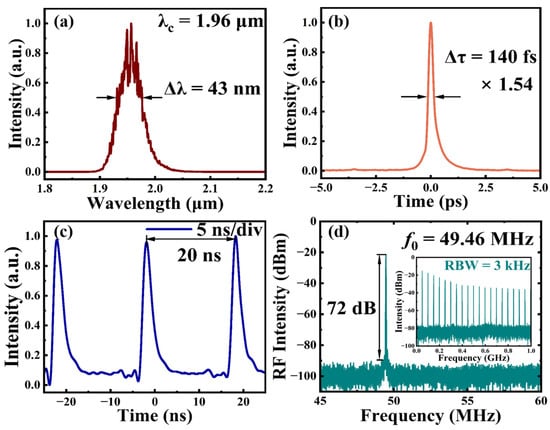
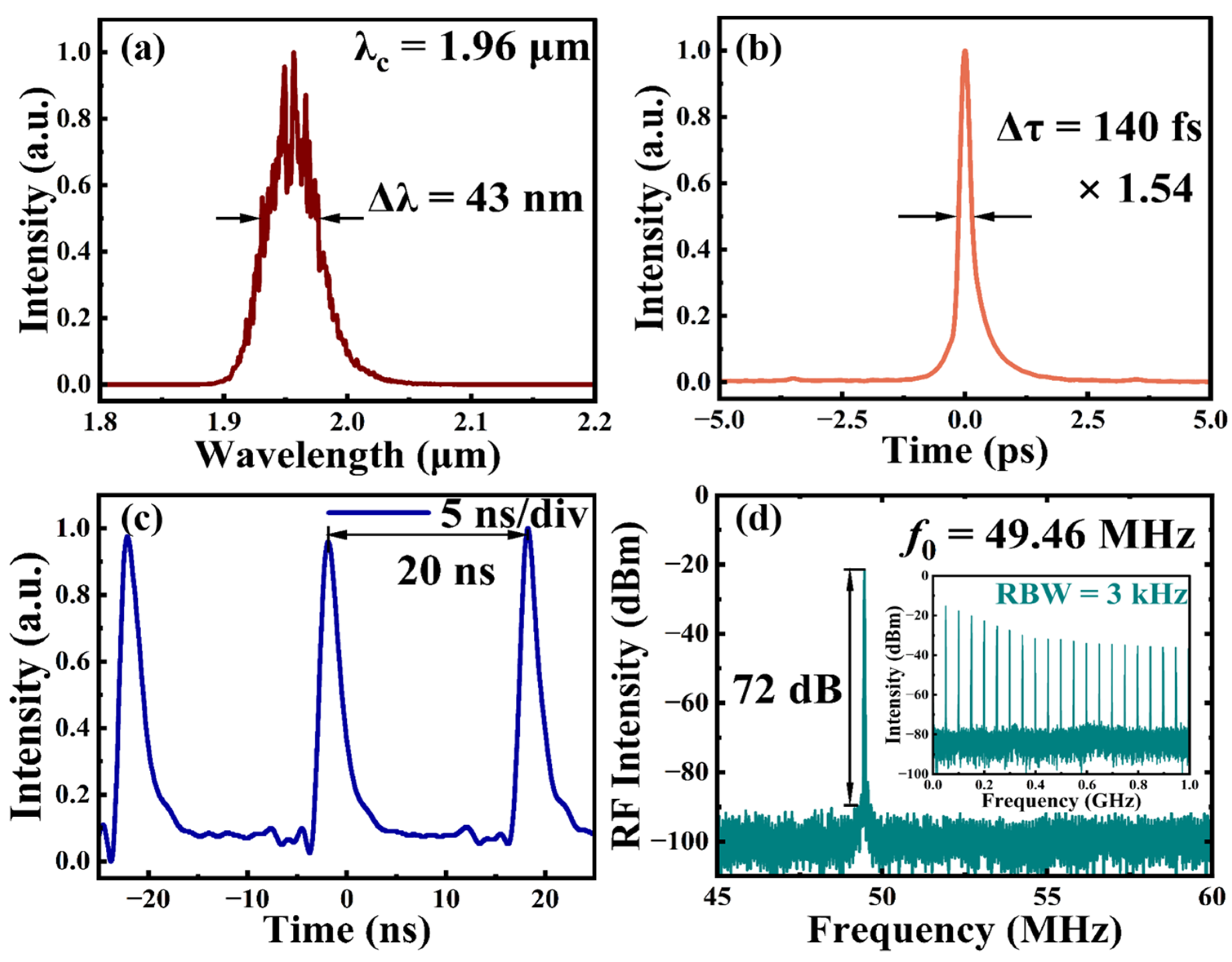
The experimental setup utilizes a 2 µm femtosecond laser as the pump source, which is pigtailed with a single-mode silica fiber (SM1950). The pump laser properties are characterized in Figure 2. The output spectrum is centered at 1.96 μm with a bandwidth of 43 nm [Figure 2a]. As depicted in Figure 2b, the pulse duration is measured to be 140 fs. The pulse has a time–bandwidth product of 0.46. Figure 2c illustrates the typical pulse trains at 50 ns time scales. As shown in Figure 2d, the laser operates at a fundamental repetition rate of 49.46 MHz with a signal-to-noise ratio of 72 dB. The radio frequency (RF) spectrum in the inset verifies the high stability of the laser mode locking state.
Figure 2.
The details of the 2 μm femtosecond laser. (a) Measured output spectrum. (b) Autocorrelation trace of the output pulse. (c) Measured pulse train on the nanosecond time scale. (d) RF spectrum measured in a scanning range of 1 GHz and a resolution bandwidth (RBW) of 3 kHz.
The pigtail fiber of the pump source is fusion-spliced to a segment of ZBLAN-1 fiber to achieve wavelength red-shifting via SSFS. To gain a comprehensive understanding of the nonlinear pulse dynamics within the fluoride fiber (ZBLAN-1), we conducted a detailed numerical investigation by solving the generalized nonlinear Schrödinger equation [26]. The simulation was initialized with a sech2-shaped input pulse possessing a duration of 140 fs and a peak power of 126 kW. These parameters correspond to a soliton order of N ≈ 3.94, as calculated from the established relation [27]:
where γ, P0, T0 and β2 are the nonlinear coefficient, peak power, pulse width parameter, and group velocity dispersion, respectively. This initial third-order soliton condition is critical, as it precipitates an initial temporal compression and spectral broadening phase, which enhances the peak power density and efficiently initiates the intra-pulse Raman scattering process.
N2 = γP0T02/|β2|
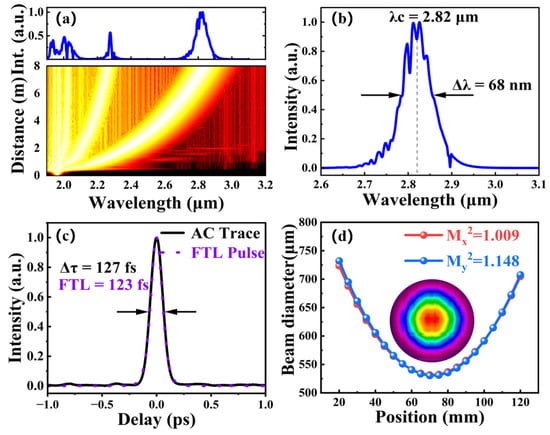
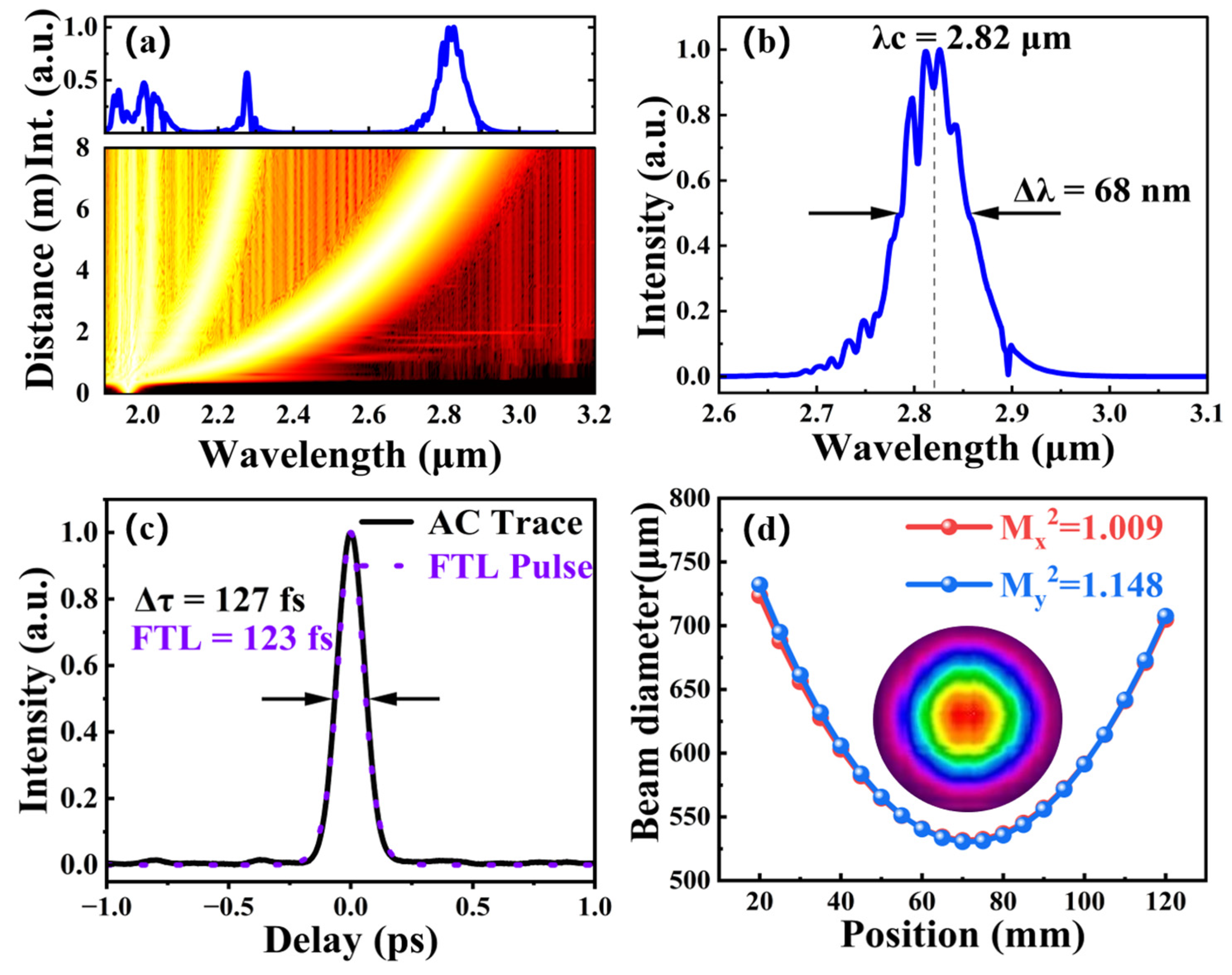
As vividly illustrated in the spectral comparison of Figure 3a, an excellent agreement is observed between the simulated and experimentally measured output spectra. The close agreement between simulated and measured SSFS spectra validates the reasonability of the numerical model, as well as reveals the physical mechanism of pulse evolution and soliton generation processes. As illustrated in Figure 3b, the SSFS process generates a stable fundamental Raman soliton centered at 2.82 μm with a spectral bandwidth (Δλ) of 68 nm. The spectrum shows multiple peaks, consistent with a cascaded process. The corresponding temporal profile of this soliton is presented in Figure 3c, revealing a nearly transform-limited pulse duration of 127 fs, close to its FTL of 123 fs, indicating minimal residual chirp. This indicates minimal residual chirp on the generated pulse. Furthermore, we rigorously characterized the spatial properties of the output beam. The inset of Figure 3d displays a near-Gaussian intensity profile in the far-field. Quantitative beam quality analysis yielded excellent M2 values of 1.009 and 1.148 along the X and Y axes, respectively, confirming near-diffraction-limited performance. This high-quality SSFS source ultimately delivers a stable pulse train at the fundamental repetition rate of 50 MHz, with a measured pulse energy of 3.44 nJ. The successful generation of this robust, energetic, and well-characterized MIR pulse seed is a pivotal prerequisite for the subsequent stages of nonlinear pulse stretching and compression.
Figure 3.
Characterization of the SSFS output. (a) Measured output spectrum (solid line) and simulated spectral evolution (false color) along the 8 m long ZBLAN-1 fiber. (b) Detailed view of the measured 2.8 μm fundamental soliton spectrum. (c) Autocorrelation trace of the output pulse (black solid: measured data, purple dot: calculated FTL pulse, where FTL is short for Fourier transform limit). (d) Measured beam quality factor (M2) in the X (red) and Y (blue) axes. Inset: corresponding far-field beam intensity profile.
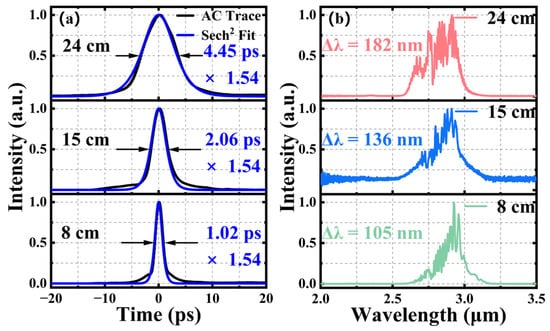
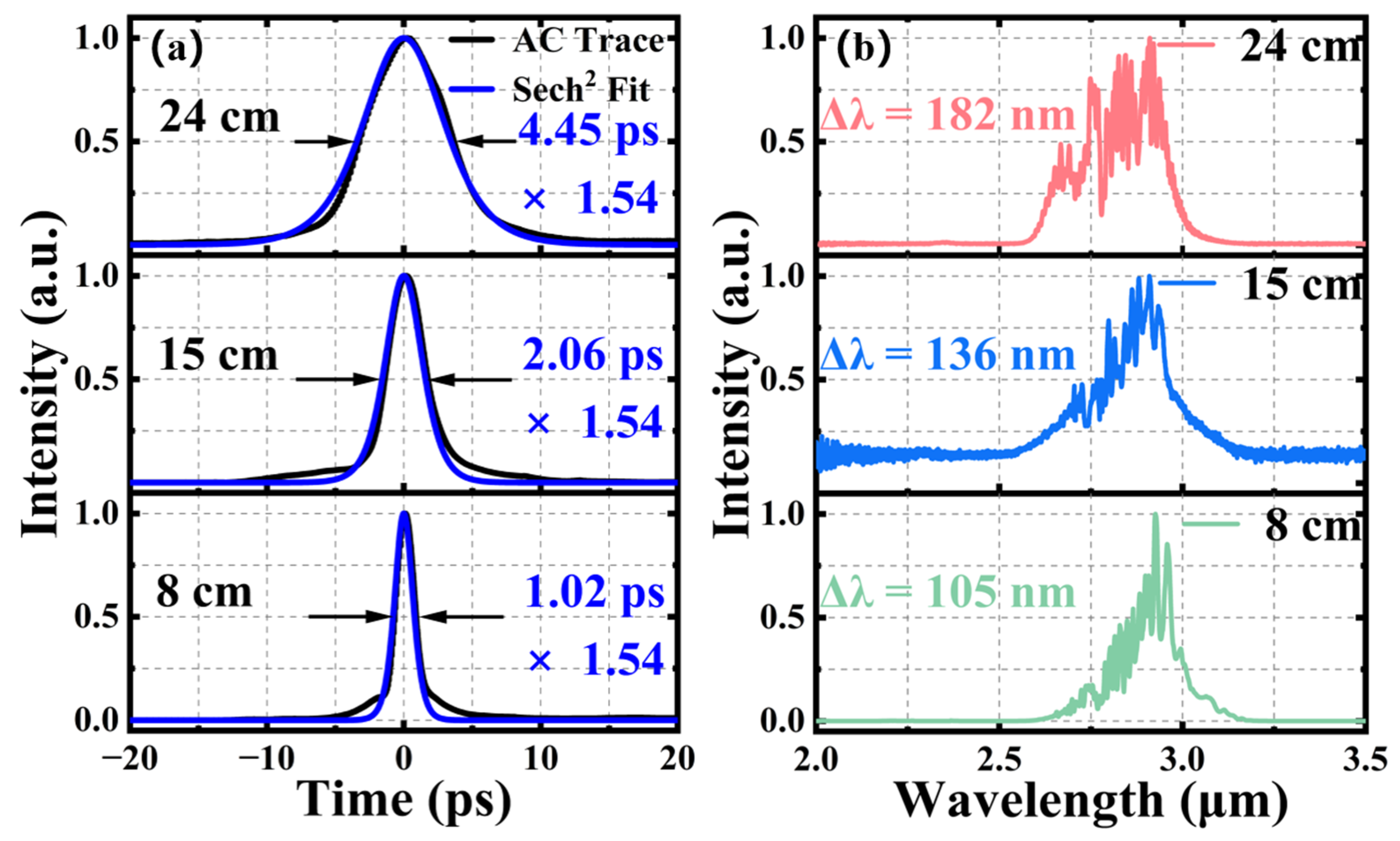
The Raman soliton generated from the SSFS stage was subsequently coupled into the As2S3 fiber for temporal stretching. To systematically investigate the dependence of the stretching ratio on the fiber length, we employed three distinct segments of As2S3 fiber with lengths of 8 cm, 15 cm, and 24 cm. The corresponding temporal and spectral characteristics of the output pulses are summarized in Figure 4. Figure 4a depicts the output temporal profiles after propagation through varying fiber lengths. The measured autocorrelation traces (solid black lines) are well-fitted by a sech2 profile (solid blue curves), confirming the maintained pulse shape. A clear trend of progressive temporal broadening is observed with increasing fiber length, directly demonstrating the dominant role of the large normal dispersion in the As2S3 fiber at 2.8 μm.
Figure 4.
Pulse stretching and spectral broadening in As2S3 fibers with varying fiber lengths. (a) Measured autocorrelation traces (black curves) and corresponding sech2 fits (blue curves) demonstrating temporal pulse stretching for 8 cm, 15 cm, and 24 cm fiber segments. (b) Corresponding output spectra showing progressive spectral broadening and modulation induced by SPM.
The spectral evolution in Figure 4b presents the prominent SPM-dominated broadening of the spectra as fiber length increases, accompanied by notable modulation patterns. The modulation patterns are attributed to inter-modal interference. The pulse spectral broadening caused by asymmetric SPM is primarily due to the short nonlinear length of As2S3, which has been thoroughly discussed within Ref. [28].
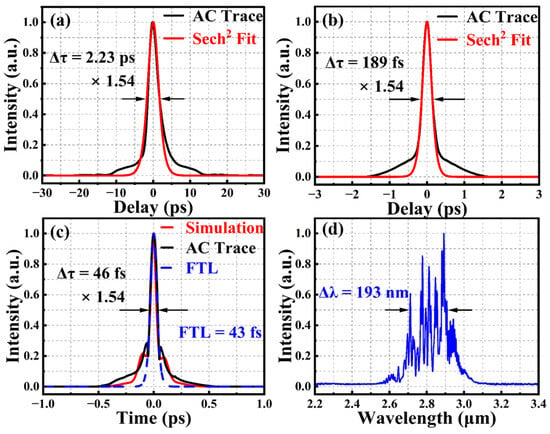
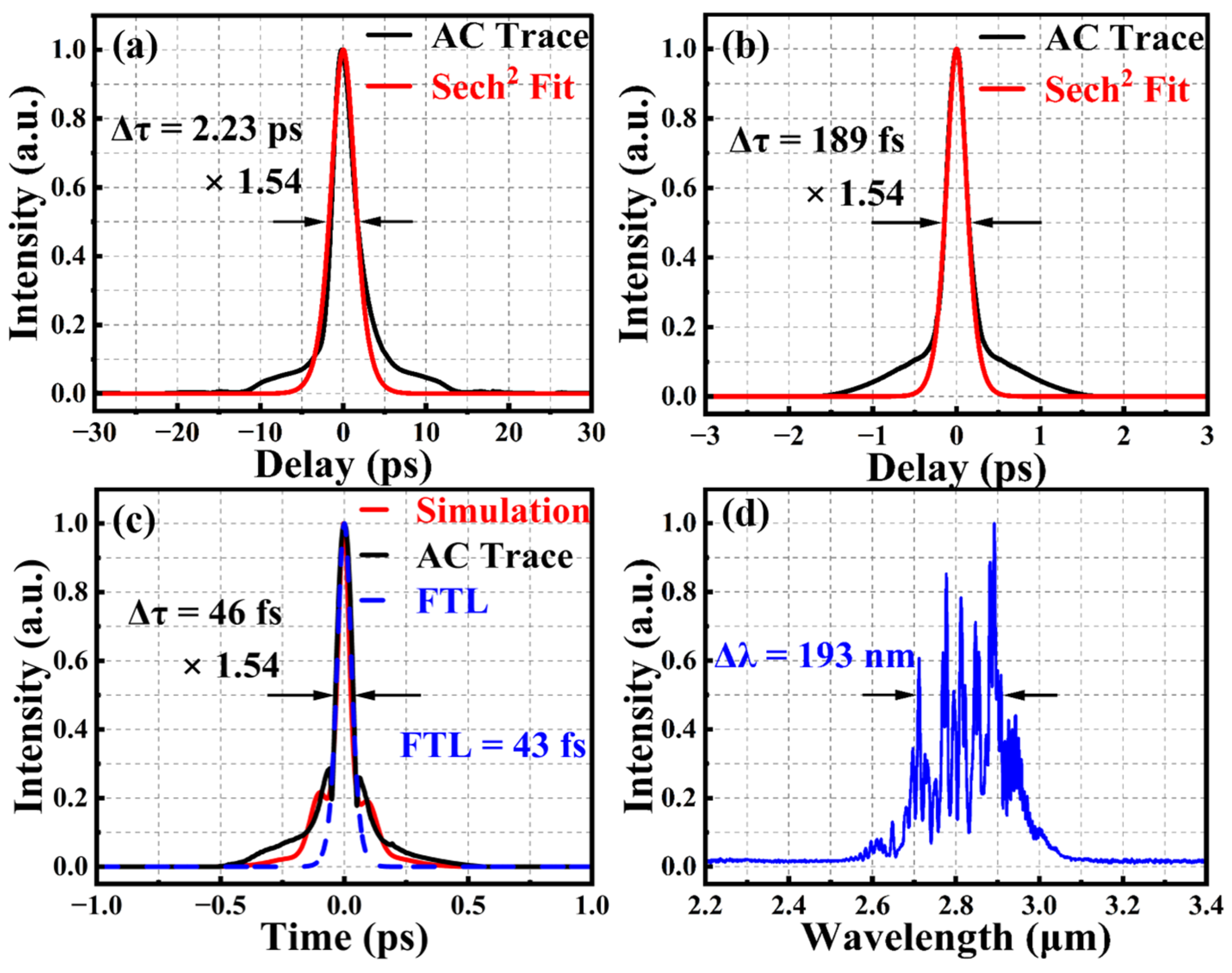
Leveraging the anomalous dispersion of the ZBLAN-2 fiber at 2.8 µm alongside its compatible mode field area, we developed an integrated compression system utilizing full-fiber fusion splicing. Through iterative experimental optimization, an initial configuration using a 24 cm As2S3 fiber (β3 = 0.048 ps3/km) and a 50 cm ZBLAN-2 compressor (β3 = 0.034 ps3/km) achieved a compressed pulse of 2.23 ps, verifying the feasibility of the proposed approach [Figure 5a]. The pedestal is attributed to accumulated nonlinear phase and higher-order dispersion effects. By reducing the length of the As2S3 fiber to 15 cm while maintaining the ZBLAN-2 at 50 cm, the pulse duration was improved to 189 fs [Figure 5b]. Although this outcome indicated significant progress in dispersion compensation, the residual pedestal suggested incomplete nonlinear phase management. Through further optimization, we achieved optimal results by employing an 8 cm As2S3 fiber paired with a 42 cm ZBLAN-2 fiber, generating a pulse of 46 fs [Figure 5c]. The residual chirp of the sub-50 fs pulse is estimated to be about 0.35. The nonlinear pulse compression was further investigated through numerical simulations using the nonlinear Schrödinger equation [27] [Figure 5c]. Though some minor discrepancies remain, numerical simulations yield a compressed pulse width of 51 fs; the minor discrepancy in pulse width between the simulation and experiment primarily arises from the discrepancies between the parameters used in the simulation and the actual experimental parameters. The presence of a pulse pedestal in both theoretical and experimental autocorrelation traces is attributed to nonlinear chirp and residual high-order dispersion, as confirmed by our model. The corresponding spectrum at this optimized compression point is shown in Figure 5d.
Figure 5.
Compressed pulses with the combination of different fibers and fiber lengths. Measured autocorrelation traces, corresponding sech2 fits or simulation for (a) 24 cm As2S3 + 50 cm ZBLAN-2, (b) 15 cm As2S3 + 50 cm ZBLAN-2, and (c) 8 cm As2S3 + 42 cm ZBLAN-2. (d) Output spectrum corresponding to the optimally compressed pulse in (c).
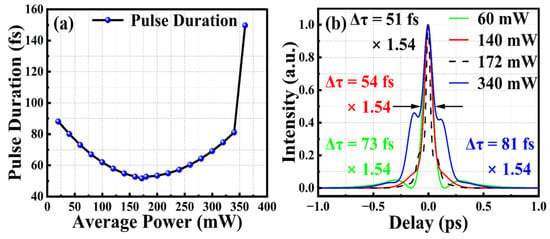
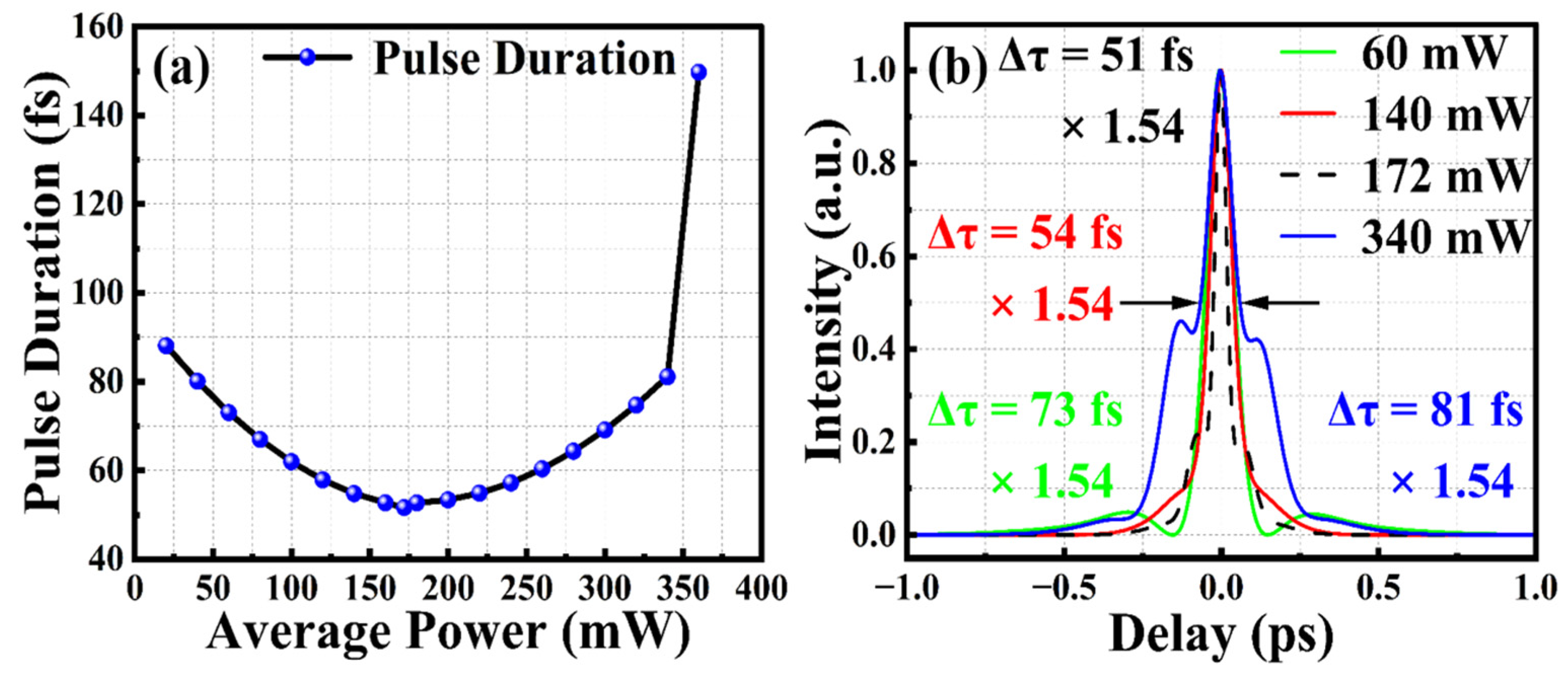
The performance of the nonlinear pulse compression configuration (8 cm As2S3 + 42 cm ZBLAN-2) over a broad power range from 20 mW to 360 mW was thoroughly investigated. Numerical simulations were conducted to assess pulse profile evolution and temporal changes at four distinct input power levels: 60 mW (green curve), 140 mW (red curve), 172 mW (black dashed line), and 340 mW (blue curve). The results are presented in Figure 6, which provides a temporal perspective across these power levels. At low input powers, limited spectral broadening and minimal SPM effects are observed, resulting in insufficient pulse compression. As the power level increases, spectral broadening and the interplay between SPM and normal dispersion in the As2S3 fiber generate a highly linear chirp. The resulting linear chirp gradually enables optimal dispersion compensation, leading to progressive pulse duration narrowing until reaching a minimum pulse duration at ~172 mW. Beyond this optimal condition, further nonlinearity-induced temporal broadening occurs. Uncompensated residual nonlinear chirp contributes to pulse pedestal enhancement as power levels surpass this threshold. Simultaneously, stimulated Raman scattering in the ZBLAN-2 fiber and self-steepening effects destabilize higher-order solitons, leading to soliton fission. These phenomena are consistent with previous findings reported in reference [29].
Figure 6.
Simulated pulses at different incident powers. (a) Pulse durations at different incident powers (varying from 20 mW to 360 mW). (b) Pulse profiles at four incident powers (green: 60 mW, red: 140 mW, black dashed: 172 mW, blue: 340 mW).
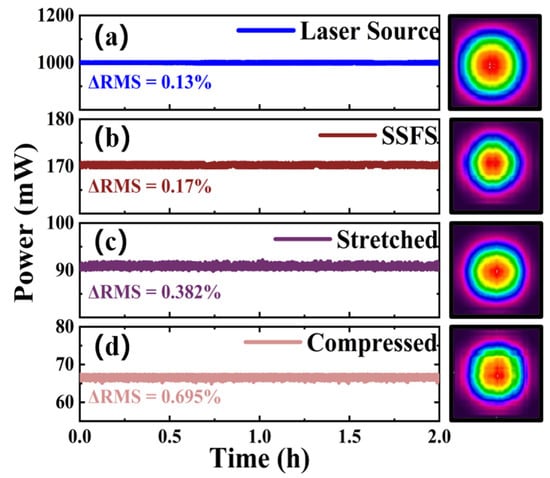
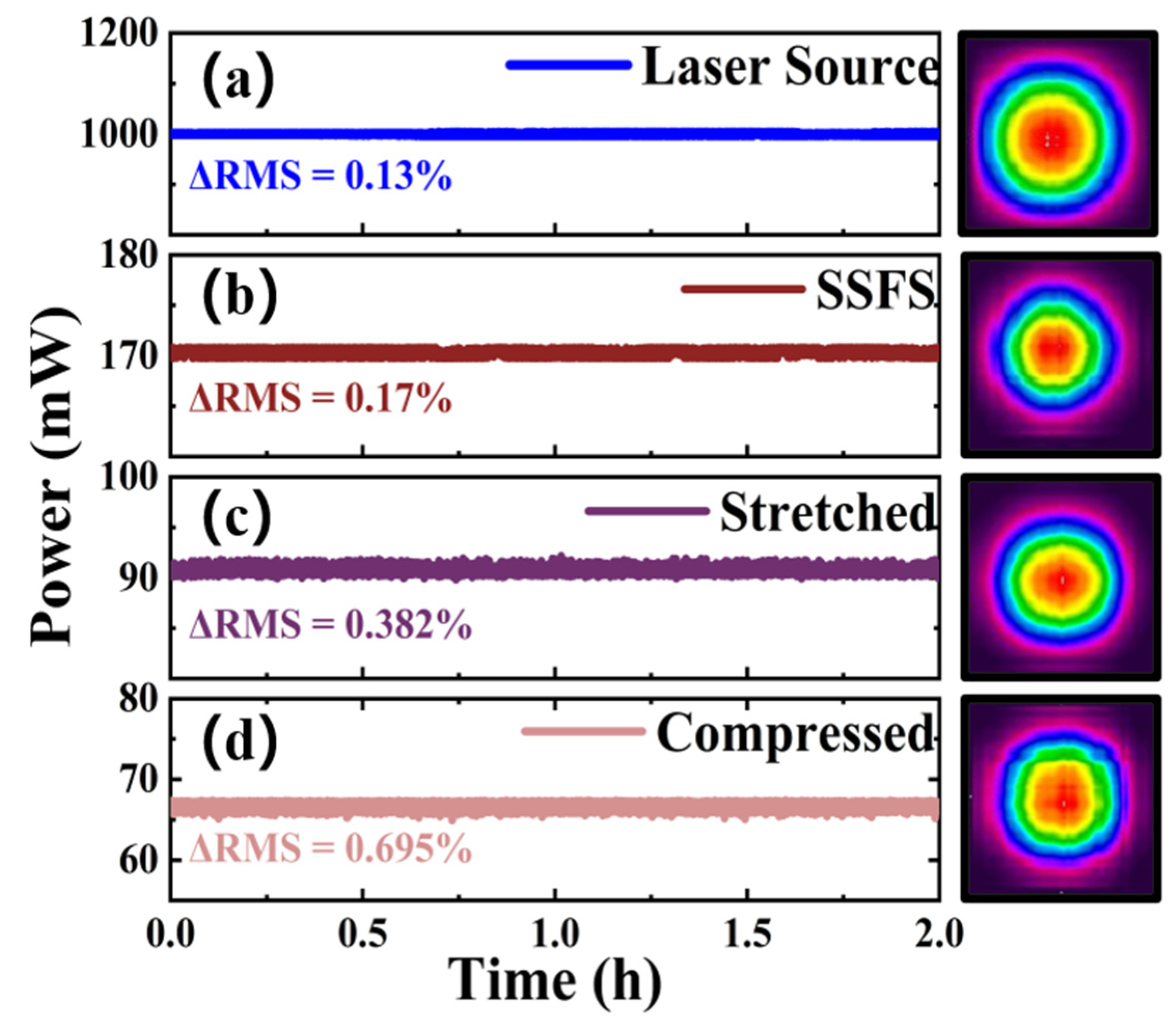
The fiber-integrated architecture of our setup ensures high environmental stability, as evidenced by the consistent power output across four key stages over two hours at maximum pump power (Figure 7). The laser source exhibited an average power of 1 W with a root-mean-square (RMS) value of power fluctuation of 0.13%. Following the SSFS stage and subsequent filtering, the average power was 172 mW with an RMS value of 0.17%. At this stage, power instability is primarily induced by the random drift of the polarization state (driven by thermal variations or fiber perturbations), which modulate the nonlinear conversion efficiency. After the As2S3 stretching fiber, the power dropped to ~91 mW with a higher RMS value of 0.382%. This stage exhibits sensitivity to mechanical assembly tolerances that are susceptible to amplification by environmental vibrations and thermal gradients. At the final compressed output, the power was 66 mW (the overall transmission efficiency of the system is estimated to be up to 38%), maintaining excellent stability with an RMS value of 0.695%. Beyond the aforementioned factors, the stability at this final stage is further compromised by the strong atmospheric absorption of 2.8 μm radiation, rendering the output power sensitive to local humidity fluctuations. Moreover, these stage-specific instabilities are significantly compounded by the nonlinear amplification of inherent pump intensity noise. Furthermore, near-Gaussian beam profiles were observed across all system stages, as shown in Figure 7, which underscores the robust spatial mode quality maintained throughout the fiber-integrated setup.
Figure 7.
Power fluctuation tests in 2 h and beam profiles for (a) the laser source, (b) the SSFS stage, (c) the stretched stage, and (d) the compressed stage. The corresponding ΔRMS values are also presented in each panel.
4. Conclusions
In conclusion, we have demonstrated a highly fiber-integrated system for nonlinear pulse compression at 2.8 μm, generating stable laser pulses with 46 fs duration, 66 mW average power, and a 50 MHz repetition rate. The cornerstone of this achievement is the implementation of robust fusion splicing between silica-ZBLAN-1 and As2S3-ZBLAN-2 fibers, which ensures exceptional system stability and enables a truly alignment-free architecture.
In this work, we demonstrate two key potential functionalities for MIR all-fiber CPA systems. First, we confirmed the feasibility of employing centimeter-scale segments of As2S3 fiber for efficient pulse stretching into the picosecond regime, representing a drastic miniaturization compared to conventional grating-based stretchers. Second, we established ZBLAN fiber as an effective and fully fiber-integrated compressor, capable of recovering near-transform-limited, sub-50 fs pulses.
This integrated stretcher–compressor unit is a pivotal step towards compact and robust MIR CPA systems. However, to fully realize high-power, all-fiber CPA systems at 2.8 μm, three key challenges must be addressed: (1) the development of high-efficiency, fiberized pump/signal combiners to support power scaling in gain fibers, (2) the refinement of fusion splicing techniques between dissimilar fibers to achieve ultra-low loss and high mechanical strength, and (3) the investigation of fiberized optical filters at 3 μm. Overcoming these hurdles will unlock the potential for environmentally stable, high-power all-fiber ultrafast sources, thereby providing a powerful tool for advanced applications such as next-generation ultrafast spectroscopy and micro-processing in special materials.
Author Contributions
Conceptualization, H.X. and L.Y.; methodology, S.Y.; software, X.Z.; validation, K.X., C.C. and B.W.; formal analysis, X.L.; investigation, H.X.; resources, S.D.; data curation, H.X.; writing—original draft preparation, H.X.; writing—review and editing, H.X., P.Y. and C.M.; visualization, X.Z.; supervision, S.D.; project administration, S.D.; funding acquisition, P.Y. All authors have read and agreed to the published version of the manuscript.
Funding
This research was funded by the National Natural Science Foundation of China, grant numbers U23A20370, 62090065, 62275015 and 62205015, and the Natural Science Foundation of Ningbo, grant number 2022J078.
Data Availability Statement
The data in this study are available upon request.
Conflicts of Interest
The authors declare no conflicts of interest.
References
- Vampa, G.; Hammond, T.J.; Taucer, M.; Ding, X.; Ropagnol, X.; Ozaki, T.; Delprat, S.; Chaker, M.; Thiré, N.; Schmidt, B.E.; et al. Strong-field optoelectronics in solids. Nat. Photonics 2018, 12, 465–468. [Google Scholar] [CrossRef] [Scilit]
- Pupeza, I.; Huber, M.; Trubetskov, M.; Schweinberger, W.; Hussain, S.A.; Hofer, C.; Fritsch, K.; Poetzlberger, M.; Vamos, L.; Fill, E.; et al. Field-resolved infrared spectroscopy of biological systems. Nature 2020, 577, 52–59. [Google Scholar] [CrossRef] [Scilit]
- Amini-Nik, S.; Kraemer, D.; Cowan, M.L.; Gunaratne, K.; Nadesan, P.; Alman, B.A.; Miller, R.J.D. Ultrafast Mid-IR Laser Scalpel: Protein Signals of the Fundamental Limits to Minimally Invasive Surgery. PLoS ONE 2010, 5, e13053. [Google Scholar] [CrossRef] [Scilit]
- Shi, W.; Fang, Q.; Zhu, X.; Norwood, R.A.; Peyghambarian, N. Fiber lasers and their applications [Invited]. Appl. Opt. 2014, 53, 6554–6568. [Google Scholar] [CrossRef] [Scilit]
- Jackson, S.D. Towards high-power mid-infrared emission from a fibre laser. Nat. Photonics 2012, 6, 423–431. [Google Scholar] [CrossRef] [Scilit]
- von Grafenstein, L.; Bock, M.; Ueberschaer, D.; Zawilski, K.; Schunemann, P.; Griebner, U.; Elsaesser, T. 5 μm few-cycle pulses with multi-gigawatt peak power at a 1kHz repetition rate. Opt. Lett. 2017, 42, 3796–3799. [Google Scholar] [CrossRef] [Scilit]
- Andriukaitis, G.; Balčiūnas, T.; Ališauskas, S.; Pugžlys, A.; Baltuška, A.; Popmintchev, T.; Chen, M.-C.; Murnane, M.M.; Kapteyn, H.C. 90 GW peak power few-cycle mid-infrared pulses from an optical parametric amplifier. Opt. Lett. 2011, 36, 2755–2757. [Google Scholar] [CrossRef] [Scilit]
- Wang, J.; Zhang, Z.; Jia, S.; Wang, S.; Farrell, G.; Li, Z.; Wang, P. Observation of Mid Infrared Domain-Wall Dark Pulses in an Er3+/Pr3+ Co-Doped InF3-Glass Based Fiber Laser. J. Light. Technol. 2025, 43, 4940–4944. [Google Scholar] [CrossRef] [Scilit]
- Lau, K.Y.; Pang, M.; Hu, M.; Liu, X.; Li, N.; Qiu, J. Sub-100-fs Ultrafast Fiber Laser Using Nonlinear Optical Fiber Systems: Perspectives and Challenges. Ultrafast Sci. 2025, 5, 0106. [Google Scholar] [CrossRef] [Scilit]
- Wu, Y.; Yao, C.; Wang, X.; Yang, L.; Wang, C.; Ren, G.; Li, P. Watt-level 2.8 μm ultrashort pulse generation from an all-fiber Er:ZBLAN fiber amplifier. Opt. Laser Technol. 2022, 156, 108499. [Google Scholar] [CrossRef] [Scilit]
- Luo, X.; Tang, Y.; Dong, F.; Wang, J.; Yu, L.; Yan, P.; Wang, J.; Lue, Q.; Guo, C.; Ruan, S. All-fiber 3.4-W 2.8-µm ultra-short pulse MOPA system seeded by the soliton self-frequency shift of 2-µm pulses. Opt. Lett. 2023, 48, 1790–1793. [Google Scholar] [CrossRef] [Scilit]
- Sun, W.; Huang, J.; Chen, L.; Luo, Z.; Lin, W.; Li, Z.; Jiang, C.; Huang, Z.; Jiang, X.; Wang, P.; et al. Three-stage dynamics of nonlinear pulse amplification in an ultrafast mid-infrared fiber amplifier with anomalous dispersion. Opt. Express 2025, 33, 26948–26961. [Google Scholar] [CrossRef] [Scilit]
- Tomlinson, W.J.; Stolen, R.H.; Shank, C.V. Compression of optical pulses chirped by self-phase modulation in fibers. J. Opt. Soc. Am. B 1984, 1, 139–149. [Google Scholar] [CrossRef] [Scilit]
- Qian, J.; Wang, P.; Peng, Y.; Li, Y.; Shao, B.; Su, H.; Lv, X.; Wang, D.; Leng, Y.; Li, R. Pulse combination and compression in hollow-core fiber for few-cycle intense mid-infrared laser generation. Photonics Res. 2021, 9, 477–483. [Google Scholar] [CrossRef] [Scilit]
- Huang, J.; Pang, M.; Jiang, X.; Köttig, F.; Schade, D.; He, W.; Butryn, M.; Russell, P.S.J. Sub-two-cycle octave-spanning mid-infrared fiber laser. Optica 2020, 7, 574–579. [Google Scholar] [CrossRef] [Scilit]
- Zhou, L.; Lou, H.; Deng, Z.; Qin, X.; Pan, J.; Di, Y.; Gu, C.; Luo, D.; Li, W. Compact mid-infrared dual-comb spectrometer over 3–4 μm via intra-pulse difference frequency generation in LiNbO3 waveguides. High Power Laser Sci. Eng. 2024, 12, e23. [Google Scholar]
- Woodward, R.I.; Hudson, D.D.; Fuerbach, A.; Jackson, S.D. Generation of 70-fs pulses at 2.86 μm from a mid-infrared fiber laser. Opt. Lett. 2017, 42, 4893–4896. [Google Scholar] [CrossRef] [Scilit]
- Zhou, Y.; Qin, Z.; Zhou, X.; Xie, G. Grating-free 2.8 μm Er:ZBLAN fiber chirped pulse amplifier. High Power Laser Sci. Eng. 2022, 10, e41. [Google Scholar]
- Nagy, T.; von Grafenstein, L.; Ueberschaer, D.; Griebner, U. Femtosecond multi-10-mJ pulses at 2 µm wavelength by compression in a hollow-core fiber. Opt. Lett. 2021, 46, 3033–3036. [Google Scholar] [CrossRef] [Scilit] [PubMed]
- Yin, K.; Zhang, B.; Yao, J.; Yang, L.; Chen, S.; Hou, J. Highly stable, monolithic, single-mode mid-infrared supercontinuum source based on low-loss fusion spliced silica and fluoride fibers. Opt. Lett. 2016, 41, 946–949. [Google Scholar] [CrossRef] [Scilit]
- Yang, L.; Yan, B.; Zhao, R.; Wu, D.; Xu, T.; Yang, P.; Nie, Q.; Dai, S. Ultra-low fusion splicing loss between silica and ZBLAN fiber for all-fiber structured high-power mid-infrared supercontinuum generation. Infrared Phys. Technol. 2021, 113, 103576. [Google Scholar] [CrossRef] [Scilit]
- Zhang, C.; Song, J.; Zhang, Z.; Xia, K.; Wei, Z.; Lv, M.; Mei, C.; Yang, P.; Peng, X.; Xu, P.; et al. All-fiber mid-infrared supercontinuum generation with high coherence in chalcogenide fiber pumped by 2.8 µm Raman femtosecond solitons. Infrared Phys. Technol. 2025, 148, 105882. [Google Scholar] [CrossRef] [Scilit]
- Ren, H.; Xia, K.; Wang, J.; Ge, S.; Huang, T.; Yang, P.; Xu, P.; Mo, S.; Qiu, M.; Bai, S.; et al. The polarization-aided tunable high-power femtosecond Raman solitons generation from 1.96 to 3.1 μm in fibers cascaded system. Opt. Laser Technol. 2022, 150, 107934. [Google Scholar] [CrossRef] [Scilit]
- Yin, K.; Zhang, B.; Yao, J.; Cai, Z.; Liu, G.; Hou, J. Toward high-power all-fiber 2–5 μm supercontinuum generation in chalcogenide step-index fiber. J. Light. Technol. 2017, 35, 4535–4539. [Google Scholar] [CrossRef] [Scilit]
- Yang, L.; Wang, Y.; Jiao, K.; Dai, S.; Zhao, R.; Nie, Q.; Wang, X.; Jia, Z.; Qin, G. High-coupling efficiency and robust fusion splicing between fluorotellurite and chalcogenide fibers. Infrared Phys. Technol. 2022, 122, 104075. [Google Scholar] [CrossRef] [Scilit]
- Shamim, M.H.M.; Alamgir, I.; Correr, W.; Messaddeq, Y.; Rochette, M. Soliton Self-Frequency Shift in a Cascade of Silica, Fluoride, and Chalcogenide Fibers. J. Light. Technol. 2024, 42, 6063–6069. [Google Scholar] [CrossRef] [Scilit]
- Agrawal, G.P. Nonlinear Fiber Optics, 4th ed.; Elsevier Science: New York, NY, USA, 2007. [Google Scholar]
- Shamim, M.H.M.; Brilland, L.; Chahal, R.; Troles, J.; Rochette, M. All-fiber coherent supercontinuum generation in a cascade of silica, fluoride, and chalcogenide fibers. J. Phys. Photonics 2024, 6, 045018. [Google Scholar] [CrossRef] [Scilit]
- Dudley, J.M.; Genty, G.; Coen, S. Supercontinuum generation in photonic crystal fiber. Rev. Mod. Phys. 2006, 78, 1135–1184. [Google Scholar] [CrossRef] [Scilit]

Disclaimer/Publisher’s Note: The statements, opinions and data contained in all publications are solely those of the individual author(s) and contributor(s) and not of MDPI and/or the editor(s). MDPI and/or the editor(s) disclaim responsibility for any injury to people or property resulting from any ideas, methods, instructions or products referred to in the content. |
© 2026 by the authors. Licensee MDPI, Basel, Switzerland. This article is an open access article distributed under the terms and conditions of the Creative Commons Attribution (CC BY) license.