


Abstract
Most of the existing carbon dot (CD)-based afterglow materials are limited to a single emission mode of either room-temperature phosphorescence (RTP) or delayed fluorescence (DF), which makes it difficult to meet the application requirements of advanced anti-counterfeiting and multi-level information encryption. Therefore, the development of CD-based composite materials with multi-mode afterglow emission, long lifetime and high stability holds significant research significance and application value. In this study, long-afterglow manganese/nitrogen co-doped CDs@boric acid (BA) composites (Mn, N-CDs @BA) are successfully prepared, and their optical properties and emission mechanism are clarified. The results demonstrate that the Mn, N-CDs @BA composites exhibit wavelength-dependent dual-afterglow emission characteristics of RTP and DF. Under 254 nm ultraviolet (UV) light excitation, they exhibit DF emission with an average lifetime of 903.36 ms. Under 365 nm UV light excitation, RTP emission with an average lifetime of 354.43 ms is observed. Moreover, the afterglow color exhibits time dependence. Based on the triple emission modes (fluorescence, RTP and DF) of the Mn, N-CDs @BA composites, optical patterns were designed and fabricated, and counterfeit-resistant and unclonable anti-counterfeiting and high concealment information encryption were successfully achieved. This work develops a potentially feasible approach for next-generation advanced optical anti-counterfeiting and information encryption systems.
1. Introduction
Carbon dots (CDs), as a class of carbon-based nanomaterials with a typical particle size of less than 10 nm, have attracted extensive attention since the first report in 2004 [1]. Owing to their tunable photoluminescence, low toxicity, cost-effectiveness and excellent biocompatibility, CDs are regarded as promising candidates for next-generation luminescent materials [2]. According to the luminescence mechanisms, CDs can be classified into fluorescent CDs and afterglow CDs. The afterglow CDs can be further categorized into room-temperature phosphorescence CDs (RTP-CDs) [3,4], delayed fluorescence CDs (DF-CDs) [5,6] and high-temperature phosphorescence CDs (HTP-CDs) [7,8].
Compared with fluorescence CDs, afterglow CDs generally exhibit a larger Stokes shift and longer luminescence lifetime, thus demonstrating broad application prospects in various fields such as optoelectronic devices [9,10,11], bioimaging [12,13], optical anti-counterfeiting [14,15] and information encryption [16,17,18]. To achieve efficient solid-state afterglow, current strategies primarily focus on two aspects: (i) intersystem crossing (ISC) promotion—introducing heteroatoms (e.g., N, P) or heavy atoms to alter the electronic energy level structure and enhance spin–orbit coupling (SOC); (ii) non-radiative decay suppression—embedding CDs into rigid matrices (e.g., PVA, SiO2, MOFs or B2O3) to restrict molecular motions and shield triplet excitons from oxygen quenching [19,20,21,22,23,24].
Although significant progress has been made, most reported CD-based materials exhibit only a single afterglow mode (either RTP or DF). This “single-mode” characteristic limits their information carrying capacity and security level in advanced anti-counterfeiting and information encryption scenarios. Therefore, the development of CD-based composites with excitation-dependent dual-mode afterglow, high stability and easy scalability is of great research significance and practical application value. In this work, manganese/nitrogen co-doped carbon dots (Mn, N-CDs) were first synthesized via a facile solvothermal method. Subsequently, using boric acid (BA) as the matrix, Mn, N-CDs @BA long-afterglow composite materials are successfully prepared. The as-prepared Mn, N-CDs @BA composites exhibit remarkable excitation-dependent dual-mode afterglow behavior: excitation at high energy (254 nm) triggers DF, while excitation at low energy (365 nm) induces RTP. This tunable luminescence behavior enables the realization of dynamic, difficult-to-replicate anti-counterfeiting labels and multi-level encryption systems, significantly enhancing the concealment and information security.
2. Materials and Methods
2.1. Materials
The chemical reagents used in this study include folic acid (FA, 97.0%), manganese (II) chloride tetrahydrate (MnCl2·4H2O, 99%), absolute ethanol (C2H5OH, 99.7%), boric acid (H3BO3, 99.8%), and urea (CO(NH2)2, 99.7%), all of which were purchased from Sinopharm Chemical Reagent Co., Ltd. (Shanghai, China). All reagents were used directly without further purification.
2.1.1. Synthesis of Mn, N-CDs @BA Composites
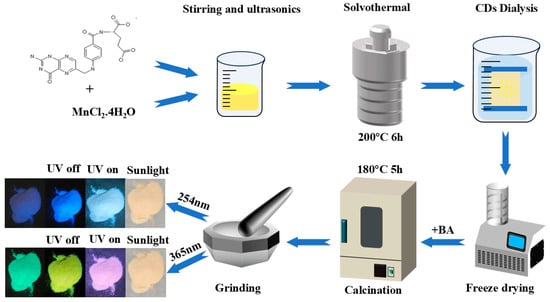
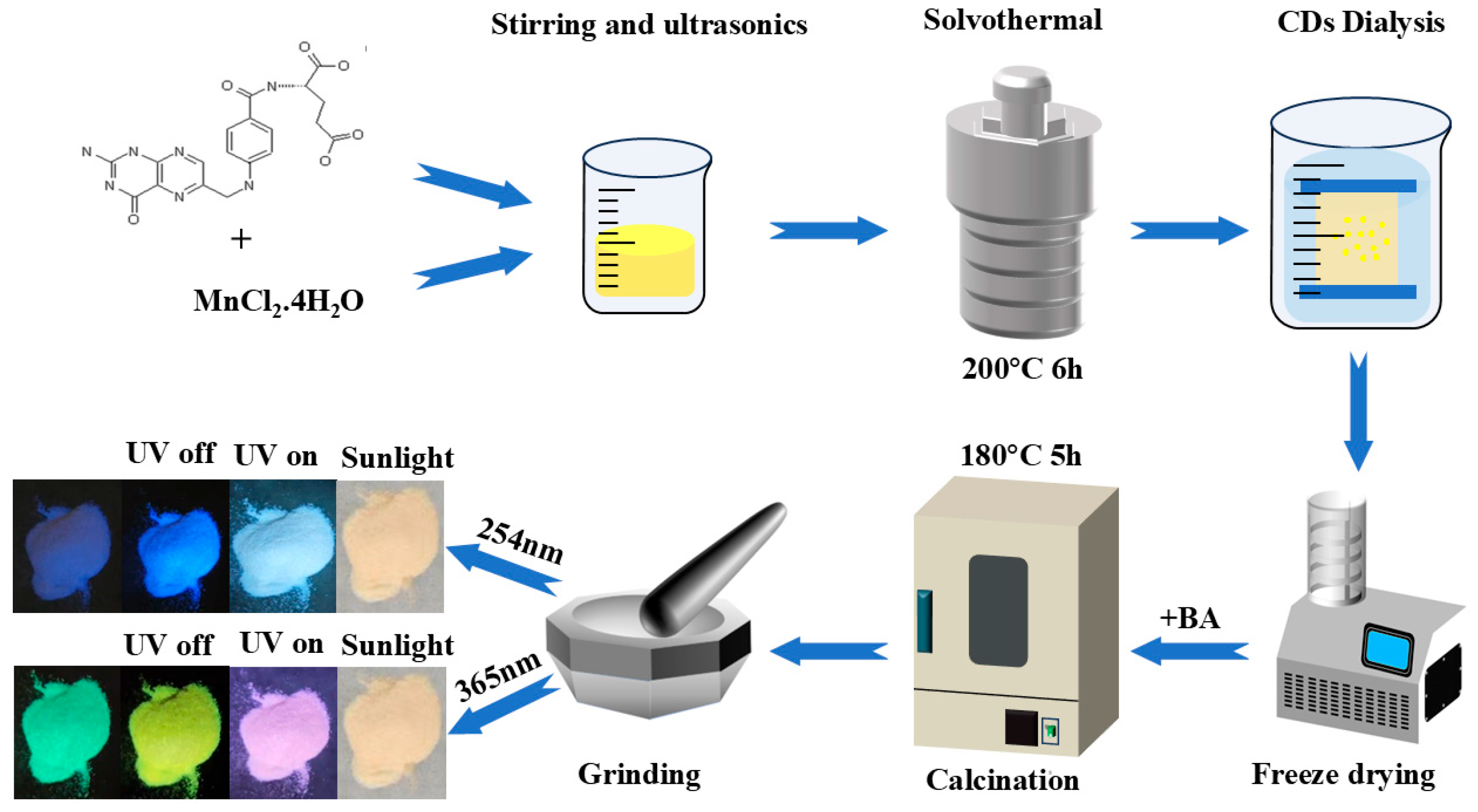
The Mn, N-CDs @BA composites were synthesized via a two-step method, and the synthesis conditions were systematically optimized via single-factor experiments. In this work, all preparation processes were performed under the optimized conditions. First, Mn, N-CDs were synthesized via a solvothermal method. Specifically, 0.1 g FA and 0.38 g MnCl2·4H2O were weighed and transferred into a 50 mL beaker, followed by the addition of 30 mL of ethanol. The mixture was thoroughly stirred with a glass rod and then subjected to ultrasonication for 20 min. Next, the mixed solution was transferred into a 50 mL Teflon-lined stainless-steel autoclave, which was placed in a blast drying oven and heated at 200 °C for 6 h. The obtained solution was filtered and then purified by dialysis in a 500 mL beaker using a dialysis bag (MWCO: 1000 Da) for 24 h to remove unreacted reagents and small-molecule impurities. The dialyzed CD solution was freeze-dried to obtain Mn, N-CDs powder. Subsequently, the Mn, N-CDs @BA composite was prepared via a matrix-assisted thermal treatment. Using deionized water as the solvent, Mn, N-CDs solution (2 mg/mL) and BA solution (50 mg/mL) were prepared separately. Next, 2 mL of Mn, N-CDs solution and 40 mL of BA solution were mixed in a beaker, followed by stirring and ultrasonication until a homogeneous mixture was formed. The beaker was placed in a blast drying oven and calcined at 180 °C for 5 h. After cooling to room temperature, the solid product was ground to obtain Mn, N-CDs @BA composite powder. A schematic diagram of the Mn, N-CDs @BA synthesis process is shown in Figure 1.
Figure 1.
A schematic diagram of the Mn, N-CDs @BA synthesis process.
2.1.2. Application in Optical Anti-Counterfeiting and Information Encryption
In daily life, commodity anti-counterfeiting labels serve as a critical basis for product authentication. However, the proliferation of counterfeit and shoddy commodities remains a prevalent issue. Existing anti-counterfeiting methods suffer from drawbacks such as easy replication, high costs and complex verification processes. Meanwhile, traditional encryption algorithms are also facing the risk of being cracked due to the rapid development of quantum computing. Therefore, developing an optical anti-counterfeiting and information encryption system characterized by high concealment, easy identification and resistance to replication has great significance and promising application prospects.
Based on the dual-mode emission and time-dependent luminescence properties of the prepared Mn, N-CDs @BA composites, which exhibit excitation wavelength dependence, optical patterns or information encoding was designed and fabricated. This enables the realization of highly concealed, easily recognizable, and anti-replication optical dynamic anti-counterfeiting and information encryption. In this work, various optical anti-counterfeiting and information encryption patterns were designed and successfully implemented, achieving optical dynamic anti-counterfeiting and multi-level information encryption with high concealment and strong anti-replication.
2.2. Characterization
The morphology and microstructure of the Mn, N-CDs @BA composites were characterized by transmission electron microscopy (TEM, JEOL, JEM-3200FS, Tokyo, Japan). X-ray diffraction (XRD, Rigaku, MiniFlex600, Tokyo, Japan) was employed for crystal structure analysis. The absorption spectrum in the wavelength range of 200–700 nm was measured with an ultraviolet-visible spectrophotometer (PerkinElmer, Lambda 1050, Waltham, MA, USA). X-ray photoelectron spectroscopy (XPS, Thermo Fisher Scientific, K-Alpha, Waltham, MA, USA) was used to determine the elemental composition, content and chemical bonding states. Fourier transform infrared spectroscopy (FTIR, Thermo Fisher Scientific, IS5, Waltham, MA, USA) was employed for infrared spectral analysis. The excitation spectrum and emission spectrum were tested using a fluorescence spectrophotometer (Horiba, Dual UV-NIR, Tokyo, Japan), and the quantum yield was measured with an integrating sphere accessory. The luminescence lifetime was determined using a steady-state/transient fluorescence spectrometer (Edinburgh Instruments, FLS1000, Scotland, UK). All the above characterizations were carried out at room temperature.
3. Results
3.1. Morphology and Structure Characterization of the Mn, N-CDs @BA
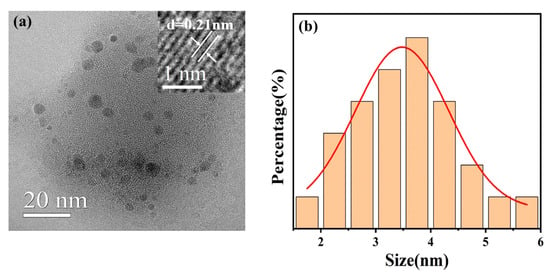
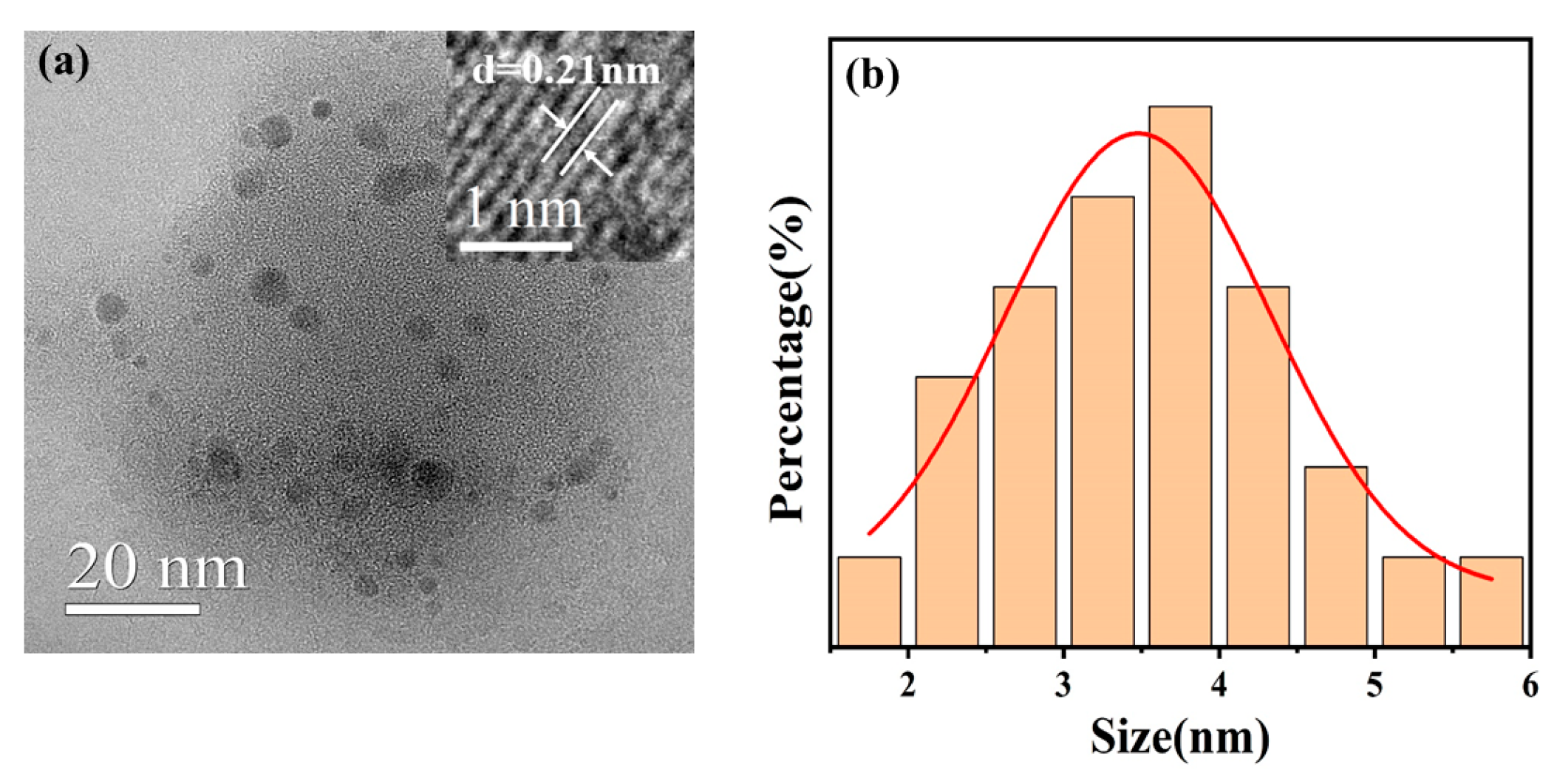
The morphology of the Mn, N-CDs @BA was characterized by transmission electron microscopy (TEM). The TEM image of the as-prepared Mn, N-CDs @BA is shown in Figure 2a, where it can be observed that the nanoparticles are basically spherical, with excellent dispersibility. The inset in the upper right corner corresponds to the HRTEM image of the Mn, N-CDs @BA, showing clear lattice fringes with an interplanar spacing of approximately 0.21 nm, which is assigned to the (100) plane of graphitic carbon [25]. Figure 2b displays the particle size distribution histogram of the Mn, N-CDs @BA, and the statistical results indicate that the average particle size is about 3.59 nm.
Figure 2.
(a) TEM and HRTEM images of the Mn, N-CDs @BA; (b) particle size distribution diagram and its fitting line of the Mn, N-CDs @BA.
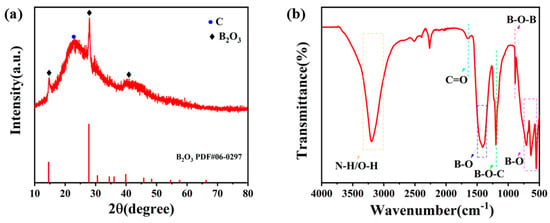
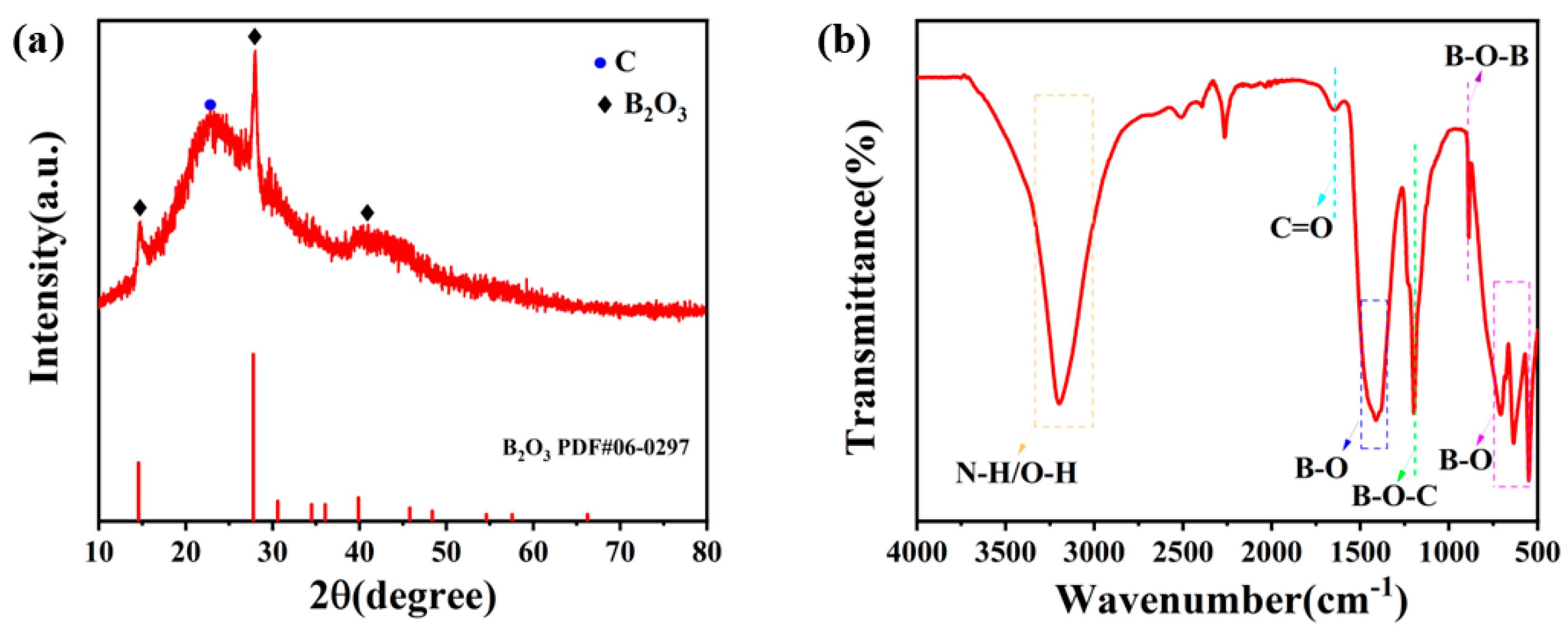
The crystal structure of the Mn, N-CDs @BA was analyzed by X-ray diffraction (XRD). Figure 3a shows the XRD pattern of the Mn, N-CDs @BA; the broad diffraction peak at 22.8° can be attributed to the disordered carbon core, corresponding to the (002) crystal plane of graphitic carbon. By comparing with the standard XRD pattern of B2O3 (PDF #06-0297), the sharp diffraction peaks at 14.8°, 28° and 43.9° can be attributed to characteristic diffraction peaks of B2O3. This reveals that a partial dehydration reaction of BA occurred during calcination, leading to the formation of a B2O3 network. Compared with the XRD pattern of pure Mn, N-CDs (Figure S2a), which shows distinct characteristic diffraction peaks at 2θ = 31.8°, 42.7°, and 66.4°, corresponding to the (210), (221), and (420) crystal planes of Mn (PDF#33-0887), respectively, this result confirms the successful doping of Mn into the CDs. For the Mn, N-CDs @BA composites, the Mn-related diffraction peaks are completely masked, suggesting that the B2O3 matrix effectively encapsulates and confines the Mn, N-CDs, thus preventing interparticle aggregation. This indirectly verifies the presence of interactions between the Mn, N-CDs and B2O3 matrix.
Figure 3.
(a) XRD pattern of the Mn, N-CDs @BA; (b) FTIR spectrum of the Mn, N-CDs @BA.
To further analyze the structure and surface functional groups of the Mn, N-CDs @BA, Fourier transform infrared spectroscopy (FTIR) was employed for characterization. The FTIR spectrum of pure Mn, N-CDs (Figure S2b) shows characteristic peaks at ~3195 cm−1 (O–H/N–H stretching); ~1704 cm−1 (C=O stretching); ~1671 cm−1 and ~1505 cm−1 (C=C stretching); ~1366 cm−1 (C–O stretching); and ~1278 cm−1/~1173 cm−1 (C–N stretching), confirming that the CDs’ surface is abundant in oxygen/nitrogen-containing functional groups. In contrast, the Mn, N-CDs @BA composite (Figure 3b) not only preserves some characteristic peaks of the Mn, N-CDs (e.g., the O–H/N–H peak at ~3195 cm−1) but also displays new B–O-related characteristic peaks, at ~1402 cm−1 (asymmetric B–O stretching); ~1191 cm−1 (B–O–C stretching); ~879 cm−1 (B–O–B ring vibration); and ~696 cm−1, ~615 cm−1, and ~541 cm−1 (B–O bending vibrations), verifying the formation of the B2O3 network. Notably, compared with pure Mn, N-CDs, the O–H stretching vibration peak (~3195 cm−1) in the composites exhibits broadening and a slight shift, and the B–O-related stretching vibrations also exhibit shifts. These spectral variations provide direct evidence for the existence of coordination interactions between the oxygen-containing functional groups on the CDs’ surface and the boron atoms in the B2O3 matrix.
The XRD and FTIR analysis results confirm the dehydration of BA and the forming of a B2O3 network during the Mn, N-CDs @BA composite synthesis. The Mn, N-CDs have a graphitic carbon core with limited crystallinity, and they are dispersedly embedded into the matrix of BA and B2O3. The identification of diverse surface functionalities (C=O, N-H/O-H) alongside the B-O framework points to a multi-center emission mechanism within the composites [26,27,28,29]. In addition, the presence of high-density oxygen-containing functional groups induces the formation of more surface states/defects, which lead to a red-shift in the emission spectrum. This is highly consistent with the recorded photoluminescence data.
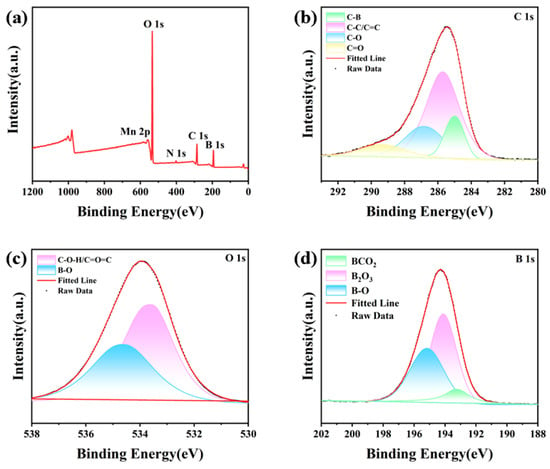
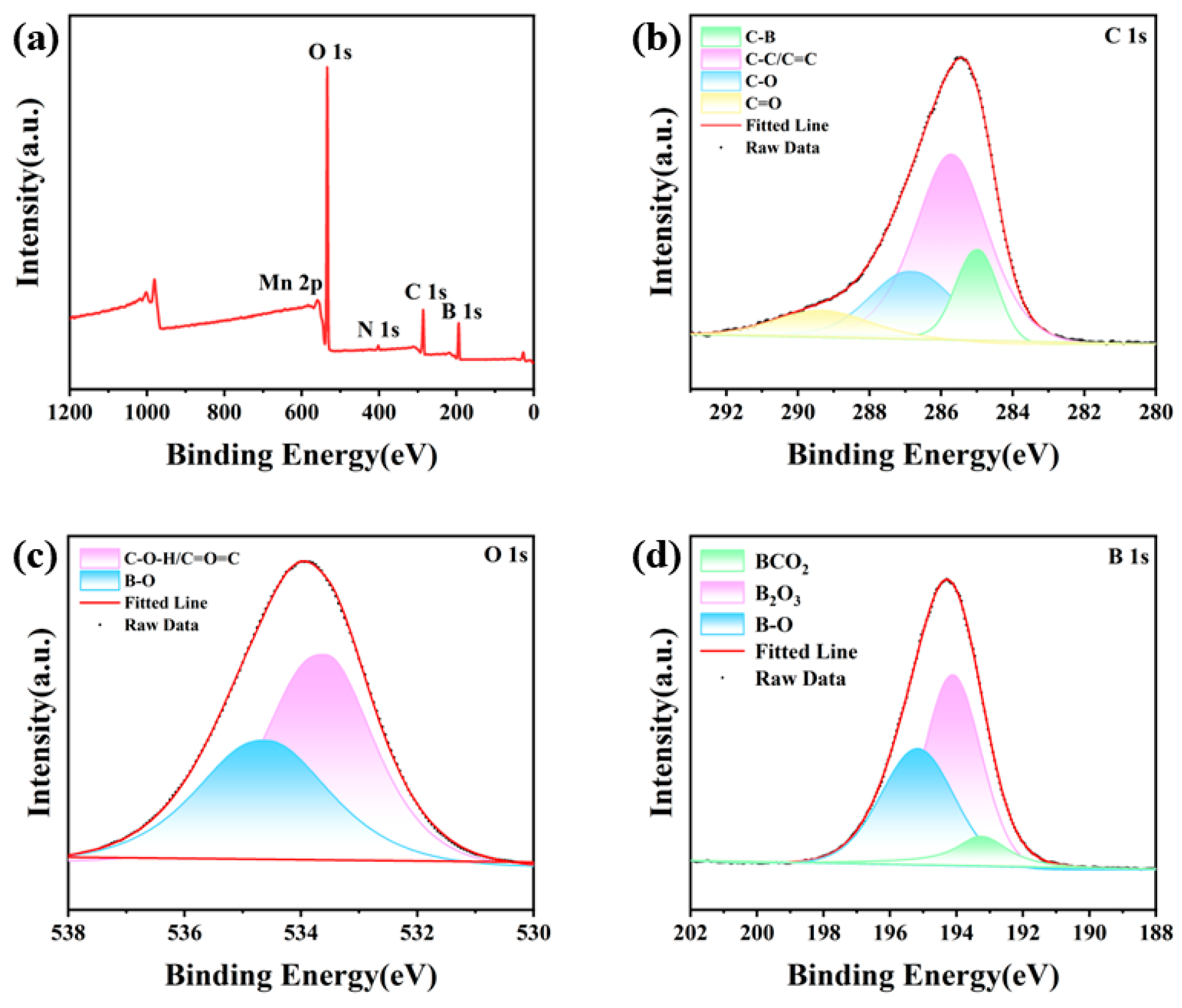
To further analyze the elemental composition, content and surface chemical bonds of the as-prepared Mn, N-CDs @BA, X-ray photoelectron spectroscopy (XPS) was employed for characterization. As shown in Figure 4a, the XPS survey spectrum exhibits characteristic peaks at 194.00 eV, 285.95 eV, 402.09 eV, 533.94 eV and 655.33 eV, which are assigned to B 1s, C 1s, N 1s, O 1s and Mn 2p, respectively. These results indicate that the Mn, N-CDs @BA is mainly composed of five elements, namely B, C, N, O and Mn; their atomic percentages are 18.71%, 22.03%, 1.49%, 57.31% and 0.46%, respectively. To further elucidate the surface chemical states of these elements in depth, high-resolution XPS (HRXPS) spectra of B, C and O were deconvoluted. As shown in Figure 4b, the C1s HRXPS spectrum was deconvoluted into four characteristic peaks, with binding energies at 284.97 eV, 285.70 eV, 286.78 eV and 289.38 eV, which correspond to the C-B covalent bonds, C-C/C=C skeletal structures, C-O functional groups and C=O functional groups, respectively [30]. As illustrated in Figure 4c, the O1s HRXPS spectrum was deconvoluted into two peaks; the peak at a binding energy of 533.58 eV is assigned to C-O-H/C=O=C groups, while the peak at 534.57 eV is attributed to B-O bonds. As shown in Figure 4d, the B1s HRXPS spectrum was resolved into three peaks, where the peaks at 193.22 eV, 194.11 eV and 195.16 eV correspond to BCO2, B2O3 and B-O bonds, respectively. The surface bonding configurations and functional group distributions revealed by HRXPS spectra are consistent with the aforementioned XRD and FTIR results.
Figure 4.
(a) XPS survey spectrum of the Mn, N-CDs @BA; (b) C1s HRXPS spectrum; (c) O1s HRXPS spectrum; (d) B1s HRXPS spectrum.
3.2. Optical Properties Analysis of Mn, N-CDs @BA
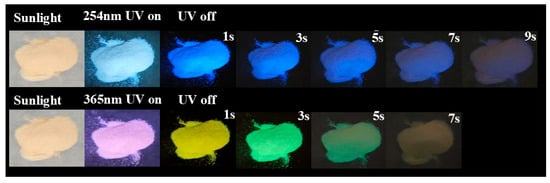
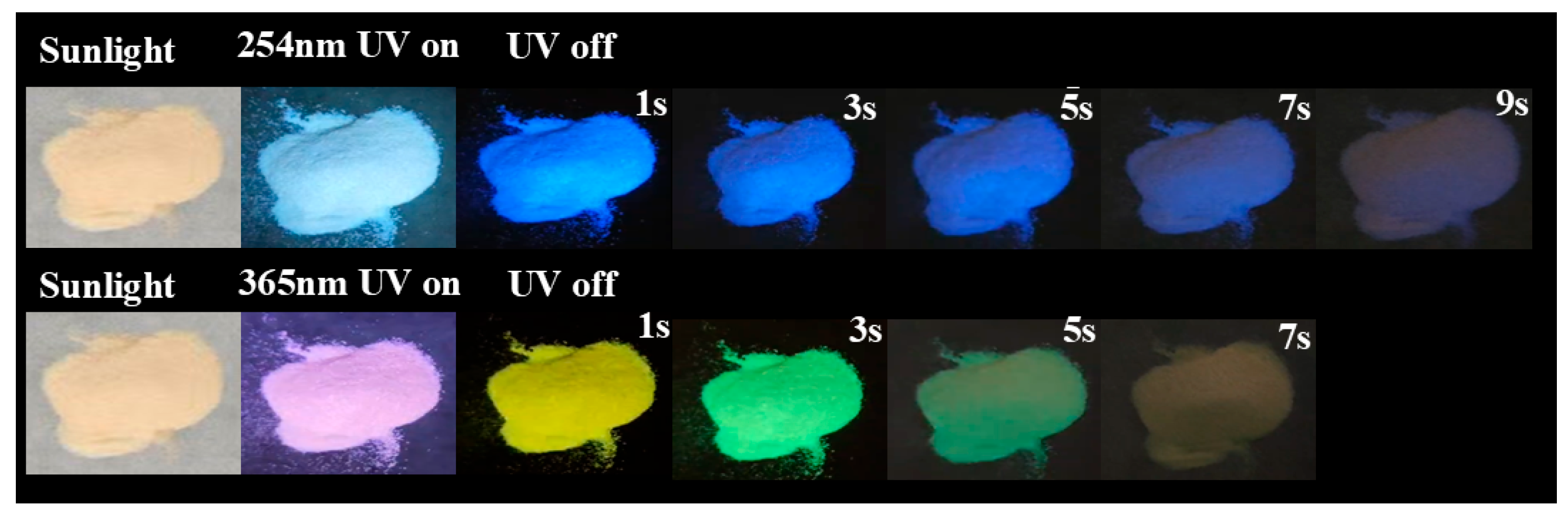
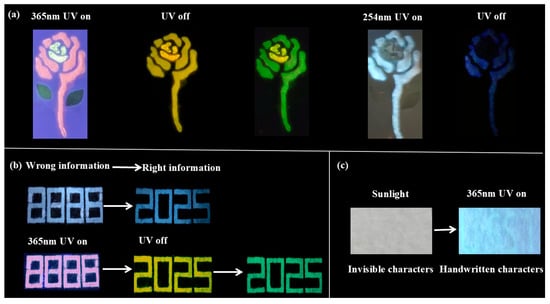
The Mn, N-CDs @BA composites exhibit excellent solid-state afterglow performance at room temperature, and their luminescence behavior shows significant wavelength-dependent excitation. When irradiated by a 254 nm UV lamp, the Mn, N-CDs @BA composites exhibit a white color, which is produced by the combination of emissions from multiple luminescent centers [31]. The high photon energy of a 254 nm UV lamp can excite multiple luminescent centers in the composites simultaneously, such as the sp2 domains of the carbon core, surface functional groups and Mn/N doping sites. After turning off the 254 nm UV lamp, the Mn, N-CDs @BA composites exhibit a distinct blue afterglow derived from the DF emission induced by reverse intersystem crossing (RISC) [32,33]. When irradiated by 365 nm UV lamp, the Mn, N-CDs @BA composites exhibit a pink color. This is because lower-energy photons can only selectively excite specific low-energy surface states and Mn-doped luminescent centers, and the emitted fluorescences mix to produce a pink color. After turning off the 365 nm UV lamp, the afterglow color dynamically evolves from yellow to green over time. This dynamic afterglow is attributed to the multiple RTP components, which are characterized by distinct triplet energy levels and decay lifetimes [34,35]. Figure 5 presents the photographs of the visual luminescence and afterglow transitions under excitation by 254 nm and 365 nm UV lamps.
Figure 5.
Photographs of the Mn, N-CDs @BA composites under UV lamp excitation and turn-off.
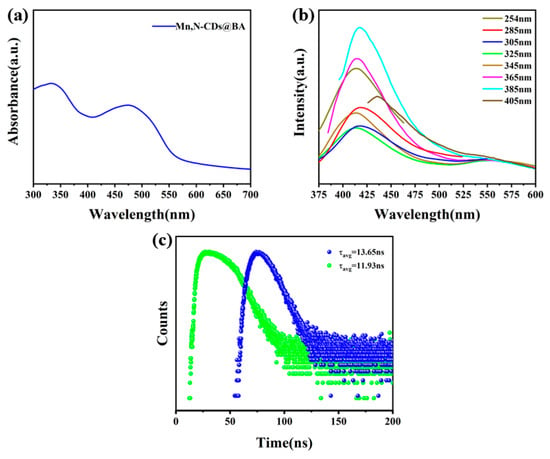
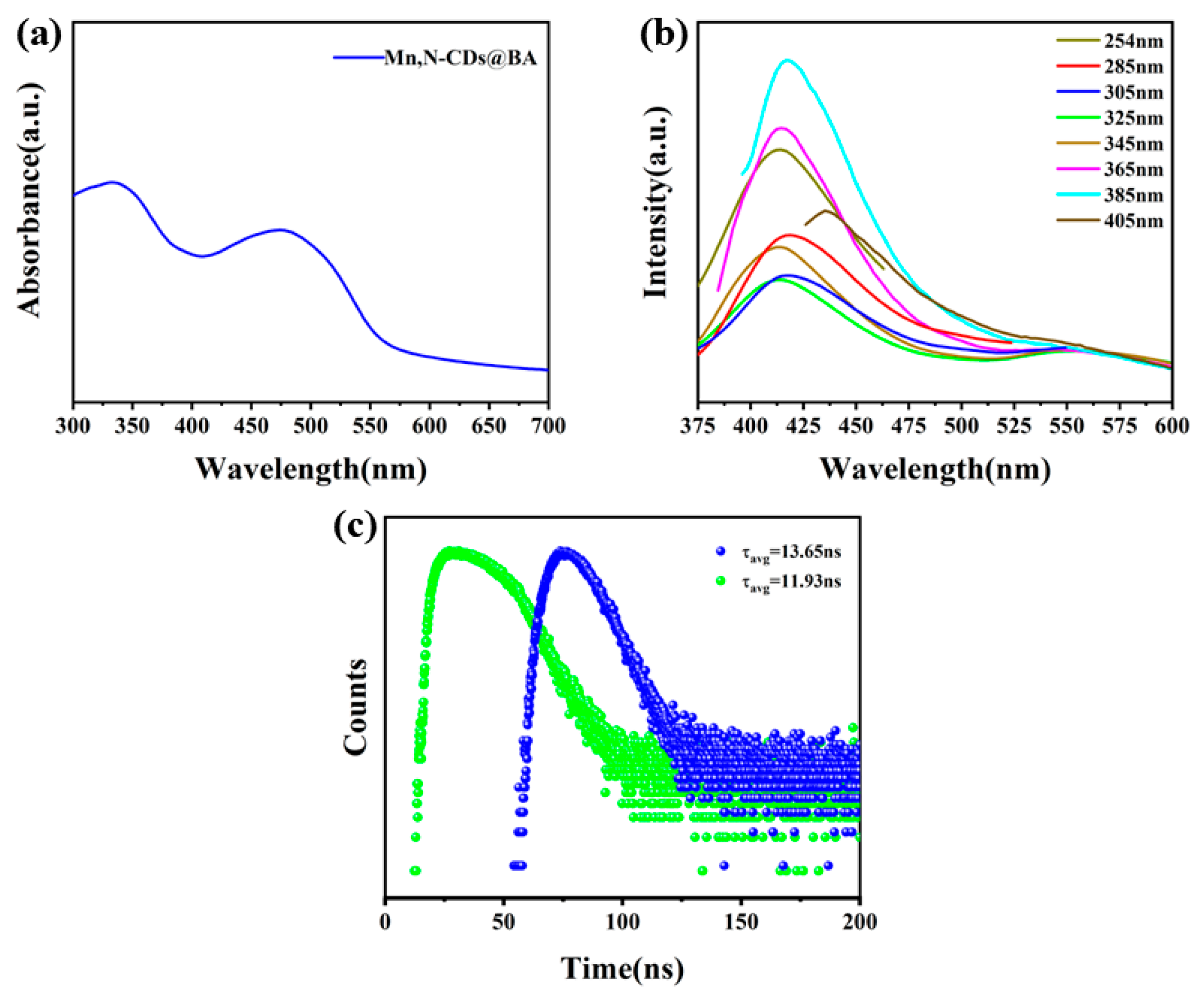
The optical properties of the Mn, N-CDs @BA composites were systematically investigated via UV-Vis absorption spectroscopy, photoluminescence (PL) spectroscopy and afterglow spectroscopy. As illustrated in Figure 6a, the UV-Vis absorption spectrum of the Mn, N-CDs @BA exhibits two distinct characteristic peaks. The distinct absorption peak at 340 nm is ascribed to the π→π* transition of the C=C bond, and the absorption peak at 474 nm is attributed to the n→π* transition of C-O/C=N bonds [36]. The n→π* transition is known to facilitate ISC from the excited singlet state to the triplet state, thereby creating favorable conditions for phosphorescence emission. Figure 6b displays the PL emission spectra of the Mn, N-CDs @BA composites under different excitation wavelengths. It can be seen that only a single emission peak is observed when excited at wavelengths below 305 nm, which indicates that high-energy photons induce efficient non-radiative energy transfer among multiple luminescent centers; this process funneled the energy into the lowest-energy emissive channel. However, the emission spectra exhibit distinct dual-peak emission with essentially constant peak positions when excited at wavelengths longer than 305 nm, which is attributed to the simultaneous excitation of two independent luminescent centers with different energy level structures [37,38]. Lower excitation energy suppresses the energy transfer process between these centers, thereby enabling each center to exhibit characteristic fluorescence emission. Such unique excitation-dependent multicolor luminescence provides a crucial optical basis for multi-level anti-counterfeiting and encryption applications. The PL quantum yield (QY) of the Mn, N-CDs @BA composites, measured using an integrating sphere, was 17.22% under 365 nm excitation. Figure 6c shows the fluorescence lifetime decay curve of the Mn, N-CDs @BA at 410 nm and 540 nm under 365 nm excitation. The fluorescence average lifetimes are 13.65 ns and 11.93 ns, respectively. The results further confirm that the dual emissions originate from distinct emissive centers.
Figure 6.
(a) UV-Vis absorption spectrum of the Mn, N-CDs @BA; (b) fluorescence emission spectra of the Mn, N-CDs @BA at different excitation wavelengths; (c) fluorescence lifetime decay curves of the Mn, N-CDs @BA.
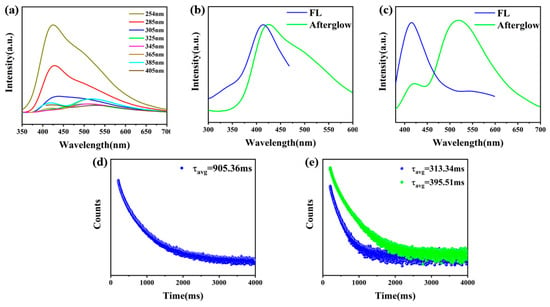
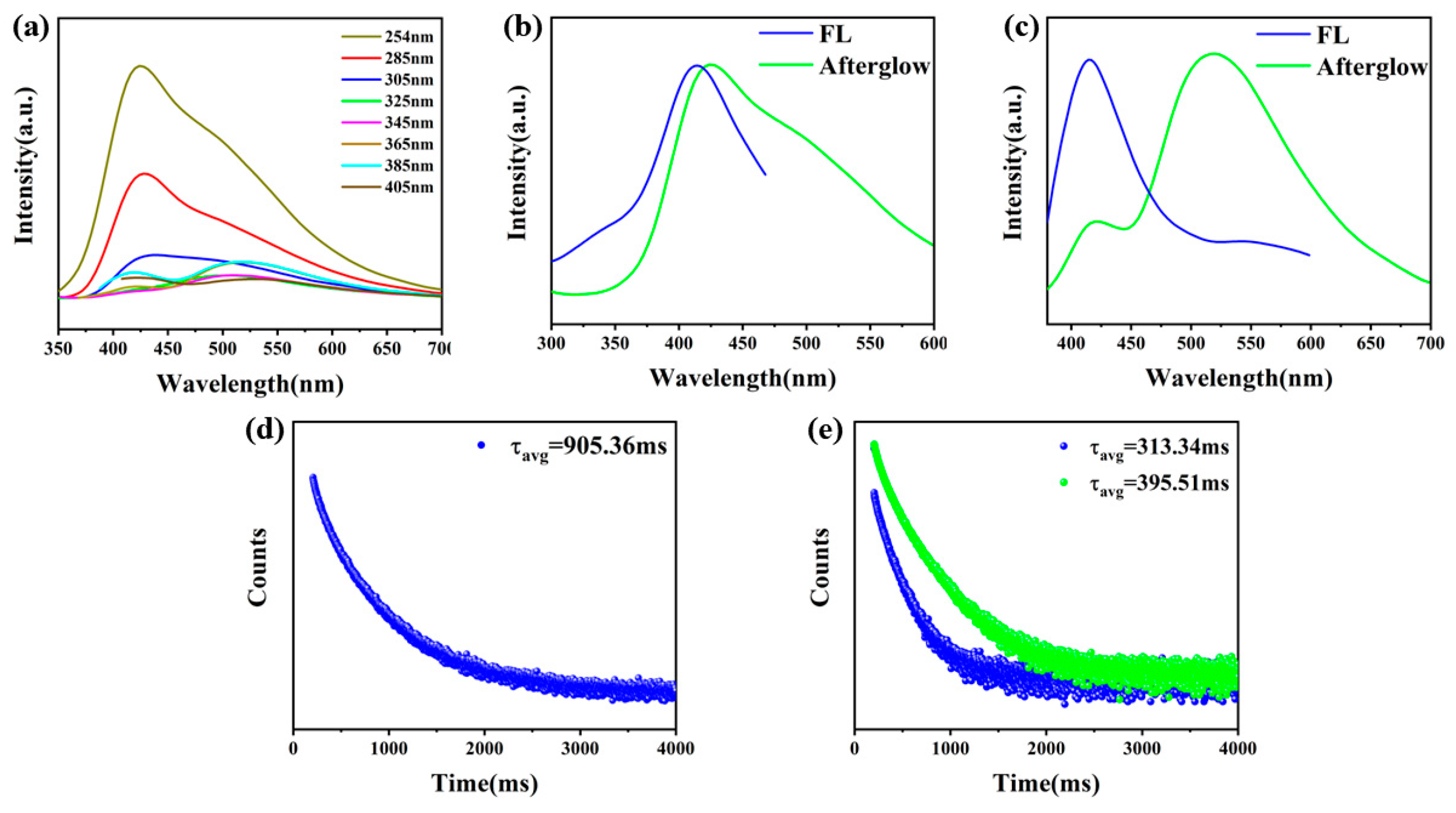
The solid-state Mn, N-CDs typically suffer from aggregation-induced fluorescence quenching, while the embedding of Mn, N-CDs in the BA matrix effectively constrains their rotation and vibration and suppresses non-radiative relaxation pathways, thereby facilitating excellent solid-state afterglow performance of the Mn, N-CDs @BA composites. Figure 7a presents the afterglow emission spectra of the Mn, N-CDs @BA under different excitation wavelengths; it can be observed that the afterglow emission spectra exhibit a clear excitation wavelength dependence, and its afterglow spectra undergo a gradual red-shift with the increase in excitation wavelength. Such excitation wavelength dependence originates from the coexistence of multiple luminescent centers in the Mn, N-CDs @BA; these luminescent centers are formed due to the chemical heterogeneity, varied surface functional groups and Mn/N doping [39,40,41]. Figure 7b displays the FL spectrum and afterglow emission spectrum of the Mn, N-CDs @BA under excitation at 254 nm. It can be seen that the FL emission peak is located at 412 nm, while the afterglow emission peak is at 425 nm. Compared with the FL emission peak, the afterglow emission peak shows a slight red-shift. Additionally, there is a large overlapping region between the FL and afterglow emission spectra, indicating that the afterglow is dominated by DF. Figure 7c presents the FL spectrum and afterglow emission spectrum of the Mn, N-CDs @BA under excitation at 365 nm. It can be observed that the afterglow emission peak (524 nm) exhibits a significant red-shift compared with the FL emission peak (410 nm). This large Stokes shift and negligible spectral overlap indicate that the afterglow is dominated by RTP. The dual-mode afterglow emission dynamics are further confirmed by lifetime measurements. Figure 7d is the afterglow decay curve of the Mn, N-CDs @BA under excitation at 254 nm, which shows a mono-exponential decay characteristic with a mean afterglow lifetime of 905.36 ms. However, under 365 nm excitation, two distinct decay components are observed at 424 nm and 524 nm (as shown in Figure 7e), with mean afterglow lifetimes of 313.34 ms and 395.51 ms, respectively. This result reinforces the existence of multiple phosphorescent emission centers with discrete triplet energy levels in the Mn, N-CDs @BA.
Figure 7.
(a) Afterglow emission spectra of the Mn, N-CDs @BA at different excitation wavelengths; (b) FL and afterglow spectra of the Mn, N-CDs @BA under excitation at 254 nm; (c) FL and afterglow spectra of the Mn, N-CDs @BA under excitation at 365 nm; (d) afterglow lifetime decay curve of the Mn, N-CDs @BA (afterglow emission peak at 425 nm); (e) afterglow lifetime decay curves of the Mn, N-CDs @BA (blue line: afterglow emission peak at 422 nm; green line: afterglow emission peak at 544 nm).
In the Mn, N-CDs @BA composites, the surface functional groups and defects act as tunable emissive centers, while the rigid BA matrix provides the necessary structural support to stabilize triplet states. Specifically, the synergistic effect of the cross-linked network and heteroatom-mediated hydrogen bonding effectively minimizes non-radiative transitions, which is crucial for enhancing the performance of both RTP and DF. By precisely modulating the chemical structure, the material achieves a highly controllable process of exciton generation and radiative decay. This intelligent afterglow behavior, featuring dynamic tunability, lays a robust foundation for advanced applications in optical anti-counterfeiting and high-security multi-level encryption.
3.3. Application
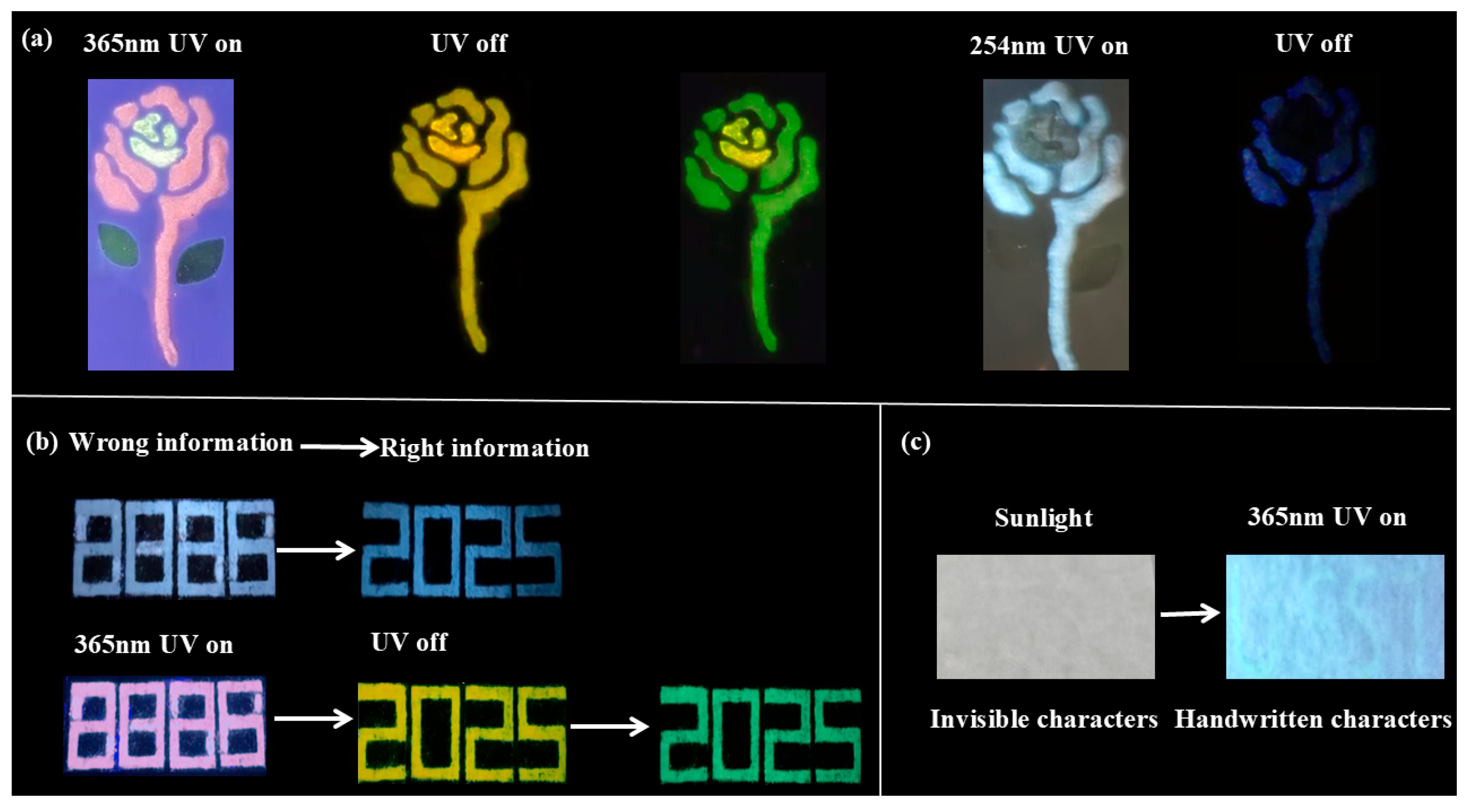
Based on the unique luminescence properties of the as-prepared Mn, N-CDs @BA composites, along with their excellent stability and batch-to-batch reproducibility, this work explores their potential applications in optical anti-counterfeiting and information encryption. As illustrated in Figure 8a, a multi-component anti-counterfeiting pattern was designed using PDMS-encapsulated yellow phosphorescence CDs, green fluorescence CDs and the Mn, N-CDs @BA composite. When irradiated with a 365 nm UV lamp, a vibrant multicolor flower pattern is observed: the stamen shows a yellow color, the leaves are green, while the petals appear pink. When the 365 nm UV lamp is turned off, the fluorescence in the leaf area disappears immediately, and the stamens emit yellow afterglow, while the petals exhibit a characteristic yellow-to-green afterglow evolution. When irradiated with a 254 nm UV lamp, the petals appear white. When the 254 nm UV lamp is turned off, the petals emit a blue afterglow. The excitation wavelength-dependent dual-afterglow emission and the dynamically evolving color change over time endow the pattern with non-replicability, which greatly elevates the difficulty of unauthorized replication. Figure 8b displays the photographs of the information encryption pattern under UV lamp irradiation and after the UV lamp has been turned off. The regions for correct information are filled with the Mn, N-CDs @BA composites, while the remaining regions are filled with fluorescent CDs as spatial interference. Under sunlight and UV lamp irradiation, the pattern displays the wrong information, “8888”, due to the similar colors of the two materials. However, when the UV lamp is turned off, the fluorescent interference information disappears immediately, and the right information, “2025”, emitted by the Mn, N-CDs @BA afterglow composites can be observed within approximately 10 s, after which the information is automatically hidden. This encryption process enables re-encryption without additional operations, demonstrating excellent reversibility and security. Moreover, liquid-state applications were demonstrated via invisible handwriting on weighing paper, as shown in Figure 8c, where the encrypted characters are only discernible under specific UV wavelengths. These results demonstrate the feasibility of the Mn, N-CDs @BA composites for next-generation optical anti-counterfeiting and information encryption materials.
Figure 8.
(a) Optical dynamic anti-counterfeiting application; (b) information encryption application; (c) information encryption application.
3.4. Luminescence Mechanism
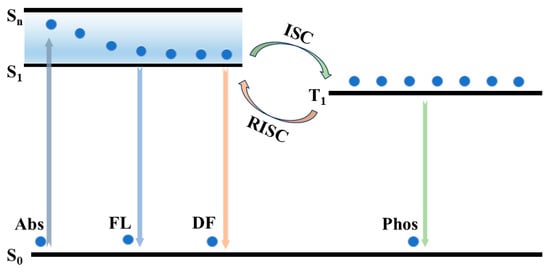
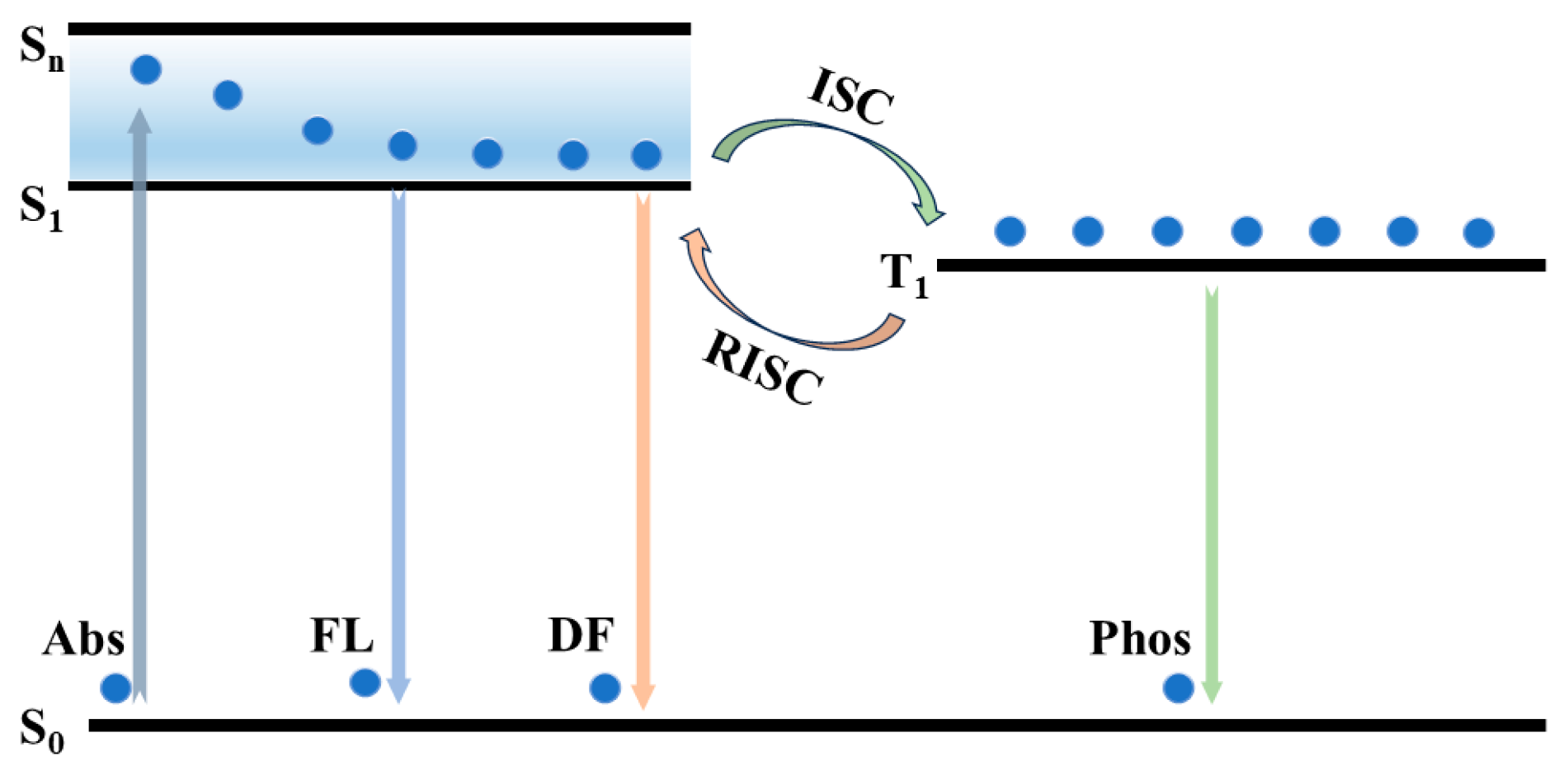
Afterglow is defined as the phenomenon where a material continues to emit light even after the excitation source is removed. This effect originates from the slow energy release of electrons that have been captured in electron traps. When materials absorb UV or visible photons, electrons can transition from the ground state (S0) to high-energy excited singlet states (Sn). Through internal conversion (IC) and vibrational relaxation (VR), these electrons rapidly dissipate excess energy to reach the lowest excited singlet state (S1). If these electrons undergo a direct transition from S1 to S0, the process will generate prompt fluorescence. Alternatively, if excited-state electrons undergo an ISC process to the triplet state (T1) of similar energy, followed by a radiative transition from T1 to S0, the process will produce phosphorescence, which typically exhibits a significantly longer lifetime than fluorescence due to the spin-forbidden characteristic of the T1 to S0 transition. Because T1 generally lies at a lower energy level than S1, phosphorescence is characteristically red-shifted. Notably, if the singlet–triplet energy gap (ΔE_ST) is sufficiently small, excitons in T1 can be thermally activated at room temperature to return to S1 via RISC, while the subsequent radiative transition from S1 to S0 generates DF. Although the emission wavelength of DF is identical to that of prompt fluorescence, its lifetime is markedly prolonged, ranging from the millisecond to the second scale. A schematic diagram illustrating the energy level transitions processes for fluorescence (FL), phosphorescence (Phos) and DF is presented in Figure 9. The unique afterglow behavior of the Mn, N-CDs @BA composites arises as a direct consequence of these synergistic photophysical pathways, which are enabled by their precisely engineered electronic structure.
Figure 9.
Schematic diagram of the energy level transition processes for FL, Phos and DF.
Based on the characterization and analytical results of XRD and FTIR, the role of Mn and N heteroatoms in modulating exciton dynamics of the Mn, N-CDs @BA composites are summarized as follows: The heavy atom effect induced by Mn doping strengthens the spin–orbit coupling (SOC), which is crucial for improving ISC from the S1 to the T1. Simultaneously, N-containing groups (e.g., C=N) promote n→π* transitions, narrowing the singlet–triplet energy gap(ΔEst) and facilitating the thermally activated RISC process. This dual-doping strategy effectively mediates the transition from prompt fluorescence to DF. The multi-peak fitting results of the C1s, O1s, and B1s spectra in XPS are consistent with the identification of polar functional groups via FTIR, which provides definitive evidence for multi-center emission mechanism. These structural features collectively optimize triplet exciton manipulation, thus enabling the observed high-performance afterglow.
Regarding the mechanism underlying the stabilization of triplet states by the B2O3 matrix, the dehydration of BA during calcination constructs a rigid B2O3 network. This network not only effectively confines the Mn, N-CDs but also potently suppresses non-radiative relaxation pathways, including molecular rotation, molecular vibration, and oxygen quenching. More crucially, the abundant oxygen-containing functional groups on the surface of the Mn, N-CDs (e.g., C=O, C–OH) and the B–OH groups in the matrix can form an extensive network consisting of covalent bonds (e.g., B–O–C) and hydrogen bonds (e.g., O–H⋯O, N–H⋯O). This chemical bond network further consolidates the rigid structure, stabilizes the triplet excitons, and effectively inhibits thermal quenching, thereby significantly boosting the emission efficiency and lifetime of both RTP and DF.
4. Conclusions
In this work, Mn, N-CDs were controllably synthesized via a solvothermal method using FA and MnCl2·4H2O as the precursors. Leveraging the property that BA can form a glassy B2O3 phase during calcination, a matrix-assisted method was subsequently employed to successfully prepare the Mn, N-CDs @BA composites, which exhibit excellent room-temperature afterglow properties. The introduction of a heteroatom doping strategy during synthesis enabled the co-doping of Mn and N, endowing the Mn, N-CDs @BA composites with dual afterglow emission characteristics. Structural characterization results indicate that the as-prepared Mn, N-CDs @BA composites possess good dispersibility, with an average particle size of approximately 3.59 nm. They feature a graphitic carbon core structure and a functional-group-rich surface, with a photoluminescence quantum yield of 17.22%. Simultaneously, the Mn, N-CDs @BA exhibits three distinct luminescence modes, namely fluorescence, RTP and DF. Based on its multi-mode luminescent characteristics, various optical anti-counterfeiting and information encryption patterns have been designed and developed. This work provides a valuable material system and design strategy for next-generation optical anti-counterfeiting and information security technologies, offering a potentially feasible approach for the construction of advanced optical anti-counterfeiting and information encryption systems.
Supplementary Materials
The following supporting information can be downloaded at https://www.mdpi.com/article/10.3390/photonics13030266/s1: Figure S1. Optimization diagram for the preparation of Mn, N-CDs @BA composite materials. Figure S2. (a) XRD pattern of the Mn, N-CDs; (b) FTIR spectrum of the Mn, N-CDs. Figure S3. (a) UV-Vis absorption spectrum of the Mn, N-CDs; (b) Fluorescence excitation and emission spectra for the aqueous Mn, N-CDs solution.
Author Contributions
Conceptualization, Z.H. and Y.J.; methodology, Y.J.; software, C.Y.; validation, Y.J., C.Y. and Y.L.; formal analysis, R.H.; investigation, C.T.; resources, D.Z.; data curation, Y.J.; writing—original draft preparation, Y.J.; writing—review and editing, Z.H.; visualization, C.Y.; supervision, D.Y.; project administration, Z.H.; funding acquisition, Z.H. All authors have read and agreed to the published version of the manuscript.
Funding
This research was funded by the National Key Research and Development Program of China (Grant No. 2022YFF0607704) and the Horizontal Cooperation Project of the Shanghai Municipal Education Commission Teaching and Research Office (Grant No. H-2020-302-121).
Data Availability Statement
The data presented in this study are available on request from the corresponding author.
Conflicts of Interest
The authors declare no conflicts of interest.
Abbreviations
The following abbreviations are used in this manuscript:
| CDs | Carbon Dots |
| RTP | Room-Temperature Phosphorescence |
| DF | Delayed Fluorescence |
| UV | UltraViolet |
| BA | Boric Acid |
| TEM | Transmission Electron Microscopy |
| XRD | X-Ray Diffraction |
| XPS | X-ray Photoelectron Spectroscopy |
| FTIR | Fourier Transform InfraRed |
References
- Xu, X.; Ray, R.; Gu, Y.; Ploehn, H.J.; Gearheart, L.; Raker, K.; Scrivens, W.A. Electrophoretic Analysis and Purification of Fluorescent Single-Walled Carbon Nanotube Fragments. J. Am. Chem. Soc. 2004, 126, 12736–12737. [Google Scholar] [CrossRef] [Scilit]
- Liu, J.; Li, R.; Yang, B. Carbon Dots: A New Type of Carbon-Based Nanomaterial with Wide Applications. ACS Cent. Sci. 2020, 6, 2179–2195. [Google Scholar] [CrossRef] [Scilit] [PubMed]
- Ma, D.-X.; Li, Z.-Q.; Tang, K.; Gong, Z.-L.; Shao, J.-Y.; Zhong, Y.-W. Nylons with Highly-Bright and Ultralong Organic Room-Temperature Phosphorescence. Nat. Commun. 2024, 15, 4402. [Google Scholar] [CrossRef] [Scilit] [PubMed]
- Xu, W.; Wang, B.; Liu, S.; Fang, W.; Jia, Q.; Liu, J.; Bo, C.; Yan, X.; Li, Y.; Chen, L. Urea-formaldehyde resin room temperature phosphorescent material with ultra-long afterglow and adjustable phosphorescence performance. Nat. Commun. 2024, 15, 4415. [Google Scholar] [CrossRef] [Scilit] [PubMed]
- Xu, B.; Wang, Z.; Shen, J.; Li, J.; Jia, Y.; Jiang, T.; Gao, Z.; Wang, X.; Meng, X. Metal–Organic Framework-Activated Full-Color Room-Temperature Phosphorescent Carbon Dots with a Wide Range of Tunable Lifetimes for 4D Coding Applications. J. Phys. Chem. C 2022, 126, 11701–11708. [Google Scholar] [CrossRef] [Scilit]
- Ran, X.; Pan, Y.; Qiao, L.; Cai, L.; Jia, Y.; Liu, Z.; Guo, L. Broadband and dynamic afterglow photoluminescent carbon dots for time-resolved optical information coding and encryption. Carbon 2025, 234, 119980. [Google Scholar] [CrossRef] [Scilit]
- Li, Y.; Li, L.; Shao, R.; Zhang, T.; Li, Y.; Li, Z.; Bi, H. High-Temperature Phosphorescence of Carbon Dots by a Synergistic Locking Strategy. ACS Appl. Mater. Interfaces 2025, 17, 23104–23113. [Google Scholar] [CrossRef] [Scilit]
- Chen, Y.; Xu, Z.; Yu, M.; Fu, H. High-Temperature Dynamic Organic Phosphorescence Based On Cyclodextrins Supramolecular Assemblies. ACS Appl. Mater. Interfaces 2025, 17, 24351–24358. [Google Scholar] [CrossRef] [Scilit]
- Yuan, T.; Yuan, F.; Sui, L.; Zhang, Y.; Li, Y.; Li, X.; Tan, Z.; Fan, L. Carbon Quantum Dots with Near-Unity Quantum Yield Bandgap Emission for Electroluminescent Light-Emitting Diodes. Angew. Chem. Int. Ed. 2023, 62, e202218568. [Google Scholar] [CrossRef] [Scilit]
- Yang, S.; Zhang, H.; Jian, K.; Fu, L.; Lan, D.; Zhao, X. Blue room-temperature phosphorescent carbon dot composites with high quantum yield for information encryption and LED light emission. Chem. Eng. J. 2024, 500, 157119. [Google Scholar] [CrossRef] [Scilit]
- Yan, Z.; Feng, Z.; Zhou, S.; Yang, X. Long-wavelength emission room-temperature phosphorescent carbon dots activated by an ortho-carboxyl substitution strategy and employed for achieving tunable LED. Chem. Eng. J. 2024, 494, 152835. [Google Scholar] [CrossRef] [Scilit]
- Guo, Y.; Shi, F.; Li, B. Study on Diamond NV Centers Excited by Green Light Emission from Upconversion Luminescence. Photonics 2025, 12, 1163. [Google Scholar] [CrossRef] [Scilit]
- Li, T.; Zhang, N.; Zhao, S.; Liu, M.; Zhang, K.; Zhang, C.; Shu, J.; Yi, T.-F. Long-lived dynamic room temperature phosphorescent carbon dots for advanced sensing and bioimaging applications. Coord. Chem. Rev. 2024, 516, 215987. [Google Scholar] [CrossRef] [Scilit]
- Wei, J.; Liu, C.; Duan, J.; Shao, A.; Li, J.; Li, J.; Gu, W.; Li, Z.; Liu, S.; Ma, Y.; et al. Conformation-dependent dynamic organic phosphorescence through thermal energy driven molecular rotations. Nat. Commun. 2023, 14, 627. [Google Scholar] [CrossRef] [Scilit]
- Tian, Y.; Yang, J.; Liu, Z.; Gao, M.; Li, X.; Che, W.; Fang, M.; Li, Z. Multistage Stimulus-Responsive Room Temperature Phosphorescence Based on Host–Guest Doping Systems. Angew. Chem. Int. Ed. 2021, 60, 20259–20263. [Google Scholar] [CrossRef] [Scilit]
- Li, D.; Zheng, T.; Hao, A.; Yao, Y.; She, J. Deep Learning Fluorescence Imaging Based on CNN-BiLSTM Hybrid Neural Network for Anti-Counterfeiting Application. Photonics 2025, 12, 1176. [Google Scholar] [CrossRef] [Scilit]
- Wang, X.; Han, Y.; Li, W.; Li, J.; Ren, S.; Wang, M.; Han, G.; Yu, J.; Zhang, Y.; Zhao, H. Doped Carbon Dots Enable Highly Efficient Multiple-Color Room Temperature Phosphorescence. Adv. Opt. Mater. 2023, 12, 2301962. [Google Scholar] [CrossRef] [Scilit]
- You, M.; Li, C.; Zhang, Z.; Zhang, Y.; Li, W.; Zhang, X.; Zhuang, J.; Hu, C.; Dong, H.; Liu, Y.; et al. Full-color room-temperature phosphorescent carbon dots with ultrahigh quantum yield via conjugation regulation. Chem. Eng. J. 2025, 505, 159246. [Google Scholar] [CrossRef] [Scilit]
- Wang, K.; Qu, L.; Yang, C. Long-Lived Dynamic Room Temperature Phosphorescence from Carbon Dots Based Materials. Small 2023, 19, e2206429. [Google Scholar] [CrossRef] [Scilit]
- Li, J.; Wu, Y.; Gong, X. Evolution and fabrication of carbon dot-based room temperature phosphorescence materials. Chem. Sci. 2023, 14, 3705–3729. [Google Scholar] [CrossRef] [Scilit] [PubMed]
- Deng, Y.; Zhao, D.; Chen, X.; Wang, F.; Song, H.; Shen, D. Long lifetime pure organic phosphorescence based on water soluble carbon dots. Chem. Commun. 2013, 49, 5751–5753. [Google Scholar] [CrossRef] [Scilit]
- Sun, Y.; Liu, J.; Pang, X.; Zhang, X.; Zhuang, J.; Zhang, H.; Hu, C.; Zheng, M.; Lei, B.; Liu, Y. Temperature-responsive conversion of thermally activated delayed fluorescence and room-temperature phosphorescence of carbon dots in silica. J. Mater. Chem. C 2020, 8, 5744–5751. [Google Scholar] [CrossRef] [Scilit]
- Ding, L.; Tang, Z.; Long, J.; Ke, X.; Peng, R.; Wei, R.; Liu, X. Hydrogen-Bond Engineering for Highly Efficient Room-Temperature Phosphorescence with Tunable Multi-Color Emission. Spectrosc. J. 2025, 3, 28. [Google Scholar] [CrossRef] [Scilit]
- León, L.C.; Palomino Merino, M.R.; Rosales, J.E.E.; Cuapa, S.T.; de Celis Alonso, B.; Martínez Bravo, O.M.; Ruiz-Hernandez, O.I.; Suárez García, J.G.; Toledo-Solano, M.; Lugo Arce, J.E. Carbon Quantum Dot-Embedded SiO2: PMMA Hybrid as a Blue-Emitting Plastic Scintillator for Cosmic Ray Detection. Photonics 2025, 12, 854. [Google Scholar] [CrossRef] [Scilit]
- Du, J.; Zhang, D.; Diao, K.; Zhou, T.; Zou, K.; Qin, S. Dual-mode fluorescent hydrogel and its ion response behavior based on the coordinated construction of europium/carbon dot dynamic dual network. Ceram. Int. 2025, 51, 39161–39169. [Google Scholar] [CrossRef] [Scilit]
- Dimitriev, O.; Kysil, D.; Zaderko, A.; Isaieva, O.; Vasin, A.; Piryatinski, Y.; Fahlman, M.; Nazarov, A. Photoluminescence quantum yield of carbon dots: Emission due to multiple centers versus excitonic emission. Nanoscale Adv. 2024, 6, 2185–2197. [Google Scholar] [CrossRef] [Scilit]
- Zhao, Q.; Fan, C.; Bu, H.; Gao, J.; Li, L.; Yu, X.; Yang, X.; Lu, Z.; Zhang, X. Electrochemical synthesis of multicolor carbon dots with room temperature phosphorescence to thermally activated delayed fluorescence via surface state modulation. Chem. Eng. J. 2024, 500, 156704. [Google Scholar] [CrossRef] [Scilit]
- Ma, X.; Li, J. Preparation of full-color carbon quantum dots with multiple emission centers. Mater. Today Commun. 2023, 36, 106561. [Google Scholar] [CrossRef] [Scilit]
- Xie, L.; Liang, C.; Guo, H.; Wang, K.; Zhang, S.; Zhang, J.; Lam, Y.M.; Liu, Z.; Wang, L. N-B-O-crosslinker-induced mechanochemical conversion of carbon phase unlocks efficient hydrogen peroxide electrosynthesis. Chin. Chem. Lett. 2026, 37, 111934. [Google Scholar] [CrossRef] [Scilit]
- Li, Y.; Huang, K.; Liu, W.; Wang, K.; Fu, S.; Guo, H.; Zhang, J.; Lian, C.; Wang, L. Interfacial engineering of carbon quantum dot/metal-organic framework heterostructures for boosted urea electrosynthesis from carbon dioxide and nitrate. J. Colloid Interface Sci. 2026, 703, 139264. [Google Scholar] [CrossRef] [Scilit] [PubMed]
- Mao, L.; Wang, J.; Zhong, L.; Deng, Y.; Ma, L.; Zhu, Y.; Lu, F.; Tang, J. High-performance single-emitting-layer hybrid white organic light-emitting diodes featuring a stable blue emission component from green thermally activated delayed fluorescence. J. Lumin. 2023, 257, 119742. [Google Scholar] [CrossRef] [Scilit]
- Vinod, K.; Noushad, N.; Tanaka, H.; Mohan, N.; Kokado, Y.; Tomiya, D.; Kobori, Y.; Hariharan, M. Aggregation-assisted energy gap modulation controls delayed emission in hybrid charge-transfer emitters. Chem. Sci. 2025, 16, 15546–15554. [Google Scholar] [CrossRef] [Scilit]
- Zhao, Z.; Yan, S.; Ren, Z. Regulating the Nature of Triplet Excited States of Thermally Activated Delayed Fluorescence Emitters. Acc. Chem. Res. 2023, 56, 1942–1952. [Google Scholar] [CrossRef] [Scilit]
- Gong, X.; Xu, Q.; Li, J.; Ma, Y.; Li, X.; Wu, W.; Wang, H. Hydrophobic Mn-Doped Solid-State Red-Emitting Carbon Nanodots with AIE Effect and Their Hydrogel Composites for Color-Changing Anticounterfeiting. Small 2023, 20, e2304673. [Google Scholar] [CrossRef] [Scilit] [PubMed]
- Wu, Q.; Wang, L.; Yan, Y.; Li, S.; Yu, S.; Wang, J.; Huang, L. Chitosan-Derived Carbon Dots with Room-Temperature Phosphorescence and Energy Storage Enhancement Properties. ACS Sustain. Chem. Eng. 2022, 10, 3027–3036. [Google Scholar] [CrossRef] [Scilit]
- Hu, J.; Lei, M.; Yan, L.; Chen, L.; Yang, Y.; Zheng, J.; Liu, X.; Xu, B. Carbon dot-based afterglow composite with tunable room temperature phosphorescence and thermally activated delayed fluorescence and their anti-counterfeiting and encryption application. Chem. Eng. J. 2024, 489, 151245. [Google Scholar] [CrossRef] [Scilit]
- Cen, Q.; Han, X.; Guo, L.; Yi, G.; Zhang, Z.; Lin, Z.; Zou, G. Excitation-Dependent Photoluminescence of Undoped Bimetallic Halides with Dual Emitting Centers for Optical Anticounterfeiting Application. Inorg. Chem. 2025, 64, 24301–24310. [Google Scholar] [CrossRef] [Scilit]
- Sanz-García, J.A.; Lifante-Pedrola, G.; Santiuste, J.E.M.; Cantelar, E. Dual luminescent nano-thermometry based on the selective excitation of optical centers in CaF2:Er3+ nanoparticles. J. Alloys Compd. 2025, 1010, 177529. [Google Scholar] [CrossRef] [Scilit]
- Jie, Y.; Gao, Y.; Yang, G.; Xi, P.; Li, F.; Zhang, J.; Wang, D.; Fan, Z.; Yan, J.; Dai, P.; et al. Yellow-Emissive Carbon Dots with Long-Lifetime Room-Temperature Phosphorescence for Information Encryption and Bioimaging. ACS Appl. Nano Mater. 2023, 6, 20431–20439. [Google Scholar] [CrossRef] [Scilit]
- Wang, C.; Chen, Y.; Hu, T.; Chang, Y.; Ran, G.; Wang, M.; Song, Q. Color tunable room temperature phosphorescent carbon dot based nanocomposites obtainable from multiple carbon sources via a molten salt method. Nanoscale 2019, 11, 11967–11974. [Google Scholar] [CrossRef] [Scilit]
- Kantuptim, P.; Kato, T.; Nakauchi, D.; Pattanaboonmee, N.; Kawaguchi, N.; Watanabe, K.; Chewpraditkul, W.; Yanagida, T. Optical and Scintillation Properties of Tb-Doped Gadolinium Pyrosilicate Single Crystals. Photonics 2024, 11, 673. [Google Scholar] [CrossRef] [Scilit]
Disclaimer/Publisher’s Note: The statements, opinions and data contained in all publications are solely those of the individual author(s) and contributor(s) and not of MDPI and/or the editor(s). MDPI and/or the editor(s) disclaim responsibility for any injury to people or property resulting from any ideas, methods, instructions or products referred to in the content. |
© 2026 by the authors. Licensee MDPI, Basel, Switzerland. This article is an open access article distributed under the terms and conditions of the Creative Commons Attribution (CC BY) license.