


Abstract
Spectral demodulation is a crucial component of the extrinsic Fabry–Pérot interferometric (EFPI) sensing technology. In this study, a feedback-based linear spectral fitting demodulation method is proposed for interrogating EFPI sensors. This method utilizes a discrete function derivative and a feedback amplitude calibration technique to extract the complete spectral phase, and the cavity length of the EFPI sensor is determined by performing a linear fit to the relationship between the optical frequency and the spectral phase. The experimental results indicated a nonlinearity of 0.134% over a cavity length range of 50–260 μm, and the resolution was 6.6 nm at a cavity length of 170.210 μm. Pressure measurements obtained with the developed sensor exhibited a nonlinearity of 0.401%. Compared to traditional spectral minimum mean square error algorithms, the proposed method is simpler and faster, making it more suitable for implementation on commodity hardware and better aligned with the practical needs of engineering applications.
1. Introduction
In recent years, fiber-optic extrinsic Fabry–Pérot interferometric (EFPI) sensors have played a crucial role in fields such as aerospace, petrochemicals, leakage monitoring, medicine, and structural health monitoring [1,2,3,4,5,6]. These sensors offer advantages such as immunity to electromagnetic interference, high-temperature resistance, and compact size. Fiber optic EFPI sensors typically determine changes in external measurands by detecting variations in the Fabry–Pérot (FP) cavity length [3,4,5,6]. Therefore, obtaining the cavity length of an EFPI sensor has become a key issue in its measurement system.
Interrogation techniques for fiber-optic EFPI sensors have been developed over many years [7,8,9,10,11,12,13,14,15,16,17,18,19,20,21,22,23,24]. A primary demodulation approach involves illuminating the EFPI sensor with broadband light and using an optical spectrum analyzer (OSA) to acquire the spectra for calculating the FP cavity length. At present, the primary cavity length interrogation methods based on OSA include the peak-to-peak method, Fourier transform method, cross-correlation method, machine learning method, and minimum mean square error (MMSE) method. The peak-to-peak methods calculate cavity length using the wavelengths of two or more interference peaks or valleys. While this method is simple and fast, it is difficult to improve its demodulation accuracy. Jiang proposed a high-resolution peak-to-peak demodulation technique in 2008, improving the resolution to within 1 μm [7]. In 2022, Nie et al. proposed a cavity length sequence-matching demodulation algorithm based on a combined valley peak positioning, with a demodulation accuracy better than 8.8 nm [8]. The Fourier transform methods extract cavity length by performing a Fourier transform on the spectrum. In 2016, Yu et al. proposed a method using the Buneman frequency estimation algorithm to demodulate fiber FP interferometer sensors, achieving a demodulation rate of 70 kHz [9]. In 2021, Yang et al. proposed an absolute cavity length demodulation technique based on a modified Buneman frequency estimation algorithm, achieving a speed of 50 kHz [10]. Yang et al. proposed a low-coherence demodulation method based on Buneman frequency estimation in 2020, achieving a rate of 5 kHz [11]. In 2024, the team further developed a fiber EFPI vibration/acoustic sensing system based on high-speed phase demodulation, with all algorithms implemented on a field programmable gate array (FPGA), reaching a demodulation speed of 20 kHz [12]. In 2024, Lv et al. proposed a demodulation method based on the combination of a Nuttall convolution window and discrete gap transformation (DGT) for non-ideal EFPI sensing structures, achieving a demodulation resolution of 1.2 nm [13]. The cross-correlation methods perform a convolution operation between a virtual spectrum and the actual spectrum, determining cavity length from the peak position of the result. In 2020, Chen et al. proposed a high-order harmonic-frequency cross-correlation demodulation algorithm to address the issue of ambiguous main peak position in cross-correlation operations when spectral width is insufficient, achieving a demodulation resolution of 107.67 pm [14]. In 2023, Cheung et al. proposed an improved parallel cross-correlation algorithm based on spectra, which increased the demodulation resolution to almost 0.3 nm [15]. In recent years, machine learning methods have also frequently been used to obtain the cavity length of EFPI sensors. In 2025, Bai et al. proposed a spectral demodulation method based on the spatio-temporal features of sparse spectra [16]. Li et al. proposed a residual convolutional neural network-based spectral data density prediction model for detecting parallel FP-FBG sensors [17]. However, machine learning demodulation methods require extensive spectral data from specific sensors for model training, lacking generality.
The MMSE methods obtain the cavity length of an EFPI sensor by performing curve fitting on spectral data and using the fitting parameters. In 2020, Feng et al. proposed an amplitude normalization-MMSE demodulation method, which reduced demodulation errors caused by the source envelope and achieved a resolution of 0.72 nm [18]. In 2021, Zhang et al. proposed an approach using dense wavelength division multiplexing and a multi-channel photodetector to construct a high-speed, low-resolution spectral detection device, combined with a maximum-likelihood estimation algorithm and MMSE demodulation [19]. Although a demodulation speed of 50 kHz was achieved, the system volume was increased. In 2020, Liu et al. from our laboratory proposed an algorithm performing least-squares fitting demodulation by expanding the multi-beam interference formula for high-finesse FP sensors [20]. Although spectral MMSE demodulation methods achieve high demodulation accuracy, they are generally limited by low demodulation speeds due to the complexity of curve-fitting algorithms. Moreover, the high error rate of MMSE demodulation methods is attributed to their sensitivity to initial values [21]. These drawbacks mean that it is challenging to apply it in practical engineering scenarios. In contrast, differential or integral algorithms offer simpler mathematical models, but they also face challenges when applied to EFPI sensors [22,23,24]. Although differential or integral algorithms are widely used for phase extraction of sinusoidal signals, such as in phase-generated carrier techniques, their demodulation accuracy remains limited by the amplitude deviations in the quadrature signals [22,23,24]. It is precisely these inherent limitations, especially the difficulty of amplitude alignment caused by the susceptibility of differentiation algorithms to high-frequency noise, that restrict their application in optical fiber EFPI sensors.
To address the above problems, a feedback-based linear spectral fitting demodulation method for fiber-optic EFPI sensors is proposed. First, a discrete function derivative formula is used to obtain the derivative of the spectrum. Then, the arctangent algorithm and the feedback amplitude calibration technique are applied to extract the phase within the spectral range. After that, the relationship between the optical frequency and the phase of the EFPI sensor is obtained through linear fitting. Finally, the cavity length of the EFPI sensor is calculated based on the linear fitting coefficient. By employing a feedback-based amplitude calibration technique to align the amplitude of the differentiated spectrum with the original spectrum, the proposed method makes it possible to extract the spectral phase through linear fitting.
2. Principle of Demodulation Algorithm
The fiber-optic EFPI sensor is composed of two parallel reflective surfaces, and the low-finesse EFPI is considered a two-beam interferometer. The interferometric light intensity of the EFPI can be described as [6]
where is the reflected light intensity of the spectrum. is the direct current (DC) of the interference signal, and is the alternating current (AC) of the interference signal. is the optical interference phase, where is the refractive index of the filling material in the FP cavity. In EFPI sensors, is the air refractive index, which is approximately equal to 1. is the cavity length of the EFPI, is the optical frequency, is the speed of light in a vacuum. The interference light intensity of the discretized and normalized EFPI can be described as
where is the discretized light intensity of the spectrum. is the discretized phase of the spectrum, where is the discretized optical frequency, where . is the sampling number of the spectral. The differentiation of Equation (2) using the discrete function differentiation formula can be expressed as
where is the frequency interval of the spectrum, . Then, if can be normalized and is divided by , the phase corresponding to each optical frequency can be extracted through the arctangent operation. The phase can be extracted by
The phase value in the range to was calculated. As the increases, deviations occur when approaches , which causes fringes of . By combining the original quadrature phase-shifted signals to determine whether the phase jump is , the recovered phase value is obtained using
where To obtain the cavity length of the EFPI sensor, the linear fitting equation is introduced to find the relationship between the phase and frequency . Compared to fitting spectral curves, linear fitting has a simpler mathematical model and less computational complexity, and it is more suitable for practical engineering applications. The linear fitting equation is described as
where and are the slope and intercept of linear fitting, respectively. The cavity length of the EFPI sensor can be obtained using
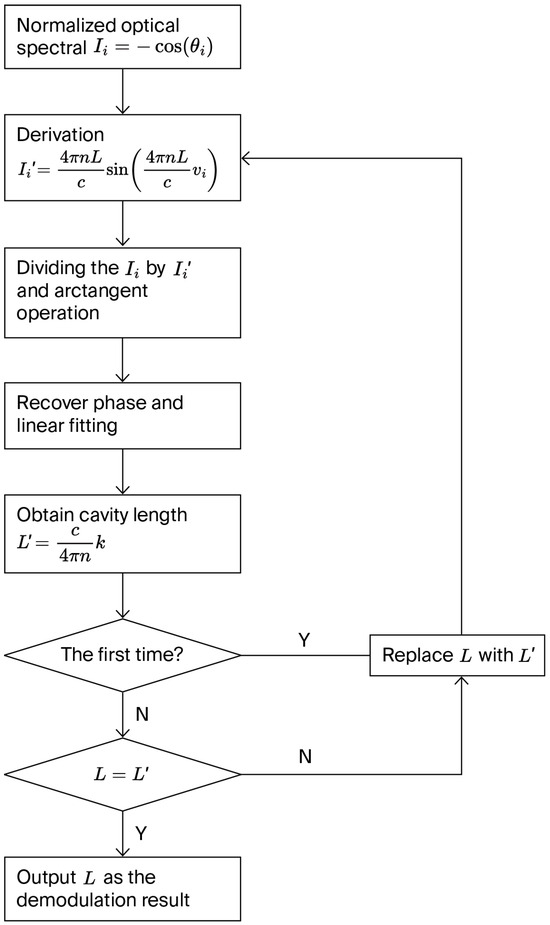
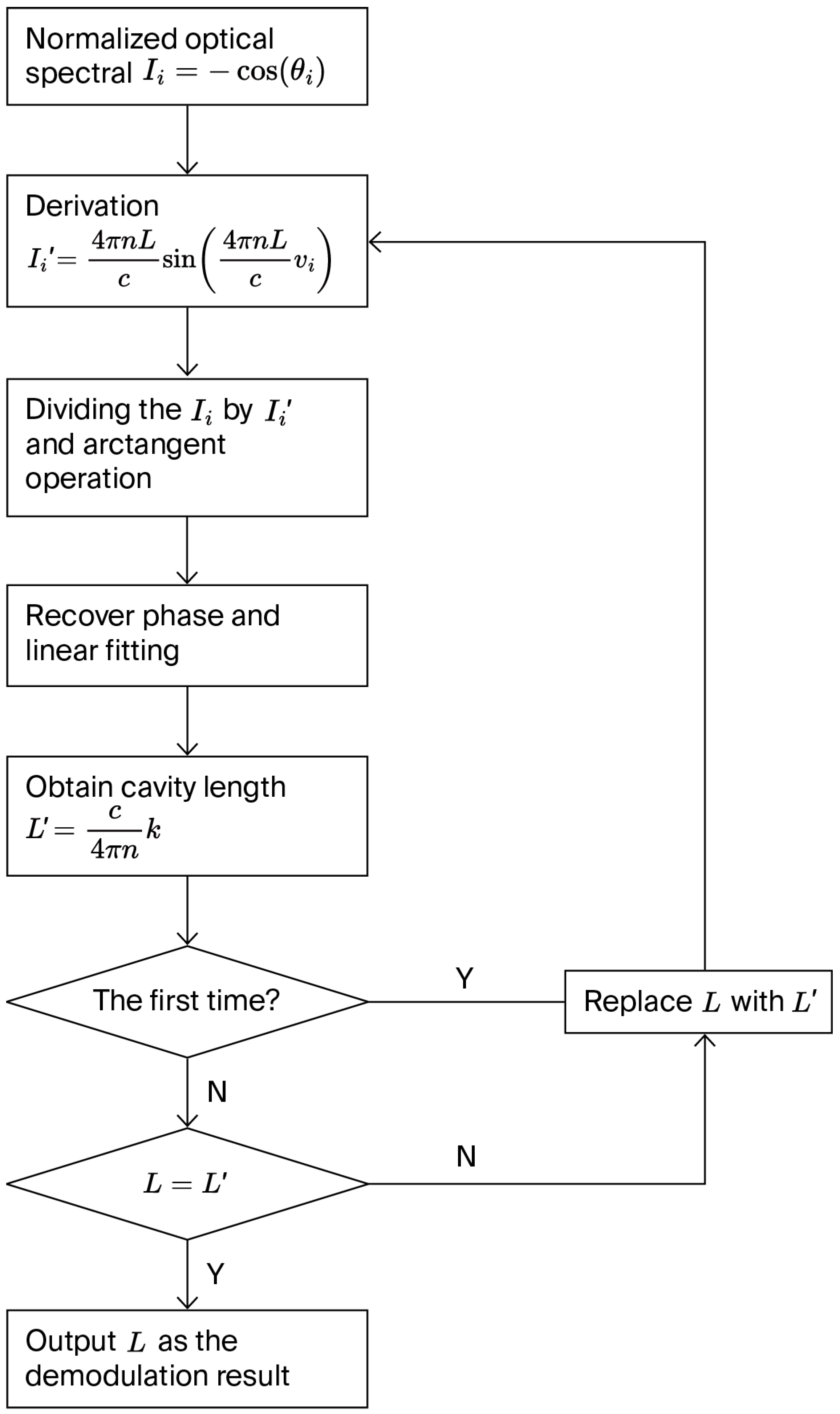
However, obtaining the cavity length using the above equations requires aligning the amplitude of Equation (2) with that of Equation (3). However, the actual cavity length L must be obtained before this amplitude alignment can be performed, creating a contradiction. Therefore, this study proposes a feedback-based amplitude calibration technique to align the amplitude of . Before using the feedback amplitude calibration technique, due to the non-uniform spectral distribution of the broadband light source, the raw reflection spectrum acquired by the OSA is superimposed with the source’s spectral envelope. To eliminate the source-induced spectral non-uniformity, a spectral normalization process is performed, following the procedure described in reference [21]. After this step, the reflection spectrum is corrected to exhibit a uniform amplitude across the entire wavelength range. The flowchart of the feedback amplitude calibration technique is shown in Figure 1.
Figure 1.
Flowchart of feedback amplitude calibration technique.
Step 1: After obtaining the normalized spectrum, perform the steps of differentiation, division, arctangent operation, and linear fitting in sequence.
Step 2: Obtain the cavity length based on linear fitting.
Step 3: For the first iteration, use the demodulated result instead of the parameter in Equation (3).
Step 4: Repeat the steps of differentiation, division, arctangent operation, and linear fitting and obtain the cavity length in sequence.
Step 5: Determine whether and are equal. If they are equal, output as the demodulation result. If they are not equal, repeat step 4 until and are equal.
By following the above steps, the circular dependency is resolved. This feedback amplitude calibration technique provides an iterative approach to amplitude calibration, making it more suitable for practical engineering applications.
3. Analysis and Simulation
3.1. Feasibility of the Demodulation Method
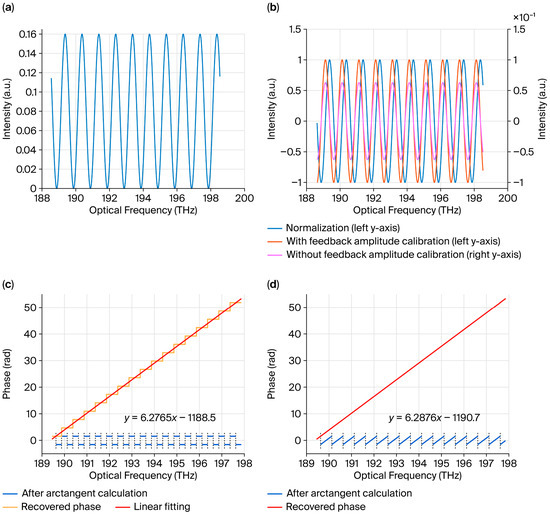
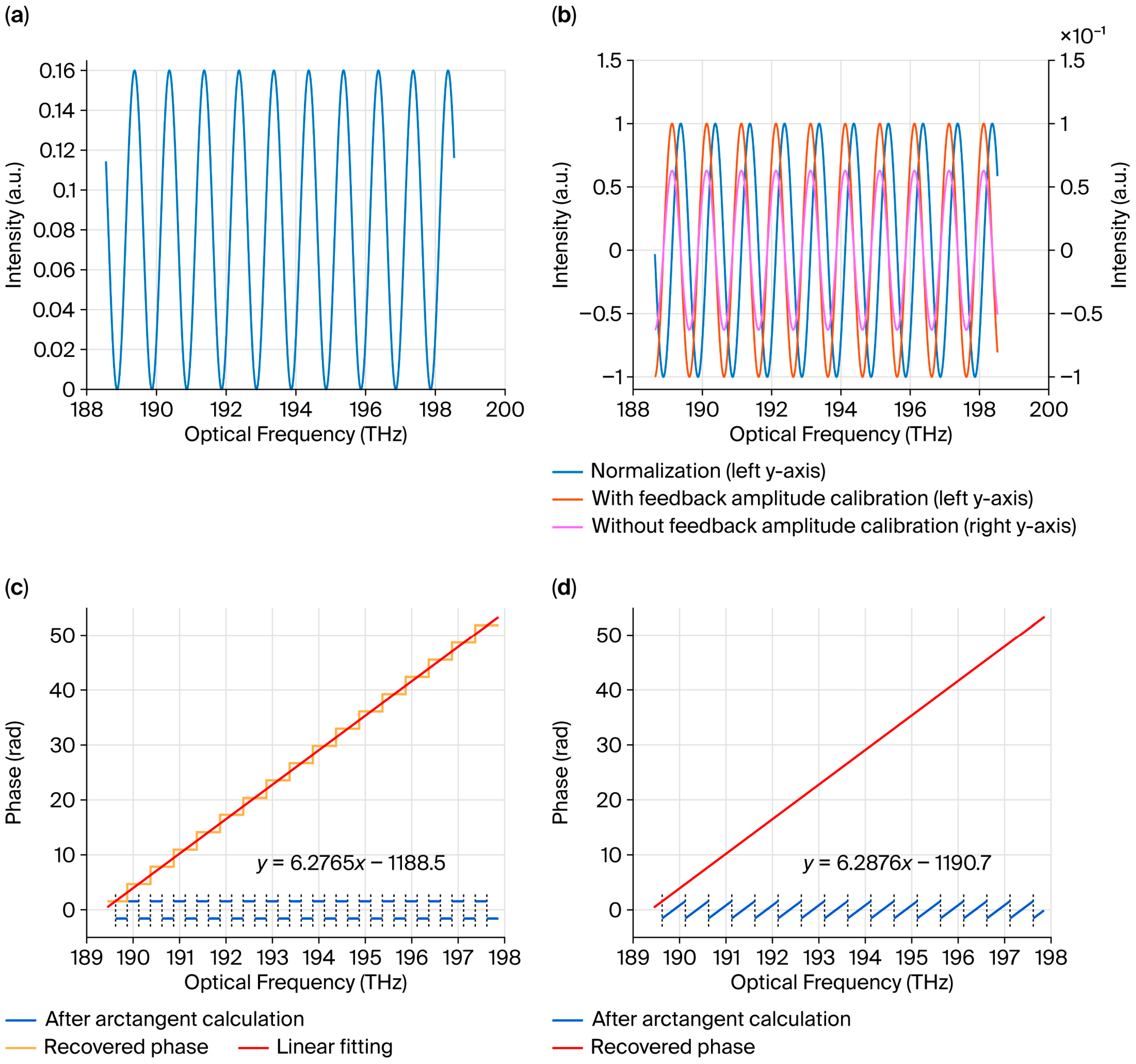
To verify the feasibility of the proposed feedback-based linear spectral fitting demodulation method, the complete demodulation algorithm process was simulated, with the results presented in Figure 2.
Figure 2.
Demodulation process. (a) Simulated spectrum. (b) Normalized spectrum and its derivative. (c) In the iterative process: phase after the arctangent operation (blue line), recovered phase (yellow line), and linear fit (red line). (d) In the final iteration: phase after arctangent operation (blue line) and recovered phase (red line).
The simulated spectrum is shown in Figure 2a. All data presented in this paper were simulated and processed with Matlab (2023a). The optical frequency range of the simulated spectrum was set to 187.8 THz~198.7 THz, corresponding to a wavelength range of approximately 1509 nm~1596 nm, which is typical for common C + L band spectrometers. The reflectivities of the two reflective surfaces of the EFPI sensor were both set to 0.04, the number of spectral sampling points was set to 512, and the refractive index was set to 1. The spectrum was simulated using Equation (1). For a reflectivity of 0.04, both parameters and in Equation (1) were set to 0.08. The normalized spectrum and the derivative of the spectrum during the feedback amplitude iteration process are shown in Figure 2b. The initially differentiated spectrum (purple line) exhibits a minimal amplitude. After calibration using the proposed amplitude calibration technique, the amplitude of the resulting spectrum (red line) closely aligns with that of the normalized original spectrum (blue line). This demonstrates the effectiveness of the amplitude calibration technique. The spectral phase obtained after the arctangent operation is shown by the blue line in Figure 2c, where obvious phase jumps are visible. This is because the range of the arctangent function is , and phase compensation can be performed using Equation (5). However, during the feedback amplitude iteration process, the amplitudes of and differed significantly, causing the recovered phase (yellow line) to exhibit noticeable distortion, although a fitting line with significant error could still be obtained. The demodulation process after iteration is shown in Figure 2d. At this stage, since the amplitudes of and were nearly equal, the recovered phase approached a straight line, allowing an accurate linear fit. Figure 2 demonstrates that the feedback-based linear spectral fitting demodulation method can improve the amplitude of the derivative result through amplitude iteration and obtain the cavity length, validating the effectiveness of the demodulation method.
3.2. Demodulation Range
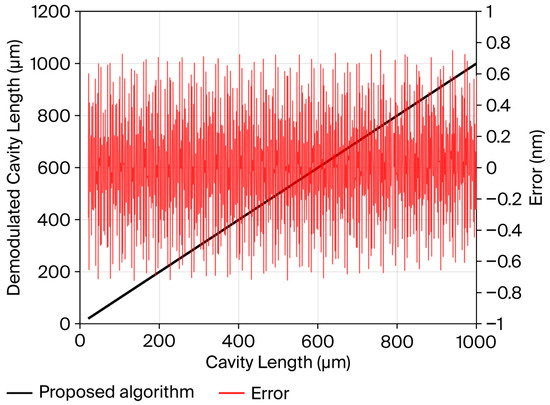
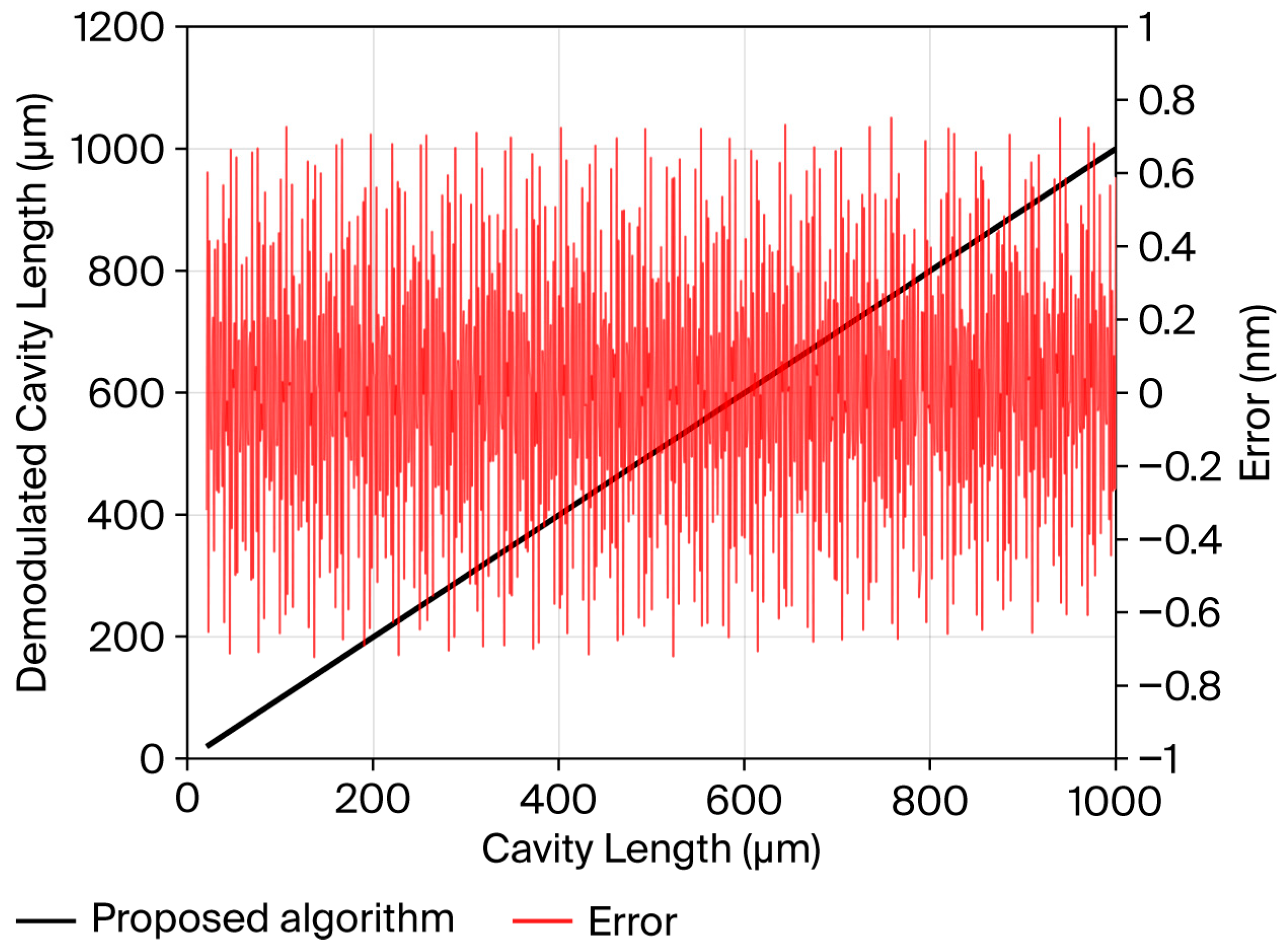
The demodulation range was simulated. Based on the previous simulation parameters, the cavity length range was set from 20 μm to 1000 μm with a step of 0.2 nm. The feedback-based linear spectral fitting demodulation method was applied to test the theoretical upper limit of the proposed algorithm.
Figure 3 presents the relationship between the cavity lengths and the demodulated cavity lengths. It is clear that the algorithm maintains a good linear response within the cavity length range of 20 μm to 1000 μm, and the demodulation error remains within ±0.8 nm. In practical applications, the dynamic range of this method is usually determined by the performance parameters of the employed OSA, such as the spectral wavelength range, wavelength resolution, absolute wavelength accuracy, and wavelength repeatability.
Figure 3.
Relationship between the cavity lengths and the demodulated cavity lengths (left), and between the cavity lengths and the error (right).
3.3. Resolution
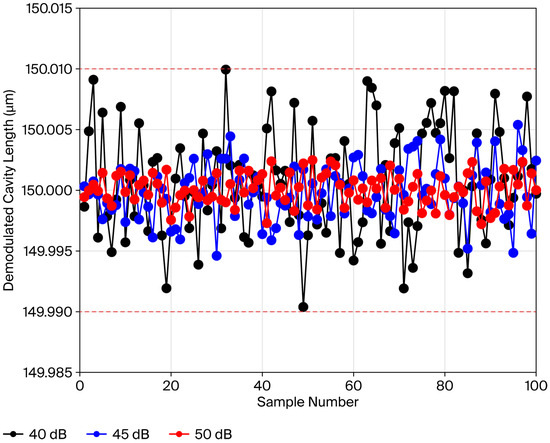
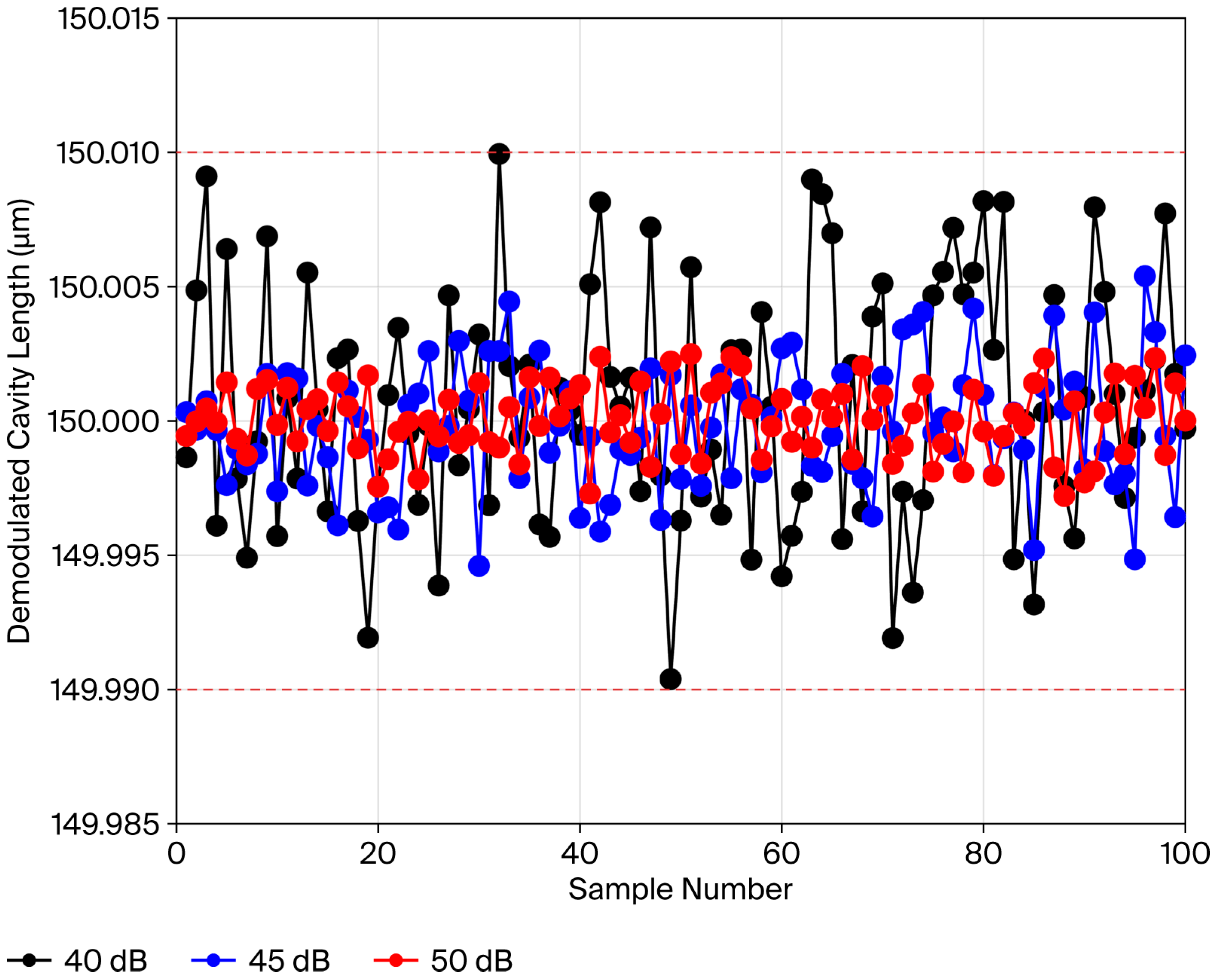
To evaluate the resolution of the algorithm under noisy conditions, white noise with various signal-to-noise ratio (SNR) levels was added to the amplitude of the simulated ideal spectra. The white noise with SNRs of 40 dB, 45 dB, and 50 dB was superimposed onto the amplitude of the simulated ideal spectra, with the cavity length fixed at 150 μm. Theoretically, the iteration condition for the demodulation method is . However, due to noise influence, infinite iteration loops might occur. Therefore, in practice, a suitable threshold was set for the condition judgment. When < , it was considered that . In this simulation, the threshold was set to 10 nm. Subsequently, 100 independent random noise spectra were demodulated. For each SNR level, 100 independent noise seeds were generated to produce 100 noisy spectra for statistical demodulation analysis. The demodulation results are shown in Figure 4.
Figure 4.
The demodulated cavity lengths with different noise levels.
The demodulation results indicate that within the noise range of 40 dB to 50 dB, the demodulated cavity lengths consistently remain between 149.99 μm and 150.01 μm, with a maximum error of ±10 nm. As the signal-to-noise ratio increases from 40 dB to 50 dB, the demodulation error progressively decreases: the standard deviation drops from 4.4 nm to 1.2 nm, and accordingly, the resolution improves from 4.4 nm to 1.2 nm. The simulation results demonstrate that the method exhibits good noise resistance.
4. Experimental Results
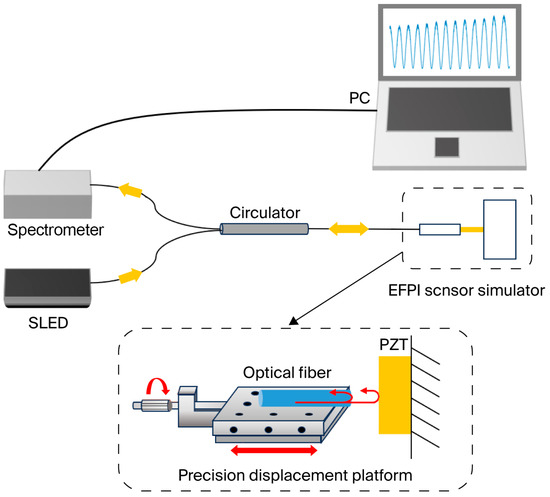
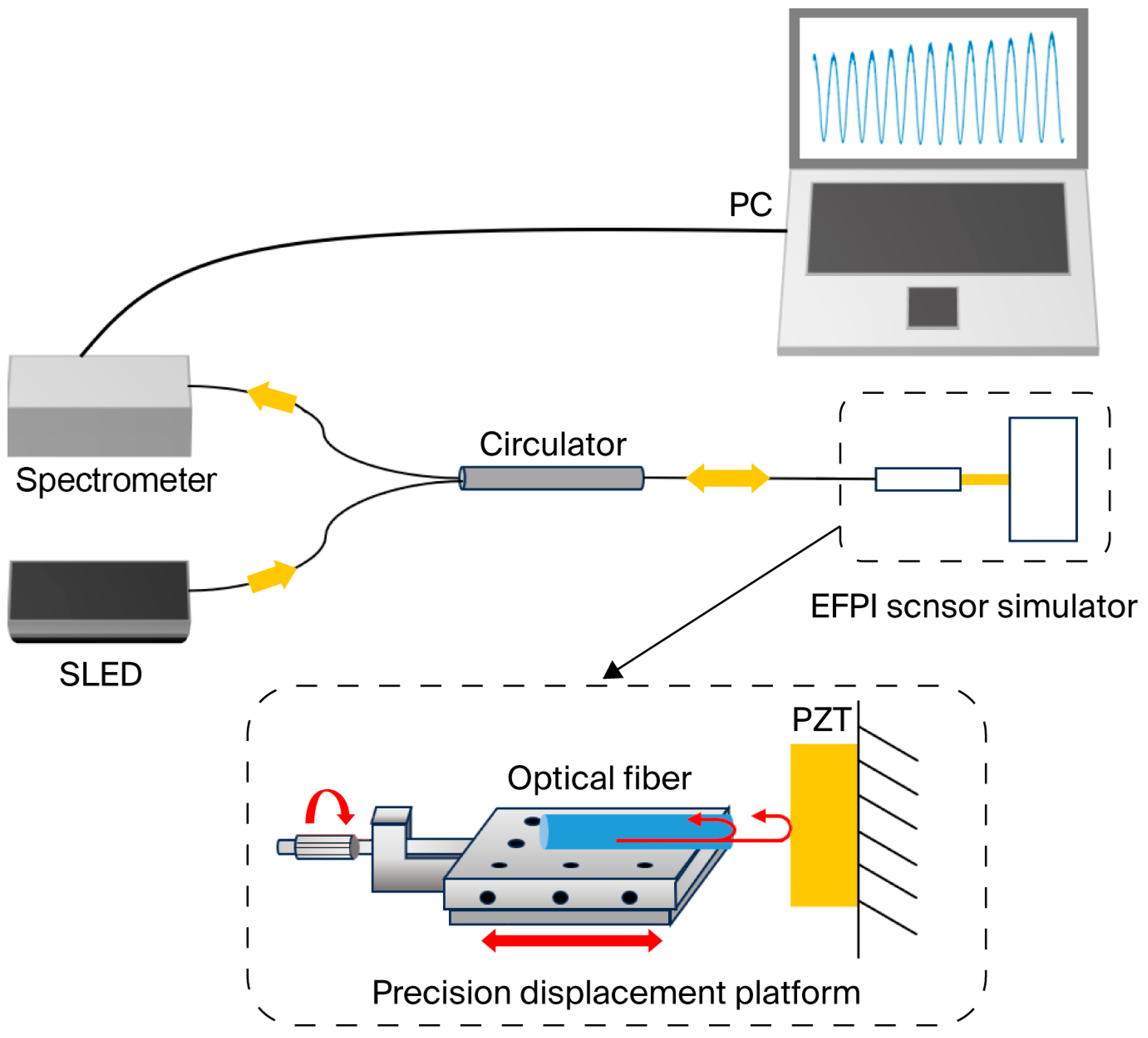
The experimental platform was established to verify the reliability of the feedback-based linear spectral fitting demodulation method, as shown in Figure 5. A superluminescent light-emitting diode (SLED) was used as the light source, with a spectral range covering 1509 nm~1596 nm and an output power of 15 mW. The optical signal emitted from the SLED passed through a circulator to reach the EFPI sensor simulator. The EFPI cavity was formed by a piezoelectric ceramic (PZT) mounted on a precision displacement stage and a fiber end face. By adjusting the precision displacement stage and changing the voltage applied to the PZT, the cavity length of the EFPI was varied. The optical signal reflected from the EFPI sensor simulator passed through the circulator to the spectral reception device. The spectra were acquired using a micro-spectrometer (Ibsen Photonics, Furesø Kommune, Denmark, Ibsen I-MON 512) equipped with 512 pixels. After receiving each spectrum, the micro-spectrometer uploaded it to a personal computer (PC), which then used the feedback-based linear fitting demodulation method to obtain the demodulated cavity length.
Figure 5.
Schematic of the experimental setup for the EFPI sensor simulator.
4.1. Linearity Experiments
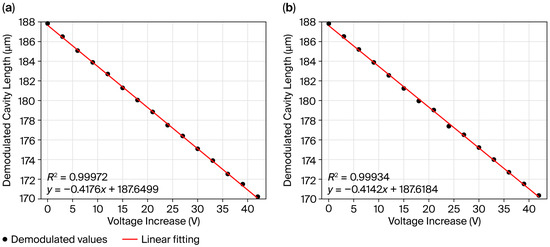
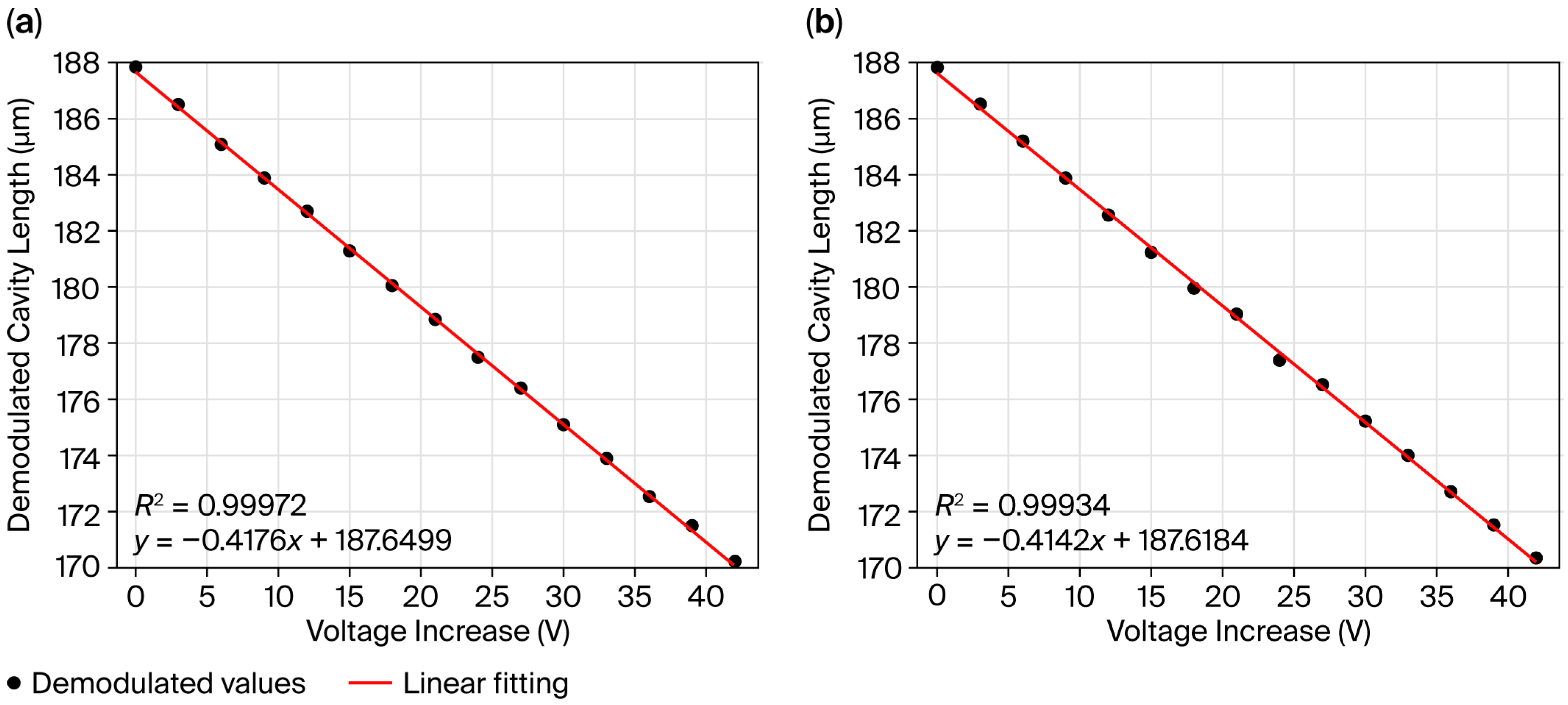
To evaluate the linearity of the demodulation method, the distance between the fiber end face and the PZT was first adjusted using a precision manual translation stage to form an EFPI with an initial cavity length of 187.814 μm. Subsequently, a voltage from 0 V to 42 V was applied to the PZT in steps of 3 V, corresponding to a maximum cavity length variation of approximately 17 μm. A total of 15 sets of spectral data with different cavity lengths were acquired. For each set of spectra, the proposed feedback-based linear fitting method and the spectral MMSE method were used to measure the demodulated cavity length. Due to the significant nonlinear error of the PZT, it is difficult to obtain highly linear cavity length variations solely by adjusting the voltage applied to the PZT. Therefore, to achieve more accurate linearity evaluation, all actual cavity lengths used in this study were calculated using the traditional cross-correlation demodulation method [15]. The cross-correlation method has been validated to achieve sub-nanometer demodulation accuracy; therefore, its demodulation results can serve as a reliable reference for linearity evaluation. The demodulation results for the two methods are shown in Figure 6a and Figure 6b, respectively. Since the traditional spectral MMSE method is a local minimum search technique, demodulation result jumps can occur when spectral quality is low or the initial parameter selection is insufficiently accurate [21]. The linearity was evaluated using the nonlinear error, which follows the equation given below:
where is the nonlinear error, is the measured cavity length, and is the fitted value. In this experiment, the nonlinear error calculated using the spectral MMSE method was 1.769%, while the nonlinear error using the proposed method was 0.979%.
Figure 6.
Linearity experimental results. (a) Cavity length measured using the feedback-based linear fitting method versus applied voltage (black dots) and linear fit (red line). (b) Cavity length measured by the spectral MMSE method versus applied voltage (black dots) and linear fit (red line).
4.2. Demodulation Range Experiments
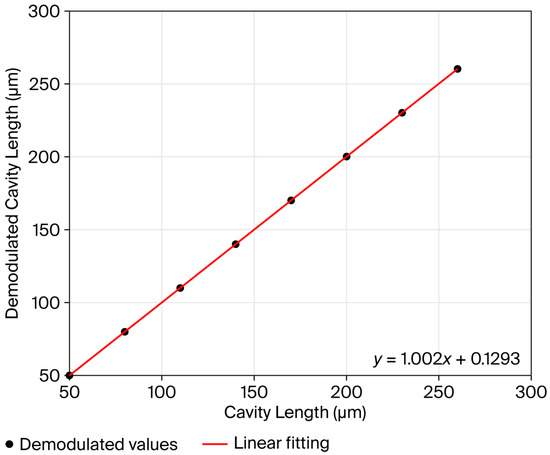
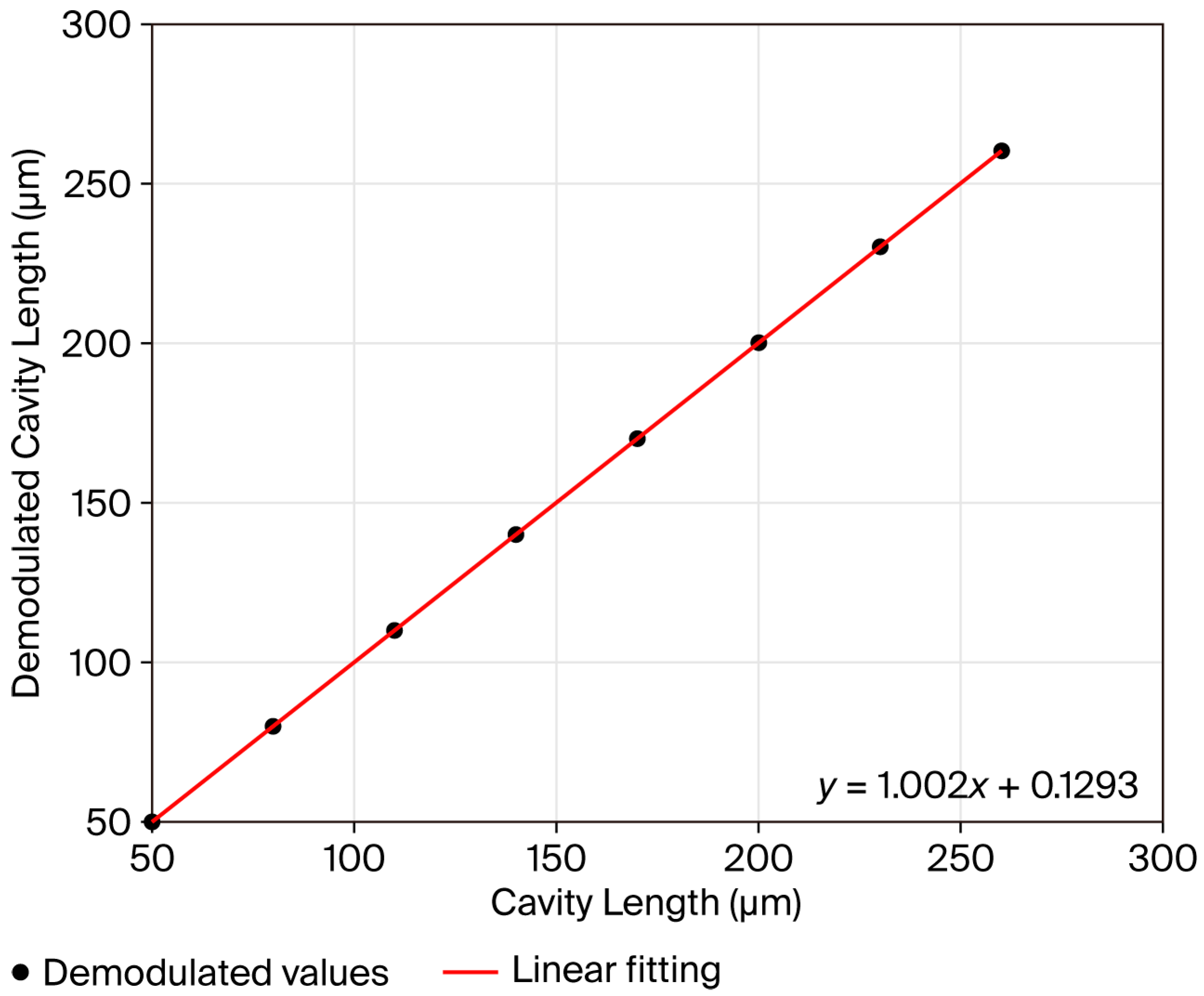
To measure the demodulation range of the method, large-scale cavity length variations in the EFPI sensor were achieved through coarse adjustment via a precision micro-displacement stage combined with fine-tuning using the PZT, as shown in Figure 5. The initial cavity length was set to about 50 μm, with about 30 μm increments. The experimental results are shown in Figure 7. It can be observed that, within the cavity length variation range of 50 μm to 260 μm, the demodulation results maintained high linearity. The average error was 0.157 μm, and the nonlinear error was only 0.134%.
Figure 7.
The experimental results of the demodulation range.
4.3. Resolution Experiments
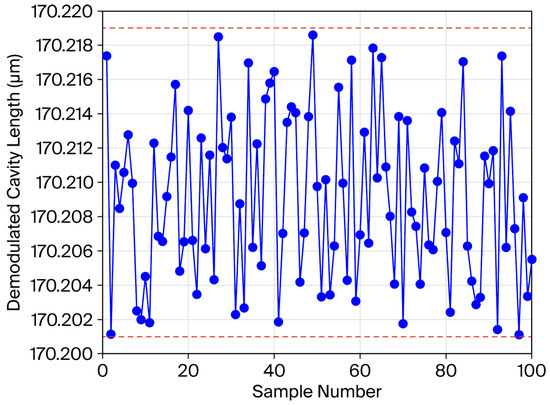
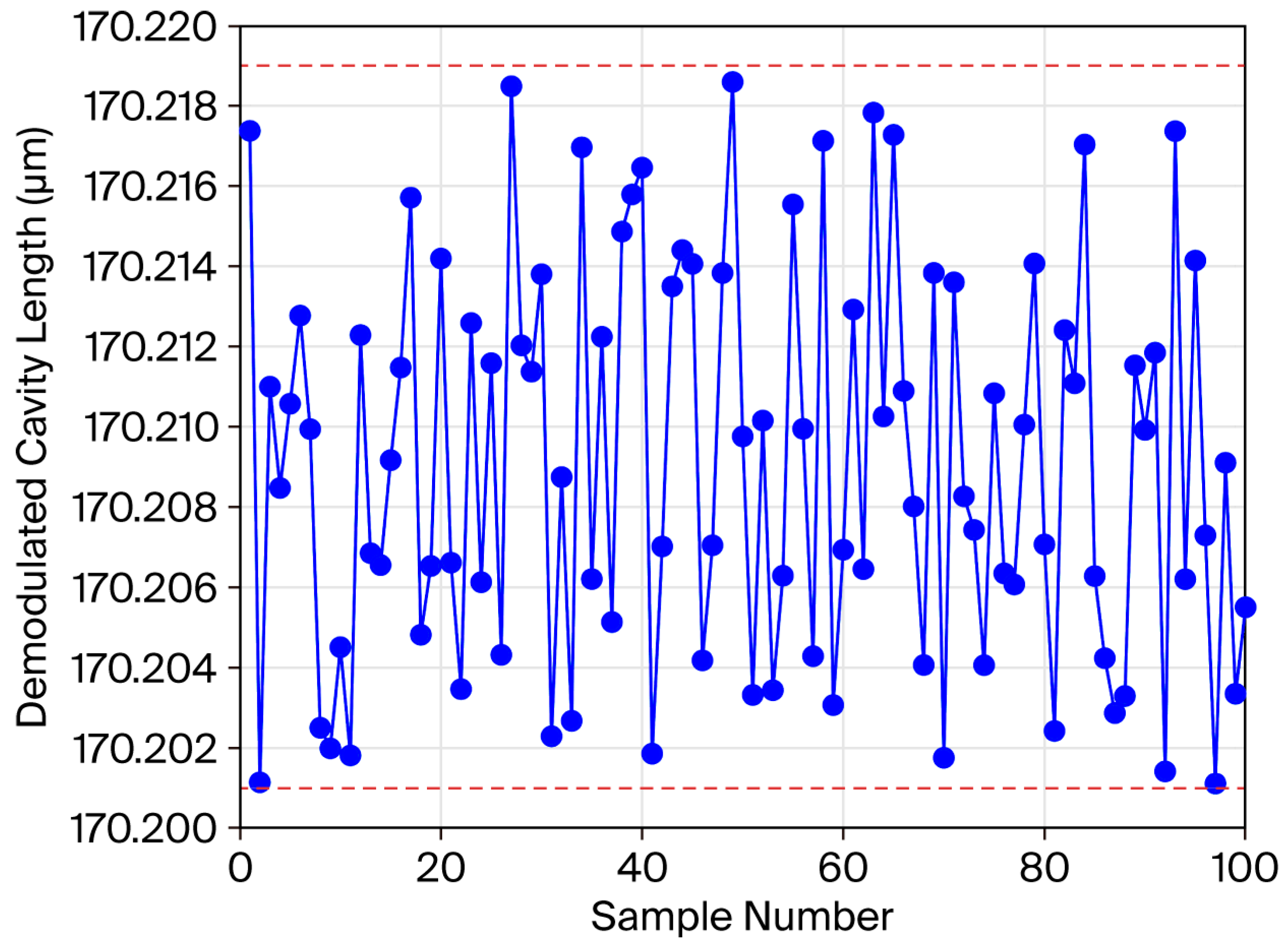
To verify the resolution of the demodulation method, the initial cavity length of the EFPI in the system shown in Figure 5 was set to 170.210 μm. One hundred sets of continuously acquired spectra were used to verify the resolution of the demodulation method.
The experimental results are shown in Figure 8. The resolution of the demodulation method was evaluated by performing 100 consecutive demodulations of the cavity length under static conditions. The demodulated cavity length was consistently maintained within the range of 170.201 μm to 170.219 μm, indicating a maximum error of 9 nm, and the resolution calculated based on the standard deviation is 6.6 nm.
Figure 8.
Cavity length measurement results.
4.4. Pressure Experiment
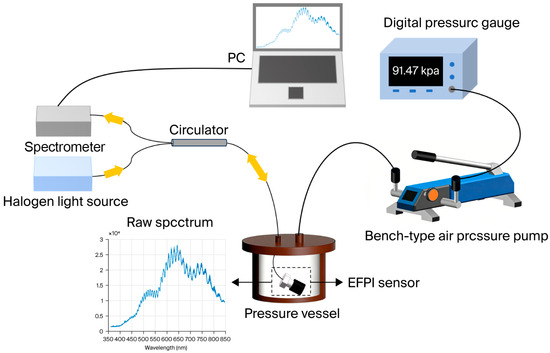
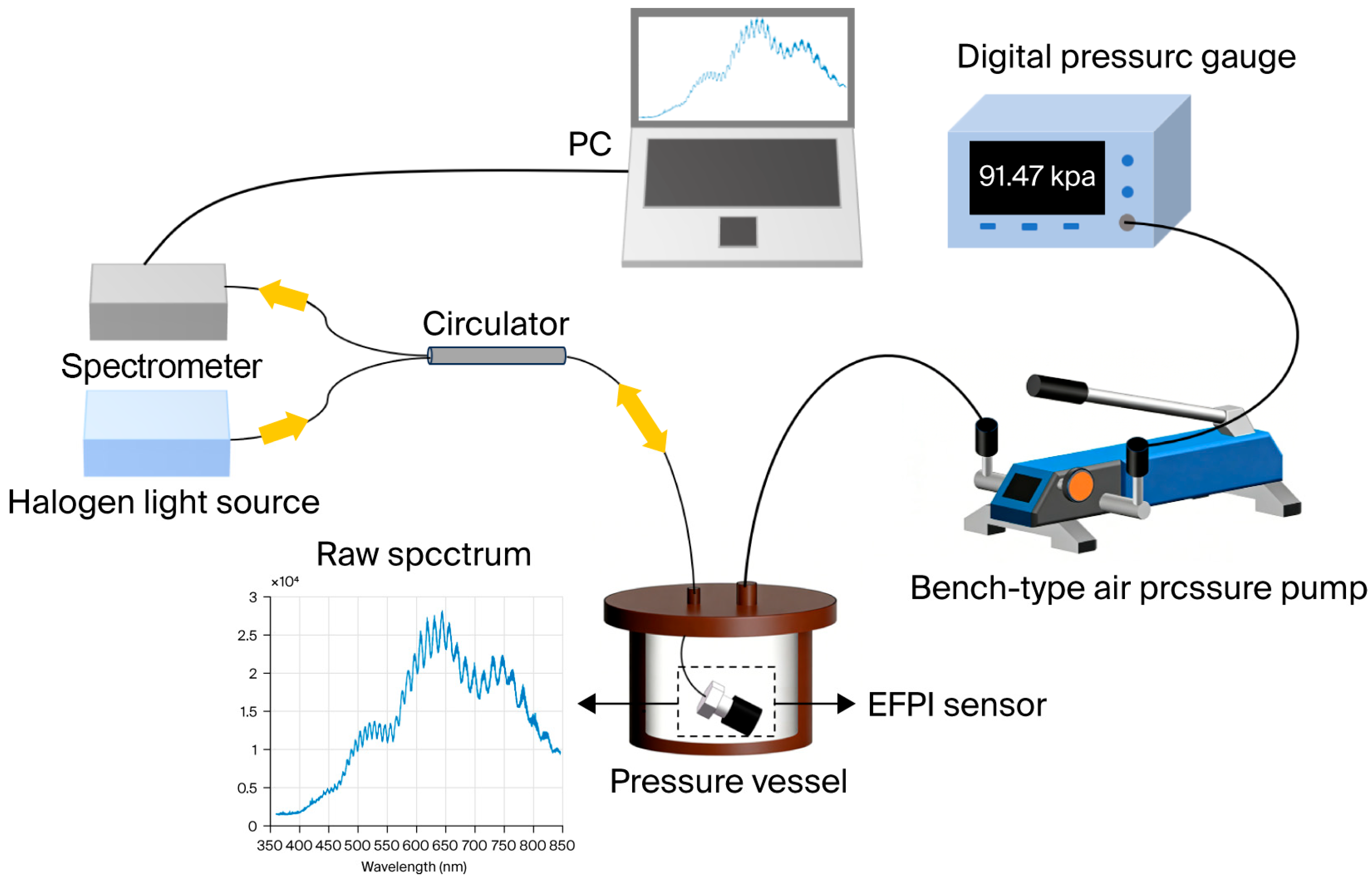
Subsequently, a pressure experiment was conducted using a self-developed fiber EFPI pressure sensor [25]. The experimental system schematic is shown in Figure 9, and all optical fibers used in the experimental system are multi-mode fibers with a core diameter of 50 μm. A halogen light source (Wyoptics, Shanghai, China, HL2000-20W) was used, with a wavelength range of 360 nm ~ 2500 nm and an output power of 8.5 mW. The spectra were acquired using a micro spectrometer (Ibsen Photonics, Furesø Kommune, Denmark, Ibsen FCV-10) with a detectable wavelength range of 360 nm to 838 nm. The spectrometer has a resolution of approximately 0.24 nm, which is sufficient to resolve the interference fringes of an EFPI sensor with a cavity length of approximately 16 μm. The sensor with a cavity length of 16.1087 μm was placed in a pressure chamber and connected to a desktop air pressure pump (ConST, Beijing, China, ConST-162). The other end of the pump was connected to a digital pressure gauge (ConST, Beijing, China, ConST-218). Light emitted from the light source passes through an optical circulator to reach the sensor. The light reflected by the sensor passes through the circulator again and reaches the micro spectrometer, which uploads the acquired spectra to the PC. A desktop air pump is used to pressurize the pressure chamber over a range of 0–4 MPa in steps of 1 MPa. Each time the reading of the digital pressure gauge reaches the target pressure, the pressure is held stable for 30 s, and both the demodulation results and the pressure gauge reading are recorded.
Figure 9.
Schematic of the experimental setup for the EFPI pressure sensor.
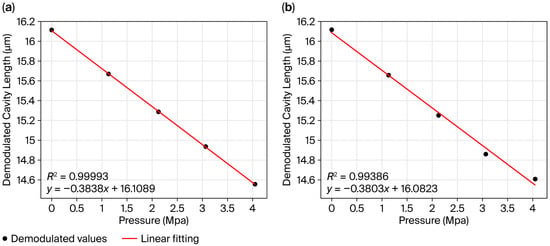
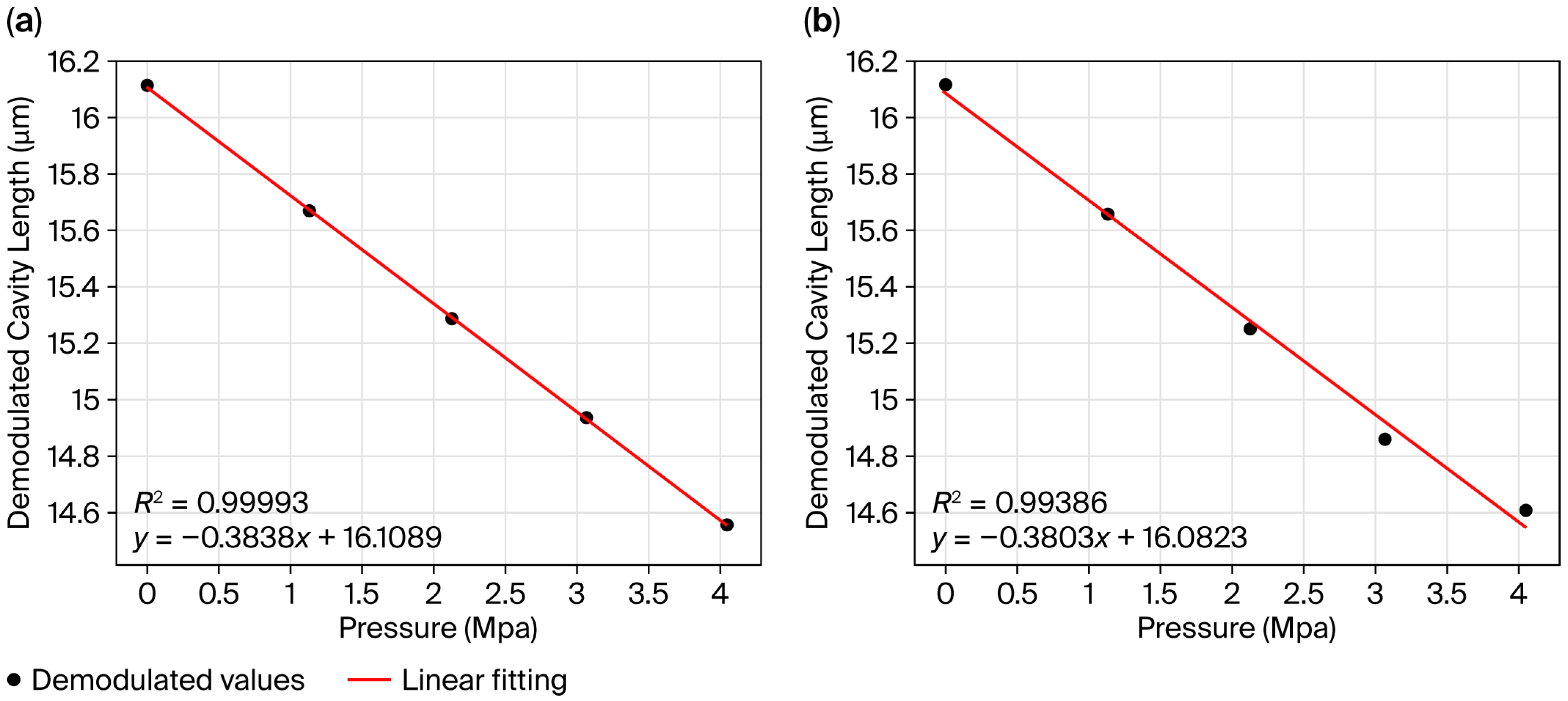
The pressure experimental results are shown in Figure 10a,b. The recorded demodulation results and pressure data were used to plot fitting lines for calculating the nonlinear error. The nonlinear error calculated using the spectral MMSE method was 4.071%, while the nonlinear error using the feedback-based linear fitting method was only 0.401%. Although multi-mode fiber introduces additional modular interference noise, the experimental results demonstrate that the nonlinearity of the demodulation results remains at a relatively low level, validating the effectiveness of the proposed demodulation method in multi-mode fiber EFPI sensing systems.
Figure 10.
Pressure experimental results. (a) Cavity length measured using the feedback-based linear fitting method versus applied pressure (black dots) and linear fit (red line). (b) Cavity length measured using the spectral MMSE method versus applied pressure (black dots) and linear fit (red line).
Based on the results of the linearity experiment and the pressure experiment, it can be observed that the traditional spectral MMSE method is susceptible to the initial values and the spectral SNR, leading to demodulated cavity length jumps and, consequently, increased demodulation errors. In contrast, the proposed feedback-based linear fitting demodulation method does not exhibit such issues. Therefore, experimental results obtained using the proposed method demonstrate higher linearity in both experiments, which demonstrates that the proposed demodulation method exhibits better robustness compared to the spectral MMSE method.
5. Discussion
5.1. Comparison with Other Demodulation Methods
Following the experimental validation, a more comprehensive discussion of the proposed demodulation method is presented. First, a performance comparison was conducted between the proposed method and other demodulation methods. The comparison results are presented in Table 1.
Table 1.
Comparison with other demodulation methods.
As shown in Table 1, the Fourier transform method achieves the highest demodulation speed and the shortest computation time due to its simple operating principle. However, it is prone to phase jumps when the phase variation is large. Additionally, when applied to EFPI sensors with short cavity lengths, this method exhibits a significant increase in demodulation error. While the DGT, cross-correlation, and MMSE methods achieve high demodulation resolution, their demodulation rate is limited, and they are prone to abrupt cavity length variations. In contrast, the proposed method introduces a novel approach based on linear spectral fitting, which achieves a high demodulation rate without phase jumps or abrupt cavity length variations.
In summary, each of the existing spectral demodulation methods for EFPI sensors has its own advantages and limitations. Therefore, in practical applications, the appropriate demodulation method should be selected based on the specific requirements of the EFPI sensor.
It should be noted that the proposed demodulation method is theoretically capable of extracting the phase of any sinusoidal or cosine signal. Therefore, it may potentially be applied to various sensors based on two-beam interference principles in the future, such as Michelson interferometers, Mach–Zehnder interferometers, and other similar configurations.
5.2. Discussion of Time Complexity
We compared the demodulation times between the proposed method and the spectral MMSE method. The spectral MMSE method used here is based on the algorithm described in Ref. [20]. The experiment was conducted on the PC equipped with an Intel i9-14900 processor. To avoid timing fluctuations caused by variations in CPU cache states during individual runs, the algorithm was executed ten consecutive times, and the total time consumption was recorded. As shown in Table 2, for spectra with varying numbers of data points, the computational time of the proposed method was more than 40 times shorter than that of the spectral MMSE method.
Table 2.
Time consumption comparison of the two methods.
We further compared the time complexity of the two methods. The analysis indicates that although both algorithms share a theoretical time complexity of O(N), where N represents the number of data points, their actual runtime differs significantly due to variations in the number of iterations. As shown in Table 2, as the data size increases, the computation time of both methods grows approximately linearly, with the speedup ratio remaining stable between 40 and 50, which is consistent with the theoretical time complexity analysis. These results demonstrate that the proposed demodulation algorithm offers significant advantages for real-time applications in large-scale spectral data processing scenarios.
5.3. Comparison with Normalization Algorithm
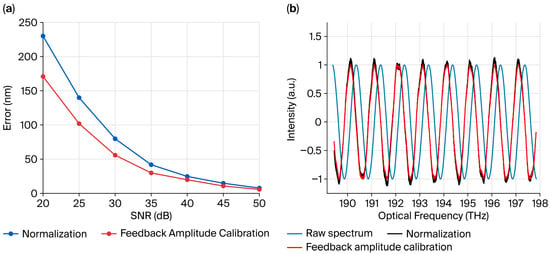
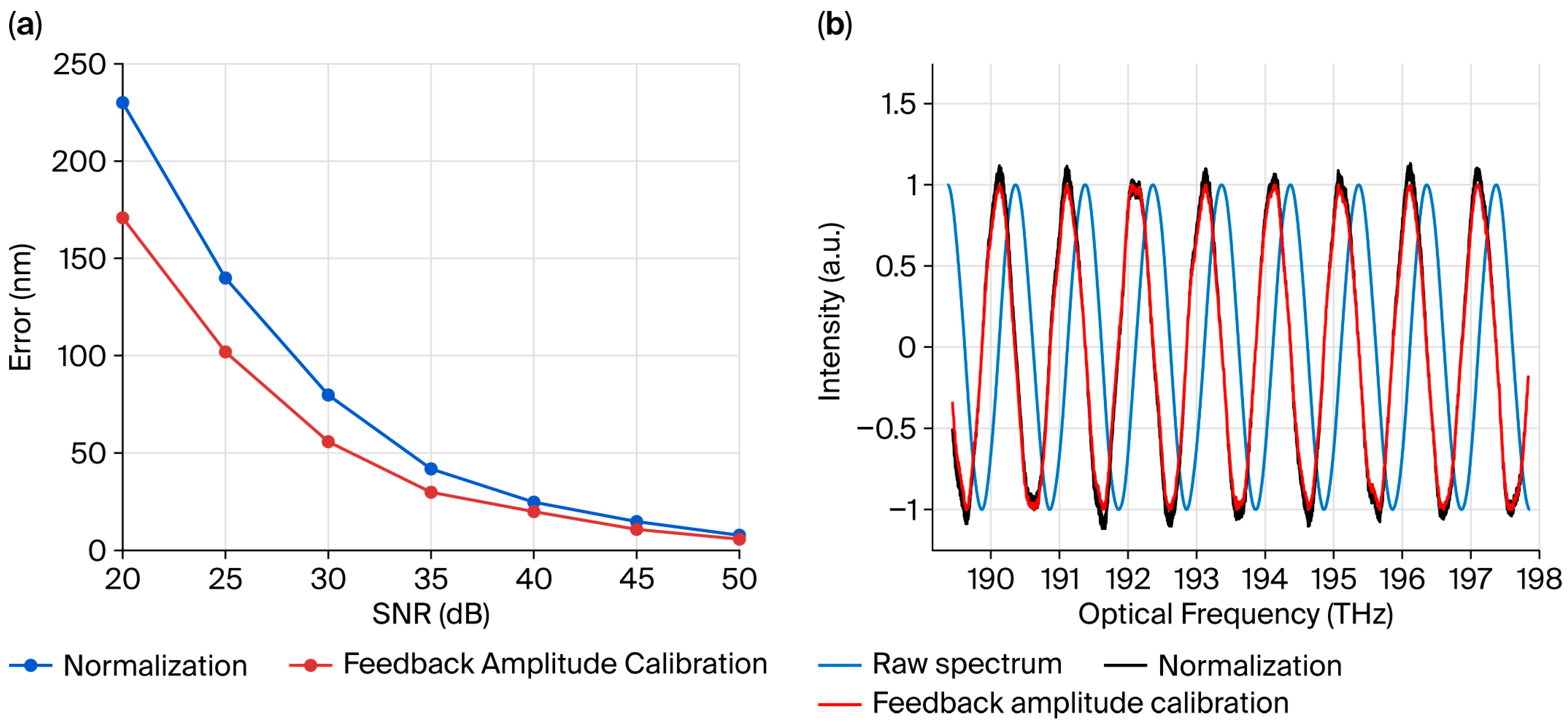
Theoretically, the amplitude of the differentiated spectrum can also be aligned with that of the original spectrum using a normalization algorithm. However, in practice, since the differentiation process amplifies high-frequency noise, this often leads to significant normalization errors, increasing the demodulation error. Through simulations, a comparison was conducted between the proposed amplitude calibration technique and the normalization algorithm. The comparison results are shown in Figure 11.
Figure 11.
Comparison with the normalization algorithm. (a) Demodulation errors of the amplitude calibration technique and the normalization algorithm under different SNRs. (b) Differentiated spectra calibrated using the amplitude calibration technique and using the normalization algorithm under an SNR of 25 dB.
The initial cavity length was set to 150 μm, and the remaining simulation parameters were consistent with those described in Section 3.1. The SNR was increased from 20 dB to 50 dB in increments of 5 dB. For each SNR level, 100 sets of spectral data were simulated and processed using both the proposed amplitude calibration technique and the normalization algorithm. After differentiation, the spectra were subjected to arctangent operation, phase compensation, and linear fitting to obtain the demodulated cavity lengths. For each set of 100 demodulated values at a given SNR, the deviation from the initial cavity length was calculated, and the standard deviation of these deviations was used as the demodulation error. The simulation results are presented in Figure 11a. As shown in the figure, as the SNR increased from 20 dB to 50 dB, the demodulation error of the normalization algorithm decreased from 230.8 nm to 8.6 nm, while that of the amplitude calibration technique decreased from 171.3 nm to 6.2 nm. Notably, at every SNR level, the demodulation error achieved by the amplitude calibration technique was significantly lower than that of the normalization algorithm, demonstrating its superior robustness against high-frequency noise. Figure 11b presents a representative example at an SNR of 25 dB. Under this condition, the amplitude of the differentiated spectrum calibrated using the proposed technique was 1.00005, whereas that processed with the normalization algorithm was 1.15315 (both calculated using the peak-to-peak method). The results indicate that the amplitude of the spectrum calibrated using the proposed technique was more closely aligned with that of the original spectrum, thereby achieving more accurate cavity length demodulation. These simulation results conclusively demonstrate that, compared to conventional normalization algorithms, the proposed amplitude calibration technique exhibits better noise immunity. Therefore, it offers higher demodulation accuracy in practical engineering applications.
Furthermore, it is worth noting that, as shown in Figure 11a, the demodulation error of the proposed method increases as the spectral SNR decreases. Therefore, in practical applications, a higher spectral SNR is desirable to achieve better demodulation accuracy.
6. Conclusions
This study presents a feedback-based linear spectral fitting demodulation method for EFPI sensors. In the proposed method, the interference spectral phase and optical frequency are linearly fitted, and the demodulated cavity length is calculated directly from the slope of the fitted line. Then, the feedback amplitude calibration technique is used, and iterative operations are conducted to improve the accuracy of the linear fitting. Theoretical analysis, simulation, and experiments were conducted to validate the feasibility and performance of the proposed demodulation method. Experimental results show that the nonlinear error of the demodulated cavity length is 0.979% over the small cavity length variation range of 170.210 μm to 187.814 μm, when using the EFPI sensor simulator. Over the large cavity length variation range of 50 μm to 260 μm, the nonlinear error of the proposed method is only 0.134%. Resolution experiments performed on an EFPI with a cavity length of 170.210 μm yield a resolution of 6.6 nm. In experiments using the optical fiber EFPI pressure sensor over the range of 0–4 MPa, the nonlinear error remains as low as 0.401%. Compared with the traditional MMSE method, the proposed method significantly reduces computational complexity and improves speed, achieving demodulation times more than 40 times faster, while avoiding the initial value sensitivity issue inherent in the traditional MMSE method. Owing to its simplicity and rapid execution, the method can be readily deployed on common-performance chips, thereby offering greater potential for engineering applications than the conventional MMSE method.
Author Contributions
Conceptualization, Q.R.; methodology, Q.R.; software, Y.D.; validation, J.C.; data curation, Y.D.; writing—original draft preparation, Q.R. and Y.D.; writing—review and editing, J.C., J.L., Z.L., C.D. and K.L.; funding acquisition, J.C., J.L., Z.L. and K.L. All authors have read and agreed to the published version of the manuscript.
Funding
This work was supported by the National Natural Science Foundation of China (52505617, 62401525, 62305313), the Natural Science Foundation of Shanxi (202303021212192, 202403021222159, 202403021222151), and the Scientific and Technological Innovation Programs of Higher Education Institutions in Shanxi (2024L204).
Institutional Review Board Statement
Not applicable.
Informed Consent Statement
Informed consent was obtained from all subjects involved in the study.
Data Availability Statement
The dataset is available on request from the authors.
Conflicts of Interest
The authors declare no conflicts of interest.
References
- Li, H.; Bu, J.; Li, W.; Lv, J.; Wang, X.; Hu, K.; Yu, Y. Fiber optic Fabry–Perot sensor that can amplify ultrasonic wave for an enhanced partial discharge detection. Sci. Rep. 2021, 11, 8661. [Google Scholar] [CrossRef] [Scilit] [PubMed]
- Xiong, L.; Chu, S.; Gan, Y.; Sun, B.; Jing, Y.; Zhang, J. Enhanced Mechanical Design for Fiber Fabry–Perot Interferometric Vibration Sensor in Oil and Gas Pipeline Safety Risk Monitoring. Processes 2025, 13, 3885. [Google Scholar] [CrossRef] [Scilit]
- Zhao, S.; Jiang, Y.; Deng, H.; Zhang, Y. High sensitivity all-sapphire fiber diaphragm-based extrinsic Fabry-Perot interferometric pressure sensor for ultra-high temperature environments. Opt. Express 2025, 33, 37322–37333. [Google Scholar] [CrossRef] [Scilit] [PubMed]
- Liu, Z.; Cheng, J.; Li, J.; Li, J.; Zhao, L.; Zheng, Z.; Huang, P.; Li, H. Fiber Optic Fabry-Perot Interferometer Pressure Sensors for Oil Well. Sensors 2025, 25, 6297. [Google Scholar] [CrossRef] [Scilit] [PubMed]
- Rovera, A.; Tancau, A.; Boetti, N.; Dalla Vedova, M.D.L.; Maggiore, P.; Janner, D. Fiber Optic Sensors for Harsh and High Radiation Environments in Aerospace Applications. Sensors 2023, 23, 2512. [Google Scholar] [CrossRef] [Scilit]
- Liu, W.; Qian, C.; Li, K.; Wang, Y.; Cai, X.; Liu, Q. Real-time respiratory monitoring using a sparse-sampled frequency-scanning white-light interferometry system. Photonics 2025, 12, 45. [Google Scholar] [CrossRef] [Scilit]
- Jiang, Y. High-resolution interrogation technique for fiber optic extrinsic Fabry-Perot interferometric sensors by the peak-to-peak method. Appl. Opt. 2008, 47, 925–932. [Google Scholar] [CrossRef] [Scilit]
- Nie, L.; Li, X.; Chen, H.; Zhang, J.; Chen, H.; Zhao, X.; Wang, S.; Liu, G. Cavity length sequence matching algorithm based on combined valley peak positioning for fiber-optic Fabry-Perot sensors. Photonics 2022, 9, 451. [Google Scholar] [CrossRef] [Scilit]
- Yu, Z.; Wang, A. Fast demodulation algorithm for multiplexed low-finesse Fabry-Perot interferometers. J. Light. Technol. 2016, 34, 1015–1019. [Google Scholar] [CrossRef] [Scilit]
- Yang, Y.; Wang, Y.; Chen, K. Wideband fiber-optic Fabry-Perot acoustic sensing scheme using high-speed absolute cavity length demodulation. Opt. Express 2021, 29, 6768–6779. [Google Scholar] [CrossRef] [Scilit] [PubMed]
- Yang, Y.; Ma, F.; Chen, K.; Yu, Q. High-speed and high-resolution low-coherence interferometric demodulation without phase jumps. IEEE Sens. J. 2020, 20, 12225–12231. [Google Scholar] [CrossRef] [Scilit]
- Li, C.; Zhao, X.; Qi, H.; Wang, Z.; Xu, Y.; Han, X.; Huang, J.; Guo, M.; Chen, K. Integrated fiber-optic Fabry–Perot vibration/acoustic sensing system based on high-speed phase demodulation. Opt. Laser Technol. 2024, 169, 110131. [Google Scholar] [CrossRef] [Scilit]
- Lv, R.; Du, C.; Wang, Y.; Liu, Y. EFPI demodulation algorithm based on the combination of Nuttall convolution window and discrete gap transformation. IEEE Sens. J. 2024, 24, 10091–10097. [Google Scholar] [CrossRef] [Scilit]
- Chen, H.; Liu, J.; Zhang, X.; Wang, W.; Ma, Z.; Lv, W.; Guo, Z. High-order harmonic-frequency cross-correlation algorithm for absolute cavity length interrogation of white-light fiber-optic Fabry-Perot sensors. J. Light. Technol. 2019, 38, 953–960. [Google Scholar] [CrossRef] [Scilit]
- Cheung, Y.; Jing, Z.; Guo, Y.; Liu, Y.; Liu, Q.; Li, A.; Zhou, D.; Peng, W. Parallel cross-correlation algorithm for the fast interrogation of high-finesse fiber-optic Fabry-Perot sensors. J. Light. Technol. 2023, 41, 4522–4530. [Google Scholar] [CrossRef] [Scilit]
- Bai, J.; Cao, S.; Chai, H.; Zheng, Y.; Xue, C. Ultrahigh-Speed Demodulation for Fabry-Pérot Sensors Based on Spatio-Temporal Features of Sparse Spectra. J. Light. Technol. 2025, 43, 6957–6968. [Google Scholar] [CrossRef] [Scilit]
- Li, R.; Liu, F.; Chen, D.; Li, H.; Li, J.; Zhang, W.; Ni, J.; Leng, J.; Zhang, Z. Density Prediction Model for Spectral Data Based on Residual Convolutional Neural Network. Laser Optoelectron. Prog. 2025, 62, 1306010. [Google Scholar] [CrossRef] [Scilit]
- Feng, J.; Wang, W.; Zhang, X.; Chen, H.; Guo, Z.; Shen, J.; Zhang, J. Combined interrogation algorithm of amplitude normalization and minimum mean square error for fiber-optic Fabry-Perot sensors. Acta Photonica Sin. 2020, 49, 0906002. [Google Scholar] [CrossRef] [Scilit]
- Zhang, P.; Wang, Y.; Chen, Y.; Lei, X.; Qi, Y.; Feng, J.; Liu, X. A high-speed demodulation technology of fiber optic extrinsic Fabry-Perot interferometric sensor based on coarse spectrum. Sensors 2021, 21, 6609. [Google Scholar] [CrossRef] [Scilit] [PubMed]
- Liu, W.; Ren, Q.; Jia, P.; Hong, Y.; Liang, T.; Liu, J.; Xiong, J. Least square fitting demodulation technique for the interrogation of an optical fiber Fabry–Perot sensor with arbitrary reflectivity. Appl. Opt. 2020, 59, 1301–1306. [Google Scholar] [CrossRef] [Scilit] [PubMed]
- Hai, Z.; Su, Z.; Liang, R.; Guo, M.; Zhu, H.; Chen, J.; Zhang, Q.; Chen, Y.; Lin, R.; Zhang, Y.; et al. Numerical and Experiment Analysis of Sapphire Sandwich-Structure Fabry–Perot Pressure Sensor through Fast Fourier Transform and Mean Square Error Demodulation Algorithm. Materials 2024, 17, 3649. [Google Scholar] [CrossRef] [Scilit] [PubMed]
- Anisha, A.; Nitin, K. A Fabry-Perot interferometer based fiber optic dynamic displacement sensor with an analog in-phase/quadrature generator. IEEE Sens. J. 2020, 20, 14764–14771. [Google Scholar] [CrossRef] [Scilit]
- Xiao, W.; Cheng, J.; Zhang, D.; Kong, Y.; Ye, H.; He, J. High stability PGC demodulation technique for fiber-optic interferometric sensor. Opto-Electron Eng 2022, 49, 210368. [Google Scholar] [CrossRef]
- Xu, Y.; Wang, Y.; Ji, Y.; Jin, W.; Bu, M.; Liang, M.; Han, H. A derivative method of phase retrieval based on two interferograms with an unknown phase shift. Optik 2016, 127, 326–330. [Google Scholar] [CrossRef] [Scilit]
- Li, J.; Jia, P.; Fang, G.; Wang, J.; Qian, J.; Ren, Q.; Xiong, J. Batch-producible all-silica fiber-optic Fabry–Perot pressure sensor for high-temperature applications up to 800 °C. Sens. Actuators A Phys. 2022, 334, 113363. [Google Scholar] [CrossRef] [Scilit]

Disclaimer/Publisher’s Note: The statements, opinions and data contained in all publications are solely those of the individual author(s) and contributor(s) and not of MDPI and/or the editor(s). MDPI and/or the editor(s) disclaim responsibility for any injury to people or property resulting from any ideas, methods, instructions or products referred to in the content. |
© 2026 by the authors. Licensee MDPI, Basel, Switzerland. This article is an open access article distributed under the terms and conditions of the Creative Commons Attribution (CC BY) license.