


Abstract
Mid-IR flat/integrated optics require low-loss, programmable phase control. We investigate femtosecond laser direct writing (FLDW) in aluminogermanate glass (Corning 9754), first mapping the processing landscape to delineate no modification, Type I index increase, and spatial broadening regimes. We then operate in a non-accumulating regime that provides a broad, stable writing window. Quantitative-phase microscopy yields Δφ and a monotonic Δn with optically limited cross-sections compatible with low loss. Transmission spectroscopy shows high values (about 90% up to 4 µm) and no additional absorptions across the near-IR and mid-IR range. FTIR reveals a redshift of the Ge–O–(Ge/Al) stretching envelope from ≈1 µJ, correlating with the high Δn onset. s-SNOM at 925 cm−1 resolves the written line as reduced near-field amplitude and decreased phase, confirming a local complex permittivity change consistent with densification-driven Type I tracks. Together, these results define practical conditions for on-demand mid-IR flat/GRIN/Fresnel optics by FLDW in this commercial mid-IR transparent glass.
1. Introduction
Photonics is currently shifting towards greater integration of optical components and the use of structured beams [1]. Compact and lightweight components are essential for applications in healthcare, transportation, and space. Simultaneously, complex shaping of amplitude, phase, and polarization is crucial for a fast-growing number of applications and fundamental science (quantum optics, biophotonics, attosecond pulses, laser materials processing). Therefore, next-generation photonics needs a manufacturing technique to print “on-demand” any arbitrary optical component for beam shaping. Ideally, such optics would be flat and thin, exhibiting low optical losses and a high damage threshold, and manufactured at a low cost. Conventional light-shaping tools have limited capabilities: spatial light modulators are bulky and expensive, provide limited phase change, and exploit a single polarization axis. Diffractive optical elements cannot offer polarization shaping [2]. Space variant metasurfaces [3] enable full control of the output light field, but the associated surface 2D lithographic processes are long, multi-step, costly, and environmentally intensive, and the final nm layer is fragile. In parallel, recent advances in flat optics have challenged the limitations of conventional optics [4]. The phase profile of nearly any optical component, including lenses, gratings, prisms, vortex phase plates, waveguides, as well as elements capable of bending light in unusual ways, can be designed using the geometric phase (also called Pancharatnam–Berry phase) [5]. Theoretically, any phase pattern can be achieved by means of geometric-phase optics with efficiencies reaching up to 100%.
With femtosecond (fs) laser pulses, 3D phase changes can be imprinted inside most optical glasses in a multi-pulse laser regime, either through refractive index profiling or by exploiting nanograting formation [6]. The latter structures are subwavelength, periodic (typ. 200–300 nm), and birefringent [7]. In both regimes, phase amplitude can be controlled through pulse energy, scanning speed, and light polarization direction, allowing a complex shaping of both phase and polarization. Therefore, femtosecond laser direct writing (FLDW) opens up broad opportunities to fabricate any optical component [8,9,10]. It has been exploited to demonstrate the fabrication of 3D space-variant birefringent optics (vector beams, Poincaré beams, micro-waveplate arrays) [11,12] as well as a wide range of optical elements operating on 3D freeform geometric phase, such as lenses, prisms, gratings, waveguides, or phase masks [13,14,15,16,17].
In this paper, we investigate this laser-based 3D manufacturing technique in a specific commercial mid-IR material, namely Corning 9754. Indeed, in IR instrumentation, there is a need for miniaturized, lightweight, and low-cost optical systems for civilian, security, and military applications. In this field, IR materials, like heavy oxide glasses transparent up to 5.5 μm [18,19,20], or non-oxide glasses, like the chalcogenide family, are excellent candidates for on-demand refractive index profiling [21,22,23,24]. One major advantage of chalcogenide is the transparency above 12 μm and high laser-induced refractive index changes, e.g., up to 0.05 in the Ge-Sb-S family [25,26]. In contrast, the chosen germanate glass offers high durability in a harsh environment and has high thermal stability [27], and also enables both large refractive index changes and birefringence based on “nanogratings” formation [28,29], which cannot form in other classical IR glasses like fluoride or chalcogenide glasses [30].
In this paper, we report a comprehensive investigation of femtosecond laser direct writing in the commercial mid-IR aluminogermanate glass Corning 9754. The novelty of this work is threefold: (i) we establish processing maps in the (Ep, v, f) landscape that identify a broad, stable, non-accumulating Type I window, (ii) we quantitatively determine the resulting phase and refractive-index changes using transmission quantitative-phase microscopy in a geometry-controlled thickness configuration, and (iii) we connect the macroscopic (Dn > 0) response to its structural origin by combining FTIR spectroscopy and nano-IR s-SNOM imaging of the written tracks. Together, these results provide practical guidelines for rapid, maskless printing of low-loss mid-IR phase elements (GRIN/Fresnel/flat optics) in this durable glass platform.
2. Materials and Methods
All experiments were performed in a commercial aluminogermanate glass (Corning 9754, Corning, NY, USA). Samples were optically polished on both sides and cleaned with acetone. A Yb-doped fiber amplifier at 1030 nm with a pulse duration of 800 fs was then used for fs-3D inscription. The beam was focused inside the bulk with an aspheric lens; the light polarization was linear. Tracks were written using two geometries: Xx (polarization parallel to the scan direction) and Xy (polarization perpendicular to the scan direction). For the threshold maps, we used a high scan speed (up to v = 20 mm s−1) and swept repetition rate from 10 kHz to 1000 kHz and pulse energy Eₚ in the range of 1 nJ–5 μJ to delineate the domains “no modification”, Type I (isotropic Δn > 0), and the spatial-broadening regime. The characterizations were mostly performed at v = 1 mm s−1 and f = 100 kHz, yielding a pulse overlap of ≈100 pulses μm−1, which stabilizes Type I writing over a wide range of energies while minimizing pulse-to-pulse heat accumulation and still allows practical writing speeds.
Bright-field optical microscopy (Olympus BX60) was used to measure the axial length and lateral width of the modified zones versus Eₚ and f under the fixed optical conditions above. Quantitative-phase microscopy in transmission was then used to measure the optical phase shift Δφ at a visible probe wavelength (λ = 550 nm). These phase maps were retrieved by the SID4 Phasics wavefront sensor. In the present study, the quantitative-phase microscopy measurements were performed using Kohler illumination and further collected with an objective with numerical aperture NA = 0.3, chosen to integrate the axial extent of the written object. This prevents saturation effects when the object becomes too thick relative to the aperture [31]. In this view, we wrote a specific series of dedicated objects through the edge of the sample in such a way that the “axial extent” was voluntarily fixed to 20 µm during the scanning process. The refractive index change was then obtained from the usual relation , where d is the effective thickness of the modified layer (fixed to 20 µm in our case). This conversion is standard for fs-laser-written glasses and provides a robust first-order estimate of Δn for Type I tracks.
Broadband transmission spectra were recorded on pristine and laser-written regions to assess excess loss and possible spectral fingerprints related to point defect formation. Fourier transform infrared (FTIR) spectroscopy (Thermo Fisher Nicolet 5700 FTIR spectrometer with a continuum microscope) was used to monitor the glass network stretching band in the 800–1100 cm−1 range.
To further probe the modifications at the nanoscale, we used an IR scattering-type scanning near-field optical microscope, s-SNOM [32]. To this end, we first inscribed a specific sample made of an array of lines with a 1 mm pitch and with the following writing conditions: NA = 0.16, 800 fs, linear polarization, mm s−1, f = 100 kHz, Ep = 1.5 µJ. Post-inscription, the Corning 9754 glass sample was cleaved along the z–y plane to analyze the cross-section of the laser tracks. Subsequently, the cross-section was examined using AFM and optical microscopy to investigate the surface morphology and to construct a detailed map to assist subsequent IR measurements. s-SNOM was performed at the SMIS beamline (Synchrotron Soleil in Saint Aubin, France) in tapping mode with demodulation at the second harmonic of the tip oscillation frequency, acquiring both near-field amplitude and phase. For single-wavelength imaging, we set the probe to 925 cm−1, on the high-frequency shoulder of the Ge–O–(Ge/Al) stretching envelope, which is particularly sensitive to densification-induced redshifts (note: depending on high-frequency edge choice as done in silica) [33]. Atomic-force microscopy (AFM) topography was also employed, when needed, to confirm that the near-field IR contrast in s-SNOM was not driven by surface corrugation.
3. Results and Discussion
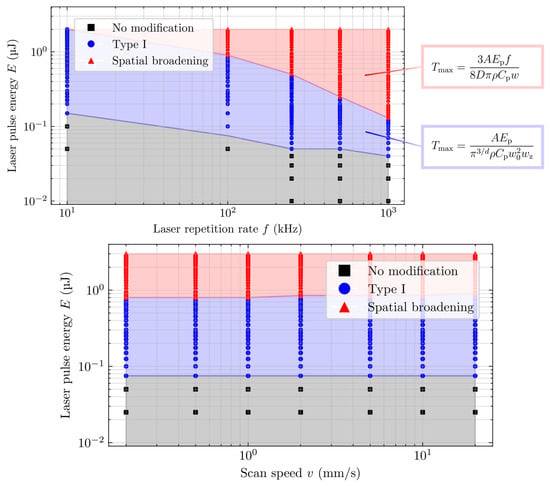
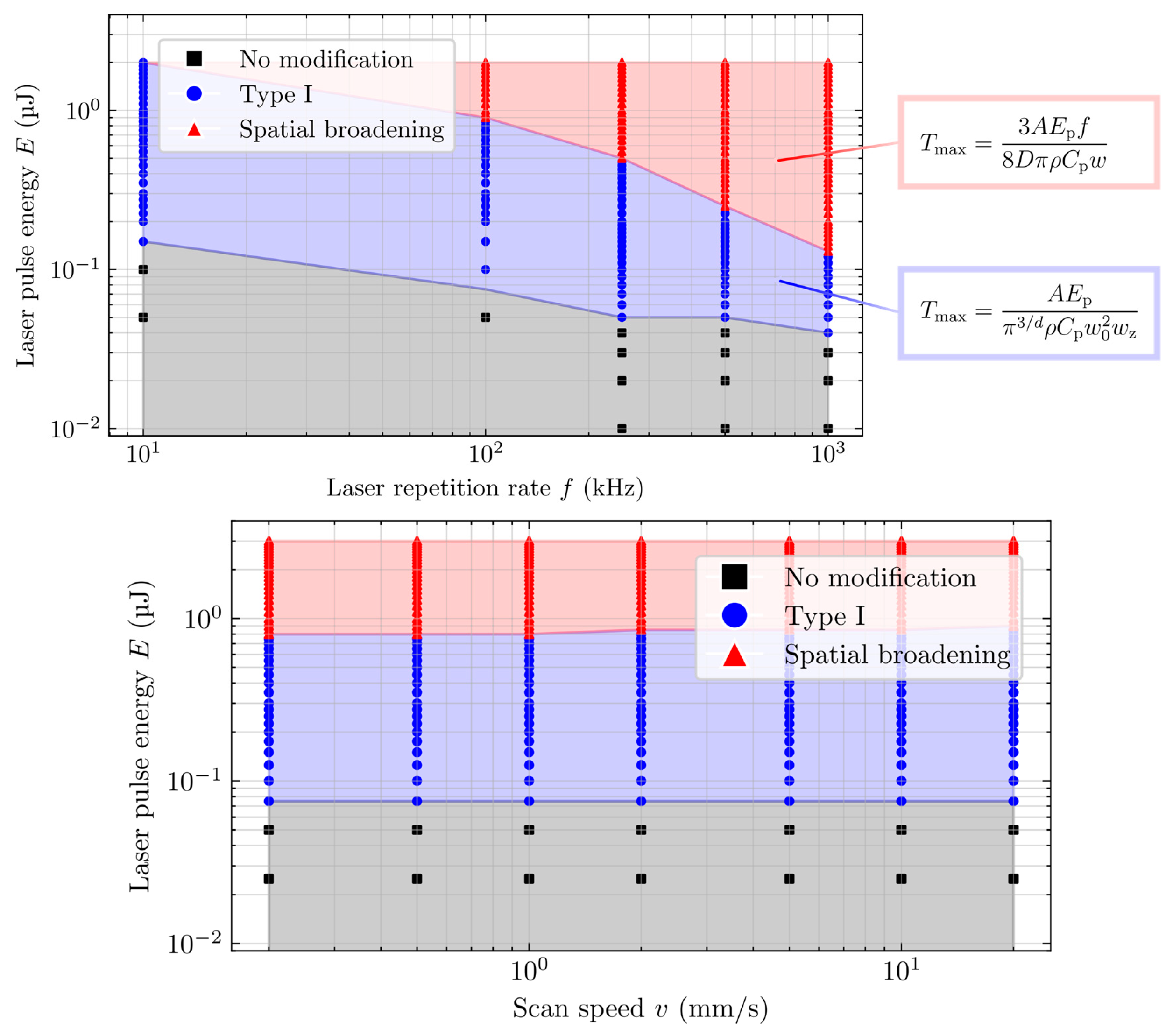
Figure 1 maps the laser-writing thresholds as a function of the laser repetition rate f (kHz) and pulse energy Ep (expressed in µJ) for femtosecond inscription at 1030 nm, NA = 0.60, 800 fs, linear polarization, 20 mm s−1 scan speed, and then for various scan speeds at a fixed repetition rate of 100 kHz. For both cases, three clear domains are distinguished: no modification (black squares, grey area), Type I (blue circles; isotropic refractive index increase), and spatial broadening (red triangles; Type-I-like index change with a broadened track). We use the wording “spatial broadening regime” following the definition that differentiates it from standard Type I by a significant, polarization-insensitive widening of the modified zone, much beyond the size of the focal spot measured at 4σ. This spatial broadening is attributed to pulse-to-pulse heat accumulation [34,35,36], which extends the heat-affected volume beyond the optically modified core and results in a surrounding region that is primarily thermally modified and manifests as a persistent refractive index change [35].
Figure 1.
(Up) Laser writing thresholds for a fixed speed of 20 mm s−1. Pulse energy Ep (µJ) versus repetition rate f (kHz). (Bottom) Laser writing thresholds for a fixed repetition rate of 100 kHz. Pulse energy Ep (µJ) versus scanning speed v (mm s−1). Laser conditions: 1030 nm 800 fs, 0.6 NA, linear polarization. Black squares (grey area) indicate no modification; blue circles indicate Type I changes; red triangles indicate spatial broadening regime.
The organization of the map follows a thermal accumulation criterion that was extensively developed in ref [34]. This criterion distinguishes between two regimes: the non-accumulating regime when 1/f > 7 τth and the accumulating regime when 1/f < 7 τth, leading to the observed spatial broadening of the laser tracks. τth represents the thermal diffusion time over a distance of about 1 µm (typically around 2.3 µs in Corning 9754). At the practical boundary 1/f = 7 τth, the steady-state temperature increase is about 6%. In the non-accumulating regime, the threshold reveals mostly type I modifications. In contrast, in the accumulating regime, the threshold decreases with increasing f, causing the onset of spatial broadening to shift to lower Ep. For reference, the two regimes are captured by the usual estimates for the peak temperature rise, (no heat accumulation), (heat accumulation), where A is the absorption coefficient, ρ is the density, Cp is the heat capacity, D is the thermal diffusion coefficient of the chosen material, w0 is the laser beam waist at the focus, and wz is its axial extension.
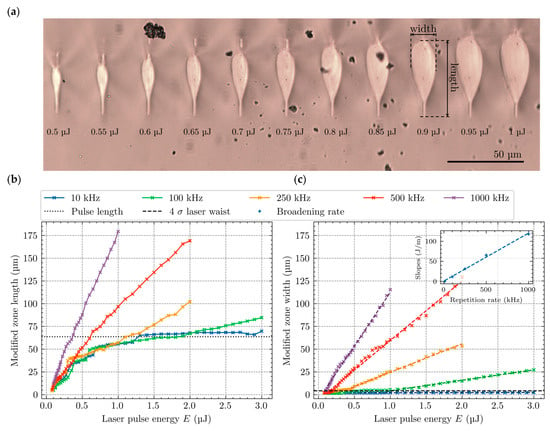
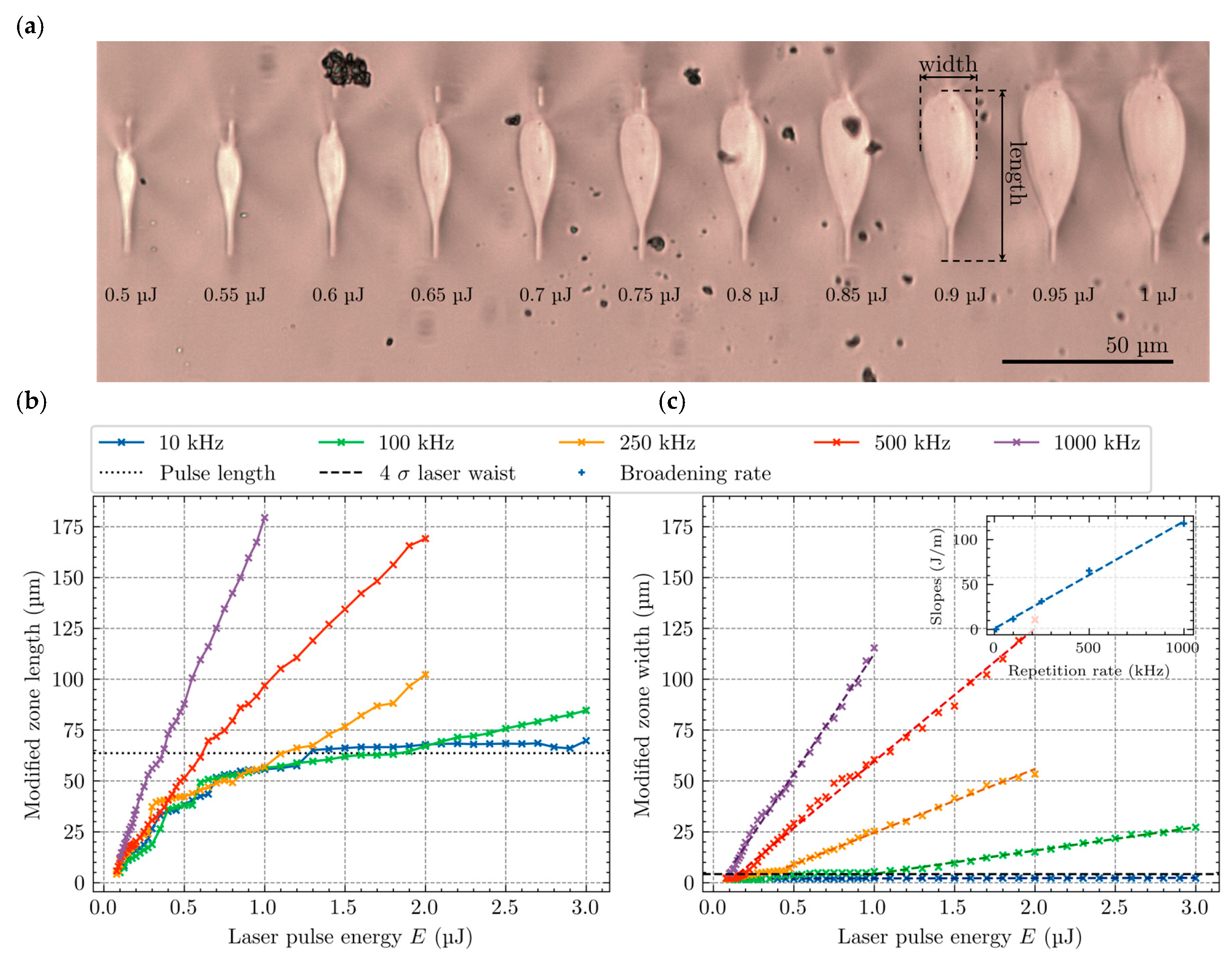
Figure 2a first shows a representative cross-section of a written track at fixed 1030 nm, NA = 0.60, linear polarization, v = 1 mm s−1, and repetition rate of 250 kHz. The tear-drop-shaped features illustrate how both the axial length and lateral width expand with while remaining free of Type II birefringent nanogratings. Building on this qualitative view, the graph in Figure 2b reports the axial length of the modified region as a function of the pulse energy for several repetition rates. At v = 1 mm s−1 and f = 10–100 kHz, the pulse sampling is f/v 100–10 pulses µm−1, which promotes continuous, smooth tracks while keeping thermal accumulation negligible. At 10–100 kHz, the axial length increases monotonously with across the accessible window, consistent with a stable multi-pulse build-up in a non-accumulating thermal regime. By contrast, higher repetition rates (250–1000 kHz) exhibit steeper slopes and quasi-linear growth, reflecting the onset of cumulative heating and the transition toward the spatial-broadening regime.
Figure 2.
Dimensional analysis of femtosecond-laser-written tracks in Corning 9754 (1030 nm, NA = 0.60, linear polarization, v =1 mm s−1). (a) Optical micrograph of tracks written at increasing pulse energy Ep at 250 kHz. Axial length (b) and lateral width (c) of the modified zone versus pulse energy for repetition rates from 10 to 1000 kHz; 10 kHz (and 100 kHz up to 1.2 mJ) provides a broad, non-accumulating processing window with steadily increasing, yet compact, track widths.
Figure 2c shows the lateral width versus Ep under the same fixed conditions. At 100 kHz, the width increases monotonically with Ep from a near-threshold value of a few micrometers to the few-tens-of-micrometers range at the upper end of the window, maintaining a compact cross-section compatible with low-loss Type I components, e.g., gratings, waveguides, GRIN lenses [16,37,38]. As expected, increasing f beyond 100 kHz leads to larger widths at a given Ep (signature of cumulative energy deposition), whereas a lower f shifts the onset of measurable width to higher Ep. The optical micrograph (example at 250 kHz) illustrates the broader, tear-drop-like profiles characteristic of stronger cumulative effects. Accordingly, kHz is selected as the reference condition, which deliberately avoids this regime while retaining 100 pulses µm−1 for process regularity.
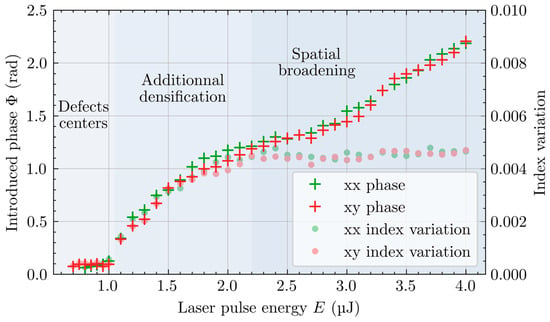
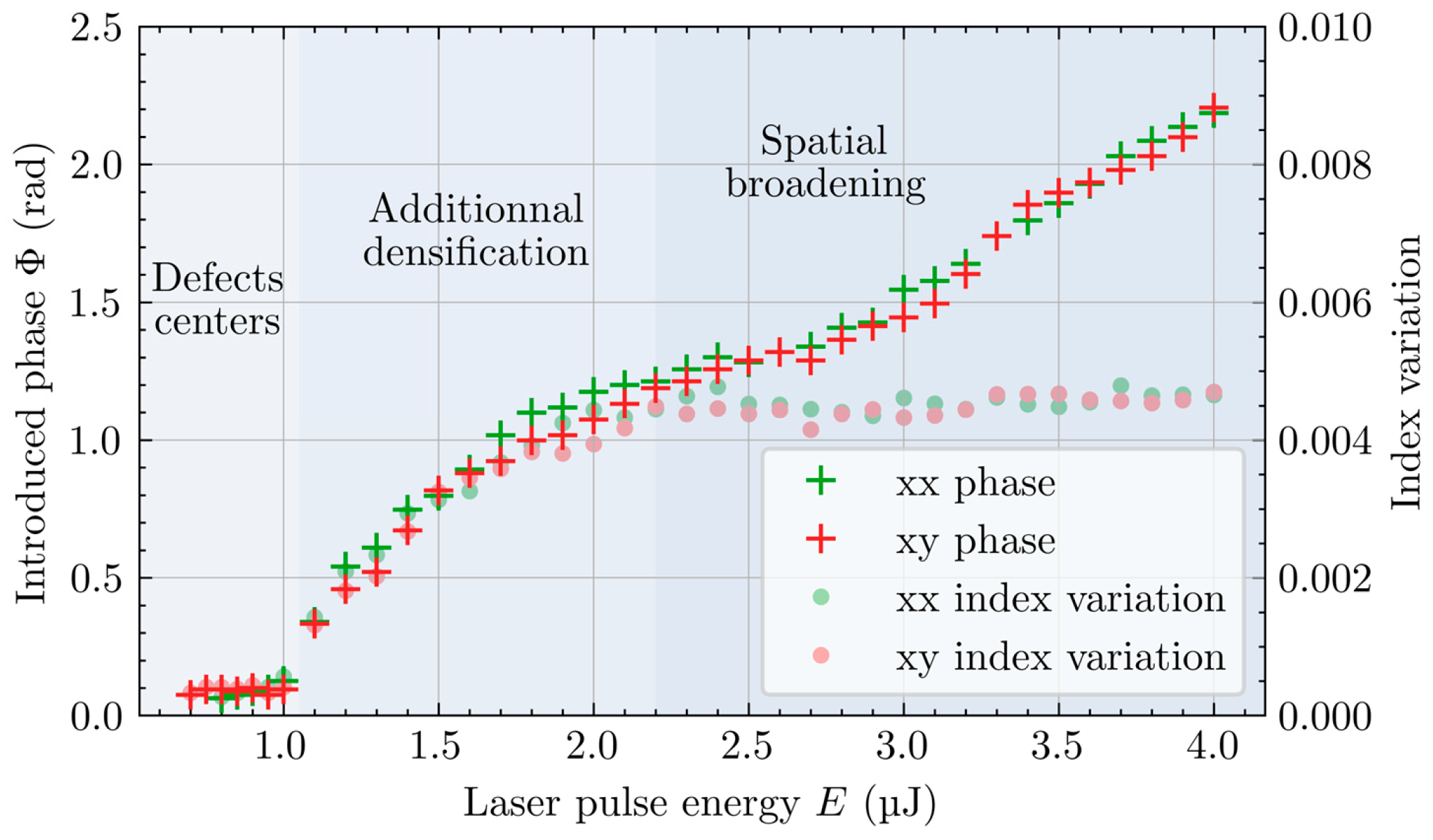
Figure 3 compiles, on a single dual-axis graph, the maximum phase shift measured at 550 nm (left axis, in radians) together with the corresponding refractive index change (right axis) as functions of pulse energy (Ep), for two orthogonal writing geometries (Xx and Xy). The refractive index change is obtained from the measured phase and the effective thickness of the modified layer, which has been deliberately fixed to 20 µm by the writing geometry itself. This direct mapping justifies plotting and on dual y-axes of the same Ep-axis. At 100 kHz and v = 1 mm s−1 (i.e., 100 pulses µm−1), the curves display a clear onset near Ep , followed by a monotonic rise that remains close to linear over the accessible window. Based on the uncertainty, the two series (Xx, Xy) are overlapping across the whole range, indicating weak anisotropy consistent with Type I modifications. At the upper end (around Ep –), the data reach phase shifts of order 2–2.3 rad and index changes approaching 10−2 at 550 nm, which delineates a comfortable writing window for low-loss integrated elements. The choice of 100 kHz deliberately secures a non-accumulating or a moderate thermal regime while preserving a sufficiently high scan speed, providing an exploitable phase–index response and limiting lateral broadening.
Figure 3.
Phase and refractive index change vs. pulse energy (writing parameters: 1030 nm, NA = 0.16, linear polarization, v = 1 mm s−1, f = 100 kHz, pulse duration of 800 fs). Left y-axis: maximum phase shift at 550 nm; right y-axis: refractive index changes at 550 nm. Colors are for Xx (green) and Xy (red) writing geometries.
Both series show a threshold near Ep and a quasi-linear increase in the phase change up to – while exhibits a trend to saturation above 2 mJ, resulting in values up to . This trend to saturation likely delineates a change in regime towards a regime mostly dominated by thermal effects, where the laser track length increases (thus the phase shift) while is saturated, because it mostly originates from a local densification dictated or at least assisted by the heat pulse quenching rate, rather than a solely electronically driven local densification [39,40,41].
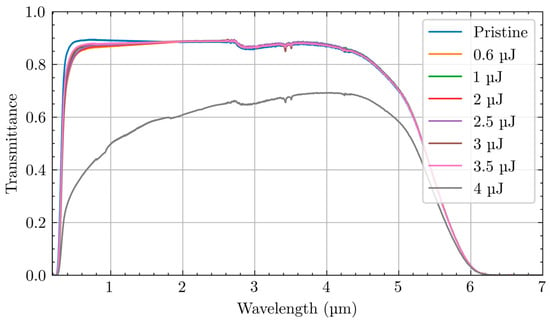
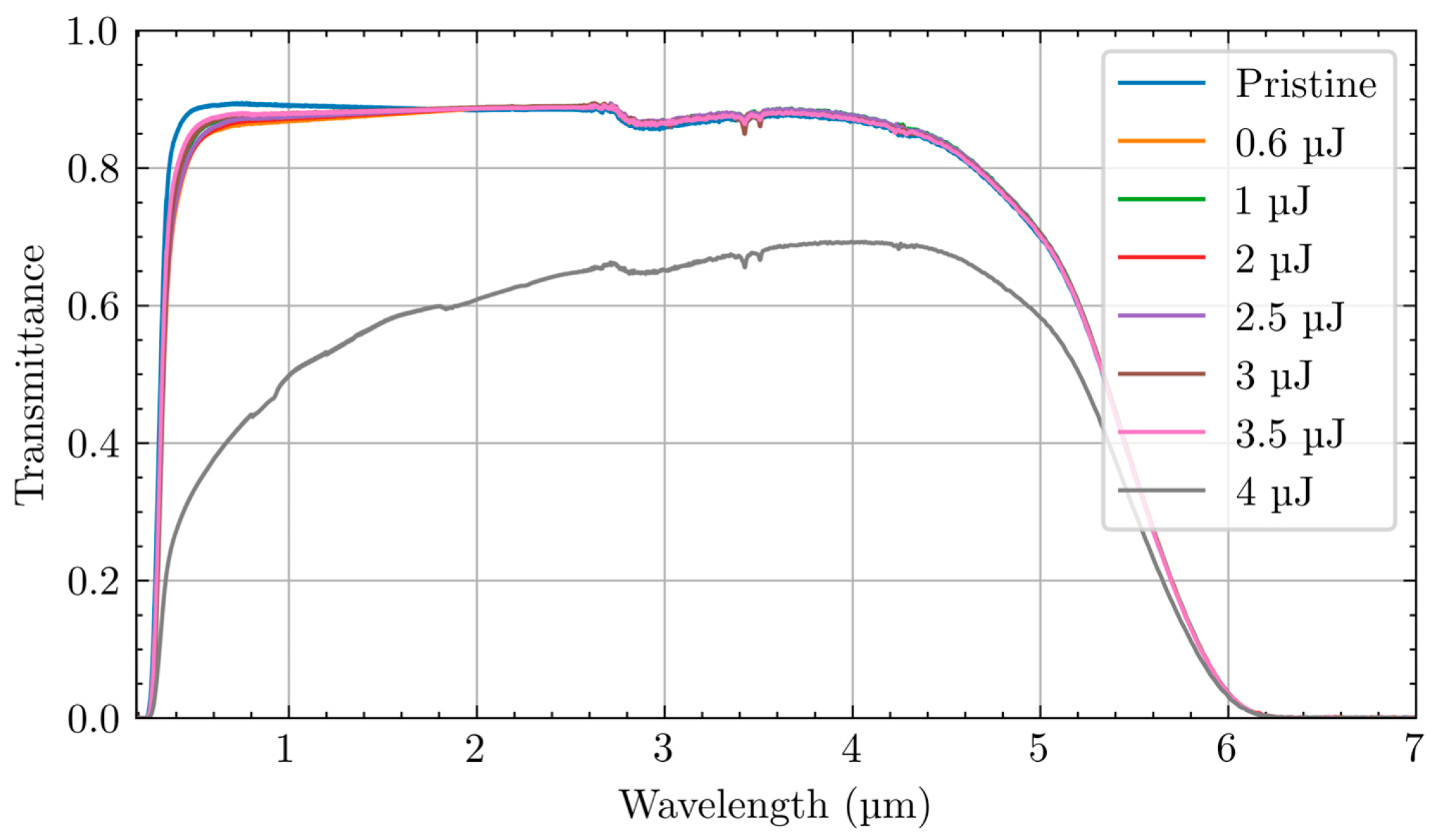
Figure 4 reports the spectral transmittance of the glass before inscription (“pristine” sample) and after laser writing at pulse energies from 0.6 to 4 µJ (v = 1 mm s−1, f = 100 kHz). Across the 0.7–6 µm range, the pristine spectrum forms the reference plateau (≈high transmittance) with a shallow vibrational dip near ~2.7 µm due to the OH vibrational band [42] and a long-wavelength cut-off approaching ~6 µm, attributable to the intrinsic vibrational edge [18]. For writing energies ≤ 3.5 µJ, the post-inscription spectra remain nearly indistinguishable from the pristine response over most of the band: no new narrow features emerge, and the residual loss stays within a few percent, consistent with compact Type I modifications produced in a non-accumulating regime at 100 kHz. In contrast, at 4 µJ, the spectrum exhibits a broadband reduction in transmittance from the visible–NIR through the mid-IR, indicative of increased scattering/absorption linked to the onset of spatial broadening (larger modified volume, micro-defects, bubbles), which places this setting beyond the low-loss window used for integrated components. The presence of micro-defects/voids (bubbles) at 4 µJ was identified by bright-field optical microscopy on polished cross-sections (Olympus BX60), where these features appear as high-contrast scattering/void inclusions within the modified volume.
Figure 4.
Broadband transmittance before and after inscription (1030 nm, NA = 0.16, linear polarization, v = 1 mm s−1, f = 100 kHz, pulse duration of 800 fs). Spectra of pristine glass and tracks written at Ep = 0.6, 1, 2, 2.5, 3, 3.5, and 4 µJ. For , transmission is essentially unchanged relative to pristine (no emergent narrow bands), consistent with low-loss Type I modifications. At 4 µJ, a broadband decrease in transmittance appears, consistent with the spatial-broadening regime together with the formation of bubbles and an increased scattering/absorption; this condition is therefore excluded for low-loss device writing.
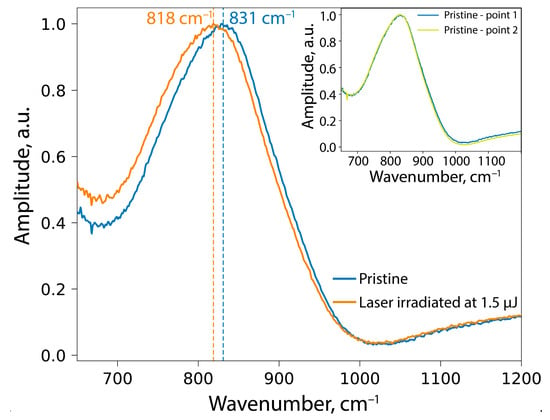
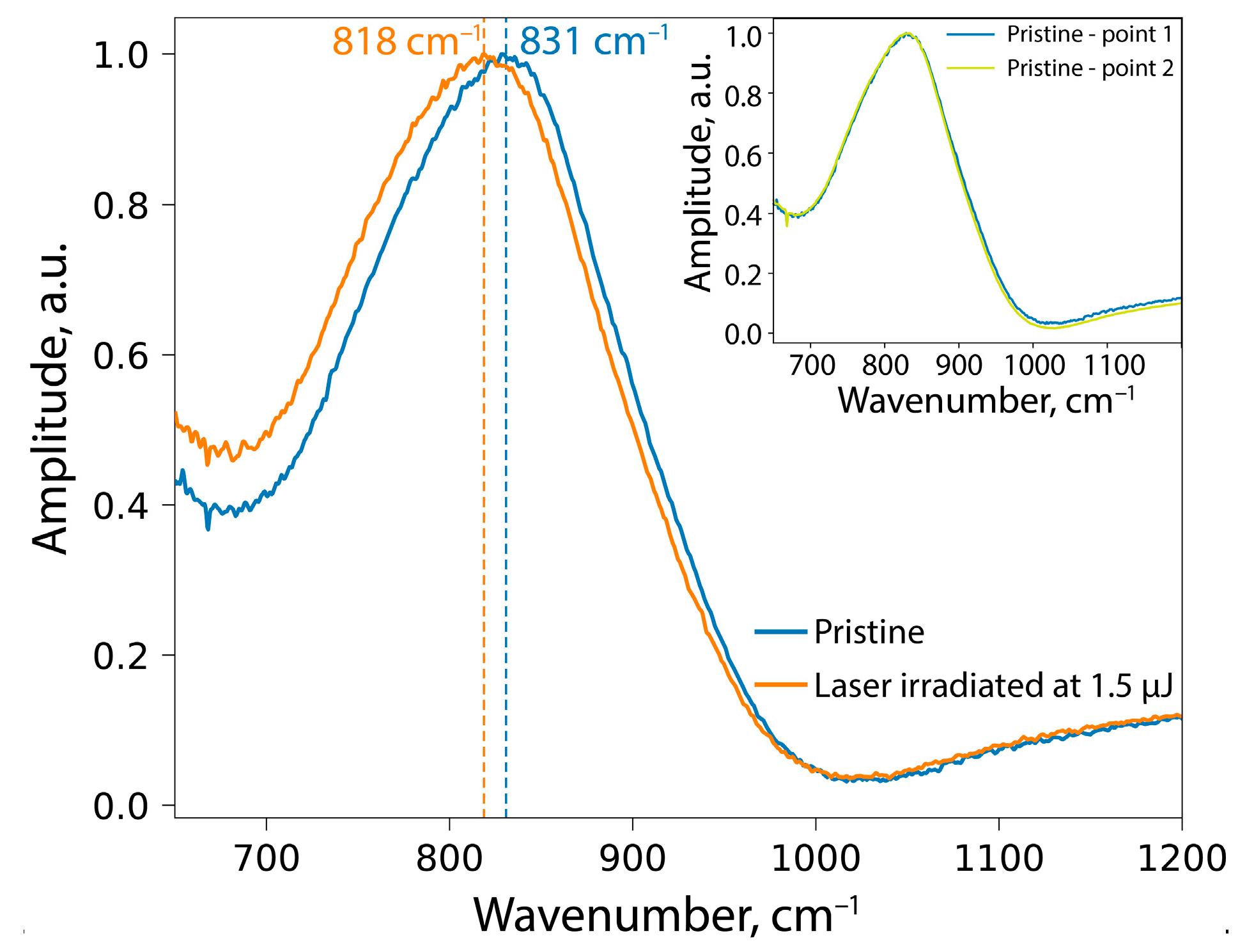
FTIR spectra recorded under fixed femtosecond laser conditions (1030 nm, NA = 0.16, pulse duration of 800 fs, linear polarization, 1 mm s−1, 100 kHz) show that the broad mid-IR band centered near 820–830 cm−1 in the pristine glass shifts to lower wavenumbers upon irradiation (e.g., from 830.9 to 818.8 cm−1 at Ep = 1.5 µJ), while keeping a similar line shape (Figure 5). This absorption is the characteristic signature of the germanate network and is commonly assigned to vibrations of bridging/non-bridging oxygens in Ge–O–Ge linkages (Q3 GeO4 units) with a minor contribution of mixed Ge–O–Al linkages in the same spectral range. In heavy-metal–oxide germanate systems, a band around 800–830 cm−1 is well documented and attributed to Q3 units and NBO-related modes, with its precise wavenumber sensitive to network modifier content and network depolymerization [43,44,45,46]. The observed redshift therefore indicates a laser-induced structural rearrangement consistent with local densification (positive Δn), since densification in oxide networks is known to drive low-frequency shifts of network vibrational bands [47,48,49,50]. Notably, the onset of a resolvable shift appears at Eₚ ≳ 1 μJ, matching the threshold where the refractive index curve begins its significant rise (see Figure 3). The inset in Figure 5 shows spectra collected at several positions in the pristine material, confirming that no intrinsic shift occurs in the absence of laser exposure. Altogether, the correlated band shift and Δn > 0 support a picture in which femtosecond laser exposure increases network connectivity/packing (more constrained Ge–O–T environments), while no additional absorption lines emerge within the low-loss writing window, including the mid-IR range.
Figure 5.
FTIR response before and after femtosecond inscription (1030 nm, NA = 0.16, linear polarization, mm , kHz, pulse duration of 800 fs; representative J). The inset shows spectra measured at two positions in the pristine glass, demonstrating the absence of intrinsic spectral shifts. Spectra show a shift of the broad band near 800–830 cm−1, commonly assigned to Ge–O–Ge stretching, with possible contributions from Ge–O–Al bridges in aluminogermanate networks.
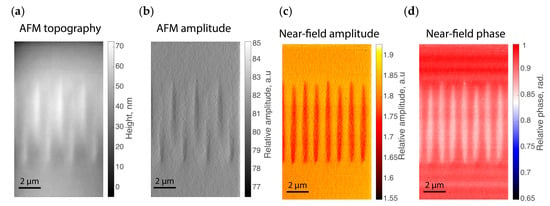
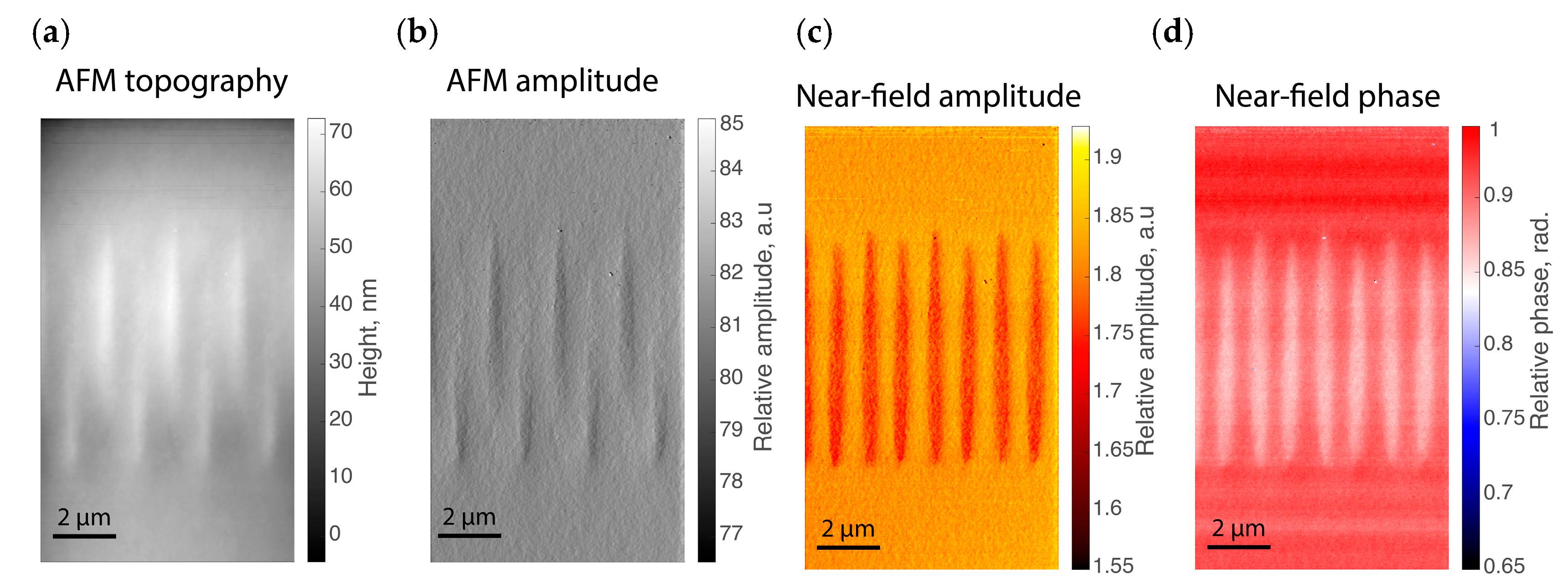
Figure 6 assembles four nanoscale maps acquired by scattering-type SNOM (s-SNOM) at 925 cm−1, namely AFM topography (Figure 6a), AFM amplitude (Figure 6b), near-field amplitude (Figure 6c), and near-field phase (Figure 6d). The AFM measurements reveal only mild, slowly varying surface corrugation, whereas the near-field amplitude/phase maps exhibit strong, line-shaped contrast that is spatially coincident with the laser track, evidencing a modification of the local IR complex permittivity rather than a purely topographic mechanical signature. At a fixed probe wavenumber, i.e., 925 cm−1, lying on the high-frequency shoulder of the Ge–O–(Ge/Al) stretching envelope, the densification-induced redshifts of the vibrational band translate into a decrease in near-field amplitude and near-field phase in the written zone. This is similar to recent results reported in s-SNOM/nano-FTIR studies on femtosecond-modified SiO2 glass, used to map densified regions at the 10 nm scale [33,51]. Under our Type I writing conditions (f = 100 kHz, mm s−1, Ep = 1.5 µJ), this contrast corroborates the positive Δn (see Figure 3) and the FTIR band shifts observed at the micron scale (see Figure 4), now resolved at the nanoscale along the laser tracks. Indeed, the written lines appear darker in the amplitude of the near-field reflectance and display a lower near-field phase, consistent with a redshifted vibrational resonance centered initially at 930 cm−1, which can be attributed to a densified network.
Figure 6.
s-SNOM nano-imaging at 925 cm−1 (1030 nm, NA = 0.16, 800 fs, linear polarization, mm s−1, f = 100 kHz, Ep = 1.5µJ). (a) AFM topography; (b) AFM amplitude; (c) near-field amplitude and (d) near-field phase at 925 cm−1. The near-field IR maps show strong contrast, i.e., reduced amplitude and phase contrast consistent with a permanent glass densification.
Regarding stability, the Type I tracks reported here are supported by spectroscopic signatures consistent with a densified network (FTIR redshifts and s-SNOM nano-IR contrast), indicating a structural origin rather than transient defect-related absorption. In addition, the reference writing condition (100 kHz) was deliberately chosen in (or close to) a non-accumulating thermal regime, thereby limiting pulse-to-pulse heat build-up and associated relaxation pathways. A broader discussion of the thermal stability of laser-imprinted refractive index changes in mid-IR glasses can be found in Refs. [25,26]. In future work, we will quantify long-term temporal drift and thermal endurance using accelerated aging up to temperatures approaching the glass transition.
4. Conclusions
We have studied a practical and robust route to Type I femtosecond laser direct writing in a commercial aluminogermanate glass (Corning 9754) tailored for mid-IR flat/integrated optics. Processing maps identify the operating domains and motivate a wide processing window in a non-accumulating regime at 1030 nm, 0.2–20 mm s−1, 100 kHz, where compact tracks deliver a monotonic, controllable Δn while preserving the host’s broadband transmission. Independent spectroscopies link the macroscopic index increase to a network redshift: FTIR reveals a shift of the Ge–O–(Ge/Al) stretching envelope emerging near the Δn onset, and s-SNOM at 925 cm−1 resolves the laser tracks as an elevated near-field amplitude/reduced phase, i.e., a nanoscale signature of densification-driven complex permittivity change. Together, the combination of laser and materials used here, i.e., a heavy-oxide glass with good environmental durability and fs-inscription at 100 kHz, offers a favorable compromise between index tunability, high fabrication speed, and mid-IR transparency, supporting rapid prototyping of 3D phase elements by a single, mask-less step.
Future work will leverage this stable low-loss window to fabricate and benchmark high-density 2D/3D phase-element arrays (GRIN and Fresnel/flat optics, phase masks) and to quantify device-level metrics such as insertion loss, wavefront quality, and mid-IR damage threshold. In addition, combining the present processing maps with nano-IR diagnostics opens a route to correlate writing parameters with nanoscale structural metrics (densification amplitude, homogeneity, and stress distribution), enabling predictive optimization for application-specific mid-IR photonic components.
Author Contributions
Conceptualization, M.L., G.D., and P.M.; methodology, M.L., G.D., F.D.L.B., P.M., and N.S.; formal analysis, P.M. and N.S.; investigation, P.M. and N.S.; resources, M.L. and G.D.; data curation, P.M. and N.S.; writing—original draft preparation, M.L., P.M., and N.S.; writing—review and editing, M.L., G.D., F.D.L.B., P.M., and N.S.; supervision, M.L., G.D., and F.D.L.B.; project administration, M.L. and G.D.; funding acquisition, M.L. and G.D. All authors have read and agreed to the published version of the manuscript.
Funding
This work was supported by the Agence de l’Innovation de Défense (AID) for Paul Mathieu’s PhD, by the French Ministry of Higher Education and Research (MESR) for Nadezhda Shchedrina’s PhD, and by ANR OPTOPHAB (ANR-24-CE51-4059-01). This work has been supported as part of the France 2030 program with the reference ANR-11-IDEX-0003.
Data Availability Statement
Data are available upon reasonable request.
Acknowledgments
We acknowledge the support of the SMIS beamline at Synchrotron Soleil.
Conflicts of Interest
The authors declare no conflicts of interest.
References
- Forbes, A. Structured light: Tailored for purpose. Opt. Photonics News 2020, 31, 24–31. [Google Scholar] [CrossRef] [Scilit]
- Khonina, S.N.; Kazanskiy, N.L.; Butt, M.A. Exploring Diffractive Optical Elements and Their Potential in Free Space Optics and imaging—A Comprehensive Review. Laser Photonics Rev. 2024, 18, 2400377. [Google Scholar] [CrossRef] [Scilit]
- Arbabi, A.; Horie, Y.; Bagheri, M.; Faraon, A. Dielectric metasurfaces for complete control of phase and polarization with subwavelength spatial resolution and high transmission. Nat. Nanotechnol. 2015, 10, 937–943. [Google Scholar] [CrossRef] [Scilit]
- Yu, N.; Capasso, F. Flat optics with designer metasurfaces. Nat. Mater. 2014, 13, 139–150. [Google Scholar] [CrossRef] [Scilit]
- Pancharatnam, S. Generalized theory of interference, and its applications: Part I. Coherent pencils. Proc. Indian Acad. Sci. 1956, 44, 247–262. [Google Scholar] [CrossRef] [Scilit]
- Shimotsuma, Y.; Sakakura, M.; Kazansky, P.G.; Beresna, M.; Qiu, J.; Miura, K.; Hirao, K. Ultrafast Manipulation of Self-Assembled Form Birefringence in Glass. Adv. Mater. 2010, 22, 4039–4043. [Google Scholar] [CrossRef] [Scilit]
- Bricchi, E.; Klappauf, B.G.; Kazansky, P.G. Form birefringence and negative index change created by femtosecond direct writing in transparent materials. Opt. Lett. 2004, 29, 119–121. [Google Scholar] [CrossRef] [Scilit] [PubMed]
- Stoian, R. Volume photoinscription of glasses: Three-dimensional micro-and nanostructuring with ultrashort laser pulses. Appl. Phys. A 2020, 126, 438. [Google Scholar] [CrossRef] [Scilit]
- Chambonneau, M.; Grojo, D.; Tokel, O.; Ilday, F.Ö.; Tzortzakis, S.; Nolte, S. In-volume laser direct writing of silicon—Challenges and opportunities. Laser Photonics Rev. 2021, 15, 2100140. [Google Scholar] [CrossRef] [Scilit]
- Yao, H.; Pugliese, D.; Lancry, M.; Dai, Y. Ultrafast laser direct writing nanogratings and their engineering in transparent materials. Laser Photonics Rev. 2024, 18, 2300891. [Google Scholar] [CrossRef] [Scilit]
- Lei, Y.; Wang, H.; Shayeganrad, G.; Kazansky, P.G. Ultrafast laser nanostructuring in transparent materials for beam shaping and data storage. Opt. Mater. Express 2022, 12, 3327–3355. [Google Scholar] [CrossRef] [Scilit]
- Beresna, M.; Geceviçius, M.; Kazansky, P.G. Polarization sensitive elements fabricated by femtosecond laser nanostructuring of glass [Invited]. Opt. Mater. Express 2011, 1, 783–795. [Google Scholar] [CrossRef] [Scilit]
- Drevinskas, R.; Beresna, M.; Zhang, J.; Kazanskii, A.G.; Kazansky, P.G. Ultrafast laser-induced metasurfaces for geometric phase manipulation. Adv. Opt. Mater. 2017, 5, 1600575. [Google Scholar] [CrossRef] [Scilit]
- Sakakura, M.; Lei, Y.; Wang, L.; Yu, Y.-H.; Kazansky, P.G. Ultralow-loss geometric phase and polarization shaping by ultrafast laser writing in silica glass. Light Sci. Appl. 2020, 9, 15. [Google Scholar] [CrossRef] [Scilit]
- Jisha, C.P.; Nolte, S.; Alberucci, A. Geometric phase in optics: From wavefront manipulation to waveguiding. Laser Photonics Rev. 2021, 15, 2100003. [Google Scholar] [CrossRef] [Scilit]
- Le Phu, T.; Ledesma Molinero, M.; Boussard-Plédel, C.; Le Coq, D.; Masselin, P. Femtosecond Laser Fabrication of Gradient Index Micro-Optics in Chalcogenide Glass. Photonics 2024, 11, 1076. [Google Scholar] [CrossRef] [Scilit]
- Li, J.; Cao, C.; Qiu, Y.; Kuang, C.; Liu, X. Optical waveguides fabricated via femtosecond direct laser writing: Processes, materials, and devices. Adv. Mater. Technol. 2023, 8, 2300620. [Google Scholar] [CrossRef] [Scilit]
- Dumbaugh, W.H. Infrared transmitting germanate glasses. In Proceedings of the Emerging Optical Materials; SPIE: Bellingham, WA, USA, 1982; pp. 80–85. [Google Scholar]
- Bayya, S.S.; Harbison, B.B.; Sanghera, J.S.; Aggarwal, I.D. BaO Ga2O3 GeO2 glasses with enhanced properties. J. Non-Cryst. Solids 1997, 212, 198–207. [Google Scholar] [CrossRef] [Scilit]
- Skopak, T.; Calzavara, F.; Ledemi, Y.; Célarié, F.; Allix, M.; Véron, E.; Dussauze, M.; Cardinal, T.; Fargin, E.; Messaddeq, Y. Properties, structure and crystallization study of germano-gallate glasses in the Ga2O3-GeO2-BaO-K2O system. J. Non-Cryst. Solids 2019, 514, 98–107. [Google Scholar] [CrossRef] [Scilit]
- Adam, J.-L.; Zhang, X. Chalcogenide Glasses: Preparation, Properties and Applications; Woodhead Publishing: Cambridge, UK, 2014. [Google Scholar]
- Arriola, A.; Gross, S.; Ams, M.; Gretzinger, T.; Le Coq, D.; Wang, R.; Ebendorff-Heidepriem, H.; Sanghera, J.; Bayya, S.; Shaw, L. Mid-infrared astrophotonics: Study of ultrafast laser induced index change in compatible materials. Opt. Mater. Express 2017, 7, 698–711. [Google Scholar] [CrossRef] [Scilit]
- Le Phu, T.; Le Coq, D.; Masselin, P. Waveguide fabrication with integrated coupling optic. Opt. Laser Technol. 2025, 180, 111522. [Google Scholar] [CrossRef] [Scilit]
- Efimov, O.; Glebov, L.; Richardson, K.; Van Stryland, E.; Cardinal, T.; Park, S.; Couzi, M.; Bruneel, J. Waveguide writing in chalcogenide glasses by a train of femtosecond laser pulses. Opt. Mater. 2001, 17, 379–386. [Google Scholar] [CrossRef] [Scilit]
- Ari, J.; Heng, Y.; Cavillon, M.; Bernier, M.; Dussauze, M.; Lancry, M. Overview of laser imprinted refractive index changes and related thermal stability in mid-infrared optical glasses. Opt. Mater. 2025, 163, 116985. [Google Scholar] [CrossRef] [Scilit]
- Alvarado, R.; Karam, L.; Dahmani, R.; Lepicard, A.; Calzavara, F.; Piarristeguy, A.; Pradel, A.; Cardinal, T.; Adamietz, F.; Fargin, E. Patterning of the surface electrical potential on chalcogenide glasses by a thermoelectrical imprinting process. J. Phys. Chem. C 2020, 124, 23150–23157. [Google Scholar] [CrossRef] [Scilit]
- Harris, D.C. Comparative Sand and Rain Erosion Studies of Spinel, Aluminum Oxynitride (ALON), Magnesium Fluoride, and Germanate Glass. Environmental Science, Materials Science. 1993. Corpus ID: 137299320. Available online: https://apps.dtic.mil/sti/tr/pdf/ADB175668.pdf (accessed on 10 February 2026).
- Yao, H.; Zaiter, R.; Cavillon, M.; Delullier, P.; Lu, B.; Cardinal, T.; Dai, Y.; Poumellec, B.; Lancry, M. Formation of nanogratings driven by ultrafast laser irradiation in mid-IR heavy oxide glasses. Ceram. Int. 2022, 48, 31363–31369. [Google Scholar] [CrossRef] [Scilit]
- Yao, H.; Zaiter, R.; Cavillon, M.; Sapaly, B.; Calzavara, F.; Delullier, P.; Cardinal, T.; Dai, Y.; Poumellec, B.; Lancry, M. Photosensitivity of barium germano-gallate glasses under femtosecond laser direct writing for Mid-IR applications. Ceram. Int. 2021, 47, 34235–34241. [Google Scholar] [CrossRef] [Scilit]
- Yao, H.; Xie, Q.; Cavillon, M.; Dai, Y.; Lancry, M. Materials roadmap for inscription of nanogratings inside transparent dielectrics using ultrafast lasers. Prog. Mater. Sci. 2023, 142, 101226. [Google Scholar] [CrossRef] [Scilit]
- Abou Khalil, A.; Gebremichael, W.; Petit, Y.; Canioni, L. Refractive index change measurement by quantitative microscopy phase imaging for femtosecond laser written structures. Opt. Commun. 2021, 485, 126731. [Google Scholar] [CrossRef] [Scilit]
- Ocelic, N.; Huber, A.; Hillenbrand, R. Pseudoheterodyne detection for background-free near-field spectroscopy. Appl. Phys. Lett. 2006, 89, 101124. [Google Scholar] [CrossRef] [Scilit]
- Shchedrina, N.; Nemeth, G.; Borondics, F.; Ollier, N.; Lancry, M. Nano-FTIR spectroscopy reveals SiO2 densification within fs-laser induced nanogratings. Nanoscale Adv. 2024, 6, 5164–5170. [Google Scholar] [CrossRef] [Scilit]
- Poumellec, B.; Que, R. Thermal Limitations in Ultrafast Laser Direct Writings in Dielectric Solids. Micromachines 2025, 16, 970. [Google Scholar] [CrossRef] [Scilit]
- Eaton, S.; Zhang, H.; Herman, P.; Yoshino, F.; Shah, L.; Bovatsek, J.; Arai, A. Heat accumulation effects in femtosecond laser-written waveguides with variable repetition rate. Opt. Express 2005, 13, 4708–4716. [Google Scholar] [CrossRef] [Scilit]
- Tan, D.; Zhang, B.; Qiu, J. Ultrafast laser direct writing in glass: Thermal accumulation engineering and applications. Laser Photonics Rev. 2021, 15, 2000455. [Google Scholar] [CrossRef] [Scilit]
- Eaton, S.M.; Herman, P.R. Passive photonic devices in glass. In Femtosecond Laser Micromachining: Photonic and Microfluidic Devices in Transparent Materials; Springer: Berlin/Heidelberg, Germany, 2011; pp. 155–195. [Google Scholar]
- Delullier, P.; Calvez, L.; Druart, G.; De La Barrière, F.; Humbert, C.; Poumellec, B.; Lancry, M. Photosensitivity of Infrared Glasses under Femtosecond Laser Direct Writing for mid-IR Applications. Appl. Sci. 2022, 12, 8813. [Google Scholar] [CrossRef] [Scilit]
- Lancry, M.; Poumellec, B.; Chahid-Erraji, A.; Beresna, M.; Kazansky, P. Dependence of the femtosecond laser refractive index change thresholds on the chemical composition of doped-silica glasses. Opt. Mater. Express 2011, 1, 711–723. [Google Scholar] [CrossRef] [Scilit]
- Stoian, R.; Bhuyan, M.K.; Rudenko, A.; Colombier, J.-P.; Cheng, G. High-resolution material structuring using ultrafast laser non-diffractive beams. Adv. Phys. X 2019, 4, 1659180. [Google Scholar] [CrossRef] [Scilit]
- Stoian, R.; Mishchik, K.; Cheng, G.; Mauclair, C.; D’Amico, C.; Colombier, J.-P.; Zamfirescu, M. Investigation and control of ultrafast laser-induced isotropic and anisotropic nanoscale-modulated index patterns in bulk fused silica. Opt. Mater. Express 2013, 3, 1755–1768. [Google Scholar] [CrossRef] [Scilit]
- Plotnichenko, V.G.; Sokolov, V.O.; Dianov, E.M. Hydroxyl groups in germanosilicate glass. J. Non-Cryst. Solids 2000, 278, 85–98. [Google Scholar] [CrossRef] [Scilit]
- Kamitsos, E.; Yiannopoulos, Y.; Karakassides, M.; Chryssikos, G.D.; Jain, H. Raman and Infrared Structural Investigation of xRb2O·(1 − x)GeO2 Glasses. J. Phys. Chem. 1996, 100, 11755–11765. [Google Scholar] [CrossRef] [Scilit]
- Koroleva, O.N.; Shtenberg, M.V.; Ivanova, T.N. The structure of potassium germanate glasses as revealed by Raman and IR spectroscopy. J. Non-Cryst. Solids 2019, 510, 143–150. [Google Scholar] [CrossRef] [Scilit]
- Riebling, E. Infra-red study of polymerisation in silver, thallium, and thallium aluminogermanate glasses. J. Mater. Sci. 1972, 7, 40–46. [Google Scholar] [CrossRef] [Scilit]
- Culea, E.; Pop, L.; Bosca, M.; Rusu, T.; Pascuta, P.; Rada, S. FTIR spectroscopic study of some lead germanate glasses. J. Phys. Conf. Ser. 2009, 182, 012061. [Google Scholar] [CrossRef] [Scilit]
- Tan, C.; Arndt, J.; Xie, H. Optical properties of densified silica glasses. Phys. B Condens. Matter 1998, 252, 28–33. [Google Scholar] [CrossRef] [Scilit]
- Lancry, M.; Régnier, E.; Poumellec, B. Fictive temperature in silica-based glasses and its application to optical fiber manufacturing. Prog. Mater. Sci. 2012, 57, 63–94. [Google Scholar] [CrossRef] [Scilit]
- Agarwal, A.; Tomozawa, M. Correlation of silica glass properties with the infrared spectra. J. Non-Cryst. Solids 1997, 209, 166–174. [Google Scholar] [CrossRef] [Scilit]
- Galeener, F.L. Band limits and the vibrational spectra of tetrahedral glasses. Phys. Rev. B 1979, 19, 4292. [Google Scholar] [CrossRef] [Scilit]
- Shchedrina, N.; Sosa, M.; Cavillon, M.; Lancry, M. Properties, mechanisms, and perspectives of ultrafast laser modifications in silicate glass volume. Int. J. Appl. Glass Sci. 2026, 17, e16706. [Google Scholar] [CrossRef] [Scilit]
Disclaimer/Publisher’s Note: The statements, opinions and data contained in all publications are solely those of the individual author(s) and contributor(s) and not of MDPI and/or the editor(s). MDPI and/or the editor(s) disclaim responsibility for any injury to people or property resulting from any ideas, methods, instructions or products referred to in the content. |
© 2026 by the authors. Licensee MDPI, Basel, Switzerland. This article is an open access article distributed under the terms and conditions of the Creative Commons Attribution (CC BY) license.