


Abstract
Quantum entanglement lies at the heart of numerous quantum technologies, yet macroscopic entanglement remains a long-standing challenge to achieve. Here, we theoretically investigate stationary entanglement between a Laguerre–Gaussian (LG) cavity mode and a macroscopic rotating mirror in a double LG cavity optomechanical system with a non-degenerate optical parametric amplifier (NOPA). The two LG cavity modes interact with each other via a NOPA, and one of them is coupled with a rotating mirror through radiation torque. We employ logarithmic negativity to quantify optomechanical entanglement. We analyze the effects of the gain and phase of the NOPA, the pump powers of the two LG cavity modes, the topological charge and cavity detuning of the LG cavity mode coupled with the rotating mirror, and the environmental temperature affect optomechanical entanglement. We find that the presence of the NOPA can significantly enhance optomechanical entanglement and make it more robust against thermal noise. Our results provide a feasible approach for generating robust macroscopic optomechanical entanglement, which may find applications in quantum sensing and quantum networks.
1. Introduction
In recent years, cavity optomechanical systems have served as promising platforms for observing quantum effects at the macroscopic scale [1], as mechanical oscillators can be cooled to states with mean phonon numbers below unity [2,3,4,5]. In such systems, cavity modes couple with mechanical modes via radiation pressure owing to the exchange of photon linear momentum. Optomechanical coupling can induce entanglement between a cavity mode and a mechanical mode [6,7,8], entanglement between two macroscopic mechanical oscillators [9,10,11], and entanglement between two propagating optical modes [12]. It has been pointed out that mechanical entanglement in an optomechanical system with two cavity modes can be realized using a correlated-emission laser [13] and three-level cascade atoms [14]. Being an essential resource for quantum technologies [15], optomechanically generated entanglement is highly vulnerable to thermal noise [1]. For this reason, a variety of schemes have been proposed to enhance the degree of such entanglement. For example, optomechanical entanglement can be enhanced by cross-Kerr nonlinearity [16].
Beyond linear momentum, light may also possess angular momentum. Its spin angular momentum corresponds to optical polarization. In addition, optical beams can also carry detectable orbital angular momentum equivalent to each photon, where l is the topological charge and an integer number, and ℏ is Planck’s constant h divided by [17]. Among vortex beams with well-defined orbital angular momentum, Laguerre–Gaussian (LG) modes are the most widely studied. LG beams exhibit helical phase profiles and feature phase singularity accompanied by vanishing light intensity at the beam center [18]. They can be generated via several approaches, including spiral-phase elements [18], spatial light modulators [19], and computer-generated holograms [20]. It is noted that the topological charge of LG beams is adjustable by modifying the step height and refractive index of spiral-phase elements [18]. In recent years, LG cavity optomechanical systems proposed by Bhattacharya et al. have attracted considerable attention [21,22]. In these systems, LG laser beams interact with spiral phase elements used as macroscopic rotating mirrors owing to the transfer of photon orbital angular momentum. Previous studies have demonstrated the cooling of a rotating mirror to near its quantum ground state [21]. Accordingly, diverse quantum phenomena are observable within such systems. Bhattacharya et al. showed that radiation torque can entangle an LG cavity mode with a rotating mirror [22]. Chen et al. showed that two rotating mirrors can be entangled since they are coupled with a common LG cavity mode via radiation torque [23]. Wang et al. showed that two rotating mirrors can be entangled in a double LG cavity optomechanical system via a two-level atomic ensemble [24]. Chabar et al. showed that two rotating mirrors can be entangled in a double LG cavity optomechanical system with the help of a YIG sphere [25]. Cheng et al. studied tripartite entanglement of an LG cavity mode, a magnon mode, and a phonon mode [26]. Hidki et al. studied bipartite entanglement and quantum coherence in an LG cavity optomechanical system with two magnon modes [27]. Meanwhile, it has been found that directly coupled modes have stronger entanglement in an LG optomechanical cavity coupled to an auxiliary cavity containing a YIG sphere [28]. In addition, the entanglement between an LG cavity mode and a rotating mirror can be enhanced by injecting two-level atoms [29].
Optical parametric amplifiers have emerged as powerful tools for enhancing quantum correlations in optomechanical systems. A degenerate optical parametric amplifier (DOPA) based on type-I nonlinear crystals produces a single-mode squeezed state [30], while a non-degenerate optical parametric amplifier (NOPA) based on type-II nonlinear crystals generates entangled states of the optical field [31] and enables entanglement swapping [32]. The signal and idler fields produced by the DOPA have equal frequencies, while the signal and idler fields produced by the NOPA have different frequencies. It has been shown that the DOPA can improve the cooling of a movable mirror coupled with a cavity mode via radiation pressure [33], entanglement between two cavity modes coupled to a common movable mirror via radiation pressure [34], and entanglement between photons and phonons in the cavity magnomechanical system [35]. Moreover, it has been found that the NOPA can enhance entanglement between a micro-mechanical mirror and a cavity field, which are coupled via radiation pressure inside a bimodal cavity system [36]. In addition, it has been shown that the NOPA can generate two-mode mechanical squeezing in a doubly resonant cavity coupled with two mechanical oscillators through radiation pressure [37]. Additionally, it has been reported that strong Einstein–Podolsky–Rosen steering and Bell nonlocality between two macroscopic mechanical oscillators can be achieved using NOPA and measurement-based feedback [38].
In this paper, we investigate stationary entanglement between an LG cavity mode and a rotating mirror within a double LG cavity optomechanical system containing a NOPA. The two LG cavity modes are coupled with each other via a NOPA, and one of them interacts with a rotating mirror. We find that optomechanical entanglement depends on the gain and phase of the NOPA, the pump powers of the two LG cavity modes, the topological charge and the cavity detuning of the LG cavity mode coupled to the rotating mirror, and the temperature of the environment. By choosing the appropriate phase of the NOPA, we find that increasing the gain of the NOPA can substantially enhance optomechanical entanglement and make it more robust against environmental thermal noise.
The article is organized as follows. In Section 2, we introduce the theoretical model, present the Hamiltonian of the whole system, derive the quantum Langevin equations, and calculate the steady-state amplitudes of the system operators. In Section 3, we linearize the quantum Langevin equations and use logarithmic negativity as a measure of entanglement between the mechanical mode and one of the LG cavity modes in the steady state. In Section 4, we discuss how the steady-state optomechanical entanglement can be enhanced by the NOPA. In Section 5, we compare our results with those in ref. [36]. In Section 6, we summarize our results.
2. Model
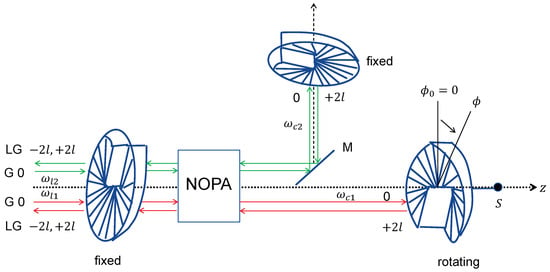
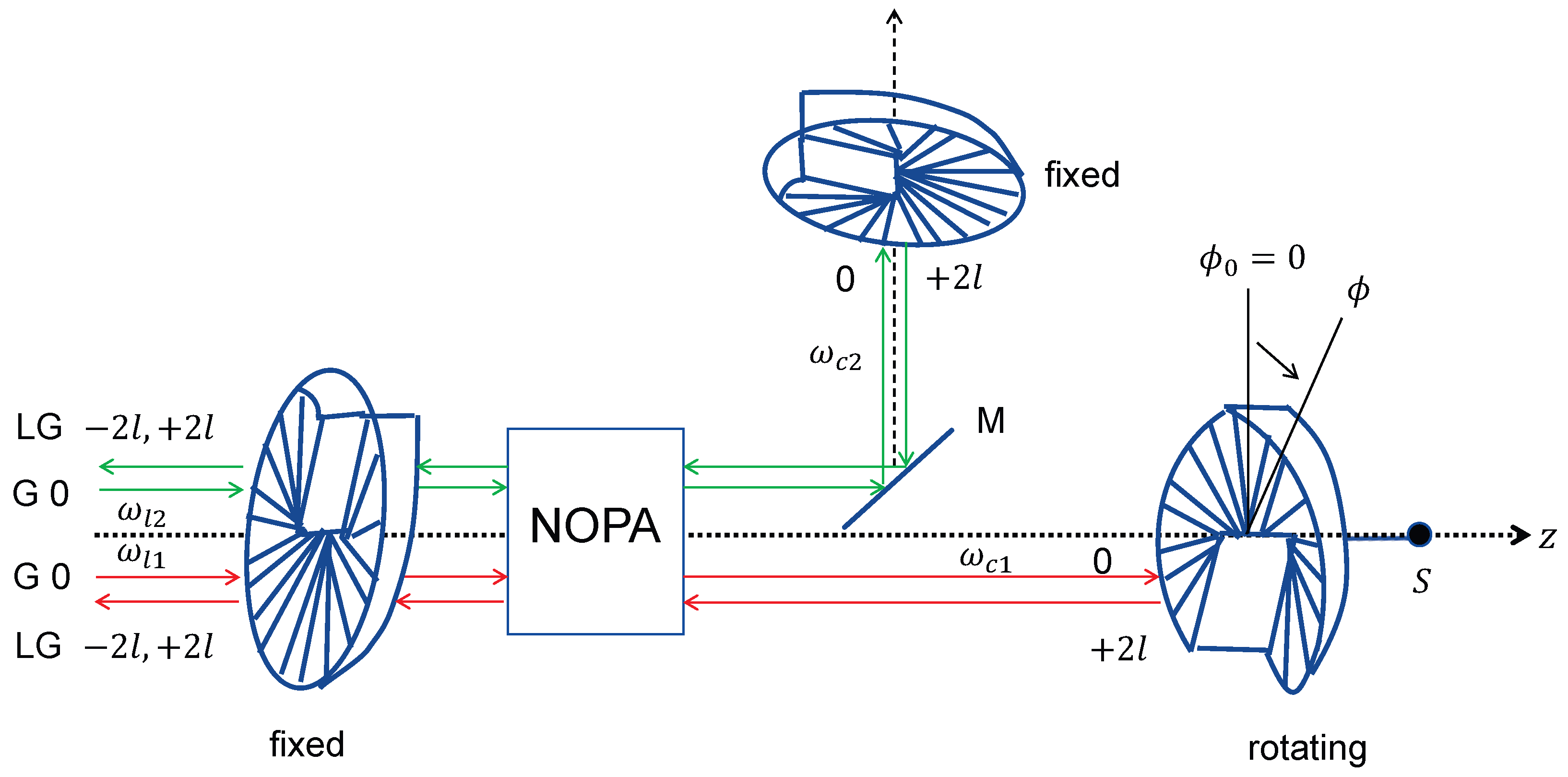
We consider a double LG cavity optomechanical system containing a non-degenerate optical parametric amplifier (NOPA), as shown in Figure 1. In this system, there are two LG optical cavities. One is formed by the left fixed spiral-phase mirror and the rotating spiral-phase mirror, and the other is formed by two fixed spiral-phase mirrors along with a fully reflective mirror. The rotating mirror is mounted on a support S and is free to rotate about the cavity z-axis. We assume that the two cavities have the same length L. The left stationary spiral-phase mirror allows a small fraction of the incident light to be transmitted, and the other two spiral-phase mirrors are totally reflective. The spiral-phase mirrors are designed to endow the incident light with a fixed topological charge [21]. Two zero-charge Gaussian beams at frequencies and illuminate the left fixed mirror. For each incoming Gaussian beam, the reflected beam’s topological charge decreases by compared with the incident beam, and the transmitted beam retains the incident topological charge. When a laser beam with topological charge 0 interacts with the rotating mirror or the other fixed spiral-phase mirror, the reflected beam’s topological charge increases by relative to the incident beam. We assume that the two LG cavity modes at frequencies and are driven by incident laser beams at frequencies and , respectively. When each intracavity photon at frequency interacts with the rotating mirror, the exchange of angular momentum between them is . The round-trip travel time for the intracavity photons at frequency is provided by , where c represents the speed of light in vacuum. Thus, the radiation torque imposed on the rotating mirror by a single intracavity photon with frequency is provided by , where denotes the coupling parameter between a single intracavity photon at frequency and the rotating mirror. Driven by the radiation torque, the rotating mirror undergoes small torsional vibrations about the cavity axis z, and its motion is governed by the conjugate variables: the angular displacement and the angular momentum , which satisfy the commutation relation . The rotating mirror is modeled as a damped harmonic oscillator with frequency and damping rate .
Figure 1.
Sketch of a double LG cavity optomechanical system with a NOPA. The system contains two LG optical cavities: one is formed by one fixed spiral-phase mirror and one rotating spiral-phase mirror, and the other is formed by two fixed spiral-phase mirrors along with a fully reflective mirror (M). The rotating mirror is mounted on a support S and is free to rotate about the cavity z-axis. Two Gaussian beams (G) with frequencies and are injected into the optical cavities via the left stationary mirror to generate two LG cavity modes with frequencies and , respectively. The topological charges carried by the different laser beams are shown, where l denotes the topological charge value. The angle represents the angular displacement of the rotating mirror relative to its equilibrium position . The NOPA is driven by a pump field (not shown) and interacts with two LG cavity modes.
In the rotating frame at the driving frequencies and , the Hamiltonian of the system is shown by
where and are the annihilation and creation operators of LG cavity modes with frequencies that obey the commutation relation ; are the detunings of the LG cavity modes with respect to the corresponding external driving fields with frequencies ; is the single-photon optomechanical coupling strength between the LG cavity mode and the rotating mirror; is the moment of inertia of the rotating mirror with mass m and radius R about the cavity axis z; G is the nonlinear gain of the NOPA; is the phase of the pump field driving the NOPA; are the amplitudes of the incident Gaussian beams, depending on their powers by , with being the decay rates of the LG cavity modes . In Equation (1), the first two terms are the free energies of the two LG cavity modes, the third term is the free energy of the rotating mirror, the fourth term represents the optomechanical interaction between the LG cavity mode and the rotating mirror, the fifth term describes the interaction between the two cavity modes induced by the NOPA, and the last two terms account for the coherent driving of the two LG cavity modes.
To explore nonlinear behaviors in the system, we use the Heisenberg equations of motion, add the damping and noise terms, and obtain the time evolution of the LG cavity modes and the mechanical mode:
where and are the input optical vacuum noise operators and have zero mean values, and is the quantum Brownian thermal noise operator of the rotating mirror originating from its coupling to the thermal environment at temperature T and has zero mean value. The time correlation functions for the input vacuum noises are provided by
The time correlation function for the Brownian thermal noise is shown by
where is the Boltzmann constant. In the high mechanical quality factor limit (), the Brownian thermal noise can be approximated to be Markovian [39], and it has the -correlated function
where is the mean thermal excitation number at the mechanical frequency .
The steady-state mean values of the system operators are obtained by setting the time derivatives equal to zero in Equation (2), which read
Here, is the effective detuning of the LG cavity mode , in which the term originates from the frequency shift caused by the radiation torque. It is seen that the steady-state amplitudes and of the LG cavity modes and depend on the gain G and of the NOPA, respectively. and are the steady-state angular displacement and angular momentum of the rotating mirror, respectively. Note that the steady-state angular displacement of the rotating mirror is proportional to the photon number of the LG cavity mode .
3. Quantum Fluctuations
The generation of entanglement between the LG cavity mode and the rotating mirror in our system requires sufficiently strong optomechanical coupling. To this end, we employ two strong driving lasers to excite the LG cavity modes and , respectively, such that both LG cavity modes have large amplitudes and at the steady state. This allows us to linearize the system dynamics around the large steady-state mean values by discarding small second-order fluctuation terms. We therefore write the system operators as , , , and . Substituting these decompositions into Equation (2) and keeping only the first-order terms in the fluctuations, we obtain the linearized quantum Langevin equations (QLEs) for the quantum fluctuations of the system:
where is the effective optomechanical coupling strength between the LG cavity mode and the rotating mirror.
For convenience, we define the quadrature fluctuations of the two LG cavity modes as , , and . The corresponding input noise quadratures are defined as and , . Using these definitions, the linearized QLEs can be rewritten in matrix form:
where is the vector of quadrature fluctuations, , is the vector of input noises, and the drift matrix M is provided by
where and . The stability of the system is governed by the eigenvalues of the drift matrix M. The system is stable if all eigenvalues have negative real parts. We use the Routh–Hurwitz stability criterion [40] to derive the stability conditions of the system (see Appendix A). The parameters for numerical simulations must satisfy these stability conditions.
Since the input noises are zero-mean Gaussian and the QLEs are linearized, the steady state of the system is a three-mode Gaussian state, which is fully characterized by a covariance matrix V. The elements of the matrix V are defined as (). The steady-state covariance matrix V can be obtained by solving the Lyapunov equation:
Here, D is the diffusion matrix, which can be calculated from the noise correlation functions through . Using the noise correlation functions in Equations (3) and (5), the diffusion matrix D is found to be .
We adopt the logarithmic negativity [41,42] to quantify the bipartite entanglement between the LG cavity mode and the mechanical mode. The logarithmic negativity is provided by
where , and det is the determinant of the matrix . The matrix consists of the elements of V associated with the LG cavity mode and the mechanical mode, and it can be written in the block form:
where is the covariance matrix of the LG cavity mode , is the covariance matrix of the mechanical mode, and is the cross-covariance matrix between the LG cavity mode and the mechanical mode.
When , the LG cavity mode and the mechanical mode are entangled. When , they are separable. The necessary and sufficient condition for the bipartite Gaussian state to be entangled is [41,42].
4. Numerical Results
In this section, we analyze the effects of the gain G and phase of the NOPA, the input laser powers and , the topological charge l of the LG cavity mode , the detuning of the LG cavity mode , and the environmental temperature T on the steady-state entanglement between the LG cavity mode and the rotating mirror.
The parameters adopted here are similar to those used in ref. [22]. The wavelengths of the two input Gaussian lasers are nm and nm, respectively. The two optical cavities have an identical length mm; the two LG cavity modes and have equal decay rates . The cavity detuning of the LG cavity mode is . The rotating mirror has mass ng, radius μm, resonance frequency MHz, and damping rate Hz. Since , the optomechanical interaction of the LG cavity mode with the rotating mirror operates in the resolved-sideband regime.
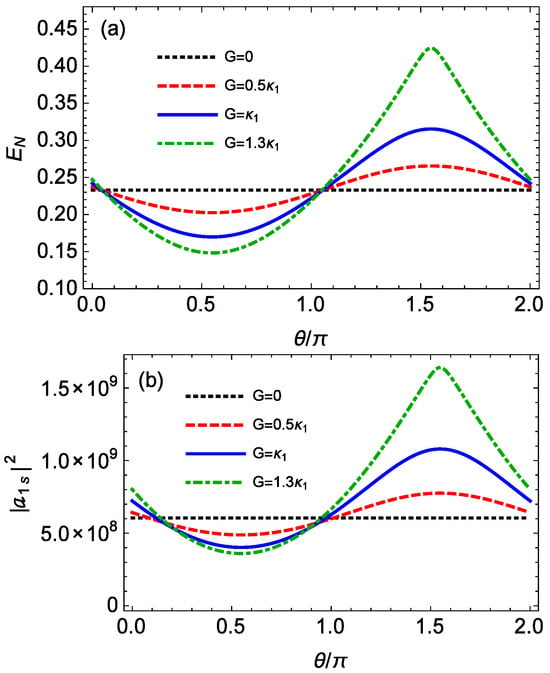
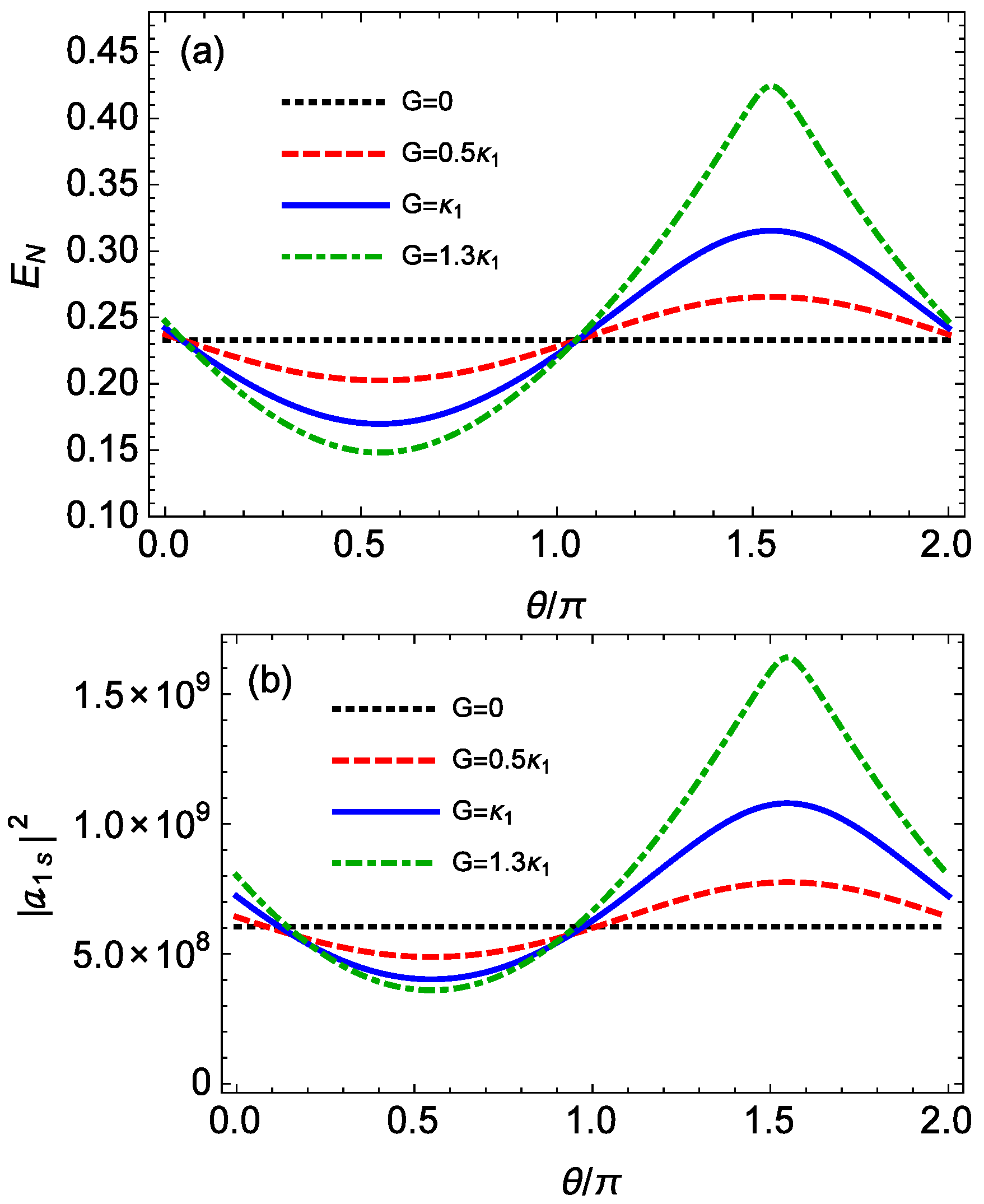
We first investigate how the gain G and phase of the NOPA affect steady-state optomechanical entanglement. Figure 2a,b shows the logarithmic negativity and the intracavity photon number as a function of the normalized phase of the NOPA for different gains G of the NOPA when mW, , , and K. For , 0.5, , and , the system is stable in the phase range . In Figure 2a, when the NOPA is absent (), is about 0.23. When the NOPA is present, for a fixed gain G of the NOPA, it is seen that changes periodically with the phase of the NOPA with a period of . When increasing the gain G of the NOPA, decreases in the phase range , but increases in the phase range . Logarithmic negativity takes the minimum value at , and takes the maximum value at . This is because the effective optomechanical coupling strength , the intracavity photon number reaches its minimum value at , and its maximum value at , as shown in Figure 2b. For , , and , the maximum value of is approximately 0.26, 0.32, and 0.42 at , respectively. Hence, for a suitable NOPA phase , increasing the NOPA gain G can enhance the optomechanical entanglement, and this enhancement reaches its maximum at .
Figure 2.
(a) The logarithmic negativity and (b) the intracavity photon number as a function of the normalized phase of the NOPA for different gains G of the NOPA. The black dotted, red dashed, blue solid, and green dot–dashed curves correspond to , , , and , respectively. Other parameters: mW, , , and K.
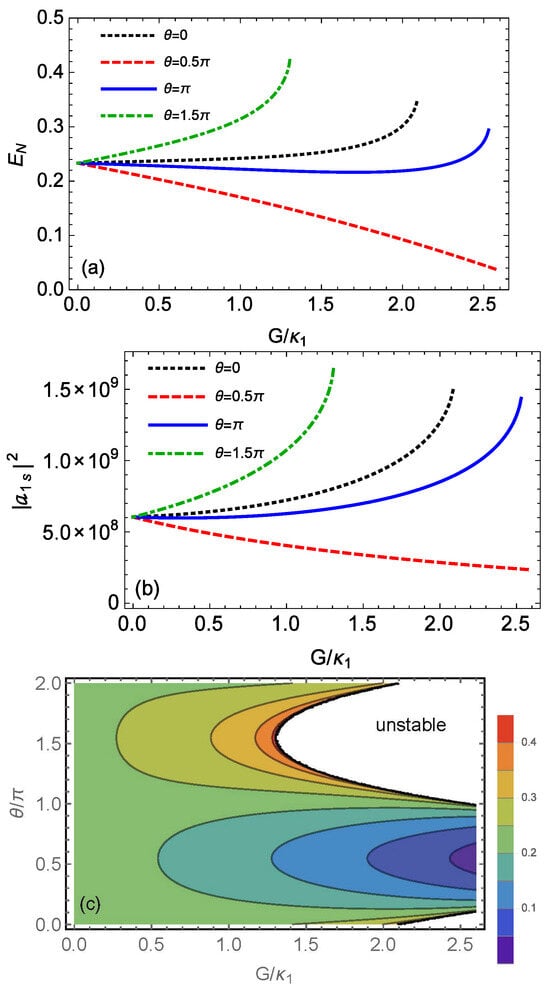
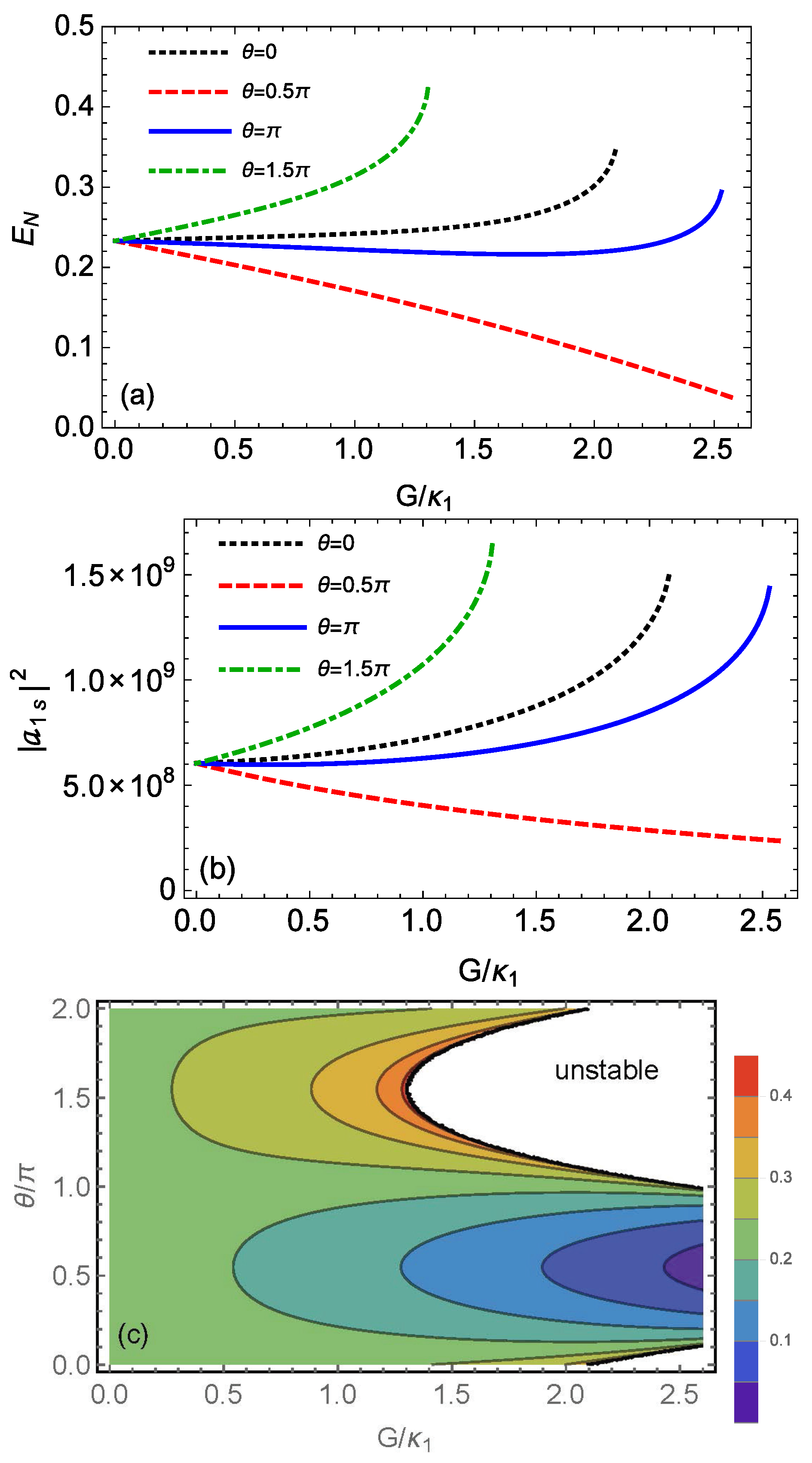
Figure 3a,b shows the logarithmic negativity and the intracavity photon number as a function of the normalized gain of the NOPA for different phases of the NOPA when mW, , , and K. Figure 3c shows the contour plot of the logarithmic negativity as functions of the normalized gain and the normalized phase of the NOPA when mW, , , and K. In Figure 3a, it is observed that the stable regimes corresponding to , , , and differ significantly. For , , and , the system is stable when G is not larger than , , and , respectively. But, for , the system remains stable throughout the entire gain range . Thus, the stable regime for is narrower compared to those for , , and , which can also be seen in Figure 3c. Moreover, for , , and , increases with the NOPA gain G. The reason is that increasing the NOPA gain G causes a larger effective optomechanical coupling strength between the LG cavity mode and the rotating mirror due to an increase in the intracavity photon number , as shown in Figure 3b. In Figure 3a, for , , and , reaches its maximum values of 0.35, 0.29, and 0.43 at , , and , respectively. The NOPA gain values G at which reaches its maximum lie close to the boundaries of the corresponding unstable regimes, which can also be seen in Figure 3c. For , increases more rapidly with the NOPA gain G than that for , which can also be seen in Figure 2; meanwhile, the growth rate for is higher than that for . This can be attributed to the similar evolving behaviors of the intracavity photon number versus the NOPA gain G across , , and 0, as shown in Figure 3b. Thus, increasing the gain G of the NOPA with phase can most effectively enhance the entanglement. For , the entanglement decreases with increasing the NOPA gain G. This originates from the reduction of intracavity photon number as the NOPA gain G increases, as shown in Figure 3b.
Figure 3.
(a) The logarithmic negativity and (b) the intracavity photon number as a function of the normalized gain of the NOPA for different phases of the NOPA. The black dotted, red dashed, blue solid, and green dot–dashed curves correspond to , , , and , respectively. (c) The contour plot of the logarithmic negativity as functions of the normalized gain and the normalized phase of the NOPA. The white regime is unstable. Other parameters: mW, , , and K.
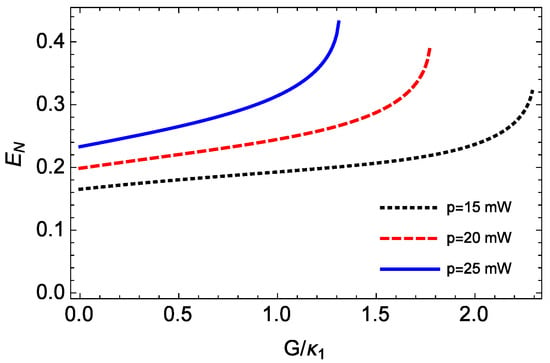
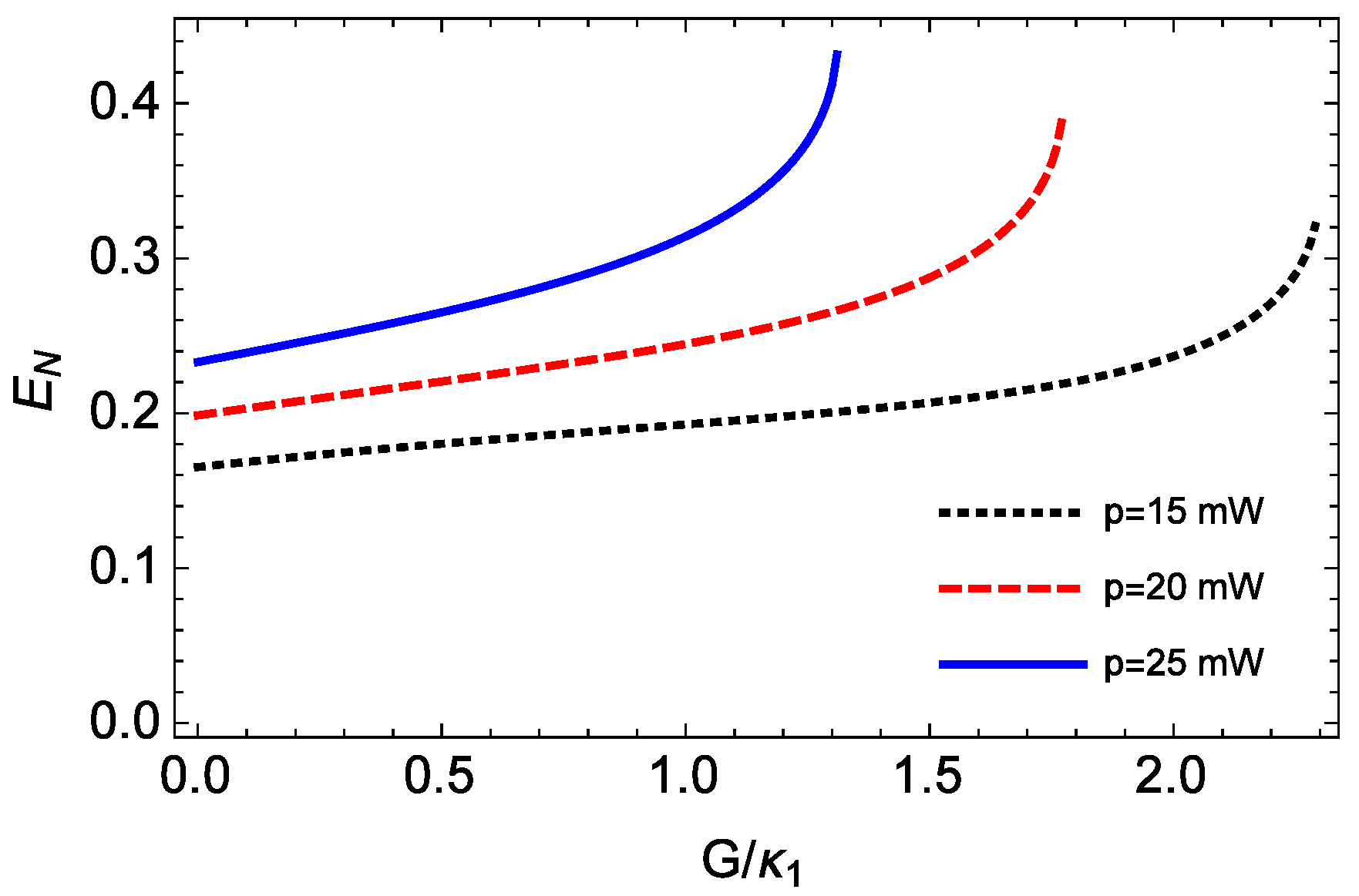
We study how the driving powers of the LG cavity modes and affect optomechanical entanglement. We assume identical driving powers for both LG cavity modes, i.e., . Figure 4 shows the logarithmic negativity as a function of the normalized NOPA gain for different input laser powers when , , , and K. Without the OPA (), for mW, 20 mW, and 25 mW, is about 0.16, 0.20, and 0.23, respectively. Thus, increasing the input laser power p increases the optomechanical entanglement. The reason is as follows: according to Equation (6), when , the intracavity photon number is proportional to the input laser power ; thus, a higher input laser power p leads to a larger intracavity photon number , which enhances the effective optomechanical coupling strength . In the presence of the NOPA, for mW, 20 mW, and 25 mW, the system is stable when the NOPA gain G is not larger than , , and , respectively. Thus, increasing the input laser power p leads to narrowing the stable regime. When the input laser power p is fixed, increases monotonically with increasing the gain G of the NOPA. takes the maximum value at a NOPA gain G close to the unstable regime. For mW, 20 mW, and 25 mW, reaches the maximum value of about 0.33, 0.39, and 0.43 at , , and , respectively. Therefore, as the input laser power p increases, the maximum optomechanical entanglement increases and occurs at a weaker gain G of the NOPA. In addition, for a fixed NOPA gain G in the stable regime, higher input laser power p improves the entanglement. This follows from the fact that, according to Equation (6), when and , the intracavity photon number scales linearly with the input laser power p, thus increasing p raises , which increases the effective optomechanical coupling strength .
Figure 4.
The logarithmic negativity as a function of the normalized gain of the NOPA for different input powers . The black dotted, red dashed, and blue solid curves correspond to mW, 20 mW, and 25 mW, respectively. Other parameters: , , , and K.
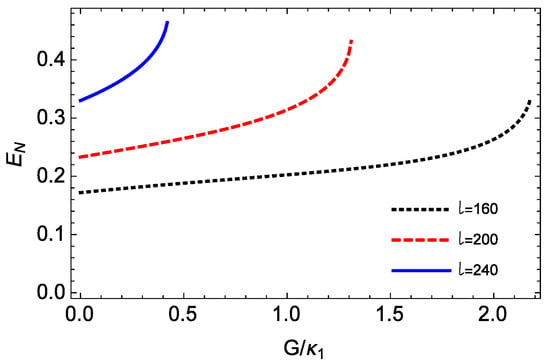
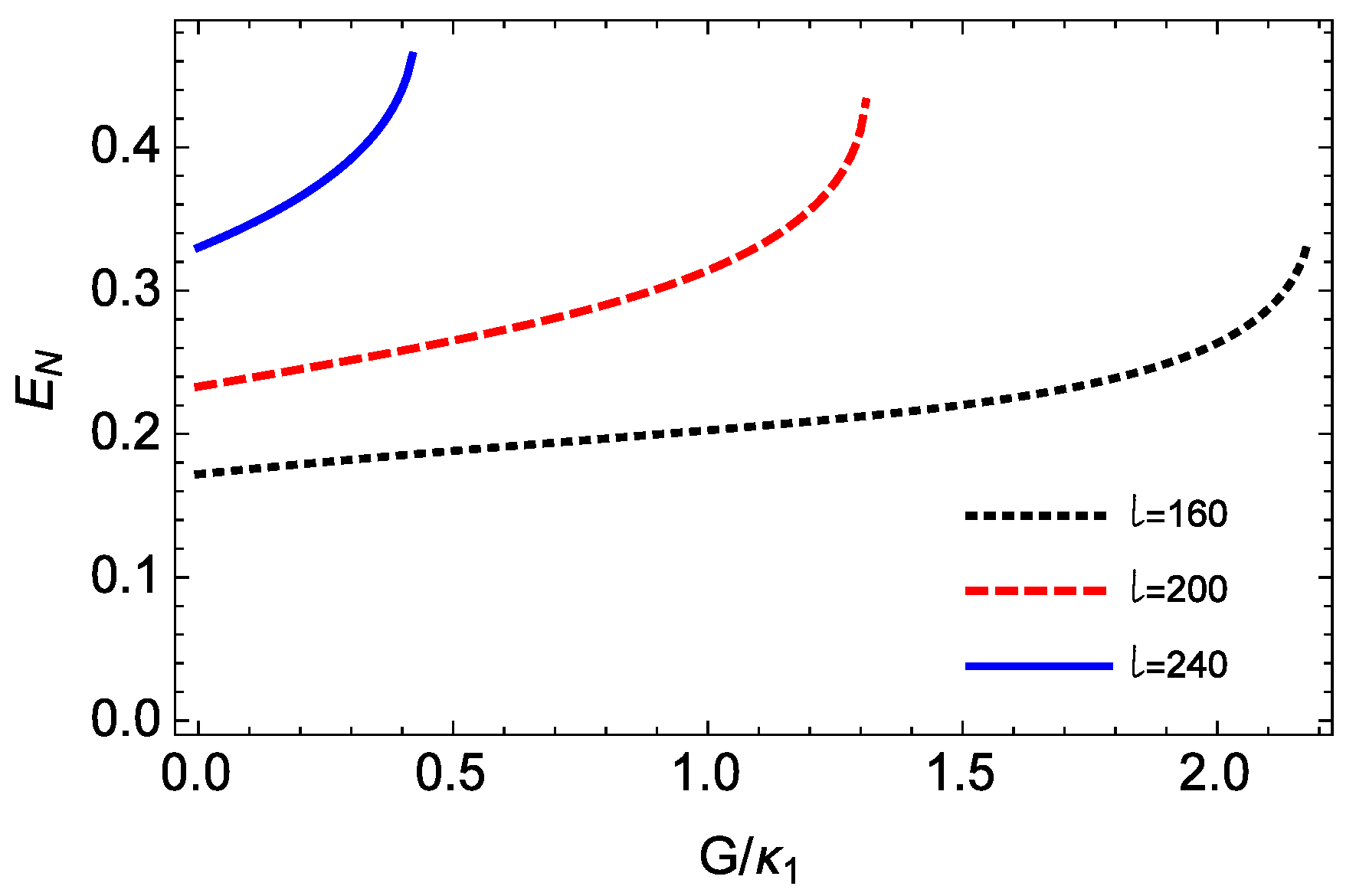
We show how the topological charge l of the LG cavity mode affects optomechanical entanglement. Figure 5 shows the logarithmic negativity as a function of the normalized NOPA gain for different topological charges l of the LG cavity mode when , mW, , and K. In the absence of the NOPA (), for , 200, and 240, is about 0.17, 0.23, and 0.33, respectively. Thus, optomechanical entanglement increases significantly with increasing topological charge l. This is because the optomechanical coupling strength g is proportional to topological charge l. A larger topological charge l yields a larger optomechanical coupling strength g. However, in the presence of the NOPA (), a larger topological charge l narrows the stable regime of the system. For , 200, and 240, the system is stable when the NOPA gain G is not larger than , , and , respectively. This indicates that when the topological charge l is larger, the system enters the unstable regime at a lower gain G. When the topological charge l is fixed, increases monotonically with increasing the gain G of the NOPA. The maximum value of occurs when the NOPA gain G approaches the unstable regime. For , 200, and 240, reaches the maximum value of about 0.34, 0.43, and 0.47 at , , and , respectively. Therefore, as the topological charge l of the LG cavity mode increases, the maximum optomechanical entanglement increases and occurs at a weaker gain G of the NOPA. Moreover, for a fixed NOPA gain G in the stable regime, increasing the topological charge l of the LG cavity mode gives rise to improved entanglement.
Figure 5.
The logarithmic negativity as a function of the normalized gain of the NOPA for different topological charges l of the LG cavity mode . The black dotted, red dashed, and blue solid curves correspond to , 200, and 240, respectively. Other parameters: , mW, , and K.
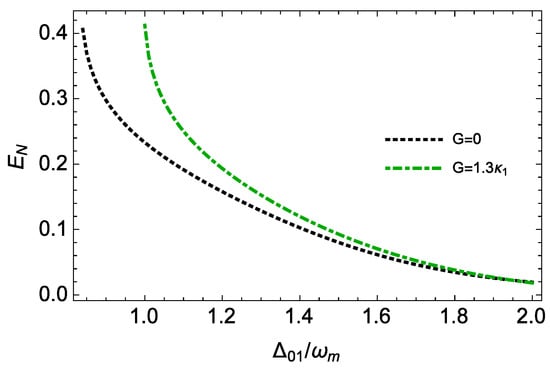
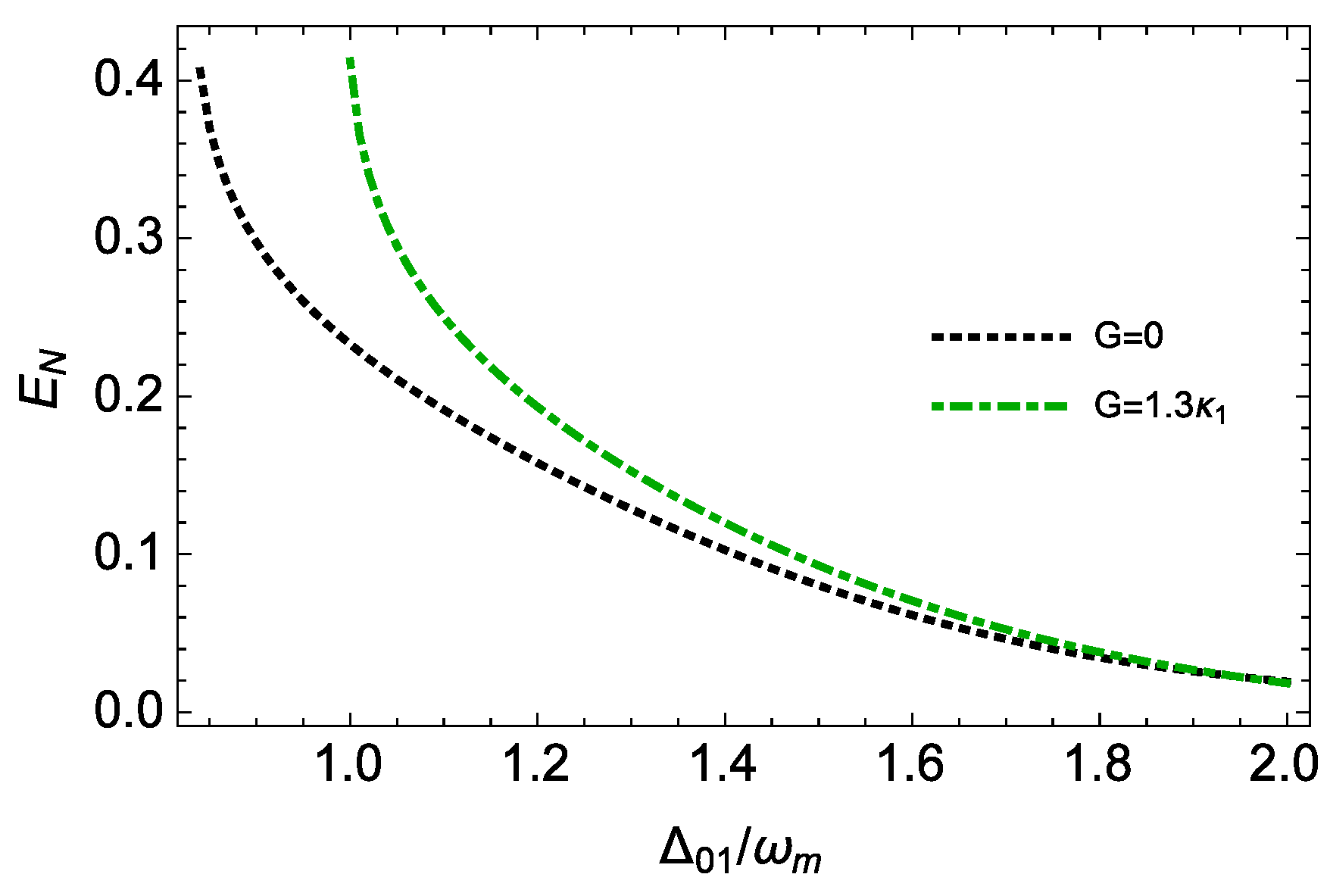
We show the effect of the detuning of the LG cavity mode on optomechanical entanglement. Figure 6 shows the logarithmic negativity as a function of normalized cavity detuning for different NOPA gains G when , mW, , , and K. For , , the system is stable when the detuning of the cavity mode satisfies , . It is seen that increasing the NOPA gain G makes the stable regime shift toward high cavity detuning . When the NOPA gain G is fixed, decays monotonically as the cavity detuning rises, with its maximum achieved at a value of the NOPA gain G close to the boundary of the unstable regime. For , , the maximum value of is about 0.41, 0.41 at , , respectively. Therefore, as the NOPA gain G increases, the maximum optomechanical entanglement occurs at larger cavity detuning . Moreover, when , the system is always stable for , , and increasing the NOPA gain G improves entanglement. This improvement in entanglement is most prominent at resonance and decreases monotonically with increasing . The underlying mechanism is that the optomechanical coupling between the LG cavity mode and the mechanical mirror reaches its maximum under the resonant condition . As deviates further from , optomechanical coupling gradually weakens.
Figure 6.
The logarithmic negativity as a function of the normalized detuning of the LG cavity mode for different gains G of the NOPA. The black dotted and green dotdashed curves correspond to , , respectively. Other parameters: , mW, , , and K.
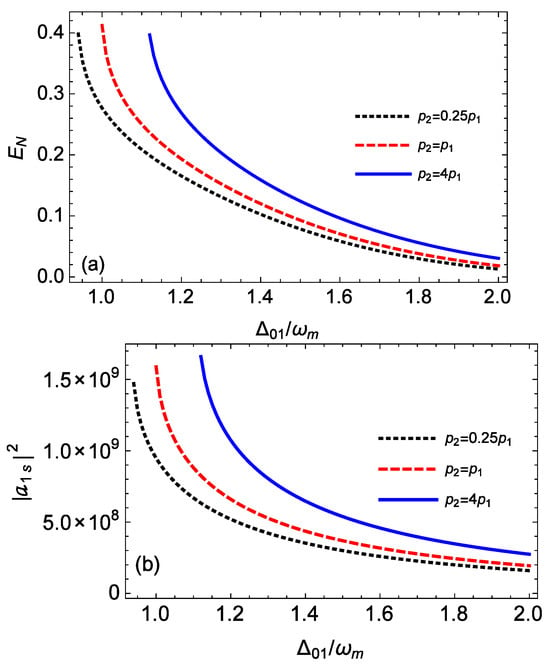
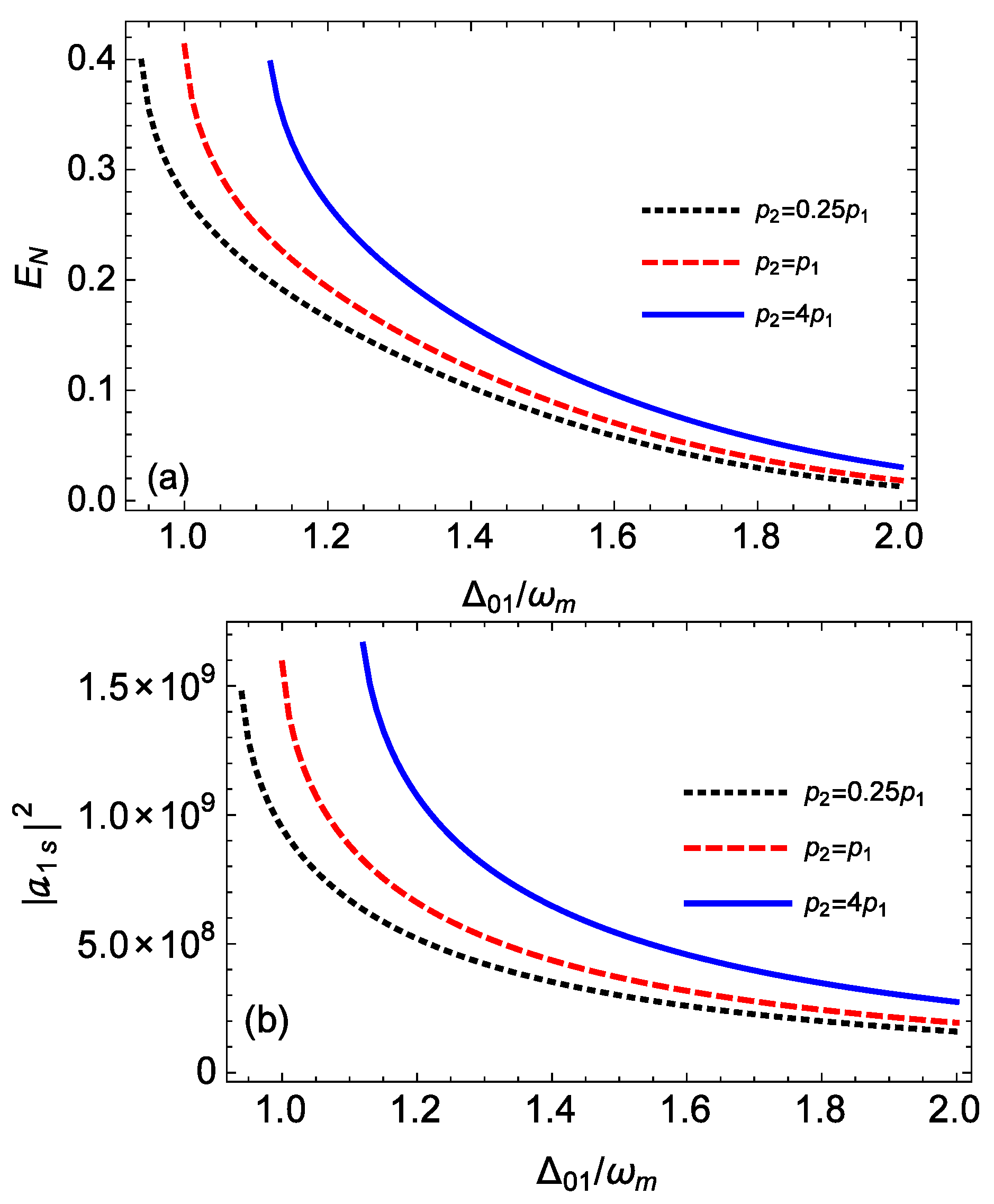
We show the effect of the driving power of the LG cavity mode on optomechanical entanglement. It is noted that the LG cavity mode does not directly interact with the rotating mirror. Figure 7a,b shows the logarithmic negativity and the intracavity photon number as a function of the normalized detuning of the LG cavity mode for different pump powers of the LG cavity mode when , , mW, , , and K. For , , and , the system is stable if cavity detuning is not less than , , and , respectively. Thus, increasing the input laser power shifts the stability regime toward larger cavity detuning . In Figure 7a, when the input laser power is fixed, decreases monotonically with increasing the cavity detuning , reaching its maximum near the edge of the unstable regime. For , , and , the maximum value of is about 0.40, 0.41, and 0.40 at , , and , respectively. Therefore, as the input laser power increases, maximum optomechanical entanglement occurs at a larger cavity detuning . For fixed cavity detuning in the stable regime, increasing the input laser power enhances entanglement. Physically, for fixed cavity detuning in the stable regime, higher pump power increases the intracavity photon number , as shown in Figure 7b, which yields a stronger coupling between the LG cavity mode and the rotating mirror. This entanglement enhancement is most pronounced at small cavity detuning and gradually diminishes as the cavity detuning increases.
Figure 7.
(a) The logarithmic negativity and (b) intracavity photon number as a function of the normalized detuning of the LG cavity mode for different pump powers of the LG cavity mode . The black dotted, red dashed, and blue solid curves correspond to , , and , respectively. Other parameters: , , mW, , , and K.
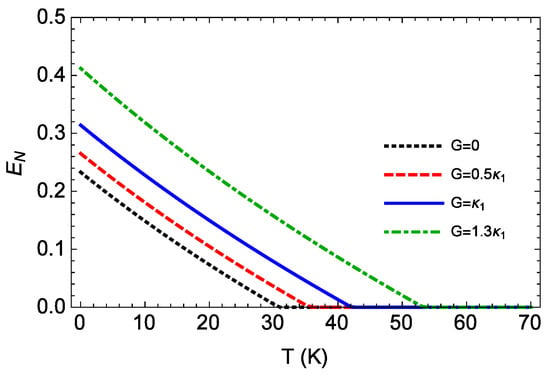
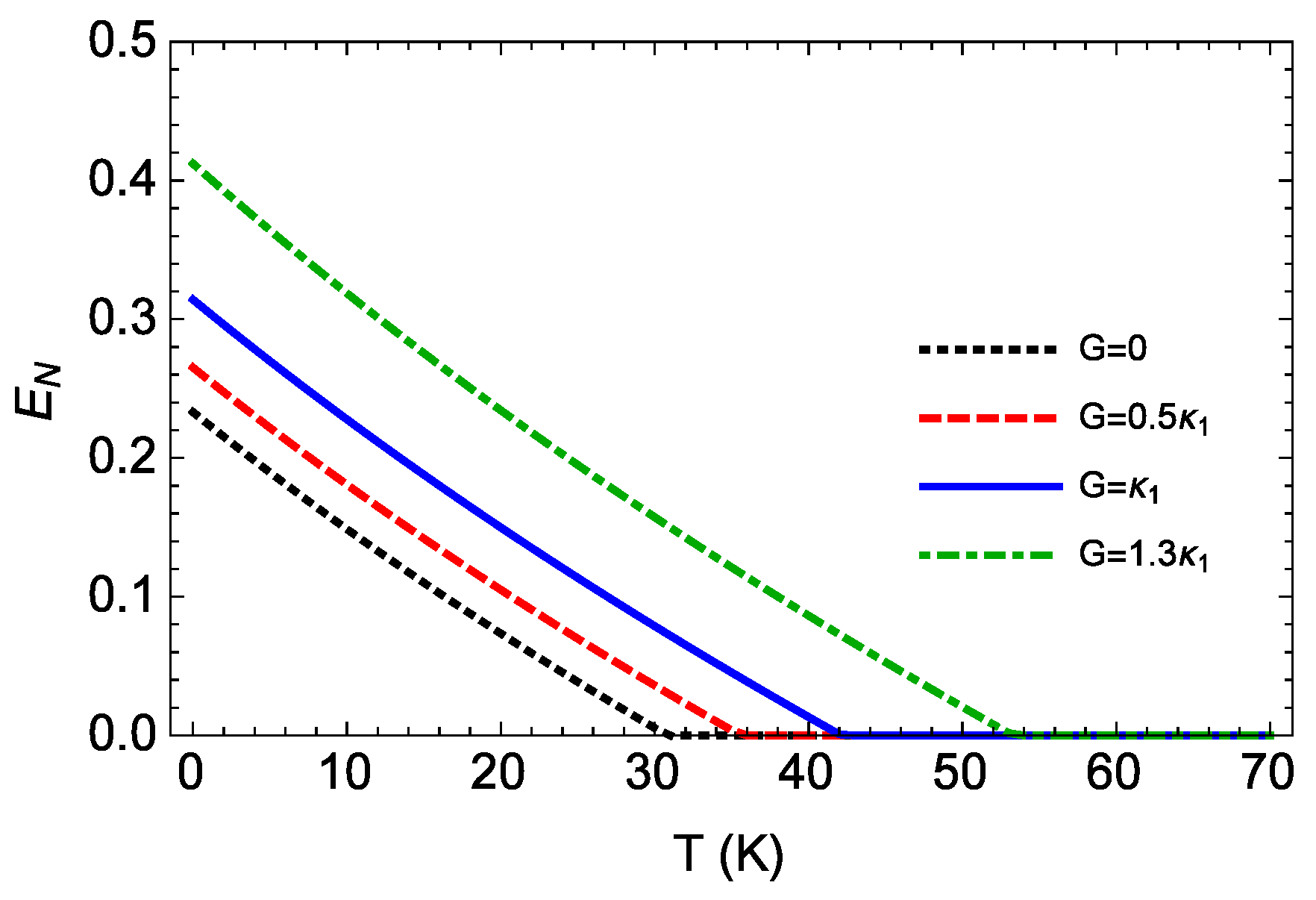
We further investigate the robustness of optomechanical entanglement against the environmental temperature T. Figure 8 shows the logarithmic negativity as a function of the environmental temperature T for different NOPA gains G when , mW, , and . At K, it is seen that increases monotonically with the gain G of the NOPA. For , , , and , is approximately 0.23, 0.26, 0.31, and 0.41, respectively. For a fixed NOPA gain G, the optomechanical entanglement decreases monotonically with increasing environmental temperature T, owing to the detrimental effects of thermal fluctuations on optomechanical entanglement. Without the NOPA , entanglement vanishes when K. For , , and , the critical temperature for entanglement disappearance increases to 36 K, 43 K, and 54 K, respectively. This direct comparison shows that the NOPA can raise the critical survival temperature of optomechanical entanglement. Therefore, a larger NOPA gain G improves the thermal robustness of entanglement against thermal fluctuations, so that the entanglement can survive at a higher environmental temperature T.
Figure 8.
The logarithmic negativity as a function of the environmental temperature T for different gains G of the NOPA. The black dotted, red dashed, blue solid, and green dot–dashed curves correspond to , , , and , respectively. Other parameters: , mW, , and .
5. Discussion
In this section, we compare our results with those reported in ref. [36], where optomechanical entanglement mediated by radiation pressure is modulated via a NOPA.
In ref. [36], the logarithmic negativity exhibits periodic dependence on the NOPA phase with period . Importantly, decreases as the NOPA gain G increases across the whole range , which is different from our findings. This difference originates from distinct optomechanical interaction mechanisms. In ref. [36], the cavity mode is coupled to the translational mechanical motion via radiation pressure, but in our system, the cavity mode is coupled to the rotational mechanical degree of freedom via radiation torque. Under a properly chosen phase of the NOPA, a larger NOPA gain G strengthens the coherent parametric interaction between the cavity field and the rotating mirror, thereby increasing optomechanical entanglement. In contrast, in ref. [36], increased NOPA gain G introduces stronger optomechanical backaction noise that suppresses optomechanical entanglement.
We now discuss the experimental feasibility of our proposed scheme. Experimental realization of the LG cavity optomechanical system remains unachieved to date [29]. However, previous studies have achieved LG beams with topological charge 10,010using spiral phase mirrors [43] and torsional mechanical resonators with frequencies of 3–20 MHz [44]. Meanwhile, a recent optomechanical experiment has demonstrated the cooling of a movable mirror with mass 25 ng, radius 15 μm, and mechanical quality factor [45]. In addition, a micro-mirror with mass 300 μg, frequency kHz, and mechanical quality factor has been experimentally demonstrated at cryogenic temperature 4.5 K under high-vacuum conditions [46]. Benefiting from ongoing technological advances, the rotating mirror used in our scheme with mass 10 ng, radius 10 μm, frequency MHz, and mechanical quality factor is within reach. Moreover, optomechanical entanglement between the LG cavity mode and the rotating mirror can be detected via the homodyne method, as described in ref. [6]. Thus, it is possible to implement our scheme experimentally.
6. Conclusions
In summary, we proposed a scheme for enhancing stationary entanglement between an LG cavity mode and a rotating mirror in a double LG cavity optomechanical system using a NOPA. The two LG cavity modes are coupled through the NOPA, and one of them is coupled to the rotating mirror. By choosing a suitable phase for the NOPA, we found that increasing the NOPA gain can significantly enhance the optomechanical entanglement. Moreover, we showed that higher driving powers of the two LG cavity modes or a larger topological charge carried by the LG cavity mode coupled to the rotating mirror increased maximum optomechanical entanglement and made this maximum occur at a weaker gain of the NOPA. In addition, increasing the NOPA gain led to the occurrence of maximum optomechanical entanglement at larger cavity detuning of the LG cavity mode coupled to the rotating mirror. Additionally, the NOPA enhanced the robustness of optomechanical entanglement against the thermal noise acting on the rotating mirror. This study had provided an alternative method of creating stronger optomechanical entanglement, with potential applications in continuous-variable quantum information processing.
Author Contributions
Conceptualization, S.H. and A.C.; methodology, S.H. and A.C.; software, W.H., S.H. and L.D.; formal analysis, W.H., S.H. and L.D.; writing—original draft preparation, W.H., S.H. and L.D.; writing—review and editing, S.H. and A.C. All authors have read and agreed to the published version of the manuscript.
Funding
This research was funded by the National Natural Science Foundation of China (grants numbers 12174344, 12175199, 12575031, 12547108) and the Foundation of the Department of Science and Technology of Zhejiang Province (grants number 2022R52047).
Institutional Review Board Statement
Not applicable.
Informed Consent Statement
Not applicable.
Data Availability Statement
The original contributions presented in this study are included in the article. Further inquiries can be directed to the corresponding author(s).
Conflicts of Interest
The authors declare no conflicts of interest.
Appendix A. Stability Conditions of the System
The stability of the system can be examined by applying the Routh–Hurwitz criterion [40] to the characteristic polynomial of the matrix M (Equation (9)), which reads
Here the coefficients are provided by
where , , and . The system is stable if , where are provided by
References
- Aspelmeyer, M.; Kippenberg, T.J.; Marquardt, F. Cavity optomechanics. Rev. Mod. Phys. 2014, 86, 1391. [Google Scholar] [CrossRef] [Scilit]
- Marquardt, F.; Chen, J.P.; Clerk, A.A.; Girvin, S.M. Quantum theory of cavity-assisted sideband cooling of mechanical motion. Phys. Rev. Lett. 2007, 99, 093902. [Google Scholar] [CrossRef] [Scilit] [PubMed]
- Wilson-Rae, I.; Nooshi, N.; Zwerger, W.; Kippenberg, T.J. Theory of ground state cooling of a mechanical oscillator using dynamical backaction. Phys. Rev. Lett. 2007, 99, 093901. [Google Scholar] [CrossRef] [Scilit] [PubMed]
- Chan, J.; Alegre, T.P.M.; Safavi-Naeini, A.H.; Hill, J.T.; Krause, A.; Gröblacher, S.; Aspelmeyer, M.; Painter, O. Laser cooling of a nanomechanical oscillator into its quantum ground state. Nature 2011, 478, 89. [Google Scholar] [CrossRef] [Scilit] [PubMed]
- Teufel, J.D.; Donner, T.; Li, D.; Harlow, J.W.; Allman, M.S.; Cicak, K.; Sirois, A.J.; Whittaker, J.D.; Lehnert, K.W.; Simmonds, R.W. Sideband cooling of micromechanical motion to the quantum ground state. Nature 2011, 475, 359. [Google Scholar] [CrossRef] [Scilit] [PubMed]
- Vitali, D.; Gigan, S.; Ferreira, A.; Böhm, H.; Tombesi, P.; Guerreiro, A.; Vedral, V.; Zeilinger, A.; Aspelmeyer, M.A. Optomechanical entanglement between a movable mirror and a cavity field. Phys. Rev. Lett. 2007, 98, 030405. [Google Scholar] [CrossRef] [Scilit] [PubMed]
- Sun, F.X.; Mao, D.; Dai, Y.T.; Ficek, Z.; He, Q.Y.; Gong, Q.H. Phase control of entanglement and quantum steering in a three-mode optomechanical system. New J. Phys. 2017, 19, 123039. [Google Scholar] [CrossRef] [Scilit]
- Palomaki, T.A.; Teufel, J.D.; Simmonds, R.W.; Lehnert, K.W. Entangling mechanical motion with microwave fields. Science 2013, 342, 710. [Google Scholar] [CrossRef] [Scilit] [PubMed]
- Ockeloen-Korppi, C.F.; Damskägg, E.; Pirkkalainen, J.M.; Asjad, M.; Clerk, A.A.; Massel, F.; Woolley, M.J.; Sillanpää, M.A. Stabilized entanglement of massive mechanical oscillators. Nature 2018, 556, 478. [Google Scholar] [CrossRef] [Scilit] [PubMed]
- Riedinger, R.; Wallucks, A.; Marinković, I.; Löschnauer, C.; Aspelmeyer, M.; Hong, S.; Gröblacher, S. Remote quantum entanglement between two micromechanical oscillators. Nature 2018, 556, 473. [Google Scholar] [CrossRef] [Scilit] [PubMed]
- Wang, M.; Lü, X.Y.; Wang, Y.; You, J.Q.; Wu, Y. Macroscopic quantum entanglement in modulated optomechanics. Phys. Rev. A 2016, 94, 053807. [Google Scholar] [CrossRef] [Scilit]
- Chen, J.; Rossi, M.; Mason, D.; Schliesser, A. Entanglement of propagating optical modes via a mechanical interface. Nat. Commun. 2020, 11, 943. [Google Scholar] [CrossRef] [Scilit] [PubMed]
- Ge, W.; Al-Amri, M.; Nha, H.; Zubairy, M.S. Entanglement of movable mirrors in a correlated-emission laser. Phys. Rev. A 2013, 88, 022338. [Google Scholar] [CrossRef] [Scilit]
- Zhou, L.; Han, Y.; Jing, J.; Zhang, W. Entanglement of nanomechanical oscillators and two-mode fields induced by atomic coherence. Phys. Rev. A 2011, 83, 052117. [Google Scholar] [CrossRef] [Scilit]
- Horodecki, R.; Horodecki, P.; Horodecki, M.; Horodecki, K. Quantum entanglement. Rev. Mod. Phys. 2009, 81, 865. [Google Scholar] [CrossRef] [Scilit]
- Chakraborty, S.; Sarma, A.K. Enhancing quantum correlations in an optomechanical system via cross-Kerr nonlinearity. J. Opt. Soc. Am. B 2017, 34, 1503. [Google Scholar] [CrossRef] [Scilit]
- Leach, J.; Jack, B.; Romero, J.; Jha, A.K.; Yao, A.M.; Franke-Arnold, S.; Ireland, D.G.; Boyd, R.W.; Barnett, S.M.; Padgett, M.J. Quantum correlations in optical angle–orbital angular momentum variables. Science 2010, 329, 662. [Google Scholar] [CrossRef] [Scilit] [PubMed]
- Oemrawsingh, S.S.R.; Eliel, E.R.; Woerdman, J.P.; Verstegen, E.J.K.; Kloosterboer, J.G.; Hooft, G.W. Half-integral spiral phase plates for optical wavelengths. J. Opt. A Pure Appl. Opt. 2004, 6, S288. [Google Scholar] [CrossRef] [Scilit]
- Forbes, A.; Dudley, A.; Mclaren, M. Creation and detection of optical modes with spatial light modulators. Adv. Opt. Photon. 2016, 8, 200. [Google Scholar] [CrossRef] [Scilit]
- Heckenberg, N.R.; McDuff, R.G.; Smith, C.P.; White, A.G. Generation of optical phase singularities by computer generated hologram. Opt. Lett. 1992, 17, 22. [Google Scholar] [CrossRef] [Scilit] [PubMed]
- Bhattacharya, M.; Uys, H.; Meystre, P. Optomechanical traping and cooling of partially reflective mirrors. Phys. Rev. A 2008, 77, 033819. [Google Scholar] [CrossRef] [Scilit]
- Bhattacharya, M.; Giscard, P.L.; Meystre, P. Entanglement of a Laguerre-Gaussian cavity mode with a rotating mirror. Phys. Rev. A 2008, 77, 013827. [Google Scholar] [CrossRef] [Scilit]
- Chen, Z.; Peng, J.X.; Fu, J.J.; Feng, X.L. Entanglement of two rotating mirrors coupled to a single Laguerre-Gaussian cavity mode. Opt. Express 2019, 27, 029479. [Google Scholar] [CrossRef] [Scilit] [PubMed]
- Wang, F.; Shen, K.; Xu, J. Rotational mirror–mirror entanglement via dissipative atomic reservoir in a double-Laguerre–Gaussian-cavity system. New J. Phys. 2023, 24, 123044. [Google Scholar] [CrossRef] [Scilit]
- Chabar, N.; Amghar, M.B.; Singh, S.K.; Amazioug, M. Gaussian geometric discord, entanglement and EPR steering of two rotational mirrors in a double-Laguerre-Gaussian cavity optomechanics in the presence of YIG sphere. Quantum Inf. Process. 2025, 24, 321. [Google Scholar] [CrossRef] [Scilit]
- Cheng, H.J.; Zhou, S.J.; Peng, J.X.; Kundu, A.; Li, H.X.; Jin, L.; Feng, X.L. Tripartite entanglement in a Laguerre-Gaussian rotational-cavity system with an yttrium iron garnet sphere. J. Opt. Soc. Am. B 2021, 38, 285. [Google Scholar] [CrossRef] [Scilit]
- Hidki, A.; Peng, J.; Singh, S.K.; Khalid, M.; Asjad, M. Entanglement and quantum coherence of two YIG spheres in a hybrid Laguerre–Gaussian cavity optomechanics. Sci. Rep. 2024, 14, 11204. [Google Scholar] [CrossRef] [Scilit] [PubMed]
- Hidki, A.; Sohail, A.; Benrass, N.; Singh, S.K.; Nassik, N. Entanglement Generation and Control via Photon Tunneling in a Hybrid L-G Cavity-Magnon-Phonon System. Int. J. Theor. Phys. 2025, 64, 122. [Google Scholar] [CrossRef] [Scilit]
- Singh, S.K.; Peng, J.X.; Asjad, M.; Mazaheri, M. Entanglement and coherence in a hybrid Laguerre–Gaussian rotating cavity optomechanical system with two-level atoms. J. Phys. B At. Mol. Opt. Phys. 2021, 54, 215502. [Google Scholar] [CrossRef] [Scilit]
- Wu, L.A.; Kimble, H.J.; Hall, J.L.; Wu, H. Generation of Squeezed States by Parametric Down Conversion. Phys. Rev. Lett. 1986, 57, 2520. [Google Scholar] [CrossRef] [Scilit] [PubMed]
- Zhou, Y.; Jia, X.; Li, F.; Xie, C.; Peng, K. Experimental generation of 8.4 dB entangled state with an optical cavity involving a wedged type-II nonlinear crystal. Opt. Express 2015, 23, 4952. [Google Scholar] [CrossRef] [Scilit] [PubMed]
- Zhang, J.; Xie, C.D.; Peng, K.C. Entanglement swapping using nondegenerate optical parametric amplifier. Phys. Lett. A 2002, 299, 427. [Google Scholar] [CrossRef] [Scilit]
- Huang, S.; Agarwal, G.S. Enhancement of cavity cooling of a micromechanical mirror using parametric interactions. Phys. Rev. A 2009, 79, 013821. [Google Scholar] [CrossRef] [Scilit]
- Yang, R.G.; Li, N.; Zhang, J.; Li, J.; Zhang, T.C. Enhanced entanglement of two optical modes in optomechanical systems via an optical parametric amplifier. J. Phys. At. Mol. Opt. Phys. 2017, 50, 085502. [Google Scholar] [CrossRef] [Scilit]
- Hussain, B.; Qamar, S.; Irfan, M. Entanglement enhancement in cavity magnomechanics by an optical parametric amplifier. Phys. Rev. A 2022, 105, 063704. [Google Scholar] [CrossRef] [Scilit]
- Ahmed, R.; Qamar, S. Optomechanical entanglement via nondegenerate parametric interactions. Phys. Scr. 2017, 92, 105101. [Google Scholar] [CrossRef] [Scilit]
- Wodedo, M.A.; Tesfahannes, T.G.; Darge, T.Y.; Bedore, M.T.; Kumela, A.G.; Adera, G.B. Generation of two modemechanical squeezing induced by nondegenerate parametric amplification. Sci. Rep. 2024, 14, 27234. [Google Scholar] [CrossRef] [Scilit] [PubMed]
- Luo, Y.; Tan, H. Quantum-feedback-controlled macroscopic quantum nonlocality in cavity optomechanics. Quantum Sci. Technol. 2020, 5, 045023. [Google Scholar] [CrossRef] [Scilit]
- Genes, C.; Mari, A.; Tombesi, P.; Vitali, D. Robust entanglement of a micromechanical resonator with output optical fields. Phys. Rev. A 2008, 78, 032316. [Google Scholar] [CrossRef] [Scilit]
- DeJesus, E.X.; Kaufman, C. Routh-Hurwitz criterion in the examination of eigenvalues of a system of nonlinear ordinary differential equations. Phys. Rev. A 1987, 35, 5288. [Google Scholar] [CrossRef] [Scilit] [PubMed]
- Vidal, G.; Werner, R.F. Computable measure of entanglement. Phys. Rev. A 2002, 65, 032314. [Google Scholar] [CrossRef] [Scilit]
- Plenio, M.B. Logarithmic negativity: A full entanglement monotone that is not convex. Phys. Rev. Lett. 2005, 95, 090503. [Google Scholar] [CrossRef] [Scilit] [PubMed]
- Fickler, R.; Campbell, G.; Buchler, B.; Lam, P.K.; Zeilinger, A. Quantum entanglement of angular momentum states with quantum numbers up to 10,010. Proc. Natl. Acad. Sci. USA 2016, 113, 13642. [Google Scholar] [CrossRef] [Scilit] [PubMed]
- Olkhovets, A.; Evoy, S.; Carr, D.; Parpia, J.M.; Craighead, H.G. Actuation and internal friction of torsional nanomechanical silicon resonators. J. Vac. Sci. Technol. B Microelectron. Nanometer Struct. Process. Meas. Phenom. 2000, 18, 3549. [Google Scholar] [CrossRef] [Scilit]
- Kleckner, D.; Bouwmeester, D. Sub-kelvin optical cooling of a micromechanical resonator. Nature 2006, 444, 75. [Google Scholar] [CrossRef] [Scilit] [PubMed]
- Serra, E.; Borrielli, A.; Cataliotti, F.S.; Marin, F.; Marino, F.; Pontin, A.; Prodi, G.A.; Bonaldi, M. Ultralow-dissipation micro-oscillator for quantum optomechanics. Phys. Rev. A 2012, 86, 051801(R). [Google Scholar] [CrossRef] [Scilit]
Disclaimer/Publisher’s Note: The statements, opinions and data contained in all publications are solely those of the individual author(s) and contributor(s) and not of MDPI and/or the editor(s). MDPI and/or the editor(s) disclaim responsibility for any injury to people or property resulting from any ideas, methods, instructions or products referred to in the content. |
© 2026 by the authors. Licensee MDPI, Basel, Switzerland. This article is an open access article distributed under the terms and conditions of the Creative Commons Attribution (CC BY) license.