


Abstract
Topological photonic microcavities have been widely applied in the design of photonic devices due to their unique stability against structural defects. Because higher-order topological corner states can confine photons in a lower-dimensional space (0D corners), they offer significantly higher quality factors (Q-factors). Typically, higher-order topological corner states exist in square and Kagome lattices, where the electric field manifests as a monopole at the vertices of the structure. Here, by engineering the global structural symmetry, we construct topological corner states in the form of dipoles and hexapoles in square and Kagome lattices, respectively. Taking the response to ambient refractive index variations as an example, we demonstrate that these symmetry-engineered corner states can provide more sensitive detection, higher Q-factors, and stronger immunity to structural defects. Therefore, this work further expands the tuning mechanisms of higher-order topological photonics and highlights its application potential in highly stable and ultra-sensitive sensing.
1. Introduction
Topological photonics, a new chapter of electromagnetics research has recently attracted growing attention [1,2]. Topology was originally a mathematical concept used to study properties of spaces that are invariant under any continuous deformation. Later, it was introduced to condensed matter physics to investigate a new phase of matter, the topological insulators whose bulk is an insulator while the boundary is a conductor [3]. Topological state is protected by the bulk band topology and demonstrates robust unidirectional propagation and backscattering immunity against imperfections and disorder. This has motivated a surge of interest in the study of unidirectional transport of light along interfaces and gives birth to photonic topological insulators [4,5]. Intriguingly, topological photonics provide some properties that have no counterparts in condensed matter physics, primarily due to the non-Hermiticity and nonlinearity in photonic system [6]. This alters the current design logic of active photonic devices, since the undesired modes due to inevitable fabrication imperfections tend to compromise the performance of the device. To date, these topological photonic devices have been demonstrated utilizing topological edge states in both one-dimensional (1D) and two-dimensional (2D) systems, including optically and electrically pumped lasers based on lattices featuring Su-Schrieffer-Heeger (SSH) model [7,8], quantum Hall or spin Hall effect [9,10,11,12], or valley Hall effect [13].
Leveraging the stability of topological single modes, researchers have successfully developed various topological photonic devices (e.g., topological lasers [7,8,9,11,13,14,15] and sensors [16,17,18,19,20,21]). However, while traditional one-dimensional (1D) or two-dimensional (2D) topological edge states can achieve robust light transport, realizing higher-performance photonic microcavities (such as highly sensitive biochemical sensors) requires further localizing the light field into even smaller spatial dimensions. In recent years, the concept of higher-order topological insulators (HOTIs) has provided a solution to this goal [15,22,23,24,25,26,27,28,29,30,31,32,33,34,35,36,37,38,39,40,41,42,43]. By generalizing the bulk-boundary correspondence, 2D higher-order topological photonic systems can support zero-dimensional (0D) topological corner states. Such corner states can highly localize photons at the vertices of the structure, thereby drastically reducing the mode volume and significantly enhancing the quality factor (Q-factor) of the microcavity [15,37,38,39].
Typically, higher-order topological corner states widely exist in classical models such as the square lattice and Kagome lattice. In conventional designs, whether within a single topological domain or through simple boundary partitions, the electric field distribution of the excited corner states usually manifests as a monopole at the corners of the structure [32,33,35,37,38,39]. Although these monopole corner states possess certain topological protection, their modes are highly susceptible to degradation or hybridization with adjacent edge states when subjected to extreme or specific perturbations (e.g., structural defects located exactly near the corners). Furthermore, in sensing applications, the light-matter interaction strength and response sensitivity of monopole modes still encounter bottlenecks.
To break through these limitations, this work proposes a novel mechanism to construct multipole topological corner states in photonic lattices by macroscopically engineering the global structural symmetry. Specifically, we transcend the constraints of a single topological domain. By delicately combining multiple topological and trivial domains, we reconfigure the spatial arrangement of corner states. We demonstrate that introducing diagonally arranged dual topological domains in a square lattice can successfully excite a dipole corner state formed by the coupling of two adjacent corner states. Meanwhile, introducing three-fold symmetric topological domains in a Kagome lattice enables the construction of a hexapole corner state composed of antisymmetric type-III corner states.
More importantly, we comprehensively evaluate the superior performance of these symmetry-engineered multipole corner states in photonic device applications. Taking refractive index sensing as an example, compared to traditional monopole corner states, the designed dipole and hexapole modes not only exhibit a steeper and more sensitive eigenfrequency response to changes in the ambient refractive index (i.e., higher sensitivity) in a gas environment, but the multipole modes (especially the hexapole) also provide a significantly higher microcavity Q-factor. Additionally, regarding topological robustness, when severe structural defects (such as missing lattice units) or local deformations (such as dimer rotations) are introduced near the corners, traditional monopole corner states rapidly vanish due to mixing with edge states. In stark contrast, our constructed dipole and hexapole corner states exhibit extreme defect immunity, with the modes remaining stable alongside merely a slight frequency shift. Our platform relies on reciprocal crystalline symmetries, which provide robustness against bulk structural perturbations that preserve the underlying lattice topology, rather than the genuinely unidirectional, backscattering-immune edge transport found in non-reciprocal systems.
This study not only theoretically expands the dimensional control of modes in higher-order topological photonics (from monopoles to dipoles and hexapoles) but also provides an application foundation for future topological photonic sensing chips with high stability, high Q-factors, and robust interference resistance.
2. Methods
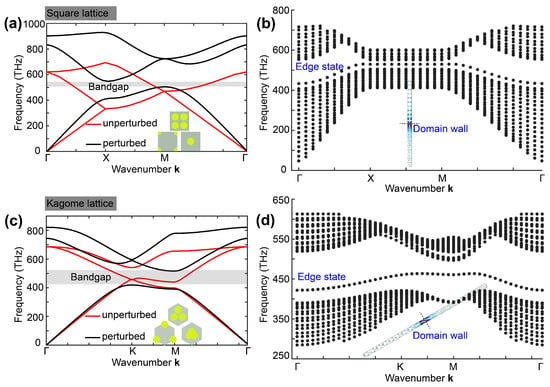
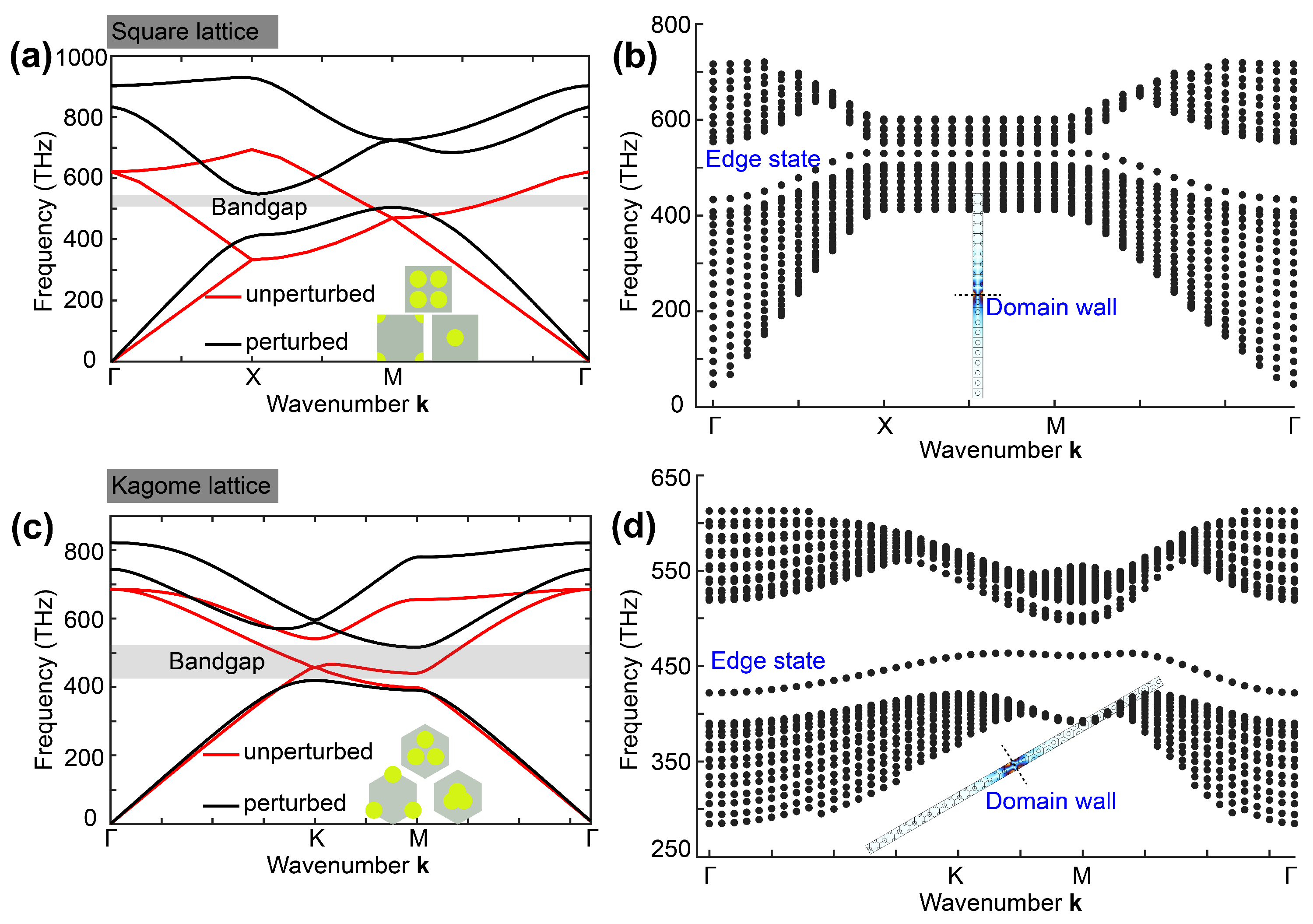
To overcome the limitations of traditional monopole topological corner states in terms of confinement capability and perturbation immunity, we successfully constructed multipole (dipole and hexapole) higher-order topological corner states in photonic systems by macroscopically engineering the global structural symmetry based on the physical mechanism of the 2D SSH model and Kagome model. This topological phase transition is achieved by systematically altering the intra-cell () and inter-cell () coupling strengths in the unperturbed lattice. When , the original Dirac degeneracy is broken and a complete bandgap opens, thereby distinguishing the topologically trivial (, shrunken lattice) and nontrivial (, expanded lattice) domains. To construct higher-dimensional topological corner states, it is first necessary to establish the topologically nontrivial nature of the bulk bands in the 2D system and verify the existence of topologically protected 1D edge states. Figure 1 systematically illustrates the fundamental band structures and their evolution processes for both the square and Kagome lattices.
Figure 1.
Band diagrams of unperturbed (red curves) and degenerated trivial and non-trivial (black curves) (a) square and (c) Kagome lattices. A Dirac-like degeneracy is formed at the X point and a quadratic band touching occurs at the M point for an unperturbed square lattice in (a). A Dirac-like degeneracy is formed at the K point for an unperturbed Kagome lattice in (c). The colored circles in the gray squares and hexagons represent high-refractive-index nanostructure units. The introduction of perturbation lifts the degenaracies and induces complete bandgaps in both cases. (b,d) Band diagrams of supercells composed by trivial and nontrivial domains for (b) square and (d) Kagome lattices. Edge state exists at the boundary between these two domains. Insets show the electric field profiles of the edge states. For both cases, we design the edge states working around 500 THz, i.e., within the visible light spectrum.
For the square lattice [Figure 1a], under an ideal periodic arrangement without perturbations i.e., with four high-index () disks (top panel of the insets) positioned at the four centers of the square’s diagonals (unperturbed, red curves), the dispersion curves exhibit a Dirac-like degeneracy at the X point and a quadratic band touching at the M point in the Brillouin zone. To open a photonic bandgap, we introduced perturbations by tuning the lattice parameters (altering the intra- and inter-cell coupling strengths), with four high-index disks (bottom panel of the insets) expanded or shrank from the four centers of the square’s diagonals, thereby breaking the original structural symmetry. Consequently, the degeneracies are successfully lifted, inducing a clear and complete topological photonic bandgap (black curves). Subsequently, we calculated the projected band structure for a square lattice supercell composed of alternating trivial and nontrivial domains [Figure 1b]. The results reveal a dispersion curve traversing the bulk bandgap, which represents the 1D topological edge state. The electric field profile in the inset visually confirms that the light field is strictly and efficiently localized at the domain wall between the two distinct topological phases.
The identical topological bandgap generation mechanism is also validated in the Kagome lattice. As shown in Figure 1c, the unperturbed Kagome lattice (top panel of the insets) possesses a typical Dirac-like degeneracy at the K point. When perturbations are introduced to break the equilibrium between intra- and inter-cell couplings (bottom panel of the insets), the degenerate states are lifted, similarly opening a complete bulk bandgap. In the corresponding band diagram of the Kagome supercell [Figure 1d], a clear edge state mode predictably emerges within the bulk bandgap. The inset’s electric field profile once again confirms the strong localized transport characteristic of the light field along the domain wall.
It is worth emphasizing that through precise geometric parameter design of the photonic crystals, we successfully tuned the operating frequencies of the topological bandgaps and edge states to around 500 THz for both the square and Kagome lattices. This indicates that the proposed topological microcavities operate entirely within the visible light spectrum, laying a crucial physical foundation for realizing highly localized, ultra-sensitive topological photonic devices (e.g., topological lasers and biochemical sensors) in the visible wavelength range.
3. Results
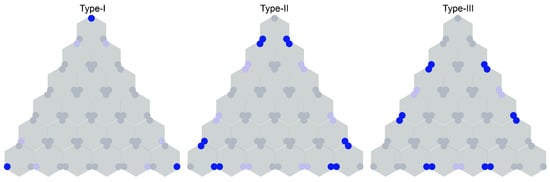
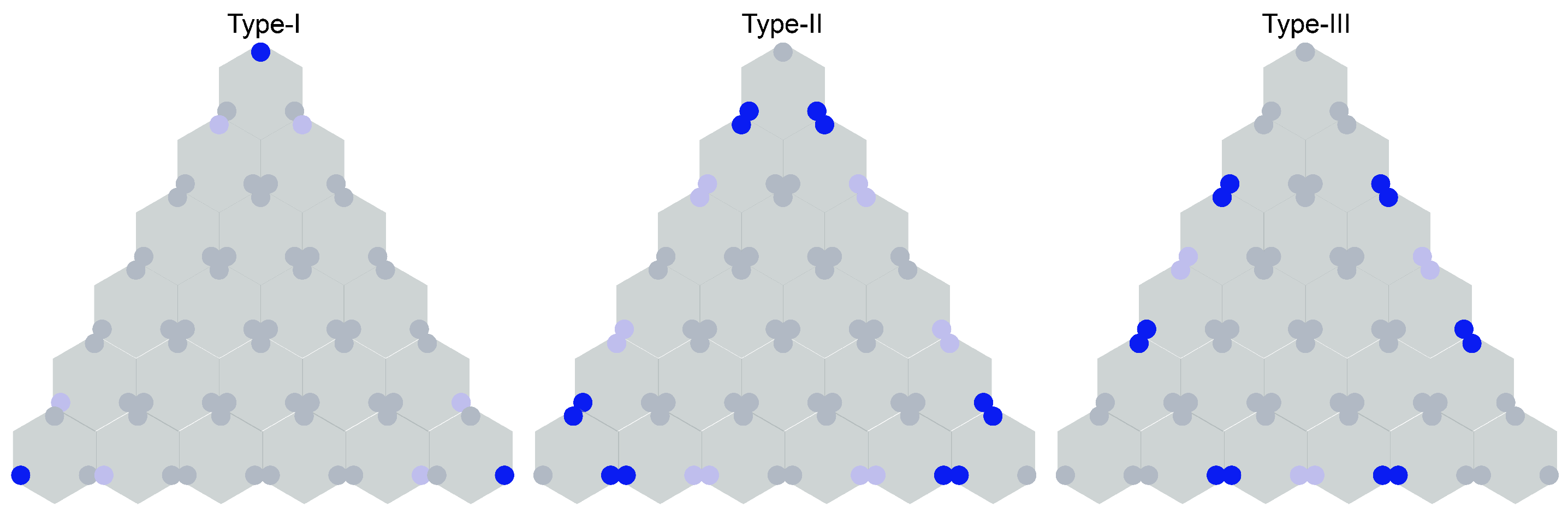
Here we provide a brief schematic summary defining different corner state types and their distinguishing field features, as shown in Figure 2. Type-I corner states: The electric field is predominantly localized at the three outermost apexes (vertices) of the triangular Kagome model. Type-II corner states: The electric field is mainly localized on the nearest-neighbor nanopillar dimers immediately adjacent to the three apexes. Type-III corner states: The electric field is primarily localized on the next-nearest-neighbor dimers relative to the three apexes. For symmetric (S)/antisymmetric (A) notation: For the extended states (Type-II and Type-III), the modes are further classified as symmetric (S) or antisymmetric (A) based on whether their phase/field profiles are symmetric (in-phase) or antisymmetric (out-of-phase) with respect to the angle bisector of each corner.
Figure 2.
A brief schematic summary defining different corner state types and their distinguishing field features. The electric field intensity is highly concentrated in the region where the corner states appear, which is colored dark blue here.
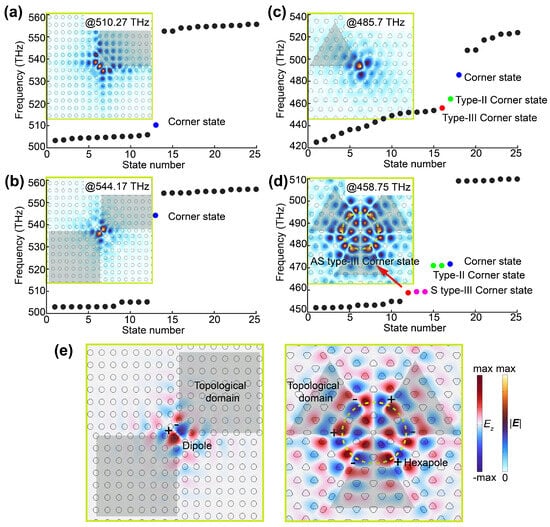
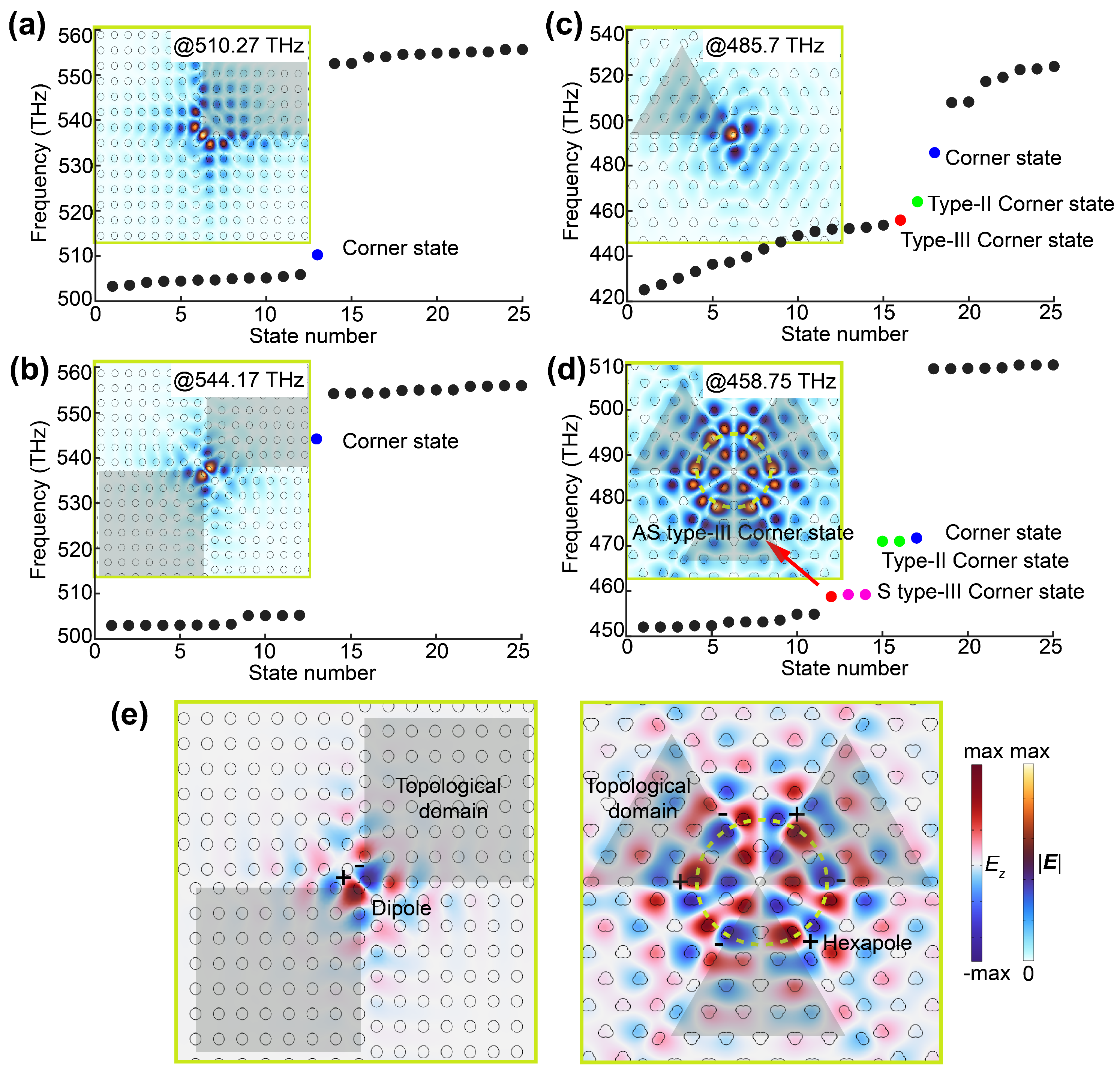
We first calculated the eigenfrequency spectra of the square lattice. As shown in Figure 3a, when only a single topologically nontrivial domain is included (surrounded by a trivial background), a traditional monopole topological corner state bound to an isolated corner is excited within the bandgap (510.27 THz).
Figure 3.
(a) Eigenfrequency spectrum of a structure containing a single square lattice topological domain. (b) Eigenfrequency spectrum of a structure containing a pair of diagonally arranged square lattice topological domains. The corner state forms a dipole. (c) Eigenfrequency spectrum of a structure containing a monopole Kagome lattice topological domain. A symmetric Type-III topological state is present. (d) Eigenfrequency spectrum of a structure containing three Kagome lattice topological domains. An antisymmetric Type-III topological state is present, constituting a hexapole. (e) Electric field distributions of the dipole and hexapole corner states. Shaded areas represent topological domains, while unshaded areas denote trivial domains.
To construct a dipole, we altered the macroscopic symmetry by introducing a set of two diagonally arranged square nontrivial domains into the trivial background [Figure 3b]. In this configuration, the corners of the two nontrivial domains are brought spatially very close to each other. This geometric arrangement triggers a strong near-field interaction (edge-edge coupling) between the two originally isolated monopole corner states. Similar to energy level hybridization in quantum mechanics, this strong coupling leads to mode splitting, forming a new mode with parity symmetry (at 544.17 THz). As depicted in the electric field profile on the left of Figure 3e, the coupled electric field exhibits clear phase reversal (one positive, one negative), successfully forming a dipole topological corner state in the square lattice. Compared to the multipolar corner states by varying the finite lattice size and utilizing intrinsic higher-order topological phases [27], the dipole size in this work is only a few hundred nanometers, which can confine light in a very compact dimension.
In the Kagome lattice, the construction mechanism of multipoles is richer and more complex. As noted in the literature [15,32,33,35,41,43], long-range interactions cannot be ignored in electromagnetic wave systems. In our nontrivial (expanded) lattice design, the nanopillars at the boundaries of adjacent unit cells inevitably overlap physically, leading to a drastically increased next-nearest-neighbor coupling strength (close to ). This robust next-nearest-neighbor coupling not only supports traditional monopole Type-I corner states but also excites Type-II [31] and even newly discovered Type-III corner states [15,32,33,35,41,43], where the field distribution extends outward. Based on the symmetry of the electric field along the angle bisector, these corner states can be further classified into symmetric (S) and antisymmetric (A) modes [15,32,33,35]. As shown in Figure 3c, a single Kagome nontrivial domain, while generating a conventional corner state (485.7 THz), indeed simultaneously supports a symmetric Type-III (S-Type-III) topological state.
To capture the elusive antisymmetric mode and construct a higher-order multipole, we meticulously designed a super-structure consisting of three identical Kagome nontrivial domains and three trivial domains arranged alternately [referring to the model in Figure 3d]. Inspired by our previous work [15], we re-designed a structure working in the visible light spectrum. These three nontrivial domains are translated towards the center so that their vertices collectively point toward the central region, forming a specific coupling network at the domain wall junctions. This centripetal translation design with rotational symmetry forces the antisymmetric Type-III (A-Type-III) corner states-which otherwise easily mix with bulk or edge states-to undergo strong multi-body interactions at the three adjacent vertices. The eigenspectrum [Figure 3d] reveals that this multiple coupling stabilizes an asymmetric Type-III topological state at 458.75 THz. The electric field profile on the right of Figure 3e perfectly illustrates that the wavefunctions of three A-Type-III modes coherently superimpose, forming six alternating positive and negative electric field poles () around the corners. This represents the demonstration of a hexapole topological corner state governed by symmetry in the optical regime.
To quantitatively investigate the proposed multi-domain topological cavities, full-wave numerical simulations were performed using the two-dimensional (2D) finite-element method, focusing on transverse magnetic (TM) polarized modes with an out-of-plane electric field component (). In both lattice configurations, the dielectric nanopillars are modeled with a refractive index of (typical of silicon nitride in the visible spectrum) embedded in an air background ().
For the square lattice, the unit-cell lattice constant is and the nanopillar diameter is . To construct the coupled dipole cavity, the two diagonally arranged topologically nontrivial domains are translated toward each other by a spatial displacement of . For the breathing Kagome lattice, the unit-cell side length is with a nanopillar diameter of . The trivial (shrunken) and nontrivial (expanded) phases are realized by displacing the nanopillars inward and outward by relative to the unit-cell center, respectively. To form the central hexapole junction, the three alternating nontrivial Kagome domains are translated centripetally toward the center by .
In the eigenfrequency and sensing calculations, the finite-sized multi-domain supercells are truncated by scattering boundary conditions and perfectly matched layers (PMLs) to eliminate unphysical boundary reflections. Although the 2D approximation (assuming infinitely long cylinders) neglects out-of-plane vertical radiation losses—thereby yielding higher quality (Q) factors than finite-thickness three-dimensional (3D) slabs—the 2D complex eigenfrequencies () rigorously quantify the in-plane transverse energy leakage tunneling evanescently through the finite trivial cladding, from which the quality factor is evaluated as . Mesh refinement and computational-domain convergence tests were thoroughly conducted (with maximum mesh element sizes kept below ), ensuring relative variations of less than for both resonance frequencies and Q-factors. As established in our previous studies [15], this 2D framework accurately captures the essential topological hybridization physics and multipolar sensing characteristics while avoiding the prohibitive computational memory overhead of large-scale 3D supercell sweeps.
To rigorously establish the topological origin of the corner modes prior to multi-domain hybridization, we characterize the bulk topology of the individual building blocks based on the generalized two-dimensional (2D) Su–Schrieffer–Heeger (SSH) frameworks. Both the square and Kagome photonic crystals (PhCs) are well-established higher-order topological models whose bulk invariants are strictly quantized by crystalline symmetries.
For the square lattice, the unit cell is defined such that the intra-cell and inter-cell couplings are modulated by the shrunken (trivial) and expanded (nontrivial) configurations, focusing on the lowest dielectric band below the directional bandgap. Its bulk topology is characterized by the 2D Zak phase , which corresponds to the integration of the Berry connection across the first Brillouin zone (BZ) [39]:
where a is the lattice constant, is the area element in the first BZ, and is the Berry connection of the lowest band with periodic Bloch function . Protected by the point-group symmetry (specifically mirror symmetries and ), the 2D Zak phase is quantized to for the topologically trivial domain and for the topologically nontrivial domain. According to the bulk–edge–corner correspondence, this topological mismatch induces quantized fractional edge polarizations , guaranteeing the existence of a 0D monopole corner state at a monopole domain intersection (as verified in Figure 3a).
Similarly, for the breathing Kagome lattice consisting of three nanopillars per unit cell, the topological invariant of the lowest band is governed by the bulk polarization , which is identical to the Wannier center and expressed as [23]:
where S is the area of the first BZ. Mirror symmetries and crystalline symmetry restrict the Wannier center to two high-symmetry Wyckoff positions within each unit cell, corresponding to two topologically distinct bulk phases determined by the ratio of intra-cell () to inter-cell () couplings. For the shrunken trivial lattice (), the Wannier center is pinned at the unit-cell center . Conversely, for the expanded nontrivial lattice (), the Wannier center shifts to the downward-pointing triangle center at . While long-range electromagnetic couplings in PhCs break strict chiral symmetry (shifting the corner states out of the mid-gap frequency) and excite extended Type-II and Type-III corner states, the underlying crystalline symmetries remain intact, preserving the topological protection against bulk perturbations.
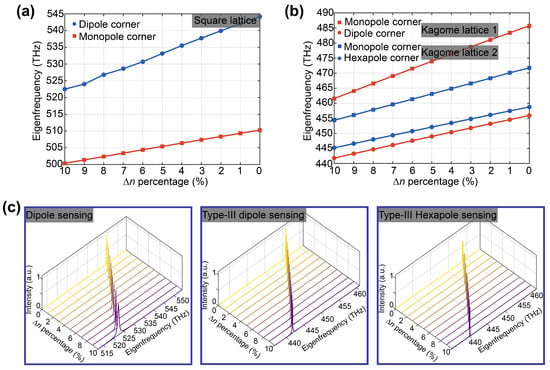
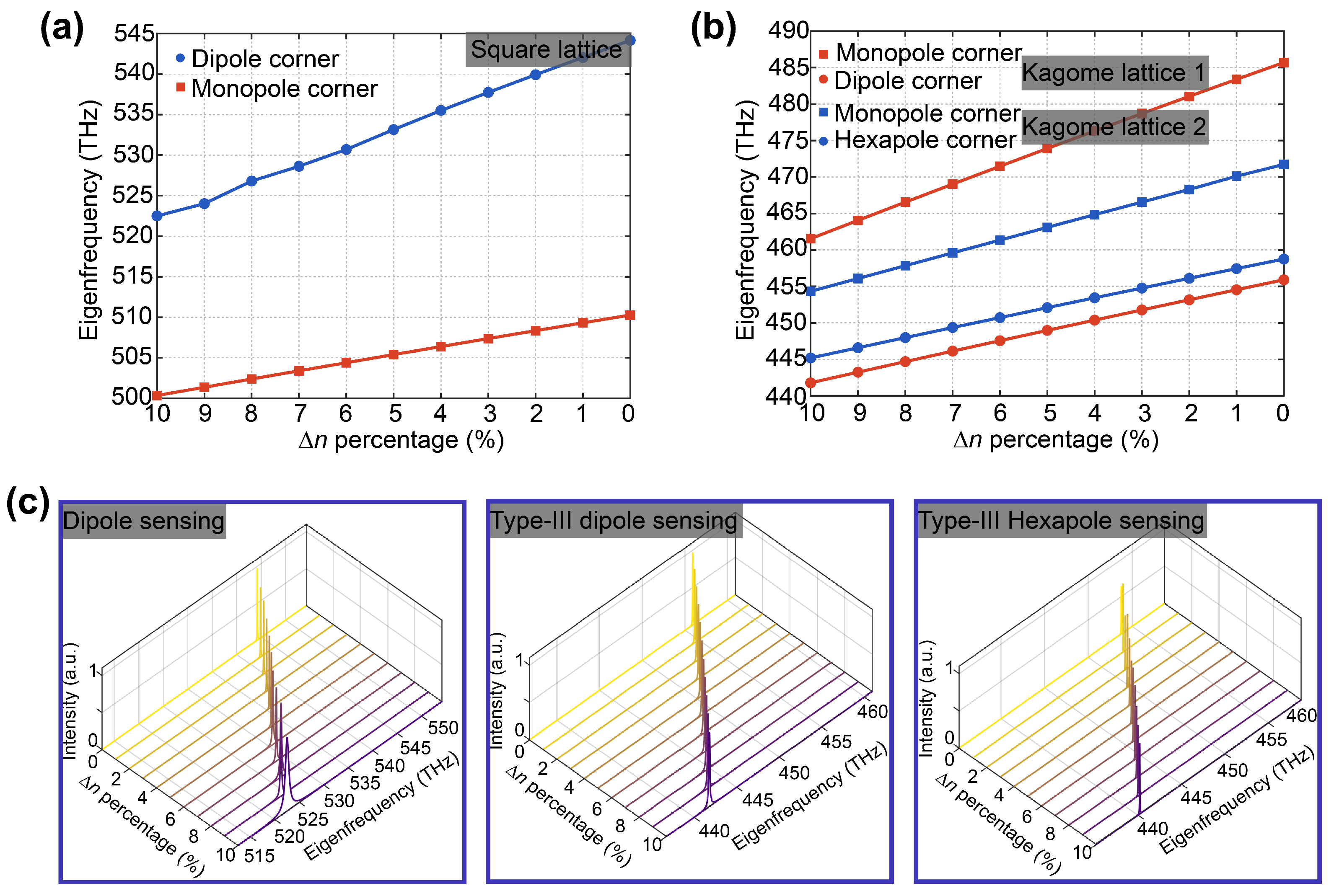
Due to their extremely small mode volumes, higher-order topological microcavities serve as ideal refractive index sensors [17]. We systematically compared the performance of traditional monopole corner states with the newly designed dipole and hexapole corner states in sensing micro-environmental refractive index changes. Figure 4a illustrates the response curves of the eigenfrequency versus background refractive index variation () in the square lattice. The comparison reveals that the dipole corner state generated by the dual topological domains exhibits a steeper slope than the monopole corner state from a single domain. This implies that the dipole mode possesses higher sensitivity to minute changes in the external refractive index. In the Kagome lattice [Figure 4b], we compared the sensing responses of the single-domain monopole Type-I corner state, the dipole Type-III corner state, and the hexapole antisymmetric Type-III corner state generated by triple domains. The results show that the eigenfrequency shift slopes in response to refractive index changes are relatively similar among these structures. However, the actual detection limit of a sensor depends not only on the wavelength/frequency shift sensitivity but is also largely governed by the resonance linewidth (i.e., the Q-factor).
Figure 4.
(a) Square lattice: Comparison of sensing performance between the monopole corner state generated by a monopole topological domain and the dipole corner state generated by dual topological domains. The dipole exhibits a more sensitive eigenfrequency response to refractive index variations. (b) Kagome lattice: Comparison of sensing performance among the monopole Type-I and dipole Type-III corner states generated by a monopole topological domain, and the monopole Type-I and hexapole antisymmetric Type-III corner states generated by multiple topological domains. These monopole, dipole, and hexapole structures exhibit similar sensitivities in their eigenfrequency responses to refractive index changes. However, as shown in (c), the Lorentz lineshapes fitted based on the calculated Q-factors for the sensing of the square lattice dipole (left), Kagome lattice dipole (middle), and Kagome lattice hexapole (right) indicate that the hexapole possesses a significantly higher Q-factor.
It is worth emphasizing that the terms “dipole” and “hexapole” used herein refer to the symmetry-enforced signed electric field () phase distributions—characterized by two alternating out-of-phase lobes under symmetry and six alternating lobes under symmetry, respectively—rather than claiming a new bulk topological invariant. Under the specific centripetal domain displacements ( for the square lattice and for the Kagome lattice), the strong near-field coupling lifts the hybridization degeneracy and shifts competing symmetric combinations into the bulk or edge continuum, yielding a unique, isolated eigenmode solution for both the square-lattice dipole state and the Kagome-lattice Type-III(A) hexapole state in the calculated eigenspectra. Consequently, the rigorous bulk topological invariant calculations ( and ), the isolated solutions in the eigenspectra, and the localized signed field profiles collectively confirm that the resulting resonances are symmetry-edited dipole and hexapole topological corner states.
To this end, we plotted the Lorentz lineshapes of different modes based on their calculated Q-factors. As shown in the 3D intensity spectra in Figure 4c, from left to right are the sensing lineshapes of the square lattice dipole, Kagome lattice dipole, and Kagome lattice hexapole. It is visually evident that the hexapole corner state in the Kagome lattice (right panel) features the narrowest resonance linewidth, translating to a significantly higher Q-factor. This high-Q multipole characteristic can vastly lower the sensing detection limit and enhance resolution.
To rigorously evaluate the refractive index sensing performance beyond visual slope comparisons, we quantify the resonance shifts of both the square-lattice dipole state and the Kagome-lattice hexapole state using metrics grounded in first-order cavity perturbation theory. Note that the calculated sensing ability is only for the 2D case, which would be considerably higher than that in practical scenarios. These results are for demonstration purposes only. Here, the “ percentage” is defined as the relative refractive index variation , varied from to in fine increments of ( per step relative to a baseline index ; note that sensitivities normalized to the dielectric index scale proportionally by a factor of ). By continuously tracking the target eigenmodes across these fine index increments, linear regression confirms exceptional linearity with a coefficient of determination of for both configurations.
Specifically, for the hybridized dipole mode in the square lattice (tracked from / at to / at ), we obtain a frequency sensitivity of and a wavelength sensitivity of . For the hybridized Type-III(A) hexapole mode in the Kagome lattice (tracked from / at to / at ), the frequency and wavelength sensitivities reach and , respectively. Furthermore, from the complex eigenfrequency of the Kagome hexapole state, the intrinsic full-width at half-maximum (FWHM) at the unperturbed baseline is (, corresponding to a high quality factor of ), yielding an ultrahigh linewidth-based figure of merit of (with an average of across the entire perturbation range).
To eliminate frequency-scaling bias between modes operating at different baseline frequencies , we further evaluate the dimensionless normalized frequency sensitivity and relate it to the spatial electromagnetic energy overlap via first-order cavity perturbation theory:
where denotes the fraction of modal electric energy residing within the perturbed region . The extracted normalized sensitivities reveal that the Kagome hexapole state achieves a substantially higher normalized sensitivity (, corresponding to ) than the square-lattice dipole state (, ), demonstrating that the six-lobe hexapole hybridization more effectively concentrates the modal electric energy into the active sensing junction. Moreover, this perturbation framework naturally explains why the various Kagome corner states in Figure 4b exhibit comparable frequency slopes: within the same Kagome lattice, the different corner modes share similar dielectric-to-air energy confinement ratios (). Consequently, the superior sensing performance of our symmetry-edited multipolar topological states stems specifically from the enhanced spatial field overlap () at the central multi-domain cavity and their ultranarrow spectral linewidths (), which jointly maximize the overall detection resolution ().
It should be noted that the normalized Lorentzian profiles in Figure 4c are analytically reconstructed from the complex eigenfrequencies computed with perfectly matched layers (PMLs) to illustrate the intrinsic spectral tracking, where the intrinsic quality factor is extracted as . Specifically, for the Kagome hexapole state across the perturbation range, varies from to , corresponding to high intrinsic quality factors of at () to at (), whereas the symmetry-protected square-lattice mode exhibits vanishing in-plane radiation loss (visualized using a nominal linewidth of ). In practical driven optical measurements (such as waveguide-coupled transmission or localized scattering), the measurable linewidth is determined by the loaded quality factor, , where represents the external coupling rate to the excitation and collection channels. As highlighted by Conteduca et al. [44], maximizing Q alone does not guarantee an optimal detection limit under realistic system noise; rather, the effective sensing figure of merit scales with the product of the loaded quality factor and the resonance amplitude (contrast), . According to temporal coupled-mode theory, operating near the critical coupling condition () maximizes the resonance contrast while maintaining a high loaded quality factor ( for the Kagome hexapole cavity), thereby ensuring both high spectral resolution and strong signal-to-noise ratio in practical interrogation schemes.
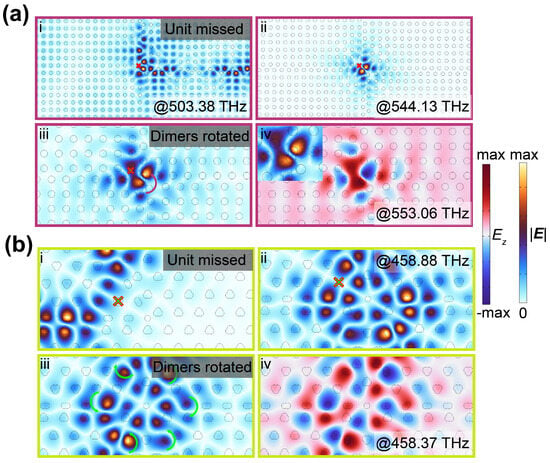
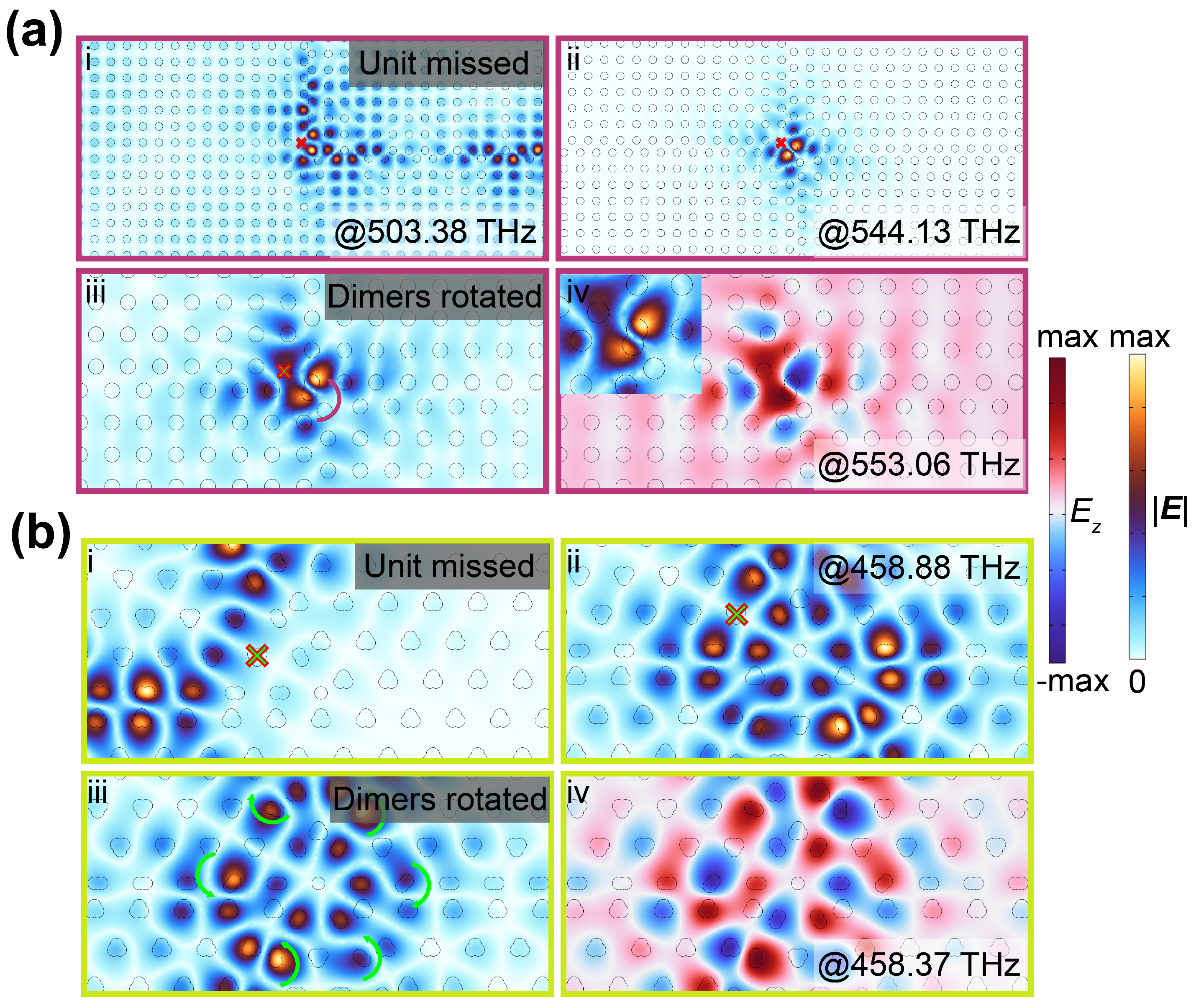
One of the compelling features of topological photonics is its immunity to structural defects. To verify whether the multipole corner states engineered via macroscopic symmetry retain or even surpass traditional topological protection, we introduced severe structural perturbations for testing. For the square lattice [Figure 5a], when a dielectric pillar unit is removed near the corner of a monopole topological domain (Unit missed), the traditional monopole corner state mode immediately undergoes strong mixing with the edge state mode, causing the corner state to vanish within the bandgap [Figure 5a(i)]. In sharp contrast, when the same unit-missing defect is introduced into the diagonally arranged dual-domain model, the dipole corner state remains stable, accompanied by only a minuscule eigenfrequency shift (544.13 THz) [Figure 5a(ii)]. To further test its stability, we artificially rotated the dimers constituting the dipole corner state (Dimers rotated) on top of the missing unit. As shown in Figure 5a(iii,iv), even under such intense dual-disorder perturbations, the dipole corner state remains robust, preserving its characteristic electric field dipole distribution.
Figure 5.
(a) Stability comparison between the traditional monopole corner state and the dipole corner state in a square lattice: (i) A missing unit near the corner of a monopole topological domain causes the eigenfrequency of the corner state mode to mix with that of the edge state mode, leading to the disappearance of the corner state. (ii) With a missing unit near the corner of diagonally arranged dual topological domains, the corner state remains stable, accompanied only by a slight shift in its eigenfrequency (compared to Figure 3b). (iii) In addition to the missing unit, we further rotate the dimers constituting the dipole corner state, and the state remains stable. (iv) The characteristic dipole electric field distribution resulting from the stable formation of the dipole corner state. (b) Stability comparison of Type-III topological corner states in a Kagome lattice: (i) A missing unit near the corner of a monopole topological domain leads to the disappearance of the Type-III corner state. (ii) With a missing unit near the corner of triple topological domains, the hexapole Type-III corner state remains stable, accompanied only by a slight eigenfrequency shift (compared to Figure 3d). (iii) Upon rotating the six dimers constituting the hexapole corner state, it remains robustly stable. (iv) The characteristic hexapole electric field distribution resulting from the stable formation of the hexapole corner state.
Similar stability is observed in the Kagome lattice [Figure 5b]. A missing unit near the corner completely destroys the Type-III monopole corner state of a single domain [Figure 5b(i)]. However, for the structure containing three topological domains, the identical defect fails to destroy the hexapole Type-III corner state, whose frequency remains stable around 458.88 THz [Figure 5b(ii)]. Furthermore, when all six dimers constituting the hexapole corner state are randomly rotated [Figure 5b(iii)], the hexapole mode exhibits certain robustness, with its electric field distribution maintaining clear hexapole symmetry characteristics [Figure 5b(iv)]. Topological protection guarantees the persistence and localization of the mode (it does not hybridize with bulk states and disappear, maintaining a high Q-factor), but its exact eigenfrequency must shift because the local dielectric volume changes.
These results provide compelling evidence that the dipole and hexapole topological corner states constructed via macroscopic symmetry engineering not only boast advantages in localized field enhancement and Q-factors but also possess structural defect immunity exceeding that of traditional monopole-domain corner states, establishing a solid foundation for designing highly robust active and passive photonic devices.
4. Conclusions
In summary, this work proposes a novel mechanism to construct multipole higher-order topological corner states in photonic systems by engineering the global macroscopic symmetry of the lattice. Although the demonstration is based on a 2D system, the approach can be readily extended to 3D cases. Breaking the limitations of traditional structures where a single topological domain yields only monopole corner states, we successfully excited dipole and hexapole topological corner states in square and Kagome lattices by deliberately arranging the spatial distribution of topological and trivial domains.
Through systematic theoretical calculations and numerical validations, we demonstrated that these symmetry-engineered multipole corner states exhibit outstanding performance in photonic device applications, comprehensively outperforming traditional monopole corner states: First, in sensing applications, dipole and hexapole corner states exhibit stronger light-matter interactions. Compared to conventional monopole modes, they possess higher sensitivity to changes in the micro-environmental refractive index. The hexapole corner state, in particular, delivers an extremely narrow resonance linewidth and an ultra-high Q-factor, significantly lowering the sensing detection limit. Second, regarding topological protection, multipole corner states display defect immunity. When confronted with severe local structural perturbations, such as missing lattice units near the corners or random dimer rotations, traditional monopole corner states rapidly vanish due to mode hybridization. In contrast, the dipole and hexapole corner states constructed in this work perfectly withstand these disruptions, stably maintaining their topological modes and eigenfrequencies.
5. Discussion
Possible experimental platforms for the actual fabrication of a 3D topological sensor include conventional e-beam lithography and nanoimprint technologies, using semiconductor materials or gain materials such as perovskite quantum dots. We also note the limitations of our current theoretical study, specifically considering that experimental detection limits and the complexities of full 3D device fabrication (e.g., sidewall roughness affecting experimental Q) remain to be established in future empirical works.
Ultimately, this research not only theoretically expands the dimensional paradigm of modes in higher-order topological photonics—from monopoles to higher-order multipoles, providing a new degree of freedom for localizing light fields—but also offers a highly promising design blueprint and theoretical basis for developing next-generation on-chip active/passive devices (e.g., topological photonic sensing chips and topological microcavity lasers) that simultaneously feature ultra-high sensitivity, high Q-factors, and extreme interference resistance.
Author Contributions
Conceptualization, Q.Z.; Methodology, L.Y., G.L. and Q.Z.; Software, L.Y., G.L. and Q.Z.; Formal analysis, L.Y., G.L. and Q.Z.; Writing—original draft preparation, L.Y., G.L. and Q.Z.; Writing—review and editing, L.Y., G.L., J.Y., R.C., L.Z., X.Y. and Q.Z.; Supervision, L.Z. and Q.Z.; Project administration, L.Z. and Q.Z.; Funding acquisition, L.Z., Q.Z. and X.Y. All authors have read and agreed to the published version of the manuscript.
Funding
This research was funded by the National Natural Science Foundation of China (No. 12534017), Guangdong Basic and Applied Basic Research Foundation (No. 2025A1515010326), and the Shenzhen Science and Technology Innovation Program (No. JCYJ20250604181902003).
Data Availability Statement
Data underlying the results presented in this paper are not publicly available at this time but may be obtained from the authors upon reasonable request.
Conflicts of Interest
The authors declare no conflicts of interest.
References
- Lu, L.; Joannopoulos, J.D.; Soljačić, M. Topological photonics. Nat. Photonics 2014, 8, 821–829. [Google Scholar] [CrossRef] [Scilit]
- Ozawa, T.; Price, H.M.; Amo, A.; Goldman, N.; Hafezi, M.; Lu, L.; Rechtsman, M.C.; Schuster, D.; Simon, J.; Zilberberg, O.; et al. Topological photonics. Rev. Mod. Phys. 2019, 91, 015006. [Google Scholar] [CrossRef] [Scilit]
- Hasan, M.Z.; Kane, C.L. Colloquium: Topological insulators. Rev. Mod. Phys. 2010, 82, 3045–3067. [Google Scholar] [CrossRef] [Scilit]
- Haldane, F.D.M.; Raghu, S. Possible Realization of Directional Optical Waveguides in Photonic Crystals with Broken Time-Reversal Symmetry. Phys. Rev. Lett. 2008, 100, 013904. [Google Scholar] [CrossRef] [Scilit] [PubMed]
- Wang, Z.; Chong, Y.; Joannopoulos, J.D.; Soljačić, M. Observation of unidirectional backscattering-immune topological electromagnetic states. Nature 2009, 461, 772–775. [Google Scholar] [CrossRef] [Scilit] [PubMed]
- El-Ganainy, R.; Makris, K.G.; Khajavikhan, M.; Musslimani, Z.H.; Rotter, S.; Christodoulides, D.N. Non-Hermitian physics and PT symmetry. Nat. Phys. 2018, 14, 11–19. [Google Scholar] [CrossRef] [Scilit]
- St-Jean, P.; Goblot, V.; Galopin, E.; Lemaître, A.; Ozawa, T.; Le Gratiet, L.; Sagnes, I.; Bloch, J.; Amo, A. Lasing in topological edge states of a one-dimensional lattice. Nat. Photonics 2017, 11, 651–656. [Google Scholar] [CrossRef] [Scilit]
- Ota, Y.; Katsumi, R.; Watanabe, K.; Iwamoto, S.; Arakawa, Y. Topological photonic crystal nanocavity laser. Commun. Phys. 2018, 1, 86. [Google Scholar] [CrossRef] [Scilit]
- Bahari, B.; Ndao, A.; Vallini, F.; El Amili, A.; Fainman, Y.; Kanté, B. Nonreciprocal lasing in topological cavities of arbitrary geometries. Science 2017, 358, 636–640. [Google Scholar] [CrossRef] [Scilit] [PubMed]
- Klembt, S.; Harder, T.; Egorov, O.; Winkler, K.; Ge, R.; Bandres, M.; Emmerling, M.; Worschech, L.; Liew, T.; Segev, M.; et al. Exciton-polariton topological insulator. Nature 2018, 562, 552–556. [Google Scholar] [CrossRef] [Scilit] [PubMed]
- Bandres, M.A.; Wittek, S.; Harari, G.; Parto, M.; Ren, J.; Segev, M.; Christodoulides, D.N.; Khajavikhan, M. Topological insulator laser: Experiments. Science 2018, 359, eaar4005. [Google Scholar] [CrossRef] [Scilit] [PubMed]
- Harari, G.; Bandres, M.A.; Lumer, Y.; Rechtsman, M.C.; Chong, Y.D.; Khajavikhan, M.; Christodoulides, D.N.; Segev, M. Topological insulator laser: Theory. Science 2018, 359, eaar4003. [Google Scholar] [CrossRef] [Scilit] [PubMed]
- Zeng, Y.; Chattopadhyay, U.; Zhu, B.; Qiang, B.; Li, J.; Jin, Y.; Li, L.; Davies, A.G.; Linfield, E.H.; Zhang, B.; et al. Electrically pumped topological laser with valley edge modes. Nature 2020, 578, 246–250. [Google Scholar] [CrossRef] [Scilit] [PubMed]
- Wang, Y.; Xia, S.; Xie, Q.; Yang, D.; Shao, J.; Zhang, X.; Drevensek-Olenik, I.; Wu, Q.; Chen, Z.; Xu, J. Soft-matter-based topological vertical cavity surface emitting lasers. Light Sci. Appl. 2026, 15, 27. [Google Scholar] [CrossRef] [Scilit] [PubMed]
- Zhang, Q.; Duan, R.; Ao, Y.; Wang, L.; Zhou, X.; Yang, X.; Zhang, Q.; Yuan, X.C.; Zhang, B.; Sun, H. Nanoimprinted topological laser in the visible. Sci. Bull. 2026, 71, 1941–1948. [Google Scholar] [CrossRef] [Scilit] [PubMed]
- Lv, J.; Chen, Z.; Yin, X.; Zhang, Z.; Hu, W.; Peng, C. High-Sensitive Refractive Index Sensing Enabled by Topological Charge Evolution. IEEE Photonics J. 2020, 12, 4501610. [Google Scholar] [CrossRef] [Scilit]
- Yu, Z.; Lin, H.; Zhou, R.; Wang, Y. A high-Q topological refractive index sensor based on high-order corner states. Opt. Laser Technol. 2025, 181, 111582. [Google Scholar] [CrossRef] [Scilit]
- Abood, I.; El. Soliman, S.; He, W.; Ouyang, Z. Topological Photonic Crystal Sensors: Fundamental Principles, Recent Advances, and Emerging Applications. Sensors 2025, 25, 1455. [Google Scholar] [CrossRef] [Scilit] [PubMed]
- Sani, M.H.; Zhang, Z.; Chen, S.; Zhang, H.; Xiao, S.; Han, Q.; Zhang, Z.; Wang, J.; Chen, H.; Tsang, H.K.; et al. Topological photonic crystal triangular micro-cavity for on-chip gas sensing. Sens. Actuators B Chem. 2026, 458, 139809. [Google Scholar] [CrossRef] [Scilit]
- Panciera, C.; Brunetti, G.; Ciminelli, C. Numerical investigation of IgG sensing through nanoscale topological-assisted metasurface for liquid biopsy. Nanotechnol. Rev. 2026, 15, 20250284. [Google Scholar] [CrossRef] [Scilit]
- Mohamed, Z.A.; Abd-Elnaiem, A.M.; Abood, I.; Almokhtar, M.; Soliman, S.E. Fano resonance-boosted topological sensor for next-generation sensing. Opt. Quan. Electron. 2025, 57, 127. [Google Scholar] [CrossRef] [Scilit]
- Benalcazar, W.A.; Bernevig, B.A.; Hughes, T.L. Quantized electric multipole insulators. Science 2017, 357, 61–66. [Google Scholar] [CrossRef] [Scilit] [PubMed]
- Xue, H.; Yang, Y.; Gao, F.; Chong, Y.; Zhang, B. Acoustic higher-order topological insulator on a kagome lattice. Nat. Mater. 2019, 18, 108–112. [Google Scholar] [CrossRef] [Scilit] [PubMed]
- Ni, X.; Weiner, M.; Alu, A.; Khanikaev, A.B. Observation of higher-order topological acoustic states protected by generalized chiral symmetry. Nat. Mater. 2019, 18, 113–120. [Google Scholar] [CrossRef] [Scilit] [PubMed]
- Kempkes, S.; Slot, M.; van Den Broeke, J.; Capiod, P.; Benalcazar, W.; Vanmaekelbergh, D.; Bercioux, D.; Swart, I.; Morais Smith, C. Robust zero-energy modes in an electronic higher-order topological insulator. Nat. Mater. 2019, 18, 1292–1297. [Google Scholar] [CrossRef] [Scilit] [PubMed]
- van Miert, G.; Ortix, C. On the topological immunity of corner states in two-dimensional crystalline insulators. npj Quan. Mater. 2020, 5, 63. [Google Scholar] [CrossRef] [Scilit]
- Kim, H.R.; Hwang, M.S.; Smirnova, D.; Jeong, K.Y.; Kivshar, Y.; Park, H.G. Multipolar lasing modes from topological corner states. Nat. Commun. 2020, 11, 3045–3067. [Google Scholar] [CrossRef] [Scilit] [PubMed]
- Jung, M.; Yu, Y.; Shvets, G. Exact higher-order bulk-boundary correspondence of corner-localized states. Phys. Rev. B 2021, 104, 195437. [Google Scholar] [CrossRef] [Scilit]
- Herrera, M.A.J.; Kempkes, S.N.; de Paz, M.B.; García-Etxarri, A.; Swart, I.; Smith, C.M.; Bercioux, D. Corner modes of the breathing kagome lattice: Origin and robustness. Phys. Rev. B 2022, 105, 085411. [Google Scholar] [CrossRef] [Scilit]
- Vakulenko, A.; Kiriushechkina, S.; Wang, M.; Li, M.; Zhirihin, D.; Ni, X.; Guddala, S.; Korobkin, D.; Alù, A.; Khanikaev, A.B. Near-field characterization of higher-order topological photonic states at optical frequencies. Adv. Mater. 2021, 33, 2004376. [Google Scholar] [CrossRef] [Scilit] [PubMed]
- Li, M.; Zhirihin, D.; Gorlach, M.; Ni, X.; Filonov, D.; Slobozhanyuk, A.; Alu, A.; Khanikaev, A.B. Higher-order topological states in photonic kagome crystals with long-range interactions. Nat. Photonics 2020, 14, 89–94. [Google Scholar] [CrossRef] [Scilit]
- Yang, H.; Song, L.; Cao, Y.; Yan, P. Observation of type-III corner states induced by long-range interactions. Phys. Rev. B 2022, 106, 075427. [Google Scholar] [CrossRef] [Scilit]
- Xiong, W.; Wang, S.; Zhang, Z.; Zhang, H.; Cheng, Y.; Liu, X. Observation of multiple off-site corner states induced by next-nearest-neighbor coupling in a sonic crystal. Phys. Rev. B 2024, 109, 024305. [Google Scholar] [CrossRef] [Scilit]
- Hu, Z.; Bongiovanni, D.; Jukić, D.; Jajtić, E.; Xia, S.; Song, D.; Xu, J.; Morandotti, R.; Buljan, H.; Chen, Z. Nonlinear control of photonic higher-order topological bound states in the continuum. Light Sci. Appl. 2021, 10, 164. [Google Scholar] [CrossRef] [Scilit] [PubMed]
- Deng, Z.; Zhang, X.; Gao, D.; Lu, M.H.; Zhang, X. Deterministic generation of multiple topological corner states based on an extremely expanded coupling condition. Phys. Rev. Res. 2022, 4, 033084. [Google Scholar] [CrossRef] [Scilit]
- Xie, B.; Wang, H.X.; Zhang, X.; Zhan, P.; Jiang, J.H.; Lu, M.; Chen, Y. Higher-order band topology. Nat. Rev. Phys. 2021, 3, 520–532. [Google Scholar] [CrossRef] [Scilit]
- Wu, J.; Ghosh, S.; Gan, Y.; Shi, Y.; Mandal, S.; Sun, H.; Zhang, B.; Liew, T.C.; Su, R.; Xiong, Q. Higher-order topological polariton corner state lasing. Sci. Adv. 2023, 9, eadg4322. [Google Scholar] [CrossRef] [Scilit] [PubMed]
- Ota, Y.; Liu, F.; Katsumi, R.; Watanabe, K.; Wakabayashi, K.; Arakawa, Y.; Iwamoto, S. Photonic crystal nanocavity based on a topological corner state. Optica 2019, 6, 786–789. [Google Scholar] [CrossRef] [Scilit]
- Zhang, W.; Xie, X.; Hao, H.; Dang, J.; Xiao, S.; Shi, S.; Ni, H.; Niu, Z.; Wang, C.; Jin, K.; et al. Low-threshold topological nanolasers based on the second-order corner state. Light Sci. Appl. 2020, 9, 109. [Google Scholar] [CrossRef] [Scilit] [PubMed]
- Kim, M.; Jacob, Z.; Rho, J. Recent advances in 2D, 3D and higher-order topological photonics. Light Sci. Appl. 2020, 9, 130. [Google Scholar] [CrossRef] [Scilit] [PubMed]
- Medina-Vázquez, J.A. Influence of asymmetric long-range interactions on corner states in photonic higher-order topological insulators. Phys. Rev. A 2023, 107, 043503. [Google Scholar] [CrossRef] [Scilit]
- Medina-Vázquez, J.A.; González-Ramírez, E.Y.; Murillo-Ramírez, J.G. Corner states in photonic higher-order Dirac semimetals. Phys. Rev. A 2023, 107, 053511. [Google Scholar] [CrossRef] [Scilit]
- Liu, Z.; Zhang, J.; Wei, G.; Li, P.; Zhang, X.; Xiao, J.J. Type-III corner states in second-order topological insulators enabled by distinct hybridization of photonic Wannier functions. Phys. Rev. B 2025, 111, 165408. [Google Scholar] [CrossRef] [Scilit]
- Conteduca, D.; Arruda, G.S.; Barth, I.; Wang, Y.; Krauss, T.F.; Martins, E.R. Beyond Q: The Importance of the Resonance Amplitude for Photonic Sensors. ACS Photonics 2022, 9, 1757–1763. [Google Scholar] [CrossRef] [Scilit] [PubMed]
Disclaimer/Publisher’s Note: The statements, opinions and data contained in all publications are solely those of the individual author(s) and contributor(s) and not of MDPI and/or the editor(s). MDPI and/or the editor(s) disclaim responsibility for any injury to people or property resulting from any ideas, methods, instructions or products referred to in the content. |
© 2026 by the authors. Licensee MDPI, Basel, Switzerland. This article is an open access article distributed under the terms and conditions of the Creative Commons Attribution (CC BY) license.