


Abstract
Metasurfaces provide a versatile platform for vivid structural coloration by tailoring the visible spectrum at the subwavelength scale. A variety of research has been dedicated to broadening the color gamut including hue and saturation. However, the color gamut is limited in a 2D CIE map, which cannot exhibit chiaroscuro information of colorful images due to the lack of brightness tuning. In this work, we propose a passive, reflective and analyzer-free metasurface platform performing arbitrary HSB tunability and exhibiting full color generation by simultaneous spectral and polarizing filtration. A single plasmonic metasurface consisting of aluminum nanorods is demonstrated to generate multiple colors, which are determined by the in-plane dimension of the nanorod. Based on Malus’s law, continuous brightness tuning of these individual colors can be achieved by adjusting the nanorod orientation under linearly polarized illumination, without requiring an additional polarization analyzer in the reflected-light path. Finally, we numerically reproduce the artwork “Portrait of a Musician”, which features photorealistic presentation and stereoscopic impression. Such an approach shows great potential to simply control the color in HSB space with high spatial resolution, which is significant in the applications of next-generation compact reflective displays.
1. Introduction
Color is a visual perceptual characteristic of humans which originates from the interaction between the visible light and light receptors with the spectral sensitivities in the eye. In general, the chromogenic mechanisms of colorful materials or objects are mainly related to their emission, absorption, transmission or reflection spectra [1,2,3,4]. For example, laser display devices can generate full color images by emitting and mixing light of three primary colors, i.e., red, green, and blue (RGB). The laser display techniques can realize high color hue and saturation (HS), but they need an external power supply and are easily affected by the ambient light intensity. Alternatively, passive color materials free from power consumption have been widely applied to printing, textile and consumer electronics industries and so on. Dyes and pigments, as typical passive color materials, can exhibit various colors by absorbing specific wavelengths of light and reflecting others, which depends on their chemical composition and molecular electronic structure. However, they would fade under some harsh conditions such as ultraviolet (UV) irradiation or high temperature. Additionally, some synthetic dyes and pigments may pollute the environment or be harmful to the human body.
Structural coloration based on metal, dielectric or semiconductor nanostructures has been extensively explored due to its high resolution, chemical stability and environmentally friendly characteristics [5,6,7]. Particularly, with the remarkable development of nano-scale fabrication, emerging optical metasurfaces composed of two-dimensional (2D) subwavelength structure arrays provide a versatile optical platform for manipulating the visible transmission or reflection spectrum and exhibiting almost all kinds of colors [8,9,10,11,12,13]. More recently, printable meta-assemblies have demonstrated scalable and highly tunable structural coloration, further highlighting the potential of nanostructured optical platforms for large-area color printing and display applications [14]. The generated colors can be characterized by three merits, i.e., hue, saturation, and brightness (HSB). At present, a variety of research works for metasurface-based structural colors realize high HS by modifying the nanoscale unit’s geometry dimensions such as its shape, size or period [15,16,17,18,19,20,21,22,23,24]. For example, by tuning the plasmonic resonance effect of metals, arbitrary color control within the visible range can be achieved [15,16,17,18]. Alternatively, by adjusting the Mie scattering resonance in dielectric structures, continuous color tuning from blue to red can be realized [19,20,21,22,23,24,25]. But the color gamut in these works is limited in a 2D CIE map, which cannot exhibit chiaroscuro information of colorful images due to the lack of brightness tuning. Alternatively, the realization of arbitrary full-color HSB tuning is needed. Recently, full-color images have been generated by printing ordinary silver nanoparticle ink on top of a substrate patterned with polymer nanostructures and their brightness tuning was achieved by controlling the number of silver nanoparticle within an individual subpixel [26]. However, this approach used large-scale pixels in hundreds of micros, which leads to low resolution of the color printing. Another method using small plasmonic pixels in tens of microns to achieve brightness-tuning color printing is demonstrated by selecting and mixing different spatially separated subpixels with either black, white, or the three primary colors [27]. In order to reduce the number of colored subpixels mixed for additive color printing and overcome the limitation of specific mixing ratios, there is a demand for arbitrarily tuning the brightness of individual colors such as RGB colors, which can be used for exhibition of photorealistic images [15,28,29,30]. For instance, a plasmonic color mixing approach with independent tuning of the brightness of RGB color components was demonstrated to show photorealistic printing images by simply varying dimensions of nanorods and lattice periodicity of the nanorod array [15]. In addition, the orientation angle of the nanorod is also a geometric in-plane parameter, which can be utilized to control the brightness of individual colors. More recently, full-color generation and ultrasmooth brightness variation enabled by a transmission metasurface were realized by adjusting the interference between two nanopillars [28] or utilizing Malus’s law [29]. The constructed nanoprinting images featured excellent photorealistic color presentation, but these approaches require an essential polarization analyzer, which would hinder the miniaturization and integration of passive color display systems. Meanwhile, recent advances in integrated meta-optics have further emphasized the importance of incorporating multiple optical functionalities into compact photonic platforms [31].
Herein, we propose a passive, reflective and analyzer-free metasurface platform with integration of spectral and polarizing filtering for achieving arbitrary hue–saturation–brightness (HSB) tuning of structural color. In this work, “analyzer-free” refers to the absence of an additional polarization analyzer in the reflected light path. The metasurface achieves brightness modulation by varying the relative angle between the aluminum nanorods and the incident linearly polarized light. The metasurface consisting of aluminum nanorods is demonstrated to generate multiple colors, which are determined by the in-plane dimension of the nanorod. Meanwhile, this metasurface is also designed to function as a reflective analyzer for linear polarization filtering. Based on Malus’s law, continuous brightness tuning of these individual colors can be achieved by adjusting the orientation of the nanorod without an additional polarization analyzer. Therefore, the color gamut is extended from a 2D CIE map to a 3D HSB space. Finally, by utilizing the proposed aluminum metasurface, we reproduce the artwork “Portrait of a Musician” in simulation, which features photorealistic presentation and stereoscopic impression. Such an approach shows great potential to simultaneously control the HSB with high spatial resolution, which is significant in the applications of next-generation compact reflective displays.
2. Principles
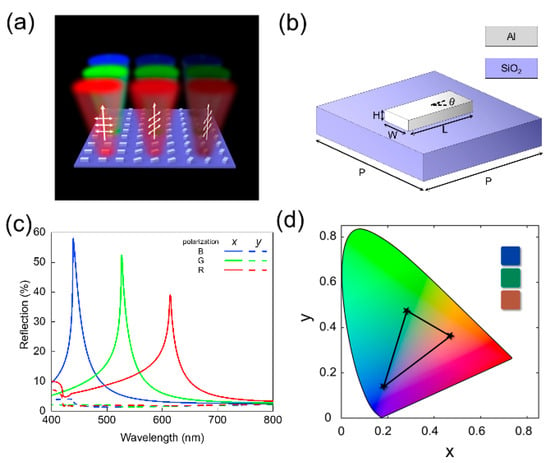
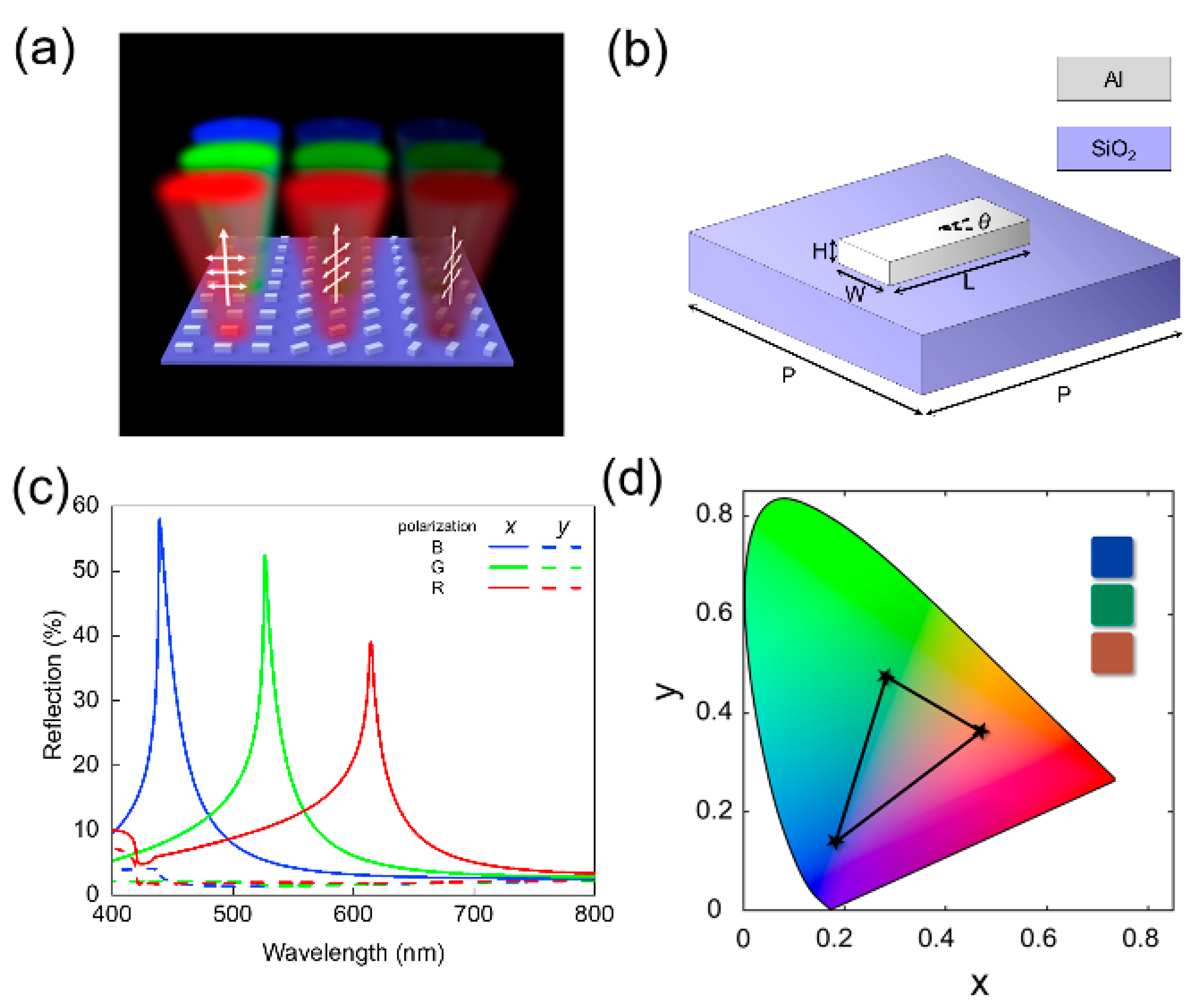
Figure 1a illustrates the proposed reflective plasmonic metasurface, which is capable of arbitrary full-color HSB tuning by filtering spectrum and polarization of incident light. Multiple colors and their brightness can be controlled by varying the dimensions and orientation angles of nanorods on the metasurface. The unit cell of this metasurface consists of an aluminum nanorod sitting on a silica substrate (Figure 1b). Aluminum is chosen here due to its broadband plasmonic characteristics from ultraviolet to near-infrared. Moreover, aluminum is much cheaper than conventional noble metals and is compatible with complementary metal-oxide-semiconductor (CMOS) technology. In addition, aluminum nanoantenna metasurfaces with comparable nanoscale dimensions have been experimentally fabricated using well-established electron-beam lithography, metal deposition, and lift-off processes, demonstrating the practical feasibility of fabricating such aluminum nanostructures [32]. The height, width and length of the aluminum nanorod are denoted by H, W, and L, respectively. The square lattice constant of the nanorod array is P and the angle between the major axis of the aluminum nanorod and the x axis is defined as θ. To obtain the reflective spectrum of the proposed aluminum metasurface, the numerical simulations are performed using the finite difference time domain (FDTD) algorithm.
Figure 1.
(a) Schematic diagram of the proposed reflective plasmonic metasurface for spectral and polarizing filtration. (b) The unit cell of the aluminum metasurface. The thickness, period, length and width of aluminum nanorods are denoted by H, P, L and W, respectively. (c) Reflectance spectra of the three primary RGB colors under x- and y-polarized light. (d) The chromaticity coordinates of the generated RGB colors in the CIE 1931 map.
The incident plane-wave with a wavelength range of 400–800 nm is polarized along the x or y axes and incident on the nanorod from the top side of the silica substrate. Periodic boundary conditions are applied along the x and y axes, and a perfectly matched layer boundary condition is used in the z direction. The mesh grid along the x, y, and z axes in simulation is set to 2 nm, 2 nm and 2 nm, respectively. The refractive indices of aluminum and silica are obtained from Palik [30]. The height H, width W and orientation angle θ of the aluminum nanorod are set to 80 nm, 70 nm and 0 rad, respectively. When the length and lattice period of the aluminum nanorods are specially optimized, the plasmon resonance could be excited under a selected wavelength of incident light. The reflective spectrum of the aluminum nanorod array is optimized by varying the values of L from 100 nm to 150 nm and P from 300 nm to 450 nm. The period of the aluminum nanorod array should be sub-wavelength scale to avoid high-order optical diffraction. The simulated reflection magnitudes for B, G and R pixels of three different geometric dimensions under x-polarized light are selected and depicted by solid lines in Figure 1c. The optimized length and period (L, P) of aluminum nanorods for B, G and R pixels are (100 nm, 300 nm), (120 nm, 360 nm), and (140 nm, 420 nm), respectively. As the length and period of the aluminum nanorods increase, the resonance wavelength is red-shifted. As expected, a single prominent peak can be observed in each spectrum and located approximately at the wavelength of 440 nm, 527 nm, and 617 nm, corresponding to the reflectance of 50.84%, 56.58% and 49.33%, respectively. In addition, the full width at half maximum (FWHM) of the reflectance spectra corresponding to B, G and R is 38 nm, 19 nm, 37 nm, respectively. For y-polarized light incident on the aluminum nanorod array, the simulated reflectance spectra of B, G and R pixels are depicted by dashed lines in Figure 1c. The reflectance across the entire visible spectral range for the three dashed curves is very low and close to zero, which indicates that this kind of aluminum nanorod array can function as an analyzer and allow the reflection of linear polarization along the x-direction. This polarization property of the proposed metasurface can be used for later brightness tuning of individual colors. According to the three spectra of x-polarized light in Figure 1c, their corresponding colors and CIE 1931 chromaticity coordinates are calculated and shown in Figure 1d.
Additionally, the proposed reflective aluminum metasurface is capable of tuning color brightness. When the orientation angle θ of aluminum nanorods is 0°, the intensity of reflected light is denoted as , which is a function of the free space wavelength of reflected light. When the nanorod has an orientation angle of θ, the reflected light intensity can be derived based on Malus’ law and written as
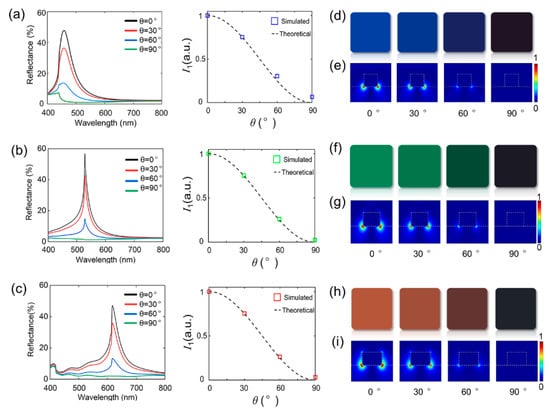
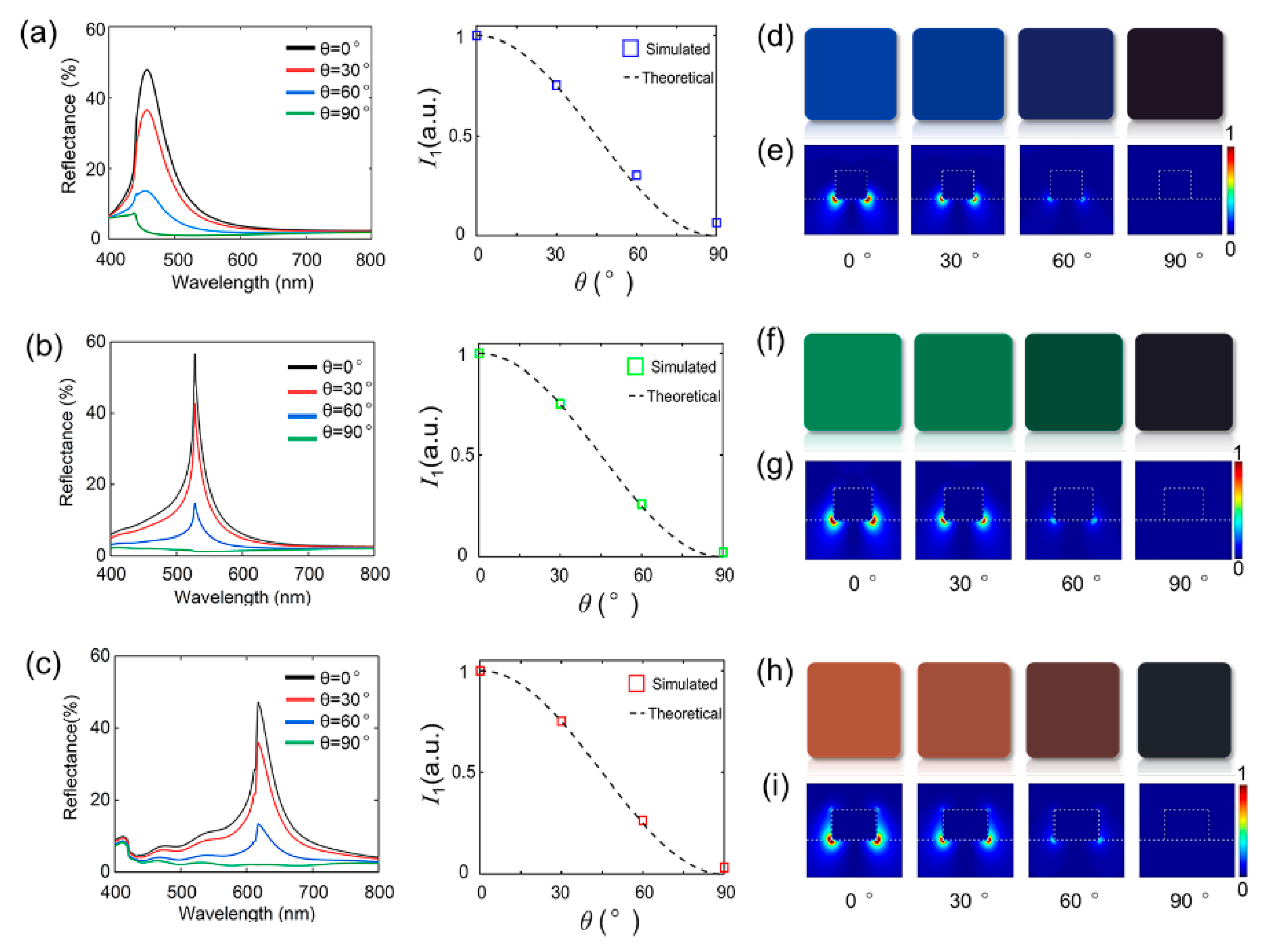
As a result, in theory, the brightness of each RGB component can be easily controlled from light to dark by varying the orientation angle of the nanorod. To numerically verify the ability of brightness tuning for the proposed metasurface, we simulated the reflectance spectra of B, G, and R pixels where the nanorods are of different orientation angles. Figure 2a–c show the reflectance spectra of the aluminum nanorod arrays with different values for B, G and R pixels under x-polarized light.
Figure 2.
(a–c) Left panels: the reflectance spectra of aluminum nanorod arrays with different rotation angles for B (a), G (b) and R (c) pixels under x-polarized light. Right panels: the simulated (square) and theoretical (dashed line) reflective intensity as a function of at the peak wavelength for B (a), G (b) and R (c) pixels. The black dashed line shows the function of vs. . (d,f,h) The B (d), G (f), and R (h) colors calculated from the reflectance spectra corresponding to the rotation angles θ of 0°, 30°, 60° and 90°. (e,g,i) The electric field (|E|2) distributions of the nanorods without rotation angle for incident light with different polarization angles (0°, 30°, 60° and 90°) at the peak wavelength in the x–z plane.
3. Results
In Figure 2a, when the nanorod’s angle for the B pixel ranges from 30° to 90° with a step of 30°, the simulated reflectance at the peak wavelength is 38.25%, 15.51% and 3.41%, which are close to the theoretical values of 38.13%, 12.71% and 0%, respectively. The right panel of Figure 2a shows the simulated reflectance fits the theoretical prediction of very well. Similarly, with respect to G and R pixels, the simulated reflectance at the peak wavelength for different is also close to the theoretical values, which are shown in the right panel of Figure 2b,c. Furthermore, according to the spectra in Figure 2a–c, various colors are calculated and shown in Figure 2d,f,h.
As expected, when the rotation angle θ increases from 0° to 90°, the brightness of the three RGB colors varies from bright to black. In order to understand the physical mechanism of the generation of the reflectance spectra, we study the plasmon resonance properties of different aluminum nanorods designed for B, G and R pixels. For clear illustration, the electric field (|E|2) distributions of the nanorods without rotation angle for different incident polarization directions are simulated and shown in Figure 2e,g,i. When the angle of incident linear polarization is 0°, it can be seen that the electrical field is mainly localized in the bottom corner of the aluminum nanorods, which indicates the excitation of the surface plasmon resonance mode [33,34,35,36]. With increasing polarization angle from 0° to 90°, the confined energy and volume mode decrease and thus the intensity of the excited plasmon resonance becomes weak gradually.
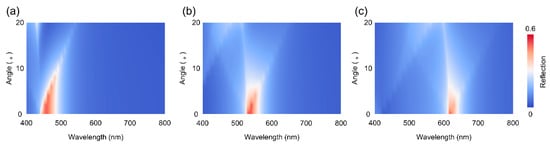
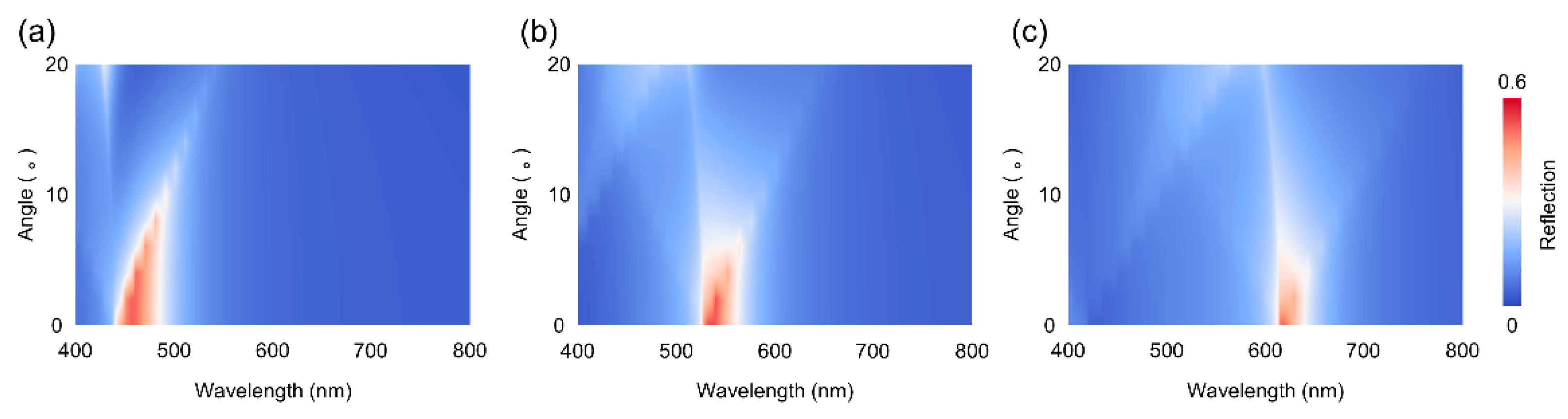
To examine the angular sensitivity and possible diffraction-related effects, we have performed additional simulations for the representative B, G, and R structures under x-polarized illumination, with the incident angle varied from 0° to 20°. As shown in Figure 3a–c, at small oblique angles, particularly within approximately 0–5°, the dominant resonances have remained within the corresponding blue, green, and red spectral regions, with only moderate changes in the resonance wavelength and intensity. This result has indicated that the characteristic structural-color response has been largely preserved under near-normal illumination.
Figure 3.
Angle-dependent simulated reflectance spectra of the representative (a) B-, (b) G-, and (c) R-type aluminum nanorod metasurfaces under x-polarized illumination. The incident angle varies from 0° to 20°.
As the incident angle has further increased toward 10–20°, more pronounced resonance shifts, spectral broadening, and additional angle-dependent spectral features have appeared. These changes have indicated increasing angular sensitivity and lattice/diffraction effects, which are particularly relevant for structures with larger lattice periods. We have therefore clarified that the present design provides better color stability under near-normal and small-angle illumination, while larger viewing/illumination angles may lead to increased color deviation.
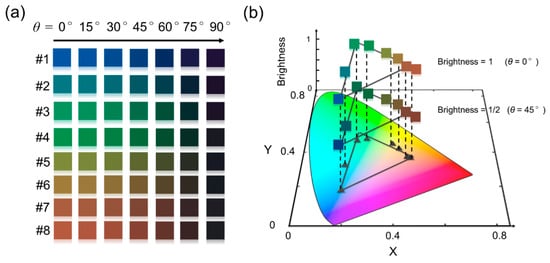
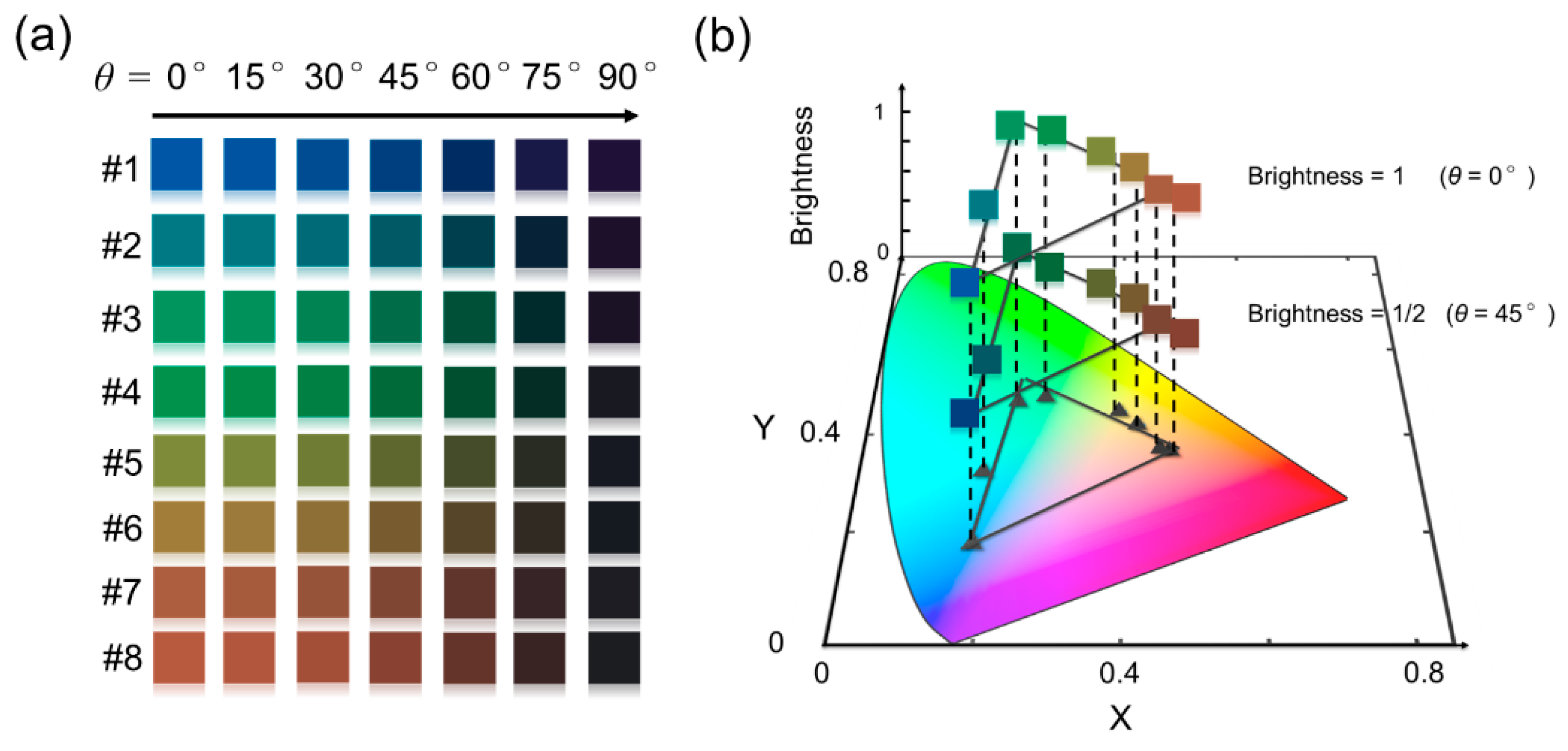
In addition, other transitional colors between RGB colors can be generated by varying the period P and length L of the aluminum nanorods and their brightness is simultaneously controlled by changing the in-plane orientation angle θ of the identical nanorod. Figure 4a presents the simulated colors corresponding to nanorods with different periods (P), lengths (L) and orientation angles (θ), which are labeled by #1 to #8. The detailed parameters of different nanorods are summarized in Table 1.
Figure 4.
(a) The simulated color palette corresponding to nanorods with different geometrical parameters, which are labeled #1 to #8. (b) Eight colors with brightness of 1 and 1/2 are plotted in the CIE 1931 color space with an extended z axis labeled brightness.
Table 1.
The structural parameters of the aluminum nanorods used to generate the various colors denoted by #1–#8 as shown in Figure 4a.
The first column of Figure 4a shows eight different colors with the maximum brightness when the orientation angle θ of the nanorod equals 0°. As the angle θ increases from 0° to 90° with an interval of 15°, the brightness of these colors decreases gradually from bright to dark. In addition, eight colors with brightness of 1 and 1/2 are plotted in the CIE 1931 color space with an extended z axis labeled brightness (Figure 4b). Due to the brightness tuning, the color gamut is extended from a 2D CIE map to a 3D HSB space, which is significant for the reproduction of photorealistic images with chiaroscuro information.
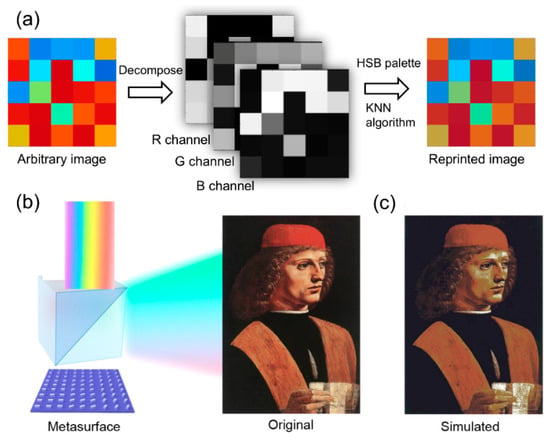
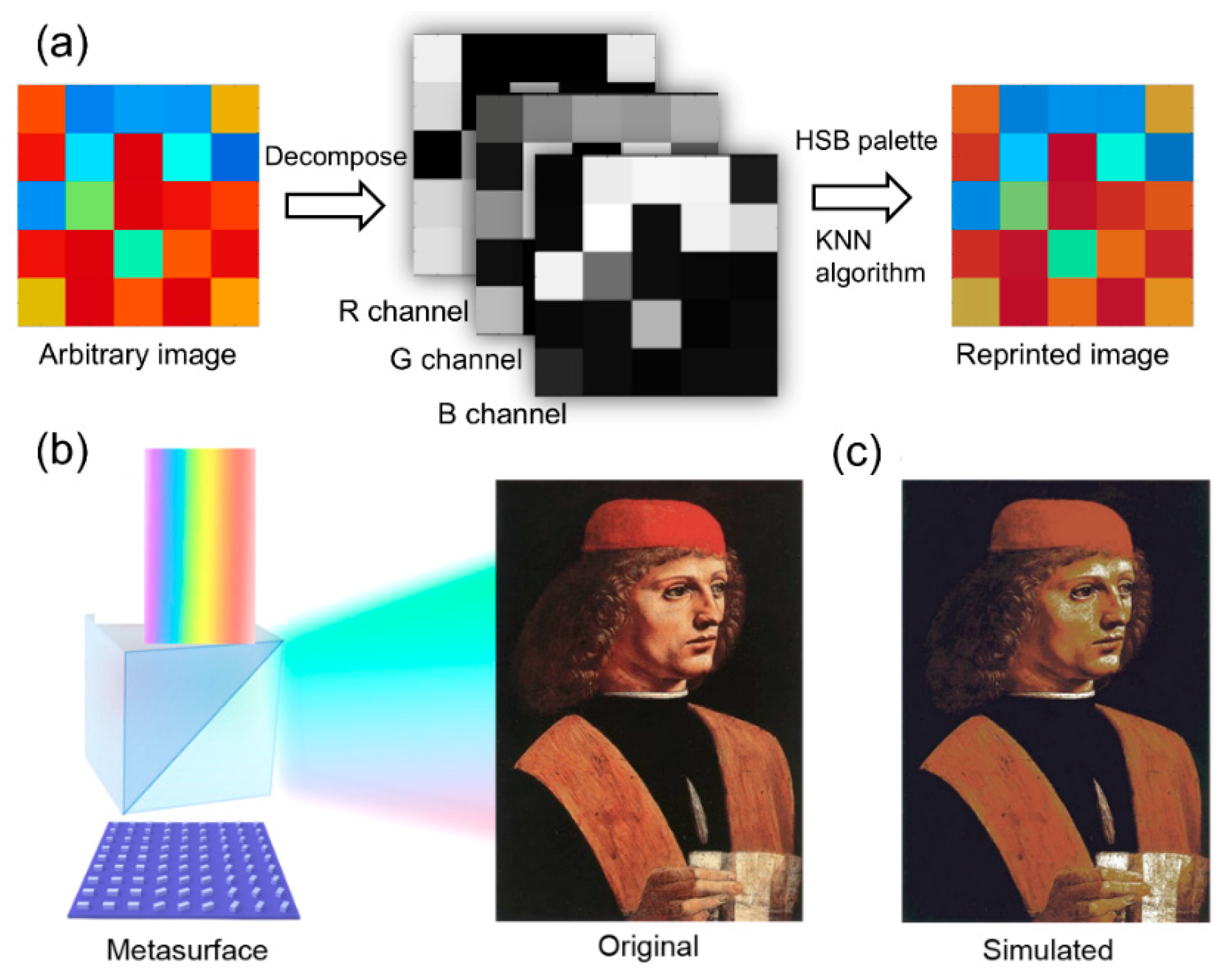
To verify the HSB tuning of the proposed method, we reproduced Leonardo da Vinci’s painting “Portrait of a Musician” in which subtle light and shadow changes were utilized. When white light is incident on the aluminum metasurface encoding artwork information, the hidden information can be decoded and presented as the nanoprinting image in reflection mode (Figure 5b). In simulation, the digital image of the painting was input into the MATLAB software (MATLAB R2025a) and the RGB values of each pixel were obtained. By using the K-Nearest Neighbor (KNN) algorithm, the color of each pixel in the image can be replaced by the closest color in the metasurface-generated color palette (Figure 5a). The simulated image is shown in Figure 5c. It can be observed that the musician has curly shoulder-length hair, wears a red cap, and is holding folded sheet music in his hand, which is close to the original image. The smooth transitions of color brightness in this painting are nicely represented by using the proposed approach.
Figure 5.
(a) Schematic illustration of the KNN-based color-mapping procedure using the structural-color palette. (b) Schematic illustration of the reflective metasurface imaging system without an additional output-side analyzer, together with the original artwork “Portrait of a Musician”. (c) Reconstructed image obtained using the proposed structural-color palette.
In addition, we have quantitatively evaluated the reconstruction fidelity of Figure 5 using five pixel-wise error metrics. The absolute errors of the R, G, and B channels were calculated independently, while the combined RGB error was evaluated as
The grayscale intensity was calculated using
The pixel-wise grayscale error was then calculated as
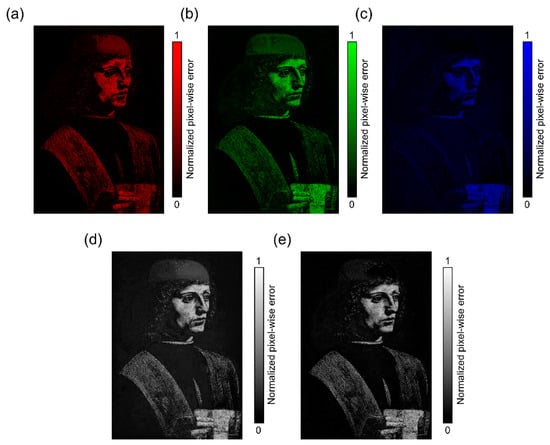
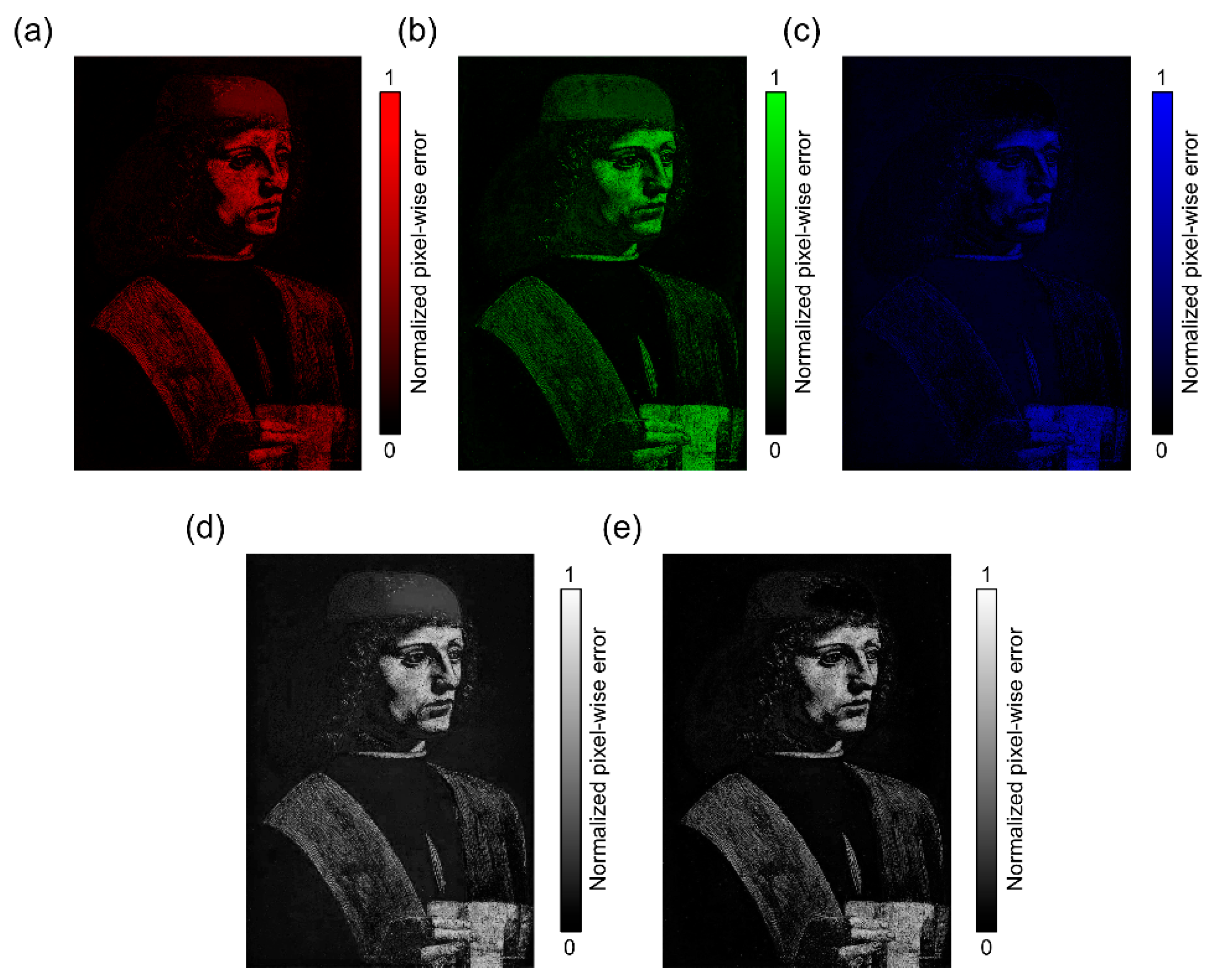
All five error maps retained the same spatial dimensions as the original image. As shown in Figure 6, the R-, G-, and B-channel errors are presented in panels (a)–(c), respectively, while the combined RGB Euclidean error and grayscale error are presented in panels (d) and (e). Normalization was used only for visualization, while all quantitative statistics were calculated from the unnormalized 8-bit pixel-error data.
Figure 6.
Pixel-wise error distributions between the original image and the KNN-reconstructed image. (a–c) Normalized absolute error maps of the R, G, and B channels, respectively. (d) Normalized combined RGB Euclidean error map calculated from the three channel differences. (e) Normalized grayscale error map obtained after luminance-weighted grayscale conversion. Each error map has been independently normalized to the range [0, 1] for visualization only.
Quantitatively, the mean errors of the R, G, and B channels were 10.43, 8.64, and 14.47, respectively, while the mean RGB Euclidean error and grayscale error were 21.87 and 8.33, respectively; these results show that the B channel exhibited the largest average channel-wise deviation, whereas the overall grayscale-intensity difference remained comparatively small. Although the limited discrete structural-color palette has inevitably introduced certain color deviations, the proposed method has demonstrated its ability to reasonably preserve the overall brightness distribution and light–shadow variations in the original image.
4. Discussion
In this paper, we proposed a simple method to achieve arbitrary HSB tuning for structural coloration based on a reflective metasurface platform. The spatially varying nanorods provide extraordinary characteristics of linear polarization selection and color generation. Meanwhile, based on Malus’s law, continuous brightness tuning of these individual colors can be achieved by adjusting the orientation of a nanorod without an additional polarization analyzer. This is conducive to the integration of the optical system. By enabling polarization-controlled brightness modulation without an additional analyzer, the proposed metasurface offers a promising approach for large-area structural-color printing. Through the use of tunable color gamut and brightness, we successfully reproduced the famous artwork “Portrait of a Musician” in simulation. We envision that such a metasurface with HSB tuning provides a promising platform for applications of reflective display techniques.
Author Contributions
Conceptualization, Y.R.; methodology, Y.R.; software, Y.R. and G.L.; validation, Y.R., G.L. and Y.Z.; formal analysis, Y.R.; investigation, Y.R.; resources, Y.R.; data curation, Y.R. and G.L.; writing—original draft preparation, Y.R.; writing—review and editing, Y.R., G.L., Y.Z. and L.G.; visualization, Y.R.; supervision, Y.R. and L.G.; project administration, Y.R. and L.G.; funding acquisition, Y.R. and L.G. All authors have read and agreed to the published version of the manuscript.
Funding
The work was supported by the National Natural Science Foundation of China (U24A20295, 62288102,62375139), National Key Research and Development Program of China (2021YFA1202904), Major Science and Technology Special Project of Jiangsu Province (BG2024017), Basic Research Program of Jiangsu (BK20243057, BK20251211), Jiangsu Province Outstanding Postdoctoral Program (2026ZB279), the Natural Science Research Start-up Foundation of Recruiting Talents of Nanjing University of Posts and Telecommunications (NY226045) and Open Research fund of Suzhou Laboratory (SZLAB-1508-2025-TS028).
Data Availability Statement
The original contributions presented in this study are included in the article. Further inquiries can be directed to the corresponding author.
Conflicts of Interest
The authors declare no conflicts of interest.
References
- Nishiwaki, S.; Nakamura, T.; Hiramoto, M.; Fujii, T.; Suzuki, M. Efficient colour splitters for high-pixel-density image sensors. Nat. Photonics 2013, 7, 240–246. [Google Scholar] [CrossRef] [Scilit]
- Hong, J.; Son, H.; Kim, C.; Mun, S.-E.; Sung, J.; Lee, B. Absorptive metasurface color filters based on hyperbolic metamaterials for a CMOS image sensor. Opt. Express 2021, 29, 3643–3658. [Google Scholar] [CrossRef] [Scilit] [PubMed]
- Wang, D.; Liu, Z.; Wang, H.; Li, M.; Guo, L.J.; Zhang, C. Structural color generation: From layered thin films to optical metasurfaces. Nanophotonics 2023, 12, 1019–1081. [Google Scholar] [CrossRef] [Scilit] [PubMed]
- Song, M.; Wang, D.; Peana, S.; Choudhury, S.; Nyga, P.; Kudyshev, Z.A.; Yu, H.; Boltasseva, A.; Shalaev, V.M.; Kildishev, A.V. Colors with plasmonic nanostructures: A full-spectrum review. Appl. Phys. Rev. 2019, 6, 041308. [Google Scholar] [CrossRef] [Scilit]
- Li, Y.; Yin, J.; Zhang, C.; Zhang, Y.; Liu, Q.; Han, J.; Sha, X.; Li, K.; Du, K.; Liu, Z.; et al. All-dielectric Schrödinger colours across the visible spectrum. Nat. Commun. 2026, 17, 275. [Google Scholar] [CrossRef] [Scilit] [PubMed]
- Song, M.; Feng, L.; Huo, P.; Liu, M.; Huang, C.; Yan, F.; Lu, Y.; Xu, T. Versatile full-colour nanopainting enabled by a pixelated plasmonic metasurface. Nat. Nanotechnol. 2023, 18, 71–78. [Google Scholar] [CrossRef] [Scilit] [PubMed]
- Khan, M.A.K.; Vasini, S.; Divan, R.; Liu, P.Q. Electrically reconfigurable liquid metal nanophotonic platform for color display and imaging. Adv. Mater. 2026, 38, e12901. [Google Scholar] [CrossRef] [Scilit] [PubMed]
- Brongersma, M.L.; Pala, R.A.; Altug, H.; Capasso, F.; Chen, W.T.; Majumdar, A.; Atwater, H.A. The second optical metasurface revolution: Moving from science to technology. Nat. Rev. Electr. Eng. 2025, 2, 125–143. [Google Scholar] [CrossRef] [Scilit]
- He, C.; Li, X.; Wang, H.; Li, J.; Zhang, Z.; Liu, S.; Jiang, Q.; Zhang, N.; Wang, Y.; Huang, L. Orbital angular momentum multiplexing diffractive neural networks for high-capacity optical inference. Nat. Photonics 2026, 20, 896–904. [Google Scholar] [CrossRef] [Scilit]
- Yu, Z.; Gao, X.; Yao, J.; Li, H.; Shi, Y.; Li, B.; Xie, Z.; Yuan, X.; Lai, P.; Song, Q. Spin-orbit-locking vectorial metasurface holography. Adv. Mater. 2025, 37, 2415142. [Google Scholar] [CrossRef] [Scilit] [PubMed]
- Shen, Z.; Zhao, F.; Ni, Y.; Yang, Y. Extended monocular 3D imaging via the fusion of diffraction- and polarization-based depth cues. Optica 2025, 12, 872–878. [Google Scholar] [CrossRef] [Scilit]
- Li, L.; Wang, S.; Zhao, F.; Zhang, Y.; Wen, S.; Chai, H.; Gao, Y.; Wang, W.; Cao, L.; Yang, Y. Single-shot deterministic complex amplitude imaging with a single-layer metalens. Sci. Adv. 2024, 10, eadl0501. [Google Scholar] [CrossRef] [Scilit] [PubMed]
- Huang, T.; Xie, Y.; Zhang, Z.; Zhao, Y.; Hu, D.; Yu, S.; Zheng, G.; Li, G.; Li, Z. Wavelength decoupling based on minimalist metasurfaces enabling bicolor display and information encryption. Laser Photonics Rev. 2025, 19, 2401599. [Google Scholar] [CrossRef] [Scilit]
- Li, K.; Chen, J.; Li, H.; Li, A.; Hou, X.; Ma, S.; Zhao, M.; Chen, S.; Liu, Q.; Yang, D.; et al. Printable meta-assemblies enable synergetic colouration. Nature 2026, 652, 1195–1203. [Google Scholar] [CrossRef] [Scilit] [PubMed]
- Hail, C.U.; Schnoering, G.; Damak, M.; Poulikakos, D.; Eghlidi, H. A plasmonic painter’s method of color mixing for a continuous red–green–blue palette. ACS Nano 2020, 14, 1783–1791. [Google Scholar] [CrossRef] [Scilit] [PubMed]
- Neubrech, F.; Duan, X.; Liu, N. Dynamic plasmonic color generation enabled by functional materials. Sci. Adv. 2020, 6, eabc2709. [Google Scholar] [CrossRef] [Scilit] [PubMed]
- Zhao, Y.; Yang, Y.; Ji, C.; Liang, Q.; Fu, H.; Liu, X.; Zhou, L.; Li, J.; Wang, Y. Thermosensitive plasmonic color enabled by sodium metasurface. Adv. Funct. Mater. 2023, 33, 2214492. [Google Scholar] [CrossRef] [Scilit]
- Mousavi Khaleghi, S.S.; Wen, D.; Cadusch, J.; Crozier, K.B. High resolution multicolor holograms encoded into color print images with hybrid dielectric/plasmonic metasurfaces. Appl. Phys. Lett. 2025, 126, 051102. [Google Scholar] [CrossRef] [Scilit]
- Proust, J.; Bedu, F.; Gallas, B.; Ozerov, I.; Bonod, N. All-dielectric colored metasurfaces with silicon Mie resonators. ACS Nano 2016, 10, 7761–7767. [Google Scholar] [CrossRef] [Scilit] [PubMed]
- Miyata, M.; Nakajima, M.; Hashimoto, T. High-sensitivity color imaging using pixel-scale color splitters based on dielectric metasurfaces. ACS Photonics 2019, 6, 1442–1450. [Google Scholar] [CrossRef] [Scilit]
- Wang, L.; Wang, T.; Yan, R.; Yue, X.; Wang, H.; Wang, Y.; Zhang, J.; Yuan, X.; Zeng, J.; Wang, J. Color printing and encryption with polarization-switchable structural colors on all-dielectric metasurfaces. Nano Lett. 2023, 23, 5581–5587. [Google Scholar] [CrossRef] [Scilit] [PubMed]
- Yang, B.; Liu, W.; Li, Z.; Cheng, H.; Choi, D.-Y.; Chen, S.; Tian, J. Ultrahighly saturated structural colors enhanced by multipolar-modulated metasurfaces. Nano Lett. 2019, 19, 4221–4228. [Google Scholar] [CrossRef] [Scilit] [PubMed]
- Yang, J.-H.; Babicheva, V.E.; Yu, M.-W.; Lu, T.-C.; Lin, T.-R.; Chen, K.-P. Structural colors enabled by lattice resonance on silicon nitride metasurfaces. ACS Nano 2020, 14, 5678–5685. [Google Scholar] [CrossRef] [Scilit] [PubMed]
- Sun, S.; Zhou, Z.; Zhang, C.; Gao, Y.; Duan, Z.; Xiao, S.; Song, Q. All-dielectric full-color printing with TiO2 metasurfaces. ACS Nano 2017, 11, 4445–4452. [Google Scholar] [CrossRef] [Scilit] [PubMed]
- Ren, Y.; Jin, R.; Song, M.; Lin, P.; Xu, T.; Lu, Y. High-performance color printing and information encryption enabled by silicon carbide metasurface. Adv. Funct. Mater. 2026, 36, e26191. [Google Scholar] [CrossRef] [Scilit]
- Jiang, H.; Alan, S.; Shahbazbegian, H.; Patel, J.N.; Kaminska, B. Molding inkjetted silver on nanostructured surfaces for high-throughput structural color printing. ACS Nano 2016, 10, 10544–10554. [Google Scholar] [CrossRef] [Scilit] [PubMed]
- James, T.D.; Mulvaney, P.; Roberts, A. The plasmonic pixel: Large area, wide gamut color reproduction using aluminum nanostructures. Nano Lett. 2016, 16, 3817–3823. [Google Scholar] [CrossRef] [Scilit] [PubMed]
- Bao, Y.; Yu, Y.; Xu, H.; Guo, C.; Li, J.; Sun, S.; Zhou, Z.-K.; Qiu, C.-W.; Wang, X.-H. Full-colour nanoprint-hologram synchronous metasurface with arbitrary hue-saturation-brightness control. Light Sci. Appl. 2019, 8, 95. [Google Scholar] [CrossRef] [Scilit] [PubMed]
- Huo, P.; Song, M.; Zhu, W.; Zhang, C.; Chen, L.; Lezec, H.J.; Lu, Y.; Agrawal, A.; Xu, T. Photorealistic full-color nanopainting enabled by a low-loss metasurface. Optica 2020, 7, 1171–1172. [Google Scholar] [CrossRef] [Scilit] [PubMed]
- Rakić, A.D. Algorithm for the determination of intrinsic optical constants of metal films: Application to aluminum. Appl. Opt. 1995, 34, 4755–4767. [Google Scholar] [CrossRef] [Scilit] [PubMed]
- Meng, Y.; Chen, Y.; Lu, L.; Ding, Y.; Cusano, A.; Fan, J.A.; Hu, Q.; Wang, K.; Xie, Z.; Liu, Z.; et al. Optical meta-waveguides for integrated photonics and beyond. Light Sci. Appl. 2021, 10, 235. [Google Scholar] [CrossRef] [Scilit] [PubMed]
- Song, M.; Wang, D.; Kudyshev, Z.A.; Xuan, Y.; Wang, Z.; Boltasseva, A.; Shalaev, V.M.; Kildishev, A.V. Enabling optical steganography, data storage, and encryption with plasmonic colors. Laser Photonics Rev. 2021, 15, 2000343. [Google Scholar] [CrossRef] [Scilit]
- Huang, L.; Chen, X.; Bai, B.; Tan, Q.; Jin, G.; Zentgraf, T.; Zhang, S. Helicity dependent directional surface plasmon polariton excitation using a metasurface with interfacial phase discontinuity. Light Sci. Appl. 2013, 2, e70. [Google Scholar] [CrossRef] [Scilit]
- Liu, F.; Wang, D.; Zhu, H.; Zhang, X.; Liu, T.; Sun, S.; Zhang, X.; He, Q.; Zhou, L. High-efficiency metasurface-based surface-plasmon lenses. Laser Photonics Rev. 2023, 17, 2201001. [Google Scholar] [CrossRef] [Scilit]
- Tang, X.; He, R.; Chen, C.; Huang, Z.; Guo, J. Quasi-bound states in the continuum in a metal nanograting metasurface for a high figure-of-merit refractive index sensor. Opt. Express 2024, 32, 762–773. [Google Scholar] [CrossRef] [Scilit] [PubMed]
- King, J.; Wan, C.; Park, T.J.; Deshpande, S.; Zhang, Z.; Ramanathan, S.; Kats, M.A. Electrically tunable VO2–metal metasurface for mid-infrared switching, limiting and nonlinear isolation. Nat. Photonics 2024, 18, 74–80. [Google Scholar] [CrossRef] [Scilit]

Disclaimer/Publisher’s Note: The statements, opinions and data contained in all publications are solely those of the individual author(s) and contributor(s) and not of MDPI and/or the editor(s). MDPI and/or the editor(s) disclaim responsibility for any injury to people or property resulting from any ideas, methods, instructions or products referred to in the content. |
© 2026 by the authors. Licensee MDPI, Basel, Switzerland. This article is an open access article distributed under the terms and conditions of the Creative Commons Attribution (CC BY) license.