


Abstract
We report a high-energy femtosecond burst-mode laser based on an all-fiber chirped-pulse amplification (CPA) chain followed by a grating compressor. The system incorporates a nonlinear amplifying loop mirror oscillator, a dispersion-adjustable dual chirped fiber Bragg grating stretcher, a fiber-coupled acousto-optic modulator, and three stages of fiber amplification. Temporally synchronized pulsed pumping is applied to the booster and main amplifiers to confine gain buildup to the burst-amplification window, limiting amplified spontaneous emission and unnecessary thermal loading. At a repetition rate of 1 kHz, the system delivers a single-pulse energy of 128 µJ and a total energy of 203 µJ in the three-pulse burst mode. After compression, a pulse duration of 148 fs is obtained, compared with a Fourier-transform-limited duration of 135 fs. The system operates without active cooling and maintains near-diffraction-limited beam quality with M2 = 1.15. To the best of our knowledge, this represents the first demonstration of a flexible Yb-doped fiber CPA system simultaneously combining few-pulse burst operation with a 200 µJ burst energy and a sub-150 fs pulse duration.
1. Introduction
High-energy ultrafast fiber lasers operating at low repetition rates are attractive for applications requiring high peak power, precise temporal control, and reduced average thermal load [1,2]. Compared with high-repetition-rate operation, kilohertz-level excitation reduces thermal accumulation and the associated heat-affected zone, improving processing precision and repeatability [3,4]. However, single-pulse excitation concentrates the energy into a single interaction event. Although this favors high pulse energy and peak intensity, it limits the manipulation of the transient material response after the initial excitation. In comparison, burst operation distributes the energy among multiple sub-pulses and therefore reduces the energy and fluence of each individual pulse. With increasing pulse number, the sub-pulse energy may become insufficient for efficient excitation or material removal, while the large number of successive interactions can also increase the influence of heat accumulation and plasma shielding [5].
Few-pulse burst operation (N < 10) provides an intermediate temporal format between these two regimes. Distributing the energy among a few sub-pulses can maintain relatively high pulse fluence and peak intensity while enabling controlled pulse-to-pulse interactions over short temporal intervals [6]. The first pulse can initiate ionization, heating, or material removal, while subsequent pulses interact with the transient state created by the preceding excitation [7,8,9]. Such sequential excitation enables controlled energy deposition and modification of transient plasma, shockwave, thermal, and structural responses over a short temporal window [7,8,9,10,11]. Few-pulse bursts provide a balance between single and dense excitation regimes: they introduce temporal coupling and cumulative effects beyond single-pulse excitation, while preserving higher sub-pulse energy and peak intensity than multi-pulse bursts.
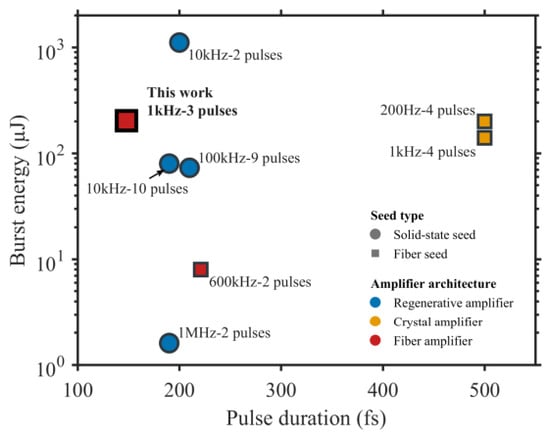
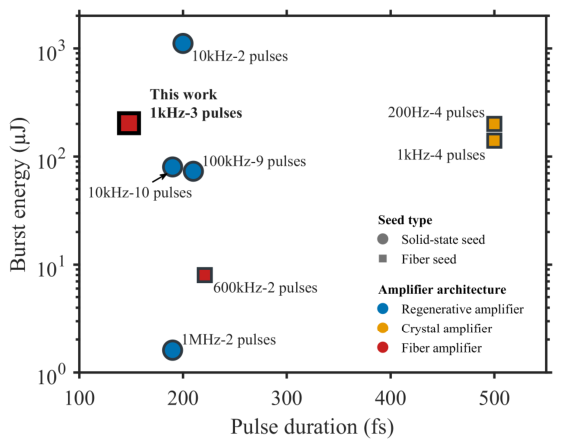
Recent studies have employed few-pulse burst operation to tailor energy deposition and pulse-to-pulse interactions in a variety of processing applications. Gaidys et al. used MHz bursts containing up to nine sub-pulses to adjust the effective fluence and utilize residual heat during laser polishing, with a pulse duration of 210 fs and a burst energy of 73 µJ [5]. Momgaudis et al. investigated two-pulse 62.5 MHz bursts and showed that residual free-electron plasma and self-trapped excitons generated by the first sub-pulse can substantially affect the nonlinear propagation of the subsequent pulse. The system delivered 190 fs pulses with burst energies at the microjoule level [6]. Balage et al. employed four-pulse 40 MHz bursts for drilling studies, reporting 140 µJ at a 1 kHz envelope repetition rate and 200 µJ at 200 Hz, both with pulse durations of approximately 500 fs; pump–probe measurements further revealed distinct shockwave and plume dynamics compared with single-pulse excitation at the same total energy [7,8]. Chen et al. demonstrated two-pulse excitation with an intra-burst period of 56 ns, an 8 µJ burst energy, and a pulse duration of 221 fs for controlling crack initiation during SiC slicing [9]. Teshima et al. employed 10 pulses at an intra-burst repetition rate of 63.3 MHz, with a pulse duration of 190 fs and a burst energy of 80 µJ, and demonstrated improved surface quality in single-crystal diamond machining under appropriate burst conditions [10]. At higher burst energies, Metzner et al. investigated two-pulse 65 MHz bursts with energies ranging from the hundred-microjoule level to above 1 mJ and a pulse duration of approximately 200 fs [11]. These results demonstrate that few-pulse bursts can maintain relatively high instantaneous intensity while introducing controllable cumulative material responses without distributing the burst energy over tens to hundreds of pulses.
The burst energy and pulse duration of the few-pulse systems discussed above are summarized in Figure 1 to illustrate the accessible performance space. The comparison reveals the difficulty of simultaneously amplifying burst energy and shortening the pulse duration. In addition, most of the reported few-pulse burst sources are based on solid-state or hybrid ultrafast laser architectures, whereas comparable performance in Yb-doped fiber (YDF) CPA systems remains limited. Flexible YDFs can be coiled for compact integration and higher-order mode suppression, and AOM-based pulse picking enables configurable single pulse and burst operation. However, simultaneously achieving high burst energy and sub-150 fs pulse duration in such a flexible fiber CPA architecture remains challenging. At low envelope repetition rates, the long interval between successive bursts imposes stringent requirements on stored-energy management and amplified spontaneous emission (ASE) suppression, while high-energy amplification enhances nonlinear phase accumulation, gain narrowing, and stimulated Raman scattering [12,13].
Figure 1.
Burst energy versus compressed pulse duration for few-pulse MHz burst systems [5,6,7,8,9,10,11].
Here, we demonstrate a high-energy femtosecond burst CPA system based on a polarization-maintaining (PM) fiber front end and flexible YDF amplifier chain followed by a free-space diffraction-grating compressor. An all-normal dispersion fiber oscillator mode locked by a nonlinear amplifying loop mirror (NALM) provides an 8.13 MHz pulse train, corresponding to a pulse separation of approximately 123 ns. A fiber-coupled acousto-optic modulator (AOM) reduces the envelope repetition rate to 1 kHz and enables controllable few-pulse burst operation. Temporally synchronized pulsed pumping is implemented in the booster and main amplifiers to confine energy storage to the amplification window, limiting ASE buildup and unnecessary thermal loading. Through coordinated optimization of pump duration, gain distribution, nonlinear effects, and system dispersion, the laser delivers 128 µJ pulses in single-pulse operation and a total energy of 203 µJ in the three-pulse burst mode. After compression, a pulse duration of 148 fs is obtained, while the output maintains near-diffraction-limited beam quality with M2 = 1.15. By combining synchronized pulsed pumping with adjustable dispersion compensation, this system addresses the challenges of stored energy management and pulse compression in low-repetition-rate, high-energy fiber amplification. The simultaneous achievement of 200 µJ-level few-pulse burst energy and sub-150 fs pulse duration provides a high peak power few-pulse burst source for precision micromachining and investigations of transient laser–matter interactions involving successive ultrashort pulses.
2. Methods
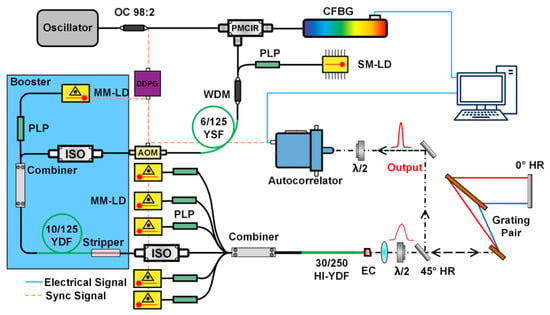
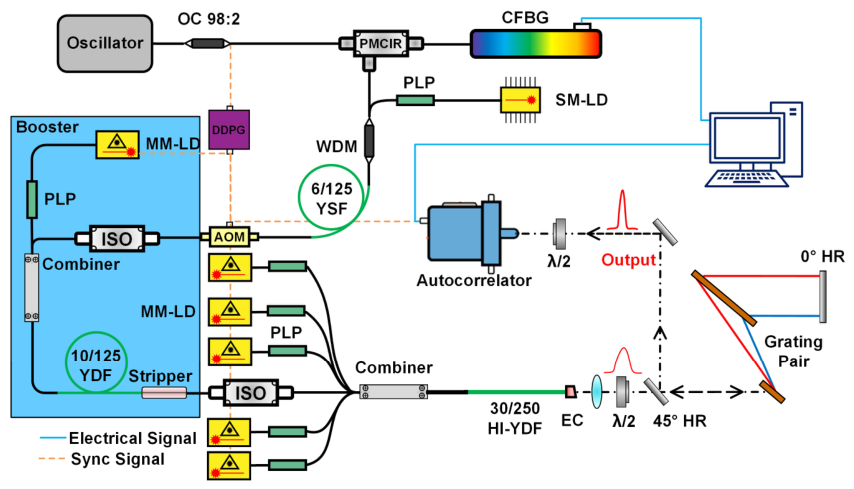
The femtosecond burst-mode fiber CPA laser system, shown schematically in Figure 2, comprises a NALM oscillator, a dual CFBG stretcher, a three-stage fiber amplifier, and an AOM positioned after the first amplifier. The laser system is reported in our conference paper [14]. In this work, the system was further optimized through synchronized-pump characterization and increased energy extraction. The NALM oscillator operated at a repetition rate of 8.13 MHz and delivered a 22 nm optical bandwidth. Approximately 2% of the oscillator output was tapped by a fiber coupler to provide a timing reference for a digital delay and pulse generator (DDPG). The DDPG subsequently generated synchronized trigger signals for the AOM and the pump drivers of the booster and main amplifiers. The remaining signal was launched into the dual-CFBG stretcher, where the pulse duration was increased from 35 ps to 1.46 ns.
Figure 2.
Schematic diagram of the femtosecond burst-mode fiber CPA laser system. PMCIR: polarization-maintaining optical circulator, OC: optical coupler, CFBG: chirped fiber Bragg grating, WDM: wavelength-division multiplexer, SM/MM-LD: single-mode/multimode laser diode, AOM: acousto-optic modulator, DDPG: digital delay and pulse generator, ISO: isolator, YSF: Yb-doped single-mode fiber, EC: end cap, HR: high-reflectivity mirror, λ/2: half-wave plate, PLP: pump light protector.
The stretched pulses were first amplified in a 0.5 m-long segment of highly Yb-doped single-mode fiber. The amplified signal was then coupled into the AOM, which served as a pulse picker. The AOM was triggered at 1 kHz to reduce the envelope repetition rate, while its gate width was adjusted to control the number of pulses selected within each burst. The subsequent booster and main amplifiers employed synchronized pulsed pumping to further increase the pulse energy while suppressing ASE buildup and minimizing excess thermal loading. The booster amplifier employed a double-clad YDF, pumped at 976 nm by a 25 W pulsed multimode laser diode (MM-LD) through a fiber combiner. Residual cladding pump light was removed by a power stripper before the amplified signal was injected into the main amplifier. The main amplifier comprised a 0.7 m-long segment of double-clad YDF with a pump absorption value of 17 dB/m at 975 nm. The gain fiber was pumped through a fiber combiner by five 25 W MM-LDs.
At the output of the main amplifier, the gain fiber was spliced to a cleaved (8°) 250 µm coreless fiber end cap (EC). The EC reduced the optical intensity at the fiber facet, thereby mitigating end-face damage and suppressing parasitic oscillations induced by back reflections. The amplified pulses were subsequently collimated using an aspheric lens with a focal length of 25 mm and compressed in a transmission-grating pair for dispersion compensation.
3. Results
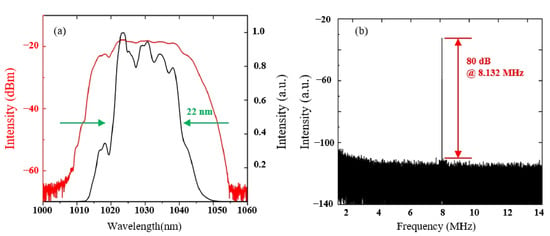
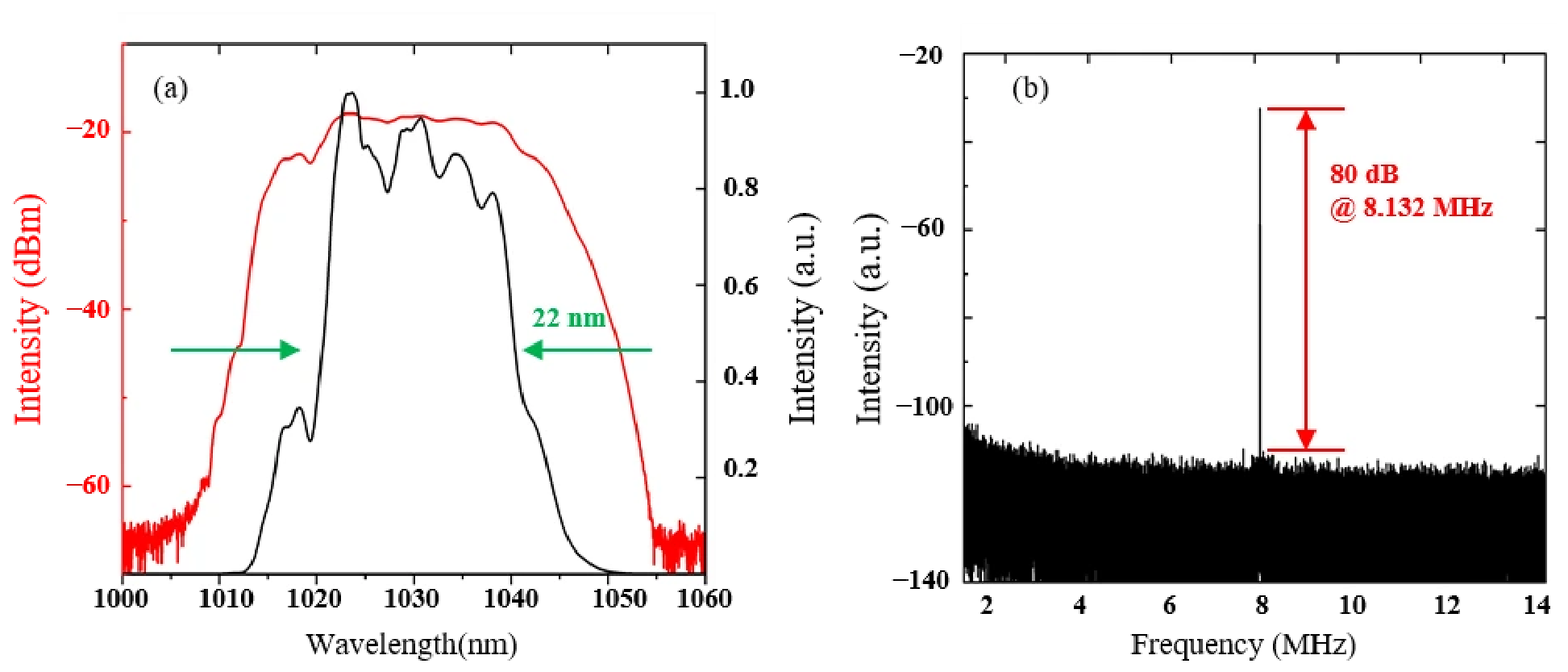
In the mode-locked regime, the oscillator delivers an average output power of 18 mW and pulses with a duration of 35 ps. The oscillator exhibits an optical bandwidth of approximately 22 nm, as measured using an optical spectrum analyzer (AQ6370D, Yokogawa, Tokyo, Japan) and shown in Figure 3a. A high-speed photodetector (DXM30BF, Thorlabs, Newton, NJ, USA) and a signal analyzer (N9040B, Keysight, Santa Rosa, CA, USA) are employed. A high-speed photodetector (DXM30BF, Thorlabs) and a signal analyzer (N9040B, Keysight) are employed for radio-frequency (RF) characterization. The resulting RF spectrum [Figure 3b] exhibits a fundamental repetition frequency of 8.132 MHz, consistent with stable mode-locked operation.
Figure 3.
(a) Output spectrum of the oscillator; (b) RF spectrum of the oscillator.
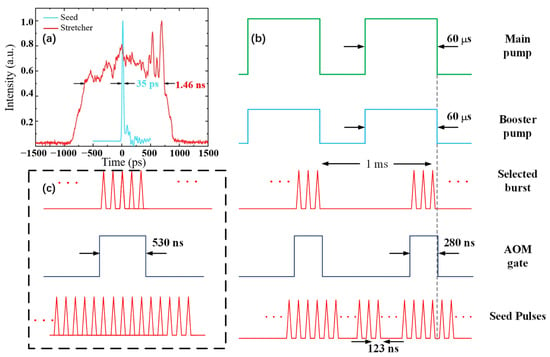
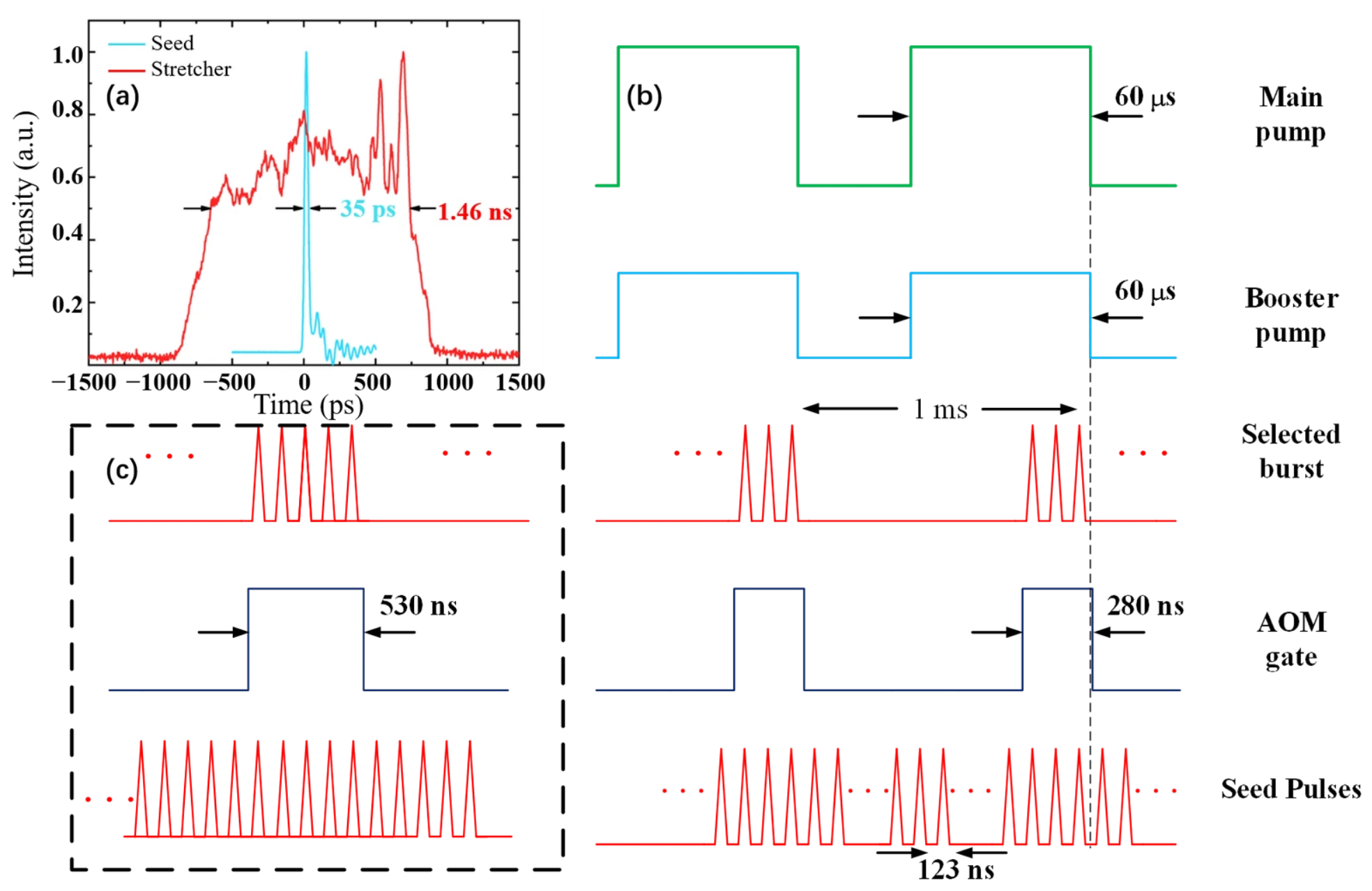
The dual-CFBG stretcher temporally broadens the seed pulses before amplification. As shown in Figure 4a, the pulse duration increases from 35 ps to 1.46 ns after stretching. The detected oscillator signal serves as the timing reference for the DDPG, which generates synchronized trigger signals for the AOM and the pump drivers of the booster and main amplifiers. Figure 4b schematically illustrates the timing relationship among the seed pulses, the AOM gate, the selected three-pulse burst, and the synchronized pump windows. The AOM converts the original 8.13 MHz pulse train into burst envelopes at a repetition rate of 1 kHz. With an AOM gate width of 280 ns, three pulses are selected within each envelope. The relative timing between the pump windows and the seed pulses is adjusted using the DDPG, such that the seed pulse arrives near the trailing edge of the pump window, allowing sufficient population inversion to build up before amplification both in the single pulse and burst mode. This synchronization method limits gain buildup to the amplification window and reduces ASE accumulation. By increasing the AOM gate width to 530 ns, five pulses can be selected, as illustrated in Figure 4c.
Figure 4.
(a) Seed pulse (blue line) and stretched pulse (red line) in the time domain; (b) schematic timing diagram of the seed pulses, AOM gate, selected three-pulse burst, and synchronized pump windows of the booster and main amplifiers; (c) pulse-selection timing for a five-pulse burst.
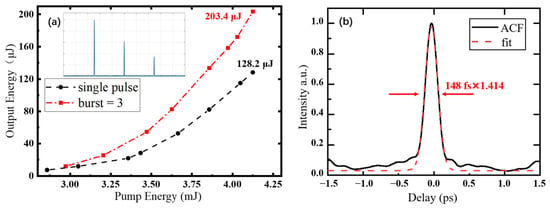
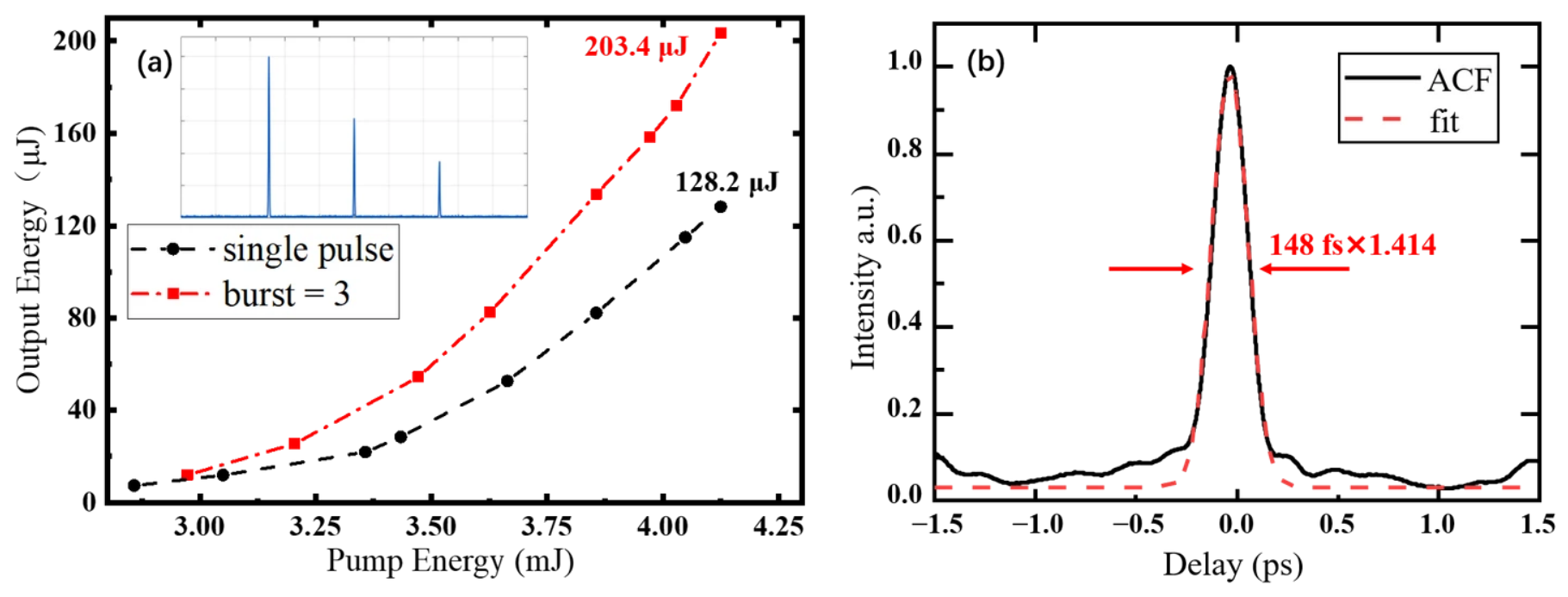
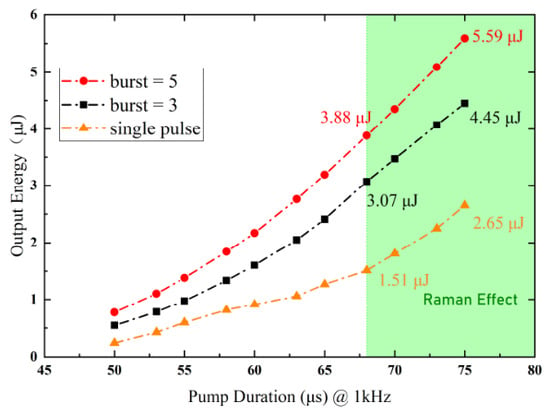
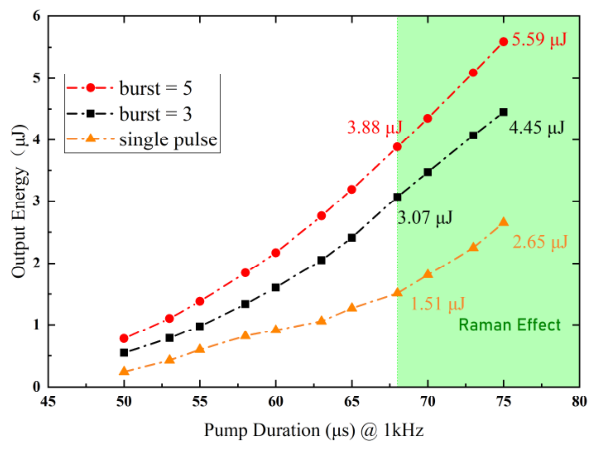
During the pump-duration scan experiment, Raman-related spectral components became observable on the optical spectrum analyzer at pump pulse durations of approximately 68 µs. At this point, the output energy in the three-pulse burst mode is approximately 3 µJ. To balance energy extraction and nonlinear spectral distortion, a pump duration of 60 µs is selected for both the booster and main amplifiers in the subsequent experiments. The output energy after compression is characterized using an energy sensor (PE10-SH-V2, Ophir, Jerusalem, Israel) as a function of the main-amplifier pump energy, as shown in Figure 5a. To balance SRS suppression and the spectral bandwidth for pulse compression, the pump input energy is set to 4.2 mJ. The inset of Figure 5a shows the measured temporal profile of the three-pulse burst recorded using a high-speed photodetector before compression. The three sub-pulses exhibit relative intensity contributions of approximately 51.11%, 31.11%, and 17.78%. The system delivers 128 µJ in the single-pulse operation and a total burst energy of 203 µJ in the three-pulse operation, with the individual pulse energies estimated at 104.0, 63.3, and 36.2 µJ, respectively.
Figure 5.
(a) Output energy as a function of the main-amplifier pump energy in single pulse and burst operation. The inset shows the burst temporal profile before compression; (b) measured autocorrelation trace and Gaussian fit of the compressed pulse.
The measured output spectrum has a bandwidth of 11.5 nm, corresponding to a Fourier-transform-limited pulse duration of 135 fs. Pulse compression is performed using a transmission-grating pair with a grating separation of 18.5 cm and an incidence angle of 61.3°. The dispersion parameters of the fiber sections are calculated from the fiber specifications and the corresponding fiber lengths. For the transmission grating compressor, the group-delay dispersion and third-order dispersion are calculated from the grating parameters and system geometry, providing −18.44 ps2 and +0.2297 ps3, respectively. The dispersion parameters of the dual-CFBG stretcher are set and adjusted directly through the device control software. The initial CFBG dispersion settings are determined from the nominal dispersion contributions of the fiber sections and grating compressor. The CFBG dispersion is then fine-tuned experimentally around the calculated matching condition while monitoring the autocorrelation trace to optimize pulse compression.
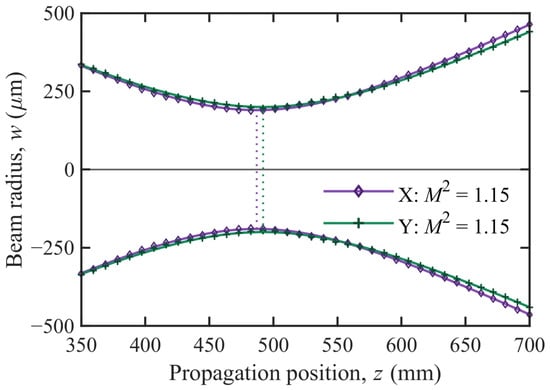
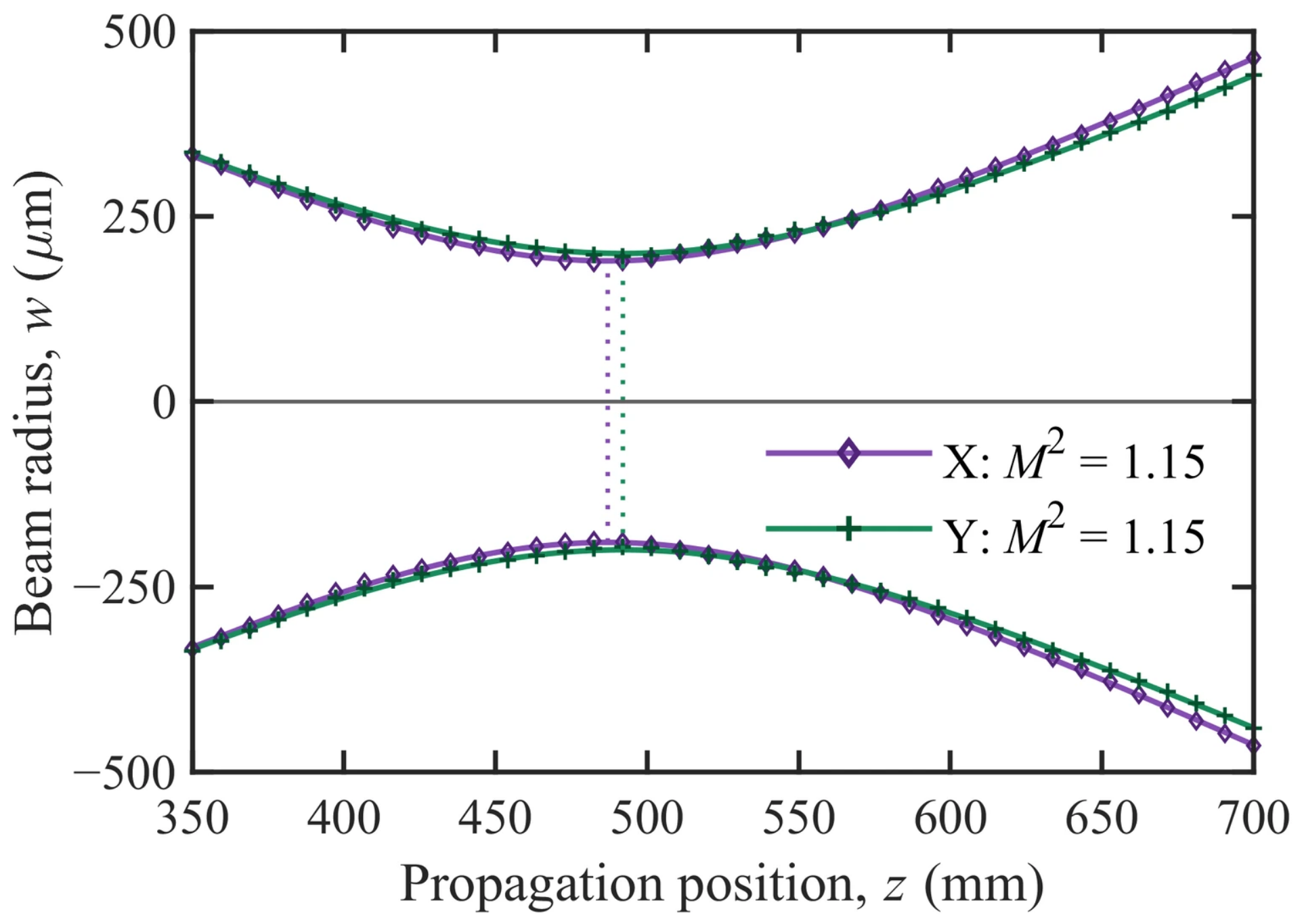
The compressed pulse duration is measured using an intensity autocorrelator (pulseCheck 150 NX, APE GmbH, Berlin, Germany) and the measured autocorrelation traces are fitted with a Gaussian function. Under the optimized dispersion condition, both single-pulse and three-pulse burst operations yield compressed pulse durations of approximately 148 fs and the autocorrelation trace and its Gaussian fit are shown in Figure 5b. To suppress higher-order modes, the 30/250 µm gain fiber is coiled to a radius of approximately 5 cm to increase bending losses. The beam quality factors are measured by an M2 measurement system (BeamSquared, Ophir Spiricon, Jerusalem, Israel) with M2 = 1.15 in both directions, as shown in Figure 6, indicating near-diffraction-limited beam quality at a high pulse energy.
Figure 6.
Measured beam quality factor M2.
4. Discussion
The influence of the synchronized pump pulse duration on the booster-amplifier output energy is investigated under single-pulse, three-pulse burst, and five-pulse burst operations. As shown in Figure 7, increasing the synchronized pump pulse duration enhances energy extraction in all three modes. However, longer pump durations also increase the risk of nonlinear spectral distortion, which can affect subsequent amplification and pulse compression. The onset of SRS is identified by observing Raman-related spectral components using an optical spectrum analyzer at a pump pulse duration of approximately 68 µs in all three modes, suggesting a weak dependence of the SRS onset on the number of sub-pulses.
Figure 7.
Output energy as a function of synchronized pump pulse duration for single-pulse, three-pulse burst, and five-pulse burst operations in the booster amplifier.
Compared with single-pulse operation, the three-pulse burst operation enables greater extraction of stored energy from the gain fiber under comparable pumping conditions. The decreasing sub-pulse amplitudes may result from progressive gain depletion as successive pulses extract energy from the gain fiber. The measured compressed pulse duration of approximately 148 fs in both operating modes approaches the estimated Fourier-transform limit of 135 fs. Stretching the seed pulses to 1.46 ns and employing a short 0.7 m large-mode-area gain fiber help reduce nonlinear phase accumulation during amplification, while the adjustable CFBG dispersion enables further pulse compression optimization. The remaining difference from the Fourier-transform limit may arise from gain narrowing, nonlinear phase accumulation, and residual higher-order dispersion. The 30/250 µm large-mode-area gain fiber supports high-energy amplification but may also guide higher-order transverse modes. Coiling the fiber to a radius of approximately 5 cm introduces more bending loss for higher-order modes than the fundamental mode, improving transverse-mode discrimination.
5. Conclusions
In conclusion, we demonstrated a high-energy femtosecond burst-mode CPA laser based on a PM all-fiber YDF amplification chain followed by a grating compressor. The system combines a dispersion-adjustable dual-CFBG stretcher, AOM-based pulse picking, three-stage fiber amplification, and temporally synchronized pulsed pumping of the booster and main amplifiers. By varying the AOM gate width, controllable three- and five-pulse bursts are generated at a 1 kHz envelope repetition rate. Optimization of the synchronized pump duration reveals an SRS onset near 68 µs, and a 60 µs pump window is selected to balance energy extraction and nonlinear spectral distortion.
The system delivers a single-pulse energy of 128 µJ and a total three-pulse burst energy of 203.4 µJ after compression and the pulses are compressed to 148 fs, which is close to the 135 fs Fourier-transform limit. Coiling the 30/250 µm large-mode-area gain fiber suppresses higher-order-mode content and results in near-diffraction-limited beam quality with M2 = 1.15. The combination of high pulse energy and sub-150 fs duration supports high peak intensities, while the 123 ns intra-burst interval enables controlled excitation of transient material states. These characteristics make the system potentially useful for investigating plasma evolution, ablation plume dynamics, and pulse-to-pulse interactions in precision laser drilling and material modification [8,9,10,15]. Furthermore, the 1 kHz envelope repetition rate facilitates synchronization with external diagnostic systems for time-resolved investigations [8,15]. The system demonstrates the potential of this flexible-fiber CPA system for ultrafast processing and controlled laser–matter interaction studies.
Author Contributions
Conceptualization, J.C. and H.Z.; methodology, J.C. and L.D.; investigation, J.C., L.D. and X.L.; formal analysis, J.C. and L.D.; validation, J.C. and X.L.; data curation, J.C. and L.D.; visualization, J.C.; writing—original draft preparation, J.C. and L.D.; writing—review and editing, H.Z. and X.L.; supervision, H.Z.; project administration, H.Z.; funding acquisition, H.Z. All authors have read and agreed to the published version of the manuscript.
Funding
This research was funded by the Open Foundation of the State Key Laboratory of Precision Space-time Information Sensing Technology (No. STSL2025-B-04-01(L)).
Informed Consent Statement
Not applicable.
Data Availability Statement
The data presented in this study are available from the corresponding authors upon reasonable request.
Conflicts of Interest
The authors declare no conflicts of interest.
Abbreviations
The following abbreviations are used in this manuscript:
| AOM | Acousto-optic modulator |
| ASE | Amplified spontaneous emission |
| CFBG | Chirped fiber Bragg grating |
| CPA | Chirped-pulse amplification |
| DDPG | Digital delay and pulse generator |
| EC | End cap |
| HR | High-reflectivity mirror |
| ISO | Isolator |
| MM-LD | Multimode laser diode |
| NALM | Nonlinear amplifying loop mirror |
| OC | Optical coupler |
| PLP | Pump light protector |
| PM | Polarization-maintaining |
| PMCIR | Polarization-maintaining optical circulator |
| RF | Radio frequency |
| SM-LD | Single-mode laser diode |
| SRS | Stimulated Raman scattering |
| WDM | Wavelength-division multiplexer |
| YDF | Yb-doped fiber |
| YSF | Yb-doped single-mode fiber |
References
- Niu, S.; Wang, W.; Liu, P.; Zhang, Y.; Zhao, X.; Li, J.; Xiao, M.; Wang, Y.; Li, J.; Shao, X. Recent Advances in Applications of Ultrafast Lasers. Photonics 2024, 11, 857. [Google Scholar] [CrossRef] [Scilit]
- He, Z.; Lei, L.; Lin, S.; Tian, S.; Tian, W.; Yu, Z.; Li, F. Metal Material Processing Using Femtosecond Lasers: Theories, Principles, and Applications. Materials 2024, 17, 3386. [Google Scholar] [CrossRef] [Scilit] [PubMed]
- Singh, S.; Samuel, G.L. Ultrashort Pulse Laser Micromachining of Silicon: Effect of Repetition Rate and Assessment of Surface Integrity of Microchannels. Silicon 2023, 15, 4229–4246. [Google Scholar] [CrossRef] [Scilit]
- Li, Y.; He, G.; Liu, H.; Wang, M. Investigation of Heat Accumulation in Femtosecond Laser Drilling of Carbon Fiber-Reinforced Polymer. Micromachines 2023, 14, 913. [Google Scholar] [CrossRef] [Scilit] [PubMed]
- Gaidys, M.; Žemaitis, A.; Gečys, P.; Gedvilas, M. Efficient Surface Polishing Using Burst and Biburst Mode Ultrafast Laser Irradiation. RSC Adv. 2023, 13, 3586–3591. [Google Scholar] [CrossRef] [Scilit] [PubMed]
- Momgaudis, B.; Marčiulionytė, V.; Jukna, V.; Tamošauskas, G.; Barkauskas, M.; Dubietis, A. Supercontinuum Generation in Bulk Solid-State Material with Bursts of Femtosecond Laser Pulses. Sci. Rep. 2024, 14, 7055. [Google Scholar] [CrossRef] [Scilit] [PubMed]
- Balage, P.; Lafargue, M.; Guilberteau, T.; Bonamis, G.; Hönninger, C.; Lopez, J.; Manek-Hönninger, I. Femtosecond Laser Percussion Drilling of Silicon Using Repetitive Single Pulse, MHz-, and GHz-Burst Regimes. Micromachines 2024, 15, 632. [Google Scholar] [CrossRef] [Scilit] [PubMed]
- Balage, P.; Guilberteau, T.; Lafargue, M.; Bonamis, G.; Hönninger, C.; Lopez, J.; Manek-Hönninger, I. Pump-Probe Imaging of Ultrafast Laser Percussion Drilling of Glass in Single Pulse, MHz- and GHz-Burst Regimes. Adv. Mater. Interfaces 2025, 12, 2400853. [Google Scholar] [CrossRef] [Scilit]
- Chen, Y.-W.; Kuo, J.-F.; Wang, Y.-C.; Cheng, C.-W. MHz Burst-Mode Femtosecond Laser Slicing of n-Type 4H-SiC Wafer: From Initiating to Propagating Cracks. CIRP J. Manuf. Sci. Technol. 2026, 65, 336–344. [Google Scholar] [CrossRef] [Scilit]
- Teshima, Y.; Yoshizaki, R.; Kuroda, Y.; Sugita, N. Mechanism of Surface Quality Enhancement in MHz Burst Femtosecond Laser Machining of Single-Crystal Diamond Revealed by In-Situ Observation. Appl. Phys. A 2026, 132, 390. [Google Scholar] [CrossRef] [Scilit]
- Metzner, D.; Rebentrost, P.; Lickschat, P.; Lampke, T.; Weißmantel, S. Influence of Plasma, Surface, and Angle on Interlinked X-Ray Emission Dynamics in Femtosecond Burst Pulse Ablation. Sci. Rep. 2026, 16, 885. [Google Scholar] [CrossRef] [Scilit] [PubMed]
- Cao, X.; Li, Q.; Li, F.; Zhao, H.; Zhao, W.; Wang, Y.; Li, D.; Yang, Y.; Wen, W.; Si, J. Femtosecond Yb-Doped Tapered Fiber Pulse Amplifiers with Peak Power of over Hundred Megawatts. Opt. Express 2023, 31, 5507–5518. [Google Scholar] [CrossRef] [Scilit] [PubMed]
- Wang, T.; Ren, B.; Li, C.; Guo, K.; Leng, J.; Zhou, P. Monolithic Tapered Yb-Doped Fiber Chirped Pulse Amplifier Delivering 126 µJ and 207 MW Femtosecond Laser with Near Diffraction-Limited Beam Quality. Front. Optoelectron. 2023, 16, 30. [Google Scholar] [CrossRef] [Scilit] [PubMed]
- Chen, J.; Zhang, H.; Liu, X.; Li, C. High-Energy All-Fiber Femtosecond Burst Laser Delivering 158 μJ, 148 fs at 1 kHz Repetition Rate. In Proceedings of Second International Conference on Optical Communication and Optical Information Processing (OCOIP 2024); SPIE: Wuhan, China, 2025; Volume 13548, pp. 179–184. [Google Scholar] [CrossRef] [Scilit]
- Wei, W.; Wu, J.-D.; Huang, X.-Q.; Liu, Y.; Wu, H.-X.; Ji, C.-H.; Huang, Y.-F.; Long, Y. Monitoring Femtosecond Laser Processing of Metallic/Composite/Ceramic Materials Using Ultrafast Optical Imaging: A Review. Rare Met. 2025, 44, 5165–5200. [Google Scholar] [CrossRef] [Scilit]
Disclaimer/Publisher’s Note: The statements, opinions and data contained in all publications are solely those of the individual author(s) and contributor(s) and not of MDPI and/or the editor(s). MDPI and/or the editor(s) disclaim responsibility for any injury to people or property resulting from any ideas, methods, instructions or products referred to in the content. |
© 2026 by the authors. Licensee MDPI, Basel, Switzerland. This article is an open access article distributed under the terms and conditions of the Creative Commons Attribution (CC BY) license.