


Abstract
Complex electromagnetic warfare poses increasingly stringent requirements on the spatial selectivity of jamming systems. Existing jamming methods mainly focus on false-target generation, while research on regional coverage of harmonic energy remains limited. In this paper, a harmonic-energy regional-control jamming method based on a radiating space–time-modulated digital metasurface is proposed. By optimizing the turn-on instants and duty cycles of 1-bit programmable elements, the amplitude, phase, and far-field superposition of the target harmonic are controlled, thereby constructing a predefined jamming region as a reconfigurable angular-domain energy window. The energy ratio inside the designated region, the in-region fluctuation, and the out-of-region leakage are incorporated into a unified optimization objective, enabling different jamming modes such as narrow-angle highly concentrated coverage and wide-angle uniform coverage. Both simulations and experiments verify the controllability of the harmonic radiation patterns and regional energy distributions under different coverage angles. The proposed method provides a quantitatively designable implementation approach for intelligent jamming systems with spatially reconfigurable harmonic energy.
1. Introduction
Linear frequency-modulated (LFM) radar can achieve high range resolution and processing gain through pulse compression, and has therefore been widely used in both military and civilian applications. Accordingly, radar electronic countermeasure techniques against LFM radar, including noise jamming and deception jamming, have been extensively investigated [1,2]. Existing studies have proposed various jamming techniques, such as full-duplex DRFM jamming [3] and DRFM-based phase-modulated deception jamming [4]. However, these jamming systems generally rely on high-speed sampling and forwarding modules, dedicated waveform-generation units, or high-power transmitting front ends. As a result, they suffer from high structural complexity and power consumption, and often depend on the parameters, modulation format, or stringent hardware synchronization accuracy of the target signal. In addition, time-modulated jamming technology based on modulation circuits has been applied to deceptive jamming against LFM radar, providing a new implementation approach for dynamic modulation of jamming signals [5,6]. Nevertheless, such methods require additional radio-frequency links, which increases the size and complexity of the jamming chain. Reconfigurable intelligent surfaces (RIS) and programmable metasurfaces have demonstrated flexible control over electromagnetic wave propagation, including frequency selection and phase adjustment [7], independent control of amplitude and phase for multiple harmonics [8], reconfigurability of electromagnetic functions [9], and adaptive adjustment of electromagnetic wave absorptivity according to incident signal power [10], indicating that metasurfaces have the potential to integrate electromagnetic regulation and information modulation within a compact hardware architecture.
In recent years, metasurface-based radar jamming methods have shown considerable potential for false-target generation, radar deception, and imaging interference. Existing studies have exploited time-varying metasurfaces to achieve range deception [11]. By setting different modulation frequencies for different channels, the number and range positions of false targets can be flexibly controlled [12]. Yu et al. employed a dual-metasurface architecture to improve the angular adaptability of radar deception [13]. Wan et al. combined direction-of-arrival (DOA) estimation with jamming to realize trackable electronic deception [14]. Sun et al. proposed a counter-radar method based on a space–time-coding metasurface (STCM), in which multiple radar receivers obtain different false ranges [15]. In addition, time-modulated digital metasurfaces have been further extended to coherent jamming [16], SAR/ISAR imaging interference [17,18], and moving-target jamming scenarios [19]. More recently, the spatial distribution of harmonic components in metasurface-based jamming systems has been further explored. For example, Gao et al. employed a radiation-type space–time-modulated digital metasurface to direct high-energy harmonic beams toward multiple spatial directions, thereby realizing wide-angle communication jamming [20]. These studies demonstrate that time-varying and space–time-modulated metasurfaces can flexibly manipulate electromagnetic waves. However, existing works mainly focus on false-target jamming, imaging jamming, communication jamming, or direction-specific deceptive jamming. Systematic research is still lacking on how harmonic jamming energy can be concentrated or dispersed into different coverage angles according to different coverage requirements. Therefore, introducing harmonic-control mechanisms [21] into jamming tasks and realizing reconfigurable design of harmonic energy distributions are key issues for further advancing metasurface-based jamming.
To address the above issues, this paper proposes a harmonic-energy regional-control jamming method based on a radiating space–time-modulated digital metasurface. By exploiting the 1-bit phase states and periodic time modulation of radiating digital metasurface elements, the proposed method optimizes the turn-on time and duty cycle of each element to control the amplitude, phase, and far-field superposition of multiple harmonic orders. The predefined jamming region is constructed as a reconfigurable angular-domain harmonic energy window. Using the in-region energy ratio, out-of-region leakage, and in-region fluctuation as evaluation metrics, the proposed method enables switching between narrow-angle concentrated coverage and wide-angle uniform coverage. The main contributions of this paper are summarized as follows:
- A mapping relationship is established among modulation time sequences, harmonic amplitude–phase responses, and far-field angular energy distributions.
- A temporal optimization method for reconfigurable regional jamming-energy distribution is proposed, enabling harmonic energy to be redistributed among different angular regions according to task requirements.
- Simulations and experiments are conducted to verify the harmonic radiation patterns, energy distributions, and in-region and out-of-region jamming effects under different coverage-angle conditions.
The results provide a programmable, optimizable, and quantitatively evaluable implementation path for jamming based on radiating space–time-modulated digital metasurfaces.
2. Theoretical Design
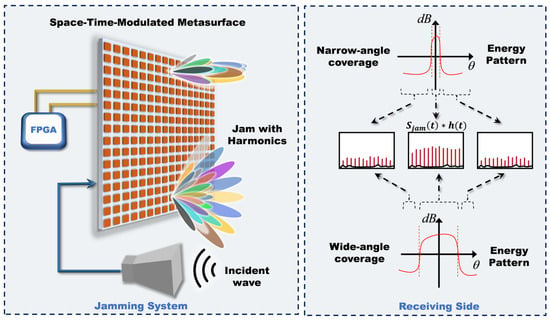
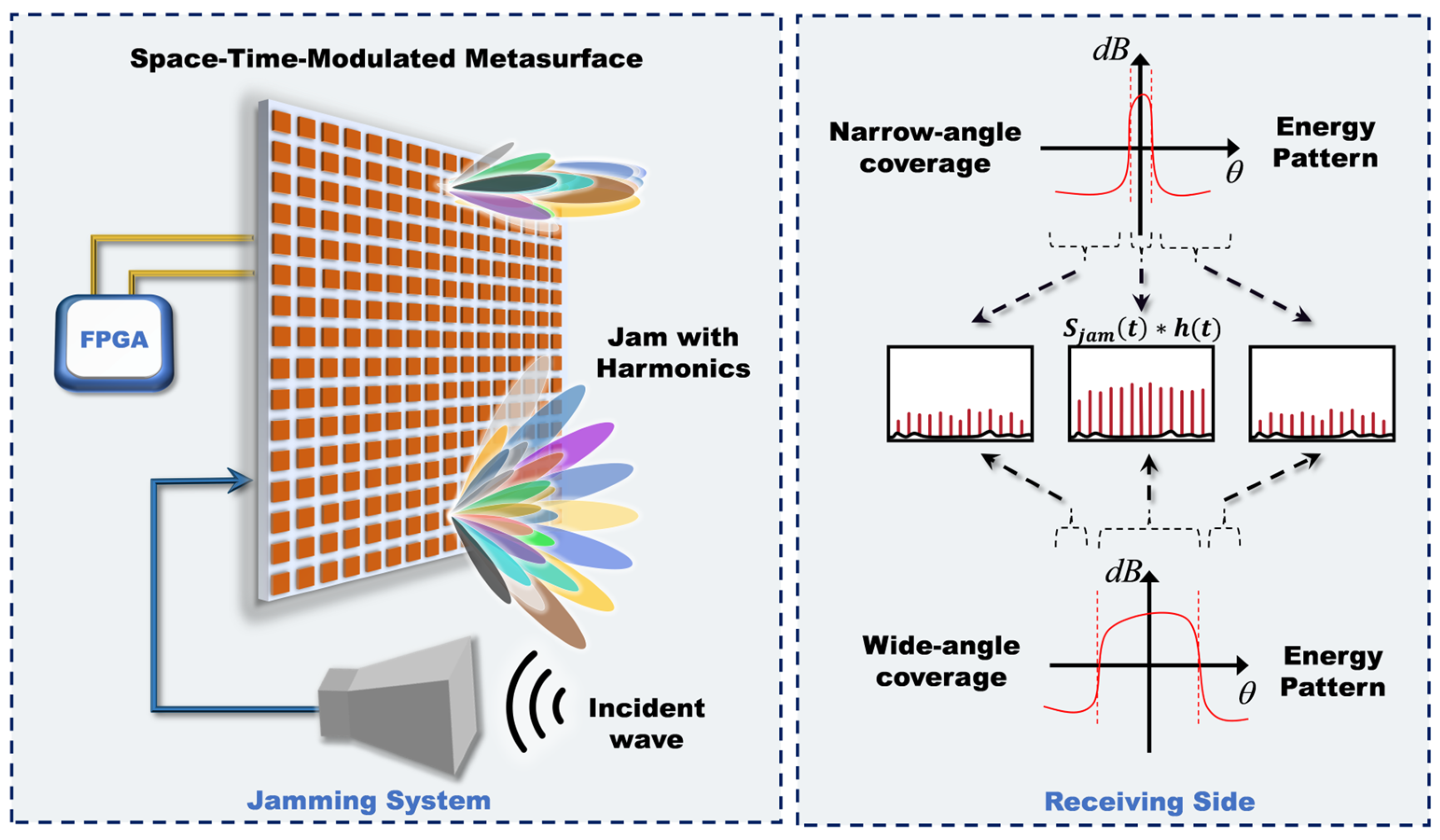
This section establishes a harmonic-energy regional-control jamming model based on a space–time-modulated radiation-type digital metasurface. Specifically, the radiation-type digital metasurface is used as a programmable radiating aperture that applies phase coding to the fed signal and directly radiates it into free space. Periodic temporal coding generates multiple harmonic components around the carrier frequency. For an LFM radar system, harmonic components of different orders can be regarded as LFM echoes with distinct frequency shifts, which are mapped to false targets in the range dimension after matched-filter pulse compression. Since the pulse-compressed peak amplitude of the hth-order false target is determined by the far-field amplitude of the corresponding harmonic in the observation direction, controlling the angular energy distribution of the harmonics enables control over the false-target amplitudes at different observation angles. Unlike designs that merely generate harmonic beams with fixed pointing directions, the objective of this work is to achieve harmonic energy coverage over a designated angular region. By optimizing the temporal modulation parameters of the metasurface elements, high and relatively uniform false-target amplitudes are maintained within the coverage region, while the false-target responses outside the coverage region are effectively suppressed. The operational mechanism is illustrated in Figure 1.
Figure 1.
Block diagram of the harmonic-energy regional-control jamming method based on a space–time-modulated radiation-type digital metasurface. The FPGA-controlled metasurface modulates the incident signal into harmonic jamming components with controllable angular energy coverage.
As shown in Figure 1, the proposed method consists of a jamming system and the corresponding receiving-side response. At the jamming-system side, the FPGA loads periodic temporal coding sequences onto the radiation-type digital metasurface, such that the incident LFM signal is modulated into harmonic components with different frequency shifts and radiated with controllable angular energy distributions. At the receiving side, harmonic components of different orders are mapped to range-dimensional false targets after matched-filter pulse compression, and their amplitudes vary with the harmonic energy observed in a given direction. Therefore, when the harmonic energy is concentrated within a narrow angular region, high-amplitude false targets can be formed over a small angular range. When the harmonic energy is broadened over a larger angular region, relatively uniform false-target responses can be generated over a wider coverage range. Outside the coverage region, the false-target energy remains low. Based on this physical mechanism, the radiation-type metasurface configuration, the space–time-modulated harmonic model, and the temporal optimization model for regional coverage are developed in the following subsections.
2.1. Radiation-Type Metasurface Configuration
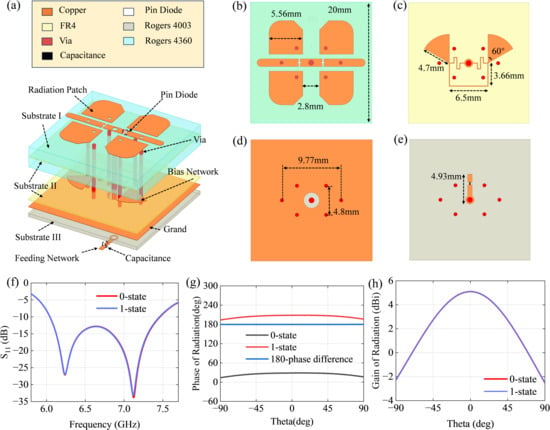
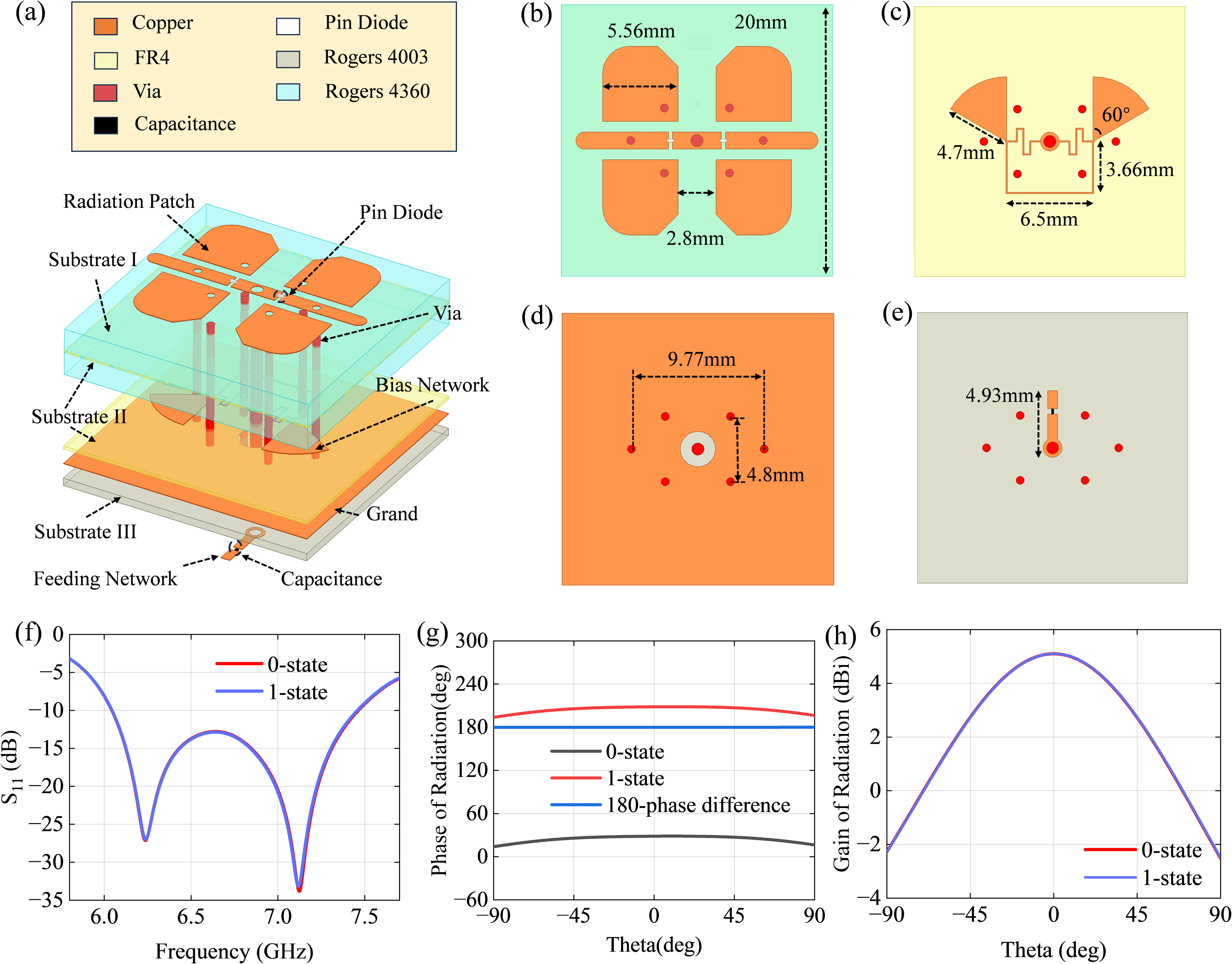
The radiation-type digital metasurface adopted in this work employs an integrated design that combines radiating elements with the feeding network. This radiation-type architecture integrates feeding transmission, bias control, phase switching, and electromagnetic radiation within the same aperture, enabling active radiation and programmable beam control with a low-profile configuration. The metasurface used in this work consists of a 16 × 16 array of programmable radiating elements. As shown in Figure 2, each element can be functionally divided into a radiation layer, a bias-network layer, an isolation ground layer, and a feeding-network layer. From top to bottom, the layers are arranged as follows: radiation layer, Rogers 4003 dielectric layer, FR4 dielectric layer, Rogers 4003 dielectric layer, bias-network layer, FR4 dielectric layer, ground plane, Rogers 4360 dielectric layer, and feeding-network layer, with specific dimensions annotated in the figure. The radiation layer converts the fed energy into a spatial radiated field and realizes two phase states by loading controllable devices. The bias-network layer suppresses the influence of the DC path on RF radiation. The isolation ground layer reduces the coupling between the bias-network layer and the bottom feeding network. The feeding-network layer provides stable RF excitation for the radiating elements. The S11 shown in Figure 2f indicates that the metasurface element with this multilayer integrated configuration can achieve integrated radiation and phase control around the target carrier frequency .
Figure 2.
Structural diagram and simulated performance of the radiation meta-atom. (a) Exploded view of the meta-atom. (b) Radiation patch layer. (c) Biasing network layer. (d) Metallic ground plane. (e) Feeding network layer. (f) Simulated S11 parameter of the meta-atom. (g) Radiation phase of the meta-atom. (h) Radiation gain of the meta-atom.
The 1-bit phase control of each element is determined by the state of the loaded switching devices. When the control signal changes the on/off state of the device, the radiation response of the element switches between two states. The equivalent radiation coefficients of the two states can be written as
where m and n denote the row and column indices of the array, respectively, and q denotes the digital coding state. Ideally, the two coding states have approximately equal radiation amplitudes and a phase difference of about 180° around the carrier frequency, namely
Under the same array aperture and optimization objective, 2-bit and continuous-phase modulation can achieve a higher maximum amplitude for the designated first-order harmonic than 1-bit modulation. In addition, 1-bit modulation imposes conjugate symmetry between positive- and negative-order harmonics, whereas 2-bit and continuous-phase modulation use complex-valued modulation functions, so that the positive and negative harmonics of the same order are no longer necessarily constrained to have equal magnitudes. This provides additional degrees of freedom for tailoring the harmonic-energy distribution and suppressing undesired harmonic components. Such performance improvement, however, comes at the cost of increased hardware complexity, since 2-bit and continuous-phase control require additional phase states and more elaborate biasing. Therefore, the 1-bit modulation used in this work represents a practical trade-off among harmonic-control capability, metasurface hardware complexity, and implementation feasibility. Accordingly, the following theoretical model is formulated based on the two radiation states of the fabricated 1-bit element. Based on these two radiation states, the time-varying radiation coefficient of the (m,n)th element can be further expressed as
where Am,n is the equivalent radiation amplitude of the element, and is the instantaneous phase determined by the digital control state.
To verify the feasibility of the element design, Figure 2f–h presents the electromagnetic simulation results of the element within the target frequency band, including the reflection coefficient, the radiation phases under the two coding states, the phase difference, and the radiation gain. The radiation phases of the two states validate the 1-bit phase-switching capability, while the radiation gain and radiation pattern evaluate the effectiveness of the element as a radiating aperture.
Based on the proposed radiating element, an M × N = 16 × 16 radiation-type digital metasurface array is constructed. The equivalent weight of the (m,n)th element is written as
where represents the 1-bit phase state of the element. If the element spacings along the x- and y-directions are and , respectively, the array factor at the carrier frequency can be expressed as
where is the element pattern, ,, and . This planar-array model describes the spatial superposition of time-varying coded elements in the two-dimensional angular domain and provides the array-model basis for the following harmonic-energy regional synthesis.
2.2. False-Target Jamming Based on Harmonic-Energy Regional Control
When the coding states of all elements are periodically switched with modulation period , within one modulation period, the temporal coding sequence is written as
where and are the normalized switch-on instant and duty cycle of the (m,n)th element, respectively, with and . Due to the periodicity, is expanded into a Fourier series and written as
where is the modulation frequency corresponding to , and is the Fourier coefficient of the hth harmonic of the (m,n)th modulator, which can be calculated by
It can be seen that the duty cycle mainly controls the harmonic amplitude, whereas the switch-on instant mainly controls the harmonic phase. The far field of the hth-order harmonic in the direction can be expressed as
where , , and are the temporal parameters to be optimized.
To clarify the relationship between harmonic energy and radar false targets, assume that the jammed radar transmits an LFM signal
where is the pulse duration, and is the chirp rate. After being retransmitted by the space–time-modulated metasurface, the hth-order harmonic can be regarded as an LFM component with frequency shift . The jamming signal in the direction can be written as
where is the amplitude coefficient of the jamming link, and is the propagation and system delay.
At the radar receiver, the matched filter is used for pulse compression. For an LFM component with time delay and frequency shift , the peak of the pulse-compressed envelope appears at . Therefore, the false-target range corresponding to the hth-order harmonic is
This equation indicates that the harmonic frequency shifts induced by time modulation are mapped to range-dimensional false targets through LFM pulse compression. Meanwhile, the peak amplitude of the false target corresponding to the hth harmonic after pulse compression in different observation directions satisfies
where Kh includes the matched-filter gain, propagation loss, link gain, and other system constants. Therefore, controlling the harmonic far-field energy distribution is equivalent to controlling the angular distribution of pulse-compressed false-target amplitudes.
The normalized pulse-compressed false-target energy pattern is defined as
where is the overall angular observation domain used for normalization, and i is the index of a discrete observation direction within . is the set of harmonics selected for jamming.
To obtain high and relatively uniform false-target amplitudes inside the coverage region while suppressing the false-target amplitudes outside the coverage region, the optimization objective is constructed as
where
where is the target jamming region, is the remaining angular domain, and . increases the harmonic energy ratio within the target jamming region, suppresses the maximum energy leakage in the non-target region, and constrains the energy fluctuation within the target region. The coefficients , , and are the corresponding weighting factors. Through this objective function, the temporal coding parameters corresponding to the minimum value of the objective are sought. The optimization does not aim for the maximum harmonic gain at a single angle. Instead, it directly generates the temporal coding parameters that satisfy the desired angular energy coverage.
Through the differential evolution algorithm, the optimal duty cycles and switch-on instants of the 16 × 16 radiating elements can be obtained, enabling multiple harmonics to form a reconfigurable energy coverage region in space. This angular energy distribution is in turn reflected in the radar pulse-compression results. When the observation direction lies inside , the corresponding range bins exhibit high and relatively uniform false-target peaks. When the observation direction lies inside , the false-target peaks are significantly suppressed. Therefore, the proposed method can switch between narrow-angle highly concentrated coverage and wide-angle regional coverage according to the jamming task, thereby achieving reconfigurable control of the harmonic false-target energy coverage range.
3. Numerical Simulation
To validate the harmonic-energy regional-control model established in Section 2, this section conducts numerical simulations of the angular-domain harmonic energy distribution of a radiating space–time-modulated digital metasurface. In the simulations, a 16 × 16 radiating programmable metasurface array is adopted, and the turn-on instant and duty cycle of each element are selected as the optimization variables. According to Equation (8), the duty cycle mainly determines the amplitude weighting of different harmonic orders, whereas the turn-on instant primarily controls the harmonic phase. Furthermore, Equation (9) indicates that the far-field pattern corresponding to a given harmonic order is formed by the spatial superposition of the amplitude and phase responses of all array elements at that harmonic order. Therefore, by jointly optimizing the time-modulation parameters of all elements, the desired harmonic energy coverage can be synthesized within a targeted angular region.
The observation angle is defined as . The turn-on instants and duty cycles of the programmable elements are selected as the optimization variables, and the temporal modulation parameters are optimized within a prescribed target coverage region . The optimization objective is to enhance the total harmonic energy within the target region, reduce the in-region energy fluctuation, and suppress energy leakage outside the target region, thereby obtaining temporal coding sequences that satisfy different angular-coverage requirements. Both the numerical simulations and the subsequent experimental measurements in this work adopt the two-dimensional cross-section at a fixed azimuth angle and both use the harmonic-order set In both the simulations and experiments, the carrier frequency is set to 6.775 GHz, the modulation frequency to 100 kHz, the LFM bandwidth to 20 MHz, and the signal duration to 100 μs.
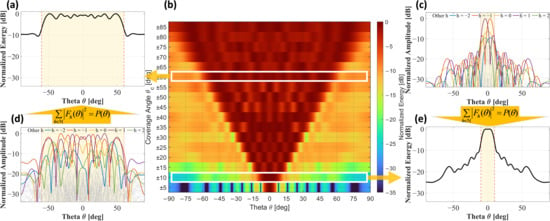
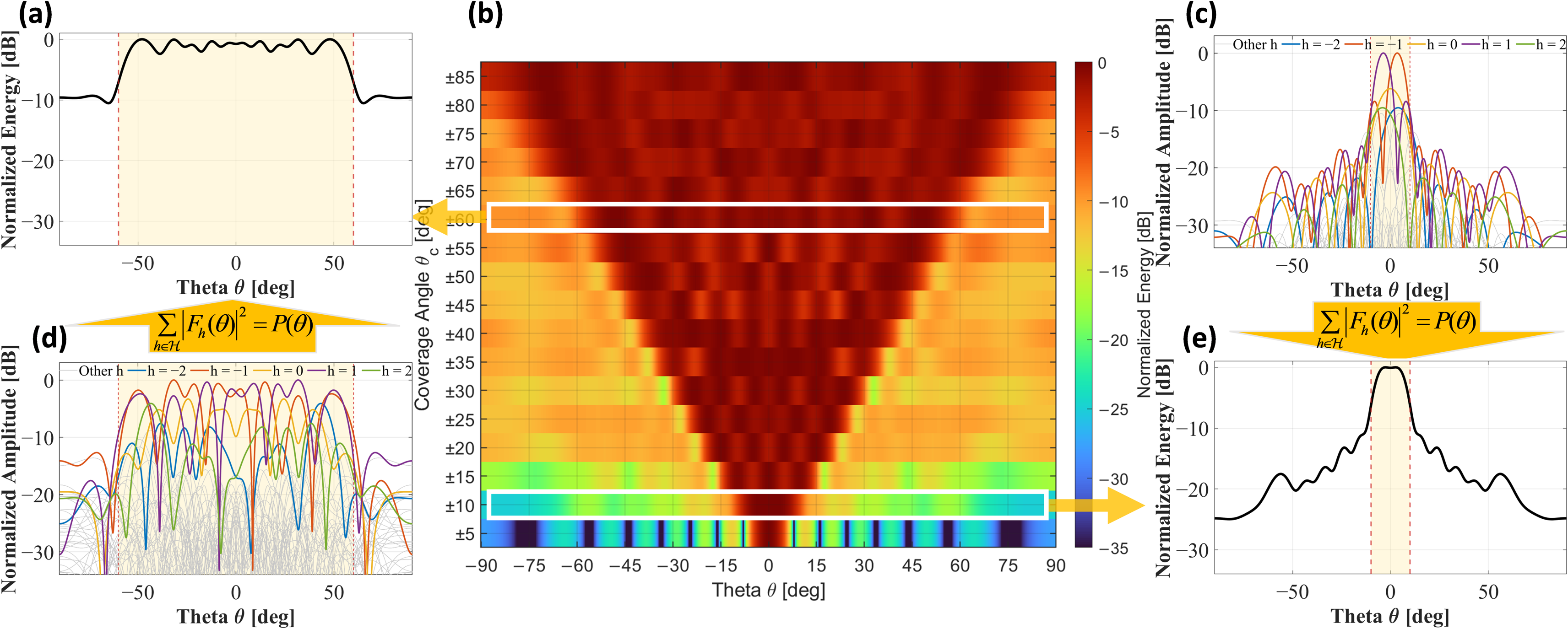
Figure 3b shows the two-dimensional normalized total harmonic-energy distribution for different coverage angles. The horizontal axis denotes the observation angle , ranging from to , while the vertical axis represents the coverage angle , varying from to . As increases, the high-energy region gradually expands from a narrow angular region around broadside to a wider angular range. The harmonic energy is primarily concentrated within the designated coverage region, whereas the energy outside this region remains at a relatively low level. The two typical coverage cases of and are highlighted by white boxes for comparison with the one-dimensional energy patterns in Figure 3a,e.
Figure 3.
Simulated results of harmonic-energy regional control under different prescribed jamming coverage regions. (a,e) show the normalized total harmonic-energy patterns for θc = ±60° and θc = ±10°, respectively. (c,d) present the normalized amplitude patterns of different harmonic orders for θc = ±10° and θc = ±60°, respectively. (b) shows the two-dimensional normalized total harmonic-energy distribution for different coverage angles.
For the wide-angle coverage case of , Figure 3a shows the normalized total harmonic-energy pattern, while Figure 3d presents the normalized amplitude patterns of different harmonic orders. In Figure 3d, the dominant harmonics with are represented by colored curves, whereas the remaining low-energy harmonics are shown in gray. It can be observed that the energy of different harmonic orders is not concentrated into a single narrow beam. Instead, the harmonic patterns form uniform radiation distributions over a broad angular range. The total harmonic-energy pattern in Figure 3a is obtained by summing the squared amplitudes of the individual harmonics, , where is the set of harmonic orders included in the calculation, and is the far-field response of the hth-order harmonic at observation angle . As shown in Figure 3a, the total harmonic energy remains at a high level within and decreases gradually near the coverage boundaries, while the energy outside the designated region is significantly suppressed. These results indicate that wide-angle coverage is achieved primarily through the spatial complementarity among multiple harmonic patterns, rather than by generating a fixed wide beam with a single harmonic order.
For the narrow-angle coverage case of , Figure 3c presents the normalized amplitude patterns of different harmonic orders, and Figure 3e shows the corresponding normalized total harmonic-energy pattern. Compared with the wide-angle case, the high-energy regions of the dominant harmonics are concentrated around broadside, and their superposition produces a pronounced energy enhancement within . As shown in Figure 3e, the total harmonic energy approaches its normalized peak within the target region and decreases rapidly outside the prescribed coverage interval. These results demonstrate that, by optimizing the switch-on instants and duty cycles of the array elements, the concentration region of harmonic energy can be reconfigured to realize narrow-angle, highly focused jamming coverage.
According to Equations (12) and (13), the harmonic components generated by space–time modulation are mapped to false targets at different range positions after matched filtering and pulse compression in an LFM radar system. The pulse-compressed peak amplitude of each false target is related to the harmonic far-field energy pattern in the corresponding observation direction. Therefore, the relatively high and uniform total harmonic energy within the target region in Figure 3 corresponds to strong and uniform false-target responses within the coverage region, whereas the lower harmonic energy outside the target region leads to suppressed false-target responses. The simulation results demonstrate that the proposed method can be switched between narrow-angle, highly concentrated coverage and wide-angle regional coverage according to different jamming requirements.
4. Experimental Verification
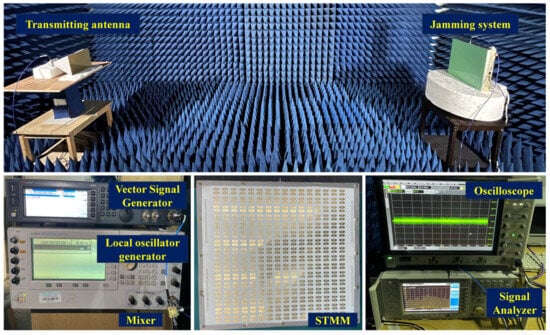
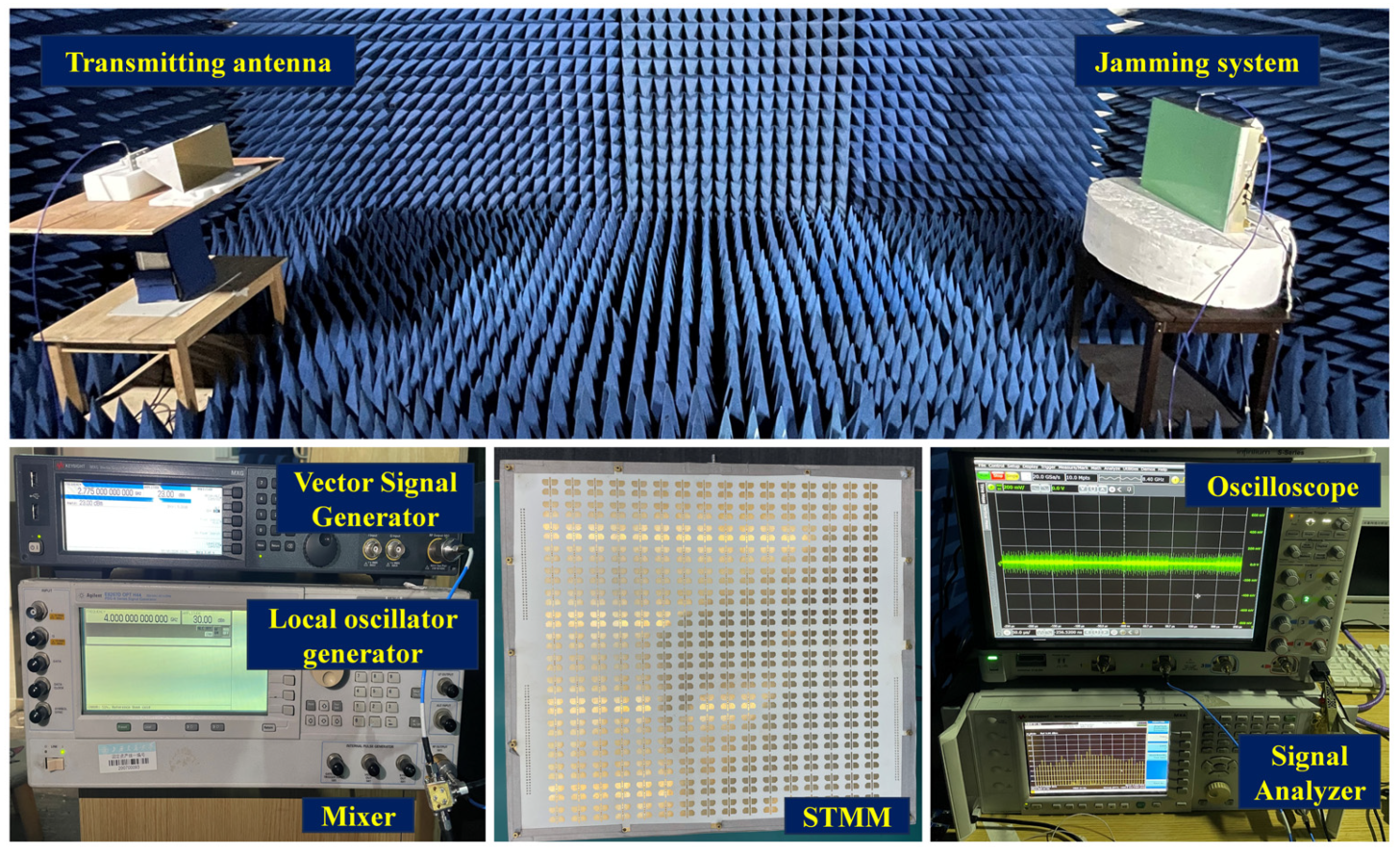
To further validate the proposed mechanism for regional control of harmonic energy and the effectiveness of the numerical simulations, an experimental test system based on a radiating space–time-modulated digital metasurface was established, as shown in Figure 4. The experimental system uses a 16 × 16 space–time-modulated digital metasurface, which mainly consists of an FPGA-based digital controller, a power divider, the metasurface elements, an integrated RF feeding network, and a DC power supply. An Altera Cyclone IV E FPGA (EP4CE40F29C8N) is used as the core controller. A one-to-256 equal-amplitude and in-phase power-dividing network is integrated into the feeding layer of the radiation-type metasurface to distribute a single RF input signal to the 16 × 16 radiating elements. A T-type feeding topology is used to provide approximately identical RF excitation for the array elements. The programmable elements employ MACOM MADP-000907-14020P PIN diodes, with a typical switching time of approximately 2 ns. A 5 V DC power supply is used for the control subsystem, and the measured DC power consumption is approximately 19.7 W.
Figure 4.
Experimental platform for harmonic-energy regional-control jamming. The upper panel shows the jamming test scenario in a microwave anechoic chamber; the lower panels show the transmit-signal generation equipment, the fabricated space–time-modulated metasurface, and the jamming-signal acquisition equipment, respectively.
During the experiment, at the transmitter, a vector signal generator was used to generate a linear frequency-modulated signal, which was radiated toward the jamming system through a transmitting antenna. The jamming system consisted of the space–time-modulated metasurface. The control unit loaded the periodic codes obtained from simulation-based optimization onto the metasurface elements, such that the incident signal was modulated into harmonic jamming signals with a prescribed angular-domain energy distribution. At the receiver, a spectrum analyzer was used to measure the angular pattern of the total harmonic energy, while an oscilloscope was employed to acquire the radiated signals at different observation angles. The acquired signals were further processed by pulse compression to obtain the range-domain false-target jamming results. The distances from the transmitting and receiving antennas to the metasurface are both 3.6 m.
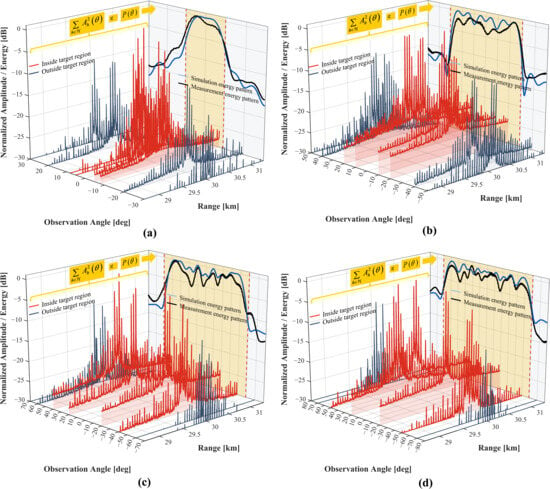
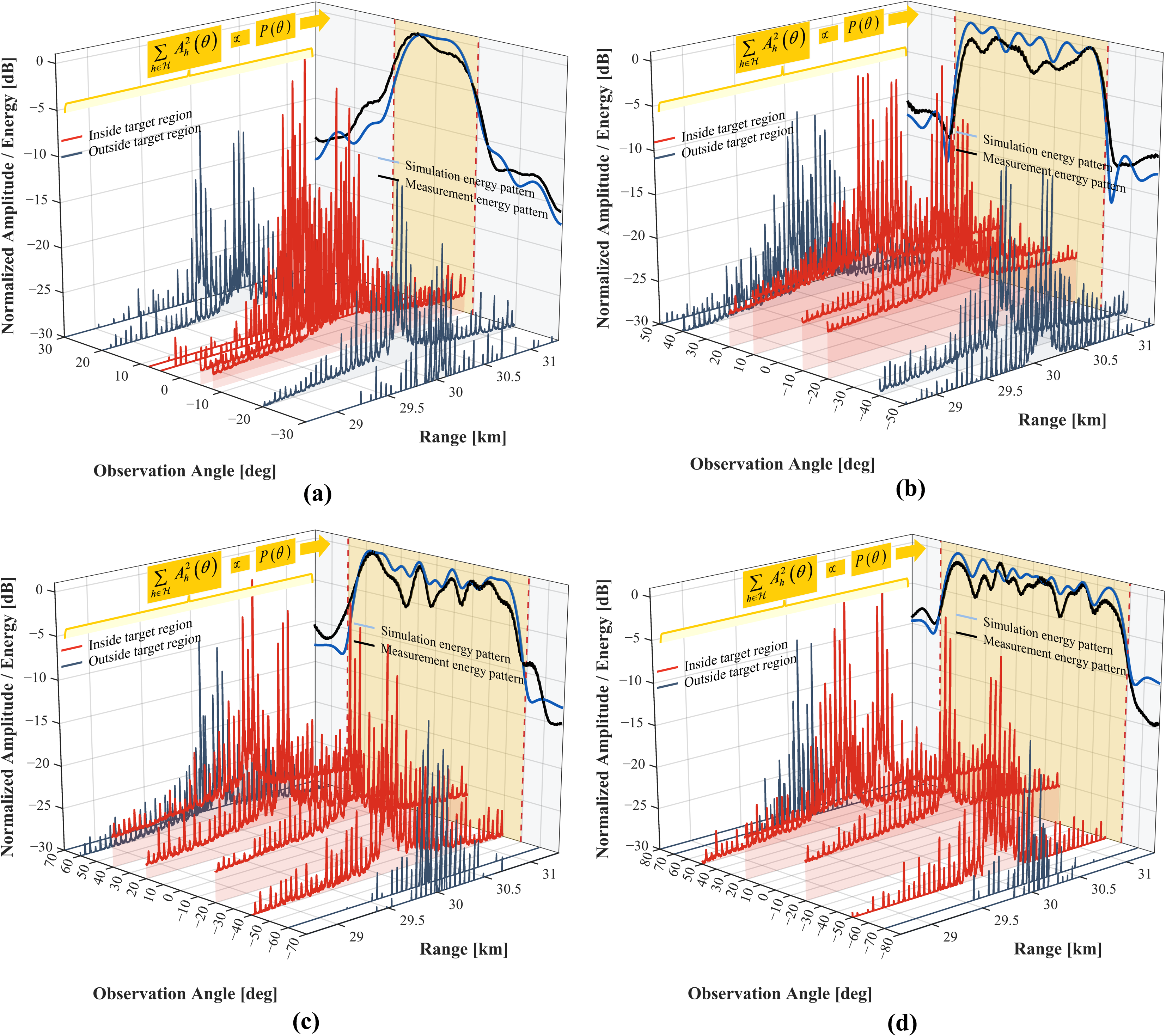
Figure 5 presents the experimental results under four jamming coverage regions, namely , , and , where Figure 5a–d correspond to these four coverage cases, respectively. Each three-dimensional plot contains three axes: range, observation angle, and normalized amplitude/energy. The range axis represents the pulse-compressed range response, the observation-angle axis represents the different measured observation angles, and the vertical axis represents the normalized pulse-compression amplitude or normalized harmonic energy. For each fixed observation angle, the range-domain false-target peaks generated by different harmonic components after pulse compression can be observed along the range axis. The red curves represent the measured results inside the target jamming region, whereas the blue curves represent the measured results outside the target jamming region.
Figure 5.
Measured pulse-compressed false-target results and total harmonic-energy patterns under different jamming coverage regions. (a) Pulse-compressed range response and simulated and measured total harmonic-energy patterns under the ±10° coverage condition. (b) Pulse-compressed range response and simulated and measured total harmonic-energy patterns under the ±30° coverage condition. (c) Pulse-compressed range response and simulated and measured total harmonic-energy patterns under the ±50° coverage condition. (d) Pulse-compressed range response and simulated and measured total harmonic-energy patterns under the ±60° coverage condition.
The simulated and measured total harmonic-energy patterns as functions of the observation angle are also plotted on the background plane behind each three-dimensional plot. The blue curves represent the simulation results, whereas the black curves represent the measured results. The relationship marked in the figure, , where is the amplitude of the pulse-compressed false-target response associated with the hth harmonic at the observation angle , indicates that, for a given observation angle , the accumulated energy of the pulse-compressed false-target responses associated with the respective harmonic components is proportional to the total harmonic energy at that angle. Therefore, the pulse-compressed range responses have a direct correspondence with the angular-domain harmonic-energy patterns: a higher angular-domain energy corresponds to a stronger range-domain false-target response, whereas a lower angular-domain energy corresponds to a weaker false-target response.
For the coverage case, as shown in Figure 5a, the measured total harmonic energy is mainly concentrated within , and the measured energy pattern is in good overall agreement with the simulation. Within the designated jamming region, the range-domain responses at different observation angles all exhibit pronounced false-target peaks. When the observation angle lies outside the designated region, the false-target peaks are significantly reduced. These results indicate that, under narrow- angle coverage, the harmonic energy can be concentrated within the prescribed sector, thereby generating a jamming effect with pronounced spatial selectivity.
When the coverage region is expanded to and , as shown in Figure 5b,c, the high-energy regions extend to and , respectively. As the predefined jamming coverage angle increases, the boundaries of the energy patterns expand accordingly toward both sides of the angular domain, and the strong false-target responses in the range dimension cover a broader angular range. Although the measured energy patterns exhibit certain fluctuations, their overall trends remain consistent with the simulations, and the pulse-compressed responses inside the designated region are generally stronger than those outside the region. These results demonstrate that the proposed method can continuously adjust the spatial distribution of harmonic energy according to the predefined coverage angle.
For the wider coverage case, as shown in Figure 5d, the high total harmonic energy extends to . Although the energy pattern under wide-angle coverage exhibits some fluctuations, the measured results still follow the simulation reasonably well and maintain a relatively high energy level within the designated jamming region. Within this angular region, strong false-target responses are observed at all different observation angles. Outside the region, where , both the harmonic energy and the pulse-compressed false targets are significantly suppressed. This result verifies that the proposed method enables reconfigurable control from narrow-angle concentrated coverage to wide-angle regional coverage.
To further clarify the differences between the proposed method and existing related works, Table 1 compares several representative metasurface-based jamming approaches. Considering the substantial differences among these methods in terms of application scenarios and implementation architectures, direct comparisons of numerical metrics such as operating frequency and gain are not adopted. Instead, the comparison focuses on the temporal modulation scheme and two capabilities that are directly related to the regional-control mechanism proposed in this work, namely, whether the harmonic-energy coverage angle can be reconfigured and whether out-of-region energy leakage is taken into account in the optimization.
Table 1.
Comparison with Representative Related Works.
In Table 1, “✓“ indicates that the corresponding capability is explicitly considered and validated in the cited work, whereas “--“ indicates that it is not explicitly formulated as a design objective. The other representative studies employ different temporal modulation or coding schemes, including continuous-phase modulation and digital 1-bit or 2-bit modulation. The advantage of the proposed method lies in its ability to reconfigure the harmonic-energy coverage over different prescribed angular regions under 1-bit phase time modulation by jointly optimizing the turn-on instant and duty cycle of each element. In addition, out-of-region energy leakage is explicitly incorporated into the optimization objective, enabling the desired harmonic-energy coverage to be formed within the target region while suppressing undesired energy outside it. Therefore, compared with the other representative methods listed in Table 1, the proposed method can adapt to jamming scenarios with different angular coverage ranges.
Overall, the experimental results further validate the regional-control capabilities highlighted in Table 1. First, the measured total harmonic-energy patterns under all four coverage conditions are in good agreement with the corresponding simulations, indicating that the time sequences obtained by jointly optimizing the switching instants and duty cycles can realize the desired harmonic-energy regional-control jamming on the radiating space–time-modulated digital metasurface. Second, the pulse-compressed range responses at different observation angles satisfy the proportional relationship shown in the figure with the corresponding total harmonic-energy patterns, verifying the mapping mechanism from angular-domain harmonic-energy control to range-domain false-target amplitude modulation. As the coverage angle expands from to , the experimental results exhibit energy expansion and false-target response variations consistent with the designated regions, demonstrating that the proposed method can achieve adjustable switching between narrow-angle highly concentrated coverage and wide-angle regional coverage in a practical jamming system.
5. Conclusions
This paper proposes a harmonic-energy regional-control jamming method based on a radiating space–time-modulated digital metasurface. By jointly optimizing the turn-on instants and duty cycles of 1-bit programmable elements, the proposed method establishes a mapping among time sequences, harmonic amplitude–phase responses, and far-field angular energy distribution, and formulates the designated jamming region as a reconfigurable angular-domain energy window. Compared with methods that only generate harmonics with fixed pointing directions, the proposed method can simultaneously increase the harmonic energy ratio within the target region and suppress leakage outside the region, thereby enabling switchable control between narrow-angle highly concentrated coverage and wide-angle uniform coverage. The numerical simulation results show that the proposed method can produce the expected harmonic energy distributions under different designated jamming regions. Further experimental validation demonstrates that the measured angular energy distributions are consistent with the simulation results, and that the pulse-compression results at different observation angles also agree with the theoretical analysis, indicating that regional control of angular harmonic energy can be directly translated into spatially selective control of range-domain false-target amplitudes. Overall, the proposed method provides a quantifiable, programmable, and regionally reconfigurable implementation path for metasurface-based jamming systems.
Author Contributions
Conceptualization, J.C. and Y.S.; methodology, J.C. and Y.S.; validation, Y.S.; resources, J.C., Y.C. and X.B.; data curation, Y.S.; writing—original draft preparation, Y.S.; writing—review and editing, J.C. and Y.X.; visualization, T.G. and Y.X.; supervision, J.C., Y.X. and R.J.; funding acquisition, J.C. All authors have read and agreed to the published version of the manuscript.
Funding
This work was funded by the National Natural Science Foundation of China under Grants 62371287 and 62001291, and in part by the State Key Laboratory of Radio Frequency Heterogeneous Integration (Independent Scientific Research Program No. 2025022).
Data Availability Statement
The original contributions presented in this study are included in the article. Further inquiries can be directed to the corresponding authors.
Conflicts of Interest
The authors declare no conflicts of interest.
References
- Tai, N.; Pan, Y.; Yuan, N. Quasi-coherent noise jamming to LFM radar based on pseudo-random sequence phase-modulation. Radioengineering 2015, 24, 1013–1024. [Google Scholar] [CrossRef] [Scilit]
- Zhang, Y.; Yang, S. Convolution Jamming Technique Countering LFM Radar. J. Electron. Inf. Technol. 2007, 29, 1408–1411. [Google Scholar]
- Zhang, K.; Zhang, T.; Liang, Z. A new oversampling-based full-duplex radar jamming method with a single antenna. Digit. Signal Process. 2024, 153, 104642. [Google Scholar] [CrossRef] [Scilit]
- Shi, Q.; Tai, N.; Wang, C. On deception jamming for countering LFM radar based on periodic 0-π phase modulation. AEU-Int. J. Electron. Commun. 2018, 83, 245–252. [Google Scholar] [CrossRef] [Scilit]
- Chen, J.; Ni, G.; He, C. Coherent jamming method for wideband radar with time modulated technology. In Proceedings of the 2020 IEEE International Symposium on Antennas and Propagation and North American Radio Science Meeting, Montreal, QC, Canada, 5–10 July 2020; pp. 1885–1886. [Google Scholar]
- Yang, L.; Zhang, Y.; Zhao, X. Deception jamming method for wideband linear frequency modulation radar based on time-modulated array. IEEE Antennas Wirel. Propag. Lett. 2024, 23, 4408–4412. [Google Scholar] [CrossRef] [Scilit]
- Liang, J.; Zhang, L.; Luo, Z. A filtering reconfigurable intelligent surface for interference-free wireless communications. Nat. Commun. 2024, 15, 3838. [Google Scholar] [CrossRef] [Scilit] [PubMed]
- Luo, Z.; Zhang, Z.; Tai, J. Fully Breaking Entanglement of Multiple Harmonics for Space-and Frequency-Division Multiplexing Wireless Applications via Space-Time-Coding Metasurface. Adv. Sci. 2024, 11, 2404558. [Google Scholar] [CrossRef] [Scilit] [PubMed]
- Yang, R.; Luo, Z.; Liang, J. Reconfigurable Metasurface With Multiple Functionalities of Frequency-Selective Rasorber, Frequency-Selective Surface, Absorber, and Reflector. Adv. Mater. Technol. 2025, 10, 2400966. [Google Scholar] [CrossRef] [Scilit]
- Luo, Z.; Shan, X.; Ren, X. Active metasurface absorber for intensity-dependent surface-wave shielding. IEEE Trans. Antennas Propag. 2023, 71, 5795–5804. [Google Scholar] [CrossRef] [Scilit]
- Zhou, W.; Zhu, S.; Zhang, Z. Time-varying metasurface driven broadband radar jamming and deceptions. Opt. Express 2024, 32, 17911–17921. [Google Scholar] [CrossRef] [Scilit] [PubMed]
- Fang, X.; Li, M.; Li, S. Diverse frequency time-modulated metasurface for false target jamming: Theory and experiment. IEEE Trans. Microw. Theory Tech. 2023, 72, 1932–1942. [Google Scholar]
- Yu, S.; Guan, D.; Xu, H. A dual-metasurface-based imaging radar deception jammer with angular adaptability and scattering enhancement. IEEE Trans. Antennas Propag. 2024, 72, 5261–5272. [Google Scholar] [CrossRef] [Scilit]
- Wan, X.; Wang, H.; Wang, W. Trackable Electronic Deception Enabled by Space-Time Coding Metasurface. Adv. Opt. Mater. 2024, 12, 2401353. [Google Scholar] [CrossRef] [Scilit]
- Sun, Z.; Zhang, L.; Chen, X. Anti-radar based on metasurface. Nat. Commun. 2025, 16, 7258. [Google Scholar] [CrossRef] [Scilit] [PubMed]
- Chen, J.; Liu, D.; Zhao, X. Coherent jamming with 1-bit time modulated digital metasurfaces. In Proceedings of the 2022 IEEE International Symposium on Antennas and Propagation and USNC-URSI Radio Science Meeting, Denver, CO, USA, 10–15 July 2022; pp. 1390–1391. [Google Scholar]
- Ding, C.; Mu, H.; Shi, Y. Dual-polarized and conformal time-modulated metasurface-based 2-D jamming against SAR imaging systems. IEEE Trans. Antennas Propag. 2025, 73, 7752–7764. [Google Scholar] [CrossRef] [Scilit]
- Li, S.; Wang, J.; Fang, X. Jamming of ISAR imaging with time-modulated metasurface partially covered on targets. IEEE Antennas Wirel. Propag. Lett. 2022, 22, 372–376. [Google Scholar] [CrossRef] [Scilit]
- Ding, C.; Mu, H.; Meng, Y. Time-modulated metasurface-assisted moving target jamming for synthetic aperture radar. IEEE Trans. Microw. Theory Tech. 2025, 73, 4191–4203. [Google Scholar] [CrossRef] [Scilit]
- Gao, T.; Zhou, S.; Chen, Y. Space-Time-Modulated Radiation-Type Digital Metasurface Enabled Smart Jamming. Laser Photonics Rev. 2026, 20, e01421. [Google Scholar] [CrossRef] [Scilit]
- Poli, L.; Rocca, P.; Oliveri, G. Harmonic beamforming in time-modulated linear array. IEEE Trans. Antennas Propag. 2011, 59, 2538–2545. [Google Scholar] [CrossRef] [Scilit]

Disclaimer/Publisher’s Note: The statements, opinions and data contained in all publications are solely those of the individual author(s) and contributor(s) and not of MDPI and/or the editor(s). MDPI and/or the editor(s) disclaim responsibility for any injury to people or property resulting from any ideas, methods, instructions or products referred to in the content. |
© 2026 by the authors. Licensee MDPI, Basel, Switzerland. This article is an open access article distributed under the terms and conditions of the Creative Commons Attribution (CC BY) license.