


Abstract
Spin-decoupled phase control is essential for independently manipulating opposite circular-polarization channels in terahertz (THz) metasurfaces. However, existing strategies generally require multiple phase degrees of freedom, increasing the complexity of phase engineering. Here, we propose an optically programmable reflective THz metasurface that realizes spin-decoupled phase control solely through curvature-induced geometric phase (CIGP), without overall meta-atom rotation or hybrid phase mechanisms. The proposed metasurface incorporates two independently controllable photosensitive silicon elements, each of which can be assigned either a low- or high-conductivity state to independently reconfigure the effective surface-current paths and corresponding CIGP of the two spin channels. At 1.1 THz, all four coding states (00, 01, 10, and 11) maintain reflection amplitudes above 0.8, while the left and right silicon elements independently provide 0/π phase control of the LCP and RCP channels, respectively. By assigning different conductivity states to the photosensitive silicon elements across the metasurface, the desired spin-dependent phase profiles can be encoded for reconfigurable focusing, multi-angle focal-spot steering, and independent dual-channel near-field imaging. As a proof-of-concept, full-wave numerical simulations show good agreement between the preset and simulated steering angles and distinct image reconstruction in the two spin channels with negligible mutual interference. This work establishes a single-geometric-phase route to optically programmable spin decoupling, providing a simple and flexible approach to multifunctional THz wavefront manipulation.
1. Introduction
Terahertz (THz) waves have attracted considerable attention owing to their unique properties, including strong penetration, low photon energy, and distinctive spectral fingerprints, with promising applications in communications, imaging, sensing, and nondestructive testing [1,2,3]. The practical implementation of these applications requires efficient and flexible control over the amplitude, phase, and polarization of THz waves. However, conventional THz components based on natural materials are generally bulky and provide limited flexibility in electromagnetic-wave manipulation, making it difficult to meet the increasing demands for integration and multifunctionality [4]. Metasurfaces, composed of artificially engineered subwavelength structures, provide unprecedented capabilities for tailoring electromagnetic waves at the subwavelength scale and have therefore emerged as a powerful platform for THz wavefront manipulation [5,6,7,8,9,10]. Recent advances in THz metasurfaces have enabled versatile functionalities, including beam steering, polarization control, and holographic wavefront generation [11,12,13,14].
Geometric phase provides an important route for phase manipulation in metasurfaces. Among various geometric-phase mechanisms, the rotation-induced Pancharatnam–Berry (PB) phase has been widely employed owing to its intrinsically dispersionless nature and broadband applicability [15,16,17,18]. However, conventional PB-phase modulation inherently couples the phase responses of opposite spin states, with LCP and RCP waves acquiring conjugate phase profiles. Consequently, the two spin channels cannot be independently engineered, restricting applications that require independent wavefront control under opposite circularly polarized incidences [19]. To overcome this limitation, various spin-decoupled phase-control strategies have been developed by introducing additional phase degrees of freedom [20,21,22,23,24]. For example, Ding et al. combined propagation phase with PB phase to independently control LCP and RCP phases [20]. Fu et al. engineered surface-current paths in C-shaped split-ring resonators to realize spin-decoupled geometric phase control based on curved current evolution [25]. Liu et al. combined the nonadiabatic Aharonov–Anandan (AA) geometric phase with PB phase to achieve complete phase decoupling of the two circular-polarization channels with full 2π phase coverage [21]. Despite these advances, existing spin-decoupling approaches generally rely on multiple phase degrees of freedom, such as the combination of propagation, resonant, or other geometric phases with rotation-induced PB phase, increasing the complexity of phase engineering. Therefore, realizing independent dual-spin phase control through a single geometric-phase mechanism remains highly desirable.
Curvature-induced geometric phase (CIGP) provides a promising route toward spin-decoupled phase control through the engineering of curved surface-current paths. CIGP can be regarded as a PB-like geometric phase generated by the effective rotation of surface currents along curved paths. Although CIGP and the conventional PB phase share a spin-dependent rotational origin, the effective surface-current rotation is realized differently: in the conventional PB phase, it is induced by the rigid in-plane rotation of the meta-atom, whereas in CIGP, it is engineered through curved surface-current paths, enabling the phase responses of different spin channels to be independently controlled [25]. Wang et al. employed an S-shaped arc meta-atom to achieve complete spin decoupling by combining curvature-induced and rotation-induced geometric phases [26]. However, their approach still relies on the PB phase introduced by the overall rotation of the meta-atoms, requiring different spatial orientations to realize the desired phase responses. Therefore, whether independent phase control of the two spin channels can be achieved solely through CIGP, without introducing overall meta-atom rotation or additional phase mechanisms, remains an important question.
Meanwhile, dynamic reconfiguration is increasingly required for programmable and multifunctional metasurfaces, whereas many spin-decoupled metasurfaces exhibit fixed electromagnetic responses once fabricated [27,28,29]. To enable active THz wavefront control, various tunable materials and switchable elements have been introduced, among which photosensitive semiconductors provide an attractive route for optical programming owing to their dynamically tunable conductivity and compatibility with spatially structured illumination [30,31,32,33,34,35,36]. However, existing optically reconfigurable spin-decoupled metasurfaces generally rely on hybrid phase mechanisms involving propagation phase or rotation-induced PB phase [37]. Therefore, directly achieving independent dual-spin phase control through optically reconfigurable CIGP without additional phase mechanisms remains largely unexplored.
In this work, we propose an optically programmable THz metasurface that realizes spin-decoupled phase control solely through curvature-induced geometric phase (CIGP). Unlike existing approaches relying on overall meta-atom rotation or hybrid phase mechanisms, two independently controllable photosensitive silicon elements are designed with selectable low- and high-conductivity states to reconfigure the effective surface-current paths associated with the two spin channels, enabling independent phase control of LCP and RCP waves without altering the physical structure. At 1.1 THz, all four coding states (00, 01, 10, and 11) maintain reflection amplitudes above 0.8, while the left and right photosensitive silicon elements independently provide 0/π phase control of the LCP and RCP channels, respectively. By assigning different conductivity states to the photosensitive silicon elements across the metasurface, the desired spin-dependent phase profiles can be encoded for dynamically reconfigurable spin-decoupled focusing, multi-angle focal-spot steering, and independent dual-channel near-field imaging. These results demonstrate that optical programmability and spin-decoupled phase control can be simultaneously realized through current-path reconfiguration based solely on CIGP, providing a simple and flexible approach to multifunctional THz wavefront manipulation.
2. Theoretical Analysis and Design
2.1. Unit Structure Design
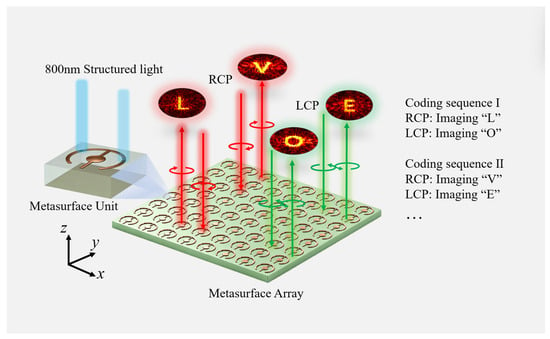
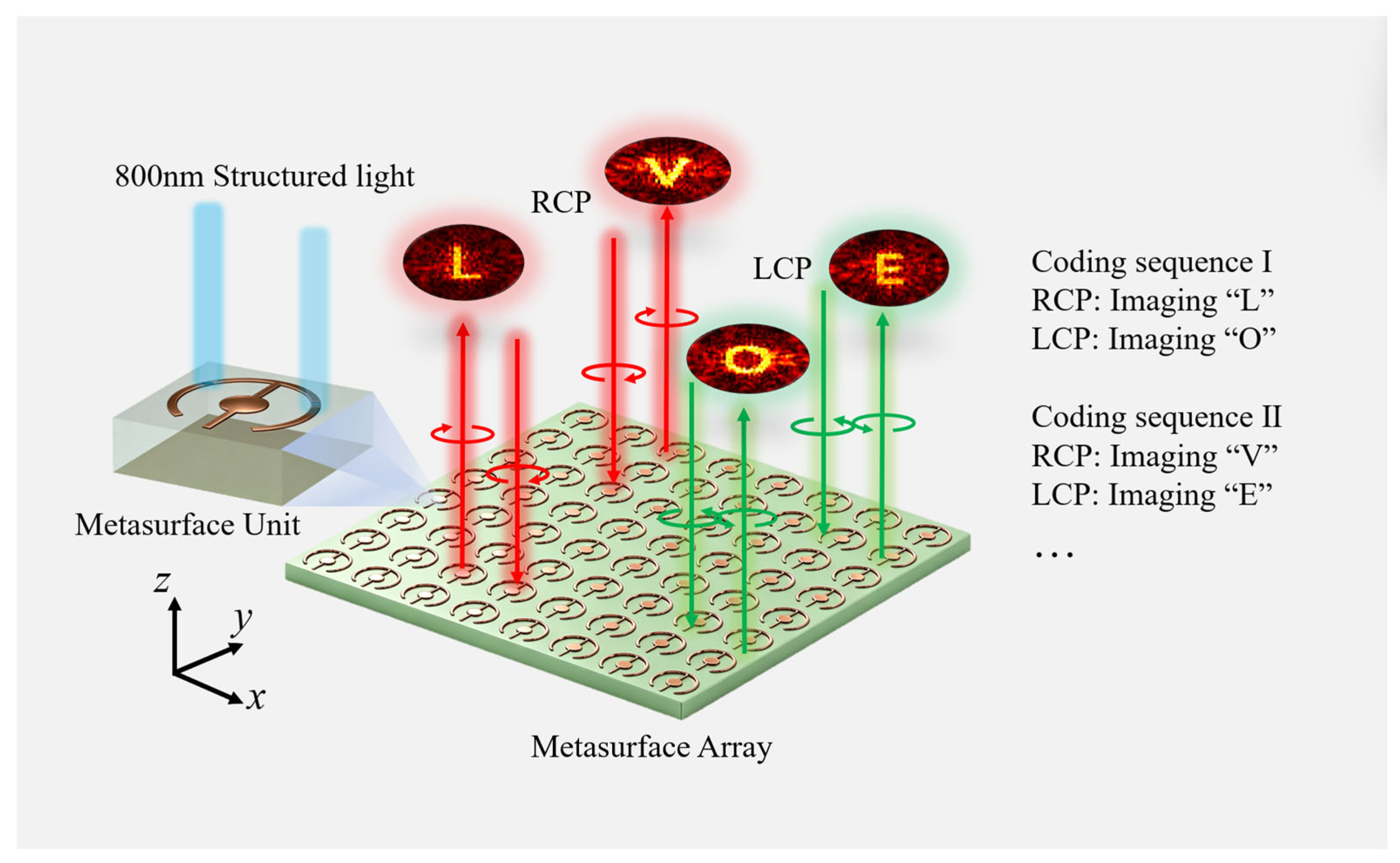
To realize the proposed optically programmable spin-decoupled control, we design a reflective THz metasurface incorporating two independently controlled photosensitive silicon elements. As illustrated in Figure 1, spatially structured light selectively switches the conductivity states of the two photosensitive silicon elements, thereby reconfiguring the phase responses of the LCP and RCP channels. Through different optical coding patterns, the two spin channels can be independently programmed without physically altering the metasurface, enabling dynamic switching among spin-decoupled wavefront-manipulation functionalities.
Figure 1.
Schematic diagram of the function of the spin-decoupled metasurface.
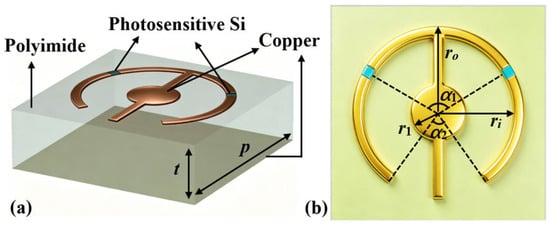
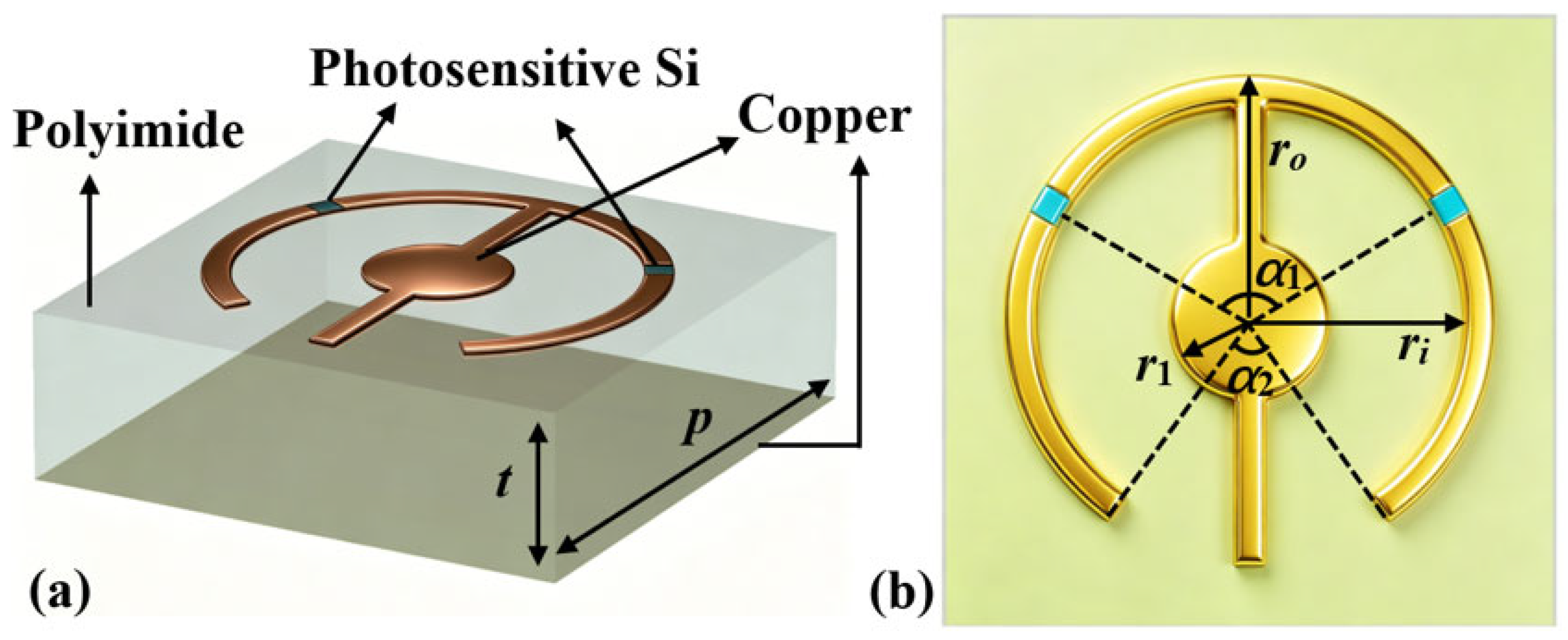
The proposed THz metasurface adopts a metal–insulator–metal (MIM) reconfiguration, as illustrated in Figure 2a. The bottom metallic layer serves as a reflective ground plane to suppress transmission, while the intermediate low-loss dielectric layer acts as a spacer. The top layer consists of a symmetric double-arc metallic resonator with two photosensitive silicon elements embedded in the gaps of the left and right arcs, allowing independent optical control at the two sites. Figure 2b shows the top view of the meta-atom and defines the key geometric parameters, including the inner and outer radii of the resonator, the central angles of the two arcs, and the positions of the photosensitive silicon elements.
Figure 2.
(a) Three-dimensional diagram of the unit structure; (b) top view of the unit structure.
In this architecture, the left and right photosensitive silicon elements are designed to modulate the phase responses of LCP and RCP waves, respectively, thereby providing two independently addressable spin channels. The dielectric spacer is made of polyimide with a relative permittivity of 3.5, while the top resonator and bottom ground plane are made of copper with a thickness of 200 nm and an electrical conductivity of 5.8 × 10⁷ S/m. Based on full-wave electromagnetic simulations, the optimized geometric parameters are determined as follows: the lattice period is p = 100 μm along both the x and y directions, the dielectric spacer thickness is t = 30 μm, and the outer and inner radii of the resonator are ro = 40 μm and ri = 35 μm, respectively. The radius of the central disk is r1 = 13 μm, and the central angles of the two arc segments are α1 = 120° and α2 = 70°, respectively. Each photosensitive silicon element is a square element with a side length of 5 μm.
Previous studies have shown that the conductivity of photosensitive silicon can be substantially increased under near-infrared illumination with a central wavelength of 800 nm by increasing the incident optical power density [38]. Accordingly, the photosensitive silicon is modeled with two conductivity states in the present design. Without optical illumination, its conductivity is set to Esi = 10 S/m, corresponding to a low-conductivity state in which the resonant gap remains electrically disconnected. Under sufficient optical excitation, the conductivity increases to Esi = 5 × 10⁵ S/m, corresponding to a high-conductivity state that electrically bridges the resonant gap. By spatially controlling the optical excitation, the two photosensitive silicon elements can therefore be independently switched between the low- and high-conductivity states, enabling programmable reconfiguration of the metasurface response.
2.2. Theoretical Analysis of Spin Decoupling
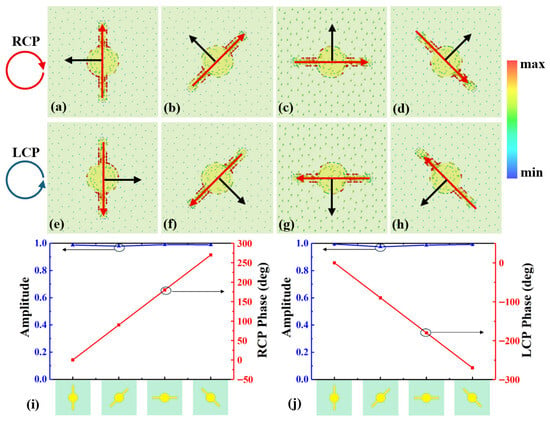
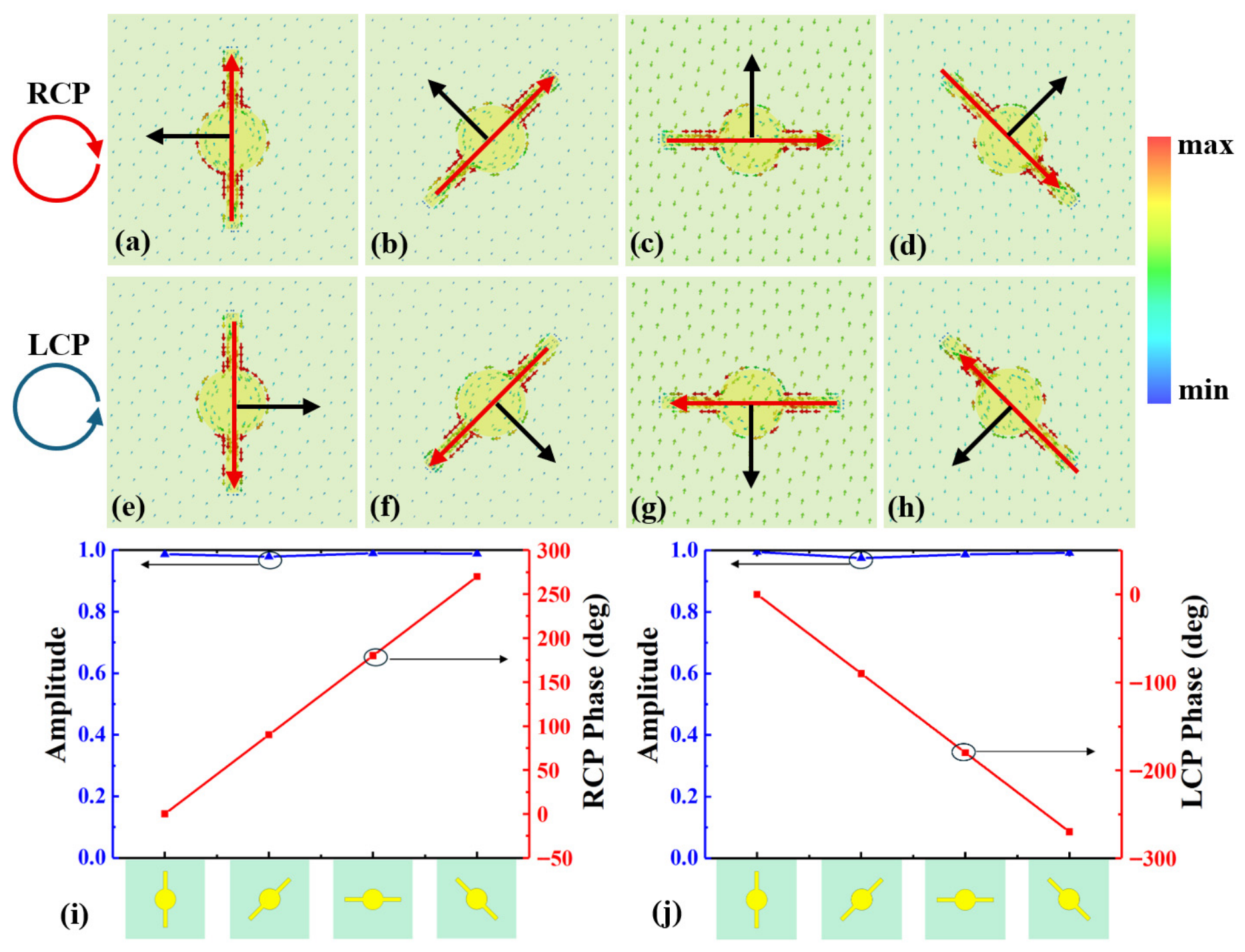
To clarify the origin of spin coupling in conventional PB-phase modulation, the proposed meta-atom is first simplified to a metallic strip without the arc segments. In conventional PB-phase metasurfaces, the geometric phase is introduced by the overall rotation of the meta-atom, which is accompanied by a corresponding rotation of the induced surface-current path. Figure 3a–h show the surface-current distributions under RCP and LCP incidence, respectively, for rotation angles of 0°, 45°, 90°, and 135°, while Figure 3i,j present the corresponding reflection amplitudes and phases. Owing to the opposite spin angular momenta of RCP and LCP waves, the induced surface currents exhibit opposite starting positions and mirror-symmetric circulation directions. As the meta-atom rotates, the corresponding current paths rotate synchronously by the same angle. According to the rotational Doppler effect, the rotation angle of the current path determines the accumulated geometric phase, while the relative orientation between the incident spin and current rotation determines its sign. The resulting PB phases can therefore be expressed as φRR = +2θ and φLL = −2θ, where θ is the rotation angle of the meta-atom. As shown in Figure 3i,j, when α increases from 0° to 135°, the reflection phases of the RCP and LCP channels vary linearly with equal magnitudes and opposite signs, while the reflection amplitudes remain above 0.95. This conjugate phase relation intrinsically couples the two spin channels, preventing their independent phase encoding and wavefront manipulation.
Figure 3.
Surface-current distributions and reflection amplitude and phase responses of the conventional geometric-phase structure under different incident polarizations and rotation angles. (a–d) Surface-current distributions under RCP incidence at rotation angles of (a) 0°, (b) 45°, (c) 90°, and (d) 135°. (e–h) Surface-current distributions under LCP incidence at rotation angles of (e) 0°, (f) 45°, (g) 90°, and (h) 135°. (i) Co-polarized reflection amplitude and phase as functions of the rotation angle under RCP incidence. (j) Co-polarized reflection amplitude and phase as functions of the rotation angle under LCP incidence.
As discussed above, conventional spin-decoupling approaches generally introduce additional phase degrees of freedom, such as propagation, resonant, or nonadiabatic Aharonov–Anandan (AA) phases, to overcome the intrinsic spin coupling of the PB phase. The involvement of multiple phase mechanisms and structural parameters, however, increases the complexity of meta-atom design and phase engineering. To achieve spin-decoupled phase control through a single geometric-phase mechanism, we employ the curvature-induced geometric phase (CIGP), in which the phase response is governed by the effective surface-current path rather than the overall rotation of the meta-atom.
Unlike the conventional PB phase induced by overall meta-atom rotation, CIGP arises from the effective rotation of surface currents along curved structures [25,26]. According to the rotational Doppler interpretation of CIGP [25,26], the surface current induced by a circularly polarized THz wave along a metallic arc can be equivalently regarded as a rotating dipole. As the current propagates along the curved path, its orientation continuously changes, resulting in an accumulated geometric phase determined by the effective rotation angle of the current path. Consequently, tailoring the effective surface-current path enables geometric-phase modulation without physically rotating the entire meta-atom. The corresponding phase response can be expressed as
where Δω denotes the angular-frequency shift induced by the rotational Doppler effect, Ωz is the angular velocity of the equivalent rotating dipole, and σ = ±1 is the spin index determined by the handedness of the incident circularly polarized wave. For the mirror-symmetric double-arc structure proposed here, α1 and α2 define the geometric boundaries of the arc-shaped resonator. Switching the photosensitive silicon between the low- and high-conductivity states does not alter the physical curvature of the metallic arcs but reconfigures the effective propagation path of the surface current. In the low-conductivity state, the current path is interrupted at the corresponding photosensitive silicon element, defining an initial effective rotation angle. When the silicon is switched to the high-conductivity state, the path becomes electrically connected, allowing the surface current to propagate further along the arc and thereby changing its effective path length and rotation angle. Because RCP and LCP waves exhibit mirror-symmetric, spin-dependent current responses, the two photosensitive silicon elements provide independent degrees of freedom for tailoring the effective current-rotation angles of the two spin channels. The switching-induced change in the effective rotation angle is denoted by Δαeff, and the corresponding geometric-phase change can be expressed as
where Δαeff represents the variation in the effective central angle of the arc resonator induced by the switching states of the photosensitive silicon. This phase modulation mechanism is solely determined by geometric parameters, such as the arc length and central angle, enabling independent phase control of the two spin states. It should be noted that the CIGP proposed in this work shares the same physical origin as the conventional Pancharatnam–Berry (PB) phase, both of which arise from the geometric phase associated with the rotational Doppler effect. According to the rotational Doppler theory [25], the geometric phase is determined by the rotation angle of the induced surface-current trajectory with respect to the meta-atom center, rather than by the physical rotation of the meta-atom itself. In conventional PB-phase metasurfaces, the entire meta-atom is physically rotated, forcing the LCP- and RCP-induced surface currents to rotate simultaneously with opposite spin-dependent phase responses, resulting in an inherent conjugate coupling between the two spin channels. In contrast, the proposed CIGP is achieved by independently engineering the spin-dependent current pathways of an arc-shaped resonator. Due to the spin-dependent excitation characteristics of the double-arc structure, the RCP- and LCP-induced surface currents are mainly distributed along the right and left arc arms, respectively. Therefore, selectively switching the corresponding photosensitive silicon element dynamically reconfigures only the dominant current pathway of the addressed spin channel, while producing negligible perturbation to the other channel. This enables complete spin-decoupled geometric phase modulation.
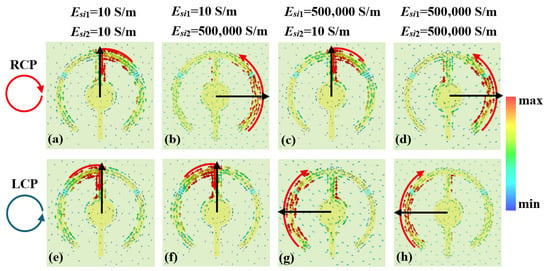
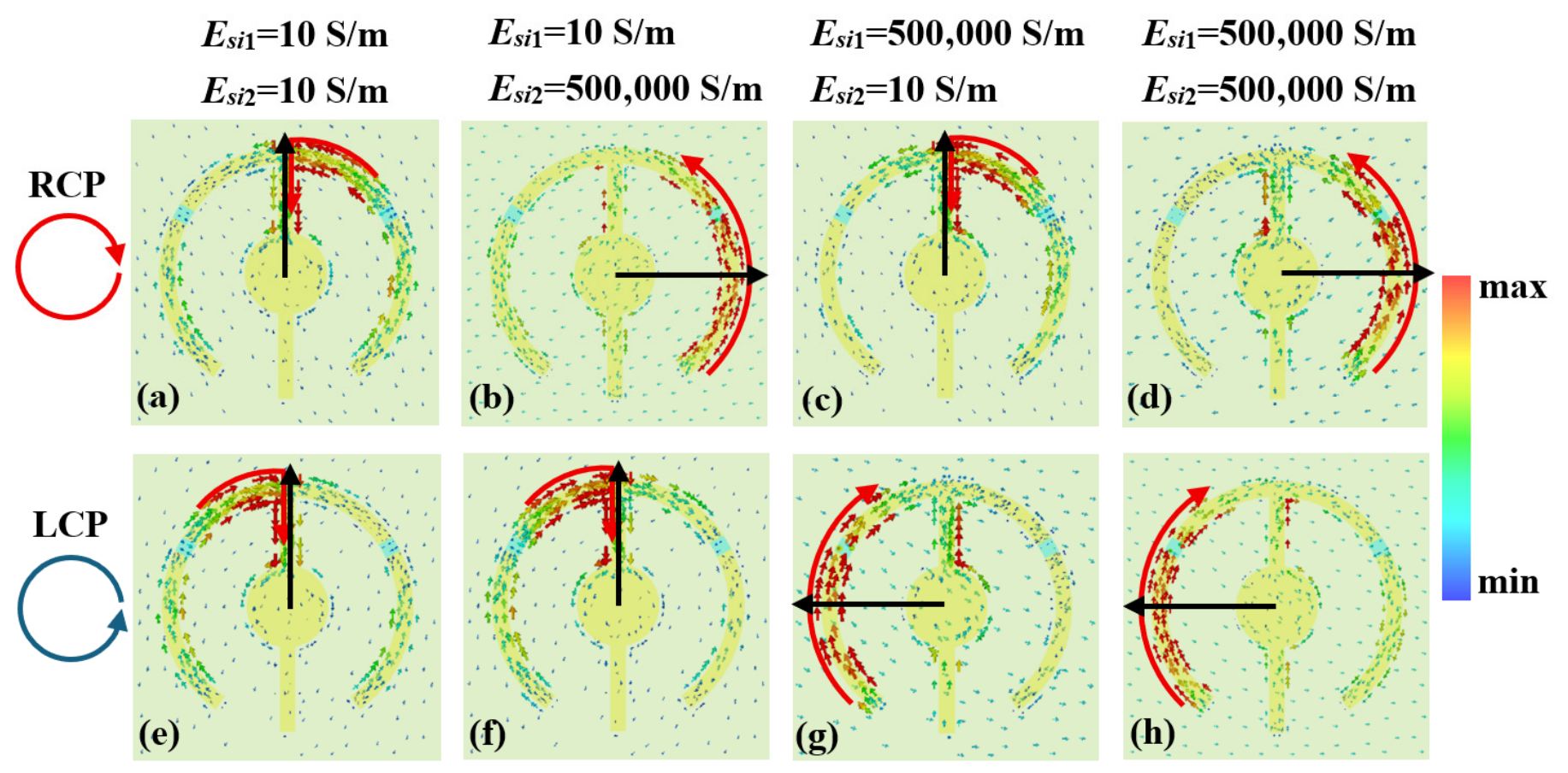
To verify the optically controlled CIGP mechanism, Figure 4 shows the surface-current distributions for the four coding states of the dual-photosensitive-silicon meta-atom. Here, ESi1 and ESi2 denote the conductivities of the left and right photosensitive silicon elements, respectively. The low- and high-conductivity states are encoded as “0” and “1”, respectively, yielding four coding states: 00, 01, 10, and 11. Under RCP incidence, the dominant surface current is mainly distributed along the right arc. Switching the right photosensitive silicon element from the low- to high-conductivity state electrically connects and reconfigures the current path, changing its effective path length and rotation angle. As shown in Figure 4a–d, the black arrow indicating the normal direction of the current path rotates by approximately 90° relative to the 00 state, corresponding to an approximately 180° geometric-phase change according to Equation (2) and thus enabling 0°/180° switching of the RCP reflection phase. In contrast, switching the left photosensitive silicon element has little influence on the dominant RCP current path and its corresponding phase response. Under LCP incidence, the dominant surface current is mainly distributed along the left arc, exhibiting a mirror-symmetric response. Switching the left photosensitive silicon element similarly reconfigures the current path, producing an approximately 90° rotation of its normal direction [Figure 4e–h] and, consequently, an approximately 180° geometric-phase change. By contrast, switching the right photosensitive silicon element has little influence on the LCP response. These results demonstrate spin-selective current-path reconfiguration, providing the physical basis for independent 0°/180° phase control of the RCP and LCP channels.
Figure 4.
Surface-current distributions of the proposed meta-atom under four coding states. Under RCP incidence: (a) coding state 00, (b) coding state 01, (c) coding state 10, and (d) coding state 11; under LCP incidence: (e) coding state 00, (f) coding state 01, (g) coding state 10, and (h) coding state 11. Here, ESi1 and ESi2 denote the conductivity states of the left and right photosensitive silicon elements, respectively. The “ON” and “OFF” states correspond to the high- and low-conductivity states of the photosensitive silicon elements. Specifically, ESi1 mainly controls the LCP phase response, whereas ESi2 mainly controls the RCP phase response. The four coding states (00, 01, 10, and 11) represent different combinations of the two independently switchable photosensitive silicon elements.
Based on the above surface-current analysis, the RCP and LCP reflection phases, φRR and φLL, are selectively controlled by ESi2 and ESi1, respectively. The two phase responses can therefore be independently manipulated, breaking the conjugate relation φRR = −φLL imposed by the conventional PB phase. The approximately 90° rotation of the current-path normal produces an approximately 180° reflection-phase change, consistent with the CIGP mechanism described by Equation (2). Accordingly, independent switching of the two photosensitive silicon elements yields four coding states for (φRR, φLL): 00 (φRR = 0, φLL = 0), 01 (φRR = π, φLL = 0), 10 (φRR = 0, φLL = π), and 11 (φRR = π, φLL = π). This four-state coding scheme enables independent 0/π phase control of the two spin channels through CIGP-based current-path reconfiguration. Combined with site-selective illumination by spatially encoded structured light, this coding scheme enables programmable reconfiguration of the metasurface array, providing the basis for independent dual-spin wavefront manipulation and dynamic switching among different functionalities.
2.3. Optically Coded Dual-Channel Meta-Atom Response Analysis
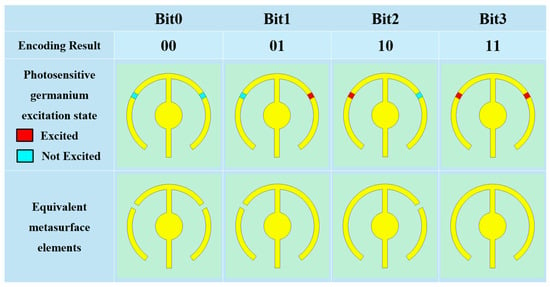
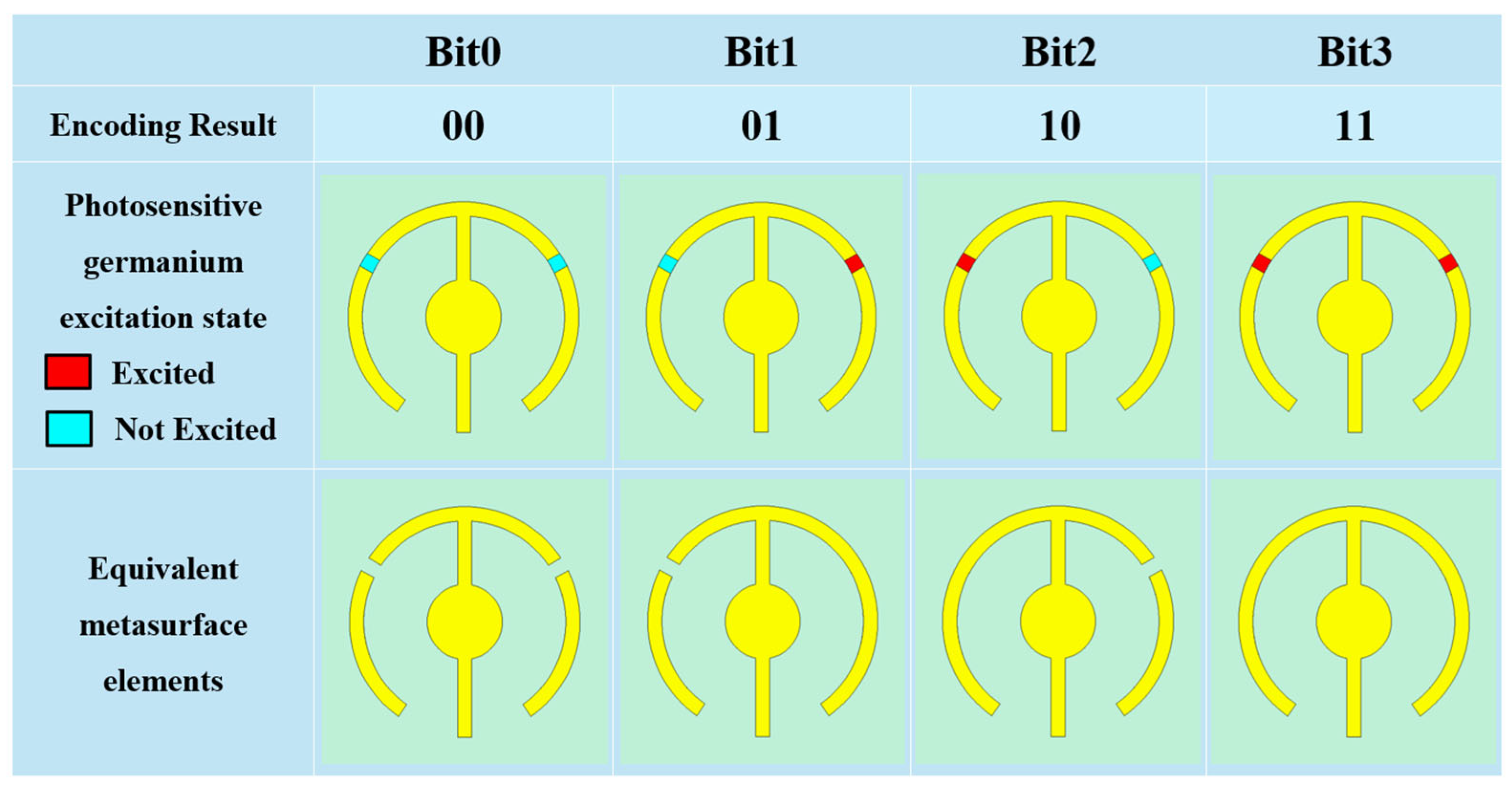
Based on the above mechanism, the two photosensitive silicon elements can be regarded as independently addressable optical switches, establishing a dual-channel 2-bit programmable scheme within a single meta-atom. The metasurface configuration and its equivalent switch model are illustrated in Figure 5, where the left and right photosensitive silicon elements correspond to the LCP and RCP phase channels, respectively. In the absence of optical illumination, each photosensitive silicon element remains in the low-conductivity state and is equivalent to an open switch, leaving the corresponding resonant gap electrically disconnected and maintaining the reference phase. Under structured-light illumination, the silicon switches to the high-conductivity state and behaves as a closed switch, electrically bridging the resonant gap and reconfiguring the effective surface-current path. The resulting change in the effective current-rotation angle produces an approximately 180° phase reversal, as described by the CIGP mechanism above. By selectively illuminating the two photosensitive silicon elements with spatially encoded structured light, their switching states can be independently controlled, yielding four coding states: 00, 01, 10, and 11. The most significant bit represents the state of the left photosensitive silicon element, while the least significant bit represents that of the right element. For each bit, “0” denotes the low-conductivity open state corresponding to the reference phase, whereas “1” denotes the high-conductivity closed state corresponding to an approximately 180° phase reversal.
Figure 5.
Schematic of the metasurface coding design and equivalent configuration.
3. Results and Analysis
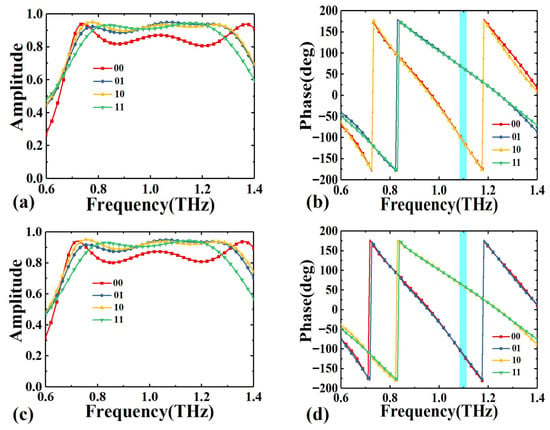
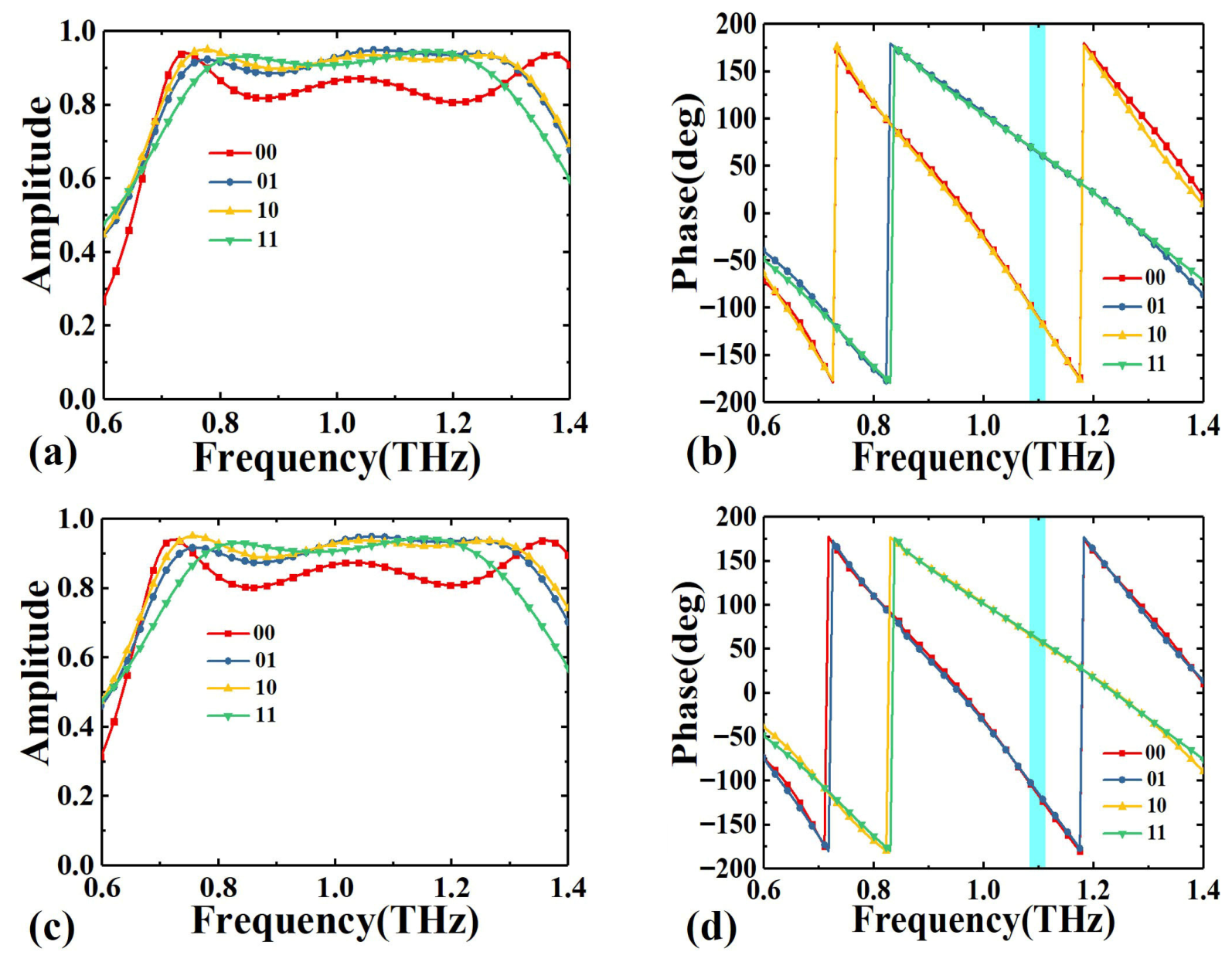
To verify the spin-decoupled phase-modulation performance of the proposed meta-atom, the circularly polarized reflection responses under the four coding states are numerically investigated. Figure 6a,b show the co-polarized reflection amplitude rRR and phase φRR under RCP incidence, respectively, while Figure 6c,d show the corresponding amplitude rLL and phase φLL under LCP incidence. At 1.1 THz, the reflection amplitudes of both spin channels remain above 0.8 for all four coding states, ensuring sufficiently high reflection efficiency for phase modulation. Under RCP incidence, the reflection phase is primarily controlled by the right photosensitive silicon element. Switching the right element produces an approximately 180° phase change, whereas switching the left element has negligible influence on the phase response. Consequently, states 00 and 10 exhibit nearly identical reflection phases, as do states 01 and 11, with an approximately 180° phase difference between the two groups. Under LCP incidence, the opposite dependence is observed: the reflection phase is primarily controlled by the left photosensitive silicon element, resulting in nearly identical phases for states 00 and 01 and for states 10 and 11, with an approximately 180° phase difference between the two groups. These results confirm independent 0/π phase control of the RCP and LCP channels by the right and left photosensitive silicon elements, respectively, validating the proposed CIGP-based optically programmable spin-decoupling scheme.
Figure 6.
Under RCP incidence: (a) co-polarized reflection amplitude rRR and (b) reflection phase φRR for different metasurface coding states; under LCP incidence: (c) co-polarized reflection amplitude rLL and (d) reflection phase φLL for different metasurface coding states.
To further quantify the unit-cell performance, the cross-polarization isolation is evaluated from the undesired phase perturbation of the non-addressed spin channel. At 1.1 THz, switching the photosensitive silicon element associated with the opposite spin channel produces a phase variation of less than 1° in the unaffected channel, indicating weak mutual coupling between the LCP and RCP responses. In addition, by requiring the reflection amplitude to remain above 0.8 and the binary phase difference to remain within 180°± 30°, the effective operating bandwidth is approximately 1.05–1.20 THz, corresponding to a fractional bandwidth of about 13.3%. The phase deviation of the non-addressed channel remains below 1° at the operating frequency, further confirming the high phase independence of the two spin channels.
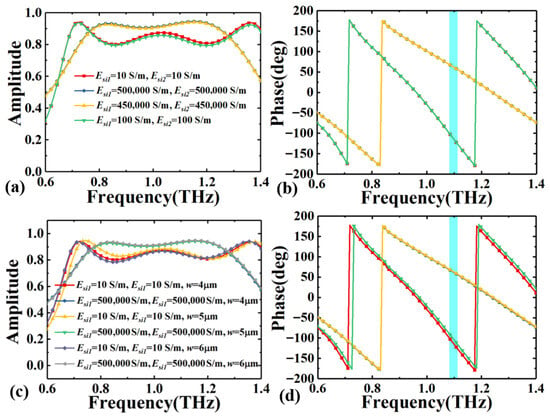
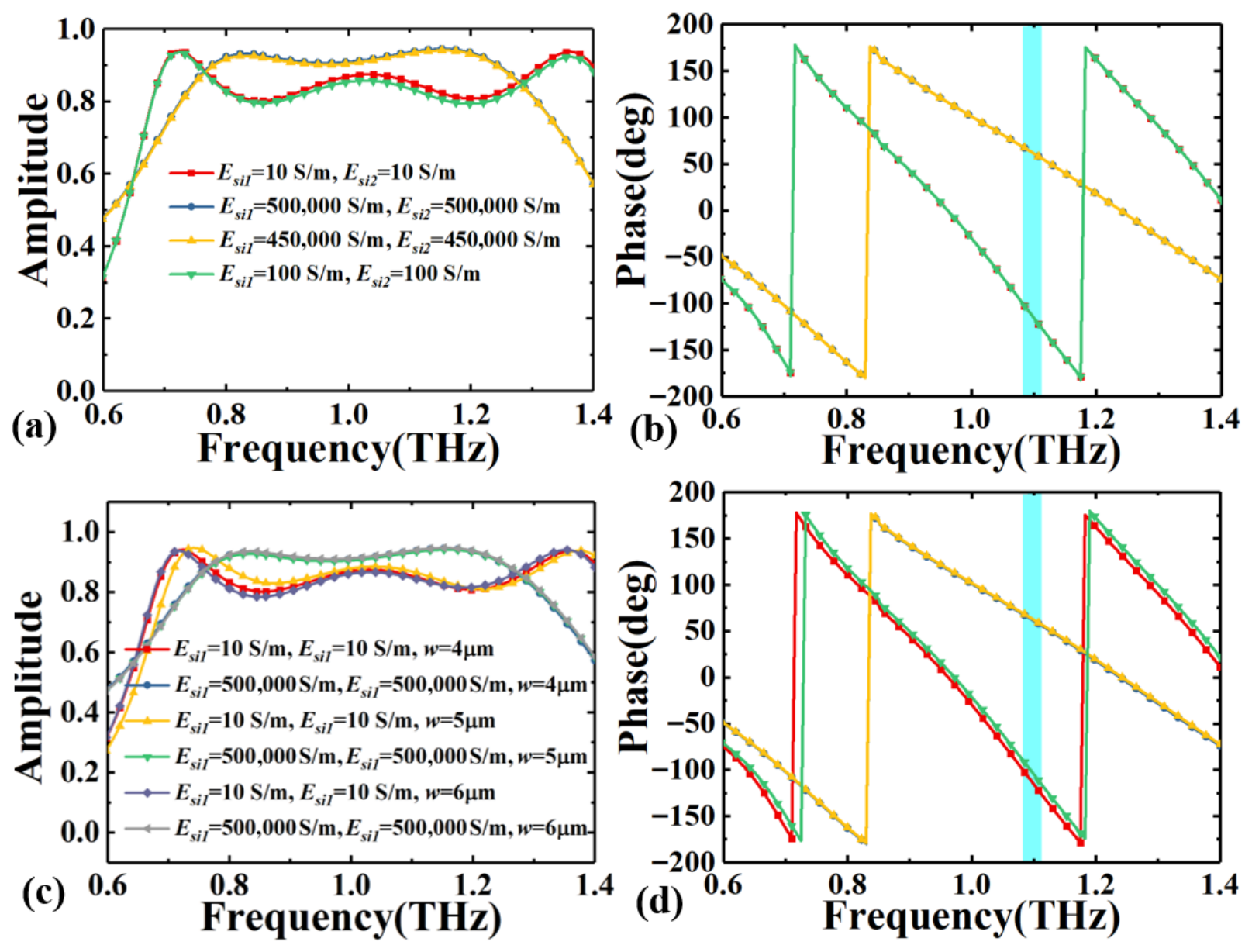
The fabrication tolerance of the proposed phase-switching mechanism is further examined by considering variations in the conductivity and size of the photosensitive silicon regions. Owing to the mirror-symmetric configuration of the meta-atom, the LCP and RCP channels exhibit corresponding phase-switching behaviors controlled by the left and right photosensitive silicon elements, respectively. Therefore, the response of rLL is selected as a representative case for the following analysis. As shown in Figure 7a,b, when the conductivity of the photosensitive silicon is varied, including a decrease in the high-conductivity state from 5 × 10⁵ S/m to 4.5 × 10⁵ S/m and an increase in the low-conductivity state from 10 S/m to 100 S/m, the reflection amplitude and phase response remain nearly unchanged at 1.1 THz. Furthermore, as shown in Figure 7c,d, varying the silicon size from the nominal 5 μm × 5 μm to 4 μm × 4 μm and 6 μm × 6 μm only induces minor variations, while maintaining reflection amplitudes above 0.8 and an approximately 180° phase difference between the two states. These results confirm that the proposed CIGP-based phase-switching scheme exhibits reasonable tolerance against the considered fabrication-related variations.
Figure 7.
Fabrication tolerance analysis of the proposed meta-atom. (a) Reflection amplitude and (b) reflection phase of rLL under different photosensitive-silicon conductivity states. (c) Reflection amplitude and (d) reflection phase of rLL with different photosensitive-silicon sizes. The cyan shaded region indicates the operating frequency around 1.1 THz.
3.1. Optically Coded Reconfigurable Focusing Lens
Based on the CIGP mechanism and optical programmability described above, the optimized meta-atoms are arranged into an array to construct a dynamically reconfigurable spin-decoupled focusing metalens. By selectively illuminating the photosensitive silicon elements with spatially structured light, the phase profiles of the LCP and RCP channels can be independently programmed, enabling dynamic focusing and focal-spot steering without physically modifying the metasurface. The required phase profile combines a spherical focusing phase with a linear phase gradient, which determines the focal position along the propagation direction and the lateral steering of the focal spot, respectively. For a meta-atom located at (x,y) in the metasurface plane, the ideal continuous phase distribution is expressed as [39]
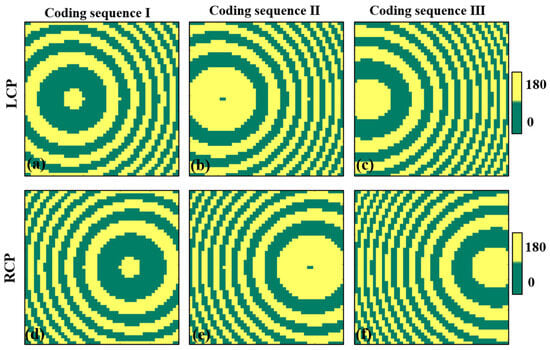
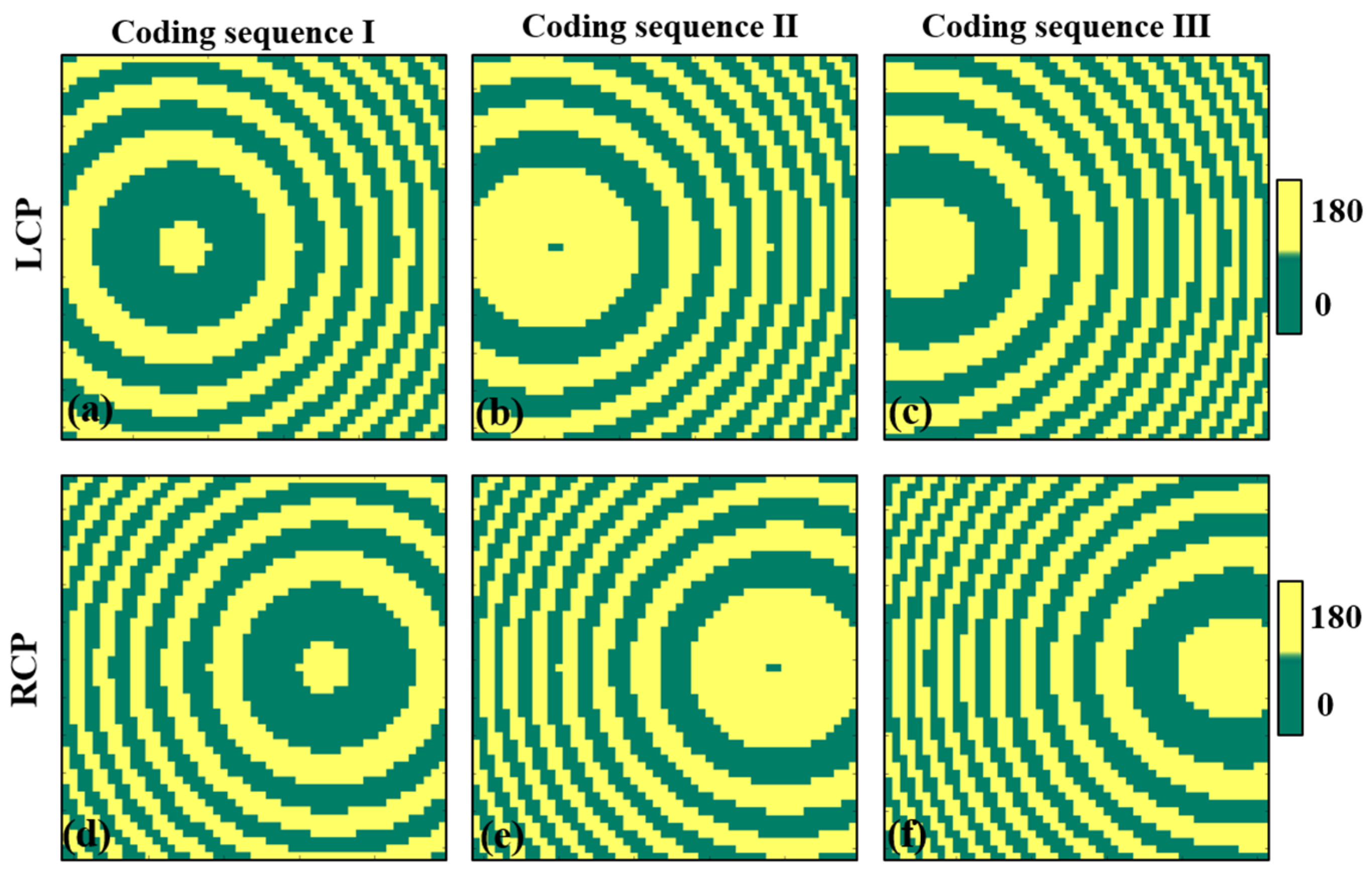
Here, λ denotes the free-space wavelength at 1.1 THz, F is the designed focal length, and θx is the prescribed beam-deflection angle. The first and second terms represent the spherical focusing phase and linear phase gradient, respectively. Since the proposed meta-atom provides two discrete phase states, 0 and π, the ideal continuous phase profile is quantized into a 1-bit distribution using π as the threshold: phase values within [0, π) are mapped to the 0-phase state (code “0”), corresponding to the non-illuminated low-conductivity state, whereas those within [π, 2π) are mapped to the π-phase state (code “1”), corresponding to the illuminated high-conductivity state. Owing to the spin-decoupled phase response of the meta-atom, independent coding matrices can be constructed for the LCP and RCP channels, allowing the two wavefronts to be programmed separately within the same metasurface array. To demonstrate multi-angle spin-decoupled focusing, three coding sequences are designed for steering angles of 13°, 20°, and 27°, as shown in Figure 8. The LCP channel is designed for leftward focusing at these angles, while the RCP channel is independently designed for rightward focusing at the corresponding angles. Figure 8a–f show the resulting 1-bit phase distributions for the LCP and RCP channels, respectively, with the two regions representing the quantized 0 and π phase states.
Figure 8.
The 1-bit phase distributions of the metalens with a focal length of 4 mm for beam steering of (a) 13° to the left, (b) 20° to the left, (c) 27° to the left, (d) 13° to the right, (e) 20° to the right, and (f) 27° to the right.
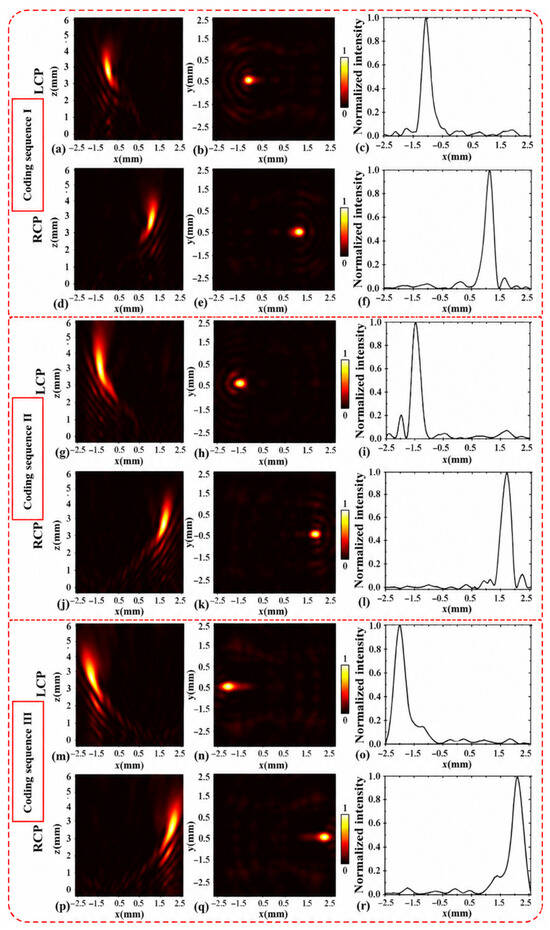
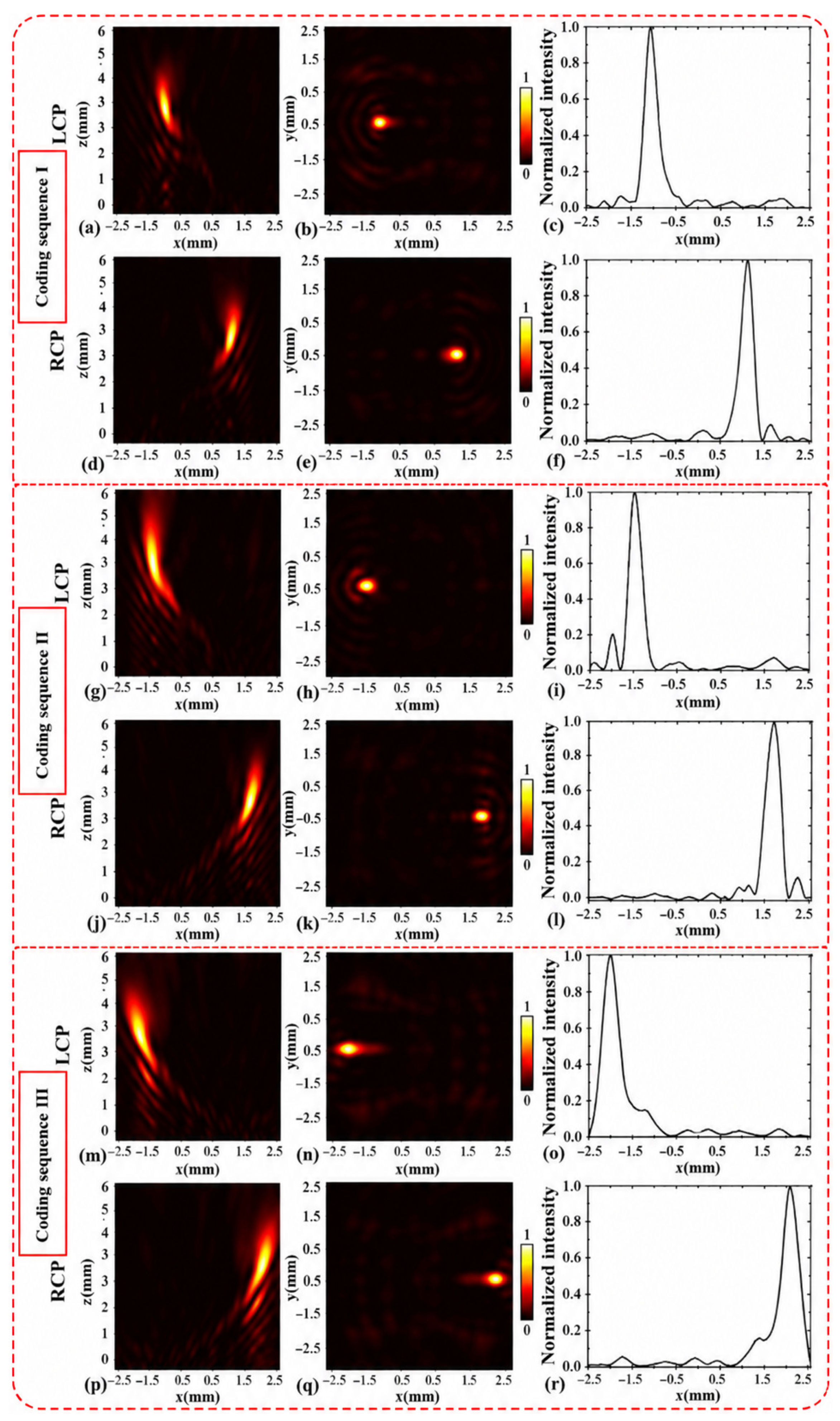
Full-wave electromagnetic simulations are performed to evaluate the focusing and steering performance of the three coding sequences. Figure 9 presents the beam propagation trajectories in the x-z plane, focal-plane intensity distributions in the x-y plane, and normalized electric-field intensity profiles along y = 0. For sequence I, the LCP and RCP waves are focused toward the left and right, respectively, forming well-defined focal spots at the prescribed focal plane with low sidelobe levels. As the phase gradient increases from sequences I to III, the focal spots of both spin channels are steered to larger angles while maintaining opposite steering directions, demonstrating independent wavefront control of the LCP and RCP channels. The focusing efficiencies within the 3 dB focal regions are calculated to quantitatively evaluate the energy concentration. For the LCP channel, the efficiencies for sequences I–III are 67%, 66%, and 69%, respectively, while those for the RCP channel are 70%, 67%, and 69%, respectively. The corresponding full widths at half maximum (FWHMs) of the focal spots are 0.27 mm and 0.28 mm for sequences I and II, respectively. For sequence III, the FWHM increases to 0.41 mm, which can be attributed to the enhanced phase quantization error under the larger steering angle.
Figure 9.
Simulated focusing performance under different optical coding sequences. For optical coding sequence I, under LCP incidence: (a) LCP energy distribution in the xz plane, (b) LCP energy distribution in the xy plane, and (c) LCP electric-field distribution along y = 0 mm in the focal plane; under RCP incidence: (d) RCP energy distribution in the xz plane, (e) RCP energy distribution in the xy plane, and (f) RCP electric-field distribution along y = 0 mm in the focal plane. For optical coding sequence II, under LCP incidence: (g) LCP energy distribution in the xz plane, (h) LCP energy distribution in the xy plane, and (i) LCP electric-field distribution along y = 0 mm in the focal plane; under RCP incidence: (j) RCP energy distribution in the xz plane, (k) RCP energy distribution in the xy plane, and (l) RCP electric-field distribution along y = 0 mm in the focal plane. For optical coding sequence III, under LCP incidence: (m) LCP energy distribution in the xz plane, (n) LCP energy distribution in the xy plane, and (o) LCP electric-field distribution along y = 0 mm in the focal plane; under RCP incidence: (p) RCP energy distribution in the xz plane, (q) RCP energy distribution in the xy plane, and (r) RCP electric-field distribution along y = 0 mm in the focal plane.
To quantitatively evaluate the steering performance, the peak positions of the electric-field intensity along the x-axis are extracted at the focal plane of z = 4 mm. For coding sequences I–III, the LCP/RCP focal-spot offsets are −1.05/+1.05, −1.53/+1.53, and −2.02/+2.02 mm, respectively. According to the geometrical relation θx = arctan(Δx/F), where F = 4 mm is the focal length and Δx is the lateral focal-spot offset, the corresponding simulated steering angles are 14.7°, 20.9°, and 26.9°, respectively. These values agree well with the preset angles of 13°, 20°, and 27°, with a maximum angular deviation of 1.7°. The results demonstrate that the focusing and steering responses can be dynamically programmed through structured-light-controlled switching of the photosensitive silicon elements, while the LCP and RCP channels maintain independent wavefront responses with negligible mutual interference. The slight deviations between the simulated and preset steering angles are mainly attributed to the 1-bit phase discretization, in which the continuous phase profile is approximated by only two discrete phase states, 0 and π, with the intermediate phase values discarded. Consequently, the quantized phase distribution cannot exactly reproduce the ideal phase gradient, resulting in deviations in the focal positions and steering angles. Notably, the deviation decreases as the steering angle increases and is more pronounced at smaller angles. This behavior arises because a smaller steering angle requires a more gradual phase gradient with a broader phase-transition region, making the distortion introduced by 1-bit quantization relatively more significant.
3.2. Optically Reconfigurable Near-Field Imaging
The beam-focusing results above demonstrate the spin-decoupled and programmable wavefront-control capability of the proposed metasurface. To further explore its multifunctional potential, THz near-field imaging is investigated using phase-only wavefront reconstruction. By independently controlling the two photosensitive silicon elements through spatially structured-light illumination, the phase distribution of the metasurface array can be reconfigured to enable independent image reconstruction in the LCP and RCP channels. The required phase profiles are optimized using the Gerchberg–Saxton (GS) algorithm based on forward and backward Rayleigh–Sommerfeld diffraction propagation, and the resulting dual-channel imaging performance is subsequently verified by full-wave simulations. The Rayleigh–Sommerfeld diffraction model describes the propagation and complex-amplitude transformation of THz waves from the metasurface plane to the near-field imaging plane.
Accordingly, the complex-amplitude distribution at the imaging plane can be obtained from the electric-field distribution at the metasurface output plane through the following diffraction relation [40]:
where U0(x0, y0) denotes the initial complex electric-field amplitude at the metasurface array plane, and U(x, y) represents the diffracted electric-field distribution at the imaging plane. The (x0, y0) and (x, y) are the spatial coordinates on the metasurface plane and the imaging plane, respectively. denotes the straight-line distance between a meta-atom and a sampling point on the imaging plane, λ is the operating wavelength, and zd is the perpendicular distance between the metasurface and the imaging plane. At 1.1 THz, the proposed meta-atom maintains a reflection amplitude above 0.8 with only minor variations across all coding states, providing an approximately constant-amplitude phase-modulation response. Therefore, the complex-amplitude reconstruction can be simplified to pure phase optimization by normalizing the electric-field amplitude at the metasurface output plane to unity and retaining the phase as the only modulation degree of freedom. Accordingly, the electric-field distribution at the imaging plane can be simplified as
where φ(x0, y0) denotes the modulation phase of the meta-atom located at (x0, y0) in the metasurface array. To achieve high-fidelity reconstruction of the prescribed target pattern, the Gerchberg–Saxton (GS) algorithm is employed to optimize the 1-bit phase distribution through iterative forward and backward diffraction propagation. Starting from a random initial phase distribution, the complex-amplitude field at the imaging plane is calculated through forward Rayleigh–Sommerfeld propagation. The propagated phase is retained, while its amplitude is replaced by the prescribed target amplitude. The resulting field is then propagated backward to the metasurface plane, where the updated phase is extracted and constrained to the available 1-bit phase states for the next iteration. This forward–backward procedure is repeated until the reconstructed image converges toward the target, yielding the optimized 1-bit phase distribution for subsequent metasurface coding.
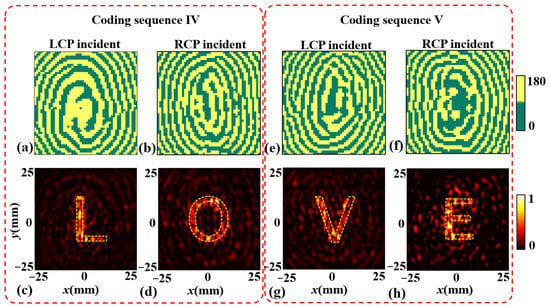
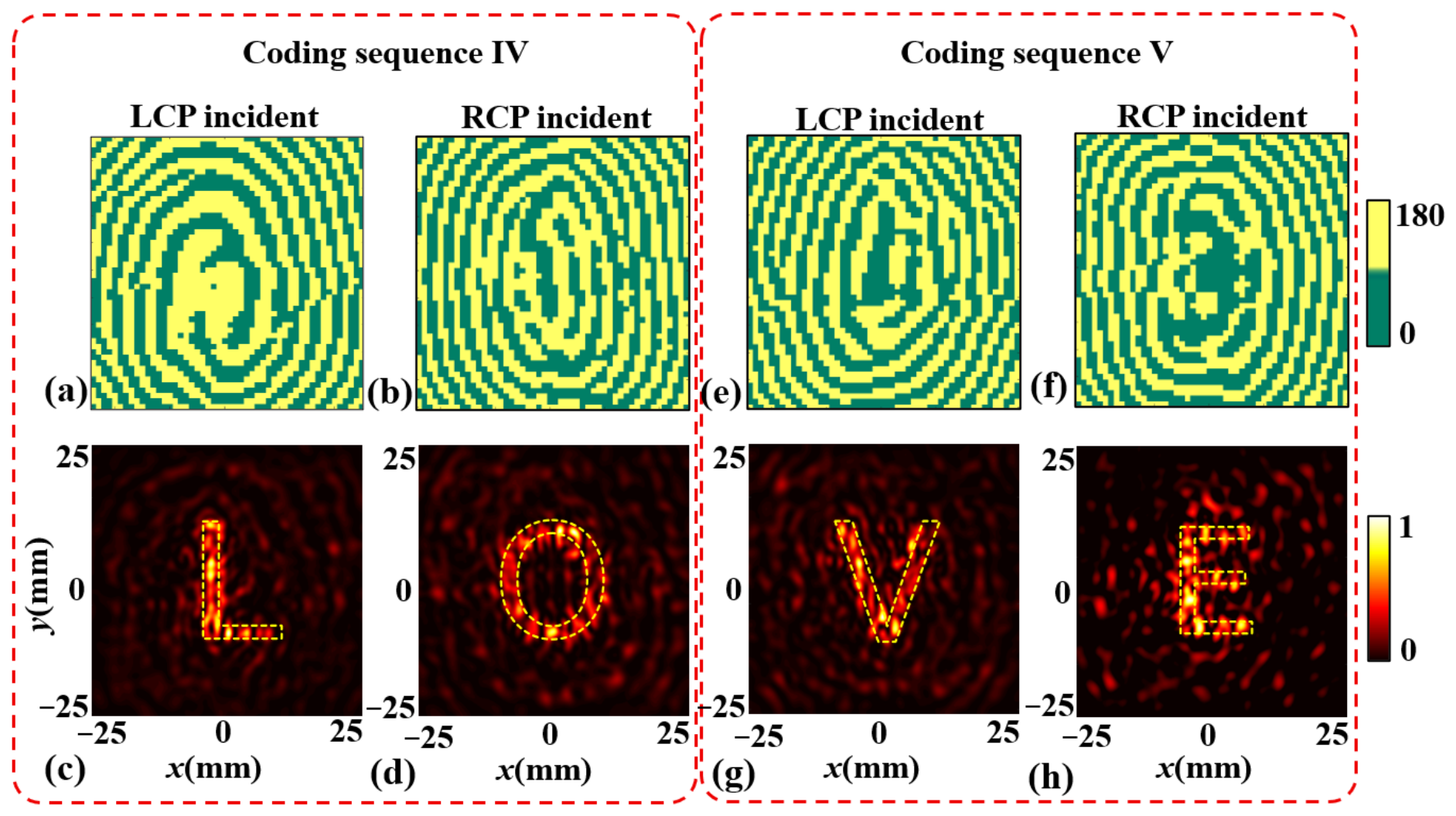
Based on the diffraction theory and GS phase optimization described above, two sets of 1-bit phase-coding matrices are designed for independent dual-channel imaging, with the corresponding phase distributions and near-field simulation results shown in Figure 9. For coding sequence IV, the LCP and RCP channels are designed to reconstruct the letters “L” and “O”, respectively. Figure 10a,b show the optimized 1-bit phase distributions for the two channels, while the reconstructed near-field images are presented in Figure 10c,d. Well-defined “L” and “O” patterns are independently reconstructed in the same imaging plane with high image contrast and negligible mutual interference. Upon switching the structured-light coding pattern to sequence V, the phase distributions are reprogrammed, as shown in Figure 10e,f, resulting in the reconstruction of the letters “V” and “E” in the LCP and RCP channels, respectively [Figure 10g,h]. These results demonstrate that distinct images can be independently reconstructed in the two spin channels and dynamically switched through optical reprogramming, confirming the spin-decoupled and reconfigurable imaging capability of the proposed metasurface.
Figure 10.
Near-field imaging results under different optical coding sequences. Under optical coding sequence IV: (a,b) 1-bit phase distributions designed for the target images “L” and “O”, respectively; (c,d) energy distributions of the LCP and RCP components in the xy plane, respectively. Under optical coding sequence V: (e,f) 1-bit phase distributions designed for the target images “V” and “E”, respectively; (g,h) energy distributions of the LCP and RCP components in the xy plane, respectively.
To quantitatively evaluate the reconstruction quality, the correlation coefficient (Co) is introduced as an evaluation metric, which represents the normalized correlation between the reconstructed image and the target image. A value of Co approaching 1 indicates higher reconstruction similarity [41]:
where It and Ir denote the intensity distributions of the target and reconstructed images, respectively, and M(·) represents the spatial averaging operation. The calculated Co values for coding sequence IV are 0.67 and 0.54 for the LCP and RCP channels, respectively. For coding sequence V, the corresponding Co values are 0.61 and 0.58. These results indicate reasonable agreement between the reconstructed images and the target patterns, further confirming the spin-decoupled and optically reconfigurable imaging capability of the proposed metasurface.
4. Discussion
To more comprehensively position the present work with respect to previous CIGP-based spin-decoupling strategies and optically reconfigurable metasurfaces, representative approaches are systematically compared in Table 1. The comparison considers the reconfiguration strategy, independently controlled CP phase channels, phase-modulation mechanism, meta-atom configuration, and phase encoding/resolution. Previous CIGP-based approaches achieve spin-decoupled phase control through spatially varying meta-atom geometries. In Ref. [25], independent phase modulation is realized by engineering the curved surface-current paths, while Ref. [26] further combines CIGP with rotation-induced geometric phase to provide additional phase-control freedom. In contrast, the present approach employs identical fixed-geometry meta-atoms with two independently addressable photosensitive-silicon elements. Switching their conductivity states selectively reconstructs the surface-current paths associated with the two spin channels, enabling dynamic and independent LCP/RCP phase control solely through the CIGP mechanism. Compared with other optically reconfigurable THz metasurfaces [31,32,33], the proposed scheme achieves dual-spin phase control within a fixed meta-atom architecture through a single CIGP mechanism. The current design provides 1-bit phase encoding for each spin channel, and additional independently controllable photosensitive elements may be introduced in future designs to realize multilevel phase modulation.
Table 1.
Comparison of representative CIGP-based spin-decoupled and optically reconfigurable metasurfaces for circular-polarization phase control.
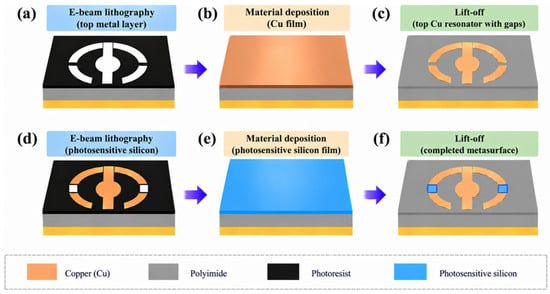
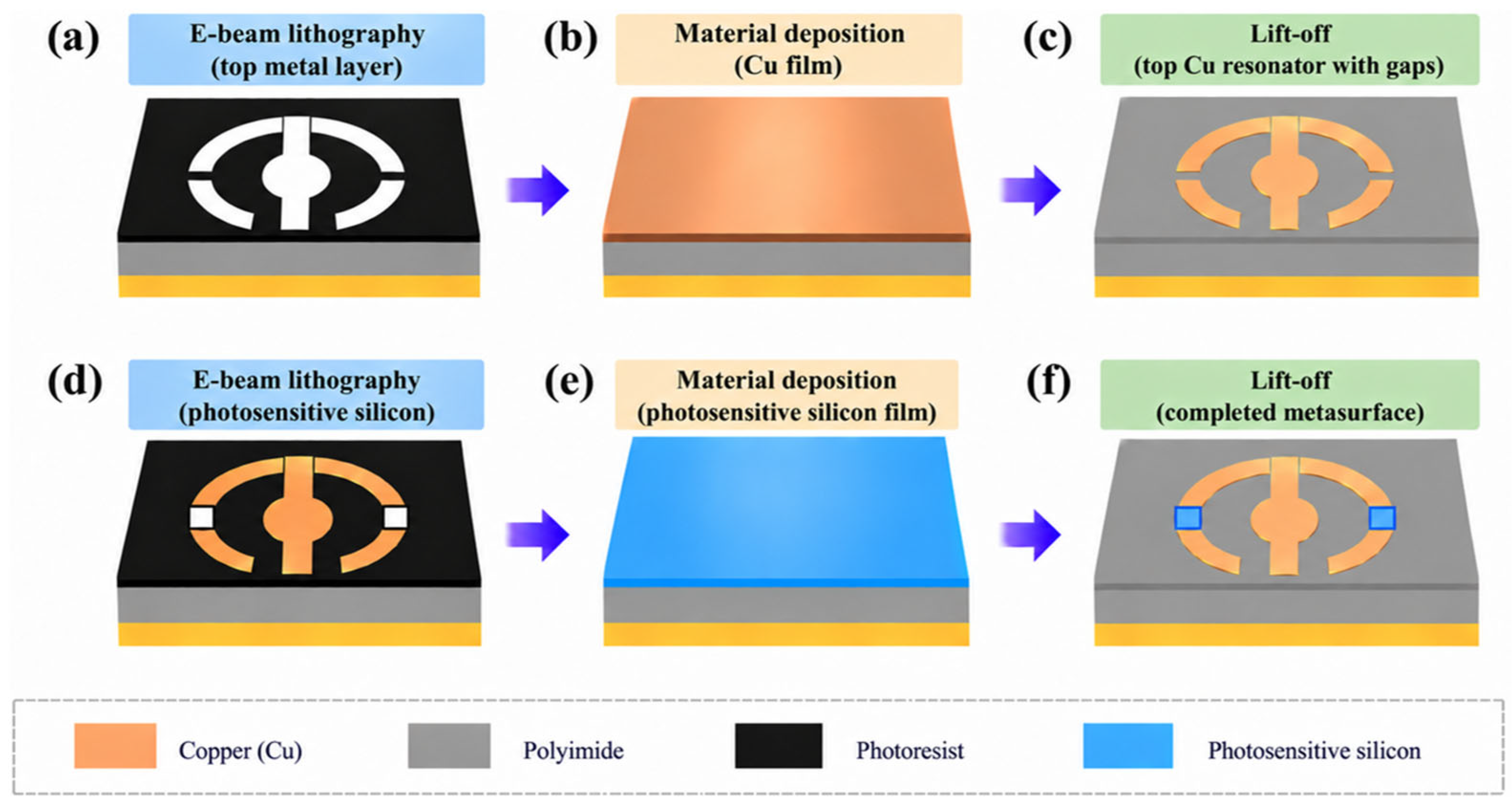
To evaluate the practical feasibility of the proposed optically programmable spin-decoupled THz metasurface, a compatible fabrication procedure is considered based on established micro- and nanofabrication techniques. Although the present study is primarily based on electromagnetic simulations and theoretical analysis, the proposed MIM meta-atom can in principle be fabricated using standard thin-film deposition, photolithography, and lift-off processes, as shown in Figure 11. First, a 200 nm thick Cu film can be deposited to form the metallic ground plane, followed by the preparation of a 30 μm thick polyimide dielectric spacer. A photoresist layer is then spin-coated onto the polyimide surface and patterned by photolithography to define the symmetric double-arc resonator. Subsequently, a 200 nm thick Cu film is deposited by electron-beam evaporation, followed by a lift-off process to form the patterned top metallic resonator. After fabrication of the metallic resonator, a second aligned lithography step is employed to define two 5 μm × 5 μm regions within the gaps of the left and right arcs. Photosensitive silicon is then deposited onto the patterned regions, followed by lift-off to form the two spatially separated photosensitive silicon elements embedded in the resonator gaps. Precise alignment during the second lithography step is required to ensure accurate positioning of the two silicon elements relative to the metallic arcs. For subsequent experimental characterization, the fabricated metasurface can be measured using a reflection-mode optical-pump THz probe system, in which spatially structured near-infrared illumination selectively excites the two photosensitive silicon elements to modulate their conductivity states, while the reflected THz response is measured under LCP and RCP incidence. Such a configuration would enable experimental verification of the optically programmable spin-decoupled phase response and the associated wavefront-manipulation functionalities.
Figure 11.
Fabrication process flow of the proposed metasurface.
However, the present architecture also has certain application constraints. The requirement of an external optical addressing system may increase the overall system complexity, and the current 1-bit phase modulation limits the phase resolution for high-fidelity wavefront manipulation. This limitation originates from the present dual-photosensitive-silicon configuration, where the two silicon elements are assigned to independently control the LCP and RCP channels rather than increasing the phase levels of a single spin channel. Based on the existing double-arc meta-atom architecture, introducing additional independently controllable photosensitive silicon elements along the curved current paths could provide more phase states and enable multilevel phase modulation, thereby improving the performance of future reconfigurable wavefront-control devices.
5. Conclusions
In summary, we proposed an optically programmable terahertz metasurface that realizes spin-decoupled phase control solely through curvature-induced geometric phase (CIGP). The proposed metasurface incorporates two independently controllable photosensitive silicon elements, each of which can be assigned either a low- or high-conductivity state. This allows the effective surface-current paths associated with the two spin channels to be independently reconfigured, thereby enabling independent 0/π phase control of LCP and RCP waves without overall meta-atom rotation or hybrid phase mechanisms. At 1.1 THz, the reflection amplitudes remain above 0.8 for all four coding states (00, 01, 10, and 11), demonstrating dual-channel phase modulation within a single meta-atom. By assigning different conductivity states to the photosensitive silicon elements across the metasurface, the desired spin-dependent phase profiles can be encoded for dynamically reconfigurable spin-decoupled focusing, multi-angle focal-spot steering, and independent dual-channel near-field imaging. Full-wave simulations show good agreement between the preset and simulated steering angles, while distinct images are independently reconstructed in the two spin channels with negligible mutual interference. The proposed approach establishes a single-geometric-phase route to optically programmable spin decoupling, providing a simple and flexible platform for multifunctional terahertz wavefront manipulation.
Author Contributions
Conceptualization, X.F.; methodology, N.C. and X.F.; software, N.C.; validation, N.C.; formal analysis, N.C. and X.F.; investigation, N.C.; resources, Y.Z. and X.F.; data curation, N.C.; writing—original draft preparation, N.C.; writing—review and editing, N.C., Y.Z. and X.F.; visualization, N.C.; supervision, Y.Z. and X.F.; project administration, X.F.; funding acquisition, Y.Z. and X.F. All authors have read and agreed to the published version of the manuscript.
Funding
This work is supported by the National Natural Science Foundation of China (12564047, 11874004, 11204019, 62501204);the specific research fund of The Innovation Platform for Academicians of Hainan Province (YSPTZX202407); Nanhai New Star project of Hainan (H20260407017E); and Hainan Province Flexible Talent Introduction Collaborative Innovation Center (Yu changbin).
Data Availability Statement
Data underlying the results presented in this paper are not publicly available at this time but may be obtained from the authors upon reasonable request.
Conflicts of Interest
The authors declare no conflicts of interest.
References
- Tonouchi, M. Cutting-edge terahertz technology. Nat. Photonics 2007, 1, 97–105. [Google Scholar] [CrossRef] [Scilit]
- Li, X.; Li, J.; Li, Y.; Ozcan, A.; Jarrahi, M. High-throughput terahertz imaging: Progress and challenges. Light Sci. Appl. 2023, 12, 233. [Google Scholar] [CrossRef] [Scilit]
- Teng, Y.; Wang, T.; Li, C.; Huang, Z.; Jiang, L. Design of boadband THz multi-beam splitting metasurface. Opt. Express 2024, 32, 26195–26206. [Google Scholar] [CrossRef] [Scilit]
- Zang, X.; Yao, B.; Chen, L.; Xie, J.; Guo, X.; Balakin, A.V.; Shkurinov, A.P.; Zhuang, S. Metasurfaces for manipulating terahertz waves. Light Adv. Manuf. 2021, 2, 148–172. [Google Scholar] [CrossRef] [Scilit]
- Yu, N.; Genevet, P.; Kats, M.A.; Aieta, F.; Tetienne, J.-P.; Capasso, F.; Gaburro, Z. Light Propagation with Phase Discontinuities: Generalized Laws of Reflection and Refraction. Science 2011, 334, 333–337. [Google Scholar] [CrossRef] [Scilit]
- Wang, C.; Xu, H.-X.; Zhu, R.; Li, B.; Wang, X.; Yang, C.; Lu, Y. 3-D-Printed Pentahedral Polarization-Division Transmissive Metadevice With Versatile Wavefronts. IEEE Trans. Antennas Propag. 2026, 74, 4915–4920. [Google Scholar] [CrossRef] [Scilit]
- Zou, X.-J.; Li, X.; Chen, J.; Zhang, Y.; Wang, Y. Miniaturized Low-Profile Ultrawideband Antipodal Vivaldi Antenna Array Loaded With Edge Techniques. IEEE Trans. Antennas Propag. 2026, 74, 1156–1161. [Google Scholar] [CrossRef] [Scilit]
- Liu, T.; Li, C.; Niu, J. Multispectral Compatible Stealth Programmable Coding Metasurface With Independent and Dynamic Manipulation of Absorption and Scattering. Photonics Res. 2026, 14, 2646–2658. [Google Scholar] [CrossRef] [Scilit]
- Fu, X.; Qi, J.; Hu, H.; Zhang, S.; Wu, Q.; Lu, Y.; Xiong, H.; Wu, H.; Chen, Z.; Chen, J.; et al. Asymmetric Reflection Based on Asymmetric Coupling in Single-Layer Extrinsic Chiral Metasurfaces. Opt. Express 2022, 30, 47124–47133. [Google Scholar] [CrossRef] [Scilit]
- Fu, X.; Hu, H.; Zhang, J.; Qi, J.; Zhang, S.; Wu, Q.; Lu, Y.; Chen, Z.; Chen, J.; Yu, X.; et al. Non-Hermitian Systems Based on 3D Chirality Enabled Asymmetrical Polarization Switching and Omni-Polarizer Action at an EP. Light Sci. Appl. 2025, 14, 383. [Google Scholar] [CrossRef] [Scilit]
- Fan, J.; Cheng, Y. Broadband high-efficiency cross-polarization conversion and multi-functional wavefront manipulation based on chiral structure metasurface for terahertz wave. J. Phys. D. Appl. Phys. 2019, 53, 025109. [Google Scholar] [CrossRef] [Scilit]
- Li, P.; Xu, N.; Yang, Z.; Li, Y.; Yang, T.; Zang, J.; Gao, X. Design, Simulation, and Validation of a Flexible Liquid Metal ReconFigureurable Metasurface. Adv. Mater. Technol. 2025, 10, 2401857. [Google Scholar] [CrossRef] [Scilit]
- Zhang, D.; He, C.; Zhu, Z.; Yu, F.; Chen, Q.; Hu, J.; Huang, M. OAM vortex wave interaction with phase modulated metasurface. Opt. Express 2024, 32, 16075–16082. [Google Scholar] [CrossRef] [Scilit]
- Chamoli, S.K. ReconFigureurable Metasurface for Enhanced Imaging and Image Denoising. Adv. Theory Simul. 2025, 8, 2400747. [Google Scholar] [CrossRef] [Scilit]
- Wang, Y.; Li, C.; Niu, J. Dynamic PB metasurface for transmissive and reflective wavefront manipulation. Physica Scr. 2024, 99, 065513. [Google Scholar] [CrossRef] [Scilit]
- Chen, G.; Han, W.; Liang, W.; Chen, B.; Zhang, B.; Wei, G.; Zhu, W.; Wang, S. High efficiency dual-band coding reflection metasurface in terahertz bands. Opt. Commun. 2025, 587, 131867. [Google Scholar] [CrossRef] [Scilit]
- Hasani, H.; Silva, J.S.; Capdevila, S.; Garcia-Vigueras, M.; Mosig, J.R. Dual-Band Circularly Polarized Transmitarray Antenna for Satellite Communications at (20, 30) GHz. IEEE Trans. Antennas Propag. 2019, 67, 5325–5333. [Google Scholar] [CrossRef] [Scilit]
- Wu, W.; Zhang, M.; Wang, C.; Zhao, T.; Kuang, N.; Zeng, Y.; Luo, H.; Jiang, P. Broadband and high transmission multifunctional metasurface based on temperature-tunable InSb. Opt. Commun. 2022, 515, 128161. [Google Scholar] [CrossRef] [Scilit]
- Xie, R.; Zhai, G.; Wang, X.; Zhang, D.; Si, L.; Zhang, H.; Ding, J. High-Efficiency Ultrathin Dual-Wavelength Pancharatnam–Berry Metasurfaces with Complete Independent Phase Control. Adv. Opt. Mater. 2019, 7, 1900594. [Google Scholar] [CrossRef] [Scilit]
- Ding, G.; Chen, K.; Luo, X.; Zhao, J.; Jiang, T.; Feng, Y. Dual-Helicity Decoupled Coding Metasurface for Independent Spin-to-Orbital Angular Momentum Conversion. Phys. Rev. Appl. 2019, 11, 044043. [Google Scholar] [CrossRef] [Scilit]
- Liu, T.; Wang, Y.; Feng, W.; Luo, H.; Wang, Z.; Wang, H.; Xu, H.X.; Luo, X. Synergetic full-parametric Aharonov-Anandan and Pancharatnam-Berry phase for arbitrary polarization and wavefront control. Nanophotonics 2025, 14, 3657–3667. [Google Scholar] [CrossRef] [Scilit]
- Guo, W.L.; Wang, G.M.; Luo, X.Y.; Hou, H.S.; Chen, K.; Feng, Y. Ultrawideband Spin-Decoupled Coding Metasurface for Independent Dual-Channel Wavefront Tailoring. Ann. Der Phys. 2020, 532, 1900472. [Google Scholar] [CrossRef] [Scilit]
- Xu, H.-X.; Han, L.; Li, Y.; Sun, Y.; Zhao, J.; Zhang, S.; Qiu, C.-W. Completely Spin-Decoupled Dual-Phase Hybrid Metasurfaces for Arbitrary Wavefront Control. ACS Photonics 2018, 6, 211–220. [Google Scholar] [CrossRef] [Scilit]
- Guo, W.-L.; Wang, G.-M.; Luo, X.-Y.; Chen, K.; Li, H.-P.; Feng, Y. Dual-Phase Hybrid Metasurface for Independent Amplitude and Phase Control of Circularly Polarized Wave. IEEE Trans. Antennas Propag. 2020, 68, 7705–7710. [Google Scholar] [CrossRef] [Scilit]
- Fu, X.; Yang, J.; Wang, J.; Han, Y.; Ding, C.; Qiu, T.; Qu, B.; Li, L.; Li, Y.; Qu, S. Completely spin-decoupled geometric phase of a metasurface. Photonics Res. 2023, 11, 1162–1174. [Google Scholar] [CrossRef] [Scilit]
- Wang, Z.; Fu, X.; Liang, J.G.; Han, Y.; Jia, Y.; Ding, C.; Qu, S.; Wang, J. Spin-Decoupled Metasurface by Hybridizing Curvature- and Rotation-Induced Geometrical Phases. Laser Photonics Rev. 2024, 18, 2400184. [Google Scholar] [CrossRef] [Scilit]
- Long, Z.; Xu, Z. A Multifunctional ReconFigureurable Terahertz Metasurface Enabling Spin-Decoupled Logic Operations and Holography. Materials 2025, 18, 4362. [Google Scholar] [CrossRef] [Scilit]
- Zhang, L.; Chen, X.; Zhao, Z.; Song, P.; Hu, X.; Yu, Z. Phototunable spin-decoupled terahertz metasurface for high-security multichannel holographic encryption. Opt. Lasers Eng. 2026, 196, 109386. [Google Scholar] [CrossRef] [Scilit]
- Gao, F.; Li, C.; Zhang, Z.; Tu, Y.; Yu, Y.; Li, X.; Yan, B. Dynamically switchable spin-coupled and spin-decoupled metasurface based on vanadium dioxide. Phys. Lett. A 2026, 568, 131242. [Google Scholar] [CrossRef] [Scilit]
- Li, Y.; Zhang, H.; Li, T.; Zhang, B. Vanadium dioxide-assisted switchable broadband terahertz metasurface for polarization conversion and phase modulation. J. Opt. 2021, 23, 125102. [Google Scholar] [CrossRef] [Scilit]
- Xu, N.; Xiao, H.; Kong, Z.; Tan, Q. Axial Multifocus Beams Formed by Binary Optical Elements. IEEE Photonics J. 2019, 11, 6500410. [Google Scholar] [CrossRef]
- He, B.; Fan, J.; Cheng, Y.; Chen, F.; Luo, H.; Gong, R. Thermally tunable terahertz vortex beam generator based on an InSb metasurface. J. Opt. Soc. Am. B 2021, 38, 1518–1524. [Google Scholar] [CrossRef] [Scilit]
- Sun, M.; Lv, T.; Liu, Z.; Wang, F.; Li, W.; Zhang, Y.; Zhu, Z.; Guan, C.; Shi, J. VO(2)-enabled transmission-reflection switchable coding terahertz metamaterials. Opt. Express 2022, 30, 28829–28839. [Google Scholar] [CrossRef] [Scilit]
- Julian, M.N.; Williams, C.; Borg, S.; Bartram, S.; Kim, H.J. Reversible optical tuning of GeSbTe phase-change metasurface spectral filters for mid-wave infrared imaging. Optica 2020, 7, 746–754. [Google Scholar] [CrossRef] [Scilit]
- Zhou, Q.; Li, Y.; Wu, T.; Qiu, Q.; Duan, J.; Jiang, L.; Mao, W.; Yao, N.; Huang, Z. Terahertz Metasurface Modulators Based on Photosensitive Silicon. Laser Photonics Rev. 2023, 17, 2200808. [Google Scholar] [CrossRef] [Scilit]
- Dai, Y.; Chen, C.; Gao, P.; Lu, X.; Zhao, J.; Wan, Y.; Wang, X.; Zhao, S.; Liu, H. 3-bit reconFigureurable THz metasurface based on structured light illumination for vortex beams and holographic imaging. Opt. Laser Technol. 2024, 169, 109951. [Google Scholar] [CrossRef] [Scilit]
- Gong, Z.; Zhang, L.; Chen, X.; Zhao, Z.; Wei, T.; Yu, Z.; Zhang, X.; Li, S. Phototunable polarization-reconFigureurable terahertz metasurface for multi-polarization holographic display and encryption. Opt. Laser Technol. 2026, 203, 115461. [Google Scholar] [CrossRef] [Scilit]
- Cheng, Y.; Gong, R.; Zhao, J. A photoexcited switchable perfect metamaterial absorber/reflector with polarization-independent and wide-angle for terahertz waves. Opt. Mater. 2016, 62, 28–33. [Google Scholar] [CrossRef] [Scilit]
- Yang, J.; Li, Y.; Wu, J.W.; Dai, J.Y.; Wang, S.R.; Li, H.D.; Chen, Y.J.; Cheng, Q. Transmission-Reflection-Integrated Programmable Metasurface for Simultaneous and Independent Control of Bidirectional Incident Waves. Adv. Funct. Mater. 2025, 35, 2419681. [Google Scholar] [CrossRef] [Scilit]
- Wang, Q.; Plum, E.; Yang, Q.; Zhang, X.; Xu, Q.; Xu, Y.; Han, J.; Zhang, W. Reflective chiral meta-holography: Multiplexing holograms for circularly polarized waves. Light Sci. Appl. 2018, 7, 25. [Google Scholar] [CrossRef] [Scilit]
- Zhang, Q.; Xie, R.; Gu, Z.; Zhang, H.; Chen, C.; Ding, J.; Chen, W. Broadband High-Efficiency Polarization-Encoded Meta-Holograms Based on 3-Bit Spin-Decoupled Reflective Meta-Atoms. Opt. Express 2022, 30, 28090–28101. [Google Scholar] [CrossRef] [Scilit]

Disclaimer/Publisher’s Note: The statements, opinions and data contained in all publications are solely those of the individual author(s) and contributor(s) and not of MDPI and/or the editor(s). MDPI and/or the editor(s) disclaim responsibility for any injury to people or property resulting from any ideas, methods, instructions or products referred to in the content. |
© 2026 by the authors. Licensee MDPI, Basel, Switzerland. This article is an open access article distributed under the terms and conditions of the Creative Commons Attribution (CC BY) license.