


Abstract
The explosive growth of optical interconnection service traffic urgently necessitates the evolution of optical transponders and fibers. The core-division-multiplexed (CDM) transmission technique using weakly coupled multi-core fibers (MCFs) and beyond-1T optical transport network (OTN) transponders has emerged as an attractive solution to meet the bandwidth demands of future networks. In this paper, we demonstrate an ultra-high-speed OTN system using C+L-band 1.2 Tb/s OTN transponders with a weakly coupled seven-core fiber. The OTN transponders support two configurable modulation rates of 135 Gbaud and 155 Gbaud, along with a probability constellation-shaping 64-ary quadrature amplitude modulation (PCS-64QAM) format. The MCF exhibits characteristics comparable to those of SMFs and negligible inter-core crosstalk, providing a superior physical channel for ultra-high-speed CDM transmission. Fiber length and low-noise EDFAs are also chosen to enhance the transmission distance under the limited optical signal-to-noise ratio (OSNR) budget when using 1.2 Tb/s OTN transponders. Benefiting from the high-performance OTN transponders and MCF, we achieve real-time 0.672 Pb/s and 0.571 Pb/s 4 × 89 km CDM transmissions using 135 Gbaud and 155 Gbaud modulation rates, respectively. The performance of the two modulation configurations is also compared and discussed. This work demonstrates the feasibility of implementing 1.2 Tb/s OTN transponders with weakly coupled MCFs to achieve ultra-high-speed metro–regional transmission, presenting a promising solution for next-generation inter-city data center interconnections.
1. Introduction
With the rapid evolution of digital economies and intelligent societies, emerging applications such as cloud computing, 5G/6G networks, and large language models (LLMs) for AI-driven services have driven an unprecedented surge in data traffic [1]. This explosive growth poses severe challenges to the capacity of existing optical fiber communication systems, which are predominantly built on standard single-mode fibers (SMFs). For decades, the capacity of SMFs has been continuously enhanced through advanced optical transmission techniques such as wavelength-division multiplexing, polarization-division multiplexing (PDM), and high-performance digital signal processing (DSP) [2,3,4]. However, constrained by the nonlinear Shannon limit, the capacity of SMFs is approaching its physical ceiling [5]. Key nonlinear effects, including self-phase modulation (SPM), four-wave mixing (FWM), and stimulated Raman scattering (SRS), exacerbate signal distortion as the transmission rate and power increase [6,7,8]. For example, SPM induces intensity-dependent phase shifts that degrade the constellation integrity of high-order modulated signals, while FWM generates unwanted inter-channel crosstalk in dense wavelength-division-multiplexed (DWDM) transmission systems, limiting the number of usable wavelength channels. To bypass this bottleneck, deploying additional SMF cables has been a common practice, but this approach is prohibitively costly and faces severe spatial constraints. Therefore, exploring new physical dimensions to expand the transmission capacity of optical fibers has become a critical research focus in the field of optical communication [9].
Recently, space-division-multiplexed (SDM) transmission techniques using few-mode fibers (FMFs), multi-mode fibers (MMFs), or multi-core fibers (MCFs) have emerged as a transformative solution to break the capacity bottleneck of SMFs. The additional available spatial dimensions in SDM fibers can greatly enhance the transmission capacity of a single fiber without causing a linear growth in fiber size with the increase in spatial channels [10,11]. Among various SDM transmission approaches, the core-division-multiplexed (CDM) transmission technique based on weakly coupled MCFs stands out as a practically viable route for next-generation ultra-high-speed optical transport networks (OTNs) [12]. Different from the mode-division-multiplexed (MDM) transmission technical route using FMFs or MMFs, which is affected by inevitable inter-mode crosstalk and typically requires customized mode multiplexers (MMUXes) or complex multiple-input–multiple-output (MIMO) DSP to achieve high-capacity transmission [13,14,15], weakly coupled MCFs integrate multiple spatially isolated fiber cores within a single fiber. This fiber structure makes it easy to suppress inter-channel crosstalk by designing the refractive index profile of MCFs, including optimized core-to-core distances and trench-assisted designs, ensuring each fiber core exhibits transmission characteristics comparable to those of SMFs and achieving a multi-fold increase in single-fiber transmission capacity [16,17]. In addition, through fan-in/fan-out (FIFO) devices, the MCFs can directly connect to existing commercial optical transmission equipment such as OTN transponders and erbium-doped fiber amplifiers (EDFAs) without modifying transceiver hardware [18,19]. These characteristics make MCFs compatible with existing network architectures and provide prerequisites for their application.
In the past decade, significant progress has been made in advancing MCF-based transmission techniques towards practical deployment. For instance, advanced fusion splicers employing azimuthal alignment algorithms and three-electrode arc-discharging systems have been demonstrated to achieve precise core-to-core alignment and minimize splice-induced penalties [20]. Moreover, high-performance FIFO devices based on fiber bundles or femtosecond-laser direct-writing techniques have also been reported, which enable the implementation of MCFs with various counts and configurations of fiber cores [21,22,23]. These notable breakthroughs provide essential support for the operation and maintenance capabilities required for the field implementation of MCFs, and gradually drive researchers to explore the application scenarios of MCFs while conducting research on MCF-based transmission techniques. For long-haul transmission, ultra-long-haul 45.7 Tb/s CDM transmission over four-core fiber has been achieved using C-band multi-core EDFAs and Raman amplification [24]. And high-capacity long-haul transmission with S+C+L-band signals in a 125 µm cladding weakly coupled four-core fiber has also been experimentally demonstrated, which achieves an average generalized mutual information (GMI) estimated data rate of 83.7 Gb/s over 8027 km transmission [25]. These excellent transmission results effectively validate the capability of weakly coupled four-core fiber in long-haul applications, enabling its deployment in long-haul scenarios with scarce fiber resources such as transoceanic submarine cables. As for short-reach, high-density optical interconnection, 3.61 Pbit/s transmission over weakly coupled 19-core fiber and field-deployed ultra-dense 1152-core-broadband 4-core fiber cable link have been demonstrated, respectively, which promotes the field implementation of weakly coupled MCFs in short-reach data center interconnections (DCIs) [26,27]. In addition, various types of emerging services, such as integrated communication and sensing (ICS), as well as classical signals/quantum key distribution (QKD) co-existence transmission systems, have also been demonstrated by leveraging the multi-channel advantage of MCFs [28,29]. However, in existing optical transmission networks, critical practical applications such as metro-regional data center disaster recovery have spawned substantial demand for ultra-high-speed inter-city DCIs, particularly under the constraint of limited cable deployment resources. Despite this pressing need, real-time, ultra-high-speed metro-regional transmission leveraging C+L-band 1.2 Tb/s OTN transponders over MCF has not been reported to date, which is primarily due to the performance limitations of both the MCF-based CDM link and 1.2 Tb/s transponders. Therefore, fully exploiting the capacity potential of MCF and unlocking its application value in capacity-constrained scenarios, such as inter-city DCIs, are highly desired.
In this paper, we report the first real-time, ultra-high-speed transmission system using novel C+L-band 1.2 Tb/s OTN transponders over weakly coupled seven-core fiber. The novel OTN transponders feature a high modulation rate up to 135 Gbaud, which enable integrating with an advanced probability constellation shaping 64-ary quadrature amplitude modulation (PCS-64QAM) format and DSP algorithms for performance improvement. They are also equipped with a configurable mode with a 155 Gbaud modulation rate, which can further improve their robustness against noise and nonlinear effects through enhanced PCS technique. Additionally, the weakly coupled MCF exhibits characteristics comparable to those of traditional SMFs while achieving negligible inter-core crosstalk, which reduces the performance degradation factors of CDM systems and provides a superior physical channel for ultra-high-speed, multi-core transmission. Fiber length and low-noise EDFAs are also strategically chosen to extend the transmission distance under the limited optical signal-to-noise ratio (OSNR) budget of 1.2 Tb/s OTN transponders. Benefiting from the high-performance 1.2 Tb/s OTN equipment and weakly coupled MCF, we achieve real-time 0.672 Pb/s and 0.571 Pb/s 356 km CDM transmissions using 135 Gbuad and 155 Gbaud modulation configurations, respectively. In addition, the performance comparison and analysis of the two modulation rates are also presented and discussed, providing insights into the trade-offs between capacity and transmission robustness as well as the evolution trend for next-generation, ultra-high-speed metro-regional networks.
The rest of this paper is organized as follows. In Section 2, we introduce the weakly coupled seven-core fiber in our experiment. Section 3 shows the system setup and the ultra-high-speed 1.2 Tb/s optical transponder units (OTUs). In Section 4, the experimental results of the real-time CDM system are presented. More in-depth discussions and prospects regarding the 1.2 Tb/s OTN system are provided in Section 5. Finally, Section 6 concludes the paper.
2. The Weakly Coupled Seven-Core Fiber
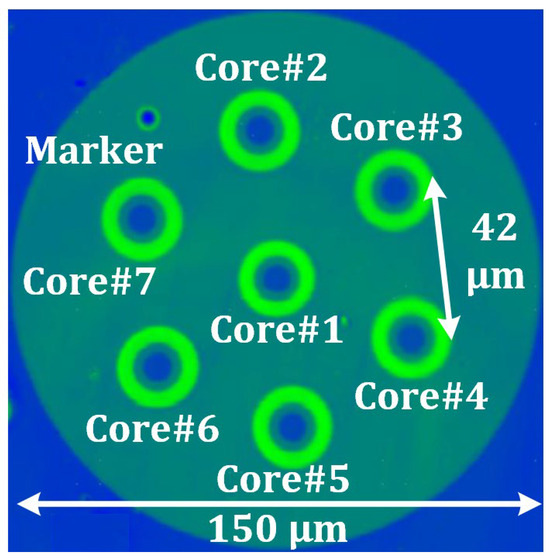
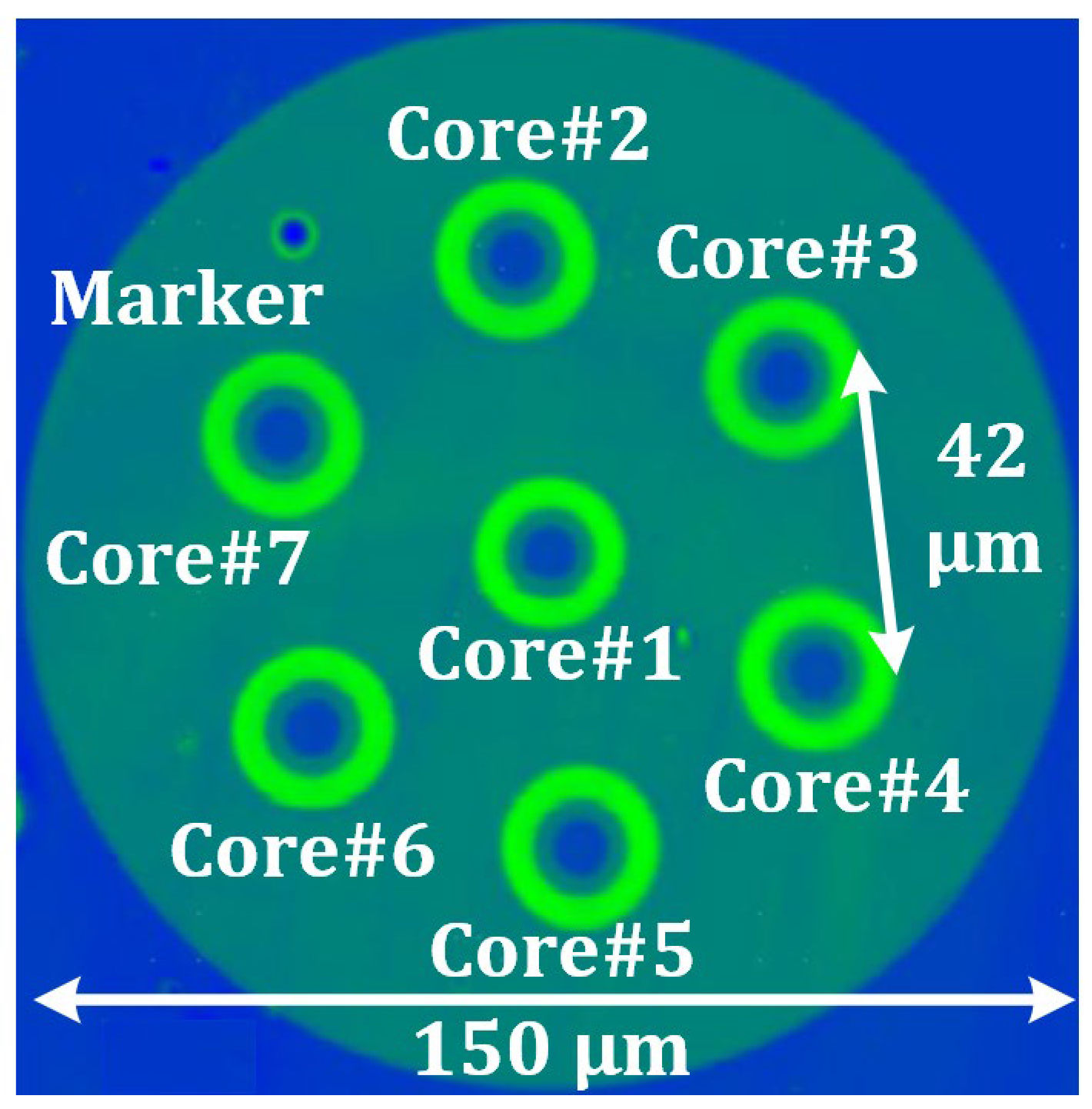
In this section, we introduce the weakly coupled seven-core fiber for ultra-high-speed transmission. The weakly coupled seven-core fiber is the WC-MCF-42-150-245 model manufactured by the Yangtze Optical Fibre and Cable Joint Stock Limited Company (YOFC), Wuhan, China, whose cross-section is presented in Figure 1. The seven fiber cores are arranged in a regular hexagonal pattern, which helps increase both the core-to-core distance and the distance from the fiber cores to the cladding edge under the same cladding diameter. The core pitch is designed to be 42 μm to suppress inter-core crosstalk. And the cladding diameter is 150 μm, which helps ensure sufficient distance from the fiber cores to the cladding edge and thereby reduce the transmission attenuation and bending loss induced by optical signal leakage. Although the cladding diameter of the seven-core fiber is larger than that of conventional SMF (which is usually 125 μm), its coating diameter remains consistent with the 245 μm coating diameter of conventional SMF. This helps eliminate the size increase associated with the use of seven-core fiber. Low-refractive-index trenches are also incorporated around each fiber core to further suppress inter-core crosstalk and bending loss, which are illustrated by the bright green rings surrounding the seven fiber cores in Figure 1. Each trench is located 4 μm from the outer edge of the fiber core, with a width of approximately 5 μm. Moreover, a marker core is fabricated within the cladding to prevent misconnection of fiber cores induced by angular rotation and help improve core alignment accuracy during fusion splicing. Each fiber core is designed and fabricated in compliance with ITU-T Recommendation G.657, and some main characteristics of the seven-core fiber are shown in Table 1. We can find that each fiber core exhibits characteristics such as attenuation coefficient, dispersion coefficient, and polarization mode dispersion comparable to those of conventional SMFs complying with the same ITU-T Recommendation. The cutoff wavelength of each fiber core is no more than 1300 nm, ensuring that optical signals with a wavelength larger than 1300 nm can achieve stable single-mode transmission. And the crosstalk is sufficiently low, which has almost no significant impact on the transmission performance of the CDM system. Moreover, the measured bending loss is less than 0.1 dB when wrapped 100 turns at a bending radius of 30 mm, which is primarily attributed to the design of low-refractive-index trenches and can meet the requirements in practical implementations. It should be emphasized that the high-performance seven-core fiber provides strong support for CDM transmission systems and helps realize ultra-high-speed, real-time transmission.
Figure 1.
Cross-section of the weakly coupled 7-core fiber.
Table 1.
Main characteristics of the 7-core fiber at 1550 nm.
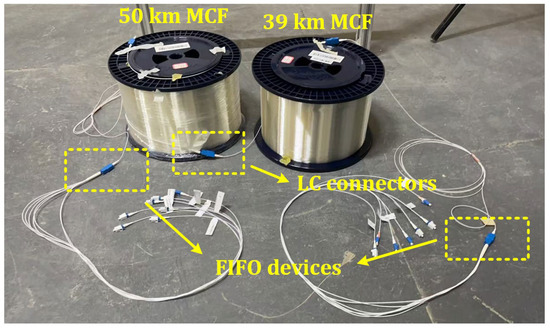
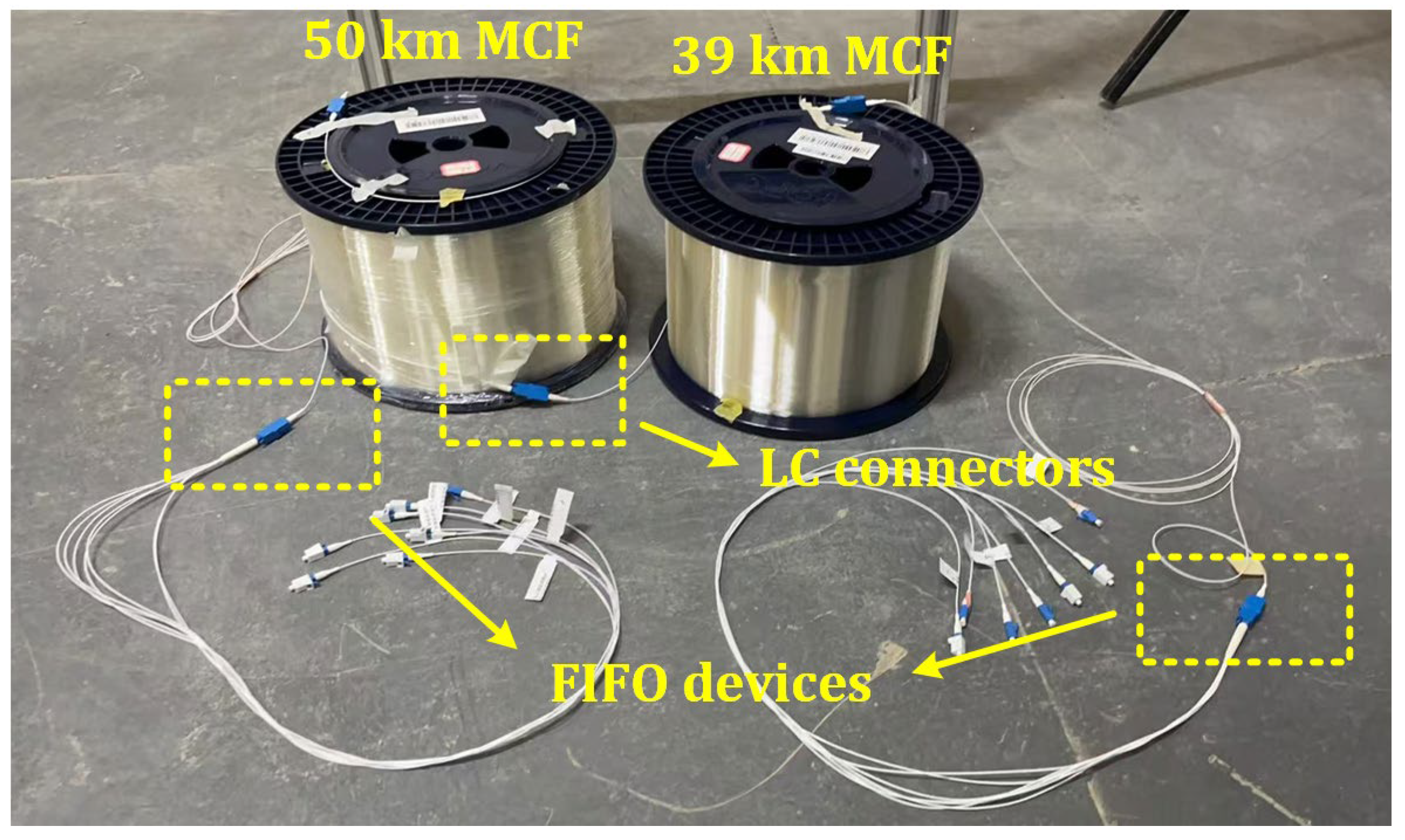
In our experiment, two spools of MCF with lengths of 50 km and 39 km, respectively, are utilized for real-time transmission. Both ends of the MCFs are fabricated with latching connectors (LCs), which enable direct interconnection through LC flanges. A pair of FIFO devices are used to realize the coupling between MCF and SMFs. The FIFOs are the FIFO-7-150-245 model manufactured by YOFC, which are fabricated via fiber bundle processing and achieve an average insertion loss (IL) of less than 0.8 dB. This average IL includes the connection loss to the multi-core fiber. Each pigtail of the FIFO devices is also fabricated with an LC connector, allowing direct connection to MCFs via LC flanges. The photograph of the two spools of MCFs and a pair of FIFO devices is depicted in Figure 2. For the subsequent ultra-high-speed, real-time transmission testing, we connect the two spools of MCFs with a pair of FIFOs to form an 89 km CDM transmission link. The span loss and total inter-core crosstalk of each channel are measured, and the results are shown in Table 2. The results indicate that the span loss and total crosstalk of each fiber core channel are below 21.1 dB and −42 dB, respectively. The deterioration of span loss and inter-core crosstalk compared to those of bare MCF is primarily induced by the FIFO devices and connection points with LCs. It should be noted that the fiber length is optimized to maximize the length of the MCF on the premise of ensuring the total transmission attenuation between the two EDFAs can be well compensated for by low-noise EDFAs. In the C+L-band transmission system, in addition to the span loss of the CDM transmission link, the total transmission loss between two EDFAs also includes the IL of a pair of wavelength multiplexers (WMUXes). The adoption of low-noise EDFAs and optimization of the fiber length can help reduce OSNR degradation induced by EDFAs while maximizing the length of each transmission span, ultimately extending the overall transmission distance for C+L-band 1.2 Tb/s signals. It should also be acknowledged that, limited by the available MCFs, the optimized fiber length has to be set to 89 km, which is the optimal length among all seven-core fibers we can obtain.
Figure 2.
Photograph of the 89 km CDM transmission link consisting of two spools of MCFs and a pair of FIFO devices.
Table 2.
Span loss and the total inter-core crosstalk of the 89 km CDM link (Unit: dB).
3. System Setup and the Ultra-High-Speed 1.2 Tb/s OTUs
3.1. System Setup of the Real-Time CDM Transmission
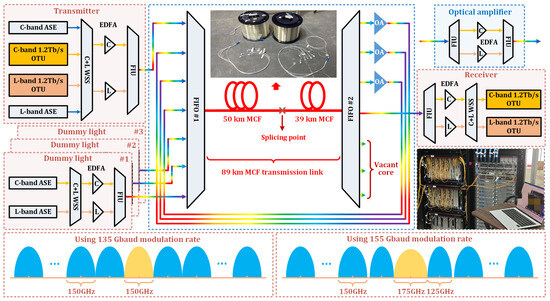
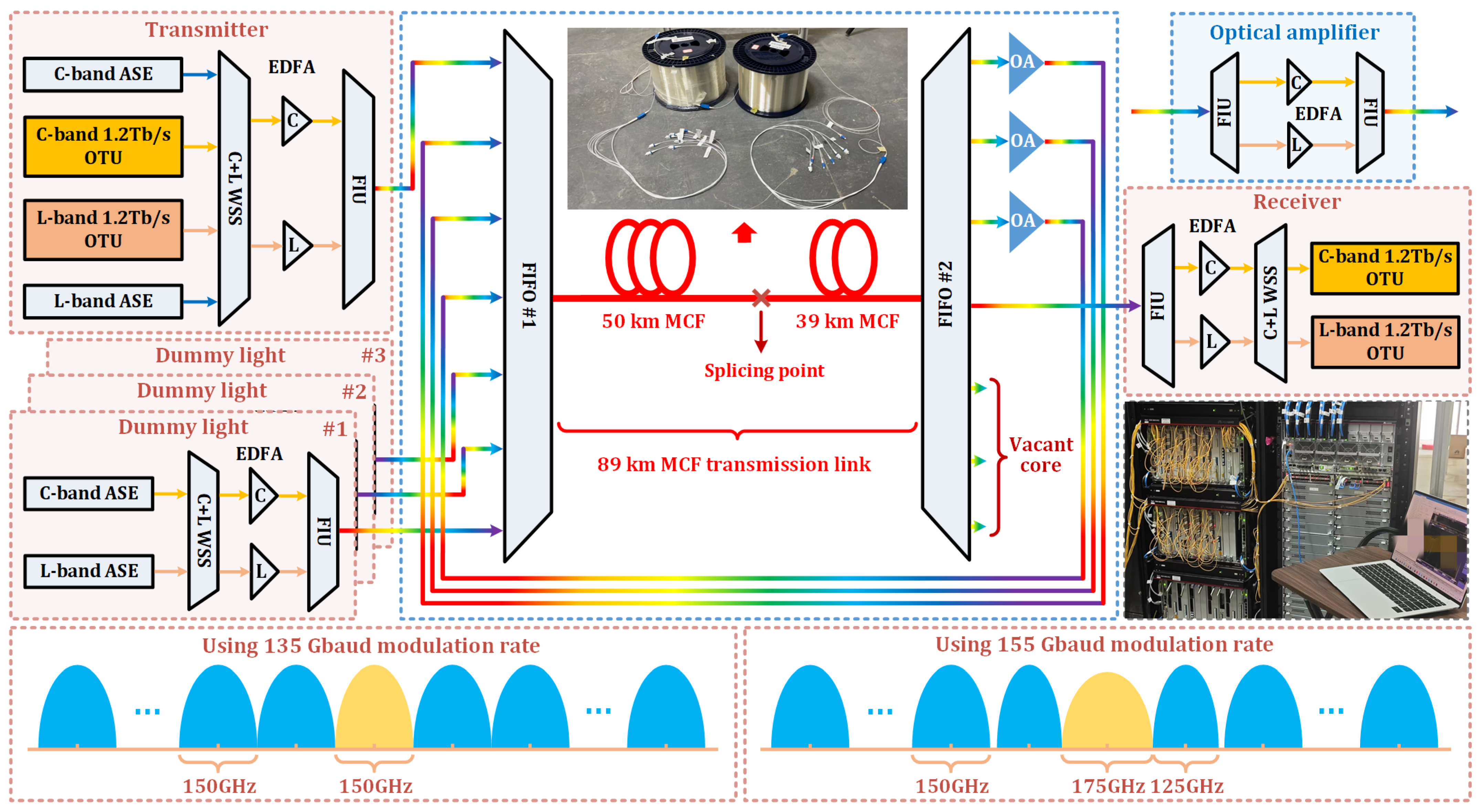
In this subsection, we present the system setup of our real-time CDM transmission using C+L-band 1.2 Tb/s OTN transponders over weakly coupled 7-core fiber, which is shown in Figure 3. At the transmitter, a pair of C-band and L-band ultra-high-speed 1.2 Tb/s OTUs are employed to transmit modulated signals, whose central wavelengths can be tuned within the range from 1524.89 nm to 1571.65 nm and from 1575.78 nm to 1625.77 nm, respectively, and support broadband C6T+L6T transmission. To simulate fully loaded 12-THz broadband WDM transmission, the dummy light (DL) generated by a pair of C-band and L-band amplified spontaneous emission (ASE) noise sources is utilized to fill the remaining wavelength channels. This experimental configuration can simulate various transmission impairments in a broadband WDM system with limited available OTUs, including inter-channel crosstalk, cross-phase modulation (XPM), and SRS. In addition, fully filling all wavelength channels can also maintain the system stability in the presence of power transfer caused by SRS. Under such conditions, the transferred power remains essentially constant and can be easily pre-compensated at the transmitter. This is particularly important in practical broadband transmission systems with frequent add–drop operations. The modulated optical signals and DL are multiplexed through a C+L integrated wavelength selection switch (WSS), whose channel spacing can be dynamically adjusted to adapt to different modulation rates. Then, the C-band and L-band WDM signals are amplified by a pair of C-band and L-band EDFAs and combined through a fiber interface unit (FIU). This FIU mainly functions to multiplex WDM signals of two transmission bands, and it can also multiplex the optical supervisory channel (OSC) with a central wavelength of 1511 nm together with the amplified WDM signals. The C+L-band signals are then coupled to one fiber-core channel for CDM transmission. The transmission link is the 89 km CDM link shown in Figure 2, which includes an 89 km MCF and a pair of FIFO devices. To simulate metro-regional transmission with the 89 km CDM link, we cascade the first four fiber-core channels in the same direction, as illustrated in Figure 3. Under this architecture, each fiber-core channel acts as an 89 km transmission span, and a 356 km (4 × 89 km) end-to-end transmission system is constructed. After transmission over each span, the optical signals are amplified by an optical amplifier (OA) and coupled to the next fiber core for subsequent transmission until reaching the receiver. Due to the lack of C+L integrated amplifiers, the OAs also consist of a pair of C-band and L-band EDFAs, and the multiplexing/demultiplexing of the two-band signals is also achieved through FIUs. After four-span transmission, the received signals are first separated by an FIU and then amplified by a pair of EDFAs at the receiver. The amplified signals are then demultiplexed by another WSS. Finally, the demultiplexed signals are sent back to the corresponding 1.2 Tb/s OTUs for real-time reception and bit error rate (BER) calculation. It should be emphasized that, to simulate fully loaded 7-core CDM transmission, the remaining three fiber cores are also filled with DL generated by ASE white noise, as depicted in Figure 3. The launching direction and input power of the DL used to fill the vacant fiber cores are consistent with those of the test signals, ensuring accurate simulation of inter-core crosstalk in the CDM transmission. In our experiment, the OTUs and FIUs are Huawei TKP1MA16DAG3 and TNG6WDAPXF01-R1 model OTN device boards, respectively. And the low-noise C-band and L-band EDFAs are Huawei TNG2OACU27U and TNG2OALU24S model pluggable optical amplifiers, respectively. The OTN transmission system is installed on the Huawei OptiX OSN 9800 platform, and network configuration as well as parameter monitoring are performed via the network management system. The photo of the OTN equipment and the network management system is also depicted in Figure 3.
Figure 3.
System setup of the real-time CDM transmission using C+L-band 1.2 Tb/s OTN transponders over weakly coupled 7-core fiber.
3.2. Ultra-High-Speed 1.2 Tb/s OTUs and Experimental Configuration
We then introduce the ultra-high-speed 1.2 Tb/s OTUs and experimental configuration in this subsection, which are improved to meet the requirements for metro-regional ultra-high-speed transmission. For single-wavelength 1.2 Tb/s optical signals, the transmission distance is mainly constrained by the limited OSNR budget, as such ultra-high-speed signals usually require the use of high-order modulation formats with poor noise tolerance. To this end, high-performance 1.2 Tb/s OTUs with beyond-130 Gbaud modulation rates are utilized in our experiment, which enables the adoption of a polarization-multiplexed (PM) PCS-64QAM modulation format to enhance their transmission capability. Advanced proprietary DSP techniques (including the PCS algorithm) and forward error correction (FEC) coding algorithms with beyond-30 Gbaud overhead are also utilized to improve the noise and nonlinearity tolerance of the OTUs. This helps reduce their OSNR threshold and thus increases the available OSNR budget. The 1.2 Tb/s OTUs are equipped with two configurable modulation rates of 135 Gbaud and 155 Gbaud. The two modulation rates correspond to channel spacings of 150 GHz and 175 GHz, respectively, enabling 80- and 68-wavelength WDM transmissions within the 12-THz bandwidth. These two modulation rates adopt similar low-density parity-check (LDPC) FEC coding algorithms and achieve a soft-decision (SD) FEC limit of 3.5 × 10⁻². Compared to the 135 Gbaud transmission mode, the 155 Gbaud configuration primarily enhances the shaping intensity of the PCS technique and compensates for the associated entropy loss. This enhanced PCS configuration further increases the transmission probability of low-power, low-order symbols in the PCS-64QAM modulation format, thereby improving robustness against both noise and nonlinear impairments of the transmission system.
In this experiment, we tested the transmission performance of the system under the two modulation rates. The wavelength configurations under the two modulation rates are also described in Figure 3, in which the yellow and blue patterns represent the test signals and DL, respectively. For the 135 Gbaud modulation configuration, the test signals and DL use the same 150 GHz channel spacing, with the central wavelengths ranging from 1524.89 nm to 1571.65 nm (C-band) and from 1575.78 nm to 1625.77 nm (L-band), respectively. The channel spacing is configured by the WSS, and the transmission performance of different wavelength channels is tested by adjusting the central wavelength of the OTUs. However, for the 155 Gbaud modulation configuration with 175 GHz channel spacing, since China Mobile has not yet established a recommendation for the center wavelength of the 175 GHz channel spacing in the C6T+L6T transmission system, the test continues to adopt the eighty center wavelengths used for the 150 GHz spacing. Under this configuration, as shown in Figure 3, the 155 Gbaud test signal occupies a 175 GHz wavelength channel, while its two adjacent channels are filled with DL using a 125 GHz spacing. The remaining DL still utilizes the 150 GHz channel spacing, which is consistent with the configuration used for the 135 Gbaud modulation rate. The central wavelengths for both the test signals and the DL remain identical to those used under the 135 Gbaud configuration. And the transmission performance of different wavelength channels is measured by adjusting the central wavelength of the OTUs and the corresponding channel configuration of the WSS. In addition, to reduce OSNR degradation induced by EDFAs and ensure that 1.2 Tb/s optical signals can achieve error-free transmission over four spans, low-noise EDFAs are utilized for optical regeneration. These low-noise EDFAs achieve a noise figure of approximately 4 dB, with corresponding gains of 27 dB and 24 dB for the C band and L band, respectively. As mentioned earlier, to maximize the transmission distance of the CDM system, the length of the MCF is extended as much as possible on the premise that the link loss can be fully compensated by the low-noise EDFAs. Considering the experimentally available MCFs, the length of each span was selected as 89 km in our experiment.
4. Experimental Results
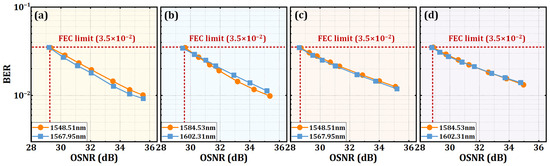
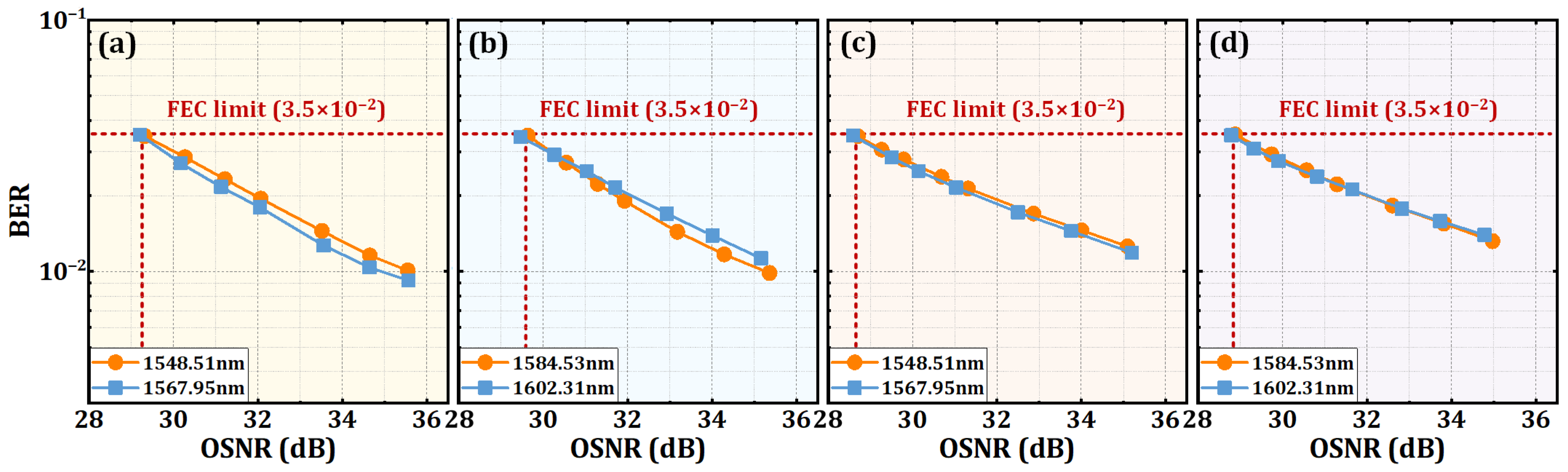
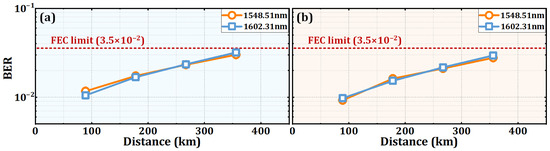
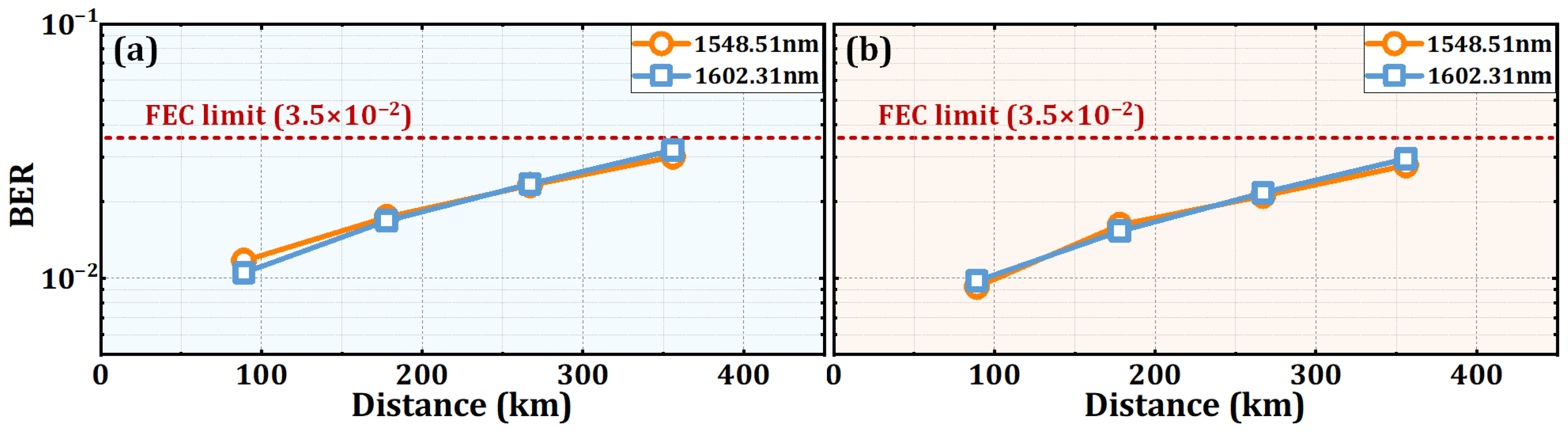
In this section, we present the experimental performance of the real-time CDM transmission using C+L-band 1.2 Tb/s OTN transponders. The results for the 135 Gbaud and 155 Gbaud transmission configurations were both investigated using the same methods. We first measured the relationship between the BER values and OSNR in a back-to-back (B2B) configuration to evaluate the anti-noise performance of the 1.2 Tb/s OTUs. The BER values were measured before FEC decoding in our experiment, which could be directly obtained through the network management system and enabled error-free transmission as long as they remained below the FEC limit. The test results of the C-band and L-band signals configured with the 135 Gbaud modulation rate are shown in Figure 4a,b, respectively. And the results of the C-band and L-band signals utilizing the 155 Gbaud configuration are presented in Figure 4c,d, respectively. For each wavelength band, two non-adjacent wavelength channels were measured. We can observe that the C-band and L-band OTUs have similar BER-OSNR performance. And the OSNR threshold, which is defined as the OSNR when the corresponding BER reaches the FEC limit, of the 135 Gbaud and 155 Gbaud modulation rates are lower than 29.6 dB and 28.9 dB, respectively, for both wavelength bands. The performance improvement under the 155 Gbaud transmission configuration is primarily attributed to the enhanced shaping intensity of the PCS technique. The BER values after transmission over each span are subsequently measured, and the results using the 135 Gbaud and 155 Gbaud modulation configurations are presented in Figure 5a,b, respectively. For each configuration, the performance of signals at 1548.51 nm (C band) and 1602.31 nm (L band) was measured, and the average single-wavelength input power was approximately 7.5 dBm and 5.5 dBm for C-band and L-band signals, respectively. The input power of the C-band signal is higher than that of the L-band signal in order to counteract the power transfer effect induced by SRS. It can be found that for each configuration, the BER values of C-band and L-band signals remained below the SD-FEC limit after four-span transmission, corresponding to a transmission distance of 356 km. Moreover, when operating under the 155 Gbaud configuration, the system exhibits lower BER values due to its superior performance in resisting interferences during fiber transmission.
Figure 4.
Measured BER values as a function of OSNR using the 135 Gbaud transmission configuration at (a) C band and (b) L band; measured BER values as a function of OSNR using the 155 Gbaud transmission configuration at (c) C band and (d) L band.
Figure 5.
Measured BER values after transmission over each span using (a) 135 Gbaud and (b) 155 Gbaud modulation configurations.
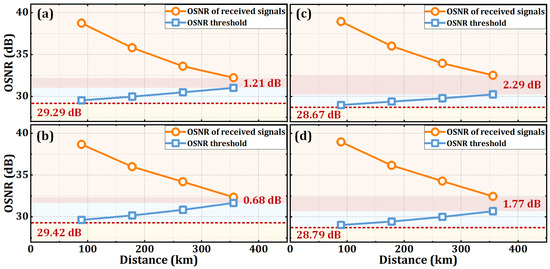
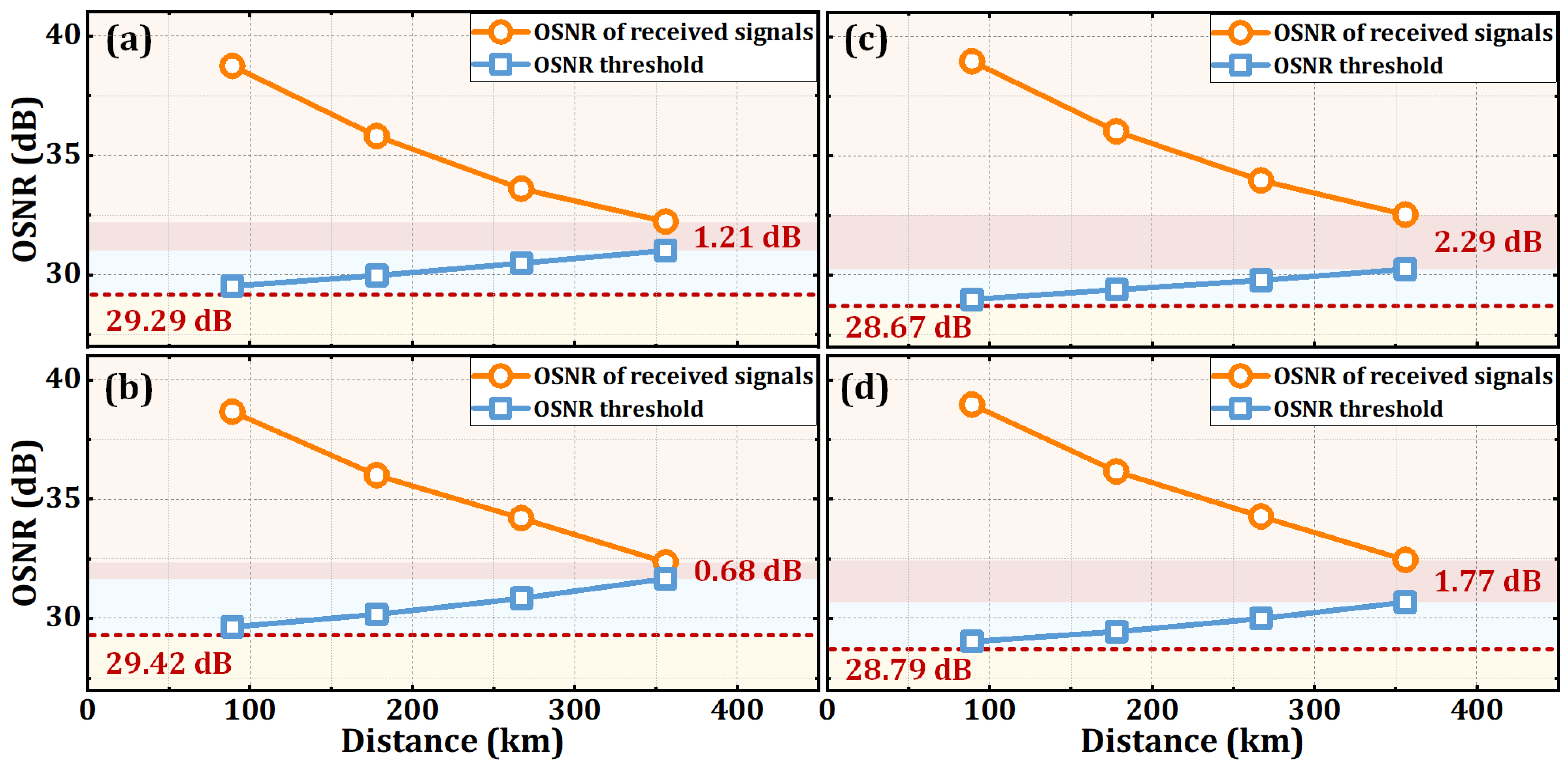
We further measured the OSNRs of received signals and OSNR thresholds after transmission over each span to better evaluate the performance of the 1.2 Tb/s OTUs and compare the performance differences between the two modulation configurations. The average single-wavelength input power was also set to 7.5 dBm and 5.5 dBm for C-band and L-band signals, respectively. The results using the 135 Gbaud transmission configuration at 1548.51 nm and 1602.31 nm are presented in Figure 6a,b, respectively. And the results using the 155 Gbaud configuration are shown in Figure 6c,d, respectively. In each figure, the light-blue and light-red regions represent the deterioration of the OSNR threshold and the remaining OSNR margin after 356 km CDM-WDM transmission, respectively. The OSNR thresholds at the corresponding wavelength channels under B2B configuration are also depicted by the dark-red dashed line for reference. We can find that after 356 km transmission, the average deterioration of the OSNR thresholds using 135 Gbaud and 155 Gbaud configurations was no more than 2 dB and 1.73 dB, respectively, which indicates that the DSP algorithm of our system can compensate for various linear transmission impairments well. The deterioration of the OSNR threshold for the 155 Gbaud modulation configuration was lower than that for the 135 Gbaud counterpart. This is because the deterioration of the OSNR threshold is mainly induced by nonlinear effects, including SPM and XPM during fiber transmission. These two nonlinear effects become increasingly prominent when the power spectral density of optical signals is high, inducing signal distortion and inter-channel crosstalk. The 155 Gbaud signals leverage an enhanced PCS technique and a comparatively low power spectral density, thereby improving their robustness against the aforementioned nonlinear impairments. Benefiting from the two-fold improvements of a lower OSNR threshold under B2B configuration and reduced OSNR threshold deterioration, the system adopting the 155 Gbaud modulation configuration could achieve an approximately 1 dB OSNR margin improvement under the same input power compared to that using the 135 Gbaud configuration.
Figure 6.
Measured OSNRs of received signals and OSNR thresholds as function of transmission distance using 135 Gbaud transmission configuration at (a) 1548.51 nm and (b) 1602.31 nm; measured OSNRs of received signals and OSNR thresholds as function of transmission distance using 155 Gbaud transmission configuration at (c) 1548.51 nm and (d) 1602.31 nm.
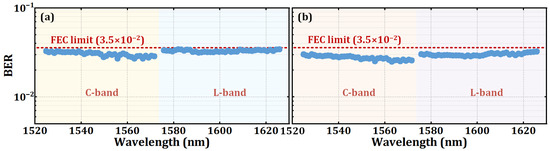
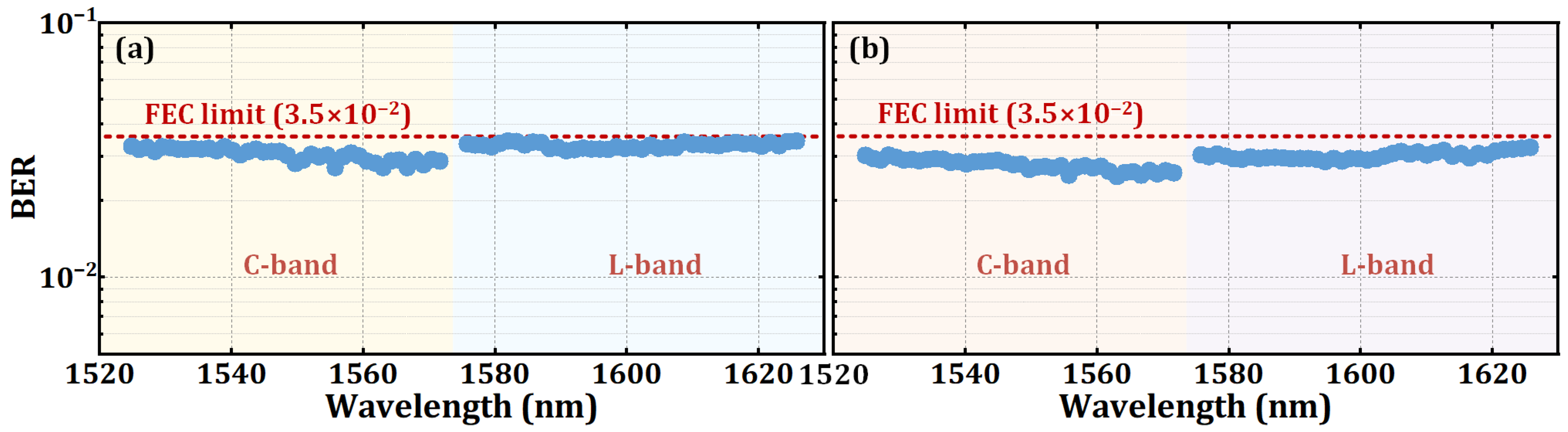
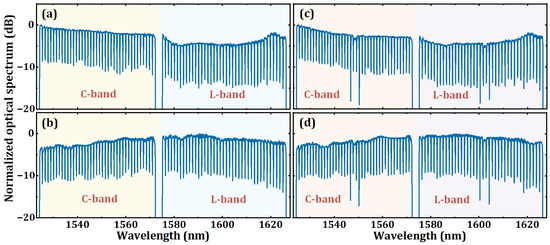
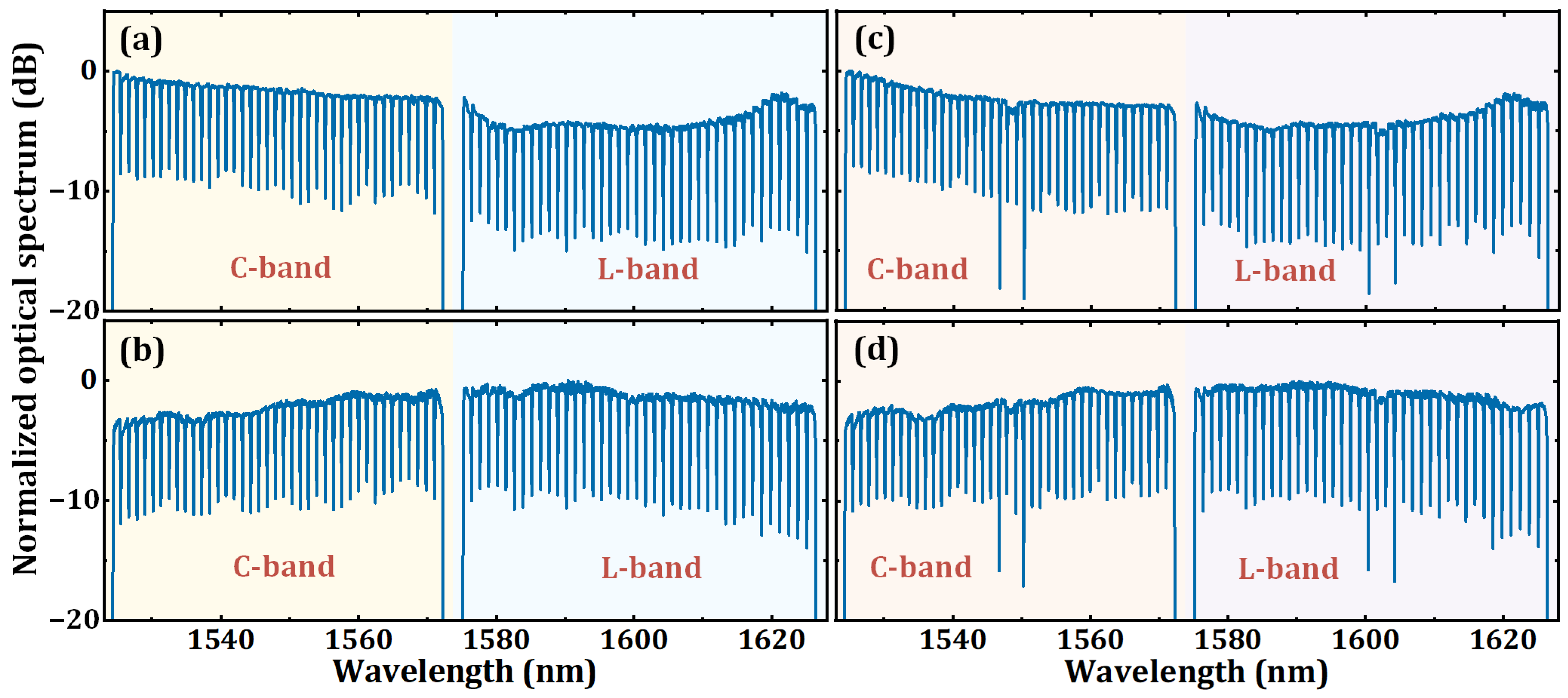
Then, we investigated the broadband characteristics of the 1.2 Tb/s WDM-CDM transmission system by adjusting the central wavelength of each OTU. The characteristics of using the 135 Gbaud and 155 Gbaud modulation configurations were tested separately. And as mentioned earlier, when testing the configuration using the 155 Gbaud modulation rate, the central wavelengths of the test signals were still selected to be consistent with those when using the 135 Gbaud rate, and a total of 80 wavelength channels across the C+L band were evaluated. The 155 Gbaud modulated signal adopted a 175 GHz wavelength channel, and its two adjacent channels were filled with DL with a 125 GHz channel spacing. The channel spacing was adjusted via the WSS. In this testing, the average single-wavelength input power was also set to 7.5 dBm and 5.5 dBm for C-band and L-band signals, respectively, and the results using the 135 Gbaud and 155 Gbaud modulation configurations are presented in Figure 7a,b, respectively. The transmitted and received optical spectra using the two configurable modulation rates are also illustrated in Figure 8a–d, respectively. We can find that the BER values were all lower than the SD-FEC limit after 356 km WDM-CDM transmission, which indicates that the ultra-high-speed transmission system using 1.2 Tb/s OTUs can achieve error-free WDM transmission over a 12-THz bandwidth. The BER values using the 155 Gbaud modulation rate were lower than those with the 135 Gbaud modulation rate, which is also due to the enhanced PCS performance. These results demonstrate the feasibility of real-time 0.672 Pb/s (1.2 Tb/s × 80 × 7) and 0.571 Pb/s (1.2 Tb/s × 68 × 7) transmissions over 356 km MCF using the 135 Gbaud and 155 Gbaud modulation configurations, respectively. And real-time capacity–distance products up to 239.23 Pb/s∙km and 203.35 Pb/s∙km were realized, respectively. It can also be obtained from Figure 8 that the transmitted optical spectrum was pre-equalized for the broadband transmission system, which was mainly to counteract the power transformation induced by SRS and the uneven gain spectrum of EDFAs. This spectrum pre-equalization method has been utilized in practical C+L-band transmission systems. Moreover, the intensities of the received long-wavelength signals are enhanced after transmission, which is also attributed to the SRS in broadband WDM transmission. This effect induces power transfer from C-band signals to L-band signals in our system. And the spectral density of the 155 Gbaud signal was lower than that of the DL, which was due to its adoption of a wider bandwidth.
Figure 7.
BER performances of the 80 wavelength channels after 356 km transmission using (a) 135 Gbaud and (b) 155 Gbaud modulation configuration.
Figure 8.
(a) Transmitted and (b) received optical spectra of the 1.2 Tb/s 80-λ signals using 135 Gbaud modulation configuration; (c) transmitted and (d) received optical spectra of the 1.2 Tb/s 80-λ signals using 155 Gbaud modulation configuration.
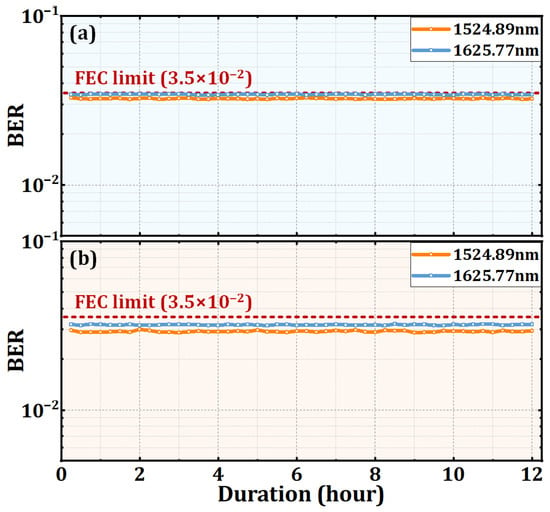
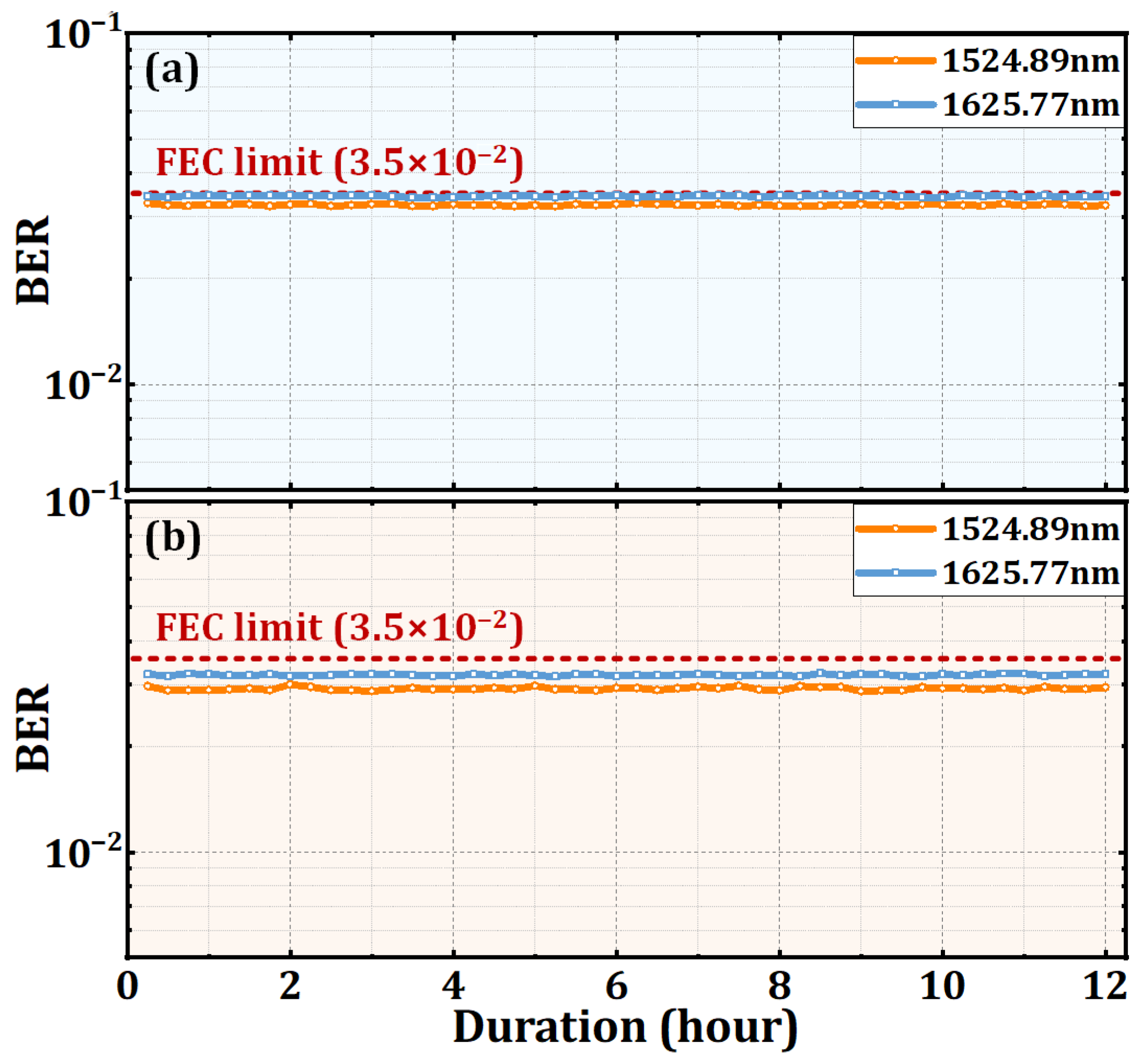
Finally, we evaluated the stability of the experimental system through 12 h continuous testing. The BER values were obtained every 15 min from the network management system, and the two worst-performing wavelength channels (with central wavelengths of 1524.89 nm and 1625.77 nm) were tested. Results using the 135 Gbaud and 155 Gbaud modulation configurations are shown in Figure 9a,b, respectively. It is obvious that the BER values of the two worst-performing channels remained below the FEC limit during the 12 h period. And only slight BER fluctuations could be observed during the continuous test. These results demonstrate that the 1.2 Tb/s ultra-high-speed WDM-CDM transmission system can maintain stability during continuous operation and has implementation potential in existing optical transmission networks.
Figure 9.
BER values over 12 h stability testing using (a) 135 Gbaud and (b) 155 Gbaud modulation configuration.
5. Discussion
In this work, we demonstrate a metro-regional, ultra-high-speed, and real-time CDM transmission system utilizing 1.2 Tb/s OTN transponders and weakly coupled seven-core fiber. To achieve broadband transmission over metro distances with a limited OSNR budget, three critical components are strategically integrated, including OTN transponders with an over 130 Gbaud modulation rate, low-noise EDFAs, and high-quality MCF. The high-modulation-rate OTUs enable the adoption of PCS-64QAM modulation format to reach the target single-wavelength data rate, which reduces the OSNR threshold compared to those using higher-order modulation formats and thereby extends the available OSNR budget. The low-noise EDFAs exhibit low noise figures, which enable the reduction in OSNR degradation during optical amplification. As for the weakly coupled seven-core fiber, it exhibits transmission characteristics comparable to those of standard SMFs, providing essential optical support for extending the reach of the ultra-high-speed system. Furthermore, the length of the seven-core fiber has also been optimized to maximize the length of each span on the premise of ensuring that the span loss can be compensated by the low-noise EDFAs. Through these synergistic optimizations, the system achieves a real-time 4 × 89 km WDM-CDM transmission utilizing the C6T+L6T bandwidth. And in our experiment, two configurable modulation rates, 135 Gbaud and 155 Gbaud, of the 1.2 Tb/s OTN transponders were, respectively, tested and compared. The results indicate that the 155 Gbaud modulation configuration with enhanced PCS performance exhibits superior noise and nonlinearity tolerance, resulting in lower BER values and larger OSNR margins after multi-span transmission compared to the 135 Gbaud configuration. This superior anti-interference performance and transmission margin make the 155 Gbaud configuration more suitable for implementation in practical, ultra-high-speed transmission networks. However, this configuration requires a 175 GHz channel spacing, limiting the number of WDM channels to 68 within a 12 THz spectral bandwidth, which is fewer than the 80 wavelength channels achievable with the 135 Gbaud configuration. To match the 80-wavelength capacity, a minimum spectral bandwidth of 14 THz is required, necessitating the extension of an additional 2 THz of available bandwidth in the S/U bands from optical fibers and transmission equipment, including OTUs, WMUXes, and EDFAs. Additionally, no standardized central wavelength recommendations currently exist for 175 GHz channel spacing, highlighting the need for further research on wavelength allocation strategies.
To support longer-distance, real-time 1.2 Tb/s WDM-CDM transmission in future work, advancements are required at both the transmission equipment and fiber levels. For transmission equipment, the limited OSNR budget of PCS-64QAM necessitates the exploration of lower-order modulation formats with higher noise tolerance, such as PCS-16QAM, to effectively extend transmission reach. This transition would require a modulation rate exceeding 190 Gbaud and 225 GHz channel spacing, which in turn demands an 18 THz spectral bandwidth to maintain 80-channel WDM transmission. Under this condition, a 6 THz spectral extension in the S/U bands compared to current systems is required. Consequently, our future efforts will focus on developing higher-speed optical modulators, as well as broadband amplifiers and WDM components covering the S and U bands. In addition, as illustrated in Figure 8, significant spectral distortions, including power transfer from C-band to L-band and edge-channel degradation, are observed after multi-span transmission. To mitigate this impact, it is necessary to improve the gain flatness of EDFAs and utilize dynamic gain equalizers (DGEs) to re-equalize the signal spectrum of broadband multi-span transmission systems. In terms of MCFs, we will combine the design approach of ultra-low-loss, large-effective-area SMFs with MCFs. Developing ultra-low-loss, large-effective-area MCFs will reduce fiber attenuation and nonlinear effects in broadband transmission systems, thereby extending their transmission reach. Furthermore, we will investigate fiber design methodologies to reduce the cutoff wavelength of ultra-low-loss, large-effective-area MCFs to 1450 nm or even lower, meeting the future application requirements of the S-band. This is critical because, although signals below the cutoff wavelength can propagate in a quasi-single-mode (QSM) format, maintaining their wavelengths above the cutoff can avoid multipath interference (MPI) and additional attenuation from higher-order mode dissipation associated with QSM transmission.
In summary, the exponential growth of high-density, ultra-high-speed data center interconnections imposes unprecedented demands on optical network capacity. Collaborative research needs to be further conducted on multiple aspects, including ultra-high-speed OTN equipment, novel MCFs, and transmission systems to improve the transmission performance of 1.2 Tb/s or even higher-speed OTN systems, thereby meeting the transmission requirements of future, longer-distance, ultra-high-speed optical interconnection systems.
6. Conclusions
In this paper, we demonstrate the first real-time, ultra-high-speed CDM transmission system using C+L-band 1.2 Tb/s OTN transponders over weakly coupled seven-core fiber. The 1.2 Tb/s OTN transponders feature a modulation rate of 135 Gbaud, enabling the adoption of the PCS-64QAM modulation format and advanced DSP algorithms. Moreover, they are also equipped with a configurable mode with a 155 Gbaud modulation rate, which can further enhance their resistance to noise and nonlinear effects by improving PCS performance. The MCF exhibits characteristics comparable to those of traditional SMFs and negligible inter-core crosstalk, providing a superior physical channel for ultra-high-speed CDM transmission. The fiber length and low-noise EDFAs are also selected to extend the transmission distance under the limited OSNR budget when using 1.2 Tb/s OTN transponders. Benefiting from the high-performance 1.2 Tb/s OTN equipment and MCF, we achieve real-time 0.672 Pb/s and 0.571 Pb/s 356 km CDM transmissions using 135 Gbuad and 155 Gbaud modulation rates, respectively, which correspond to capacity–distance products of 239.23 Pb/s·km and 203.35 Pb/s·km. And by adopting the 155 Gbaud modulation configuration, the experimental system can achieve an approximately 1 dB improvement in OSNR margin after 356 km transmission compared with the 135 Gbaud configuration, but at the cost of a 15% data rate decrease within the 12 THz bandwidth. Our work demonstrates the feasibility of using 1.2 Tb/s OTN transponders over weakly coupled MCFs to achieve ultra-high-speed, metro-regional data transmission, which is beneficial for capacity-demanding scenarios such as inter-city data center interconnections.
Author Contributions
Conceptualization, J.C., Y.D., Z.L., and C.C.; methodology, J.C., Y.D., Y.W., Y.C., and B.Y.; software, J.C. and Y.Z.; validation, J.C., Y.W., Y.Z., Z.F., L.Z., and S.C.; formal analysis, J.Z., B.H., B.W., S.H., and H.L.; investigation, J.C., Z.L., C.W., and L.S.; resources, Y.D., C.W., S.C., J.L., Y.S., Q.W., and N.G.; data curation, J.C., Y.D., Y.W., Y.Z., Z.F., and J.Z.; writing—original draft preparation, J.C., Z.L., Y.Z., L.Z., and C.W.; writing—review and editing, C.C., Y.S., and B.Y.; visualization, C.W., S.C., S.H., and H.L.; supervision, J.C. and Y.Z.; project administration, J.C., Y.W., C.W., L.S., and C.C.; funding acquisition, J.C. All authors have read and agreed to the published version of the manuscript.
Funding
This research received no external funding.
Institutional Review Board Statement
Not applicable.
Informed Consent Statement
Not applicable.
Data Availability Statement
The original contributions presented in this study are included in the article. Further inquiries can be directed to the corresponding author.
Conflicts of Interest
Authors Jian Cui, Yu Deng, Zhuo Liu, Chao Wu, Zilin Fan, Junyi Zhou, Bin Hao, Leimin Zhang, Cheng Chang, Yan Sun, Qi Wan, and Ninglun Gu were employed by the company Department of Networks, China Mobile Communications Group Co., Ltd.; authors Yuxiao Wang, Bin Wu, Yong Chen, and Bing Yan were employed by the company Network Management Center, China Mobile Communications Group Shandong Co., Ltd.; authors Yating Zhang, Shang Cao, Shenghui Hu, and Haibin Liu were employed by the company Huawei Technologies Co., Ltd.; authors Lei Shen and Jie Luo were employed by the company State Key Laboratory of Optical Fiber and Cable Manufacture Technology, YOFC. The remaining authors declare that the research was conducted in the absence of any commercial or financial relationships that could be construed as potential conflicts of interest.
References
- Ghiasi, A. Large data centers interconnect bottlenecks. Opt. Express 2015, 23, 2085–2090. [Google Scholar] [CrossRef] [Scilit] [PubMed]
- Ryf, R.; Randel, S.; Gnauck, A.H.; Bolle, C.A.; Sierra, A.; Mumtaz, S.; Esmaeelpour, M.; Burrows, E.C.; Essiambre, R.-J.; Winzer, P.J.; et al. Mode-division multiplexing over 96 km of few-mode fiber using coherent 6 × 6 MIMO processing. J. Light. Technol. 2012, 30, 521–531. [Google Scholar] [CrossRef] [Scilit]
- Kobayashi, T.; Shimizu, S.; Kawai, A.; Nakamura, M.; Abe, M.; Kazama, T.; Umeki, T.; Nagatani, M.; Kimura, K.; Wakita, H. C+L+U-Band 14.85-THz WDM Transmission Over 80-km-Span G.654.E Fiber with Hybrid PPLN-OPA/EDFA U-Band Lumped Repeater Using 144-Gbaud PCS-QAM Signals. In Proceedings of the 2024 Optical Fiber Communications Conference and Exhibition (OFC), San Diego, CA, USA, 24–28 March 2024. [Google Scholar]
- He, Q.; Ge, D.; Luo, M.; Zhang, X.; Wu, Y.; Mei, L.; Du, P.; Wang, D.; Zhang, H.; Li, H.; et al. 150.27-Tb/s Capacity over 150-km in S+C+L Band Using 156-Channel 115-GBaud Signals with Doped Fiber Amplification. In Proceedings of the 2024 Optical Fiber Communications Conference and Exhibition (OFC), San Diego, CA, USA, 24–28 March 2024. [Google Scholar]
- Richardson, D.J.; Fini, J.M.; Nelson, L.E. Space-division multiplexing in optical fibres. Nat. Photonics 2013, 7, 354–362. [Google Scholar] [CrossRef] [Scilit]
- Lasagni, C.; Serena, P.; Bononi, A.; Mecozzi, A.; Antonelli, C. Modeling of Nonlinear Transmission in Space-Division Multiplexed (SDM) Fibers. In Proceedings of the 2025 Conference on Lasers and Electro-Optics (CLEO), Long Beach, CA, USA, 4–9 May 2025. [Google Scholar]
- Kawakami, H.; Saito, K.; Masuda, A.; Yamamoto, S.; Yamazaki, E. Reducing Noise Figure and Nonlinear Penalty in Distributed Raman Amplifier System Utilizing Low-Noise Forward Pumping Technique. J. Light. Technol. 2025, 43, 7311–7321. [Google Scholar] [CrossRef] [Scilit]
- Serrano, E.; Bailleul, D.; Désévédavy, F.; Béjot, P.; Gadret, G.; Mathey, P.; Smektala, F.; Kibler, B. Towards high-power and ultra-broadband mid-infrared supercontinuum generation using tapered multimode glass rods. Photonics Res. 2025, 13, 1106–1115. [Google Scholar] [CrossRef] [Scilit]
- Li, G.; Bai, N.; Zhao, N.; Xia, C. Space-division multiplexing: The next frontier in optical communication. Adv. Opt. Photonics 2014, 6, 413–487. [Google Scholar] [CrossRef] [Scilit]
- Hout, M.; Sciullo, G.D.; Luis, R.S.; Puttnam, B.J.; Fontaine, N.K.; Ryf, R.; Chen, H.; Mazur, M.; Neilson, D.T.; Sillard, P.; et al. Transmission of 273.6 Tb/s Over 1001 km of 15-Mode Multi-Mode Fiber Using C-Band Only 16-QAM Signals. J. Light. Technol. 2024, 42, 1136–1142. [Google Scholar] [CrossRef] [Scilit]
- Puttnam, B.J.; Hout, M.; Sciullo, G.D.; Luis, R.S.; Rademacher, G.; Sakaguchi, J.; Antonelli, C.; Okonkwo, C.; Furukawa, H. 22.9 Pb/s Data-Rate by Extreme Space-Wavelength Multiplexing. In Proceedings of the 2023 European Conference on Optical Communication (ECOC), Glasgow, Scotland, 1–5 October 2023. [Google Scholar]
- Yan, H.; Liu, H.; Du, W.; Wang, Y.; Yuan, S.; Wang, Y.; Chen, M.; Sun, W.; Lao, X.; Zhang, G.; et al. Record Long-Haul Transmission with FIFO-Less Multicore EDFA Over 125-μm Cladding MCF. In Proceedings of the 2023 Asia Communications and Photonics Conference/2023 International Photonics and Optoelectronics Meetings (ACP/POEM), Wuhan, China, 4–7 November 2023. [Google Scholar]
- Soma, D.; Beppu, S.; Wakayama, Y.; Igarashi, K.; Tsuritani, T.; Morita, I.; Suzuki, M. 257-Tbit/s Weakly Coupled 10-Mode C + L-Band WDM Transmission. J. Light. Technol. 2018, 36, 1375–1381. [Google Scholar] [CrossRef] [Scilit]
- Ryf, R.; Fontaine, N.K.; Wittek, S.; Choutagunta, K.; Mazur, M.; Chen, H.; Alvarado-Zacarias, J.C.; Amezcua-Correa, R.; Capuzzo, M.; Kopf, R.; et al. High-Spectral-Efficiency Mode-Multiplexed Transmission over Graded-Index Multimode Fiber. In Proceedings of the 2018 European Conference on Optical Communication (ECOC), Rome, Italy, 23–27 September 2018. [Google Scholar]
- Rademacher, G.; Luis, R.S.; Puttnam, B.J.; Fontaine, N.K.; Mazur, M.; Chen, H.; Ryf, R.; Neilson, D.T.; Dahl, D.; Carpenter, J.; et al. 1.53 Peta-bit/s C-Band Transmission in a 55-Mode Fiber. In Proceedings of the 2022 European Conference on Optical Communication (ECOC), Basel, Switzerland, 18–22 September 2022. [Google Scholar]
- Shao, P.; Li, Z.; Zhao, X.; Wang, Y.; Li, S.; Tan, Z.; Liang, Y.; Liang, E.; Cheng, T.; Qin, Y.; et al. Low crosstalk trapezoid-index thirteen-core single-mode fiber for multi-channel and high-density applications. Opt. Express 2023, 31, 20919–20929. [Google Scholar] [CrossRef] [Scilit] [PubMed]
- Mori, T.; Yamada, Y.; Shibahara, K.; Matsui, T.; Kikuchi, M.; Sagae, Y.; Soma, D.; Beppu, S.; Nagashima, T.; Morishima, T.; et al. Applicability of Standard Cladding Diameter Multi-Core Fiber Cables for Terrestrial Field. J. Light. Technol. 2023, 42, 1044–1055. [Google Scholar] [CrossRef] [Scilit]
- Feng, L.; Zhang, A.; Guo, H.; Lou, X.; Wang, D.; Peng, C.; Liu, Y.; Lv, K.; Liu, H.; Huo, X.; et al. Real-Time 179.2Tb/s Transmission using Commercial 400Gb/s Transceivers over 350 km Multicore Fiber. In Proceedings of the 2023 Optical Fiber Communications Conference and Exhibition (OFC), San Diego, CA, USA, 5–9 March 2023. [Google Scholar]
- Cui, J.; Wu, C.; Liu, Z.; Deng, Y.; Hao, B.; Zhang, L.; Zhang, T.; Wang, Y.; Wu, B.; Zhang, C.; et al. Real-Time Unrepeated Long-Span Field Trial over Deployed 4-Core Fiber Cable Using Commercial 130-Gbaud PCS-16QAM 800 Gb/s OTN Transceivers. Photonics 2025, 12, 319. [Google Scholar] [CrossRef] [Scilit]
- Kremp, T.; Liang, Y.; McCurdy, A.H. Less Than 0.03 dB Multicore Fiber Passive Fusion Splicing Using New Azimuthal Alignment Algorithm and 3-Electrode Arc-Discharging System. In Proceedings of the 2022 European Conference on Optical Communication (ECOC), Basel, Switzerland, 18–22 September 2022. [Google Scholar]
- Shikama, K.; Abe, Y.; Kishi, T.; Takeda, K.; Fujii, T.; Nishi, H.; Matsui, T.; Aratake, A.; Nakajima, K.; Matsuo, S. Multicore-Fiber Receptacle with Compact Fan-In/Fan-Out Device for SDM Transceiver Applications. J. Light. Technol. 2018, 36, 5815–5822. [Google Scholar] [CrossRef] [Scilit]
- Alvarado-Zacarias, J.C.; Antonio-Lopez, J.E.; Habib, M.S.; Gausmann, S.; Wang, N.; Cruz-Delgado, D.; Li, G.; Schulzgen, A.; Amezcua-Correa, A.; Demontmorillon, L.A.; et al. Low-Loss 19 core Fan-in/Fan-out Device Using Reduced-Cladding Graded Index Fibers. In Proceedings of the 2019 Optical Fiber Communications Conference and Exhibition (OFC), San Diego, CA, USA, 5–7 March 2019. [Google Scholar]
- Yan, G.; Yang, M.; Cai, C.; Wang, K.; Han, B.; Zhen, S.; Wan, Z.; Zhu, Y.; Zhang, H.; Yao, C.; et al. Spatial-division multiplexing self-homodyne coherent transmission over 19-/24-core fibers assisted by homemade fan-in/fan-out 3D photonic devices. Opt. Express 2024, 32, 47982–47992. [Google Scholar] [CrossRef] [Scilit] [PubMed]
- Sciullo, G.D.; Puttnam, B.J.; Hout, M.; Luis, R.S.; Shaji, D.A.; Rademacher, G.; Okonkwo, C.; Mecozzi, A.; Antonelli, C.; Furukawa, H. 45.7 Tb/s over 12,053 km Transmission with an All-Multi-Core Recirculating-Loop 4-Core-Fiber System. In Proceedings of the 2024 Optical Fiber Communications Conference and Exhibition (OFC), San Diego, CA, USA, 24–28 March 2024. [Google Scholar]
- Puttnam, B.J.; Luis, R.S.; Rademacher, G.; Awaji, Y.; Furukawa, H. High-Throughput and Long-Distance Transmission with >120 nm S-, C- and L-Band Signal in a 125µm 4-Core Fiber. J. Light. Technol. 2022, 40, 1633–1639. [Google Scholar] [CrossRef] [Scilit]
- Zhang, X.; Ji, H.; Luo, M.; He, Q.; Yang, C.; Li, J.; Liu, W.; Li, C.; Wang, Q.; Liu, Z.; et al. 3.61 Pbit/s S, C, and L-Band Transmission with 19-Core Single-Mode Fiber. IEEE Photonics Technol. Lett. 2023, 35, 830–833. [Google Scholar] [CrossRef] [Scilit]
- Kopp, V.I.; Park, J.; Zhang, J.; Singer, J.; Neugroschl, D.; Oda, T.; Mukai, O.; Nasir, U. Ultra-dense, 1152-core, broadband multicore fiber link deployed in a metro network. Opt. Express 2023, 31, 5794–5800. [Google Scholar] [CrossRef] [Scilit]
- Wang, X.; Wang, J.; Chen, Y.; Xiao, Y.; Li, Z.; Chen, Z.; Li, Z.; Wang, D. Field Trial of 7 × 89λ × 256 Gb/s C-Band Classical/CVQKD Co-Existence Transmission over 7-Core Fiber. In Proceedings of the 2023 Asia Communications and Photonics Conference/2023 International Photonics and Optoelectronics Meetings (ACP/POEM), Wuhan, China, 4–7 November 2023. [Google Scholar]
- Chen, Y.; Xiao, Y.; Chen, S.; Xie, F.; Liu, Z.; Wang, D.; Yi, X.; Lu, C.; Li, Z. Field Trials of Communication and Sensing System in Space Division Multiplexing Optical Fiber Cable. IEEE Commun. Mag. 2023, 61, 182–188. [Google Scholar] [CrossRef] [Scilit]

Disclaimer/Publisher’s Note: The statements, opinions and data contained in all publications are solely those of the individual author(s) and contributor(s) and not of MDPI and/or the editor(s). MDPI and/or the editor(s) disclaim responsibility for any injury to people or property resulting from any ideas, methods, instructions or products referred to in the content. |
© 2026 by the authors. Licensee MDPI, Basel, Switzerland. This article is an open access article distributed under the terms and conditions of the Creative Commons Attribution (CC BY) license.