


Abstract
In this paper, we investigate the Ulam stability problem for a second-order discrete matrix difference equation with a single delay. The primary aim of this work is to establish rigorous Ulam-type stability criteria for this class of delayed matrix difference systems. Firstly, we formally define Hyers–Ulam stability (HUS) and Hyers–Ulam–Rassias stability (HURS) tailored to delayed discrete matrix equations, and derive an essential norm estimate for the delayed discrete matrix function (DDMF). Relying on this critical norm inequality, we further derive sufficient conditions to guarantee the Hyers–Ulam and Hyers–Ulam–Rassias stability of the addressed equation, which constitute the core theoretical contributions of this study. Compared with the existing literature, the obtained stability judgments are less conservative and applicable to second-order matrix delayed difference models rarely discussed in previous works. Finally, several numerical examples are presented to demonstrate the correctness and effectiveness of the derived theoretical conclusions.
1. Introduction
In 1940, Ulam [1], affiliated with the University of Wisconsin, proposed the famous stability problem related to functional equations: under what circumstances is it possible to approximate an approximately additive mapping with a strictly additive one? One year later, Hyers [2] provided a solution to this problem in the setting of Banach spaces, thereby introducing the notion of Hyers–Ulam stability. In 1978, Rassias [3] developed a generalized form of Hyers–Ulam stability for mappings, which greatly promoted the progress of this research area. Over the years, the theory of Ulam’s stability has undergone continuous development within the contexts of operator theory, functional equations, differential equations, and difference equations. As is widely known, stability is a crucial qualitative property of differential systems. There are various types of stability, but recently researchers have focused on Ulam’s stability.
It is worth noting that Popa [4,5] pioneered investigations into the HUs of difference equations back in 2005. Following this foundational work, a wealth of subsequent studies have extended this stability framework to various classes of difference equations, leading to a sustained and rapid expansion of the literature on HUs for discrete systems (see [6,7,8,9,10,11,12,13,14,15,16,17,18,19,20]). Notably, delay is a pervasive feature in real-world engineering and physical systems, which renders the analysis of delayed difference equations particularly meaningful and practically relevant. Therefore, numerous researchers have directed their efforts toward investigating the stability of time-delayed discrete systems. However, obtaining explicit solution representations for delay difference systems via conventional approaches poses notable challenges. Fortunately, Shuklin and Khusainov [21] addressed linear autonomous delay systems with commutable matrices by introducing the concept of a delayed exponential matrix function (DEMF). Inspired by this idea, Diblík and Khusainov [22] extended the methodology to characterize solutions for discrete delay systems. Later on, the DEMF approach has been broadly adopted to derive solution representations, stability results, and relative controllability criteria for a wide range of such systems [23,24,25,26,27,28,29,30,31,32,33,34,35,36]. It is noteworthy that Wang et al. [27] explored the Ulam-type stability of second-order difference discrete delay systems. Additionally, the Hyers–Ulam stability of impulsive time-delay semi-linear systems and the Ulam stability of non-singular delay differential equations have been analyzed via delayed exponential matrix techniques [37,38]. Later, Rahmat et al. [39] extended the results from [38] to investigate the HUs of non-singular delay difference equations. Moonsuwan et al. [40] further investigated the HUs, exponential stability, and relative controllability of non-singular delay difference systems, thereby extending the research outcomes presented in [38,39]. This demonstrates that DDMF serve as an effective analytical framework for discrete delay systems. As a prominent and active research area, Hyers–Ulam stability has been widely investigated by numerous scholars, who primarily employ the delayed exponential matrix technique to derive relevant results.
In the context of discrete systems, the modeling of delayed dynamics frequently relies on difference equations, which describe how a system’s state evolves from one time step to the next. Among these, second-order difference equations are particularly relevant for capturing phenomena involving acceleration-like changes (e.g., vibrations, rate-of-change of rates), while matrix-valued formulations extend applicability to multi-variable systems, where interactions between components are inherently coupled (e.g., multi-axis control systems, networked nodes, or multi-sector economic models) [41,42]. Recently, Diblík [43,44] derived explicit solutions for linear discrete matrix delay equations and second-order difference delayed discrete matrix equations, utilizing a novel, delayed exponential matrix function. The stability analysis of discrete-time systems has attracted considerable attention due to its wide applications in control theory, numerical computation, and engineering practice. The work of Chen et al. [45] investigated the Hyers–Ulam stability and relative controllability of a linear matrix discrete system with single delay, which offers a useful theoretical basis for analyzing delayed discrete matrix equations. Furthermore, Elshenhab et al. [46] studied the existence of exact solutions and the stability of first-order linear discrete matrix equations with multiple delays and non-permutable matrices, further extending the theoretical foundations for more complex discrete systems. Shankar et al. [47] presented a comprehensive survey on the Ulam–Hyers stability of fractional-order differential equations, which not only covers fundamental results in the field but also provides a valuable reference for stability analysis involving differential and difference equations. Although the above studies have laid a solid foundation for stability analysis of discrete and differential systems, further investigation is still needed for the Hyers–Ulam stability of second-order discrete matrix equations with time delays. As far as we are aware, the Ulam’s stability of delayed discrete matrix equations particularly second-order delayed discrete matrix equations involving second-order difference sremains unexplored in the existing literature. Driven by this research gap, the present work focuses on the Ulam’s stability of a second-order difference discrete matrix equation with single delay.
where denotes the time delay, and represents the second-order forward difference operator satisfying . The unknown matrix-valued function satisfies (1), where are given constant real matrices . The initial matrix function is provided, with for all . For integers with we define the finite integer set and the infinite set . Additionally, is a given matrix function, with T being a fixed positive integer.
Studying such equations is critical for understanding and regulating delayed multi-variable discrete systems across engineering (e.g., networked control, power grid stability), physics (e.g., discrete lattice dynamics), and economics (e.g., multi-sector growth models), where addressing delay-induced complexities is key to ensuring system performance and stability.
The core contribution of this work lies in establishing sufficient conditions for the Ulam-type stability of a second-order difference discrete matrix equation with single delay, leveraging a key norm estimation for the DEMF, and extending the scope of systems considered in Ref. [27], it poses greater challenges in terms of key techniques. In this process, we further apply and extend the framework of special delayed matrix functions. The obtained findings serve as a valuable complement to the existing theory on the stability of delayed discrete matrix equations.
The structure of this paper is outlined as follows: Section 2 introduces the auxiliary matrix functions ( and ), along with their key properties, and presents the explicit solution representation for the second-order difference discrete matrix equation with single delay, alongside the formal definitions of Ulam-type stability. Section 3 establishes new results concerning the Ulam-type stability of the target delayed discrete matrix equation, where sufficient stability conditions are rigorously proven via the auxiliary matrix functions and the derived solution representation. Section 4 provides illustrative examples to validate the practical applicability of the main theoretical findings.
2. Preliminaries
In this section, we present the formal definitions and fundamental concepts relevant to the subsequent analysis. For a constant matrix , we define = , where denotes the vector norm. At the same time, for an unknown matrix , we define . The binomial coefficients being defined as
Here, and is defined as 1. We use and I to represent the zero matrix and identity matrix, respectively. Based on the results from [44], we introduce two delayed discrete matrix functions and as follows:
and
For simplicity and , ℓ is a natural number, representing the power of the matrix.
Lemma 1
([44], Theorem 6). Let be constant matrices. Assume further that the commutativity conditions for all and for all hold. Under these assumptions, the matrix function
solves the problem (1).
Now, we present the formal definition of Ulam’s stability for the considered system.
Definition 1.
Definition 2.
Remark 1.
Remark 2.
Next, we establish the boundedness of , which is essential for the subsequent proof of the main results.
Lemma 2.
For every the estimate
is valid.
Proof.
For any integer and , we take the matrix norm of Equation (2) to obtain
when , we get
when , we have
From the above, we can obtain
□
Lemma 3.
For every the estimate
is valid.
Proof.
For any integer and , we take the matrix norm of Equation (3) to obtain
□
Remark 3.
Based on Lemmas 2 and 3, we can obtain for ,
and
where denotes the set of positive integers.
3. Main Results
In this section, we establish the HUs and HURs for the difference discrete matrix equation.
Theorem 1.
Proof.
Let be arbitrary, and suppose that a matrix function satisfies
In view of Remark 1, there exists a matrix function such that
where By virtue of Equations (1) and (4), (9) admits a solution
therefore, we can get
For , by virtue of Remark 3, we obtain
namely,
where . In accordance with Definition 1, we conclude that Equation (1) is Hyers–Ulam stable. □
Theorem 2.
Proof.
Let and be arbitrary, and suppose that a matrix function satisfies
In view of Remark 2, there exists a matrix function such that
where Based on Lemma 1, (11) has solution
Now, we have
By virtue of Remark 3, we further obtain for all
which implies that
where
Consequently, Equation (1) is Hyers–Ulam–Rassias stable. □
The main theoretical achievements of this paper are summarized in Theorems 1 and 2, which deliver the essential sufficient conditions for Ulam-type stability of second-order discrete matrix difference equations with single delay. These two theorems lay a solid theoretical foundation for subsequent numerical verification and extended research.
4. Examples
Example 1.
Set . We now examine the following second-order linear discrete delayed matrix difference equation:
with inequality
and
where , , , , , .
If a matrix function satisfies (13), then in light of Remark 1, there exists a matrix function such that , and
Furthermore, the solution of Equation (12) is given by
Let , and define a matrix function by
then it is clear that
We now present the solution to the perturbed delayed discrete matrix Equation (15):
According to (3), it can be obtained
Then we have
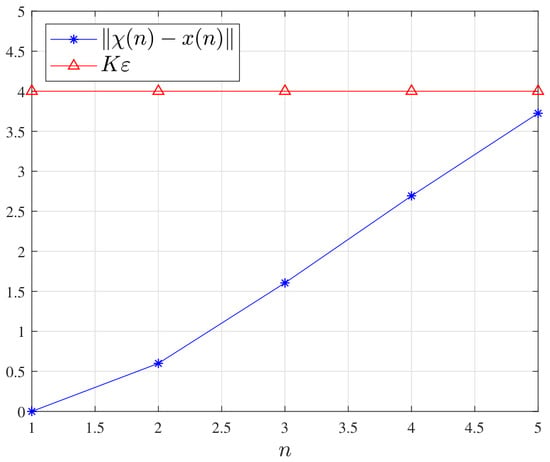
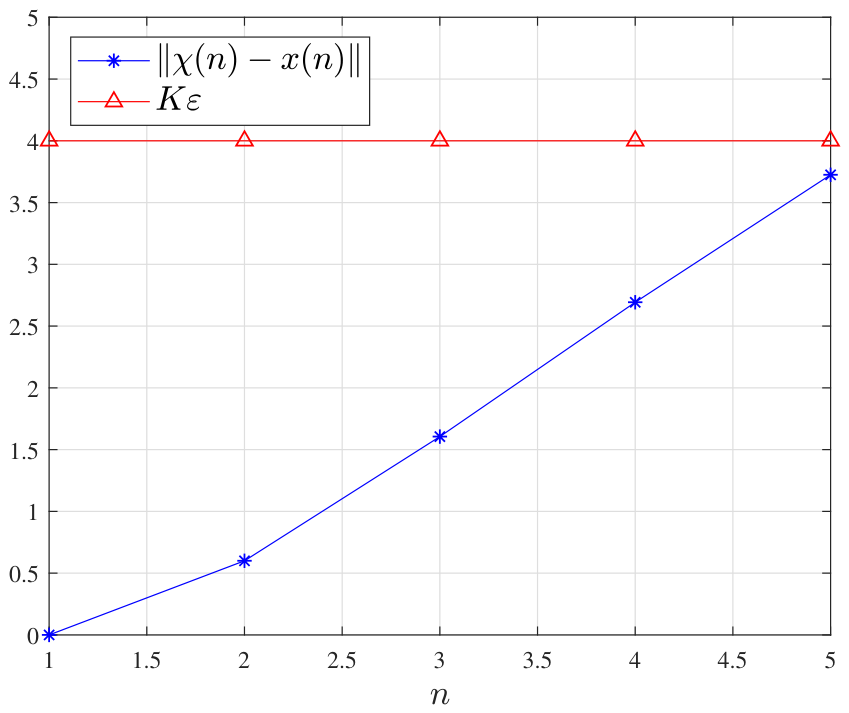
For , the values of are presented in Table 1.
Table 1.
Norm of the difference between approximate and exact solutions for Equation (12).
Figure 1 presents the dynamic response curves of the solution to Equation (12), clearly demonstrating that the considered delayed second-order discrete matrix equation satisfies Hyers–Ulam stability under the selected parameter values.
Figure 1.
State trajectory of the delayed discrete matrix system verifying the Hyers–Ulam stability.
Example 2.
Set . We now examine the following second-order linear discrete delayed matrix difference equation:
with inequality
and
where , , , , , .
If a matrix function satisfies (18), then in light of Remark 2, there exists a matrix function such that , and
Furthermore, the solution of Equation (19) is given by
Let , and define a matrix function by
it is clear that
Consequently, we obtain
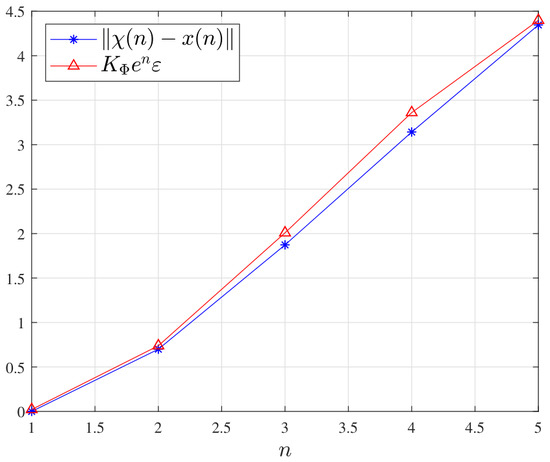
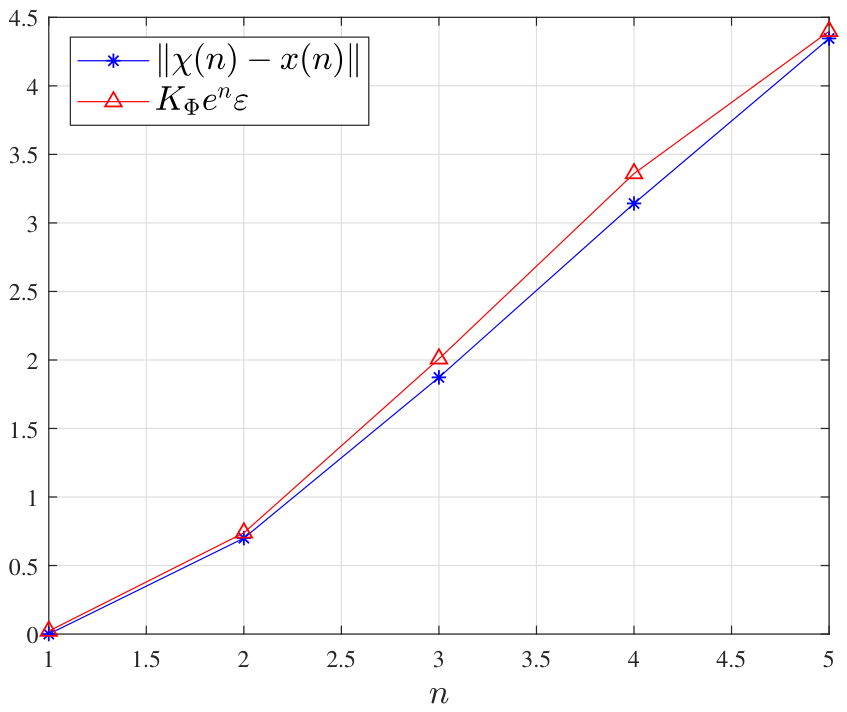
for , the values of are presented in Table 2.
Table 2.
Norm of the difference between approximate and exact solutions for Equation (16).
Figure 2 presents the dynamic response curves of the solution to Equation (16), clearly demonstrating that the considered delayed second-order discrete matrix equation satisfies Hyers–Ulam–Rassias stability under the selected parameter values.
Figure 2.
State trajectory of the delayed discrete matrix system verifying the Hyers–Ulam–Rassias stability.
5. Conclusions
In this paper, we rigorously established the HUs and HURs of second-order delayed discrete matrix equations by systematically leveraging the newly constructed DDMFs along with their corresponding bounded estimation techniques under well-defined regularity conditions. Furthermore, we constructed and developed a novel, unified methodological framework tailored specifically for theoretically analyzing and verifying the Hyers–Ulam stability of such second-order delay-involved discrete matrix equations, which provides structured analytical procedures and verifiable criteria for stability assessments of the targeted equation class. Notably, this present work marks the first pioneering endeavor to adopt the proposed discrete delayed matrix functions as core analytical tools to rigorously establish Ulam-type stability, comprehensively covering both classic Hyers–Ulam stability and generalized Hyers–Ulam–Rassias stability, within the research scope of second-order delayed discrete matrix equations, thereby filling the existing research gap in the application of DDMFs for Ulam stability of second-order discrete matrix systems with delay effects. Overall, the specific discrete delayed matrix functions introduced and utilized throughout this study are not only effectively applied to conduct quantitative stability analysis for the discussed second-order delayed discrete matrix equations but also further generalized to accommodate broader discrete delay-driven matrix equation structures. Beyond the immediate stability results derived herein, this innovative methodological approach opens up promising theoretical avenues and feasible research directions for future in-depth investigations into higher-order delayed discrete matrix equations, as well as more complex discrete matrix system problems incorporating multiple time delays, variable delays, or coupled delay structures, laying a solid analytical foundation for subsequent extended stability studies in discrete matrix dynamical systems with delay characteristics.
Author Contributions
All authors contributed equally and significantly in writing this paper and contributed to the study conception and design. The first draft of the manuscript was written by M.Y. and G.X. commented on previous versions of the manuscript. Y.L.: writing and editing, part of the proofreading. A.D. carried out numerical simulation work. All authors have read and agreed to the published version of the manuscript.
Funding
This work is partially supported by the National Natural Science Foundation of China under grant No. 12401194, Guizhou Provincial Science and Technology Projects under grant No. QianKeHe Basic-MS[2025]672, QianKeHe Basic-[2024]Youth 161, Guizhou Open University Intelligent Control and Applications Research Team No. 2024KYTD06 and Guizhou Open University Scientific Research Projects No. 2025ZD02, and the Youth Science and Technology Talent Support Project of Guizhou Association for Science and Technology under grant No. GASTYESS202508.
Data Availability Statement
Data are contained within the article.
Acknowledgments
The We sincerely appreciate the guidance and valuable suggestions provided by the editor and reviewers, which have greatly improved the quality of our manuscript.
Conflicts of Interest
The authors declare no conflict of interest.
References
- Ulam, S. Problems in Modern Mathematics; Science Editions; J. Wiley and Sons Inc.: New York, NY, USA, 1964. [Google Scholar]
- Hyers, D. On the stability of the linear functional equations. Proc. Nat. Acad. Sci. USA 1941, 27, 222–224. [Google Scholar] [CrossRef] [Scilit] [PubMed]
- Rassias, T. On the stability of the linear mapping in Banach spaces. Proc. Amer. Math. Soc. 1978, 72, 297–300. [Google Scholar] [CrossRef]
- Popa, D. Hyers-Ulam-Rassias stability of a linear recurrence. J. Math. Anal. Appl. 2005, 309, 591–597. [Google Scholar] [CrossRef] [Scilit]
- Popa, D. Hyers-Ulam stability of the linear recurrence with constant coefficients. Adv. Differ. Equ. 2005, 2005, 407076. [Google Scholar] [CrossRef] [Scilit]
- Jung, S. Hyers-Ulam stability of the first order matrix difference equations. Adv. Differ. Equ. 2015, 2015, 170. [Google Scholar] [CrossRef] [Scilit]
- Khan, A.; Rahmat, G.; Zada, A. On uniform exponential stability and exact admissibility of discrete semigroups. Int. J. Differ. Equ. 2013, 2013, 268309. [Google Scholar] [CrossRef] [Scilit]
- Tripathy, A. Hyers-Ulam stability of second order linear difference equations. Int. J. Diff. Equ. Appl. 2017, 16, 53–65. [Google Scholar]
- Shen, Y.; Li, Y. The z-transform method for the Ulam stability of linear difference equations with constant coeffcients. Adv. Differ. Equ. 2018, 2018, 396. [Google Scholar] [CrossRef] [Scilit]
- Baias, A.; Popa, D. On Ulam stability of a linear difference equation in Banach spaces. Bull. Malays. Math. Sci. Soc. 2020, 43, 1357–1371. [Google Scholar]
- Dragičević, D. On the Hyers-Ulam stability of certain nonautonomous and nonlinear difference equations. Aequationes Math. 2021, 95, 829–840. [Google Scholar] [CrossRef] [Scilit]
- Anderson, D.; Onitsuka, M. Best constant for Hyers-Ulam stability of second-order h-difference equations with constant coefficients. Results Math. 2019, 74, 151. [Google Scholar] [CrossRef] [Scilit]
- Anderson, D.; Onitsuka, M. Hyers-Ulam stability and best constant for Cayley h-difference equations. Bull. Malays. Math. Sci. Soc. 2020, 43, 4207–4222. [Google Scholar] [CrossRef] [Scilit]
- Anderson, D.; Onitsuka, M. Hyers-Ulam stability for quantum equations of Euler type. Discret. Dyn. Nat. Soc. 2020, 2020, 5626481. [Google Scholar] [CrossRef] [Scilit]
- Baias, A.; Blaga, F.; Popa, D. Best Ulam constant for a linear difference equation. Carpathian J. Math. 2019, 35, 13–22. [Google Scholar] [CrossRef] [Scilit]
- Jung, M.; Nam, W. Hyers-Ulam stability of Pielou logistic difference equation. J. Nonlinear Sci. Appl. 2017, 10, 3115–3122. [Google Scholar] [CrossRef] [Scilit]
- Nam, W. Hyers-Ulam stability of hyperbolic Möbius difference equation. Filomat 2018, 32, 4555–4575. [Google Scholar] [CrossRef] [Scilit]
- Nam, W. Hyers-Ulam stability of elliptic Möbius difference equation. Cogent Math. Stat. 2018, 5, 1492338. [Google Scholar] [CrossRef] [Scilit]
- Nam, W. Hyers-Ulam stability of loxodromic Möbius difference equation. Appl. Math. Comput. 2019, 356, 119–136. [Google Scholar] [CrossRef] [Scilit]
- Zhai, X.; Wang, J. Existence and Ulam’s type stability results for the first order time-delay Hahn difference systems. J. Appl. Math. Comput. 2026, 72, 64. [Google Scholar] [CrossRef] [Scilit]
- Khusainov, D.; Shuklin, G. Linear autonomous time-delay system with permutation matrices solving. Stud. Univ. Zilina Math. Ser. 2003, 17, 101–108. [Google Scholar]
- Diblík, J.; Khusainov, D. Representation of solutions of discrete delayed system x(k + 1) = Ax(k) + Bx(k − m) + f(k). J. Math. Anal. Appl. 2006, 318, 63–76. [Google Scholar]
- Diblík, J. Representation of solutions of linear discrete systems with constant coefficients and with delays. Opusc. Math. 2025, 45, 145–177. [Google Scholar] [CrossRef] [Scilit]
- Diblík, J. Exponential stability of linear discrete systems with nonconstant matrices and nonconstant delay. AIP Conf. Proc. 2017, 1863, 480003-1–480003-4. [Google Scholar] [CrossRef] [Scilit]
- Diblík, J.; Khusainov, D.; Růžičková, M. Exponential stability of linear discrete systems with delay. In AIP Conference Proceedings; AIP Publishing: Melville, NY, USA, 1978; pp. 430004-1–430004-4. [Google Scholar]
- Baštinec, J.; Diblík, J.; Khusainov, D. Stability of linear discrete systems with variable delays. In AIP Conference Proceedings; AIP Publishing: Melville, NY, USA, 1978; pp. 430005-1–430005-4. [Google Scholar]
- Yang, M.; Fečkan, M.; Wang, J. Ulam’s Type Stability of delayed discrete system with second-order differences. Qual. Theory Dyn. Syst. 2024, 23, 11. [Google Scholar] [CrossRef] [Scilit]
- Yang, M.; Fečkan, M.; Wang, J. Relative controllability for delayed linear discrete system with second-order differences. Qual. Theory Dyn. Syst. 2022, 21, 113. [Google Scholar] [CrossRef] [Scilit]
- Yang, M.; Fečkan, M.; Wang, J. Solution to delayed linear discrete system with constant coefficients and second-order differences and application to iterative learning control. Int. J. Adapt. Control Signal Process. 2024, 38, 677–695. [Google Scholar] [CrossRef] [Scilit]
- Yang, M.; Fečkan, M.; Wang, J. Trajectory controllability for delayed linear discrete systems with second-order differences. Qual. Theory Dyn. Syst. 2025, 24, 123. [Google Scholar] [CrossRef] [Scilit]
- Diblík, J.; Khusainov, D.; Růžičková, M. Controllability of linear discrete systems with constant coefficients and pure delay. SIAM J. Control Optim. 2008, 47, 1140–1149. [Google Scholar] [CrossRef] [Scilit]
- Diblík, J.; Fečkan, M.; Pospíśil, M. On the new control functions for linear discrete delay systems. SIAM J. Control Optim. 2014, 52, 1745–1760. [Google Scholar] [CrossRef] [Scilit]
- Diblík, J. Relative and trajectory controllability of linear discrete systems with constant coefficients and a single delay. IEEE Trans. Autom. Control 2019, 64, 2158–2165. [Google Scholar] [CrossRef] [Scilit]
- Diblík, J.; Mencáková, K. A note on relative controllability of higher order linear delayed discrete systems. IEEE Trans. Autom. Control 2020, 65, 5472–5479. [Google Scholar] [CrossRef] [Scilit]
- Mazanti, G. Relative controllability of linear difference equations. SIAM J. Control Optim. 2017, 55, 3132–3153. [Google Scholar] [CrossRef] [Scilit]
- Asadzade, J.; Mahmudov, N. Necessary and sufficient conditions for relative controllability of discrete linear delay systems. arXiv 2025, arXiv:2508.13336. [Google Scholar]
- Mahmudov, N.; Almatarneh, A. Stability of Ulam-Hyers and existence of solutions for impulsive time-delay semi-linear systems with non-permutable matrices. Mathematics 2020, 8, 1493. [Google Scholar] [CrossRef] [Scilit]
- Zada, A.; Pervaiz, B.; Alzabut, J.; Shah, S.O. Further results on Ulam stability for a system of first-order nonsingular delay differential equations. Demonstr. Math. 2020, 53, 225–235. [Google Scholar] [CrossRef] [Scilit]
- Rahmat, G.; Ullah, A.; Rahman, A.; Sarwar, M.; Abdeljawad, T.; Mukheimer, A. Hyers-Ulam stability of non-autonomous and nonsingular delay difference equations. Adv. Differ. Equ. 2021, 2021, 474. [Google Scholar] [CrossRef] [Scilit]
- Moonsuwan, S.; Rahmat, G.; Ullah, A.; Khan, M.Y.; Kamran; Shah, K. Hyers-Ulam stability, exponential stability, and relative controllability of non-singular delay difference equations. Complexity 2022, 2022, 8911621. [Google Scholar] [CrossRef] [Scilit]
- Zabarankin, M.; Grechuk, B. Matrix difference equations in applied mathematics. SIAM J. Appl. Math. 2020, 80, 753–771. [Google Scholar] [CrossRef] [Scilit]
- Ortega, F.; Barros, M. The Samuelson macroeconomic model as a singular linear matrix difference equation. J. Econ. Struct. 2020, 9, 36. [Google Scholar] [CrossRef] [Scilit]
- Diblík, J. Representation of solutions to a linear matrix discrete equation with single delay. Appl. Math. Lett. 2025, 168, 109577. [Google Scholar] [CrossRef] [Scilit]
- Diblík, J. Solution of a discrete matrix equation with second-order difference and single delay. Appl. Math. Comput. 2026, 508, 129607. [Google Scholar] [CrossRef] [Scilit]
- Chen, D.; Li, M. Hyers-Ulam stability and relative controllability of a linear matrix discrete system with single delay. J. Math. Phys. 2026, 67, 042709. [Google Scholar] [CrossRef] [Scilit]
- Elshenhab, A.M.; AlNemer, G.; Wang, X. Exact solutions and stability for first-order linear discrete matrix equations with multiple delays and non-permutable matrices. Mathematics 2026, 14, 1537. [Google Scholar] [CrossRef] [Scilit]
- Shankar, M.; Metzler, R.; Li, C. A survey on the Ulam-Hyers stability of fractional-order differential equations. J. Phys. A Math. Theor. 2025, 58, 453001. [Google Scholar] [CrossRef] [Scilit]

Disclaimer/Publisher’s Note: The statements, opinions and data contained in all publications are solely those of the individual author(s) and contributor(s) and not of MDPI and/or the editor(s). MDPI and/or the editor(s) disclaim responsibility for any injury to people or property resulting from any ideas, methods, instructions or products referred to in the content. |
© 2026 by the authors. Licensee MDPI, Basel, Switzerland. This article is an open access article distributed under the terms and conditions of the Creative Commons Attribution (CC BY) license.