


Abstract
This study examines graphs that demonstrate Gallai’s property, particularly those in which for every prescribed set S of vertices with there exists a longest path or cycle that avoids that set. Such graphs are naturally fault-tolerant in the structural sense: if some vertices fail, there can still exist longest routes that bypass the failed vertices. Our main purpose is to construct explicit Gallai-type graphs that admit embeddings into a rigorously defined three-dimensional geometric adjacency structure derived from an icosahedral–tetrahedral polyhedral cell complex. We show that similar graphs may be found in three-dimensional structures obtained from a periodic polyhedral packing (cell complex) built from tetrahedral and icosahedral cells. Importantly, we do not claim a face-to-face tessellation of by congruent regular icosahedra and tetrahedra; instead, we define a specific periodic cell complex and work in its associated adjacency graph . These geometric constructions expand lattice-based findings to a three-dimensional adjacency setting and provide new embeddings for Gallai-type graphs. Connections to AI systems are mentioned at the conceptual level.
1. Introduction
Does there exist a connected graph in which every vertex is avoided by some longest path or longest cycle? Gallai posed this question in the context of longest-path intersections [1]. Graphs that satisfy this property are said to have Gallai’s property, and they exhibit the striking behavior that longest paths or cycles do not necessarily share a common vertex.
Walther gave the first positive response by constructing a planar graph where no vertex lies on all longest paths [2]. Subsequent research aimed to reduce the size and clarify the structure of such graphs. Schmitz produced a smaller planar example, while smaller non-planar constructions were obtained independently by Walther and Zamfirescu [3,4,5]. These results established that Gallai-type avoidance can occur even under strong structural restrictions.
- Notation and formal definitions. Let G be a finite simple graph. A longest path in G is a path of maximum possible length among all paths in G; similarly a longest cycle is a cycle of maximum possible length among all cycles in G. For integers and , we use the standard terminology introduced by Zamfirescu:
- G is a -graph if G is k-connected, and for every set with , there exists a longest path P in G such that .
- G is a -graph if G is k-connected, and for every set with , there exists a longest cycle C in G such that .
Throughout the paper, the parameter j always refers to the number of avoided vertices, and k always refers to vertex connectivity.
Later, Zamfirescu generalised Gallai’s problem by strengthening both connectivity and avoidance requirements. He asked: For given integers k and j, do there exist k-connected graphs in which every set of j vertices is avoided by some longest path or cycle? Graphs satisfying these conditions are now known as - and -graphs [5,6].
More recently, Gallai-type graphs were investigated in geometric settings such as lattice graphs and surface embeddings [7,8,9,10]. Additional work studied highly nonconcurrent longest paths and cycles in regular spatial graphs [11,12].
The logical continuation of this body of work concerns Archimedean tilings and tessellations [13,14]. Gallai-type graphs in Archimedean tiling graphs were studied in [15,16,17] and related surface settings.
Here, we move beyond planar lattices and surface embeddings and study Gallai-type graphs in a three-dimensional geometric adjacency environment derived from an icosahedral–tetrahedral polyhedral cell complex. Our aim is constructive: we provide explicit graph families that are subgraphs (possibly after edge subdivision) of the adjacency graph defined in Section 2, and we compare their orders with the smallest known orders in triangular and hexagonal tilings. The motivation from fault tolerance is structural: longest routes can bypass failed nodes [10,18,19]. References to AI or distributed learning are included only as context and future directions; we do not claim algorithms, experiments, or performance advantages.
The remainder of the paper is organised as follows. In Section 2, we define the icosahedral–tetrahedral cell complex and its adjacency graph . Section 3 and Section 5 present explicit - and -constructions and their embeddings into . Section 7 discusses implications and limitations, and Section 8 concludes.
2. An Icosahedral–Tetrahedral Cell Complex and Its Adjacency Graph
There are five Platonic solids [20]. Among them, the cube tiles by translations, while regular tetrahedra and regular icosahedra do not tile individually [21].
2.1. The Cell Complex (Packing) and the Adjacency Graph
We do not assume or claim a face-to-face tessellation of by congruent regular icosahedra and tetrahedra, which is known to be impossible [20,21]. Instead, we work with a specific periodic polyhedral cell complex (packing) whose purpose is to provide a well-defined and repeatable local adjacency environment for graph embeddings.
2.2. Periodic Structure and Layers
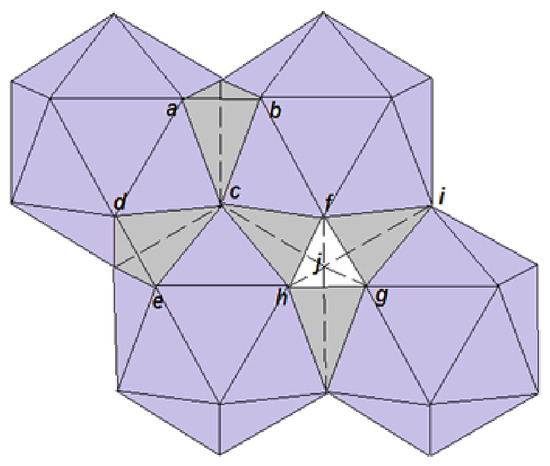
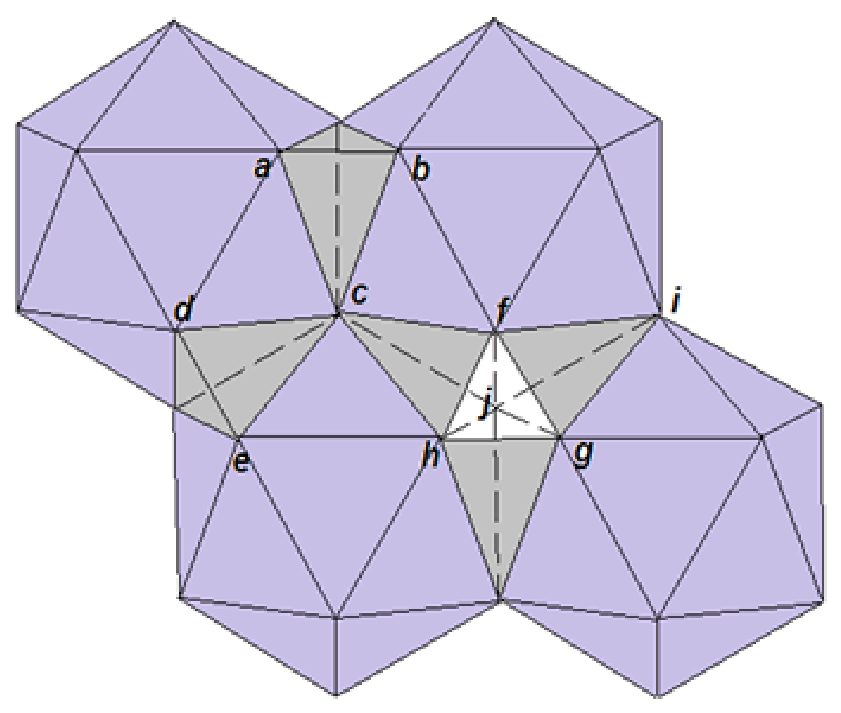
The complex is periodic under translations by a rank-three lattice . Geometrically, is organised into parallel layers orthogonal to one lattice direction. Each layer contains a regular arrangement of congruent icosahedral cells, while the inter-layer gaps are occupied by tetrahedral cells that stabilise the packing and mediate adjacency between neighbouring layers. A schematic layer structure is shown in Figure 1, and a portion of the resulting periodic packing is illustrated in Figure 2. Similar layered polyhedral packings are standard in the study of non-space-filling complexes and periodic nets [13].
Figure 1.
A layer-like arrangement of icosahedral cells with tetrahedral interstices (schematic).
Figure 2.
A periodic icosahedral–tetrahedral packing (cell complex) used to define .
2.3. Cells and Incidence
The three-cells of are of two combinatorial types: icosahedral cells and tetrahedral cells. Each tetrahedral cell is incident with exactly one triangular face of an icosahedral cell within the same layer or between adjacent layers. Tetrahedral cells may meet other tetrahedral cells along edges or vertices, but not along two-faces. No assumption is made that the icosahedra and tetrahedra are geometrically congruent across the complex; only their combinatorial face–edge–vertex incidences are fixed.
2.4. Combinatorial Interpretation of Face Adjacency
Throughout, is understood as an abstract polyhedral cell complex embedded in . When we say that two three-cells share a two-face, this means that they are incident with the same abstract triangular face of the complex. This notion of adjacency is combinatorial and does not require the two cells to be congruent or to meet face-to-face as regular solids in Euclidean geometry. Such combinatorial cell complexes are standard in topological and geometric graph theory [22,23].
- The adjacency graph . Let denote the set of three-cells (icosahedral or tetrahedral) of , and let denote the set of zero-faces (polyhedral vertices) of the complex. The associated adjacency graph is defined as follows. Its vertex set isEdges are added according to three rules:
- 1.
- A cell-vertex is adjacent to a polyhedral vertex whenever v is a vertex of the three-cell c;
- 2.
- Two cell-vertices are adjacent whenever the corresponding three-cells are incident with a common two-face of the abstract cell complex;
- 3.
- Two polyhedral vertices are adjacent whenever they form an edge of some three-cell in .
The resulting graph is locally finite and -periodic. It encodes exactly the local neighbourhood structure imposed by the packing and is the only aspect of used in our constructions.
- Embedding convention. A graph Gembeds into if there exists a graph obtained from G by subdividing edges such that is isomorphic to a subgraph of . Equivalently, G is homeomorphic to a subgraph of . All embedding statements in this paper are meant in this precise sense.
3. Embeddings of -Graphs (Longest Paths)
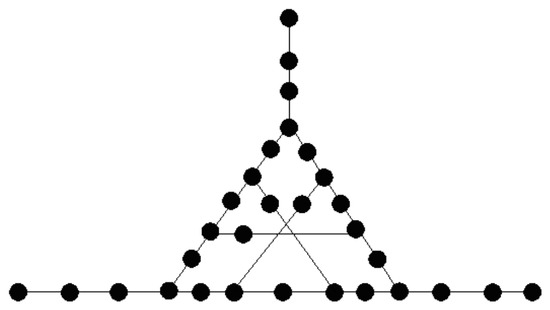
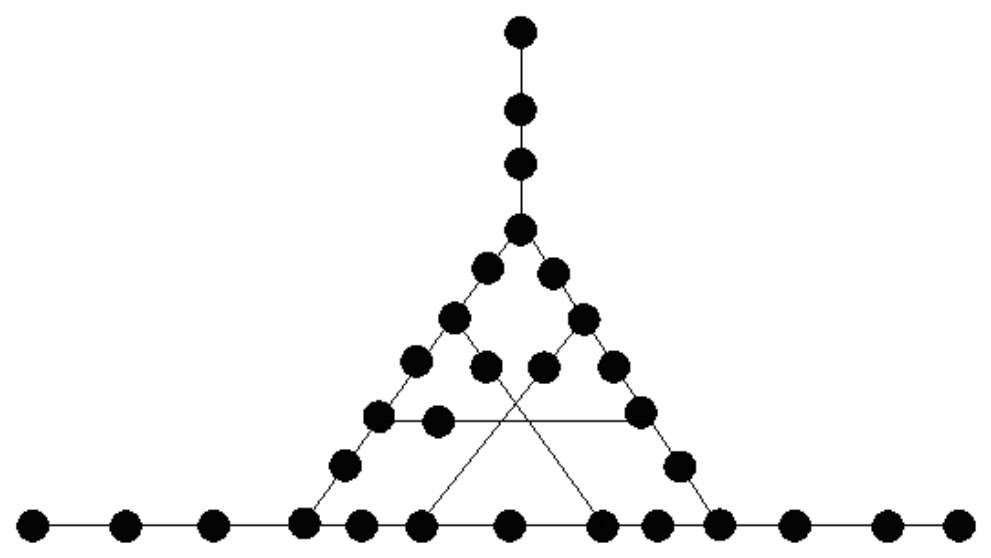
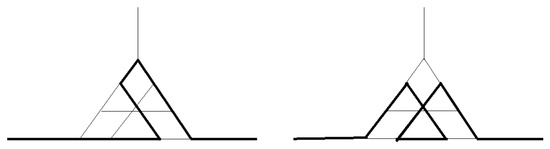
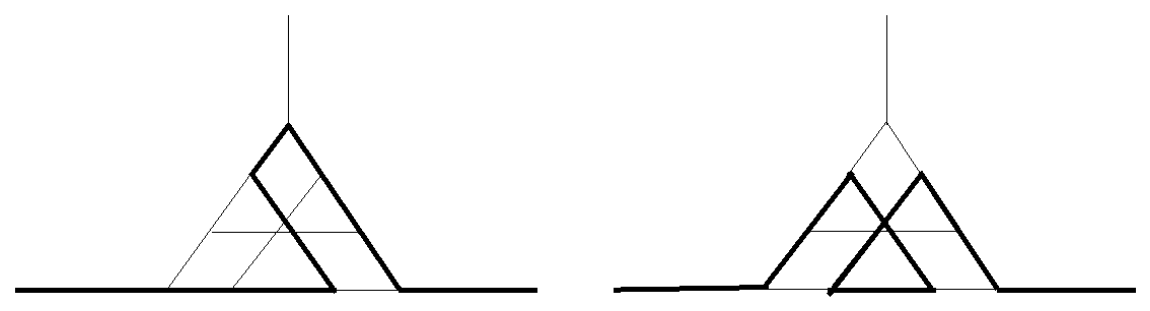
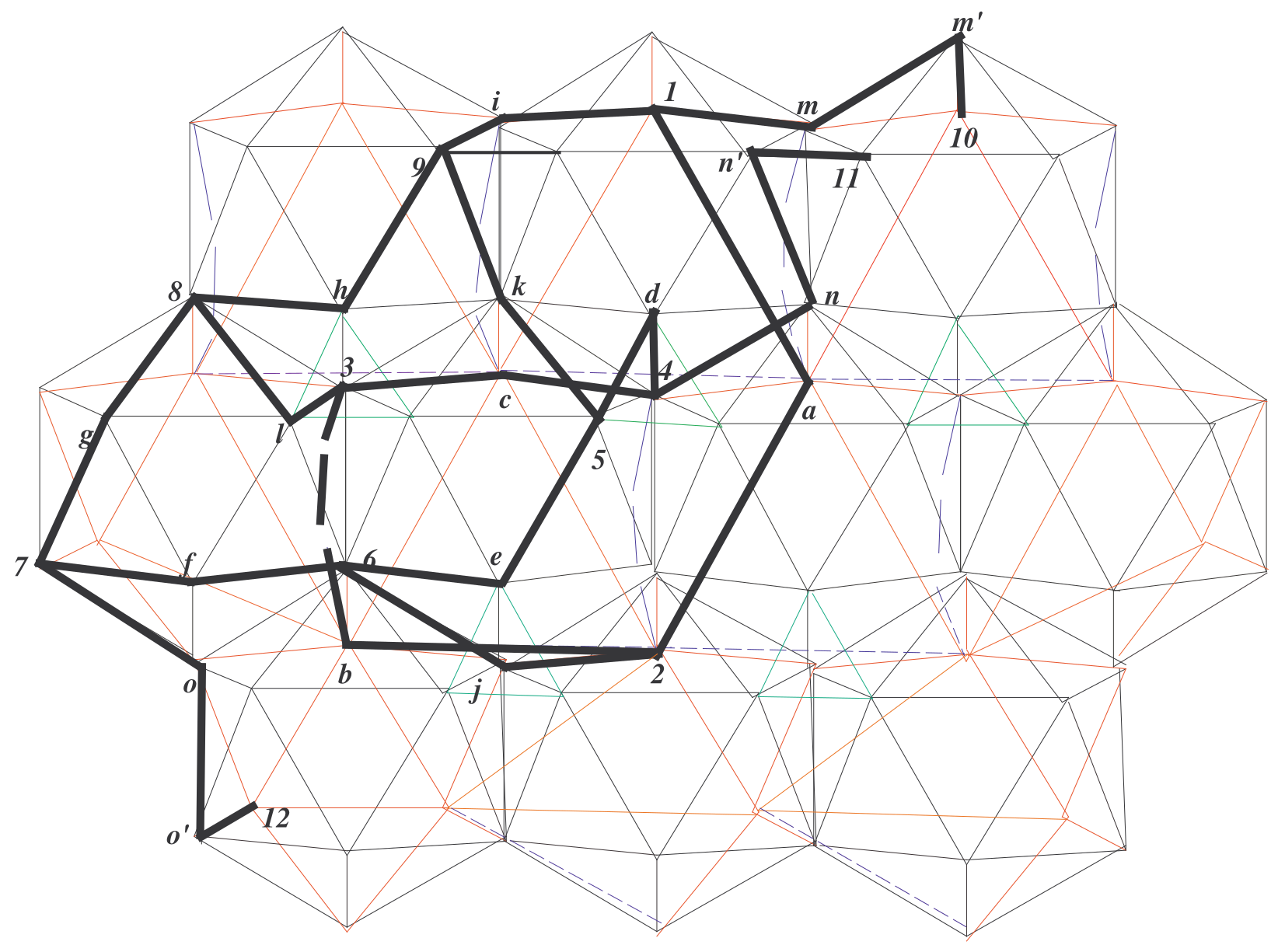
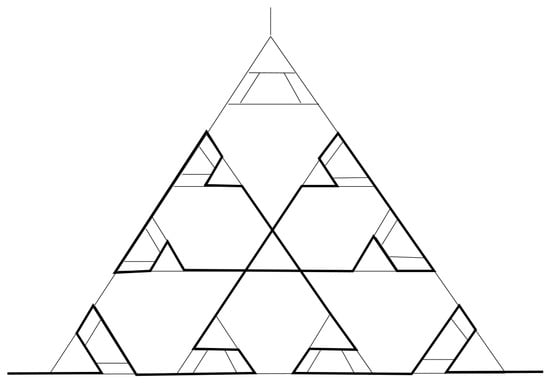
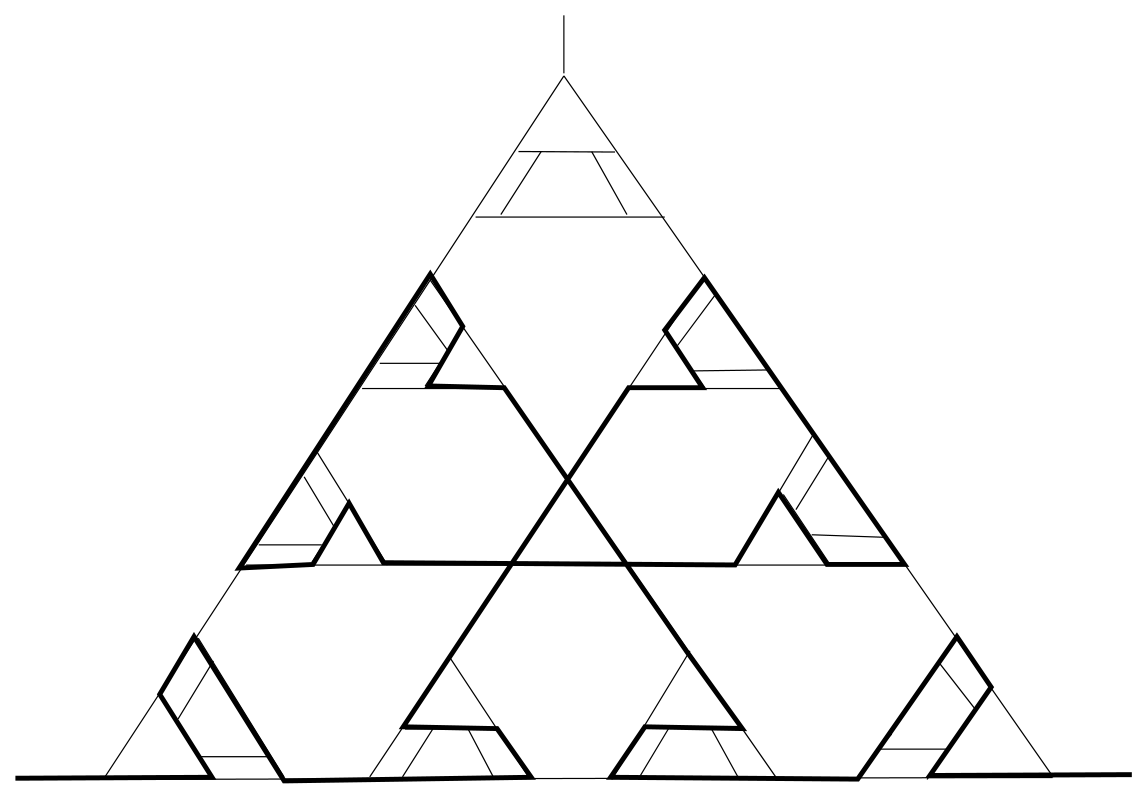
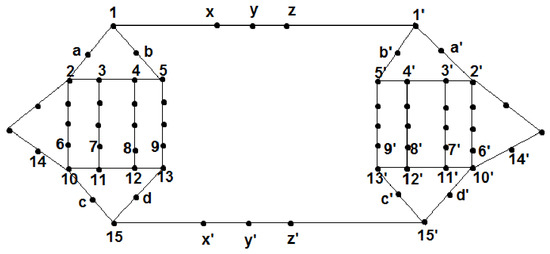
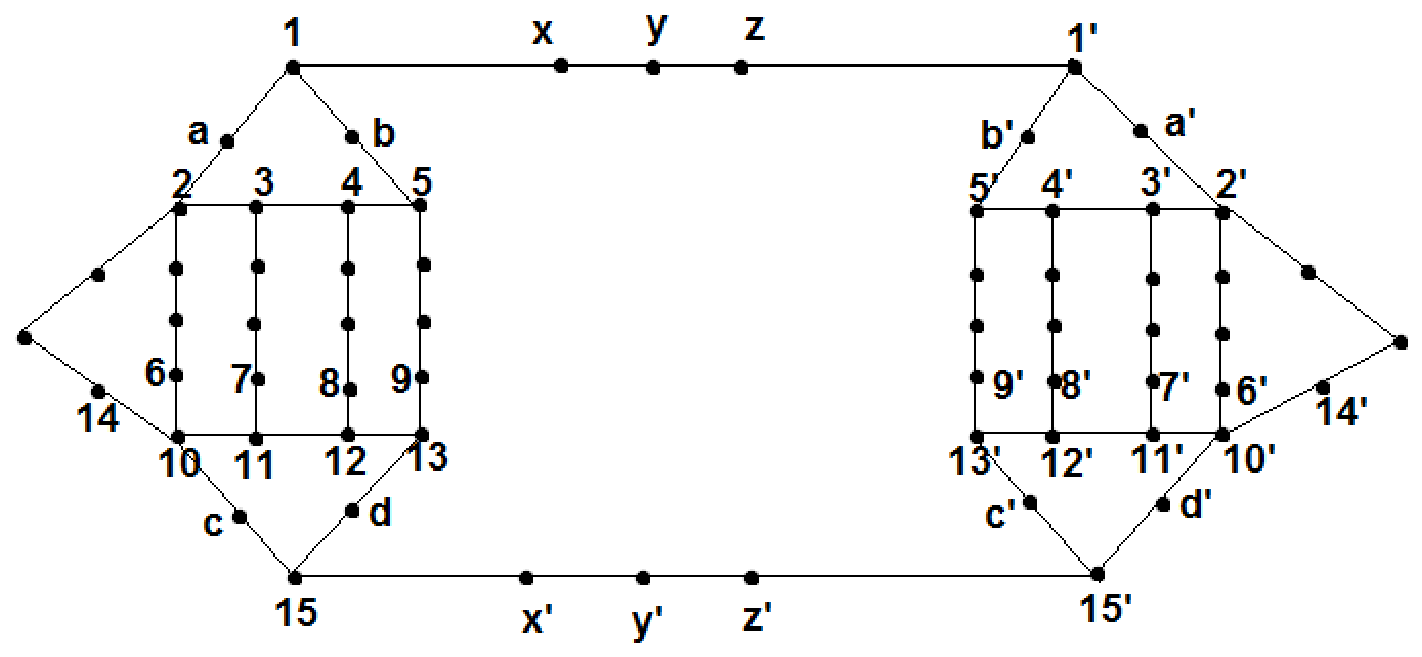
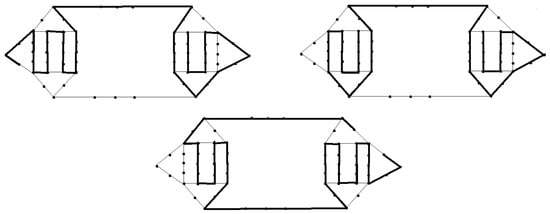
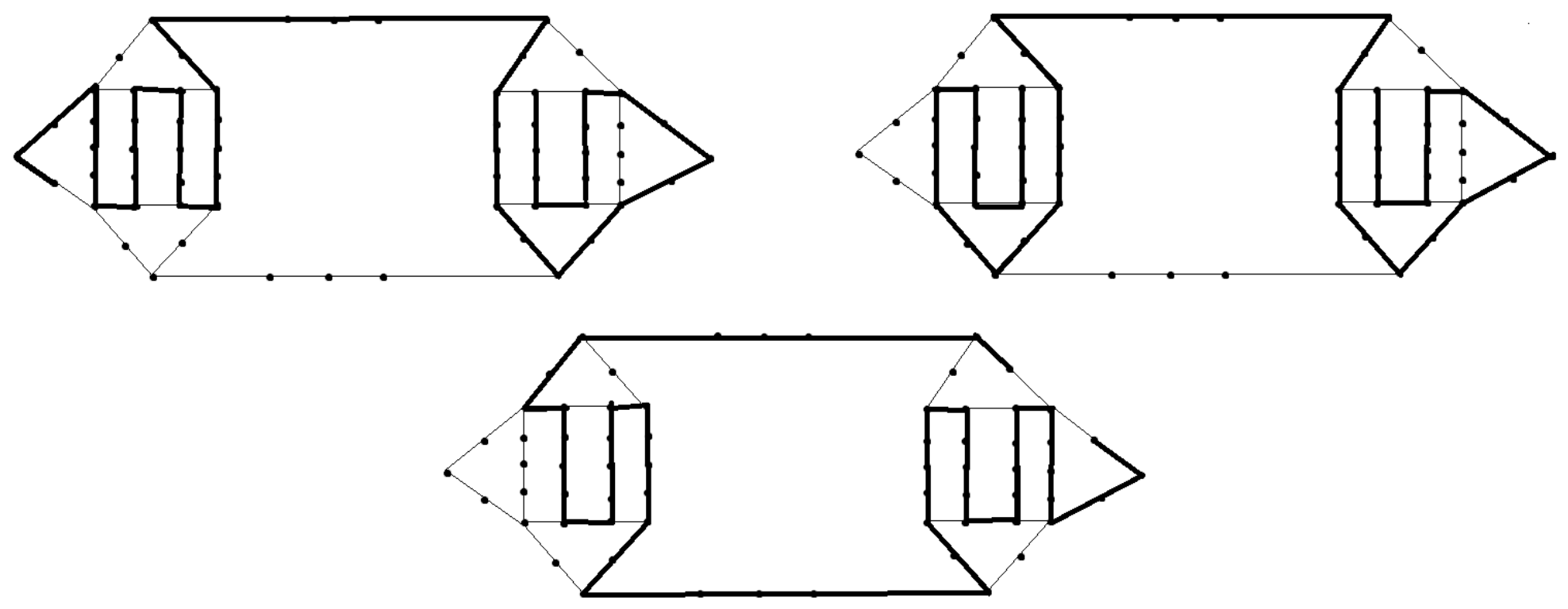
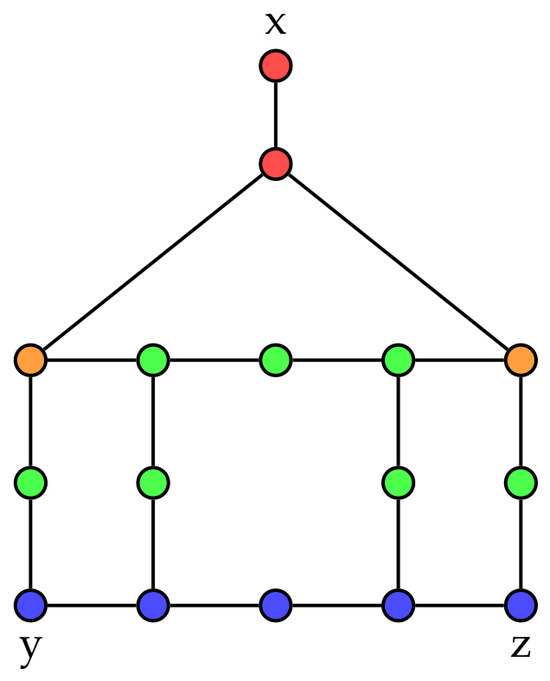
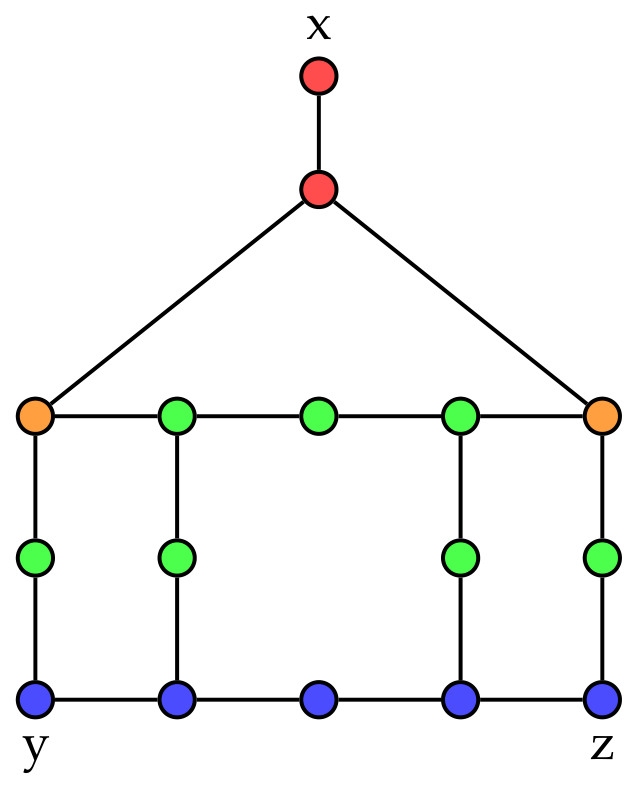
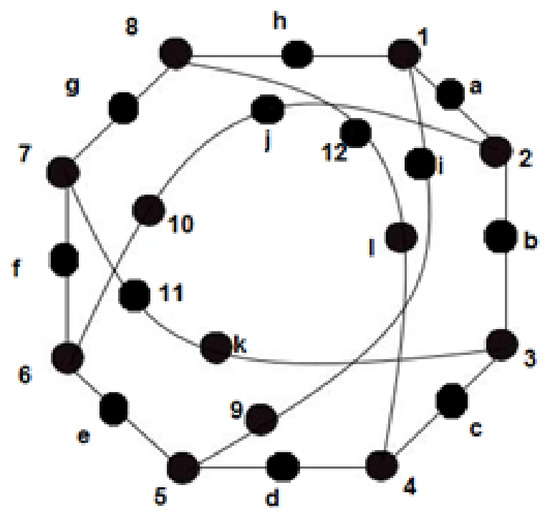
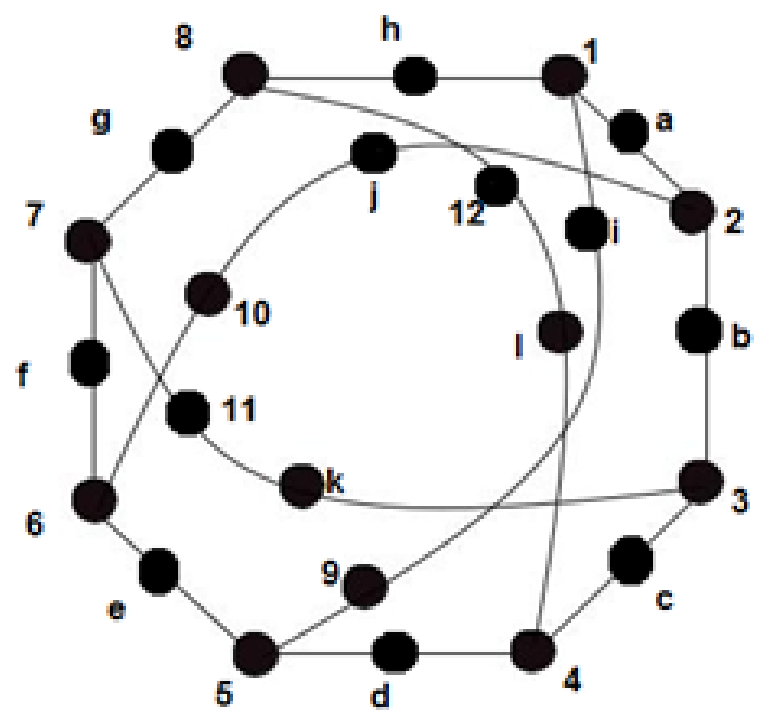
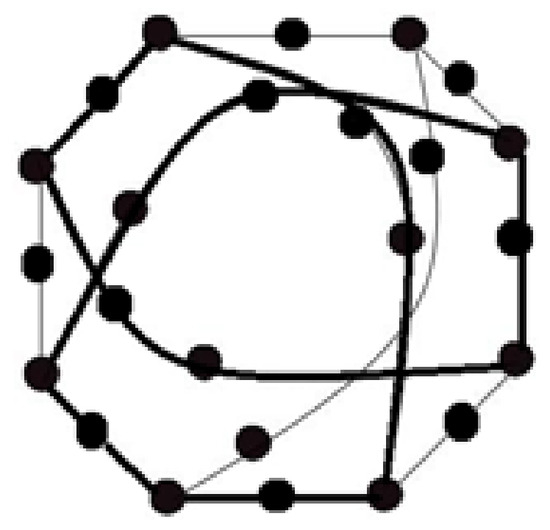
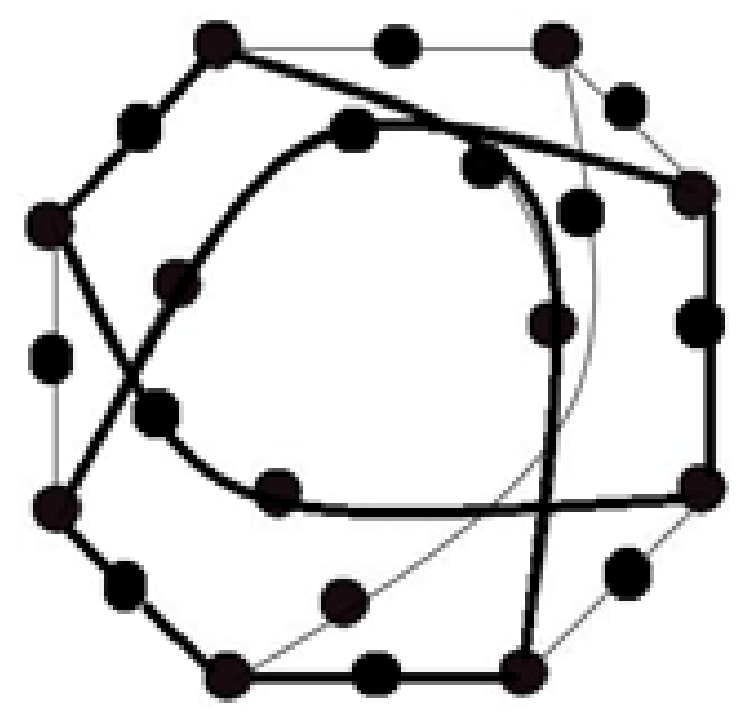
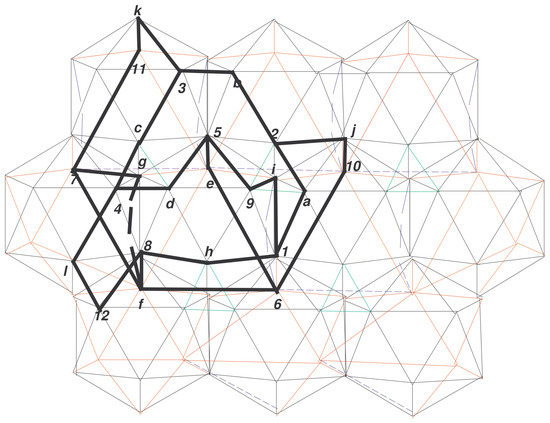
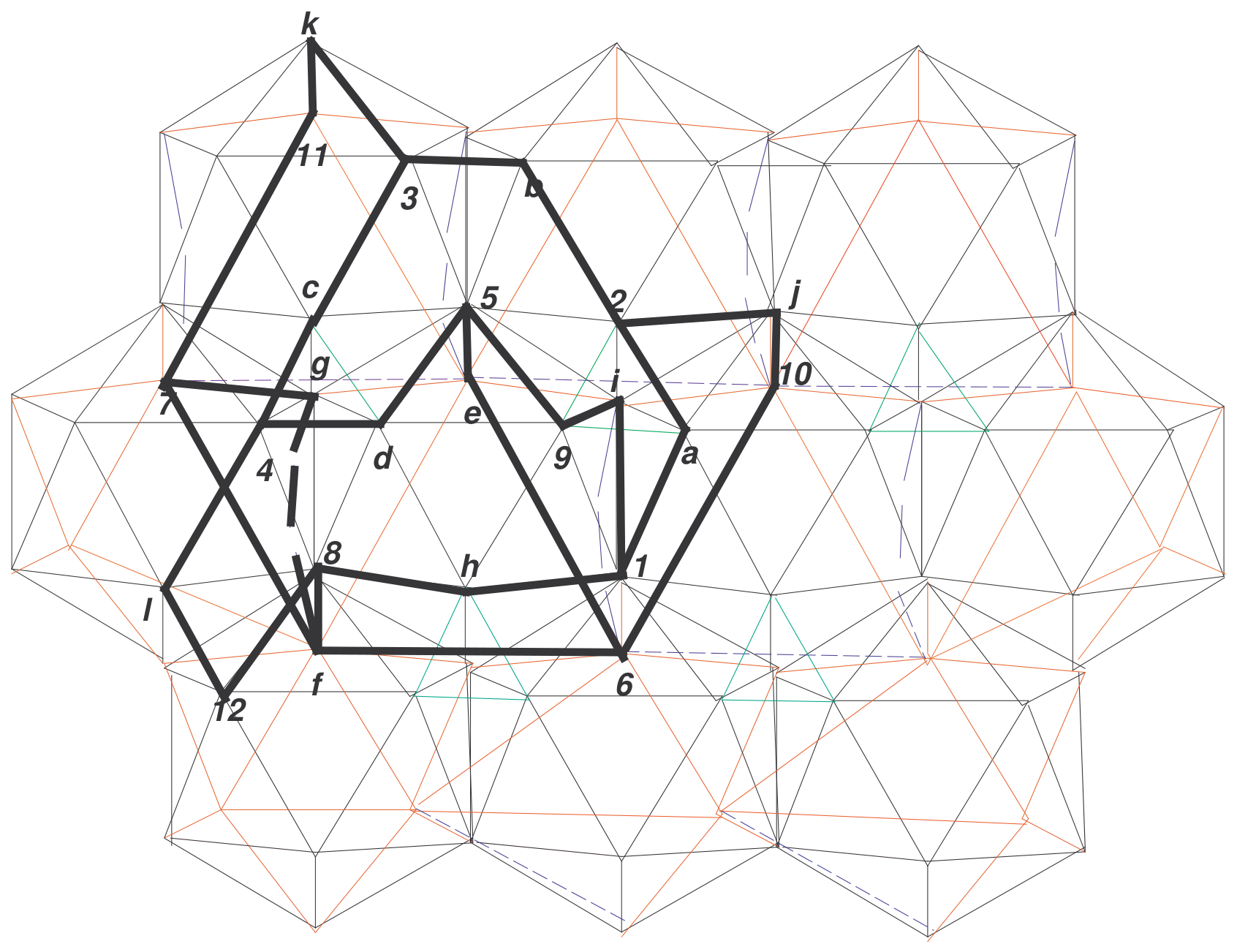
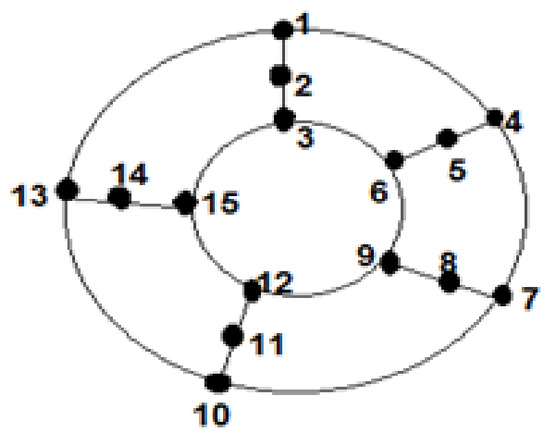
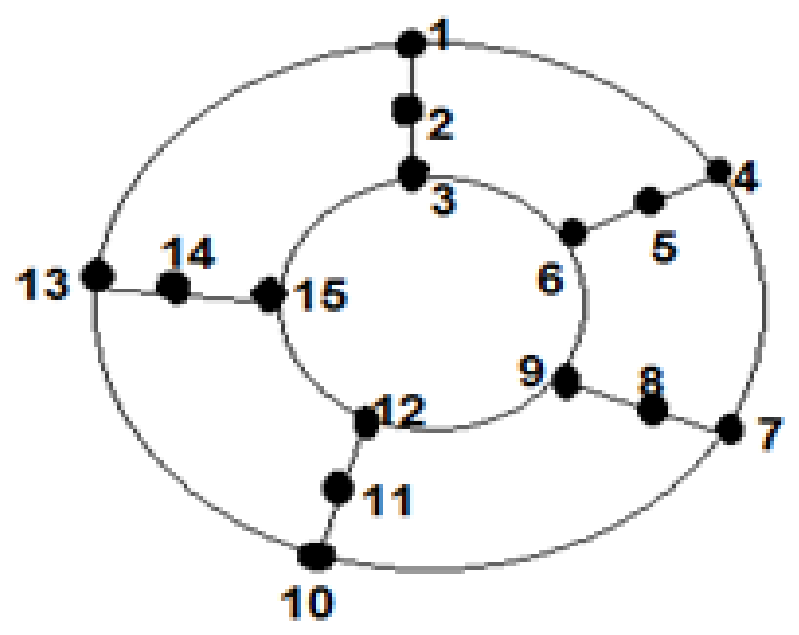
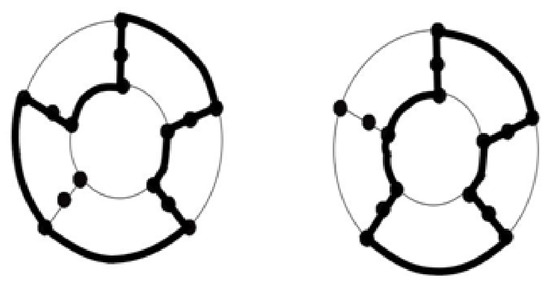
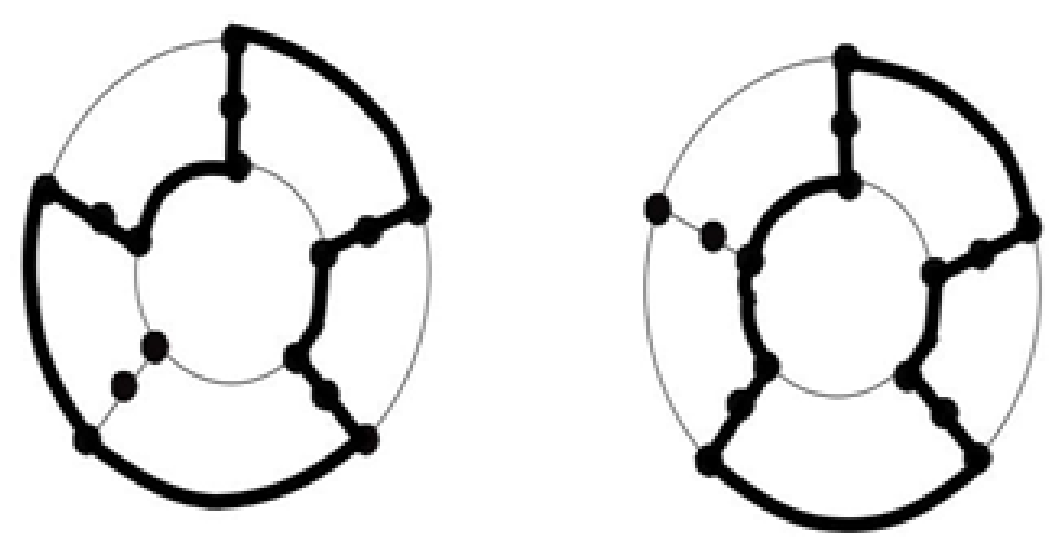
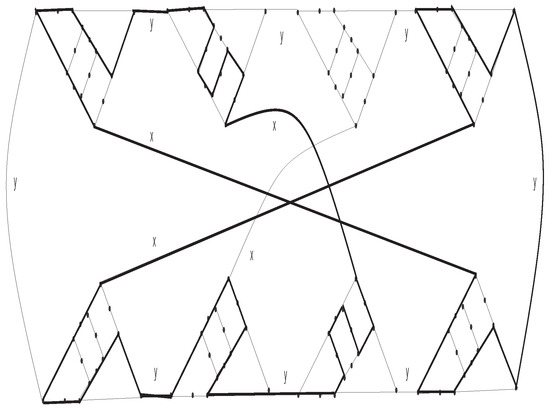
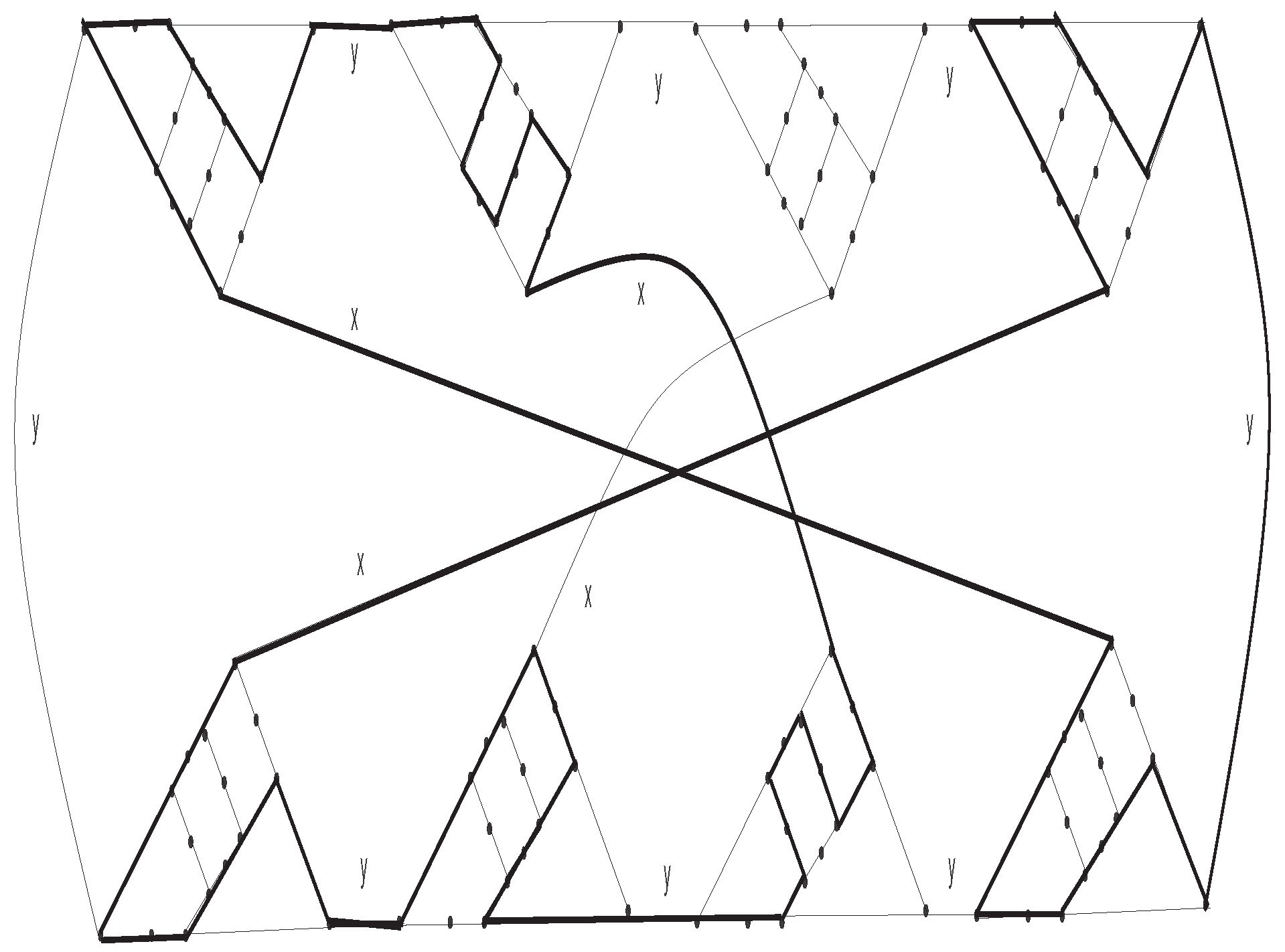
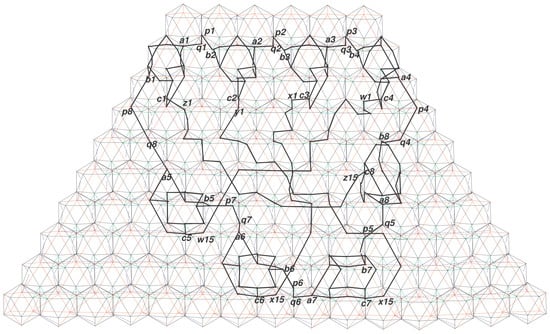
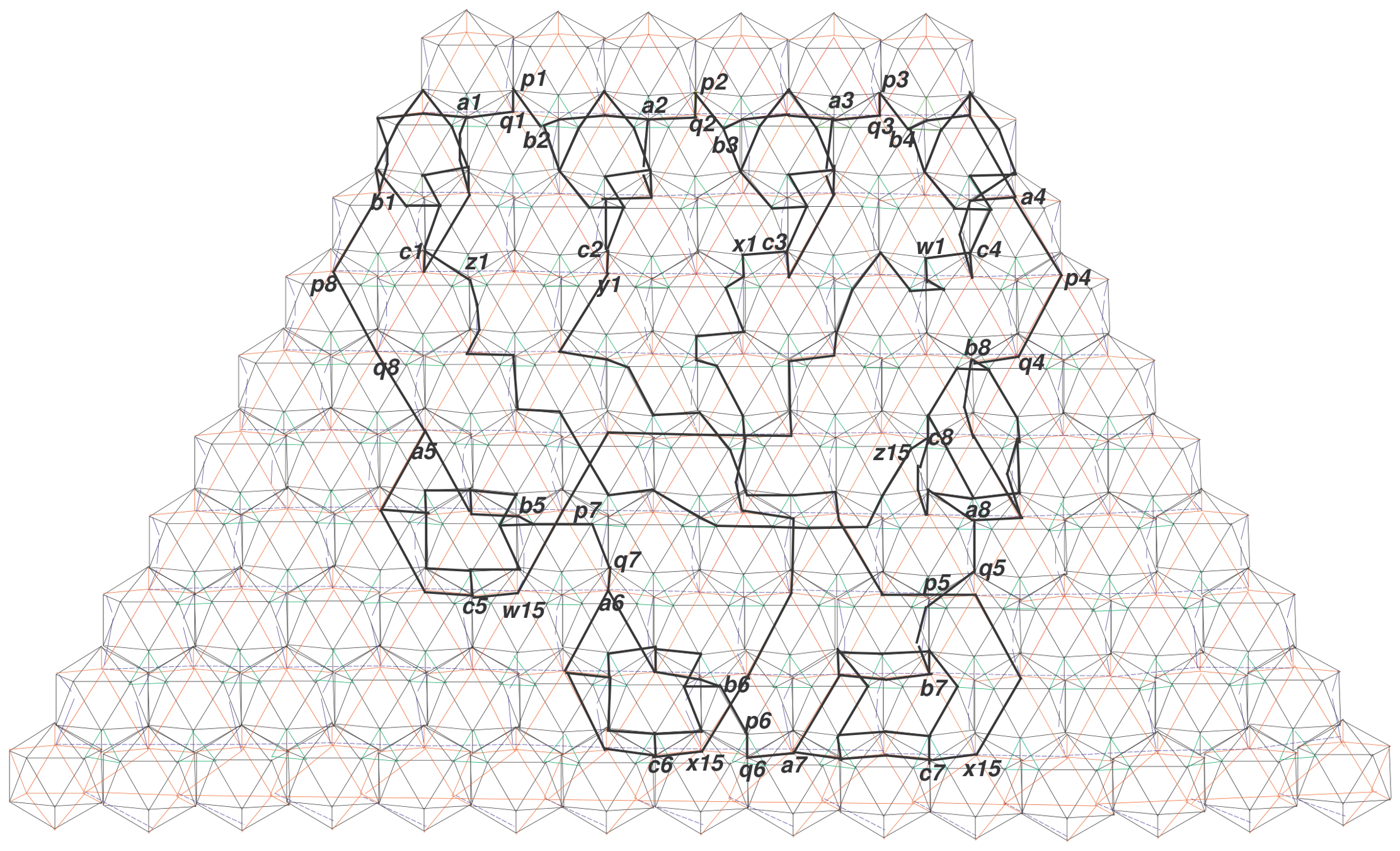
The smallest known non-planar graph satisfying Gallai’s property has order 12 [4,24]. However, our embedding framework requires compatibility with the local adjacency rules of . To increase geometric flexibility, we use a homeomorphic expansion of order 30 (Figure 3) that preserves the relevant longest-path avoidance structure (Figure 4 and Figure 5).
Figure 3.
A graph of order 30 obtained by a homeomorphic expansion of a 12-vertex non-planar Gallai-type example.
Figure 4.
A longest path in the graph of Figure 3 illustrating avoidance of a prescribed vertex.
Figure 5.
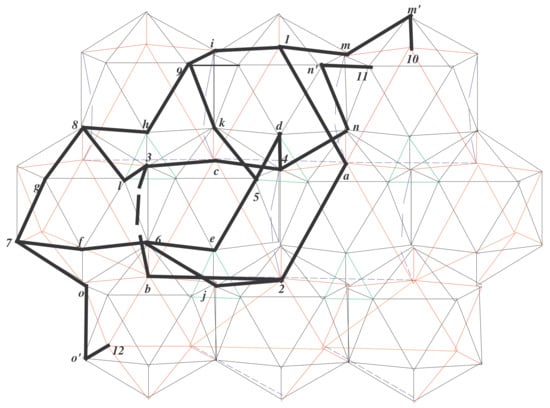
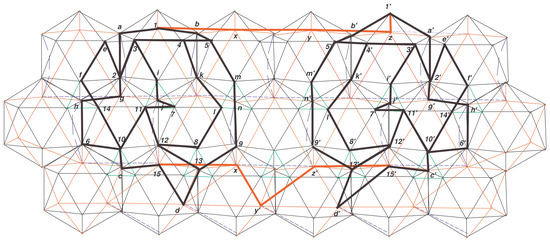
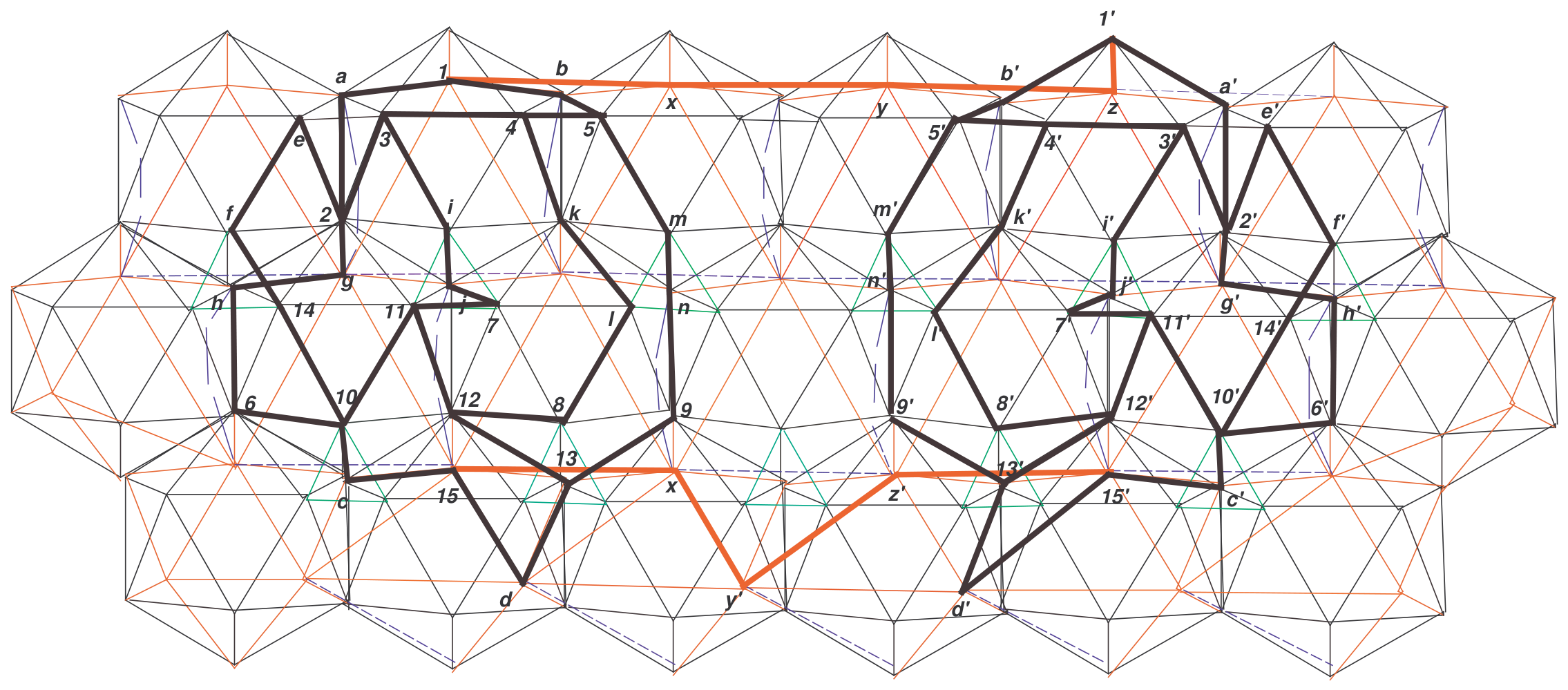
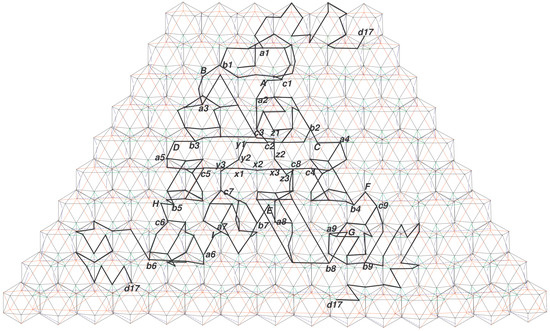
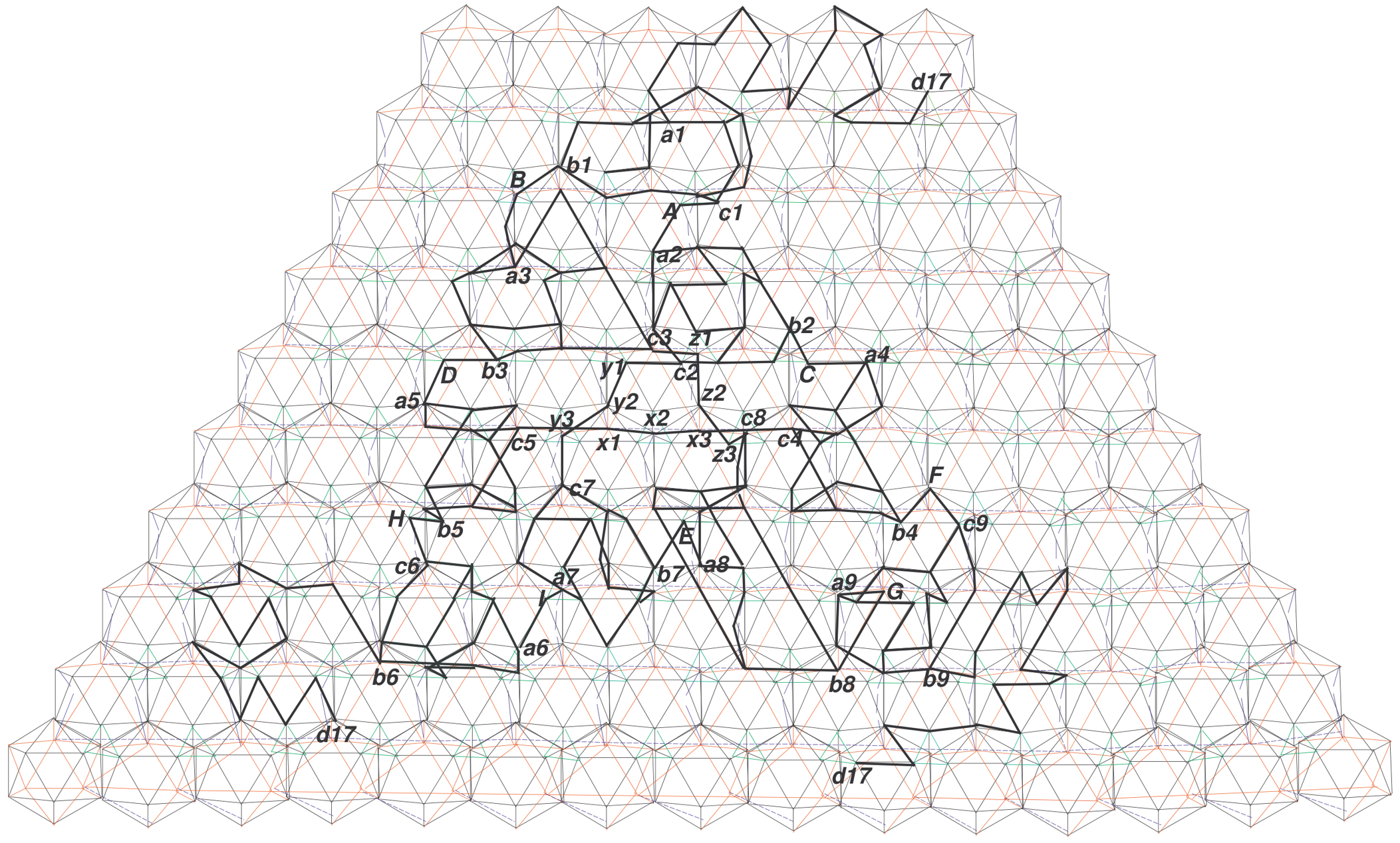
An embedding of a subdivision of the graph from Figure 3 into .
4. Material and Methods
4.1. Reproducible Construction Template
Our constructions follow a modular pipeline: (i) design a base block with controlled longest-path/longest-cycle structure; (ii) assemble blocks via a skeleton graph (vertex replacement); (iii) subdivide edges to satisfy geometric adjacency constraints in ; (iv) if needed, extend terminal edges to equalise competing longest-route lengths. We now state this as Algorithm 1.
| Algorithm 1 Gallai-type graph construction in |
|
4.2. A Planar Example of Order 17
Theorem 1.
There exists a planar -graph of order 17 that embeds (after subdivisions) into , in which every vertex is avoided by some longest path.
Proof.
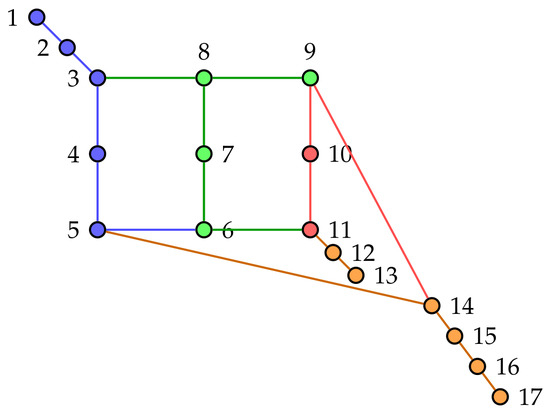
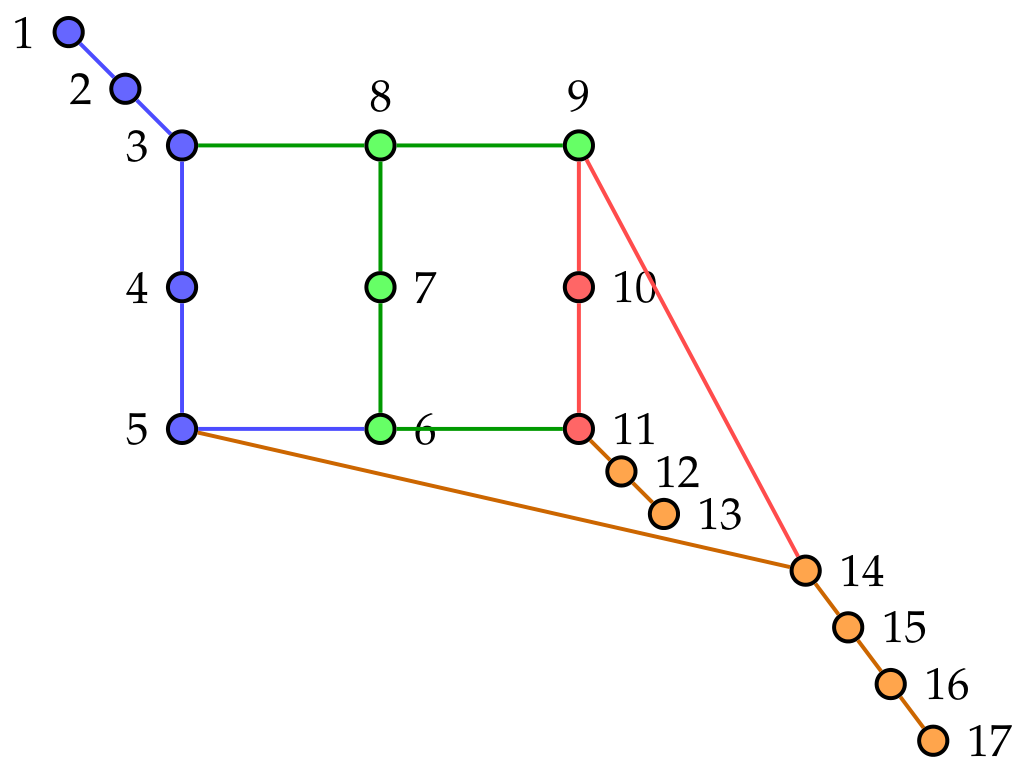
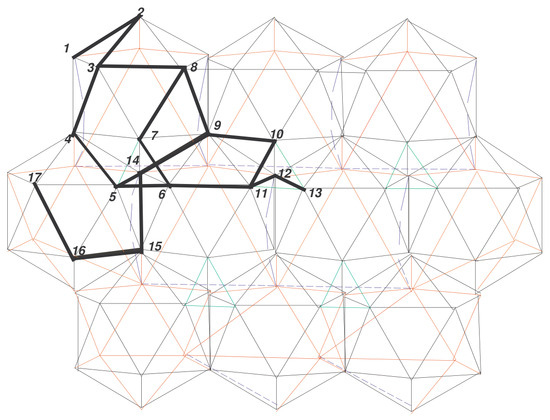
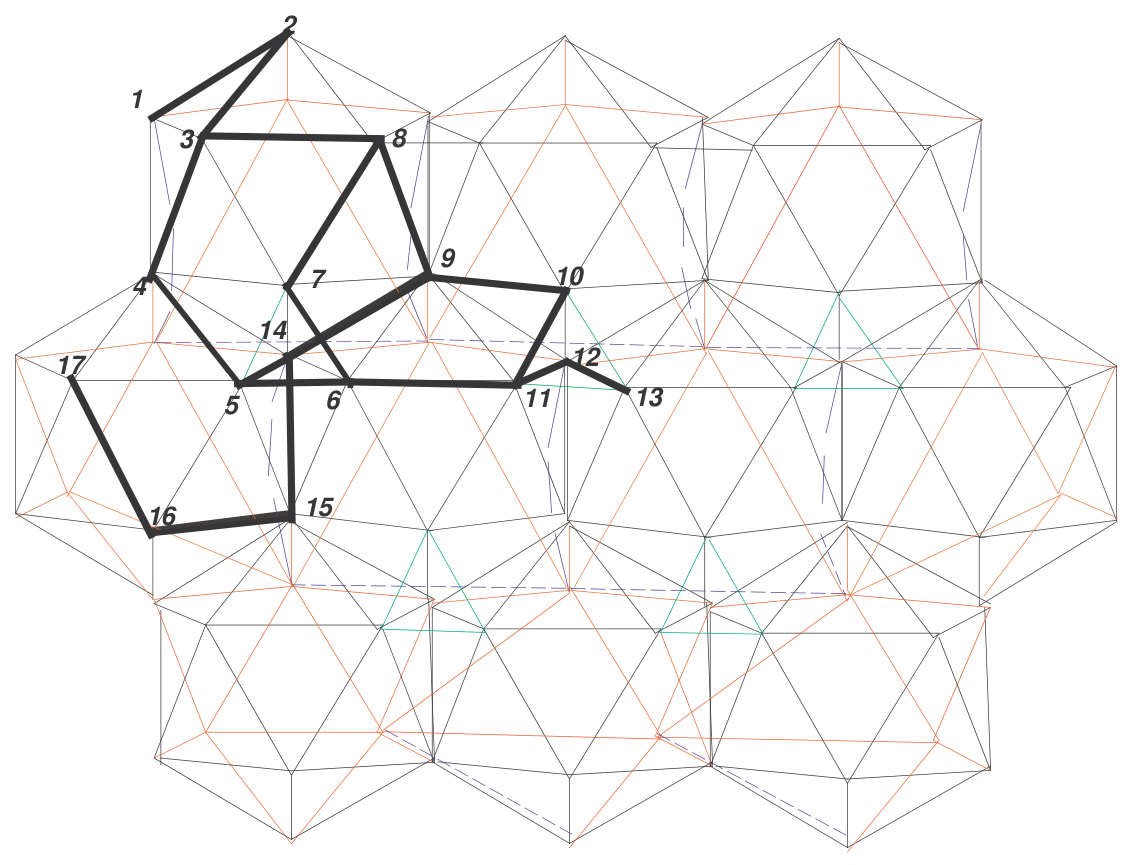
Consider the planar graph of order 17 shown in Figure 6.
Figure 6.
A planar graph of order 17 used in Theorem 1.
Vertices 1, 13, and 17 have degree one, hence at most two of them can appear in any single path (necessarily as endpoints). If a path uses vertex 13, then the subpath 11–12–13 in Figure 18; similarly, if it uses vertex 17, then the subpath 14–15–16–17 must occur at an endpoint. Thus, any path that uses both 13 and 17 must have endpoints 13 and 17 and must pass through vertices 11 and 14.
The vertices
form the central junction region of the graph (see Figure 6): vertex 11 connects the right part of the graph to the left part via 6 and to the upper part via 10, while vertex 14 connects to the left via 5 and to the upper via 9. A simple path cannot traverse both branches at 11 and both branches at 14 without repeating at least one vertex. Consequently, any path that includes both forced endpoint chains must exclude at least one additional branch, and in particular cannot include the entire left leaf branch containing vertex 1.
It follows that no simple path can contain more than 13 vertices (equivalently, more than 12 edges).
The following path has 13 vertices and 12 edges:
Hence, the upper bound is tight, and this path is a longest path of the graph.
- The property. Fix any vertex v. If v lies on one of the forced endpoint chains 11–12–13 or 14–15–16–17, choose a longest path whose endpoints lie on the other chain and the left branch, which avoids v. If v lies in the central junction region (with vertex 14 labelled as in Figure 6, adjacent to 5, 9, and 15), choose a longest path that is forced through the opposite junction vertex, thereby avoiding v (Figure 7). Thus, for every vertex v, there exists a longest path that avoids v.Figure 7. Illustrative longest path avoiding a prescribed vertex (figure used only as illustration, not as proof).
Finally, an embedding (after edge subdivisions if required by local adjacency) is shown in Figure 8, which demonstrates that a subdivision of this graph is a subgraph of . □
Figure 8.
Embedding of a subdivision of the order-17 graph into .
Lemma 1.
Let B be a finite graph with two designated attachment vertices (terminals) . Assume:
- 1.
- (Two equal corridors) There exist two internally vertex-disjoint s–t paths and in B with the same number of vertices, and every s–t path in B uses at most that many vertices.
- 2.
- (No profitable re-entry) In any supergraph formed by connecting copies of B through their terminals only, a simple global path/cycle can enter a given copy of B at most once.
Then, any simple global path (resp. cycle) that enters a copy of B through s and leaves through t uses at most vertices from that copy, with equality if and only if it uses one of the two corridors. Moreover, for any vertex v lying on exactly one corridor, switching to the other corridor preserves maximality while avoiding v; similarly, if a forbidden pair lies entirely on one corridor, switching to the other avoids the pair without reducing the contribution from that block.
Proof.
By assumption (1), the maximum number of vertices attainable by an s–t traversal inside B is , and the only traversals achieving this are the two corridors. Assumption (2) prevents a global simple route from increasing its length by leaving and re-entering the same copy. Therefore, the global maximum is obtained by taking a maximal corridor in each visited copy. Avoidance follows because corridor-switching changes only the internal subpath within the affected copy, keeps the same vertex contribution, and therefore preserves global maximality. □
4.3. A Planar Example of Order 64
Theorem 2.
There exists a planar -graph of order 64 that embeds (after subdivisions) into , in which every single vertex is avoided by some longest path.
Proof.
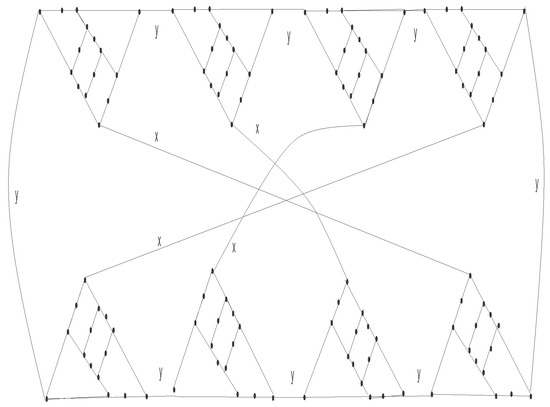
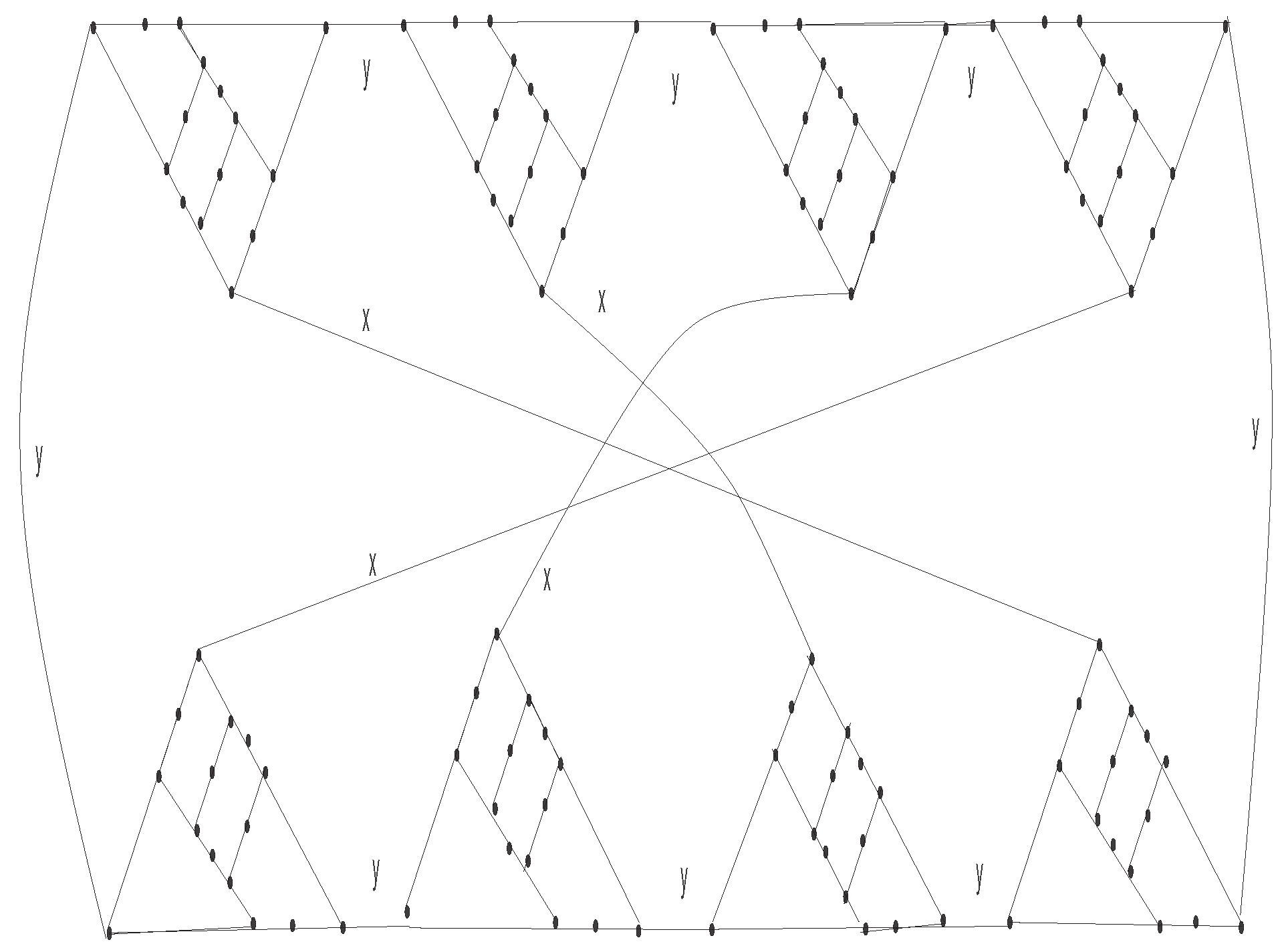
Consider the planar graph of order 64 shown in Figure 9.
Figure 9.
A planar graph of order 64 used for Theorem 2.
The graph is obtained by concatenating identical 2-connected blocks , each of order , along two attachment vertices on the left and right side of each block (as visible in Figure 9). Blocks are vertex-disjoint and are connected only by the inter-block attachment edges. Hence,
□
4.4. Per-Block Contribution and Longest-Path Length
Let be the left and right terminals of block (as labelled in Figure 9). Inside each block, there exist two internally vertex-disjoint – paths, and , each using exactly 15 vertices of , and no – path in can use more than 15 vertices (this is verified by inspection of the block: any – traversal must pass through a unique bottleneck edge, and the remaining vertices form two disjoint corridors of equal size). Also, a global simple path cannot enter the same block twice because the only contacts to the rest of the graph are through . Thus, Lemma 1 applies with per-block maximum 15.
Therefore, any global path has at most
vertices: it can use at most 15 vertices in each of the four blocks, and it uses three inter-block attachment edges to pass from to . A path achieving this bound is obtained by taking a maximal corridor in each block and traversing the blocks in order (an example is illustrated in Figure 10). Hence, the longest paths have 63 vertices.
Figure 10.
Illustrative longest path (used only as illustration).
Fix a vertex v and suppose (all other cases are symmetric). If v lies on corridor but not on corridor , we construct a longest path avoiding v as follows: take in , take in (this bypasses v), and take maximal corridors in and . By Lemma 1, switching to does not reduce the number of vertices obtained from (it remains 15), so the resulting global path still has 63 vertices and is longest. Thus, there exists a longest path avoiding v. Since the blocks and corridors are repeated copies, the same argument works for any v in any block, proving the property.
Finally, Figure 11 shows an embedding (after subdivisions if required) into .
Figure 11.
Embedding of a subdivision of the order-64 graph into .
4.5. Embeddings of Graphs in Which Every Pair of Vertices Is Avoided by Some Longest Path
We next construct a 2-connected graph in which every pair of vertices is avoided by some longest path, i.e., a -graph.
Theorem 3.
There exists a -graph of order 207 that embeds (after subdivisions) into , in which every pair of vertices is avoided by some longest path.
Proof.
We construct the graph using Algorithm 1 with base block G (Figure 12) and a fixed skeleton graph H defined as follows. The skeleton H is a finite 2-connected graph on 13 vertices, whose vertices are arranged along a simple cycle and augmented by additional chords so that between any two vertices of H, there exist at least two internally vertex-disjoint paths. Each vertex of H is replaced by a copy of the base block G, and each edge of H is realised by identifying or connecting the corresponding terminal vertices of the adjacent copies, as prescribed by Algorithm 1.
Figure 12.
Base block G (order 16) with terminals used in the construction.
Let the skeleton H in the construction have vertices, so we take 13 disjoint copies of the block G. As shown in the construction (see Figure 13), we connect successive blocks by identifying one terminal vertex per connection along the skeleton, producing identifications in total, and we introduce degree-2 connector vertices to realise the required attachment interfaces while preserving 2-connectivity. Therefore,
Figure 13.
Embedding of a subdivision of the final -graph of order 207 into .
Within each copy , consider traversals between the two terminals used by the skeleton attachments. By inspection of Figure 12, there are two internally vertex-disjoint maximal corridors between those terminals, each using exactly 14 vertices of , and no traversal between the same terminal pair can use more than 14 vertices (any longer route would require revisiting the central degree-3 vertex beneath x or revisiting the bottom chain). Moreover, because each block meets the rest of the graph only at its terminals, a global simple path can enter at most once. Hence, Lemma 1 applies with per-block maximum 14.
A global path that visits t blocks can therefore use at most block-vertices, plus at most the connector vertices on the traversed skeleton edges. In particular, a longest skeleton route visits all blocks, giving the bound
A path achieving this bound is obtained by traversing a longest route in the skeleton and, within each visited block, taking a maximal corridor between the appropriate terminals; the 12 connectors are then included automatically along the skeleton.
Fix a forbidden pair . We give a complete case when (the same argument applies to any by symmetry).
Inside , the attachment terminals determine two equal-length maximal corridors and (each with 14 vertices). If , then avoids both u and v, and by Lemma 1, replacing by does not reduce the contribution from . Keeping maximal corridors in all other blocks yields a global longest path avoiding .
If u and v lie in different blocks, choose a longest skeleton route that bypasses one of those blocks (the skeleton was chosen 2-connected precisely to permit such rerouting), and again realise it with maximal corridors in each visited block. This produces a longest path avoiding the forbidden pair.
Finally, we subdivide obstructing edges only for geometric compatibility with , as illustrated in Figure 13. □
5. Analysis: Embeddings of -Graphs (Longest Cycles)
We now consider -graphs, where avoidance is with respect to longest cycles. Note that any graph containing a cycle is at least two-connected on the vertex set of that cycle; accordingly, our cycle-avoidance constructions are formulated with .
It is known that there exists a non-planar longest-cycle avoidance example of order 12 [24]. Because our embeddings require compatibility with , we use a homeomorphic expansion that admits a subdivision embedding in Figure 14, Figure 15 and Figure 16.
Figure 14.
A homeomorphic expansion used for a longest-cycle avoidance construction (order 24).
Figure 15.
Illustrative longest cycle avoiding a prescribed vertex (figure used only as illustration).
Figure 16.
Base graph connected linearly to form an extended subdivision structure into .
Theorem 4.
There exists a planar -graph of order 15 that embeds (after subdivisions) into , in which every vertex is avoided by some longest cycle.
Proof.
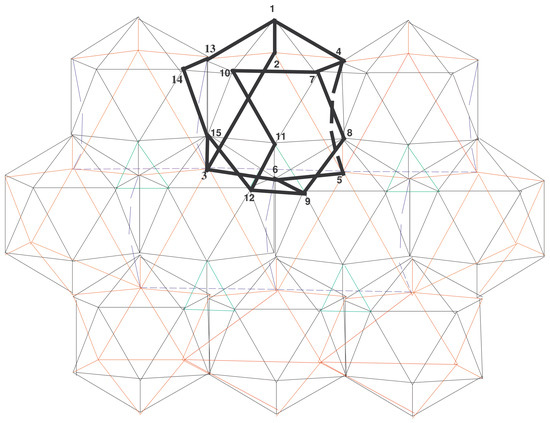
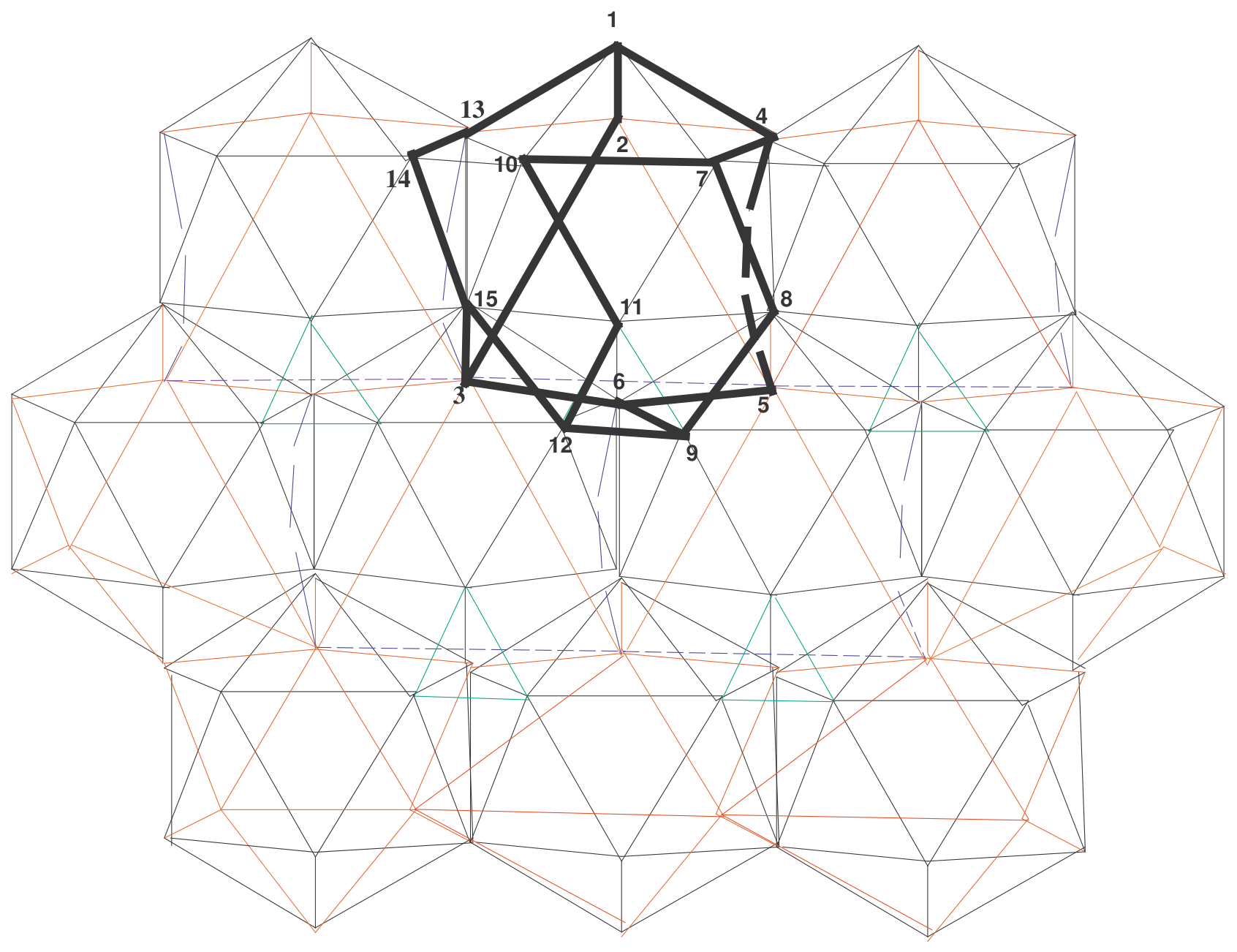
Consider the graph of order 15 shown in Figure 17.
Figure 17.
A symmetric planar cycle-avoidance graph of order 15.
We upper-bound the longest cycle length by identifying a separator pair of vertices whose removal disconnects two degree-two chains; any cycle can include at most one vertex from each such chain unless it repeats the separator vertices. This yields an explicit maximum cycle length. A cycle achieving this bound is constructed by traversing the unique maximal corridor between the separator vertices and returning through the alternative corridor.
For avoidance, fix . If v lies on one corridor, choose the alternative maximal corridor cycle; if v lies on the separator pair, choose a cycle using the other separator orbit (the graph admits two such maximal choices by construction). Thus, for each v there exists a longest cycle avoiding v (Figure 18).
Figure 18.
Illustrative longest cycle avoiding a prescribed vertex (figure used only as illustration).
Finally, Figure 19 illustrates an embedding into . □
Figure 19.
Embedding of a subdivision of the order-15 -graph into .
Pair Avoidance for Longest Cycles
Theorem 5.
There exists a -graph of order 196 that embeds (after subdivisions) into , in which every pair of vertices is avoided by some longest cycle.
Proof.
The construction follows Algorithm 1 using the cycle-controlled base block B shown in Figure 20 and Figure 21.
Figure 20.
The auxiliary graph used as the basic building block in the construction.
Figure 21.
A longest cycle of length 140 in the graph G(15, 2) avoiding a prescribed pair of vertices.
The block B in Figure 20 has vertices. We take disjoint copies and connect them according to the two-connected skeleton cycle shown in Figure 22 (each copy contributes one segment of the global cycle), without identifying vertices between copies (attachments are by edges only). Hence, the resulting graph has
Per-block cycle contribution and longest-cycle bound. Each block has two designated attachment vertices (the two interfaces shown in Figure 20) and contains two internally vertex-disjoint maximal corridors between these interfaces, and , each using exactly 12 vertices of . No interface-to-interface traversal in can use more than 12 vertices (any longer route would force repetition because the remaining vertices form two disjoint corridors between the same interfaces). Because each copy meets the rest of the graph only at its interfaces, a simple global cycle can enter each block at most once. Thus, Lemma 1 applies (with “path” replaced by “cycle segment”) and per-block maximum 12.
Figure 22.
Embedding of a subdivision of the -graph of order 196 into .
Therefore, any global cycle uses at most 12 vertices from each block, so the longest cycles have
vertices, attained by choosing a maximal corridor in every block and following the skeleton cycle.
Let be a forbidden pair and suppose (all other same-block cases are symmetric). If , then avoids and has the same length. Replace by inside and keep maximal corridors in every other block. By Lemma 1, the resulting cycle is still longest and avoids .
If u and v lie in different blocks, use the fact that the skeleton is two-connected and admits two distinct maximal skeleton cycles (as depicted in Figure 22); select a maximal skeleton cycle that avoids one of the two blocks and realise it with maximal corridors in the visited blocks. This yields a longest cycle avoiding the forbidden pair.
Finally, the subdivision-embedding into is illustrated in Figure 22. □
6. Comparison of Smallest Known Orders
Table 1 summarises the smallest reported abstract orders of Gallai-type constructions across triangular (), hexagonal (), and the three-dimensional adjacency setting . For and , the listed orders correspond to graphs realised directly as subgraphs of the respective tilings. For , the listed orders refer to the abstract graphs prior to subdivision; additional subdivision vertices may be introduced when embedding these graphs into to satisfy local adjacency constraints. Accordingly, the table is intended as a comparison of construction scales and structural complexity, not as a claim of strict size minimality across different geometric settings.
Table 1.
Smallest reported abstract orders of - and -graphs in triangular (), hexagonal (), and the 3D adjacency graph .
7. Discussion
In this paper, we established the existence of several classes of graphs with Gallai-type properties within the three-dimensional adjacency graph derived from an icosahedral–tetrahedral cell complex. We constructed explicit examples of , , , , and graphs of the stated orders that admit subdivision embeddings into .
We emphasize that our contribution is constructive and comparative: we provided explicit families in a 3D adjacency setting and compared their orders to the smallest known orders in classical planar tilings. We did not claim algorithmic fault-tolerance guarantees; rather, we interpreted avoidance of prescribed vertices by longest routes as a structural robustness feature.
Limitations
The constructions presented here are explicit but not claimed optimal in general.
Moreover, our geometric setting is the adjacency graph of a specified periodic cell complex, not an asserted classification-level tessellation of by congruent regular polyhedra.
Finally, AI-related remarks are motivational only and are not supported by implementations or experiments.
8. Conclusions
We constructed explicit - and -graphs that embed (after subdivisions) into the rigorously defined adjacency graph associated with an icosahedral–tetrahedral polyhedral cell complex. These examples extend Gallai-type constructions from planar lattices to a three-dimensional adjacency setting and yield small-order constructions in this framework.
The results highlight a strong interaction between geometric adjacency constraints and extremal longest-path/longest-cycle phenomena.
Future Work
Determining sharp lower bounds on the smallest possible orders of - and -graphs embeddable in remains open. Further directions include analogous constructions in other three-dimensional cell complexes and higher-connectivity parameters.
Author Contributions
Conceptualization, N.M., Y.B., M.F.N. and A.E.; methodology, Y.B., M.F.N. and N.M.; software, Y.B. and M.F.N.; validation, Y.B., M.F.N. and N.M.; formal analysis, Y.B., A.E. and N.M.; investigation, Y.B., N.M. and M.F.N.; resources, Y.B., M.F.N. and N.M.; data curation, Y.B., M.F.N., A.E. and N.M.; writing-original draft preparation, Y.B., M.F.N. and A.E.; writing—review and editing, Y.B. and N.M.; visualization, N.M., Y.B. and M.F.N.; supervision, Y.B.; project administration, Y.B. and N.M. All authors have read and agreed to the published version of the manuscript.
Funding
This research received no external funding.
Data Availability Statement
The data supporting the results of the study are available from the corresponding author upon request.
Conflicts of Interest
The authors declare no conflicts of interest.
References
- Sachs, H. Theory of Graphs. (Proceedings of the Colloquium Held at Tihany, Hungary, September 1966). 370 S. m. Fig. Budapest/New York 1968. Akedémiaí Kiadó/Academic Press. Preis geb. 11.00. Z. Angew. Math. Mech. 1969, 49.5, 313. [Google Scholar] [CrossRef] [Scilit]
- Walther, H. Über die Nichtexistenz eines Knotenpunktes, durch den alle längsten Wege eines Graphen gehen. J. Comb. Theory 1969, 6, 1–6. [Google Scholar] [CrossRef] [Scilit]
- Schmitz, W. Über längste Wege und Kreise in Graphen. Rend. Semin. Mat. Della Univ. Padova 1975, 53, 97–103. [Google Scholar]
- Halin, R. Walther/Voss, Über Kreise in Graphen. 271 Seiten. 99 Abb., Berlin 1974. VEB Deutscher Verlag der Wissenschaften. Preis 56,–M. Available online: https://onlinelibrary.wiley.com/doi/abs/10.1002/zamm.19760560710 (accessed on 15 May 2026).
- Zamfirescu, T. On Longest Paths and Circuits in Graphs. Math. Scand. 1976, 38, 211–239. [Google Scholar] [CrossRef] [Scilit]
- Shabbir, A.; Zamfirescu, C.T.; Zamfirescu, T. Intersecting Longest Paths and Longest Cycles: A Survey. Electron. J. Graph Theory Appl. 2013, 1, 56–76. [Google Scholar] [CrossRef] [Scilit]
- Nadeem, F.; Shabbir, A.; Zamfirescu, T. Planar Lattice Graphs with Gallai’s Property. Graphs Comb. 2013, 29, 1523–1529. [Google Scholar] [CrossRef] [Scilit]
- Jumani, A.D.; Zamfirescu, T. On Longest Paths in Triangular Lattice Graphs. Util. Math. 2012, 89, 269–273. [Google Scholar]
- Shabbir, A.; Zamfirescu, T. Gallai’s Property for Graphs in Lattices on the Torus and the Möbius Strip. Period. Math. Hung. 2016, 72, 1–11. [Google Scholar] [CrossRef] [Scilit]
- Shabbir, A. Fault-Tolerant Designs in Lattice Networks on the Klein Bottle. Electron. J. Graph Theory Appl. 2014, 2, 99–109. [Google Scholar] [CrossRef] [Scilit]
- Bashir, Y.; Zamfirescu, T. Lattice Graphs with Gallai’s Property. Bull. Math. Soc. Des Sci. Math. Roum. 2013, 56, 65–71. [Google Scholar]
- Bashir, Y.; Nadeem, F.; Shabbir, A. Highly Non-Concurrent Longest Paths in Lattices. Turk. J. Math. 2016, 40, 21–31. [Google Scholar] [CrossRef] [Scilit]
- Grünbaum, B.; Shephard, G.C. Tilings and Patterns; W. H. Freeman: New York, NY, USA, 1987. [Google Scholar]
- Bashir, Y.; Aslam, A.; Kamran, M.; Qureshi, M.I.; Jahangir, A.; Rafiq, M.; Bibi, N.; Muhammad, N. On Forgotten Topological Indices of Some Dendrimers Structure. Molecules 2017, 22, 867. [Google Scholar] [CrossRef] [Scilit] [PubMed]
- Chang, Z.; Yuan, L. Archimedean Tiling Graphs with Gallai’s Property. An. Ştiinţifice Univ. Ovidius Constanţa Ser. Mat. 2017, 25, 185–199. [Google Scholar] [CrossRef] [Scilit]
- He, Y.; Yuan, L. Archimedean Tiling Graphs with Gallai’s Property. Ars Comb. 2020, 150, 31–40. [Google Scholar]
- Nadeem, M.F.; Iqbal, H.; Siddiqui, H.M.A.; Azeem, M. Intersecting Longest Cycles in Archimedean Tilings. Algorithmica 2023, 85, 2348–2362. [Google Scholar] [CrossRef] [Scilit]
- Hayes, J.P. A Graph Model for Fault-Tolerant Computing Systems. IEEE Trans. Comput. 1976, C-25, 875–884. [Google Scholar] [CrossRef] [Scilit]
- Nadeem, M.F.; Imran, M.; Afzal Siddiqui, H.M.; Azeem, M. Fault tolerance designs of interconnection networks. Peer-to-Peer Netw. Appl. 2023, 16, 1125–1134. [Google Scholar] [CrossRef] [Scilit]
- Coxeter, H.S.M. Regular Polytopes, 3rd ed.; Dover Publications: New York, NY, USA, 1973. [Google Scholar]
- Conway, J.H.; Torquato, S. Packing, Tiling, and Covering with Tetrahedra. Proc. Natl. Acad. Sci. USA 2006, 103, 10612–10617. [Google Scholar] [CrossRef] [Scilit] [PubMed]
- Zomorodian, A.J. Topology for Computing; Cambridge University Press: Cambridge, UK, 2005; Volume 16. [Google Scholar]
- Hatcher, A. Algebraic Topology; Tsinghua University Press Co., Ltd.: Beijing, China, 2005. [Google Scholar]
- Zamfirescu, T. Intersecting Longest Paths or Cycles: A Short Survey. An. Univ. Craiova Ser. Mat. Inform. 2001, 28, 27. [Google Scholar]

Disclaimer/Publisher’s Note: The statements, opinions and data contained in all publications are solely those of the individual author(s) and contributor(s) and not of MDPI and/or the editor(s). MDPI and/or the editor(s) disclaim responsibility for any injury to people or property resulting from any ideas, methods, instructions or products referred to in the content. |
© 2026 by the authors. Licensee MDPI, Basel, Switzerland. This article is an open access article distributed under the terms and conditions of the Creative Commons Attribution (CC BY) license.