1. Introduction
Short-term node-level cargo-volume forecasting in logistics sorting networks can be formulated as an applied mathematical and computational problem on a directed network. In such systems, sorting centers are represented as nodes, and route connections define directed dependencies through which upstream volume variation, downstream transfer capacity, diversion patterns, and network topology may influence local cargo volumes. The forecasting target is therefore not an isolated local time series, but a node-level response embedded in a route-connected system [
1,
2]. Although such forecasts can support downstream applications, the central modeling problem is how temporal signals and network-coupled structural information can be organized into admissible computational inputs for node-level prediction.
This problem is particularly challenging under a partial-information boundary. Before prediction, historical node volumes, the pre-change network structure, and planned route-topology adjustments may be available, whereas continuous post-change dynamic edge weights, realized cargo transfers, and updated graph states are typically unavailable in disruption-management, dynamic-routing, and logistics-network resilience settings [
3,
4,
5,
6,
7,
8,
9,
10]. This differs from full-information dynamic-graph forecasting, where evolving node–edge states, adaptive graph weights, or continuously updated graph structures can be observed during model construction [
11,
12,
13,
14,
15,
16,
17]. Under the information boundary considered here, forecasting inputs must be constructed without target-period node volumes, realized post-change edge flows, or updated dynamic graph states. The key computational question is therefore how to encode planned topology changes and potential node-level perturbation responses in an interpretable and information-admissible manner.
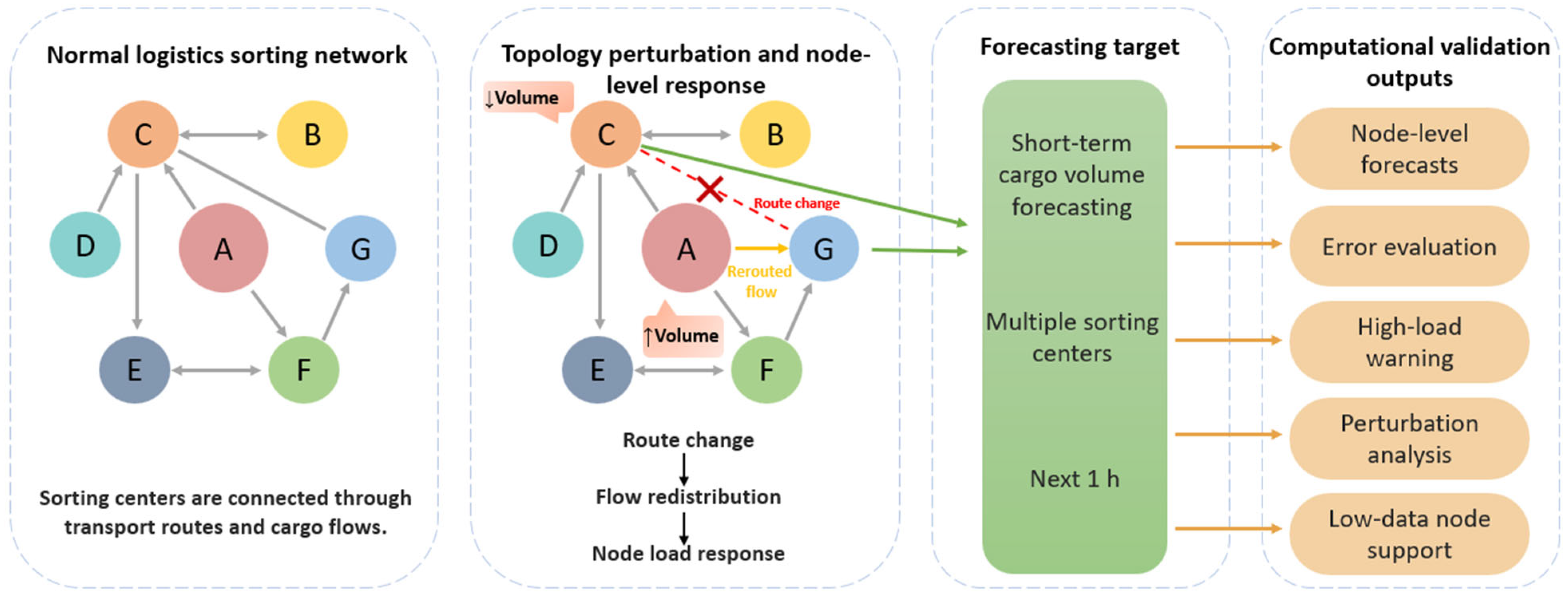
Figure 1 illustrates the adopted forecasting setting by linking directed network coupling, planned topology perturbation, the 1-h-ahead node-level forecasting target, and computational validation outputs.
Several research streams provide useful foundations for this problem, although each addresses only part of the present setting.
First, short-term logistics demand and cargo-volume forecasting studies have developed statistical, machine-learning, neural-network, and ensemble methods for operational, freight, regional, distribution-center, and supply-chain demand prediction [
18,
19,
20,
21,
22,
23,
24,
25,
26,
27,
28]. These studies show that lagged observations, temporal regularity, nonlinear learning, and ensemble modeling can support logistics-related forecasting. However, many formulate the target as an aggregate demand series, regional indicator, or operational planning unit, rather than as node-level cargo-volume forecasting in a directed logistics network. This study therefore reformulates cargo-volume forecasting as a node-level prediction problem under directed route dependence.
Second, graph-based and spatiotemporal forecasting studies show that network relations can be used to model inter-node dependence and temporal evolution. Representative models, including diffusion graph forecasting, spatiotemporal graph convolution, adaptive graph learning, and dynamic spatial–temporal graph neural networks, demonstrate the value of graph structures in transportation and networked forecasting [
11,
12,
13,
14,
15,
16,
17]. They also show that node states should not be treated as independent time series when network relations exist. However, many such models require observed dynamic node–edge states, adaptive graph weights, or updated graph structures during model construction. In the present setting, these post-change graph states are unavailable before prediction, creating a different problem: how to transform pre-forecast and planned topology information into admissible node-level predictors.
Third, studies on topology perturbation, disruption propagation, dynamic routing, reliable logistics-network design, and supply-chain resilience explain how topology changes, route disruptions, node failures, rerouting pressure, and inter-tier connections influence network performance [
3,
4,
5,
6,
7,
8,
9,
10,
29]. These studies are important because they show that network structure and disruption propagation can affect local load and system-level performance. Nevertheless, their main focus is usually disruption explanation, resilience assessment, dynamic routing, or network-design optimization. Few studies convert planned route-topology changes into computable node-level variables for 1-h-ahead cargo-volume forecasting under a strict partial-information boundary. This motivates the perturbation-response proxy representation proposed in this paper.
Fourth, data-scarce, few-shot, transfer-learning, and neighborhood-support forecasting studies show that information from related regions, nodes, or systems can support prediction when local observations are limited [
30,
31,
32,
33]. These studies provide a methodological basis for transferable or similarity-based support in low-data settings. In this study, however, data scarcity is not treated as a separate forecasting task with a different target or evaluation logic. Similarity-assisted support is instead introduced under the same forecasting target, sample-construction rule, forecasting backbone, and chronological evaluation protocol, allowing its incremental value to be evaluated without changing the prediction problem.
The remaining gap is therefore not merely the absence of a more accurate forecasting algorithm but how to represent partial pre-forecast information in a directed logistics network. Planned topology changes must be transformed into interpretable and information-admissible node-level variables, while similarity support must be incorporated without changing the forecasting target or evaluation protocol.
Table 1 summarizes these four research streams, their limitations under the partial-information boundary, and how this study addresses each computational gap.
To address this gap, this study develops a perturbation-aware computational framework for 1-h-ahead node-level cargo-volume forecasting in directed logistics sorting networks. The framework represents the logistics system as a directed graph and constructs supervised node-hour samples using temporal features, pre-change structural descriptors, topology-change encodings, perturbation-response proxies, and similarity-assisted support features. A shared random forest model is used as a controlled forecasting backbone for mixed temporal, structural, perturbation-related, and similarity-derived inputs [
34]. The novelty lies not in the random forest algorithm itself but in the information-admissible representation of planned topology perturbations and limited-history support.
This study makes four main contributions. First, it formulates 1-h-ahead node-level cargo-volume forecasting as a partial-information problem on a directed logistics network. Second, it introduces topology-change encodings and perturbation-response proxies to capture neighborhood reconfiguration, damage to the pre-change connectivity basis, and rerouting pressure without reconstructing post-change edge-level flows. Third, it extends the same forecasting protocol to data-scarce nodes using similarity-assisted support from topological structure, cargo-volume patterns, and periodic regularity. Fourth, it provides a unified validation design for stable-network, topology-perturbation, and data-scarce-node settings, covering ablation analysis, sensitivity analysis, node-level gain coverage, statistical testing, and high-load warning evaluation.
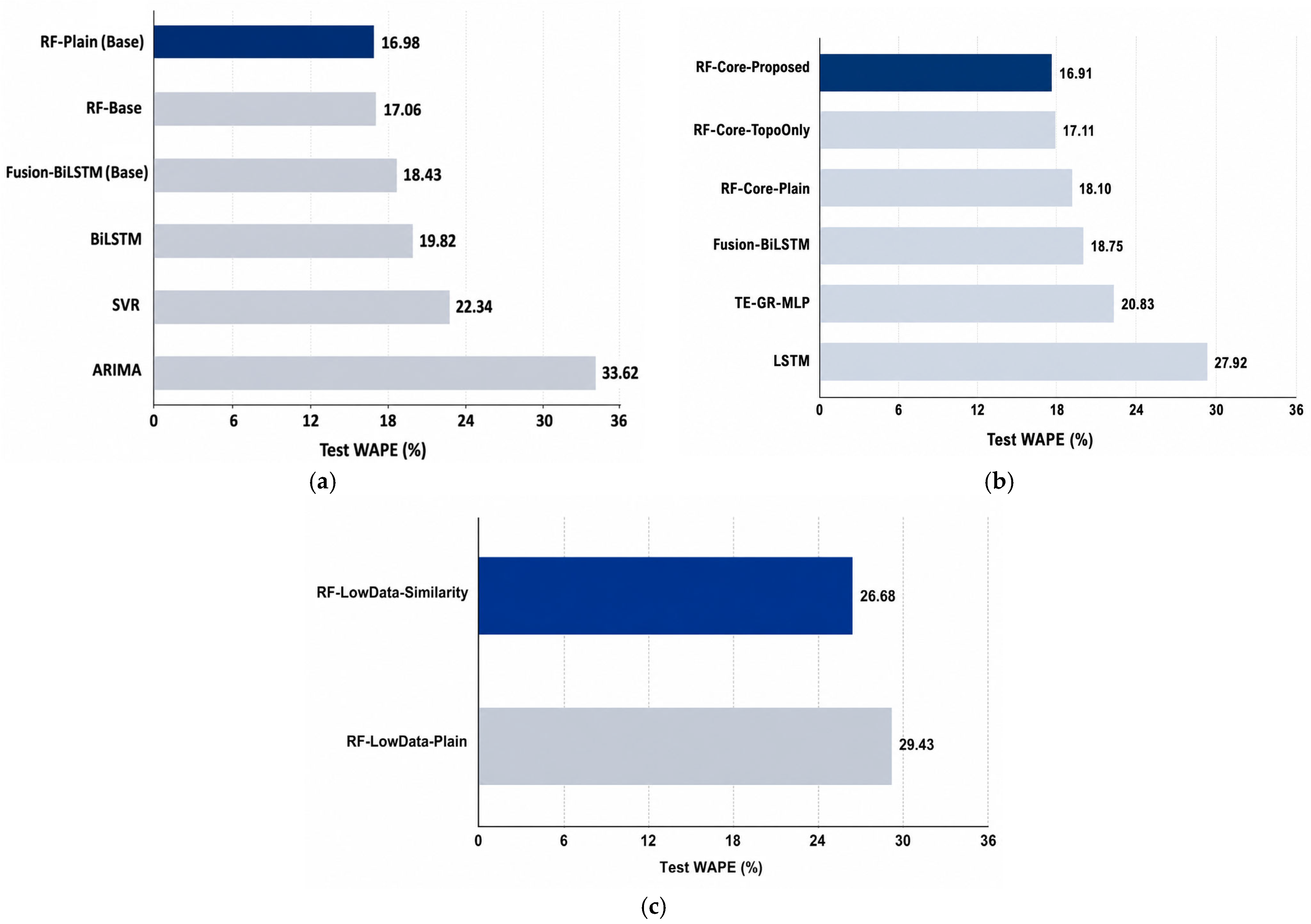
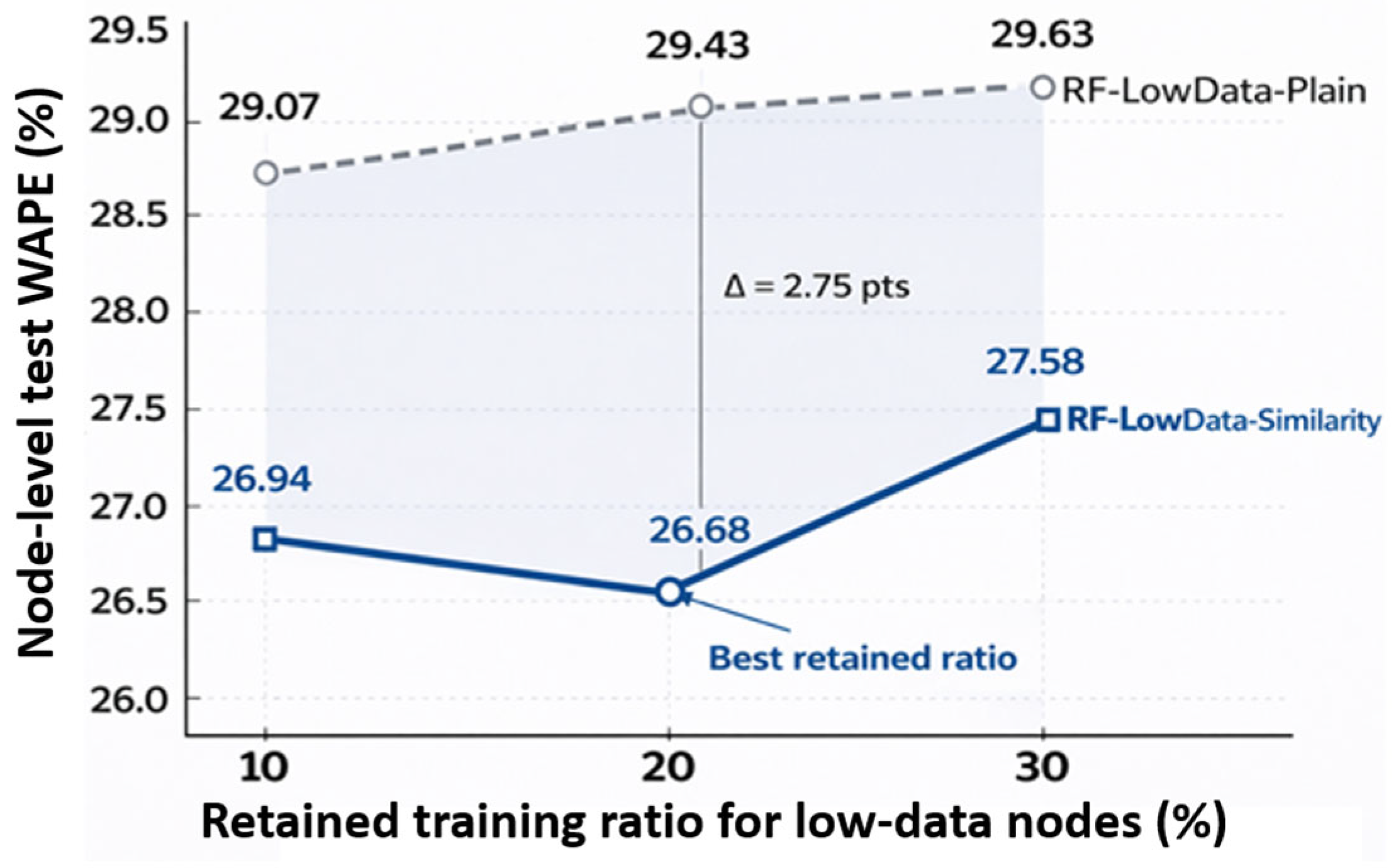
The principal findings are that temporal signals dominate stable-network forecasting, topology-change and perturbation-response inputs provide incremental predictive value under route perturbations, and similarity-assisted support improves transitional forecasting for data-scarce nodes. Specifically, topology-change signals reduce test WAPE from 18.10% to 17.11%, perturbation-response proxies further reduce it to 16.91%, and similarity support reduces test WAPE from 29.43% to 26.68% under the data-scarce-node setting. These results indicate that topology perturbation and similarity information can improve node-level forecasting within the adopted partial-information boundary, without relying on target-period node volumes or realized post-change dynamic edge weights.
The remainder of this paper is organized as follows.
Section 2 describes the data, directed network representation, feature construction, perturbation-response proxies, similarity support, and evaluation protocol.
Section 3 reports the experimental results under stable-network, topology-perturbation, and data-scarce-node settings.
Section 4 discusses methodological implications, limitations, and generalizability.
Section 5 concludes the paper.
2. Materials and Methods
2.1. Research Scope and Boundary Conditions
This study examines 57 sorting centers in a logistics sorting network and addresses node-level short-term cargo-volume forecasting under network dependence, topology perturbation, and uneven data availability. The logistics system is modeled as a directed graph rather than as a set of independent nodes [
1,
2,
11,
12,
13,
14,
15,
16,
17]. Each sorting center is treated as a forecasting node, and directed route connections define the structural relations through which local volume dynamics may be affected by upstream and downstream network states.
The empirical node set is defined by the dataset rather than selected by the authors. The benchmark data contain 57 anonymized sorting centers, all of which are retained after node-index unification. No center is included or excluded according to operational importance, cargo scale, geographic representativeness, or forecasting performance. Accordingly, the experiments should be interpreted as covering the complete anonymized node set available in the benchmark data under the adopted partial-information boundary, rather than as a statistically representative sample of all logistics sorting networks.
Three task settings are examined within the same computational framework. The Base task evaluates routine node-level forecasting under stable-network conditions, following short-term logistics demand and cargo-volume forecasting studies [
18,
19,
20,
21,
22,
23,
24,
25,
26,
27,
28]. The Core task evaluates forecasting under topology perturbation, where planned route-topology changes are known before prediction but continuous post-change edge weights are unavailable, consistent with disruption-management, dynamic-routing, and logistics-network resilience studies [
3,
4,
5,
6,
7,
8,
9,
10,
29]. The Extension task applies the same forecasting protocol to a controlled limited-history setting, in which selected nodes retain limited but nonzero local observations, following data-scarce, few-shot, transfer-learning, and neighborhood-support forecasting studies [
30,
31,
32,
33].
2.2. Data Description and Availability
The empirical data are derived from the anonymized logistics sorting-network benchmark dataset described in the Data Availability Statement. Four data components are integrated under a unified node-index mapping: daily node-volume records, hourly node-volume records, pre-change route-volume records, and planned topology-adjustment records. The selected periods correspond to the complete and internally consistent data windows available for each component. Daily records from 1 August to 30 November 2023 provide medium-term trends and day-level periodic information, while hourly records from 1 to 30 November 2023 provide high-frequency observations for lag-feature construction, 24 h historical windows, and 1-h-ahead forecasting. The pre-change route-volume records summarize historical route volumes over the preceding 90 days and are used to construct the weighted directed network before topology adjustment. The planned topology-adjustment records describe pre-announced route connectivity and are used only for planned topology-change encoding; they do not contain realized post-change cargo flows, target-period node volumes, or continuous post-change dynamic edge weights.
All four data components were derived from the same anonymized benchmark dataset, and all 57 available sorting centers were retained after node-index unification.
Table 2 summarizes the data scope, preprocessing statistics, chronological split, supervised-sample construction, and information-exclusion rules.
Based on the summary in
Table 2,
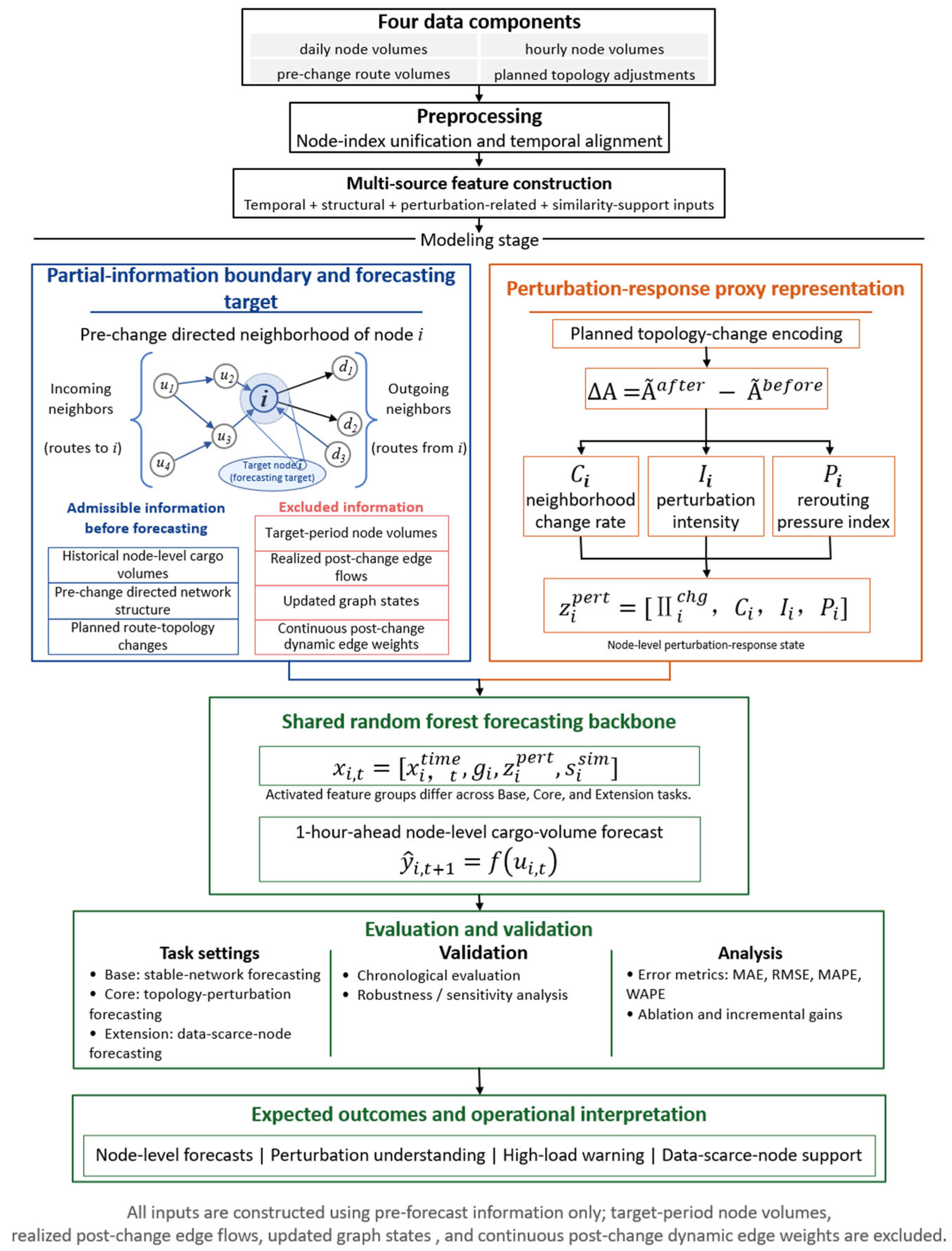
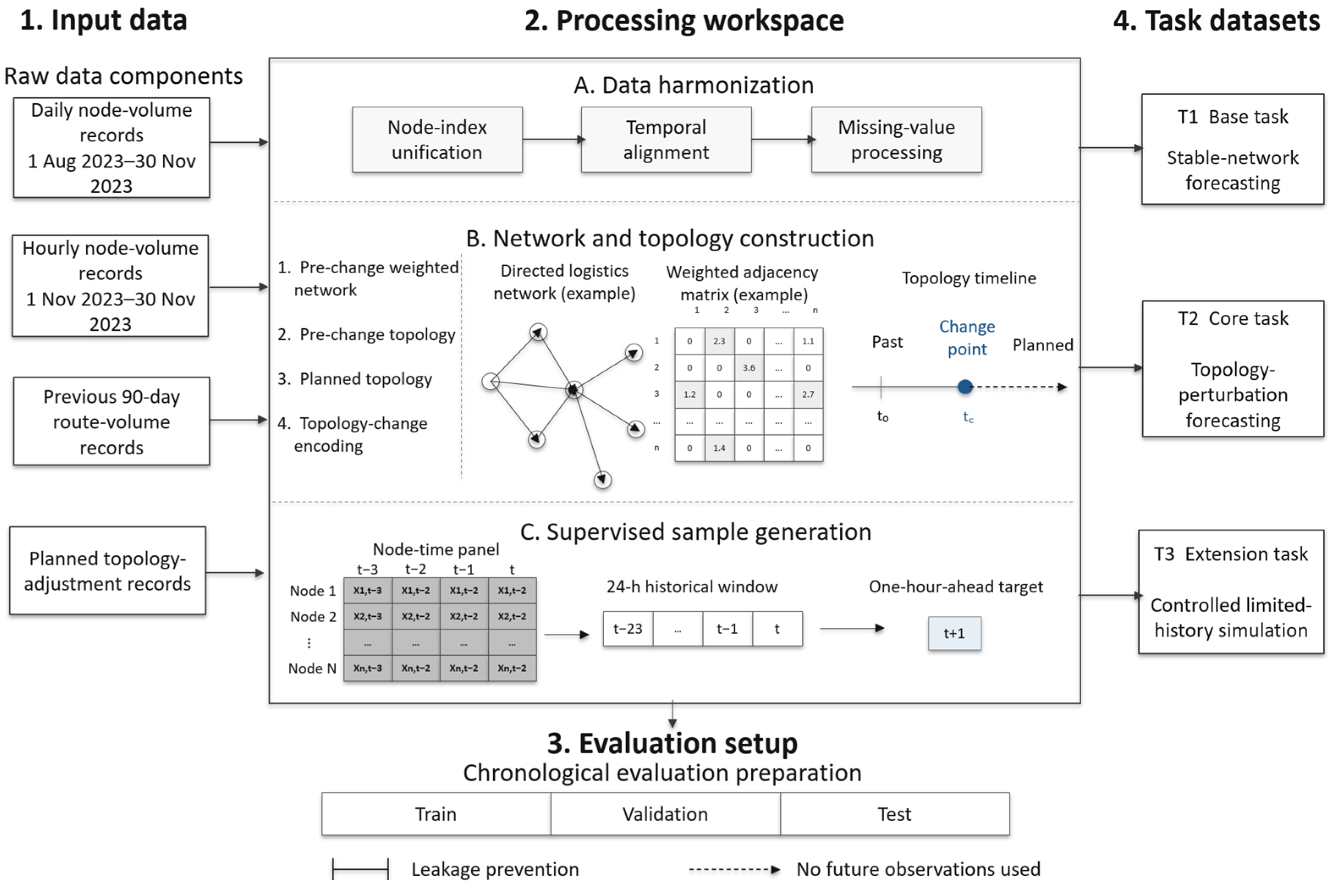
Figure 3 illustrates how the raw records are transformed into model-ready task datasets through node-index unification, temporal alignment, missing-value imputation, network-matrix construction, topology-change extraction, supervised-sample generation, chronological splitting, and leakage prevention. Across all tasks, only information available up to forecast origin
is used to predict the node-level cargo volume at
.
Supervised samples are constructed with a 24 h historical window and a unified 1-h-ahead node-level target. To avoid cross-split historical leakage, the window is constructed within each chronological split. Excluding the first 24 h of each split yields 36,936 valid supervised samples, corresponding to 57 × 648 node-hour forecast origins.
Each supervised sample is indexed by node
and forecast origin time
, uses only information available up to
, and predicts the node-level cargo volume at
. The Base, Core, and Extension tasks share the same target, split, and leakage-prevention protocol, but activate different input modules.
Appendix A.2 Table A2 provides a compact sample-structure example and one anonymized model-ready sample row. Numerical values are masked, anonymized, or rounded only to illustrate the supervised node-hour sample structure without disclosing raw operational records.
In the controlled limited-history experiment, the 57 nodes are divided into 40 data-rich nodes and 17 data-scarce nodes. For data-scarce nodes, only the earliest 20% of training samples are retained, while validation and test observations remain unchanged under the same chronological protocol. This setting approximates newly activated, recently reconfigured, or low-history nodes with limited but nonzero local records. It is not a naturally missing-data scenario because the history reduction is imposed for experimental control, nor a complete cold-start setting because each data-scarce node retains partial local history.
2.3. Logistics Network Representation
The logistics system is represented as a directed network
where
is the set of sorting centers,
is the set of directed transport connections, and
. This representation is consistent with graph-based forecasting studies that model inter-node dependence through network structure [
11,
12,
14,
15].
Because cargo transfer is directional, the edges are directed. Let . A transport route from node to node is denoted by . In general, the existence or strength of does not imply the same existence or strength of .
Under regular conditions, the pre-change network dataset is used to construct the original weighted directed adjacency matrix:
where
denotes the historical route strength from node
to node
, measured by the average cargo volume on that route over the previous 90 days. If no directed route exists from node
to node
, then
.
For topology-level comparison, the pre-change binary topology matrix is defined as
where
Under route-change conditions, the planned post-adjustment topology is represented by the post-change topology matrix:
where
It should be emphasized that is a planned topology matrix rather than a realized post-change weighted-flow matrix. It records whether a route connection is planned to exist after adjustment, but it does not contain realized post-change cargo volumes or continuous dynamic edge weights.
The topology-change matrix is then defined as
For each directed pair , indicates an added connection, indicates a removed connection, and indicates no topology change. This representation converts planned route adjustments into a computable perturbation matrix while remaining within the partial-information boundary.
Node in-degree, out-degree, weighted in-degree, and weighted out-degree are also computed as basic structural indicators. They are not forecasting targets, but they support structural feature construction, perturbation characterization, and node-similarity analysis.
2.4. Multi-Source Feature Construction
A unified multi-source feature system is built from the network representation. Inputs are grouped into temporal, structural, perturbation-response, and similarity-support features, corresponding to short-term node dynamics, network position, local topology-perturbation response, and transferable support for data-scarce nodes.
For node
at time
, the general multi-source feature vector can be written as
where
denotes temporal features,
denotes pre-change structural features,
denotes perturbation-response proxy features, and
denotes similarity-support information. The specific activated feature groups differ across the Base, Core, and Extension tasks, as defined in
Section 2.6.
2.4.1. Temporal Features
Temporal features are the main source of short-term predictive information. Using the daily and hourly datasets, this study extracts lag features and moving averages to represent recent fluctuations and local trends [
22,
23,
25,
26]. Calendar and periodic encodings are further used to capture intraday and recurrent operating rhythms [
18,
19,
20,
21,
24]. Missingness indicators are retained to preserve information contained in observation status.
2.4.2. Structural Features
Structural features describe each node’s position and relational strength in the pre-change network. They are derived from the pre-change weighted adjacency matrix
and the binary topology matrix
, consistent with studies that model inter-node dependency through network topology and graph representations [
1,
2,
11,
12,
14,
15]. These features include in-degree, out-degree, neighbor scale, weighted degree, and upstream and downstream connection strength. They provide routine relational context in the Base task, the pre-change connectivity basis in the Core task, and a structural basis for comparing data-scarce and data-rich nodes in the Extension task.
2.4.3. Perturbation-Related Features
Perturbation-response features describe local structural reconfiguration and load-bearing pressure under route changes, following studies on logistics-network topology, disruption propagation, and resilience [
1,
2,
3,
4,
5,
6,
7,
8,
9,
10,
29]. They are derived from the planned topology-change matrix
, the pre-change weighted adjacency matrix
, and local neighborhood indicators. Their detailed proxy definitions are provided in
Section 2.5.
These features should be interpreted as partial-information proxy variables. They do not reconstruct true post-change edge-level cargo flows, but they provide admissible node-level inputs for representing potential local perturbation response before realized post-change edge weights become available.
2.4.4. Similarity-Support Features
Similarity-support features are constructed for the data-scarce-node scenario. They identify the most similar reference node from three dimensions: topological structure, cargo-volume pattern, and periodic regularity, following transfer-support and neighborhood-information ideas in data-scarce prediction settings [
30,
31,
32,
33]. The resulting component scores and composite similarity score provide auxiliary transferable information for nodes with limited local history.
These feature groups serve as task-activated input modules. The next section develops the perturbation-response proxy representation for route-change scenarios.
2.5. Perturbation-Response Proxy Representation
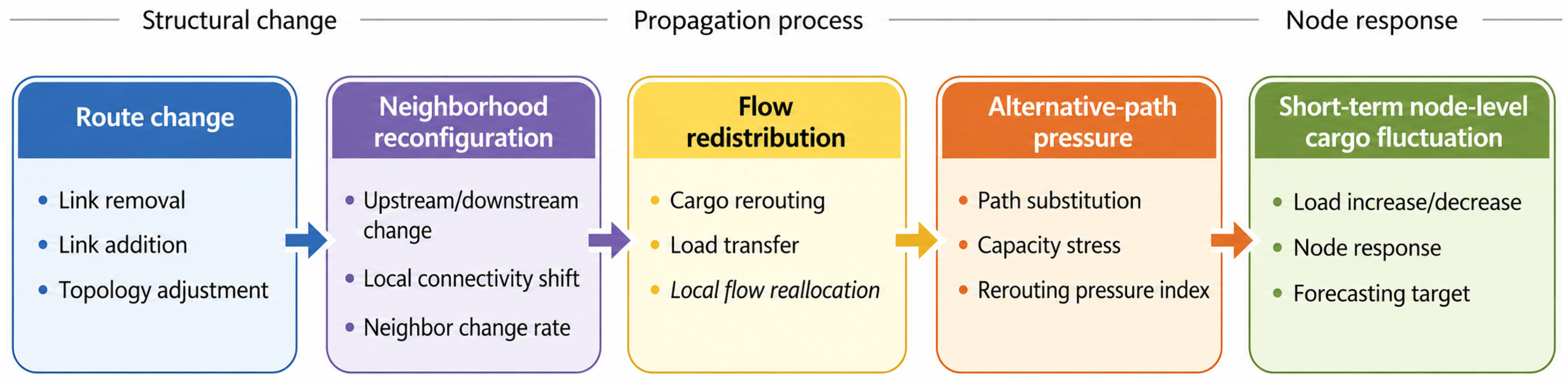
In logistics sorting networks, route changes affect node load indirectly by altering local connectivity, triggering possible cargo-flow redistribution, and producing short-term load fluctuations [
1,
2,
3,
4,
5,
6,
7,
8,
9,
10,
29]. This study therefore represents route changes as node-level perturbation states rather than simple event labels. Because continuous post-change edge weights are unavailable, these states are described by proxy variables derived from observable structural change [
3,
5,
6,
7,
8,
9,
10].
Based on
Figure 4, route changes are translated into the following computable and interpretable perturbation-response proxies.
2.5.1. Neighborhood Change Rate
The neighborhood change rate measures the relative extent of local connectivity reconfiguration. Let
and
denote the numbers of added and removed connections associated with node
, respectively, and let
denote its pre-change neighborhood size. The neighborhood change rate is defined as
where
is a small constant used to avoid division by zero. This variable uses only pre-change topology, planned post-change topology, and their difference. A larger
indicates stronger local reconfiguration and a higher likelihood of subsequent redistribution pressure under the partial-information boundary.
2.5.2. Perturbation Intensity
Connection counts alone cannot reflect the severity of a perturbation, because removing high-weight routes is usually more consequential than modifying low-weight routes. Perturbation intensity therefore measures damage to the original strong-connectivity basis. Let
denote the total lost pre-change weight associated with removed connections,
denote the compensatory proxy contribution associated with newly added connections, and
denote the original weighted connectivity basis. The perturbation intensity is defined as
where
does not represent observed post-change flow. Instead, it is a topology-based compensatory proxy constructed from planned added connections and pre-change node-level connectivity strength. The parameter
controls how strongly this proxy compensation offsets the lost pre-change connectivity basis. In the main experiments,
is used because it yields the lowest validation WAPE among the representative settings examined in
Appendix B.1 and
Table A3. This parameter should therefore be interpreted as a validation-selected proxy-construction weight, not as a realized post-change flow-redistribution parameter. The resulting
is a partial-information proxy, with larger values indicating greater damage to the pre-change operating basis.
2.5.3. Rerouting Pressure Index
Node-level deviations after route changes depend not only on connection loss but also on temporary diversion pressure. The rerouting pressure index captures this local load-bearing risk:
This index combines connectivity-basis damage and neighborhood reconfiguration. Compared with a simple topology-change indicator, it better reflects whether a node may become a local pressure-bearing point during cargo-flow reorganization. It remains a proxy variable under partial information and should not be interpreted as an observed rerouted cargo volume.
2.5.4. Node-Level Perturbation State Representation
The perturbation state of node
is represented as:
where
= 1 if any added or removed connection exists in the neighborhood of node
, and 0 otherwise.
This state vector does not attempt to recover the true post-change edge-level propagation process. Instead, it converts route changes into structured, computable inputs that reflect local structural reconfiguration, damage to the connectivity basis, and potential load-bearing pressure under the adopted information boundary. These variables form the perturbation-response module activated in the Core task and, as complementary information, in the Extension task, as summarized in
Table 3.
2.5.5. Verification Strategy for Perturbation-Response Proxy Design
The perturbation variables are evaluated as a proxy set rather than as direct reconstructions of edge-level flow propagation. Their validity is assessed through two checks. First,
Appendix B.1 and
Table A3 report the sensitivity analysis for the perturbation-intensity balancing parameter
. The test WAPE remains within a narrow range across representative
values, indicating that the Core-task conclusion is not driven by a single parameter setting. Second, node-level statistical tests, gain coverage, heterogeneity analysis, and high-load warning results examine whether the proxy set provides stable incremental value within the unified framework.
2.6. Unified Forecasting Framework as a Testable Research Design
Random forest is used as a shared forecasting backbone to evaluate the proposed representations under a controlled setting. It is suitable because it handles nonlinear tabular inputs, mixed temporal and graph-derived features, and interactions among heterogeneous feature groups [
34]. Unlike dynamic graph models, it does not require continuous post-change dynamic edge weights, updated graph states, or long sequence inputs, which are unavailable under the adopted partial-information boundary.
Using a common random forest backbone isolates the incremental value of topology-change encodings, perturbation-response proxies, and similarity-support features under the same forecasting target, sample-construction rules, chronological split, and evaluation metrics. Thus, the methodological contribution lies in the information-admissible representation of planned topology perturbations and limited-history support, rather than in the random forest algorithm itself.
Under the same forecasting target, sample-construction rules, temporal split, and evaluation metrics, the Base, Core, and Extension tasks evaluate the computational value of task-specific information modules.
Table 3 summarizes the shared design and task-specific modules.
2.6.1. Framework Overview
Let the input sequence of node
over a historical window of length
at time
be:
where
is the multi-source feature vector of node
at time
. Depending on the task, this vector may contain temporal, structural, perturbation-response, and similarity-support features.
The unified forecasting target is
where
is the task-specific input vector at time
. The Base task uses temporal and structural features. The Core task adds perturbation-response inputs. The Extension task further adds similarity-support information. The target
, sample-construction logic, chronological split, and evaluation metrics remain identical across tasks.
2.6.2. Multi-Source Input Organization
Candidate inputs are drawn from four sources: temporally unfolded historical features, pre-change structural features, perturbation-response proxy features, and similarity-support information for data-scarce nodes. Let denote temporal unfolding within the historical window, and let denote the temporal subsequence of node . Temporal features capture short-term evolution and periodicity, structural features describe regular network position, perturbation features represent local reconfiguration and temporary load-bearing pressure, and similarity features provide transferable support when history is insufficient.
2.6.3. Unified Predictor
Random forest is used as the common predictor [
34]. It consists of multiple regression trees trained with bootstrap sampling and random feature selection at each split. For any input sample,
where
is the output of the
m-th regression tree. Random forest is used as a controlled forecasting backbone for representation evaluation rather than as the methodological novelty of this study. The input vector consists of heterogeneous tabular variables, including lagged temporal features, static structural descriptors, topology-change indicators, perturbation-response proxies, and similarity-support features. RF is suitable because it can model nonlinear interactions among mixed feature groups without requiring continuous post-change dynamic edge weights, updated graph states, or long sequence inputs.
The same RF model class and leakage-prevention protocol are therefore used across the Base, Core, and Extension tasks. Hyperparameters are selected only from predefined validation-set search spaces within each task, and the test set is not used for parameter selection. This controlled design keeps the model family fixed while allowing validation-based tuning, thereby isolating the contribution of topology-change encoding, perturbation-response proxies, and similarity-support features under the same forecasting target, sample-construction rule, and chronological evaluation protocol.
2.6.4. Task-Specific Input Forms
Under the shared design, the three tasks differ only in the activated input modules. The Base-task input is:
where
denotes the structural feature vector of node
.
The Core-task input is:
where
denotes the perturbation-response state vector defined in
Section 2.5. For the Core-task ablation variants, the perturbation-related module is controlled by either removing it, as in RF-Core-Plain, or replacing it with basic topology-change indicators, as in RF-Core-TopoOnly. Thus, the Core-task variants differ only in the level of perturbation-information representation, while the forecasting target, sample-construction rule, and evaluation protocol remain unchanged.
The Extension-task input is:
where
denotes structural features and
similarity-support information.
2.7. Similarity-Assisted Extension for Data-Scarce Nodes
To evaluate similarity-assisted support under controlled limited-history conditions, this study constructs the Extension task by intentionally restricting the available training history of selected nodes while retaining their validation and test observations for chronological evaluation. This design simulates limited but nonzero local history rather than naturally missing data or a complete cold-start setting [
30,
31,
32,
33].
Node similarity is defined along three dimensions: topology, cargo-volume pattern, and periodic regularity. The composite similarity between target node
and candidate reference node
is:
where
,
, and
denote topological similarity, cargo-volume pattern similarity, and periodic similarity, respectively. The weights
,
, and
are validation-selected combination weights rather than causal parameters.
Topological similarity is computed from standardized structural indicators, including in-degree, out-degree, weighted degree, neighborhood size, and relative structural role. Cargo-volume pattern similarity uses historical volume level, fluctuation features, and short-term variation patterns. Periodic similarity captures consistency in intraday rhythms and recurring operating patterns. All three scores are normalized before weighted summation.
All similarity scores are computed using only training-period or pre-forecast historical observations. Test-period cargo volumes are not used in reference-node selection or similarity-weight estimation. The final weight combination is , , and . This setting gives greater weight to short-term periodic regularity and is chosen by validation comparison.
For each data-scarce node, the most similar data-rich reference node is
where
is the set of data-rich nodes. The selected reference-node information is then added as auxiliary input together with the target node’s temporal, structural, and perturbation-related features. This design provides similarity-assisted support for limited-history nodes while keeping the forecasting target, sample-construction rule, forecasting backbone, and evaluation protocol unchanged.
2.8. Baselines, Evaluation Metrics, and Experimental Setting
All comparative experiments use the same sample-construction procedure, chronological split, and evaluation metrics. The aim is to test whether the proposed partial-information representations provide incremental forecasting value under a consistent modeling setting, rather than to present a universal ranking of forecasting algorithms.
2.8.1. Baselines and Comparison Levels
The comparison includes statistical and time-series baselines, conventional machine-learning models, recurrent deep-learning baselines, feature-fusion deep-learning references, and the proposed random forest comparison series [
27,
28,
34,
35]. These models provide reference levels ranging from simple historical extrapolation to nonlinear tabular learning, sequence modeling, and feature-fusion forecasting under the same information boundary.
The random forest series forms the main comparison chain. RF-Plain (Base) and RF-Base are used to test the marginal value of structural information under stable-network conditions. In the Base-task comparison, RF-Plain (Base) denotes the temporal-feature RF baseline, whereas RF-Base denotes the structure-augmented RF model using temporal features and pre-change structural features.
Within the Core task, three RF variants are constructed to separate the contribution of different perturbation-related representations. RF-Core-Plain uses temporal features and pre-change structural features under the route-change evaluation period but does not include explicit topology-change or perturbation-response variables. RF-Core-TopoOnly further adds observable topology-change indicators, such as added-edge counts, removed-edge counts, and change flags. RF-Core-Proposed adds the perturbation-response proxy state, including neighborhood change rate, perturbation intensity, and rerouting pressure index, together with the validation-selected feature subset. RF-LowData-Plain and RF-LowData-Similarity test the value of similarity support under the data-scarce-node scenario. A supplementary temporal–graph reference model, Temporal Encoder + Graph Residual + MLP (TE-GR-MLP), is also included because it combines node history with the pre-change weighted directed network without requiring continuous post-change dynamic edge weights.
The model groups, available input information, and comparison status are summarized in
Table 4.
2.8.2. Evaluation Metrics
MAE, RMSE, MAPE, and WAPE are reported throughout the experiments. MAE measures average absolute error, RMSE gives greater weight to large deviations, and MAPE provides a relative-error reference but may be unstable for low-volume samples. WAPE is therefore used as the primary metric because it better captures aggregate forecasting error across heterogeneous cargo-volume scales.
High-load warning performance is evaluated to examine whether forecasting improvements enhance the identification of high-volume node-time periods. For each node
, the high-load threshold is defined as the
-th empirical quantile of its raw hourly cargo volume observed before the corresponding test period:
where
is the first test timestamp of node
. The main warning analysis uses
, and the threshold-sensitivity analysis uses
.
The observed high-load indicator is defined as
Predicted high-load events are obtained by applying the same node-specific threshold to the predicted cargo volumes. Based on TP, FP, FN, and TN computed on the test samples, the warning metrics are defined as follows:
Here,
denotes the proportion of predicted warning events that are false alarms. In addition, a continuous asymmetric weighted loss is reported:
where under-prediction is penalized twice as heavily as over-prediction. The warning metrics and the continuous weighted loss are used only for evaluation, not for model training.
2.8.3. Data Processing and Leakage Prevention
Table 2 reports the aggregate preprocessing and split statistics. Missing values were identified on the complete hourly node-time grid of
expected records, corresponding to 57 sorting centers, 30 days, and 24 hourly observations per day. Among 7759 missing entries, 402 were filled by local linear interpolation, 3909 by node-specific same-hour means, and 3448 by node-level overall means. No missing values remained after imputation, and missingness/imputation indicators were retained as input features.
To prevent information leakage, imputation statistics, normalization parameters, feature-screening decisions, similarity-node selection, similarity-weight estimation, and hyperparameter tuning were determined only from the training and validation periods or from pre-forecast information. The test period was reserved for final evaluation. The 24 h historical window was also constructed within each chronological split, yielding 25,992 training, 5472 validation, and 5472 test supervised samples.
All topology-change variables were constructed from planned route-adjustment information available before the forecasting timestamp, rather than from realized post-change flows, target-period node volumes, or continuous post-change dynamic edge weights.
2.8.4. Parameter Setting and Lightweight Screening
The random forest series is implemented in MATLAB R2021a using staged parameter search. Preliminary screening compares the number of trees, minimum leaf size, and random feature-subset size on the validation set. For the final Core-task model, a full grid search with multi-random-seed repetition is applied after the final feature subset is determined. Mean validation WAPE is used as the primary selection criterion, with standard deviation as a stability reference. The test set is not used for parameter selection or feature screening.
Appendix A.2 Table A1 summarizes the candidate search spaces, final settings, and validation-based selection criteria for all comparison models.
Before task-specific activation, candidate predictors are organized into four groups: temporal features, pre-change structural features, topology-change and perturbation-related features, and similarity-support features. The model-ready feature set contains 25 temporal and quality-control features, 12 pre-change structural features, 16 topology-change and perturbation-related features, and 12 similarity-support features. The Base task activates temporal and structural information, the Core task adds topology-change and perturbation-related information, and the Extension task further includes similarity-support information for limited-history nodes.
After task-specific organization, the compact feature-channel dimensions are 36 for the Base task, 52 for the Core task, and 56 for the Extension task. These values describe task-level feature channels, not the final predictor count used by random forest. In the RF implementation, time-indexed variables and selected feature channels are flattened into an expanded predictor matrix after temporal unfolding and validation-only feature screening. Thus, the RF-Core-Proposed setting of mtry = 386 in
Appendix A.2 Table A1 refers to the number of predictors sampled at each tree split from the expanded RF predictor matrix, not to the compact 52-channel Core-task dimension. Feature organization, screening, similarity-weight selection, and hyperparameter tuning are conducted only with the training and validation periods. The test set is not used for feature selection, feature screening, similarity-node identification, or parameter tuning. Detailed hyperparameter configurations are reported in
Appendix A.2 Table A1.
2.8.5. Comparison Boundary and Fairness
Because continuous post-change dynamic edge weights are unavailable, the main comparison is limited to models implementable under the same pre-forecast information boundary. Dynamic-edge GNN/STGNN variants are therefore excluded from the fair main comparison.
Table 4 defines this information-admissible comparison boundary by distinguishing models implementable with pre-forecast information from dynamic-graph models that require unavailable post-change edge weights. Accordingly, the results should be interpreted as evidence on partial-information representation design rather than as a universal ranking of forecasting algorithms.
2.8.6. Implementation Environment and Reproducibility
Data processing, sample construction, and model experiments are conducted mainly in MATLAB R2021a. The workflow includes raw-data cleaning, node-time sample construction, chronological train-validation-test splitting, and supervised-sample generation for the Base, Core, and Extension tasks. All tasks share the same data-preparation workflow; they differ only in input composition. Reproducibility is supported by the unified workflow, shared temporal split, shared evaluation system, leakage-prevention rules, and transparent reporting of parameter settings and implementation details under the available data constraints.
4. Discussion
The findings suggest that node-level short-term cargo-volume forecasting in logistics sorting networks should be understood as a partial-information computational forecasting problem rather than as a competition in model complexity alone. Under stable-network conditions, temporal dynamics and periodic regularities dominate routine prediction. Under topology perturbation, robustness depends on whether planned route-topology changes can be converted into admissible node-level representations when continuous post-change dynamic edge weights are unavailable. Under data-scarce-node conditions, forecasting performance depends on whether transferable information from similar nodes can be incorporated without changing the forecasting target or evaluation protocol. Across the three tasks, the shared random forest backbone keeps the predictor class stable, allowing the empirical analysis to focus on the value of task-activated representations within a unified computational framework.
4.1. Methodological Interpretation of the Main Findings
First, the Base-task results show that routine 1-h-ahead forecasts are driven mainly by temporal dynamics and periodic patterns, whereas pre-change structural descriptors provide limited additional value under stable-network conditions. This result is consistent with the idea that, when topology does not change, recent node-level observations already contain much of the short-term predictive information.
Second, the Core-task results show that observable route-topology changes and perturbation-response proxies improve forecasting robustness under the adopted information boundary. The reduction in WAPE from 18.10% to 17.11% indicates that basic topology-change signals contain useful predictive information. The further reduction to 16.91% indicates that perturbation-response proxies provide additional value by representing local structural reconfiguration and rerouting pressure.
Third, the Extension-task results show that similarity-assisted support can improve forecasting for nodes with limited but nonzero local history. The reduction in WAPE from 29.43% to 26.68%, together with the improvement of 15 of 17 data-scarce nodes, indicates that similarity information can provide useful transitional support when local training samples are insufficient.
4.2. Relation to Existing Forecasting and Graph-Based Modeling Studies
The Base-task findings are consistent with logistics demand and cargo-volume forecasting studies showing that recent observations, lagged volumes, trends, and periodic patterns are strong predictors under stable operating conditions [
22,
23,
24,
25,
26]. This study extends that line of work by formulating the target as node-level forecasting in a directed network, rather than as isolated single-node or aggregated demand prediction.
The Core-task findings clarify the relationship between the proposed framework and graph-based spatiotemporal forecasting. Graph neural networks and spatiotemporal graph models are valuable when dynamic graph states, updated edge weights, or node–edge observations are available [
14,
15,
16,
17,
22,
23,
24,
25,
26]. Under the present partial-information boundary, however, continuous post-change edge weights and updated post-change graph states are unavailable before prediction. Therefore, the main computational challenge is not simply to adopt a more complex graph model, but to convert planned topology changes into admissible node-level inputs. The staged gain from topology-change signals to perturbation-response proxies supports the value of this representation strategy.
The Extension task connects the study with data-scarce, few-shot, and transfer-support forecasting research [
30,
31,
32]. In the present framework, data-scarce nodes are not treated as a separate prediction problem with a different target. Instead, similarity support is introduced into the same supervised forecasting protocol, using topological structure, cargo-volume patterns, and periodic regularity to support nodes with limited but nonzero local history.
4.3. Methodological Implications of the Proposed Representations
The results provide four methodological implications. First, temporal representation dominates short-term node-level forecasting under stable-network conditions, while structural features mainly provide relational context when recent local observations and periodic patterns are already informative.
Second, topology-change encoding is useful when post-change dynamic edge weights are unavailable. Because planned route adjustments may be known before realized edge-level transfers, added and removed connections can be encoded as admissible pre-forecast topology inputs. The improvement from RF-Core-Plain to RF-Core-TopoOnly supports the incremental value of these signals.
Third, perturbation-response proxies provide an admissible way to represent local structural reconfiguration and rerouting pressure. They should not be interpreted as reconstructed edge-level flows but as proxy inputs derived from planned topology changes and pre-change network information.
Fourth, similarity-assisted support is useful for data-scarce nodes with limited but nonzero history when meaningful reference nodes can be identified. It should be interpreted as a controlled limited-history extension, not as a complete cold-start solution.
Taken together, the proposed representations are not generic feature engineering. They are designed for a partial-information setting in which only historical node volumes, the pre-change network structure, and planned topology changes are available before prediction. Within this boundary, topology-change encoding and perturbation-response proxies convert planned edge-level route adjustments into admissible node-level forecasting inputs.
The core methodological contribution of this study is therefore not the use of random forest itself. Random forest is used as a controlled forecasting backbone so that the incremental value of the proposed information representations can be evaluated under the same forecasting target, sample-construction logic, chronological split, and evaluation protocol. The main contribution lies in transforming planned topology perturbations into interpretable and information-admissible node-level predictive variables under partial information. In particular, the perturbation-response proxies represent neighborhood reconfiguration, damage to the pre-change connectivity basis, and potential rerouting pressure without reconstructing true post-change edge-level cargo flows.
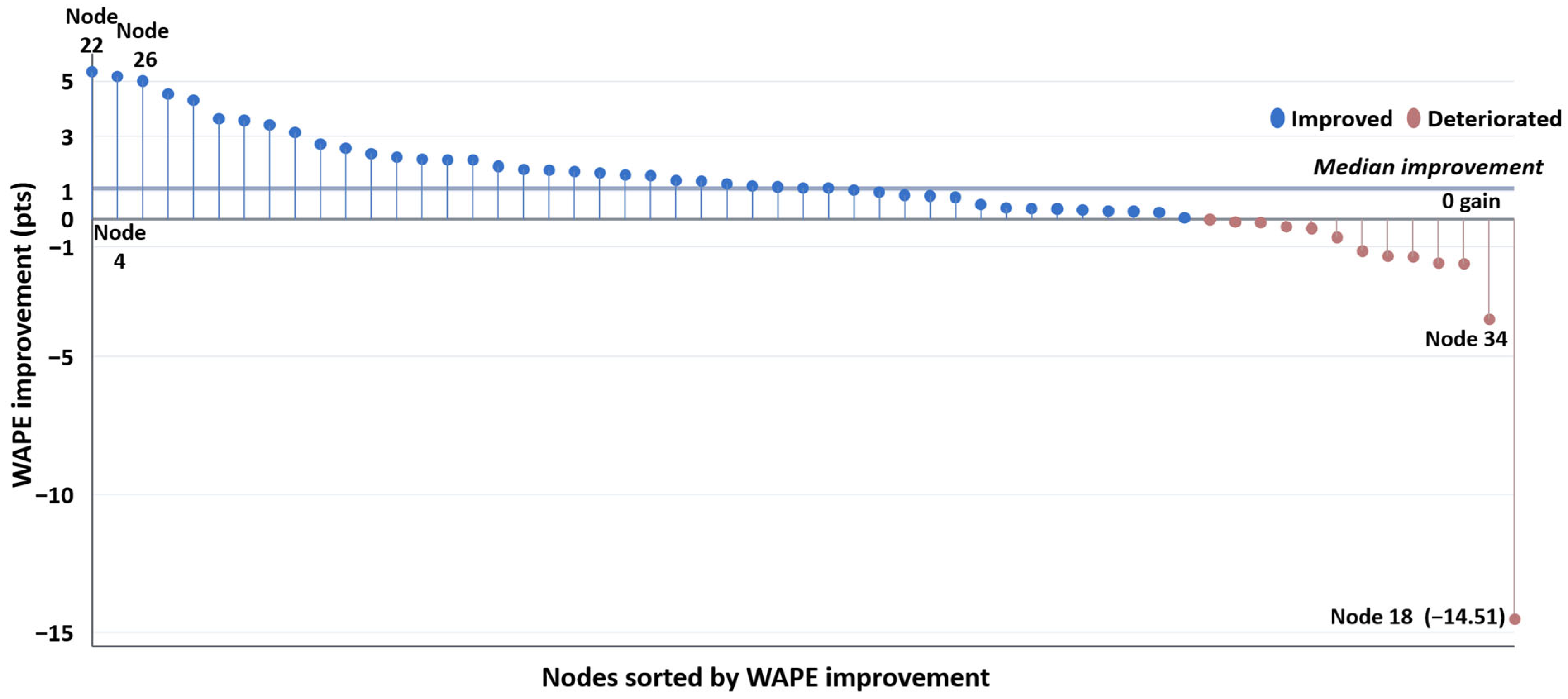
The empirical gains support this methodological contribution, but they should be interpreted cautiously. In the Core task, topology-change encoding reduces test WAPE from 18.10% to 17.11%, and perturbation-response proxies further reduce it to 16.91%. Node-level paired statistical tests indicate that the improvement is statistically significant, and 44 of 57 nodes are improved. However, these gains remain incremental rather than large-scale. They should not be interpreted as evidence that the proposed RF-based framework universally dominates all forecasting alternatives, especially under full-information dynamic-graph settings where continuous post-change edge weights and updated graph states are available.
Table 12 summarizes these scenario-specific interpretations by linking the stable-network, route-perturbation, and data-scarce-node evidence to the corresponding computational and methodological implications.
4.4. Practical Implications and System Integration
The proposed framework translates partial pre-forecast information into three operationally usable outputs: 1-h-ahead node-level cargo-volume forecasts, high-load warning flags, and perturbation-sensitive node lists. These outputs are intended to support short-term operational preparation rather than replace routing or dispatching decisions.
The operational use of these outputs depends on the forecasting scenario. Under stable-network conditions, node-level forecasts support routine monitoring, staffing adjustment, equipment allocation, vehicle organization, and buffer-area preparation. Under planned route perturbations, topology-change encoding and perturbation-response proxies help identify nodes exposed to local reconfiguration or potential rerouting pressure, thereby supporting priority monitoring, temporary staffing, vehicle rescheduling, and capacity-buffer preparation. For data-scarce nodes, similarity-assisted forecasting provides conservative transitional support for newly activated, recently reconfigured, or peripheral nodes with limited but nonzero local history.
The operational meaning of the Core-task WAPE reduction should be interpreted cautiously. The decrease from 18.10% to 17.11% and then to 16.91% is moderate in absolute magnitude and should not be described as a large-scale improvement or evidence of universal superiority. Its value lies in the strict partial-information boundary: forecasts are generated before realized post-change edge flows, continuous dynamic edge weights, and updated graph states become available.
To provide a quantitative indication of deployment cost, runtime was measured using MATLAB 9.10.0.1602886 (R2021a) on a PCWIN64 workstation with a 13th Gen Intel(R) Core(TM) i9-13900HX CPU, 16 GB RAM, and 24 CPU cores detected by MATLAB. Although an NVIDIA GeForce RTX 4060 Laptop GPU was available on the workstation, no GPU acceleration was used in this benchmark. For the final RF-Core-Proposed model with 700 trees, a minimum leaf size of 10, and 386 predictors sampled at each split, final model training required 474.87 ± 15.88 s over three repeated benchmark runs. RF inference for the complete test set of 5472 node-hour samples required 9.52 ± 0.25 s, corresponding to approximately 0.0992 ± 0.0026 s per hourly forecast origin for all 57 sorting centers. This benchmark covers model fitting and RF inference after the required feature tables have been prepared. It does not include raw data I/O, database access, dashboard communication, or full recomputation of structural descriptors from raw operational systems. Online inference assumes cached structural and topology descriptors. When planned route-adjustment records are updated, topology-change encodings and perturbation-response proxies should be recomputed before the next forecasting cycle. These results indicate that the proposed framework has a lightweight online computational profile in the present 57-node setting, although runtime and scalability should be re-evaluated before deployment in larger logistics networks.
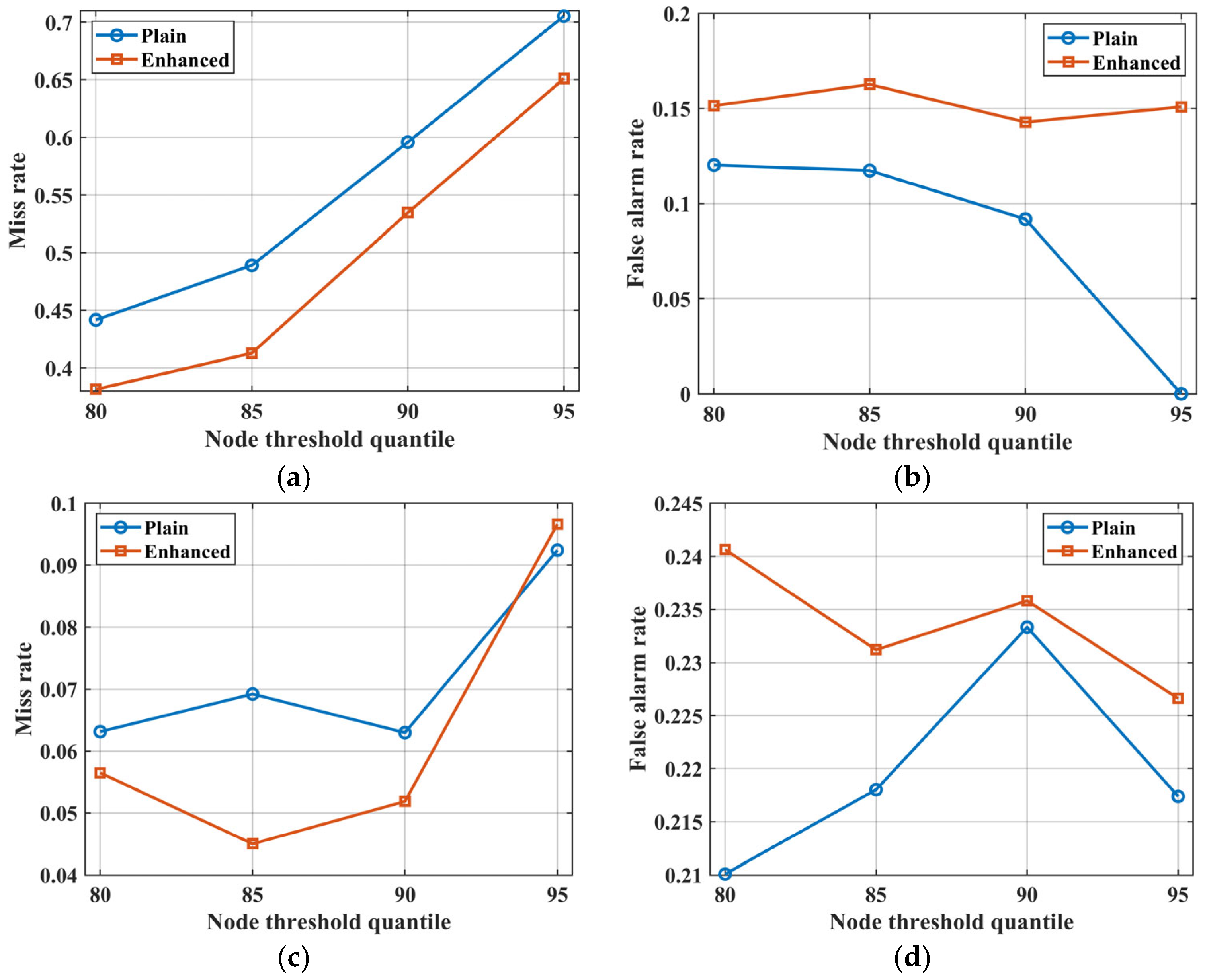
The high-load warning results provide a more direct operational interpretation than WAPE alone. In the Core setting, the miss rate decreases from 0.596 to 0.535 and recall increases from 0.404 to 0.465, indicating fewer missed high-load periods. Continuous weighted loss also decreases from 155.92 to 148.31, suggesting lower under-prediction-oriented error. Because this benefit is accompanied by a higher false-warning ratio, the result should be interpreted as improved high-load coverage rather than uniform improvement across all warning metrics. In sorting operations, reducing missed warnings may support more timely staffing, vehicle dispatch, equipment activation, and buffer-area preparation, although the additional false-warning burden should be considered in deployment.
A real-world deployment can follow an hourly rolling forecasting workflow. At each forecast origin, the system updates recent node-level cargo volumes and reads cached pre-change network descriptors. When planned route-topology adjustments are available, the topology-change matrix and perturbation-response proxies are updated. For limited-history nodes, similarity-support features are computed from admissible historical information or retrieved from a precomputed reference-node table. The deployed predictor then outputs 1-h-ahead node-level forecasts, high-load warning flags, and perturbation-sensitive node lists, which can be connected to staffing systems, vehicle-dispatch modules, equipment-activation rules, buffer-area planning tools, and monitoring dashboards. Warning thresholds and false-warning tolerance should be selected according to the local cost balance between missed high-load periods and unnecessary resource activation.
Most computational burden is offline or periodic. The trained forecasting model does not need to be retrained at every hourly forecast origin. Routine retraining can be scheduled daily or weekly, depending on local data-drift monitoring, operational policy, and computational resources. By contrast, topology-change encodings and perturbation-response proxies should be recomputed whenever planned route-adjustment records are updated. Thus, volume-feature refreshing follows the hourly forecasting cycle, model retraining follows a periodic schedule, and topology-related feature recomputation is triggered by route-topology update events.
Several operational constraints remain. The framework requires reliable node identifiers, timely hourly cargo-volume data, planned topology-change records, and stable data interfaces among forecasting, routing, and monitoring systems. It is less suitable for unannounced disruptions when no topology-change information is available before prediction. It is also not a complete cold-start solution, because similarity-assisted forecasting still assumes limited but nonzero local history. In full-information settings where dynamic edge weights and updated graph states are available, dynamic GNN or STGNN models should be evaluated under that richer information boundary. For policymakers and platform managers, the findings highlight the importance of standardized data sharing, route-adjustment logging, and early-warning protocols in logistics sorting networks.
4.5. Generalizability, Boundary, and Failure Conditions
The proposed framework is applicable when historical node-level volumes, the pre-change network structure, and planned or observable route-topology changes are available before forecasting, but continuous post-change dynamic edge weights and regularly updated graph states are not. Under this boundary, the framework provides admissible node-level forecasting inputs rather than attempting to reconstruct the full post-change edge-level cargo-flow process.
The framework may also be relevant to other networked forecasting systems, such as transportation networks, supply-chain networks, service networks, and infrastructure networks, where planned topology changes are known before realized dynamic edge weights are observed. However, this generalizability should be treated as a hypothesis requiring external validation. The present evidence is based on one logistics sorting network and should not be interpreted as direct proof of performance in other networked systems.
The framework is less suitable in several conditions. First, when disruptions occur unexpectedly and no advance topology-change information is available, perturbation-response proxy features may not capture the relevant change. Second, in full-information settings where continuous post-change dynamic edge weights are observable, dynamic graph or spatiotemporal graph models should be compared under that richer information setting rather than excluded. Third, the framework is designed for short-term node-level forecasting, not for long-term structural evolution forecasting. Fourth, if topology changes do not plausibly affect node-level load redistribution, perturbation-response proxy features may provide limited additional value. Fifth, for data-scarce nodes with almost no usable history or no meaningful reference nodes, similarity support may be unstable.
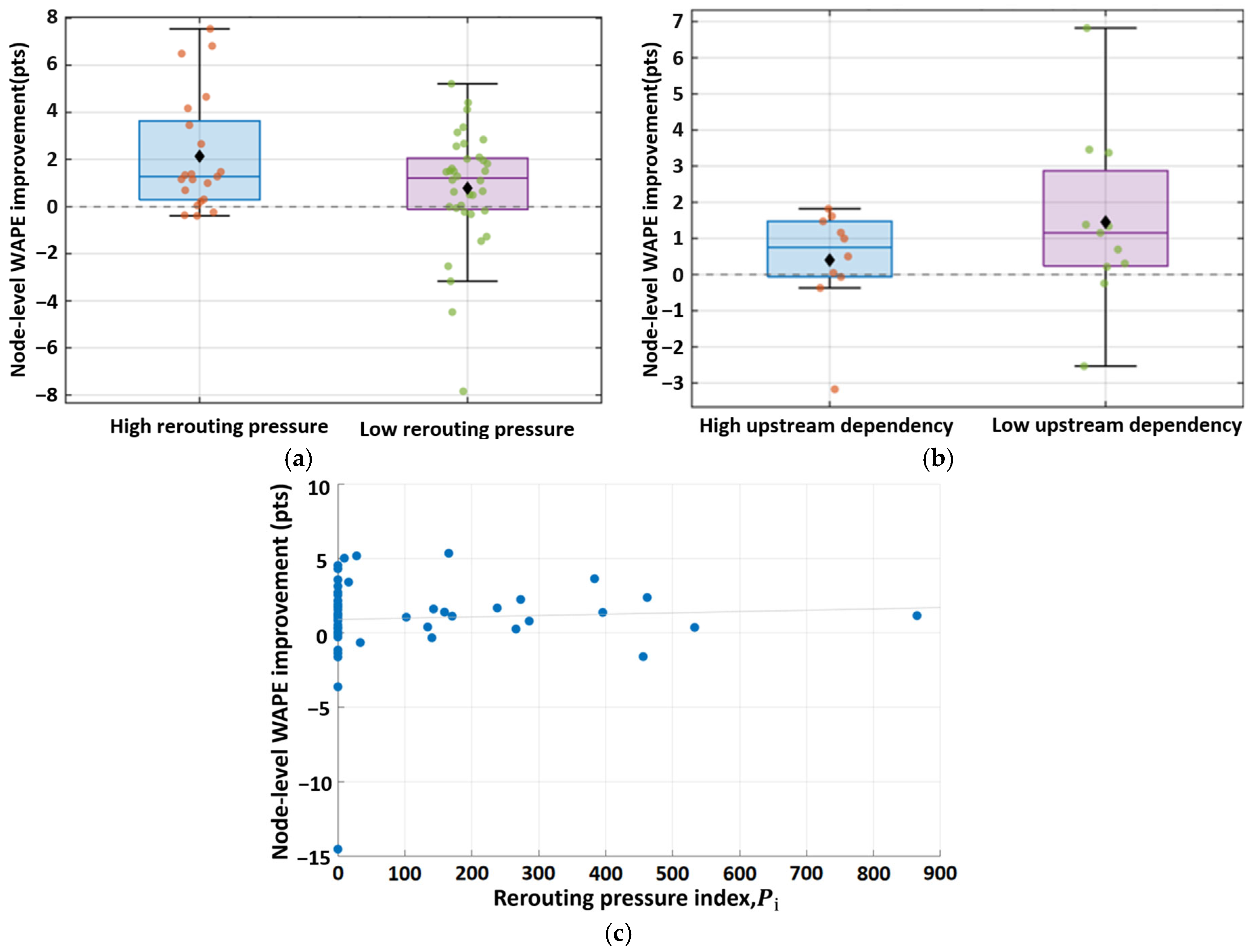
The gains should also be interpreted as conditional rather than uniform. In the Core task, nodes under stronger perturbation pressure obtain larger improvements: the low-perturbation group has a mean improvement of 0.55 percentage points, whereas the medium–high-perturbation group has a mean improvement of 1.70 percentage points. This does not imply a proportional linear relationship between rerouting pressure and forecasting gain. It indicates that perturbation-response proxy features are more useful when topology changes create stronger local load-bearing pressure. In the Extension task, similarity support improves 15 of 17 data-scarce nodes and remains beneficial under 10%, 20%, and 30% retention ratios, with WAPE changing from 29.07% to 26.94%, from 29.43% to 26.68%, and from 29.63% to 27.58%, respectively. Nevertheless, gain magnitudes vary across nodes, so the reported improvements should be interpreted as conditional gains under the defined partial-information setting rather than as universal improvements across all forecasting environments.
4.6. Limitations and Future Research
This study has several limitations. First, the empirical validation is based on a single anonymized logistics sorting network. Although the dataset contains all 57 sorting centers available under the adopted benchmark structure, it should not be interpreted as a statistically representative sample of logistics sorting networks in general. Future research should validate the framework across multiple logistics networks, firms, regions, and operating periods.
Second, the perturbation-response variables are proxy inputs constructed when post-change dynamic edge weights are unavailable. They represent neighborhood reconfiguration, damage to the pre-change connectivity basis, and potential rerouting pressure, but they do not recover true edge-level cargo-flow propagation. Future work should compare these proxies with realized post-change flow data when such data become available.
Third, full-information dynamic graph models, including dynamic GNN and STGNN variants, are excluded from the main comparison because they require post-change edge weights, evolving node–edge states, or updated graph structures that are unavailable before prediction in the present setting. This exclusion reflects the information-admissibility boundary and should not be interpreted as a claim that such models are inherently inferior. Future research should compare the proposed framework with dynamic graph and spatiotemporal graph models under full-information settings.
Fourth, the data-scarce-node extension is a controlled limited-history simulation, not a naturally missing-data scenario or a complete cold-start method. Each data-scarce node retains limited but nonzero local history, and the similarity-support module still depends on meaningful reference-node selection. Future work should examine true cold-start settings, adaptive reference-node selection, and robustness when reference nodes are weakly matched or operationally unstable.
5. Conclusions
Before prediction, the available information includes historical node volumes, the pre-change network structure, and planned route-topology changes, whereas realized post-change edge flows, continuous post-change dynamic edge weights, and updated graph states remain unavailable. This setting differs from full-information dynamic-graph forecasting, where evolving node–edge states or updated graph structures can be observed and directly incorporated into model construction. The central computational problem addressed in this study is therefore how to convert limited pre-forecast information and planned topology changes into admissible node-level predictors for short-term forecasting.
The empirical results demonstrate that different information modules contribute differently across the three forecasting settings. Under stable-network conditions, temporal dynamics and periodic patterns dominate node-level forecasting, while structural descriptors provide only limited additional benefit. Under route perturbation, topology-change signals reduce test WAPE from 18.10% to 17.11%, and perturbation-response proxies further reduce it to 16.91%, with improvements observed for 44 of the 57 nodes. Under the data-scarce-node setting, similarity support reduces test WAPE from 29.43% to 26.68%, with 15 of the 17 data-scarce nodes improved. The gains remain consistent under 10%, 20%, and 30% training-sample retention settings, where WAPE decreases from 29.07% to 26.94%, from 29.43% to 26.68%, and from 29.63% to 27.58%, respectively. These improvements are incremental rather than large-scale, but node-level statistical tests indicate significant gains, and the reductions are practically meaningful under the defined partial-information boundary.
The warning-oriented results further indicate improved high-load coverage. The enhanced settings reduce missed high-load events and increase recall, while the continuous weighted loss decreases, suggesting reduced under-prediction-oriented forecasting error. However, in the Core task, the improvement in recall is accompanied by a higher false-warning ratio, revealing a trade-off between missed-event reduction and false-warning control. Therefore, the warning results should be interpreted as recall-oriented improvement in high-load identification, rather than as uniform improvement across all operational warning metrics.
The methodological novelty of this study does not lie in the random forest algorithm itself. Random forest is used as a controlled forecasting backbone to evaluate the incremental value of the proposed computational representations under the same target, sample-construction logic, and evaluation protocol. The core contribution is the transformation of planned topology perturbations into interpretable and information-admissible node-level predictive variables. Specifically, the perturbation-response proxies represent neighborhood reconfiguration, damage to the pre-change connectivity basis, and rerouting pressure before realized post-change edge-level information becomes available. These proxies do not reconstruct true post-change edge-level flows. The similarity-support module further extends the same forecasting protocol to limited-history nodes without changing the forecasting target, supervised-sample construction rule, or evaluation protocol.
From a practical and computational perspective, the proposed framework provides an information-admissible decision-support layer for hourly node monitoring, high-load warning, short-term staffing, vehicle coordination, equipment allocation, and buffer-area preparation. Its value is particularly relevant before realized post-change dynamic edge weights become available, when logistics managers must still prepare for possible short-term node-level load changes. The framework is not intended to replace richer full-information dynamic graph models when continuous post-change edge weights, updated graph states, and realized flow observations are available. In deployment, warning thresholds and false-warning tolerance should be selected according to the local cost balance between missed high-load periods and unnecessary resource activation.
Several limitations remain. First, the empirical validation is based on a single anonymized logistics sorting network; future work should evaluate the framework across multiple networks, firms, and operating periods. Second, the perturbation-response proxies are not true edge-flow recovery variables; future studies should compare them with realized post-change flow data when such data become available. Third, dynamic GNN and STGNN models are excluded only because their required information is unavailable under the present boundary; future work should compare them with the proposed framework under full-information settings. Fourth, the data-scarce-node experiment is a controlled limited-history simulation, not a naturally missing-data scenario or a complete cold-start method; future research should examine true cold-start settings and adaptive reference-node selection. Future work should also investigate online updating, integration with real-time monitoring systems, and forecast-informed operational optimization.