Article

Partitioning Uncertainty in Model Predictions from Compartmental Modeling of Global Carbon Cycle


Department of Mathematical Sciences, Montana Technological University, Butte, MT 59701, USA
Math. Comput. Appl. 2024, 29(4), 47; https://doi.org/10.3390/mca29040047
Submission received: 6 April 2024 / Revised: 12 June 2024 / Accepted: 20 June 2024 / Published: 22 June 2024

Abstract

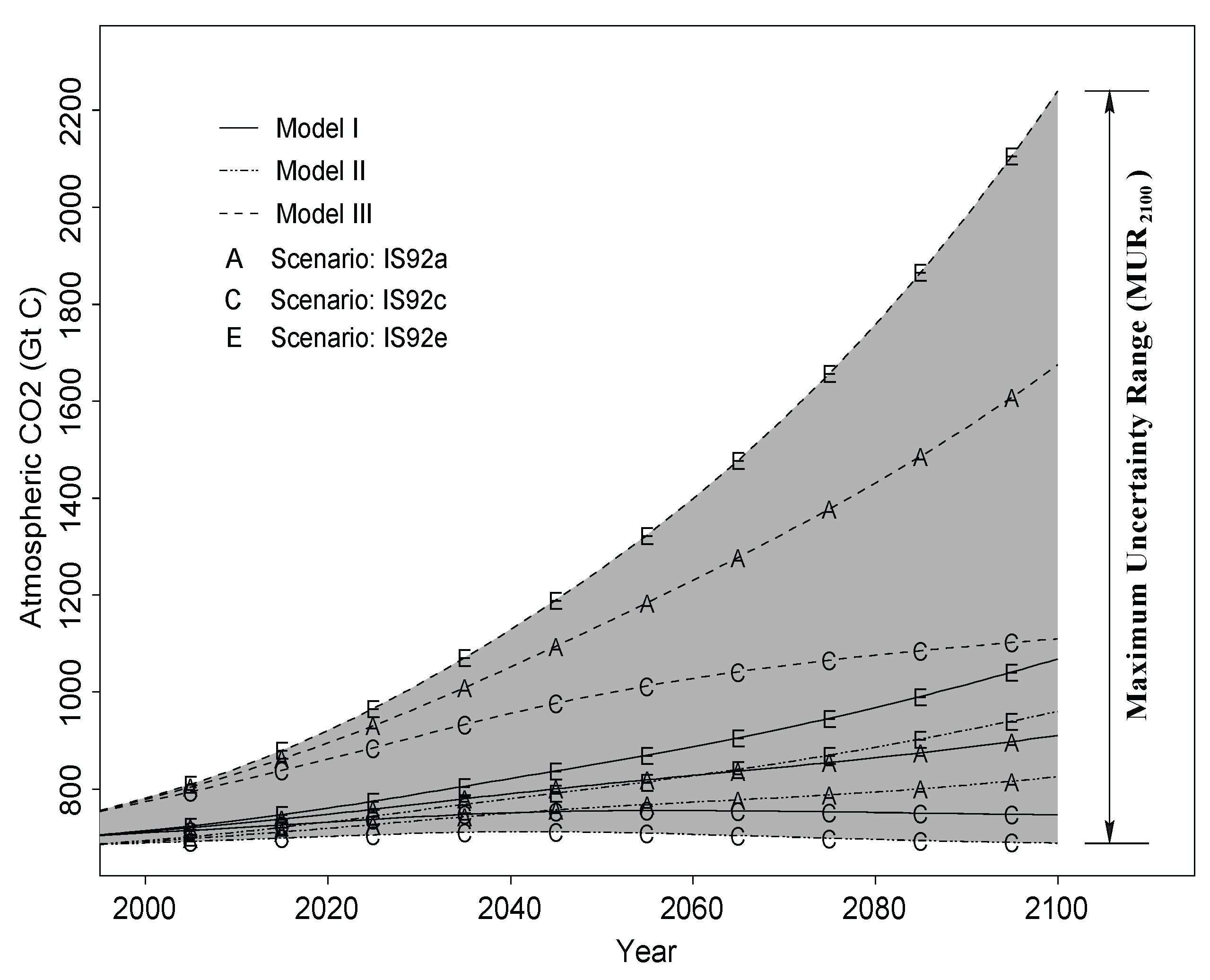
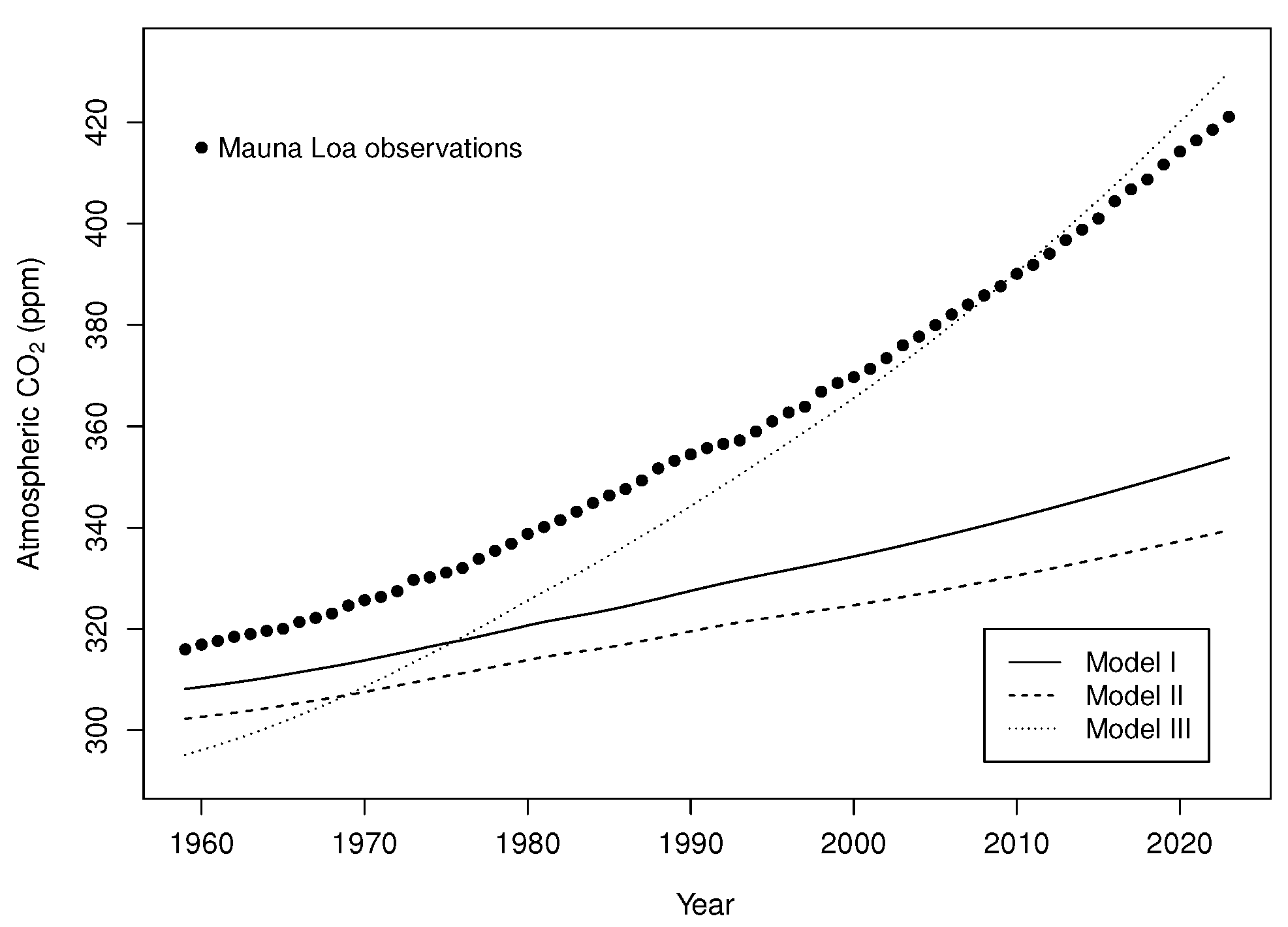
Our comprehension of the real world remains perpetually incomplete, compelling us to rely on models to decipher intricate real-world phenomena. However, these models, at their pinnacle, serve merely as close approximations of the systems they seek to emulate, inherently laden with uncertainty. Therefore, investigating the disparities between observed system behaviors and model-derived predictions is of paramount importance. Although achieving absolute quantification of uncertainty in the model-building process remains challenging, there are avenues for both mitigating and highlighting areas of uncertainty. Central to this study are three key sources of uncertainty, each exerting significant influence: (i) structural uncertainty arising from inadequacies in mathematical formulations within the conceptual models; (ii) scenario uncertainty stemming from our limited foresight or inability to forecast future conditions; and (iii) input factor uncertainty resulting from vaguely defined or estimated input factors. Through uncertainty analysis, this research endeavors to understand these uncertainty domains within compartmental models, which are instrumental in depicting the complexities of the global carbon cycle. The results indicate that parameter uncertainty has the most significant impact on model outputs, followed by structural and scenario uncertainties. Evident deviations between the observed atmospheric CO2 content and simulated data underscore the substantial contribution of certain uncertainties to the overall estimated uncertainty. The conclusions emphasize the need for comprehensive uncertainty quantification to enhance model reliability and the importance of addressing these uncertainties to improve predictions related to global carbon dynamics and inform policy decisions. This paper employs partitioning techniques to discern the contributions of the aforementioned primary sources of uncertainty to the overarching prediction uncertainty.
Keywords: compartmental model; uncertainty analysis; partitioning uncertainty compartmental model; uncertainty analysis; partitioning uncertainty