
Assessing the Condition of Complex Poly-Material Artworks by Py-GC-MS: The Study of Cellulose Acetate-Based Animation Cels


Abstract
1. Introduction
2. Materials and Methods
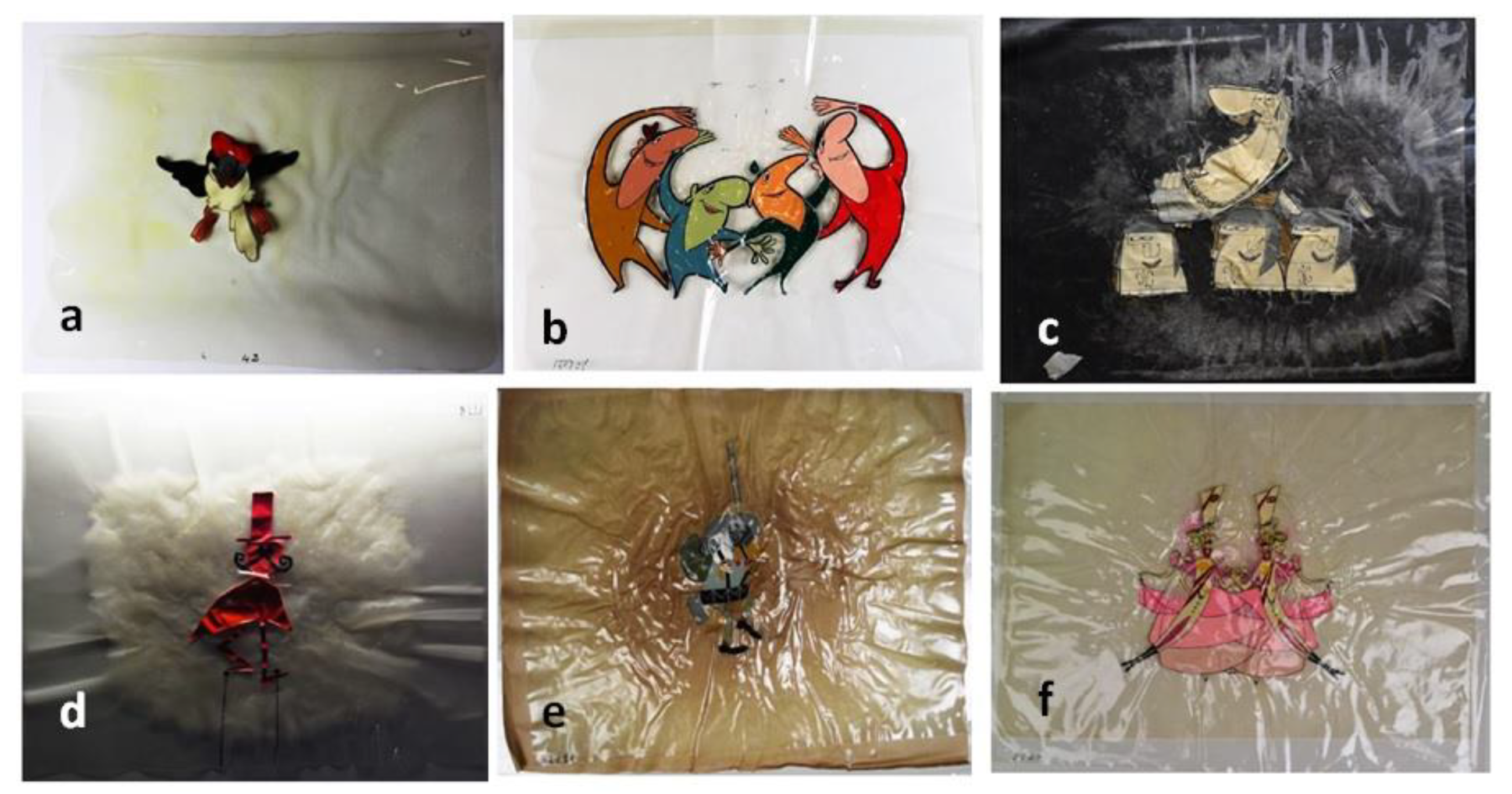
2.1. Selected Animation Cels
2.2. Flash Pyrolysis-GC-MS Investigation of Plastic
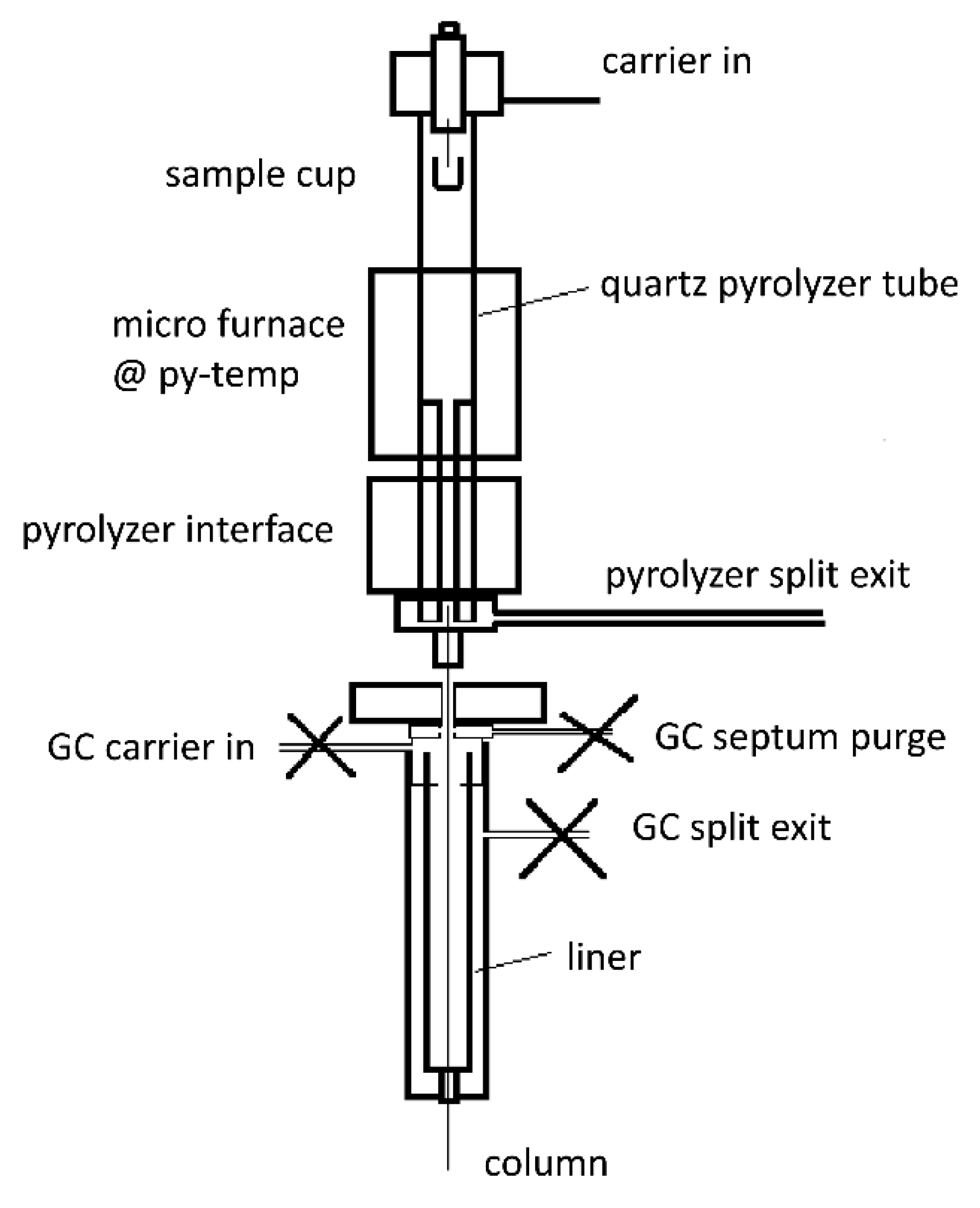
2.3. Septum-Less Pyrolyzer Connection Novelty
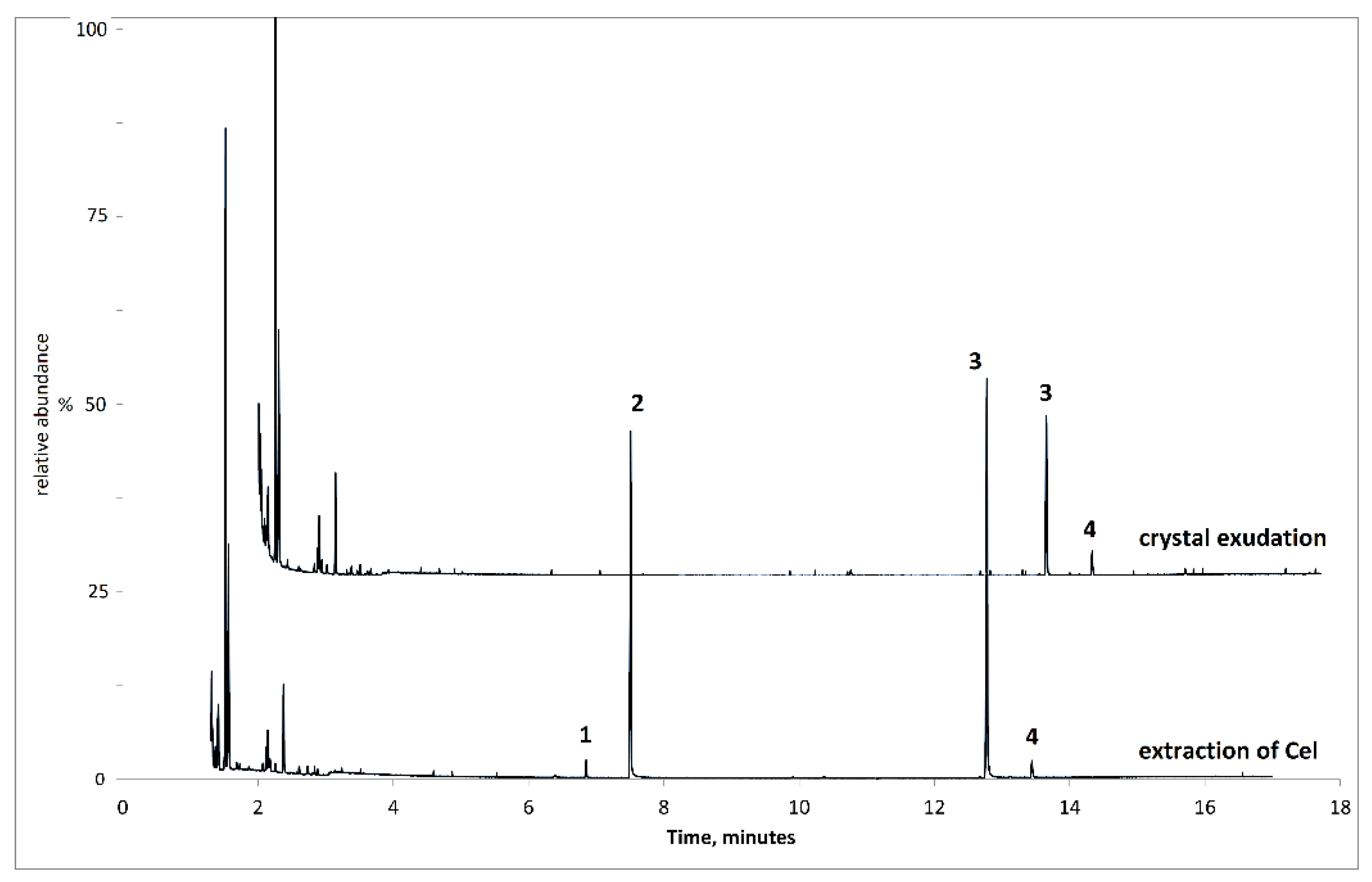
2.4. GC-MS Identification of Exudation and Plasticizer Content
2.5. Analysis of Paint Samples by Thermally Assisted Hydrolysis and Methylation-(Py-)GC-MS
3. Results and Discussion
3.1. Plastic Substrate
3.2. Painted Layers
4. Conclusions and Further Perspectives
Author Contributions
Funding
Institutional Review Board Statement
Informed Consent Statement
Data Availability Statement
Acknowledgments
Conflicts of Interest
References
- Alle Fonti del Cinema. Available online: http://www.musilbrescia.it/minisiti/alle-fonti-del-cinema/rodovetri.asp (accessed on 20 February 2022).
- Giachet, M.T.; Schilling, M.; McCormick, K.; Mazurek, J.; Richardson, E.; Khanjian, H.; Learner, T. Assessment of the composition and condition of animation cels made from cellulose acetate. Polym. Degrad. Stab. 2014, 107, 223–230. [Google Scholar] [CrossRef] [Scilit]
- Giachet, M.T.; Schilling, M.; Mazurek, J.; Richardson, E.; Pesme, C.; Khanjian, H.; Learner, T.; McCormick, K. Characterization of Chemical and Physical Properties of Animation Cels from the Walt Disney Animation Research Library. In ICOM Committee for Conservation 17th Triennial Meeting Melbourne Preprints; Bridgland, J., Ed.; International Council of Museums: Paris, France, 2014. [Google Scholar]
- McCormick, K.; Schilling, M.R. ANIMATION CELS—Preserving a Portion of Cinematic History. Available online: http://www.getty.edu/conservation/publications_resources/newsletters/29_1/animation.html (accessed on 15 January 2022).
- Hoeyng, K.; Rapoport, E. Animation cels of the German Institute for Animated Film from 1968. Consolidation of alkyd resin and polyvinyl acetate paint layer on cellulose acetate. In Future Talks 011, Technology and Conservation of Modern Materials in Design; The Design Museum: Munich, Germany, 2011; pp. 217–223. [Google Scholar]
- Izzo, F.C.; Carrieri, A.; Bartolozzi, G.; van Keulen, H.; Lorenzon, I.; Balliana, E.; Cucci, C.; Grazzi, F.; Picollo, M. Elucidating the composition and the state of conservation of nitrocellulose-based animation cells by means of non-invasive and micro-destructive techniques. J. Cult. Herit. 2019, 35, 254–262. [Google Scholar] [CrossRef] [Scilit]
- Meade, R.K.; McCormack, H.; Clark, L.T.; Sclater, S.G.; Alexander, G.; Lamborn, L. Chemical Age. McCready Publishing Company. 1905. Available online: https://books.google.it/books?id=kwA3AQAAMAAJ&pg=PA288&redir_esc=y (accessed on 15 January 2022).
- Puls, J.; Wilson, S.A.; Hoelter, D. Degradation of Cellulose Acetate-Based Materials: A Review. J. Polym. Environ. 2011, 19, 152–165. [Google Scholar] [CrossRef] [Scilit]
- Rambaldi, D.C.; Suryawanshi, C.; Eng, C.; Preusser, F.D. Effect of thermal and photochemical degradation strategies on the deterioration of cellulose diacetate. Polym. Degrad. Stab. 2014, 107, 237–245. [Google Scholar] [CrossRef] [Scilit]
- Allen, N.S.; Edge, M.; Appleyard, J.; Jewitt, T.; Horie, C.; Francis, D. Degradation of historic cellulose triacetate cinematographic film: The vinegar syndrome. Polym. Degrad. Stab. 1987, 19, 379–387. [Google Scholar] [CrossRef] [Scilit]
- Phuong, V.T.; Verstichel, S.; Cinelli, P.; Anguillesi, I. Cellulose acetate blends—Effect of plasticizers on properties and biodegradability. J. Renew. Mater. 2014, 2, 35–41. [Google Scholar] [CrossRef] [Scilit]
- Schwarzinger, C.; Tanczos, I.; Schmidt, H. Pyrolysis–gas chromatography/mass spectrometry and thermally assisted hydrolysis and methylation (THM) analysis of various cellulose esters. J. Anal. Appl. Pyrolysis 2001, 58–59, 513–523. [Google Scholar] [CrossRef] [Scilit]
- Sutherland, K.; Schwarzinger, C.; Price, B.A. The application of pyrolysis-gas chromatography-mass spectrometry for the identification of degraded early plastics in a sculpture by Naum Gabo. J. Anal. Appl. Pyrolysis 2012, 94, 202–208. [Google Scholar] [CrossRef] [Scilit]
- Cappitelli, F.; Learner, T.; Cummings, A. Thermally assisted hydrolysis and methylation-gas chromatography-mass spectrometry for the chemical characterization of traditional and synthetic binders. In ICOM Committee for Conservation 13th Triennial Meeting Rio de Janeiro Preprints; Bridgland, J., Ed.; International Council of Museums: Paris, France, 2002; pp. 231–237. [Google Scholar]
- Van Oosten, T.; Cudell, A.; Veiga, R.; Lagana, A.; Van Keulen, H.; Venade, I. Strategies for the conservation of cellulose acetate artworks—a case study of two plastic books. In ICOM Committee for Conservation 16th Triennial Meeting Lisbon Preprints; Bridgland, J., Ed.; International Council of Museums: Paris, France, 2011. [Google Scholar]
- ExxonMobil Aviation Lubricants, Technical Bulletin. Available online: https://www.exxonmobil.com/lubes/exxonmobil/emal/files/HyJetV_Technical_Bulletin.pdf. (accessed on 12 May 2013).
- Van Keulen, H.; Schilling, M. AMDIS & EXCEL: A Powerful Combination for Evaluating THM-Py-GC/MS Results from European Lacquers. Stud. Conserv. 2019, 64, 74–80. [Google Scholar] [CrossRef] [Scilit]
- NIST Mass Spectral Library. Available online: https://chemdata.nist.gov/ (accessed on 3 October 2021).
- Richardson, E.; Giachet, M.T.; Schillling, M.; Learner, T. Assessing the physical stability of archival cellulose acetate films by monitoring plasticizer loss. Polym. Degrad. Stab. 2014, 7, 231–236. [Google Scholar] [CrossRef] [Scilit]
- Moldoveanu, S. Analytical Pyrolysis of Natural Organic Polymers; Elsevier Science B.V.: Amsterdam, The Netherlands, 1998; pp. 239, 258. [Google Scholar]
- Shinagawa, Y.; Murayama, M.; Sakaino, Y. Investigation of the archival Stability of Cellulose Triacetate Film: The effect of additives to CTA support, Ashigara Research Laboratories. In Polymers in Conservation; Allen, N.S., Edge, M., Horie, C.V., Eds.; Royal Society of Chemistry: Cambridge, UK, 1992; pp. 139–149. [Google Scholar]
- Wilson, W.K.; Forshee, B.W. Preservation of Documents by Lamination, US Department of Commerce National Bureau of Standards. 1959. Available online: https://nvlpubs.nist.gov/nistpubs/Legacy/MONO/nbsmonograph5.pdf (accessed on 12 July 2021).
- Yarsley, V.E.; Flavell, W.; Adamson, P.S.; Perkins, N.G. Cellulosic Plastics; The Plastic Institute: London, UK, 1964; pp. 77–78, 120–121. [Google Scholar]
- Van den Berg, J.D.J.; Van den Berg, K.J.; Boon, J.J. Identification of non-cross-linked compounds in methanolic extracts of cured and aged linseed oil-based paint films using gas chromatography mass spectrometry. J. Chromatogr. A 2002, 950, 195–211. [Google Scholar] [CrossRef] [Scilit]
- Thorburn Burns, D.; Doolan, K.P. A comparison of pyrolysis-gas chromatography-mass spectrometry and Fourier transform infrared spectroscopy for the analysis of a series of modified alkyd paint resins. Anal. Chim. Acta 2000, 422, 217–230. [Google Scholar] [CrossRef] [Scilit]
- Van den Berg, K.J.; Boon, J.J.; Pastorovat, I.; Spetter, L.F.M. Mass spectrometric methodology for the analysis of highly oxidized diterpenoid acids in Old Master paintings. J. Mass Spectrom. 2000, 35, 512–533. [Google Scholar] [CrossRef] [Scilit]
- Orsavova, J.; Misurcova, L.; Ambrozova, J.V.; Vicha, R.; Mlcek, J. Fatty Acids Composition of Vegetable Oils and Its Contribution to Dietary Energy Intake and Dependence of Cardiovascular Mortality on Dietary Intake of Fatty Acids. Int. J. Mol. Sci. 2015, 16, 12871–12890. [Google Scholar] [CrossRef] [Scilit] [PubMed]
- Tumosa, C.S. A Brief History of Aluminium Stearate as a Component of Paint. WAAC Newsl. 2001, 23, 3. [Google Scholar]
 = 1 mm) illustrating degradation of the CA sheets: (a) yellowing and cracking, (b) exudation, (c) crystalline exudates; and on painted layers: (d,e) plasticizers migration and crystallization, (f) paint loss.
= 1 mm) illustrating degradation of the CA sheets: (a) yellowing and cracking, (b) exudation, (c) crystalline exudates; and on painted layers: (d,e) plasticizers migration and crystallization, (f) paint loss.
= 1 mm) illustrating degradation of the CA sheets: (a) yellowing and cracking, (b) exudation, (c) crystalline exudates; and on painted layers: (d,e) plasticizers migration and crystallization, (f) paint loss.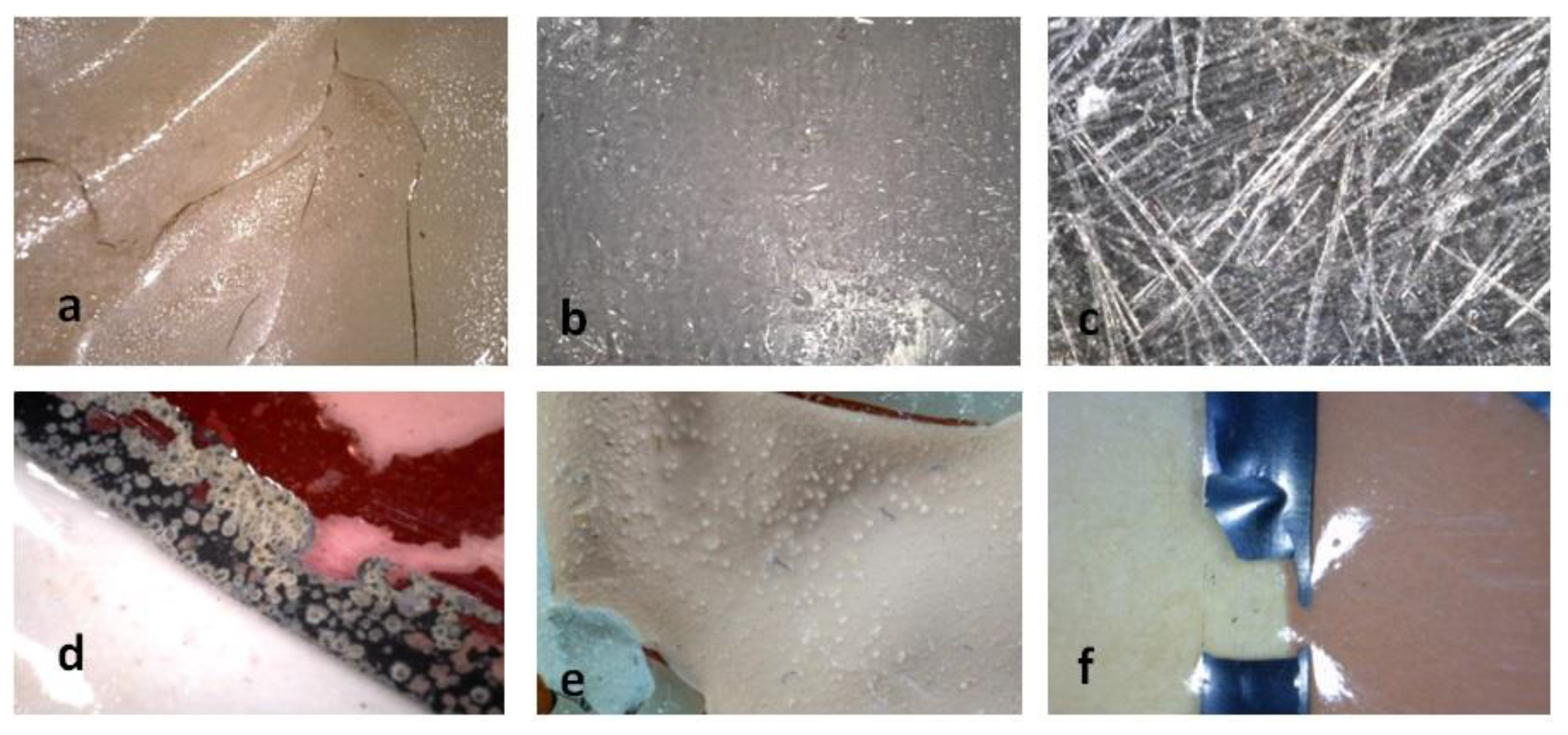


| Rodovetro/CA from the Series (Name, Year) | Typology of Sample | Samples Names | Optical Microscopy Picture (Where Available) = 1 mm = 1 mm | Visual Condition through Macro and Micro-Observations | CA Condition According to Py-GC/MS Results | (Main) Detected Plasticizers | Composition of Painted Layers |
|---|---|---|---|---|---|---|---|
| “Brandy Gran Senior” Fabbri (1974) | Plastic support | A5a | 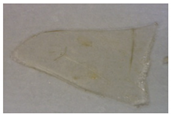 | Partially yellowed CA with the presence of exudates. | Degraded | DMEP + TPP | / |
| Painted layer | C5a | 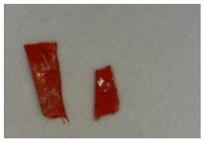 | Red painted film with surface whitening | / | / | Alkyd-pentaerythritol, drying oil, PR4, PR49, sulphide/sulphate, plasticiser-compounds | |
| “Vita” Stock (nd) | plastic support | A13 | 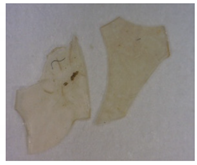 | Very yellowed, sticky and fragile CA fragments with the presence of exudates | Degraded | DMEP + TPP | / |
| “Stock Brandy Grand Senior”—series 2 (nd) | Plastic support | A15 | 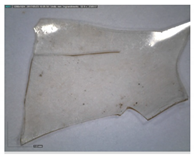 | Yellowed, sticky and fragile CA fragments with the presence of exudates | Degraded | DMEP + TPP | / |
| Painted layer | C12a |  | Black paint fragments with exudation | / | / | Alkyd-pentaerythritol, heat bodied oil, stearate, pine resin, sulphide, plasticiser-compounds | |
| “Derby” (1962) | Plastic support | A16 | 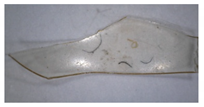 | Partially yellowed surface, exudated and sticky | Minor Degradation | DMEP + TPP | / |
| “RHO” (nd) | Plastic support | A18b | 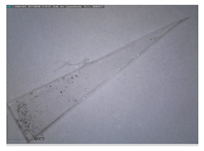 | Presence of black spots on the surface (biological attack?) | Good | DMEP + TPP | / |
| “Crepuscolo Veneziano— Sfinge Veneziana” (1970) | Plastic support | A20 |  | Slightly yellowed CA fragment | Good | DMEP + TPP | / |
| Painted layer | C20a | 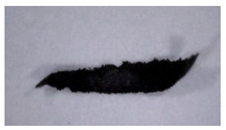 | Opaque black paint sample | / | / | Acrylics, alkyd-pentaerythritol, drying oil, pine resin, carbohydrates, sulphide, plasticiser-compounds | |
| Painted layer | C22 | 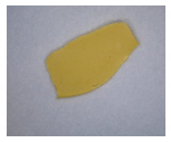 | Yellow paint sample | / | / | Alkyd-pentaerythritol, brassica oil, drying oil, sulphide, plasticiser-compounds | |
| “Caio Gregorio” (1960) | ROD5-C12 | 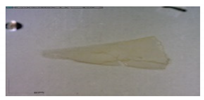 | Very yellowed and fragile CA fragment | Degraded | DMEP + TPP | / | |
| “La Rosa di Bagdad” (1949) | Plastic support | ROD9-31 | 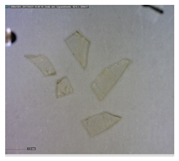 | Very yellowed and fragile CA fragments | Degraded | DMEP + TPP | / |
| “Pasta Scarpe Drago” (nd) | Painted layer | C4b | 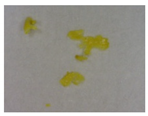 | Yellow paint fragments | / | / | Alkyd-glycerol, drying oil, pine resin, sulphide, plasticiser compounds. |
| “Ballo” Stock (nd) | Painted layer | C10d | 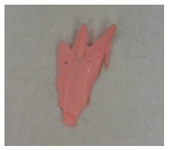 | Pink paint | / | / | Alkyd-pentaerythritol, castor oil, cenwax, pine resin, sulphide, plasticiser-compounds |
| “Recoaro” (1965) | Painted layer | C23a | 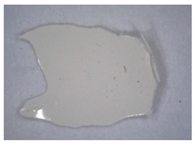 | White paint samples | / | / | Alkyd-pentaerythritol, drying oil, cenwax, starch, pine resin, plasticiser-compounds |
| Painted layer | C23c | 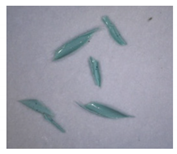 | Light blue painted layer | / | / | Alkyd-pentaerythritol, drying oil, pine resin, starch, sulphide, plasticiser compounds. | |
| “Vegetallumina” (1959) | Figure silhouette from the recto | RodA-3C22 | 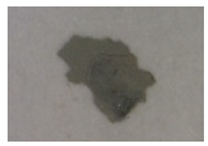 | Greyish paint film | / | / | Alkyd-pentaerythritol, drying oil, pine resin, starch, sulphide, plasticiser-compounds |
| Cellulose acetate sheet from Gamma film (1969) | Plastic support | VR11-V-AC | / | Slightly yellowed CA fragment | Good | DMP + DEP | / |
| Lourdes Castro, Ombres tranparentes (1960s) | Plastic support | D 3,4,5,6 | 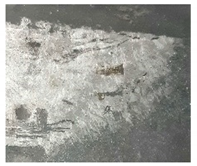 | Warped CA sheet with the presence of exudates | Good | DEP + TPP | / |
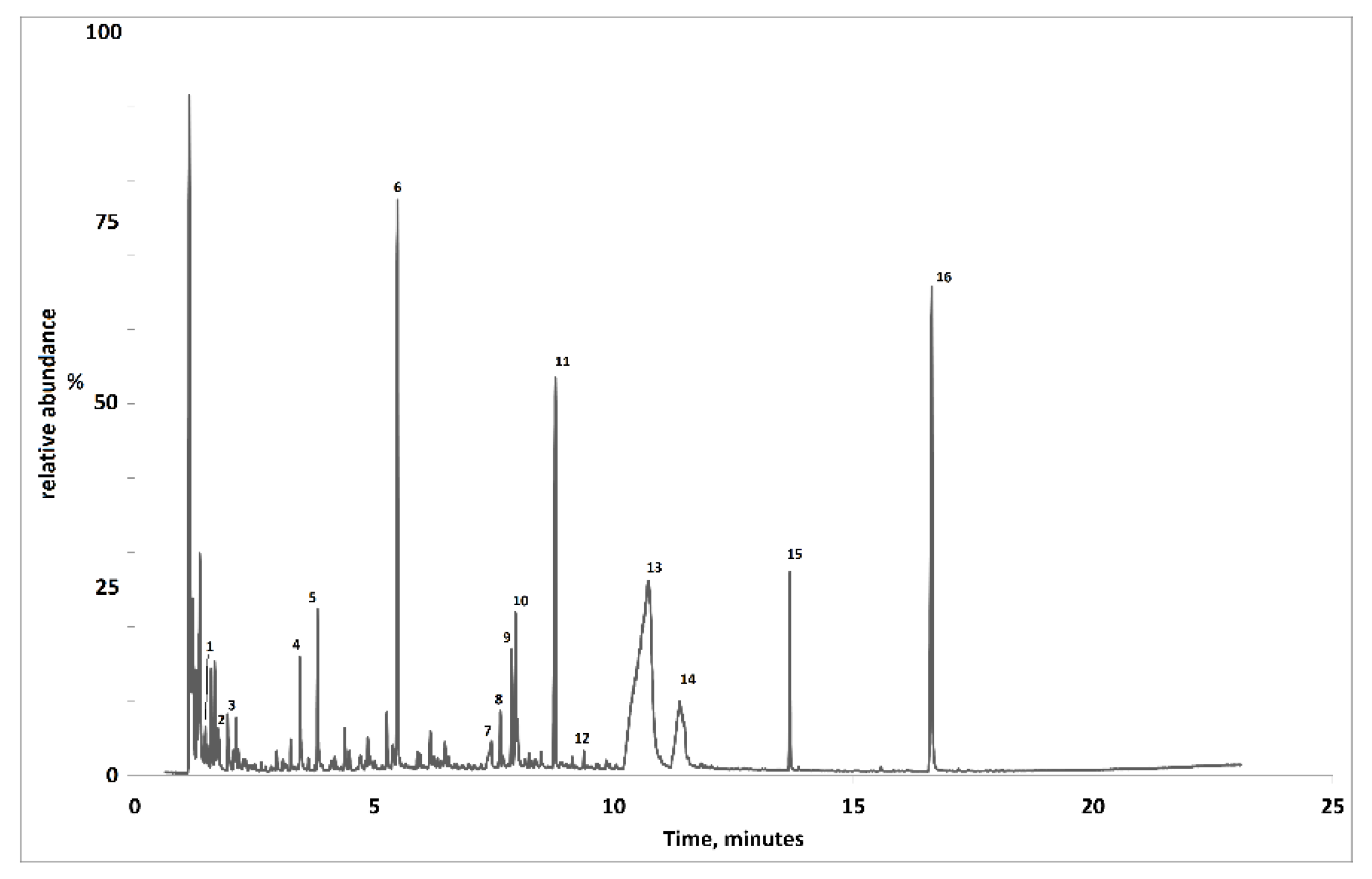
| Peak # | Retention Time (min) | Identified Compound | m/z (M+) |
|---|---|---|---|
| 1 | 1.48 | cyclopentadiene | 39/(66) |
| 2 | 1.76 | acetic acid | 43/45/(60) |
| 3 | 1.94 | methoxyethanol | 45/(76) |
| 4 | 3.45 | 2(5H)-furanose | 55/(84) |
| 5 | 3.81 | furfural | 39/95/(96) |
| 6 | 5.48 | phenol | 66/(94) |
| 7 | 7.45 | benzoic acid | 77/105/(122) |
| 8 | 7.63 | 1,2-napthalenedione | 102/130/(158) |
| 9 | 7.86 | 1,4:3,6-dianhydro-α-D-glucopyranose | 69/(144) |
| 10 | 7.95 | 5-hydroxy methylfurfural | 41/79/(126) |
| 11 | 8.78 | phthalic anhydride | 76/104/(148) |
| 12 | 9.37 | 2-methoxyethylbenzoate | 58/105/(180) |
| 13 | 10.72 | levoglucosan | 60/(180) |
| 14 | 11.33 | 1.6-Anhydro-β-D-glucofuranose | 73/(162) |
| 15 | 13.67 | bis(2-methoxyethyl) phthalate (DMEP) | 59/149/(282) |
| 16 | 16.63 | triphenyl phosphate (TPP) | 77/(326) |
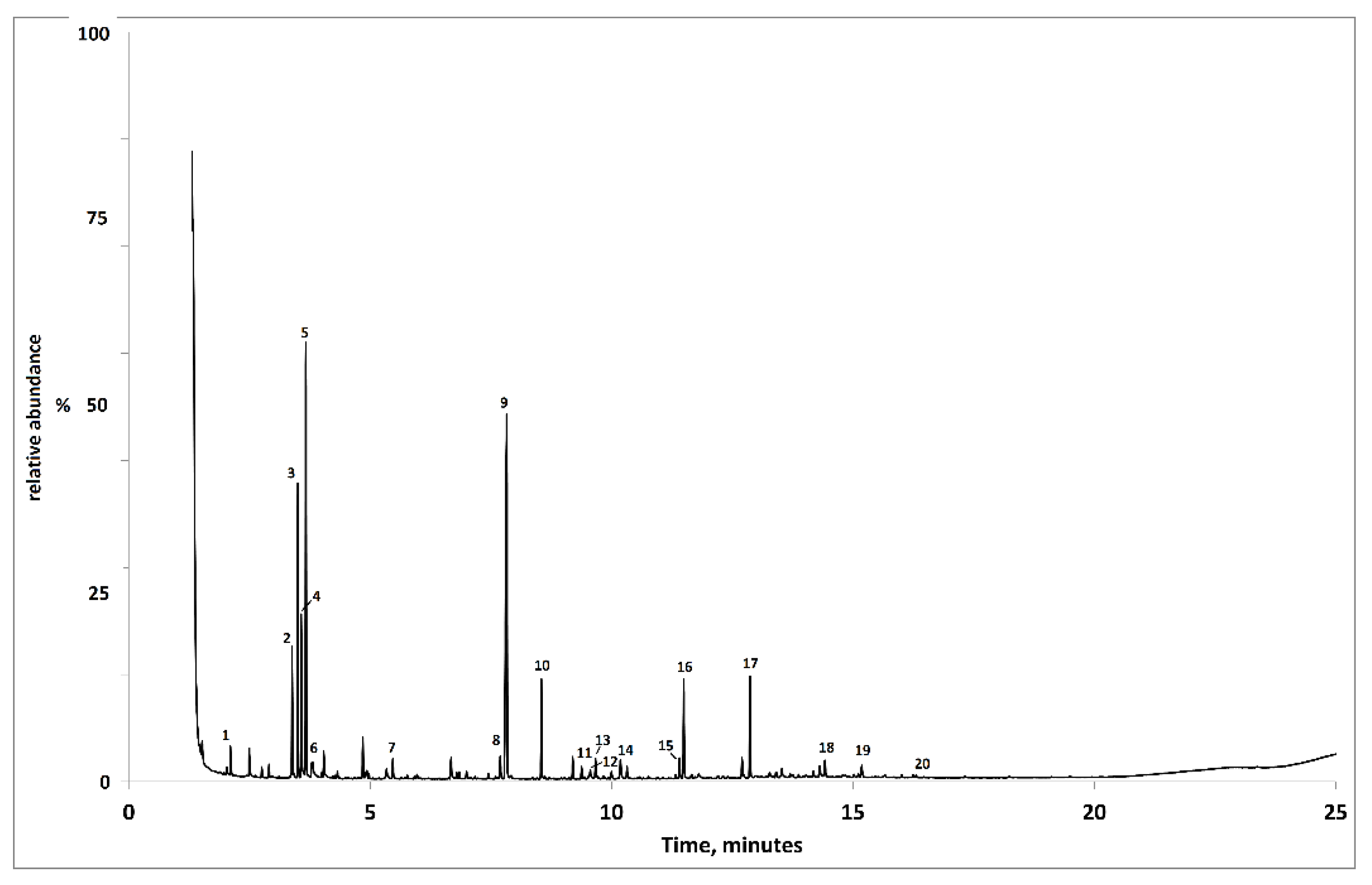
| Peak # | Retention Time (min) | Identified Compound | m/z (M+) |
|---|---|---|---|
| 1 | 2.10 | 1,2 dimethoxy ethane | 45/60/(90) |
| 2 | 3.38 | glycerol, 1,3-dimethyl ether | 45/75/(120) |
| 3 | 3.51 | glycerol, 1,2,3-trimethyl ether | 59/89/(134) |
| 4 | 3.58 | glycerol, 2,3-dimethyl ether | 45/75/89/(120) |
| 5 | 3.67 | Anisole | 65/78/(108) |
| 6 | 3.81 | trimethyl phosphate | 79/110/(140) |
| 7 | 5.47 | pentaerythritol, trimethyl ether | 45/75/(178) |
| 8 | 7.70 | octanedioic acid, dimethyl ester | 74/129/(202) |
| 9 | 7.83 | dimethyl phthalate | 163/(194) |
| 10 | 8.55 | nonanedioic acid, dimethyl ester | 74/152/(216) |
| 11 | 9.38 | decanedioic acid, dimethyl ester | 74/125/(230) |
| 12 | 9.57 | 2-naphthylamine, N-methyl | 115/128/(157) |
| 13 | 9.67 | 1-naphthylamine, N,N-dimethyl | 128/154/(171) |
| 14 | 10.18 | 1-naphthylamine, 2-methoxy | 130/158/(173) |
| 15 | 11.41 | diphenyl-methyl phosphate (MDPP) | 77/170/(264) |
| 16 | 11.49 | hexadecanoic acid, methyl ester | 74/(270) |
| 17 | 12.87 | octadecanoic acid, methyl ester | 74/(298) |
| 18 | 14.42 | dehydroabietic acid, methyl ester | 239/(314) |
| 19 | 15.18 | 7-methoxy dehydroabietic acid, methyl ester | 227/267/(342) |
| 20 | 16.91 | 7,15-dimethoxy tetradehydroabietic acid, methyl ester | 73/340/(372) |
Publisher’s Note: MDPI stays neutral with regard to jurisdictional claims in published maps and institutional affiliations. |
© 2022 by the authors. Licensee MDPI, Basel, Switzerland. This article is an open access article distributed under the terms and conditions of the Creative Commons Attribution (CC BY) license (https://creativecommons.org/licenses/by/4.0/).
Share and Cite
Izzo, F.C.; Van Keulen, H.; Carrieri, A. Assessing the Condition of Complex Poly-Material Artworks by Py-GC-MS: The Study of Cellulose Acetate-Based Animation Cels. Separations 2022, 9, 131. https://doi.org/10.3390/separations9050131
Izzo FC, Van Keulen H, Carrieri A. Assessing the Condition of Complex Poly-Material Artworks by Py-GC-MS: The Study of Cellulose Acetate-Based Animation Cels. Separations. 2022; 9(5):131. https://doi.org/10.3390/separations9050131
Chicago/Turabian StyleIzzo, Francesca Caterina, Henk Van Keulen, and Alessandra Carrieri. 2022. "Assessing the Condition of Complex Poly-Material Artworks by Py-GC-MS: The Study of Cellulose Acetate-Based Animation Cels" Separations 9, no. 5: 131. https://doi.org/10.3390/separations9050131
APA StyleIzzo, F. C., Van Keulen, H., & Carrieri, A. (2022). Assessing the Condition of Complex Poly-Material Artworks by Py-GC-MS: The Study of Cellulose Acetate-Based Animation Cels. Separations, 9(5), 131. https://doi.org/10.3390/separations9050131