


Abstract
Five pH- and light-switchable punicine derivatives were investigated as collectors in the flotation of spodumene and quartz. At the natural pH of the minerals, the punicine substituted with a C17 alkyl residue showed the best recovery under daylight (>5000 lux), with values up to 65.0% and 97.8%, and also the highest absolute recovery difference between the two minerals. For pH values of 2 and 12, the punicine collector with a viologen moiety and a C9 alkyl residue shows the best absolute recovery difference, with values of 32.45% and 32.88%, respectively. Studies on the influence of pH, particle size distribution, UV light and darkness, ζ-potential measurements, and IR spectroscopic measurements were carried out to gain insight into the mechanisms.
1. Introduction
Global demand for lithium is constantly increasing due to the rise in electric vehicles and the use of this element in rechargeable batteries, which already accounted for 29% of lithium demand about 10 years ago [1]. Besides the battery industry, the aluminum production and processing industry [2], together with the ceramics and glass sector, is also an important consumer of lithium [3]. Lithium is mined as pegmatitic ores or extracted from brines [4,5], and, in addition, there is also a significant interest in recycling lithium-containing materials from waste streams, e.g., by taking advantage of engineered artificial minerals (EnAM) [6]. However, due to a lack of suitable processes, very little lithium is recycled at present. Spodumene is the principal economic lithium-bearing mineral, accounting for more than 90% of the global production of this mineral group [4,7]. Spodumene [LiAl(SiO3)2] is a naturally occurring pyroxene mineral and, in its ideal composition, contains 8.0 wt.% Li2O, 27.4 wt.% Al2O3, and 64.6 wt.% SiO2. Typical gangue materials include, for example, from the Kings Mountains (North Carolina, USA), 7% muscovite [K2Al4(Al2Si6O20)(OH)4], 43% feldspar [KAlSi3O8], and 30% quartz (SiO2) [8]. Froth flotation with fatty acid collectors, mainly sodium oleate (NaOL; (Me(CH2)7CH=CH(CH2)7COO− Na+)), is the most important method for separating spodumene from the associated silicate minerals. In spodumene, chains of silicate tetrahedra [SiO3]2− are present, which form lateral ionic bonds to Li+ and Al3+ in octahedral coordination. Aluminum is coordinated octahedrally to six oxygen atoms. Lithium also coordinates with six oxygen atoms, two of which are non-bridging basal oxygen atoms, two bridging basal oxygen atoms, and two apical oxygen atoms [5,9,10]. Moon and Fuerstenau showed that spodumene cleavage occurs along the weakest {1 1 0} plane, consistent with its pronounced anisotropy [5]. Subsequent investigations demonstrated that the relative exposure of spodumene crystal planes also depends on the grinding method: wet grinding preferentially exposes {1 1 0} and {1 0 0} planes, whereas dry grinding results in a higher proportion of exposed {0 1 0} planes [7]. The {1 1 0} and {1 0 0} planes are more favorable for the adsorption of NaOL in the flotation of this mineral. These planes are preferentially exposed during wet grinding, which is consistent with the higher flotation recovery observed for wet-ground spodumene compared with dry-ground spodumene [10]. According to further studies, the {1 1 0} plane of spodumene is more favorable for the chemisorption of oleate molecules than the {0 0 1} plane, because on the {1 1 0} plane, two unsaturated coordination sites are available as a consequence of Al-O bond cleavages, but on the {0 0 1} plane, only one site is available [10]. A comparison with jadeite NaAl(SiO3)2, the sodium analog of spodumene, indicated that aluminum ion complexation significantly influences the flotation characteristics of these minerals. Nonetheless, additional factors, like the crystal structure, significantly influence the outcome. For example, the contact angle of the {1 1 0}-plane of spodumene is larger than that of the {0 0 1}-plane, the formation of which is not preferred [10]. The difference in Al sites and O sites between the spodumene {1 1 0} surface and the feldspar {0 1 0} surface obviously accounted for the selectivity of mixed amino group and carboxylate-containing collectors [11]. When NaOL is used as a collector, other additives are often added. These include sodium hydroxide or sodium carbonate as regulators or modifiers [12,13]. Furthermore, metal cations such as Fe3+, Ca2+, and Mg2+ enhance the adsorption of NaOL on the spodumene surface, so that grinding processes (corundum mill, nylon mill) affect the flotation results. Ions such as Fe3+ and Ca2+ have the same effect when they occur as impurities in the natural mineral [14].
Due to the very similar surface properties of aluminosilicate minerals, the selective separation of spodumene from gangue minerals using conventional fatty acid-derived collectors remains challenging. Consequently, significant efforts are devoted to developing more selective collector systems. In addition to NaOL, benzyl arsenic acid [15], mixtures of NaOL and dodecyl trimethyl ammonium chloride [16] or NaOL plus tributyl tetradecyl phosphonium chloride [17] have been reported as new collectors for the selective flotation of spodumene.
Naturally occurring α-spodumene can be converted into the β-spodumene, which is less resistant to chemical attack, by heating to 1050–1100 °C [18,19]. In conventional processing, this conversion is often followed by roasting or leaching, for example, with 93% sulfuric acid at 200–300 °C to obtain water-soluble lithium sulfate [20,21]. This procedure is, undoubtedly, highly energy-intensive and, due to the generated waste products, significantly detrimental to the environment. Alternatives have been proposed. These include reactions with elemental chlorine [22,23], with phosphoric acid [24], with hydrofluoric acid [25], sodium fluoride [26], or sodium carbonate in an autoclave [27,28], which are used with β-spodumene and therefore require the previous energy-intensive calcination. The methods used to extract lithium from α-spodumene are no less toxic to the environment, as they also use HF [29], mixtures of HF and H2SO4 [30], or a roasting process in the presence of ammonium bifluoride [31] or sodium sulfate [32]. Roasting with NaOH at about the melting temperature of NaOH (318 °C) produces water-soluble phases, including the water-soluble Li-bearing phase LiNaSiO4, so that lithium can be directly extracted from α-spodumene without calcination in a sustainable way [33]. Aqueous sodium hydroxide (25 wt%) was also used to extract lithium at 250 °C from α-spodumene as lithium silicate Li2SiO3 according to Equation (1) [34].
2 LiAl(SiO3)2 + 8 NaOH(aq) → Li2SiO3(s) + 3 Na2SiO3(aq) + 2 NaAl(OH)4(aq)
Whether LiAl(SiO3)(OH)2 is formed as an intermediate in this transformation does not appear to have been investigated. The fact is that this product exists [35], and its structure, which resembles α-spodumene, has been proven by X-ray diffraction [36]. It constitutes alternating layers of chains of edge-sharing AlO6 octahedra and chains of corner-condensed SiO4 tetrahedra, in which the hydroxide groups are part of the former.
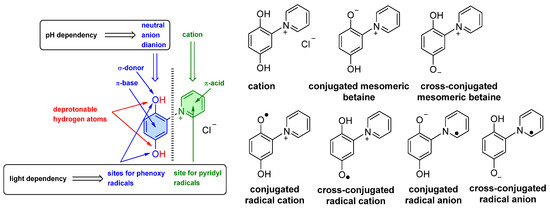
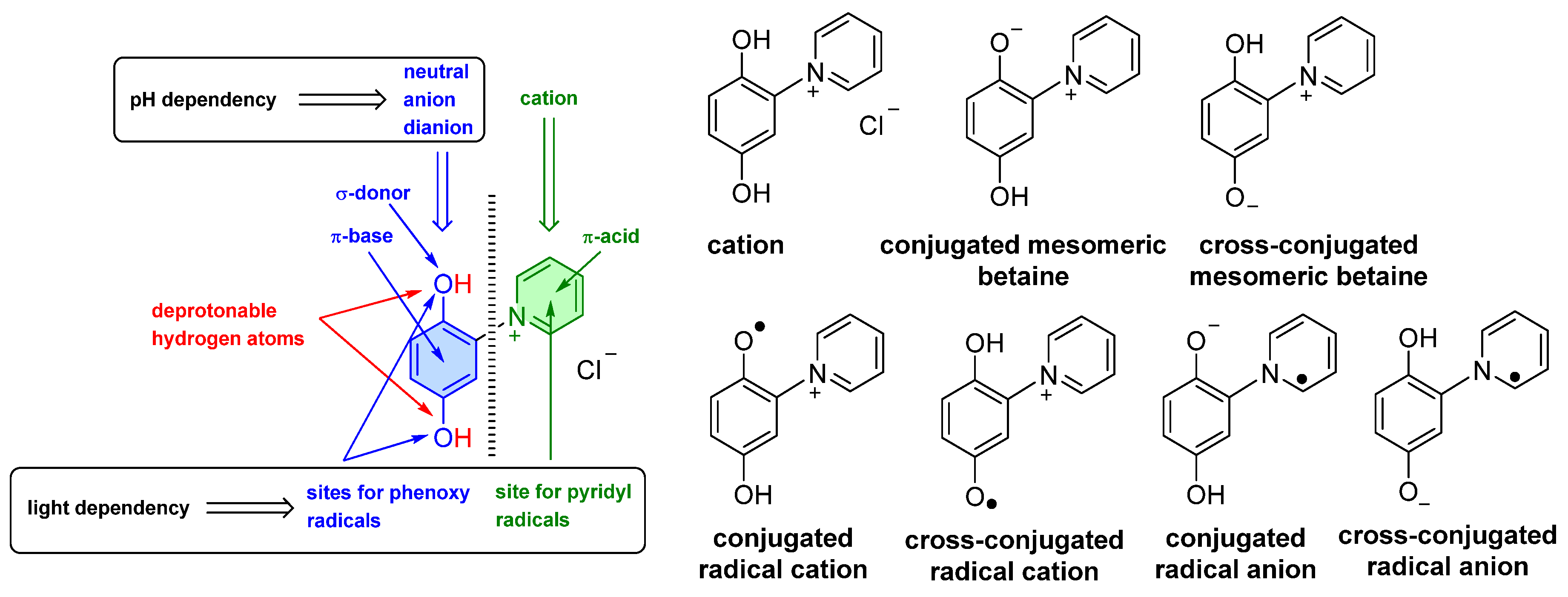
In the search for new collectors, derivatives of punicines have become interesting for the flotation of the EnAM lithium aluminate LiAlO2 vs. its gangue material, gehlenite, for example [37,38,39]. The natural product punicine was isolated from the leaves of the pomegranate tree (Punica granatum) as a punicine cation with a chloride counterion, which is due to the processing method and chromatographic work-up of the natural material [40] (Scheme 1). We found that in aqueous solution, punicine is present in a partially deprotonated form and thus as a mixture of two tautomers with 2-olate and 5-olate groups, respectively [41]. The negative charge of the phenolate ion is stabilized by the positive charge of the pyridinium ring, resulting in a neutrally charged molecule. Because the positive and negative charges delocalize within a common π-electron system, they are two different mesomeric betaines, depending on whether the OH group is deprotonated at position 2 (conjugated) or 5 (cross-conjugated). Double deprotonation in a stronger alkaline environment then leads to an anion with one positive charge and two negative charges, one in conjugation and the second in cross-conjugation. Model reactions show that the 2-OH or 2-olate group has a greater σ-donicity than the 5-OH or 5-olate group [42]. In summary, the overall charge of punicine (cationic, neutral, anionic) can be adjusted by the pH. In addition, in punicines, a π-base and a π-acid are linked, and the strength of the π-base is adjusted by the protonation status, i.e., the pH of the solvent. The pyridinium ring is an electron acceptor that can potentially form pyridyl radicals. Conversely, the OH groups are sites for the formation of phenoxy radicals. Under the influence of light, radical species are indeed formed, some possible structures of which are shown in Scheme 1. Of the various punicine radicals that can be formulated, the conjugated radical cation and the cross-conjugated radical anion could be characterized—the former in a punicine bound to a polymer [43].
Scheme 1.
Properties of the punicine cation isolated from Punica granatum.
Moon and Fuerstenau showed that the chemistry of spodumene [LiAl(SiO3)2] at the crystal surface is the major contributing factor for the selectivity in the usual industrial flotation of this mineral from muscovite [K2Al4[Al2Si6O20](OH,F)], feldspar K[AlSi3O8] and quartz (SiO2), when NaOL (Me(CH2)7CH=CH(CH2)7COO− Na+) is used as a collector [5]. The chemisorption of the collector is favored on the surface aluminum site on {1 1 0}, while the gangue materials mentioned have less good accessibility to this site in the crystallographic unit, which prevents the chemisorption of this collector [5]. The nucleophilicity of phenolic olate groups, present in punicines, differs from that of carboxylates. For example, the 4-methoxyphenolate anion as a model of the hydroxyphenolate of punicine has an N-parameter in MeCN of 20.62 and an SN-parameter of 0.69 [44], while the acetate anion as a model substance for NaOL has an N-parameter of 16.90 and an SN parameter of 0.75 in this solvent [45]. Oleic acid has a pKa of 5.02 in aqueous solution at 25 °C [46], while phenol has a pKa of 9.99. With these key figures in mind, we investigated the flotation behavior of various punicine derivatives with respect to spodumene and quartz as its gangue material.
2. Materials and Methods
2.1. General
All the microflotation experiments were performed in a modified Hallimond tube. A total of 2.00 g of the mineral, together with 25 mL deionized water, was added to the tube and stirred for 1 min. Then 60 µL of the corresponding collector stock solution was added and stirred for an additional minute. A total of 30 µL of the frother, which consisted of an emulsion of 1% pine oil and 0.1% Emulsogen™ M from the company Clariant International Ltd., Muttenz, Switzerland, was added to the mixture and stirred for an additional minute. The Hallimond tube was then filled up with additional 225 mL of deionized water. The flotation was then performed for 3 min with an air flow rate of 32 mL/min. For the entirety of the experiment, the mixture was stirred with a magnetic stirrer at 500 rpm.
The light scenarios of the flotations alternated between daylight (>5000 lux), UV light irradiation (390–400 nm, 4500 lux), and darkness. UV experiments took place in a closed box (60 cm × 60 cm × 60 cm) containing the Hallimond tube. Each wall had four LEDs from the company Avonec, Wesel, Germany, (Premium 3W LED, 390–400 nm, UV-A color, max power: 750 mA, operating voltage: 3.5–4.5 V), powered by an APC-16-700 unit (input: 100–240 V, output: +24 V, max. 700 mA, class 2 power supply), irradiating the tube. For details of the Hallimond tube and the irradiation experiment setup, see the Supplementary Materials. The pH values were adjusted by adding 0.1 M NaOH and Britton–Robinson buffer. For the flotation of spodumene, 1 mL of buffer was used to achieve a pH of 2. To adjust the pH to 12, 6 mL of NaOH was used. For the flotation of quartz, 0.2 mL of buffer at pH 2 and 7 mL of NaOH at pH 12 were used. The natural pH of spodumene in water is 8, and for quartz, it is 5. In all experiments, the remaining volume was filled up to 250 mL in the Hallimond tube. Deionized water over ionic exchange resin from the company Windaus-Labortechnik GmbH & Co. KG, Clausthal-Zellerfeld, Germany, was used for all experiments, with a measured conductivity of <0.5 µS/cm for the water used for all experiments. The syntheses of the punicines were performed with p-benzoquinone from the chemical provider Sigma-Aldrich, Darmstadt, Germany, with the respective substituted pyridines, which were previously synthesized in the Institute for Organic Chemistry at Clausthal University of Technology. The substituted pyridines were synthesized starting from 4-picoline, provided by TCI Chemicals, Zwijndrecht, Belgium. The alkyl bromides for the alkylation reactions, 1-bromooctane, 1-bromohexadecane, and 1-bromononane, as well as 4,4′-bipyridine for the synthesis of the viologenpunicine, were purchased from BLDPharmatech GmbH, Reinbek, Germany. 4-Aminopyridine was purchased from the company Merck, Darmstadt, Germany.
2.2. Minerals Used
Spodumene was purchased as powder from Mineraliengroßhandel Hausen GmbH, Telfs, Austria. Brazil was indicated as the origin of the spodumene. A second batch was used from the Institute for Mechanical Process Engineering at Clausthal University of Technology. The quartz samples came from the collection of the Institute for Mechanical Process Engineering at Clausthal University of Technology and from the company Puraja GmbH, Trostberg, Germany.
2.3. ζ-Potential Measurements
A Zetasizer Nano (Malvern, Worcestershire, UK) was used to measure the ζ potentials (zeta potentials). The collector to be examined was added to the solution. For each measurement, 1 g of the mineral was suspended in water and allowed to settle so that large particles sedimented. The pH was adjusted by titrating 0.1 M NaOH to a Britton–Robinson buffer solution, followed by the addition of the collector solution. All measurements were carried out with the supernatant dispersion. The measurements were not performed under controlled irradiation or dark conditions. Since the instrument relies on optical detection using a red laser at 632.8 nm, absolute darkness cannot be maintained during the measurement itself. Therefore, the data were used to assess pH- and collector-dependent changes in the particle surface charge, but not to evaluate light-induced changes in collector–surface interactions. For each sample, three repeated ζ-potential measurements were performed, and the reported value represents the mean of these three measurements. For each individual measurement, the Zetasizer software (version 7.13) monitored the evolution of the accumulated ζ potential and stopped either when its internal stability criterion was met or after the specified maximum number of runs, which is 20 here. The final value of each individual measurement was calculated from the accumulated measurement runs.
2.4. Particle Size Measurements
The particle size distribution of the samples was determined by wet measurement using the HELOS laser diffractometer from Sympatec, Clausthal-Zellerfeld, Germany, using Na4P2O7 as a stabilizer. Two batches of spodumene were analyzed and yielded median particle sizes of 14.58 μm, which were used for the flotation experiments, and 13.16 μm, which were used for ζ-potential measurements, leaching experiments, and IR experiments. The quartz used in most of the flotation experiments was determined to have a median particle size of 36.12 µm. Additional quartz fractions were prepared by milling in a vibratory disk mill equipped with steel grinding disks, followed by sieving and laser diffraction analysis. Their X50 values were 10.94 µm, 15.34 µm, and 115.18 µm. Because quartz is abrasive, minor transfer of iron-containing material from the grinding tools cannot be completely excluded. However, since all quartz fractions were prepared using the same milling setup and interpreted relative to the corresponding blank experiments, possible grinding-induced surface effects were treated as a systematic factor in the interpretation of the flotation results.
2.5. ICP-OES Measurements
ICP-OES measurements were performed with a Varian Model Vista MPX from the company Agilent Technologies Deutschland GmbH, Waldbronn, Germany. The results were analyzed with the program Varian ICP Expert Software (Version 4.0). The analyzed spectral lines used to quantify the elements silicon, lithium, and aluminum were 251.612 nm, 670.789 nm, and 167.078 nm, respectively.
2.6. Stock Solutions of the Punicines for Flotations
Stock solutions of the punicines were prepared, so that 60 μL of the stock solution in water—ethanol = 1:1 or isopropanol—corresponded to a concentration of 1 × 10⁻⁵ mol/L and 120 μL to 2 × 10⁻⁵ mol/L of punicine in a 250 mL microflotation experiment. Punicine-C9 and punicine-C2 were added to 10 mL of ethanol. Punicine-C17 and viologenpunicine-C9 were added to 10 mL of isopropanol. Aminopunicine (NH2-punicine) was added to 10 mL of H2O.
2.7. Syntheses
Syntheses are described in the Supporting Information.
3. Results and Discussion
Initial experiments were conducted to determine the extent of lithium and aluminum release from spodumene in water, since the pH value of 8 of an aqueous suspension of spodumene indicates an interaction between the particles and the suspending solvent. For this reason, 2 g of spodumene was stirred in 250 mL of water for one day and five days, respectively. The suspension was then filtered, and the filtrates were subjected to ICP-OES measurements. Table 1 summarizes the results. The reported values represent the averages of three measurements. Reports indicate that at pH levels exceeding 3, the negatively charged surface of spodumene attracts cations such as Li+ or Al3+ from the suspension, which is suggested as a potential rationale for the effective application of anionic collectors like NaOL in the flotation of spodumene. The anionic carboxylate group interacts with these cations, particularly with Al cations [8]. Other authors demonstrated that the oleate group undergoes chemisorption to the exposed Al and Si sites of spodumene, which are generated after breaking the Al-O and Si-O bonds on the mineral surface [8]. This occurs at the {1 0 0} surface as the most favorable surface [8] and, according to other authors, also at the {1 1 0} surface [7].
Table 1.
Leaching from spodumene (X50 = 13.16 µm) in water.
3.1. Selection of Punicine Derivatives
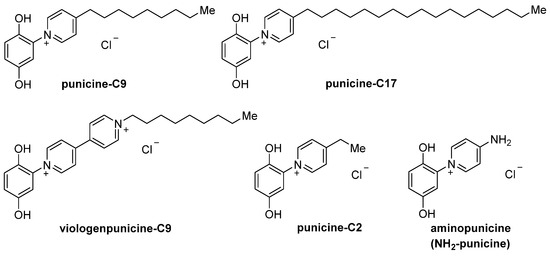
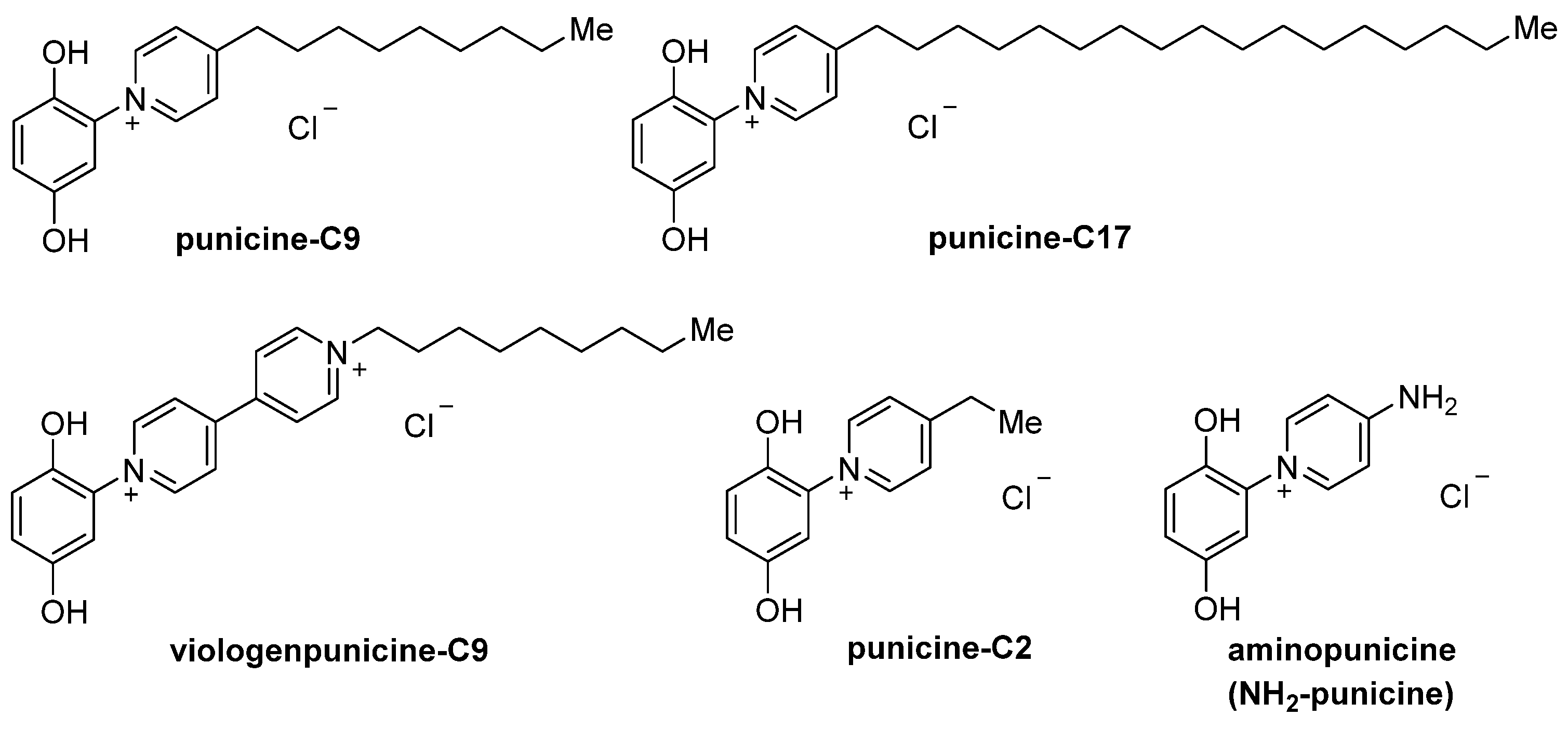
A series of punicine derivatives was selected to evaluate the impact of the substituent at the γ-position of the pyridinium ring or in which the pyridinium ring was replaced by a 4,4′-bipyridinium unit (Scheme 2). We thus investigated the n-nonyl-substituted punicine-C9 and its derivative with a 17-membered chain, punicine-C17. We selected viologenpunicine-C9 as 4,4′-bipyridine derivative. The 4-ethyl-substituted punicine-C2 and the 4-aminopyridinium derivative NH2-punicine were used for comparison because they can only cause very slight or no hydrophobization of the particle surfaces. The syntheses are straightforward and are described in the Supporting Information.
Scheme 2.
Punicine derivatives employed in this study.
3.2. Characterization of the Minerals
Before the minerals were subjected to the flotation experiments, powder X-ray diffraction measurements were carried out to gain information about the polymorphs of the spodumene we used. The X-ray diffractograms shown in the Supporting Information indicate that the spodumene used consists predominantly of spodumene, with quartz as a minor crystalline impurity. Semi-quantitative analysis suggested approximately 95% spodumene and 5% quartz. No additional crystalline phases were detected in the quartz sample.
3.3. Flotation Studies
3.3.1. Initial Collector Screening at Natural pH
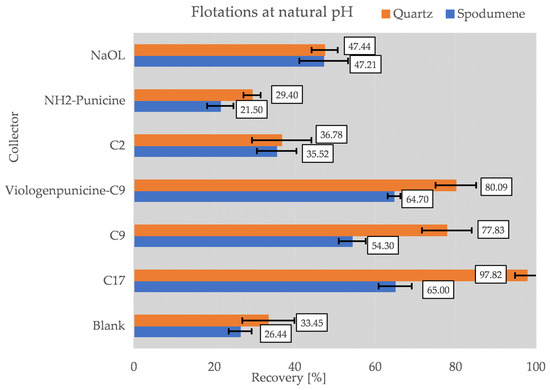
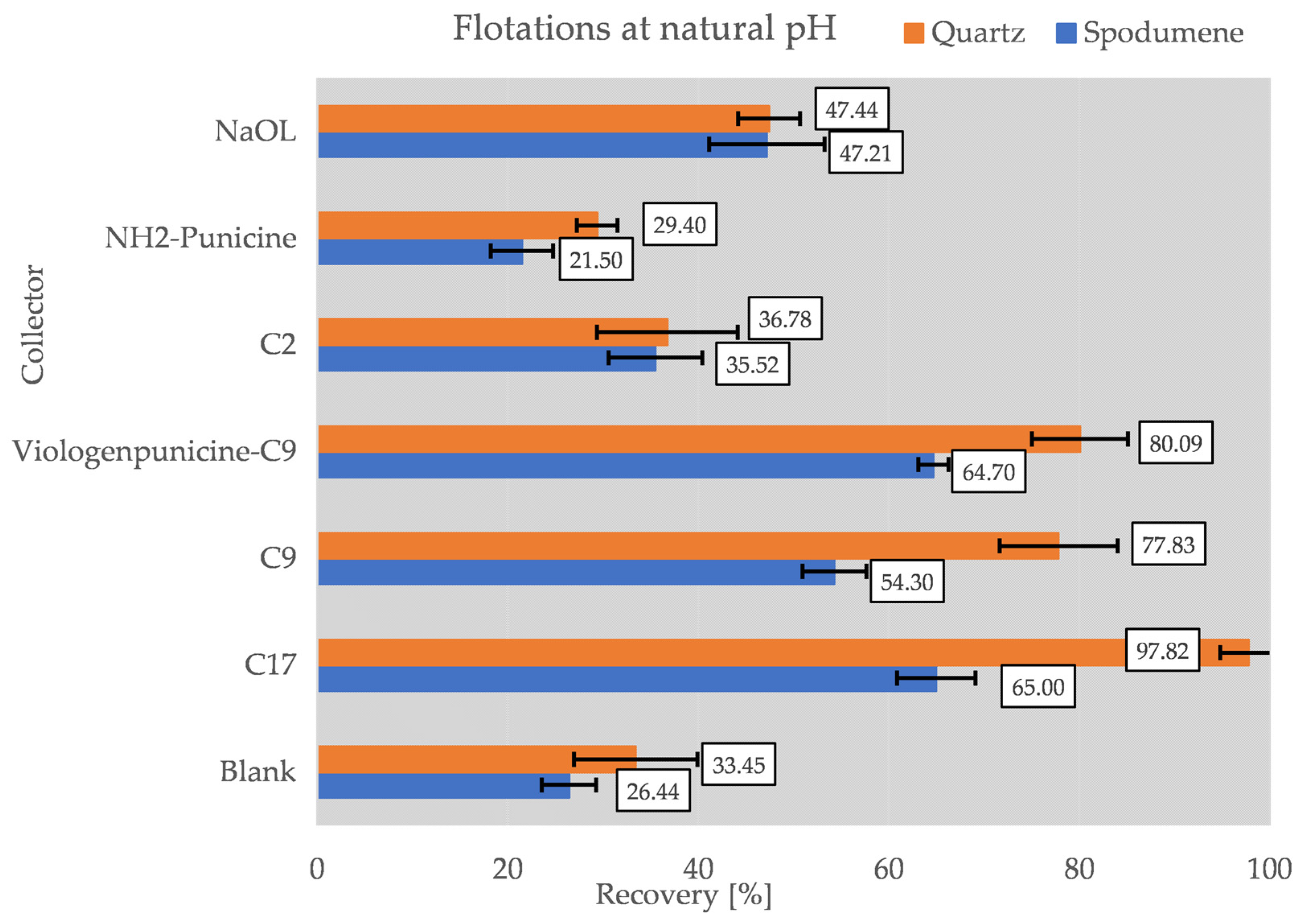
In order to first study the influence of the different substitution patterns of the punicines on the flotation behavior, all derivatives were tested under the same conditions and compared both with each other and with a blank sample. Results are shown in Figure 1.
Figure 1.
Comparison of the recovery of spodumene and quartz at daylight at their natural pH employing different punicine derivatives under otherwise identical conditions, i.e., 2.00 g of the mineral, 1 min of mixing (500 rpm) with 25 mL of distilled water, 60 µL (1 × 10⁻⁵ M) of the corresponding collector, 1 min of mixing, 30 µL of frother, and another 1 min of mixing. The flotation was performed for 3 min at an air flow rate of 32 mL/min using 225 mL distilled water in daylight at the natural pH values of the samples. Median particle sizes X50: 14.58 μm for spodumene and 36.12 μm for quartz.
Initially, no influence was exerted on the natural pH value of the suspensions in water, which was 5 for the quartz samples in water and 8 for the spodumene. The blank sample was tested without a collector and yielded recoveries of 26.44% for spodumene and 33.45% for quartz under the selected conditions in daylight. As can be seen in Figure 1, the different substitution patterns have different effects on the flotation results. The best recovery of 97.82% was achieved with punicine-C17 in the flotation of quartz and 65.01% in spodumene, followed by punicine-C9 (77.83%: quartz and 54.30%: spodumene) and viologenpunicine-C9 (80.09%: quartz, 64.70%: spodumene). Punicine C-17 shows the best separation rate of both minerals, with a yield difference of 32.81%. It is moreover remarkable that the long-chain punicine-C17 achieves a considerably higher yield than flotation with NaOL, which, moreover, was unable to achieve separation effects between the two minerals in our experiments. The yields with punicine-C9 and viologenpunicine-C9 are also higher than those with NaOL, which is considered the standard collector in widely used flotation processes. As expected, punicine-C2 and NH2-punicine showed no effect or proved to be more of a suppressant, as their flotation yield was very low in their presence, as well as in the blank tests.
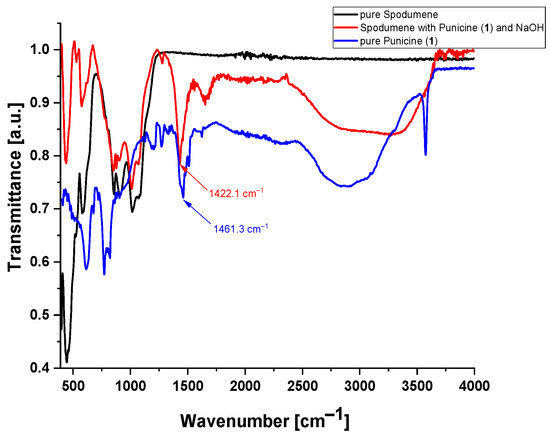
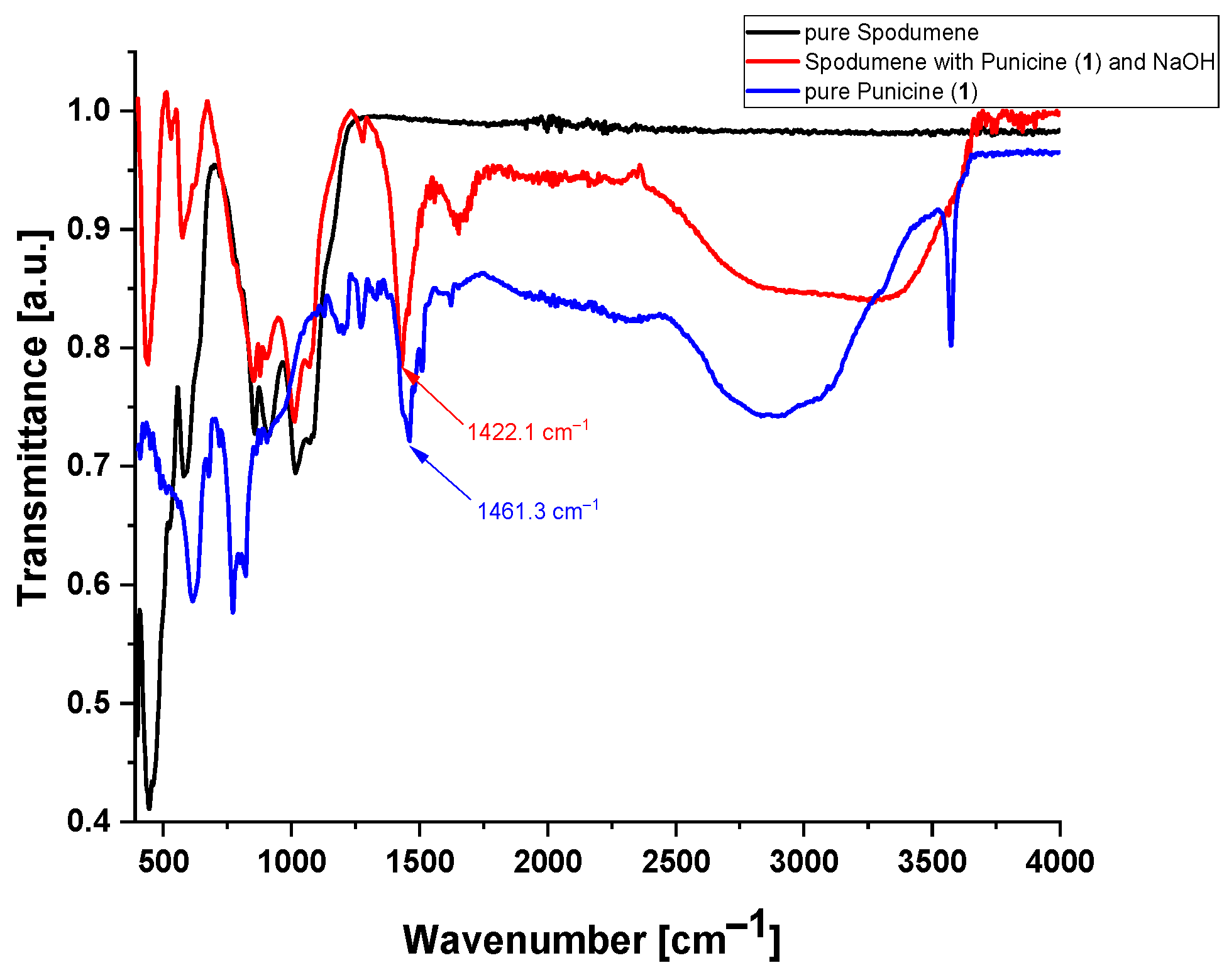
In order to gain insights into the interaction of spodumene and quartz with punicines, IR measurements were taken of the respective pure minerals, naturally occurring punicine from Punica granatum, and mixtures of both after treatment with NaOH to induce deprotonations of the OH-groups of punicine (Figure 2). The most important diagnostic finding is that the absorption band at 1461.3 cm−1 of punicine shifts to 1422.1 cm−1 upon spodumene addition. According to a DFT calculation (r2 SCAN− 3c/def2-mTZVPP) [38], this band can be attributed to the ν(C-O−) frequency of the two neutral, tautomeric mesomeric betaines of punicine. According to the calculation, these values shift by approximately 35 cm−1 on complexation of the olate group with lithium, which indeed corresponds to the experimental shift in terms of magnitude. With regard to NaOL, it was found that a peak at 1590 cm−1, which developed after treatment of spodumene with NaOL, belongs to the asymmetrical stretching vibration of the carboxylate group in aluminum oleate. This finding also indicated a chemical adsorption of the collector on the spodumene surface [17,47]. This is supported by the fact that the asymmetric and symmetric stretching vibrations of the T-O bonds of the interlocked 5-membered rings of (Si,Al)O4 tetrahedra (TO4) of spodumene at approximately 1000 cm−1 and 785 cm−1, respectively, change in terms of their shape and relative intensity on punicine addition. By contrast, the external vibrations between TO4 at approximately 1140 cm−1 and the vibrations of the oxygen rings of the framework at 550 cm−1 remain virtually unchanged [48].
Figure 2.
IR spectra of spodumene (X50 = 13.16 µm) (black), punicine (blue), and a sample of spodumene which was treated with punicine and NaOH (red).
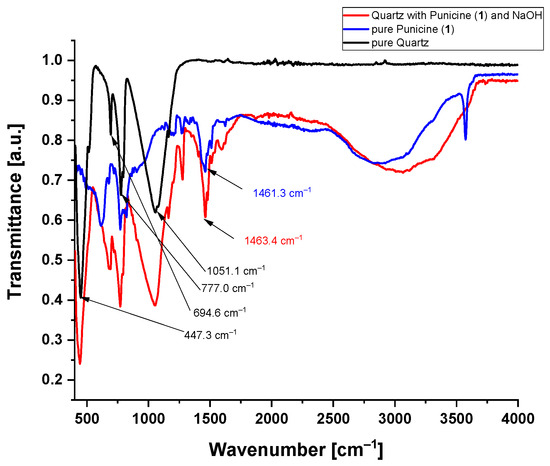
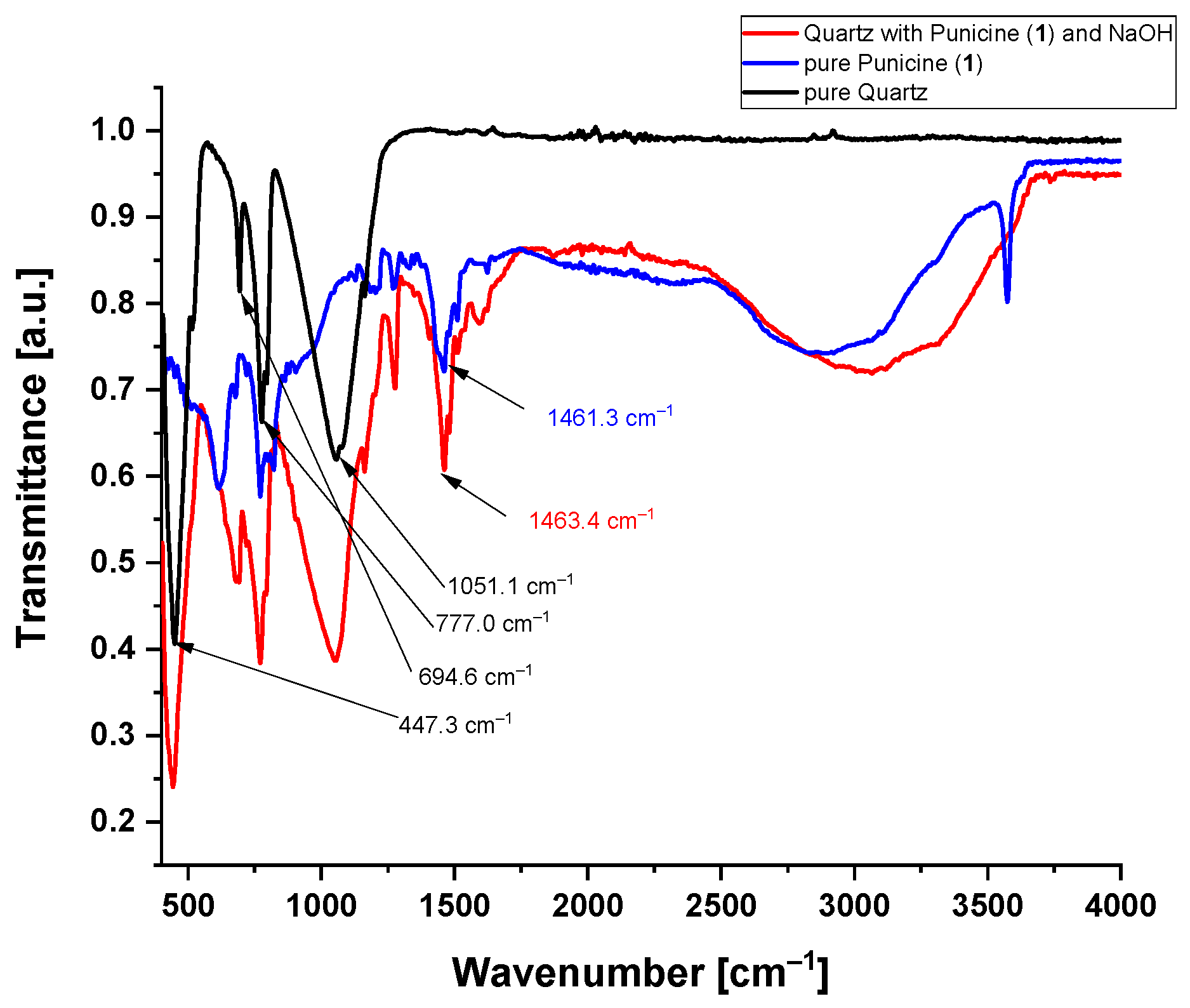
In contrast to these observations with spodumene, the absorption of the ν(C-O−) vibration changes only slightly from 1461.3 cm−1 to 1463.4 cm−1 when quartz is added (Figure 3). Changes can only be seen in the fingerprint region of the IR spectra of the punicine, which indicates that the interaction between the collector and quartz must be different from that in the case of spodumene, because it apparently does not occur via the olate group. The broad band of quartz at 1051.1 cm−1, which can be attributed to the asymmetric stretching vibrations of Si-O bonds, as well as the absorption bands at 777 and 694.6 cm−1 of the symmetric stretching vibrations of Si-O and the band at 447.3 cm−1 of the asymmetric bending vibration of quartz [49], remain unchanged with the addition of the punicine.
Figure 3.
IR spectra of quartz (X50 = 15.34 µm) (black), punicine (blue), and a sample of quartz which was treated with punicine and NaOH (red).
These spectroscopic results are reflected in investigations of the pH dependence of flotation, although flotation outcomes are influenced by a wide range of additional parameters.
3.3.2. Effect of pH on Flotation Recovery
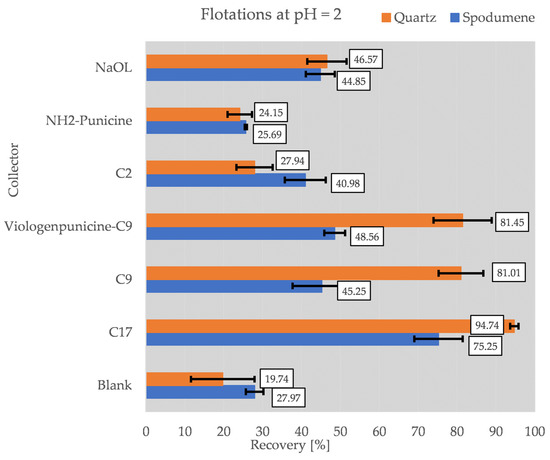
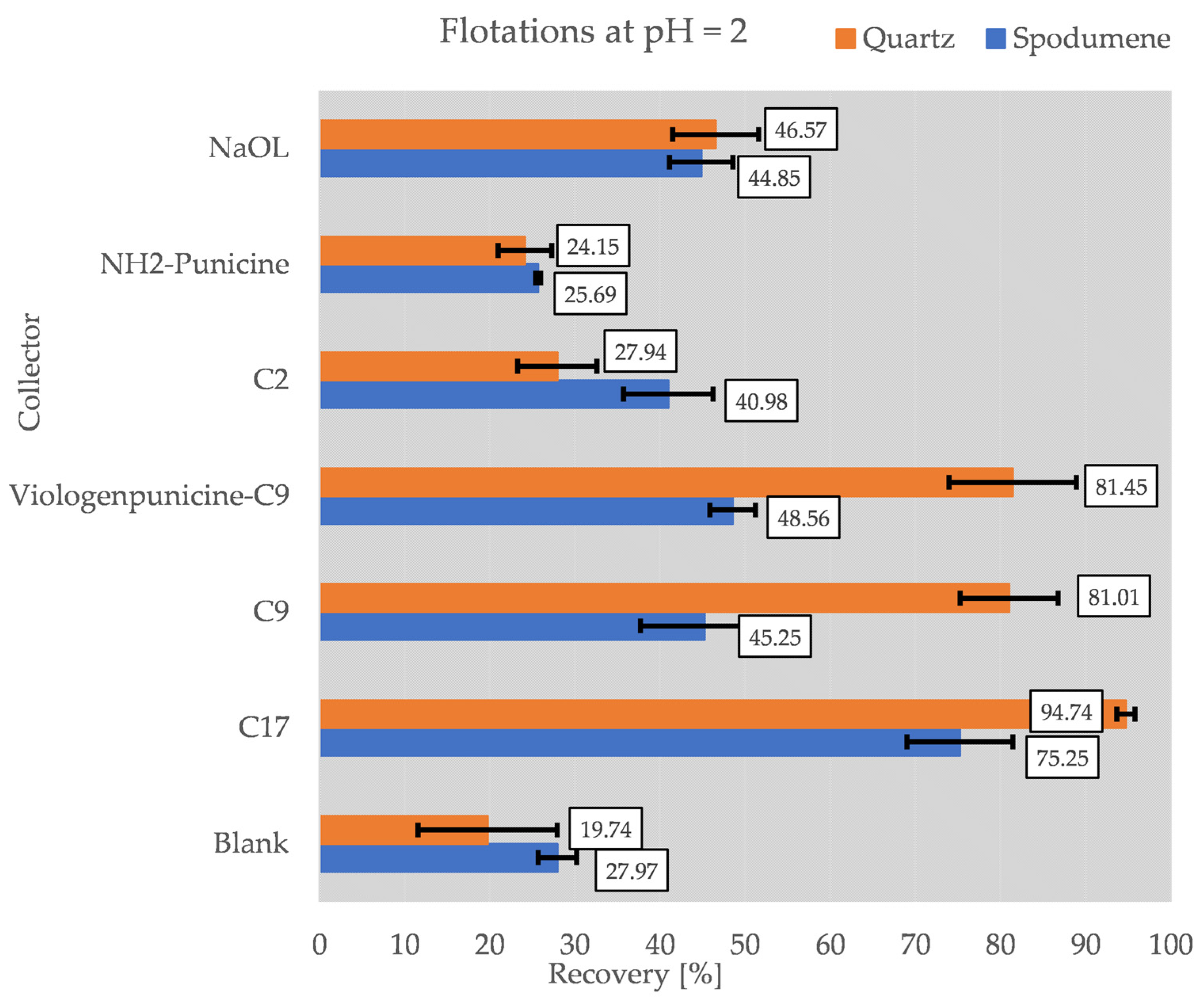
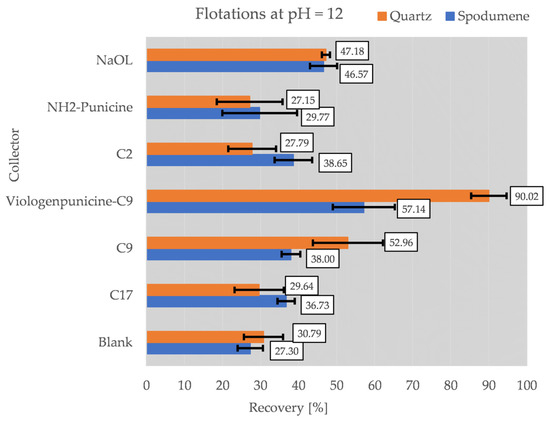
After the initial screening at the natural pH of the mineral suspensions, the effect of pH on flotation recovery was investigated at pH 2 and 12 (Figure 4 and Figure 5). Comparison of the results obtained at natural pH with those at pH 2 shows that the recoveries of spodumene obtained with punicine-C17, punicine-C9, and viologenpunicine-C9 decreased by up to 16 percentage points under acidic conditions. This decrease may be attributed to protonation of the olate groups of betainic punicines to OH-groups, which are therefore less nucleophilic. NaOL, by contrast, did not show a statistically significant effect on flotation recovery under the present conditions. This aligns with its function as an anionic collector. Given that the surfaces of quartz and spodumene exhibit a negative charge at pH values exceeding approximately 2, it is anticipated that electrostatic repulsion between the negatively charged mineral surfaces and oleate species will restrict collector adsorption in the absence of activating metal cations [50,51]. Welch’s t-tests verified that the recoveries achieved with NaOL were not significantly different from the respective blank studies for both quartz and spodumene. The blank experiments also showed comparatively high recoveries for both quartz and spodumene, with a small but statistically significant decrease in quartz recovery at pH 2. This behavior is likely related to a combination of suspension stability and hydrodynamic entrainment. The ζ-potential measurements indicate that quartz exhibits only a weak negative surface charge at pH 2, thereby reducing electrostatic repulsion between particles and potentially promoting agglomeration. More generally, fine particles can be transported into the froth by the hydrodynamic flow in the flotation cell even in the absence of collector-induced hydrophobization. The effect of entrainment is expected to be particularly pronounced for smaller particles and to decrease with increasing particle size, as demonstrated by the particle-size-dependent blank studies outlined below.
Figure 4.
Comparison of the recovery of spodumene and quartz at pH 2 in daylight employing different punicine derivatives under identical conditions, i.e., 2.00 g of the mineral, 1 min of mixing (500 rpm) with 25 mL of distilled water, 60 µL (1 × 10⁻⁵ M) of the corresponding collector, 1 min of mixing, 30 µL of frother, and another 1 min of mixing. The flotation was performed for 3 min at an air flow rate of 32 mL/min using 225 mL distilled water. Median particle sizes X50: 14.58 μm for spodumene and 36.12 μm for quartz.
Figure 5.
Comparison of the recovery of spodumene and quartz at pH 12 in daylight employing different punicine derivatives under identical conditions, i.e., 2.00 g of the mineral, 1 min of mixing (500 rpm) with 25 mL of distilled water, 60 µL (1 × 10⁻⁵ M) of the corresponding collector, 1 min of mixing, 30 µL of frother, and another 1 min of mixing. The flotation was performed for 3 min at an air flow rate of 32 mL/min using 225 mL distilled water. Median particle sizes X50: 14.58 μm for spodumene and 36.12 μm for quartz.
The behavior of the punicine differs from that of NaOL. Depending on pH, punicine can exist as cationic, zwitterionic/betainic, or anionic species. Therefore, electrostatic attraction between positively charged or zwitterionic punicine species and the negatively charged mineral surfaces may contribute to collector adsorption. At pH 2, punicine-C9 provided the highest spodumene-over-quartz recovery difference, with recoveries of 81.01% for spodumene and 45.25% for quartz. This corresponds to an absolute recovery difference of 35.76 percentage points.
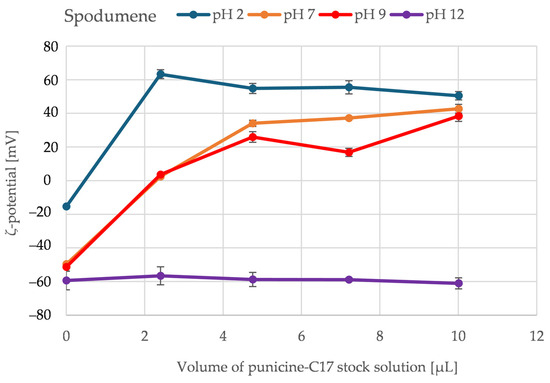
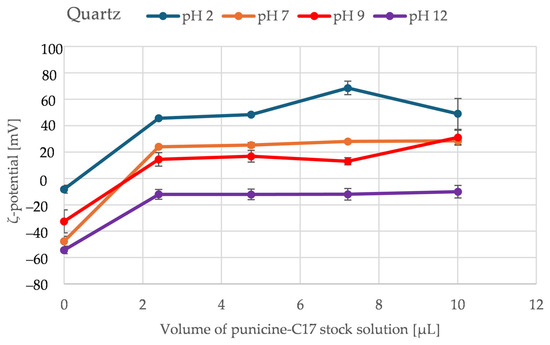
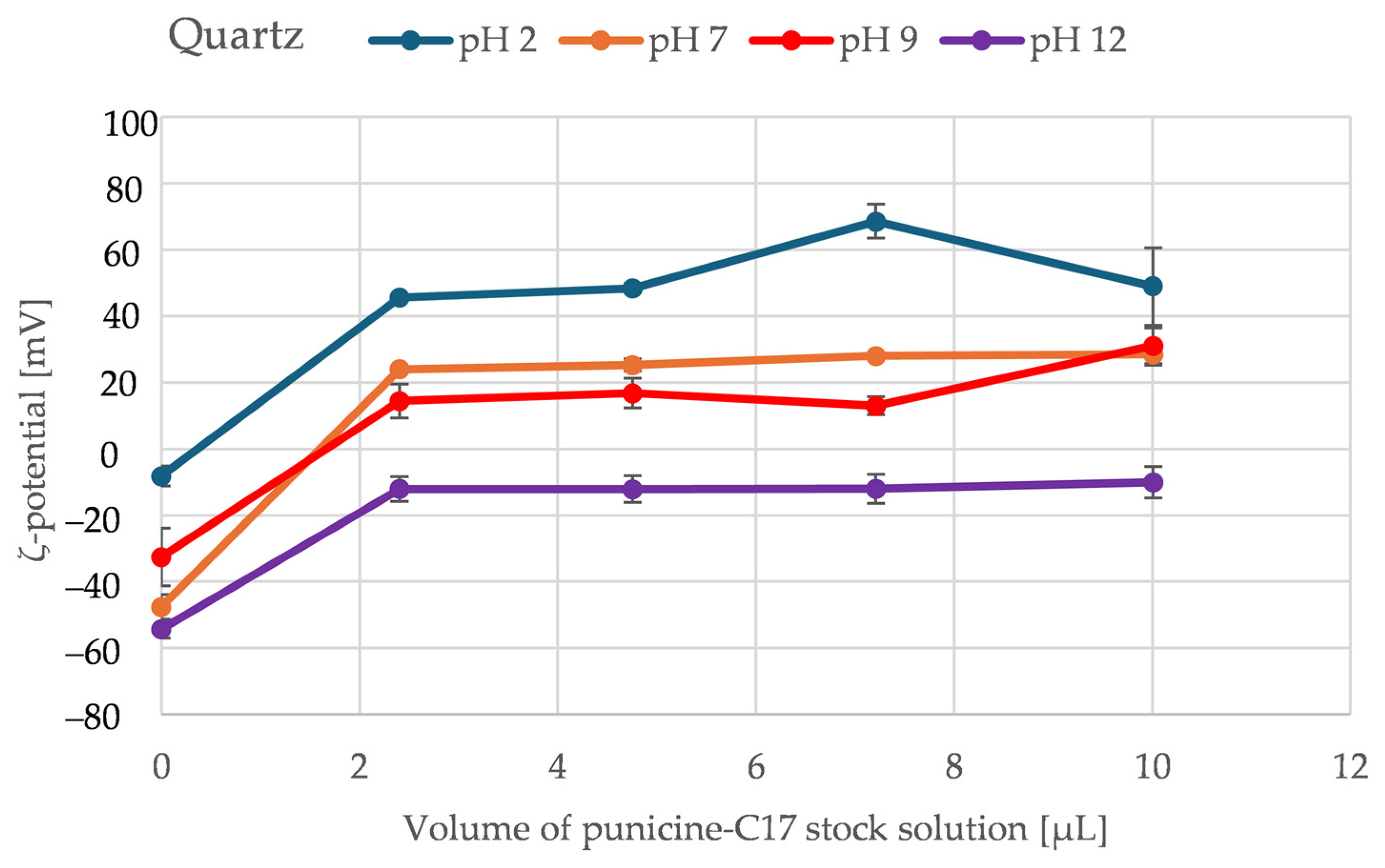
Then, flotation was carried out at a pH of 12 to deprotonate the punicine derivatives and thus convert the punicines-C17, -C9, and -C2, and the NH2-punicine into their anions (Figure 5). First, it should be noted that the flotation recovery of quartz and spodumene at a pH of 12 decreases significantly compared to the natural pH values (Figure 1) and pH 2 (Figure 4), except in the case of flotation with viologenpunicine-C9. This results in a recovery reduction of over 68 percentage points for quartz when changing from a natural pH of 8 (97.82%) to pH 12 (29.64%) and using punicine C-17 as a collector. In contrast, the recovery rate for viologenpunicine-C9 increases by approximately 10 percentage points to 90.02%. Viologenpunicine-C9 is the only punicine in this series that remains neutral at pH 12 due to the bipyridinium increment, which is twofold positively charged and cannot form an anion due to the lack of acidic protons. For spodumene, the blank experiment was largely unaffected by pH, in contrast to quartz. These results can be explained by the ζ potential of spodumene (Figure 6), which remains negative regardless of the pH value from pH 2 to pH 12. Electrostatic repulsion between the negatively charged mineral surface and anionic collector species lead to poor flotation recoveries. Consequently, the ζ potential of spodumene remains negative on the addition of punicine-C17 at pH 12, whereas it becomes positive at pH 2, 7, and 9. The same is true for the ζ potentials of quartz (Figure 7). This supports the assumption that punicine-C17 can adsorb electrostatically onto quartz and spodumene at pH levels of 2, 7, and 9, as indicated by the alteration in the sign of the ζ potential. At pH 12, the charge reversal was weak for quartz and absent for spodumene, indicating significantly less electrostatic adsorption of the more deprotonated, anionic punicine species. This is consistent with the low quartz recovery obtained with punicine-C17 at pH 12. For spodumene, however, punicine-C17 produced a small but statistically significant improvement compared with the blank experiment. This indicates that electrostatic interactions alone cannot fully explain the flotation response at pH 12 and that weak non-electrostatic interactions may still contribute under strongly alkaline conditions. In contrast, NH2-punicine did not produce a statistically significant change in recovery compared with the corresponding blank experiments, indicating that its apparent effect remained within the experimental variability. This is consistent with the limited hydrophobization expected for this derivative. It is noteworthy that punicine-C9 is superior to NaOL in relation to quartz, and viologenpunicine-C9 is superior to NaOL in relation to both minerals.
Figure 6.
ζ Potential of spodumene in dependence on the volume of punicine-C17 stock solution and the pH values. Median particle size X50: 13.16 µm.
Figure 7.
ζ Potential of quartz as a function of the volume of punicine-C17 stock solution at different pH values. Median particle size X50: 15.34 µm.
3.3.3. Flotation of Quartz with Punicine-C17 Depending on the Particle Sizes
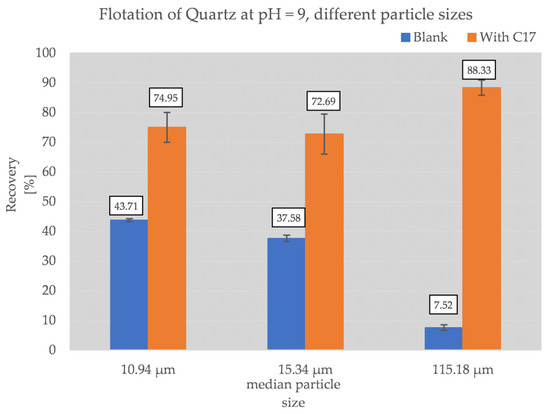
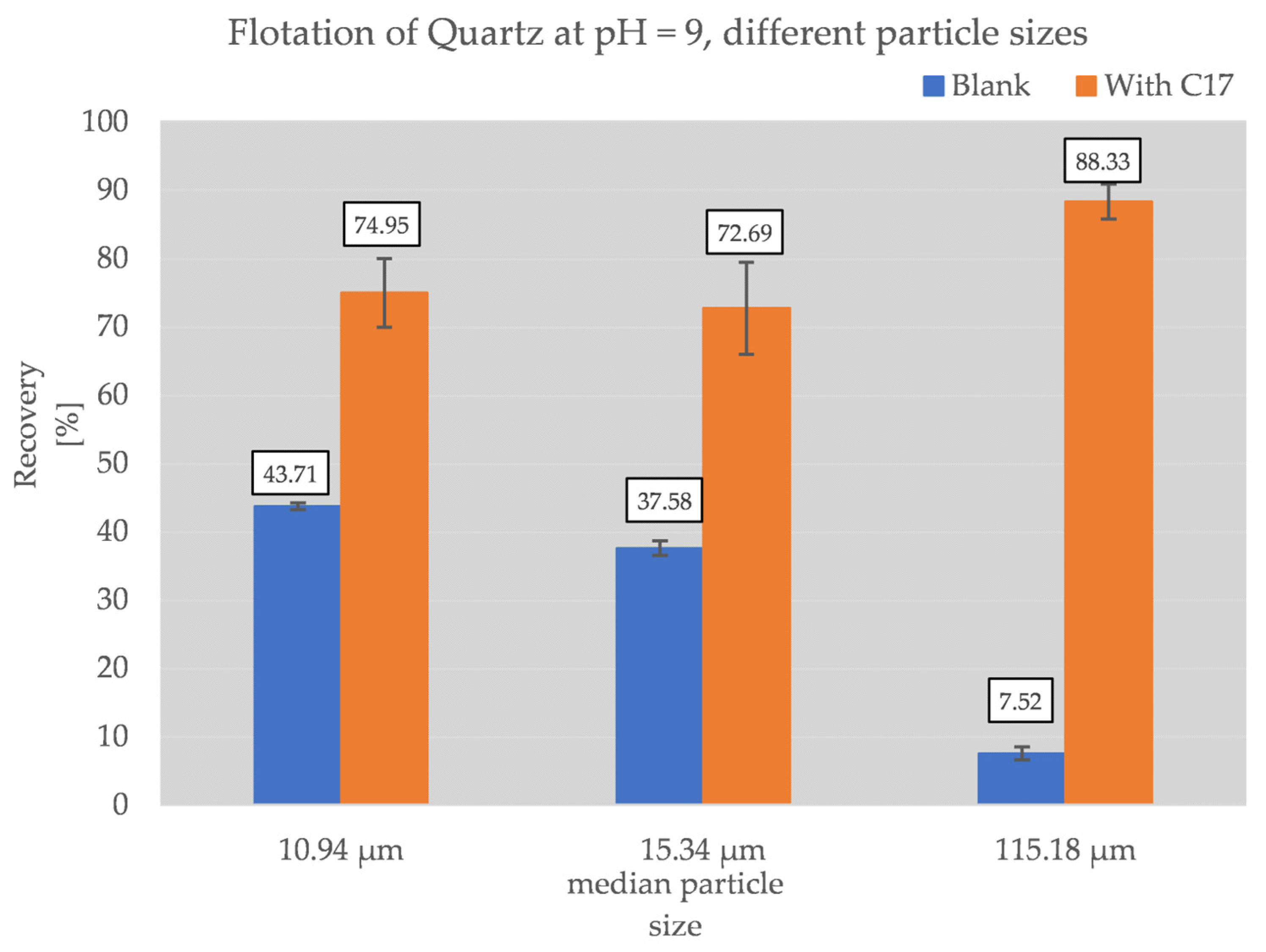
Flotation tests were then carried out with three quartz samples of different particle sizes (X50 = 10.94, 15.34, and 115.18 μm). Samples with 60 μL of punicine-C17 stock solution at pH 9 in daylight showed that punicine-C17 had a significant influence on the flotation results, with quartz particles of 115.18 μm increasing significantly to 88.33% compared to the blank sample without a collector molecule (7.52%) (Figure 8).
Figure 8.
Comparison of the recovery of quartz depending on the particle size at pH 9 in daylight employing punicine-C17 under otherwise identical conditions, i.e., 2.00 g of the mineral, 1 min of mixing (500 rpm) with 25 mL of distilled water, 60 µL (1 × 10⁻⁵ M) of the corresponding collector, 1 min of mixing, 30 µL of frother, and another 1 min of mixing. The flotation was performed for 3 min at an air flow rate of 32 mL/min using 225 mL distilled water.
The blank experiments in Figure 8 illustrate the strong influence of particle size on hydrodynamically induced recovery, i.e., entrainment. The highest blank recoveries were observed for the finer quartz fractions, whereas the coarsest fraction showed only 7.52% recovery in the absence of a collector. This trend indicates that entrainment contributed substantially to the apparent recovery of fine quartz particles under the applied microflotation conditions. Fine particles can be transported into the froth by liquid flow and bubble motion in the Hallimond tube even without sufficient hydrophobization. In contrast, coarser particles are less prone to entrainment, which explains the much lower blank recovery of the X50 = 115.18 µm fraction. Since most flotation experiments in this study were conducted with comparatively fine particles, entrainment likely contributed to the absolute recovery values. However, the statistically significant increases observed upon addition of the punicine collectors demonstrate that the collector effect cannot be explained by entrainment alone. To account for the contribution of entrainment in the blank experiments, the collector-induced recovery increase was calculated as ΔRcollector = Rwith C17 − Rblank (Table 2).
Table 2.
Collector-induced recovery increase for quartz flotation with punicine-C17 at pH 9.
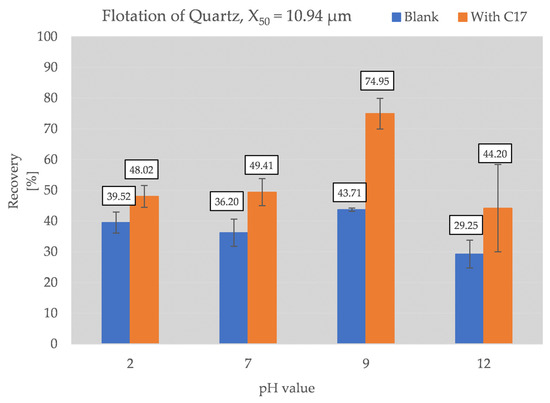
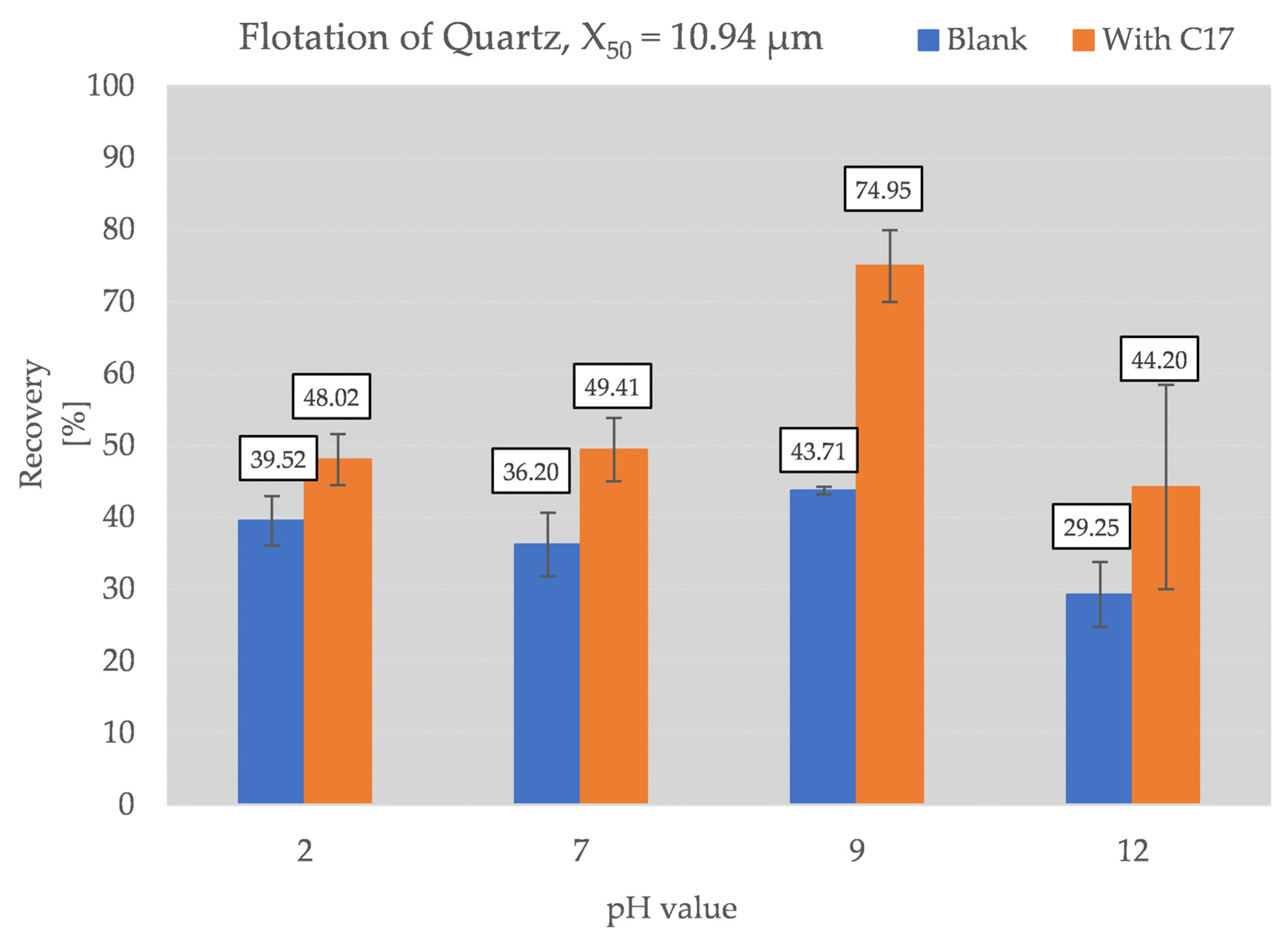
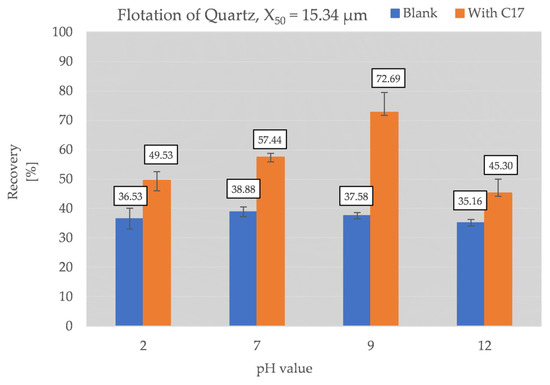
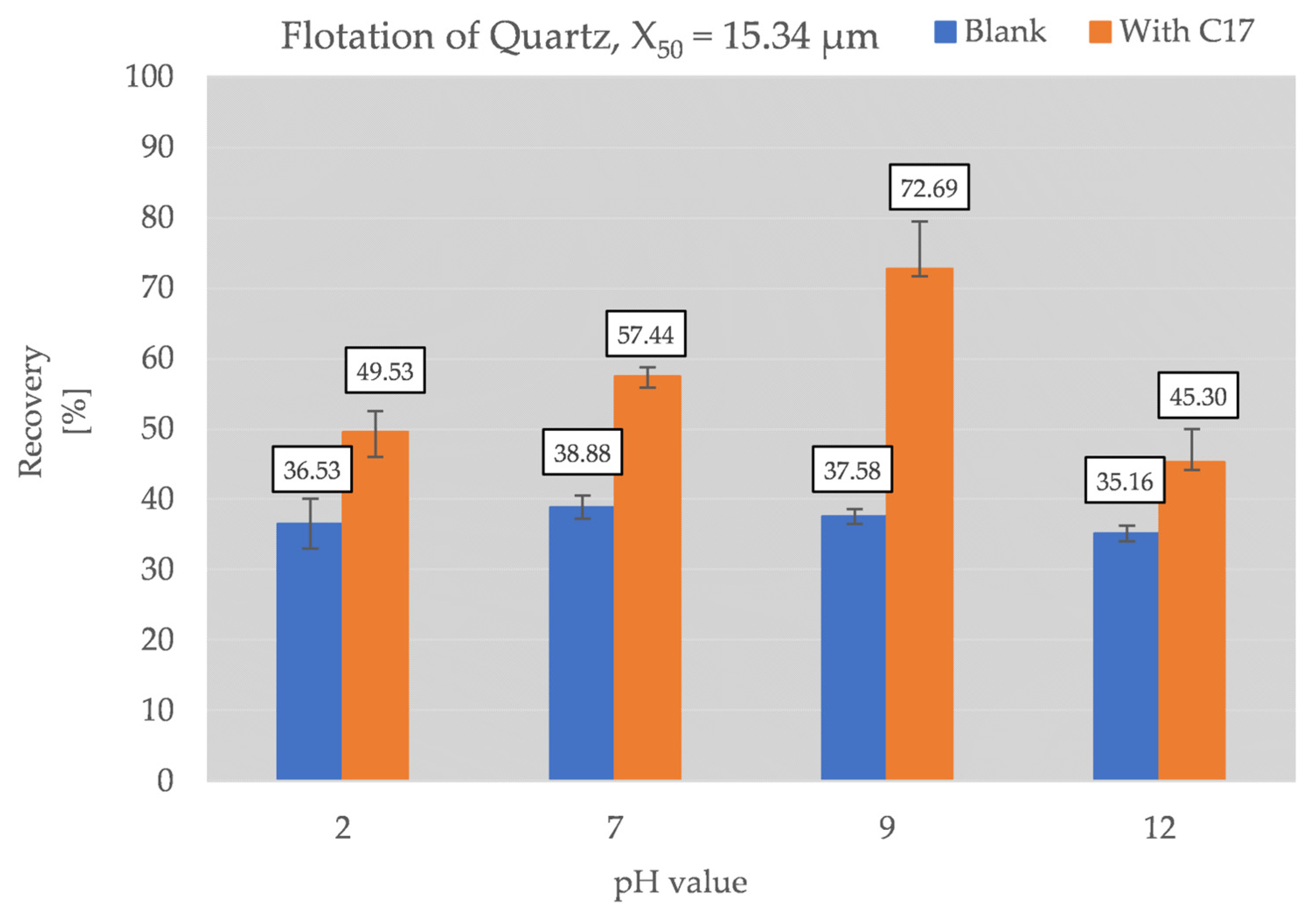
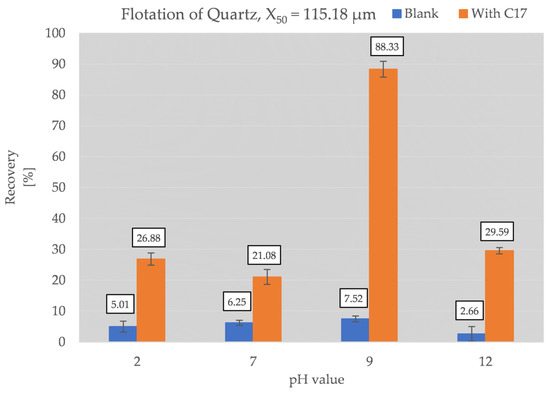
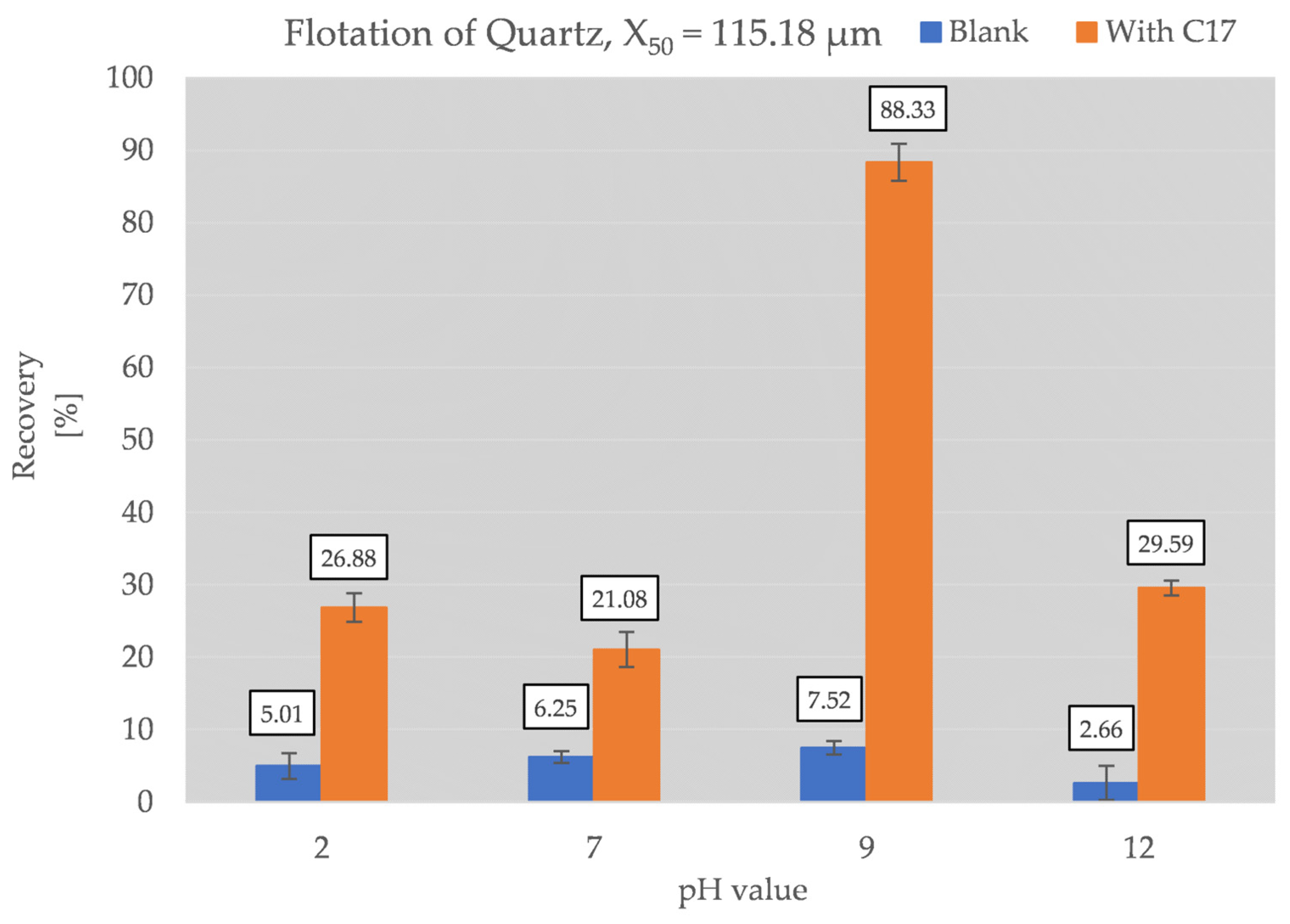
Under otherwise identical conditions, a series of measurements with quartz of different particle sizes was then carried out while varying the pH value. The recovery rate drops from 74.95% at pH 9 to below 50% at pH values of 2, 7, and 12 when a particle size of 10.94 μm is used (Figure 9). The situation is similar for series with quartz particle sizes of 15.34 μm (Figure 10). The effects are particularly significant for particle sizes of 115.18 μm (Figure 11). In this case, the recovery drops from 88.33% at pH 9 to 21.08% at pH 7.
Figure 9.
Comparison of the recovery of quartz (X50 = 10.94 µm) at different pH values in daylight employing punicine-C17 under otherwise identical conditions, i.e., 2.00 g of the mineral, 1 min of mixing (500 rpm) with 25 mL of distilled water, 60 µL (1 × 10⁻⁵ M) of the corresponding collector, 1 min of mixing, 30 µL of frother, and another 1 min of mixing. The flotation was performed for 3 min at an air flow rate of 32 mL/min using 225 mL distilled water.
Figure 10.
Comparison of the recovery of quartz (X50 = 15.34 µm) at different pH values in daylight employing punicine-C17 under otherwise identical conditions, i.e., 2.00 g of the mineral, 1 min of mixing (500 rpm) with 25 mL of distilled water, 60 µL (1 × 10⁻⁵ M) of the corresponding collector, 1 min of mixing, 30 µL of frother, and another 1 min of mixing. The flotation was performed for 3 min at an air flow rate of 32 mL/min using 225 mL distilled water.
Figure 11.
Comparison of the recovery of quartz (X50 = 115.18 µm) at different pH values in daylight employing punicine-C17 under otherwise identical conditions, i.e., 2.00 g of the mineral, 1 min of mixing (500 rpm) with 25 mL of distilled water, 60 µL (1 × 10⁻⁵ M) of the corresponding collector, 1 min of mixing, 30 µL of frother, and another 1 min of mixing. The flotation was performed for 3 min at an air flow rate of 32 mL/min using 225 mL distilled water.
3.3.4. Flotation of Spodumene and Quartz Depending on the Irradiation Conditions
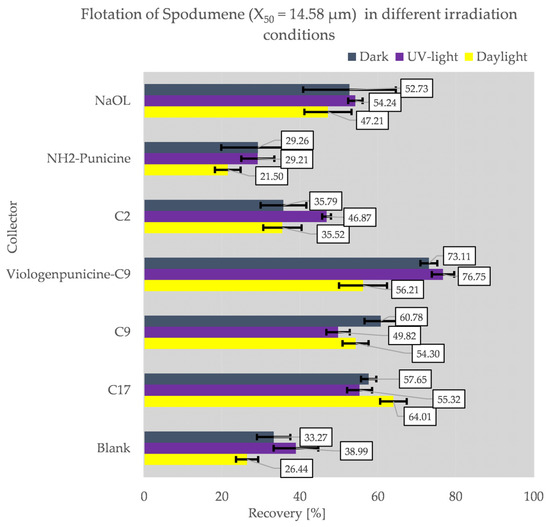
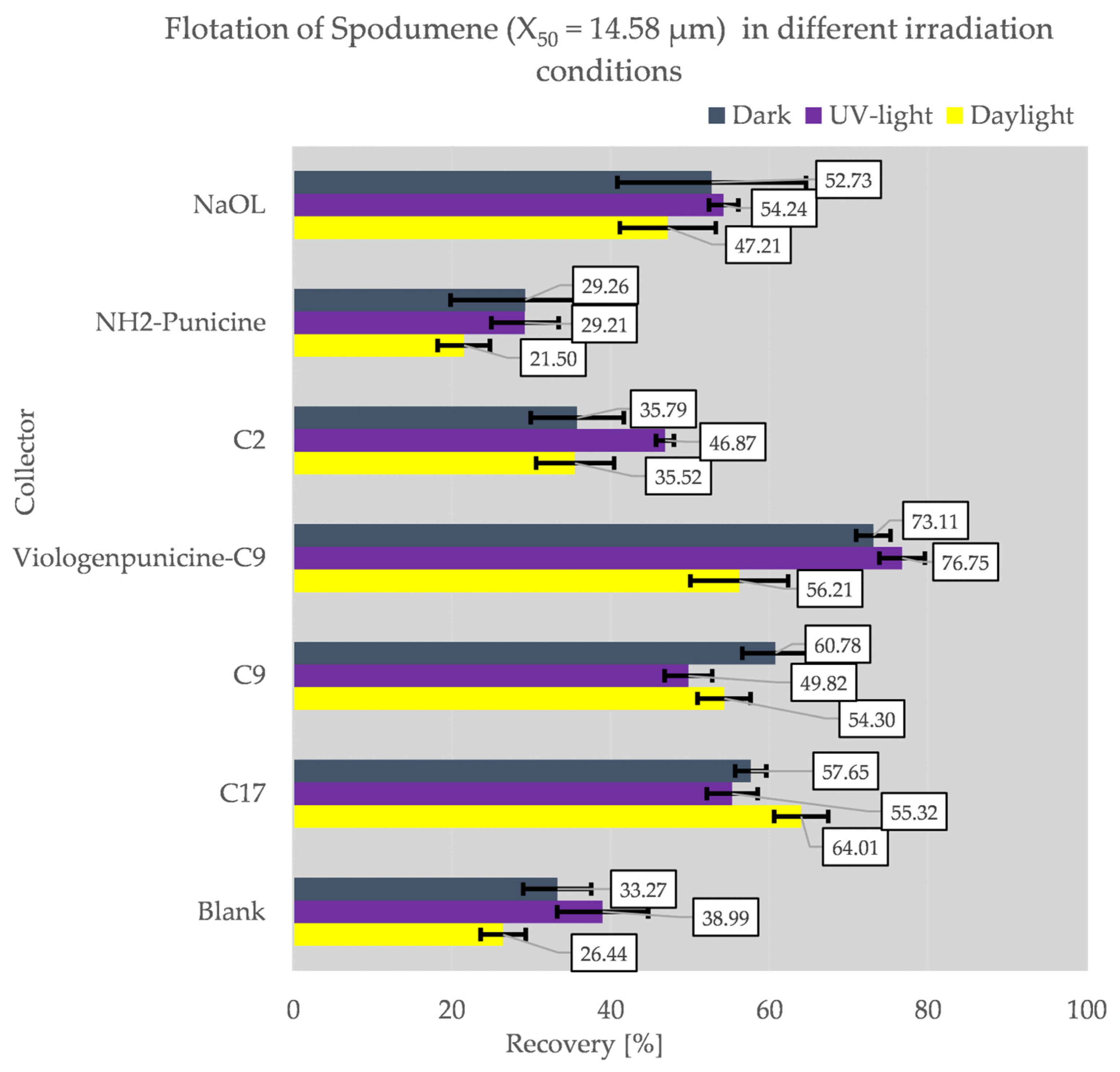
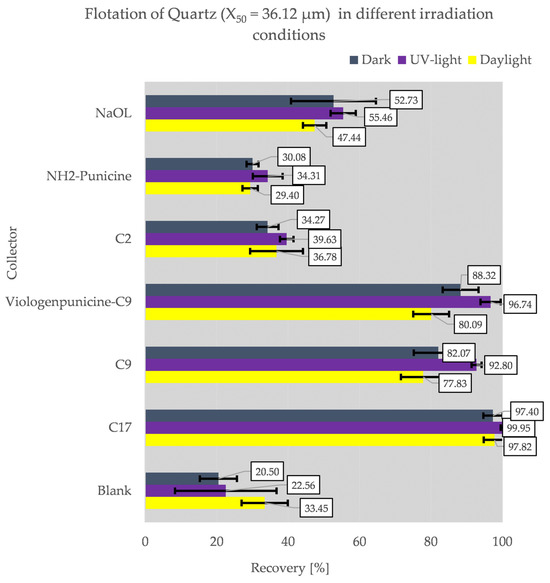
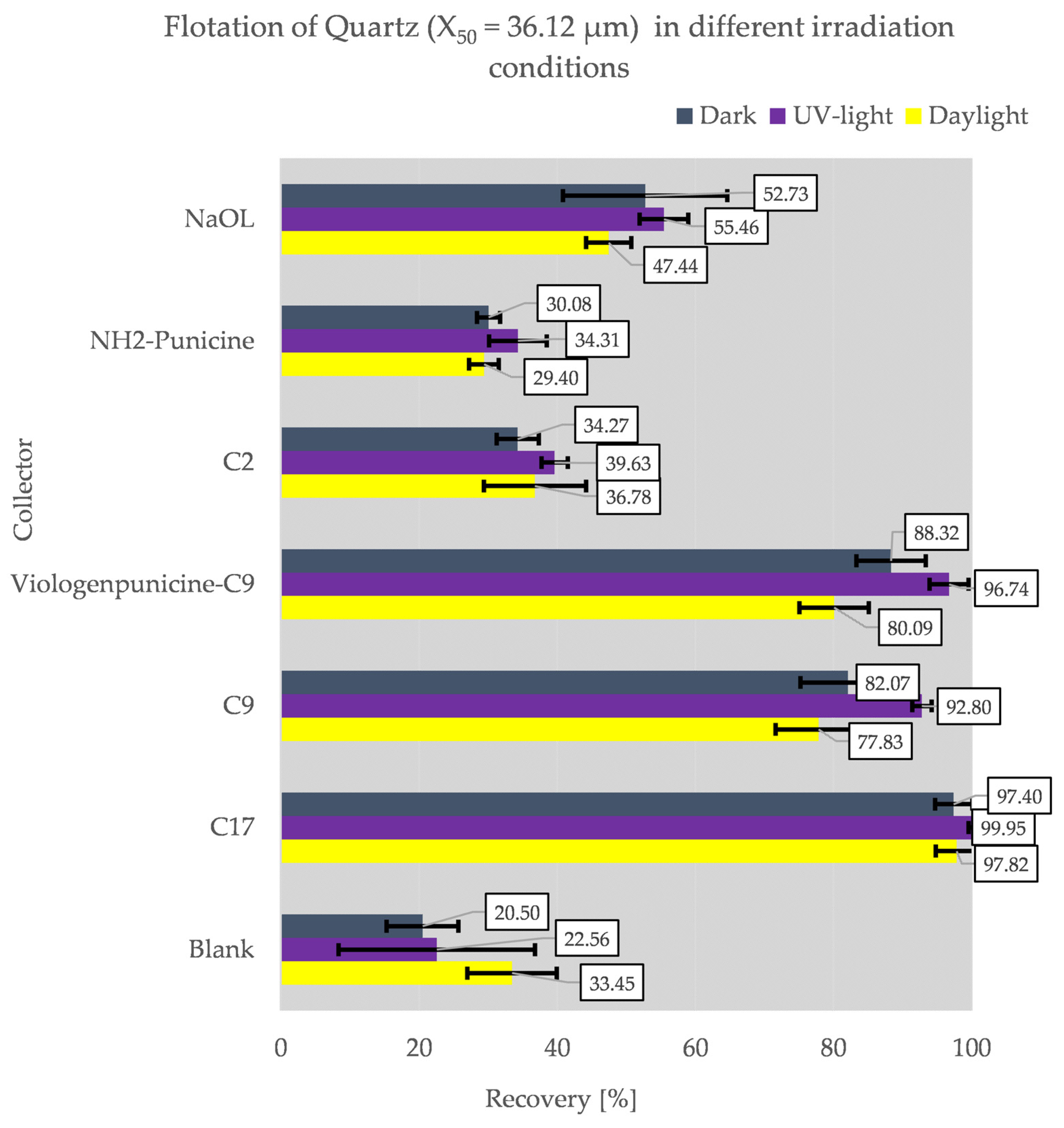
We continued our investigations with studies on the light dependence of flotation (Figure 12 and Figure 13). The blank tests showed that the recovery increased from 26.44% under daylight to 38.99% under UV light, corresponding to an increase of 12.55 percentage points, although the rather large confidence interval should be taken into account. As expected, because of the photoresponsive character of the bipyridinium moiety, viologenpunicine-C9 shows the greatest differences in flotation recovery under daylight, UV light, and in the dark, with a 20.54% difference in recovery rate between daylight and UV light. It is interesting to note that, especially when using viologenpunicine-C9, the recovery in UV light and in the dark is higher than in daylight. This can be explained by the different absorption ability of the radical forms of the punicines, which are significantly affected by the irradiation conditions. All other derivatives, such as punicine-C17, show smaller differences. When using NaOL, no influence of light can be detected within the error limits.
Figure 12.
Comparison of the recovery of spodumene under different light scenarios under otherwise identical conditions, i.e., 2.00 g of the mineral, 1 min of mixing (500 rpm) with 25 mL of distilled water, 60 µL (1 × 10⁻⁵ M) of the corresponding collector, 1 min of mixing, 30 µL of frother, and another 1 min of mixing. The flotation was performed for 3 min at an air flow rate of 32 mL/min using 225 mL distilled water. Median particle size: 14.58 µm.
Figure 13.
Comparison of the recovery of quartz under different light scenarios under otherwise identical conditions, i.e., 2.00 g of the mineral, 1 min of mixing (500 rpm) with 25 mL of distilled water, 60 µL (1 × 10⁻⁵ M) of the corresponding collector, 1 min of mixing, 30 µL of frother, and another 1 min of mixing. The flotation was performed for 3 min at an air flow rate of 32 mL/min using 225 mL distilled water. Median particle size: 36.12 µm.
The flotation of quartz with punicine-C17 as the collector shows no light dependence; recoveries are very high regardless of the light scenario. Flotation under UV light leads to an increase in recovery of approximately 15 to 16 percentage points in the case of punicine-C9 and viologenpunicine-C9. Within the error limits, no significant light dependencies are apparent for punicine-C2, NH2-punicine, and NaOL, respectively.
The present study was designed as a single-mineral screening to evaluate the collector response of the punicine derivatives and to identify trends in potential selectivity based on individual mineral recoveries. Accordingly, the recovery differences observed here should be interpreted as indicators of potential selectivity rather than as direct separation performance in a mixed-mineral system. Mixed-mineral flotation experiments using spodumene–quartz mixtures, followed by tests with more complex ore matrices containing feldspar and muscovite, would represent an important next step toward assessing practical applicability and will be considered in future work.
4. Conclusions
In this study, we explored different punicine-based flotation collectors for the separation of the minerals quartz and spodumene. For both minerals, higher recoveries were achieved in comparison to the standard collector NaOL. Especially efficient recoveries were achieved for quartz, with almost quantitative flotation recoveries for selected punicine collectors. For punicine C-17 (natural pH), punicine C-9 (after adjustment of the pH value to 2), and viologenpunicine-C9 (after adjustment of the pH value to 2 or 12), differences in the flotation recoveries for both minerals were big enough to consider a separation from each other on a technical scale. Additionally, for the mineral quartz, the influence of particle size on flotation recoveries was studied, showing the best recovery at a median particle size of 36.12 µm, compared to batches with median particle sizes above and below this value.
Supplementary Materials
The following supporting information can be downloaded at https://www.mdpi.com/article/10.3390/separations13060168/s1, experimental details of the syntheses, NMR spectra, particle size measurements, PXRD spectra, specifications of the Hallimond tube, and the irradiation parameters The Supporting Information includes: Scheme S1: General reaction pathway for the synthesis of punicines, Figure S1: 1H NMR spectrum of punicine-C9, Figure S2: 1H NMR spectrum of punicine-C17, Figure S3: 1H NMR spectrum of viologenpunicine-C9, Figure S4: 1H NMR spectrum of Punicine-C2, Figure S5: 1H NMR spectrum of aminopunicine, Figure S6: XRD spectra of Spodumene from “Mineraliengroßhandel Hausen GmbH”(above), Spodumene from Institute for Mechanical Processes Engineering at the Clausthal University of Technology (middle) and Quartz from Institute for Mechanical Processes Engineering at the Clausthal University of Technology (below), Figure S7: Particle Size distribution of Spodumene from Mineraliengroßhandel Hausen GmbH, Figure S8: Particle Size distribution of Spodumene from Institute for Mechanical Processes Engineering at the Clausthal University of Technology, Figure S9: Particle Size distribution of Quartz from Institute for Mechanical Processes Engineering at the Clausthal University of Technology, Figure S10: Particle size distributions via laser diffraction of quartz: 3 minute-milled sample X50 = 10.94 µm (above) 2-minute milled sample X50 = 15.34 µm (middle) and coarser remaining particles X50 = 115.18 µm (below) and Figure S11: Sketch of the modified Hallimond tube.
Author Contributions
Conceptualization, A.S., S.M.T. and A.M.M.; methodology, S.M.T., A.M.M., A.Z., M.H.F., A.W. and T.S.; validation, A.Z., S.M.T., A.W. and T.S.; investigation, S.M.T., A.Z., M.H.F., A.Z., A.M.M., A.W. and T.S.; data curation, S.M.T., A.S., A.Z. and A.W.; writing—original draft preparation, S.M.T. and A.S.; writing—review and editing, A.S.; supervision, A.S., A.W. and U.E.A.F.; project administration, A.S.; funding acquisition, A.S. All authors have read and agreed to the published version of the manuscript.
Funding
This research was funded by the Deutsche Forschungsgemeinschaft DFG, grant number SCHM 1371/18-1, project no. 470324113 for A.S. within the priority program SPP 2315 “Engineered Artificial Minerals (EnAM)—a geo-metallurgical tool to recycle critical elements from waste streams”.
Data Availability Statement
The original contributions presented in this study are included in the article/Supplementary Materials. Further inquiries can be directed to the corresponding author.
Acknowledgments
We would also like to thank the German Research Foundation for approving the project SCHM 1371/18-1 (project number 470324113) “Switchable selective collectors for the flotation of engineered artificial minerals” as part of the priority program SPP 2315 “Engineered Artificial Minerals (EnAM)—a geo-metallurgical tool to recycle critical elements from waste streams”.
Conflicts of Interest
The authors declare no conflicts of interest.
References
- Choubey, P.K.; Kim, M.-S.; Srivastava, R.R.; Lee, J.-C.; Lee, J.-Y. Advance review on the exploitation of the prominent energy-storage element: Lithium. Part I: From Mineral and brine resources. Miner. Eng. 2016, 89, 119–137. [Google Scholar] [CrossRef] [Scilit]
- Nicholson, P. Past and future development of the market for lithium in the world aluminum industry. Energy 1978, 3, 243–246. [Google Scholar] [CrossRef] [Scilit]
- Global Lithium Industry—Statistics & Facts. Available online: www.statista.com (accessed on 1 December 2025).
- Bowell, R.J.; Lagos, L.; de los Hoyos, C.R.; Declercq, J. Classification and characteristics of natural lithium resources. Elements 2020, 16, 259–264. [Google Scholar] [CrossRef] [Scilit]
- Moon, K.S.; Fuerstenau, D.W. Surface crystal chemistry in selective flotation of spodumene (LiAl[SiO3]2) from other aluminosilicates. Int. J. Miner. Process. 2003, 72, 11–24. [Google Scholar] [CrossRef] [Scilit]
- Han, W.; Weiss, J.; Lu, X.; Munchen, D.; Jiang, C.; Lucas, H.; Ran, M.; Chen, W.; Friedrich, B. Engineered Artificial Minerals (EnAMs): Concept, Design Strategies, and Case Studies. Minerals 2025, 15, 1129. [Google Scholar] [CrossRef] [Scilit]
- Zhu, G.; Wang, Y.; Liu, X.; Yu, F.; Lu, D. The cleavage and surface properties of wet and dry ground spodumene and their flotation behavoir. Appl. Surf. Sci. 2015, 357, 333–339. [Google Scholar] [CrossRef] [Scilit]
- Filippov, L.; Farrokhpay, S.; Lyo, L.; Filippova, I. Spodumene Flotation Mechanisms. Minerals 2019, 9, 372. [Google Scholar] [CrossRef] [Scilit]
- Bloss, F.D. Crystallography and Crystal Chemistry; Mineralogical Society: New York, NY, USA, 1971. [Google Scholar]
- Rai, B.; Sathish, P.; Tanwar, J.; Pradip, K.S.; Moon, K.S.; Fuerstenau, D.W. A molecular dynamics study of the interaction of oleate and dodecylammoniumchloride surfactants with complex aluminosilicate minerals. J. Colloid Interface Sci. 2011, 362, 510–516. [Google Scholar] [CrossRef] [Scilit]
- Xie, R.; Zhu, Y.; Li, Y.; Han, Y. Flotation behavior and mechanism of a new mixed collector on separation of spodumene from feldspar. Colloids Surf. A 2020, 599, 124932. [Google Scholar] [CrossRef] [Scilit]
- Kupka, N.; Rudolph, M. Role of sodium carbonate in scheelite flotation—A multi-faceted reagent. Miner. Eng. 2018, 129, 120–128. [Google Scholar] [CrossRef] [Scilit]
- Xu, L.; Hu, Y.; Wu, H.; Tian, J.; Liu, J.; Gao, Z.; Wang, L. Surface crystal chemistry of spodumene with different size fractions and implications for flotation. Sep. Purif. Technol. 2016, 169, 33–42. [Google Scholar] [CrossRef] [Scilit]
- Zhu, G.-l.; Wang, Y.-H.; Wang, X.-M.; Miller, J.D.; Lu, D.-F.; Zheng, X.-Y.; Zhao, Y.-H.; Zheng, H.-T. Effects of grinding environment and lattice impurities on spodumene flotation. Trans. Nonferrous Met. Soc. China 2019, 29, 1527–1537. [Google Scholar] [CrossRef] [Scilit]
- Zhou, H.; Xie, F.; Luo, X.; Zhang, B.; Yang, S.; Zhang, Y. Difference of solidophilic atoms in collectors: Enlightenments for flotation separation of spodumene and feldspar. Appl. Surf. Sci. 2023, 615, 156363. [Google Scholar] [CrossRef] [Scilit]
- Xu, L.; Hu, Y.; Tian, J.; Wu, H.; Yang, Y.; Zeng, X.; Wang, Z.; Wang, J. Selective flotation se-paration of spodumene from feldspar using new mixed anionic/cationic collectors. Miner. Eng. 2016, 89, 84–92. [Google Scholar] [CrossRef] [Scilit]
- Wu, H.; Tian, J.; Xu, L.; Fang, S.; Zhang, Z.; Chi, R. Flotation and adsorption of a new mixed anionic/cationic collector in the spodumene-feldspar system. Miner. Eng. 2018, 127, 42–47. [Google Scholar] [CrossRef] [Scilit]
- Meng, F.; McNeice, J.; Zadeh, S.S.; Ghahreman, A. Review of lithium production and recovery from minerals, brines, and lithium-ion batteries. Miner. Process. Extr. Met. Rev. 2019, 42, 123–141. [Google Scholar] [CrossRef] [Scilit]
- Resentera, A.C.; Rosales, G.D.; Esquivel, M.R.; Rodriguez, M.H. Thermal and structural analysis of the re-action pathways of α-spodumene with NH4HF2. Thermochim. Acta 2020, 689, 178609. [Google Scholar] [CrossRef] [Scilit]
- Gao, T.-M.; Na, F.; Chen, W.; Dai, T. Lithium extraction from hard rock lithium ores (spodumene, lepidolite, zinnwaldite, petalite): Technology, resources, environment and cost. China Geol. 2023, 6, 137–153. [Google Scholar] [CrossRef] [Scilit]
- Kamienski, C.W.; McDonald, D.P.; Stark, M.W.; Papcun, J.R. Lithium and lithium compounds. In Kirk-Othmer Encyclopedia of Chemical Technology; Wiley: Hoboken, NJ, USA, 2004. [Google Scholar] [CrossRef] [Scilit]
- Barbosa, L.I.; Valente, G.; Orosco, R.P.; González, J.A. Lithium extraction from β-spodumene through chlorination with chlorine gas. Miner. Eng. 2014, 56, 29–34. [Google Scholar] [CrossRef] [Scilit]
- Barbosa, L.I.; Valente, N.G.; González, J.A. Kinetic study on the chlorination of β-spodumene for lithium extraction with Cl2 gas. Thermochim. Acta 2013, 557, 61–67. [Google Scholar] [CrossRef] [Scilit]
- Paris, J.; Mohammadi-Jam, S.; Li, R.; Liang, J.; Oh, H.J.; Kökkılıç, O.; Omelon, S.; Waters, K.E. Preliminary investigation into lithium extraction by phosphoric acid leaching of spodumene. Miner. Eng. 2024, 209, 108613. [Google Scholar] [CrossRef] [Scilit]
- Rosales, G.D.; del Carmen Ruiz, M.; Rodriguez, M.H. Novel process for the extraction of lithium from β-spodumene by leaching with HF. Hydrometallurgy 2014, 147–148, 1–6. [Google Scholar] [CrossRef] [Scilit]
- Rosales, G.D.; Resentera, A.C.J.; Gonzalez, J.A.; Wuilloud, R.G.; Rodriguez, M.H. Efficient extraction of lithium from β-spodumene by direct roasting with NaF and leaching. Chem. Eng. Res. Des. 2019, 150, 320–326. [Google Scholar] [CrossRef] [Scilit]
- Tiihonen, M.; Haavanlammi, L.; Kinnunen, S.; Kolehmainen, E. Outotec lithium hydroxide process—A novel direct leach process for the production of battery grade lithium hydroxide monohydrate from calcined spodumene. In Proceedings of the ALTA 2019 Lithium Processing Sessions including Novel Lithium Processes Forum, Perth, Australia, 24 May 2019; Available online: https://api.semanticscholar.org/CorpusID:222129495 (accessed on 1 May 2026).
- Chen, Y.; Tian, Q.; Chen, B.; Shi, X.; Liao, T. Preparation of lithium carbonate from spodumene by a sodium carbonate autoclave process. Hydrometallurgy 2011, 109, 43–46. [Google Scholar] [CrossRef] [Scilit]
- Kuang, G.; Chen, Z.; Guo, H.; Li, M. Lithium extraction mechanism from α-spodumene by fluorine chemical method. In Advanced Materials Research; Trans Tech Publications: Bäch, Switzerland, 2012; pp. 2011–2016. [Google Scholar] [CrossRef] [Scilit]
- Guo, H.; Yu, H.; Zhou, A.; Lu, M.; Wang, Q.; Kuang, G.; Wang, H. Kinetics of leaching lithium from α-spodumene in enhanced acid treatment using HF/H2SO4 as medium. Trans. Nonferrous Met. Soc. China 2019, 29, 407–415. [Google Scholar] [CrossRef] [Scilit]
- Resentera, A.C.; Esquivel, M.R.; Rodriguez, M.H. Low-temperature lithium extraction from α-spodumene with NH4HF2: Modeling and optimization by least squares and artificial neural networks. Chem. Eng. Res. Des. 2021, 167, 73–83. [Google Scholar] [CrossRef] [Scilit]
- Setoudeh, N.; Nosrati, A.; Welham, N.J. Phase changes in mechanically activated spodumene-Na2SO4 mixtures after isothermal heating. Miner. Eng. 2020, 155, 106455. [Google Scholar] [CrossRef] [Scilit]
- Subasinghe, H.C.S.; Rezaee, M. Direct lithium extraction from α-spodumene using NaOH roasting and water leaching. Chem. Eng. J. 2025, 505, 159661. [Google Scholar] [CrossRef] [Scilit]
- Qiu, S.; Liu, C.; Yu, J. Conversion from α-spodumene to intermediate product Li2SiO3 by hydrothermal alkaline treatment in the lithium extraction process. J. Miner. Eng. 2022, 183, 107599. [Google Scholar] [CrossRef] [Scilit]
- Ångström, J.; Jenei, I.Z.; Spektor, K.; Häussermann, U. Formation of hydrous, pyroxene-related phases from LiAlSiO4 glass in high-pressure hydrothermal environments. ACS Earth Space Chem. 2019, 3, 8–16. [Google Scholar] [CrossRef] [Scilit]
- Spektor, K.; Fischer, A.; Häussermann, U. Crystallization of LiAlSiO4 Glass in Hydrothermal Environments at Gigapascal Pressures—Dense Hydrous Aluminosilicates. Inorg. Chem. 2016, 55, 8048–8058. [Google Scholar] [CrossRef] [Scilit] [PubMed]
- Fischer, M.H.; Zgheib, A.; El Hraoui, I.; Schnickmann, A.; Schirmer, T.; Jeschke, G.; Schmidt, A. Inverse Punicines: Isomers of Punicine and Their Application in LiAlO2, Melilite and CaSiO3 Separation. Separations 2025, 12, 202. [Google Scholar] [CrossRef] [Scilit]
- Zgheib, A.; Fischer, M.H.; Namyslo, J.C.; Fittschen, U.E.A.; Wollmann, A.; Weber, A.P.; Schmidt, A. Photo-switchable Collectors for the Flotation of Lithium Aluminate for the Reycling of the Critical Raw Material Lithium. ChemSusChem 2024, 12, e202301900. [Google Scholar] [CrossRef] [Scilit] [PubMed]
- Zgheib, A.; Acker, S.; Fischer, M.H.; Namyslo, J.C.; Strube, F.; Rudolph, M.; Fittschen, U.E.A.; Wollmann, A.; Weber, A.; Nieger, M.; et al. Lithium aluminate flotation by pH- and light-switchable collectors based on the natural product punicine. RSC Adv. 2024, 14, 9353–9364. [Google Scholar] [CrossRef] [Scilit]
- Nawwar, M.A.; Hussein, S.A.; Merfort, I. Leaf phenolics of Punica granatum. Phytochemistry 1994, 37, 1175–1177. [Google Scholar] [CrossRef] [Scilit]
- Schmidt, A.; Mordhorst, T.; Nieger, M. Investigation of a betainic alkaloid from Punica granatum. Nat. Prod. Res. 2005, 19, 541–546. [Google Scholar] [CrossRef] [Scilit]
- Otto, C.F.; Liu, M.; Herzberger, C.; Namyslo, J.C.; Nieger, M.; Hübner, E.G.; Lederle, F.; Freese, T.; Schmidt, A. Borane adducts of punicine and of its dehydroxy derivatives (pyridinium-1-yl)-2- and 3-phenolates. Tetrahedron 2020, 76, 131627. [Google Scholar] [CrossRef] [Scilit]
- Schmidt, A.; Albrecht, M.; Mordhorst, T.; Topp, M.; Jeschke, G. Studies on photocatalytically active materials containing structure elements of a pyridinium alkaloid from Punica granatum. J. Mater. Chem. 2007, 17, 2793–2800. [Google Scholar] [CrossRef] [Scilit]
- Mayer, R.J.; Breugst, M.; Hampel, N.; Ofial, A.R.; Mayr, H. Ambident Reactivity of Phenolate Anions Revisited: A Quantitative Approach to Phenolate Reactivities. J. Org. Chem. 2019, 84, 8837–8858. [Google Scholar] [CrossRef] [Scilit]
- Schaller, H.F.; Tishkov, A.A.; Feng, X.; Mayr, H. Direct Observation of the Ionization Step in Solvolysis Reactions: Electrophilicity versus Electrofugality of Carbocations. J. Am. Chem. Soc. 2008, 130, 3012–3022. [Google Scholar] [CrossRef] [Scilit]
- Riddick, J.A.; Bunger, W.B.; Sakano, T.K. Techniques of Chemistry, 4th ed.; Organic Solvents: New York, NY, USA; John Wiley and Sons: Hoboken, NJ, USA, 1985; Volume II, p. 379. [Google Scholar]
- Zhu, G.; Wang, X.; Li, E.; Wang, Y.; Miller, J.D. Wetting characterisations of spodumene surfaces as influenced by collector. Miner. Eng. 2019, 130, 117–128. [Google Scholar] [CrossRef] [Scilit]
- Botto, I.L. Structural and spectroscopic properties of leached spodumene in the acid roast processing. Mater. Chem. Phys. 1985, 13, 423–436. [Google Scholar] [CrossRef] [Scilit]
- Shen, Z.; Tao, J.; Wen, S.; Wang, H.; Zhang, Q.; Feng, Q. Surface characteristics and flotation performance of quartz in the presence of dissolved components of malachite. Colloids Surf. A Physicochem. Eng. Asp. 2023, 656, 130497. [Google Scholar] [CrossRef] [Scilit]
- Ding, Z.; Li, J.; Yuan, J.; Yu, A.; Wen, S.; Bai, S. Insights into the influence of calcium ions on the adsorption behavior of sodium oleate and its response to flotation of quartz: FT-IR, XPS and AMF studies. Miner. Eng. 2023, 204, 108437. [Google Scholar] [CrossRef] [Scilit]
- Li, W.; Ma, Z.; Weng, X.; Zheng, Y.; Guo, H. The Flotation Mechanism and Quantum Chemical Calculation of Ba(II) Ions Activating Quartz in a Sodium Oleate System. Adv. Theory Simul. 2026, 9, e01927. [Google Scholar]

Disclaimer/Publisher’s Note: The statements, opinions and data contained in all publications are solely those of the individual author(s) and contributor(s) and not of MDPI and/or the editor(s). MDPI and/or the editor(s) disclaim responsibility for any injury to people or property resulting from any ideas, methods, instructions or products referred to in the content. |
© 2026 by the authors. Licensee MDPI, Basel, Switzerland. This article is an open access article distributed under the terms and conditions of the Creative Commons Attribution (CC BY) license.