1. Introduction
Artemisia argyi belongs to the genus Artemisia in the Asteraceae family. As a perennial herbaceous plant, it is widely distributed in China and has a long cultivation history, serving as a classic medicinal and edible homologous resource with both medicinal and edible values. Modern separation and activity studies have confirmed that
Artemisia argyi contains various active components, including flavonoids, volatile oils, alkaloids, and polysaccharides. Among these components, AAP, as a core bioactive macromolecule, exhibits significant pharmacological effects such as immunoregulation, antioxidation, antitumor, hepatoprotection, and anti-fatigue [
1,
2]. The experiments in vitro and in vivo have demonstrated that AAP can promote lymphocyte proliferation and induce the secretion of cytokines including tumor necrosis factor-α (TNF-α), interleukin-6 (IL-6), and interleukin-12 (IL-12), thereby enhancing immune function [
2,
3]. Related studies have confirmed that AAP shows strong free-radical scavenging capacity with a low IC
50 value for DPPH radical scavenging [
2].
Current studies mostly adopt intensified auxiliary extraction techniques including enzyme-assisted extraction (e.g., cellulase), ultrasonic-assisted extraction and microwave-assisted extraction to enhance the extraction yield of AAP, and the optimal extraction yield of enzyme-assisted extraction has been reported to reach 12.46% in the literature [
4]. Nevertheless, each of these intensified methods has inherent limitations. Enzyme-assisted extraction suffers from high cost of biological enzyme reagents, long enzymatic hydrolysis duration, difficult regulation of enzyme activity, and cumbersome subsequent separation and purification procedures. Ultrasonic-assisted extraction is prone to local overheating and structural degradation of active ingredients, while microwave-assisted extraction faces the drawbacks of uneven heating and high energy consumption. Although conventional hot water extraction features environmental friendliness and mild reaction conditions, it is limited by low extraction efficiency and lengthy extraction time. Therefore, balancing extraction efficiency, green performance and economic benefit remains a core bottleneck restricting the high-value utilization of AAP. There is an urgent demand to develop novel extraction technologies with the advantages of eco-friendliness, low energy consumption, high efficiency and good industrial scalability.
SWE is a green separation technology that uses water as the solvent. When water is in a subcritical state, its solvent polarity and dielectric constant change significantly. This characteristic can be utilized to optimize the extraction process, improve the mass transfer efficiency of extracts, and effectively retain the biological activity of target components. Currently, this technology has been successfully applied to the extraction of polysaccharides from various plants, such as brown algae and stevia [
5,
6]. Compared with conventional methods, including hot water extraction, ultrasonic-assisted extraction, and microwave-assisted extraction, SWE has distinct advantages, such as being green with no organic solvent residues, high efficiency and energy saving, and excellent retention of active components [
7,
8], which better meets the safety and high-efficiency requirements of extraction processes in the food and pharmaceutical industries. Although subcritical water is a preferred technical solution for AAP extraction, systematic process optimization studies on the SWE of AAP are still relatively scarce. In the extraction process, the extraction efficiency is nonlinearly and interactively affected by many parameters, such as extraction temperature, extraction time, solid–liquid ratio, etc. It is difficult to accurately determine the optimal parameter combination using traditional single-factor optimization methods, often leading to poor process stability. Therefore, the introduction of an efficient multi-factor optimization method is crucial for improving the scientificity and practicality of AAP extraction technology.
Traditional process optimization methods, including single-factor experiments, orthogonal experiments, and RSM, exhibit inherent limitations when tackling complex extraction systems characterized by strong nonlinearity and multi-parameter coupling effects. Among them, RSM owns a standardized experimental design and can visually interpret the interaction relationships between variables; nevertheless, it is constrained by quadratic regression assumptions and fails to deliver satisfactory fitting performance for highly nonlinear systems. In comparison, NN possesses superior nonlinear mapping and self-learning abilities, with prediction errors maintained within 5%, which well compensates the inherent defects of conventional RSM [
9]. DSA is capable of conducting global optimization relying on NN fitting results, circumventing the drawback of easily falling into local optima, and greatly enhancing the robustness and practical applicability of optimized process parameters [
10].
Accordingly, this work innovatively constructs an integrated RSM-NN-DSA intelligent optimization framework for AAP extraction under the SWE system, taking AAP extraction yield as the primary evaluation indicator. The research firstly screens key influencing factors via single-factor trials and conducts preliminary process exploration using RSM. On this basis, a NN is adopted for high-precision model fitting, and DSA is further introduced to implement global parameter optimization. This approach enables an in-depth clarification of how core variables (e.g., extraction temperature and extraction time) and their interactions govern the SWE behavior, and ultimately acquires the maximum AAP extraction yield along with the matched optimal technological parameters.
This study aims to fill the existing research gap in the combined application of SWE and hybrid intelligent optimization algorithms for AAP separation. The findings are expected to establish a precise and controllable technical route for the green and high-efficiency preparation of AAP, and also provide a methodological basis and technical reference for the intelligent process optimization of bioactive components from homologous medicinal and edible plants.
2. Materials and Methods
2.1. Materials and Reagents
The reagents used, including glucose, phenol, ethanol, sodium hydroxide, glacial acetic acid, concentrated sulfuric acid, and potassium bromide, were all of analytical grade. Artemisia argyi leaves were provided by Henan Subcritical Biotechnology Co., Ltd. (Anyang, China).
2.2. SWE of AAP
Artemisia argyi leaves were dried, ground, and sieved through a 40-mesh sieve, and the powder was sealed for later use. An accurate amount of Artemisia argyi leaf powder was weighed, mixed with deionized water at a given liquid-to-solid ratio, and adjusted to a certain pH. The mixture was placed in a 350 mL pressure-resistant bottle, sealed, and equipped with a magnetic stir bar before being subjected to SWE in a constant-temperature heating magnetic stirrer under preset conditions. After natural cooling, the extract was filtered under reduced pressure, and the filtrate was collected to obtain the AAP extract. Each experiment was performed in triplicate, and the average value was taken as the final AAP extraction yield to ensure the accuracy and repeatability of the experimental data.
The AAP extraction yield was calculated using the phenol–sulfuric acid method [
11].
where c is AAP concentration (mg/mL), N is the dilution factor, V is the total volume (mL), and m is raw material mass (g).
2.3. Single-Factor Optimization
The ranges of extraction time, extraction temperature, liquid-to-solid ratio, stirring speed, and pH were determined based on preliminary exploratory experiments and previous literature reports on subcritical water extraction of plant polysaccharides [
5,
7,
8]. These ranges were chosen to cover the effective operating window of SWE while avoiding extreme conditions that may lead to polysaccharide degradation or low extraction efficiency. The effects of these parameters on the extraction yield of AAP were investigated, as summarized in
Table 1.
2.4. RSM Optimization
Based on the single-factor results, three key factors that most significantly influenced AAP extraction yield were chosen as independent variables, with AAP extraction yield as the response value (Y). The coded and actual levels of the three selected variables are listed in
Table 2. A three-factor, three-level RSM optimization was performed using the BBD module in Design-Expert 10.0 software [
12].
2.5. NN Modeling
The
NN modeling process includes data normalization and categorization, screening of the optimal model structure, and accuracy evaluation [
13]. A three-layer NN with input layer (3 nodes), hidden layer (3–12 nodes), and output layer (1 node) was constructed. Data were normalized to [−1, 1] and divided into training (70%), testing (15%), and validation (15%) sets. The {3, 5, 1} structure was selected as the optimal model with the minimum mean square error (MSE).
2.6. Optimization Calculation of NN Using DSA
The DSA is a general term for a class of optimization methods with low requirements for the objective function. Especially when it is inconvenient to obtain the optimal value of the objective function through derivation, DSA remains competent and is sometimes even the only effective method [
14]. The genetic algorithm (GA) and the pattern search algorithm (PSA) are common DSAs. In this work, the trained NN was used as the objective function. GA and PSA were applied to search for the global maximum AAP extraction yield and corresponding parameters.
2.7. Experimental Verification
Following the combined optimization of RSM, NN and DSA, three parallel verification tests were implemented at the optimal conditions to validate the optimized parameters. Meanwhile, Artemisia argyi leaf samples from Nanyang (the experimental material), Qichun and Tangyin were determined under the same conditions for comparative analysis of polysaccharide extraction yield.
For structural characterization, crude polysaccharide powder was prepared from the extract obtained under optimal conditions. The extract was concentrated at 50 °C using a rotary evaporator, mixed with 4-fold volumes of anhydrous ethanol, and stored at 4 °C for 12 h to precipitate polysaccharides. The precipitate was collected by centrifugation, washed with ethanol, and freeze-dried to obtain crude polysaccharide samples.
The dried crude polysaccharide powder was mixed with KBr powder at a mass ratio of 1:(100–200) and pressed into thin pellets for FT-IR analysis.
3. Results and Discussion
3.1. Optimization Results of Chromogenic Conditions
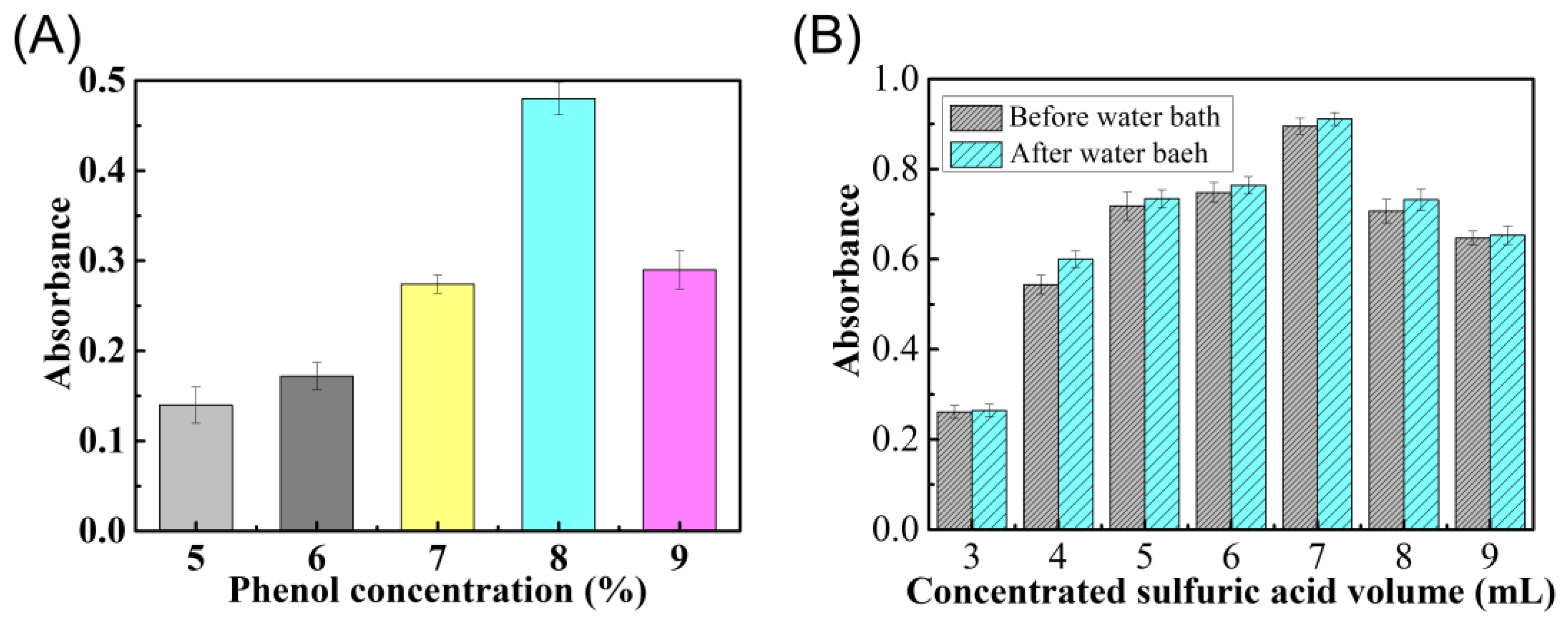
As presented in
Figure 1A, the absorbance increased gradually with rising phenol concentration. The maximum absorbance was achieved at 8% phenol, indicating the optimal chromogenic performance. When phenol concentration further increased to 9%, solution stratification and turbidity occurred due to supersaturation at room temperature, which interfered with detection and significantly reduced absorbance. Therefore, 8% phenol was selected as the optimal concentration.
As shown in
Figure 1B, absorbance increased rapidly and then stabilized with increasing concentrated sulfuric acid dosage. The maximum absorbance was reached at 7 mL, with no further improvement beyond this volume. Meanwhile, absorbance values slightly increased but not significantly after heating in a 40 °C water bath for 15 min. To ensure stable and sufficient color development, 7 mL of concentrated sulfuric acid and 40 °C water bath heating were adopted in subsequent determinations.
3.2. Single-Factor Experiments
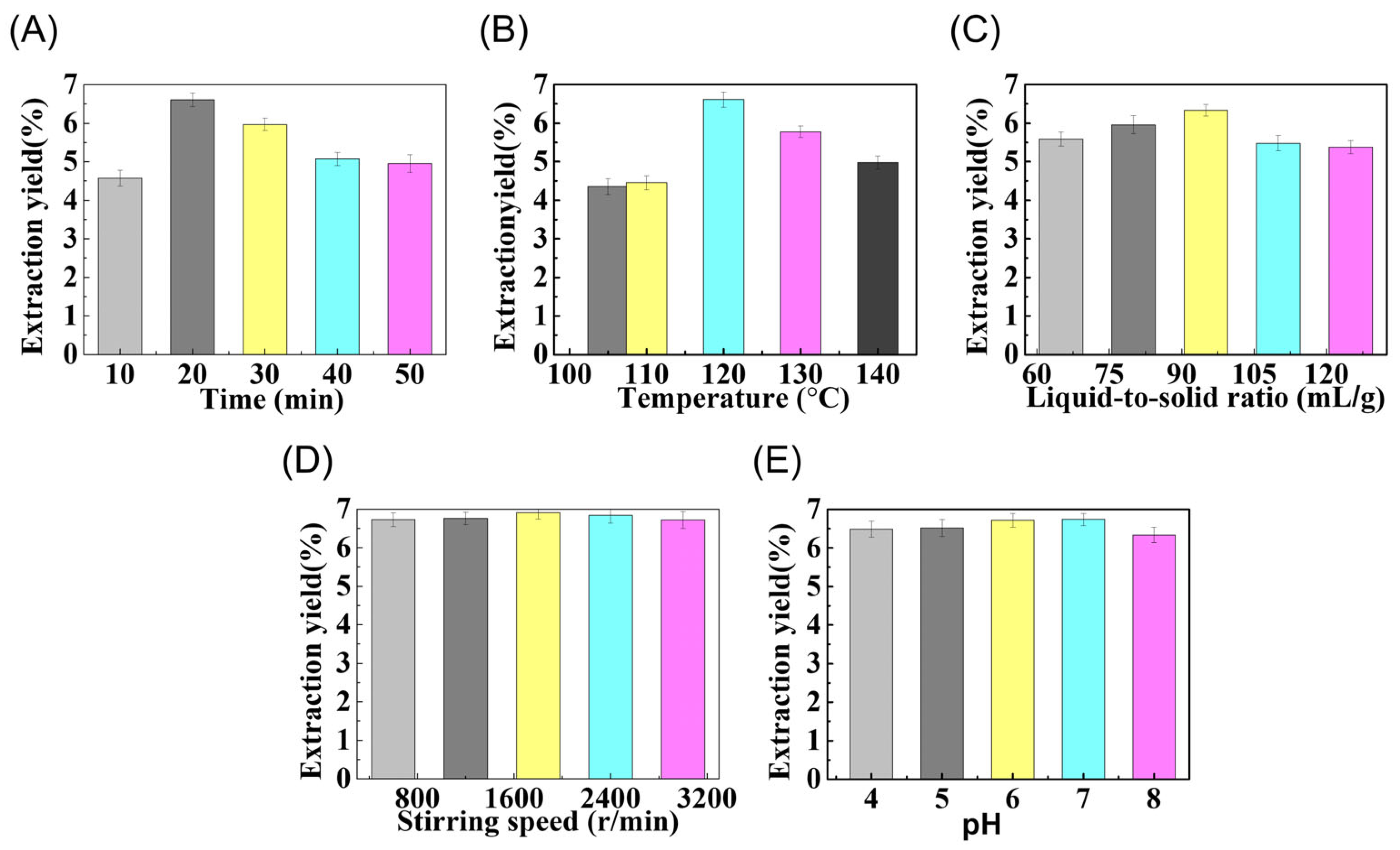
The effects of five key extraction parameters, namely extraction time, extraction temperature, liquid-to-solid ratio, stirring speed, and pH, on the extraction yield of AAP were systematically investigated via single-factor experiments. The corresponding results are presented in
Figure 2A–E.
It can be seen from
Figure 2A that extraction time exerted a highly significant influence on the extraction yield of AAP. In the range of 10–20 min, the extraction yield of AAP increased gradually as the extraction time was prolonged. During this period, subcritical water fully penetrated into the tissue structure of
Artemisia argyi leaves, promoting the continuous dissolution and release of polysaccharides. When the extraction time reached 20 min, the extraction yield reached its maximum value. However, when the extraction time was further extended beyond 20 min, the extraction yield began to decrease continuously. It is inferred that the main reason for this trend is that excessive heating leads to the degradation and structural damage of partial polysaccharides, thereby reducing the extraction yield [
15]. Therefore, 20 min was determined as the appropriate extraction time for the subsequent experiments.
As shown in
Figure 2B, extraction temperature presented a significant effect on the extraction yield of AAP. In the range of 105–120 °C, with the increase in temperature, the polarity, permeability and dissolution ability of subcritical water were significantly enhanced, which promoted the full release of AAP, so the extraction yield increased continuously. The extraction yield reached the maximum value at 120 °C. When the temperature exceeded 120 °C, the extraction yield decreased significantly. This phenomenon can be explained by the fact that an excessively high temperature destroys the molecular chains of polysaccharides with poor thermal stability, damages their structure and biological activity, and accelerates the degradation of polysaccharides, resulting in a decrease in the extraction yield [
16]. Therefore, 120 °C was selected as the suitable extraction temperature.
As shown in
Figure 2C, the effect of the liquid-to-solid ratio on AAP extraction yield showed a trend of first increasing and then decreasing. In the range of 65–95 mL/g, with the increase in the liquid-to-solid ratio, the contact between
Artemisia argyi leaf powder and subcritical water became more sufficient, the mass transfer area was enlarged, and the diffusion rate of polysaccharides was accelerated, so the extraction yield increased steadily. The extraction yield reached the maximum at 95 mL/g. When the ratio was further increased to 110–125 mL/g, the extraction yield decreased instead. The main reasons were that the excessive volume of extract led to increased loss during hot filtration, and higher energy consumption and production cost in the subsequent concentration and ethanol precipitation processes [
17]. Therefore, 95 mL/g was determined as the optimal liquid-to-solid ratio.
As shown in
Figure 2D, the effect of stirring speed on AAP extraction yield showed a trend of rapid increase followed by a gentle plateau. In the range of 600–1800 r/min, with the increase in stirring speed, the turbulence intensity of the extraction system increased significantly, the mixing uniformity between powder and solvent was improved, and the mass transfer effect was effectively strengthened, so the extraction yield increased obviously. When the stirring speed exceeded 1800 r/min, the extraction yield no longer increased significantly. Further increasing the stirring speed not only failed to improve the extraction effect, but also increased energy consumption and equipment loss. Therefore, 1800 r/min was selected as the suitable stirring speed.
As shown in
Figure 2E, in the range of pH 4–9, there was no significant difference in AAP extraction yield, indicating that the pH of the extraction system had little effect on the dissolution of polysaccharides. Considering that pH adjustment requires additional acid and alkali reagents, as well as subsequent neutralization treatment, which increases process complexity and production cost, deionized water without pH adjustment (natural pH) was used as the extraction solvent in this study.
3.3. RSM Optimization and Analysis of Variance
Based on the single-factor experiments, extraction time (A), liquid-to-solid ratio (B), and extraction temperature (C) were chosen as independent variables, and AAP extraction yield as the response. A three-factor, three-level BBD was employed, and the results are listed in
Table 3.
The experimental data were fitted by multiple quadratic regression using Design-Expert 10.0 software, and the regression equation between AAP extraction yield and each factor was obtained as follows:
To verify the reliability and significance of the regression model, variance analysis was performed, and the results are shown in
Table 4 and
Table 5.
According to the analysis of variance results: (1) The regression model was extremely significant (
p < 0.0001), while the lack-of-fit term was not significant (
p = 0.0748 > 0.05), suggesting excellent goodness of fit between the experimental data and the proposed model. Thus, the model is reliable and can be employed to predict AAP extraction yield and optimize the extraction process [
18]. (2) The model exhibited a high correlation coefficient (R
2 = 0.9961) and adjusted correlation coefficient (Adj R
2 = 0.9912), indicating that 99.12% of the variation in AAP extraction yield could be explained by the model. The coefficient of variation (C.V. = 1.51%) was far below 15%, confirming satisfactory experimental repeatability and accuracy. In addition, the difference between Pred R
2 (0.9499) and Adj R
2 was less than 0.2, reflecting good consistency between predicted and experimental values. (3) Adequate precision was 38.969, which was much higher than four, further verifying the acceptable reliability and discrimination capability of the model.
Based on the F values, the influencing order of the three factors on AAP extraction yield was extraction temperature (C) > extraction time (A) > liquid-to-solid ratio (B). All three linear terms exerted extremely significant effects (
p < 0.01). For interactive effects, the combinations of extraction time–liquid-to-solid ratio (AB) and liquid-to-solid ratio–extraction temperature (BC) were extremely significant (
p < 0.01), whereas the interaction between extraction time and extraction temperature (AC) was not significant (
p > 0.05) [
19].
3.4. Interactive Effects
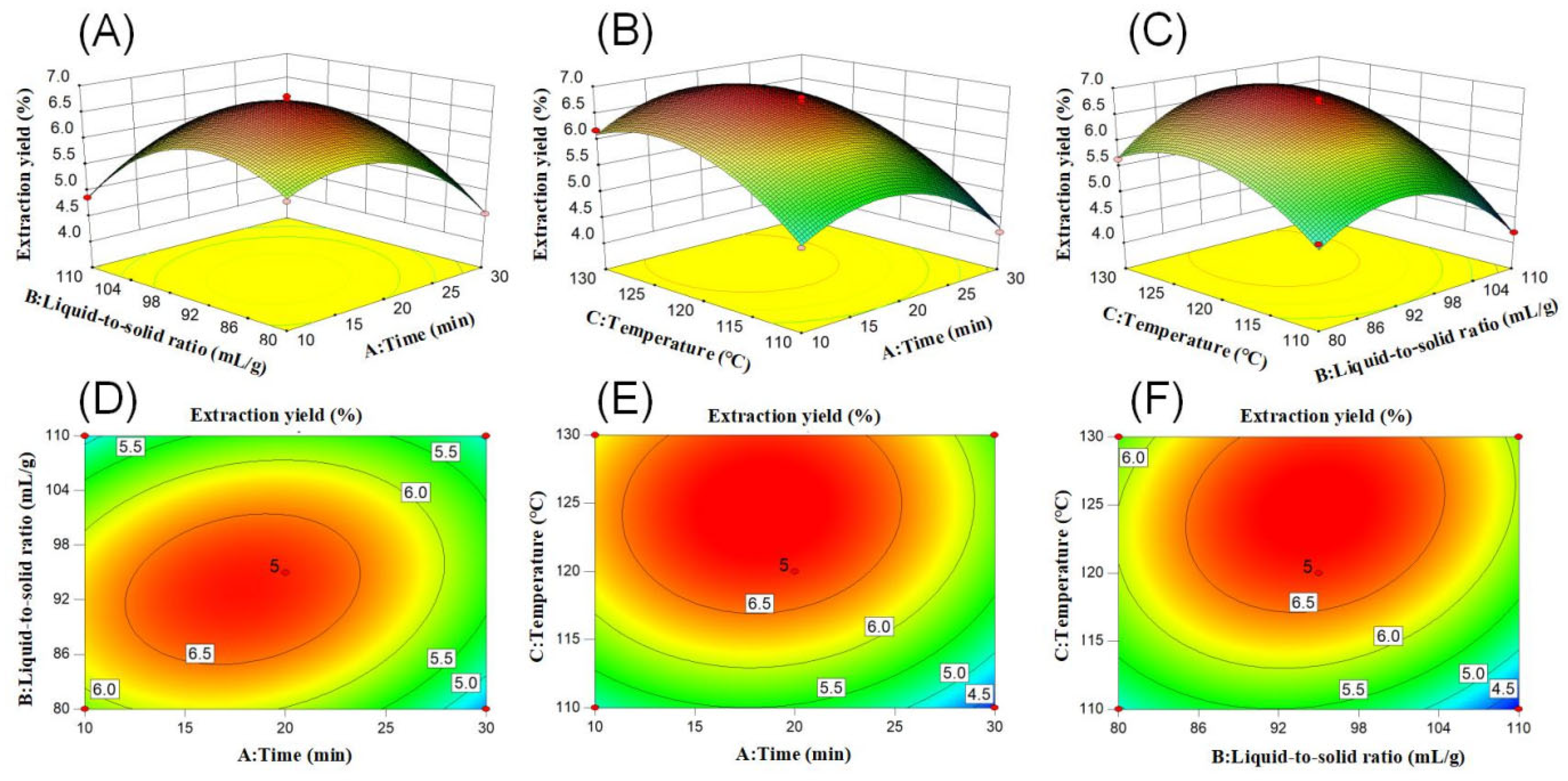
Design-Expert 10 software was used to analyze the interactive effects of different process parameters. Contour plots and three-dimensional (3D) response surface plots (
Figure 3) were generated to intuitively reflect the influences of two-factor interactions on the response value. In the 3D response surface graphs, the surface steepness reflects the change amplitude of the extraction yield with factor levels. A steeper surface usually indicates a more significant interactive effect between the two variables on the AAP extraction yield [
20].
As shown in
Figure 3A,D, the 3D response surface is steep with a prominent peak, and the 2D contour lines exhibit an obvious elliptical shape, indicating an extremely significant interaction between extraction time and liquid-to-solid ratio, which agrees with the ANOVA results. Within an appropriate liquid-to-solid-ratio range, the AAP extraction yield first increases and then decreases with prolonged extraction time. When the liquid-to-solid ratio is too low, the dissolution of AAP remains insufficient even with a long extraction time, resulting in a low extraction yield. When the liquid-to-solid ratio is excessively high, a long extraction duration leads to the degradation of AAP, thus reducing the extraction yield [
21].
As illustrated in
Figure 3B,E, the 3D response surface is relatively gentle, and the 2D contour lines are approximately circular, suggesting that the interaction between extraction time and temperature is not significant. In the initial extraction stage, a longer time and higher temperature promote the dissolution of AAP, thus gradually increasing the extraction yield. However, when the temperature is excessively high and the extraction time is too long, the molecular chains of AAP tend to break and degrade, resulting in a lower extraction yield [
22]. In contrast, if the temperature is too low or the time is too short, the dissolution of AAP is insufficient, and the extraction yield remains at a low level.
As observed in
Figure 3C,F, the 3D response surface shows a distinct convex peak at the center, corresponding to the maximum extraction yield region, and the contour lines are elliptical. These results indicate an extremely significant interaction between extraction temperature and liquid-to-solid ratio. The extraction yield decreases significantly when the liquid-to-solid ratio is either too low or too high, or when the extraction temperature is excessively low. Efficient dissolution of AAP can be achieved only under a well-coordinated combination of temperature and liquid-to-solid ratio.
The regression model was optimized using Design-Expert 10.0 to determine the optimal process parameters for SWE of AAP. The preliminary optimized conditions were obtained as follows: extraction time 19.6 min, liquid-to-solid ratio 93.1 mL/g, extraction temperature 123.5 °C, stirring speed 1800 r/min, and natural pH. Under these conditions, the model predicted an AAP extraction yield of 6.85%.
3.5. Further Optimization of RSM by NN Combined with DSA
To further optimize the experimental results obtained by the RSM, a NN model for the SWE process of AAP was established based on 63 data points derived from the RSM model. It acted as the objective function for achieving the optimal extraction yield and corresponding process conditions [
23,
24].
The input variables of the NN model included extraction time, liquid-to-solid ratio, and extraction temperature. To ensure model convergence and accuracy, all original data were normalized to the range of [−1, 1]. The output variable was defined as the AAP extraction yield. The dataset was randomly divided into three parts: a training set (45 data points, 70%), a test set (nine data points, 15%), and a validation set (nine data points, 15%). The training set was used to adjust the weights and biases of the network; the test set was applied to avoid overfitting; and the validation set, which was not involved in training, was adopted to evaluate the generalization ability of the model.
NN structures with three to 12 hidden layer nodes were tested, and the MSE values of the three datasets are listed in
Table 6. The MSE was calculated as follows:
where n is the number of data points, and
and
denote the AAP extraction yields obtained from NN and RSM models, respectively. The results showed that the {3, 5, 1} network structure achieved the lowest MSE among all structures. Therefore, this structure was selected as the optimal model, and the corresponding weights and biases are listed in
Table 7.
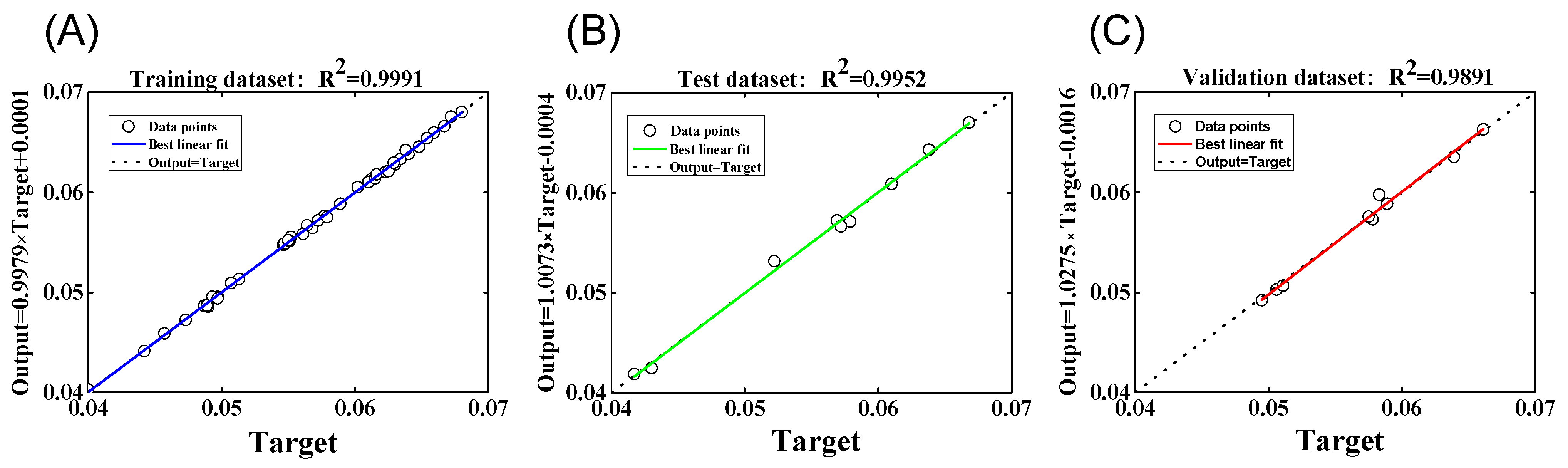
To verify the reliability of the NN model, parity plots of the three datasets were generated, as shown in
Figure 4. Ideally, the slope, intercept, and correlation coefficient should be close to 1, 0, and 1, respectively. All parity plots in this study were close to the ideal state, indicating that the established NN model could accurately reflect the quantitative relationship between extraction parameters and AAP extraction yield.
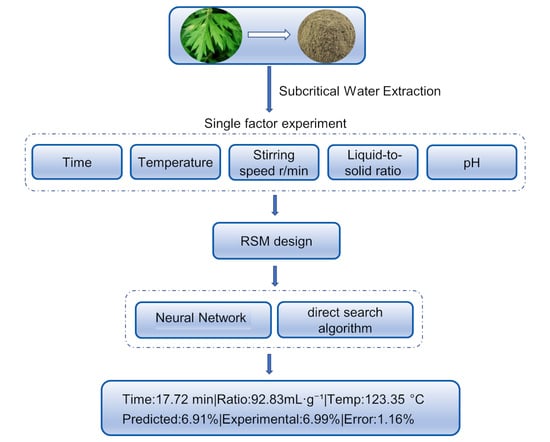
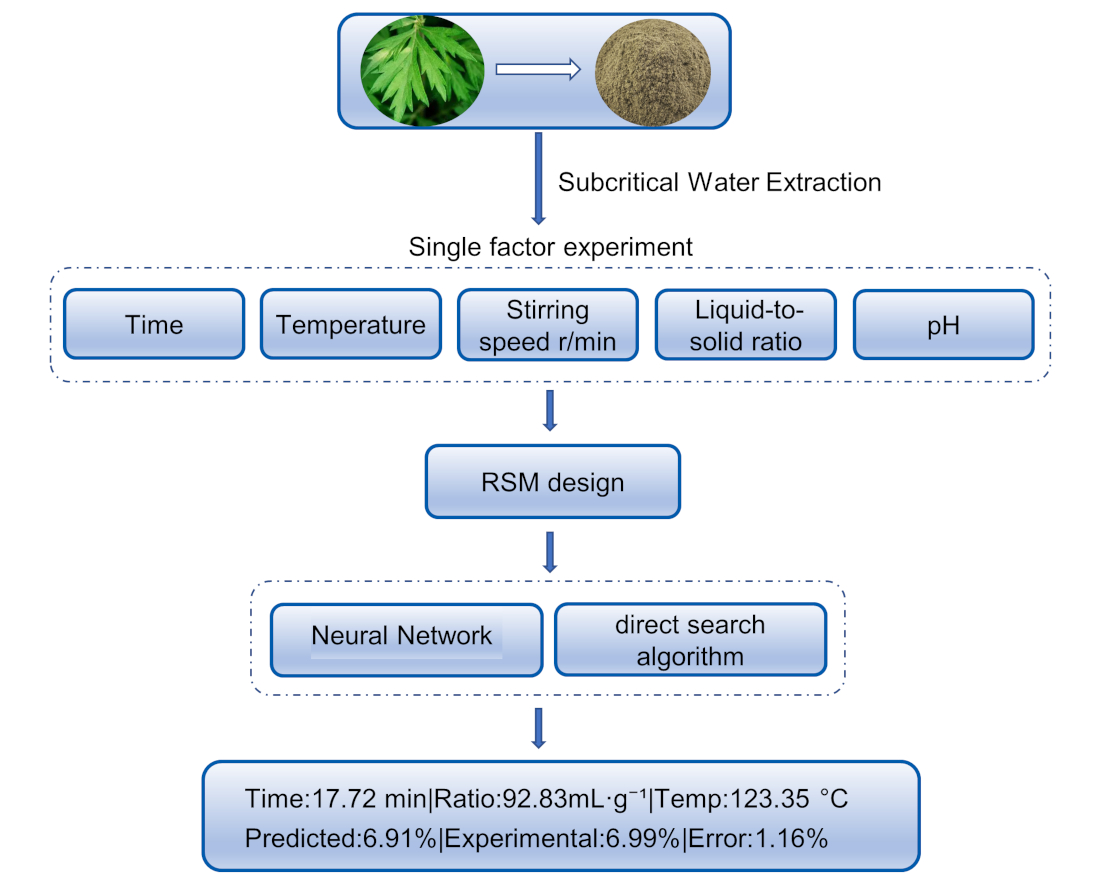
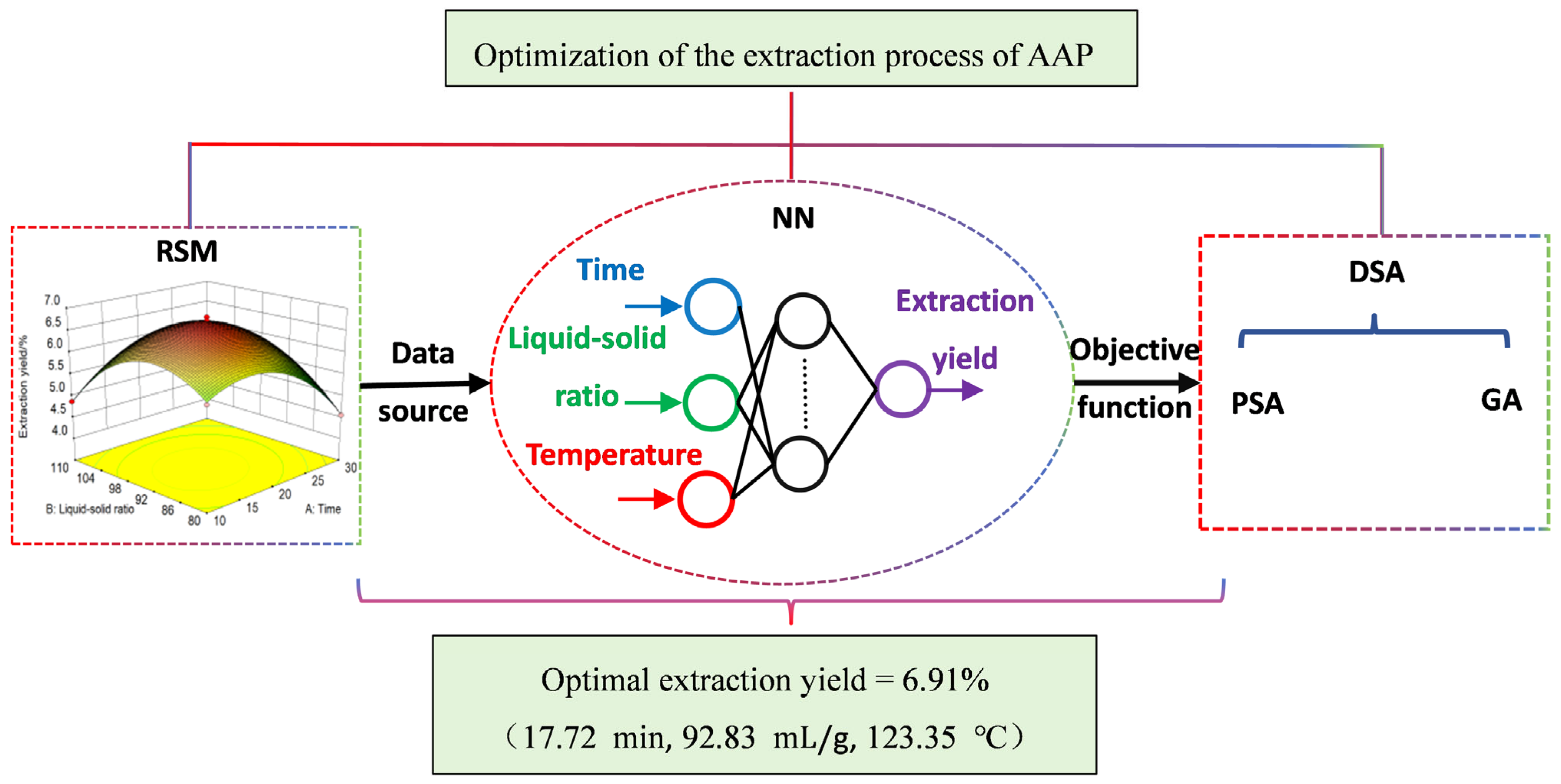
Based on the well-trained NN model, the DSA was used for global optimization. Both GA and PSA gave the same optimal solution. The maximum predicted AAP extraction yield was 6.91%, corresponding to normalized input variables of [–0.228, –0.145, 0.335]. The actual optimized process parameters were as follows: extraction time 17.72 min, liquid-to-solid ratio 92.83 mL/g, and extraction temperature 123.35 °C. The entire NN modeling and DSA optimization process was implemented in MATLAB (R2016a). The integrated RSM-NN-DSA framework used in this study is illustrated in
Figure 5.
3.6. Parameter Validation and Structural Characterization
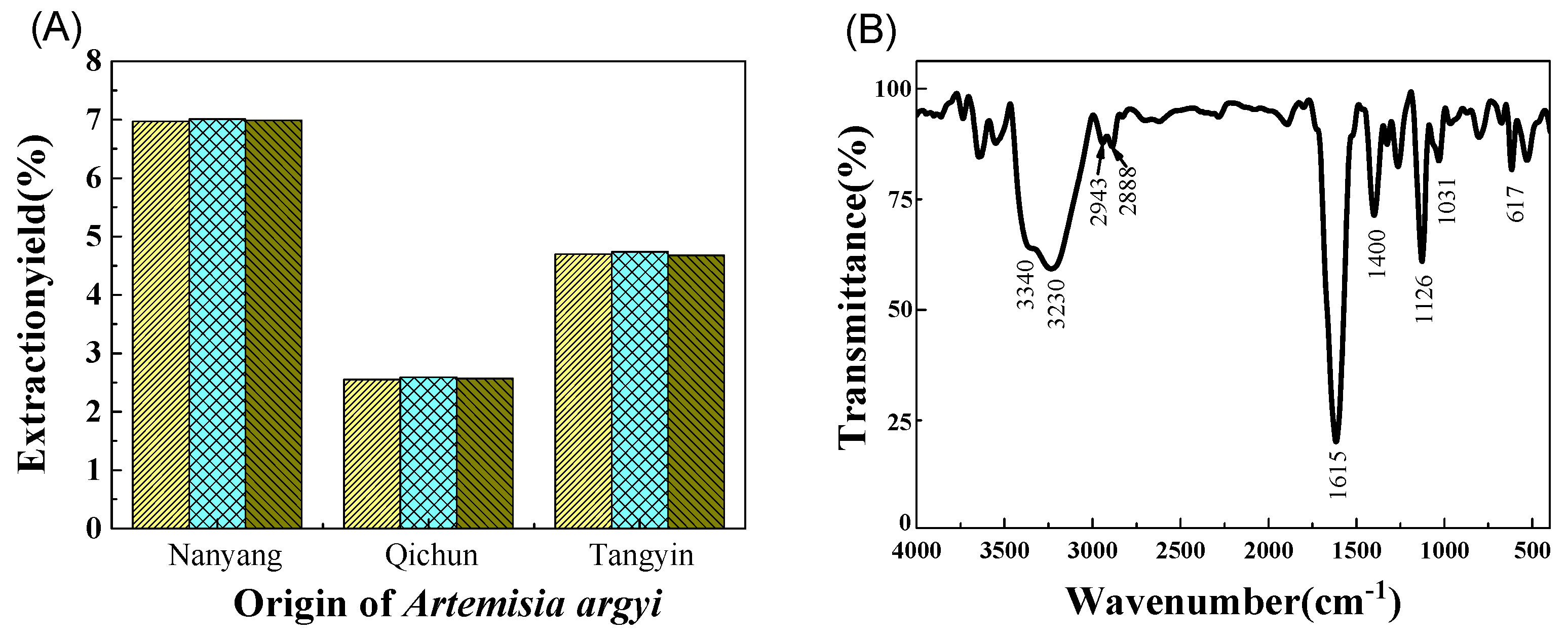
As shown in
Figure 6A, the average experimental extraction yield of AAP from
Artemisia argyi leaves (Nanyang) was 6.99%, and the predicted value was 6.91%. A
t-test confirmed that there was no statistically significant difference between the two values (
p > 0.05). The relative error was only 1.16%, which further verifies that the optimized model has high precision and the obtained process parameters are reliable and suitable for practical production.
In the comparison among Artemisia argyi leaves from different origins, the polysaccharide extraction yields of Qichun and Tangyin samples under the same process conditions were 2.55% and 4.70%, respectively, both of which were significantly lower than that of Artemisia argyi leaves (Nanyang). This indicates that Artemisia argyi leaves (Nanyang) possess a higher polysaccharide content and are more suitable for the industrial production of AAP.
As shown in
Figure 6B, crude polysaccharide exhibits typical infrared absorption peaks of carbohydrate compounds. Broad and strong absorption peaks appeared at 3340 cm
−1 and 3230 cm
−1, which are attributed to O–H stretching vibration. The O–H stretching peaks may shift toward lower wavenumbers with increased sample concentration, forming a characteristic broad band in the range of 3400–3200 cm
−1 [
25]. The peaks at 2943 cm
−1 and 2888 cm
−1 correspond to asymmetric and symmetric stretching vibrations of methyl groups (–CH
3), indicating the presence of saturated alkyl structures in the polysaccharide chains. The absorption peak at 1615 cm
−1 is assigned to C=O stretching vibration in acetamide groups. It is speculated that a cyclic conjugated structure may exist in the crude polysaccharide molecules, causing the carbonyl peak to shift toward lower wavenumbers. The peak at 1400 cm
−1 is attributed to C=C stretching vibration of vinyl end groups. The band at 1126 cm
−1 corresponds to asymmetric stretching vibration of C–O–C, which is a characteristic absorption of glycosidic bonds, confirming the existence of a typical carbohydrate skeleton. The peaks at 1031 cm
−1 and 617 cm
−1 are characteristic of pyranose rings.
Based on the comprehensive assignment and analysis of the above characteristic absorption peaks, the extract obtained by SWE and ethanol precipitation was confirmed to be crude polysaccharides with a pyranose ring structure [
26]. It should be noted that the structural characterization of the extracted product in this study was only performed using FT-IR spectroscopy. Further analyses, such as monosaccharide composition, molecular weight distribution, and detailed structural identification, are recommended to fully characterize the polysaccharides in future work.
4. Conclusions
In this study, a hybrid optimization strategy combining single-factor experiments, RSM, NN, and DSA was developed to optimize the SWE process of AAP. Single-factor tests were first conducted to screen out three critical influencing parameters: extraction time, liquid-to-solid ratio, and extraction temperature. Based on these factors, RSM was employed for preliminary optimization and to establish the regression model between extraction conditions and AAP extraction yield. Furthermore, a well-fitted NN model was constructed using the RSM data, and DSA was adopted to determine the globally optimal process parameters.
The optimal conditions were determined as follows: extraction time 17.72 min, liquid-to-solid ratio 92.83 mL/g, extraction temperature 123.35 °C, stirring speed 1800 r/min, and natural pH. Under these conditions, the predicted AAP extraction yield reached 6.91%, and the experimental extraction yield was 6.99% with a relative error of only 1.16%, confirming the high accuracy and reliability of the optimized results. FT-IR characterization verified that the extracted product possessed the typical structure of polysaccharides.
The proposed RSM-NN-DSA integrated framework exhibited superior optimization performance over the traditional RSM in the nonlinear SWE system. This study not only provides a feasible and efficient process for the large-scale preparation of AAP but also offers a universal and reliable intelligent optimization strategy for the SWE of other plant-derived bioactive components.




 ,
,