
Detoxification and Targeted Conversion of Waste Lithium Battery Electrolyte to Light Hydrocarbons via In Situ Catalytic Pyrolysis: Roles of Li, Ni, Co, and Mn Elements


Abstract
1. Introduction
2. Materials and Methods
2.1. Chemicals and Materials
2.2. Experimental Design
2.3. Analysis Methods
3. Results and Discussion
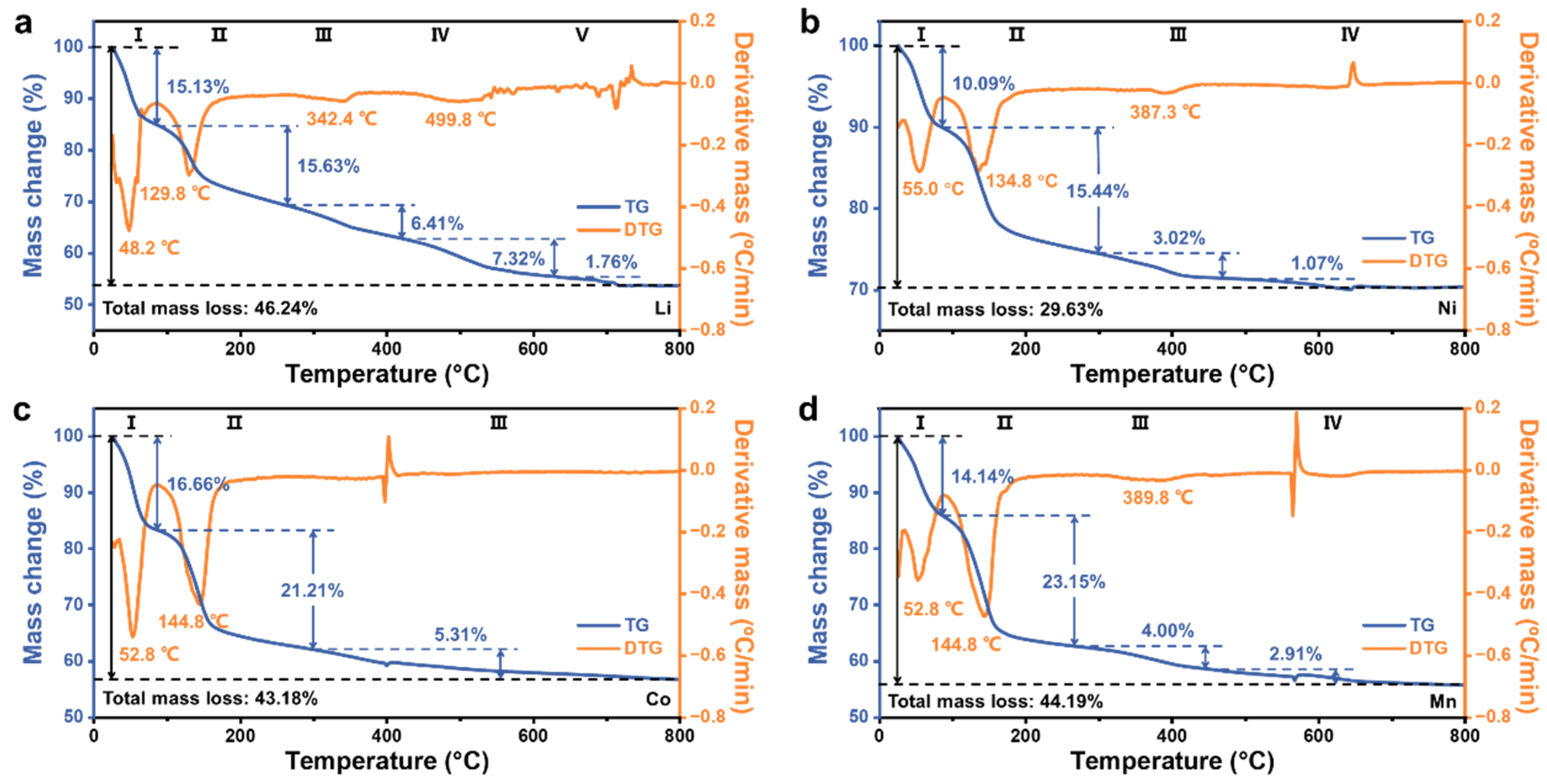
3.1. Thermal Behavior and Reaction Window of Electrolyte Catalytic Pyrolysis
3.2. Role of Individual Metal Elements During In Situ Catalytic Pyrolysis of Electrolyte
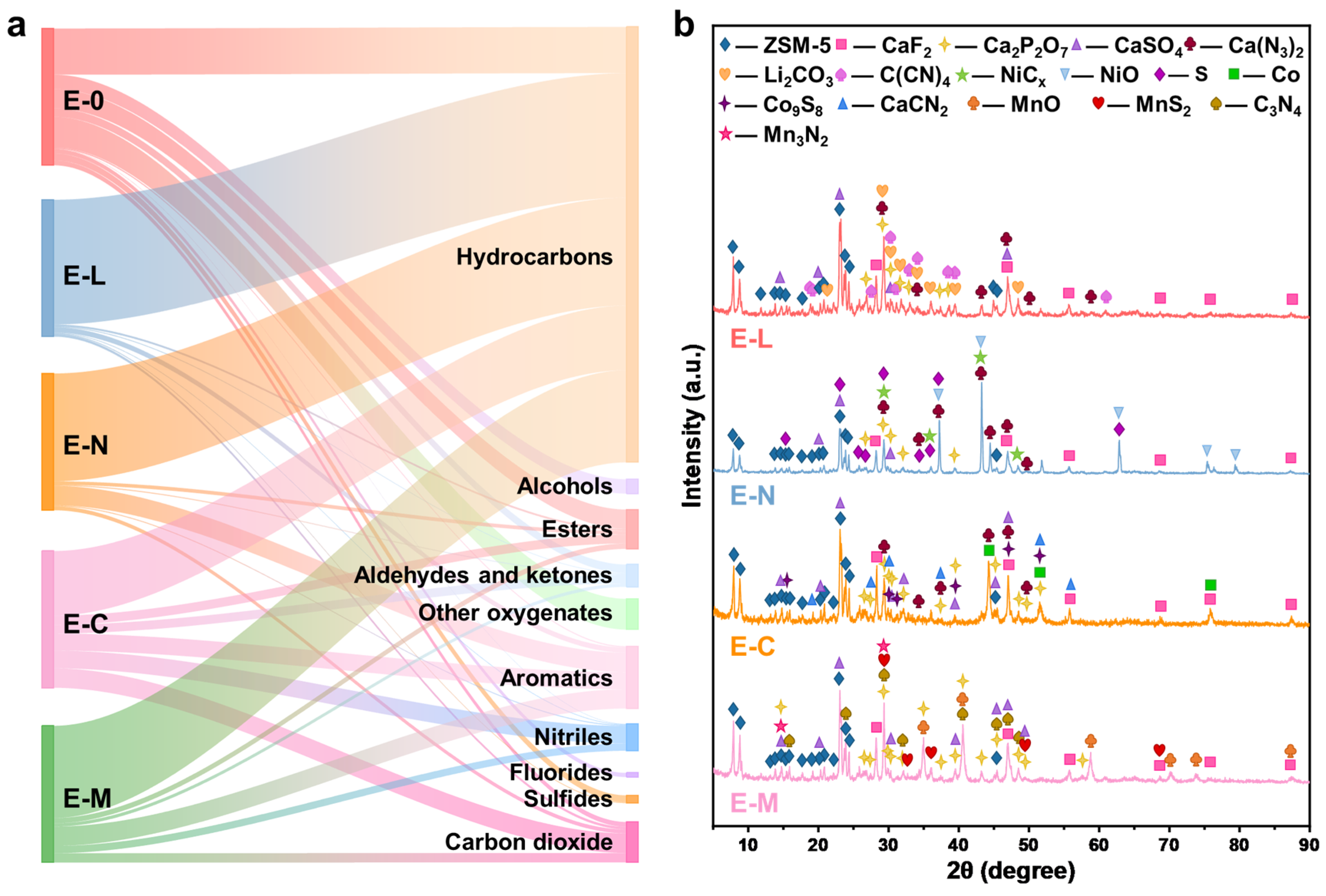
3.2.1. Product Comparison Between Monometallic-Catalyzed and Control Pyrolysis
3.2.2. Differences in Catalytic Pyrolysis Products Among Li, Ni, Co, and Mn
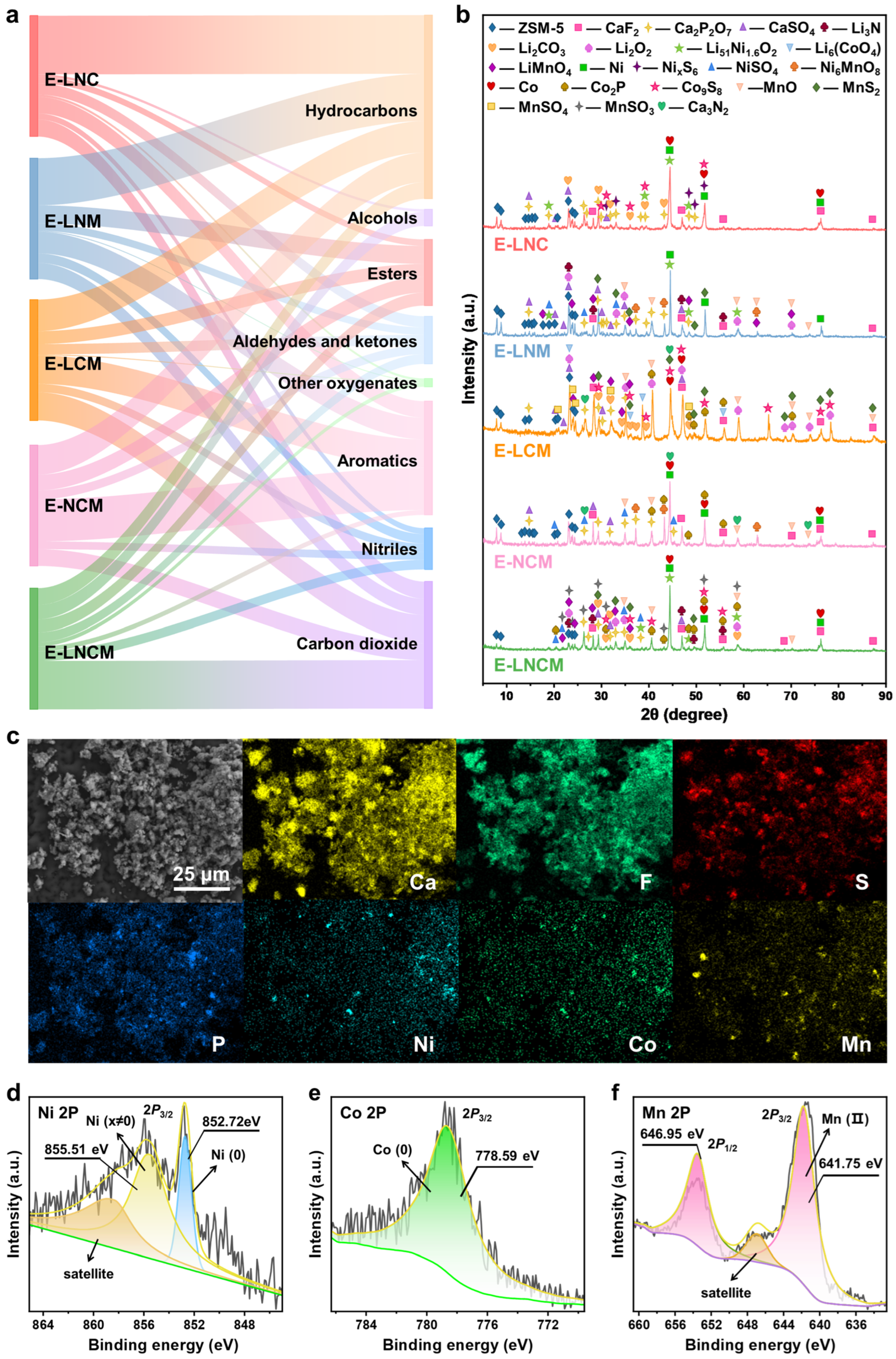
3.3. Synergistic/Antagonistic Effect of Li, Ni, Co, and Mn Multi-Metallic Combination During In Situ Catalytic Pyrolysis of Electrolyte
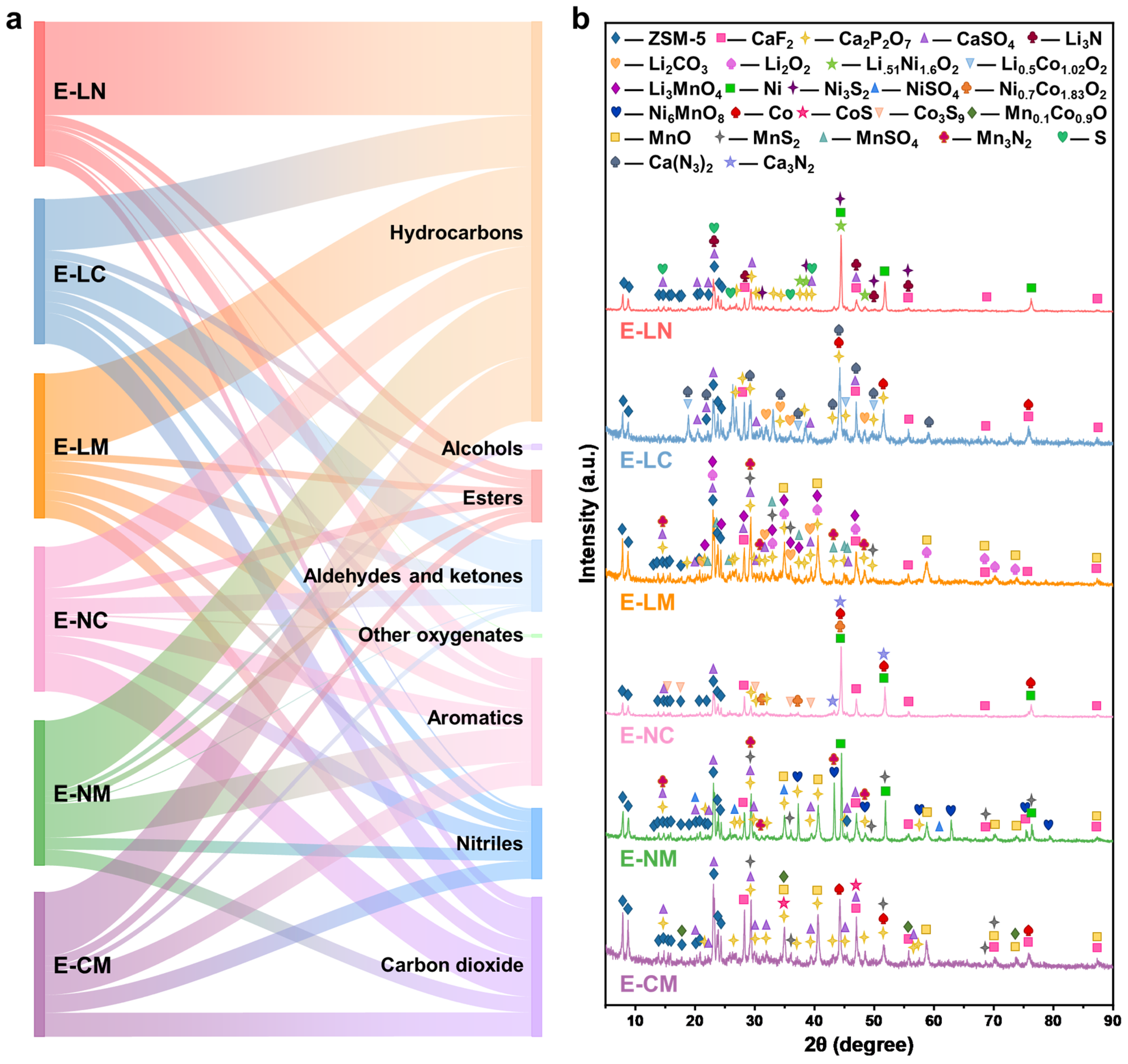
3.3.1. Bimetallic Antagonism in Hydrocarbon Upgrading
3.3.2. Progressive Suppression in Trimetallic Catalytic Systems
3.3.3. Analysis of Tetrametallic Catalytic Pyrolysis Products
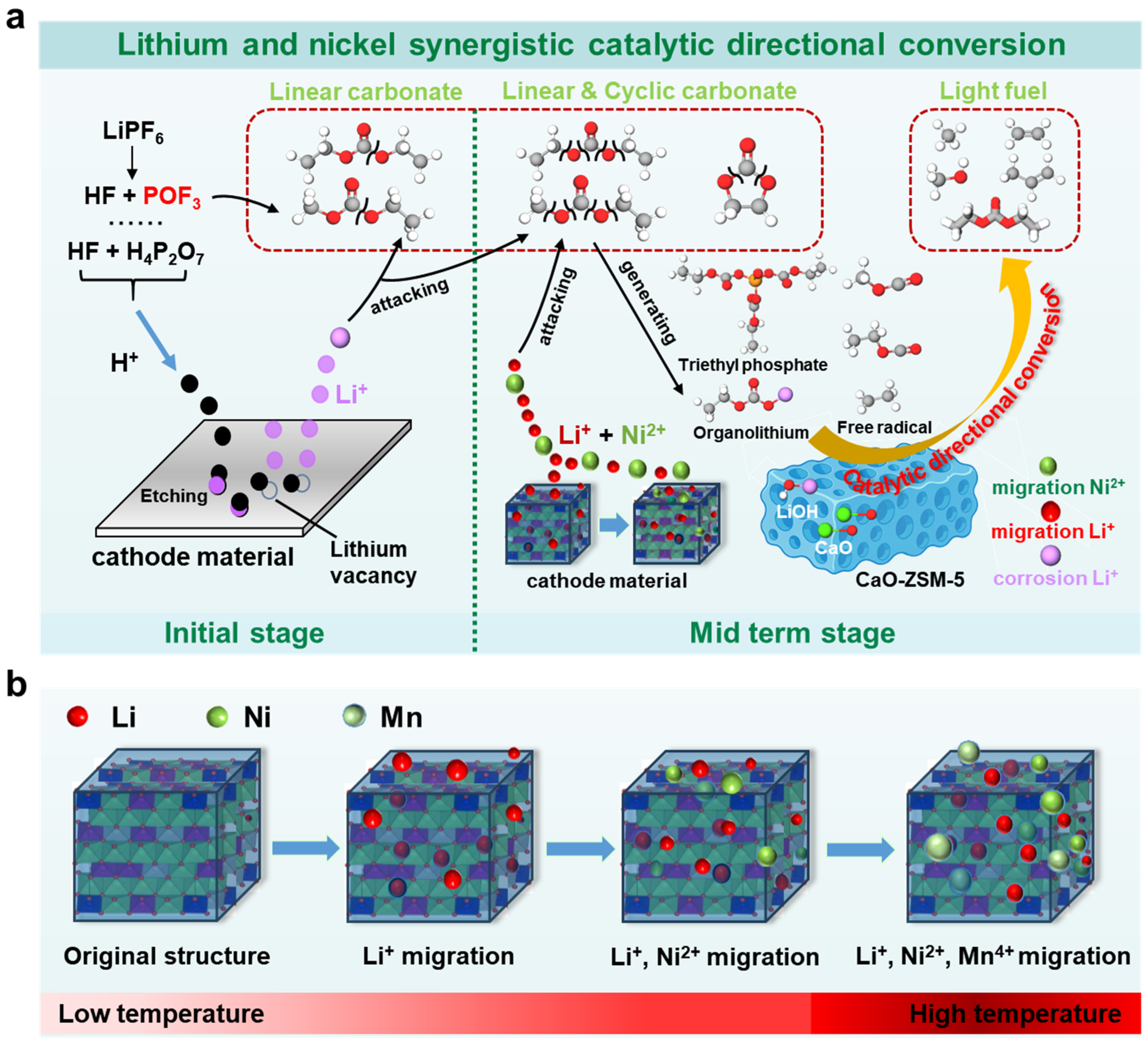
3.4. Mechanism of In Situ Catalytic Pyrolysis for Light Hydrocarbon Conversion and Electrolyte Detoxification by Li, Ni, Co, and Mn Metals in Cathode Materials
- (1)
- Li+ and Ni2+, in synergy with CaO-ZSM-5*, dominate the process of the directional conversion of spent electrolytes into light hydrocarbons during vacuum catalytic pyrolysis.
- (2)
- The structure of the cathode material itself suggests a sequential activation model for the metal elements.
- (3)
- Li+, Ni2+, and Mn4+, in synergy with CaO-ZSM-5*, dominate the deep gas-phase detoxification of the spent electrolyte during vacuum catalytic pyrolysis.
- (4)
- The structure of the cathode material itself suppresses the release of lattice oxygen at high temperatures.
4. Conclusions
Supplementary Materials
Author Contributions
Funding
Data Availability Statement
Conflicts of Interest
References
- Kang, F.; Zhao, Y.; Liu, Y.; Shen, J.; Liu, W.; Lv, W.; Cao, T.; Cao, H.; Sun, Z. Discharge Pathways and Deactivation Mechanisms of Retired Lithium-Ion Batteries. ACS Sustain. Chem. Eng. 2025, 13, 5985–5995. [Google Scholar] [CrossRef] [Scilit]
- Xing, Z.; Srinivasan, M. Electrochemical Approach for Lithium Recovery from Spent Lithium-Ion Batteries: Opportunities and Challenges. ACS Sustain. Resour. Manag. 2024, 1, 1326–1339. [Google Scholar] [CrossRef] [Scilit]
- Xu, J.; Jin, Y.; Liu, K.; Lyu, N.; Zhang, Z.; Sun, B.; Jin, Q.; Lu, H.; Tian, H.; Guo, X.; et al. A green and sustainable strategy toward lithium resources recycling from spent batteries. Sci. Adv. 2022, 8, eabq7948. [Google Scholar] [CrossRef] [Scilit]
- Mao, Z.; Song, Y.; Zhen, A.G.; Sun, W. Recycling of electrolyte from spent lithium-ion batteries. Next Sustain. 2024, 3, 100015. [Google Scholar] [CrossRef] [Scilit]
- Huang, B.; Pan, Z.; Su, X.; An, L. Recycling of lithium-ion batteries: Recent advances and perspectives. J. Power Sources 2018, 399, 274–286. [Google Scholar] [CrossRef] [Scilit]
- Han, J.Y.; Jung, S. Thermal Stability and the Effect of Water on Hydrogen Fluoride Generation in Lithium-Ion Battery Electrolytes Containing LiPF6. Batteries 2022, 8, 61. [Google Scholar] [CrossRef] [Scilit]
- Liu, M.; Vatamanu, J.; Chen, X.; Xing, L.; Xu, K.; Li, W. Hydrolysis of LiPF6-Containing Electrolyte at High Voltage. ACS Energy Lett. 2021, 6, 2096–2102. [Google Scholar] [CrossRef] [Scilit]
- Xu, R.; Lei, S.; Wang, T.; Yi, C.; Sun, W.; Yang, Y. Lithium recovery and solvent reuse from electrolyte of spent lithium-ion battery. Waste Manag. 2023, 167, 135–140. [Google Scholar] [CrossRef] [Scilit]
- Fernandes, Y.; Bry, A.; de Persis, S. Thermal degradation analyses of carbonate solvents used in Li-ion batteries. J. Power Sources 2019, 414, 250–261. [Google Scholar] [CrossRef] [Scilit]
- Jung, R.; Metzger, M.; Maglia, F.; Stinner, C.; Gasteiger, H.A. Oxygen Release and Its Effect on the Cycling Stability of LiNixMnyCozO2 (NMC) Cathode Materials for Li-Ion Batteries. J. Electrochem. Soc. 2017, 164, A1361. [Google Scholar] [CrossRef] [Scilit]
- Sharifi-Asl, S.; Lu, J.; Amine, K.; Shahbazian-Yassar, R. Oxygen Release Degradation in Li-Ion Battery Cathode Materials: Mechanisms and Mitigating Approaches. Adv. Energy Mater. 2019, 9, 1900551. [Google Scholar] [CrossRef] [Scilit]
- Wu, Z.; Zhang, C.; Yuan, F.; Lyu, M.; Yang, P.; Zhang, L.; Zhou, M.; Wang, L.; Zhang, S.; Wang, L. Ni-rich cathode materials for stable high-energy lithium-ion batteries. Nano Energy 2024, 126, 109620. [Google Scholar] [CrossRef] [Scilit]
- Geldasa, F.T.; Kebede, M.A.; Shura, M.W.; Hone, F.G. Identifying surface degradation, mechanical failure, and thermal instability phenomena of high energy density Ni-rich NCM cathode materials for lithium-ion batteries: A review. RSC Adv. 2022, 12, 5891–5909. [Google Scholar] [CrossRef] [Scilit]
- Li, G.; He, K.; Zhang, F.; Jiang, G.; Zhao, Z.; Zhang, Z.; Cheng, J.; Hao, Z. Defect enhanced CoMnNiOx catalysts derived from spent ternary lithium-ion batteries for low-temperature propane oxidation. Appl. Catal. B 2022, 309, 121231. [Google Scholar] [CrossRef] [Scilit]
- Babii, T.; Jirátová, K.; Balabánová, J.; Koštejn, M.; Michalcová, A.; Maixner, J.; Kovanda, F. Performance of nickel-manganese and nickel-cobalt-manganese mixed oxide catalysts in ethanol total oxidation. Catal. Today 2024, 428, 114438. [Google Scholar] [CrossRef] [Scilit]
- Spannring, P.; Bruijnincx, P.C.A.; Weckhuysen, B.M.; Klein Gebbink, R.J.M. Transition metal-catalyzed oxidative double bond cleavage of simple and bio-derived alkenes and unsaturated fatty acids. Catal. Sci. Technol. 2014, 4, 2182–2209. [Google Scholar] [CrossRef] [Scilit]
- Meng, Z.; Dai, J.; Lu, X.-Y.; Wu, K.; Deng, Y.; Wang, J.; Shih, K.; Tang, Y. Synergetic pyrolysis of lithium-ion battery cathodes with polyethylene terephthalate for efficient metal recovery and battery regeneration. Commun. Eng. 2024, 3, 175. [Google Scholar] [CrossRef] [Scilit]
- Chen, Q.; Zhang, X.; Cheng, R.; Shi, H.; Pei, Y.; Yang, J.; Zhao, Q.; Zhao, X.; Wu, F. Crystal phase and nanoscale size regulation utilizing the in-situ catalytic pyrolysis of bamboo sawdust in the recycling of spent lithium batteries. Waste Manag. 2024, 182, 186–196. [Google Scholar] [CrossRef] [Scilit]
- Chen, X.; Liu, Z.; Chen, W.; Yang, H.; Chen, H. Catalytic pyrolysis of cotton stalk to produce aromatic hydrocarbons over Fe modified CaO catalysts and ZSM-5. J. Anal. Appl. Pyrolysis 2022, 166, 105635. [Google Scholar] [CrossRef] [Scilit]
- Sun, Z.; Xu, B.; Rony, A.H.; Toan, S.; Chen, S.; Gasem, K.A.M.; Adidharma, H.; Fan, M.; Xiang, W. Thermogravimetric and kinetics investigation of pine wood pyrolysis catalyzed with alkali-treated CaO/ZSM-5. Energy Convers. Manag. 2017, 146, 182–194. [Google Scholar] [CrossRef] [Scilit]
- Fu, L.; Xiong, Q.; Wang, Q.; Cai, L.; Chen, Z.; Zhou, Y. Catalytic Pyrolysis of Waste Polyethylene Using Combined CaO and Ga/ZSM-5 Catalysts for High Value-Added Aromatics Production. ACS Sustain. Chem. Eng. 2022, 10, 9612–9623. [Google Scholar] [CrossRef] [Scilit]
- Zhang, Y.; Zhang, X.; Zhu, P.; Li, W.; Zhang, L. Defluorination and directional conversion to light fuel by lithium synergistic vacuum catalytic co-pyrolysis for electrolyte and polyvinylidene fluoride in spent lithium-ion batteries. J. Hazard. Mater. 2023, 460, 132445. [Google Scholar] [CrossRef] [Scilit]




| Parameter | Prior Work | This Manuscript |
|---|---|---|
| Feedstock (Waste Stream) | Real spent NCM cathode + PVDF binder + electrolyte | Simulated spent electrolyte |
| Catalyst Components | CaO + ZSM-5 molecular sieve | Metal Additives (MA: LiOH, NiO, Co3O4, MnO2) + Ca(OH)2 + ZSM-5 molecular sieve |
| Catalyst Preparation | Energy-intensive multi-step process:
| Simplified two-step physical mixing:
|
| Mass Ratios | Electrolyte: CaO-ZSM-5: Cathode = 2:2:1 | Metal Additive: Electrolyte: CaO-ZSM-5* = 1:2:3 |
| Process Conditions | Temperature: 530 °C Initial pressure: 100 Pa Pyrolysis time: 20 min | Temperature: 530 °C Initial pressure: 100 Pa Pyrolysis time: 20 min |
| Research Objective | Macro-level feasibility of electrolyte defluorination and directional upgrading into light fuels | Element-specific mechanistic deconvolution of individual cathode metals and their multi-metallic interactions |
| Key Outputs/Conclusions |
|
|
| Groups | Total Light Hydrocarbons (C1–C6)/% | Total Oxygenates/% | Aromatics/% | Nitriles/% | Sulfides/% | Fluorides/% | CO2/% |
|---|---|---|---|---|---|---|---|
| E-0 | 33.75 | 53.22 | 0.93 | 0.25 | 5.05 | 3.18 | 3.62 |
| E-L | 91.08 | 2.02 | 3.86 | 0.48 | 0.67 | 0 | 1.89 |
| E-N | 78.77 | 3.41 | 14.21 | 0.71 | 0 | 0 | 2.90 |
| E-C | 47.17 | 13.15 | 12.47 | 12.93 | 0 | 0 | 14.28 |
| E-M | 67.40 | 6.36 | 14.07 | 5.31 | 0 | 0 | 6.86 |
| E-LN | 64.84 | 10.37 | 14.94 | 1.72 | 0 | 0 | 8.13 |
| E-LC | 35.42 | 27.83 | 7.76 | 7.51 | 0 | 0 | 21.48 |
| E-LM | 55.10 | 13.49 | 12.12 | 7.08 | 0 | 0 | 12.21 |
| E-NC | 28.44 | 19.43 | 13.49 | 11.76 | 0 | 0 | 26.88 |
| E-NM | 48.42 | 8.90 | 23.46 | 8.31 | 0 | 0 | 10.91 |
| E-CM | 44.20 | 10.76 | 16.13 | 12.36 | 0 | 0 | 16.55 |
| E-LNC | 48.50 | 18.67 | 13.66 | 4.95 | 0 | 0 | 14.22 |
| E-LNM | 39.03 | 21.82 | 17.94 | 7.86 | 0 | 0 | 13.35 |
| E-LCM | 26.08 | 20.05 | 23.59 | 6.97 | 0 | 0 | 23.31 |
| E-NCM | 24.50 | 20.40 | 34.78 | 6.42 | 0 | 0 | 13.90 |
| E-LNCM | 13.80 | 34.18 | 4.06 | 7.97 | 0 | 0 | 39.99 |
Disclaimer/Publisher’s Note: The statements, opinions and data contained in all publications are solely those of the individual author(s) and contributor(s) and not of MDPI and/or the editor(s). MDPI and/or the editor(s) disclaim responsibility for any injury to people or property resulting from any ideas, methods, instructions or products referred to in the content. |
© 2026 by the authors. Licensee MDPI, Basel, Switzerland. This article is an open access article distributed under the terms and conditions of the Creative Commons Attribution (CC BY) license.
Share and Cite
Wang, J.; Zhang, Y.; Zhang, L. Detoxification and Targeted Conversion of Waste Lithium Battery Electrolyte to Light Hydrocarbons via In Situ Catalytic Pyrolysis: Roles of Li, Ni, Co, and Mn Elements. Separations 2026, 13, 163. https://doi.org/10.3390/separations13060163
Wang J, Zhang Y, Zhang L. Detoxification and Targeted Conversion of Waste Lithium Battery Electrolyte to Light Hydrocarbons via In Situ Catalytic Pyrolysis: Roles of Li, Ni, Co, and Mn Elements. Separations. 2026; 13(6):163. https://doi.org/10.3390/separations13060163
Chicago/Turabian StyleWang, Jingyi, Yu Zhang, and Lingen Zhang. 2026. "Detoxification and Targeted Conversion of Waste Lithium Battery Electrolyte to Light Hydrocarbons via In Situ Catalytic Pyrolysis: Roles of Li, Ni, Co, and Mn Elements" Separations 13, no. 6: 163. https://doi.org/10.3390/separations13060163
APA StyleWang, J., Zhang, Y., & Zhang, L. (2026). Detoxification and Targeted Conversion of Waste Lithium Battery Electrolyte to Light Hydrocarbons via In Situ Catalytic Pyrolysis: Roles of Li, Ni, Co, and Mn Elements. Separations, 13(6), 163. https://doi.org/10.3390/separations13060163