1. Introduction
The development of chromatography in the Republic of North Macedonia has closely followed the global progress of analytical chemistry and instrumental analysis. Chromatography is one of the most important analytical techniques in chemical sciences, widely used for the separation, identification, and quantification of the constituents in complex mixtures. Since its establishment in the early twentieth century, chromatography has evolved into a suite of advanced instrumental techniques, employing gas chromatography (GC), high-performance liquid chromatography (HPLC) for separation, and sophisticated detection, such as the liquid chromatography–mass spectrometry (LC–MS) combination, as well as hyphenated platforms coupling separation with high-resolution mass spectrometry, diode-array detection, and nuclear magnetic resonance spectroscopy.
In the Republic of North Macedonia, chromatographic research is strongly associated with the Ss. Cyril and Methodius University in Skopje (UKIM), which serves as the central academic institution for analytical chemistry. The development of chromatographic methods in the country has followed global trends, progressing from classical separation techniques toward advanced hyphenated systems used in environmental monitoring, pharmaceutical analysis, food chemistry, and phytochemical research. Despite the increasing scientific output, no comprehensive scientometric study had previously mapped the institutional structure, methodological evolution, and industrial contribution of this field within the country. The present work addresses this gap by integrating Scopus-based publication data with institutional and industrial analysis.
2. Historical Development
The foundations of analytical chemistry in the country were established, particularly with the introduction of analytical chemistry courses and laboratories at the Faculty of Chemistry as a part of Ss. Cyril and Methodius University in Skopje in 1948. During this period, the first laboratories for qualitative and quantitative chemical analysis were organized, creating the basis for the later introduction of chromatographic methods into scientific research and industrial applications.
Although paper chromatography and other classical separation techniques were likely introduced in laboratory practice during the 1950s and 1960s, documented international evidence of chromatography-related research from North Macedonia appeared later. The earliest currently identified Scopus-indexed chromatography publication affiliated with Macedonia is the work of Nastev, Efremov, and Petkov (1977), published in the journal
Hemoglobin [
1]. The authors, working at the Medical Center in Titov Veles and within the research group later associated with the Macedonian Academy of Sciences and Arts (MANU), described a microcolumn ion-exchange chromatography method using DEAE-cellulose (DE 52, Whatman Inc.) for the quantitation of hemoglobin A2. This study represents the earliest internationally indexed evidence of chromatographic separation applied by Macedonia-affiliated researchers in clinical biochemistry.
However, chromatographic methodologies, particularly paper chromatography and thin-layer chromatography (TLC), were almost certainly already present in university teaching and routine laboratory practice prior to this publication, although such activities were mainly documented in local reports, institutional publications, or non-indexed journals.
A pioneer in this field was
Bojan Podolešov, a professor of biochemistry whose research focused on natural products and oxidation reactions. Together with his assistant,
Zoran Zdravkovski he investigated the constituents of
Aristolochia species endemic to Macedonia, including
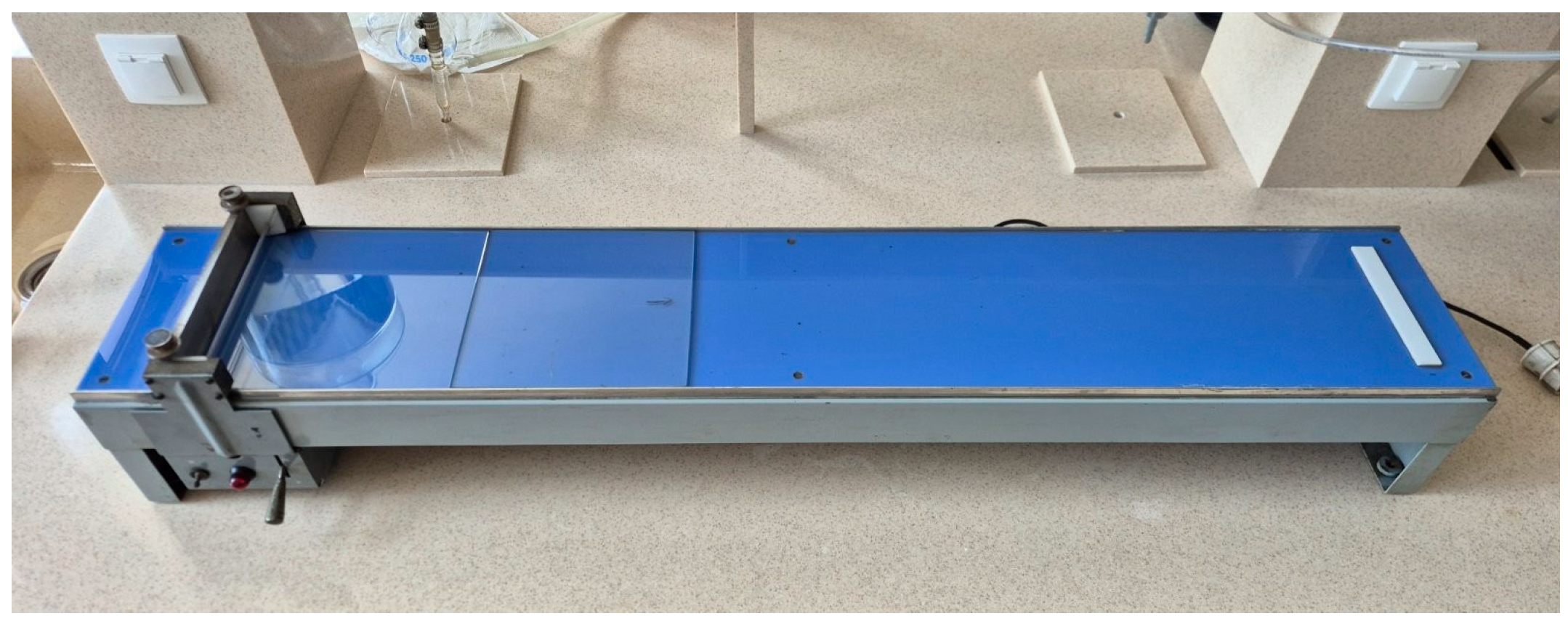
Aristolochia macedonica Born. Their work involved the use of self-prepared TLC plates, produced with an applicator (
Figure 1) and coated with silica gel containing the GF
254 indicator. In 1980 and 1981, they published two papers in
Acta Pharmaceutica Jugoslavica (now
Acta Pharmaceutica) and another in
Contributions of the Macedonian Academy of Sciences and Arts [
2,
3,
4].
A particularly important role in the subsequent development of chromatographic science and analytical chemistry in the country has been played by the Institute of Chemistry at the Faculty of Natural Sciences and Mathematics, Ss. Cyril and Methodius University in Skopje. The Institute has been one of the leading academic and research centers in the country for the implementation and advancement of modern chromatographic techniques, including thin-layer chromatography (TLC), gas chromatography (GC), high-performance liquid chromatography (HPLC), ion chromatography, and mass spectrometry-coupled techniques. Through continuous scientific research, education of chemists, and international collaboration, the Institute has significantly contributed to the training of generations of chemists and analytical scientists, as well as to the modernization of analytical methodologies in the country.
Following the 1977 milestone, paper chromatography, thin-layer chromatography (TLC), and classical column chromatography became increasingly applied during the 1970s and 1980s in pharmaceutical, food, agricultural, and environmental analyses. These methods enabled the separation and identification of organic compounds, pigments, pharmaceuticals, and natural products and represented a significant advancement in analytical capabilities within the country.
The development of instrumental chromatography accelerated during the 1980s and 1990s with the introduction of GC and HPLC in university laboratories, research institutions, and industrial quality-control laboratories. These techniques significantly improved analytical precision, sensitivity, and reproducibility, allowing broader applications in toxicology, pharmaceutical analysis, environmental monitoring, and food quality assessment. The first phase (1980–1995) was characterized by limited instrumental infrastructure and reliance on classical gas chromatography for basic organic-compound analysis. The second phase (1995–2010) marked a significant expansion in analytical capabilities, particularly with the introduction of HPLC and gas chromatography–mass spectrometry (GC–MS), which enabled applications in environmental chemistry, natural products, pharmaceutical analysis, and food safety.
In the last two decades, chromatographic research in Macedonia has expanded considerably through the implementation of advanced hyphenated techniques such as GC–MS and liquid chromatography–tandem mass spectrometry (LC–MS/MS). Modern chromatographic methods are now routinely employed in studies involving natural products, metabolomics, pharmaceutical analysis, wine characterization, environmental pollutants, and biomonitoring, and have been complemented at MANU by matrix-assisted laser desorption/ionization–time of flight (MALDI-TOF) mass spectrometry for clinical proteomics. Macedonian researchers actively contribute to international scientific literature, particularly in the fields of analytical chemistry, phytochemistry, and environmental science. Today, chromatography represents one of the most important analytical approaches in academic and industrial laboratories in North Macedonia, supporting research, quality control, environmental protection, and public health applications. The timeline is given in
Table 1.
3. Institutional Structure and Main Contributors
Chromatography research in the Republic of North Macedonia is highly centralized within “Ss. Cyril and Methodius University in Skopje”. The most productive units are the Institute of Chemistry at the Faculty of Natural Sciences and Mathematics and the Faculty of Pharmacy. In later stages of development, significant contributions in the field of chromatography also emerged from the Faculty of Agricultural Sciences and Food, the Faculty of Veterinary Medicine, and the Faculty of Technology and Metallurgy.
These activities have been further complemented by contributions from the Macedonian Academy of Sciences and Arts (MANU) and the Faculty of Agriculture, Goce Delčev University in Štip. The list of all relevant contributors is given in
Table 2.
3.1. Institute of Chemistry, Faculty of Natural Sciences and Mathematics, Ss. Cyril and Methodius University in Skopje
The Institute of Chemistry serves as the primary national center for fundamental analytical chemistry, environmental analysis, and natural products research. Researchers at the Institute apply thin-layer chromatography (TLC), gas chromatography (GC), high-performance liquid chromatography (HPLC), gas chromatography–mass spectrometry (GC–MS), and liquid chromatography–mass spectrometry (LC–MS) for pollutant monitoring and detailed phenolic profiling of Macedonian plants, fruits, and bee products.
The pioneering work in thin-layer chromatography within the Institute was carried out as part of qualitative organic and inorganic analysis during the early phase of the laboratory development. A major contribution to the establishment and modernization of chromatographic science at the Institute was made by Zoran Zdravkovski, who introduced and developed gas chromatography methodologies within the Institute laboratories. His research focused particularly on volatile organic compounds and environmental samples, and he played an important role in establishing GC as a routine analytical technique at the Institute.
Marina Stefova introduced HPLC into the Institute and, together with Jasmina Petreska Stanoeva, has played a central role in establishing HPLC coupled with diode-array and mass spectrometric detection (HPLC–DAD–MSn) as a fundamental analytical technique for research and practical applications. Their work has significantly contributed to phytochemical research through the application of HPLC and LC–MS techniques for plant metabolite profiling, while in recent years their research has also expanded toward environmental analysis. At the same time, the collaboration with the pharmaceutical industry developed and contributed to advanced applications in this sector.
In recent years, Jane Bogdanov has contributed significantly to the development of chromatographic applications in environmental analytical chemistry. He has also contributed to the application of chromatographic methods in essential-oil characterization and natural-product analysis.
During the last few years, Ivona Sofronievska and Marinela Cvetanoska, working in the fields of environmental analysis and natural products, have represented a younger generation of researchers continuing the development of chromatographic science at the Institute.
In the period preceding the consolidation of in-house chromatographic capacity at the Institute, Trajče Stafilov, whose primary research focus is environmental pollutant analysis using atomic spectroscopy techniques, was among the first Macedonian researchers to publish papers involving chromatographic methods through collaborations with colleagues from abroad.
3.2. Faculty of Pharmacy, Ss. Cyril and Methodius University in Skopje
The Faculty of Pharmacy is the leading national center for pharmaceutical chromatography, focusing on HPLC and LC–MS methods for pharmacognosy, medicinal plant analysis, drug quality control, and pharmaceutical formulation studies. Key researchers include Svetlana Kulevanova, Gjoshe Stefkov, Marija Karapandzova (pharmacognosy and essential-oil analysis of Macedonian medicinal and aromatic plants), Aneta Dimitrovska, Jelena Acevska, Rumenka Petkovska, and Natalija Nakov (chromatographic method development and validation, stability-indicating HPLC and UHPLC/MS methods, HPLC-MS/MS bioanalysis—including chiral separation of ibuprofen enantiomers in human plasma—and chemometric data treatment in pharmaceutical analysis), Ivana Karanfilova Cvetkovikj, Tatjana Kadifkova-Panovska, Biljana Bauer-Petrovska, and Lidija Petrushevska-Tozi (bromatology, dietary and bioactive-compound analysis), and Zoran Kavrakovski. Their combined output spans essential oil analysis of Macedonian medicinal and aromatic plants, validation of stability-indicating HPLC methods for active pharmaceutical ingredients (APIs), and bioactive-compound profiling for pharmacognostic standardization.
3.3. Macedonian Academy of Sciences and Arts (MANU)
MANU has strongly supported the advancement of chemical and analytical sciences through scientific projects, interdisciplinary research, and international cooperation. The Research Center for Genetic Engineering and Biotechnology “Georgi D. Efremov” serves as the National Reference Center for Genomics and Proteomics. The historical lineage of chromatographic research at the Center traces back to Georgi D. Efremov, a foundational figure in Macedonian molecular genetics and hematology and co-author of the 1977 Hemoglobin paper that constitutes the earliest Scopus-indexed Macedonian chromatography publication [
1]. The Center is currently directed by
Dijana A. Plaseska-Karanfilska, under whose leadership the proteomics and biomarker program has expanded.
Aleksandar J. Dimovski (Head of Genetics and Pharmacogenetics) co-authors the broader pharmacogenetic, pharmacogenomic, and chromatographic-method work of the Center and is one of MANU’s most-cited researchers overall.
Katarina Davalieva applies advanced proteomic platforms, including 2D-DIGE/MALDI-TOF mass spectrometry and nano-LC–MS/MS, complementing traditional chromatography for biomarker discovery and biomedical research; her 2015 paper on prostate-cancer proteomics in
Prostate is the most-cited Macedonian MALDI/proteomics study to date.
3.4. Other Contributing Institutions
Several additional institutions contribute substantially to the national chromatographic landscape:
- •
Goce Delčev University, Štip: Violeta Ivanova-Petropulos, with a PhD in wine polyphenol characterization from the Institute of Chemistry (UKIM) and a permanent position at the Faculty of Agriculture, leads research in wine chemistry and food authenticity using GC–MS and LC–MS, with a strong record of internationally co-authored publications. At the affiliated Faculty of Medical Sciences, Katarina Smilkov works on radiolabeled-peptide HPLC characterization and nutraceutical analysis (piperine, curcuminoids).
- •
Faculty of Agricultural Sciences and Food, UKIM: Lenche Velkoska-Markovska, Mirjana S. Jankulovska, and Biljana Petanovska-Ilievska focus on food chemistry, antioxidants, and pesticide residues.
- •
Faculty of Technology and Metallurgy, UKIM: Vesna Rafajlovska contributes to food extraction chemistry, HPTLC of bearberry leaves, and HPLC characterization of refill liquids for electronic cigarettes; Kiril Lisichkov works in supercritical-fluid extraction coupled with GC analysis of fish oil and plant bioactives.
- •
Faculty of Veterinary Medicine, UKIM: Elizabeta Stojkovikj-Dimitrieska works in food safety, acrylamide, and aflatoxin determination in foods of animal origin; Zehra Hajrulai-Musliu is active in the development and validation of multi-class LC-ESI-MS/MS methods for veterinary drug, mycotoxin, and pesticide residues in bovine milk, urine, and apicultural products.
- •
Hydrobiological Institute, Ohrid, University St. Kliment Ohridski, Bitola: E. M. Veljanoska-Sarafiloska conducts environmental analysis of aquatic systems, with a focus on Lake Ohrid and related freshwater ecosystems.
4. Most-Cited Chromatography-Related Publications
The total number of publications related to chromatography is 424. Analysis of citation impact identifies a relatively small core of highly influential papers authored or co-authored by Macedonia-affiliated researchers (
Table 3). The most striking pattern is the dominance of one research lineage: of the fifteen top-cited chromatography papers from the country, eleven involve Marina Stefova of the Institute of Chemistry, either as senior author or as part of the wider network of her associates. The 2011 paper by Gavrilova, Kajdžanoska, Gjamovski & Stefova on the HPLC-DAD-ESI-MS
n profiling of berries and small fruits (224 citations,
J. Agric. Food Chem.) and the 2010 strawberry paper by Kajdžanoska, Gjamovski & Stefova (162 citations, Maced.
J. Chem. Chem. Eng.) are not isolated successes but the visible tip of a coherent, two-decade-long program in HPLC-DAD-MS
n phenolic profiling of Macedonian plants, fruits, and bee products.
Methodologically, the top-cited output splits along three strands that map onto distinct institutions and styles of collaboration.
The phytochemistry strand, led by the Institute of Chemistry (FNSM, UKIM), accounts for most of
Table 3. Beyond Stefova herself, the strand includes Jasmina Petreska Stanoeva (phenolic and polyphenolic fingerprinting of plants, fruits, and propolis by HPLC-DAD-MS
n and GC-MS) and Trajče Stafilov (environmental analytical chemistry; the most-cited Macedonian author overall, although several of his top papers fall outside chromatography proper and are not included in
Table 3).
The pharmaceutical chromatography strand, led by the Faculty of Pharmacy (UKIM) but also involving the Institute of Chemistry, is the second-largest contributor. The 2013 J. Chromatogr. A paper by Cvetkovikj, Stefkov, Acevska, Petreska, Stanoeva, Karapandzova, Stefova, Dimitrovska & Kulevanova on culinary Salvia species (91 citations) is the strand’s flagship publication and is also the only top-20 paper published in a flagship chromatography journal. The faculty divides functionally into a pharmacognosy/essential-oil sub-group (Kulevanova, Stefkov, and Karapandzova, who led work on Juniperus excelsa essential oils and Karapandzova led the work on Pinus phenolics) and a pharmaceutical-analysis sub-group (Dimitrovska, Acevska, Petkovska, and Nakov) that develops, validates, and chemometrically optimizes stability-indicating RP-HPLC methods (e.g., atorvastatin, simvastatin) and HPLC-MS/MS bioanalysis (e.g., chiral separation of ibuprofen enantiomers in human plasma, Nakov et al. 2015). The two sub-groups co-publish frequently with Stefova’s Institute of Chemistry team—the 2005 Acta Pharm. paper on antioxidant activity of Teucrium species (Panovska, Kulevanova & Stefova; 158 citations) and the 2011 Food Chem. paper on Macedonian Sideritis “Mountain Tea” (Petreska, Stefova, Stefkov, Kulevanova et al.; 80 citations) are textbook examples of this inter-institutional channel.
The wine and food authenticity strand, from Goce Delčev University in Štip, originating from the Institute of Chemistry, is the third pillar and is built around Violeta Ivanova-Petropulos. The three top-cited papers (2014 Vranec wine aroma profile, 62 citations; 2015 Food Chem. targeted phenolics in red wines, 57 citations; 2019 LC-IMS-MS wine fingerprinting in Anal. Chim. Acta, 56 citations) define the methodological frontier of Macedonian enology and food authentication, with strong international participation. The 2011 Food Res. Int. paper on Macedonian grape varieties (Ivanova, Stefova, Vojnoski, Stafilov, Kilár et al.; 116 citations) and the 2011 Food Chem. paper on Vranec wines (95 citations) explicitly bridges Goce Delčev with the Institute of Chemistry and with the Hungarian group of F. Kilár, and they remain the most visible examples of intra-Macedonian, inter-faculty, wine-chemistry collaboration.
The MANU Research Center “Georgi D. Efremov” is represented by Davalieva, Kostovska, Kiprijanovska et al. (2015 Prostate, 70 citations)—the most-cited Macedonian MALDI/proteomics study—and by a longer institutional lineage running from the 1977 founding ion-exchange chromatography paper of Nastev, Efremov & Petkov, through Efremov’s hemoglobin work, and onwards to the contemporary 2D-DIGE/MALDI-TOF and nano-LC–MS/MS proteomics led by Plaseska-Karanfilska, Dimovski, and Davalieva. The Faculty of Pharmacy also contributes through the highly cited 2000 Int. J. Food Sci. Technol. paper of Bauer-Petrovska & Petrushevska-Tozi on kombucha (104 citations), which sits between bromatology and food chemistry.
Looking beyond
Table 3 itself, each institution adds a distinct complementary layer. The Faculty of Technology and Metallurgy (UKIM) contributes a supercritical-fluid-extraction–GC program led by Kiril Lisichkov (the 2018 J. Supercrit. Fluids fish-oil paper at 63 citations is the institution’s most-cited chromatography-adjacent work), and a smaller HPTLC and HPLC food-extraction line led by Vesna Rafajlovska. The Faculty of Agricultural Sciences and Food (UKIM) is essentially the trio of Velkoska-Markovska, Petanovska-Ilievska, and Jankulovska, who have built a steady RP-HPLC/RRLC program on pesticide residues in tomatoes, table grapes, and apple juice, malathion formulation analysis, and food-additive determination in beverages, publishing predominantly in Acta Chromatographica. The Faculty of Veterinary Medicine (UKIM) is anchored by the Dimitrieska-Stojkovikj/Hajrulai-Musliu work, whose recent LC-ESI-MS/MS multi-class methods cover veterinary drug, mycotoxin, and pesticide residues in cow milk, urine, and apicultural products and bring the country into compliance with EU regulatory frameworks for foods of animal origin. The Hydrobiological Institute in Ohrid contributes a narrowly focused but characteristic chlorinated-pesticide-residue program led by E. M. Veljanoska-Sarafiloska, who has profiled DDT metabolites and organochlorine residues in fish and sediments from Lakes Ohrid, Prespa, and Dojran.
Overall pattern. Three findings emerge clearly from the citation and co-authorship data. First, a small number of senior figures dominate: across all institutions and all top-cited papers, the Stefova group (Institute of Chemistry), the Kulevanova–Stefkov group (Faculty of Pharmacy), and the Ivanova-Petropulos group (Goce Delčev) generate the majority of the country’s chromatographic citation impact. Second, the dominant analytical field is phytochemistry by HPLC-DAD-ESI-MSn, applied to Macedonian berries, small fruits, mountain teas, edible oils, wines, and grapes; pharmaceutical analysis and clinical bioanalysis form a second, methodologically more rigorous strand, while environmental and veterinary residue analysis form a smaller but expanding third strand. Third, collaboration in Macedonian chromatography is strongly internal but selectively international: the most productive coupling is between the Institute of Chemistry and the Faculty of Pharmacy, with secondary couplings to the Institute of Biology (Hypericum work), Goce Delčev (wine chemistry), and MANU (proteomics). International partners are concentrated in a few European laboratories—V. Bankova’s group in the Center of Phytochemistry (Bulgarian Academy of Sciences, Sofia), F. Kilár’s group in Pécs (Hungary), the Lankmayr and Siegmund groups in Graz (Austria), the Hermosín-Gutiérrez group in Spain, and most recently the Hann/Causon group in Vienna (LC-IMS-MS)—reflecting the natural orientation of Macedonian analytical science toward Central and Western European research networks.
5. Industrial Contribution to Chromatography and Separation Science
In addition to academic institutions, the pharmaceutical and chemical industry plays an important role in the development and application of chromatography in the Republic of North Macedonia. Alkaloid AD Skopje and Replek Farm Ltd. represent the two most significant industrial contributors to chromatographic research and analytical practice in the country, while Farmahem contributes through laboratory services, technical support, and by facilitating national access to chromatographic technologies, instrumentation, and consumables.
Among industrial institutions, Replek Farm Ltd. currently has the largest number of chromatography-related publications indexed in Scopus (22 papers), compared with 16 papers affiliated with Alkaloid AD Skopje. The chromatographic profile of Replek Farm Ltd. is strongly dominated by the work of Marjan Piponski, who appears as lead author or co-author in most of the company’s publications. Frequent collaborators include T. Bakovska Stoimenova, G. Trendovska Serafimovska, and M. Topkoska-Naumoska, often in collaboration with the group of L. Logoyda from Ternopil National Medical University, Ukraine. Methodologically, the Replek research program is centered primarily on rapid and simplified reversed-phase HPLC method development and validation for pharmaceutical formulations, especially cardiovascular drugs such as atorvastatin, valsartan, atenolol, bisoprolol, lisinopril, captopril, memantine, fosfomycin, and rosuvastatin. Additional research directions include chaotropic-salt-assisted chromatography, green-chemistry approaches in HPLC, and LC–MS/MS bioanalytical methods. Among the company’s most cited publications are studies on chiral monolithic silica-based HPLC columns for enantiomeric separation, fast HPLC methods for atorvastatin impurity determination, chaotropic-salt effects in simultaneous hydrophilic and lipophilic drug analysis, and green-profile HPLC methods for antihypertensive drugs.
Alkaloid AD Skopje operates advanced analytical laboratories routinely employing HPLC, GC, UHPLC/MS, and LC–MS techniques for pharmaceutical quality control, stability testing, impurity profiling, packaging-material characterization, and active pharmaceutical ingredient (API) analysis. The chromatographic research profile of Alkaloid is methodologically broader and more strongly oriented toward pharmaceutical quality assurance and industrial analytical chemistry. Major research topics include stability-indicating UHPLC/MS methods, forced-degradation studies of pharmaceutical products such as simvastatin, atorvastatin, and venlafaxine; impurity profiling by LC-HESI-MS and UHPLC; extractables and leachables from pharmaceutical packaging materials; and, more recently, sustainable and “green” chromatography approaches using environmentally friendly solvents such as dimethyl isosorbide. Important contributors within the company include Ugarković, Petruševski, Chachorovska, Petkovska, Tomikj, Hadzieva Gigovska, Trojachanec Jolevska, Mitrevska, and collaborators.
The citation profiles of industrial chromatography publications remain lower than those of the leading academic phytochemical and food-analysis studies; however, the industrial sector plays a critical role in method validation, implementation of pharmacopoeial standards, technology transfer, and modernization of analytical practice in the country. Industrial laboratories have significantly contributed to the establishment of contemporary pharmaceutical chromatography, particularly in the areas of quality control, impurity analysis, stability testing, and environmentally sustainable analytical methodologies.
6. Scientometric Insights and Research Trends
A Scopus-based analysis of chromatography-related research in the Republic of North Macedonia reveals a highly centralized system dominated by the University “Ss. Cyril and Methodius” in Skopje. The query TITLE-ABS-KEY(chromatograph*) AND AFFILCOUNTRY(macedonia) returns 424 documents (Scopus, 11 May 2026), with the Institute of Chemistry, the Faculty of Pharmacy, and MANU accounting for the majority of scientific output and citation impact. Co-authorship patterns show strong institutional clustering, with relatively few independent research groups operating outside UKIM. International collaboration exists and is most pronounced in phytochemistry and environmental chemistry, where Macedonian researchers participate in joint projects with European partners.
Keyword evolution analysis demonstrates a clear methodological transition: from classical column and ion-exchange chromatography in clinical biochemistry (1977 onwards), through gas chromatography and HPLC applications (1980s–2010), to LC–MS-driven metabolomics, MALDI-TOF proteomics, and advanced food-authentication studies in the modern period (2010–present). Recent years show an emerging interest in high-resolution mass spectrometry, untargeted metabolomics, and chemometric data analysis, in line with international research trends.
7. Discussion
Taken together, the historical, institutional, and scientometric data indicate that chromatography in the Republic of North Macedonia has matured from a peripheral separation and analytical activity in the mid-twentieth century into a well-structured research field supporting both fundamental science and industrial applications. The 1977 Nastev–Efremov–Petkov paper shows that Macedonian researchers entered the international chromatography literature through clinical biochemistry before instrumental chromatography became routine at UKIM. The strong centralization around UKIM has facilitated the rapid diffusion of new methodologies once they are introduced in flagship laboratories, but it also creates a structural dependence on a small number of research groups and senior investigators. Continued investment in high-end instrumentation, the systematic training of younger analysts, and a deliberate broadening of international collaboration would help reduce this concentration and increase the overall resilience and visibility of the field.
The increasing role of the pharmaceutical industry—particularly Alkaloid AD Skopje and Replek Farm—represents an important bridge between academic chromatography and applied analytical chemistry, providing both validation pressure and a sink for the methodological output of university laboratories. The MANU proteomics group, anchored historically by G. D. Efremov and currently led by K. Davalieva, has integrated MALDI-TOF and nano-LC–MS/MS into clinical biomarker discovery, complementing the natural-product chromatography of UKIM. Future research directions are likely to include high-resolution LC–MS-based metabolomics, targeted residue and contaminant analysis aligned with EU regulatory frameworks, and wider application of chemometric and machine-learning approaches to chromatographic datasets.
8. Conclusions
Chromatography research in the Republic of North Macedonia has evolved into a well-structured and scientifically productive field centered on the “Ss. Cyril and Methodius University in Skopje”. The development of chromatographic methodologies reflects global technological trends, transitioning from classical ion-exchange and column chromatography (Nastev, Efremov & Petkov, 1977) [
1]. through gas chromatography and HPLC to advanced LC–MS- and MALDI-TOF-based analytical platforms. The research system is characterized by strong institutional clustering, increasing methodological sophistication, and growing industrial integration. The pharmaceutical industry, particularly Alkaloid AD Skopje and Replek Farm, plays a key role in translating chromatographic research into practical applications. Overall, the Republic of North Macedonia represents a small but specialized and scientifically active contributor to global separation science, with clear potential for further methodological expansion and stronger international integration in the coming decade.