


Abstract
Elemental sulfur frequently coexists with organic polysulfides in environmental samples and laboratory sulfurization experiments, complicating the accurate analysis of sulfur speciation. Reliable methods for selective sulfur removal are therefore required to avoid analytical artifacts. In this study, we systematically evaluated commonly used chemical sulfur removal approaches, including treatment with metallic copper and silver and reaction with tetrabutylammonium sulfite, and compared them with a chromatographic separation method based on C18 reversed-phase silica gel column chromatography. Model organic polysulfides, dimethyl polysulfides, diallyl polysulfides, dibenzyl disulfide, and cyclic polysulfide lenthionine were used to assess method performance under controlled conditions. The results demonstrate that chemical treatments are non-selective and lead to substantial decomposition of organic polysulfides, particularly for longer-chain compounds. In contrast, C18 reversed-phase silica gel column chromatography enables efficient and selective removal of elemental sulfur while preserving the original composition of organic polysulfides, with recoveries in the range of ~90–107%. These findings indicate that commonly applied sulfur removal procedures may introduce significant biases in sulfur speciation analyses. The chromatographic approach presented here provides a reproducible and non-destructive alternative for sample preparation, improving the reliability of studying sulfur speciation and transformation in natural and laboratory systems.
1. Introduction
Elemental sulfur and other zero-valent sulfur-bearing compounds (e.g., polysulfides) have been known and investigated for more than 3500 years [1]. Elemental sulfur is widespread in oxygen-deficient, sulfur-rich aquatic environments [2,3,4] and occurs in crude oil and petroleum [5]. In aquatic systems, it is present as orthorhombic cyclooctasulfur (α-S8) as well as in colloidal and dissolved forms [6,7,8,9,10,11]. It serves as both a product and a substrate in microbial [12,13] and abiotic [10,14] processes that drive sulfur cycling in water columns and sediments of natural aquatic environments. The reaction between elemental sulfur and hydrogen sulfide produces inorganic polysulfides, which represent the most reactive intermediates in sulfide oxidation [15,16]. During early diagenesis, sulfurization of organic matter governs the preservation of organic carbon and the distribution of sulfur within sediments. Sulfurization reactions involving organic molecules and inorganic polysulfides constitute the principal mechanism for sulfur incorporation into natural organic matter, yielding organic polysulfides and sulfur-rich macromolecules [17,18,19,20,21,22,23]. This process directly competes with iron sulfide and pyrite formation for available hydrogen sulfide, and thus organic matter and iron function as alternative sinks for reduced sulfur [24,25,26,27,28]. In settings where reactive iron is limited, sulfurization of organic matter may dominate over pyrite formation, leading to elevated organic sulfur contents and delayed precipitation of sulfide minerals [27,29,30]. Through this mechanism, sulfurization enhances carbon burial and links early diagenetic sulfur cycling to long-term carbon sequestration and climate regulation [22,27]. Polysulfide anions are regarded as the most potent sulfurizing agents due to their high nucleophilicity [17,31]. Consequently, organic polysulfides are expected to be prevalent during the initial stages of diagenesis and to serve as key intermediates in sulfurized organic matter [22,32]. With continued burial and thermal maturation, these reactive polysulfidic species are converted into more stable sulfur-containing heterocycles, such as thiophenes, benzothiophenes, and dibenzothiophenes, which constitute the dominant pools of organic sulfur in fossil fuels [27,33,34].
Elemental sulfur is soluble in most organic solvents and is co-extracted together with organic sulfur compounds during laboratory sulfurization experiments [19] and analyses of environmental samples [35]. In some cases, the abundance of elemental sulfur exceeds that of organic sulfur [36], creating a major analytical challenge for quantification of the latter. Elemental sulfur interferes with commonly used analytical techniques for the analysis of organic compounds, including chromatographic techniques [35,37,38], and can lead to underestimation during the quantification of organic compounds such as pesticides [4,36].
The characterization of organic polysulfides requires quantification of the total sulfur incorporated into organic molecules as well as identification of polysulfide chain lengths. Reduction with an acidic Cr(II) solution is used to quantify elemental and pyrite sulfur (Equations (1) and (2)) in sediments [39,40].
FeS2 + Cr2+ + H+ → H2S + Fe2+ + Cr3+
S0 + Cr2+ + H+ → H2S + Cr3+
This procedure also accounts for organic polysulfides with more than two sulfur atoms Equation (3) [41] and therefore cannot distinguish between organic and elemental sulfur.
R−Sn+2−R′ + Cr2++H+ → n H2S + R−SH + R′−SH + Cr3+
An additional method for characterizing organic polysulfides is the cleavage of sulfur-sulfur bonds with CH3Li, followed by methylation with CH3I and analysis by GC-MS [19,20,42,43,44]. As sulfur-sulfur bonds in the cyclooctasulfur ring are weaker than the bonds in organic polysulfides (e.g., the energy of the S-ring cleavage is 138 kJ/mol, while the dissociation energy of the S-S bond is 281 kJ/mol, 183 kJ/mol, and 151 kJ/mol for DMDS, DMTS, and DM4S, respectively [45,46], it should be as well reactive toward CH3Li. Thus, CH3Li/CH3I treatment should result in the formation of dimethyl disulfide (DMDS). Results of the elemental analysis of organo-sulfur compounds, which yield total sulfur content and sulfur-to-carbon ratio of the sulfurized organic matter, are also biased in the presence of elemental sulfur.
Several methods are used to remove elemental sulfur from mixtures with organosulfur compounds. One such method is the reaction with tetrabutylammonium (TBA) sulfite (Equation (4)) [4,47], which is based on the known reactivity of zero-valent sulfur toward sulfite [48].
where TBA+ is the tetrabutylammonium cation.
(TBA+)2SO32− + S0 → 2 TBA+ + S2O32−
Another option is a reaction with metals such as copper or silver (Equations (5) and (6)). This method has been widely used for the last 70 years [19,20,35,36,44,49,50,51]. In these approaches, reduced sulfur species and elemental sulfur react with the metal surface to form insoluble metal sulfides (e.g., CuS or Ag2S), thereby scavenging sulfur from organic solvent extracts. Metal-based cleanup methods are widely used because they are simple, inexpensive, and do not require additional reagents or complex instrumentation.
Cu + S0 → CuS
2 Ag + S0 → Ag2S
Several column-based design clean-up methods have been evaluated for the selective sulfur removal in sediment extracts containing organotin compounds. In this context, conventional adsorption columns packed with alumina, silica gel, Florisil®, or their combinations were shown to provide high recoveries of organotin analytes but were largely ineffective at removing elemental sulfur and alkyl sulfides, which co-eluted with the organotin compounds [38,50]. In contrast, ligand-exchange chromatography using metal-impregnated stationary phases, such as AgNO3-coated silica gel, enabled nearly quantitative removal of both elemental sulfur and organosulfur compounds [38,52]. Reverse-phase chromatography was also successfully applied for separation between sulfur and organic sulfur species due to a strong retention of the non-polar cyclooctasulfur molecule on C18 reversed-phase silica gel [53].
While these methods have demonstrated effective removal of elemental sulfur from its mixture with various organic substances, their selectivity toward organic polysulfides has not been examined. As a result, the application of these methods to sulfurization experiments may compromise the measurements of sulfur content and speciation in organo-sulfur compounds. To date, no validated method exists for the quantitative separation of organo-sulfur compounds from elemental sulfur. Instead, unverified techniques that likely produce biased results have been widely used for decades without rigorous assessment. The aims of this study were (1) to examine the effect of common sulfur removal approaches on polysulfides with various structures, and (2) to develop the first rigorous protocol for the selective removal of elemental sulfur in the presence of organic polysulfides.
2. Materials and Methods
The seven compounds investigated in this study are DMDS, dimethyl trisulfide (DMTS), dimethyl tetrasulfide (DM4S), dibenzyl disulfide (DBDS), 1,2,3,5,6-pentathiepane (lenthionine), diallyl disulfide (DADS), and diallyl trisulfide (DATS).
2.1. Synthesis of DM4S
The DM4S was prepared following the procedure from Buchshtav et al. [54]. A mixture of inorganic polysulfides was prepared by the reaction between hydrogen sulfide and elemental sulfur [15]. Dimethyl polysulfides (DMPSs) were synthesized by methylation of polysulfide anions with methyl trifluoromethanesulfonate. Individual DMPSs, including DM4S, were isolated by preparative chromatography on a glass column (150 mm × 50 mm) packed with 200 g of C18 reversed-phase silica gel (particle size 15–25 µm, pore size 100 Å). The mobile phase consisted of 2% acetonitrile in 98% formic acid. Fractions containing DM4S were combined, extracted three times with 50 mL of pentane, dried with MgSO4, and the solvent removed on a rotary evaporator. The purified DM4S (95% purity) was stored at −20 °C in the dark until use.
2.2. Lenthionine Synthesis
Lenthionine was prepared according to Morita and Kobayashi [55], as described in detail in Zweig and Kamyshny [56]. Briefly, sodium sulfide was dissolved in water, elemental sulfur was added, and the mixture was heated and stirred until complete dissolution. After cooling, formaldehyde and chloroform were added, and the reaction mixture was stirred for 5 h with periodic addition of acetic acid. The organic phase was separated, dried over anhydrous sodium sulfate, and concentrated by rotary evaporation. The resulting residue was purified by preparative normal phase silica gel column chromatography using n-hexane as the mobile phase. Fractions containing pure lenthionine were combined, and the solvent was evaporated.
2.3. Copper Treatment
Copper treatment experiments were conducted in 65 mL glass BOD bottles. For each experiment, 22 ± 2 µmol of the polysulfidic compound was dissolved in 65 mL of hexane. The bottles were filled without headspace to prevent hexane evaporation. Copper wire (0.5 mm diameter, lengths of 11.6 cm, 34.8 cm, 1.16 m, and 3.48 m, corresponding to surface areas of 183, 547, 1822, and 5465 mm2) was cleaned with 32% HCl, followed by five rinses with Milli-Q water (Merck Millipore, Burlington, MA, USA), and washed with acetone [57]. For each compound, four bottles containing different lengths of copper wire were prepared. An additional control bottle without copper wire was prepared for each compound. After the addition of the copper wire, the bottles were stored in the dark at room temperature. Aliquots of 100 µL were withdrawn from each bottle at predetermined time points (4, 12, 24, 36, 48, 60, 84, and 120 h). Each aliquot was immediately transferred into borosilicate glass HPLC vials, and the target compounds were quantified by HPLC-UV (Agilent 1260 Infinity, Agilent Technologies, Santa Clara, CA, USA).
2.4. Silver Treatment
Silver treatment experiments were conducted similarly to the experiments with copper, using 11 ± 1 µmol of the polysulfidic compound in 35 mL hexane and proportionally shorter silver wire lengths (5.8 cm, 17.4 cm, 0.58 m, and 1.74 m, diameter 0.5 mm, corresponding surface areas of 91, 274, 911, and 2732 mm2). Before use, the silver wire was cleaned in a freshly prepared solution consisting of equal volumes of 3% H2O2 and 25% aqueous ammonia [58], rinsed with Milli-Q water and then with acetone, and dried before being added to the reaction bottles. For each compound, four bottles containing different lengths of silver wire were prepared. An additional control bottle without silver wire was prepared for each compound. After the addition of the silver wire, the bottles were sealed and stored in the dark at room temperature. Sampling time points and analysis followed the same schedule as for copper experiments.
2.5. Tetrabutylammonium Sulfite Treatment
The experiment of sulfur removal using TBA sulfite was performed according to the method described by Jensen et al. [4]. The TBA sulfite reagent was prepared by dissolving 3.39 g of TBA hydrogen sulfate in 100 mL of double-distilled water. To this solution, 25 g of sodium sulfite was added. The resulting solution was extracted three times with 10 mL hexane (water-to-hexane volumetric ratio 10:1) to remove organic impurities. The purified solution was stored in an amber glass bottle in the dark at room temperature and was used within one month of preparation.
For each experiment, 22 ± 2 µmol of the target compound was dissolved in 2 mL of hexane and transferred into a 20 mL glass scintillation vial. Subsequently, 2 mL of TBA sulfite reagent and 4 mL of 2-propanol were added to the vial. The mixture was shaken for 1 min and checked for sodium sulfite precipitation. In case no precipitate formed, 100 mg portions of sodium sulfite were added with repeated shaking until a persistent solid remained. Following this step, 10 mL of Milli-Q water was added to the reaction mixture, and the vial was shaken for either 10 s or 60 s in separate experiments. The sample was then allowed to stand for 2–5 min to achieve separation between the aqueous and organic layers. The upper hexane phase was collected with a gas-tight glass syringe and immediately analyzed by HPLC.
2.6. Preparative Chromatography
Chromatographic removal of elemental sulfur was performed using a glass preparative column (Chemglass, Vineland, NJ, USA, inner diameter of 1.9 cm, effective length 45.7 cm) packed with 10 g of C18 reversed-phase silica gel (particle size 15–25 µm, pore size 100 Å). For these experiments, a stock solution of elemental sulfur was prepared in dichloromethane. Aliquots corresponding to 21 ± 3 µmol of elemental sulfur were taken from this stock solution, mixed with 22 ± 3 µmol of the organic polysulfide, and loaded onto the preparative C18 reversed-phase silica gel column.
A mixture of acetonitrile and formic acid was used as the mobile phase. The initial mobile phase consisted of 5% (v/v) acetonitrile in 95% (v/v) formic acid and was used to elute the target organic polysulfidic compounds. During this stage, fractions of 10 mL were collected and analyzed by HPLC. Elution of the target compounds was considered complete after at least one fraction with no detectable analyte was obtained. After complete elution of the organic polysulfide, elution was continued with 100% acetonitrile. Fractions with 10 mL volume were collected and analyzed until all elemental sulfur was eluted (at least one fraction with sulfur concentration below the detection limit). In the experiment with DMDS, 30 mL of eluted solvent were collected before changing the mobile phase to 100% acetonitrile, as complete elution of DMDS occurred earlier than expected. Fractions collected during elution of the polysulfidic compounds were combined and analyzed to determine the recovery of the organic polysulfide. Fractions corresponding to elemental sulfur elution were combined to quantify sulfur recovery.
2.7. Quantification of Organic Polysulfides and Elemental Sulfur
Concentrations of organic polysulfides and elemental sulfur were determined by high-performance liquid chromatography (HPLC) (Agilent 1260 Infinity, Agilent Technologies, Santa Clara, CA, USA) with a reversed phase Prevail C18 column (250 mm length, 4.6 mm ID) using UV detection at 220 nm [59]. Organic polysulfides were measured as follows: eluent A was methanol (HPLC grade), and eluent B was Milli-Q water. The mobile phase was 35% A / 65% B for 0–10 min, then increased linearly to 100% A at 10–40 min, 100% A at 41–50 min, and 35% A/65% B at 51–61 min. The flow rate was 1 mL·min−1, and UV detection was performed at a 220 nm wavelength. The minimum detection limit for the method was 6 µM, 0.5 µM, and 0.5 µM for DMDS, DMTS, and DM4S, respectively. Elemental sulfur was measured as follows: 100% methanol (HPLC grade) was used as the eluent for 10 min, with a flow rate of 1 mL·min−1.
3. Results
3.1. Copper Treatment
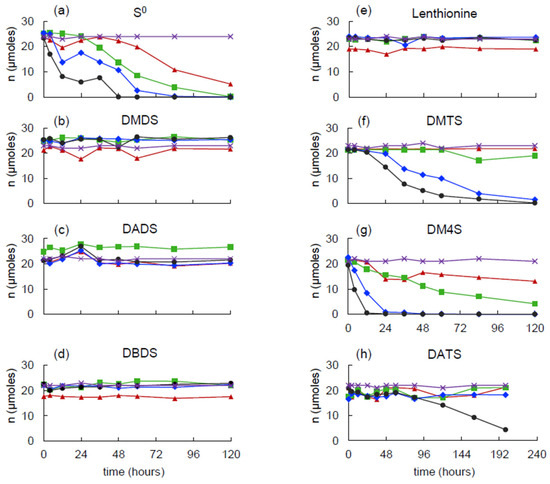
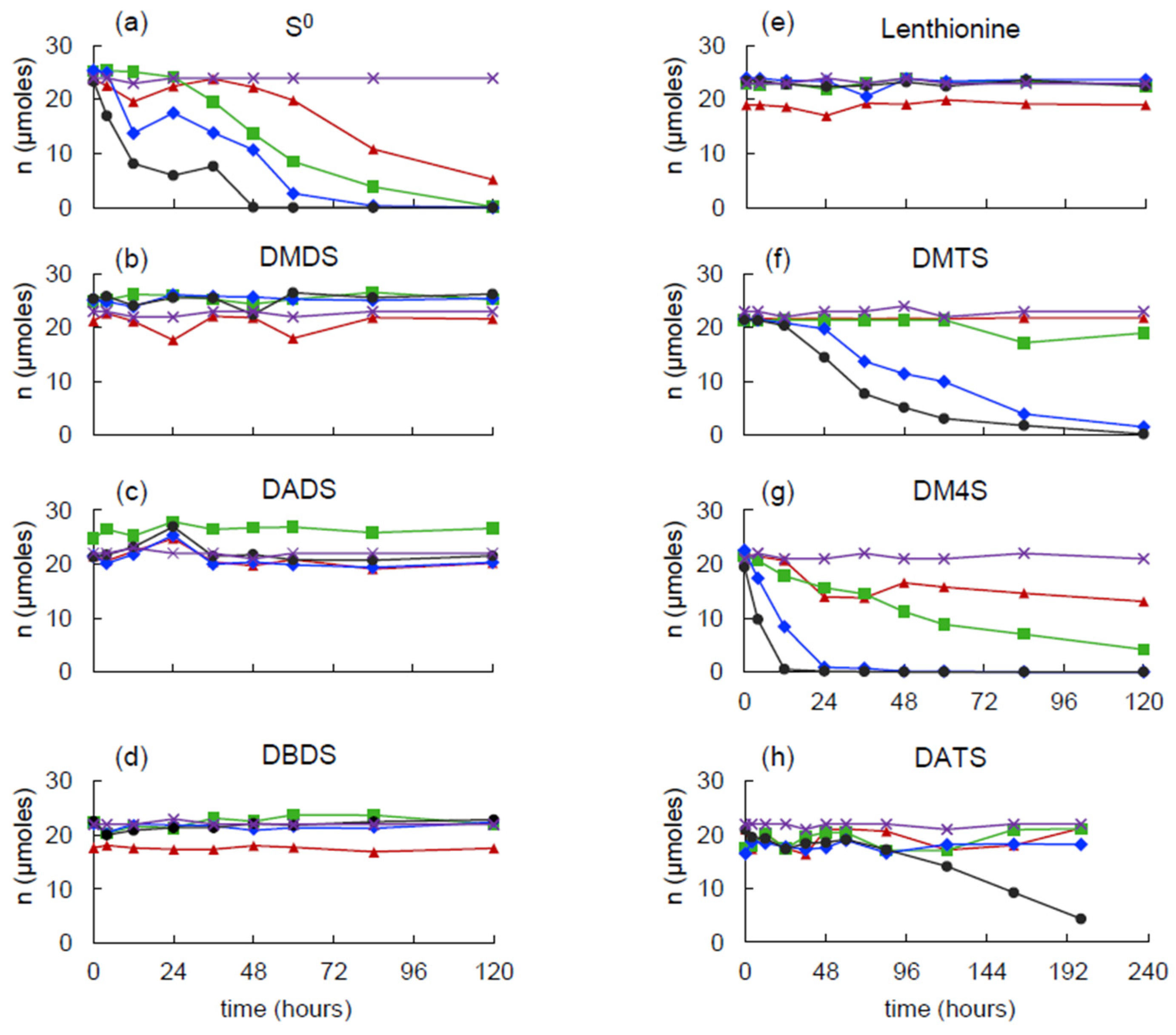
The results of the copper treatment experiments are presented in Figure 1. Elemental sulfur (Figure 1a) reacted with copper at all tested surface areas, with complete removal occurring after 48 h at the largest surface area (5465 mm2) and after 84 and 120 h at surface areas of 1822 and 547 mm2, respectively. Compounds containing two sulfur atoms, including DMDS (Figure 1b), DADS (Figure 1c), and DBDS (Figure 1d), are not reactive toward copper, and their amounts remain constant over 120 h in all experiments with wire surface areas up to 5465 mm2. Cyclic lenthionine (Figure 1e), which contains both two- and three-atom sulfur sequences, has also remained stable in the presence of copper.
Figure 1.
Changes in organic polysulfide contents during their reaction with copper wire, examined over time and across different wire surface areas. Compounds shown are (a) S0, (b) DMDS, (c) DADS, (d) DBDS, (e) lenthionine, (f) DMTS, (g) DM4S, and (h) DATS. Red triangles and lines represent a surface area of 183 mm2, green squares and lines 547 mm2, blue diamonds and lines 1822 mm2, and black circles and lines 5465 mm2. Purple crosses and lines represent the control sample.
Polysulfides containing more than two sulfur atoms exhibited reactivity toward copper; the decrease in their content depended on the copper surface area. A decrease in the amount of DMTS was observed at surface areas of 1822 and 5465 mm2 (Figure 1f) after 36 h and 24 h, respectively. DM4S (Figure 1g) showed a decrease in amount at all surface areas already after 4 h of reaction. For DATS (Figure 1h), a decrease in amount was observed only at the largest surface area (5465 mm2). The amount of DATS decreased by 32% after 84 h of incubation.
3.2. Silver Treatment
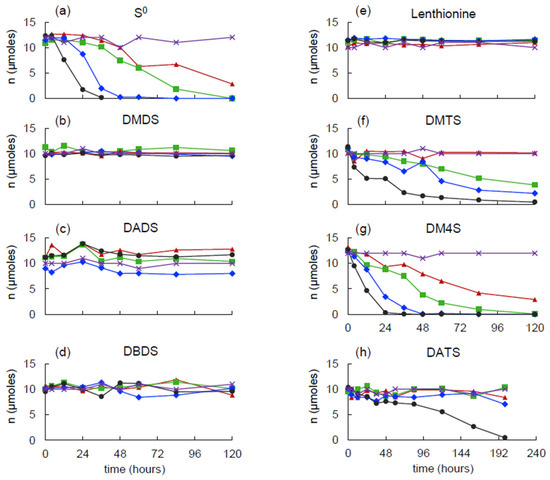
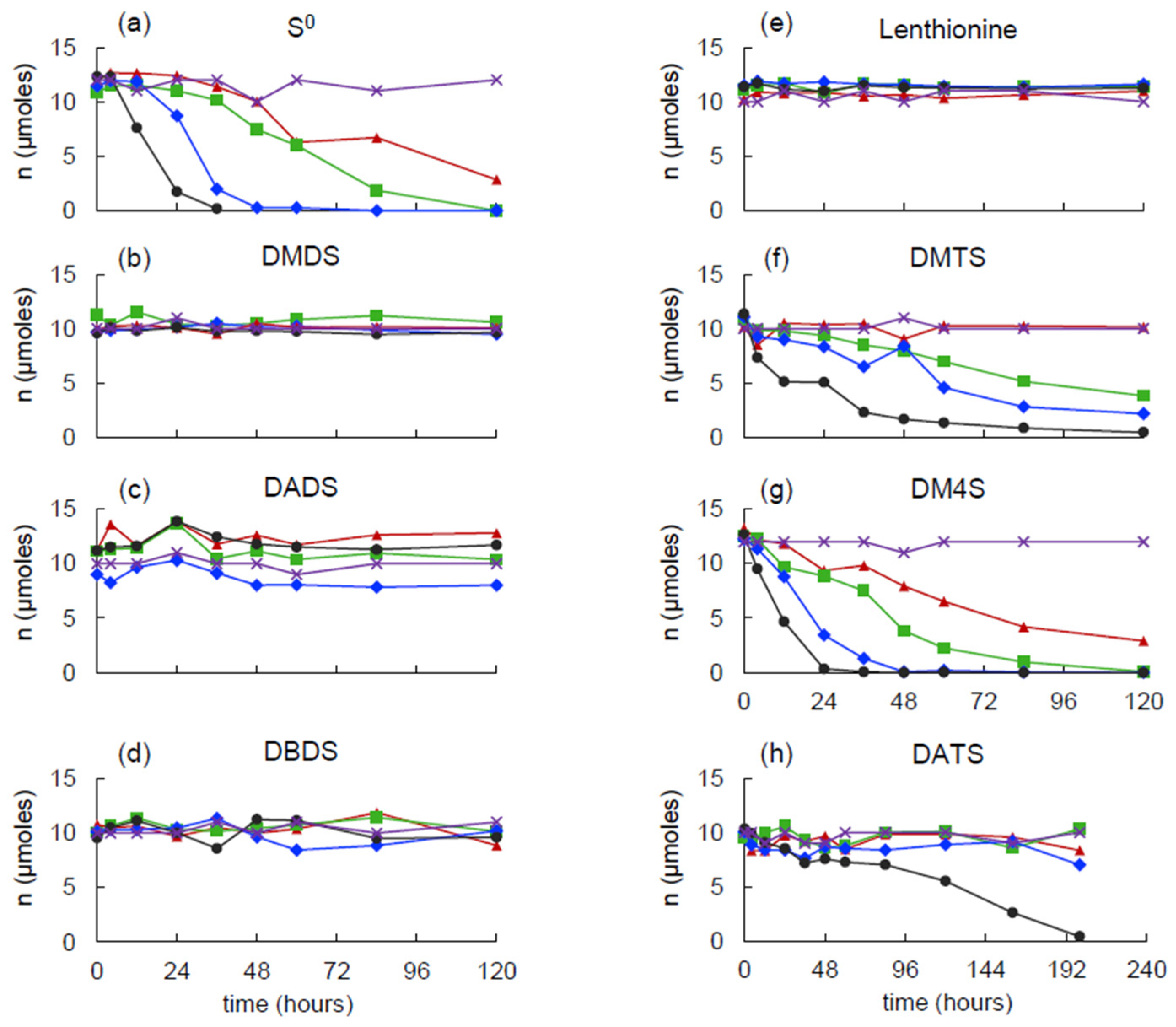
The results of the silver treatment experiment are presented in Figure 2. Overall, the reactivity pattern observed for the reactions with silver was similar to that obtained for the reactions with copper. Elemental sulfur (Figure 2a) reacted with silver at all tested surface areas. Complete removal was observed after 48 h at the largest surface area (2732 mm2), and after 84 h and 120 h at surface areas of 911 and 274 mm2, respectively. At the smallest surface area (91 mm2), the content of elemental sulfur decreased from 12 µmol to 2.8 µmol after 120 h of the experiment. Compounds containing two sulfur atoms, including DMDS (Figure 2a), DADS (Figure 2b), and DBDS (Figure 2c), showed no reactivity toward silver, and their amounts remained constant over a 120 h period for all four wire surface areas. Lenthionine (Figure 2d) is also stable in the presence of silver.
Figure 2.
Changes in organic polysulfide contents during their reaction with silver wire, examined over time and across different wire surface areas. Compounds shown are (a) S0, (b) DMDS, (c) DADS, (d) DBDS, (e) lenthionine, (f) DMTS, (g) DM4S, and (h) DATS. Red triangles and lines represent a surface area of 91 mm2, green squares and lines 274 mm2, blue diamonds and lines 911 mm2, and black circles and lines 2732 mm2. Purple crosses and lines represent the control sample.
Polysulfides containing more than two sulfur atoms exhibited measurable decreases in amount consistent with the general trend observed in the copper treatment experiments. For DMTS (Figure 2e), a decrease in amount was observed at surface areas of 274 mm2 and above. At the largest surface area (2732 mm2), a rapid decrease was observed, with the amount decreasing from 11.4 to 7.4 µmol within 4 h and reaching 0.5 µmol after 120 h. DM4S (Figure 2f) exhibited high reactivity toward silver at all surface areas. During the experiment with the highest surface area (2732 mm2), the amount of DM4S decreased from 12.6 to 9.5 µmol within 4 h and disappeared from the solution after 48 h. For DATS (Figure 2g), a measurable decrease in amount was observed only at the largest surface area (2732 mm2), consistent with the trend observed in the copper experiments, where its amount decreased from 10.3 to 0.4 µmol after 200 h.
3.3. Tetrabutylammonium Sulfite Treatment
The reactivity of polysulfides toward TBA sulfite was investigated in two experimental series with reaction times of 10 s and 60 s. The results are summarized in Table 1. Overall, the experiments showed rapid, non-specific sulfur removal, with increasing reactivity for compounds with longer polysulfide chains. The S0 content decreased from 19.4 µmol to 2.4 µmol (by 87%) in 10 s and to zero after 60 s. Among disulfides, DMDS showed moderate reactivity. Its amount decreased from 22.2 to 20.1 µmol after 10 s (9% decrease) and further to 13.0 µmol after 60 s (41% decrease). In contrast, DADS and DBDS did not exhibit any measurable decrease in concentration. The lenthionine amounts decreased from 18.2 to 10.2 µmol after 10 s (44% decrease).
Table 1.
Changes in the amount of polysulfidic compounds after reaction with TBA sulfite for 10 s and 60 s.
Polysulfides containing more than two sulfur atoms reacted substantially faster. DMTS showed a strong decrease in amounts from 24.4 to 9.1 µmol after 10 s (63% decrease) and to 3.4 µmol after 60 s (86% decrease). DATS content decreased from 20.2 to 8.2 µmol after 10 s (59% decrease). DM4S amount decreased by >99% in 10 s.
3.4. Preparative Chromatography Separation
The efficiency of preparative C18 reversed-phase silica gel column chromatography for separating and recovering polysulfides and elemental sulfur was evaluated in duplicate experiments (Table 2). Complete separation of all organic polysulfides from elemental sulfur was achieved. Overall recoveries ranged from 91 to 107% for the organic polysulfides and 91–108% for sulfur. All polysulfidic compounds were eluted with 5% acetonitrile in formic acid, indicating that no increase in acetonitrile concentration was required for their elution and that no elemental sulfur was eluted at this mobile phase composition. In all experiments, elemental sulfur started to elute within a volume interval of 10–20 mL after the mobile phase composition was changed to 100% acetonitrile.
Table 2.
Amounts, recovery, and elution volumes of polysulfidic compounds and elemental sulfur during preparative C18 reversed-phase silica gel column separation experiments.
4. Discussion
4.1. Role of Organic Polysulfides in the Biogeochemical Sulfur Cycling
Organic polysulfides are widespread in natural environments and have been reported in sediments, petroleum, and aquatic systems. In petroleum, linear and cyclic organic polysulfanes, including DMDS, DMTS, DM4S, and lenthionine, have been detected [60,61,62]. Although more complex organo-sulfur polymers with various chemical properties are known to exist in the sediments [22], dimethyloligosulfides and lenthionine are used as the models for the study of the reactivity of the organo-sulfur compounds due to their high reactivity and relatively high solubility in water [56]. Organic polysulfides have also been identified as early diagenetic products formed during the sulfurization of unsaturated functionalized lipids [17,43,63,64]. Sulfurization and desulfurization of organic matter play a key role in controlling the formation and content of organic sulfur compounds in natural systems. Under the slightly basic conditions typical of many aquatic and sedimentary environments, sulfurization proceeds mainly through nucleophilic addition (Michael addition on the conjugated double bond or 1,2-addition to the carbonyl carbon) to reactive organic compounds such as aldehydes, ketones, and activated double bonds [19,20,31,65,66]. Inorganic polysulfides are the most important agents for the sulfurization of organic matter due to their high nucleophilicity, although hydrogen sulfide can also participate in these reactions [17,23,31,67]. Thus, sulfurization reactions commonly lead to the formation of polysulfidic macromolecules and cyclic structures.
Inorganic polysulfides in natural waters are dominated by S42− − S62− species [68]. Thus, their biological methylation is expected to result in the formation of organic polysulfides containing mainly four to six sulfur atoms. However, natural aquatic systems are usually dominated by DMDS and DMTS, whereas DM4S occurs at lower concentrations and longer-chain species have never been detected [69,70,71,72,73]. DMTS and DM4S were detected in salt marsh and coastal marine sediments [3,74,75] and in Mangrove Lake sediments [76]. DMTS concentrations of up to 2 nM were reported in the water mains of Perth, Australia [77,78]. DMTS and DM4S at concentrations of 10 nM and 4 nM, respectively, were found in algal clusters from Lake Kinneret (Israel) [69]. Zhang et al. [72] reported DMTS concentrations as high as 136 nM in the waters of Lake Taihu (China). Roberts and Burton [71] detected DMTS and DM4S at concentrations of up to 704 nM and 63 nM, respectively, in meromictic Antarctic lakes.
These observations indicate that compounds with sulfur chains longer than four sulfur atoms are formed during sulfurization reactions but decompose rapidly under environmental conditions. In natural aquatic systems, organic polysulfides are known to undergo chemical decomposition through reactions with cyanide anion [79], hydroxyl anion [54,80], and bisulfide anion [56]. These processes result in preferential decomposition of long-chain polysulfides, while shorter species such as DMDS and DMTS are more likely to persist in natural aquatic systems.
In natural aquatic systems, organic polysulfides frequently coexist with elemental sulfur. This coexistence reflects the complex sulfur chemistry in environmental systems, where partial oxidation of hydrogen sulfide results in the formation of intermediate sulfur species, including elemental sulfur and polysulfides [80,81,82]. In addition, elemental sulfur is one of the products of DMPS decomposition through reactions with the hydroxyl anion [53], an intermediate product of the reaction with cyanide anion [79], and a possible product of the reaction with bisulfide anion [56].
4.2. Treatment with Metals
Elemental sulfur was removed efficiently by the reactions with both metals (Equations (7) and (8)), especially at larger surface areas and longer reaction times. In contrast, disulfides and lenthionine showed high stability and were largely unaffected under all experimental conditions. The reactivity of linear polysulfides depends on their sulfur chain length. Compounds containing more than two sulfur atoms became reactive toward metals, and DM4S showed the highest reactivity. This trend suggests that increasing sulfur chain length enhances interaction with metal surfaces. This behavior is consistent with the decreasing dissociation energy of S–S bonds with increasing chain length. For example, the S–S bond energy in DMDS is about 281 kJ·mol−1 [45], whereas in DMTS it decreases to approximately 185–200 kJ·mol−1 [46]. In DM4S, the central S–S bond, which is the longest and weakest and undergoes energetically favorable symmetric cleavage, has an even lower bond energy of about 151 kJ·mol−1 [83,84]. The progressive weakening of S–S bonds with increasing chain length facilitates their interaction with metal surfaces and promotes faster decomposition. As a result, substantial losses of linear polysulfides were observed within the time required for efficient sulfur removal. At the two highest surface areas (1822 and 5465 mm2 for copper and 911 and 2732 mm2 for silver), up to 50–80% of trisulfides and complete degradation of DM4S occurred during the time required for the removal of >97% of elemental sulfur. These results show that treatment with copper and silver is not a selective method for elemental sulfur removal and inevitably consumes linear organic polysulfides with more than two sulfur atoms. Reactions with silver were generally as fast as, or slightly faster than, those with copper, with no clear advantage of either metal in removing elemental sulfur and organic polysulfides. In experiments with both metals, decomposition of DMTS resulted in the formation of DMDS, whereas decomposition of DM4S initially produced DMTS, which was subsequently converted to DMDS. In both cases, the reactions ultimately produced shorter-chain dimethyl polysulfides (Equations (7) and (8)).
R−Sn−R + Cu → R−Sn−1−R + CuS
R−Sn−R + 2Ag → R−Sn−1−R + Ag2S
From an analytical perspective, these results highlight an important limitation of methods for removing elemental sulfur from its mixtures with organic polysulfides. While methods based on reactions with metal surfaces successfully remove elemental sulfur, they require long reaction times and also promote decomposition of linear organic polysulfides, especially those with long sulfur chains. As a result, this approach is not suitable for the removal of elemental sulfur from samples containing reactive polysulfides.
Previous studies have applied copper surfaces for elemental sulfur removal. For example, Annunciação et al. [35] used copper to remove elemental sulfur from extracts of aquatic sediments, with a reaction time of 24 h. In our experiments, elemental sulfur was still present in solution after 24 h, even at the highest surface area of 5465 mm2 (Figure 1a). However, during the same time period, a significant fraction of DMTS and DM4S had already been decomposed (Figure 1f,g). Similarly, Amrani and Aizenshtat [19,20] reported sulfur removal in experiments on the sulfurization of α,β-unsaturated aldehydes using copper curls, with reaction times of 1–3 days. Under comparable time scales in our experiments, both DMTS and DM4S were significantly decomposed (Figure 1f,g), while elemental sulfur was completely removed from solution only after 3 days at the highest surface area of 5465 mm2. These studies reported neither the initial elemental sulfur concentrations nor the exact amounts of copper used. Therefore, a quantitative comparison with our results is not possible. However, our results suggest that time periods commonly used for sulfur removal with copper are sufficient to cause extensive degradation of reactive organic polysulfides.
4.3. Treatment with Tetrabutylammonium Sulfite
The reactivity of elemental sulfur and organic polysulfides toward TBA sulfite differed markedly from that observed for metal surfaces. Elemental sulfur was removed rapidly, with 87% loss within 10 s, and complete removal occurred within 60 s (Table 1) indicating the high efficiency of this method for sulfur removal. In contrast to their reactions with metals, organic polysulfides, including DMDS and lenthionine, were found to react with TBA sulfite within 1 min (Table 1). Trisulfides, including DMTS and DATS, were even more reactive, with concentrations decreasing by more than 50% over the time required for complete elemental sulfur removal. Similar to the experiments with metal surfaces, DM4S showed the highest reactivity among all sulfur species, being almost completely removed within 10 s, which is faster than elemental sulfur.
These results indicate that TBA sulfite causes rapid and non-selective degradation of both elemental sulfur and organic polysulfides. Even relatively stable molecules, such as lenthionine and DATS, experience significant loss under the conditions required for complete sulfur removal. Therefore, this method does not allow selective removal of elemental sulfur without simultaneously removing organic sulfur compounds and is unsuitable for studies aimed at preserving polysulfide distributions.
4.4. Preparative Chromatography Separations
The separation between elemental sulfur and organic polysulfides was achieved using preparative C18 reversed-phase silica gel column chromatography. This approach is based on physical partitioning between a nonpolar stationary phase and a polar mobile phase and does not involve chemical reactions. Separation is therefore controlled primarily by differences in compound polarity and hydrophobicity. In this study, we aimed to develop a generalized approach, building on previous research [38,52,53] that utilized various preparative chromatographic techniques to separate organic polysulfide mixtures.
All experiments were conducted using 5% acetonitrile and 95% formic acid as the mobile phase. Formic acid was used, as organic polysulfides are known to be more stable under acidic rather than basic or neutral conditions [54,80]. Under these conditions and at the applied sample amounts and mobile phase volumes, elemental sulfur did not elute in the first 220 mL of eluent, which was required to achieve complete recovery of the organic polysulfide compounds. The elution order reflected differences in polarity, with lenthionine being eluted first, followed by linear polysulfides. Importantly, even organic polysulfide with the lowest polarity, such as DBDS, was completely eluted before the elution of elemental sulfur began, demonstrating good separation efficiency.
Recoveries ranged from 91 to 107% for organic polysulfides and from 91 to 108% for elemental sulfur (Table 2), which may partly reflect experimental and analytical uncertainties and losses due to compound volatility. Overall, these results indicate that preparative C18 reversed-phase silica gel column chromatography enables efficient and non-destructive separation of elemental sulfur from organic polysulfides. This approach preserves the original composition of organic polysulfides and allows selective isolation of target compounds. With optimized solvent gradients, further improvement in the separation between different organic polysulfides is possible [54,85].
The commonly used methods of chemical analyses of the organosulfur compounds (e.g., NMR, GC-MS, elemental analysis and mass-spectrometric analysis) require milligrams to tens of milligrams of material; c.a. 100 mg of the material should suffice for all analyses. In our experiments for 2–5 mg of organic polysulfides, we used 10 g of C18 reversed-phase silica gel. Thus, in order to separate 100 mg of organo-sulfur compounds from the elemental sulfur, chromatographic separation on 200 g of the stationary phase in the standard laboratory 50 mm diameter column and c.a. 5 L of the mobile phase may be used.
5. Conclusions
Chemical methods of sulfur removal from its mixtures with organic (poly)sulfides, such as reactions with metal surfaces and treatment with TBA sulfite, result in the collateral removal of organic polysulfides. The reactivity of DMPSs toward desulfurizing agents strongly depends on the length of their sulfur chain. Compounds containing more sulfur atoms are generally more reactive and less stable than shorter-chain species. As a result, organic polysulfides such as DMTS and DM4S react as fast as, or even faster than, elemental sulfur during chemical treatment. In both metal-based and sulfite-based methods for the removal of elemental sulfur, substantial degradation of organic polysulfides occurred within the time interval required for efficient sulfur removal. This demonstrates that these approaches are not selective for elemental sulfur and inevitably lead to the loss of reactive organic sulfur compounds. As organic polysulfides are widespread in natural and experimental samples and often coexist with elemental sulfur, such losses may significantly alter sample composition. As a consequence, results of quantitative analyses may be biased, and sulfur speciation and transformation processes in natural aquatic systems may be misinterpreted. Therefore, we conclude that chemical methods for sulfur removal are unsuitable for samples containing organic polysulfides when preservation of molecular distributions is required.
In contrast, a non-destructive physical separation method, such as preparative C18 reversed-phase silica gel column chromatography, allows efficient removal of elemental sulfur without inducing chemical transformation of organic polysulfides. Such an approach preserves the original composition of sulfur species and provides a more reliable basis for future studies of sulfur chemistry and sulfurization processes.
Author Contributions
Conceptualization, I.Z. and A.K.J.; methodology, I.Z. and A.K.J.; validation, I.Z.; formal analysis, I.Z.; investigation, I.Z. and A.K.J.; resources, A.K.J.; writing—original draft preparation, I.Z.; writing—review and editing, A.K.J.; visualization, I.Z.; supervision, A.K.J.; project administration, A.K.J.; funding acquisition, A.K.J. All authors have read and agreed to the published version of the manuscript.
Funding
This research was funded by the Israel Science Foundation (ISF) Grant 623/24 and was partially funded by the Ben-Gurion University of the Negev “High-Tech, Bio-Tech and Chemo-Tech” stipend.
Data Availability Statement
The data that support the findings of this study are openly available in Mendeley Data at https://doi.org/10.17632/y372mzgyp3.1.
Conflicts of Interest
The authors declare no conflicts of interest.
References
- Kamyshny, A., Jr. History of polysulfides and their role in the evolution of chemical knowledge: From ancient Egypt medicine to the discovery of oxygen. Cogent Arts Humanit. 2025, 12, 2507988. [Google Scholar] [CrossRef] [Scilit]
- Kaplan, I.R.; Emery, K.O.; Rittenberg, S.C. The distribution and isotopic abundance of sulfur in recent marine sediments off southern California. Geochim. Cosmochim. Acta 1963, 27, 297–331. [Google Scholar] [CrossRef] [Scilit]
- Boulegue, J.; Lord, C.J.; Church, T.M. Sulfur speciation and associated trace metals (Fe, Cu) in the pore waters of Great Marsh, Delaware. Geochim. Cosmochim. Acta 1982, 46, 453–464. [Google Scholar] [CrossRef] [Scilit]
- Jensen, S.; Renberg, L.; Reutergardh, L. Residue analysis of sediment and sewage sludge for organochlorines in the presence of elemental sulfur. Anal. Chem. 1977, 49, 316–318. [Google Scholar] [CrossRef] [Scilit]
- Eccleston, B.H.; Morrison, M.; Smith, H.M. Elemental sulfur in crude oil. Anal. Chem. 1952, 24, 1745–1748. [Google Scholar] [CrossRef] [Scilit]
- Bura-Nakić, E.; Helz, G.R.; Ciglenečki, I.; Ćosović, B. Reduced sulfur species in a stratified seawater lake (Rogoznica Lake, Croatia): Seasonal variations and argument for organic carriers of reactive sulfur. Geochim. Cosmochim. Acta 2009, 73, 3738–3751. [Google Scholar] [CrossRef] [Scilit]
- Kamyshny, A., Jr. Solubility of cyclooctasulfur in pure water and sea water at different temperatures. Geochim. Cosmochim. Acta 2009, 73, 6022–6028. [Google Scholar] [CrossRef] [Scilit]
- Kamyshny, A., Jr.; Ferdelman, T.G. Dynamics of zero-valent sulfur species including polysulfides at seep sites on intertidal sand flats (Wadden Sea, North Sea). Mar. Chem. 2010, 121, 17–26. [Google Scholar] [CrossRef] [Scilit]
- Knossow, N.; Blonder, B.; Eckert, W.; Turchyn, A.V.; Antler, G.; Kamyshny, A., Jr. Annual sulfur cycle in a warm monomictic lake with sub-millimolar sulfate concentrations. Geochem. Trans. 2015, 16, 7. [Google Scholar] [CrossRef] [Scilit] [PubMed]
- Avetisyan, K.; Eckert, W.; Findlay, A.J.; Kamyshny, A., Jr. Diurnal variations in sulfur transformations at the chemocline of a stratified freshwater lake. Biogeochemistry 2019, 146, 83–100. [Google Scholar] [CrossRef] [Scilit]
- Avetisyan, K.; Mirzoyan, N.; Payne, R.B.; Hayrapetyan, V.; Kamyshny, A., Jr. Eutrophication leads to formation of sulfide-rich deep-water layer in Lake Sevan (Armenia). Isot. Environ. Health Stud. 2021, 57, 535–552. [Google Scholar] [CrossRef] [Scilit] [PubMed]
- Franz, B.; Lichtenberg, H.; Hormes, J.; Modrow, H.; Dahl, C.; Prange, A. Utilization of solid ‘elemental’ sulfur by the phototrophic purple sulfur bacterium Allochromatium vinosum: A sulfur K-edge X-ray absorption spectroscopy study. Microbiology 2007, 153, 1268–1274. [Google Scholar] [CrossRef] [Scilit]
- Pjevac, P.; Kamyshny, A., Jr.; Dyksma, S.; Mußmann, M. Microbial consumption of zero-valence sulfur in marine benthic habitats. Environ. Microbiol. 2014, 16, 3416–3430. [Google Scholar] [CrossRef] [Scilit]
- Avetisyan, K.; Zweig, I.; Luther, G.W.; Kamyshny, A., Jr. Kinetics and mechanism of polysulfides and elemental sulfur formation by a reaction between hydrogen sulfide and δ-MnO2. Geochim. Cosmochim. Acta 2021, 313, 21–37. [Google Scholar] [CrossRef] [Scilit]
- Avetisyan, K.; Buchshtav, T.; Kamyshny, A., Jr. Kinetics and mechanism of polysulfides formation by a reaction between hydrogen sulfide and orthorhombic cyclooctasulfur. Geochim. Cosmochim. Acta 2019, 247, 96–105. [Google Scholar] [CrossRef] [Scilit]
- Kafantaris, F.C.A.; Druschel, G.K. Kinetics of the nucleophilic dissolution of hydrophobic and hydrophilic elemental sulfur sols by sulfide. Geochim. Cosmochim. Acta 2020, 269, 554–565. [Google Scholar] [CrossRef] [Scilit]
- Vairavamurthy, A.; Mopper, K. Mechanistic studies of organosulfur (thiol) formation in coastal marine sediments. In Biogenic Sulfur in the Environment; ACS Publication: Washington, DC, USA, 1989; pp. 231–242. [Google Scholar]
- De Graaf, W.; Sinninghe Damsté, J.S.; De Leeuw, J.W. Laboratory simulation of natural sulphurization: I. Formation of monomeric and oligomeric isoprenoid polysulphides. Geochim. Cosmochim. Acta 1992, 56, 4321–4328. [Google Scholar] [CrossRef] [Scilit]
- Amrani, A.; Aizenshtat, Z. Mechanisms of sulfur introduction chemically controlled: δ34S imprint. Org. Geochem. 2004, 35, 1319–1336. [Google Scholar] [CrossRef] [Scilit]
- Amrani, A.; Aizenshtat, Z. Reaction of polysulfide anions with α,β-unsaturated isoprenoid aldehydes in aquatic media: Simulation of oceanic conditions. Org. Geochem. 2004, 35, 909–921. [Google Scholar] [CrossRef] [Scilit]
- Werne, J.P.; Lyons, T.W.; Hollander, D.J.; Schouten, S.; Hopmans, E.C.; Damste, J.S.S. Investigating pathways of diagenetic organic matter sulfurization using compound-specific sulfur isotope analysis. Geochim. Cosmochim. Acta 2008, 72, 489–502. [Google Scholar] [CrossRef] [Scilit]
- Amrani, A. Organosulfur compounds: Molecular and isotopic evolution from biota to oil and gas. Annu. Rev. Earth Planet. Sci. 2014, 42, 733–768. [Google Scholar] [CrossRef] [Scilit]
- Raven, M.R. The marine organic sulfur cycle. Annu. Rev. Mar. Sci. 2025, 18, 195–218. [Google Scholar] [CrossRef] [Scilit] [PubMed]
- Goldhaber, M.B.; Kaplan, I.R. The sulfur cycle. In The Sea, Vol. 5: Marine Chemistry; Goldberg, E.D., Ed.; Wiley-Interscience: New York, NY, USA, 1974; pp. 569–655. [Google Scholar]
- Berner, R.A.; Westrich, J.T. Bioturbation and the early diagenesis of carbon and sulfur. Am. J. Sci. 1985, 285, 193–206. [Google Scholar] [CrossRef] [Scilit]
- Rickard, D.; Luther, G.W. Chemistry of iron sulfides. Chem. Rev. 2007, 107, 514–562. [Google Scholar] [CrossRef] [Scilit]
- Shawar, L.; Halevy, I.; Said-Ahmad, W.; Feinstein, S.; Boyko, V.; Kamyshny, A.; Amrani, A. Dynamics of pyrite formation and organic matter sulfurization in organic-rich carbonate sediments. Geochim. Cosmochim. Acta 2018, 241, 219–239. [Google Scholar] [CrossRef] [Scilit]
- Raven, M.R.; Keil, R.G.; Webb, S.M. Rapid, concurrent formation of organic sulfur and iron sulfides during experimental sulfurization of sinking marine particles. Glob. Biogeochem. Cycles 2021, 35, e2021GB007062. [Google Scholar] [CrossRef] [Scilit]
- Hartgers, J.F.; Lopez, J.S.; Sinninghe Damste, C.; Reiss, J.R.; Maxwell, J.O.; Grimalt, J.O. Sulfur-binding in recent environments: II. Speciation of sulfur and iron and implications for the occurrence of organo-sulfur compounds. Geochim. Cosmochim. Acta 1997, 61, 4769–4788. [Google Scholar] [CrossRef] [Scilit]
- Urban, K.; Ernst, S.; Bernasconi, S. Addition of sulfur to organic matter during early diagenesis of lake sediments. Geochim. Cosmochim. Acta 1999, 63, 837–853. [Google Scholar] [CrossRef] [Scilit]
- LaLonde, R.T.; Ferrara, L.M.; Hayes, M.P. Low-temperature, polysulfide reactions of conjugated ene carbonyls: A reaction model for the geologic origin of S-heterocycles. Org. Geochem. 1987, 11, 563–571. [Google Scholar] [CrossRef] [Scilit]
- Kohnen, M.E.; Damste, J.S.S.; Baas, M.; Kock-van Dalen, A.C.; de Leeuw, J.W. Sulfur-bound steroid and phytane carbon skeletons in geomacromolecules: Implications for the mechanism of incorporation of sulfur into organic matter. Geochim. Cosmochim. Acta 1993, 57, 2515–2528. [Google Scholar] [CrossRef] [Scilit]
- Damste, J.S.S.; Rijpstra, W.I.C.; de Leeuw, J.W.; Schenck, P.A. The occurrence and identification of series of organic sulphur compounds in oils and sediments: II. Their presence in samples from hypersaline and non-hypersaline paleoenvironments and possible application as source, palaeoenvironmental and maturity indicators. Geochim. Cosmochim. Acta 1989, 53, 1323–1341. [Google Scholar]
- Koopmans, M.P.; de Leeuw, J.W.; Lewan, M.D.; Damste, J.S.S. Impact of dia- and catagenesis on sulphur and oxygen sequestration of biomarkers as revealed by artificial maturation of an immature sedimentary rock. Org. Geochem. 1996, 23, 913–936. [Google Scholar] [CrossRef] [Scilit]
- Annunciação, D.L.R.; Almeida, F.V.; Sodré, F.F. Method development and validation for the determination of polybrominated diphenyl ether congeners in Brazilian aquatic sediments. Microchem. J. 2017, 133, 43–48. [Google Scholar] [CrossRef] [Scilit]
- Blumer, M. Removal of elemental sulfur from hydrocarbon fractions. Anal. Chem. 1957, 29, 1039–1041. [Google Scholar] [CrossRef] [Scilit]
- Smedes, F.; de Boer, J. Determination of chlorobiphenyls in sediments—Analytical methods. Trends Anal. Chem. 1997, 16, 503–517. [Google Scholar] [CrossRef] [Scilit]
- Schubert, P.; Fernández-Escobar, I.; Rosenberg, E.; Bayona, J.M. Evaluation of desulfurization procedures for the elimination of sulfur interferences in the organotin analysis of sediments. J. Chromatogr. A 1998, 810, 245–251. [Google Scholar] [CrossRef] [Scilit]
- Fossing, H.; Jørgensen, B.B. Measurement of bacterial sulfate reduction in sediments. Biogeochemistry 1989, 8, 205–222. [Google Scholar] [CrossRef] [Scilit]
- Gröger, J.; Franke, J.; Hamer, K.; Schulz, H.D. Quantitative recovery of elemental sulfur and improved selectivity in a chromium-reducible sulfur distillation. Geostand. Geoanal. Res. 2009, 33, 17–27. [Google Scholar] [CrossRef] [Scilit]
- Ferdelman, T.G. Oceanographic and geochemical controls on sulphur diagenesis in coastal environments. Ph.D. Thesis, University of Delaware, Newark, DE, USA, 1994. [Google Scholar]
- Eliel, E.L.; Hutchins, R.O.; Mebane, R.; Willer, R.L. Endocyclic vs. exocyclic attack in nucleophilic displacement reactions on five- and six-membered cyclic onium salts. J. Org. Chem. 1976, 41, 1052–1057. [Google Scholar] [CrossRef] [Scilit]
- Kohnen, M.E.; Damste, J.S.S.; Kock-van Dalen, A.C.; De Leeuw, J.W. Di- or polysulphide-bound biomarkers in sulphur-rich geomacromolecules as revealed by selective chemolysis. Geochim. Cosmochim. Acta 1991, 55, 1375–1394. [Google Scholar] [CrossRef] [Scilit]
- van Dongen, B.E.; Schouten, S.; Baas, M.; Geenevasen, J.A.; Damste, J.S.S. An experimental study of the low-temperature sulfurization of carbohydrates. Org. Geochem. 2003, 34, 1129–1144. [Google Scholar] [CrossRef] [Scilit]
- Steudel, R. Properties of sulfur–sulfur bonds. Angew. Chem. Int. Ed. Engl. 1975, 14, 655–664. [Google Scholar] [CrossRef] [Scilit]
- Nikoo, S.; Meister, P.J.; Hayward, J.J.; Gauld, J.W. An assessment of computational methods for calculating accurate structures and energies of bio-relevant polysulfur/selenium-containing compounds. Molecules 2018, 23, 3323. [Google Scholar] [CrossRef] [Scilit] [PubMed]
- Donard, O.; Lalere, B.; Martin, F.; Lobinski, R. Microwave-assisted leaching of organotin compounds from sediments for speciation analysis. Anal. Chem. 1995, 67, 4250–4254. [Google Scholar] [CrossRef] [Scilit]
- Szekeres, L. Analytical chemistry of the sulphur acids. Talanta 1974, 21, 1–44. [Google Scholar] [CrossRef] [Scilit]
- Hardman, A.F.; Barbehenn, H.E. Determination of free sulfur in rubber. Ind. Eng. Chem. Anal. Ed. 1935, 7, 103–104. [Google Scholar] [CrossRef] [Scilit]
- Greenwood, P.F.; Grotheer, H.; Böttcher, M.E.; Grice, K. The stable sulfur isotope and abundance fluxes of reduced inorganic sulfur and organic sulfur phases recorded in the Permian-Triassic transition of the Meishan type section. Organ. Geochem. 2024, 196, 104808. [Google Scholar] [CrossRef] [Scilit]
- Rogowska, J.; Sychowska, J.; Cieszynska-Semenowicz, M.; Wolska, L. Elemental sulfur in sediments: Analytical problems. Environ. Sci. Pollut. Res. 2016, 23, 24871–24879. [Google Scholar] [CrossRef] [Scilit]
- Fernández-Escobar, I.; Gibert, M.; Messeguer, À.; Bayona, J.M. Complete elimination of interferences in the organotin determination by oxidation with dimethyldioxirane combined with alumina cleanup. Anal. Chem. 1998, 70, 3703–3707. [Google Scholar] [CrossRef] [Scilit]
- Rizkov, D.; Lev, O.; Gun, J.; Anisimov, B.; Kuselman, I. Development of in-house reference materials for determination of inorganic polysulfides in water. Accredit. Qual. Assur. 2004, 9, 399–403. [Google Scholar] [CrossRef] [Scilit]
- Buchshtav, T.; Amrani, A.; Said-Ahmad, W.; Kamyshny, A. Kinetics and mechanism of the abiotic decomposition of dimethyl polysulfides with three, four and five sulfur atoms under dark, oxic conditions. Environ. Chem. 2019, 16, 495–504. [Google Scholar] [CrossRef] [Scilit]
- Morita, K.; Kobayashi, S. Isolation and synthesis of lenthionine, an odorous substance of shiitake, an edible mushroom. Tetrahedron Lett. 1966, 6, 573–577. [Google Scholar] [CrossRef] [Scilit]
- Zweig, I.; Kamyshny, A., Jr. Reactivity of hydrogen sulfide toward organic compounds with sulfur–sulfur bonds. Geochim. Cosmochim. Acta 2024, 367, 16–28. [Google Scholar] [CrossRef] [Scilit]
- U.S. Environmental Protection Agency. Method 3660B: Sulfur Cleanup. Available online: https://www.epa.gov/hw-sw846/sw-846-test-method-3660b-sulfur-cleanup (accessed on 11 April 2026).
- Starovoytov, O.N.; Kim, N.S.; Han, K.N. Dissolution behavior of silver in ammoniacal solutions using bromine, iodine and hydrogen-peroxide as oxidants. Hydrometallurgy 2007, 86, 114–119. [Google Scholar] [CrossRef] [Scilit]
- Kamyshny, A., Jr.; Ekeltchik, I.; Gun, J.; Lev, O. Method for the determination of inorganic polysulfide distribution in aquatic systems. Anal. Chem. 2006, 78, 2359–2400. [Google Scholar] [CrossRef] [Scilit]
- Kawka, O.E.; Simoneit, B.R.T. Survey of hydrothermally-generated petroleums from the Guaymas Basin spreading center. Org. Geochem. 1987, 11, 311–328. [Google Scholar] [CrossRef] [Scilit]
- Orr, W.L.; Sinninghe Damsté, J.S. Geochemistry of sulfur in petroleum systems. ACS Symp. Ser. 1990, 429, 2–29. [Google Scholar]
- Zhu, G.; Wang, M.; Zhang, Y.; Zhang, Z. Low-molecular-weight organic polysulfanes in petroleum. Energy Fuels 2018, 32, 6770–6773. [Google Scholar] [CrossRef] [Scilit]
- Kohnen, M.E.; Damsté, J.S.; Kock-van Dalen, A.C.; Ten Haven, H.L.; Rullkötter, J.; De Leeuw, J.W. Origin and diagenetic transformations of C25 and C30 highly branched isoprenoid sulphur compounds: Further evidence for the formation of organically bound sulphur during early diagenesis. Geochim. Cosmochim. Acta 1990, 54, 3053–3063. [Google Scholar] [CrossRef] [Scilit]
- Wakeham, S.G.; Damsté, J.S.S.; Kohnen, M.E.; De Leeuw, J.W. Organic sulfur compounds formed during early diagenesis in Black Sea sediments. Geochim. Cosmochim. Acta 1995, 59, 521–533. [Google Scholar] [CrossRef] [Scilit]
- Krein, E.B.; Aizenshtat, Z. Phase transfer catalyzed reactions between polysulfide anions and α,β-unsaturated carbonyl compounds. J. Org. Chem. 1993, 58, 6103–6108. [Google Scholar] [CrossRef] [Scilit]
- Adam, P.; Schneckenburger, P.; Schaeffer, P.; Albrecht, P. Clues to early diagenetic sulfurization processes from mild chemical cleavage of labile sulfur-rich geomacromolecules. Geochim. Cosmochim. Acta 2000, 64, 3485–3503. [Google Scholar] [CrossRef] [Scilit]
- Vairavamurthy, A.; Mopper, K. Geochemical formation of organosulphur compounds (thiols) by addition of H2S to sedimentary organic matter. Nature 1987, 329, 623–625. [Google Scholar] [CrossRef] [Scilit]
- Kamyshny, A.; Gun, J.; Rizkov, D.; Voitsekovski, T.; Lev, O. Equilibrium distribution of polysulfide ions in aqueous solutions at different temperatures by rapid single phase derivatization. Environ. Sci. Technol. 2007, 41, 2395–2400. [Google Scholar] [CrossRef] [Scilit]
- Ginzburg, B.; Chalifa, I.; Zohary, T.; Hadas, O.; Dor, I.; Lev, O. Identification of oligosulfide odorous compounds and their source in the Lake of Galilee. Water Res. 1998, 32, 1789–1800. [Google Scholar] [CrossRef] [Scilit]
- Ginzburg, B.; Dor, I.; Chalifa, I.; Hadas, O.; Lev, O. Formation of dimethyloligosulfides in Lake Kinneret: Biogenic formation of inorganic oligosulfide intermediates under oxic conditions. Environ. Sci. Technol. 1999, 33, 571–579. [Google Scholar] [CrossRef] [Scilit]
- Roberts, N.J.; Burton, H.R. Volatile compounds in meromictic Antarctic lakes and basins. Chemosphere 1994, 29, 1627–1637. [Google Scholar] [CrossRef] [Scilit]
- Zhang, X.; Chen, C.; Ding, J.; Hou, A.; Li, Y.; Niu, Z.; Su, X.; Xu, Y.; Laws, E.A. The 2007 water crisis in Wuxi, China: Analysis of the origin. J. Hazard. Mater. 2010, 182, 130–135. [Google Scholar] [CrossRef] [Scilit]
- Oduro, H.; Kamyshny, A., Jr.; Zerkle, A.L.; Li, Y.; Farquhar, J. Quadruple sulfur isotope constraints on the origin and cycling of volatile organic sulfur compounds in a stratified sulfidic lake. Geochim. Cosmochim. Acta 2013, 120, 251–262. [Google Scholar] [CrossRef] [Scilit]
- Ferdelman, T.G.; Church, T.M.; Luther, G.W. Sulfur enrichment of humic substances in a Delaware salt marsh sediment core. Geochim. Cosmochim. Acta 1991, 55, 979–988. [Google Scholar] [CrossRef] [Scilit]
- Francois, R. A study of sulphur enrichment in the humic fraction of marine sediments. Geochim. Cosmochim. Acta 1987, 51, 17–27. [Google Scholar] [CrossRef] [Scilit]
- Canfield, D.E.; Boudreau, B.P.; Mucci, A.; Gundersen, J.K. The early diagenetic formation of organic sulfur in the sediments of Mangrove Lake, Bermuda. Geochim. Cosmochim. Acta 1998, 62, 767–781. [Google Scholar] [CrossRef] [Scilit]
- Wajon, J.E.; Alexander, R.; Kagi, R.I. Dimethyl trisulfide and objectionable odours in potable water. Chemosphere 1985, 14, 85–89. [Google Scholar] [CrossRef] [Scilit]
- Franzmann, P.D.; Heitz, A.; Zappia, L.R.; Wajon, J.E.; Xanthis, K. The formation of malodorous dimethyloligosulphides in treated groundwater. Water Res. 2001, 35, 1730–1738. [Google Scholar] [CrossRef] [Scilit] [PubMed]
- Kurashova, I.; Kamyshny, A., Jr. Kinetics and mechanism of the reaction between dimethyl trisulfide and cyanide. Environ. Chem. 2021, 18, 81–90. [Google Scholar] [CrossRef] [Scilit]
- Buchshtav, T.; Amrani, A.; Kamyshny, A. Kinetics and mechanism of abiotic decomposition of malodorous dimethyl disulfide under dark, oxic conditions. Environ. Chem. 2019, 16, 165–170. [Google Scholar] [CrossRef] [Scilit]
- Steudel, R.; Eckert, B. Solid sulfur allotropes. Top. Curr. Chem. 2003, 230, 1–80. [Google Scholar]
- Rickard, D. Sulfidic Sediments and Sedimentary Rocks; Elsevier: Oxford, UK, 2012; Volume 65. [Google Scholar]
- Luther, G.W., III. Inorganic Chemistry for Geochemistry and Environmental Sciences: Fundamentals and Applications; John Wiley & Sons Ltd.: Chichester, UK, 2016. [Google Scholar]
- Kende, I.; Pickering, T.L.; Tobolsky, A.V. The dissociation energy of the tetrasulfide linkage. J. Am. Chem. Soc. 1965, 87, 5582–5586. [Google Scholar] [CrossRef] [Scilit]
- Pickering, T.L.; Saunders, K.J.; Tobolsky, A.V. Disproportionation of organic polysulfides. J. Am. Chem. Soc. 1967, 89, 2364–2367. [Google Scholar] [CrossRef] [Scilit]

Disclaimer/Publisher’s Note: The statements, opinions and data contained in all publications are solely those of the individual author(s) and contributor(s) and not of MDPI and/or the editor(s). MDPI and/or the editor(s) disclaim responsibility for any injury to people or property resulting from any ideas, methods, instructions or products referred to in the content. |
© 2026 by the authors. Licensee MDPI, Basel, Switzerland. This article is an open access article distributed under the terms and conditions of the Creative Commons Attribution (CC BY) license.