


Abstract
Over the past 20 years, the iron-activated persulfate systems have been widely used for removing pharmaceuticals and personal care products (PPCPs) from water. However, slow Fe(III)/Fe(II) redox cycling and precipitation of iron, unless in very acidic conditions, were the main limitations. Thus, two ligand-assisted Fe(III)/persulfate systems, Fe(III)-acetohydroxamic acid (AHA)/peroxydisulfate (PDS) and Fe(III)-nitrilotriacetic acid (NTA)/peroxymonosulfate (PMS), were comparatively investigated for the degradation of atenolol (ATL) in this study. The experimental results showed that the Fe(III)-NTA/PMS system worked much better than the AHA system. However, the cost of PMS is higher than that of PDS, which should be considered. The primary advantage of the NTA system was its ability to overcome the pH limitations. It worked well over a wide pH range (3.0–10.0), whereas the AHA system could only be used in a narrower pH window (pH 2.4 to 6.5). The investigation of radicals that contributed to ATL degradation revealed that sulfate radicals (SO4•−) were dominant in the NTA system, while hydroxyl radicals (•OH) and SO4•− were the primary and secondary radicals in the AHA system. These results provided useful insight into the comparative behavior of two ligand-assisted Fe(III)/persulfate systems for ATL degradation, with the Fe(III)-NTA/PMS system showing clear potential under neutral or near-neutral conditions, while Fe(III)-AHA/PDS may still represent a lower-cost option under acidic conditions.
1. Introduction
The increasing detection of pharmaceuticals and personal care products (PPCPs) in natural water bodies has become a pressing environmental concern in recent years [1], largely due to their potential toxicity and bioaccumulation tendency [2,3]. Atenolol (ATL), a beta-blocker that is widely prescribed for cardiovascular conditions, served as a prime example of PPCPs [4,5]. Conventional wastewater treatment plants often failed to remove it effectively, leading to its frequent occurrence in surface water and groundwater [6,7]. Thus, finding efficient ways to eliminate such recalcitrant micropollutants is critical for water safety [8].
Among the various treatment options, Advanced Oxidation Processes (AOPs) stood out because they generate highly reactive species that are capable of degrading recalcitrant organic contaminants [9,10,11]. While the AOPs based on the hydroxyl radical (•OH) are common, sulfate radical-based AOPs (SR-AOPs) have also gained significant attention [12]. Sulfate radicals (SO4•−) offer distinct chemical advantages, including higher redox potential (E0 = 2.5–3.1 V), longer half-life, and greater selectivity towards electron-rich pollutants [13]. Typically, peroxydisulfate (PDS) [14,15,16,17] and peroxymonosulfate (PMS) [18,19] mainly serve as precursors for SO4•−, which is often activated by transition metals such as iron (Fe). Iron is an attractive activator due to its abundance, non-toxicity, and environmental friendliness. However, using iron in a homogeneous system is not straightforward. The reaction is often limited by the slow regeneration of Fe(II) from Fe(III). In addition, the tendency of Fe(III) to hydrolyze and form sludge above pH 4.0 limits the application of traditional Fenton-like processes within a narrow acidic range (usually pH < 3.0) [11]. In recent years, efforts have been made to overcome this limitation by adding an organic ligand that forms a soluble and photoactive Fe(III)-complex [20,21].
These Fe(III)-complexes can maintain iron in a dissolved state at a neutral pH and facilitate conversion of Fe(III) to Fe(II) through a light-driven ligand-to-metal charge transfer (LMCT) process [22,23]. Acetohydroxamic acid (AHA), a small hydroxamic acid molecule, is a known chelating agent for metals and is also a reducing agent that enhances iron reduction [24]. Nitrilotriacetic acid (NTA), on the other hand, acts as a robust chelating agent, forming highly stable complexes with Fe(III) (log K ≈ 15.9) [25,26] that remained soluble over a much wider pH range [27]. Thus, Fe(III)-AHA and Fe(III)-NTA exhibit strong potential for promoting persulfate activation. Moreover, comparative studies of their performance in degrading specific pollutants, such as ATL, remain underexplored.
This study was carried out to evaluate two light-assisted systems, including the Fe(III)-AHA-activated PDS system (abbreviated as AHA system) and Fe(III)-NTA-activated PMS system (abbreviated as NTA system). The effects of key factors, such as Fe(III) concentration, ligand dosage, and initial pH, on ATL degradation kinetics were systematically explored. In addition to the degradation performance assessment, radical scavenging experiments were conducted to determine the dominant reactive species and underlying activation mechanisms in both systems. These findings were intended to provide preliminary insight into the performance of chelated iron systems for pharmaceutical wastewater treatment and lay the groundwork for more in-depth future studies.
2. Materials and Methods
2.1. Chemicals and Reagents
Atenolol (ATL, ≥98%) was purchased from Sigma-Aldrich (Saint Louis, MO, USA). Acetohydroxamic acid (AHA, 98%), nitrilotriacetic acid (NTA, 99%), peroxymonosulfate (PMS) also called Oxone (KHSO5·0.5KHSO4·0.5K2SO4), and sodium peroxydisulfate (PDS, ≥99%) were obtained from Aladdin Biochemical Technology Co., Ltd. (Shanghai, China). Iron(III) perchlorate hydrate (Fe(ClO4)3·xH2O, iron content was 11.6%) was obtained from Sigma-Aldrich (Saint Louis, MO, USA). Methanol (HPLC grade) and acetonitrile (HPLC grade) were supplied by Merck (Darmstadt, Germany). All aqueous solutions were prepared using ultrapure water (18.2 MΩ·cm) produced by a Milli-Q system.
2.2. Experimental Procedures
Photochemical degradation experiments were conducted in a cylindrical quartz reactor surrounded by a water-cooling jacket to maintain a constant temperature of 25 ± 1 °C (XPA-7, Xujiang Electromechanical Plant, Nanjing, China). A 500 W Xenon lamp equipped with a 290 nm cut-off filter was used as the light source to simulate solar irradiation, placed vertically in the center of the reactor. The same reactor was used in previous studies [28]. All irradiation experiments in this study were carried out under the same reactor configuration and fixed light source conditions to ensure the consistency of comparative evaluation.
In a typical run, a specific amount of ATL stock solution was diluted into the reactor to achieve an initial concentration of 10 μM. Predetermined amounts of Fe(III) and ligand (AHA or NTA) were added and stirred for 30 min in the dark to ensure adsorption–desorption equilibrium and complexation. The chemical structure of AHA and NTA was shown in Figure S1 in the Supplementary Materials (SM). The reaction was initiated by adding the oxidant (PDS or PMS) and turning on the light source simultaneously. The initial pH of the solution was adjusted using HClO4 or NaOH solutions. At specific time intervals, 1.0 mL of the sample was withdrawn and immediately quenched with 100 μL of sodium thiosulfate (Na2S2O3) or methanol to terminate the reaction before analysis. All experiments were performed in triplicate, and the average values were reported in the figures.
2.3. Analytical Methods
The concentration of ATL was quantified by high-performance liquid chromatography (HPLC, Agilent 1200, Agilent technologies, Santa Clara, CA, USA) equipped with a DAD detector and a reverse-phase C18 column (4.6 mm × 150 mm × 5 μm, Agilent). The injection volume was 20 μL. The detection wavelength was 224 nm [29]. The ATL concentrations at different reaction times (Ct) were determined, and the reaction kinetics were analyzed using line fitting of the pseudo-first-order kinetic model, as shown in Equation (1).
ln(Ct) = ln(C0) − kobst
3. Results and Discussion
3.1. ATL Degradation Kinetics in Different Systems
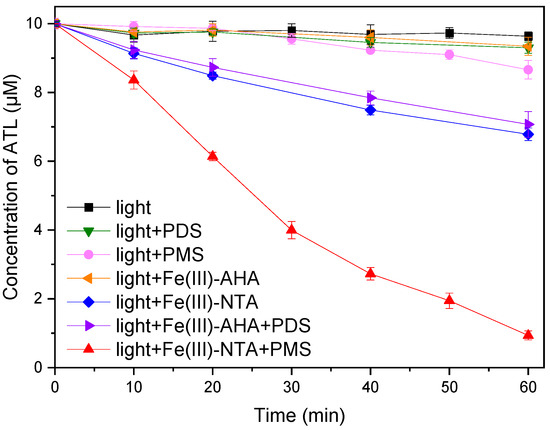
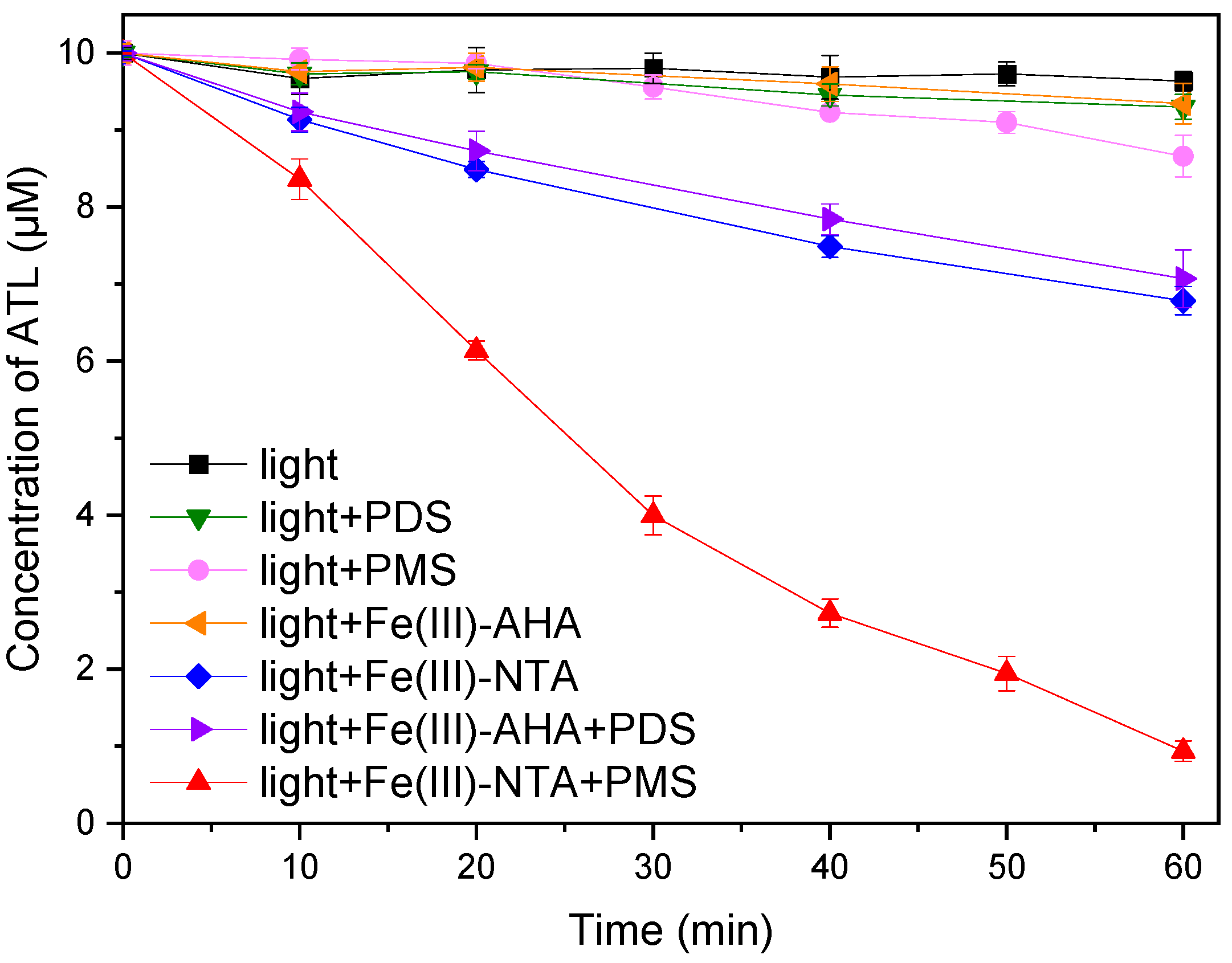
To evaluate and compare the catalytic performances of AHA and NTA systems, the ATL degradation kinetics were studied under their respective optimized experimental conditions. Since all experiments were performed under one fixed irradiation setup, the kinetic results reported herein are interpreted as comparative values within the same experimental framework. To ensure consistency in the comparative experiments and maintain the effective photochemical activity, the initial molar ratio of ligand to iron in both the AHA and NTA systems was set at 1:1 [21,30]. Concurrently, to validate the pivotal roles of iron complexes and persulfates, multiple control experiments were conducted. The results are presented in Figure 1. The TOC measurement of this optimized NTA system is provided in the SM (Table S1). Although the ATL was almost completely degraded within 1 h, the TOC value remained nearly unchanged during this period and decreased by only about 23.5% after a prolonged reaction duration (12 h), because the addition of NTA contributed to the initial TOC of the reaction solution.
Figure 1.
Degradation of ATL in different systems ([PDS] = [PMS] = 100 μM, Fe(III)-AHA = 30 μM-30 μM, Fe(III)-NTA = 25 μM-25 μM, pH = 6.5).
The experimental data clearly demonstrated that ATL was extremely difficult to degrade in systems lacking a key activator or oxidant. The ATL concentration remained virtually unchanged over 60 min with only light irradiation, indicating its strong photochemical stability. When the reaction was carried out with only oxidants under light exposure (light + PDS or light + PMS), the degradation rates of the ATL were approximately 6.9 and 12.4%, respectively. The slight degradation of ATL was due to the limited generation of oxidative radicals from the direct photolysis of PDS/PMS. Additionally, the removal rate of ATL was low (6.5%) in the light/Fe(III)-AHA system, confirming that Fe(III)-AHA was weakly photoactivated or produced radicals with a low oxidizing ability. However, 32.2% degradation of ATL was observed at 60 min with the light/Fe(III)-NTA system. This result was expected because Fe(III)-NTA could generate Fe(II) and NTA-free radicals by photoreduction through a ligand-to-metal charge transfer reaction (Equation (2)) [31]. Subsequent generation of superoxide anion radical (O2•−) and hydroxyl radicals (•OH) (Equations (3) and (4)) [21,32] contribute to the pollutant degradation.
Fe(III)-NTA + hυ → [Fe(III)-NTA]* → Fe(II) + NTA•+
NTA•+ + O2 → NTAox + O2•−
NTA•+ + OH− → NTAox + •OH
When the oxidant was added to the light-irradiated Fe(III)-complex systems, both the AHA and NTA systems demonstrated significant enhancement in ATL degradation. The same dosages of PDS and PMS (100 μM) were then added to the AHA and NTA systems, separately. The ATL degradation rates at 60 min in the AHA system increased from 6.5 to 29.3% and from 32.2 to 91.6% in the NTA system. The degradation efficiency of the NTA system was three times higher than that of the AHA system. This difference could be attributed to two main factors. First, this enhancement was primarily attributed to the formation of a photo-responsive complex between NTA and Fe(III), which was likely to facilitate PMS activation and radical generation for ATL degradation through an LMCT-assisted pathway. In contrast, Fe(III)-AHA complex appeared to show lower photoresponsivity compared with Fe(III)-NTA. The AHA system likely relied on the ligand-assisted reduction to produce Fe(II) for PDS activation, which was comparatively less efficient. Secondly, PMS was more easily activated than PDS due to its asymmetrical structure. However, PMS is two to four times more expensive than PDS. Thus, a balance between cost-effectiveness and efficiency should be considered while selecting these two oxidants for practical applications.
3.2. Effect of Fe(III) Concentration
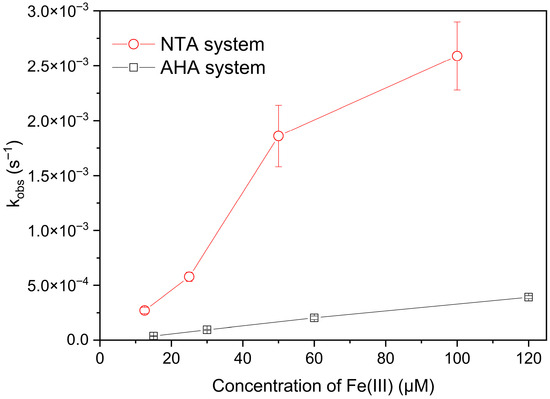
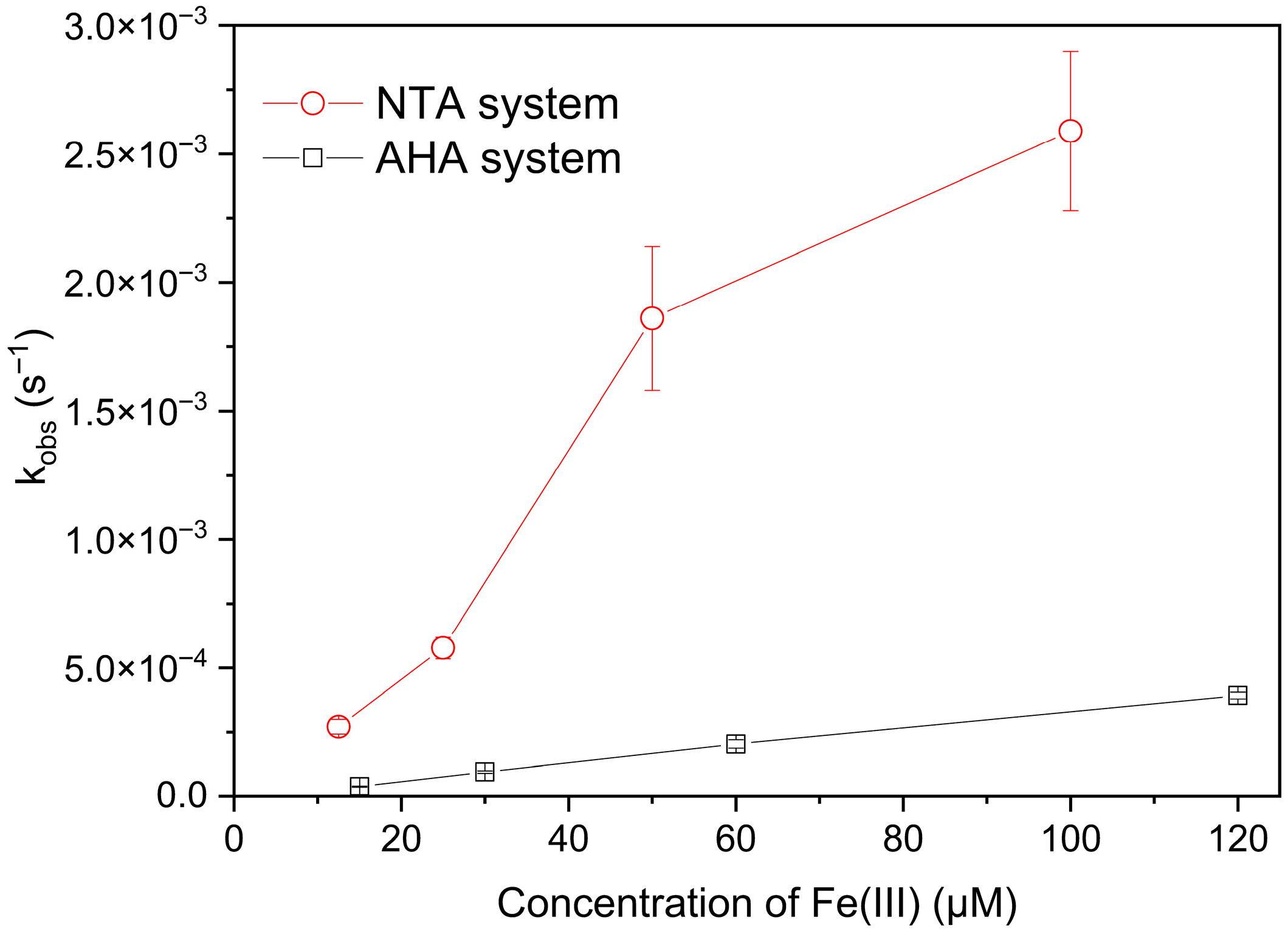
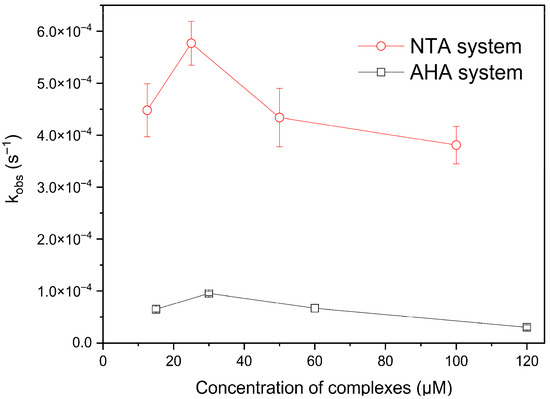
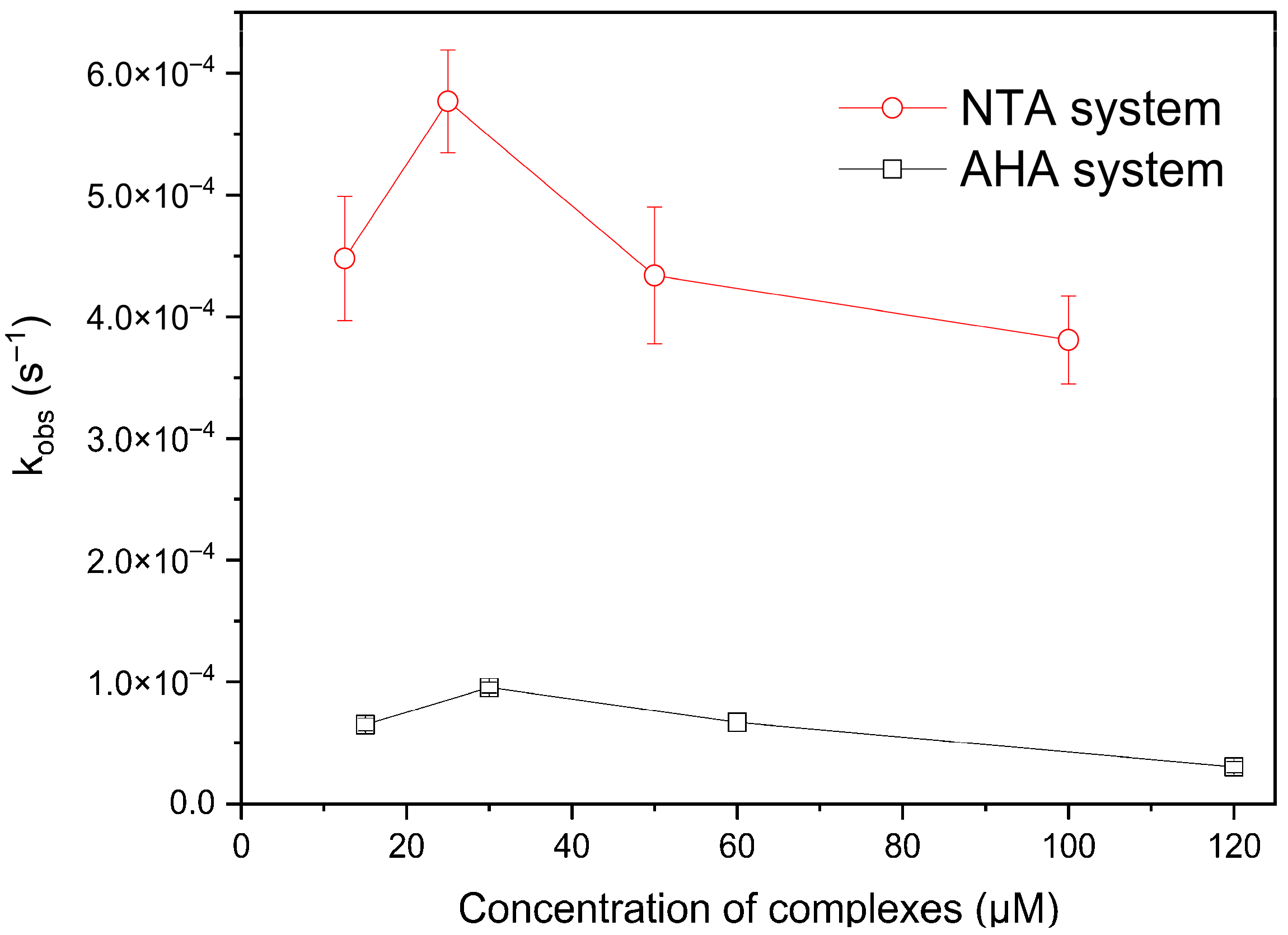
The concentration of Fe(III) is directly proportional to the formation rate of the active Fe(II) species [33], which is very important in the activation of persulfates [34]. Therefore, the effects of varying Fe(III) concentrations on the ATL degradation rate constants of the two systems were studied. The degradation of ATL in the AHA and NTA systems is shown in Figure S2. The degradation kinetics fitted the pseudo-first-order kinetic model well. Thus, the reaction rate constants (kobs) are calculated to elucidate the effects of the Fe(III) concentrations. The data for kobs with confidence intervals and R2 are shown in Table S2 and the results are presented in Figure 2.
Figure 2.
Effect of initial Fe(III) concentration on kobs of ATL degradation in two systems ([ATL] = 10 μM, [PDS] = [PMS] = 100 μM, pH = 6.5).
The ATL degradation was examined at Fe(III) concentrations of 12.5, 25, 50, and 100 μM with a fixed NTA concentration of 25 μM. A sustained upward trend in the degradation rate of ATL was observed with an increasing Fe(III) concentration. The reaction rate constant kobs increased significantly and monotonically. This is attributable to Fe(III), which acts as the primary limiting factor in both PMS activation and photochemical reactions. The increased concentration of Fe(III) led to the increased formation of Fe(III)-NTA in the system, which resulted in the increased Fe(II) concentration under light irradiation, effectively activating PMS to produce sufficient SO4•− and accelerating ATL degradation [35]. An excessive concentration of Fe(III) led to its photolysis, producing •OH and Fe(II), as shown in Equation (5) [36,37]. The Fe(II) produced during photolysis also contributes to the continuous activation of PMS and enhances the ATL degradation.
Fe(III) + H2O + hυ → Fe(II) + •OH + H+
Similar to the NTA system, the degradation rate of ATL in the AHA system also exhibited strong dependence on the Fe(III) concentration. The Fe(III) concentrations were set at 15, 30, 60, and 120 μM, while the AHA concentration was fixed at 30 μM. As depicted in Figure 2, the kobs exhibited a monotonically increasing trend as the Fe(III) concentration progressively rose. However, the rate of increase in kobs was significantly lower than that for the NTA system. This can be attributed to the low photoactivity of Fe(III)-AHA, as well as the low activity of PDS. This comparative study clearly demonstrated that the NTA system was more efficient than the AHA system, with Fe(III)-NTA effectively driving the generation of reactive oxidative species.
3.3. Effect of Ligand Concentration
Ligand concentration is a key parameter, as at optimal concentrations, it enhances the Fe(III) activity, whereas excess ligand may lead to radical scavenging, thereby reducing the degradation efficiency. To investigate this influence, the effect of varying ligand concentrations on the degradation of ATL under fixed oxidant concentrations ([PDS] = [PMS] = 100 μM) at an initial pH of 6.5, and under optimal Fe(III) loading conditions (Fe(III) = 25 μM in NTA system, Fe(III) = 30 μM in AHA system), was studied systematically. The results of the ATL degradation are presented in Figure S3. The kobs were calculated, and the relationship between the ligand concentration and the kobs values is shown in Figure 3.
Figure 3.
Effect of ligand concentration on kobs of ATL degradation in two systems ([ATL] = 10 μM, [PDS] = [PMS] = 100 μM, Fe(III) = 30 μM in AHA system and 25 μM in NTA system, pH = 6.5).
The ATL degradation was examined at AHA concentrations of 15 μM, 30 μM, 60 μM, and 120 μM. The results indicated that kobs reached its maximum value at an AHA concentration of 30 μM (corresponding to a 1:1 Fe(III)-ligand ratio). Under either low (15 μM) or high concentration (60 μM, 120 μM) conditions, the ATL degradation rates were significantly constrained. This further confirmed that a 1:1 coordination ratio provided the optimal equilibrium for ensuring the maximum activity. Insufficient AHA failed to complex all the Fe ions and form stable Fe(III)-AHA, which was beneficial for the ATL degradation. Contrastingly, the excessive AHA consumed large quantities of the generated oxidative radicals, resulting in pronounced quenching effects and reduced ATL degradation efficiency.
The Fe(III)-NTA/PMS system demonstrated similar trends to those of the AHA system. The ATL degradation kinetics were studied at NTA concentrations of 12.5, 25, 50, and 100 μM. The kobs of ATL degradation exhibited a characteristic volcano-type dependence on the NTA concentration, with an initial increase followed by a decrease with the increase in NTA concentration. Specifically, the kobs peaked when the NTA concentration was increased from 12.5 to 25 μM. Thus, the concentration of the photoactive Fe(III)-NTA complex reached a maximum value, thereby maximizing the LMCT effect and radical generation. However, when the NTA concentration was further increased to 50 and 100 μM, the degradation rate declined monotonically. This decline was primarily attributed to the radical-quenching effect of excess organic ligand. Non-coordinated free NTA molecules in the system act as potent radical scavengers, reacting with the highly reactive species such as SO4•− and •OH, thereby competing with the target contaminant ATL degradation. This substantial consumption of oxidizing radicals led to a significant reduction in the ATL degradation efficiency.
3.4. Effect of Initial pH
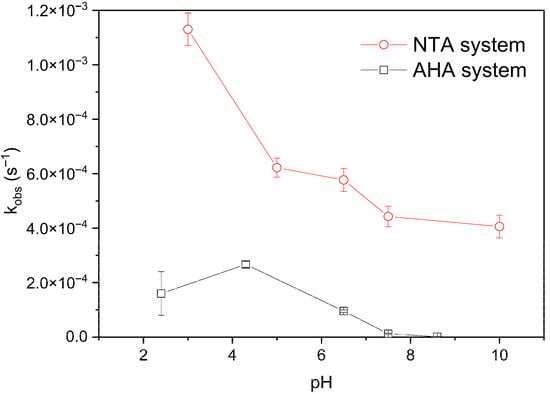
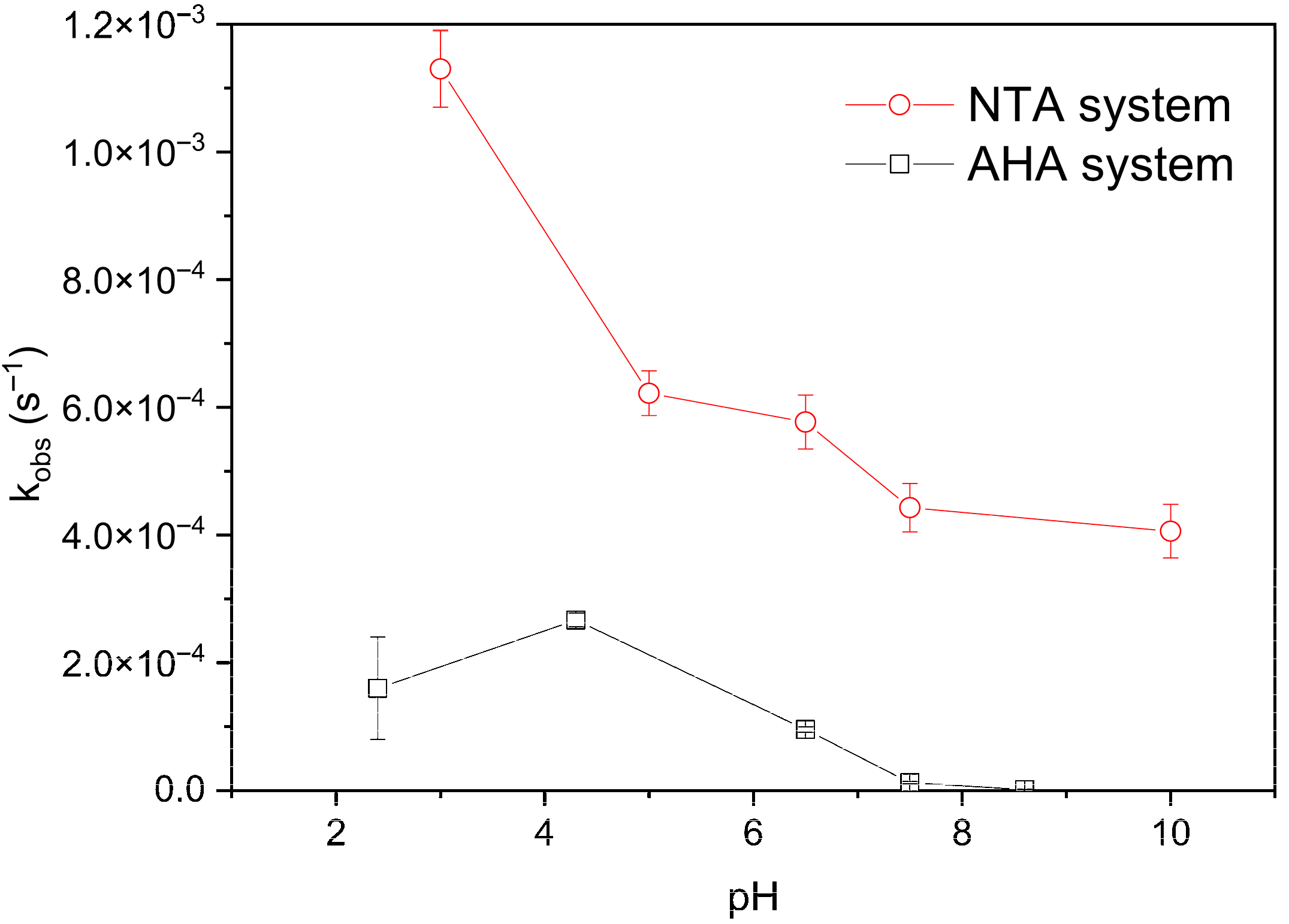
The initial pH of the solution is one of the most critical reaction parameters that can influence the oxidation efficiency of pollutants in the iron-based AOPs. It directly governs the distribution of Fe ions in an aqueous solution (between dissolved and precipitated states) and the complexation capacity of ligands, thereby determining the activation efficiency of the oxidants (PDS/PMS). To compare the pH-dependent performance of both systems and provide preliminary insight into their potential relevance for practical wastewater treatment, the effects of the varying initial pH values on ATL degradation in both Fe(III)-NTA/PMS and Fe(III)-AHA/PDS systems were systematically compared. The experimental results are shown in Figure S4. The reaction kinetics followed the pseudo-first-order model. The rate constants (kobs) were then obtained to elucidate the effect of the initial pH. The results are presented in Figure 4.
Figure 4.
Effect of initial pH on the kobs of ATL degradation in two systems ([PDS] = [PMS] = 100 μM, Fe(III)-AHA = 30 μM-30 μM, Fe(III)-NTA = 25 μM-25 μM).
The Fe(III)-AHA/PDS system exhibited a typical ‘narrow acidic window’ characteristic. As shown in Figure 4 and Figure S4a, when the pH was increased from 2.3 to 4.3, the kobs reached its optimal value (approximately 2.67 × 10⁻⁴ s−1). However, with a further increase in the pH to 6.5 (weakly acidic) or 7.5 (neutral), the ATL degradation rate declined sharply. Furthermore, the reaction ceased entirely under alkaline conditions (pH 8.6). This extreme pH sensitivity primarily stemmed from the severely compromised stability of the AHA-Fe(III)-complex under non-acidic conditions [38]. With the increase in pH, the enhanced binding affinity of OH− ions toward Fe(III) progressively surpassed that of AHA. This caused the dissociation of Fe(III) from the complex and its rapid hydrolysis into inactive iron hydroxide precipitates, disrupting Fe(II) formation.
However, the Fe(III)-NTA/PMS system demonstrated exceptionally broad pH adaptability and successfully overcame the traditional ‘pH bottleneck’ of iron-based AOPs. As illustrated in Figure 4 and Figure S4b, the NTA system exhibited the highest degradation rate (kobs = 1.13 × 10⁻³ s−1) under strongly acidic conditions (pH 3.0). Although kobs gradually decreased with the increasing pH (from 5.0 to 10.0), the NTA system maintained considerable activity even under extreme alkaline conditions (pH 10.0) (kobs = 4.06 × 10⁻⁴ s−1). Notably, with the NTA system at pH 10, the degradation rate remained higher than that with the AHA system under its optimal conditions (pH 4.3). This superior performance can be primarily attributed to the potent chelating capacity of NTA (log K ≈ 15.9) [25,39], which formed thermodynamically highly stable complexes with Fe(III). This effectively inhibited the hydrolytic precipitation of Fe ions in neutral and alkaline aqueous environments, thereby ensuring the sustained progression of the light-induced LMCT process.
3.5. Identification of Reactive Species
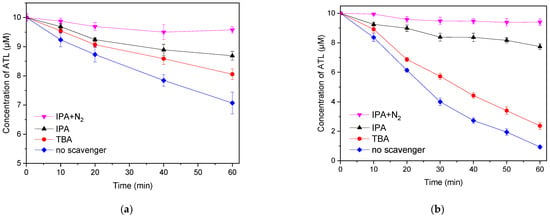
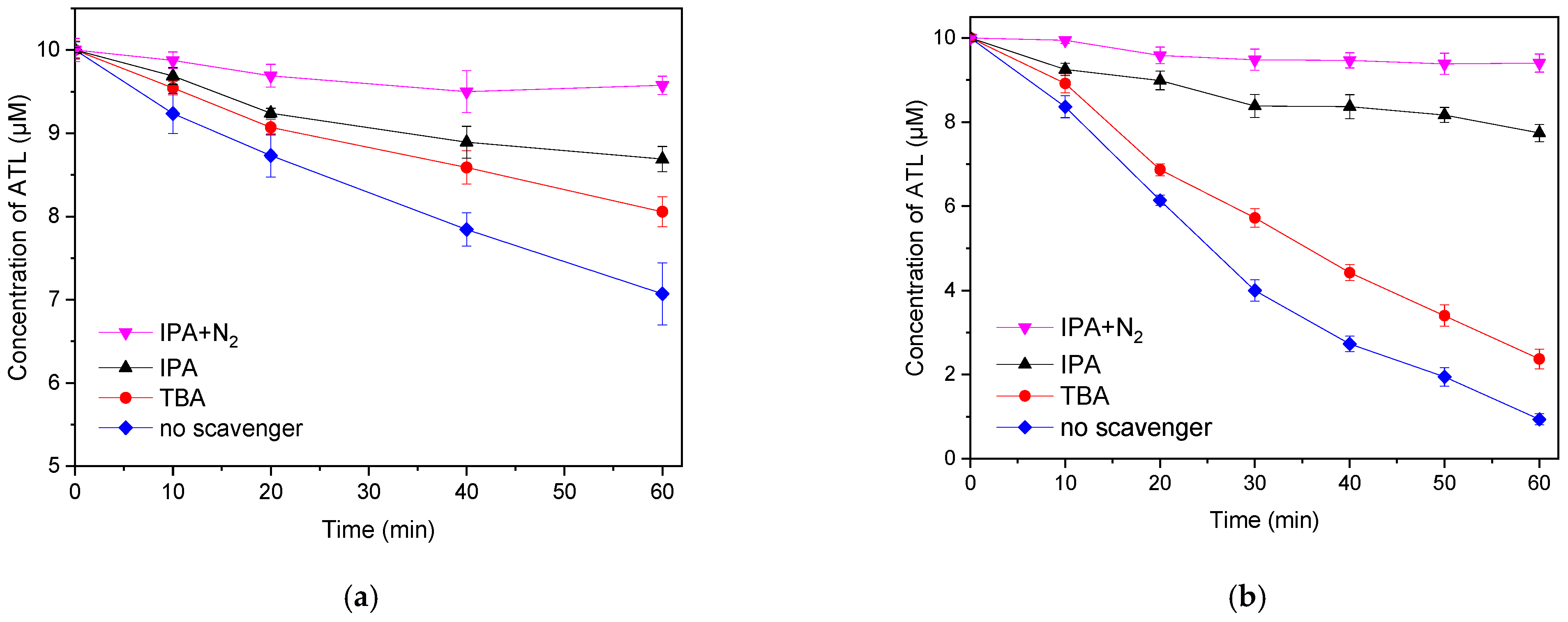
To investigate the intrinsic driving force differences in the mechanism of ATL degradation between Fe(III)-AHA/PDS and Fe(III)-NTA/PMS systems, radical quenching experiments were conducted to identify the dominant reactive oxidative species (ROS). Tert-Butanol (TBA) with the concentration of 5 mM was used as •OH quencher due to its high reaction rate constant with •OH instead of SO4•− (kTBA,•OH = 6.0 × 10⁸ mol·L−1·s−1, kt-BuOH,SO4•− = (9.1 ± 1.0) × 105 mol·L−1·s−1) [40,41]. Isopropanol (IPA) with the concentration of 5 mM was introduced as the scavenger of both SO4•− and •OH due to its high reactivity toward these radicals (kIPA,•OH = 1.9 × 10⁹ mol·L−1·s−1, kIPA,SO4•− = 8.5 × 10⁷ mol·L−1·s−1) [40,42]. The reactions were carried out under a N2 atmosphere to prevent the reaction between electrons and O2, thus blocking the generation of O2•−. The results are shown in Figure 5.
Figure 5.
Effect of different scavengers on the degradation of ATL in (a) Fe(III)-AHA/PDS system and (b) Fe(III)-NTA/PMS system.
In the AHA system (Figure 5a), the addition of both TBA and IPA significantly inhibited ATL degradation compared to the control experiment. Specifically, the degradation rate of ATL at 60 min decreased from 30.2% without a scavenger to 19.4% with TBA and further dropped to 13.1% with IPA. The partial inhibition by TBA indicates that •OH play an important role in ATL degradation. Meanwhile, the higher inhibition by IPA than TBA indicated the contribution of SO4•−. These results suggest that the contribution of •OH was more than SO4•− in the degradation of ATL. With the IPA and N2, the degradation of ATL was almost totally inhibited (only about 5% degradation of ATL), indicating that O2•− also contributed to the ATL degradation. The order of contribution proportions was •OH > SO4•− > O2•−.
As shown in Figure 5b, the degradation was much faster in the NTA system than that in the AHA system, even when sufficient dosages of TBA and IPA were added. These results showed that TBA only caused a slight inhibition, with the degradation rate being maintained at 76.3% after 60 min of the reaction. This indicated that •OH, although involved in the reaction, was not the dominant oxidative species. In sharp contrast, the addition of IPA severely suppressed the ATL degradation, plummeting the degradation rate to approximately 22%. The significant difference in inhibition between TBA and IPA indicated that SO4•− was the predominant reactive species responsible for the ATL degradation in this system. With the addition of both IPA and N2, the ATL degradation was almost suppressed, with only 6.2% degradation rate. Thus, O2•− also contributed to ATL degradation in this system. The order of contribution proportions was SO4•− >> •OH ≈ O2•−.
3.6. Reaction Mechanism
Based on the degradation kinetics and radical quenching results, a plausible photo-assisted persulfate activation pathway is proposed for the Fe(III)-NTA/PMS and Fe(III)-AHA/PDS systems. The reaction was initiated with the formation of photoactive Fe(III)-complexes (Fe(III)-NTA and Fe(III)-AHA) (Equation (6)). These Fe(III)-complexes underwent a ligand-to-metal charge transfer (LMCT) under light irradiation, whereby the ligand transferred electrons to the central metal ion, rapidly reducing Fe(III) to Fe(II), as shown in Equation (7) [21,33]. Subsequently, the generated Fe(II) rapidly acted as an electron donor, breaking the peroxide bond (O-O) of the oxidants (PMS or PDS), thereby releasing the highly oxidative SO4•− (Equations (8) and (9)) [43,44]. A portion of the generated SO4•− reacted with the OH groups in the solution to form •OH (Equation (10), k = 500 ± 60 s−1) [45]. Furthermore, the results from the experiments in nitrogen saturation indicated that dissolved oxygen (O2) in the water also captured photogenerated electrons to form O2•− (Equation (11)), synergistically contributing to the oxidation process. Ultimately, these abundant highly reactive species collectively attacked the ATL molecules, leading to their structural disruption and degradation.
Fe(III) + L → Fe(III)-L
Fe(III)-L + hυ → Fe(II) + L•+
Fe(II) + HSO5− → Fe(III) + SO4•− + OH−
Fe(II) + S2O82− → Fe(III) + SO4•− + SO42−
SO4•− + H2O → HSO4− + •OH
O2 + e− → O2•−
4. Conclusions
This study compared the performances of the two ligand-assisted Fe(III)/persulfate systems for the degradation of ATL. The experimental results showed that the Fe(III)-NTA/PMS system was superior in both the reaction rate and environmental adaptability. The biggest breakthrough for the NTA system was overcoming the pH limitations. A notable advantage of the NTA system was its ability to overcome the pH limitations that were commonly associated with conventional iron-based SR-AOP systems. The strong complexing ability of NTA with Fe(III) played an important role in maintaining the reactivity of the complex over a pH range of 3.0 to 10.0. Thus, the NTA system maintained considerable activity under neutral conditions. In the NTA system, the ATL degradation was dominated by SO4•−, whereas •OH and O2•− played much less important roles. Although the efficiency of the Fe(III)-AHA/PDS system was lower, it still achieved considerable ATL degradation within a pH range of 2.3 to 6.5, using a low dosage of the relatively low-cost PDS oxidant. In the AHA system, •OH played a major role, while SO4•− and O2•− showed smaller and roughly comparable contributions to the ATL degradation. Overall, this work provides useful insights into two ligand-assisted Fe(III)/persulfate systems for the treatment of ATL. The Fe(III)-NTA/PMS system might offer a potential choice under neutral or near-neutral conditions, while Fe(III)-AHA/PDS could offer a low-cost option for acidic or weakly acidic conditions. Further studies on water matrix effects and transformation behaviors would help to deepen the investigation of these systems.
Supplementary Materials
The following supporting information can be downloaded at: https://www.mdpi.com/article/10.3390/separations13050130/s1, Figure S1: The chemical structures of AHA (a) and NTA (b); Figure S2: Effect of different Fe(III) concertation on the degradation of ATL in (a) Fe(III)-AHA/PDS system ([PDS] = 100 μM, [AHA] = 30 μM, pH = 6.5) and (b) Fe(III)-NTA/PMS system ([PMS] = 100 μM, [NTA] = 25 μM, pH = 6.5); Figure S3: Effect of different ligand (AHA/NTA) concertation on the degradation of ATL ([PDS] = [PMS] = 100 μM, Fe(III) = 30 μM in AHA system, Fe(III) = 25 μM in NTA system, pH=6.5); Figure S4: Effect of different pH on the degradation of ATL in (a) Fe(III)-AHA/PDS system ([PDS] = 100 μM, Fe(III)-AHA = 30 μM-30 μM) and (b) Fe(III)-NTA/PMS system ([PMS] = 100 μM, Fe(III)-NTA = 25 μM-25 μM); Table S1: The TOC in NTA system; Table S2: The kobs and R2 in different reaction conditions and systems [28,46].
Author Contributions
Methodology, Y.L. and S.S.; software, Y.W. and L.L.; validation, X.W., W.D. and G.M.; investigation, Y.W.; resources, X.W. and W.D.; data curation, Y.L. and S.S.; writing—original draft preparation, Y.W. and L.L.; writing—review and editing, G.M.; supervision, Y.W., W.D. and G.M.; project administration, Y.W. and W.D.; funding acquisition, Y.W. All authors have read and agreed to the published version of the manuscript.
Funding
This research was funded by the Science and Technology Development Fund of Pudong New Area, grant number PKJ2024-N03. This research was also funded by the Chinese Scholarship Council (CSC), grant number 202508310228.
Data Availability Statement
Data will be made available upon request.
Acknowledgments
The authors acknowledge Yilan Zeng (Comenius University Bratislava, Slovakia) for their technical support.
Conflicts of Interest
The authors declare no conflicts of interest.
References
- Dzionek, A. β-Blockers in the Environment: Challenges in Understanding Their Persistence and Ecological Impact. Molecules 2025, 30, 4630. [Google Scholar] [CrossRef] [Scilit] [PubMed]
- Hama Aziz, K.H.; Mustafa, F.S.; Karim, M.A.H.; Hama, S. Pharmaceutical Pollution in the Aquatic Environment: Advanced Oxidation Processes as Efficient Treatment Approaches: A Review. Mater. Adv. 2025, 6, 3433–3454. [Google Scholar] [CrossRef] [Scilit]
- Ivantsova, E.; Martyniuk, C.J. A Synthesis on the Sub-Lethal Toxicity of Atenolol, a Beta-Blocker, in Teleost Fish. Environ. Toxicol. Pharmacol. 2023, 102, 104236. [Google Scholar] [CrossRef] [Scilit]
- Wellauer, J.; Pfund, B.; Becker, I.; Meyer, F.; Prescimone, A.; Wenger, O.S. Iron(III) Complexes with Luminescence Lifetimes of up to 100 Ns to Enhance Upconversion and Photocatalysis. J. Am. Chem. Soc. 2025, 147, 8760–8768. [Google Scholar] [CrossRef] [Scilit]
- Zhou, H.; Zhong, S.; Chen, J.; Ren, S.; Ren, W.; Lai, B.; Guan, X.; Ma, T.; Wang, S.; Duan, X. Overlooked Complexation and Competition Effects of Phenolic Contaminants in a Mn(II)/Nitrilotriacetic Acid/Peroxymonosulfate System: Inhibited Generation of Primary and Secondary High-Valent Manganese Species. Environ. Sci. Technol. 2024, 58, 19080–19089. [Google Scholar] [CrossRef] [Scilit]
- Sharmin, A.; Asif, M.B.; Zhang, G.; Bhuiyan, M.A.; Pramanik, B.K. Reactive Layered Hydroxide Membrane for Advanced Water Treatment: Micropollutant Degradation and Antifouling Potential. Chemosphere 2024, 359, 142318. [Google Scholar] [CrossRef] [Scilit]
- Xu, Q.; Luo, L.; Zhu, Z.; Liu, X.; Ong, T.V.; Wong, J.W.C.; Pan, M. The Fate of Atenolol in Wastewater Treatment Plants of Representative Densely Urban Agglomerations in China. J. Environ. Qual. 2025, 54, 204–216. [Google Scholar] [CrossRef] [Scilit]
- Ahmed, N.; Vione, D.; Rivoira, L.; Carena, L.; Castiglioni, M.; Bruzzoniti, M.C. A Review on the Degradation of Pollutants by Fenton-Like Systems Based on Zero-Valent Iron and Persulfate: Effects of Reduction Potentials, pH, and Anions Occurring in Waste Waters. Molecules 2021, 26, 4584. [Google Scholar] [CrossRef] [Scilit] [PubMed]
- Chen, Y.; Gao, Y.; Liu, T.; Zhang, Z.; Li, W. Activated Persulfate by Iron-Carbon Micro Electrolysis Used for Refractory Organics Degradation in Wastewater: A Review. Water Sci. Technol. 2022, 86, 690–713. [Google Scholar] [CrossRef] [Scilit] [PubMed]
- Hu, Y.; Yang, K.; Lin, Y.; Weng, X.; Jiang, Y.; Huang, J.; Lv, Y.; Li, X.; Liu, Y.; Lin, C.; et al. Performance and Mechanistic Studies of Rapid Atenolol Degradation through Peroxymonosulfate Activation by V, Co, and Bamboo Carbon Catalyst. Environ. Sci. Pollut. Res. 2024, 31, 36761–36777. [Google Scholar] [CrossRef] [Scilit]
- Zhang, Z.; Du, F.; Shi, H.; Du, H.; Xiao, P. Iron Redox Cycling in Persulfate Activation: Strategic Enhancements, Mechanistic Insights, and Environmental Applications—A Review. Nanomaterials 2025, 15, 1712. [Google Scholar] [CrossRef] [Scilit]
- Kovács, K.; Tóth, T.; Wojnárovits, L. Evaluation of Advanced Oxidation Processes for β -Blockers Degradation: A Review. Water Sci. Technol. 2022, 85, 685–705. [Google Scholar] [CrossRef] [Scilit]
- Govindan, K.; Sumanasekara, V.D.W.; Jang, A. Mechanisms for Degradation and Transformation of β-Blocker Atenolol via Electrocoagulation, Electro-Fenton, and Electro-Fenton-like Processes. Environ. Sci. Water Res. Technol. 2020, 6, 1465–1481. [Google Scholar] [CrossRef] [Scilit]
- Wang, Z.; Cheng, M.; Liu, Q.; Chen, R. Enhanced Peroxydisulfate Activation via Fe-Doped BiOBr for Visible-Light Photocatalytic Degradation of Paracetamol. Catalysts 2025, 15, 594. [Google Scholar] [CrossRef] [Scilit]
- Meng, X.; Peng, G.; Yan, Y.; Wang, X.; Zhu, J.; Belver, C.; Gong, W.; Blaney, L. Analysis of the steady-state concentrations of reactive species and their role in contaminant degradation by the iron-biochar/persulfate advanced oxidation process: Comparison of probe compound and quenching agent methods. Sep. Purif. Technol. 2025, 354, 128502. [Google Scholar] [CrossRef] [Scilit]
- Yin, R.; Hu, L.; Xia, D.; Yang, J.; He, C.; Liao, Y.; Zhang, Q.; He, J. Hydroxylamine Promoted Fe(III)/Fe(II) Cycle on Ilmenite Surface to Enhance Persulfate Catalytic Activation and Aqueous Pharmaceutical Ibuprofen Degradation. Catal. Today 2020, 358, 294–302. [Google Scholar] [CrossRef] [Scilit]
- Qiu, T.; Li, L.; Dong, W.; Mailhot, G.; Wu, Y.; Zeng, X. Degradation of Chloramphenicol in Soil with Catechin-Enhanced Ferric Iron/Persulfate System. J. Clean. Prod. 2022, 372, 133742. [Google Scholar] [CrossRef] [Scilit]
- Hu, H.; Liu, J.; Zheng, X.; Zhao, K.; Lin, Y.; Xu, X.; Long, H.; Zhang, Y.; Wang, X.; Chen, D.; et al. Recent Advances in Iron-Based Catalyst-Driven Persulfate Activation for Organic Pollutant Degradation. J. Water Process Eng. 2025, 71, 107423. [Google Scholar] [CrossRef] [Scilit]
- Kottapurath Vijay, A.; Marks, V.; Mizrahi, A.; Wen, Y.; Ma, X.; Sharma, V.K.; Meyerstein, D. Reaction of FeaqII with Peroxymonosulfate and Peroxydisulfate in the Presence of Bicarbonate: Formation of FeaqIV and Carbonate Radical Anions. Environ. Sci. Technol. 2023, 57, 6743–6753. [Google Scholar] [CrossRef] [Scilit]
- Wei, Z.; Huang, W.; Huang, C.; Meng, L.; Dong, Y.; Gao, Y.; Liang, C.; Xiong, J.; Wang, S.; Xu, J. Mechanism and Degradation Pathways of Photo-Fenton System Using Fe(III)-EDDS for Microcystis Aeruginosa and Microcystin-LR Removal. J. Environ. Chem. Eng. 2024, 12, 112415. [Google Scholar] [CrossRef] [Scilit]
- Mejri, A.; Soriano-Molina, P.; Miralles-Cuevas, S.; Sánchez Pérez, J.A. Fe3+-NTA as Iron Source for Solar Photo-Fenton at Neutral pH in Raceway Pond Reactors. Sci. Total Environ. 2020, 736, 139617. [Google Scholar] [CrossRef] [Scilit]
- Chaudhuri, A.; Denkler, L.M.; Zhuo, Q.; Mandal, A.; Bunescu, A. LMCT-Driven Iron Photocatalysis: Mechanistic Insights and Synthetic Applications. Chem. Eur. J. 2025, 31, e02185. [Google Scholar] [CrossRef] [Scilit]
- May, A.M.; Dempsey, J.L. A New Era of LMCT: Leveraging Ligand-to-Metal Charge Transfer Excited States for Photochemical Reactions. Chem. Sci. 2024, 15, 6661–6678. [Google Scholar] [CrossRef] [Scilit]
- Conrad, J.K.; Pilgrim, C.D.; Pimblott, S.M.; Mezyk, S.P.; Horne, G.P. Multiscale Modelling of the Radical-Induced Chemistry of Acetohydroxamic Acid in Aqueous Solution. RSC Adv. 2022, 12, 29757–29766. [Google Scholar] [CrossRef] [Scilit] [PubMed]
- Anderegg, G. Critical Survey of Stability Constants of NTA Complexes. Pure Appl. Chem. 1982, 54, 2693–2758. [Google Scholar] [CrossRef] [Scilit]
- Zhang, Y.; Wu, S.; Sun, P. Estimation of Stability Constants of Fe(III) with Antibiotics and Dissolved Organic Matter Using a Novel UV–Vis Spectroscopy Method. Sci. Total Environ. 2023, 899, 165702. [Google Scholar] [CrossRef] [Scilit] [PubMed]
- Gong, Y.; Shen, J.; Shen, L.; Zhao, S.; Wu, Y.; Zhou, Y.; Cui, L.; Kang, J.; Chen, Z. Whose Oxygen Atom Is Transferred to the Products? A Case Study of Peracetic Acid Activation via Complexed MnII for Organic Contaminant Degradation. Environ. Sci. Technol. 2023, 57, 6723–6732. [Google Scholar] [CrossRef] [Scilit]
- Wu, Y.; Qiu, T.; Wang, Y.; Liu, H.; Sun, W.; Dong, W.; Mailhot, G. Application of a Microbial Siderophore Desferrioxamine B in Sunlight/Fe3+/Persulfate System: From the Radical Formation to the Degradation of Atenolol at Neutral pH. Environ. Sci. Pollut. Res. 2020, 27, 36782–36788. [Google Scholar] [CrossRef] [Scilit]
- Liu, X.; Zhang, T.; Zhou, Y.; Fang, L.; Shao, Y. Degradation of Atenolol by UV/Peroxymonosulfate: Kinetics, Effect of Operational Parameters and Mechanism. Chemosphere 2013, 93, 2717–2724. [Google Scholar] [CrossRef] [Scilit]
- Dong, J.; Lv, J.; Yang, G. Dielectric Barrier Discharge Combined with Fe(III)-NTA Activated Persulfate for Efficient Degradation of Enrofloxacin in Water. Environ. Pollut. Bioavailab. 2024, 36, 2319250. [Google Scholar] [CrossRef] [Scilit]
- Stasicka, Z. Transition Metal Complexes as Solar Photocatalysts in the Environment. In Advances in Inorganic Chemistry; Elsevier: Amsterdam, The Netherlands, 2011; Volume 63, pp. 291–343. ISBN 978-0-12-385904-4. [Google Scholar]
- Ahile, U.J.; Wuana, R.A.; Itodo, A.U.; Sha’Ato, R.; Dantas, R.F. A Review on the Use of Chelating Agents as an Alternative to Promote Photo-Fenton at Neutral pH: Current Trends, Knowledge Gap and Future Studies. Sci. Total Environ. 2020, 710, 134872. [Google Scholar] [CrossRef] [Scilit]
- Xiao, S.; Cheng, M.; Zhong, H.; Liu, Z.; Liu, Y.; Yang, X.; Liang, Q. Iron-Mediated Activation of Persulfate and Peroxymonosulfate in Both Homogeneous and Heterogeneous Ways: A Review. Chem. Eng. J. 2020, 384, 123265. [Google Scholar] [CrossRef] [Scilit]
- Kumari, M.; Pulimi, M. Sulfate Radical-Based Degradation of Organic Pollutants: A Review on Application of Metal-Organic Frameworks as Catalysts. ACS Omega 2023, 8, 34262–34280. [Google Scholar] [CrossRef] [Scilit]
- Li, H.; Shan, C.; Li, W.; Pan, B. Peroxymonosulfate Activation by Iron(III)-Tetraamidomacrocyclic Ligand for Degradation of Organic Pollutants via High-Valent Iron-Oxo Complex. Water Res. 2018, 147, 233–241. [Google Scholar] [CrossRef] [Scilit]
- Lever, A.B.P. Charge Transfer Spectra of Transition Metal Complexes. J. Chem. Educ. 1974, 51, 612. [Google Scholar] [CrossRef] [Scilit]
- Wu, Y.; Yuan, H.; Wei, G.; Zhang, S.; Li, H.; Dong, W. Photodegradation of 4-Tert Octylphenol in Aqueous Solution Promoted by Fe(III). Environ. Sci. Pollut. Res. 2013, 20, 3–9. [Google Scholar] [CrossRef] [Scilit]
- Edwards, D.C.; Myneni, S.C.B. Hard and Soft X-Ray Absorption Spectroscopic Investigation of Aqueous Fe(III)−Hydroxamate Siderophore Complexes. J. Phys. Chem. A 2005, 109, 10249–10256. [Google Scholar] [CrossRef] [Scilit] [PubMed]
- Perrin, D.D. Stability Constants of Metal-Ion Complexes. Part A: Inorganic Ligands; Högfeldt, E., Ed.; IUPAC Chemical Data Series; Pergamon Press: Oxford, UK, 1982; ISBN 978-0-08-020959-3. [Google Scholar]
- Buxton, G.V.; Greenstock, C.L.; Helman, W.P.; Ross, A.B. Critical Review of Rate Constants for Reactions of Hydrated Electrons, Hydrogen Atoms and Hydroxyl Radicals (·OH/·O− in Aqueous Solution. J. Phys. Chem. Ref. Data 1988, 17, 513–886. [Google Scholar] [CrossRef] [Scilit]
- Hayon, E.; Treinin, A.; Wilf, J. Electronic spectra, photochemistry, and autoxidation mechanism of the sulfite-bisulfite-pyrosulfite systems. The SO2−, SO3−, SO4−, and SO5− radicals. J. Am. Chem. Soc. 1972, 94, 47–57. [Google Scholar] [CrossRef] [Scilit]
- Dogliotti, L.; Hayon, E. Flash Photolysis of per[Oxydi]Sulfate Ions in Aqueous Solutions. The Sulfate and Ozonide Radical Anions. J. Phys. Chem. 1967, 71, 2511–2516. [Google Scholar] [CrossRef] [Scilit]
- Zou, J.; Ma, J.; Chen, L.; Li, X.; Guan, Y.; Xie, P.; Pan, C. Rapid acceleration of ferrous iron/peroxymonosulfate oxidation of organic pollutants by promoting Fe(III)/Fe(II) cycle with hydroxylamine. Environ. Sci. Technol. 2013, 47, 11685–11691. [Google Scholar] [CrossRef] [Scilit]
- Ghauch, A.; Ayoub, G.; Naim, S. Degradation of sulfamethoxazole by persulfate assisted micrometric Fe0 in aqueous solution. Chem. Eng. J. 2013, 228, 1168–1181. [Google Scholar] [CrossRef] [Scilit]
- Lau, T.K.; Chu, W.; Graham, N.J.D. The Aqueous Degradation of Butylated Hydroxyanisole by UV/S2O82−: Study of Reaction Mechanisms via Dimerization and Mineralization. Environ. Sci. Technol. 2007, 41, 613–619. [Google Scholar] [CrossRef] [Scilit] [PubMed]
- Wu, Y.; Monfort, O.; Dong, W.; Brigante, M.; Mailhot, G. Enhancement of iron-mediated activation of persulfate using catechin: From generation of reactive species to atenolol degradation in water. Sci. Total Environ. 2019, 697, 134188. [Google Scholar] [CrossRef] [Scilit] [PubMed]
Disclaimer/Publisher’s Note: The statements, opinions and data contained in all publications are solely those of the individual author(s) and contributor(s) and not of MDPI and/or the editor(s). MDPI and/or the editor(s) disclaim responsibility for any injury to people or property resulting from any ideas, methods, instructions or products referred to in the content. |
© 2026 by the authors. Licensee MDPI, Basel, Switzerland. This article is an open access article distributed under the terms and conditions of the Creative Commons Attribution (CC BY) license.