


Abstract
Coal slime, typically with particle sizes below 1 mm, is difficult to utilize directly and is frequently associated with energy loss and environmental burden. This study comparatively investigates hot–air drying and transient steam flash drying for the dehydration and upgrading of filter–pressed coal slime. In hot–air drying, elevated temperature and reduced particle size markedly accelerate the drying rate, and the apparent activation energy ranges from 18.39 to 20.96 kJ·mol−1 for different particle sizes. For steam flash drying, the influences of steam pressure, particle size, and holding time on moisture–removal efficiency and physicochemical structure are evaluated. The dehydration performance is enhanced by higher steam pressure and larger particle size, reducing the moisture content of the coal slime from 38% to 20%, with approximately 80% of the total water removed during the transient depressurization stage. Structural analyses reveal partial decomposition of oxygen–containing functional groups and mesopore contraction after flash treatment. Compared with hot–air drying, steam flash drying achieves shorter processing time and lower specific energy consumption. These findings indicate that steam flash drying is governed by a pressure–induced phase transition and enhanced thermodynamic driving force, providing an intensified pathway for the efficient upgrading of high–moisture coal slime.
1. Introduction
Coal slime is a semi–solid viscous material formed by the mixing of fine coal particles, powdered gangue, and water, and it is one of the main by–products of coal washing and preparation processes. In recent years, the annual output of coal slime in China has continued to increase, reaching approximately 300 million tons by 2020 [1]. Coal slime is generally characterized by its fine particle size (mostly <1 mm), high moisture content (>25%), and strong cohesiveness, which present significant challenges for direct utilization [2]. Currently, the main utilization pathways for coal slime include direct combustion of wet coal slime [3,4], co–combustion with other fuels [5], slurry combustion [6], and briquette combustion [7]. However, its high moisture content leads to 20–25% of the heat energy being consumed for water evaporation during combustion, thereby significantly reducing the power generation efficiency of thermal plants [8,9]. Studies have shown that introducing a pre–drying process can increase plant efficiency by 4–6% and reduce CO2 emissions per unit of electricity generated by approximately 30% [10,11]. In addition, stored coal slime can easily flow away in rain or become airborne when dried, resulting in both energy waste and serious environmental pollution.
To overcome the adverse effects caused by high moisture, dewatering of coal slime is essential. Moisture in coal slime can be classified as free moisture and bound moisture [12]. Free moisture, which includes pore, interstitial, and surface water, is weakly associated with the particle structure and can be removed by conventional mechanical dewatering methods such as screening, filtration, or centrifugation [13]. In contrast, bound moisture is retained within the internal pore structure of the coal and is associated with capillary forces and hydrogen bonding interactions between water molecules and oxygen–containing functional groups in low–rank coal [14]. This fraction cannot be removed by mechanical means. Instead, its removal requires thermal drying to supply sufficient energy for breaking physical adsorption forces and promoting moisture diffusion and evaporation. Therefore, many researchers have investigated thermal drying techniques, including hot–air [15,16], solar [1], microwave [17,18], and fluidized bed drying [19]. For instance, Rong et al. [20] reported that the drying process of low–rank coal under vacuum conditions consists of accelerating and decelerating stages, with finer particles drying faster than coarse ones. Li et al. [21] examined the moisture migration behavior of lignite under microwave irradiation and revealed a coupled migration mechanism of liquid water and vapor. Phiciato et al. [22] employed a two–stage rotary drying system to enhance drying temperature and efficiency. Hacifazlioglu [23] compared flue gas drying with microwave drying and found that traditional hot–air drying causes particle agglomeration and higher surface temperatures. Although these studies have achieved partial moisture removal, they also highlight inherent limitations of conventional drying methods: rapid temperature rise, uneven drying among particles of different sizes, and potential overheating. Moreover, since these methods operate in an air or flue gas atmosphere, local over–drying can cause spontaneous combustion and fine coal particles may generate dust, posing explosion risks in industrial systems where residence time is difficult to control precisely [15,24].
To address these limitations, researchers have proposed the steam flash drying method [25]. This technique uses saturated steam as the heat carrier and removes internal moisture through transient pressure release and flash evaporation. The core principle involves direct contact between saturated steam and coal particles, which rapidly heats the internal moisture before instant depressurization to atmospheric pressure. Because the pressure drop occurs faster than the heat dissipation, the internal moisture becomes super–heated and is instantaneously removed via flash evaporation. Compared with conventional hot–air drying, this process operates in an oxygen–free steam environment, effectively preventing combustion risk while taking advantage of the higher enthalpy and superior heat– and mass–transfer efficiency of steam. Steam flash drying thus provides a safe, efficient, and energy–saving approach for coal drying [25]. Previous studies have mainly focused on lump coal, revealing distinct drying stages—steam heating, flash evaporation, and residual–heat drying—and clarifying the influence of steam parameters on drying performance [26]. However, for fine particles (e.g., <3 mm pulverized coal), the drying efficiency remains low (<20%) because saturated steam may condense in cooler regions during heat transfer, and the resulting liquid water is retained within narrow inter–particle voids under capillary forces, increasing pre–flash moisture and reducing the overall dewatering efficiency [27]. Given the substantial differences in physical properties between coal slime and lump coal, these earlier findings are insufficient to solve the drying challenges of fine–grained (<1 mm) coal slime.
In this study, hot–air drying served as a quasi–steady thermal reference, while steam flash drying represented a transient pressure–driven dewatering process. A comparison of these two thermal regimes was used to examine moisture migration behavior and drying kinetics of coal slime under different thermodynamic conditions. The roles of temperature, pressure, and pore structure in moisture evaporation were also considered. The results provide mechanistic insight and practical guidance for improving the drying and upgrading efficiency of high–moisture, low–rank coal.
2. Materials and Methods
2.1. Coal Sample
In this study, coal slime filter cake obtained from a coal washing plant in Inner Mongolia, China, after pressure filtration, was used as the test sample. The results of proximate analysis (including moisture, ash content, volatile matter, and fixed carbon contents) and ultimate analysis of the coal slime sample are presented in Table 1. The proximate analysis was conducted according to GB/T 212–2008 [28], and the ultimate analysis was conducted according to GB/T 476–2008 [29].
Table 1.
Industrial analysis and elemental analysis of coal slime.
In addition, the bulk sample was homogenized prior to preparation, and its total moisture content (Mt) was determined to be 38.22 wt.% before size classification. All experimental size fractions were obtained from the same batch by mechanical sieving and were immediately sealed to minimize moisture loss. Therefore, the initial moisture content of all tested fractions corresponds to the Mt value reported in Table 1.
2.2. Hot–Air Drying Setup
Hot–air drying experiments were conducted using an electric thermostatic blast drying oven, with the blast function activated throughout the process to ensure uniform temperature distribution in the internal flow field and stable hot–air velocity. Prior to the experiments, the wet and sticky coal slime was separated into four particle size fractions: 3–6 mm, 6–13 mm, 13–25 mm, and 25–50 mm. Approximately 50 g of coal slime from each particle size fraction was placed in 75 × 35 mm weighing bottles and subjected to hot–air drying in a convection oven. For most size fractions (except for the 25–50 mm fraction), the initial material layer height was controlled at approximately 20 mm to minimize the influence of bed thickness on drying behavior. Due to its larger particle size and distinct packing characteristics, the 25–50 mm fraction exhibited a slightly different bed structure.
Given the risk of oxidative spontaneous combustion of coal slime at elevated temperatures, the temperature gradients selected for the experiments was 80 °C, 100 °C, 120 °C, 140 °C, and 160 °C. During drying, the mass of the material was measured at different time intervals using an electronic balance: recordings were taken every 10 min within the first hour, and every 20 min thereafter, until the mass remained constant, indicating the completion of drying.
2.3. Steam Flash Drying Setup
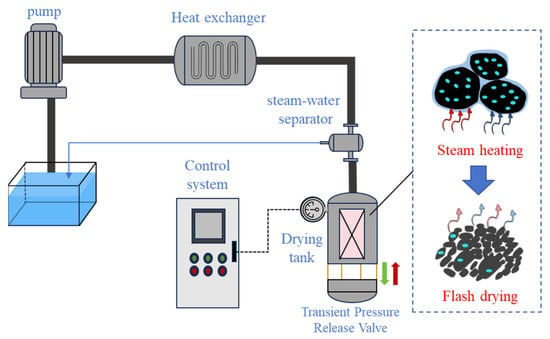
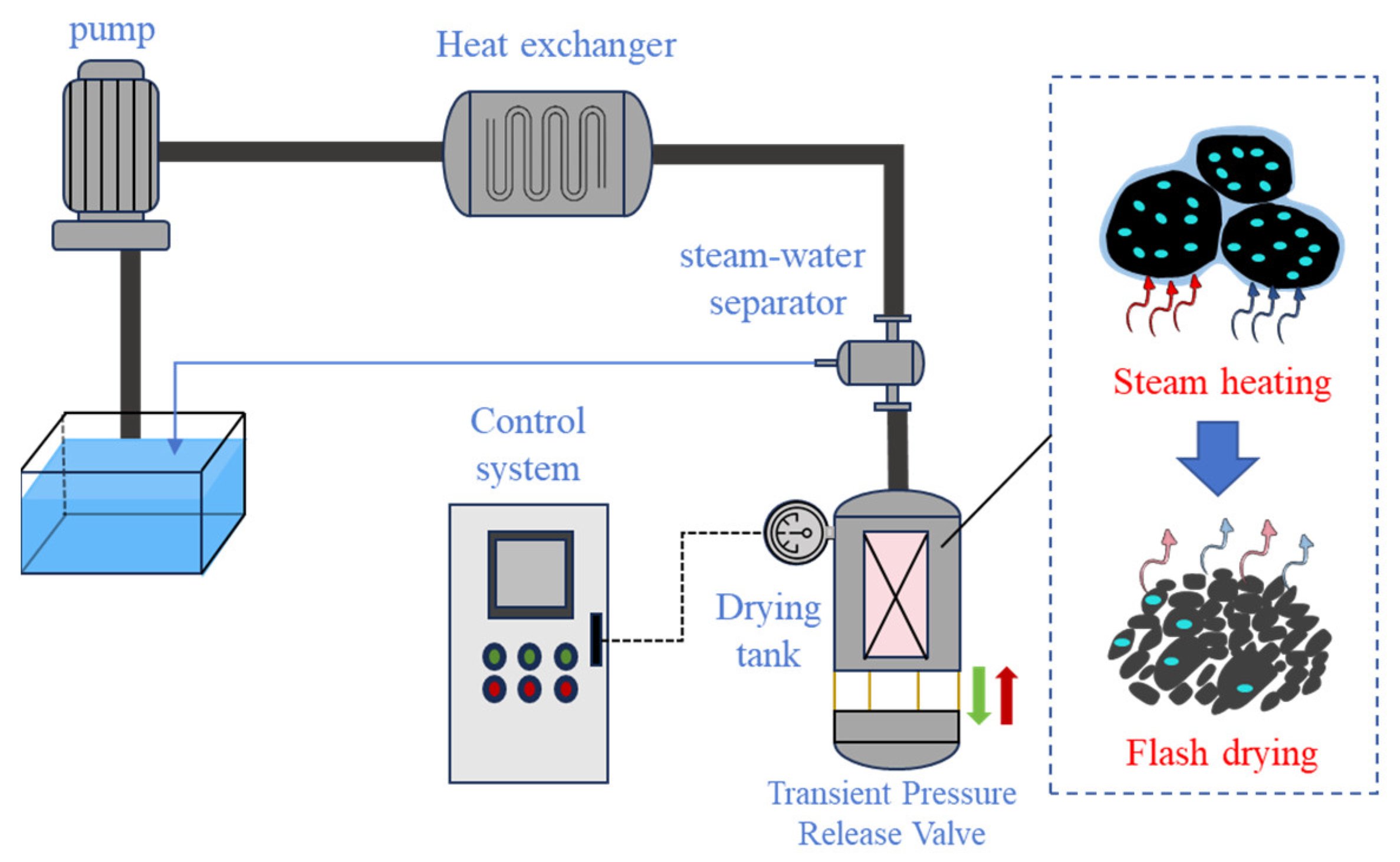
The experiments were conducted using a steam flash dryer, and its schematic diagram is shown in Figure 1. The drying process consists of three stages: steam pressurization, pressure holding, and transient drying. The specific experimental procedure is as follows: the container with coal slime was fixed inside the drying tank, and the tank lid was closed and sealed. Saturated steam was introduced through the steam inlet until the preset experimental pressure (1.0 MPa, 1.5 MPa, 2.0 MPa, 2.5 MPa, or 3.0 MPa) was reached, after which steam supply was stopped. Once the preset pressure holding time was achieved, the control system opened the pressure relief valve, and steam was discharged through the steam outlet within 1 s to complete pressure relief, marking the end of the transient drying process.
Figure 1.
Steam flash drying test system diagram.
2.4. Energy Consumpution Analysis
The energy consumption of coal slime under different drying conditions was calculated to quantitatively characterize the energy usage during the drying process. The calculation method is as follows:
where Q is the moisture–removal energy (kJ), Ps is the equipment power (W), and t is the drying time (s).
For a comparative analysis of energy efficiency, the specific energy consumption per unit mass of water removed, q, is defined by the following equation:
where q is the drying energy consumption per unit mass of water (kJ/kg H2O) and mw is the mass of the removed moisture (kg).
3. Results and Discussion
3.1. Hot–Air Drying Characteristics of Sticky Coal Slime
To investigate the drying behavior under hot–air conditions, the highly cohesive coal slime was separated into four particle–size fractions. Drying experiments were subsequently conducted at various temperatures for each fraction.
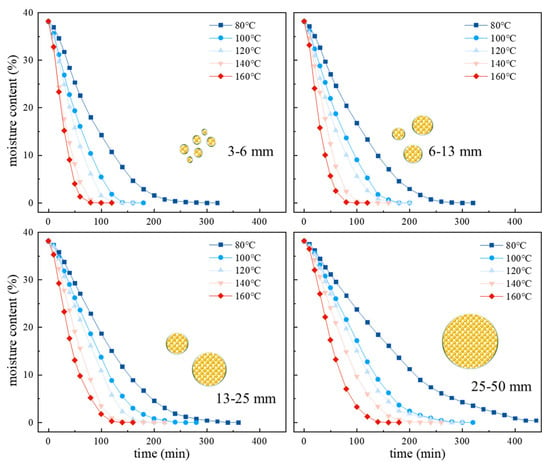
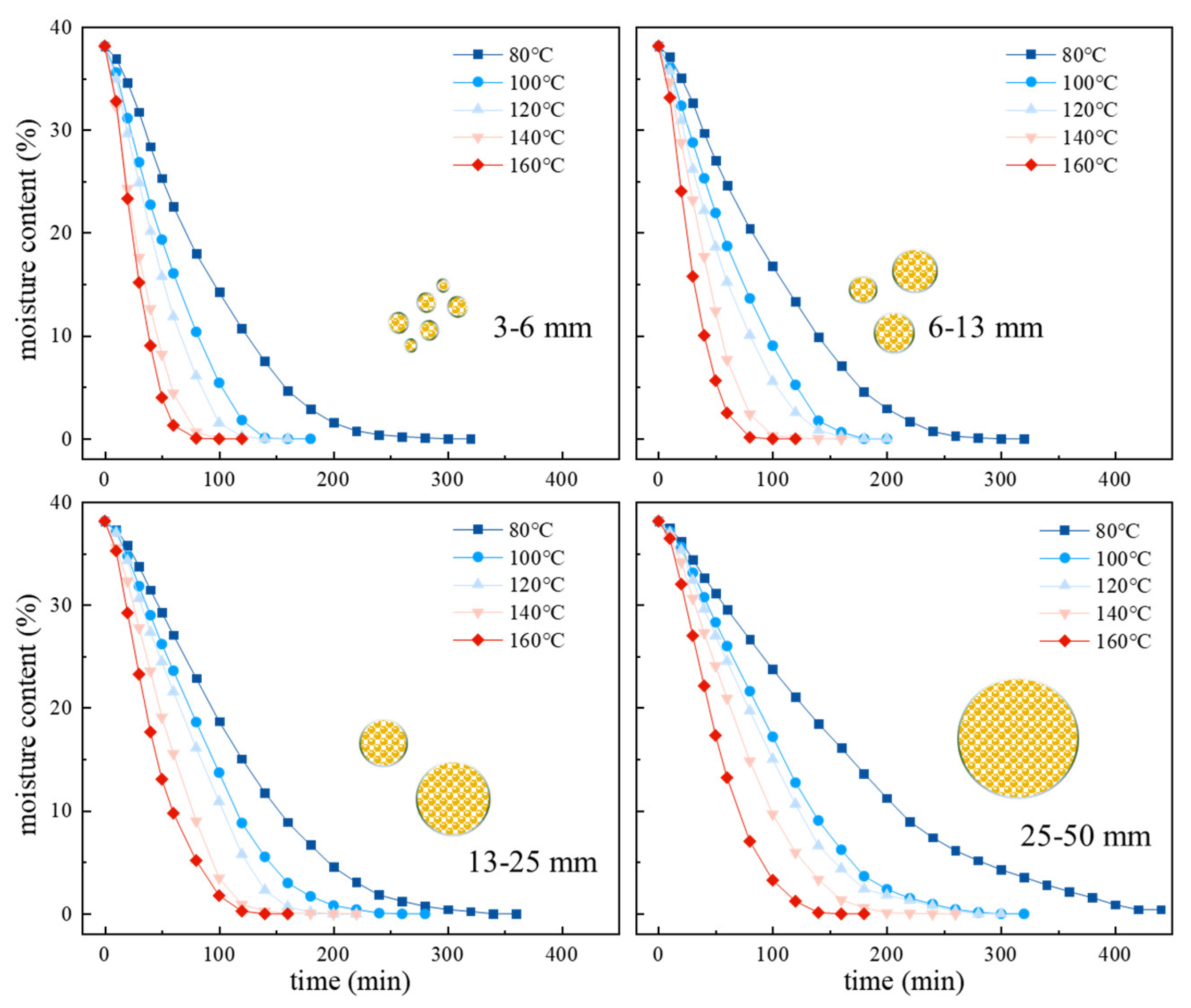
Figure 2 presents the moisture evolution curves of the four particle–size groups. Taking the 25–50 mm fraction as an example, equilibrium moisture was reached after approximately 440 min at 80 °C, whereas complete drying required only about 180 min at 160 °C. The strong temperature dependence arises from two coupled effects. A higher temperature rapidly increases the saturated vapor pressure at the particle surface, enlarging the vapor–pressure gradient between the surface and the surrounding air and thus accelerating surface evaporation. At the same time, additional thermal input promotes heat penetration into the interior of the particles, establishing steeper temperature and moisture gradients and enhancing internal diffusion [30].
Figure 2.
Moisture variation curves of coal slime at different temperatures.
Particle size also plays a vital role in the overall drying performance. At a given temperature, larger particles generally require longer drying times, although adjacent size ranges may occasionally show similar endpoints. For instance, at 80 °C, the 25–50 mm fraction needed about 440 min to approach equilibrium moisture, while the 6–3 mm fraction dried in roughly 240 min, shortening the process by nearly 200 min. This difference is mainly associated with the internal migration path of moisture [31]. Hot–air drying proceeds through gradual evaporation accompanied by inward heat transfer and outward moisture diffusion. As particle size increases, the diffusion distance becomes longer and internal mass–transfer resistance rises, delaying the removal of moisture from the particle core.
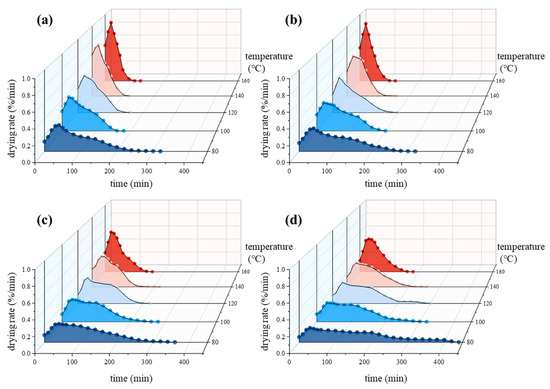
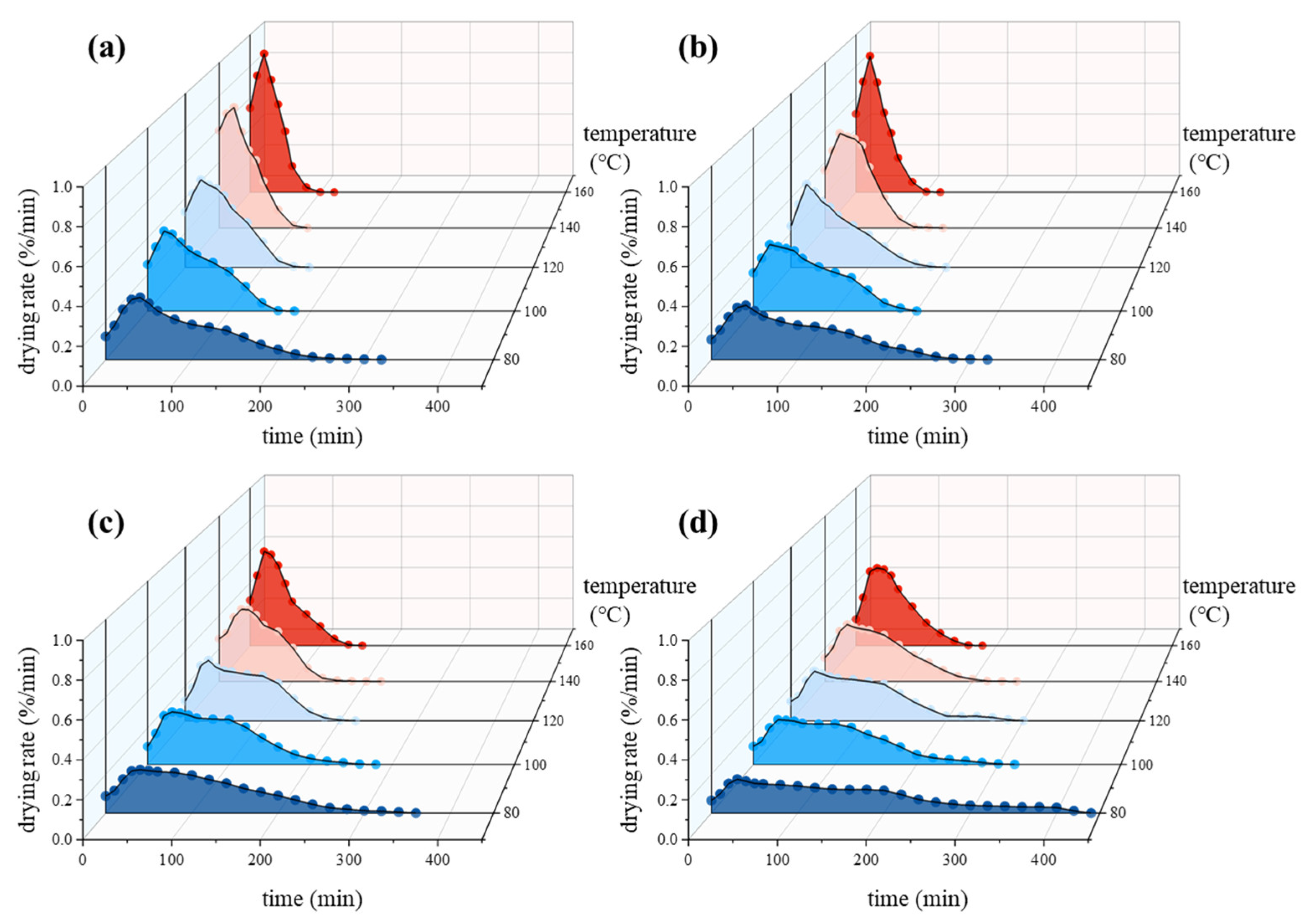
The drying–rate curves shown in Figure 3 further illustrate the stage characteristics. Based on the slope variation, the process at constant temperature can be divided into an initial acceleration stage, a falling–rate stage, and a final equilibrium stage. For some size–temperature combinations, the falling–rate period can be further distinguished into a relatively stable low–rate phase followed by a rapid decline, indicating the progressive shift in control from surface evaporation to internal diffusion. At 100 °C, for example, the 25–50 mm fraction exhibited an initial acceleration period within the first 30 min, during which the moisture content decreased from 38.13% to 33.13%. In this stage, surface heating dominated, and free water together with moisture in large pores evaporated preferentially. Between 30 and 120 min, the moisture content decreased to 12.74%, with the drying rate remaining nearly constant at a low level. This stage reflects the combined effects of intra–particle moisture migration and vapor transport through inter–particle voids within the thin–layer bed. From 120 to 200 min, the drying rate declined sharply as moisture removal became increasingly influenced by bound water in finer pores and by capillary and adsorption forces. After 200 min, the process approached the equilibrium stage, with drying rates below 0.06%/min, corresponding mainly to the removal of strongly bound water.
Figure 3.
Drying rate curves of coal slime at different temperatures for different particle size fractions: (a) 3–6 mm; (b) 6–13 mm; (c) 13–25 mm; (d) 25–50 mm.
Overall, hot–air drying of coal slime is governed by convective heat transfer coupled with internal moisture diffusion and can be regarded as a mild evaporation process. Temperature controls both the thermal gradient and the vapor–pressure gradient, while particle size determines the effective diffusion distance and internal resistance. Smaller particles and higher temperatures consistently lead to shorter drying times and higher drying rates. These drying characteristics provide a useful baseline for comparison with the transient steam flash –drying process discussed in the following sections.
3.2. Kinetics Analysis of Coal Slime Hot–Air Drying
The effective moisture diffusion coefficient (Deff) represents the amount of moisture transferred by diffusion per unit area and unit time and is commonly used to evaluate the diffusion capacity of porous materials under given conditions. In the hot–air drying of coal slime, moisture migration is essentially governed by internal diffusion from the particle core toward the surface. A larger Deff therefore indicates lower internal resistance and a more facile drying process.
Moisture diffusion within the coal matrix can be described using Fick’s second law. The moisture ratio (MR) is expressed as [32,33]
where Deff is the effective moisture diffusion coefficient of coal slime (m2/s); D is the characteristic particle diameter used in the drying calculations (for each particle–size group, D was taken as the arithmetic mean of the lower and upper sieve limits, representing an equivalent diameter for the irregular coal slime fragments); and t is the drying time (s).
Taking the logarithm of both sides of Equation (3) gives Equation (4):
Under constant drying conditions, Deff can be regarded as time–independent, leading to an approximately linear relationship between ln(MR) and drying time. Experimental drying data were therefore fitted using linear regression, and the slope of the fitted line was used to calculate Deff. The obtained diffusion coefficients at different temperatures are summarized in Table 2.
Table 2.
Effect of hot–air temperature on the effective diffusion coefficient of coal slime moisture.
Table 2 indicates that, for a given particle size, Deff increases monotonically with temperature. Elevated temperatures intensify convective heat transfer and promote vapor formation within the particles, leading to a larger vapor–pressure gradient relative to the ambient air. The strengthened thermodynamic driving force promotes moisture diffusion and shortens the internal mass–transfer period. The effective moisture diffusion coefficient (Deff) decreases with decreasing particle size. Although smaller particles generally exhibit faster overall drying rates in conventional drying theory, this advantage is mainly associated with enhanced external heat and mass transfer rather than improved internal moisture mobility. It should be noted that Deff derived from Fickian fitting is an apparent parameter that reflects the combined effects of internal pore connectivity, structural evolution, and moisture migration resistance, rather than a purely geometric or molecular diffusion property. During drying, fine coal slime particles may undergo more uniform shrinkage due to stronger capillary forces and structural compaction, which could increase internal resistance to vapor transport. In contrast, larger particles are more susceptible to surface cracking and shell rupture, which create additional vapor escape channels and effectively enhance internal permeability despite their longer diffusion paths. Consequently, the apparent diffusion coefficient of larger particles can exceed that of finer ones. This behavior indicates that Deff in coal slime drying is governed not only by particle size but also, more critically, by the dynamic evolution of pore structure and internal connectivity.
Drying activation energy (Ea) is another important kinetic parameter, defined as the minimum energy required to remove one mole of moisture from the material. It can be estimated using the Arrhenius relationship [32]:
where D0 is the pre–exponential factor (m2/s); Ea is the drying activation energy (J/mol); T is the drying temperature (K); and R is the molar gas constant.
Taking the logarithm of both sides of Equation (5) gives Equation (6):
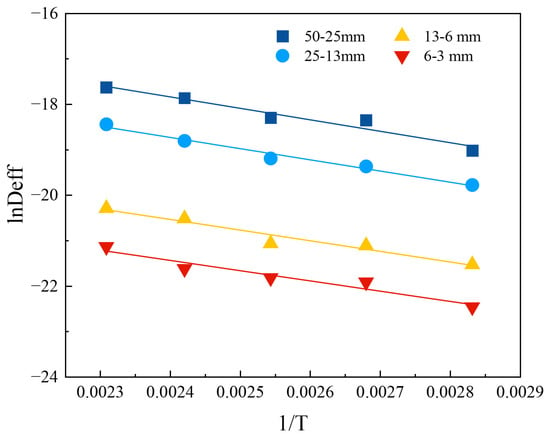
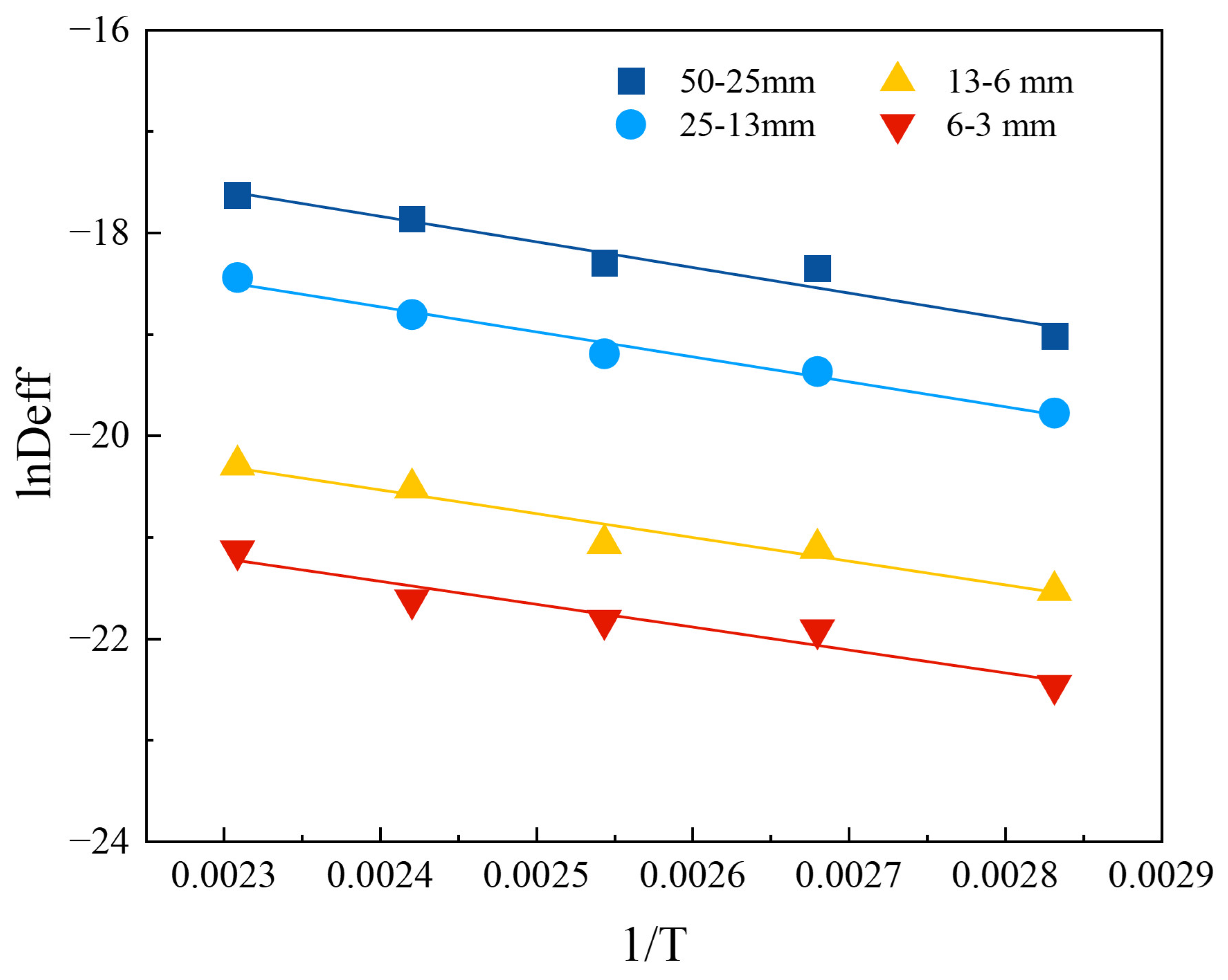
Based on the diffusion coefficients at different temperatures, a linear relationship between ln(Deff) and 1/T was obtained (Figure 4). The calculated Ea for different particle sizes are listed in Table 3. The Ea shows a gradual decrease with decreasing particle size, indicating that the overall energy barrier for moisture removal becomes lower in finer particles. Although structural shrinkage may reduce the apparent diffusion coefficient, the shorter average migration distance still reduces the thermodynamic energy requirement for moisture escape.
Figure 4.
Relationship between Deff and 1/T.
Table 3.
Drying activation energy of coal slime with different particle size.
Overall, the kinetic analysis confirms that the hot–air drying of coal slime is primarily diffusion–controlled and can be regarded as a quasi–steady evaporation process. Temperature mainly governs the thermodynamic driving force, while particle size influences both migration distance and structural evolution. These steady–state kinetic characteristics provide a quantitative baseline for comparison with the transient steam flash –drying behavior discussed in the subsequent sections.
3.3. Steam Flash Drying Characteristics of Coal Slime
To clarify the influence of operating parameters on the steam flash drying performance of coal slime, a series of single–factor experiments were conducted by varying steam pressure, particle size, and holding time. The evolution of moisture content under different conditions was systematically analyzed to reveal the dominant drying characteristics and their underlying physical basis.
3.3.1. Mechanistic Interpretation of Transient Flash Evaporation
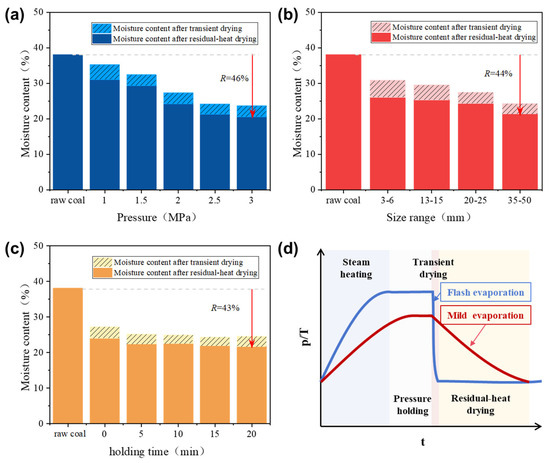
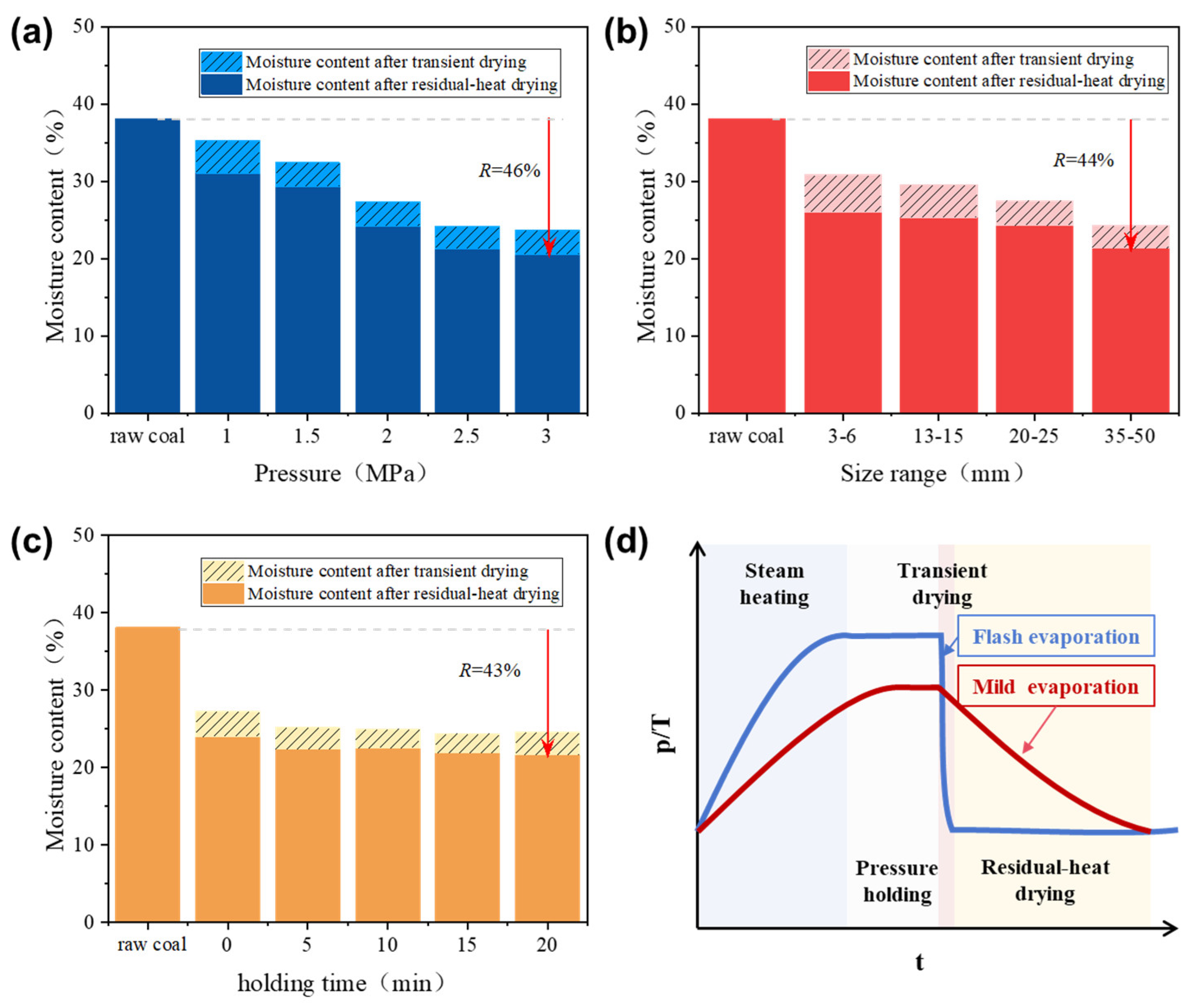
The steam flash drying of coal slime generally proceeds through four characteristic stages—steam heating, pressure holding, transient flash evaporation, and residual–heat drying (Figure 5d). During steam heating and subsequent pressure holding, thermal energy is rapidly transferred to the wet particles, elevating both particle temperature and internal vapor pressure and gradually bringing internal moisture toward a super–heated state. Upon sudden depressurization, the super–heated liquid undergoes instantaneous phase transition, which constitutes the primary source of rapid moisture removal. The sharp reduction in moisture content observed during depressurization indicates the existence of a strong thermodynamic driving force associated with phase transition. Because the entire pressure–release process is completed within approximately 1 s, it can be reasonably approximated as an adiabatic process. To qualitatively interpret this behavior, a thermodynamic framework based on liquid super–heat is introduced.
Figure 5.
Coal slime steam flash drying characteristics. (a) Steam pressure–moisture relation; (b) particle size–moisture relation; (c) holding time–moisture relation; (d) drying mechanism schematic.
Liquid super–heat (ΔTsh) is defined as the temperature difference between the actual liquid temperature and the saturation temperature at the corresponding pressure [34]:
where Tl is the liquid temperature and Tsat(p) is the saturation temperature at pressure p. This parameter reflects the degree to which the internal moisture deviates from equilibrium prior to pressure release.
ΔTsh = Tl − Tsat(p)
The thermal energy stored in super–heated liquid water can be expressed as
where mw is the mass of liquid water and cw is the specific heat capacity at constant pressure. During sudden depressurization, this stored energy may be partially or fully converted into the latent heat required for vaporization:
where mevap is the instantaneously evaporated water mass, hfg is the latent heat of vaporization, and η is the energy–utilization efficiency coefficient.
Qsh = mwcwΔTsh
mevaphfg = ηQsh
The introduction of Equations (7)–(9) provides a practical thermodynamic framework for regulating the intensity of flash evaporation during instantaneous depressurization. Instead of viewing moisture release as an uncontrollable transient phenomenon, these relations reveal that the dewatering rate can be actively tuned through coordinated adjustment of temperature and pressure. In particular, ΔTsh reflects the super–heating margin created by preheating temperature and initial system pressure, while Qsh represents the amount of internal thermal energy available to drive phase transition. By modifying the initial steam temperature, holding pressure, and final release pressure, the stored super–heat energy and thus the potential instantaneous evaporation mass can be effectively controlled. Therefore, these equations not only explain the physical origin of rapid moisture removal but also provide a quantitative basis for defining suitable operating windows, preventing excessive structural damage or energy waste, and achieving a targeted dehydration ratio in practical steam flash drying processes.
3.3.2. Effects of Operating Parameters on Drying Performance
The steam flash drying performance is jointly influenced by thermodynamic driving force, particle–structure permeability, and internal heat–equilibrium duration. The effects of steam pressure, particle size, and holding time are discussed below.
Effect of steam pressure. As shown in Figure 5a, increasing steam pressure from 1.0 to 3.0 MPa markedly enhanced the drying performance. The moisture content decreased from 38.13% to 20.51%, corresponding to a maximum removal of approximately 46%. Nearly 80% of the total moisture reduction occurred during the transient flash stage, indicating that instantaneous vaporization dominates the overall efficiency. The improvement rate gradually slowed beyond 1.5 MPa and approached a plateau above 2.5 MPa. Elevated pressure raises the saturation temperature of steam and increases the internal liquid temperature prior to depressurization, thereby enlarging the liquid super–heat level and strengthening the flash–evaporation driving force. However, once most free water has been removed, the remaining moisture is primarily adsorbed or capillary–bound water that requires substantially higher energy for phase transition. Considering both drying efficiency and energy consumption, a steam pressure range of 2.5–3.0 MPa is identified as optimal.
Effect of particle size. A pronounced dependence on particle size is evident in Figure 5b, with larger particle fractions exhibiting lower final moisture contents and higher overall dewatering efficiencies. For instance, the 35–50 mm fraction showed a reduction in moisture content from 38.13% to 21.36%, corresponding to a removal rate of 44%. This trend is mainly associated with the coupled influences of heat– and mass–transfer behavior and condensate migration within the agglomerated particle bed [27]. During steam heating, saturated steam releases latent heat upon contact with the relatively cooler coal surface, inevitably generating condensate within the particle assembly. The subsequent transport and retention of this condensate critically affect the residual moisture level. In larger particle agglomerates, wider inter–particle voids facilitate gravitational drainage of condensed water rather than its entrapment within the pore network. Such enhanced drainage effectively reduces liquid accumulation and contributes to lower equilibrium moisture contents. Meanwhile, the enlarged interstitial channels also promote vapor escape and gas penetration, thereby decreasing internal mass–transfer resistance and improving overall dewatering performance. Conversely, smaller particle fractions tend to form more compact packing structures with narrower pore throats, which favor condensate retention due to enhanced capillary forces and restrict vapor discharge pathways. Under these conditions, capillary pressure retains liquid within inter–particle voids and contact regions, offsetting part of the thermal advantage provided by steam heating. As a result, liquid re–adsorption and restricted internal transport lead to comparatively lower dehydration ratios. Overall, these results suggest that particle size governs dehydration behavior not merely through geometric diffusion distance, but more fundamentally through its regulation of internal void architecture, capillary pressure, and condensate drainage capacity within coal slime agglomerates.
Effect of holding time. The influence of holding time exhibits a diminishing–return tendency, as shown in Figure 5c. Extending the holding duration from 0 to 15 min gradually reduced the moisture content across all particle sizes. Without a holding stage, the moisture content decreased rapidly from 38.13% to approximately 23%. Increasing the holding time from 0 to 5 min produced the most pronounced improvement, while further extension to 10–15 min yielded only limited additional moisture removal. When prolonged to 20 min, the moisture content no longer declined and occasionally showed a slight rebound. This pattern is associated with the evolution of internal thermal balance within the material. Most heat equilibration under saturated steam conditions is achieved within the first few minutes; once temperature gradients weaken, the driving forces for both heat and mass transfer diminish. Excessive holding can also induce minor moisture redistribution or localized re–condensation, partially offsetting the benefit of extended heating.
Steam flash drying performance is therefore governed by the interaction among the thermodynamic driving force, particle permeability, capillary retention within the inter–particulate matrix, and the duration required for thermal equilibration. Steam pressure determines the magnitude of liquid super–heat and the potential for instantaneous evaporation, particle size regulates pore connectivity and condensate drainage behavior, and holding time defines the establishment of internal heat balance. Conventional hot–air drying is largely diffusion–controlled, whereas steam flash drying involves rapid pressure–induced phase transition followed by evaporation driven by residual internal heat. This mechanistic difference forms the conceptual basis for the quantitative comparison presented in the subsequent section.
3.4. Residual–Heat Temperature and Moisture Evolution After Steam Flash Drying
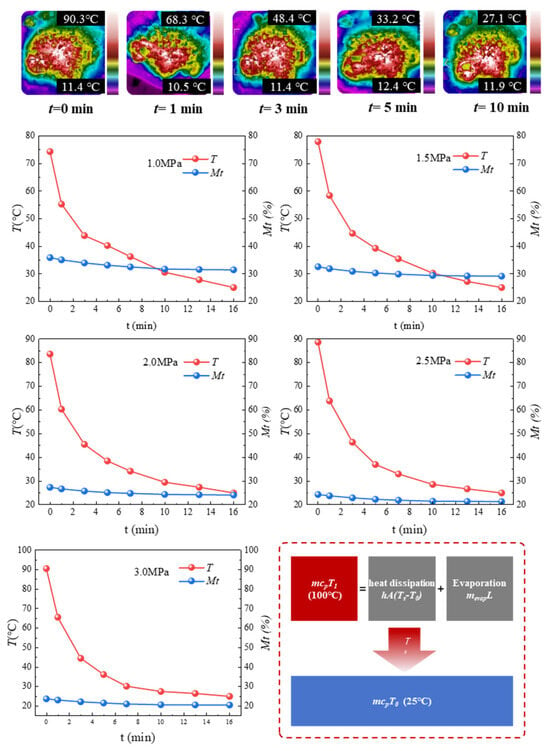
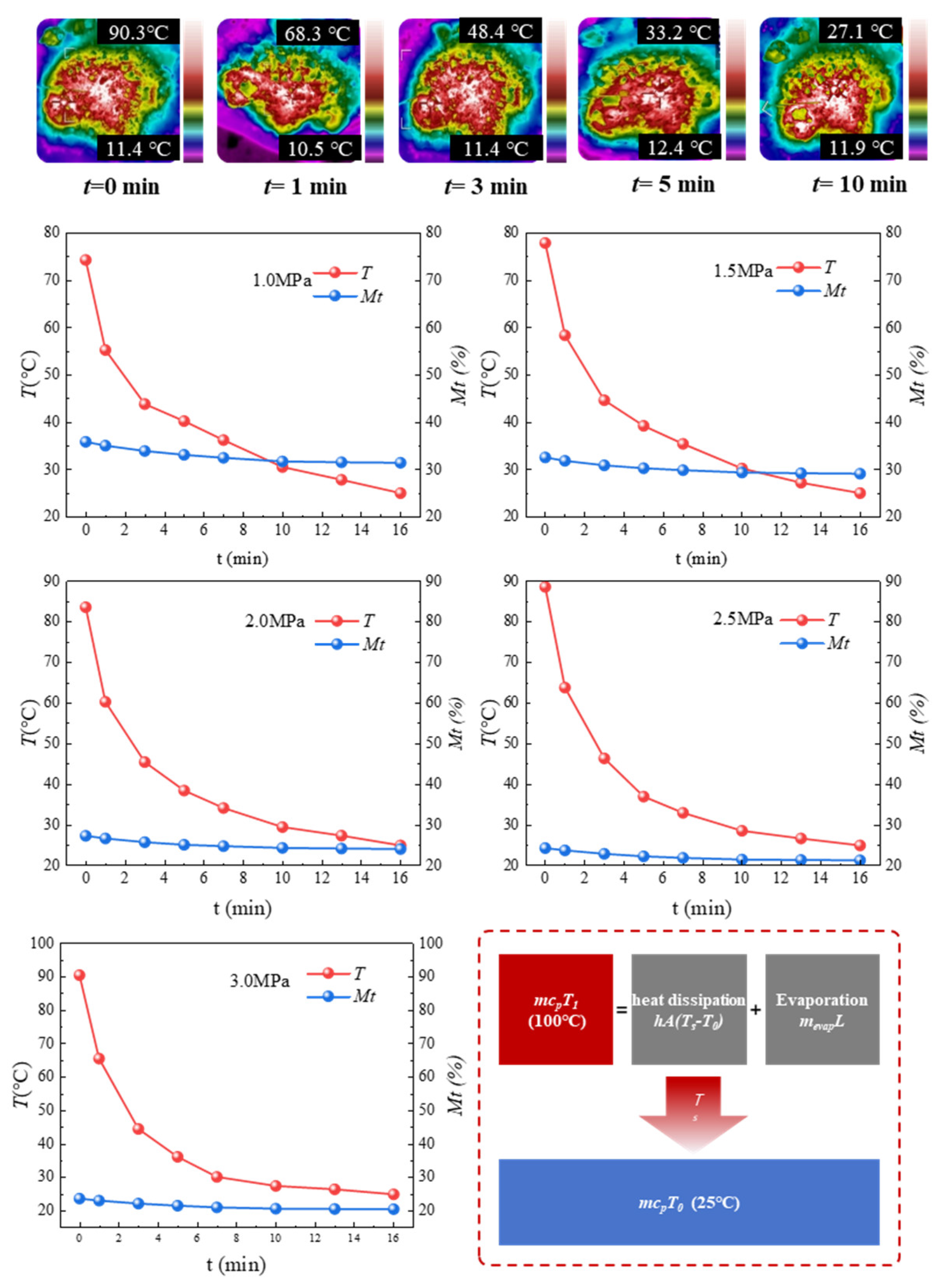
To investigate the heat dissipation behavior of coal slime after steam flash drying, the temperature evolution of the material during the residual–heat stage was measured, as shown in Figure 6. With increasing steam pressure from 1.0 to 3.0 MPa, the initial temperature of the coal in the residual–heat stage rose from 74.2 °C to 90.4 °C. This increase is mainly attributed to the higher saturation temperature of steam at elevated pressures, which enhances heat transfer during the pressurization phase. Although part of the stored energy is released during sudden depressurization, the residual temperature remains primarily determined by prior steam heating rather than transient energy loss.
Figure 6.
Temperature and moisture variation in coal slime during steam flash drying at different steam pressures.
During the residual–heat stage, the coal temperature decreased continuously with time, with the most pronounced decline occurring within the first 5 min. Higher drying pressures resulted in a larger initial temperature drop. Based on the macroscopic observations (Figure 6), the agglomerated coal particles appeared to become partially dispersed after flash drying, which may be attributed to the mechanical action of the vapor flow during rapid evaporation. This possible dispersion could increase the exposed surface area and promote faster heat dissipation. After several minutes, the temperature gradually approached the ambient level, indicating the transition from rapid heat release to a slow equilibrium process.
A comparison of temperature and moisture evolution shows that both parameters decrease synchronously, while their rates gradually diminish over time. In the absence of external heat input, further moisture removal relies entirely on the sensible heat stored in the coal matrix. As the temperature declines, the evaporation driving force weakens, resulting in a typical falling–rate behavior. Consequently, the residual–heat stage contributes limited but non–negligible additional moisture removal.
From a practical perspective, freshly flash–dried coal slime retains sufficient thermal energy to support continued evaporation. Immediate stacking may lead to heat accumulation and potential safety risks, whereas allowing a short natural cooling period enables further moisture reduction and improves product stability. This finding highlights the importance of utilizing residual heat as a transitional drying stage rather than treating flash drying as an instantaneous endpoint.
3.5. Effects of Steam Flash Drying on the Physicochemical Structure of Coal Slime
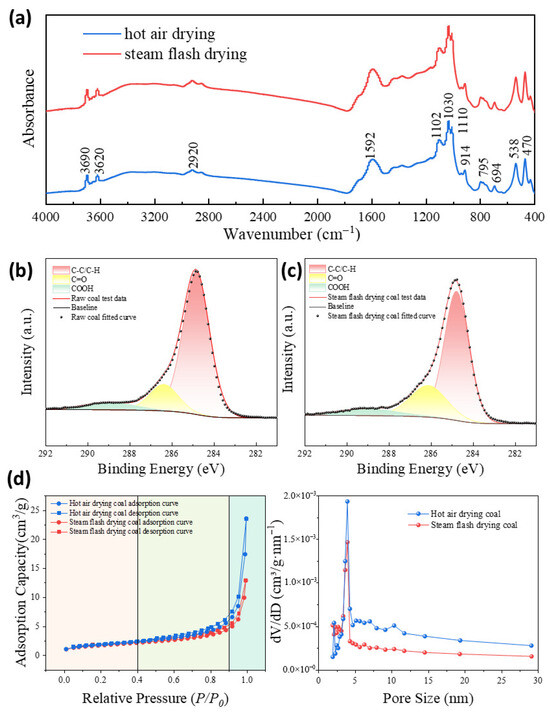
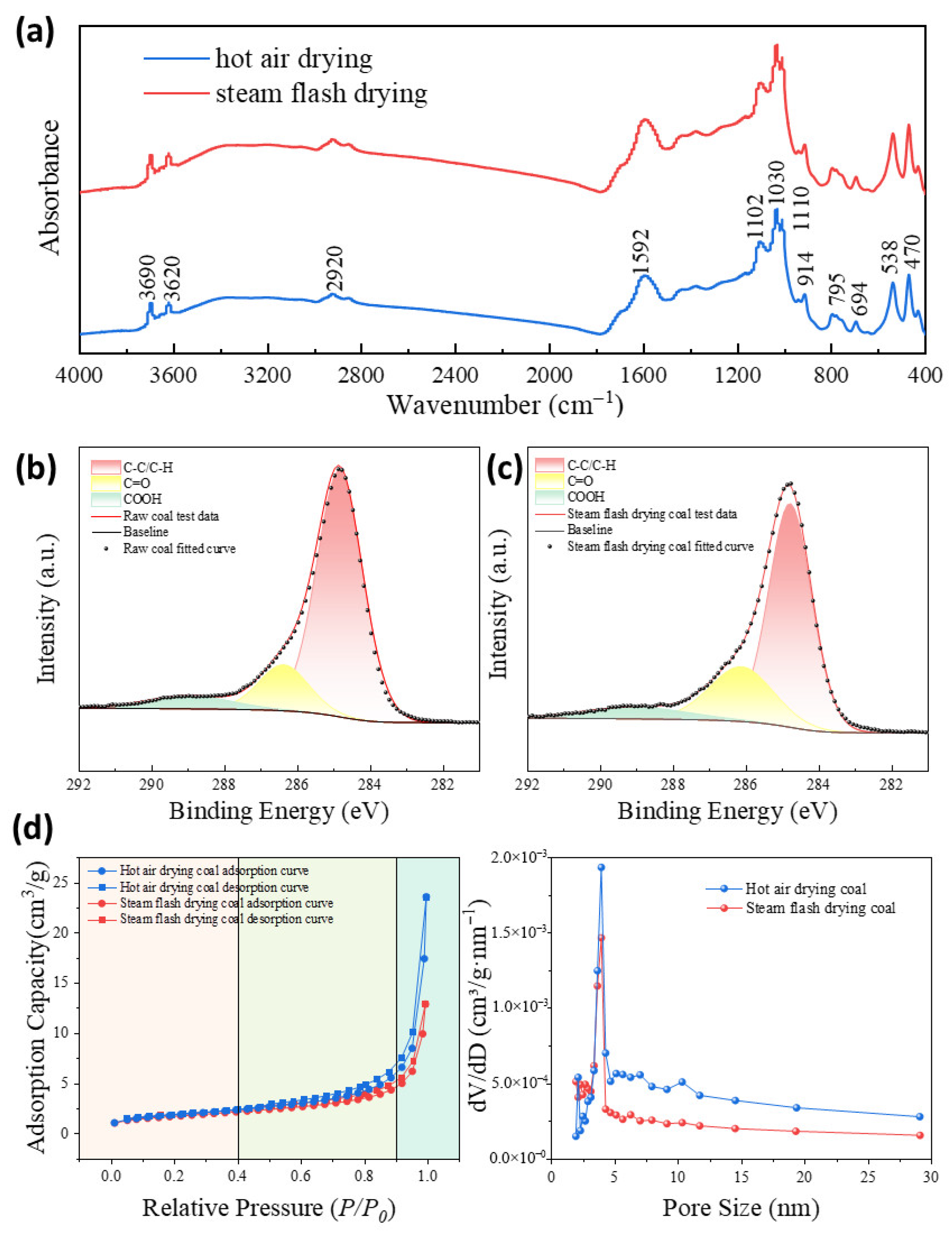
To further elucidate the effects of steam flash drying on the physicochemical structure of coal slime, samples under typical conditions (particle size 25–50 mm, dewatering pressure 3.0 MPa, pressure holding time 0 min) were systematically characterized after steam flash drying and conventional hot–air drying. Characterization techniques included Fourier transform infrared spectroscopy (FTIR) (DS 2500, Metrohm AG, Herisau, Switzerland), X–ray photoelectron spectroscopy (XPS) (Nexsa, Thermo Fisher Scientific, Waltham, MA, USA), and low–temperature nitrogen adsorption (BET) (ASAP 2460, Micromeritics Instrument Corporation, Norcross, GA, USA), providing insights into molecular structure, surface chemistry, and pore evolution.
The FTIR spectra of coal slime before and after drying are shown in Figure 7a. The overall spectral shape remains largely unchanged, although the absorbance of some weak polar functional groups slightly decreases. At a dewatering pressure of 3.0 MPa, the system temperature reaches approximately 230 °C, under which major chemical bonds (e.g., C=C, Si–O, Al–O) remain intact, while thermally less stable oxygen–containing functional groups (e.g., C=O, COOH) may undergo decomposition [35,36]. XPS analysis of the C1s spectra (Figure 7b; quantitative results in Table 4) indicates a decrease in C=O and COOH content, accompanied by an increase in C–C components after steam drying, suggesting decarboxylation and decomposition of oxygenated groups, which enhance aromaticity and reduce polarity. The increase in hydrophobic C–C structures together with the reduction in hydrophilic oxygen–containing groups suggests an enhancement in surface hydrophobicity, which may contribute to reduced moisture affinity and reabsorption behavior. [37,38].
Figure 7.
Effects of steam flash drying on coal slime: (a) FTIR spectra of raw coal and steam flash–dried coal; (b) XPS C1s spectrum of raw coal; (c) XPS C1s spectrum of steam flash–dried coal; (d) N2 adsorption–desorption isotherms and corresponding pore size distribution curves.
Table 4.
Carbon–containing functional group composition of coal slime before and after drying.
Nitrogen adsorption–desorption isotherms and pore size distributions before and after drying are shown in Figure 7c. All samples exhibit type IV isotherms with H3 hysteresis loops, indicating a predominance of mesopores and the presence of partially enclosed pores [39]. At low relative pressures (P/P0 = 0–0.4), adsorption gradually increases, reflecting multilayer formation; at medium pressures (P/P0 = 0.4–0.9), adsorption continues, indicating the filling of micropores and mesopores; at high pressures (P/P0 = 0.9–1.0), a sharp increase reflects the presence of meso–to–macropores and capillary condensation. After steam flash drying, the adsorption–desorption curve shifts downward, particularly at high pressures, indicating a reduction in large pores and overall densification. Pore size distribution analysis further shows a decrease in mesopore volume while the main peak remains around 3.9 nm. BET surface area decreases from 6.65 to 6.10 m2/g, and total pore volume decreases from 0.0146 to 0.0104 cm3/g. These changes are attributed to thermal stress induced by the instantaneous pressure release during flash drying, leading to partial mesopore collapse and pore closure. Previous studies indicate that mesopores can re–adsorb moisture via capillary condensation, causing water regain. Here, densified pore structures after flash drying reduce contact with water and oxygen, suppressing moisture reabsorption and low–temperature oxidation, thereby improving storage stability and safety [40].
In summary, steam flash drying improves the physicochemical structure of coal slime through temperature and pressure effects: at the molecular scale, weak polar oxygen–containing groups decompose, C–C structures increase, hydrophobicity rises, and water reabsorption decreases; at the pore scale, mesopores collapse and structures densify, reducing surface area and pore volume, which enhances storage stability and safety [41]. These results indicate that this technology not only achieves efficient drying but also optimizes microstructure and surface properties, providing theoretical and technical support for the clean and safe utilization of coal slime.
3.6. Comparative Analysis of Steam Flash Drying and Hot–Air Drying
Based on the above investigations of drying behavior, heat evolution, and kinetic characteristics, steam flash drying and conventional hot–air drying exhibit fundamentally different heat– and mass–transfer mechanisms. Hot–Air drying is predominantly governed by continuous external heat supply and diffusion–controlled moisture migration, in which water gradually evaporates under a temperature and concentration gradient. In contrast, steam flash drying operates in a semi–closed environment where saturated steam directly contacts the coal slime, rapidly elevating the temperature of both the solid matrix and internal moisture. Subsequent instantaneous depressurization induces flash evaporation of super–heated liquid water. In this mode, moisture removal is largely driven by pre–stored thermal energy rather than sustained external heating, and the heating and evaporation stages are partially decoupled. These intrinsic differences in energy–transfer pathways and phase –transition modes lead to pronounced variations in drying rate and energy–utilization efficiency [42].
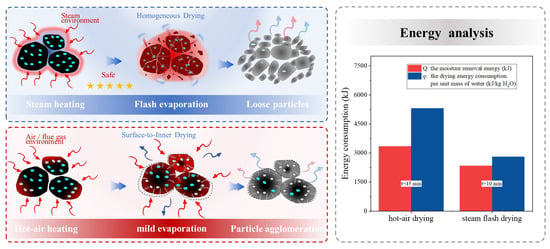
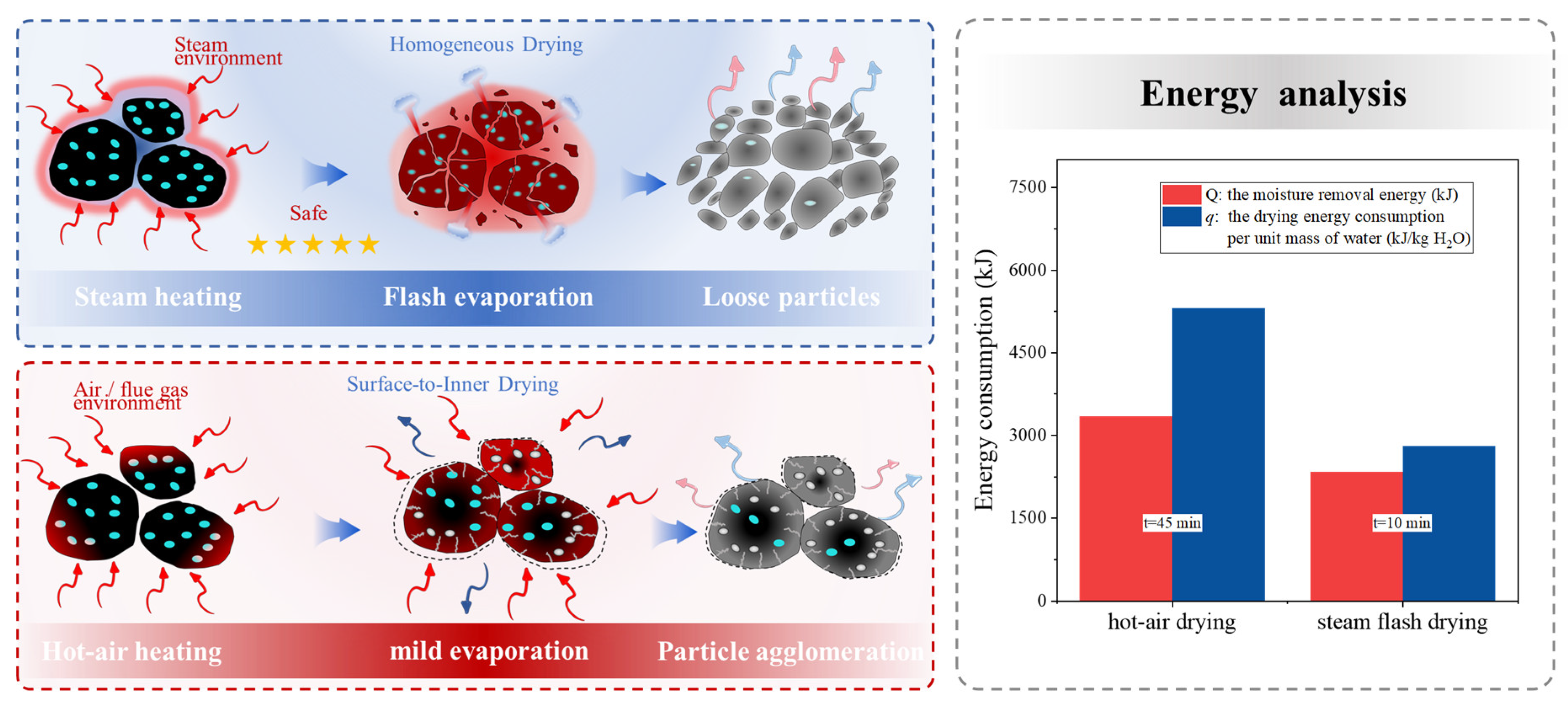
From an engineering perspective, the target moisture content of coal slime is generally controlled at approximately 15–20% to balance product stability and energy consumption [43,44]. As illustrated in Figure 8, reducing the moisture content of 3.5 kg coal slime from 40% to 20% requires about 45 min and a total energy input of 3346 kJ under hot–air drying, whereas steam flash drying achieves the same target with only 10 min of heating and an energy input of 2342 kJ. When normalized by the amount of water removed, the specific energy consumption decreases from 5311 kJ·kg−1 H2O for hot–air drying to 2806 kJ·kg−1 H2O for steam flash drying, corresponding to an energy reduction of approximately 40%. This quantitative difference corroborates the earlier thermal analysis, indicating that the residual sensible heat stored in the coal matrix and the latent heat utilization of steam jointly contribute to a higher overall energy–transfer efficiency.
Figure 8.
Analysis of drying time and energy consumption: steam flash drying vs. hot–air drying.
In addition to energy performance, the two drying methods also produce distinct structural outcomes. Continuous hot–air heating tends to induce partial surface consolidation or particle agglomeration, which increases internal diffusion resistance and limits further moisture release [23]. In contrast, instantaneous pressure release in steam flash drying generates micro–cracks and enlarged pore channels, resulting in a looser and more permeable particle structure. This structural evolution not only facilitates moisture migration during drying but also improves subsequent handling, blending, and combustion uniformity. Overall, the superiority of steam flash drying does not merely arise from faster heat input, but from its phase –transition–dominated moisture–removal pathway coupled with efficient energy utilization and favorable structural modification. These combined advantages highlight its potential as an effective upgrading technology for high–moisture coal slime under industrial conditions.
4. Conclusions
This study investigates the drying characteristics of coal washing slime, focusing on the effects of temperature and particle size on hot–air drying behavior and the associated kinetic and moisture –migration mechanisms. The influences of steam pressure, particle size, and holding time on steam flash drying performance are also evaluated, together with the physicochemical structural variations induced by the two methods. On this basis, the differences in moisture–removal pathways and energy–transfer mechanisms between hot–air drying and steam flash drying are clarified, followed by a comparative assessment of energy consumption and application potential. The main conclusions are summarized as follows:
Steam flash drying of coal slime is mainly influenced by steam pressure, particle size, and pressure holding time. Increasing steam pressure enhances material superheating and pressure gradients, thereby improving flash drying efficiency. Controlling particle aggregation facilitates steam flow and condensate removal, benefiting fine coal slime drying.
The steam flash drying process can be divided into four stages: steam heating, pressure holding, transient flash drying, and residual–heat drying. Approximately 80% of moisture is removed during the transient flash stage. During the residual–heat drying stage, coal slime temperature and moisture decrease simultaneously; rational utilization of this stage can further reduce product moisture and facilitate material cooling, mitigating the risk of spontaneous combustion during storage.
Steam flash drying promotes the decomposition of oxygen–containing functional groups and increases aromatic structures, enhancing the hydrophobicity of coal slime. Drying also induces mesopore collapse and pore densification, further improving storage safety and inhibiting moisture reabsorption.
Hot–Air drying relies on heat transfer via contact with hot–air and convective heating, whereas steam flash drying primarily utilizes direct steam heating followed by transient depressurization–induced flash drying. The mechanistic differences result in reduced drying time and energy consumption for steam flash drying, while producing a loosened coal slime structure conducive to subsequent blending and utilization, offering an efficient route for high–moisture coal slime processing.
Author Contributions
Conceptualization, G.Z. and Z.S.; methodology, G.Z. and S.Y.; software, F.C. and S.Y.; validation, Y.Z., K.L. and Z.S.; formal analysis, K.L. and S.Y.; investigation, S.Y. and F.C.; resources, Y.Z.; data curation, Y.Z.; writing—original draft preparation, G.Z. and Z.S.; writing—review and editing, Y.Z. and Z.S.; visualization, K.L. and S.Y.; supervision, Z.S.; funding acquisition, Y.Z. All authors have read and agreed to the published version of the manuscript.
Funding
This work was supported by the National Natural Science Foundation of China (52534004, 52322405, 52304306), the Central Guidance on Local Science and Technology Development Fund of Xinjiang Province (ZYYD2024CG08), the Fundamental Research Funds for Central Universities (2023ZDPY07), Jiangsu Provincial Natural Science Foundation Youth Fund Project (BK20231073), and Research program of Jiangsu Key Laboratory for Clean Utilization of carbon resources (BM2024007).
Data Availability Statement
The original contributions presented in this study are included in the article. Further inquiries can be directed to the corresponding author.
Conflicts of Interest
The authors declare no conflicts of interest.
References
- Guo, X.; Li, K.; Zhou, P.; Liang, J.X.; Gu, J.N.; Xue, Y.X.; Guo, M.M.; Sun, T.H.; Jia, J.P. Insight into the Enhanced Removal of Water from Coal Slime via Solar Drying Technology: Dewatering Performance, Solar Thermal Efficiency, and Economic Analysis. ACS Omega 2022, 7, 6710–6720. [Google Scholar] [CrossRef] [Scilit] [PubMed]
- Guo, H.Y.; Zhao, S.F.; Xia, D.P.; Wang, L.; Lv, J.H.; Yu, H.F.; Jiao, X.J. Efficient utilization of coal slime using anaerobic fermentation technology. Bioresour. Technol. 2021, 332, 125072. [Google Scholar] [CrossRef] [Scilit]
- Mei, W.G.; Jia, T.Y.; Zhang, Y.S.; Wang, T.; Wang, J.W.; Pan, W.P. Combustion and Fragmentation Characteristics of Single Wet Coal Slime Particle. Combust. Sci. Technol. 2024, 196, 1933–1956. [Google Scholar] [CrossRef] [Scilit]
- Wang, H.; Yang, D.W.; Chen, X.R.; Liu, H.H.; Zhao, K.X.; Yang, H.R.; Wu, J.Q. Primary Fragmentation Characteristics in the Process of Coal Slime Combustion. Combust. Sci. Technol. 2023, 195, 1328–1345. [Google Scholar] [CrossRef] [Scilit]
- Wzorek, M. Solar drying of granulated waste blends for dry biofuel production. Environ. Sci. Pollut. Res. 2021, 28, 34290–34299. [Google Scholar] [CrossRef] [Scilit]
- Liang, B.; Bai, H.L.; Tan, B.; Fu, L.L.; Bai, D.R. Experimental investigation of circulating fluidized bed combustion of dry powders of coal slime. Fuel 2023, 348, 128566. [Google Scholar] [CrossRef] [Scilit]
- Wang, H.; Liu, H.H.; Zhao, K.X.; Yang, H.R.; Chen, J. Combustion characteristics of spherical particles mixed with coal slime and sawdust. Energy Sources Part A 2022, 44, 535–549. [Google Scholar] [CrossRef] [Scilit]
- Xing, H.B.; Gao, J.; Zhang, J.; Cheng, X.Y.; Zhang, Y.Y.; Cheng, F.Q.; Zhang, D.K. An experimental investigation into the fate of fuel–bound N–species during fluidised bed combustion of a dried coal slime in O2/Ar mixtures. Fuel 2024, 363, 130860. [Google Scholar] [CrossRef] [Scilit]
- Hu, S.; Man, C.; Gao, X.; Zhang, J.; Xu, X.; Che, D. Energy Analysis of Low–Rank Coal Pre–Drying Power Generation Systems. Dry. Technol. 2013, 31, 1194–1205. [Google Scholar] [CrossRef] [Scilit]
- Domazetis, G.; Barilla, P.; James, B.D.; Glaisher, R. Treatments of low rank coals for improved power generation and reduction in greenhouse gas emissions. Fuel Process. Technol. 2008, 89, 68–76. [Google Scholar] [CrossRef] [Scilit]
- Rao, Z.; Zhao, Y.; Huang, C.; Duan, C.; He, J. Recent developments in drying and dewatering for low rank coals. Prog. Energy Combust. Sci. 2015, 46, 1–11. [Google Scholar] [CrossRef] [Scilit]
- Yu, J.; Tahmasebi, A.; Han, Y.; Yin, F.; Li, X. A review on water in low rank coals: The existence, interaction with coal structure and effects on coal utilization. Fuel Process. Technol. 2013, 106, 9–20. [Google Scholar] [CrossRef] [Scilit]
- Fan, Y.; Dong, X.; Li, H. Dewatering effect of fine coal slurry and filter cake structure based on particle characteristics. Vacuum 2015, 114, 54–57. [Google Scholar] [CrossRef] [Scilit]
- Allardice, D.J.; Clemow, L.M.; Favas, G.; Jackson, W.R.; Marshall, M.; Sakurovs, R. The characterisation of different forms of water in low rank coals and some hydrothermally dried products. Fuel 2003, 82, 661–667. [Google Scholar] [CrossRef] [Scilit]
- Song, Z.; Jing, C.; Yao, L.; Zhao, X.; Sun, J.; Wang, W.; Mao, Y.; Ma, C. Coal slime hot air/microwave combined drying characteristics and energy analysis. Fuel Process. Technol. 2017, 156, 491–499. [Google Scholar] [CrossRef] [Scilit]
- Lei, H.; Wan, T.; Chen, T.; Ma, B.; Yao, Z.; Xu, B.; Wang, Q.; Xu, X. Study on the Drying Characteristics of Moist Fine Lignite in a Dense Gas–Solid Separation Fluidized Bed. Minerals 2025, 15, 1039. [Google Scholar] [CrossRef] [Scilit]
- Ullah, H.; Shahab, A.; Rashid, A. Volatilization characteristics of selenium during conventional and microwave drying of coal slime: An emerging contaminant in mining industry. Environ. Sci. Pollut. Res. 2020, 27, 11164–11173. [Google Scholar] [CrossRef] [Scilit]
- Wang, F.; Tian, N.; Li, C.; Zhang, K.; Zhang, H.R.; Zhang, Y.Y. Reducing the Energy Consumption during Microwave Drying of Coal Slime Dough by Optimizing Parameters: Experiment and Modeling. ACS Omega 2024, 9, 31986–31997. [Google Scholar] [CrossRef] [Scilit] [PubMed]
- Fan, H.D.; Deng, B.Y.; Shi, J.; Qin, S.N.; Feng, Y.P.; Huang, Z.; Fan, B.G.; Yang, H.R.; Jin, Y.; Zhang, M. Experimental research on morphology and drying characteristics of coal slime dough injected into circulating fluidized bed boiler. Fuel Process. Technol. 2021, 222, 106981. [Google Scholar] [CrossRef] [Scilit]
- Rong, L.K.; Xiao, J.H.; Wang, X.P.; Sun, J.L.; Jia, F.J.; Chu, M. Low–rank coal drying behaviors under negative pressure: Thermal fragmentation, volume shrinkage and changes in pore structure. J. Clean. Prod. 2020, 272, 122572. [Google Scholar] [CrossRef] [Scilit]
- Li, H.; Lin, B.; Hong, Y.; Liu, T.; Huang, Z.; Wang, R.; Wang, Z. Assessing the moisture migration during microwave drying of coal using low–field nuclear magnetic resonance. Dry. Technol. 2018, 36, 567–577. [Google Scholar] [CrossRef] [Scilit]
- Phiciato, P.; Yaskuri, D. Dual–Stage Drying Process of Lignite Using Pilot Scale Coal Rotary Dryer. Int. J. Coal Prep. Util. 2019, 39, 373–388. [Google Scholar] [CrossRef] [Scilit]
- Hacifazlioglu, H. Comparison of Efficiencies of Microwave and Conventional Electric Ovens in the Drying of Slime–Coal Agglomerates. Int. J. Coal Prep. Util. 2017, 37, 169–178. [Google Scholar] [CrossRef] [Scilit]
- Zhang, L.; Song, Z.; Wu, D.; Luo, Z.; Zhao, S.; Wang, Y.; Deng, J. Prediction of coal self–ignition tendency using machine learning. Fuel 2022, 325, 124832. [Google Scholar] [CrossRef] [Scilit]
- Sun, Z.S.; Su, Y.F.; Zhang, Z.X.; Yang, F.; Zhang, M.R.; Yan, G.H.; Zhang, B. Enhanced water removal from low–rank coal via flash evaporation: Insights into dewatering performance, upgrading effects, and energy analysis. Energy Sources Part A 2024, 46, 12829–12842. [Google Scholar] [CrossRef] [Scilit]
- Sun, Z.S.; Zhao, Y.M.; Yan, G.H.; Yuan, H.T.; Zhang, M.R.; Zhang, B. A novel method for low–rank coal drying using steam transient flash evaporation. Fuel 2023, 354, 129238. [Google Scholar] [CrossRef] [Scilit]
- GB/T 212–2008; Proximate Analysis of Coal. Standards Press of China: Beijing, China, 2008.
- GB/T 476–2008; Method for Ultimate Analysis of Coal. Standards Press of China: Beijing, China, 2008.
- Sun, Z.S.; Yao, S.Y.; Ren, G.J.; Guo, J.W.; Yang, F.; Zhang, M.R.; Zhang, B. Study on coarse–grained coal water removal characteristics via steam flash drying for low–rank coal upgrading. J Clean. Prod. 2024, 446, 141349. [Google Scholar] [CrossRef] [Scilit]
- Zheng, C.K.; Yao, Q.L.; Li, X.H.; Hudson–Edwards, K.; Shan, C.H.; Shang, X.B.; Li, Y. Experimental investigation of mechanical characteristics of coal samples at different drying temperatures. Dry. Technol. 2022, 40, 3483–3495. [Google Scholar] [CrossRef] [Scilit]
- Zhang, Y.D.; Dong, Y.N.; Chen, Z.Q.; Zhao, Y.M.; Duan, C.L.; Yang, X.L.; Dong, L. Study on fluidization characteristics and drying characteristics of fine coal in thermal vibration separation fluidized bed. Fuel 2023, 332, 126195. [Google Scholar] [CrossRef] [Scilit]
- Han, R.; Zhou, A.; Zhang, N.; Li, Z. A review of kinetic studies on evaporative dehydration of lignite. Fuel 2022, 329, 125445. [Google Scholar] [CrossRef] [Scilit]
- Ding, L.; Zeng, Q. Study on Characteristics of Coal Spontaneous Combustion in Kerjian Mining Area, Xinjiang, China. Minerals 2022, 12, 1508. [Google Scholar] [CrossRef] [Scilit]
- Saury, D.; Harmand, S.; Siroux, M. Experimental study of flash evaporation of a water film. Int. J. Heat Mass Transf. 2002, 45, 3447–3457. [Google Scholar] [CrossRef] [Scilit]
- Miao, Z.; Gao, M.; Wan, K.; Pei, Z.; He, Q.; Ji, P.; Bai, L. Modification of Zhaotong lignite by steam explosion treatment: Pore structure and oxygen–containing functional groups. Energy Fuels 2019, 33, 4033–4040. [Google Scholar] [CrossRef] [Scilit]
- Wu, Y.; Zhang, S.; Li, Y.; Li, H.; Song, X. Transformation of the reabsorption characteristics of lignite treated by low and high temperature drying process. Dry. Technol. 2020, 38, 1857–1868. [Google Scholar] [CrossRef] [Scilit]
- Shang, X.; Si, C.; Wu, J.; Miao, Z.; Zhang, Y.; Wang, Y.; Wang, B.; Hou, K. Comparison of drying methods on physical and chemical properties of Shengli lignite. Dry. Technol. 2016, 34, 454–461. [Google Scholar] [CrossRef] [Scilit]
- Zhao, Y.; Liu, L.; Qiu, P.; Xie, X.; Chen, X.; Lin, D.; Sun, S. Impacts of chemical fractionation on Zhundong coal’s chemical structure and pyrolysis reactivity. Fuel Process. Technol. 2017, 155, 144–152. [Google Scholar] [CrossRef] [Scilit]
- Hu, B.; Cheng, Y.; Pan, Z. Classification methods of pore structures in coal: A review and new insight. Gas Sci. Eng. 2023, 110, 204876. [Google Scholar] [CrossRef] [Scilit]
- Xu, Y.; Chen, X.; Zhao, W.; Chen, P. Water vapor sorption properties on coals affected by hydrophilic inorganic minerals and pore fissures. Fuel 2022, 324, 124659. [Google Scholar] [CrossRef] [Scilit]
- Lv, B.; Luo, Z.; Zhang, B.; Chen, C. Drying and Moisture Readsorption Characteristics of Lignite. Int. J. Coal Prep. Util. 2020, 40, 712–729. [Google Scholar] [CrossRef] [Scilit]
- Defraeye, T. Advanced computational modelling for drying processes—A review. Appl. Energy 2014, 131, 323–344. [Google Scholar] [CrossRef] [Scilit]
- Tarhan, S.; Telci, İ.; Tuncay, M.T.; Polatci, H. Product quality and energy consumption when drying peppermint by rotary drum dryer. Ind. Crops Prod. 2010, 32, 420–427. [Google Scholar] [CrossRef] [Scilit]
- Wan, K.; Ji, P.; Miao, Z.; Chen, Z.; Wan, Y.; He, Q. Analysis of Water Forms in Lignite and Pore Size Distribution Measurement Utilizing Bound Water as a Molecular Probe. Energy Fuels 2017, 31, 11884–11891. [Google Scholar] [CrossRef] [Scilit]

Disclaimer/Publisher’s Note: The statements, opinions and data contained in all publications are solely those of the individual author(s) and contributor(s) and not of MDPI and/or the editor(s). MDPI and/or the editor(s) disclaim responsibility for any injury to people or property resulting from any ideas, methods, instructions or products referred to in the content. |
© 2026 by the authors. Licensee MDPI, Basel, Switzerland. This article is an open access article distributed under the terms and conditions of the Creative Commons Attribution (CC BY) license.