


Abstract
Sulfonamide antibiotics (SAs) are frequently detected in aquatic environments worldwide, raising concerns about their environmental impact. Adsorption using biochar is a promising approach, but pristine biochars often exhibit limited removal efficiencies. In this study, biochars derived from spent coffee grounds were prepared under limited oxygen in a muffle furnace (LBC) and CO2 in a tube furnace (CBC) at 500, 700, and 900 °C, and their adsorption performance toward sulfapyridine (SPY), sulfamerazine (SM1), and sulfamethazine (SM2) was investigated. The results revealed a pronounced temperature-dependent effect. At 500 and 700 °C, LBC exhibited comparable to or better adsorption than CBC. However, at 900 °C, CBC900 had the highest specific surface area (1025 m2·g−1) and total pore volume (0.5583 cm3·g−1) among the studied biochars. Under neutral pH and 25 °C, CBC900 exhibited the highest Langmuir-estimated maximum adsorption capacities of 262.7, 220.1, and 244.5 mg·g−1 for SPY, SM1, and SM2, respectively. Positive correlations between the estimated adsorption capacities and specific surface area, total pore volume, and micropore volume remained statistically significant after CBC900 was omitted from the analysis. These findings highlight the potential of high-temperature pyrolysis under CO2 flow to produce spent coffee ground-derived biochar for sulfonamide removal without further modification.
1. Introduction
Sulfonamide antibiotics (SAs) are a class of broad-spectrum antibiotics that are widely used because of their effectiveness and relatively low cost [1,2,3,4]. SAs can enter the environment through aquaculture discharge, agricultural runoff, and wastewater effluents and have been detected in water and soil [5,6]. Although SAs are often detected at relatively low concentrations [7], studies have reported effects on aquatic organisms, including inhibited algal growth [8], impaired fish development, and morphological abnormalities [9,10,11]. Chronic low-dose exposure has also been associated with allergic reactions [12], changes in the intestinal microbiota [13], and antibiotic resistance [14,15,16]. Therefore, the effective removal of SAs from contaminated water is of particular importance.
Methods used to remove SAs include biological treatment, advanced oxidation processes, and adsorption [17]. Adsorption has received attention because it can be effective and relatively simple to operate [18,19,20]. Carbonaceous materials, including biochar, hydrochar, activated carbon, graphene, and carbon nanotubes, are particularly attractive adsorbents owing to their specific surface areas, pore structures, and surface functional groups [18,19]. Biochar is of particular interest because it can be produced from waste biomass [21,22,23], typically through pyrolysis under oxygen-limited conditions [24,25,26]. However, critical reviews indicate that although biochar adsorption of antibiotics has been widely reported, the performance of pristine biochars remains highly variable, and the underlying structure–adsorption relationships—particularly those governing SAs—are still insufficiently understood [27,28]. SCG contains lignin, cellulose, and hemicellulose [29]. Previous studies have reported that biochars produced from these biomasses have porous structures, high specific surface area, and thermal stability [30,31,32]. These properties make SCG a potential feedstock for biochar used in water treatment. Zhang et al. synthesized biochar from spent coffee grounds (SCG) within a temperature range of 200–700 °C, achieving adsorption capacities of 121.5 μg·g−1 for sulfadiazine and 130.1 μg·g−1 for sulfamethoxazole [33]. Since then, most SCG-derived adsorbents have relied on chemical modification or activation strategies, such as NaOH activation [34] and metal impregnation [35], which improve adsorption capacity but add reagent cost and the risk of secondary pollution [36]. By contrast, studies that tune the pyrolysis conditions themselves to optimize the structure of SCG biochar remain scarce, and their adsorption performances remain widely scattered [34].
Pyrolysis temperature is an important factor affecting the physicochemical properties of biochar. During thermochemical conversion, biomass components decompose, and oxygen-containing functional groups may form within the 400–500 °C range [37,38]. At higher temperatures, aromatic structures become more condensed, while thermally unstable functional groups tend to decrease, which increases the hydrophobicity of biochar [39]. These transformations can substantially modify the surface area, pore structure, surface chemistry, and adsorption properties of biochar. For example, higher-temperature biochars have been reported to exhibit enhanced surface areas and adsorption capacities for inorganic and organic contaminants compared with their low-temperature counterparts [24,40,41]. For instance, a 700 °C biochar’s adsorption for sulfapyridine outperformed lower-temperature counterparts owing to its larger surface area and higher hydrophobicity [42]. However, it is also reported that this improvement is not monotonic. The surface area and adsorption capacity of biochars typically peak at an intermediate temperature and decline at excessively high temperatures owing to ash melting, pore blockage, or structural collapse [42,43,44], and adsorption capacities tend to level off beyond an optimum temperature [45]. Moreover, the temperature-dependent evolution of biochar is strongly influenced by the precursor composition. For SCG-derived biochar in particular, the structural and adsorption responses to extreme pyrolysis temperatures (e.g., ≥800 °C) remain insufficiently understood. Therefore, identifying the temperature-dependent structural evolution of SCG biochar is essential for optimizing its adsorption performance.
Beyond temperature, the pyrolysis atmosphere can exert a strong influence on the resulting biochar structure and surface chemistry [46,47,48]. Although conventional biochar production is commonly performed under inert or oxygen-limited conditions, CO2 can participate in high-temperature gasification through the Boudouard reaction, particularly above approximately 750 °C, thereby promoting carbon etching and pore development [49,50]. In contrast, incorporating trace oxygen can accelerate the decomposition of volatile biomass components and influence carbonization and aromatic structure formation [46,51]. Thus, pyrolysis atmosphere is an active factor governing the structural evolution and surface properties of biochar. Pyrolysis temperature also changes biochar structure, but how atmosphere and temperature jointly affect SCG-derived biochar and its adsorption for SAs remains unclear. In particular, systematic comparisons of SCG biochars prepared under different atmospheres and temperatures are limited, and the implications of these changes for sulfonamide adsorption require further investigation.
In this study, SCG was pyrolyzed under CO2 in a tube furnace and oxygen-limited conditions in a muffle furnace at 500, 700, and 900 °C. The resulting biochars were characterized in terms of specific surface area, pore structure, surface functional groups, and hydrophobicity. Sulfapyridine (SPY), sulfamerazine (SM1), and sulfamethazine (SM2) were selected to evaluate adsorption performance. Batch adsorption experiments, physicochemical characterization, and molecular-level calculations were then used to examine how the preparation conditions affected biochar properties and SA adsorption.
2. Materials and Methods
2.1. Materials and Reagents
The SCG was obtained from Arabica coffee beans grown in the Kochere region of Ethiopia. The target SAs, including SPY (≥98%), SM1 (≥99%), and SM2 (≥99%), were obtained from Aladdin Reagent Co., Ltd. (Shanghai, China). Other reagents, including HCl, NaOH, NaCl, NaHCO3, and Na2SO4, were of analytical grade. Methanol of high-performance liquid chromatography (HPLC) grade was applied for analytical purposes.
2.2. Preparation of Biochars
2.2.1. Biochar Prepared in a CO2 Atmosphere (CBC)
The pristine SCG was washed with deionized water and dried at 105 °C for 36 h. Then the samples were ground and passed through a 50-mesh sieve. The pretreated SCG was pyrolyzed in a tube furnace (SK2-4-12DZ, Jinan Jingrui Analytical Instruments Co., Ltd., Jinan, China) with a quartz boat under a CO2 atmosphere. The crucible was lidded with a slight gap. Before heating, high-purity N2 (99.999%) was purged through the quartz tube for 30 min to displace air inside the reactor. The N2 flow rate was maintained at 200 mL min−1 throughout pyrolysis and cooling. The samples were heated to 500, 700, and 900 °C at a rate of 5 °C·min−1 and held at the target temperature for 2 h [52]. After thermal preservation, the sample was naturally cooled to room temperature inside the tube furnace under continuous N2 protection. After that, the biochars were ground, passed through a 100-mesh sieve, and labeled as CBC500, CBC700, and CBC900, respectively [53].
2.2.2. Biochar Prepared in an Oxygen-Limited Atmosphere (LBC)
To create an oxygen-limited environment, the pretreated SCG were placed in a fully covered crucible and heated in a muffle furnace (KSL-1100X, Hefei Kejing Material Technology Co., Ltd., Hefei, China) without gas purging [54,55,56]. Heating rate, pyrolysis temperatures, and residence time were identical to those used for the CBC group. After pyrolysis, the power was turned off, and the crucible remained covered with a lid inside the muffle furnace for natural cooling to room temperature. The obtained biochars were labeled as LBC500, LBC700, and LBC900. Biochar yield was calculated as the mass of dry biochar recovered after pyrolysis divided by the initial mass of dry SCG, expressed as a percentage.
The two systems represent two practical pyrolysis strategies commonly used in biochar research. This comparison cannot decouple the furnace type effect from the atmosphere condition.
2.3. Characterization
Scanning electron microscopy (SEM), specific surface area (SSA) and porosity analysis, water contact angle (WCA), Fourier-transform infrared spectroscopy (FTIR), X-ray photoelectron spectroscopy (XPS), Raman spectroscopy, and zeta-potential measurements were carried out to probe the physicochemical properties of the biochars. Thermogravimetric analysis (TG) of the SCG was also conducted to simulate the pyrolysis process. Ash content was determined gravimetrically and expressed as the mass of residue remaining after combustion as a percentage of the initial dry biochar mass. Detailed instrument information and measurement parameters for all characterizations are provided in Text S1 of the Supporting Information.
2.4. Adsorption Experiments
2.4.1. Adsorption Isotherm Experiments
The solutions SPY, SM1, and SM2 were prepared in 0.01 M NaCl to maintain a stable ionic strength and the initial concentrations were set at 0.5, 1, 1.5, 2, 3, 4, 5, 6, 7, 8, 9, and 10 mg·L−1. The solution volume and corresponding biochar dosage were optimized based on preliminary experiments to ensure that the adsorption percentage at equilibrium remained within the range of 30 to 80%. The dosages (solid-to-liquid ratios) used for the different biochars are listed in Table S1. After sealing, the vials were placed in a thermostatic shaker and mixed at 105 rpm and 25 °C for 6 days to ensure complete equilibrium. After that, the liquid phase was sampled using a 0.22 μm PTFE membrane filter. The liquid equilibrium concentration (Ce) of SAs was quantified using HPLC (LC-20AT, Shimadzu, Kyoto, Japan) equipped with an Eclipse XDB C18 chromatographic column (5 μm, 4.6 × 150 mm) and a diode array detector (SPD-M20A, Shimadzu, Japan). The mobile phase was methanol and 0.1% aqueous formic acid (35:65, v/v) at a flow rate of 0.5 mL·min−1. The column temperature was set at 35 °C and the detection wavelengths were at 263, 267, and 265 nm for SPY, SM1, and SM2, respectively. All groups were performed in duplicate, and blank controls without biochar were prepared to account for any non-target losses.
2.4.2. Effects of Solution pH and Coexisting Anions
Since adsorption performance varied considerably among the biochars, a uniform dosage could result in nearly complete removal by CBC900 or negligible removal by less effective biochars, making changes difficult to detect. Therefore, different biochar dosages were used here, with the solid-to-liquid ratios kept consistent with those in the adsorption isotherm experiments (Table S1). The solution pH was adjusted to 1, 3, 5, 7, 9, and 11, and the initial SA concentration was set at 3 mg·L−1. Furthermore, to evaluate the influence of ubiquitous anions (Cl−, HCO3− and SO42−) on the adsorption of SAs by LBC900 and CBC900, the removal efficiencies of 5 mg L−1 SAs were determined in the presence of these anions at varying concentrations (0, 1, and 10 mg L−1). Each group, including blank groups, was conducted in triplicate.
2.5. Data Processing
To describe the adsorption behavior of SAs onto the biochars, Langmuir and Freundlich models were employed, as mathematically expressed in Equations (1) and (2), respectively:
where qe and Ce represent the equilibrium adsorption capacity (mg·g−1) and residual adsorbate concentration (mg·L−1), respectively; qm (mg·g−1) corresponds to the theoretical monolayer capacity, while KL (L·mg−1) reflects the Langmuir affinity coefficient.
where n (dimensionless) reflects the surface heterogeneity of the biochar; KF [mg · g−1/(mg · L−1)1/n] is the Freundlich capacity factor associated with adsorption energy.
3. Results and Discussion
3.1. Physicochemical Properties of Biochars
3.1.1. SEM Analysis
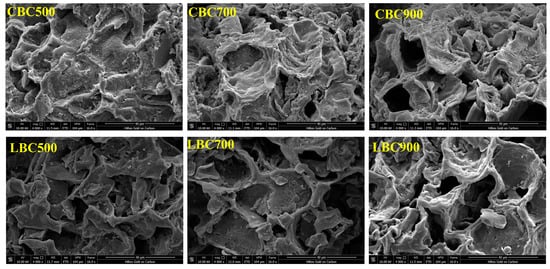
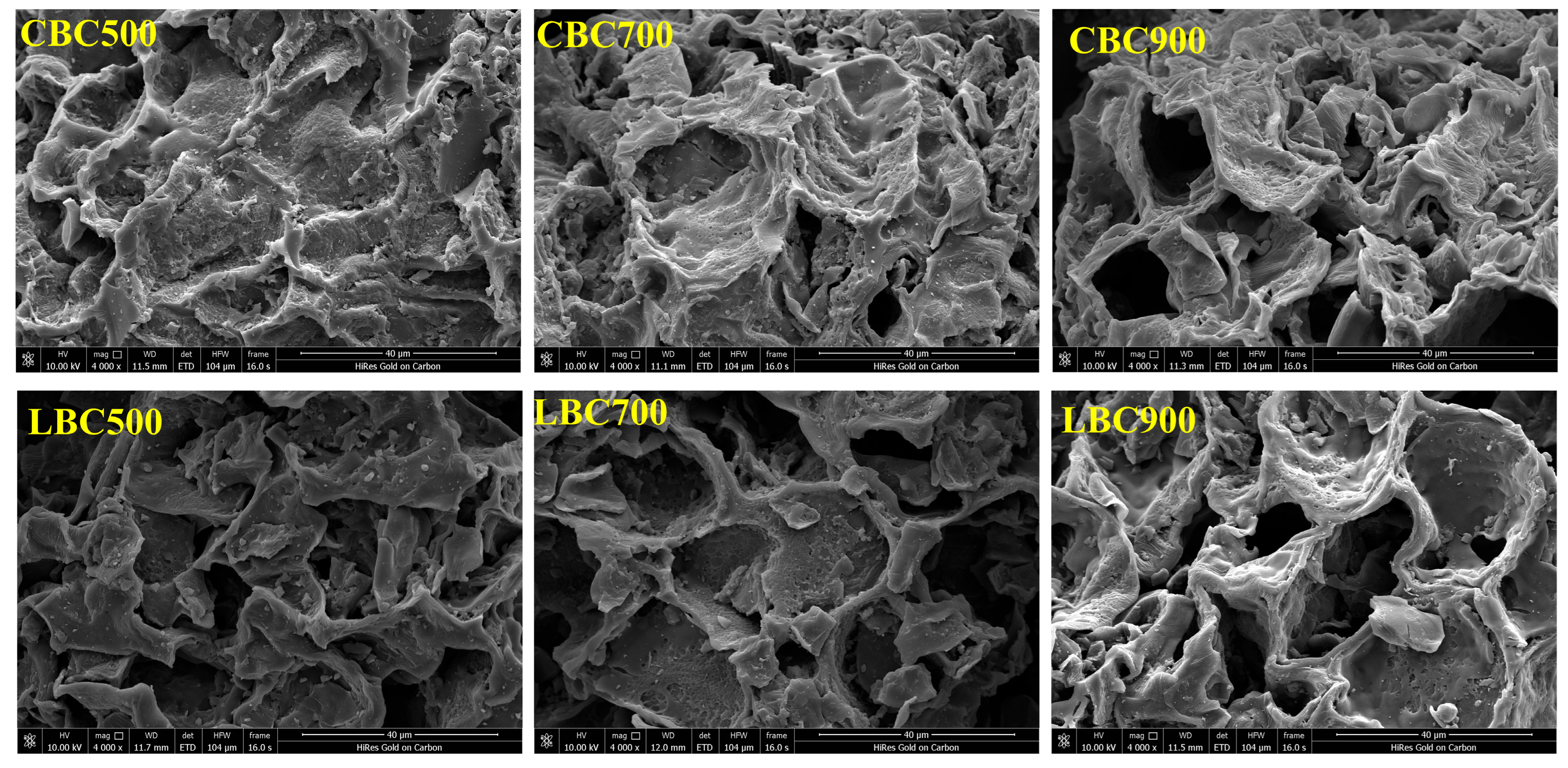
SEM observations highlighted that the porous structure of biochars pyrolyzed under distinct conditions underwent different structural evolution as temperature elevated (Figure 1). For CBC samples, the surface became progressively rougher and more porous as the temperature increased, with CBC900 exhibiting a highly developed pore network and abundant wrinkled structures. This is primarily attributed to the Boudouard reaction that occurs at temperatures exceeding 750 °C, which significantly promotes pore propagation via carbon gasification [57]. The enhanced porous structure of CBC900 is expected to increase the accessibility of adsorption sites and facilitate the diffusion of SAs molecules into the carbon framework. In comparison, while the LBC series also shows an increase in porosity with rising temperature, its structural characteristics differ significantly from those of the CBC series. At 500 and 700 °C, LBC exhibits relatively more developed pores than CBC prepared at the same temperature, suggesting that LBC favored initial pore formation during biomass carbonization. However, at 900 °C, LBC900 showed a less pronounced porous structure and a smoother surface morphology compared with CBC900. The limited pore development of CBC may result from the absence of gasification-induced activation, while excessive thermal treatment could promote structural rearrangement and partial pore blockage caused by condensed carbonaceous species. Therefore, the SEM observations suggest that CO2 activation becomes increasingly important for maintaining and expanding pore structures at elevated temperatures.
Figure 1.
SEM micrographs of biochars prepared under different pyrolysis conditions.
3.1.2. SSA and Pore Volume
The SSA and porosity of biochars were strongly dependent on both pyrolysis temperature and reaction conditions (Table S2). At 500 and 700 °C, LBC exhibited higher SSA and total pore volume (Vtotal) than CBC, suggesting that the LBC condition promoted the initial formation of porous structures during biomass carbonization. However, this trend was reversed at 900 °C. The SSA and Vtotal of CBC900 reached 1025 m2·g−1 and 0.558 cm3·g−1, respectively, which were substantially higher than those of LBC900 (436.4 m2·g−1 and 0.227 cm3·g−1). These results demonstrate that the effect of pyrolysis condition on biochar porosity is strongly temperature-dependent. Above approximately 750 °C, CO2 participates in the Boudouard reaction, consuming carbon atoms and generating additional pores through carbon gasification [58]. To verify this transition, CBC prepared at 800 °C (CBC800) was synthesized as an intermediate-temperature sample. Compared with CBC700, CBC800 exhibited a more than threefold increase in SSA and pore volume, accompanied by a micropore proportion of 93%, indicating rapid micropore development during CO2 activation. At 900 °C, this activation effect became even more pronounced, resulting in a dramatic expansion of the pore structure in CBC900. In contrast, LBC showed only limited increases in SSA and pore volume over the same temperature range, suggesting that thermal treatment alone was insufficient to induce comparable pore generation without CO2-mediated gasification.
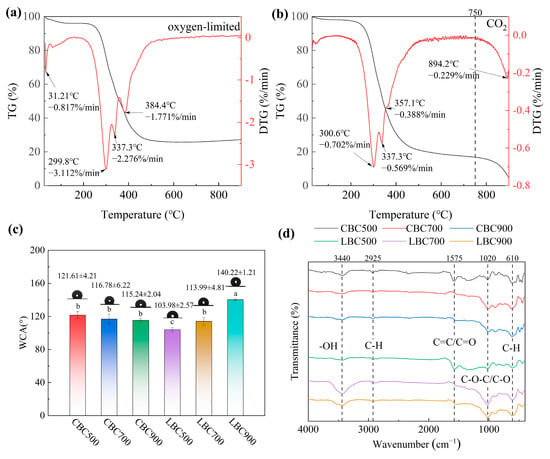
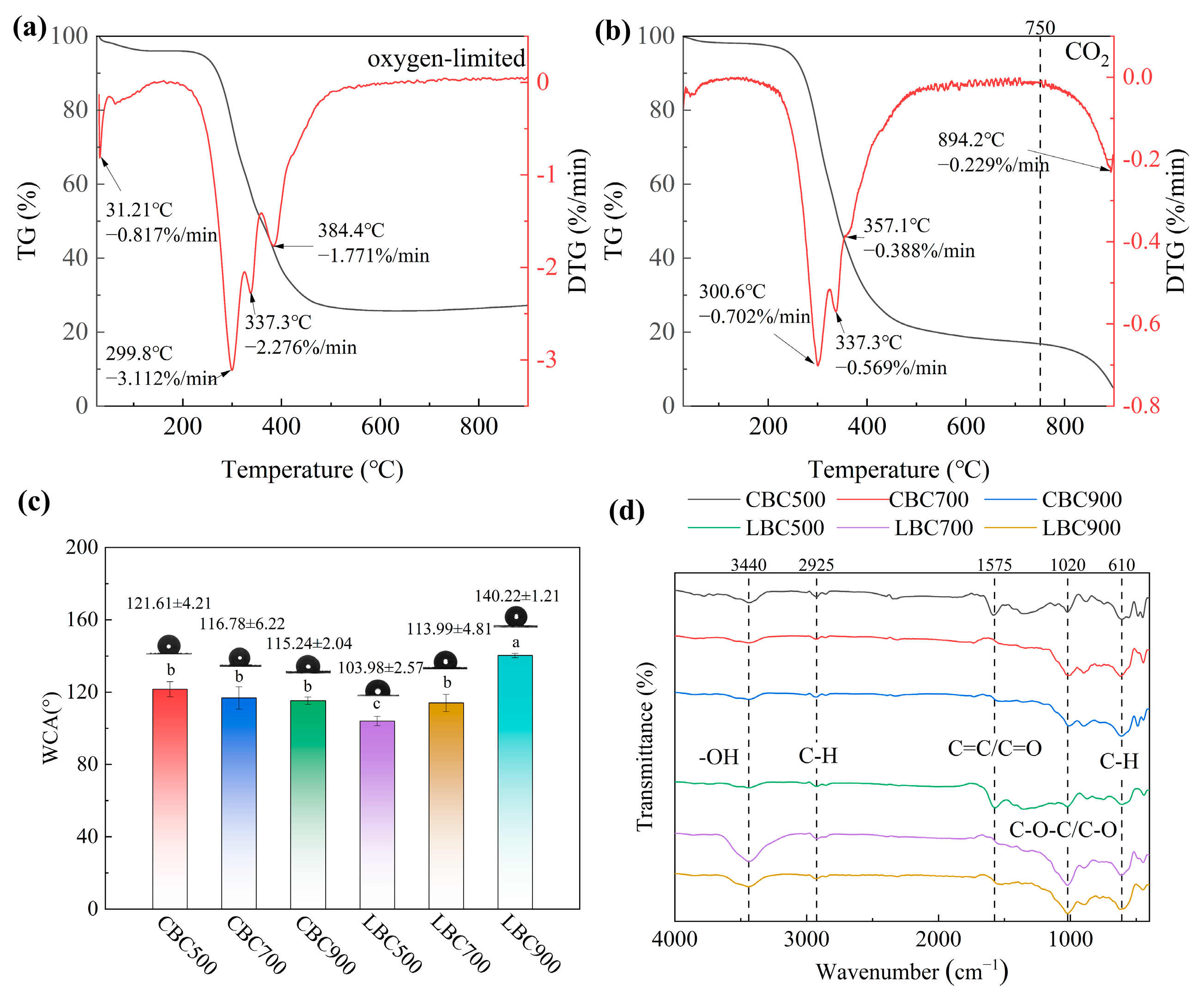
To verify the role of atmosphere during the pyrolysis process, the TG and derivative TG (DTG) curves of SCG under Ar (to simulate the oxygen-limited environment) and CO2 were detected (Figure 2a,b) [59]. During the temperature below 750 °C, the weight-loss trends were generally comparable. However, a distinct difference appeared above approximately 750 °C. Under CO2 conditions, continuous mass loss was observed at elevated temperatures. The DTG profiles further demonstrate the differences in biomass decomposition behavior. Compared with the oxygen-limited atmosphere, CO2 exhibited lower maximum weight-loss rates during the primary devolatilization stage. The combined TG/DTG results demonstrate that the role of CO2 is stage-dependent. It has limited influence during the initial pyrolysis stage but becomes an effective activating agent at high temperatures by inducing carbon gasification, which may further produce more SSA and pore volume at high pyrolysis temperature.
Figure 2.
(a) Thermogravimetric (TG, black line) and derivative thermogravimetric (DTG, red line) curves of spent coffee grounds under oxygen-limited atmosphere; (b) thermogravimetric (TG, black line) and derivative thermogravimetric (DTG, red line) curves of spent coffee grounds under CO2 atmosphere; (c) water contact angle (WCA), with different lowercase letters indicating statistically significant differences (p < 0.05); and (d) FTIR spectra of biochar.
3.1.3. WCA Analysis
The WCA measurements revealed distinct changes in surface hydrophobicity depending on the pyrolysis conditions (Figure 2c). For CBC, the WCA gradually decreased from 121.6° at 500 °C to 115.2° at 900 °C, indicating a slight reduction in hydrophobicity under the CBC condition with the increased temperature. This transition can be attributed to two factors. First, the CO2-induced gasification process generates abundant surface defects and pore structures, which can enhance water penetration through capillary effects [60]. Second, carbon gasification preferentially removes relatively reactive carbon domains, resulting in changes in surface elemental composition and a higher relative contribution of oxygen-containing functionalities, thereby increasing surface polarity [50]. In contrast, LBC exhibited an opposite trend, with the WCA increasing from 103.98° (LBC500) to 140.2° (LBC900) as the pyrolysis temperature increased. The enhanced hydrophobicity of LBC at elevated temperatures is mainly associated with the progressive removal of polar oxygen-containing groups during carbonization, accompanied by increased aromatic condensation and surface carbonization. Consequently, the hydrophobicity of LBC900 is significantly higher than that of CBC900. These results demonstrate that pyrolysis conditions strongly regulate the surface hydrophobicity of biochars.
3.1.4. FTIR Analysis
The FTIR spectra of CBC and LBC exhibited similar overall spectral profiles, indicating comparable types of surface functional groups derived from the original biomass (Figure 2d). A broad band around 3440 cm−1 corresponding to O–H stretching vibrations was observed in all samples, suggesting the presence of hydroxyl-related functionalities on the biochar surfaces [59,61]. With increasing pyrolysis temperature, the absorption band near 2925 cm−1 associated with aliphatic C–H stretching gradually weakened, indicating the progressive decomposition of aliphatic structures during carbonization [59,62]. Meanwhile, the broad band around 1575 cm−1, assigned mainly to aromatic C=C stretching with possible contributions from C=O vibrations, decreased in intensity at higher temperatures [63]. This reduction should not be interpreted simply as the destruction of aromatic structures because the overlapping contribution of oxygen-containing groups, particularly carbonyl species, decreases substantially during thermal treatment [1,63,64]. The structural transformation of the carbon framework will be further discussed based on XPS and Raman analyses. Furthermore, the enhanced intensity of the band near 1020 cm−1 in high-temperature CBC may be associated with the preservation or transformation of oxygen-containing ether structures derived from lignin components [59,65,66].
3.1.5. XPS Analysis
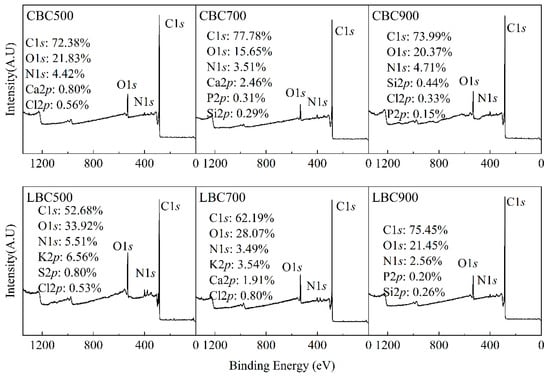
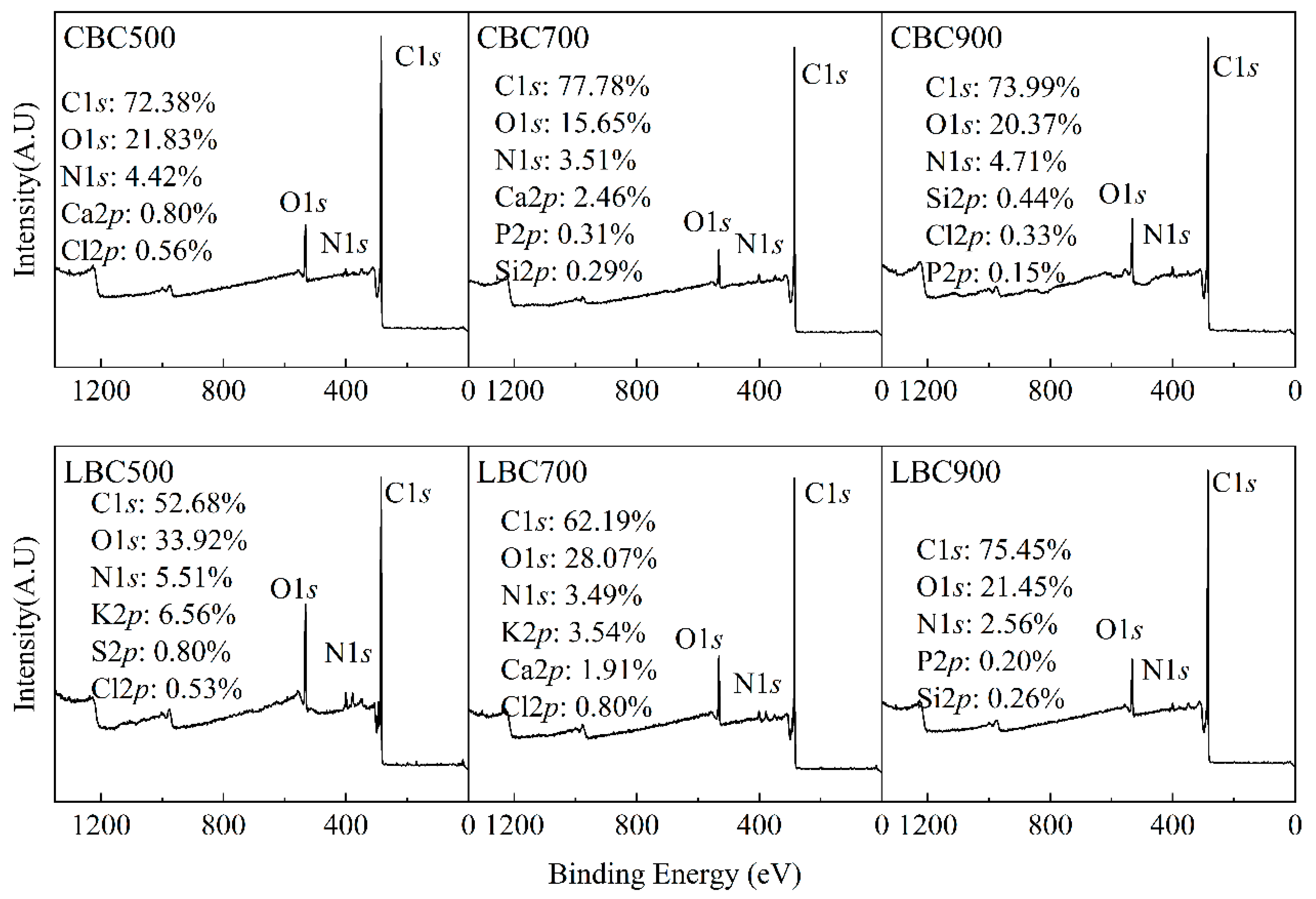
XPS survey scans showed pronounced variations in biochar elemental composition across different pyrolysis conditions (Figure 3). Except for CBC900, increasing pyrolysis temperature generally resulted in increased carbon content accompanied by decreased oxygen and nitrogen contents, which is consistent with progressive deoxygenation and denitrogenation during thermal carbonization. In contrast, CBC900 exhibited an apparent decrease in carbon content and a relative enrichment of oxygen and nitrogen compared with CBC700. It can be attributed to carbon consumption induced by the Boudouard reaction, which promotes pore generation and structural rearrangement of the carbon matrix [50]. Consequently, the remaining carbon framework becomes enriched in more condensed structures, although the total carbon content decreases. The apparent increase in O and N contents may result from the relative enrichment of heteroatoms after preferential carbon removal by CO2 gasification.
Figure 3.
XPS survey spectra of CBC500, CBC700, CBC900, LBC500, LBC700, and LBC900.
The C1s spectra further demonstrated the evolution of carbon bonding configurations (Figure S1). For CBC, the proportion of C–C/C=C species increased from 57.7% at 500 °C to 61.53% at 700 °C, followed by a slight decrease to 59.0% at 900 °C (Figure S1). Meanwhile, oxygen-containing carbon species (C–O/C=O) continuously decreased from 41.84% to 29.23%, indicating progressive removal of oxygenated functionalities during thermal treatment [25]. The slight decline in C–C/C=C proportion at 900 °C does not necessarily indicate reduced carbon ordering because CO2 gasification simultaneously removes carbon from the matrix. Instead, the structural evolution should be considered together with Raman analysis and pore development results. In contrast, the C–C proportion in LBC steadily increased from 64.69% to 73.24% as pyrolysis temperature increased from 500 to 900 °C (Figure S1). The N1s spectra show that the proportion of pyridinic nitrogen in both biochars significantly decreased as temperature rose, suggesting its lower thermal stability during carbonization (Figure S2). Meanwhile, pyrrolic N became increasingly enriched, suggesting the rearrangement of nitrogen species within the aromatic carbon framework. The increased proportion of pyrrolic-N may provide additional hydrogen-bonding sites and facilitate specific interactions with SAs molecules. The O1s spectra showed that CBC retained a relatively higher proportion of hydroxyl-related oxygen species compared with LBC (Figure S3), indicating that pyrolysis condition affected the distribution of oxygen-containing functionalities on biochar surfaces.
3.1.6. Raman Spectroscopic Analysis
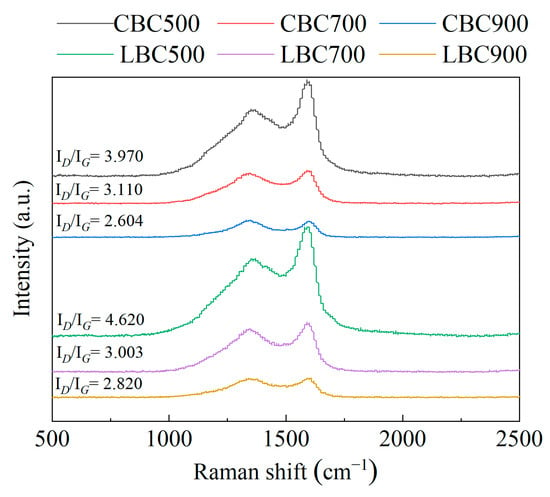
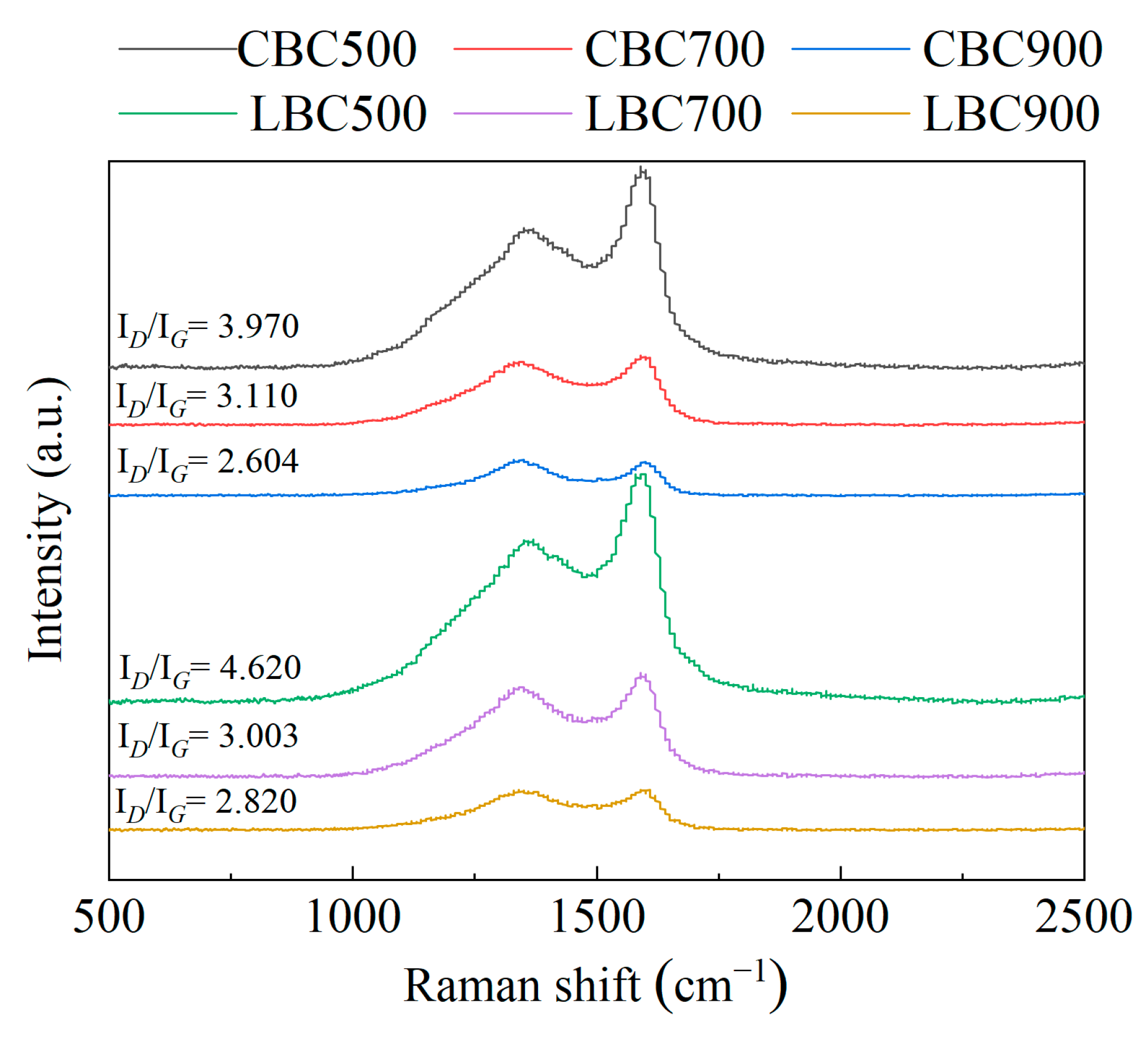
Raman spectroscopy characterized the structural ordering and defect evolution of the biochar carbon skeleton (Figure 4). The D band (~1350 cm−1) corresponds to disordered carbon structures associated with defects, while the G band (~1580 cm−1) represents the in-plane vibration of sp2-hybridized carbon domains. The ID/IG ratio is commonly used to assess the degree of structural disorder in carbon materials, where a lower value generally indicates increased carbon ordering and aromatic condensation [60,67]. The ID/IG ratios of both CBC and LBC decreased progressively with increasing pyrolysis temperature. Specifically, the ID/IG value of CBC decreased from 3.970 at 500 °C to 2.604 at 900 °C, while that of LBC decreased from 4.620 to 2.820. This trend indicates that higher pyrolysis temperatures accelerated carbonization, converting amorphous carbon networks into condensed aromatic rings [25]. Under identical pyrolysis temperatures, CBC exhibited slightly lower ID/IG values than LBC at 500 and 900 °C, whereas the difference became negligible at 700 °C. These results suggest that the CBC condition may promote carbon structural rearrangement at elevated temperatures.
Figure 4.
Raman spectra of the biochar samples.
3.1.7. Yield and Ash Content of Biochars
The yield and ash content of the biochars are summarized in Table S3. For both pyrolysis conditions, biochar yield decreased continuously with increasing temperature, reflecting the progressive release of volatile components and carbon conversion during thermal treatment. It should be noted that CBC and LBC were prepared using different reactor systems: CBC was synthesized in a tube furnace with a gapped-lid crucible under continuous gas purging, while LBC was pyrolyzed in a fully covered crucible within a muffle furnace. Variations in furnace configuration and volatile residence time can alter devolatilization behavior and secondary reactions of volatile matter. When the temperature increased from 700 to 900 °C, the yield of CBC decreased from 24.21% to 14.54%, whereas that of LBC decreased only slightly from 24.84% to 21.38%. This significant difference indicates that CO2 promoted additional carbon consumption at elevated temperatures through gasification reactions, consistent with the enhanced pore development observed in BET analysis. At 500–700 °C, the yield variations in CBC and LBC were relatively comparable, suggesting that biomass devolatilization rather than atmosphere-induced carbon activation dominated the early pyrolysis stage. Therefore, the distinct yield loss of CBC only became evident when the temperature was sufficiently high for CO2 to participate in carbon gasification.
Opposite to the trend in yield, ash fraction in both biochars rose progressively at higher pyrolysis temperatures. This increase was particularly evident for CBC, where carbon removal by CO2 gasification resulted in the relative concentration of inorganic mineral components within the remaining solid phase [50]. To confirm that this increase stems from relative enrichment, the feedstock-normalized ash mass (yield × ash content) was calculated. The values were 0.753 wt%, 0.804 wt% and 0.833 wt% for CBC500, CBC700 and CBC900, respectively. The nearly constant ash mass on a feedstock basis shows that inherent inorganic constituents from raw coffee grounds were largely preserved, and continuous carbon loss concentrated minerals in the residual solid. Ash content alone cannot identify whether these minerals contribute to sulfonamide adsorption. Minerals may affect adsorption via pH variation induced by mineral dissolution or direct surface binding of sulfonamides [68]. Previous studies show mineral effects on sulfonamide adsorption are system-dependent, and isolated ash fractions display limited adsorption capacity [69]. Overall, such findings highlight an inherent compromise between structural development and yield retention: high-temperature CO2 treatment sacrifices part of the carbon mass but generates a highly porous carbon framework favorable for adsorption applications.
3.2. Adsorption Performance and Mechanisms
3.2.1. Adsorption Isotherms
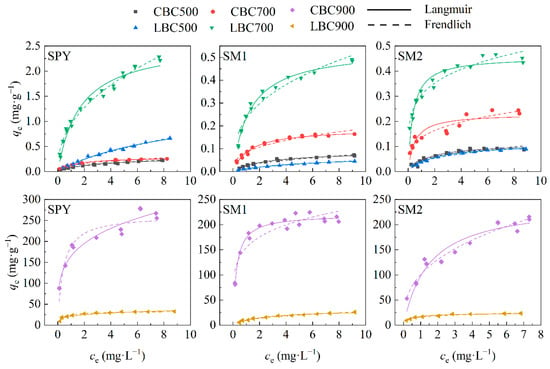
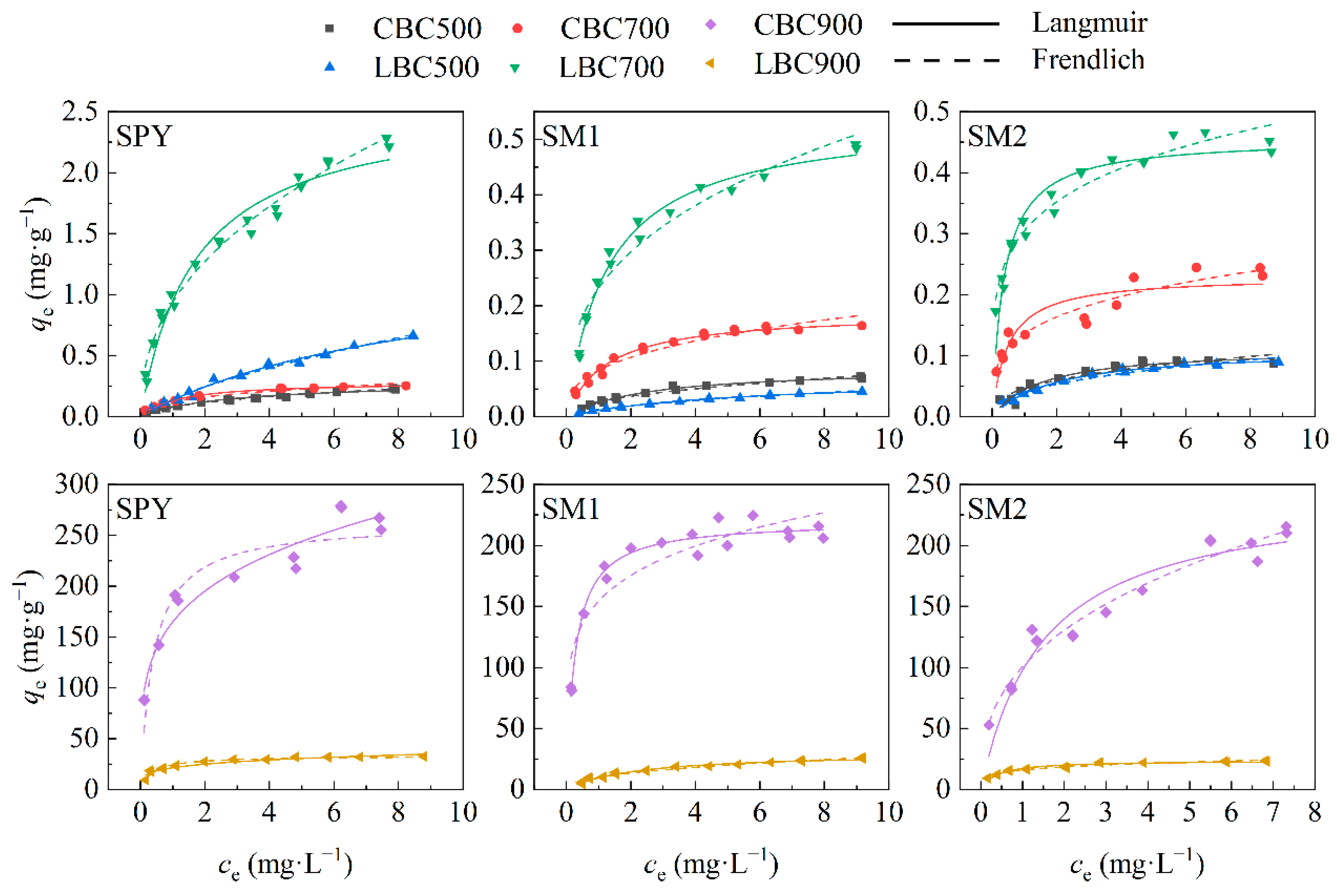
The adsorption isotherms of SAs on the biochars are presented in Figure 5. For all biochars, the adsorption performance increased continuously along with the elevation of initial SAs concentration and eventually approached a plateau. For biochars prepared under the same atmosphere, the adsorption capacity for a specific SA increased with rising pyrolysis temperature. At 500 °C, CBC and LBC exhibited comparable adsorption performance, suggesting that the difference in preparation atmosphere had a limited influence on adsorption at relatively low temperatures. At 700 °C, LBC showed slightly higher adsorption capacity than CBC, which was consistent with its larger surface area at this temperature (Table S2). However, when the temperature increased to 900 °C, CBC displayed a remarkable enhancement in adsorption capacity and substantially outperformed LBC.
Figure 5.
Adsorption isotherms of SAs onto the biochars.
Equilibrium isotherms were fitted via Langmuir and Freundlich models (Table S4). Both models provided acceptable fitting results. The maximum adsorption capacity indicated with Langmuir fitting results by CBC900 were 262.7, 220.1, and 244.5 mg·g−1 for SPY, SM1, and SM2, respectively, which is much larger than that by LBC900 (33.31, 30.42, and 23.86 mg·g−1 for SPY, SM1, and SM2, respectively) or that by CBC700 (0.2866, 0.1882, 0.2297 mg·g−1 for SPY, SM1, and SM2, respectively) (Table S4). The adsorption of SPY and SM2 was better described by the Freundlich model, suggesting heterogeneous adsorption sites and possible multilayer adsorption characteristics. In contrast, SM1 showed a relatively better fit with the Langmuir model, implying a more dominant monolayer adsorption behavior [70,71]. Although the Freundlich model yielded a better fit for most adsorption systems in this study, the Freundlich constant KF is an empirical parameter coupled with 1/n and is not suitable for quantitative comparison of adsorption capacity. Therefore, Langmuir Qm was adopted for subsequent performance comparison across different biochar samples and literature data. The adsorption performance of the prepared biochar was further compared with previously reported spent coffee grounds or other biochar that had not undergone extra activation, as shown in Table S5. Overall, the CBC900 developed in this work exhibits superior adsorption capacity toward the studied SAs compared with most unactivated spent coffee grounds or other biochars under similar pyrolysis conditions. Notably, this superior performance is maintained even when accounting for the loss of biochar yield at high temperature. The yield of CBC dropped from 24.21% (CBC700) to 14.54% (CBC900), requiring a 1.67-fold increase in carbon-normalized adsorption capacity to match CBC700 on a raw-feedstock basis (Table S3). The measured adsorption capacity of CBC900 far exceeds this critical threshold for all tested SAs, confirming its advantage in raw material utilization.
3.2.2. Relationship Between Adsorption and Biochar Properties
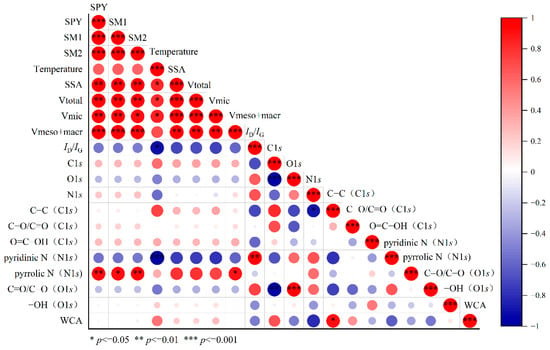
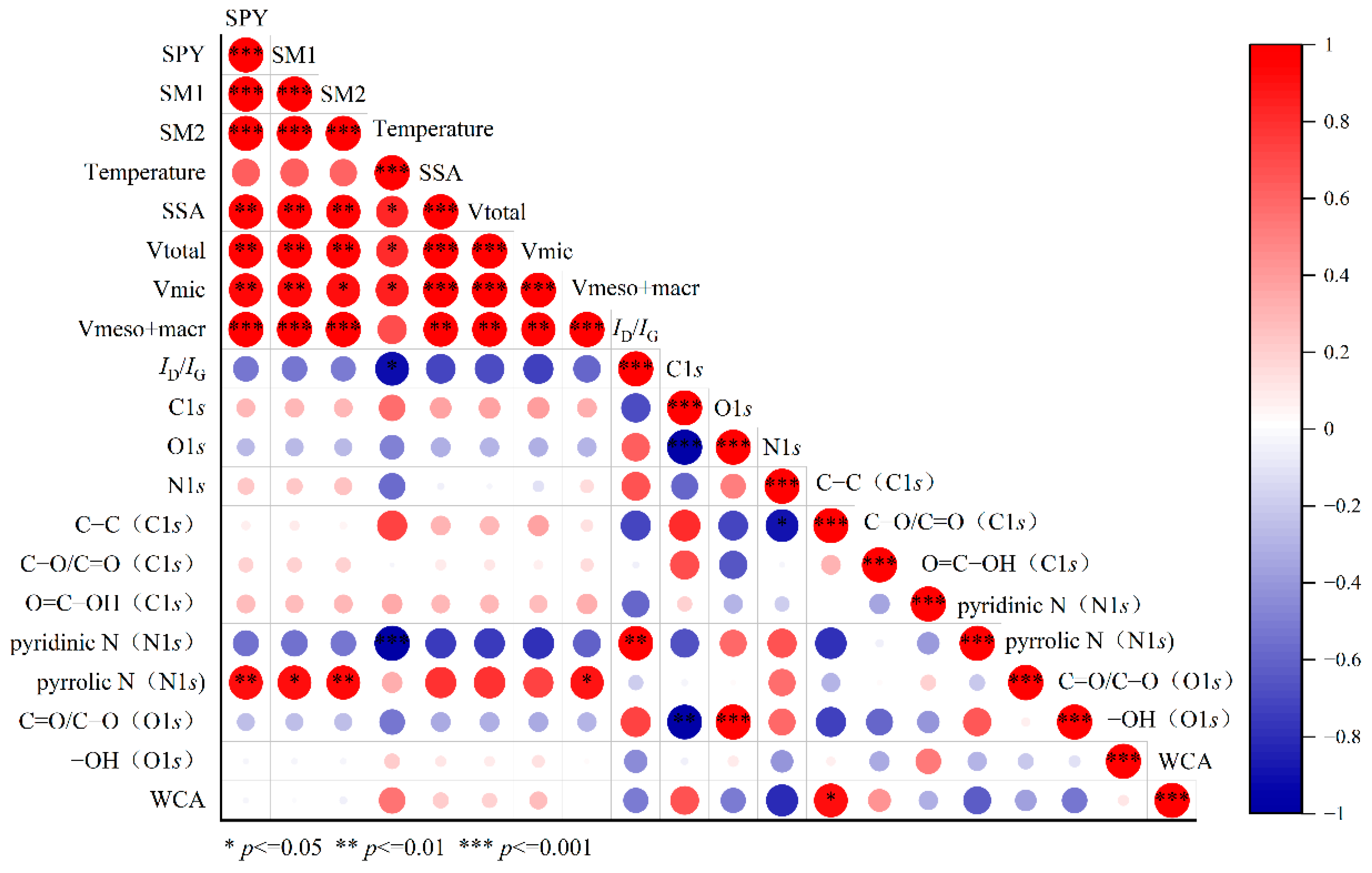
The differences in SA adsorption between the two biochar preparation routes varied with pyrolysis temperature (Figure 5). Pearson correlation analysis was applied to explore associations between biochar properties and the Langmuir-estimated maximum adsorption capacity (Qm) of the three SAs (Figure 6). In the full dataset, Qm was positively correlated with SSA, total pore volume, micropore volume, medium-large pore volume, and pyrrolic N content (p < 0.05). The correlations between ID/IG ratio and Qm were weakly negative and statistically non-significant. The correlations of ID/IG ratio with SSA and pore volume were negative and statistically non-significant. A non-significant negative correlation between ID/IG ratio and SSA or pore volume was observed, as well as a non-significant positive correlation between pyrrolic-N and SSA, total pore volume, or micropore volume. However, a significant correlation between medium-large pore volume and pyrrolic-N content was observed (p < 0.05).
Figure 6.
Pearson correlation heatmap between the Langmuir maximum adsorption capacity (Qm) of SAs and the physicochemical properties and pyrolysis temperatures of biochars.
To assess the influence of CBC900, the Pearson correlation coefficients were recalculated after omitting this sample (Figure S4 and Table S6). After CBC900 was omitted, the positive correlations of Qm with SSA, total pore volume and micropore volume remained statistically significant, whereas those with medium-large pore volume no longer reached statistical significance for SM1 or SM2. The correlations with pyrrolic N content and Qm changed from statistically significant positive values to non-significant negative values. Thus, the positive associations observed in the full dataset were sensitive to the inclusion of CBC900. Previous studies have proposed that π–π interactions between aromatic carbon domains and the aromatic rings of sulfonamides may contribute to adsorption [72,73]. In this study, the weak negative correlations between ID/IG ratio and Qm changed little after CBC900 was omitted and did not reach statistical significance in either analysis. These correlations alone are insufficient to assess the contribution of π–π stacking.
From CBC700 to CBC900, SSA and pore volume increased by approximately 13-fold (Table S2), whereas the Langmuir-estimated Qm values increased by more than three orders of magnitude (Table S4). The larger SSA and more developed pore structure of CBC900 may have contributed to its higher SA uptake. The association between micropore volume and Qm in both analyses is consistent with a possible role for micropore filling. When pore widths are comparable to the dimensions of the adsorbate molecules, adsorption potentials from opposing pore walls can overlap and favor adsorption [74,75].
Nitrogen-containing sites on carbon surfaces have been proposed as potential participants in hydrogen bonding with organic adsorbates [76]. To explore how SAs might bind to nitrogen-containing sites, DFT calculations were applied to compare the adsorption energies and optimized geometries of SAs on carbon models containing pyrrolic or pyridinic N (Figures S5–S7). The calculation method is listed in Text S2. The electrostatic potential maps identified electron-rich sulfonyl oxygen atoms and regions of positive potential around certain hydrogen atoms as potential sites for intermolecular interactions (Figure S5). In the SA–H orientation, all three SAs exhibited more negative calculated adsorption energies on the pyridinic N model than on the pyrrolic N model. Among the configurations examined, the lowest-energy structures for SM1 and SM2 were obtained on the pyrrolic N model in the SA–O orientation, whereas SPY favored the pyridinic N model in the SA–H orientation (Figure S7). In the SA–O configurations, hydrogen bonding between the pyrrolic N–H group and a sulfonyl oxygen atom may contribute to the favorable binding of SM1 and SM2. These calculations suggest that the preferred binding site and orientation varied among the three SAs in the model systems.
3.2.3. Influence of Antibiotic Physicochemical Properties on Adsorption
Besides biochar properties, the physicochemical characteristics of SAs molecules also influenced their adsorption behavior. For most biochars, the Langmuir-estimated Qm followed the order of SPY > SM2 > SM1. For LBC700 and LBC900, the order was SPY > SM1 > SM2 (Table S4). The predominant order was consistent with the ranking of the compounds by logKow values (Table S7), suggesting that molecular hydrophobicity may partly explain the differences in uptake. The reversal of the SM1 and SM2 order on LBC700 and LBC900 indicates that their relative uptake also depended on the biochar. Differences in heterocyclic structure may influence how the sulfonamides access narrow pores. SPY contains an unsubstituted pyridine ring, whereas SM1 and SM2 contain methyl-substituted pyrimidine rings. These structural differences may affect how the molecules orient at pore entrances and enter narrow micropores [36,77]. Previous studies have also reported that differences in molecular properties can affect sulfonamide adsorption [78]. For SM1, the estimated Qm was substantially higher on CBC900 than on LBC900, although CBC900 had a lower water contact angle (Figure 2c). The larger SSA and more developed pore structure of CBC900 may have contributed to this difference. Together, these results suggest that molecular properties help explain the uptake order within a given biochar, while differences in biochar properties can alter both the magnitude and the order of uptake.
3.3. Effects of Solution pH and Coexisting Ions on Adsorption Performance
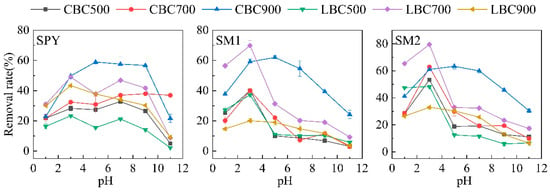
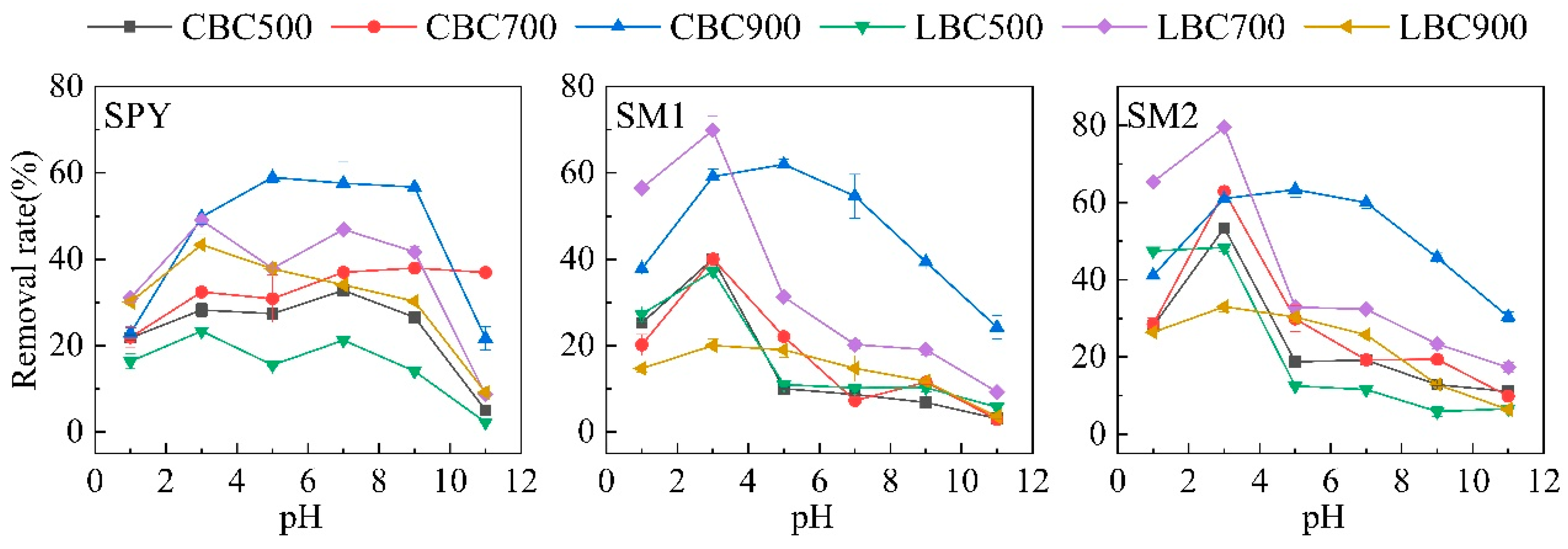
As the adsorption capacity difference in various biochars is substantial, to better compare the influence of solution pH on the adsorption performance, the mass of the biochar applied here for CBC900 and LBC900 is different from other biochars. The adsorption performance of biochars was strongly influenced by solution pH (Figure 7), with relatively lower adsorption under strongly acidic (pH 1) and alkaline conditions (pH 11) [79]. Zeta potential analysis showed that biochar surfaces became positively charged at pH 1 and negatively charged under alkaline conditions (Figure S8). Meanwhile, the ionization state of SAs also varies under different pH environments (Table S7). Under strongly acidic conditions, protonated SA species and positively charged biochar surfaces generated electrostatic repulsion, thereby reducing adsorption efficiency. Conversely, under alkaline conditions, deprotonated SA species and negatively charged biochar surfaces also caused electrostatic repulsion, resulting in suppressed adsorption. Most biochars exhibited optimal adsorption performance around mildly acidic conditions (pH 3), where SAs mainly existed in less charged forms and electrostatic interference was minimized [80]. In addition, partial dissolution of mineral components under acidic conditions may expose additional adsorption sites, although this effect is expected to be secondary compared with pore structure and surface interactions [81,82]. Notably, CBC900 maintained relatively stable adsorption performance over a wider pH range, indicating enhanced tolerance toward changes in solution chemistry.
Figure 7.
Effects of initial solution pH on the adsorption of SAs by biochars.
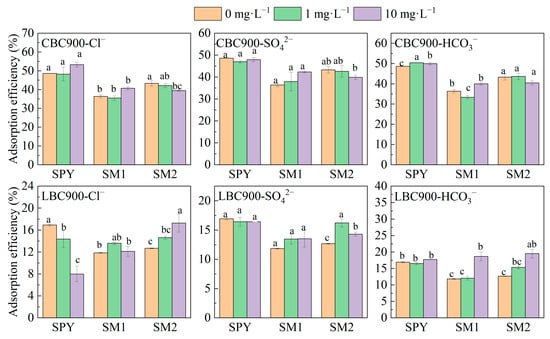
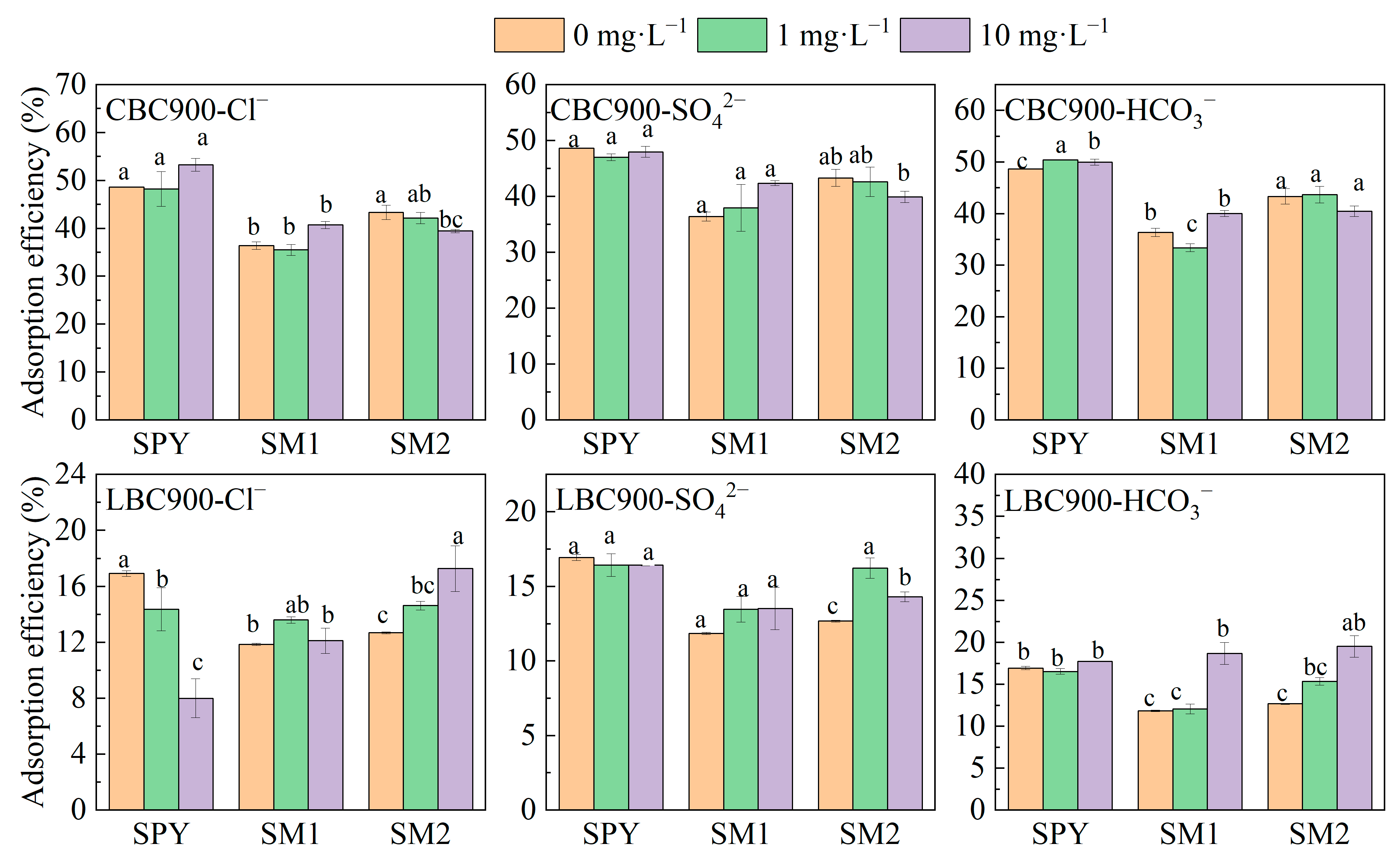
The effects of coexisting anions on SA adsorption were further evaluated to assess the environmental stability of the two biochars (LBC900 and CBC900) with relative high adsorption performance (Figure 8). At relatively low anion concentrations (1 mg·L−1), negligible changes were observed, indicating limited interference under dilute ionic conditions. When the concentration increased to 10 mg·L−1, certain anions influenced SA adsorption, particularly for LBC900. The adsorption variation may be associated with competition between dissolved anions and SA molecules for surface interaction sites, as well as modification of the interfacial electrostatic environment. In contrast, CBC900 maintained relatively stable adsorption performance regardless of anion type and concentration. The enhanced ionic tolerance of CBC900 can be attributed to its highly developed microporous structure and abundant adsorption sites, which reduce the sensitivity of adsorption performance to external ionic fluctuations. These findings suggest that CO2-activated biochar possesses improved stability under complex aqueous conditions.
Figure 8.
Influence of ionic concentrations on the adsorption of SAs by biochars, with different lowercase letters indicating statistically significant differences (p < 0.05).
4. Conclusions
This study compared the physicochemical properties and SA adsorption performance of SCG-derived biochars prepared at 500, 700, and 900 °C in a muffle furnace without external gas purging (LBC) or under continuous CO2 flow in a tube furnace (CBC). At 500 and 700 °C, LBC favored the development of accessible pore structures and preservation of oxygen-containing functional groups, resulting in slightly higher adsorption performance than CBC. However, at 900 °C, CBC900 achieved the maximum adsorption capacities of 262.7 mg g−1 for SPY, 220.1 mg g−1 for SM1, and 244.5 mg g−1 for SM2, all superior to those of LBC900. CBC900 had the highest SSA (1025 m2 g−1) and total pore volume (0.5583 cm3 g−1) among the tested biochars. The positive correlations of adsorption capacity with SSA, total pore volume, and micropore volume remained statistically significant after CBC900 was excluded from the correlation analysis. Furthermore, CBC900 exhibited improved resistance toward variations in solution pH and coexisting ions, indicating its potential for application in SA removal under varying aqueous environments. Overall, this study demonstrates that high-temperature continuous gas-flow pyrolysis provides an effective strategy for tailoring biochar structures and improving antibiotic adsorption performance. Nevertheless, elevated pyrolysis temperature inevitably brings concerns including increased energy consumption and reduced biochar yield. Future studies should focus on optimizing preparation conditions to balance carbon yield, energy consumption, and adsorption efficiency for sustainable water treatment applications.
Supplementary Materials
The following supporting information can be downloaded at https://www.mdpi.com/article/10.3390/separations13120354/s1, Text S1: Detailed instrument information and measurement parameters for characterizations; Text S2: Method of Density functional theory calculations; Figure S1: High-resolution C1s spectra of biochar; Figure S2: High-resolution N1s spectra of biochar; Figure S3: High-resolution O1s spectra of biochar; Figure S4: Correlation heatmap of biochar properties and SA adsorption capacity after excluding CBC900; Figure S5: Electrostatic potentials of sulfapyridine, sulfamethazine, and sulfadimethoxine; Figure S6: Electrostatic potential of simulated biochar within pyridinic N and pyrrolic N; Figure S7: Adsorption of SAs by simulated biochar within pyridinic N and pyrrolic N; Figure S8: Zeta potentials of the raw biochars; Table S1: Solid-to-liquid ratios applied in adsorption experiment; Table S2: Specific surface area and pore structure parameters of the biochars; Table S3: Yields and ash contents of the biochar samples; Table S4: Fitting parameters of adsorption isotherms for SAs onto the biochars; Table S5: Adsorption performance comparison of raw biochars toward organic pollutants; Table S6: Pearson correlation coefficients (r) and p-values between key physicochemical parameters and Langmuir maximum adsorption capacity (Qm) of SPY, SM1 and SM2; Table S7: Physicochemical properties of the three SAs. References [29,60,68,83,84,85,86,87,88,89,90,91,92,93,94,95,96,97] are cited in the Supplementary Materials.
Author Contributions
Conceptualization, W.L. and X.Y.; methodology, W.L. and X.Y.; software, W.L. and B.L.; validation, W.L. and X.S.; formal analysis, X.S.; investigation, W.L. and X.Y.; resources, W.L. and X.Y.; data curation, W.L. and X.Y.; writing—original draft preparation, W.L.; writing—review and editing, B.L. and X.S.; visualization, W.L.; supervision, B.L. and X.S.; project administration, X.S.; funding acquisition, X.S. All authors have read and agreed to the published version of the manuscript.
Funding
This research was funded by the National Natural Science Foundation of China, grant number 41701545.
Data Availability Statement
The raw data supporting the conclusions of this article will be made available by the authors on request.
Acknowledgments
During the preparation of this manuscript, the authors used Gemini 3 Pro for the purposes of visual presentation of the Graphical Abstract. The authors have reviewed and edited the output and take full responsibility for the content of this publication.
Conflicts of Interest
The authors declare no conflicts of interest.
Abbreviations
The following abbreviations are used in this manuscript:
| SAs | Sulfonamide antibiotics |
| SPY | Sulfapyridine |
| SM1 | Sulfamerazine |
| SM2 | Sulfamethazine |
| LBC | Biochars prepared in an oxygen-limited atmosphere |
| LBC500 | Biochars prepared in an oxygen-limited atmosphere at 500 °C |
| LBC700 | Biochars prepared in an oxygen-limited atmosphere at 700 °C |
| LBC900 | Biochars prepared in an oxygen-limited atmosphere at 900 °C |
| CBC | Biochars prepared in a CO2 atmosphere |
| CBC500 | Biochars prepared in a CO2 atmosphere at 500 °C |
| CBC700 | Biochars prepared in a CO2 atmosphere at 700 °C |
| CBC800 | Biochars prepared in a CO2 atmosphere at 800 °C |
| CBC900 | Biochars prepared in a CO2 atmosphere at 900 °C |
| SCG | Spent coffee grounds |
| SEM | Scanning electron microscopy |
| SSA | Specific surface area |
| WCA | Water contact angle |
| FTIR | Fourier-transform infrared spectroscopy |
| XPS | X ray photoelectron spectroscopy |
| TG | Thermogravimetric |
| DTG | Derivative thermogravimetric |
| HPLC | High-performance liquid chromatography |
References
- Peng, T.; Song, B.; Wang, Y.; Yuan, J.; Yang, Z.; Tang, L. Trophic transfer of sulfonamide antibiotics in aquatic food chains: A comprehensive review with a focus on environmental health risks. Environ. Pollut. 2025, 369, 125823. [Google Scholar] [CrossRef] [Scilit] [PubMed]
- Mai, Z.; Xiong, X.; Hu, H.; Jia, J.; Wu, C.; Wang, G. Occurrence, distribution, and ecological risks of antibiotics in Honghu Lake and surrounding aquaculture ponds, China. Environ. Sci. Pollut. Res. 2023, 30, 50732–50742. [Google Scholar] [CrossRef] [Scilit] [PubMed]
- Zhou, L.; Li, S.; Li, F. Damage and elimination of soil and water antibiotic and heavy metal pollution caused by livestock husbandry. Environ. Res. 2022, 215, 114188. [Google Scholar] [CrossRef] [Scilit] [PubMed]
- Lewis, K. The Science of Antibiotic Discovery. Cell 2020, 181, 29–45. [Google Scholar] [CrossRef] [Scilit] [PubMed]
- Baran, W.; Adamek, E.; Ziemiańska, J.; Sobczak, A. Effects of the presence of sulfonamides in the environment and their influence on human health. J. Hazard. Mater. 2011, 196, 1–15. [Google Scholar] [CrossRef] [Scilit] [PubMed]
- He, Y.; Wang, S.; Li, H.; Han, Z.; Liu, X.; Meng, Q.; Li, J. Adsorption of sulfonamide antibiotics by phosphoric acid-activated passion fruit peel biochar and its plasma regeneration. J. Water Process Eng. 2026, 91, 110570. [Google Scholar] [CrossRef] [Scilit]
- Yi, C.; Shang, J.; Shen, Z.; Sun, Y.; Yang, Y.; Zheng, X.; Peng, Z.; Chen, J.; Liu, Y.; Guo, R.; et al. Distribution and risk characteristics of antibiotics in China surface water from 2013 to 2024. Chemosphere 2025, 375, 144197. [Google Scholar] [CrossRef] [Scilit] [PubMed]
- Białk-Bielińska, A.; Caban, M.; Pieczyńska, A.; Stepnowski, P.; Stolte, S. Mixture toxicity of six sulfonamides and their two transformation products to green algae Scenedesmus vacuolatus and duckweed Lemna minor. Chemosphere 2017, 173, 542–550. [Google Scholar] [CrossRef] [Scilit] [PubMed]
- Yan, Z.; Yang, Q.; Jiang, W.; Lu, J.; Xiang, Z.; Guo, R.; Chen, J. Integrated toxic evaluation of sulfamethazine on zebrafish: Including two lifespan stages (embryo-larval and adult) and three exposure periods (exposure, post-exposure and re-exposure). Chemosphere 2018, 195, 784–792. [Google Scholar] [CrossRef] [Scilit] [PubMed]
- Limbu, S.M.; Zhou, L.; Sun, S.-X.; Zhang, M.-L.; Du, Z.-Y. Chronic exposure to low environmental concentrations and legal aquaculture doses of antibiotics cause systemic adverse effects in Nile tilapia and provoke differential human health risk. Environ. Int. 2018, 115, 205–219. [Google Scholar] [CrossRef] [Scilit] [PubMed]
- Lin, T.; Yu, S.; Chen, Y.; Chen, W. Integrated biomarker responses in zebrafish exposed to sulfonamides. Environ. Toxicol. Pharmacol. 2014, 38, 444–452. [Google Scholar] [CrossRef] [Scilit] [PubMed]
- Ribeiro, C.F.A.; Silveira, G.G.D.O.S.; Cândido, E.D.S.; Cardoso, M.H.; Espínola Carvalho, C.M.; Franco, O.L. Effects of Antibiotic Treatment on Gut Microbiota and How to Overcome Its Negative Impacts on Human Health. ACS Infect. Dis. 2020, 6, 2544–2559. [Google Scholar] [CrossRef] [Scilit] [PubMed]
- Zhang, C.; Chen, Y.; Chen, S.; Guan, X.; Zhong, Y.; Yang, Q. Occurrence, risk assessment, and in vitro and in vivo toxicity of antibiotics in surface water in China. Ecotoxicol. Environ. Saf. 2023, 255, 114817. [Google Scholar] [CrossRef] [Scilit] [PubMed]
- Kim, H.; Kim, J.; Kim, M.; Hyun, S.; Moon, D.H. Sorption of sulfathiazole in the soil treated with giant Miscanthus-derived biochar: Effect of biochar pyrolysis temperature, soil pH, and aging period. Environ. Sci. Pollut. Res. 2017, 25, 25681–25689. [Google Scholar] [CrossRef] [Scilit] [PubMed]
- Zimmermann, P.; Curtis, N. The effect of antibiotics on the composition of the intestinal microbiota—A systematic review. J. Infect. 2019, 79, 471–489. [Google Scholar] [CrossRef] [Scilit] [PubMed]
- Zhang, J.; Zhang, X.; Hu, T.; Xu, X.; Zhao, D.; Wang, X.; Li, L.; Yuan, X.; Song, C.; Zhao, S. Polycyclic aromatic hydrocarbons (PAHs) and antibiotics in oil-contaminated aquaculture areas: Bioaccumulation, influencing factors, and human health risks. J. Hazard. Mater. 2022, 437, 129365. [Google Scholar] [CrossRef] [Scilit] [PubMed]
- Zhao, Y.; He, J.; Pang, H.; Li, L.; Cui, X.; Liu, Y.; Jiang, W.; Liu, X. Anaerobic digestion and biochar/hydrochar enhancement of antibiotic-containing wastewater: Current situation, mechanism and future prospects. Environ. Res. 2025, 264, 120087. [Google Scholar] [CrossRef] [Scilit] [PubMed]
- Yu, F.; Li, Y.; Han, S.; Ma, J. Adsorptive removal of antibiotics from aqueous solution using carbon materials. Chemosphere 2016, 153, 365–385. [Google Scholar] [CrossRef] [Scilit] [PubMed]
- Xiang, Y.; Xu, Z.; Wei, Y.; Zhou, Y.; Yang, X.; Yang, Y.; Yang, J.; Zhang, J.; Luo, L.; Zhou, Z. Carbon-based materials as adsorbent for antibiotics removal: Mechanisms and influencing factors. J. Environ. Manag. 2019, 237, 128–138. [Google Scholar] [CrossRef] [Scilit] [PubMed]
- Ahmed, I.; Lee, H.J.; Jhung, S.H. Covalent-organic polymer-derived carbons: An effective adsorbent to remove sulfonamide antibiotics from water. Chem. Eng. J. 2022, 437, 135386. [Google Scholar] [CrossRef] [Scilit]
- Krasucka, P.; Pan, B.; Ok, Y.S.; Mohan, D.; Sarkar, B.; Oleszczuk, P. Engineered biochar—A sustainable solution for the removal of antibiotics from water. Chem. Eng. J. 2021, 405, 126926. [Google Scholar] [CrossRef] [Scilit]
- Ahmad, M.; Rajapaksha, A.U.; Lim, J.E.; Zhang, M.; Bolan, N.; Mohan, D.; Vithanage, M.; Lee, S.S.; Ok, Y.S. Biochar as a sorbent for contaminant management in soil and water: A review. Chemosphere 2014, 99, 19–33. [Google Scholar] [CrossRef] [Scilit] [PubMed]
- Xue, Y.; Gao, B.; Yao, Y.; Inyang, M.; Zhang, M.; Zimmerman, A.R.; Ro, K.S. Hydrogen peroxide modification enhances the ability of biochar (hydrochar) produced from hydrothermal carbonization of peanut hull to remove aqueous heavy metals: Batch and column tests. Chem. Eng. J. 2012, 200–202, 673–680. [Google Scholar] [CrossRef] [Scilit]
- Zhang, J.B.; Dai, C.; Wang, Z.; You, X.; Duan, Y.; Lai, X.; Fu, R.; Zhang, Y.; Maimaitijiang, M.; Leong, K.H.; et al. Resource utilization of rice straw to prepare biochar as peroxymonosulfate activator for naphthalene removal: Performances, mechanisms, environmental impact and applicability in groundwater. Water Res. 2023, 244, 120555. [Google Scholar] [CrossRef] [Scilit] [PubMed]
- Pei, S.; Zhao, Y.; Li, W.; Qu, C.; Ren, Y.; Yang, Y.; Liu, J.; Wu, C. Critical impact of pyrolysis temperatures on biochars for peroxymonosulfate activation: Structural characteristics, degradation performance and mechanism. Chem. Eng. J. 2023, 477, 147274. [Google Scholar] [CrossRef] [Scilit]
- Grimm, A.; dos Reis, G.S.; Khokarale, S.G.; Ekman, S.; Lima, E.C.; Xiong, S.; Hultberg, M. Shiitake spent mushroom substrate as a sustainable feedstock for developing highly efficient nitrogen-doped biochars for treatment of dye-contaminated water. J. Water Process Eng. 2023, 56, 104435. [Google Scholar] [CrossRef] [Scilit]
- Jia, Y.; Ou, Y.; Khanal, S.K.; Sun, L.; Shu, W.-S.; Lu, H. Biochar-based strategies for antibiotics removal: Mechanisms, factors, and application. ACS ES&T Eng. 2024, 4, 1256–1274. [Google Scholar] [CrossRef] [Scilit]
- Sen, U.; Esteves, B.; Aguiar, T.; Pereira, H. Removal of antibiotics by biochars: A critical review. Appl. Sci. 2023, 13, 11963. [Google Scholar] [CrossRef] [Scilit]
- Zhang, X.; Zhang, Y.; Ngo, H.H.; Guo, W.; Wen, H.; Zhang, D.; Li, C.; Qi, L. Characterization and sulfonamide antibiotics adsorption capacity of spent coffee grounds based biochar and hydrochar. Sci. Total Environ. 2020, 716, 137015. [Google Scholar] [CrossRef] [Scilit] [PubMed]
- Jiang, C.; Bo, J.; Xiao, X.; Zhang, S.; Wang, Z.; Yan, G.; Wu, Y.; Wong, C.; He, H. Converting waste lignin into nano-biochar as a renewable substitute of carbon black for reinforcing styrene-butadiene rubber. Waste Manag. 2020, 102, 732–742. [Google Scholar] [CrossRef] [Scilit] [PubMed]
- Lonappan, L.; Rouissi, T.; Brar, S.K.; Verma, M.; Surampalli, R.Y. An insight into the adsorption of diclofenac on different biochars: Mechanisms, surface chemistry, and thermodynamics. Bioresour. Technol. 2018, 249, 386–394. [Google Scholar] [CrossRef] [Scilit] [PubMed]
- Lobos, M.L.N.; Sieben, J.M.; Comignani, V.; Duarte, M.; Volpe, M.A.; Moyano, E.L. Biochar from pyrolysis of cellulose: An alternative catalyst support for the electro-oxidation of methanol. Int. J. Hydrogen Energy 2016, 41, 10695–10706. [Google Scholar] [CrossRef] [Scilit]
- Zhang, X.; Wang, Y.; Cai, J.; Wilson, K.; Lee, A.F. Bio/hydrochar sorbents for environmental remediation. Energy Environ. Mater. 2020, 3, 453–468. [Google Scholar] [CrossRef] [Scilit]
- Madikizela, L.M.; Pakade, V.E. Trends in removal of pharmaceuticals in contaminated water using waste coffee and tea-based materials with their derivatives. Water Environ. Res. 2023, 95, e10857. [Google Scholar] [CrossRef] [Scilit] [PubMed]
- El-Shafie, A.S.; Mahmoud, R.; Ahsan, I.; Hamdi, H.; Shibl, M.F.; El-Azazy, M. Removal of antibiotics from aqueous solutions: Insights of competitive adsorption onto Ni-impregnated biochar of spent coffee grounds. Appl. Water Sci. 2024, 14, 209. [Google Scholar] [CrossRef] [Scilit]
- Wang, J.; Hou, Y.; Li, X.; Zhao, R.; Mu, X.; Liu, Y.; Huang, C.; Fu, F.; Yang, F. Research progress and prospects of modified biochar in the adsorption and degradation of sulfonamide antibiotics. Antibiotics 2026, 15, 268, Correction in Antibiotics 2026, 15, 803. [Google Scholar] [CrossRef] [Scilit] [PubMed]
- Fawzy, S.; Osman, A.I.; Mehta, N.; Moran, D.; Al-Muhtaseb, A.H.; Rooney, D.W. Atmospheric carbon removal via industrial biochar systems: A techno-economic-environmental study. J. Clean. Prod. 2022, 371, 133660. [Google Scholar] [CrossRef] [Scilit]
- Wang, D.; Jiang, P.; Zhang, H.; Yuan, W. Biochar production and applications in agro and forestry systems: A review. Sci. Total Environ. 2020, 723, 137775. [Google Scholar] [CrossRef] [Scilit] [PubMed]
- Zheng, X.; Zhou, Y.; Liu, X.; Fu, X.; Peng, H.; Lv, S. Enhanced adsorption capacity of MgO/N-doped active carbon derived from sugarcane bagasse. Bioresour. Technol. 2020, 297, 122413. [Google Scholar] [CrossRef] [Scilit] [PubMed]
- Yu, O.Y.; Harper, M.; Hoepfl, M.; Domermuth, D. Characterization of biochar and its effects on the water holding capacity of loamy sand soil: Comparison of hemlock biochar and switchblade grass biochar characteristics. Environ. Prog. Sustain. Energy 2017, 36, 1474–1479. [Google Scholar] [CrossRef] [Scilit]
- Ke, Y.; Cui, S.; Fu, Q.; Hough, R.; Zhang, Z.; Li, Y.-F. Effects of pyrolysis temperature and aging treatment on the adsorption of Cd2+ and Zn2+ by coffee grounds biochar. Chemosphere 2022, 296, 134051. [Google Scholar] [CrossRef] [Scilit] [PubMed]
- Ndoun, M.C.; Elliott, H.A.; Preisendanz, H.E.; Williams, C.F.; Knopf, A.; Watson, J.E. Adsorption of pharmaceuticals from aqueous solutions using biochar derived from cotton gin waste and guayule bagasse. Biochar 2020, 3, 89–104. [Google Scholar] [CrossRef] [Scilit]
- Mašek, O.; Buss, W.; Wang, L.; Sun, J.; Wang, X.; Wang, Y.; Skreiberg, Ø. Biochar production under different atmospheres: An overview. Biochar 2026, 8, 129. [Google Scholar] [CrossRef] [Scilit] [PubMed]
- Li, Y.; Xing, B.; Ding, Y.; Han, X.; Wang, S. A critical review of the production and advanced utilization of biochar via selective pyrolysis of lignocellulosic biomass. Bioresour. Technol. 2020, 312, 123614. [Google Scholar] [CrossRef] [Scilit] [PubMed]
- Luo, Q.; Deng, Y.; Li, Y.; He, Q.; Wu, H.; Fang, X. Effects of pyrolysis temperatures on the structural properties of straw biochar and its adsorption of tris-(1-chloro-2-propyl) phosphate. Sci. Rep. 2024, 14, 25711. [Google Scholar] [CrossRef] [Scilit] [PubMed]
- Luo, L.; Xu, C.; Chen, Z.; Zhang, S. Properties of biomass-derived biochars: Combined effects of operating conditions and biomass types. Bioresour. Technol. 2015, 192, 83–89. [Google Scholar] [CrossRef] [Scilit] [PubMed]
- Igalavithana, A.D.; Kim, K.-H.; Jung, J.-M.; Heo, H.-S.; Kwon, E.E.; Tack, F.M.G.; Tsang, D.C.; Jeon, Y.J.; Ok, Y.S. Effect of biochars pyrolyzed in N2 and CO2, and feedstock on microbial community in metal(loid)s contaminated soils. Environ. Int. 2019, 126, 791–801. [Google Scholar] [CrossRef] [Scilit] [PubMed]
- Wang, Z.; Ma, X.; Yao, Z.; Yu, Q.; Wang, Z.; Lin, Y. Study of the pyrolysis of municipal sludge in N2/CO2 atmosphere. Appl. Therm. Eng. 2018, 128, 662–671. [Google Scholar] [CrossRef] [Scilit]
- Bonato, J.L.; Perondi, D.; Manera, C.; Borghetti, M.; Ferreira, S.D.; de Almeida Neuwald, O.; Godinho, M. CO2 adsorption evaluation of different biochars produced from peanut shell pyrolysis. Biomass Convers. Biorefinery 2026, 16, 267. [Google Scholar] [CrossRef] [Scilit]
- Premchand, P.; Demichelis, F.; Chiaramonti, D.; Bensaid, S.; Fino, D. Biochar production from slow pyrolysis of biomass under CO2 atmosphere: A review on the effect of CO2 medium on biochar production, characterisation, and environmental applications. J. Environ. Chem. Eng. 2023, 11, 110009. [Google Scholar] [CrossRef] [Scilit]
- Zhang, C.; Shan, B.; Tang, W.; Zhu, Y. Comparison of cadmium and lead sorption by Phyllostachys pubescens biochar produced under a low-oxygen pyrolysis atmosphere. Bioresour. Technol. 2017, 238, 352–360. [Google Scholar] [CrossRef] [Scilit] [PubMed]
- Zhao, B.; O’Connor, D.; Zhang, J.; Peng, T.; Shen, Z.; Tsang, D.C.W.; Hou, D. Effect of pyrolysis temperature, heating rate, and residence time on rapeseed stem derived biochar. J. Clean. Prod. 2018, 174, 977–987. [Google Scholar] [CrossRef] [Scilit]
- Liu, Y.; Wang, S.; Huo, J.; Zhang, X.; Wen, H.; Zhang, D.; Zhao, Y.; Kang, D.; Guo, W.; Ngo, H.H. Adsorption recovery of phosphorus in contaminated water by calcium modified biochar derived from spent coffee grounds. Sci. Total Environ. 2024, 909, 168426. [Google Scholar] [CrossRef] [Scilit] [PubMed]
- Santiago, P.Q.; Silva, L.C.; Sousa, E.F.; Sousa, J.P.; Medeiros, S.L.S.; Rios, M.A.S.; Nogueira, R.E.F.Q. Structural and chemical characterization of carnauba stalk biochar (copernicia prunifera) and its application in methylene blue adsorption. Processes 2026, 14, 905. [Google Scholar] [CrossRef] [Scilit]
- Li, Z.; Zhang, H.; Guo, W.; Meng, T.; Cui, H.; Ma, C. Enhanced peroxydisulfate activation by co-doping of nitrogen, chlorine, and iron: Preparation, synergistic effects, and application. Catalysts 2025, 15, 880. [Google Scholar] [CrossRef] [Scilit]
- Wan, J.; Guo, Y.; Zhang, Z.; Deng, R.; Wang, X.; Cao, S.; Zhang, X.; Miao, Y.; Jiang, J.; Song, Z.; et al. Persulfate activation with biochar supported nanoscale zero- valent iron: Engineering application for effective degradation of NCB in soil. Sci. Total Environ. 2024, 933, 173053. [Google Scholar] [CrossRef] [Scilit] [PubMed]
- Sher, F.; Iqbal, S.Z.; Liu, H.; Imran, M.; Snape, C.E. Thermal and kinetic analysis of diverse biomass fuels under different reaction environment: A way forward to renewable energy sources. Energy Convers. Manag. 2020, 203, 112266. [Google Scholar] [CrossRef] [Scilit]
- Kim, Y.; Oh, J.-I.; Vithanage, M.; Park, Y.-K.; Lee, J.; Kwon, E.E. Modification of biochar properties using CO2. Chem. Eng. J. 2019, 372, 383–389. [Google Scholar] [CrossRef] [Scilit]
- Che, D.; Wang, L.; Liu, H.; Sun, B.; Guo, S. Effects of lipids on sludge and chlorella protein pyrolysis by thermogravimetry Fourier transform infrared spectrometry. J. Environ. Chem. Eng. 2022, 10, 107011. [Google Scholar] [CrossRef] [Scilit]
- Li, X.; Cen, K.; Li, J.; Jia, D.; Gao, J.; Zhang, L.; Chen, D. Insights into the interactions between cellulose and hemicellulose during pyrolysis for optimizing the properties of biochar as a potential energy vector. Ind. Crops Prod. 2025, 223, 120126. [Google Scholar] [CrossRef] [Scilit]
- Pan, Z.; Qi, G.; Zhang, X.; You, Q.; Zheng, Y.; Xiang, W.; Zhao, Y.; Gao, B. Lignin-based hierarchical porous biochar prepared from negative pressure pyrolysis enhanced CO2 and VOCs adsorption. Sep. Purif. Technol. 2024, 345, 127398. [Google Scholar] [CrossRef] [Scilit]
- Erans, M.; Arencibia, A.; Sanz-Pérez, E.S.; Sanz, R. Amine-bridged periodic mesoporous organosilica adsorbents for CO2 capture. J. Environ. Chem. Eng. 2023, 11, 111590. [Google Scholar] [CrossRef] [Scilit]
- Keiluweit, M.; Nico, P.S.; Johnson, M.G.; Kleber, M. Dynamic molecular structure of plant biomass-derived black carbon (biochar). Environ. Sci. Technol. 2010, 44, 1247–1253. [Google Scholar] [CrossRef] [Scilit] [PubMed]
- Ahmad, M.; Lee, S.S.; Dou, X.; Mohan, D.; Sung, J.-K.; Yang, J.E.; Ok, Y.S. Effects of pyrolysis temperature on soybean stover- and peanut shell-derived biochar properties and TCE adsorption in water. Bioresour. Technol. 2012, 118, 536–544. [Google Scholar] [CrossRef] [Scilit] [PubMed]
- Jiao, M.; Shi, Y.; Li, M.; Zhang, H.; Li, S.; Deng, H.; Xia, D. The surface functional groups-driven fast and catalytic degradation of naproxen on sludge biochar enhanced by citric acid. Environ. Pollut. 2024, 361, 124857. [Google Scholar] [CrossRef] [Scilit] [PubMed]
- Tang, W.; Zanli, B.L.G.L.; Jing, F.; Hu, T.; Chen, J. Low temperature pyrolytic biochar is a preferred choice for sulfonamide-Cu(II) contaminated soil remediation in tropical climate region. Sci. Total Environ. 2023, 876, 162792. [Google Scholar] [CrossRef] [Scilit] [PubMed]
- Qin, L.; Tong, T.; Huang, D.; Zhang, M.; Ma, D.; Fan, X.; Deng, H.; Lv, G.; Ma, M.; Yan, M. Efficient removal of sulfamethoxazole by boron-doped porous biochar-activated persulfate: Simultaneously enhanced adsorption and non-radical pathways. J. Water Process Eng. 2025, 78, 108708. [Google Scholar] [CrossRef] [Scilit]
- Chen, Z.; Xiao, X.; Xing, B.; Chen, B. pH-dependent sorption of sulfonamide antibiotics onto biochars: Sorption mechanisms and modeling. Environ. Pollut. 2019, 248, 48–56. [Google Scholar] [CrossRef] [Scilit] [PubMed]
- Zhao, J.; Zhou, D.; Zhang, J.; Li, F.; Chu, G.; Wu, M.; Pan, B.; Steinberg, C.E. The contrasting role of minerals in biochars in bisphenol A and sulfamethoxazole sorption. Chemosphere 2021, 264, 128490. [Google Scholar] [CrossRef] [Scilit] [PubMed]
- Ezzati, R. Derivation of Pseudo-First-Order, Pseudo-Second-Order and Modified Pseudo-First-Order rate equations from Langmuir and Freundlich isotherms for adsorption. Chem. Eng. J. 2020, 392, 123705. [Google Scholar] [CrossRef] [Scilit]
- Alves, B.S.Q.; Fernandes, L.A.; Southard, R.J. Biochar-cadmium retention and its effects after aging with Hydrogen Peroxide (H2O2). Heliyon 2021, 7, e08476. [Google Scholar] [CrossRef] [Scilit] [PubMed]
- Diao, Y.; Shan, R.; Li, M.; Gu, J.; Yuan, H.; Chen, Y. Efficient adsorption of a sulfonamide antibiotic in aqueous solutions with N-doped magnetic biochar: Performance, mechanism, and reusability. ACS Omega 2023, 8, 879–892. [Google Scholar] [CrossRef] [Scilit] [PubMed]
- Liu, B.; Xing, Z.; Xue, Y.; Zhang, J.; Zhai, J. Effect of pyrolysis temperature on the carbon sequestration capacity of spent mushroom substrate biochar in the presence of mineral iron. Molecules 2024, 29, 5712. [Google Scholar] [CrossRef] [Scilit] [PubMed]
- Fan, Y.; Huang, L.; Wu, L.; Zhang, C.; Zhu, S.; Xiao, X.; Li, M.; Zou, X. Adsorption of sulfonamides on biochars derived from waste residues and its mechanism. J. Hazard. Mater. 2021, 406, 124291. [Google Scholar] [CrossRef] [Scilit] [PubMed]
- Pan, B.; Xing, B. Adsorption mechanisms of organic chemicals on carbon nanotubes. Environ. Sci. Technol. 2008, 42, 9005–9013. [Google Scholar] [CrossRef] [Scilit] [PubMed]
- Jiang, H.; Liu, L.; Zhao, K.; Liu, Z.; Zhang, X.; Hu, S. Effect of pyridinic- and pyrrolic-nitrogen on electrochemical performance of Pd for formic acid electrooxidation. Electrochim. Acta 2020, 337, 135758. [Google Scholar] [CrossRef] [Scilit]
- Xia, W.; Liu, Y.; Tang, M.; Li, D.; Zhang, G. Meta-analysis reveals the effect of biochar on sulfonamides and tetracyclines in soil. Sci. Rep. 2025, 15, 42393. [Google Scholar] [CrossRef] [Scilit] [PubMed]
- Sun, Y.; Zheng, L.; Zheng, X.; Xiao, D.; Yang, Y.; Zhang, Z.; Ai, B.; Sheng, Z. Adsorption of sulfonamides in aqueous solution on reusable coconut-shell biochar modified by alkaline activation and magnetization. Front. Chem. 2022, 9, 814647. [Google Scholar] [CrossRef] [Scilit] [PubMed]
- Li, H.; Cheng, Y.; Li, F.; Wang, H.; Qing, R.; Lan, T.; Yang, Y.; Yang, J.; Liao, J.; Liu, N. Dual-template synthesis of microalgae-derived biochar for uranium removal from aqueous solution. J. Ind. Eng. Chem. 2025, 148, 560–568. [Google Scholar] [CrossRef] [Scilit]
- Kayranli, B.; Bilen, M.; Seckin, I.Y.; Yilmaz, T.; Dinc, A.; Akkurt, F.; Simsek, H. Peanut shell biochar for Rhodamine B removal: Efficiency, desorption, and reusability. Chemosphere 2024, 364, 143056. [Google Scholar] [CrossRef] [Scilit] [PubMed]
- Chen, W.; Wei, R.; Yang, L.; Yang, Y.; Li, G.; Ni, J. Characteristics of wood-derived biochars produced at different temperatures before and after deashing: Their different potential advantages in environmental applications. Sci. Total Environ. 2019, 651, 2762–2771. [Google Scholar] [CrossRef] [Scilit] [PubMed]
- Wang, C.; Chen, W.; Yang, L.; Wei, R.; Ni, J.; Yang, Y. Insights into the roles of the morphological carbon structure and ash in the sorption of aromatic compounds to wood-derived biochars. Sci. Total Environ. 2019, 693, 133455. [Google Scholar] [CrossRef] [Scilit] [PubMed]
- Guo, J.; Zheng, L.; Li, Z.; Zhou, X.; Cheng, S.; Zhang, L.; Zhang, Q. Effects of various pyrolysis conditions and feedstock compositions on the physicochemical characteristics of cow manure-derived biochar. J. Clean. Prod. 2021, 311, 127458. [Google Scholar] [CrossRef] [Scilit]
- GB/T 212-2008; Proximate Analysis of Coal. China Standards Press: Beijing, China, 2008.
- Hafner, J. Ab-initiosimulations of materials using VASP: Density-functional theory and beyond. J. Comput. Chem. 2008, 29, 2044–2078. [Google Scholar] [CrossRef] [Scilit] [PubMed]
- Blöchl, P.E. Projector augmented-wave method. Phys. Rev. B 1994, 50, 17953–17979. [Google Scholar] [CrossRef] [Scilit] [PubMed]
- Perdew, J.P.; Burke, K.; Ernzerhof, M. Generalized gradient approximation made simple. Phys. Rev. Lett. 1996, 77, 3865–3868. [Google Scholar] [CrossRef] [Scilit] [PubMed]
- Grimme, S. Semiempirical GGA-type density functional constructed with a long-range dispersion correction. J. Comput. Chem. 2006, 27, 1787–1799. [Google Scholar] [CrossRef] [Scilit] [PubMed]
- Monkhorst, H.J.; Pack, J.D. Special points for Brillouin-zone integrations. Phys. Rev. B 1976, 13, 5188–5192. [Google Scholar] [CrossRef] [Scilit]
- Kwon, Y.; Kim, S.; Moon, S.; Yum, J.; Shin, J.; Kwak, J.; Jun, B.-M.; Chon, K. Enhanced adsorption of pharmaceuticals using coffee ground biochars via KHCO3 and urea pre-treatment: Effects of π-π interactions and hydrogen bonding. Environ. Chem. Ecotoxicol. 2027, 9, 92–103. [Google Scholar] [CrossRef] [Scilit]
- Nguyen, V.-T.; Nguyen, T.-B.; Huang, C.P.; Chen, C.-W.; Bui, X.-T.; Dong, C.-D. Alkaline modified biochar derived from spent coffee ground for removal of tetracycline from aqueous solutions. J. Water Process Eng. 2021, 40, 101908. [Google Scholar] [CrossRef] [Scilit]
- Maged, A.; Dissanayake, P.D.; Yang, X.; Pathirannahalage, C.; Bhatnagar, A.; Ok, Y.S. New mechanistic insight into rapid adsorption of pharmaceuticals from water utilizing activated biochar. Environ. Res. 2021, 202, 111693. [Google Scholar] [CrossRef] [Scilit] [PubMed]
- Huyen, V.L.D.; Nguyen, T.H.; Truong-Lam, H.S. Phosphoric-acid-activated biochar derived from spent coffee grounds as sustainable adsorbent for solid-phase extraction. Mater. Today Commun. 2026, 54, 115590. [Google Scholar] [CrossRef] [Scilit]
- Yoon, K.; Kwon, G.; Kim, E.; Lee, H.; Lee, D.-J.; Song, H. Pyrolytic conversion of cattle manure into value-added products and application of biochar for adsorption of sulfamethoxazole. Chemosphere 2024, 366, 143493. [Google Scholar] [CrossRef] [Scilit] [PubMed]
- Lin, S.; Shen, Z.; Pan, D.; Ji, R.; Bian, Y.; Han, J.; Jiang, X.; Song, Y.; Cheng, H.; Xue, J. Marine macroalgae-derived multielement-doped porous biochars for efficient removal of sulfamethoxazole from aqueous solution: Sorption performance and governing mechanisms. J. Anal. Appl. Pyrolysis 2023, 171, 105963. [Google Scholar] [CrossRef] [Scilit]
- Huang, J.; Zimmerman, A.R.; Chen, H.; Gao, B. Ball milled biochar effectively removes sulfamethoxazole and sulfapyridine antibiotics from water and wastewater. Environ. Pollut. 2020, 258, 113809. [Google Scholar] [CrossRef] [Scilit] [PubMed]
- Huang, J.; Zimmerman, A.R.; Chen, H.; Wan, Y.; Zheng, Y.; Yang, Y.; Zhang, Y.; Gao, B. Fixed bed column performance of Al-modified biochar for the removal of sulfamethoxazole and sulfapyridine antibiotics from wastewater. Chemosphere 2022, 305, 135475. [Google Scholar] [CrossRef] [Scilit] [PubMed]
Disclaimer/Publisher’s Note: The statements, opinions and data contained in all publications are solely those of the individual author(s) and contributor(s) and not of MDPI and/or the editor(s). MDPI and/or the editor(s) disclaim responsibility for any injury to people or property resulting from any ideas, methods, instructions or products referred to in the content. |
© 2026 by the authors. Licensee MDPI, Basel, Switzerland. This article is an open access article distributed under the terms and conditions of the Creative Commons Attribution (CC BY) license.