


Abstract
The volatile aroma of Osmanthus fragrans flowers is governed by both cultivar background and extraction technique, yet their relative contributions remain unquantified. Here, four representative cultivars from Xianning, China—‘Boye Yingui’ (BYYG), ‘Daye Jingui’ (DYJG), ‘Xiaoye Dangui’ (XYDG), and ‘Mantiaohong’ (MTH)—were processed in parallel by solid-phase microextraction (SPME), solvent extraction of intact flowers (IF), solvent extraction of ground flowers (GF), and rotary distillation (RD), and the resulting profiles were analyzed by GC-MS combined with PCA, Venn analysis, and ANOVA. In total, 78 volatile compounds in seven chemical classes were detected across the 16 cultivar–method combinations. Variance partitioning showed that the extraction method, rather than the cultivar, was the dominant source of variation (77.2–79.2% of total variance). RD preferentially enriched alcohols (73.9–78.6%) and esters (up to 19.8%) but largely eliminated aldehydes, alkenes, and alkanes; SPME produced the highest relative proportions of ketones and alkenes in its volatile profile; and GF delivered the broadest compound coverage and the most unique compounds in three of the four cultivars. DYJG accumulated the most linalool (10.6 ± 6.4%), whereas MTH was distinguished by γ-decalactone (11.2 ± 6.6%, reaching 19.3% under RD). A target-component-oriented method–cultivar matching strategy is proposed for the efficient utilization of O. fragrans aroma resources.
1. Introduction
Osmanthus fragrans (Thunb.) Lour., an evergreen tree of the family Oleaceae, is one of the ten most celebrated traditional ornamental plants of China and has been cultivated for more than 2500 years [1]. Beyond its ornamental value, the flowers are widely used in foods, beverages, and perfumery, and the characteristic sweet, floral scent constitutes the core of their commercial and cultural value [1,2]. The fragrance originates from a complex blend of volatile secondary metabolites—chiefly alcohols, ketones, esters, aldehydes, and terpenoids [3]—among which linalool and its oxides, α-ionone, β-ionone, dihydro-β-ionone, and γ-decalactone are consistently identified as the key odorants by gas chromatography–olfactometry and odor activity value approaches [4,5]. Many of these compounds also display antioxidant, anti-inflammatory, and antimicrobial activities, which extend the nutraceutical and cosmeceutical potential of O. fragrans flowers [2,6,7]. Recent work has begun to unravel the molecular basis of floral scent formation, including the circadian regulation of fragrance-related genes by the transcription factor OfMYBR1 [8], and a reference genome and multi-omics resources for this species are now available [9].
The composition and abundance of the volatile profile are strongly genotype-dependent. On the basis of flower color and flowering season, O. fragrans cultivars are conventionally assigned to four groups, namely ‘Jingui’, ‘Yingui’, ‘Dangui’, and ‘Sijigui’ [10,11]. Comparative analyses have revealed clear chemotypic contrasts among the groups: Jingui cultivars are generally rich in ionones, Yingui cultivars accumulate high levels of alcohols—particularly linalool and its oxides—whereas Dangui cultivars are characterized by distinctive ester profiles [3,10,11,12]. Volatile emission also varies with flower developmental stage [13], further complicating comparisons among datasets acquired with different plant materials.
In parallel with genotypic effects, the sample-preparation technique applied prior to instrumental analysis exerts a decisive, yet frequently underestimated, influence on the volatile profile that is finally recorded. Solid-phase microextraction (SPME) is rapid and solvent-free and preferentially samples highly volatile, low-boiling compounds, but it may under-represent less volatile or matrix-bound constituents [4,14]. Solvent extraction recovers a broader fraction of semi-volatile compounds, and disrupting the floral tissue before extraction further enlarges the recovered spectrum [15]. Rotary distillation (RD), the technique that underlies the production of O. fragrans hydrosols, favors water-soluble and heat-stable volatiles such as alcohols and lactones [16]. Comparative studies in O. fragrans and other aromatic plants have repeatedly shown that different drying or extraction protocols reshuffle the apparent ranking of varieties and can even change the identity of the dominant volatiles [17,18,19].
Despite this accumulating knowledge, most studies of O. fragrans aroma have addressed a single factor at a time—either comparing cultivars under one fixed protocol [10,11,20,21] or comparing protocols for a single cultivar [16,18]—so the interaction between cultivar and extraction method remains essentially unexplored. Moreover, the four local cultivars of Xianning, Hubei Province, one of the most important centers of O. fragrans cultivation in China, have rarely been characterized systematically [22]. In this study, a fully crossed 4 × 4 comparison was therefore conducted, in which four Xianning cultivars—‘Boye Yingui’ (BYYG), ‘Daye Jingui’ (DYJG), ‘Xiaoye Dangui’ (XYDG), and ‘Mantiaohong’ (MTH)—were processed by four techniques based on distinct principles (SPME, solvent extraction of intact flowers (IF), solvent extraction of ground flowers (GF), and rotary distillation (RD)) and analyzed by GC-MS supported by principal component analysis (PCA), Venn analysis, and analysis of variance (ANOVA). The specific objectives were to (i) quantify the relative contributions of cultivar and extraction method to volatile profile variation, (ii) identify the compound classes and marker compounds for which each method and cultivar is selective, and (iii) translate these findings into a target-component-oriented method–cultivar matching strategy for the efficient utilization of O. fragrans aroma resources.
2. Materials and Methods
2.1. Plant Materials
Flowers of four Osmanthus fragrans (Thunb.) Lour. cultivars—‘Boye Yingui’ (BYYG), ‘Daye Jingui’ (DYJG), ‘Xiaoye Dangui’ (XYDG), and ‘Mantiaohong’ (MTH)—were harvested at full bloom from the planting base of the Hubei University of Science and Technology (Xianning, Hubei Province, China; 29°52′ N, 114°24′ E) between 6:00 and 9:00 a.m. in October 2023. Healthy petals free of pests, diseases, and mechanical damage were collected, immediately frozen in liquid nitrogen, and stored at −80 °C until analysis. Four biological replicates were prepared for each cultivar.
2.2. Chemicals and Instruments
n-Hexane (HPLC grade) and methyl laurate (internal standard, purity ≥ 99.5%) were purchased from Merck (Darmstadt, Germany). Anhydrous sodium sulfate (analytical grade) was obtained from Sinopharm Chemical Reagent Co., Ltd. (Shanghai, China). The main instruments were a 50/30 μm DVB/CAR/PDMS SPME fiber (Supelco, Bellefonte, PA, USA), a 7890B-7000D GC-MS system (Agilent, Santa Clara, CA, USA), an IKA RV10 control V rotary evaporator (IKA -Werke GmbH & Co. KG, Staufen, Germany), an FS-70B thermostatic shaker (Faithful Instruments (Hebei) Co., Ltd., Cangzhou, China), an NDK200-2N nitrogen evaporator (Miulab, Hangzhou, China), and a KQ-800DE ultrasonic cleaner (Kunshan Ultrasonic Instrument Co., Ltd., Kunshan, China).
2.3. Extraction Procedures
Four extraction methods representing distinct sample-preparation principles were compared.
2.3.1. Solid-Phase Microextraction (SPME)
Fresh petals (2 g) were sealed in a 40 mL vial and equilibrated at 25 °C for 30 min. An SPME fiber, preconditioned at 250 °C for 30 min, was exposed to the vial headspace at 25 °C for 30 min and then thermally desorbed in the GC inlet at 230 °C for 5 min [4,23].
This solvent-free headspace-sampling technique operates via competitive, finite adsorption onto the fiber coating; its extraction efficiency depends on temperature, equilibrium time, and fiber properties. No liquid-phase internal standard (methyl laurate) can be implemented for SPME measurements.
2.3.2. Solvent Extraction of Intact Flowers (IF)
Fresh petals (2 g) were immersed in 15 mL of n-hexane containing 20 ng/μL methyl laurate in a 40 mL vial. The headspace of the vial was then evacuated to a gauge pressure of −0.05 MPa (corresponding to an absolute pressure of approximately 50 kPa) for 5 min to remove air trapped between the petals and thereby ensure their complete immersion in the solvent. Ultrasonic extraction was performed at 40 °C for 15 min and repeated twice. The combined extracts were kept at −20 °C overnight, concentrated to 2 mL under nitrogen, passed through an anhydrous sodium sulfate column and a 0.22 μm membrane, and stored at 4 °C until analysis [15].
2.3.3. Solvent Extraction of Ground Flowers (GF)
Fresh petals (2 g) were ground to a fine powder in liquid nitrogen and extracted with 15 mL of n-hexane containing the internal standard in a shaking incubator at 35 °C and 150 rpm for 30 min; the extraction was repeated twice. Work-up was identical to that for IF [15].
2.3.4. Rotary Distillation (RD)
Fresh petals (200 g) were placed in a 1 L round-bottom flask connected to a rotary evaporator and distilled at 50 °C, 45 rpm, and 20 mbar for 5 h; the condensate (O. fragrans hydrosol) was collected. An aliquot of hydrosol (50 mL) was mixed with 10 mL of n-hexane containing the internal standard and extracted ultrasonically at 40 °C for 15 min, twice; work-up was identical to that for the solvent extracts [16]. The larger sample amount required for RD (200 g vs. 2 g) reflects the intrinsic need of distillation to collect sufficient condensate and does not compromise the comparison, because all downstream evaluations are based on relative contents and compound identities rather than on absolute extraction yields.
2.4. GC-MS Analysis
Analyses were performed on an Agilent 7890B GC coupled to a 7000D quadrupole MS. Separation was achieved on an HP-5MS capillary column (30 m × 0.25 mm × 0.25 μm; J&W Scientific, Folsom, CA, USA) with high-purity helium (99.999%) at 1.2 mL/min. The oven program was 40 °C (3 min), ramped at 3 °C/min to 73 °C (3 min), then at 5 °C/min to 240 °C (10 min). The inlet was held at 230 °C with a split ratio of 10:1 and an injection volume of 1 μL. The MS operated in electron ionization mode (70 eV) with an ion source at 220 °C, a transfer line at 250 °C, and a scan range of m/z 45–450. Compounds were identified by comparing mass spectra with the NIST MS Search 2.3 library and by retention indices (RI), calculated from the retention times of a series of C7–C20 n-alkane standards [24,25], following the van den Dool and Kratz equation [25]; metabolite annotation confidence was assessed according to the Metabolomics Standards Initiative (MSI) reporting framework [24]. For the present study, a peak was accepted only when the library match factor was ≥80 and the measured RI deviated by no more than 30 index units from the literature value; peaks failing either criterion were manually re-examined before exclusion. A single peak that failed the RI criterion (RI 1222; Table S6, compound 7) is retained only as an unassigned Level 3 entry for transparency, although its annotation remains tentative. The 30-unit window was adopted because the four workflows differ in matrix composition and in the amount of co-eluting material, so that a stricter limit would have discarded genuine floral constituents. Every accepted annotation is reported with its measured RI, literature RI, ΔRI, match factor, and chemical class in Table S6 and is graded according to the Metabolomics Standards Initiative (MSI) reporting framework [24]: Level 2a (match factor ≥ 90 and |ΔRI| ≤ 15), Level 2b (match factor 85–89 or |ΔRI| 16–30), and Level 3 (tentative; match factor 80–84, |ΔRI| > 30, or unresolved isomer assignment). No Level 1 annotation is designated because no authentic standards were co-injected. Compound annotations were based on combined mass-spectral library matching and retention-index comparison. Given the large number of detected volatile components, not all identifications can be regarded as absolutely definitive; low-abundance compounds tend to possess lower annotation confidence. Furthermore, compositional results are known to vary across cultivars, analytical instruments, and instrumental parameters. Only compounds consistently detected in at least three biological replicates were retained in the final dataset. Accordingly, several compounds reported herein have not been previously documented in O. fragrans; their actual presence in floral tissues remains tentative and requires further targeted confirmation in future work. For solvent-extracted samples (IF, GF, RD), pre-spiked methyl laurate corrected only physical operational losses, including solvent transfer, nitrogen-evaporation concentration, and filtration. This single methyl-ester internal standard cannot compensate for analyte-specific extraction-recovery differences for compounds bearing diverse functional groups (alcohols, ketones, aldehydes, and terpenoids). Methyl laurate was not applicable for SPME samples. The calculated retention indices (RI) values are provided in Supplemental Tables. For solvent-extracted samples (IF, GF, and RD), pre-spiked methyl laurate corrected only physical operational losses, including solvent transfer, nitrogen-evaporation concentration, and filtration; this single methyl-ester internal standard cannot compensate for analyte-specific extraction–recovery differences among compounds of diverse functional groups, and it was not applicable to SPME samples. Relative contents were obtained by area normalization within each chromatogram, representing relative peak-area percentages (compositional volatile profile) rather than absolute compound concentrations. Relative-percentage data were used for profile comparison instead of cross-method absolute-yield comparison.
2.5. Statistical Analysis
All treatments comprised four biological replicates. One-way ANOVA followed by LSD post hoc tests (p < 0.05) was performed in SPSS 19.0 (SPSS Inc., Chicago, IL, USA) to assess the effects of extraction method and cultivar on the contents of 26 core peaks listed in Table S3. All 26 peaks, including toluene and p-xylene, were treated as constituents of the floral volatile profile and were included in all statistical analyses. Toluene was detected in three SPME headspace samples (DYJG, XYDG, and MTH; 4.51–8.06%), whereas p-xylene occurred in every workflow at low levels (≤1.22%). PCA, Venn diagrams, and heatmaps were generated with the Metware bioinformatics cloud platform (https://cloud.metware.cn/#/tools/, accessed on 3 August 2026) [26]. PERMANOVA based on Bray–Curtis distances (999 permutations) was used to partition the total variation in volatile profiles among cultivar, extraction method, and their interaction. Hierarchical cluster analysis (HCA) with complete linkage was further performed on the Bray–Curtis distance matrix; the corresponding dendrogram is provided in Supplementary Figure S1 to objectively assess sample grouping patterns. Data are presented as mean ± SD.
3. Results
3.1. Numbers and Classes of Volatile Compounds
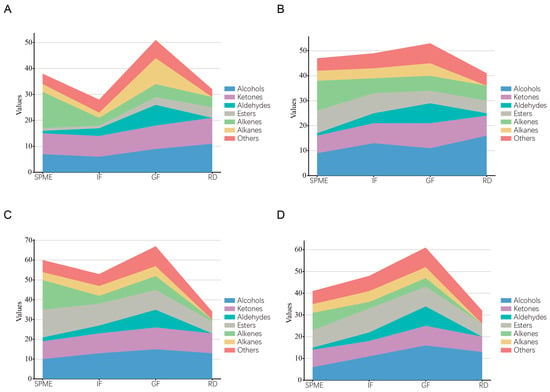
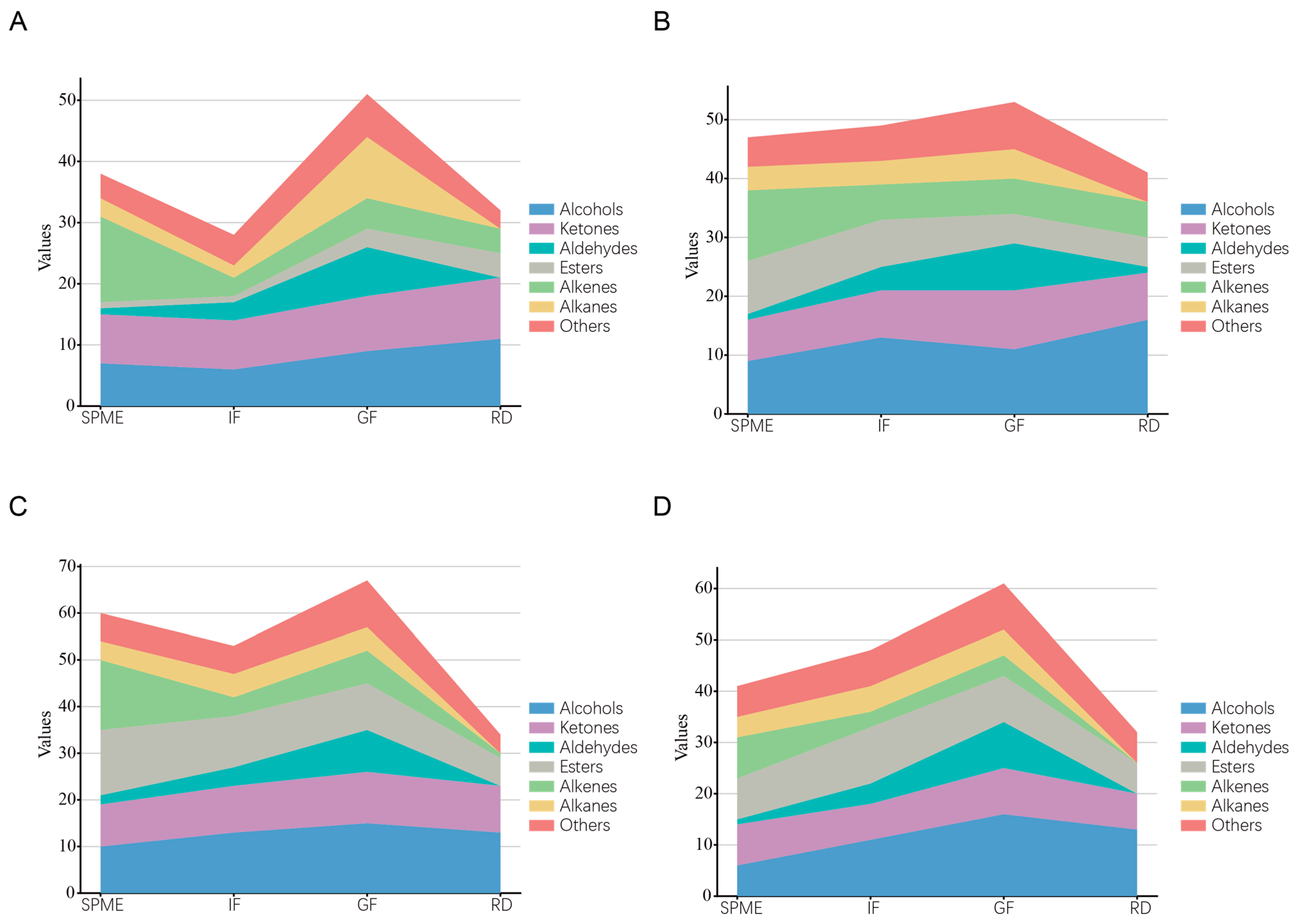
In total, 78 volatile compounds were detected across the 16 cultivar–method combinations, belonging to seven chemical classes: 21 alkenes, 18 alcohols, 12 ketones, 9 esters, 8 aldehydes, 7 alkanes, and 3 miscellaneous compounds (Table S1). The number of compounds recovered from a given cultivar depended strongly on the extraction method. GF consistently returned the largest inventories (51, 53, 67, and 61 compounds for BYYG, DYJG, XYDG, and MTH, respectively), followed by SPME (38–60), IF (28–53), and RD (32–41) (Figure 1A–D).
Figure 1.
Number of volatile compounds in each chemical class recovered from four O. fragrans cultivars by four extraction methods: (A) ‘Boye Yingui’; (B) ‘Daye Jingui’; (C) ‘Xiaoye Dangui’; (D) ‘Mantiaohong’.
At the class level, GF maximized the numbers of alcohols (up to 15–16 in XYDG and MTH), aldehydes (8–9), and miscellaneous compounds in most cultivars, which is consistent with the mechanical disruption of floral tissue releasing matrix-bound and semi-volatile constituents [15]. SPME was unmatched for alkenes in BYYG and XYDG (14 and 15 compounds, respectively). In stark contrast, RD returned almost no aldehydes (0–1), few alkenes (0–6), and no alkanes in any of the four cultivars, indicating that these classes were largely lost during the 5 h distillation, whereas ketones (7–10 compounds) survived RD in every cultivar (Table S1; Figure 1A–D).
3.2. Class-Level Relative Contents
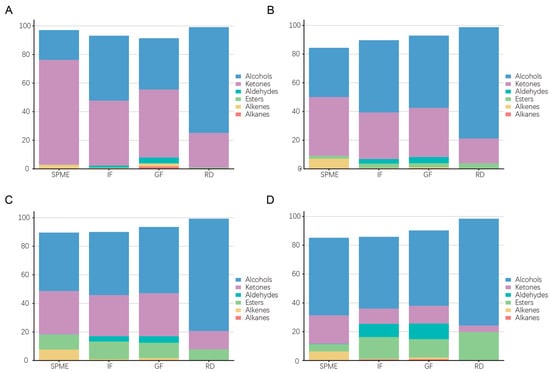
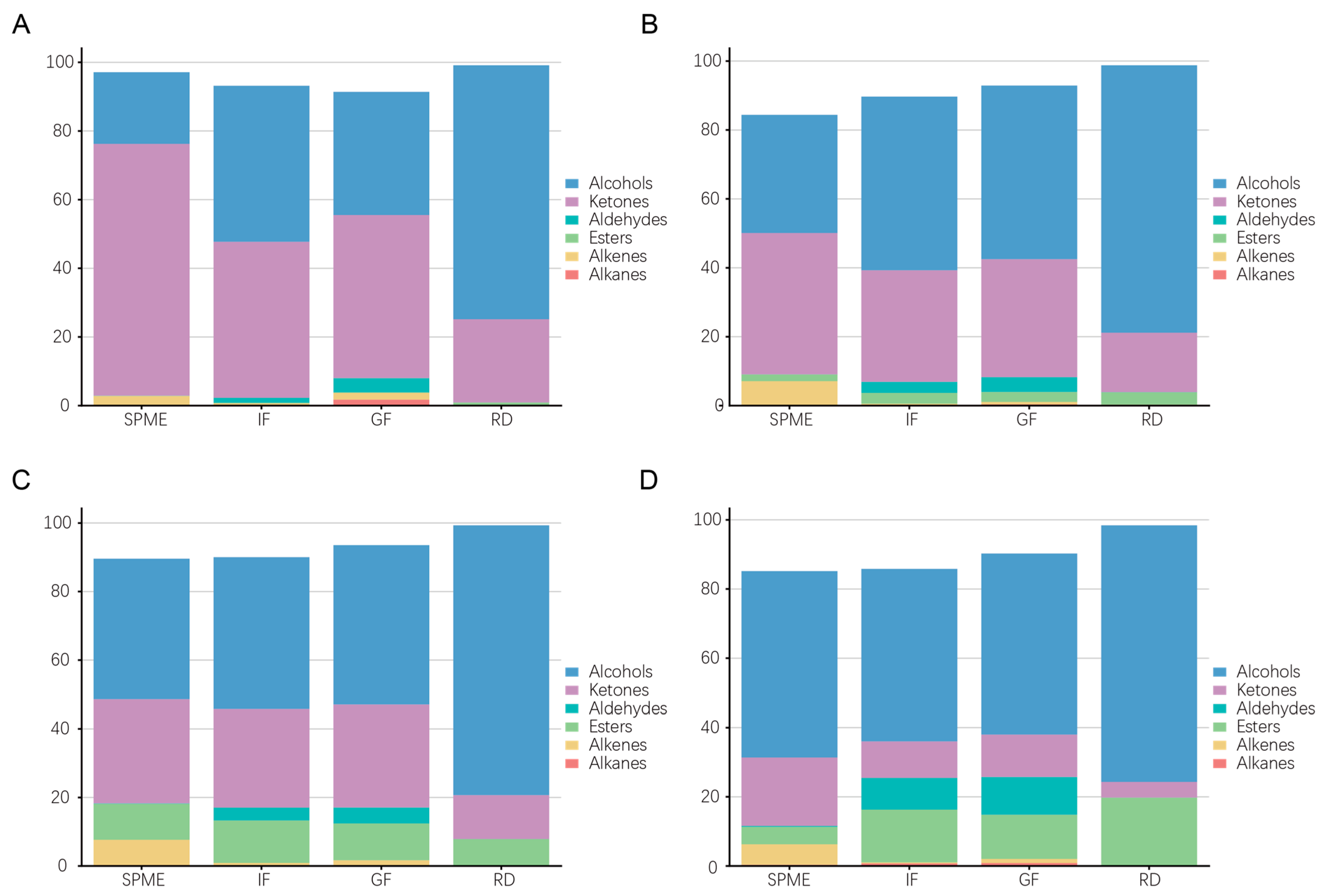
The relative contents of the six major classes are summarized in Table S2 and Figure 2. Three method-consistent patterns emerged. First, RD produced the alcohol-richest extracts in every cultivar (73.9–78.6%), at the expense of ketones (4.5–24.3%) and the near-complete loss of alkenes (0–0.3%) and alkanes (0%). Second, SPME yielded the highest relative proportions of ketones (19.8–73.3%, exceeding 73% in BYYG, where dihydro-β-ionone and β-ionone dominated) and alkenes (2.8–7.3%) within its volatile profile. Third, GF yielded the highest aldehyde (4.2–11.0%) and alkane (0.3–1.8%) contents, in line with its broadest class coverage.
Figure 2.
Relative contents (%) of the major chemical classes in the volatile profiles of four O. fragrans cultivars obtained by four extraction methods: (A) ‘Boye Yingui’; (B) ‘Daye Jingui’; (C) ‘Xiaoye Dangui’; (D) ‘Mantiaohong’.
Esters were the only class without a single dominant method: RD gave the highest ester contents in BYYG (0.8%), DYJG (3.6%), and MTH (19.8%), whereas in XYDG esters peaked with IF (12.4%). The rise of the ester fraction under RD was most conspicuous in MTH, whose ester content increased 4-fold from 5.0% (SPME) to 19.8% (RD), driven almost entirely by γ-decalactone. Taken together, no single method was universally optimal, and the choice of protocol should follow the target compound class: RD for alcohols and esters, SPME for ketones and alkenes, and GF for aldehydes and alkanes.
3.3. Shared and Unique Volatile Compounds
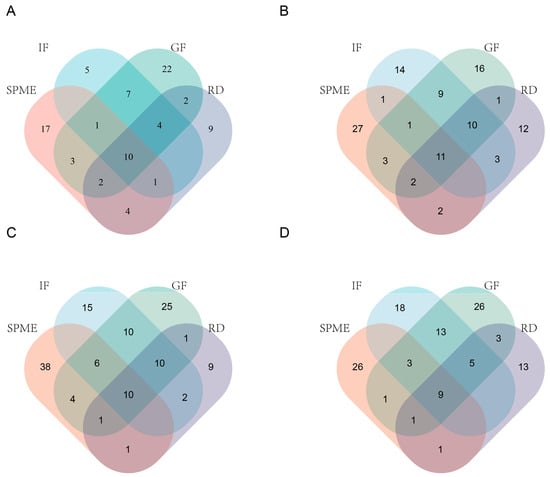
Venn analysis (Figure 3) revealed a surprisingly small common core: only 9–11 compounds were shared by all four methods within any cultivar, i.e., less than one-third of the total repertoire. This confirms that the four techniques sample substantially different slices of the volatile metabolome and that profiles acquired with different protocols are only partially comparable.
Figure 3.
Venn diagrams of the volatile compounds recovered from four O. fragrans cultivars by four extraction methods: (A) ‘Boye Yingui’; (B) ‘Daye Jingui’; (C) ‘Xiaoye Dangui’; (D) ‘Mantiaohong’. SPME, headspace solid-phase microextraction; IF, solvent extraction of intact flowers; GF, solvent extraction of ground flowers; RD, rotary distillation.
The size of the method-specific fraction was also informative. GF yielded the largest number of unique compounds in BYYG (22), XYDG (25), and MTH (26), whereas for DYJG SPME produced the largest unique set (27), and GF ranked second (16). SPME unique fractions were likewise large in XYDG (38) and MTH (26), reflecting its affinity for highly volatile alkenes and ketones. The shared core presumably comprises robust, easily extractable constituents such as linalool oxides and ionones, which thus serve as the most protocol-independent markers of cultivar identity.
3.4. Core Volatile Compounds
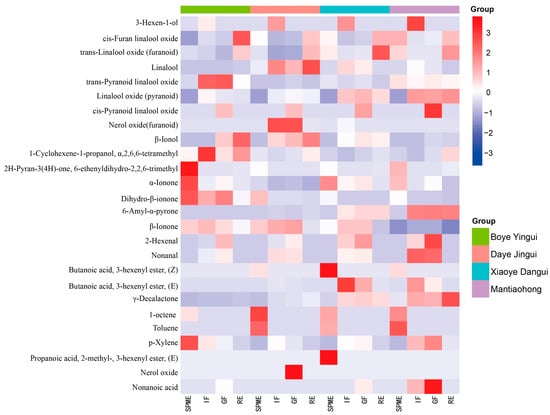
The 26 entries listed in Table S3 constitute the core volatile dataset, and all 26 compounds were included in the statistical analyses and in the biological interpretation of the profiles (Figure 4). Linalool oxides behaved as method markers: the furanoid isomers were strongly enriched by RD, with trans-linalool oxide (furanoid) reaching 45.1% in XYDG and 28.1% in BYYG under RD, approximately 2–3 times the contents obtained with the other three methods. The pyranoid isomers behaved differently: cis-linalool oxide (pyranoid) reached its maximum in MTH-RD (12.5%) and 10.2% in XYDG-GF, whereas trans-linalool oxide (pyranoid) was highest in BYYG-GF (11.2%) and BYYG-IF (11.0%).
Figure 4.
Heatmap of the relative contents of the 26 core volatile compounds across the 16 cultivar–method combinations. Rows are compounds; columns are grouped by cultivar (green, ‘Boye Yingui’; red, ‘Daye Jingui’; cyan, ‘Xiaoye Dangui’; purple, ‘Mantiaohong’) and ordered by extraction method (SPME, IF, GF, and RD). Colors are row-scaled (z-score): red, high; blue, low.
Ionones followed a cultivar- and method-specific pattern. β-Ionone peaked under solvent extraction, reaching 27.0–28.0% in DYJG and about 23% in XYDG, but collapsed to 1.1% in MTH-RD. Dihydro-β-ionone was the signature of BYYG-SPME (30.1%). Linalool itself was recovered almost exclusively in DYJG (12.9% with IF and 17.7% with RD) and was nearly absent in BYYG (≤0.3%). γ-Decalactone, the creamy, coconut-like lactone [27], was the unmistakable cultivar marker of MTH, rising to 19.3% under RD (11.4% with IF and 10.9% with GF), followed by XYDG (7.6–8.7% under solvent extraction) and DYJG (≤3.4%), while remaining below 0.8% in BYYG. The C6 alcohol 3-hexen-1-ol, a lipoxygenase-derived green-leaf volatile, was likewise confined to the solvent extracts (IF; 0.61–2.53%). Aldehydes (2-hexenal, nonanal) were detected only in the solvent extracts, whereas the two aromatic hydrocarbons showed a distinct method dependence: toluene appeared solely in three SPME headspace fractions (DYJG, XYDG, and MTH), while p-xylene was present at low levels (≤1.22%) in all workflows.
3.5. Effects of Extraction Method and Cultivar on Core Compounds
One-way ANOVA was performed across all 26 core compounds listed in Table S3; 11 compounds showed significant differences among extraction methods (Table S4). RD achieved the highest contents of cis-linalool oxide (furanoid) (22.50 ± 6.25%) and trans-linalool oxide (furanoid) (34.54 ± 7.61%), both significantly above all other methods, and was also superior to SPME for β-ionol and the cis-linalool oxide (pyranoid). SPME returned the highest α-ionone (3.80 ± 2.16%) content but was the least effective method for the cis-linalool oxide (pyranoid) (0.00%), which it did not recover at all. GF maximized the unassigned pyranoid-type linalool oxide isomer (1.76 ± 0.91%) and 2-hexenal (1.82 ± 0.94%) and matched IF for nonanal (≈3.2–3.4%); IF alone maximized 3-hexen-1-ol (1.55 ± 0.79%). Notably, linalool and β-ionone—the two quantitatively dominant odorants of O. fragrans—did not differ significantly among methods (p > 0.05), although their mean contents were higher in the solvent extracts.
Cultivar affected 7 of the 26 core peaks significantly (Table S5). DYJG accumulated by far the most linalool (10.60 ± 6.35%), approximately 6-fold higher than MTH and more than 100-fold higher than BYYG. BYYG was distinguished by the highest contents of trans-linalool oxide (pyranoid) (7.25 ± 4.50%) and by 1-(2,6,6-trimethylcyclohex-1-en-1-yl)propanol (2.94 ± 1.79%) and dihydro-β-ionone (19.89 ± 9.78%), the latter two being significantly above all other cultivars. MTH showed the highest 6-pentyl-2H-pyran-2-one (0.69 ± 0.46%) and γ-decalactone (11.17 ± 6.62%) contents but, remarkably, the lowest β-ionone content (3.63 ± 2.37%), less than one sixth of that in DYJG. XYDG did not lead in any single compound yet maintained a balanced profile with high means for α-ionone (2.65 ± 1.38%) and γ-decalactone (6.51 ± 3.38%), consistent with its intermediate position in the PCA (Section 3.6).
3.6. Principal Component Analysis of the Global Profiles
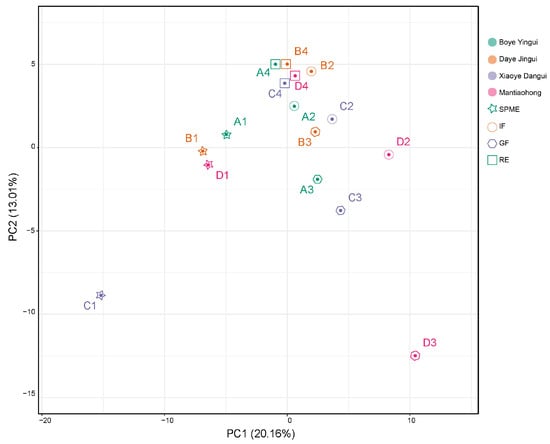
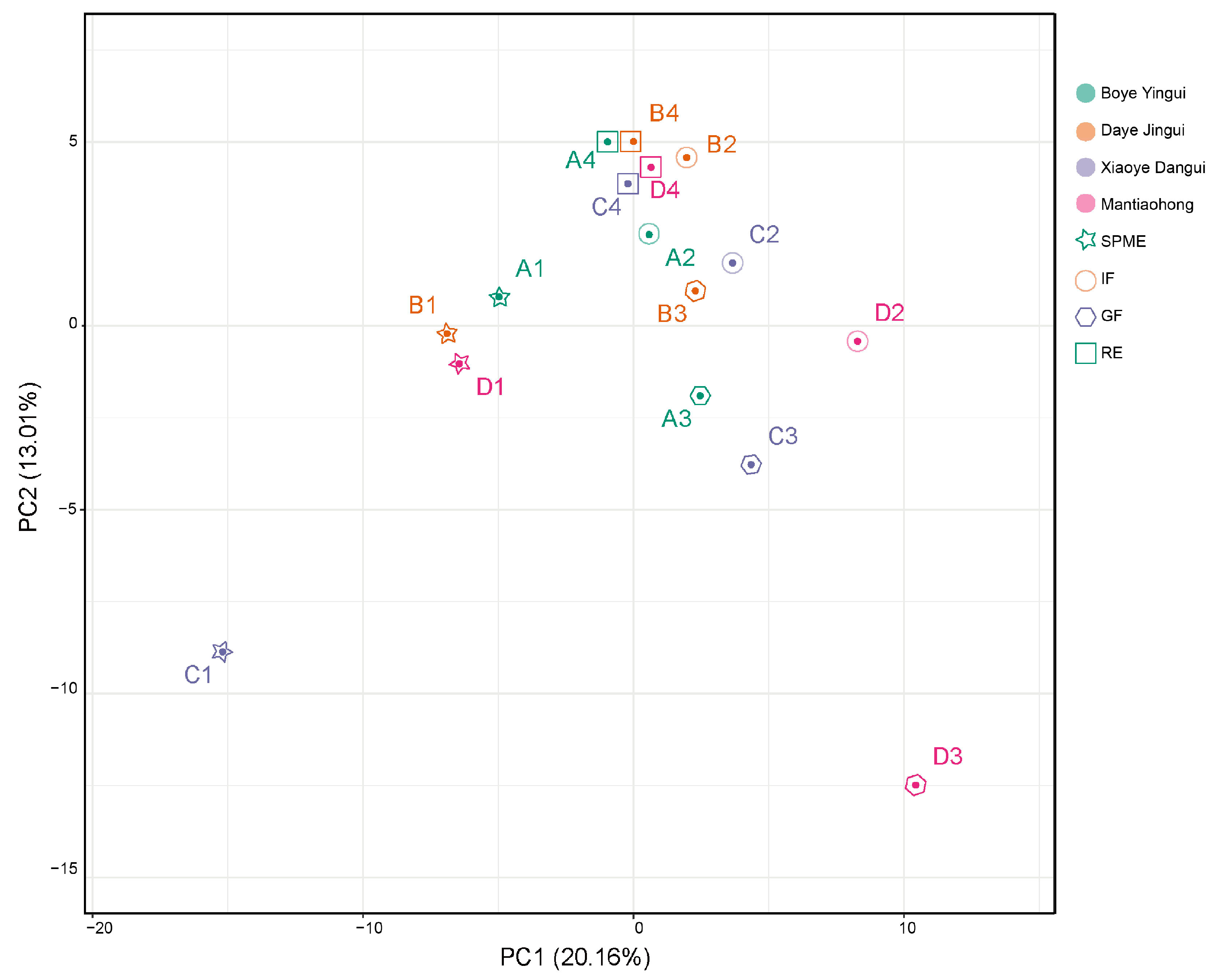
PCA of the 16 cultivar–method samples visualized the joint action of the two factors (Figure 5). PC1 and PC2 explained 20.16% and 13.01% of the total variance, respectively, cumulatively accounting for only about one third of the variation, which reflects the high dimensionality of the volatile data. Three observations stand out. First, the RD samples of all four cultivars (A4–D4) show a visual tendency to aggregate in the upper-central region of PCA space, although distinct, unambiguous clustering cannot be confirmed by PCA alone. This grouping tendency receives further mathematical support from hierarchical cluster analysis (Supplementary Figure S1), demonstrating that RD largely overrides cultivar differences and delivers highly convergent volatile profiles. Second, the extreme outliers were both method–cultivar combinations rather than cultivars per se, namely C1 (XYDG-SPME) at strongly negative PC1 and D3 (MTH-GF) at strongly positive PC1, showing that a specific method can catapult a specific cultivar into a unique chemical space. Third, the dispersion of the remaining samples was cultivar-dependent: DYJG samples (B2–B4) grouped closely, whereas BYYG samples (A1–A4) were widely scattered, indicating that the profile of BYYG is far more sensitive to the extraction protocol than that of DYJG. In line with these patterns, PERMANOVA attributed 77.2–79.2% of the total variation in volatile profiles to the extraction method (the range reflecting the partitioning models with and without the interaction term) and far less to cultivar, while their interaction was also significant. The intrinsic cultivar background thus sets the chemical potential of the material, but the extraction method determines how much of that potential—and which part of it—is actually captured.
Figure 5.
Principal component analysis (PCA) of the volatile profiles of the 16 cultivar–method combinations. A, ‘Boye Yingui’; B, ‘Daye Jingui’; C, ‘Xiaoye Dangui’; D, ‘Mantiaohong’; 1, SPME; 2, IF; 3, GF; 4, RD.
4. Discussion
4.1. Extraction Method as a Chemical Filter
The clearest message of this study is quantitative: the extraction method explained 77.2–79.2% of the total variance in volatile profiles, several-fold more than the cultivar itself. Each technique thus acts as a chemically selective filter rather than a neutral sampler. SPME samples the headspace and therefore biases profiles toward low-boiling, high-vapor-pressure compounds—alkenes and ketones such as dihydro-β-ionone and β-ionone—consistent with its behavior in previous O. fragrans studies [4,14]. Solvent extraction covers a broader polarity and volatility window, and grinding further releases matrix-bound and partially glycosidically bound constituents, which explains the widest compound coverage and the largest unique-compound pools of GF [15]. RD, which is operationally analogous to hydrodistillation, transferred water-soluble and heat-stable alcohols and lactones into the hydrosol, whereas aldehydes, alkenes, and alkanes were almost quantitatively eliminated, plausibly through volatilization and oxidative or thermal degradation during the 5 h distillation [16,17]. This filtering behavior provides a mechanistic explanation for the discrepancies among published O. fragrans datasets: β-ionone-dominated essential oils obtained by steam distillation [13] and linalool-rich solvent extracts [3] are not contradictory observations but different projections of the same metabolic background. Similar method-driven reshuffling of varietal rankings has been reported for drying treatments of O. fragrans flowers [17,28] and other aromatic materials [18,19], and for alternative drying or extraction protocols [29,30,31]. Consistent with this, GC-MS surveys of other ornamental flowers have repeatedly shown that the recovered volatile inventory—and hence the inferred “characteristic” aroma—depends heavily on the sampling technique [32].
4.2. Cultivar Background and the Cultivar × Method Interaction
Although secondary in explanatory power, the cultivar defined the upper limit of what any method could recover. The significantly higher linalool content of DYJG agrees with the alcohol-rich chemotype generally ascribed to the Jingui/Yingui groups [3,10,11], and the γ-decalactone-rich, β-ionone-poor phenotype of MTH adds a lactone-based chemotype to the O. fragrans chemo-taxonomic spectrum that has so far been framed mainly around ionones and linalool oxides [11,12]. The biosynthetic routes that generate these compound classes are increasingly well defined [33,34], and the distinction between emitted and endogenous volatile pools further complicates direct comparison among studies [35]. More important is the significant cultivar × method interaction revealed by both ANOVA and PCA. RD homogenized the four cultivars into one cluster, whereas SPME and GF amplified cultivar idiosyncrasy, pushing XYDG-SPME (C1) and MTH-GF (D3) into extreme positions. In other words, the apparent similarity of two cultivars depends on the protocol used: conclusions drawn from a single-method experiment are therefore method-conditioned and may not generalize. This observation highlights the limitation of studies relying on only one extraction strategy. This finding extends earlier cultivar-comparison studies that used a fixed protocol [10,11,20,21] and argues for multi-protocol designs whenever cultivar characterization is the goal.
4.3. Practical Implications and Limitations
The results translate directly into a target-component-oriented matching strategy. For comprehensive aroma fingerprinting and cultivar discrimination, GF is the method of choice, preferably applied to XYDG or MTH, whose unique-compound pools it maximizes. For rapid, solvent-free quality screening, SPME is unrivaled, particularly for ionone-type cultivars such as BYYG. For products built on a creamy, lactone-rich hydrosol, RD coupled with MTH delivers the highest γ-decalactone levels (19.3%), an almost 6-fold enrichment over the same cultivar processed by SPME. Conversely, aldehyde-fresh notes can only be captured with solvent extraction.
Several limitations should be acknowledged. The quantification relies on relative (area-normalized) contents, which preclude statements about absolute yields; methyl laurate was available only for the solvent-extraction methods (IF, GF, and RD), where it corrected physical sample-handling losses; it cannot account for the variable extraction recoveries of analytes with different functional groups and cannot be applied to SPME, whose competitive finite fiber adsorption operates on a fundamentally different principle from liquid-phase partitioning. This intrinsic difference restricts direct comparison of absolute extraction efficiency between SPME and solvent-based approaches, and all class-level observations therefore refer to relative compositional proportions within each method rather than to absolute mass yields. The comparisons rest on one harvest season and one location, and odor relevance was inferred from literature rather than from odor activity value (OAV) calculations or sensory recombination [36]. Future work should therefore combine absolute quantification with isotope-labeled internal standards, GC-olfactometry and OAV analysis, multi-location sampling, and the optimization of RD parameters to minimize the loss of heat-sensitive aldehydes and should explore the enzymatic and molecular mechanisms—now accessible through the emerging O. fragrans genomic resources [9]—that underlie the cultivar-specific responses to extraction stress [37]. Finally, although every annotation was re-verified against measured RIs and is reported with an explicit confidence level (Table S6), the stereochemical assignment of the two pyranoid linalool oxide isomers and of several minor constituents remains putative (Level 2b/3) and should be confirmed with authentic standards. In addition, SPME and solvent extraction operate via fundamentally distinct mechanisms—competitive, finite-fiber adsorption versus liquid-phase partitioning—which restricts direct comparison of absolute extraction efficiency between them; all class-level observations therefore refer to relative compositional proportions within each method rather than to absolute mass yields.
5. Conclusions
In a fully crossed 4 × 4 design, this study demonstrates that the extraction method, not the cultivar, is the dominant driver of the volatile profile divergence of O. fragrans flowers (77.2–79.2% of variance), acting as a chemically selective filter: GF offers the broadest and most cultivar-discriminative coverage, RD enriches alcohols and lactone esters but strips aldehydes, alkenes, and alkanes, and SPME maximizes headspace ketones and alkenes. Cultivar background defines the achievable compound ceiling—linalool in ‘Daye Jingui’, γ-decalactone in ‘Mantiaohong’, and dihydro-β-ionone in ‘Boye Yingui’—and interacts significantly with the method applied. We recommend selecting the extraction protocol according to the target components and matching it to the appropriate cultivar, e.g., GF for comprehensive fingerprinting, RD with ‘Mantiaohong’ for lactone-rich hydrosols, and SPME for rapid solvent-free screening. These results provide both a practical framework for valorizing O. fragrans aroma resources and a methodological caveat for interpreting literature data acquired with different sample-preparation protocols.
Supplementary Materials
The following supporting information can be downloaded at https://www.mdpi.com/article/10.3390/separations13110326/s1, Table S1: Numbers of volatile compounds in each chemical class recovered from four O. fragrans cultivars by four extraction methods; Table S2: Relative contents (%) of the major chemical classes in the volatile profiles of four O. fragrans cultivars obtained by four extraction methods; Table S3: Relative contents (%) of the 26 core volatile compounds in the volatile profiles of four O. fragrans cultivars obtained by four extraction methods (mean values, n = 4; the corresponding SDs are given in Tables S4 and S5); Table S4: One-way ANOVA of the contents (%) of the 26 core volatile compounds among extraction methods (mean ± SD; different lowercase letters indicate significant differences at p < 0.05, LSD test); Table S5: One-way ANOVA of the contents (%) of the 26 core volatile compounds among cultivars (mean ± SD; different lowercase letters indicate significant differences at p < 0.05, LSD test). Table S6: Identification evidence for the 26 core peaks: measured retention index, literature retention index, deviation (ΔRI), mass-spectral match factor, chemical class, MSI annotation level and origin status; Figure S1: Hierarchical cluster analysis (HCA) dendrogram of all 16 cultivar-method samples based on Bray-Curtis distance with complete-linkage clustering. Samples are annotated as cultivar-method; SPME, IF, GF, RD represent four extraction methods. DYJG, ‘Daye Jingui’; XYDG, ‘Xiaoye Dangui’; BYYG, ‘Boye Yingui’; MTH, ‘Mantiaohong’.
Author Contributions
Conceptualization, methodology, software, validation, formal analysis, investigation, data curation, visualization, and writing—original draft preparation, Q.Z.; investigation, formal analysis, and data curation, X.W.; investigation and formal analysis, F.Y.; investigation and data curation, X.X.; investigation and supervision assistance, X.Y.; investigation and visualization support, J.Y.; methodology and software support, Z.C.; investigation and resource support, H.C.; resources, supervision, project administration, funding acquisition, and writing—review and editing, X.Z. All authors have read and agreed to the published version of the manuscript.
Funding
This work was supported by grants from the Natural Science Foundation of Hubei Province (2026AFC0529 and 2025AFB857), Hubei Provincial Science and Technology Project (2025CDB024), Xianning City Science and Technology Project (2025NYYF091), and National College Student Entrepreneurship Training Program (202610927003X).
Data Availability Statement
The original contributions presented in this study are included in the article; further inquiries can be directed to the corresponding author.
Conflicts of Interest
The authors declare no conflicts of interest.
Abbreviations
The following abbreviations are used in this manuscript:
| GC-MS | gas chromatography–mass spectrometry |
| SPME | solid-phase microextraction |
| IF | solvent extraction of intact flowers |
| GF | solvent extraction of ground flowers |
| RD | rotary distillation |
| BYYG | Boye Yingui |
| DYJG | Daye Jingui |
| XYDG | Xiaoye Dangui |
| MTH | Mantiaohong |
| PCA | principal component analysis |
| ANOVA | analysis of variance |
| LSD | least significant difference |
| RI | retention index |
| ΔRI | difference between the measured and the library (NIST 2.3) retention index |
| MF | mass-spectral match factor |
| OAV | odor activity value |
References
- Wang, B.; Luan, F.; Bao, Y.; Peng, X.; Rao, Z.; Tang, Q.; Zeng, N. Traditional uses, phytochemical constituents and pharmacological properties of Osmanthus fragrans: A review. J. Ethnopharmacol. 2022, 293, 115273. [Google Scholar] [CrossRef] [Scilit] [PubMed]
- Yang, J.; Gu, T.; Lu, Y.; Xu, Y.; Gan, R.-Y.; Ng, S.B.; Sun, Q.; Peng, Y. Edible Osmanthus fragrans flowers: Aroma and functional components, beneficial functions, and applications. Crit. Rev. Food Sci. Nutr. 2023, 64, 10055–10068. [Google Scholar] [CrossRef] [PubMed]
- Fu, C.-C.; Xu, F.-Y.; Qian, Y.-C.; Koo, H.-L.; Duan, Y.-F.; Weng, G.-M.; Fan, T.-P.; Chen, M.-X.; Zhu, F.-Y. Secondary metabolites of Osmanthus fragrans: Metabolism and medicinal value. Front. Pharmacol. 2022, 13, 922204. [Google Scholar] [CrossRef] [Scilit] [PubMed]
- Cai, X.; Mai, R.Z.; Zou, J.J.; Zhang, H.Y.; Zeng, X.L.; Zheng, R.R.; Wang, C.Y. Analysis of aroma-active compounds in three sweet osmanthus (Osmanthus fragrans) cultivars by GC-olfactometry and GC-MS. J. Zhejiang Univ. Sci. B 2014, 15, 638–648. [Google Scholar] [CrossRef] [Scilit] [PubMed]
- Hong, S.J.; Cho, J.-J.; Jeong, H.; Yoon, S.; Jo, S.M.; Youn, M.Y.; Shin, E.-C. Investigation of volatile profiles and odor-active compounds in Osmanthus fragrans var. aurantiacus separated by different polarities using GC/MS, GC-olfactometry and electronic-nose system. Food Sci. Biotechnol. 2024, 33, 1585–1592. [Google Scholar] [CrossRef] [Scilit] [PubMed]
- Wang, L.; Tan, N.; Hu, J.; Wang, H.; Duan, D.; Ma, L.; Xiao, J.; Wang, X. Analysis of the main active ingredients and bioactivities of essential oil from Osmanthus fragrans var. thunbergii using a complex network approach. BMC Syst. Biol. 2017, 11, 144. [Google Scholar] [CrossRef] [Scilit] [PubMed]
- Pensamiento-Niño, C.A.; Castañeda-Ovando, A.; Añorve-Morga, J.; Hernández-Fuentes, A.D.; Aguilar-Arteaga, K.; Ojeda-Ramírez, D. Edible flowers and their relationship with human health: Biological activities. Food Rev. Int. 2024, 40, 620–639. [Google Scholar] [CrossRef] [Scilit]
- Zeng, X.; Ding, H.; Zou, J.; Cai, X.; Yang, J.; Chen, H.; Wang, C. Cloning and characterization of OfMYBR1 gene in response to circadian rhythm affecting floral fragrance of Osmanthus fragrans. Int. J. Agric. Biol. 2020, 24, 11–16. [Google Scholar] [CrossRef] [Scilit]
- Chen, H.; Zeng, X.; Yang, J.; Cai, X.; Shi, Y.; Zheng, R.; Wang, Z.; Liu, J.; Yi, X.; Xiao, S.; et al. Whole genome resequencing of Osmanthus fragrans provides insights into flower color evolution. Hortic. Res. 2021, 8, 98. [Google Scholar] [CrossRef] [Scilit] [PubMed]
- Xin, H.; Wu, B.; Zhang, H.; Wang, C.; Li, J.; Yang, B.; Li, S. Characterization of volatile compounds in flowers from four groups of sweet osmanthus (Osmanthus fragrans) cultivars. Can. J. Plant Sci. 2013, 93, 923–931. [Google Scholar] [CrossRef] [Scilit]
- Fu, J.; Hou, D.; Wang, Y.; Zhang, C.; Bao, Z.; Zhao, H.; Hu, S. Identification of floral aromatic volatile compounds in 29 cultivars from four groups of Osmanthus fragrans by gas chromatography–mass spectrometry. Hortic. Environ. Biotechnol. 2019, 60, 611–623. [Google Scholar] [CrossRef] [Scilit]
- Fu, J.; Hou, D.; Zhang, C.; Bao, Z.; Zhao, H.; Hu, S. The emission of the floral scent of four Osmanthus fragrans cultivars in response to different temperatures. Molecules 2017, 22, 430. [Google Scholar] [CrossRef] [Scilit] [PubMed]
- Wang, L.; Li, M.; Jin, W.; Li, S.; Zhang, S.; Yu, L. Variations in the components of Osmanthus fragrans Lour. essential oil at different stages of flowering. Food Chem. 2009, 114, 233–236. [Google Scholar] [CrossRef] [Scilit]
- Zhang, Y.; Yan, Y.; Shu, H.; Dan, Q.; Pan, L.; Tu, K. Analysis of aroma and key differential volatile compounds during ripening stages of three strawberry cultivars using HS-SPME-GC–MS, GC-IMS, and E-nose. Food Chem. 2025, 494, 146199. [Google Scholar] [CrossRef] [Scilit] [PubMed]
- Zhao, X.; Yang, J.; Wang, Y.; Wang, X.; Zhao, Y.; Hou, M.; Zhang, H.; Chen, J.; Xu, J.; Zhang, J. Volatile compounds evaluation and characteristic aroma compounds screening in representative germplasm of mei (Prunus mume) based on metabolomics and sensomics. Food Chem. 2025, 489, 144994. [Google Scholar] [CrossRef] [Scilit] [PubMed]
- Zhang, J.-G.; Wu, H.-X.; Zhang, A.; Thakur, K.; Hu, F.; Wei, Z.-J. Comprehensive analysis of the impact of extraction methods on the volatile organic compounds and flavor profiles of Piper nigrum L. varieties. Food Chem. 2025, 492, 145425. [Google Scholar] [CrossRef] [Scilit] [PubMed]
- Zhao, D.; Al-Dalali, S.; Nizi, H.; Ruotong, Z.; Yingmei, Y.; Yage, X.; Yingying, C.; Zhenfeng, D. Effect of various drying methods on the volatile compounds, metabolites, and sensory profile of Osmanthus fragrans flowers using GC–MS and UHPLC–MS/MS. Food Chem. 2025, 496, 146947. [Google Scholar] [CrossRef] [Scilit] [PubMed]
- Park, C.H.; Yeo, H.J.; Park, C.; Chung, Y.S.; Park, S.U. The effect of different drying methods on primary and secondary metabolites in Korean mint flower. Agronomy 2021, 11, 698. [Google Scholar] [CrossRef] [Scilit]
- Wojdyło, A.; Figiel, A.; Legua, P.; Lech, K.; Carbonell-Barrachina, Á.A.; Hernández, F. Chemical composition, antioxidant capacity, and sensory quality of dried jujube fruits as affected by cultivar and drying method. Food Chem. 2016, 207, 170–179. [Google Scholar] [CrossRef] [Scilit] [PubMed]
- Xue, Y.; Chen, G.; Zhang, J.; Zhu, G.; Zheng, X.; Xie, H.; Wang, Z.; Li, D.; Huang, J.; Liu, Z.; et al. Cultivar-specific aroma divergence in multi-type teas: Comparative study of five varieties processed into green, white, and black teas. Food Chem. X 2026, 34, 103498. [Google Scholar] [CrossRef] [Scilit] [PubMed]
- Zhang, M.; Lu, X.; Zhang, P.; Li, G.; Li, D.; Xie, H.; Huang, J.; Zhang, S.; Liu, Z.; Liu, A. Reveal the differences in flavor of five varieties of black teas via sensory evaluation, UPLC, and GC × GC-QTOFMS approaches. Food Chem. X 2025, 31, 103083. [Google Scholar] [CrossRef] [Scilit] [PubMed]
- Wei, S.; Wu, J.; Yu, P.; Tan, Y.; He, Q.; Yang, J.; Cai, X.; Zou, J.; Chen, H.; Zeng, X. Metabolomic and transcriptomic analysis of unique floral coloration in Osmanthus fragrans cultivars. Horticulturae 2024, 10, 801. [Google Scholar] [CrossRef] [Scilit]
- Aros, D.; Garrido, N.; Rivas, C.; Medel, M.; Müller, C.; Rogers, H.; Úbeda, C. Floral scent evaluation of three cut flowers through sensorial and gas chromatography analysis. Agronomy 2020, 10, 131. [Google Scholar] [CrossRef] [Scilit]
- Sumner, L.W.; Amberg, A.; Barrett, D.; Beale, M.H.; Beger, R.; Daykin, C.A.; Fan, T.W.M.; Fiehn, O.; Goodacre, R.; Griffin, J.L.; et al. Proposed minimum reporting standards for chemical analysis. Metabolomics 2007, 3, 211–221. [Google Scholar] [CrossRef] [Scilit] [PubMed]
- van den Dool, H.; Kratz, P.D. A generalization of the retention index system including linear temperature programmed gas—Liquid partition chromatography. J. Chromatogr. A 1963, 11, 463–471. [Google Scholar] [CrossRef] [Scilit] [PubMed]
- Xu, L.; Pan, M.; Cheng, X.; Liu, Z.; Pang, B.; Zhang, R.; Liu, Y.; Wang, Q. Comparative analysis of the aroma characteristics of three different cultivars of guavas under different storage conditions using HS-SPME-GC–MS and HS-GC-IMS. Food Chem. X 2025, 31, 103193. [Google Scholar] [CrossRef] [Scilit] [PubMed]
- Oyama-Okubo, N.; Tsuji, T. Analysis of floral scent compounds and classification by scent quality in tulip cultivars. J. Jpn. Soc. Hortic. Sci. 2013, 82, 344–353. [Google Scholar] [CrossRef] [Scilit]
- Chang, Y.; Lin, J.; Pan, S.; Jing, Y.; Guo, A.; Deng, Y. Effects of different drying methods on the contents of nine components and immunomodulatory activities of four components in Osmanthus fragrans flowers. Nat. Prod. Commun. 2021, 16, 1–9. [Google Scholar] [CrossRef] [Scilit]
- Li, X.; Feng, T.; Zhou, F.; Zhou, S.; Liu, Y.; Li, W.; Ye, R.; Yang, Y. Effects of drying methods on the tasty compounds of Pleurotus eryngii. Food Chem. 2015, 166, 358–364. [Google Scholar] [CrossRef] [Scilit] [PubMed]
- Qu, F.; Qiu, F.; Zhu, X.; Ai, Z.; Ai, Y.; Ni, D. Effect of different drying methods on the sensory quality and chemical components of black tea. LWT 2019, 99, 112–118. [Google Scholar] [CrossRef] [Scilit]
- Yan, J.-K.; Wu, L.-X.; Qiao, Z.-R.; Cai, W.-D.; Ma, H. Effect of different drying methods on the product quality and bioactive polysaccharides of bitter gourd (Momordica charantia L.) slices. Food Chem. 2019, 271, 588–596. [Google Scholar] [CrossRef] [Scilit] [PubMed]
- Shi, T.; Yue, Y.; Shi, M.; Chen, M.; Yang, X.; Wang, L. Exploration of floral volatile organic compounds in six typical Lycoris taxa by GC-MS. Plants 2019, 8, 422. [Google Scholar] [CrossRef] [Scilit] [PubMed]
- Lv, M.; Zhang, L.; Wang, Y.; Ma, L.; Yang, Y.; Zhou, X.; Wang, L.; Yu, X.; Li, S. Floral volatile benzenoids/phenylpropanoids: Biosynthetic pathway, regulation and ecological value. Hortic. Res. 2024, 11, uhae220. [Google Scholar] [CrossRef] [Scilit] [PubMed]
- Bao, F.; Ding, A.; Zhang, T.; Luo, L.; Wang, J.; Cheng, T.; Zhang, Q. Expansion of PmBEAT genes in the Prunus mume genome induces characteristic floral scent production. Hortic. Res. 2019, 6, 24. [Google Scholar] [CrossRef] [Scilit] [PubMed]
- Wang, X.; Wu, Y.; Zhu, H.; Zhang, H.; Xu, J.; Fu, Q.; Bao, M.; Zhang, J. Headspace volatiles and endogenous extracts of Prunus mume cultivars with different aroma types. Molecules 2021, 26, 7256. [Google Scholar] [CrossRef] [Scilit] [PubMed]
- Liu, Y.; Wen, H.; Kong, J.; Hu, Z.; Hu, Y.; Zeng, J.; Chen, X.; Zhang, H.; Chen, J.; Xu, J. Flavor characterization of Citri Reticulatae Pericarpium (Citrus reticulata ‘Chachiensis’) with different aging years via sensory and metabolomic approaches. Food Chem. 2024, 443, 138616. [Google Scholar] [CrossRef] [Scilit] [PubMed]
- Zou, J.; Cai, X.; Yang, J.; Zeng, X.; Liu, D.; Huang, S.; Chen, X.; Yang, Q.; Wang, C.; Chen, H. DNA hypomethylation mediates flower opening and senescence in sweet osmanthus through auxin and ethylene responsive pathway. Postharvest Biol. Technol. 2023, 198, 112250. [Google Scholar] [CrossRef] [Scilit]
Disclaimer/Publisher’s Note: The statements, opinions and data contained in all publications are solely those of the individual author(s) and contributor(s) and not of MDPI and/or the editor(s). MDPI and/or the editor(s) disclaim responsibility for any injury to people or property resulting from any ideas, methods, instructions or products referred to in the content. |
© 2026 by the authors. Licensee MDPI, Basel, Switzerland. This article is an open access article distributed under the terms and conditions of the Creative Commons Attribution (CC BY) license.