


Abstract
The long-term neuropsychiatric effects of COVID-19 are still unclear. Various mental health conditions are known to be influenced by biopsychosocial factors. We sought to investigate whether COVID-19 infection increases the risk for newly diagnosed anxiety, mood, or trauma and stressor-related disorders in individuals ages 12–64 years. We performed a retrospective cohort study using data from the Military Health System database (2018–2022). A propensity score match pairing each person with a COVID-19 diagnosis to two uninfected individuals was implemented, balancing matches across 1852 different variables representing medical records of procedures, diagnoses, and prescriptions in the year prior to COVID-19 infection. Exact matching was performed on sex, age in years, beneficiary type and month of entry into the cohort. We calculated the hazard ratios (HR) and Bonferroni-corrected confidence intervals (BoCI) for new mental health diagnoses using the Cox proportional hazards models. The initial matched cohort included 788,185 individuals. COVID-19 significantly increased the risk for newly diagnosed mental health conditions. The effect was strongest for trauma and stressor-related disorders (HR, 1.29; BoCI, 1.22–1.37), followed by mood disorders (HR, 1.22; BoCI, 1.15–1.30) and anxiety disorders (HR, 1.16; BoCI, 1.12–1.21). COVID-19 infection is associated with the subsequent diagnosis of a new mental health condition, including depressive, trauma and stressor-related, mood, and anxiety disorders. Our findings suggest that screening for mental health conditions should be a key part of post-COVID-19 care, and more work is needed to understand the biological reasons for this connection and consider the role of vaccines for prevention.
1. Introduction
Mental health conditions have become increasingly prevalent and currently affect one in every eight people in the world [1]. They are of significant relevance to military readiness as they are the second most frequent indication for medical encounters and the leading cause of medical separation [2,3]. Various types of mental health conditions include anxiety disorders, trauma and stressor-related disorders, and mood disorders and are known to be influenced by interactions of biopsychosocial factors, such as environment and genetics. A study by O. Köhler-Forsberg et al. explores associations between infections and mental disorders, where treatment for an infectious disease demonstrated an increase in hazard ratios for the development of mental disorders [4]. Similarly, a study by C. Stark et al. found that children prescribed antibiotics in infancy had an increased risk of future prescriptions for psychotropics [5]. Furthering these connections, various studies in the extant literature have demonstrated that inflammatory processes have been associated with mental illness, as evidenced by various mental disorders being associated with elevated levels of various interleukins (to include IL-6), c-reactive protein, and alterations in the complement system [6]. There is a higher mortality from COVID-19 among those with psychotic or mood disorders, suggesting a possible bidirectional interaction between mental health conditions and inflammatory processes [7]. These results raise questions about the connection between both bacterial and viral infections and the development of mental health disorders.
Since being declared a pandemic in March 2020, COVID-19 has resulted in the death of over 7 million people worldwide and has infected over 770 million to this day [8]. Caused by severe acute respiratory syndrome coronavirus 2 (SARS-CoV-2), common symptoms of COVID-19 include fever, cough, congestion, fatigue, and shortness of breath [9]. In addition to respiratory symptoms, psychological consequences and tolls on mental health have been increasingly prevalent throughout the COVID-19 pandemic [10]. Several studies have demonstrated this rising prevalence of depressive disorders, anxiety disorders, and post-traumatic stress disorder (PTSD) symptoms and its disproportionate impact on adolescents/young adults and females [11,12,13]. In the initial phases of the pandemic and lockdown, this was attributed to loneliness, financial struggles, and fear of infection with COVID-19 [14].
SARS-CoV-2 is widely distributed throughout the body, and although the direct pathway is not fully understood, it has been detected in the brain months following symptom onset [15]. Long-term effects of COVID-19, otherwise known as post-COVID-19 condition, impact approximately 35–45% of people who have had COVID-19. Symptoms commonly include persistent respiratory symptoms; however, neuropsychiatric symptoms such as fatigue, difficulty thinking or concentrating, and impaired sleep are also very common [16].
Less is known about associations between COVID-19 and mental disorders, as prior studies have been mixed in their results. In a survey examining mental health through the Patient Health Questionnaire—9 (PHQ-9) and General Anxiety Disorder—7 (GAD-7), participants who had previously contracted COVID-19 showed significantly higher levels of anxiety and depression symptoms than those who had not [17]. Similarly, patients hospitalized with COVID-19 developed worsening psychiatric and cognitive symptoms 2–3 years post-hospitalization [18]. Studies from a cohort of individuals with COVID-19 presenting to the emergency department found that 30% had PTSD during a post-recovery checkup and that there were higher rates of psychological distress than found normally in the population [19,20]. Furthermore, the mental health of hospitalized COVID-19 patients was compared with healthy patients, with findings revealing twice as many COVID-19 patients showing depression and anxiety symptoms [4,21]. Among a cohort of US veterans, one study found that individuals with COVID-19 who survived beyond 30 days had increased rates of anxiety, depressive, and stress and adjustment disorders [22]. This study aims to investigate the relationship between COVID-19 infection and the incident diagnosis of anxiety, mood disorders, and trauma and stressor-related disorders among military members and their families.
2. Materials and Methods
2.1. Data Source and Study Population
Using participants’ data taken from the Military Health System (MHS) Data Repository (MDR), we conducted a retrospective propensity score-matched cohort study. The MDR contains healthcare data for active-duty service members (ADSM) and their dependents (children and spouses) from all branches of the US military, National Guard and Reserve members, military retirees, and their family members.
Records of TRICARE beneficiaries were collected from July 2018 to December 2022 and included patients 12–64 years of age. Members of the National Guard and Reserve and their dependents (as they tend to be eligible for TRICARE more sporadically than other groups) were excluded. Our data included inpatient and outpatient encounter records, dispensed prescriptions, and for those receiving care at Military treatment facilities, laboratory records. To identify our primary exposure, COVID-19, an individual was required to have either an International Classification of Diseases, 10th revision (ICD-10) diagnosis code (U07.1, J12.82, and M35.81) or a positive PCR or antigen-based laboratory test for COVID-19 during the months from July 2020 to June 2021.
2.2. Propensity Score Matching
Clinical data in the year preceding COVID-19 infection were obtained. These data included inpatient and outpatient encounters with ICD-10 diagnosis codes, ICD-10 procedure codes, Healthcare Common Procedure Coding System codes and dispensed outpatient medications. The diagnosis and procedure codes were grouped into Clinical Classifications Software Refined (CCSR) categories using mapping programs from the Agency for Healthcare Research and Quality (AHRQ) Healthcare Cost and Utilization Project: the DXCCSR Mapping Program (v2022.1) [23], PRCCSR Mapping Program (v2023.1) [24], and CCS Services Procedures Mapping Program (v2022.1) [25]. Total counts for each category were summed. Pharmacy prescriptions were summed as total days supplied of dispensed medication in the previous year and grouped by the American Hospital Formulary Service (AHFS) therapeutic class codes [26]. We also considered other health insurance indicators (yes/no) and the percentage of care received in direct care at a military treatment facility.
Overall, 1852 variables were used to evaluate past-year medical history. Due to variation in both monthly infection rate and changes over time to the availability and use of testing, we aggregated past-year data by month from July 2020 to June 2021 and eliminated variables with low frequencies (fewer than 100 occurrences). We removed variables that were present only among those who had a COVID-19 diagnosis in a given month (exposed) or only among those who did not have COVID-19 in a given month (unexposed) to avoid issues with model convergence. We also excluded the CCSR category code which could include COVID-19.
Logistic regression was used to estimate each individual’s probability of receiving a COVID-19 diagnosis during a particular month. That estimated probability served as that person’s propensity score. We excluded people over the age of 64, members of the National Guard and Reserve and their dependents, subjects with no recorded prescriptions or healthcare encounters over the previous year, and extreme outliers with propensity scores of 0 or 1. Because we matched on a monthly basis from July 2020 to June 2021, once matched, a subject was not a candidate for propensity score matching in future months, except in the event where they were included first as a control and later were infected with COVID-19 and included as an exposed subject.
We matched individuals on propensity score, matching unexposed to exposed 2:1 using greedy matching without replacement on the nearest Euclidean distance of the logit of the propensity score with calipers equal to 0.2 times the standard deviation of the logit of the propensity score, as described in Austin (2011) [27]. Individuals within matched groups were required to match exactly on age (in years), sex, and beneficiary status (active duty; dependent child; dependent spouse; retiree; or other).
To evaluate the effectiveness and balance of the match, the standardized mean difference was computed for each variable in the model before and after matching to assess the balance of the matching process. Given the varying sizes of treatment and control groups, weights were applied, as described in Austin (2008) [28]. We considered a standardized mean difference below 0.1 to represent a balanced matching [29,30].
2.3. Outcome Definitions
We used ICD-10 diagnosis codes to identify and categorize our primary outcomes into three broad groups of mental health disorders: anxiety disorders, trauma and stressor-related disorders, and mood disorders. In an effort to evaluate more specific types of mental health conditions, we further categorized these three broad groups into specific diagnoses. The ICD-10 codes are listed in Table 1 and are as follows: anxiety disorders included anxiety disorders and OCD, trauma and stressor-related disorders included acute stress disorder, adjustment disorder, and PTSD, and mood disorders included depressive disorders and bipolar-spectrum disorders. Three unique cohorts were created and analyzed based on the number of incident outcomes in each of the broad mental health categories. Individuals included in the cohort were followed for a period of 18 months for the development of incident mental health outcomes. Individuals were removed from the study if they had a mental health diagnosis within the specified category 24 months before entering the cohort or up to thirty days after joining the cohort. Additionally, we required three-person (1:2) matched groups, so individuals without their intact matched trio were also removed.
Table 1.
ICD-10-CM codes used in initial cohort search.
2.4. Statistical Analyses
Descriptive statistics for demographics and time to mental health diagnoses were generated using univariate analyses, with medians and interquartile ranges (IQR) for continuous variables and frequencies and percentages for categorical variables. We used conditional Cox proportional hazards models to generate hazard ratios. We checked the proportional hazards assumption using the Schoenfeld residuals. When the Schoenfeld residuals were significantly (p < 0.05) correlated with time as well as logged and squared transformations of time, we deemed the proportional hazards assumption violated and included an interaction between the COVID-19 exposure group and time in the Cox proportional hazards model. To evaluate risk within the unique populations of active-duty service members, stratified models were performed by beneficiary type.
Because we examined multiple outcomes, the Bonferroni correction was applied to control the Type I error rate at alpha = 0.05; this required two separate adjustments based on the number of outcomes. For the three primary outcomes, individual tests used a significance threshold of alpha = 0.0167 (0.05/3), with the results presented using 98.33% confidence intervals. For the seven individual mental health outcomes, the threshold was set to alpha = 0.00714 (0.05/7) with 99.29% confidence intervals reported. For simplicity in reporting, we refer to these confidence intervals as Bonferroni-corrected confidence intervals (BoCI). Matching and matching effectiveness were performed using the MatchIt package (v4.6.0.9001) [31] and smd package (v0.7.0) [32] in R (v4.4.1) [33]. Remaining analyses were conducted using SAS (v9.4) (Cary, NC, USA). Figures were created with GraphPad Prism v10.6.1 for Windows) (Boston, MA, USA)).
3. Results
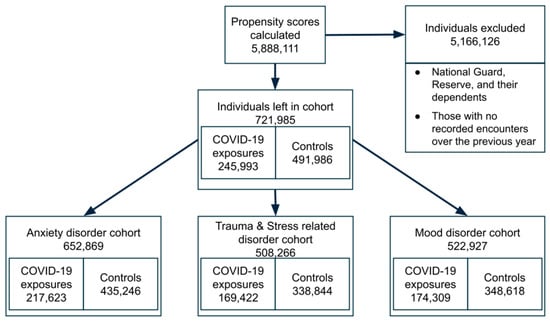
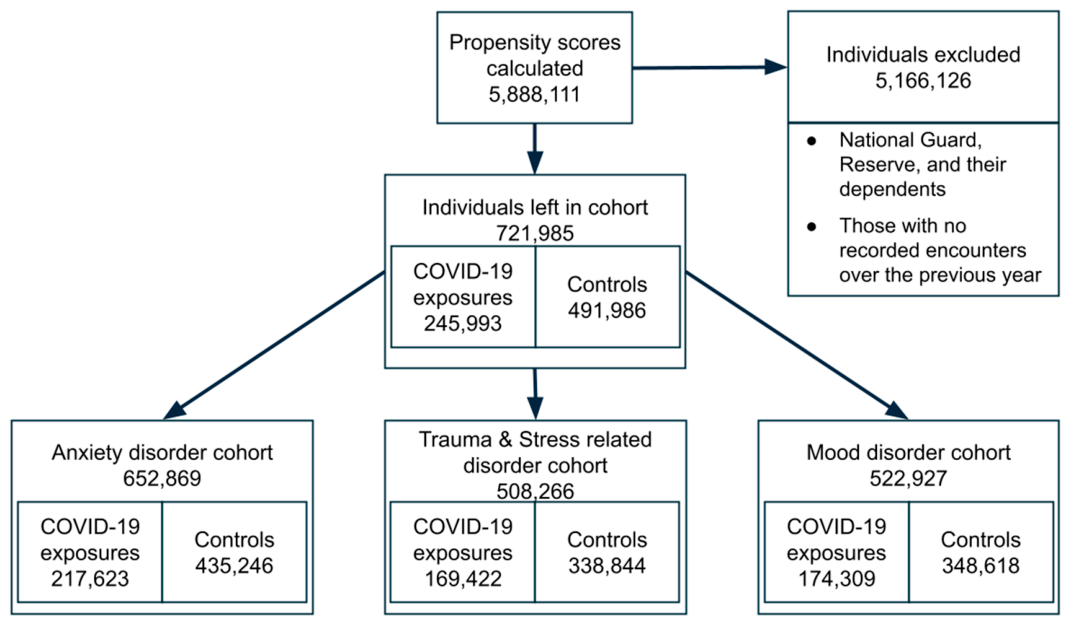
Before matching, there were a total number of 5,888,111 individuals 12–64 years of age enrolled in the MHS from July 2020 to June 2021. After excluding participants who were not matched and did not fit the study criteria, there were 721,985 individuals left in the cohort, with 245,993 COVID-19 exposures and 491,986 unexposed (some individuals served once as a control and once as an exposure). The steps for cohort selection are shown in Figure 1. Out of the individuals left in the cohort, controls and COVID-19 exposures were matched 2:1. Some individuals appeared once as a control and once as an exposure if COVID-19 was acquired later.
Figure 1.
Flowchart for selection of cohorts.
In evaluating the effectiveness of the cohort match, we found that, prior to matching, an average of 3.12% of variables used in the logistic regression model had a standardized mean difference of at least 0.1 for months July 2020–June 2021. After matching, no variables in any month had a standardized mean difference greater than or equal to 0.1.
In the overall matched cohort, prior to mental health-specific washout, the median age of participants was 32 (interquartile range 23, 48), and 44.65% were female. Additional demographics such as sponsor’s rank and beneficiary status of the COVID-19 exposures compared to the controls are shown in Table 2.
Table 2.
Demographics of matched cohort.
The cohort sizes decreased after removing subjects who had prior diagnosis of a mental disorder in the 24 months prior to entering the cohort; the numbers in each of these three cohorts are shown in Figure 1. The frequency and percentages of each group of mental health diagnoses by COVID-19 exposure are listed in Table 3; row percentages are presented in Table S1. The median age, sex, sponsor’s rank, and beneficiary status of those in each mental health category compared to those with no diagnosis are shown in Table 3. Demographics for each individual mental health outcome within the three main cohorts are presented in Table 4.
Table 3.
Demographic numbers and percentages for each mental health category.
Table 4.
Demographic numbers and percentages for each mental health outcome.
A survival analysis was done for each individual mental health outcome and for each mental health category, comparing the groups with COVID-19 to the groups without COVID-19. The average time to event for anxiety disorders was 271 days, while the average time to event for trauma and stressor-related disorders was 266 days, and the average time to event for mood disorders was 270 days. The average time to event (in days) for both COVID-19 and no COVID-19 groups are shown in Table 5.
Table 5.
Mean time to event for each mental health outcome by COVID-19 exposure status.
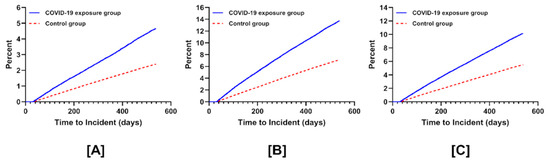
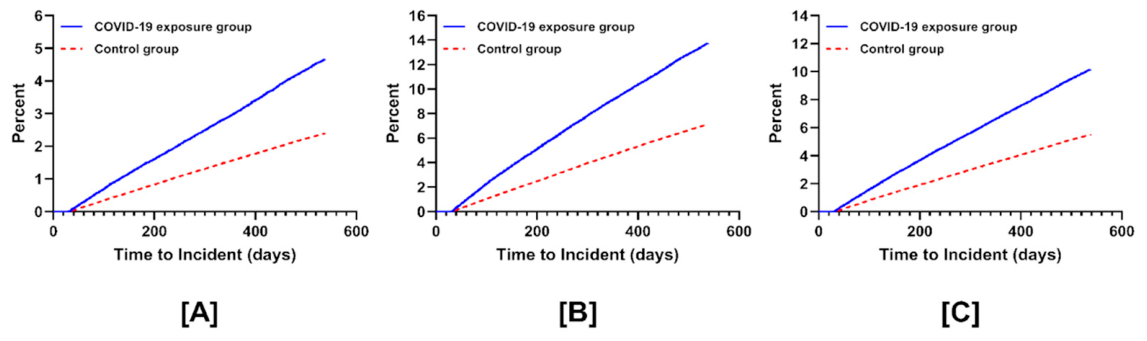
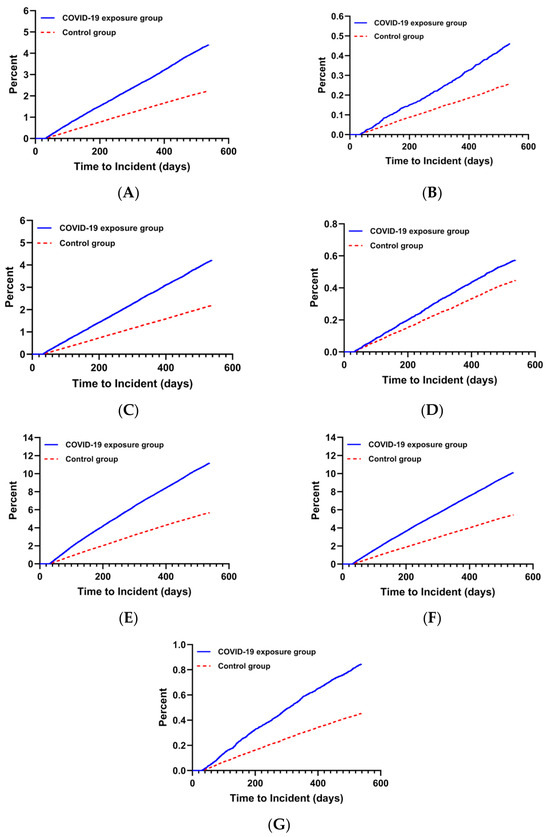
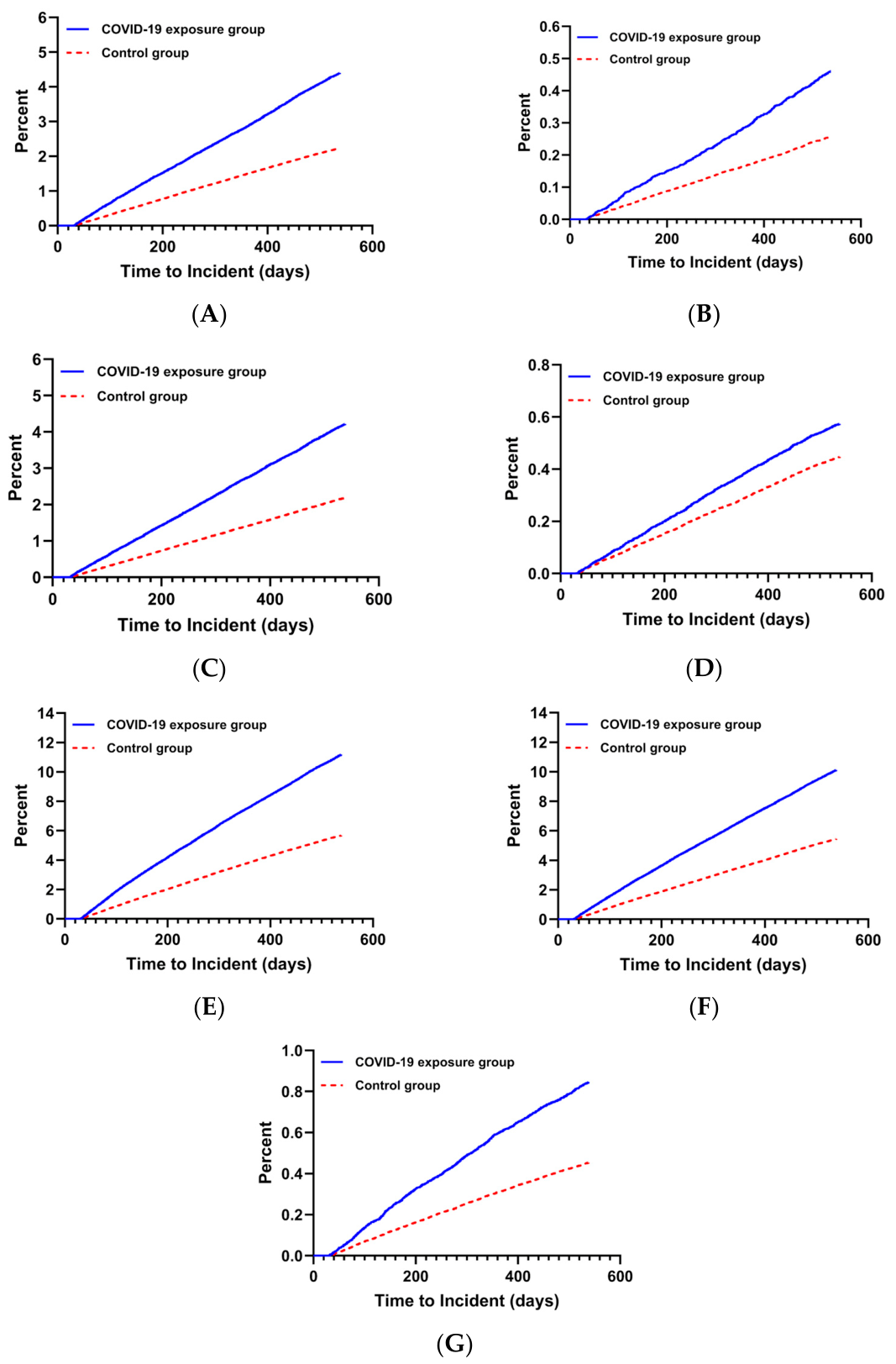
Overall, individuals in the COVID-19 positive group had a higher hazard for an incident diagnosis in all three mental health categories compared to the controls. Cohort members with COVID-19 had the highest hazard ratios for trauma and stressor-related disorders (HR, 1.29; BoCI 1.22–1.37; p < 0.0001), followed by mood disorders (HR, 1.22; BoCI 1.15–1.30; p < 0.0001) and anxiety disorders (HR, 1.16; CI 1.12–1.21; p < 0.0001). Figure 2 shows the cumulative incidence of anxiety, trauma and stressor-related, and mood disorders over time in those with and without COVID-19. Hazard ratios for those with COVID-19 were also higher for each individual mental health outcome except obsessive–compulsive disorder and bipolar disorder, as shown in Table 6. Figure 3 presents the cumulative incidences for individual mental health outcomes within the three main cohorts.
Figure 2.
Cumulative incidence graphs of mental health categories by COVID-19 exposure for (A) anxiety disorders, (B) trauma and stressor-related disorders, and (C) mood disorders.
Table 6.
Hazard ratios and 95% Bonferroni-adjusted confidence intervals for individual mental health outcome after COVID-19 infection.
Figure 3.
Cumulative incidence of each mental health outcome by COVID-19 Exposure. (A) Anxiety disorder. (B) Obsessive–compulsive disorder. (C) Post-traumatic stress disorder. (D) Acute stress disorders. (E) Adjustment disorders. (F) Depressive disorders. (G) Bipolar disorder.
In the evaluation of risks for mental health outcomes by beneficiary type, among the active-duty service members, the hazard was increased for anxiety (HR, 1.16; BoCI 1.08–1.25), mood disorders (HR, 1.16; CI: 1.11–1.21) and trauma and stressor-related disorders (HR, 1.29; BoCI, 1.20–1.39; Table 7). Risks in spouses and retirees were elevated and similar to active-duty service members. Among dependent children, only trauma and stressor-related disorders were associated with a COVID-19 infection (HR, 1.12; BoCI, 1.03–1.22).
Table 7.
Hazard ratios and 95% Bonferroni-corrected confidence intervals for mental health outcome after COVID-19 infection, stratified by beneficiary type.
4. Discussion
This large, retrospective, propensity score-matched cohort study using the Military Health System data demonstrated that a diagnosis of a COVID-19 infection is associated with a significantly increased risk of anxiety, trauma and stressor-related, or mood disorders. Although results have been mixed, these findings support previous studies demonstrating associations between viral and bacterial infections and neuropsychiatric symptoms. Guo et al. found that during the immediate period following COVID-19 infection, depression and anxiety symptoms were significantly higher among those who had developed COVID-19 (60.2% and 55.3% vs. 31.1% and 22.3%) [21]. Similarly, Xie et al. also found increases in anxiety, depressive, and stress and adjustment disorders following COVID-19 infection [22]. Our study showed weaker hazard ratios than those presented by Xie et al., but this likely stems from inclusion criteria and population differences [22]. When comparing patients diagnosed with the flu vs. with COVID-19, COVID-19 infection was associated with an increased risk of mood disorder diagnoses and anxiety disorder, suggesting a unique effect of COVID-19 infection over other viral infections [34]. Compared to individuals without COVID-19, individuals in our study with COVID-19 had the highest hazards for acute stress disorder and adjustment disorder, followed by depressive disorders. Few studies examine links between adjustment disorder and COVID-19 diagnoses; however, associations have been found between stressors during the pandemic, or pandemic era effects, and increased adjustment disorder symptoms [35], potentially contributing to the greater difference between individuals with and without COVID-19 in our own study.
Interestingly, the median ages of diagnoses for our study (31 for anxiety disorders, 29 for trauma and stressor-related and mood disorders) are higher than other studies’ findings, which may represent study population differences [13]. In Nersesjan’s study comparing mental health outcomes of those with positive COVID-19 test results, they found an age effect; in young adults, a positive COVID-19 test was either protective for those 18–29 years old or had no effect for those aged 30–69, whereas there was a positive association with those older than 70 years [36]. In our study, subjects were matched on age, which does not allow for us to evaluate age-associated risk. However, when we stratified by beneficiary type (ADSM, dependent spouses, dependent children and retirees), we found the effect sizes to be similar, suggesting that the association of COVID-19 with mental health conditions is broad. In regard to sex, incident diagnoses of anxiety disorders were more commonly observed among females than males (3.68% vs. 1.34%), supporting previous study findings that females are disproportionately affected by anxiety disorders [13]. The incidences of mood disorders and trauma and stressor-related disorders were also higher in females (7.96% and 7.77% respectively) than in males (3.78% and 6.27% respectively). However, because results within our cohort reflect new diagnoses in a population limited to military beneficiaries who met the propensity score matching criteria, they are not directly comparable to the studies measuring the prevalence of these conditions in the general population [20,37]. Our study’s findings of an association between COVID-19 and mental health conditions are biologically plausible. There are several possible biopsychosocial mechanisms for the observed associations between COVID-19 and incident mental illness. These may include direct viral invasion, secondary effects from the primary infection such as hypoxia or hypercoagulation with microvascular occlusion, immune-mediated damage [38], structural and functional changes in brain tissue, somatopsychic effects of persisting symptoms of post-COVID-19 conditions [39], or other biological pathways such as disruptions to gut microbiome [40]. Looking at brain tissues of patients who died from COVID-19, a significant increase in the extravasation of fibrinogen and immune-mediated injury to endothelial cells suggest that SARS-CoV-2 may enter the brain through classical and alternative pathways of the complement system [41]. Other proposals include hematogenous, transcriptional, and neuronal retrograde dissemination pathways [42]. MRI data from previously infected COVID-19 patients revealed a decrease in brain volume and abnormalities in the limbic system and cerebellum [43], and several studies found white matter hyperintensities following a COVID-19 diagnosis [44], indicating possibilities for explanations of cognitive impairment and mental health.
Limitations of this study include its use of the ICD-10 codes for definitions which may contribute to misclassification bias. The population studied included active-duty service members who may be generally younger and healthier than the general population. Despite a robust propensity score match methodology, there is the potential for bias related to healthcare-seeking behavior; those who have a predisposition to seek COVID-19 testing may also be more likely to develop a mental health condition. We were not able to verify that the controls were not infected, as individuals did have to seek healthcare for testing. Home testing would not have been captured in our study although our cohort was organized in the period prior to widespread availability of home COVID-19 test kits. Additionally, we did not evaluate vaccination status, comorbid long-COVID status, infection severity, or variant type.
A strength of this study is the large cohort from the MHS database. The populations studied include a large, racially, economically, and geographically diverse population. Our study design benefited from robust confounder control and was able to integrate all healthcare encounters and outpatient prescriptions and overall healthcare utilization. We were able to integrate observation time prior to COVID-19 infection to isolate incident diagnoses of mental health conditions. Our study benefitted from universal, low-cost healthcare with higher healthcare engagement. This likely led to a high level of COVID-19 ascertainment. Additionally, the study matched on beneficiary type to fully control for differences in outcomes among active-duty service members and other beneficiaries.
5. Conclusions
This study supports growing evidence that COVID-19 infection is associated with the development of trauma and stressor-related disorders, mood disorders and anxiety disorders in military beneficiaries. Given that mental health disorders have a high burden on military and attrition, these findings highlight a potential long-term threat to operational readiness [2,3]. Further research is needed to help understand the biological mechanisms between COVID-19 and mental health and whether vaccination can mitigate these effects.
Supplementary Materials
The following supporting information can be downloaded at https://www.mdpi.com/article/10.3390/sanpp176030015/s1, Table S1: Demographic Numbers and Row Percentages for Each Mental Health Category.
Author Contributions
Conceptualization, N.M., A.S. and C.M.N.; methodology, N.M., A.S., Z.B., L.N.L. and C.M.N.; interpretation of results, N.M., J.S., A.S., Z.B. and L.N.L.; data curation, J.S. and Z.B.; formal analysis, J.S. and Z.B., writing—original draft preparation, N.M.; writing—review and editing, J.S., A.S., Z.B., L.N.L. and C.M.N.; project supervision, A.S.; project administration, C.M.N.; funding acquisition, C.M.N. All authors have read and agreed to the published version of the manuscript.
Funding
This study was supported by an intramural Uniformed Services University Award (award number 66667; grant number HU00012120014). The funder had no influence over the design, conduct, analysis, and write-up of the study.
Institutional Review Board Statement
This study was reviewed and deemed no more than minimal-risk human subjects research by the Institutional Review Board of the Uniformed Services University (USUHS.2020-065).
Informed Consent Statement
Informed consent and HIPAA consents are not available, as the Institutional Review Board granted waivers due to the nature of the data being accessed.
Data Availability Statement
All data were accessed from the Military Health System database, which requires a valid data sharing agreement due to the nature of personal health information and cannot be shared without prior approval from the US Department of Defense, Defense Health Agency.
Conflicts of Interest
The authors declare no conflicts of interest. The funders had no role in the design of the study; in the collection, analyses, or interpretation of data; in the writing of the manuscript; or in the decision to publish the results.
Abbreviations
The following abbreviations are used in this manuscript:
| ADSM | Active-Duty Service Member |
| AHFS | American Hospital Formulary Service |
| AHRQ | Agency for Healthcare Research and Quality |
| BoCI | Bonferroni-corrected Confidence Intervals |
| CCS | Clinical Classification Software |
| CCSR | Clinical Classification Software Refined |
| CI | Confidence Interval |
| DXCCSR | Clinical Classification Software Refined for Diagnosis Codes |
| GAD-7 | General Anxiety Disorder—7 |
| HR | Hazard Ratio |
| ICD-10 | International Classification of Diseases, 10th revision |
| IL | Interleukin |
| IQR | Interquartile Range |
| MDR | Military Health System Data Repository |
| MHS | Military Health System |
| OCD | Obsessive–Compulsive Disorder |
| PHQ-9 | Patient Health Questionnaire—9 |
| PRCCSR | Clinical Classification Software Refined for Procedure Codes |
| PTSD | Post-Traumatic Stress Disorder |
| SARS-CoV-2 | Severe Acute Respiratory Syndrome Coronavirus 2 |
References
- World Health Organization. Mental Disorders. Available online: https://www.who.int/news-room/fact-sheets/detail/mental-disorders (accessed on 1 October 2025).
- Armed Forces Health Surveillance Division. Absolute and relative morbidity Burdens attributable to various illnesses and injuries among active component members of the U.S. Armed Forces, 2024. MSMR 2025, 32, 4–12. [Google Scholar] [PubMed]
- Hoge, C.W.; Lesikar, S.E.; Guevara, R.; Lange, J.; Brundage, J.F.; Engel, C.C.; Messer, S.C.; Orman, D.T. Mental disorders among U.S. military personnel in the 1990s: Association with high levels of health care utilization and early military attrition. Am. J. Psychiatry 2002, 159, 1576–1583. [Google Scholar] [CrossRef] [Scilit] [PubMed]
- Kohler-Forsberg, O.; Petersen, L.; Gasse, C.; Mortensen, P.B.; Dalsgaard, S.; Yolken, R.H.; Mors, O.; Benros, M.E. A Nationwide Study in Denmark of the Association Between Treated Infections and the Subsequent Risk of Treated Mental Disorders in Children and Adolescents. JAMA Psychiatry 2019, 76, 271–279. [Google Scholar] [CrossRef] [Scilit] [PubMed]
- Stark, C.M.; Susi, A.; Nierenberg, A.A.; Nylund, C.M. Association of Early Life Prescriptions for Antibiotics and Acid Suppressants with Childhood Psychotropic Prescriptions. J. Pediatr. 2022, 246, 191–198.e4. [Google Scholar] [CrossRef] [Scilit] [PubMed]
- Upthegrove, R.; Corsi-Zuelli, F.; Couch, A.C.M.; Barnes, N.M.; Vernon, A.C. Current Position and Future Direction of Inflammation in Neuropsychiatric Disorders: A Review. JAMA Psychiatry 2025, 82, 1030–1046. [Google Scholar] [CrossRef] [Scilit] [PubMed]
- Vai, B.; Mazza, M.G.; Delli Colli, C.; Foiselle, M.; Allen, B.; Benedetti, F.; Borsini, A.; Casanova Dias, M.; Tamouza, R.; Leboyer, M.; et al. Mental disorders and risk of COVID-19-related mortality, hospitalisation, and intensive care unit admission: A systematic review and meta-analysis. Lancet Psychiatry 2021, 8, 797–812. [Google Scholar] [CrossRef] [Scilit] [PubMed] [PubMed Central]
- World Health Organization. COVID-19 Cases, World; World Health Organization: Geneva, Switzerland, 2026. [Google Scholar]
- Alimohamadi, Y.; Sepandi, M.; Taghdir, M.; Hosamirudsari, H. Determine the most common clinical symptoms in COVID-19 patients: A systematic review and meta-analysis. J. Prev. Med. Hyg. 2020, 61, E304–E312. [Google Scholar] [CrossRef] [Scilit] [PubMed]
- Czeisler, M.E.; Lane, R.I.; Petrosky, E.; Wiley, J.F.; Christensen, A.; Njai, R.; Weaver, M.D.; Robbins, R.; Facer-Childs, E.R.; Barger, L.K.; et al. Mental Health, Substance Use, and Suicidal Ideation During the COVID-19 Pandemic—United States, 24–30 June 2020. MMWR Morb. Mortal. Wkly. Rep. 2020, 69, 1049–1057. [Google Scholar] [CrossRef] [Scilit] [PubMed]
- Ten Have, M.; Tuithof, M.; van Dorsselaer, S.; Schouten, F.; Luik, A.I.; de Graaf, R. Prevalence and trends of common mental disorders from 2007–2009 to 2019–2022: Results from the Netherlands Mental Health Survey and Incidence Studies (NEMESIS), including comparison of prevalence rates before vs. during the COVID-19 pandemic. World Psychiatry 2023, 22, 275–285. [Google Scholar] [CrossRef] [Scilit] [PubMed]
- Banks, J.; Xu, X. The Mental Health Effects of the First Two Months of Lockdown during the COVID-19 Pandemic in the UK*. Fisc. Stud. 2020, 41, 685–708. [Google Scholar] [CrossRef] [Scilit]
- Zhu, K.; Niu, Z.; Freudenheim, J.L.; Zhang, Z.-F.; Lei, L.; Homish, G.G.; Cao, Y.; Zorich, S.C.; Yue, Y.; Liu, R.; et al. COVID-19 Related Symptoms of Anxiety, Depression, and PTSD among US Adults. Psychiatry Res. 2021, 301, 113959. [Google Scholar] [CrossRef] [Scilit] [PubMed]
- Currin, J.M.; Evans, A.E.; Miller, B.M.; Owens, C.; Giano, Z.; Hubach, R.D. The impact of initial social distancing measures on individuals’ anxiety and loneliness depending on living with their romantic/sexual partners. Curr. Psychol. 2022, 42, 14953–14961. [Google Scholar] [CrossRef] [Scilit] [PubMed]
- Stein, S.R.; Ramelli, S.C.; Grazioli, A.; Chung, J.-Y.; Singh, M.; Yinda, C.K.; Winkler, C.W.; Sun, J.; Dickey, J.M.; Ylaya, K.; et al. SARS-CoV-2 infection and persistence in the human body and brain at autopsy. Nature 2022, 612, 758–763. [Google Scholar] [CrossRef] [Scilit] [PubMed]
- Bull-Otterson, L.; Baca, S.; Saydah, S.; Boehmer, T.; Adjei, S.; Gray, S.; Harris, A. Post–COVID Conditions Among Adult COVID-19 Survivors Aged 18–64 and ≥65 Years—United States, March 2020–November 2021. MMWR Morb. Mortal. Wkly. Rep. 2022, 71, 713–717. [Google Scholar] [CrossRef] [Scilit]
- Batterham, P.J.; Dawel, A.; Shou, Y.; Gulliver, A.; Cherbuin, N.; Calear, A.L.; Farrer, L.M.; Monaghan, C. COVID-19 infection associated with poorer mental health in a representative population sample. J. Psychosom. Res. 2024, 177, 111588. [Google Scholar] [CrossRef] [Scilit] [PubMed]
- Taquet, M.; Skorniewska, Z.; De Deyn, T.; Hampshire, A.; Trender, W.R.; Hellyer, P.J.; Chalmers, J.D.; Horsley, A.; Marks, M.; Poinasamy, K.; et al. Cognitive and psychiatric symptom trajectories 2–3 years after hospital admission for COVID-19: A longitudinal, prospective cohort study in the UK. Lancet Psychiatry 2024, 11, 696–708. [Google Scholar] [CrossRef] [Scilit] [PubMed]
- Janiri, D.; Carfì, A.; Kotzalidis, G.D.; Bernabei, R.; Landi, F.; Sani, G. Gemelli Against COVID-19 Post-Acute Care Study Group. Posttraumatic Stress Disorder in Patients After Severe COVID-19 Infection. JAMA Psychiatry 2021, 78, 567–569. [Google Scholar] [CrossRef] [Scilit] [PubMed] [PubMed Central]
- Janiri, D.; Kotzalidis, G.D.; Giuseppin, G.; Molinaro, M.; Modica, M.; Montanari, S.; Terenzi, B.; Carfì, A.; Landi, F.; Sani, G. Gemelli Against COVID-19 Post-acute Care Study Group. Psychological Distress After Covid-19 Recovery: Reciprocal Effects with Temperament and Emotional Dysregulation. An Exploratory Study of Patients over 60 Years of Age Assessed in a Post-acute Care Service. Front. Psychiatry 2020, 11, 590135. [Google Scholar] [CrossRef] [Scilit] [PubMed] [PubMed Central]
- Guo, Q.; Zheng, Y.; Shi, J.; Wang, J.; Li, G.; Li, C.; Fromson, J.A.; Xu, Y.; Liu, X.; Xu, H.; et al. Immediate psychological distress in quarantined patients with COVID-19 and its association with peripheral inflammation: A mixed-method study. Brain Behav. Immun. 2020, 88, 17–27. [Google Scholar] [CrossRef] [Scilit] [PubMed]
- Xie, Y.; Xu, E.; Al-Aly, Z. Risks of mental health outcomes in people with covid-19: Cohort study. BMJ 2022, 376, e068993. [Google Scholar] [CrossRef] [Scilit] [PubMed]
- DXCCSR_Mapping_Program_v2022-1: Clinical Classifications Software Refined (CCSR) For ICD-10-CM Mapping Program; version 2022.1; Agency for Healthcare Research and Quality Healthcare Cost and Utilization Project: Rockville, MD, USA, 2021. Available online: https://hcup-us.ahrq.gov/toolssoftware/ccsr/ccsr_archive.jsp#ccsr (accessed on 10 April 2023).
- PRCCSR_Mapping_Program_v2023-1: Clinical Classifications Software Refined (CCSR) for ICD-10-CM Mapping Program; version 2023.1; Agency for Healthcare Research and Quality Healthcare Cost and Utilization Project: Rockville, MD, USA, 2022. Available online: https://hcup-us.ahrq.gov/toolssoftware/ccsr/ccsr_archive.jsp#ccsr-pcs (accessed on 10 April 2023).
- CCS_Services_Procedures_Mapping_Program_v2022-1: Clinical Classifications Software Refined (CCSR) for ICD-10-CM Mapping Program; version 2022.1; Agency for Healthcare Research and Quality Healthcare Cost and Utilization Project: Rockville, MD, USA, 2021. Available online: https://hcup-us.ahrq.gov/toolssoftware/ccs_svcsproc/ccssvcproc.jsp#down (accessed on 10 April 2023).
- Francke, D. Uses of AHFS Classification System. Am. J. Hosp. Pharm. 1963, 20, 119–120. [Google Scholar] [CrossRef] [Scilit]
- Austin, P.C. Optimal caliper widths for propensity-score matching when estimating differences in means and differences in proportions in observational studies. Pharm. Stat. 2011, 10, 150–161. [Google Scholar] [CrossRef] [Scilit] [PubMed]
- Austin, P.C. Assessing balance in measured baseline covariates when using many-to-one matching on the propensity score. Pharmacoepidemiol. Drug Saf. 2008, 17, 1218–1225. [Google Scholar] [CrossRef] [Scilit] [PubMed]
- Austin, P.C. Balance diagnostics for comparing the distribution of baseline covariates between treatment groups in propensity-score matched samples. Stat. Med. 2009, 28, 3083–3107. [Google Scholar] [CrossRef] [Scilit] [PubMed]
- Faries, D.E.; Leon, A.C.; Haro, J.M.; Obenchain, R.L. Analysis of Observational Health Care Data Using SAS; SAS Institute Inc.: Cary, NC, USA, 2010. [Google Scholar]
- Ho, D.; Imai, K.; King, G.; Stuart, E. MatchIt: Nonparametric preprocessing for parametric causal inference. J. Stat. Softw. 2011, 42, 1–28. [Google Scholar] [CrossRef] [Scilit]
- Saul, B. smd: Compute Standardized Mean Differences, version 0.7.0; Comprehensive R Archive Network (CRAN): Vienna, Austria, 2024.
- R Core Team. R: A Language and Environment for Statistical Computing, version 4.4.1; R Foundation for Statistical Computing: Vienna, Austria, 2024.
- Taquet, M.; Geddes, J.R.; Husain, M.; Luciano, S.; Harrison, P.J. 6-month neurological and psychiatric outcomes in 236 379 survivors of COVID-19: A retrospective cohort study using electronic health records. Lancet Psychiatry 2021, 8, 416–427. [Google Scholar] [CrossRef] [Scilit] [PubMed]
- Bambrah, V.; Wyman, A.; Friedman, E.; Eastwood, J.D. Examining the Longitudinal Associations between Adjustment Disorder Symptoms and Boredom during COVID-19. Behav. Sci. 2022, 12, 311. [Google Scholar] [CrossRef] [Scilit] [PubMed]
- Nersesjan, V.; Christensen, R.H.B.; Kondziella, D.; Benros, M.E. COVID-19 and Risk for Mental Disorders Among Adults in Denmark. JAMA Psychiatry 2023, 80, 778–786. [Google Scholar] [CrossRef] [Scilit] [PubMed]
- Simonetti, A.; Restaino, A.; Calderoni, C.; De Chiara, E.; D’Onofrio, A.M.; Lioniello, S.; Camardese, G.; Janiri, D.; Tosato, M.; Landi, F.; et al. The Interplay between Gender and Duration of Hospitalization Modulates Psychiatric Symptom Severity in Subjects with Long COVID-19. Brain Sci. 2024, 14, 744. [Google Scholar] [CrossRef] [Scilit] [PubMed] [PubMed Central]
- Szczesniak, D.; Gladka, A.; Misiak, B.; Cyran, A.; Rymaszewska, J. The SARS-CoV-2 and mental health: From biological mechanisms to social consequences. Prog. Neuropsychopharmacol. Biol. Psychiatry 2021, 104, 110046. [Google Scholar] [CrossRef] [Scilit] [PubMed]
- Penninx, B.; Benros, M.E.; Klein, R.S.; Vinkers, C.H. How COVID-19 shaped mental health: From infection to pandemic effects. Nat. Med. 2022, 28, 2027–2037. [Google Scholar] [CrossRef] [Scilit] [PubMed]
- Villapol, S. Gastrointestinal symptoms associated with COVID-19: Impact on the gut microbiome. Transl. Res. 2020, 226, 57–69. [Google Scholar] [CrossRef] [Scilit] [PubMed]
- Vlaicu, S.I.; Tatomir, A.; Cuevas, J.; Rus, V.; Rus, H. COVID, complement, and the brain. Front. Immunol. 2023, 14, 1216457. [Google Scholar] [CrossRef] [Scilit] [PubMed]
- Baig, A.M. Updates on What ACS Reported: Emerging Evidences of COVID-19 with Nervous System Involvement. ACS Chem. Neurosci. 2020, 11, 1204–1205. [Google Scholar] [CrossRef] [Scilit] [PubMed]
- Douaud, G.; Lee, S.; Alfaro-Almagro, F.; Arthofer, C.; Wang, C.; McCarthy, P.; Lange, F.; Andersson, J.L.R.; Griffanti, L.; Duff, E.; et al. SARS-CoV-2 is associated with changes in brain structure in UK Biobank. Nature 2022, 604, 697–707. [Google Scholar] [CrossRef] [Scilit] [PubMed]
- Cecchetti, G.; Agosta, F.; Canu, E.; Basaia, S.; Barbieri, A.; Cardamone, R.; Bernasconi, M.P.; Castelnovo, V.; Cividini, C.; Cursi, M.; et al. Cognitive, EEG, and MRI features of COVID-19 survivors: A 10-month study. J. Neurol. 2022, 269, 3400–3412. [Google Scholar] [CrossRef] [Scilit] [PubMed]

Disclaimer/Publisher’s Note: The statements, opinions and data contained in all publications are solely those of the individual author(s) and contributor(s) and not of MDPI and/or the editor(s). MDPI and/or the editor(s) disclaim responsibility for any injury to people or property resulting from any ideas, methods, instructions or products referred to in the content. |
© 2026 by the authors. Licensee MDPI, Basel, Switzerland. This article is an open access article distributed under the terms and conditions of the Creative Commons Attribution (CC BY) license.