


Abstract
How childhood trauma and early maladaptive schemas (EMS) are linked to health anxiety, and the role of schema domains in these associations, remain unclear. This study aimed to investigate the association between childhood total, emotional, and sexual trauma and health anxiety severity, illness consequences beliefs, and screen-positive health anxiety, and to estimate indirect associations via schema domains. A total of 507 individuals participated in the study in Greece (65.5% female; mean age = 36.82 years, SD = 11.66). Participants completed the Early Trauma Inventory Self-Report-Short Form, the Young Schema Questionnaire-Short Form 3, and the Short Health Anxiety Inventory. Hierarchical multiple linear and logistic regression, and mediation analyses were conducted using SPSS, the PROCESS macro, and R. In the adjusted models, significant specific indirect associations were observed via impaired autonomy and performance (IAP) between total and emotional childhood trauma and health anxiety severity, illness consequences beliefs, and screen-positive health anxiety. In this study, childhood trauma was retrospectively self-reported in adulthood, whereas EMS and health anxiety were assessed concurrently; therefore, trauma reports may be affected by recall bias, and temporal ordering cannot be established. Total childhood traumatic experiences, particularly emotional trauma, and IAP are associated with various aspects of health anxiety. Future intervention studies should examine whether Schema Therapy targeting EMS within the IAP domain reduces health anxiety among individuals with early trauma histories.
1. Introduction
Health anxiety refers to worry about having or developing a serious illness, often involving threatening interpretations of bodily sensations. It ranges from mild concerns to persistent preoccupation and becomes clinically concerning when associated with marked distress or impaired daily functioning [1]. Health anxiety is a common mental health problem, with current literature suggesting a 1- to 2-year prevalence in the general population ranging from 1.3% to 10% [2]. Health anxiety is associated with poor health outcomes, including an increased risk of disability and reduced quality of life [3]. Moreover, health anxiety is linked to adverse healthcare and treatment-related outcomes, such as increased healthcare utilization and possibly delayed and inconsistent help-seeking for health problems [4]. Various sociodemographic factors are linked to health anxiety, including age, education, household income, and employment status, although findings vary across populations [5,6]. However, early life psychosocial factors contributing to health anxiety are understudied. To address this gap, we examined the associations of childhood trauma with different aspects of health anxiety, including indirect associations via schema domains.
1.1. Childhood Trauma
Childhood trauma is a key risk factor for adverse mental health outcomes, including health anxiety, across the lifespan [7,8]. The World Health Organization (WHO) defines child maltreatment, a key source of childhood trauma, as follows: “All forms of physical and/or emotional ill-treatment, sexual abuse, neglect or negligent treatment or commercial or other exploitation, resulting in actual or potential harm to the child’s health, survival, development or dignity in the context of a relationship of responsibility, trust or power” [9].
Childhood trauma is common, with 6 in 10 children experiencing some form of maltreatment before age 5 [10]. Early traumatic experiences (e.g., physical, emotional, and sexual abuse and neglect) have profound consequences that can persist well into adulthood [11]. Among others, childhood trauma has been linked to mental health problems (e.g., anxiety disorders, depressive disorders, and post-traumatic stress disorder) [8], physical health problems (e.g., heart and respiratory disease) [12], multimorbidity [13], health behaviors (e.g., substance use) [14], and impaired psychosocial functioning [15,16]. Moreover, other early stressful experiences (e.g., perceived parental rejection) are also linked to an individual’s mental health outcomes [17].
Regarding health anxiety, the current literature links childhood trauma to health anxiety status and severity. Specifically, individuals with high levels of health anxiety report higher rates of childhood trauma than those without health anxiety [7]. Moreover, childhood trauma is positively linked to health anxiety symptom severity [18,19,20]. Various possible mechanisms have been proposed to interpret the associations between childhood trauma and health anxiety. According to Haugaard [21], individuals who have experienced childhood trauma may tend to express emotions through physical symptoms due to a background of emotional distress closely linked to physical discomfort. Moreover, childhood trauma appears to contribute to key behaviors for health anxiety, such as increased help-seeking [22]. Emotional and interpersonal vulnerabilities may also help explain this association. Cross-sectional studies have reported indirect associations between childhood adversity and health anxiety via negative affect and trait anxiety [18], and between childhood abuse and health anxiety via anxious attachment [20]. Negative illness appraisals are another possible mechanism linking childhood trauma to health anxiety. In a cross-sectional study of emerging adults with chronic illness, childhood adversity was associated with greater illness uncertainty and perceived disruption of daily life by illness, which were in turn associated with higher health anxiety [19].
1.2. Childhood Trauma and Health Anxiety: Specificity Versus Accumulation
Over the last three decades, the literature has focused on elucidating the impact of the distinct and additive childhood trauma types on health anxiety. Previous research has reported associations between different trauma types and health anxiety. Specifically, in their study, Reiser et al. [20] found that all types of childhood abuse and total abuse severity are associated with health anxiety among University students. Moreover, in a longitudinal study spanning over 30 years, physical, emotional, and sexual abuse were independently associated with increased health anxiety [23]. However, when childhood trauma was assessed via officially substantiated records rather than self-report, only sexual abuse remained significantly linked to health anxiety [23]. This discrepancy may partly reflect differences in exposure ascertainment and statistical power, as agency records identified fewer maltreatment cases than self-reports. Retrospective reports may also be influenced by recall processes and shared-method variance when health anxiety is self-reported. Other studies have linked cumulative traumatic experiences (i.e., the total number of traumatic experiences) to health anxiety [18,19,20].
1.3. Early Maladaptive Schemas
Cognitive theories of health anxiety posit that dysfunctional cognitions and thinking styles arising from past experiences, especially childhood ones, play a key role in health anxiety [24,25]. Early maladaptive schemas (EMS) are pervasive dysfunctional patterns of thoughts, memories, emotions, and physical sensations, that develop early in an individual’s life and are thought to represent the deepest level of cognition [26,27]. According to Schema Therapy, EMS develop as a result of the interaction between early adverse or overly positive experiences and the child’s temperament, ultimately leaving the child’s core emotional needs unmet. Young et al. [26] identify 18 EMS, grouped into five broad domains, namely: disconnection and rejection (DR), impaired autonomy and performance (IAP), impaired limits (IL), other-directedness (OD), and overvigilance and inhibition (OI). Moreover, more recent studies suggest the existence of up to 23 EMS and a different arrangement of the EMS in schema domains [28].
Current literature suggests that schema domains are linked to health anxiety, with some studies reporting that all schema domains predict health anxiety [29] and others emphasizing the role of specific domains (i.e., IAP, IL) [30]. Among EMS, the vulnerability to harm/illness schema appears to be a critical vulnerability factor for health anxiety, with previous studies linking it to increased illness anxiety in general [30] and in the context of specific health threats (i.e., the COVID-19 pandemic) [31].
1.4. The Interplay Between Childhood Trauma, Early Maladaptive Schemas, and Health Anxiety
According to Thorgaard et al. [32], childhood adversity is one of the three main categories of childhood determinants of health anxiety (alongside childhood learning and attachment), with individuals diagnosed with health anxiety reporting a higher frequency of childhood traumatic experiences than healthy controls. Moreover, regarding the associations between childhood trauma and schema domains, Schema Theory posits that adverse childhood experiences contribute to the frustration of core emotional needs, ultimately leading to the development of EMS [26]. Indeed, the recent meta-analysis by Pilkington et al. [33] found that adverse childhood experiences are associated with EMS in adulthood, with emotional abuse and neglect showing the strongest associations. In turn, EMS have been shown to mediate the association between childhood trauma and anxiety-related outcomes, including general anxiety symptoms [34], social anxiety [35], and phobic anxiety [36]. In certain cases, stressful childhood experiences, such as parental rejection, appear to be indirectly linked even to an increased risk of anxiety-related mental disorders (e.g., muscle dysmorphia), via EMS [37].
Among schema domains, IAP is closely related both to childhood trauma and health anxiety [30,34]. According to Young et al. [26], IAP encompasses expectations of vulnerability and difficulties functioning independently. These expectations may help explain how adverse childhood experiences relate to health anxiety: bodily sensations may be interpreted as threatening, while the consequences of illness may be perceived as unmanageable. Indeed, IAP has been prospectively associated with more negative perceptions of the illness’s impact among individuals with major depressive disorder [38]. Although, to our knowledge, research on indirect associations between childhood trauma and health anxiety via schema domains is scarce, recent studies have reported indirect associations between childhood trauma and other types of anxiety, including anxiety symptoms in general [34], social anxiety [39], and attachment anxiety [40] via EMS and schema domains.
1.5. The Present Study
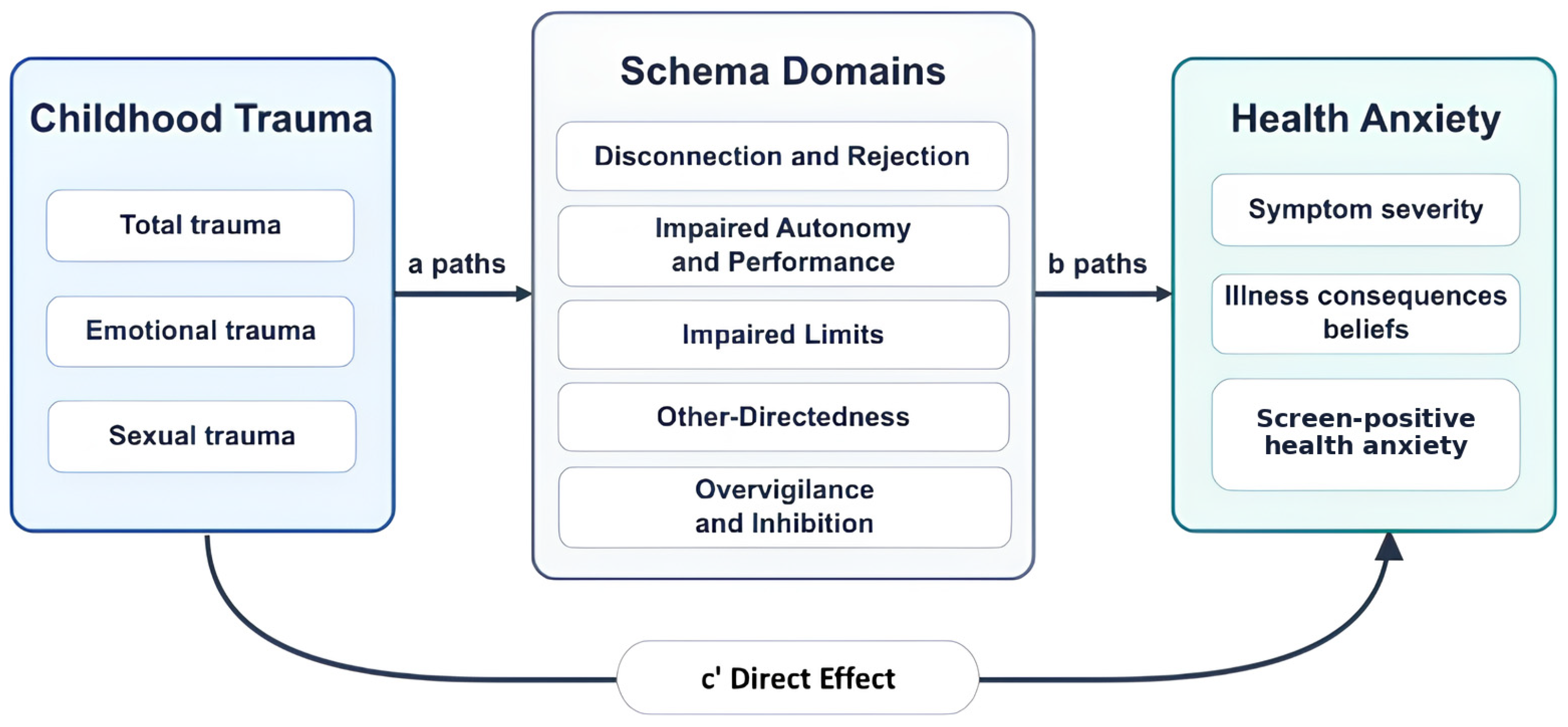
Previous research has investigated the associations between childhood trauma, EMS, and health anxiety. However, whether there are indirect associations between childhood trauma and health anxiety via schema domains remains unclear. Moreover, to our knowledge, no previous study has investigated whether the five schema domains are related to distinct aspects of health anxiety, including symptom severity, illness consequences beliefs, and screen-positive health anxiety. Finally, whether specific trauma types or total trauma count is more strongly associated with health anxiety is still debated. Therefore, the current research aimed to examine the association between childhood trauma, various aspects of health anxiety, and indirect associations via schema domains. We hypothesize that: (1) all types of childhood trauma and all schema domains are associated with higher health anxiety symptom severity, stronger illness consequences beliefs, and screen-positive health anxiety; (2) total trauma count is more strongly related to health anxiety than specific trauma types; (3) there are indirect associations between childhood trauma and health anxiety via the five schema domains. Figure 1 presents the hypothesized conceptual mediation model.
Figure 1.
Hypothesized conceptual model of the cross-sectional associations among childhood trauma, schema domains, and health anxiety. Note: Each predictor and outcome variable is modeled separately. Directional arrows indicate hypothesized statistical paths and do not imply temporal ordering or causality. A path describes the direct associations between childhood trauma and schema domains; b path describes the direct association between schema domains and health anxiety; c’ path describes the direct associations between childhood trauma and health anxiety after adjustment for schema domains.
2. Materials and Methods
2.1. Participants
In total, 507 individuals participated in the present study. Participants were recruited through study invitations posted on the researchers’ Facebook and Instagram accounts, which included a link to the online questionnaire. The link directed participants to a Microsoft Forms survey (Microsoft Corp., Redmond, WA, USA) containing the participant information sheet, consent form, and study questionnaires. Among participants, 332 were female (65.5%), 171 were male (33.7%), and 4 (0.8%) reported “other” as their gender. Participants’ age ranged from 18 to 65 years (M = 36.82, SD = 11.66). Forty-seven participants (9.3%) were primary school graduates, 227 (44.8%) were junior high school graduates, 59 (11.7%) were high school graduates, 32 (6.3%) attended vocational training, and 141 (27.8%) held a University degree. Education was missing for one participant. Ninety participants (17.8%) screened positive for health anxiety.
This study was approved by the Research Ethics Committee of the MBS College of Crete (registration number: 24/14.12.2025). Following the presentation of the study’s aims and methods, all participants provided written informed consent to participate in the study, according to the Declaration of Helsinki [41].
2.2. Measures
2.2.1. Socio-Demographic Variables
Socio-demographic questions included information about participants’ age, gender, and education.
2.2.2. Early Trauma Inventory Self-Report Short Form
The Early Trauma Inventory Self-Report Short Form (ETI-SR-SF) [42] is a 27-item questionnaire designed to measure various types of childhood traumatic experiences (i.e., general, physical, emotional, and sexual trauma), as well as total childhood traumatic experiences (total score). Individuals respond to the ETI-SR-SF items with a ‘Yes’ or a ‘No’. Each trauma subscale score is the number of endorsed experiences (general: 11 items; physical: 5; emotional: 5; sexual: 6). The total score sums all 27 items, excluding the three additional follow-up questions, and represents the number of endorsed experiences rather than their frequency, intensity, or duration. The ETI-SR-SF includes three additional items that assess the single most traumatic event for each individual, fear, and depersonalization resulting from this event. The ETI-SR-SF has been validated for use in the Greek population [43]. In the present study, McDonald’s omega was 0.84 for the ETI-SR-SF total score, 0.82 for the emotional abuse subscale, and 0.77 for sexual trauma. We excluded the general and physical trauma subscales from separate subtype analyses because of low internal consistency. Their items were retained in the total score because this index counts exposure to diverse traumatic experiences rather than measuring a single homogeneous construct.
2.2.3. Young Schema Questionnaire-Short Form 3
The Young Schema Questionnaire-Short Form 3 (YSQ-S3) [44] is a 90-item self-report questionnaire that measures the 18 EMS and the five schema domains. Responses to the YSQ-S3 are made on a 6-point Likert-type scale ranging from 1 = “Completely untrue for me” to 6 = “Describes me perfectly.” In this study, we used the mean scores for the five schema domains (possible range = 1–6). The YSQ-S3 has been validated for use in the Greek population [45]. In our study, McDonald’s omega values were: 0.95 for DR, 0.93 for IAP, 0.85 for IL, 0.88 for OD, and 0.92 for OI.
2.2.4. Short Health Anxiety Inventory
The Short Health Anxiety Inventory (SHAI) [46] is an 18-item self-report questionnaire designed to measure health anxiety severity and beliefs about illness consequences. Responses to the SHAI are made on a 4-point Likert-type scale ranging from 0 to 3 (possible range for the health anxiety severity subscale = 0–42 and for illness-consequences subscale = 0–12). Previous studies in the Greek population have shown good internal consistency for the SHAI [47]. A psychometric evaluation of the Greek SHAI supported its two-factor structure and internal consistency [48]. McDonald’s omega was 0.91 for the health anxiety severity scale and 0.76 for illness consequences beliefs. Based on the suggestions of Rode et al. [49], a score of ≥18 on the SHAI health anxiety severity subscale was used to identify screen-positive health anxiety.
2.3. Procedure
Data were collected between December 2025 and March 2026. Participants were recruited online via the researchers’ Facebook and Instagram accounts. Specifically, the researchers posted an invitation to the study on their accounts, including a link to a Microsoft Forms questionnaire. Following the post on social media sites, all interested individuals were informed about the study’s aims and methods, what they would be asked to do, anonymity and confidentiality, and their right to decline participation or withdraw from the study at any time without consequences. Moreover, participants were informed that the estimated time to complete the questionnaires was 35 min. Participants were provided with the researchers’ email address in case they needed more information or help completing the questionnaires. Participation was completely voluntary, and there were no incentives. All participants provided written informed consent. This study was approved by the Research Ethics Committee of the MBS College of Crete (registration number: 24/14.12.2025). All procedures adhered to the Declaration of Helsinki [41].
2.4. Statistical Analysis
To determine the necessary sample size for the mediation models, we conducted an a priori Monte Carlo power analysis in R 4.3.3 (R Foundation for Statistical Computing, Vienna, Austria) using 1000 simulated datasets. We specified medium-sized standardized paths (Cohen’s criteria) for the a- and b-paths for 0.8 power. Results indicated that a sample size of n = 250 achieved adequate power. For the linear models, residual-versus-fitted plots were used to assess overall functional form and homoscedasticity, whereas component-plus-residual plots were used to assess the functional form of individual continuous predictors. Normal P–P plots and residual skewness and kurtosis were used to assess the distribution of model residuals, with cut-off values of ±2 and ±7, respectively [50]. HC3 robust standard errors were used as a sensitivity check where heteroscedasticity was detected. For the logistic models, we examined convergence and complete or quasi-complete separation. Moreover, we examined linearity of continuous predictors in the logit using Box–Tidwell tests with within-model Bonferroni correction, and unusual or influential observations using standardized Pearson residuals and Cook’s distance. Multicollinearity was assessed in all models using VIFs and tolerance values. A VIF value above 5 and tolerance values below 0.20 were considered potentially problematic [51,52]. To investigate whether missing cases were missing completely at random, we used Little’s Test of Missing Completely at Random. Given the low percentage of missing questionnaire data (0.44%), missing item values were replaced with the series mean.
We described the mean and standard deviation for all variables using descriptive statistics. To investigate bivariate associations between the study’s variables, we used Pearson’s r correlation coefficient. Hierarchical multiple linear regression and hierarchical logistic regression were used to examine the multivariate associations between childhood trauma, schema domains, and health anxiety. To address the overlap between total and subtype scores, emotional trauma, sexual trauma, and the remaining cumulative exposure (the total ETI-SR-SF score minus emotional and sexual trauma) were entered simultaneously in regression models adjusted for age, gender, and education.
To evaluate the second hypothesis, total, emotional, and sexual trauma were examined in separate models, each adjusted for age, gender, and education. We compared standardized coefficients for the continuous outcomes and average marginal slopes on the probability scale per standard deviation of exposure for screen-positive health anxiety. Differences between total and subtype associations were estimated using 5000 paired bootstrap resamples, preserving the dependence between the overlapping exposure indices. Bonferroni-adjusted 97.5% confidence intervals were used for the two comparisons within each outcome.
We specified a series of mediation models using Model 4 of Hayes’ PROCESS macro (version 4.2; Andrew F. Hayes, Calgary, AB, Canada) [52] for IBM SPSS Statistics 31 (IBM Corp., Armonk, NY, USA). Three independent-variable specifications were examined: total childhood trauma score, emotional trauma, and sexual trauma. In the models including emotional and sexual trauma, each trauma type was examined while statistically adjusting for the other to estimate their adjusted associations. Moreover, we built separate models for each dependent variable (i.e., health anxiety severity, illness consequences beliefs, screen-positive for health anxiety). The five schema domains were included as mediators, and gender, age, and education were included as control variables in all models. Preacher and Hayes (2008) [53] argue that when mediators are correlated, indirect associations estimated in separate single-mediator models are not equivalent to the specific indirect associations estimated in a parallel model, which account for the other mediators. Thus, we used parallel models to estimate each domain’s specific indirect association while accounting for the other schema domains. However, we also used separate single-mediator models as a sensitivity analysis. These cross-sectional models estimate indirect associations and do not establish temporal ordering or causality. Bonferroni correction was used to correct for testing five simultaneous specific indirect effects in parallel per outcome. Regression estimates are reported as unstandardized B coefficients, with standardized β coefficients for linear regressions and odds ratios for logistic regressions. Indirect associations are reported as unstandardized products of coefficients; those involving screen-positive health anxiety are on the log-odds scale. Main and single-mediator models used 5000 bootstrap resamples. We report 95% percentile bootstrap confidence intervals (CIs), with 99% CIs used to evaluate the five domain-specific associations within each model. Hypothesis testing was conducted assuming a significance level of 0.05 and a two-sided alternative hypothesis.
To assess potential overlap with vulnerability to harm/illness, we repeated the total- and emotional-trauma parallel models after excluding this schema from IAP, retaining the other four schema domains and the same covariates. These sensitivity models used 50,000 bootstrap resamples to reduce Monte Carlo variability because the intervals for illness consequences beliefs were close to zero. Their 95% bootstrap CIs were interpreted as exploratory sensitivity results.
Nonlinear sensitivity analyses retained all five schema domains and the same covariates. Outcome equations included a quadratic term for IAP. Total-trauma models additionally used restricted cubic splines in the mediator and outcome equations, with knots at the 5th, 35th, 65th, and 95th percentiles. Average indirect associations were calculated by averaging products of path derivatives evaluated at fitted mediator values [54]. Bonferroni-adjusted 99% percentile bootstrap confidence intervals were obtained using 50,000 resamples to reduce Monte Carlo variability in the estimated interval endpoints.
All analyses were conducted using the PROCESS 4.2 macro for IBM SPSS Statistics 31 and R 4.3.3.
3. Results
3.1. Missing Data Analysis and Diagnostics
Of the total data, 0.44% of this study’s main variables were missing. Little’s Test of Missing Completely at Random was non-significant (p > 0.05), providing no evidence against the missing-completely-at-random assumption. Residual distributions showed no severe departures from normality. Associations with IAP flattened at higher scores but remained significant in quadratic sensitivity models. We detected heteroscedasticity only in the health-anxiety severity schema-domain model, but HC3 robust standard errors did not alter its conclusions. All logistic models converged without separation. Total trauma and IAP showed evidence of logit nonlinearity after within-model Bonferroni correction (adjusted p = 0.037 and 0.042, respectively). Nonlinear sensitivity results are reported in Section 3.6. No observation had Cook’s D > 1 (maximum 0.213 in linear models and 0.159 in logistic models). Across the parallel-model outcome equations, schema-domain VIFs ranged from 2.47 to 5.24 in the linear models and from 2.54 to 5.94 in the logistic models; corresponding tolerance values ranged from 0.191 to 0.405 and from 0.168 to 0.394, respectively. Some values exceeded the prespecified conservative thresholds, indicating potential sensitivity of domain-specific estimates to collinearity, although all VIFs remained below the commonly cited threshold of 10 [55] (Tables S1 and S4).
3.2. Descriptive Statistics and Intercorrelations Between the Study Variables
Total and emotional trauma were positively associated with all schema domains, health anxiety severity, and illness consequences beliefs. Sexual trauma was positively correlated with all variables except for OI and illness consequences beliefs. All schema domains were significantly and positively correlated with each other. Health anxiety severity was positively associated with illness consequences beliefs. The results of the correlation analyses are presented in Table 1.
Table 1.
Descriptive statistics and bivariate correlations among study variables.
3.3. Multivariate Associations Between Childhood Trauma, Schema Domains, and Health Anxiety
To investigate the predictive role of childhood trauma and schema domains in health anxiety, a series of hierarchical regression models were used. Age, gender, and education were used as control variables in all models. Regarding health anxiety severity, the total trauma model was statistically significant F(8, 498) = 5.82, p < 0.001, R2 = 0.086. Specifically, total childhood trauma was associated with higher health anxiety severity B = 0.36, SE = 0.06, β = 0.24, 95% CI [0.23, 0.49], p < 0.001. In the trauma type model, the final model was also significant, F(9, 497) = 6.14, p < 0.001, R2 = 0.100. Emotional trauma was significantly associated with higher health anxiety severity, B = 1.04, SE = 0.18, β = 0.26, t = 5.82, p < 0.001, whereas sexual trauma’s role was not significant, B = 0.16, SE = 0.24, β = 0.03, t = 0.66, p = 0.512. Finally, the schema-domain model was significant, F(12, 494) = 7.91, p < 0.001, and explained 16.1% of the variance, R2 = 0.161. Among the schema domains, IAP was the only significant predictor of health anxiety severity, B = 3.81, SE = 0.62, β = 0.46, t = 6.11, p < 0.001.
Concerning illness consequences beliefs, the total trauma model was statistically significant, F(8, 498) = 3.64, p < 0.001, R2 = 0.055. Total childhood trauma was a significant positive predictor of illness consequences beliefs, B = 0.06, SE = 0.02, β = 0.11, t = 2.46, p = 0.014. In the trauma type model, the final model was also significant, F(9, 497) = 4.78, p < 0.001, R2 = 0.080. Emotional trauma was significantly associated with stronger illness consequences beliefs, B = 0.27, SE = 0.06, β = 0.20, t = 4.40, p < 0.001, while sexual trauma had no significant role, B = −0.10, SE = 0.08, β = −0.06, t = −1.24, p = 0.216. Finally, the schema domain model was significant, F(12, 494) = 7.40, p < 0.001, and explained 15.2% of the variance, R2 = 0.152. Among schema domains, IAP was linked to illness consequences beliefs, B = 0.88, SE = 0.21, β = 0.31, t = 4.10, p < 0.001.
For screen-positive health anxiety, the adjusted total trauma logistic regression model was statistically significant, χ2(8) = 19.93, p = 0.011, Nagelkerke R2 = 0.063. Total childhood trauma was associated with higher odds of screening positive for health anxiety, B = 0.07, SE = 0.02, OR = 1.08, 95% CI [1.03, 1.13], p = 0.001. The trauma subtype model was statistically significant, χ2(9) = 25.42, p = 0.003, Nagelkerke R2 = 0.080. Emotional trauma was associated with higher odds of screening positive for health anxiety, B = 0.26, SE = 0.07, OR = 1.29, 95% CI [1.13, 1.47], p < 0.001. Sexual trauma was not significantly associated with screen-positive health anxiety (p > 0.05). The schema-domain model was statistically significant, χ2(12) = 54.12, p < 0.001, Nagelkerke R2 = 0.167. IAP was associated with higher odds of screening positive for health anxiety, B = 1.26, SE = 0.25, OR = 3.52, 95% CI [2.13, 5.79], p < 0.001. OD had a negative adjusted association (OR = 0.54, 95% CI [0.31, 0.93], p = 0.026). The results of the adjusted linear and logistic regression models are presented in Table 2.
Table 2.
Multivariate associations between childhood trauma, schema domains, and health anxiety.
3.4. Cumulative and Trauma-Subtype Associations
Using Bonferroni-adjusted 97.5% bootstrap confidence intervals, total trauma showed stronger associations than sexual trauma with all three outcomes. Emotional trauma showed a stronger association than total trauma with illness consequences beliefs. The differences between total and emotional trauma were not statistically significant for health anxiety severity or screen-positive health anxiety (Table 3).
Table 3.
Comparisons of associations of total, emotional, and sexual trauma with health anxiety.
Because total trauma includes the subtype scores, the sensitivity analysis modeled emotional trauma, sexual trauma, and the remaining cumulative exposure as non-overlapping components. Table S6 presents their mutually adjusted associations with each outcome. In the sensitivity models simultaneously including emotional trauma, sexual trauma, the remaining cumulative exposure, and control variables, emotional trauma remained positively associated with health anxiety severity (B = 0.935, 95% CI [0.531, 1.339], p < 0.001). Moreover, emotional trauma was also positively associated with illness consequences beliefs (B = 0.293, 95% CI [0.153, 0.432], p < 0.001) and screen-positive health anxiety (OR = 1.27, 95% CI [1.09, 1.48], p = 0.002). Sexual trauma and the remaining cumulative exposure were not significantly associated with any outcome (all p > 0.05).
3.5. Indirect Associations Between Childhood Trauma, Health Anxiety Severity, and Illness Consequences Beliefs via Schema Domains
After adjusting for gender, age, and education, total childhood trauma had significant total and direct associations with health anxiety severity. The total indirect association via schema domains was also significant, with IAP showing the only significant specific indirect association. Total trauma also had a significant total association with illness consequences beliefs. However, the direct association became non-significant after including schema domains. The total indirect association was significant. Again, IAP showed the only significant specific indirect association. Both specific indirect associations remained significant after applying Bonferroni-corrected 99% bootstrap confidence intervals.
Regarding emotional trauma, after adjusting for gender, age, education, and sexual trauma, both the total and direct associations with health anxiety severity were significant. The total indirect association via schema domains was also significant. At the 95% bootstrap confidence interval level, significant specific indirect associations emerged via DR and IAP. However, after applying Bonferroni-corrected 99% bootstrap confidence intervals, only the indirect association via IAP remained significant. Emotional trauma also had a significant total association with illness consequences beliefs, whereas the direct association became non-significant after accounting for schema domains. The total indirect association was significant, with IAP showing the only significant specific indirect association. This association also remained significant after Bonferroni correction.
Sexual trauma did not show significant total, direct, or indirect associations with health anxiety severity or illness consequences beliefs after adjusting for emotional trauma and sociodemographic covariates. Table 4 presents the results of the mediation analyses for health anxiety severity and illness consequences beliefs.
Table 4.
Childhood trauma, schema domains, and health anxiety: Total, Direct, and Indirect effects.
As a sensitivity analysis, to examine whether the role of IAP was robust to the simultaneous inclusion of the highly correlated schema domains, we repeated the analyses using separate single-mediator models. The indirect association through IAP remained positive and non-zero for all three outcomes in the total- and emotional-trauma models, including when evaluated using 99% bootstrap confidence intervals. It produced the largest indirect estimate in four of the six models and the second largest in the remaining two, and it was the only domain with non-zero estimates across all six models at the 99% confidence level. No domain showed a non-zero indirect association with any outcome for sexual trauma after adjustment for emotional trauma. Thus, the association involving IAP was robust across parallel and separate-mediator specifications, although the separate models also indicated that variance shared among schema domains contributed to several associations (Table S2).
3.6. Childhood Trauma, Schema Domains, and Screen-Positive Health Anxiety: Indirect Associations
After adjusting for age, gender, and education, total childhood trauma showed a significant direct association with screen-positive health anxiety. The total indirect association via schema domains was not significant. Significant specific indirect associations emerged via IAP (positive) and OD (negative), and both remained significant using Bonferroni-corrected 99% bootstrap confidence intervals. Emotional trauma showed the same pattern after additionally adjusting for sexual trauma: a significant direct association, a non-significant total indirect association, and positive and negative specific indirect associations via IAP and OD, respectively, both retained at the 99% confidence level. Sexual trauma showed no significant direct or indirect associations after adjustment for emotional trauma and sociodemographic covariates. These estimates are on the log-odds scale and conditional on the other domains; the negative estimates should not be interpreted as evidence of a protective mechanism. Table 5 presents the results.
Table 5.
Childhood trauma, schema domains, and screen-positive health anxiety: Total, Direct, and Indirect associations.
After excluding Vulnerability to Harm/Illness from IAP, the specific indirect associations remained significant for health anxiety severity (total trauma: B = 0.097, 95% bootstrap CI [0.033, 0.174]; emotional trauma: B = 0.314, 95% bootstrap CI [0.109, 0.542]) and screen-positive health anxiety (total trauma: B = 0.035, 95% bootstrap CI [0.013, 0.068]; emotional trauma: B = 0.116, 95% bootstrap CI [0.045, 0.216]). The corresponding intervals for illness consequences beliefs included zero (total trauma: B = 0.022, 95% bootstrap CI [−0.0005, 0.0490]; emotional trauma: B = 0.074, 95% bootstrap CI [−0.0003, 0.1556]). Full sensitivity results are provided in Table S3. In nonlinear sensitivity analyses, the average indirect associations via IAP remained positive for both total and emotional trauma across all three outcomes. All Bonferroni-adjusted 99% bootstrap confidence intervals excluded zero (Table S5).
4. Discussion
This study aimed to investigate the associations between childhood trauma, schema domains, and health anxiety, and the indirect associations between childhood trauma and health anxiety via schema domains. The results indicate that total traumatic experiences, emotional trauma in particular, and the IAP schema domain are linked to higher health anxiety severity, increased illness consequences beliefs, and higher odds of screening positive for health anxiety. Finally, significant specific indirect associations via IAP were observed between total and emotional childhood trauma and health anxiety severity, illness consequences beliefs, and screen-positive health anxiety.
Regarding the associations between childhood trauma, schema domains, and health anxiety, the findings partially supported our first hypothesis. Specifically, higher total traumatic experiences count and higher emotional trauma were associated with poorer outcomes across all aspects of health anxiety. These findings align with current literature [19,20]. Childhood trauma, and emotional maltreatment in particular, were associated with a heightened sense of health-related threat perception, specific processes associated with health anxiety (e.g., worry about health, heightened bodily awareness, difficulties resisting and disengaging from thoughts about health), and stronger beliefs about the consequences of being ill. Among schema domains, IAP was the only domain positively associated with all three outcomes in the models containing all five domains simultaneously. Indeed, previous studies link IAP to health anxiety [29,30]. According to Schema Therapy, IAP leads to a pervasive sense of vulnerability, with one of its EMS (i.e., vulnerability to harm/illness) promoting a particular vulnerability to health-related threats [26]. This latent vulnerability could lead to heightened health anxiety thoughts and behaviors when EMS within the IAP domain are activated.
The second hypothesis was also partially supported. Total trauma showed stronger associations than sexual trauma with all three outcomes, but not stronger associations than emotional trauma. Emotional trauma was more strongly associated with illness consequences beliefs than total trauma. Emotional trauma in particular is a well-documented determinant of health concerns, including somatic symptoms [56], and maladaptive reactions to them (e.g., pain catastrophizing) [57], associations that appear more specific to emotional trauma than to other trauma subtypes. Emotional trauma remained associated with all three outcomes even after accounting for sexual trauma and the remaining cumulative exposure.
Contrary to previous research [20,23], in our study, childhood sexual trauma was not significantly associated with any aspect of health anxiety after adjustment for emotional trauma and sociodemographic variables. A possible explanation is that sexual trauma is closely linked to other mental health issues, such as major depressive disorder and post-traumatic stress symptoms, in which somatic symptoms may be expressed through trauma-related self-regulatory disturbances (e.g., nervous system dysregulation) [58] rather than to the specific illness-focused cognitive concerns assessed by the SHAI. Additionally, given that in our study sexual trauma was examined in models in which emotional trauma was also included, its non-significant association with health anxiety may reflect shared variance between these trauma types. In other words, when emotional and sexual trauma are considered together, emotional trauma may account for the largest share of the variance in health anxiety. Because of low reliability, this study did not examine physical and general trauma separately.
In the present study, significant specific indirect associations via IAP were observed between total and emotional childhood trauma and all three aspects of health anxiety. Schema Theory posits that IAP represents problems, including deficits in functioning independently, a sense of failure, and beliefs that the future holds difficulties that the person will not be able to prevent or cope with [26]. The observed indirect associations are consistent with this theoretical account. Expectations of vulnerability and limited coping capacity may make bodily sensations seem more threatening and the consequences of illness less manageable. However, the cross-sectional design of the present study does not establish that these difficulties constitute a mechanism linking childhood trauma to health anxiety.
4.1. Clinical Implications
This study’s findings have several implications for clinical practice. First, the associations of emotional trauma with all three aspects of health anxiety suggest that childhood emotional trauma may be relevant to the clinical formulation of health anxiety. Second, the indirect associations via IAP suggest that this domain warrants investigation as a potential treatment target for health anxiety. Future longitudinal studies should examine whether assessing childhood trauma, particularly emotional trauma, adds clinically useful information to the formulation of health anxiety. Moreover, intervention studies should test whether Schema Therapy reduces health anxiety and whether changes in IAP are associated with sustained improvements.
4.2. Strengths and Limitations
Our study has certain strengths and limitations. Concerning its strong features, to our knowledge, this was the first attempt to investigate the complex interplay between childhood trauma, schema domains, and health anxiety. Instead of investigating dimensional symptom severity alone, various other aspects of the health anxiety experience were also studied (i.e., illness consequences beliefs, screen-positive health anxiety). Additionally, we examined trauma-subtype associations while accounting for the remaining cumulative exposure. The sample size was large enough to detect small-to-medium effects. Bonferroni-corrected bootstrap confidence intervals were used to address type I error. Finally, we used established, validated psychometric measures to assess the main variables.
The study’s cross-sectional design is a major limitation, precluding causal inferences. Online convenience sampling via the researchers’ social media was used. Childhood trauma was retrospectively self-reported in adulthood, which may have introduced recall bias. Due to the low reliability of the corresponding ETI-SR-SF subscales, general and physical trauma were not examined separately; thus, conclusions regarding trauma-type specificity are restricted to emotional and sexual trauma. Screen-positive health anxiety was identified using a SHAI cut-off score rather than a diagnostic interview, which may have led to misclassification. The sensitivity analysis supported the indirect associations we found for the health anxiety severity and screen-positive health anxiety models, whereas the findings for illness consequences beliefs were less robust. However, according to Schema Theory, Vulnerability to Harm/Illness is an integral component of IAP, as it can significantly affect an individual’s perceived capacity for autonomous functioning. Although its health-related content may overlap with aspects of health anxiety, it should be noted that excluding it significantly changes the content of the IAP schema domain. As is often the case in schema domain literature, schema domains were highly correlated in the present study, which may have affected the stability and interpretation of domain-specific indirect associations. Finally, self-reports may have introduced bias, due to social desirability or shared method variance. Replication in clinical and more representative community samples would help establish the generalizability of these findings. Future studies should also use reliable measures of all trauma subtypes to examine their distinct associations with health anxiety.
5. Conclusions
Childhood trauma, especially emotional maltreatment, is linked to health anxiety severity, illness consequence beliefs, and screen-positive health anxiety. Significant specific indirect associations were observed via IAP, although the cross-sectional design precludes conclusions about temporal ordering or causality, and retrospective self-reporting of childhood trauma may have introduced recall bias. Future longitudinal studies should examine the temporal relationships among childhood trauma, schema domains, and health anxiety. Intervention studies should test whether Schema Therapy targeting IAP reduces health anxiety among individuals with childhood trauma histories.
Supplementary Materials
The following supporting information can be downloaded at: https://www.mdpi.com/article/10.3390/sanpp176030014/s1, Table S1: Collinearity Diagnostics; Table S2: Parallel and Single-Mediator Estimates; Table S3: Excluding Vulnerability to Harm/Illness; Table S4: Regression Diagnostics; Table S5: Nonlinear Sensitivity Analyses; Table S6: Mutually Adjusted Associations of Emotional Trauma, Sexual Trauma, and Remaining Cumulative Exposure.
Author Contributions
Conceptualization, G.M. and E.A.; methodology, G.M. and E.A.; formal analysis, G.M.; investigation, G.M. and E.A.; data curation, G.M.; writing—original draft preparation, G.M. and E.A.; writing—review and editing, G.M. and E.A.; visualization, G.M.; supervision, G.M. All authors have read and agreed to the published version of the manuscript.
Funding
This research received no external funding.
Institutional Review Board Statement
The study was conducted in accordance with the Declaration of Helsinki, and approved by the Research Ethics Committee of the MBS College of Crete (protocol code 24/14.12.2025 and date of approval 14 December 2025).
Informed Consent Statement
Informed consent was obtained from all subjects involved in the study.
Data Availability Statement
The original data presented in the study are openly available in Zenodo at: https://doi.org/10.5281/zenodo.21456959.
Acknowledgments
We are grateful to all participants. During manuscript revision, the authors used ChatGPT-5.6 Sol Ultra (OpenAI, San Francisco, CA, USA) and Grammarly (Superhuman Platform Inc., San Francisco, CA, USA; web-based service) to assist with English language editing. The authors reviewed and edited the resulting text and take full responsibility for the final manuscript.
Conflicts of Interest
The authors declare no conflicts of interest.
Abbreviations
The following abbreviations are used in this manuscript:
| EMS | Early Maladaptive Schemas |
| ETI-SR-SF | Early Trauma Inventory Self-Report Short Form |
| SHAI | Short Health Anxiety Inventory |
| WHO | World Health Organization |
| YSQ-S3 | Young Schema Questionnaire-Short Form 3 |
| DR | disconnection and rejection |
| IAP | impaired autonomy and performance |
| IL | impaired limits |
| OD | other-directedness |
| OI | overvigilance and inhibition |
References
- Kikas, K.; Werner-Seidler, A.; Upton, E.; Newby, J. Illness Anxiety Disorder: A Review of the Current Research and Future Directions. Curr. Psychiatry Rep. 2024, 26, 331–339. [Google Scholar] [CrossRef] [Scilit]
- American Psychiatric Association. Diagnostic and Statistical Manual of Mental Disorders, 5th ed.; Text Revision; American Psychiatric Association Publishing: Washington, DC, USA, 2022. [Google Scholar] [CrossRef] [Scilit]
- Bobevski, I.; Clarke, D.M.; Meadows, G. Health Anxiety and Its Relationship to Disability and Service Use: Findings From a Large Epidemiological Survey. Psychosom. Med. 2016, 78, 13–25. [Google Scholar] [CrossRef] [Scilit]
- Horenstein, A.; Heimberg, R.G. Anxiety Disorders and Healthcare Utilization: A Systematic Review. Clin. Psychol. Rev. 2020, 81, 101894. [Google Scholar] [CrossRef] [Scilit]
- Sunderland, M.; Newby, J.M.; Andrews, G. Health Anxiety in Australia: Prevalence, Comorbidity, Disability and Service Use. Br. J. Psychiatry 2013, 202, 56–61. [Google Scholar] [CrossRef] [Scilit]
- Norbye, A.D.; Abelsen, B.; Førde, O.H.; Ringberg, U. Distribution of Health Anxiety in a General Adult Population and Associations with Demographic and Social Network Characteristics. Psychol. Med. 2022, 52, 2255–2262. [Google Scholar] [CrossRef] [Scilit]
- Weck, F.; Neng, J.M.B.; Göller, K.; Müller-Marbach, A.M. Previous Experiences With Illness and Traumatic Experiences: A Specific Risk Factor For Hypochondriasis? Psychosomatics 2014, 55, 362–371. [Google Scholar] [CrossRef] [Scilit]
- Baldwin, J.R.; Wang, B.; Karwatowska, L.; Schoeler, T.; Tsaligopoulou, A.; Munafò, M.R.; Pingault, J.-B. Childhood Maltreatment and Mental Health Problems: A Systematic Review and Meta-Analysis of Quasi-Experimental Studies. Am. J. Psychiatry 2023, 180, 117–126. [Google Scholar] [CrossRef] [Scilit]
- World Health Organization. Report of the Consultation on Child Abuse Prevention, 29–31 March 1999, WHO, Geneva; World Health Organization: Geneva, Switzerland, 1999. [Google Scholar]
- UNICEF. Nearly 400 Million Young Children Worldwide Regularly Experience Violent Discipline at Home—UNICEF. 11 June 2024. Available online: https://www.unicef.org/press-releases/nearly-400-million-young-children-worldwide-regularly-experience-violent-discipline (accessed on 24 July 2026).
- World Health Organization. Child Maltreatment. 8 May 2026. Available online: https://www.who.int/news-room/fact-sheets/detail/child-maltreatment (accessed on 24 July 2026).
- Hughes, K.; Bellis, M.A.; Hardcastle, K.A.; Sethi, D.; Butchart, A.; Mikton, C.; Jones, L.; Dunne, M.P. The Effect of Multiple Adverse Childhood Experiences on Health: A Systematic Review and Meta-Analysis. Lancet Public Health 2017, 2, e356–e366. [Google Scholar] [CrossRef] [Scilit]
- Senaratne, D.N.S.; Thakkar, B.; Smith, B.H.; Hales, T.G.; Marryat, L.; Colvin, L.A. The Impact of Adverse Childhood Experiences on Multimorbidity: A Systematic Review and Meta-Analysis. BMC Med. 2024, 22, 315. [Google Scholar] [CrossRef] [Scilit]
- Zhu, J.; Racine, N.; Devereux, C.; Hodgins, D.C.; Madigan, S. Associations between Adverse Childhood Experiences and Substance Use: A Meta-Analysis. Child Abus. Negl. 2025, 168, 106431. [Google Scholar] [CrossRef] [Scilit]
- Herbert, L.; Comeau, J.; Smith, C.; Smith-Carrier, T.; Saxby, C.; Botelho, N. Child Maltreatment and Adult Economic Outcomes: A Systematic Review. Child. Youth Serv. Rev. 2023, 144, 106711. [Google Scholar] [CrossRef] [Scilit]
- Fares-Otero, N.E.; De Prisco, M.; Oliva, V.; Radua, J.; Halligan, S.L.; Vieta, E.; Martinez-Aran, A. Association between Childhood Maltreatment and Social Functioning in Individuals with Affective Disorders: A Systematic Review and meta-analysis. Acta Psychiatr. Scand. 2023, 148, 142–164. [Google Scholar] [CrossRef] [Scilit]
- Fabris, M.A.; Longobardi, C.; Zdankiewicz-Ścigała, E.; Ścigała, D.K. Parental Rejection and Generalized Anxiety Disorder in Early Adolescents: The Mediating Role of Alexithymia. Front. Psychol. 2025, 16, 1511983. [Google Scholar] [CrossRef] [Scilit]
- Reiser, S.J.; McMillan, K.A.; Wright, K.D.; Asmundson, G.J.G. Adverse Childhood Experiences and Health Anxiety in Adulthood. Child Abus. Negl. 2014, 38, 407–413. [Google Scholar] [CrossRef] [Scilit]
- Traino, K.A.; Espeleta, H.C.; Dattilo, T.M.; Fisher, R.S.; Mullins, L.L. Childhood Adversity and Illness Appraisals as Predictors of Health Anxiety in Emerging Adults with a Chronic Illness. J. Clin. Psychol. Med. Settings 2023, 30, 143–152. [Google Scholar] [CrossRef] [Scilit]
- Reiser, S.J.; Power, H.A.; Wright, K.D. Examining the Relationships between Childhood Abuse History, Attachment, and Health Anxiety. J. Health Psychol. 2021, 26, 1085–1095. [Google Scholar] [CrossRef] [Scilit]
- Haugaard, J.J. Recognizing and Treating Uncommon Behavioral and Emotional Disorders in Children and Adolescents Who Have Been Severely Maltreated: Somatization and Other Somatoform Disorders. Child Maltreat. 2004, 9, 169–176. [Google Scholar] [CrossRef] [Scilit]
- Thimm, J.C.; Rognmo, K.; Skre, I.; Wang, C.E.A. Stressful and Potentially Traumatic Events and Healthcare Utilization: The 7th Tromsø Survey. BMC Health Serv. Res. 2025, 25, 455. [Google Scholar] [CrossRef] [Scilit]
- Kisely, S.; Strathearn, L.; Najman, J.M. Self-Reported and Agency-Notified Child Abuse as a Contributor to Health Anxiety in a Population-Based Birth Cohort Study at 30-Year Follow-Up. J. Acad. Consult. Liaison. Psychiatry 2022, 63, 445–453. [Google Scholar] [CrossRef] [Scilit]
- Warwick, H.M.C.; Salkovskis, P.M. Hypochondriasis. Behav. Res. Ther. 1990, 28, 105–117. [Google Scholar] [CrossRef] [Scilit]
- Williams, P.G. The Psychopathology of Self-Assessed Health: A Cognitive Approach to Health Anxiety and Hypochondriasis. Cogn. Ther. Res. 2004, 28, 629–644. [Google Scholar] [CrossRef] [Scilit]
- Young, J.E.; Klosko, J.S.; Weishaar, M.E. Schema Therapy: A Practitioner’s Guide; Guilford Press: New York, NY, USA, 2003; ISBN 1-57230-838-9. [Google Scholar]
- Nicol, A.; Mak, A.S.; Murray, K.; Kavanagh, P.S. Early Maladaptive Schemas in Young People Who Self-injure. J. Clin. Psychol. 2021, 77, 1745–1762. [Google Scholar] [CrossRef] [Scilit]
- Arntz, A.; Rijkeboer, M.; Chan, E.; Fassbinder, E.; Karaosmanoglu, A.; Lee, C.W.; Panzeri, M. Towards a Reformulated Theory Underlying Schema Therapy: Position Paper of an International Workgroup. Cogn. Ther. Res. 2021, 45, 1007–1020. [Google Scholar] [CrossRef] [Scilit]
- Ebrahimi Sadr, F.; Bakhshipour, A. Correlation between Early Maladaptive Schemas with Automatic Negative Thoughts and Health Anxiety among School Students. Int. J. Sch. Health 2022, 9, 264–268. [Google Scholar] [CrossRef]
- Ghasemi, K.; Elahi, T. The Relationship between Early Maladaptive Schemas and Illness Anxiety: The Mediating Role of Experiential Avoidance. J. Res. Psychol. Health 2019, 13, 47–55. [Google Scholar]
- Faustino, B.; Vasco, A.B.; Delgado, J.; Farinha-Fernandes, A.; Guerreiro, J.C. Early Maladaptive Schemas and COVID-19 Anxiety: The Mediational Role of Mistrustfulness and Vulnerability to Harm and Illness. Clin. Psychol. Psychother. 2022, 29, 1297–1308. [Google Scholar] [CrossRef] [Scilit]
- Thorgaard, M.V.; Frostholm, L.; Rask, C.U. Childhood and Family Factors in the Development of Health Anxiety: A Systematic Review. Child. Health Care 2018, 47, 198–238. [Google Scholar] [CrossRef] [Scilit]
- Pilkington, P.D.; Bishop, A.; Younan, R. Adverse Childhood Experiences and Early Maladaptive Schemas in Adulthood: A Systematic Review and Meta-analysis. Clin. Psychol. Psychother. 2021, 28, 569–584. [Google Scholar] [CrossRef] [Scilit]
- Yiğit, İ.; Kılıç, H.; Guzey Yiğit, M.; Çelik, C. Emotional and Physical Maltreatment, Early Maladaptive Schemas, and Internalizing Disorders in Adolescents: A Multi-Group Path Model of Clinical and Non-Clinical Samples. Curr. Psychol. 2021, 40, 1356–1366. [Google Scholar] [CrossRef] [Scilit]
- Shojaati, A.; Kalantari, M.; Mulavi, H. Do Emotional Abuse and Personality Traits Predict Early Maladaptive Schemas and Social Anxiety. Early Child Dev. Care 2021, 191, 389–402. [Google Scholar] [CrossRef] [Scilit]
- Estévez, A.; Jauregui, P.; Ozerinjauregi, N.; Herrero-Fernández, D. The Role of Early Maladaptive Schemas in the Appearance of Psychological Symptomatology in Adult Women Victims of Child Abuse. J. Child Sex. Abus. 2017, 26, 889–909. [Google Scholar] [CrossRef] [Scilit]
- Fabris, M.A.; Lin, S.; Mastrokoukou, S.; Longobardi, C. Parental Rejection and Risk of Muscle Dysmorphia in Italian Male Adolescents: The Mediating Role of Disconnection and Rejection-Related Early Maladaptive Schemas. Psychol. Men Masculinities 2026, 27, 83–91. [Google Scholar] [CrossRef] [Scilit]
- Mavroeides, G.; Basta, M.; Vgontzas, A.; Karademas, E.; Simos, P.; Koutra, K. Early Maladaptive Schema Domains and Suicide Risk in Major Depressive Disorder: The Mediating Role of Patients’ Illness-Related Self-Regulation Processes and Symptom Severity. Curr. Psychol. 2024, 43, 4751–4765. [Google Scholar] [CrossRef] [Scilit]
- Asmari Bardezard, Y.; Dolatshahi, B.; Porsharifi, H.; Barahmand, U. A Sequential Mediation Model Based on an Emotion-Focused Approach for Social Anxiety: Traumatic Childhood Experiences, Shame, and Self-Criticism. J. Educ. Health Promot. 2026, 15, 21. [Google Scholar] [CrossRef] [Scilit]
- Baroncelli, C.M.C.; Lodder, P.; van der Lee, M.; Bachrach, N. The Role of Enmeshment and Undeveloped Self, Subjugation and Self-Sacrifice in Childhood Trauma and Attachment Related Problems: The Relationship with Self-Concept Clarity. Acta Psychol. 2025, 254, 104839. [Google Scholar] [CrossRef] [Scilit]
- World Medical Association Declaration of Helsinki: Ethical Principles for Medical Research Involving Human Subjects. JAMA 2013, 310, 2191–2194. [CrossRef] [Scilit]
- Bremner, J.D.; Bolus, R.; Mayer, E.A. Psychometric Properties of the Early Trauma Inventory–Self Report. J. Nerv. Ment. Dis. 2007, 195, 211–218. [Google Scholar] [CrossRef] [Scilit]
- Antonopoulou, Z.; Konstantakopoulos, G.; Τzinieri-Coccosis, Μ.; Sinodinou, C. Rates of Childhood Trauma in a Sample of University Students in Greece: The Greek Version of the Early Trauma Inventory-Self Report. Psychiatriki 2017, 28, 19–27. [Google Scholar] [CrossRef] [Scilit][Green Version]
- Young, J. Young Schema Questionnaire-Short Form 3; Cognitive Therapy Center: New York, NY, USA, 2005. [Google Scholar]
- Malogiannis, I.; Aggeli, A.; Garoni, D.; Tzavara, C.; Michopoulos, I.; Pehlivanidis, A.; Kalantzi-Azizi, A.; Papadimitriou, G.N. Validation of the Greek Version of the Young Schema Questionnaire-Short Form 3: Internal Consistency Reliability and Validity. Psychiatriki 2018, 29, 220–230. [Google Scholar] [CrossRef] [Scilit]
- Salkovskis, P.M.; Rimes, K.A.; Warwick, H.M.C.; Clark, D.M. The Health Anxiety Inventory: Development and Validation of Scales for the Measurement of Health Anxiety and Hypochondriasis. Psychol. Med. 2002, 32, 843–853. [Google Scholar] [CrossRef] [Scilit]
- Karademas, E.C.; Christopoulou, S.; Dimostheni, A.; Pavlu, F. Health Anxiety and Cognitive Interference: Evidence from the Application of a Modified Stroop Task in Two Studies. Pers. Individ. Dif. 2008, 44, 1138–1150. [Google Scholar] [CrossRef] [Scilit]
- Leonidou, C.; Panayiotou, G. Assessing Health Anxiety with the Greek SHAI: Psychometric Properties and Identification of Correlates and Predictors. Eur. Health Psychol. 2016, 18, 526, Conference abstract. Available online: https://ehps.net/ehp/index.php/contents/article/view/1879 (accessed on 18 September 2026).
- Rode, S.; Salkovskis, P.; Dowd, H.; Hanna, M. Health Anxiety Levels in Chronic Pain Clinic Attenders. J. Psychosom. Res. 2006, 60, 155–161. [Google Scholar] [CrossRef] [Scilit]
- Hair, J.; Black, W.C.; Babin, B.J.; Anderson, R.E. Multivariate Data Analysis, 7th ed.; Pearson Educational International: London, UK, 2010. [Google Scholar]
- Menard, S. Applied Logistic Regression Analysis: Sage University Series on Quantitative Applications in the Social Sciences; Sage, Ed.; Sage: Thousand Oaks, CA, USA, 1995. [Google Scholar]
- Hayes, A.F. Introduction to Mediation, Moderation, and Conditional Process Analysis: A Regression-Based Approach, 3rd ed.; Guilford Press: New York, NY, USA, 2022. [Google Scholar]
- Preacher, K.J.; Hayes, A.F. Asymptotic and Resampling Strategies for Assessing and Comparing Indirect Effects in Multiple Mediator Models. Behav. Res. Methods 2008, 40, 879–891. [Google Scholar] [CrossRef] [Scilit]
- Hayes, A.F.; Preacher, K.J. Quantifying and Testing Indirect Effects in Simple Mediation Models When the Constituent Paths Are Nonlinear. Multivar. Behav. Res. 2010, 45, 627–660. [Google Scholar] [CrossRef] [Scilit]
- O’Brien, R.M. A Caution Regarding Rules of Thumb for Variance Inflation Factors. Qual. Quant. 2007, 41, 673–690. [Google Scholar] [CrossRef] [Scilit]
- Dutcher, E.G.; Verosky, S.C.; Mendes, W.B.; Mayer, S.E. Localizing Somatic Symptoms Associated with Childhood Maltreatment. Proc. Natl. Acad. Sci. USA 2024, 121, e2318128121. [Google Scholar] [CrossRef] [Scilit]
- Delgado-Sanchez, A.; Brown, C.; Charalambous, C.; Sivan, M.; Jones, A. Trauma in Childhood Is Associated with Greater Pain Catastrophizing but Not Anxiety Sensitivity: A Cross-Sectional Study. Pain Rep. 2023, 8, e1083. [Google Scholar] [CrossRef] [Scilit]
- Hulme, P.A. Childhood Sexual Abuse, HPA Axis Regulation, and Mental Health. West. J. Nurs. Res. 2011, 33, 1069–1097. [Google Scholar] [CrossRef] [Scilit]

Disclaimer/Publisher’s Note: The statements, opinions and data contained in all publications are solely those of the individual author(s) and contributor(s) and not of MDPI and/or the editor(s). MDPI and/or the editor(s) disclaim responsibility for any injury to people or property resulting from any ideas, methods, instructions or products referred to in the content. |
© 2026 by the authors. Licensee MDPI, Basel, Switzerland. This article is an open access article distributed under the terms and conditions of the Creative Commons Attribution (CC BY) license.