


There is good evidence for therapeutic hypothermia as neuroprotective treatment in perinatal asphyxia and in cardiac arrest in adults. However, to date, there is no evidence in paediatric traumatic brain injury (TBI). A meta-analysis of four randomised controlled trials of hypothermia in severe paediatric TBI revealed a non significant higher risk of mortality with hypothermia (risk ratio 1.45, 95% confidence interval 0.71–2.94). These patients should be kept normothermic (36–37 °C). Hypothermia may be occasionally used to lower increased intracranial pressure, but arterial hypotension in the rewarming period must be avoided.
Introduction
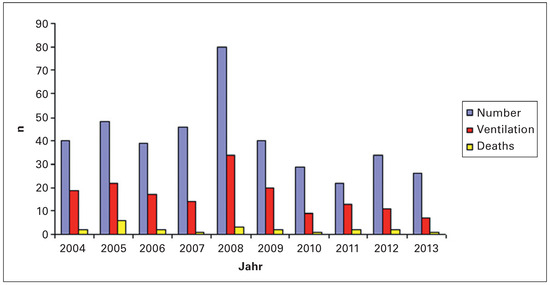
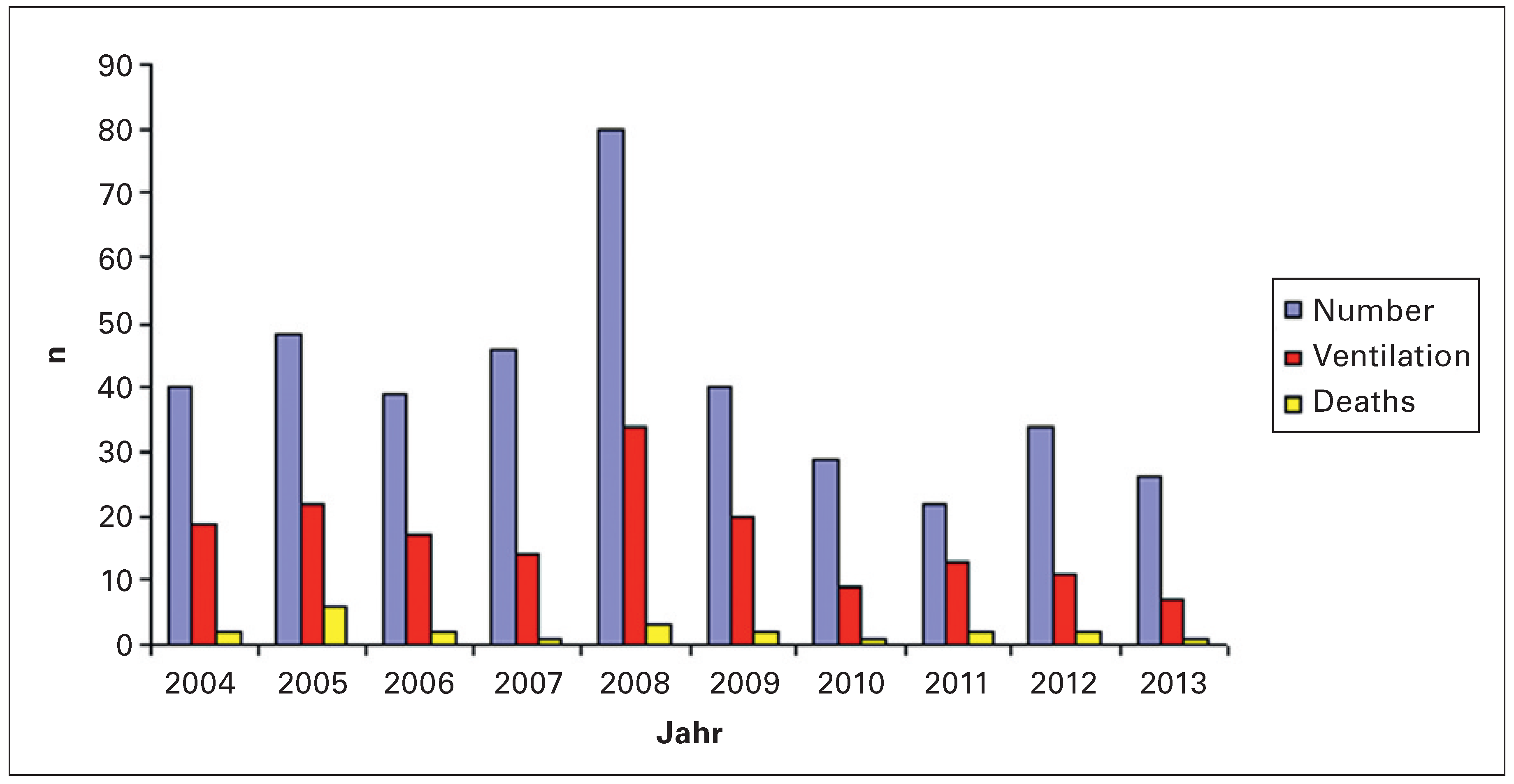
During the last 10 years, the number of cases of severe traumatic brain injury (TBI) admitted to the paediatric intensive care unit (PICU) of the Children’s Hospital in Zurich has decreased, most probably owing to the success of preventive measures, such as helmets or stricter speed limits for cars (Figure 1). The mortality of patients with TBI admitted to our PICU for the last 10 years was 5.4% (22/166) (Figure 1). The management of children with severe TBI starts at the scene, and continues during transport and in the admitting shock room, before the patient is treated in the PICU. Shock room management is crucial. There must be strict guidelines for the functions of each member of the interdisciplinary shock room team, especially with regard to the continuously changing compositions of these teams [1]. For the management in PICU, we use the “Swiss guidelines for the treatment of severe traumatic brain injury in children” [2]. The basic measures are: normo- oxygenation, normo-capnia, normo-volaemia / blood pressure, normal Na+ concentration, sedation / analgesia and head up 30°. With an intracranial pressure (ICP) transducer in place, the neurointensive care is ICP- and cerebral perfusion pressure(CPP)-driven, with additional measures added in an escalating manner to keep ICP and CPP in the normal range: mannitol, noradrenaline, cerebrospinal fluid venting, hypothermia (32–34 °C), barbiturate coma, hyper ventilation (if paCO2 <4 kPa: monitoring of SO2 in the bulbus jugularis is mandatory) and, as a last resort, decompressive craniectomy.
Figure 1.
Children with traumatic brain injury in the paediatric intensive care unit of the University Children’s Hospital Zurich, 2004–2013: total number, number of ventilated patients and deaths.
Hypothermia as neuroprotective treatment
There is much debate as to whether hypothermia may be used not only to lower ICP, but also as neuroprotective treatment modality. The biological rational for the effectiveness of therapeutic hypothermia is the reduction of secondary injury through decreased cerebral metabolic demands, decreased inflammation, decreased lipid peroxidation, decreased excitotoxicity and decreased cell death. There is good evidence for therapeutic hypothermia in perinatal asphyxia [3] and in cardiac arrest in adults [4]. However, to date, there is no evidence in paediatric TBI. A survey of eight PICUs in Switzerland revealed that only one unit uses hypothermia as neuroprotective treatment in severe TBI, the other units keep the patients normothermic [5].
Randomised trials of hypothermia for children with severe traumatic brain injury
There are four randomised controlled trials (RCTs) of hypothermia for children with severe TBI [6,7,8,9]. In all these trials, severe TBI is defined as a low Glasgow Coma Scale (GCS) score of <8 or <8.
The first trial was published in 2002 by Biswas et al. [6]. This single centre RCT compared hypothermia with normothermia in 21 children. There was no significant difference in mortality and functional outcome at 3, 6 and 12 months after TBI. During hypothermia, ICP was lower and CPP was higher, but after hypothermia (in the rewarming period), CPP was lower compared with the normothermia group. Adelson et al. performed two multicentre RCTs [7,8]. The first was a phase II study with a focus on safety, mortality and complications of hypothermia [7]. Hypothermia was maintained for 48 hours and rewarming speed was 1 °C every 3 to 4 hours. Twenty- three patients were in the hypothermia group (32– 33 °C) and 24 patients in the normothermia group. Mortality and complications, such as arrhythmias, infections and coagulopathy, were not significantly different between the two groups. Again, in the hypothermia group there was decreased mean ICP during hypothermia, but increased (rebound) ICP during rewarming.
The largest multicentre RCT so far was published in 2008 by Hutchison et al. [9]. Data sampling took place between 1999 and 2004. The primary outcome measure was the proportion of patients with an unfavourable outcome at 6 months after injury (severe disability, persistent vegetative state or death). In the hypothermia group, a mean (standard deviation) temperature of 32.5 °C (0.5 °C) was aimed for, for 24 hours, with a rewarming speed of 0.5 °C every 2 hours. There were 108 children in the hypothermia group and 117 children in the normothermia group. There was no significant difference for the primary outcome measure (unfavourable outcome): hypothermia 31%, normothermia 22% (p = 0.14). There were more deaths in the hypothermia group (21% vs 14%, p = 0.06). Long-term visual memory at 12 months after trauma was worse in the hypothermia group (p = 0.05). And again, as in the previous two studies, ICP was lower during cooling, but higher during rewarming. This study was heavily criticised: (1.) start of hypothermia was too late (the mean time to initiation of cooling was 6.3 hours) in view of the fact that neuronal death occurs a few hours after injury; (2.) duration of hypothermia (24 hours) was too short, in view of the occurrence of peak brain oedema between 24 and 48 hours after injury; (3.) rewarming was too fast, leading to rebound intracranial hypertension; (4.) the hypothermia group was worse (more patients with midline shift, oedema, hypotension and hypoxia); (5.) the normothermia group received better treatment (more patients with hypertonic saline) and (6.) there were more episodes of arterial hypotension and low CPP in the hypothermia group. In fact, the same authors published a post-hoc analysis of their data two years later and showed that arterial hypotension and low CPP were significantly associated with unfavourable outcome (in both intervention groups) [10]. The vulnerability of the brain to hypotension may be related to loss of autoregulation and vulnerability to cerebral ischaemia [11].
The second study of Adelson et al. [8], a phase III multicentre RCT, aimed to improve on the critical points of the Hutchison study: starting cooling earlier (<6 hours after injury), cooling for a longer period (48 hours or even longer), rewarming more slowly and aggressively avoiding hypotension (especially in the rewarming period) with administration of fluids and pressors. The primary outcome in this study was mortality at 3 months. Importantly, very severe cases were excluded (GCS score 3, unreactive pupils, severe arterial hypotension and uncorrectable coagulopathy). Randomisation was aimed to take place at less than 6 hours after injury. There was rapid cooling (initially with iced saline) to 32–33 °C, for 48 hours (if high ICP at 48 hours: further 24 hours of cooling) and slow rewarming (0.5–1 °C every 12–24 hours). Emphasis was put on avoiding hypotension, hypoxia and intracranial hypertension. The planned sample size was 340, but the trial was stopped early after futility analysis, with 39 hypothermia patients and 38 normothermia patients. The mean time to initiation of cooling was 5 hours, that is, within the target of 6 hours. Mortality at 3 months was not different (hypothermia 15%, normothermia 5%, p = 0.15). There were more patients with decompressive craniectomy in the normothermia group (p = 0.02), possibly to the advantage of these patients.
Conclusion
A meta-analysis of the four RCTs of hypothermia in severe paediatric TBI revealed a nonsignificant higher risk of mortality with hypothermia (risk ratio 1.45, 95% confidence interval 0.71–2.94) [12]. The mean time to starting cooling (4.6–6.3 hours) and the target temperature (three studies: 32–33 °C, one study 32–34 °C) were not very different between the four trials. However, the duration of cooling and the rewarming times were quite different, as was temperature variation during hypothermia (in the study of Biswas et al. [6], there was wide variation of temperatures). Although there was some variability between these trials, none showed a positive effect of hypothermia on mortality and some (gross and early) functional outcome measures. Further studies with alternative designs, taking into account the circumstances, such as cooling temperature, timing, and injury type, may reveal efficacy of this treatment modality [8]. In fact, it is very difficult to keep the multitude of interventions constant in therapeutic TBI trials. At least, hyperthermia should be prevented in severe childhood TBI. These patients should be kept normothermic (36–37 °C). Hypothermia may be occasionally used to lower increased ICP, but arterial hypotension must be avoided.
Disclosures
No financial support and no other potential conflict of interest relevant to this article was reported.
References
- Advanced trauma life support; American College of Surgeons: Chicago, 2004.
- Baenziger, O; Bär, W; Berger, TM; Berner, M; Cotting, J; Frey, B; et al. Empfehlungen zur Behandlung des akuten schweren Schädelhirntraumas bei Kindern und Jugendlichen. Schweiz Med Forum 2006, 6, 393–7. [Google Scholar]
- Azzopardi, D; Strohm, B; Marlow, N; Brocklehurst, P; Deierl, A; Eddama, O; et al. Effects of hypothermia for perinatal asphyxia on childhood outcomes. N Engl J Med. 2014, 371, 140–9. [Google Scholar] [CrossRef] [Scilit] [PubMed]
- Arrich, J; Holzer, M; Havel, C; Müllner, M; Herkner, H. Hypothermia for neuroprotection in adults after cardiopulmonary resuscitation. Cochrane Database Syst Rev. 2012, 9, CD004128. [Google Scholar]
- Personal communication. B. Frey, October 2014.
- Biswas, AK; Bruce, DA; Sklar, FH; Bokovoy, JL; Sommerauer, JF. Treatment of acute traumatic brain injury in children with moderate hypothermia improves intracranial hypertension. Crit Care Med. 2002, 30, 2742–51. [Google Scholar] [CrossRef] [Scilit] [PubMed]
- Adelson, PD; Ragheb, J; Muizelaar, JP; Kanev, P; Brockmeyer, D; Beers, SR; et al. Phase II clinical trial of moderate hypothermia after severe traumatic brain injury in children. Neurosurgery 2005, 56, 740–54. [Google Scholar] [CrossRef] [Scilit] [PubMed]
- Adelson, PD; Wisniewski, SR; Beca, J; Brown, SD; Bell, M; Muizelaar, JP; et al. Comparison of hypothermia and normothermia after severe traumatic brain injury in children (Cool Kids): a phase 3, randomised controlled trial. Lancet Neurol. 2013, 12, 546–53. [Google Scholar] [CrossRef] [Scilit] [PubMed]
- Hutchison, JS; Ward, RE; Lacroix, J; Hébert, PC; Barnes, MA; Bohn, DJ; et al. Hypothermia therapy after traumatic brain injury in children. N Engl J Med. 2008, 358, 2447–56. [Google Scholar] [PubMed]
- Hutchison, JS; Frndova, H; Lo, TYM; Guerguerian, AM. Impact of hypotension and low cerebral perfusion pressure on outcomes in children treated with hypothermia therapy following severe traumatic brain injury: a post-hoc analysis of the hypothermia pediatric head injury trial. Dev Neurosci. 2010, 32, 406–12. [Google Scholar] [CrossRef] [Scilit] [PubMed]
- Wagner, BP; Pfenninger, J. Dynamic cerebral autoregulatory response to blood pressure rise measured by near-infrared spectroscopy and intracranial pressure. Crit Care Med. 2002, 30, 2014–21. [Google Scholar] [CrossRef] [Scilit] [PubMed]
- Hutchison, JS; Guerguerian, AM. Cooling of children with severe traumatic brain injury. Lancet Neurol. 2013, 12, 527–9. [Google Scholar] [CrossRef] [Scilit] [PubMed]
This is an open-access article distributed under the terms of the Creative Commons Attribution Non-Commercial No Derivatives (CC BY-NC-ND) 4.0 License.