


Introduction
A number of evidence-based data have been accumulating in the last two decades supporting the effectiveness of the Stroke Unit (SU) model in reducing death and disability after stroke. The Stroke Unit Trialists’ Collaboration (SUTC) [1] has produced consistent information regarding the amount of risk reduction, and about the fact that the results apply to any category of stroke patient, independent of age, stroke severity and any other factor affecting the outcome. The leading concepts are: the coordinated care, the continuous education and training, and the multi-disciplinarity of the specialist staff. However, the practical organisation of a SU remains variable worldwide. The SUTC has also identified three main organisative models: the Acute SU, the Rehabilitative SU and the Comprehensive SU. This last model combines acute care and rehabilitation, and was the model that proved the most effective after the SUTC meta-analyses.
Guidelines
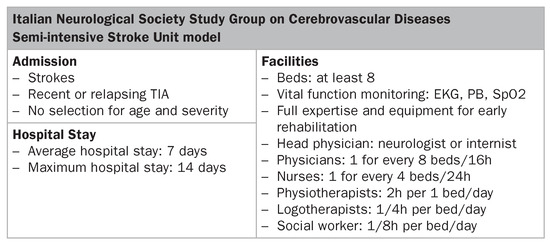
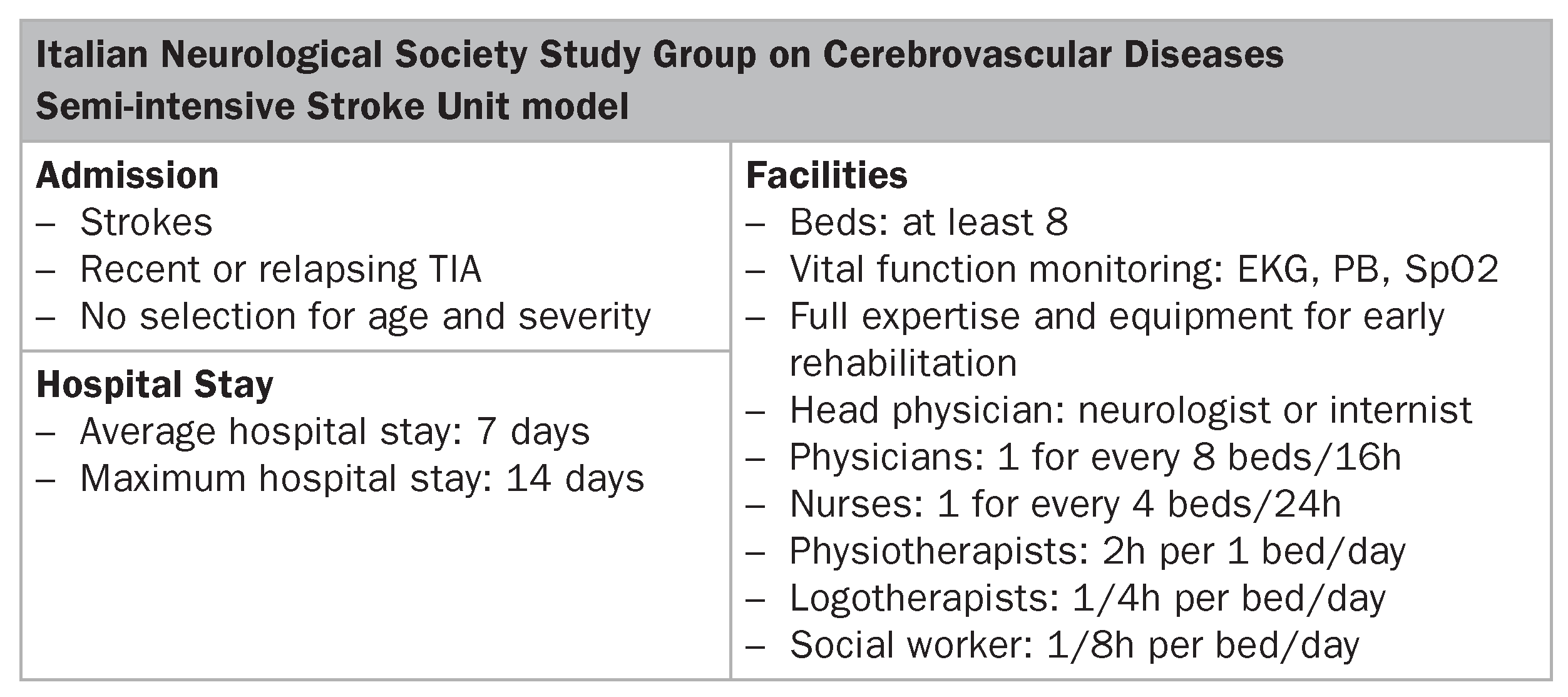
In 1998, the Study Group on Cerebrovascular Diseases of the Italian Neurological Association (SIN), after a large consultation among expert neurologists, recommended the comprehensive, semi-intensive model as the preferable one for Italy (fig. 1). This unit had to admit patients with stroke or high risk TIAs, without selection by age and severity (provisional mean length of stay: seven days). The unit had to be equipped with vital functions monitoring, tools for early mobilisation and rehabilitation, one stroke physician for every 8 beds, one nurse for every 4 beds, 1 physiotherapist, 1 speech therapist and 1 social worker (the last three professionals on part time employment). The Italian Guidelines on Stroke Management—SPREAD [2] suggest a dedicated unit of 4–16 beds, assigned to a multidisciplinary team, including expert stroke physicians, nurses and physiotherapists as the basic SU model. Qualifying aspects of a SU should include integrated care (both medical and rehabilitative care), continuous training of the personnel, and the involvement of patients and carers in the rehabilitation process.
Figure 1.
Semi-intensive Stroke Unit model.
Implementation
In 2003–2004, a survey of SUs in Italy was conducted by the PROSIT Investigators Group [3]. The criteria for defining SU care were simple: presence of dedicated beds, located in a definite area of the hospital, conducted by at least 1 dedicated full-time physician and 1 nurse. Based on these criteria, in the whole of Italy, only 68 SU resulted to be active at that time, compared to the 677 conventional wards admitting at least 50 stroke patients per year. From the comparison of these two different types of acute stroke care, SUs clearly fared better than conventional wards, as indicated by several functional indicators, and for the proven reduction of death or disability by 9% among patients admitted to a SU, adjusting for several confounders of the outcome [3]. By applying these results to the 10 223 yearly hospital admissions for stroke in the Tuscany Region, if all the patients had received SU care, 1456 deaths or disabilities per year could have been avoided. A further national survey was conducted in 2009 following similarly gross definition criteria. There were 126 SUs identified (1/4 750 000 inhabitants), with a striking gradient across the three Italian macro-areas: 85 in the North (1/300 000 inhabitants), 28 in Central Italy (1/433 000 inhabitants), and 19 in the South (1/862 000 inhabitants), which was much less than the standard indicated by a National Ministry of Health ad hoc Commission of 1 SU for every 250 000 inhabitants. In the European SU survey conducted by the European Stroke Initiative in 2007 [4], out of the 116 Italian hospital surveyed, only 4 fulfilled the criteria for the so called Comprehensive Stroke Centres (CHS), characterised by the availability of high level intensive medical/surgical/interventional facilities, the identification as a referral centre, and the availability of educational resources. The majority of units were classified “Any Hospital Ward”, where general acute care was provided and stroke protocols were applied, but intravenous thrombolysis was not performed. However in 2010, the 21 centres participating in the Synthesis Trial fulfilled the criteria for CHS. After being licensed in Europe, intravenous thrombolysis was started in Italy in 2003, reaching a total number of about 700 performed in 2007 (about 300 in the North, 300 in the centre of Italy and less than 50 in the South overall). In the same year, there were 65 SUs performing thrombolysis in Italy (35 in the North, 25 in the centre and 5 in the South).
Despite the large cultural and political work conducted in recent years (mainly by professionals), a national plan based on the concept of “integrated systems of care” (hospital-territorial network) is still lacking in Italy. Following a consensus among experts from the 20 Italian regions [5], guidelines for a whole definition of pathways related to pre-hospital care, acute hospital care, rehabilitation and long-term care were emanated in 2005 (table 1). However no indication for an effective implementation of such a plan was given. In May 2010, an ad hoc commission installed by the Ministry of Health presented updated guidelines for SU implementation in Italy. SUs were divided into three organisational levels: the first level corresponds to expert groups of professionals being in charge of a few beds dedicated to stroke patients but without expertise for performing thrombolysis; the second level to units not only expert in stroke care, but also fully organised for performing intravenous thrombolysis; the third level of SUs, to be located in tertiary hospitals, are characterised by full expertise, organisation and equipment for performing endovascular procedures. The overall amount of SU beds needed in Italy was indicated at 50 per 1 000 000 inhabitants. The need for systematic patients’ registration and performance monitoring was also strongly stressed.
Table 1.
General guidelines for an integrated system of stroke care in Italy. Consensus among Italian Regions.
Conclusions
The SU care concept has progressively expanded in Italy throughout the last 15 years. No institutionally defined and univocal models have been applied over time in the different geographical areas and hospitals. Information about its practical application only indicates the basic common characteristic of SUs operating in Italy: dedicated hospital units with beds located in a definite area, where a multidisciplinary team, including stroke physicians, nurses and physiotherapists, work following expert guidelines and protocols. The SU is usually organised as a semi-intensive care unit where combined acute medical management and early rehabilitation is provided. The majority of SU teams in Italy are now able to perform intravenous thrombolysis. Only a limited number of SUs can be defined as Comprehensive Stroke Centers according to the criteria of the European Stroke Initiative (corresponding to the third organisational level indicated by the Ministry of Health). Presently, no certification is required and no univocal pathways are followed, particularly as far as the integration between hospital and the territory is concerned. The number of SUs is still largely insufficient (particularly in the southern regions) to secure the best specialised stroke care for every patient, independent of geographics, demographics and stroke clinical features.
Funding
No funding.
Conflicts of Interest
No conflict of interest.
References
- Stroke Unit Trialists’ Collaboration. Organised inpatient (stroke unit) care for stroke (Cochrane Review). In The Cochrane Library, Issue 1; 2003.
- Stroke Prevention and Educational Awareness Diffusion (SPREAD Guidelines), March 2005. March.
- Candelise, L.; Gattinoni, M.; Bersano, A.; Micieli, G.; Sterzi, R.; Morabito, A.; and on the behalf of the PROSIT Study Group. Stroke-unit care for acute stroke patients: observational follow-up study. The Lancet 2007, 27, 299–305. [Google Scholar] [CrossRef] [Scilit] [PubMed]
- Leys, D.; Ringelstein, E.; Kaste, M.; Hacke, W. and for the Executive Committee of the European Stroke Initiative. Facilities Available in European Hospitals Treating Stroke Patients. Stroke 2007, 38, 2985–2991. [Google Scholar] [CrossRef] [Scilit] [PubMed]
- Conferenza Stato Regioni. Linee di indirizzo per la definizione del percorso assistenziale ai pazienti con ictus cerebrale. Provvedimento 3 Febbraio 2005. GU n. 50 del 2.3.

This is an open-access article distributed under the terms of the Creative Commons Attribution Non-Commercial No Derivatives (CC BY-NC-ND) 4.0 License.