


Summary
Rhythmic movement disorders (RMD) are well recognized and described in humans, including head banging [1]. By analogy with humans, several parasomnias have been described and documented in animals including REM sleep behaviour disorder (RBD) [2,3] somnambulism and nightmares [4]. Since horses spend most of their slow-wave sleep time standing owing to their “standing apparatus” [7], it is reasonable to expect parasomnias to exhibit primarily with the horse in the upright position. We have observed a horse in a position characteristic for sleep, with the movements of the head highly analogous to human head banging RMD. Here we show the existence of similar movements observed in a horse while awake and propose that these two behaviours are different and highly state dependent. The first one coupled with NREM sleep corresponds to human head banging, while the second, coupled with active ambulation of the animal is obviously wakefulness dependent. The observed and video recorded behaviour in an adult five-year-old horse is reminiscent of the human RMD of the head-banging type.
Rhythmic movement disorders (RMD) are well recognised and described in humans, including head banging or jactatio capitis nocturna (JCN), body rocking and body and leg rolling [1]. By analogy with humans, several parasomnias have been described and documented in animals including REM sleep behaviour disorder (RBD) [2,3], somnambulism and nightmares [4]. Since it is not easy to diagnose a parasomnia or RMD in an animal, the reports are scarce, rarely based on polysomnography and more frequently based on observation [4,5] sometimes accompanied by a movie [6]. RMDs, in particular of the head banging type, have not so far been described in animals. We have recently noticed a RMD-like behaviour in a horse highly analogous to human head banging, suggesting its existence in equines.
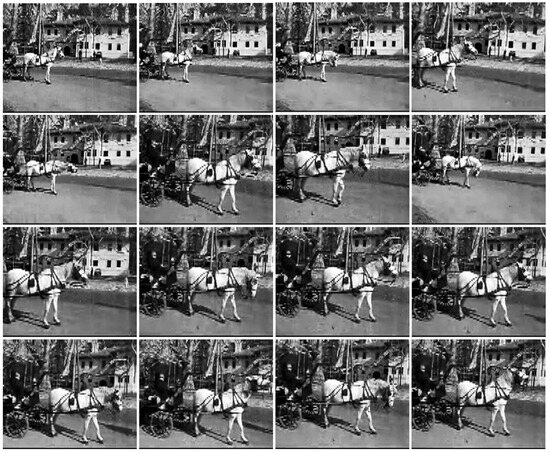
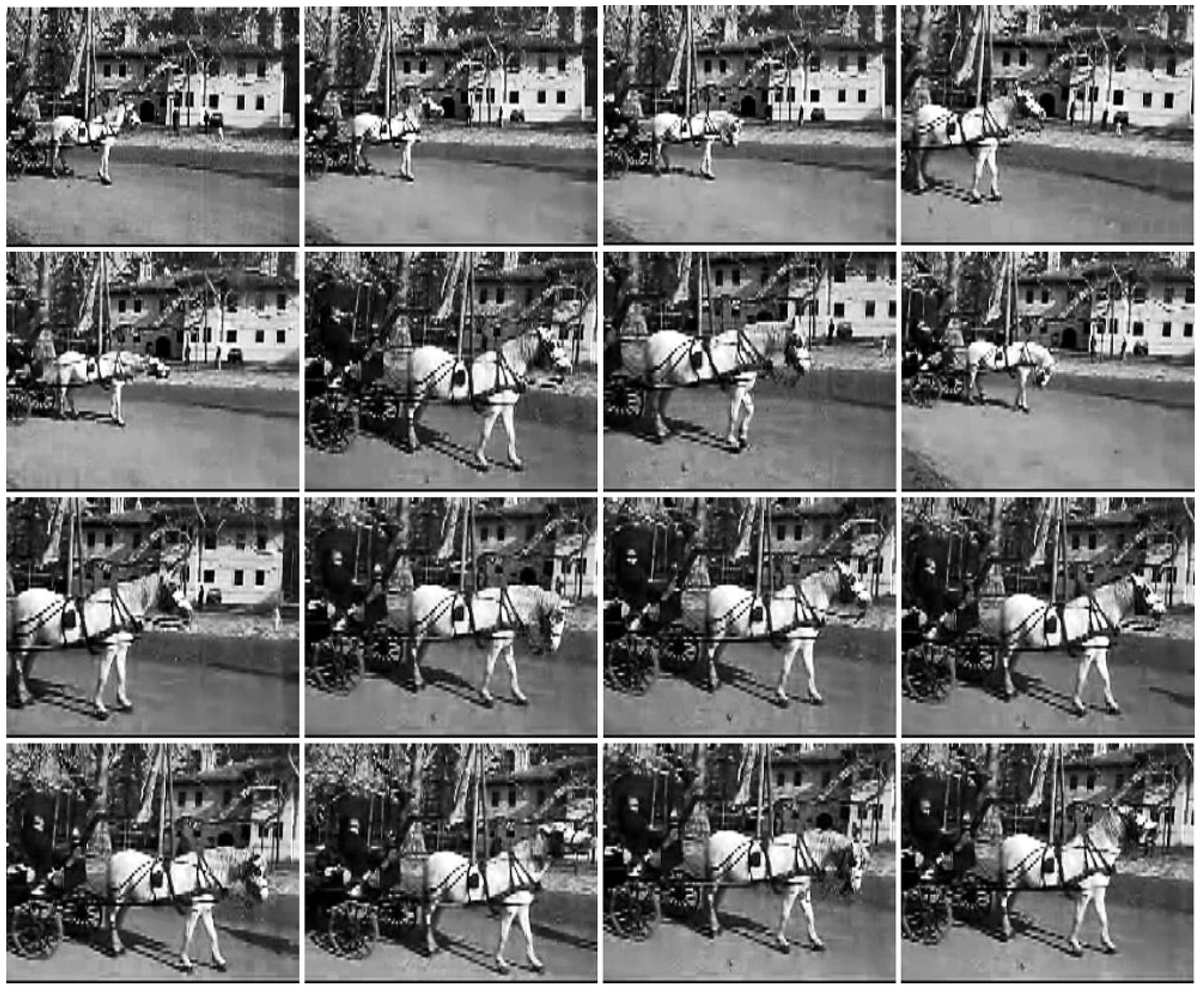
We recently observed a roundtrip horse with a carriage standing in a park and waiting for the next drive. No drive was in view and the coachman was sleeping. We observed the horse in superficial sleep having an episode of rhythmic (one-per-second) back and forth movements of the head, extremely reminiscent of human head banging. The rhythmic movements lasted approximately six minutes and we managed to record an episode of 87 seconds. The activity was present during behavioural sleep and seemed analogous to human RMD of the head banging type, which usually appears in restful wakefulness or superficial sleep.
Since horses spend part of their slow wave sleep time standing owing to their “standing apparatus” [7], it is reasonable to expect parasomnias to exhibit primarily with the horse in the upright position. The characteristic position of the horse in sleep is with one hind leg relaxed with the hoof resting on its toe, switching hips to distribute the weight of the body and trigger the stay function of the hind legs. Although the up and down movements of the head and neck may look to the observer as if the horse was awake, the characteristic behavioural aspect prompts us to conclude that it was actually superficial (or NREM) sleep that we observed. The five-year-old horse was purchased at the age of 1.5 years, and a coachman willingly confirmed his awareness of the frequent rhythmic behavioural episodes in sleep, present from the beginning. He claimed he was able to differentiate these episodes from other movements appearing in the awake and active animal. He confirmed the animal was healthy (denying a suggestion that a horse could have seizures, other sleep or muscle disorder).
Although observed rhythmic activity looks familiar simply because it is frequently noticed in horses, there are two phenotypically similar but fundamentally different, highly state dependent types of head/neck movements in a horse. The first one corresponding to head-banging episodes appears in superficial sleep or calm wakefulness in the animal and consists of shorter lasting (minutes) repetitive, rhythmic, rather stereotypical up-and-down head/ neck movements (Figure 1. Succession of movements of the head banging type in a horse). This behavior resembles but substantially differs from another, similar behavior in horses coupled with active ambulation of the awake animal, that is longer lasting, repetitive, pseudo-rhythmic, volitional and wake/activity-dependent; it is usually initiated and influenced by the ongoing activity (as seen in walking, galloping, pulling a load or simply defending itself from mosquitoes).
Figure 1.
Head banging in horse.
The two head/neck movements in a horse substantially differ in duration, rhythmicity, regularity and state of consciousness, and represent two different behaviors. While RMDs reflect the activity of neuronal networks underlying the motor pattern generators in the brain stem operating in sleep, motility in the awake animal reflects more versatile pattern of volitional movements. If this observation can be extended to all quadrupeds both domesticated and feral, awaits further observation.
Though the two similar behavioral activities certainly necessitate PSG differentiation in the future, the observed and video recorded case prompts us to suggest that this may be a simple case of head banging in an adult five-year-old horse analogous to human RMD of the head-banging type, with a possibility of similar pathophysiologic mechanism(s) underlying the behavior both in humans and horses.
A video file of this horse can be viewed at www.sanp.ch → issue 4/2010.
Conflicts of Interest
The authors declare absence of conflict of interest or any financial support.
References
- Mahowald, MW. Other parasomnias. In Principles and Practice of Sleep Medicine, 4th ed.; Kryger, MH, Roth, T, Dement, WC, Eds.; WB Saunders: Philadelphia, 2005; p. 918. [Google Scholar]
- Bush, WW; Bar, CS; Stecker, MM; Overall, KL; Bernier, NM; Darrin, EW; Morrison, AR. Diagnosis of Rapid eye movement sleep disorder with electroencephalography and treatment with tricyclic antidepressant in a dog. J Am Anim Hosp Assoc. 2004, 40, 495–500. [Google Scholar] [CrossRef] [Scilit] [PubMed]
- Hendricks, J; Morrison, A; Farnbach, G; et al. A disorder of rapid eye movement sleep in a cat. J Am Vet Med Assoc. 1981, 178, 55–7. [Google Scholar] [CrossRef] [Scilit] [PubMed]
- Hendricks, J; Morrison, A. Normal and abnormal sleep in mammals. J Am Vet Med Assoc. 1981, 178, 121–5. [Google Scholar] [CrossRef] [Scilit] [PubMed]
- Hendricks, J; Lager, A; O’Brien, D; et al. Movement disorders during sleep in cats and dogs. J Am Vet Med Assoc. 1989, 194, 686–9. [Google Scholar] [CrossRef] [Scilit] [PubMed]
- Schenck, C. Paradox lost. Midnight in the battleground of sleep and dreams; Extreme Nights, LLC, 2005. [Google Scholar]
- Sack, WO. The stay apparatus of the horse’s hind limb-explained. Equine Prac. 1989, 11, 31–5. [Google Scholar]
This is an open-access article distributed under the terms of the Creative Commons Attribution Non-Commercial No Derivatives (CC BY-NC-ND) 4.0 License.