


Abstract
This preliminary study aims to analyze the therapeutic alliance in a crosscultural triadic setting, where there is a therapist and a client who speak a different language but are able to interact thanks to an interpreter/cultural mediator. The participants’ (therapists, clients, interpreters) representations associated with the notion of therapeutic alliance, and the level of alliance between each group was obtained and compared. Clients (N = 9) were all from Albanese origin. The results show that the three groups of participants give particular meanings to the alliance and tend to evaluate their alliance level differently. The interpreter’s mediating role in the construction of the therapeutic alliance is discussed.
The therapeutic alliance when working with an interpreter: a preliminary study
Many researchers have identified the therapeutic alliance—broadly defined as the collaborative relationship between client(s) and therapist(s)—as one of the most robust and consistent predictors of the outcome for different psychotherapeutic approaches and different clients [1].
Within the cross-cultural field, Coleman [2] classifies the alliance in two types: rational and emotional. The rational alliance refers to the agreement of goals, tasks, and roles. At this level, for instance, clients with different backgrounds will have diverse representations and expectations of the therapeutic encounter. In contrast, the emotional alliance concerns the quality of the bond between the therapist and the client. At this level, clients may create with the therapist affections culturally linked to their life story. While both rational and emotional alliances are relevant when building a therapeutic relationship in a multicultural context, the most important aspect is to approach the person’s experience with “openness, wisdom and humility” [2].
In the same perspective, Shonfeld-Ringel [3] describes empathy, mutuality, and dynamics of power and authority as the essential factors when establishing a therapeutic alliance in multicultural practice. They all require an empathic connection with the clients’ different cultural backgrounds. Along with this, the mutuality and reciprocity allow an interchange of feelings and behaviours, searching for mutual accommodations that facilitate an adjustment between therapist and client.
The authors believe that mutuality and reciprocity constitute a challenge for two individuals with different cultural backgrounds, especially when reference is made to refugees/ asylum seekers who are in a precarious situation and are waiting to be assisted. From a cultural perspective, we can make reference to some social beliefs in which the therapist is associated to a physician, viewed as an expert who has the knowledge and ability to heal.
Developing the alliance with an interpreter
The bilingual setting includes a therapist and a client who speak different languages and interact thanks to the collaboration of an interpreter who translates and plays the role not only of a cultural mediator, as it is generally described in the literature, but also of a relational mediator. As a relational mediator, they have the central role in facilitating the establishment of a link, of a relationship between the therapist and the client, while regulating the direct communication and at the same time, creating a bridge for indirect communication.
As a cultural mediator, the interpreter participates in the explanation of socio-cultural values and norms implicit in the therapist and client’s language [4]. The interpreter is not a translator of words, but an intermediary that helps the construction of meanings between two linguistic worlds in the search for conflict resolution [5]. To work efficiently he should have knowledge of the client’s culture of origin and of the social representations where the therapeutic encounter takes place.
The interpreter’s role depends, to a great extent, on the therapist’s theoretical perspective as well on the institution’s approach [6]. Within this optic, we consider that the definition of the interpreter’s role and participation would directly influence the type of alliance created in the triad. For instance, an interpreter not submitted to the rigidity of a strict translation of words could enrich the alliance creation through his life experience, cultural knowledge and professional/personal resources. Tribe [7], who refers to interpreters as bicultural workers, states that in the psychological domain we should be more concerned with “the feel of the words and emotional content” (p. 570) than in the physical medicine, therefore in the psychological domain literal translation may be inadequate. The interpreter should have the space to provide through non-verbal communication what it is not possible to express in words.
When working with refugees, the interpreter’s presence could have a different impact than in other clinical encounters involving an immigrant. There often exist issues of mistrust and openness towards the interpreter because he or she may be a compatriot with different political views [8], which can generate insecurity in the client. Furthermore, the interpreter plays a major role while facilitating the expression of painful feelings and thoughts of clients frequently coming from non-psychological cultures. In the same way, this task can evoke the interpreter’s own immigration experiences that are often painful for certain communities. For all these reasons, the interpreter should benefit from specific training in order to perform his role in an adequate manner [9]. Likewise, health professionals also need to be trained in the work performed with interpreters in cross-cultural health [10].
In the bilingual health communication, Hsieh [11] insists on the significance of avoiding “the simplistic view of seeing interpreters as a generic group or dichotomizing medical interpreters as professional versus non-professional interpreters” (p. 184). He suggests that interpreters should be categorized into five different types (chance interpreters, untrained interpreters, bilingual health providers, on-site interpreters and telephone interpreters). In terms of the current research the on-site interpreters represent the interpreters/ cultural-mediators who are specifically trained in health care settings, and manage a medical language in addition to their bicultural knowledge. On the contrary, the chance interpreters (a family member or friend) and the untrained interpreters (a bilingual support staff member, as for instance the receptionist) are not trained professionals who, most likely, are limited to do a translation or to play a dual role with the client (e.g., child-interpreter). Research has proved the inadequacy of untrained interpreters. However, the translation role performed by the client’s close friends or relatives and non-qualified staff continues to be commonplace [12]. This is mainly due to budgetary restraints that impair the hiring of trained interpreters, according to a study performed by the Psychiatric Services in Switzerland [13].
For Hsieh, the differentiation of the type of interpreter would help clarify their role, style and influence in the triad. According to this classification, it can be said, once again, that the role and relationship of the interpreter with the client and the therapist will influence the alliance creation. We believe that the on-site interpreter is the more appropriate due to his neutrality, the specificity and uniqueness of his role, his professional knowledge and training, and his availability. In the therapeutic encounter, these characteristics could facilitate the creation of a therapeutic alliance, appropriate to the type of work that is done. On the other hand, the presence of intercultural mediators is recognized as a benefit for the health care institutions [14] because it decreases the number of sessions and interventions.
This preliminary study aims at documenting the specificities of the alliance in a bilingual setting, including an interpreter and an immigrant (must likely a refugee or asylum seeker) concerning:
- The difference of meaning associated with some dimensions of the alliance concept for each of the three participants.
- The difference of the level of alliance evaluated by each of the three participants concerning the client-therapist, client-interpreter and therapist-interpreter dyads.
Method
Sample
Nine Albanese clients (8 women and 1 man) were included. 5 of them are from Albania, 3 from Kosovo, and 1 from Bosnia. A significant number is represented by refugees who have experienced traumatisms, precariousness, and are often at risk of being deported. The group of therapists consisted of 2 women and 5 men. They are represented by psychologists, psychotherapists, and psychiatrists who work competently in migration issues. Each therapist participated in 1 or 2 triads. There were 5 interpreters (4 women and 1 man), all from Albanese origin. They are culturally and socially integrated into Switzerland. Each interpreter participated in 1 or 2 triads. Measurement was done after one early therapy session (3 to 5).
Therapists, interpreters and clients gave their agreement to participate in this study. The questionnaire was submitted to the internal ethics commission of the counselling service for migrants at the Appartenances Association.
Instrument
Six dimensions of the therapeutic alliance that are common in alliance scales and seem pertinent from our clinical practice were selected a-priori: help, understanding, collaboration, trust, agreement on goals, and agreement on tasks. For each dimension, each participant (the therapist, the client and the interpreter) was given two tasks:
- Alliance meaning. To explain what the dimension means by word association.
- Alliance level. To evaluate the therapeutic alliance and each of the six dimensions for each dyad (client-therapist, client-interpreter, therapist-interpreter) on a likertscale.
An independent Albanese interpreter orally administered the client version of the questionnaire.
Results
All the words were classified using a content classification scheme with emergent coding categories [15]. Overall, and in reference to the work of Bachelor [16] concerning the client’s perception of the alliance, the most frequent category (29.3%) was Nurturing (i.e., words related to caring and human values like respect, trust, honesty, or nonjudgmental attitude for example), followed by the category Relationship (i.e., words related to the sense of being connected) with 23.4%, then categories concerning Change (15.7%), Assistance (11.6%), Involvement (10.1%), Information (5.7%) and Safety (4.3%).
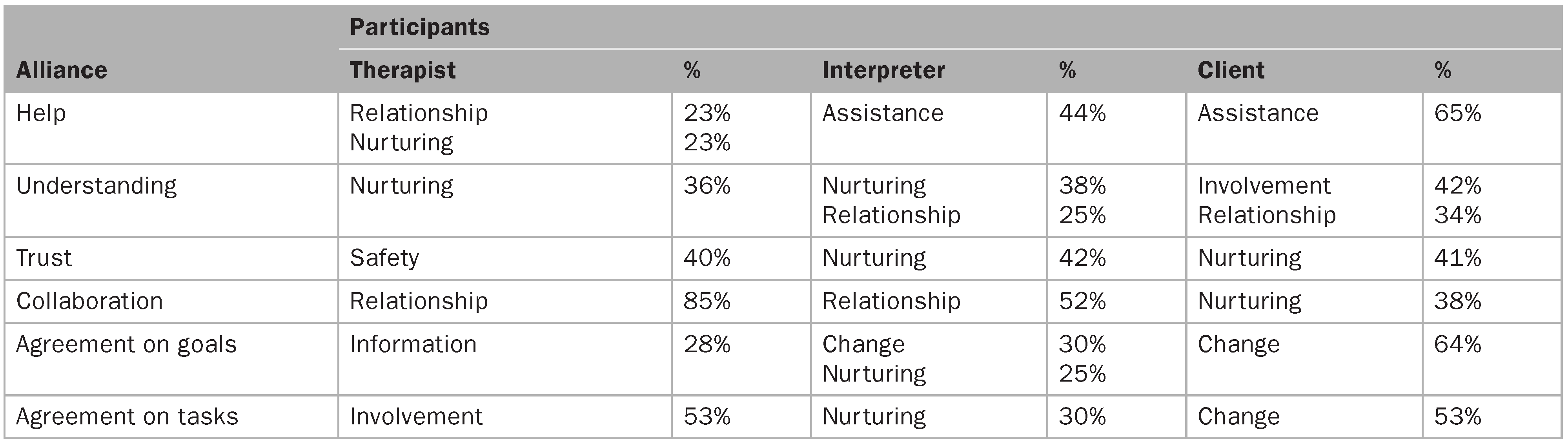
Table 1 shows that the interpreter shares some meanings with the client (concerning help, understanding, trust, agreement on goals), and some meanings with the therapist (concerning understanding and collaboration). Client and therapist have conversely different views.
Table 1.
Most frequent categories associated to each alliance dimension.
Regarding the evaluation of the alliance level, there was no significant difference between client-therapist, clientinterpreter and interpreter-therapist alliances. However, therapists always evaluated the alliance lower than the client and the interpreter. The interpreter’s alliance was always closer to the client’s evaluation than to the therapist’s one.
Discussion
Thanks to the measurement of the alliance level between the participants, it can be infered that there exists a therapeutic alliance between the therapist and the client when working with an interpreter. This reflects the interpreters “relational mediation” in addition to their typical cultural mediation. With regard to the alliance perception, the three groups of participants give a different meaning to it. While the therapists have a more intellectual representation (e.g., guiding), the clients have a more concrete one (e.g., assistance). When working with refugees/asylum seekers, the assistance brings out the clients’ needs that go beyond the strict psychotherapy setting. The interpreters show themselves especially sensitive to this. Making reference to the interpreters, it was found that their representations are often guided by their central role in the triad, which searches for stability and harmony between the participants. For instance, they often have common answers, in most cases with the clients and in some other cases with the therapists. Therapists and clients never had common alliance perceptions. Measuring the alliance in this setting required the development of an instrument adapted to what the client considers important when establishing a therapeutic relationship, and adapted to the particular and specific characteristics of the current population (multicultural and bilingual with people in exile and/or experiencing traumatisms).
The therapists evaluate the alliance lower than the other participants, especially when it was related to them (e.g., alliance between therapists-clients and therapists-interpreters). The authors’ hypothesis is that the therapists are more exigent when they are implicated in the alliance due to their theoretical ideals of a good relationship in therapy. Moreover, the alliance is not evaluated differently between the interpreters and the clients. This confirms the importance of the therapeutic group and of its necessary collaboration with the interpreter to reach the client.
This study is limited in a number of ways. Apart from the sample size, the cultural background of the clients was limited to only one group (Albanese). Another limitation comes from the necessary double translation: first of all, the questionnaire in the client’s language and secondly, the results in the researchers’ language. Finally, future studies should adopt a longitudinal design, as it is known that alliance is a relatively fluid process that changes over time.
Funding
No outside financial support was provided for this preliminary study.
Conflicts of Interest
There is no actual or potential conflict of interest in relation to this article.
References
- Horvath, AO; Bedi, RP. The alliance. In Psychotherapy relationships that work; Norcross, J.C., Ed.; Oxford University Press: New York, 2002; pp. 37–70. [Google Scholar]
- Coleman, D. The Therapeutic Alliance in Multicultural Practice. Psychoanalytic Social Work 2000, 7(2), 65–87. [Google Scholar] [CrossRef] [Scilit]
- Shonfeld-Ringel, S. A Re-conceptualization of the Working Alliance in Cross-Cultural Practice with Non-Western Clients: Integrating Relational Perspectives and Multicultural theories. Clin Soc Work J. 2001, 29(1), 53–63. [Google Scholar] [CrossRef] [Scilit]
- Goguikian, BG; Changkakoti, N. Le rôle de l’interprète dans la construction de l’interculturalité. Revue L’autre 2004, 5(2), 255–64. [Google Scholar]
- Leanza, Y. L’interprète médiateur communautaire: entre ambiguïté et polyvalence. Revue L’autre 2006, 7(1), 109–23. [Google Scholar] [CrossRef] [Scilit]
- Singy, P; Guex, P. The interpreter’s role with immigrant patients: Contrasted points of view. Communication & Medicine 2005, 2(1), 45–51. [Google Scholar]
- Tribe, R. Bridging the gap or damming the flow? Some observations on using interpreters/bicultural workers when working with refugee clients, many of whom have been tortured. Br J Med Psychol. 1999, 72, 567–76. [Google Scholar] [CrossRef] [Scilit] [PubMed]
- Tribe, R; Morrisey, J. The refugee context and the role of interpreters. In Working with Interpreters in Mental Health; Hitesh Raval, Tribe R, Ed.; Brunner-Routledge: USA and Canada, 2003; pp. 198–218. [Google Scholar]
- Métraux, J-C; Alvir, S. L’interprète: traducteur, médiateur culturel ou cothérapeute. Interdialogos 1995, 2(22), 22–6. [Google Scholar]
- Rossi, I. Médiation culturelle et formation des professionnels de la santé—de l’interculturalité à la co-disciplinarité. Soz Präventivmed 1999, 44, 288–94. [Google Scholar] [CrossRef] [Scilit] [PubMed]
- Hsieh, E. Understanding Medical Interpreters: Reconceptualizing Bilingual Health Communication. Health Communication 2006, 20(2), 177–86. [Google Scholar] [CrossRef] [Scilit] [PubMed]
- Fleischer, I. La consultation de patients migrants chez le médecin praticien avec ou sans traducteur. In Thèse en médecine; Université de Lausanne, 2002. [Google Scholar]
- Eytan, A; Bischoff, A. Use on Interpreters in Switzerland’s Psychiatric Services. J Nerv Ment Dis. 1999, 187(3), 190–2. [Google Scholar] [CrossRef] [Scilit] [PubMed]
- Es-Safi, L. Médiation interculturelle dans les hôpitaux; Ministère des Affaires sociales de la Santé publique et de l’environnement: Bruxelles, 2000. [Google Scholar]
- Weber, RP. Basic Content Analysis, 2nd ed; Sage: Newbury Park, CA, 1990. [Google Scholar]
- Bachelor, A. Client’s Perception of the Therapeutic Alliance: A Qualitative Analysis. J Counsel Psychol. 1995, 42(3), 323–37. [Google Scholar]

Disclaimer/Publisher’s Note: The statements, opinions and data contained in all publications are solely those of the individual author(s) and contributor(s) and not of MDPI and/or the editor(s). MDPI and/or the editor(s) disclaim responsibility for any injury to people or property resulting from any ideas, methods, instructions or products referred to in the content. |
This is an open-access article distributed under the terms of the Creative Commons Attribution Non-Commercial No Derivatives (CC BY-NC-ND) 4.0 License.