


Abstract
This mini-review entertains the concept that transient global amnesia (TGA) could possibly be part of the spectrum of transient epileptic amnesia (TEA), which is considered the most important differential diagnosis by many clinicians. To support this hypothesis we analysed EEG data, where conventional scalp recording was unrevealing, but nasopharyngeal electrodes demonstrated epileptic discharges in the medial temporal lobe, the region implicated in memory dysfunction during transient global amnesia.
Introduction
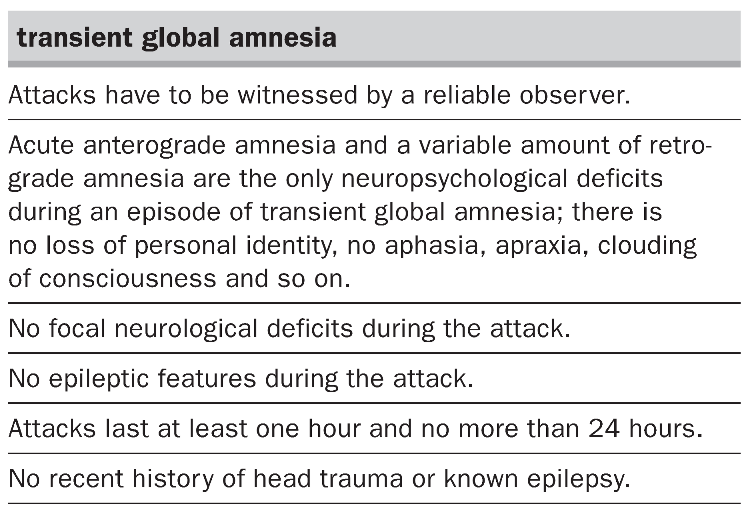
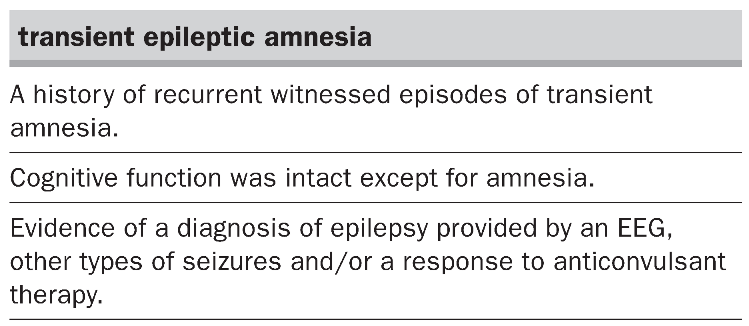
From what we know about memory function, transient global amnesia (TGA) is considered a transient disturbance of one or both medial temporal lobes (MTL), but its aetiology remains controversial. Historical case series and reports of “transient global amnesia” have often been heterogeneous, e.g., including amnesia induced by benzodiazepines [1] or probable stroke (cases with additional focal signs) [2]. Over time a strict definition was established that identifies a very homogeneous population. The typical patient is aged between 50 and 70 years, and no additional features beyond isolated amnesia resolving within 24 hours are present [3], see Table 1. According to present guidelines no additional work-up is needed, if the episode in question fulfils the case definition [4]. Nonetheless, many centres perform various auxiliary examinations to either reassure patients (and maybe themselves) that the condition is benign, or to elucidate the pathophysiology of transient global amnesia. This has brought forward a number of hypotheses and counterarguments on the aetiology of transient global amnesia. This mini-review entertains the concept that at least some episodes of transient global amnesia could be part of the spectrum of transient epileptic amnesia, which is considered the most important differential diagnosis by most clinicians.
Table 1.
Definition of transient global amnesia (TGA) according to www.dgn.org and Hodges and Warlow 1990 [3]. The distinctions between transient global amnesia and transient epileptic amnesia—as outlined in the tables—were somewhat blurred in the older literature on amnesic episodes.
Some other hypotheses regarding the pathophysiology of transient global amnesia
- (1)
- Transient global amnesia is caused by a mechanism akin to migraine, namely cortical spreading depression [4]. This leaves unexplained, why the episodes are not associated with further migraine and/or aura symptoms, and why the population at risk is older than the average migraine patient.
- (2)
- Transient global amnesia is a form of transient ischaemic attack (TIA). MRI studies using diffusion-weighted images could not demonstrate signal abnormalities in the acute phase, but only a fter a certain delay; this does not fit the picture of typical transient ischaemic attacks [5]. Howe ver, the l ocalisation of abnormalities in the medial t emporal lobes is clearly in accordance with our u nderstanding of memory function. Although the age group of TGA patients is similar to those at risk of transient ischaemic attacks, no increased occurrence of stroke or other vascular events have been observed in TGA patients during follow-up [3].
- (3)
- Benzodiazepines have an affinity to certainreceptors in the medial temporal lobes (i.e., the hippocampus), explaining their amnesic properties; the hypnotic effect being mediated by receptors in other brain regions [6]. Therefore, transient global amnesia could be provoked by endogenous benzodiazepine-like molecules that have an affinity to GABAA receptors in the hippocampus. Only one case report deals with this interesting idea: Danek et al. [7] reasoned that flumazenil, a benzodiazepine antagonist, should reverse transient global amnesia. They treated one patient with flumazenil during her transient global amnesia and believe she recovered more rapidly because of the drug. However, the details of this case are not very convincing, and the idea has not been put to the test again.
- (4)
- Imaging studies have shown that a majorityof patients with transient global amnesia tended to have abnormalities in the cerebral venous system compared to controls. Cerebral venous congestion due to retrograde flow during physical exertion could lead to transient circulatory dysfunction of the medial temporal lobe in these predisposed individuals [8]. However, about 26% did not show such abnormalities. Also, it is unclear, why transient global amnesia is not more frequent in settings where venous congestion (as a result of a Valsalva manoeuvre) is expected: crying children, wheezing asthmatics, weight lifters, cerebral vein thrombosis and so on.
- (5)
- Other authors have proposed that “emo tional arousal and phobia are involved in transient global amnesia” [9]. Although the TGA patients as a group had significantly higher mean scores on a scale that measured phobic attitudes compared to matched controls (patients with transient ischaemic attack), the values showed a large standard deviation. So, an individual patient’s score would not help in clinical decision making.
Further hypotheses regarding the aetiology of transient global amnesia have been proposed, but an in-depth discussion would be beyond the scope of this mini-review; for a quick overview we refer the reader to www.dgn.org [4].
Conclusion
The aetiology of transient global amnesia remains an enigma. Data from invasive and semi-invasive EEG recordings demonstrate that conventional scalp EEG might not be sufficiently reliable to exclude that transient global amnesia could be an ictal phenomenon (i.e., part of the spectrum of transient epileptic amnesia). However, data from certain cases of transient epileptic amnesia also show that in some instances a postictal depression of memory function as a form of Todd’s paralysis has to be considered. Immediate examination of suspected TGA cases by means of nasopharyngeal electrodes or magnetoencephalography could in future shed more light on its pathophysiology.
References
- Morris, HH; Estes, ML. Traveler’s amnesia. JAMA 1987, 258, 945–6. [Google Scholar] [CrossRef] [Scilit] [PubMed]
- Müller, HR. Die Transient Global Amnesia. Mit einem Beitrag zu ihrer Prognose. Schweiz Rundsch Med Prax. 1989, 78, 970–5. [Google Scholar]
- Hodges, JR; Warlow, CP. Syndromes of transient amnesia: towards a classification. A study of 153 cases. J Neurol Neurosurg Psychiatry 1990, 53, 834–43. [Google Scholar] [CrossRef] [Scilit] [PubMed]
- Further information on transient global amnesia (TGA) is available from the chapter Leitlinien at www.dgn.org, the homepage of the Deutsche Gesellschaft für Neurologie.
- Sedlaczek, O; Hirsch, JG; Grips, E; Peters, CNA; Gass, A; Wöhrle, J. Detection of delayed focal MR changes in the lateral hippocampus in transient global amnesia. Neurology 2004, 62, 2165–70. [Google Scholar] [CrossRef] [Scilit] [PubMed]
- Savic, MM; Obradovic, DI; Ugresic, ND; Bokonjic, DR. Memory effects of benzodiazepines: memory stages and types versus binding-site subtypes. Neural Plasticity 2005, 12, 289–98. [Google Scholar] [CrossRef] [Scilit] [PubMed]
- Danek, A; Uttner, I; Straube, A. Is transient global amnesia related to endogenous benzodiazepines? J Neurol. 2002, 249, 628. [Google Scholar] [CrossRef] [Scilit] [PubMed]
- Sander, K; Sander, D. New insights into transient global amnesia: recent imaging and clinical findings. Lancet Neurol. 2005, 4, 437–44. [Google Scholar] [CrossRef] [Scilit] [PubMed]
- Inzitari, D; Pantoni, L; Lamassa, M; Pallanti, S; Pracucci, G; Marini, P. Emotional arousal and phobia in transient global amnesia. Arch Neurol. 1997, 54, 866–73. [Google Scholar] [CrossRef] [Scilit] [PubMed]
- Zeman, AZJ; Boniface, SJ; Hodges, JR. Transient epileptic amnesia: a description of the clinical and neuropsycho-logical features in 10 cases and a review of the literature. J Neurol Neurosurg Psychiatry 1998, 64, 435–43. [Google Scholar] [CrossRef] [Scilit] [PubMed]
- Butler, CR; Graham, KS; Hodges, JR; Kapur, N; Wardlaw, JM; Zeman, AZJ. The syndrome of transient epileptic amnesia. Ann Neurol. 2007, 61, 587–98. [Google Scholar] [CrossRef] [Scilit] [PubMed]
- Quinette, P; Guillery-Girard, B; Dayan, J; de la Sayette, V; Marquis, S; Viader, F; et al. What does transient global amnesia really mean? Review of the literature and thorough study of 142 cases. Brain 2006, 129, 1640–58. [Google Scholar] [CrossRef] [Scilit] [PubMed]
- Palmini, AL; Gloor, P; Jones-Gotman, M. Pure amnestic seizures in temporal lobe epilepsy. Brain 1992, 115, 749–69. [Google Scholar] [CrossRef] [Scilit] [PubMed]
- Tassinari, CA; Ciarmatori, C; Alesi, C; Cardinaletti, L; Salvi, F; Rubboli, R; et al. Transient global amnesia as a postictal state from recurrent partial seizures. Epilepsia 1991, 32, 882–5. [Google Scholar] [CrossRef] [Scilit] [PubMed]
- Maheu, G; Adam, C; Hazemann, P; Baulac, M; Samson, S. A case of postictal transient anterograde and retrograde amnesia. Epilepsia 2004, 45, 1459–60. [Google Scholar] [CrossRef] [Scilit] [PubMed]
- Lee, BI; Lee, BC; Hwang, YM; Sohn, YH; Jung, JW; Park, SC; et al. Prolonged ictal amnesia with transient focal abnormalities on magnetic resonance imaging. Epilepsia 1992, 33, 1042–6. [Google Scholar] [CrossRef] [Scilit] [PubMed]
- Rowan, AJ; Protass, LM. Transient global amnesia: clinical and electroencephalographic findings in 10 cases. Neurology 1979, 29, 869–72. [Google Scholar] [CrossRef] [Scilit] [PubMed]
- Wieser, HG; Elger, CE; Stodieck, SR. The ‘foramen ovale electrode’: a new recording method for the preoperative evaluation of patients suffering from mesio-basal temporal lobe epilepsy. Electroencephalogr Clin Neurophysiol. 1985, 61, 314–22. [Google Scholar] [CrossRef] [Scilit] [PubMed]
- Meador, KJ; Loring, DW; King, DW; Nichols, FT. The P3 evoked potential and transient global amnesia. Arch Neurol. 1988, 45, 465–7. [Google Scholar] [CrossRef] [Scilit] [PubMed]
- Mizuno-Matsumoto, Y; Ishijima, M; Shinosaki, K; Nishikawa, T; Ukai, S; Ikejiri, Y; et al. Transient global amnesia (TGA) in an MEG study. Brain Topography 2001, 13, 269–74. [Google Scholar] [CrossRef] [Scilit] [PubMed]
- Stippich, C; Kassubek, J; Kober, H; Sörös, P; Vieth, JB. Time course of focal slow-wave activity in transient ischemic attacks and transient global amnesia as measured by magnetoencephalography. Neuroreport 2000, 11, 3309–13. [Google Scholar] [CrossRef] [Scilit] [PubMed]

This is an open-access article distributed under the terms of the Creative Commons Attribution Non-Commercial No Derivatives (CC BY-NC-ND) 4.0 License.