


Abstract
The present study examined the associations among teachers’ emotional competence, SEL implementation practices, and school climate perceptions within schools involved in RULER-related professional development initiatives. Drawing on ecological and implementation-oriented perspectives of social and emotional learning (SEL), this study proposed an observed-variable path model in which emotionally competent educators would report greater implementation of SEL-related practices and more positive perceptions of school climate. Participants were 1185 educators from 44 Spanish-speaking educational institutions collaborating with the Yale Center for Emotional Intelligence and Universidad Camilo José Cela. After listwise deletion of cases with missing data on the variables included in the path model and unavailable school identifiers, the primary path analyses were conducted with 1022 educators nested within 44 educational institutions. Participants completed multidimensional self-report measures assessing emotional competence, emotional growth mindset, SEL implementation practices, and school climate perceptions. Observed-variable path analysis was conducted using composite scores derived from the study measures. Results indicated that emotional competence showed the strongest positive associations with both SEL implementation and school climate perceptions. SEL implementation demonstrated statistically significant indirect associations linking emotional competence with school climate perceptions. Complementary analyses additionally indicated that emotional growth mindset demonstrated comparatively weaker, although statistically significant, associations with SEL implementation and school climate. The findings highlight the relevance of teachers’ emotional competence and SEL-related implementation practices within emotionally supportive educational environments. This study contributes to the literature by examining SEL implementation as a potential implementation-related pathway linking teacher emotional competence with school climate perceptions within large SEL-oriented educational contexts.
1. Introduction
Teachers play a central role in shaping the emotional and relational quality of educational environments (Jennings & Greenberg, 2009; Schonert-Reichl, 2017). Beyond academic instruction, teachers continuously regulate emotionally demanding classroom interactions, manage interpersonal conflicts, foster student belonging, and contribute to the socioemotional climate of schools (Jennings & Greenberg, 2009; Pekrun, 2017). Consequently, increasing attention has been directed toward understanding the teacher-level psychological processes associated with positive school climate and effective social–emotional learning (SEL) implementation (Thapa et al., 2013; M. T. Wang & Degol, 2016).
Social and emotional learning (SEL) is relevant to educational quality because it addresses the emotional, interpersonal, and regulatory processes that shape everyday teaching and learning. In school settings, SEL is not limited to the delivery of specific activities or curricula; it also involves the relational practices through which educators support emotional understanding, constructive interactions, and classroom functioning. Research on K-12 educational leaders also highlights the relevance of implementation-related mindsets, knowledge, skills, and efficacy for supporting SEL in schools (Caouette et al., 2025). Recent research has examined the relationship between SEL-related approaches and teacher outcomes, while also highlighting the need to distinguish program implementation from the broader competencies and practices of educators (Blewitt et al., 2020). Longitudinal evidence from a school-based SEL initiative also suggests that structured support may be associated with improvements in teachers’ occupational self-efficacy and perceived personal accomplishment (Hövel et al., 2025). Accordingly, examining teachers’ emotional competence alongside their reported SEL practices may help clarify how individual resources and everyday educational practices are associated with school climate perceptions.
Among these processes, emotional competence has emerged as a particularly important educational resource. Contemporary developmental models of social and emotional competence additionally suggest that socioemotional capacities evolve dynamically through ongoing interactions between individual, relational, and contextual educational processes (Collie, 2020). Emotional competence refers to the ability to identify, understand, express, regulate, and use emotions effectively across both intrapersonal and interpersonal contexts (Brasseur et al., 2013). Within educational settings, teachers with stronger emotional competencies tend to demonstrate more adaptive classroom management, emotionally supportive interactions, lower occupational distress, and greater relational sensitivity toward students and colleagues (Jennings & Greenberg, 2009; Collie, 2017). Despite these consistent associations, the existing literature has focused predominantly on direct relationships between teachers’ emotional competence and educational outcomes, while providing substantially less attention to the mechanisms underlying the association between teachers’ emotional competence and school climate.
Teachers’ emotional competence may also be relevant to the ways they motivate, guide, and respond to students during classroom interactions. Research on teachers’ social-emotional competence highlights its relevance to educational quality and the need to consider how these competencies relate to teachers’ professional practices (Lozano-Peña et al., 2021). Recent qualitative research suggests that teachers’ SEL identity may help explain why social-emotional competence does not always translate into classroom practice (Kaplan & Göl-Güven, 2026). Teaching styles are not always enacted as intended, and differences between planned, adopted, and perceived teaching practices underline the importance of examining how educators’ characteristics relate to their actual educational behavior (J. Wang et al., 2024). From this perspective, emotional competence may be associated with the capacity to sustain supportive interactions and respond constructively to emotionally demanding situations. However, these relationships should not be assumed to be causal, and the present study focuses on associations among emotional competence, reported SEL implementation, and school climate perceptions rather than on directly observed teaching styles.
One potentially important mechanism involves teachers’ implementation of SEL-related educational practices. Emotionally competent teachers may be more likely to engage consistently in emotionally supportive classroom behaviors, including emotional literacy promotion, emotionally responsive communication, emotional regulation modelling, and relationship-supportive interactions (Jennings & Greenberg, 2009; Brackett et al., 2019; Zinsser et al., 2022). Brackett et al. (2019) conceptualized these implementation-related practices as central mechanisms through which emotionally supportive school environments are developed and sustained over time.
Through everyday socioemotional exchanges within school contexts, these practices may be associated with perceptions of belonging, interpersonal relationships, discipline, and overall school climate (M. T. Wang & Degol, 2016; Collie et al., 2012; Reyes et al., 2012). From this perspective, SEL implementation may represent an important behavioral pathway statistically linking teachers’ emotional competence with broader educational climate perceptions.
This perspective aligns closely with ecological and implementation-oriented models of SEL, which emphasize that the effectiveness of socioemotional educational initiatives depends not only on formal program adoption, but also on teachers’ everyday enactment of socioemotional practices within classrooms (Oberle et al., 2016; Osher & Berg, 2017; Schonert-Reichl, 2017). However, despite the international expansion of SEL initiatives, relatively limited research has examined the association between teachers’ emotional competence and school climate in relation to SEL implementation processes. Although contemporary SEL research has demonstrated broad educational benefits associated with socioemotional learning initiatives, substantially less attention has been directed toward understanding the teacher-level mechanisms through which these outcomes may emerge within everyday school contexts (Mahoney et al., 2018).
The present study was conducted within schools implementing the RULER approach developed by the Yale Center for Emotional Intelligence. RULER is a systemic SEL framework designed to promote emotional literacy, emotion regulation, emotionally supportive interactions, and positive school climate through whole-school implementation processes (Brackett et al., 2012, 2019). This context provides a particularly relevant opportunity to examine whether teachers’ emotional competence is statistically associated with school climate perceptions in relation to socioemotional educational practices.
Prior research on the RULER approach has shown that emotionally supportive classroom climates are associated with improvements in student engagement, academic functioning, interpersonal relationships, and social–emotional adjustment (Brackett et al., 2012; Reyes et al., 2012). More broadly, systemic SEL approaches such as RULER emphasize that emotionally intelligent school environments are constructed not only through formal socioemotional curricula, but also through the quality of everyday emotional interactions, relational practices, and emotionally responsive behaviors enacted by educators throughout the school ecology (Brackett et al., 2019; Osher & Berg, 2017).
Empirical evidence further supports examining SEL implementation and school climate together. In Mexican secondary schools, RULER implementation was associated with improvements in multiple dimensions of school climate (Baumsteiger et al., 2022). Research conducted in Spanish public schools has also reported benefits for students’ psychological adjustment following RULER-related teacher training (Castillo-Gualda et al., 2023). Moreover, school climate has been associated with students’ attitudes toward creativity, highlighting its relevance to broader educational experiences (Hoffmann et al., 2025).
In addition to emotional competence and SEL implementation, the present study also incorporates emotional growth mindset as a complementary psychological factor. Emotional growth mindset refers to beliefs regarding the malleability of emotional abilities. Such beliefs may be relevant to teachers’ engagement with socioemotional learning processes and emotionally supportive educational practices (Yeager & Dweck, 2020; Duckworth & Yeager, 2015). Nevertheless, emotional growth mindset is conceptualized here as a secondary explanatory factor rather than as the central mechanism of the model.
The distinction between a general growth mindset and an emotional growth mindset is important for the present study. Whereas a general growth mindset concerns beliefs about whether abilities can develop, emotional growth mindset specifically concerns beliefs about the malleability of emotional abilities. Such beliefs may be relevant to educators’ willingness to engage with emotional learning and develop their own socioemotional capacities. Nevertheless, believing that emotional abilities can improve is conceptually distinct from possessing emotional competence or implementing SEL practices in everyday educational settings. Examining these constructs simultaneously therefore allows this study to assess whether emotional growth mindset is associated with SEL implementation and school climate perceptions beyond the associations observed for emotional competence.
Research examining teachers’ emotional functioning and school climate continues to present several important limitations. First, many studies remain primarily correlational and descriptive, focusing on associations between emotional competence and educational outcomes without examining the behavioral pathways underlying these associations.
Second, much of the SEL literature focuses predominantly on student outcomes while paying comparatively less attention to the teacher-level implementation processes sustaining effective socioemotional educational environments (Oberle et al., 2016; Schonert-Reichl, 2017; Denham, 2018). Third, relatively limited research has examined these mechanisms within large-scale SEL-informed educational contexts involving substantial numbers of educators and schools.
Taken together, these considerations provide the rationale for examining emotional competence, emotional growth mindset, SEL implementation, and school climate within a single analytical framework. Emotional competence represents teachers’ socioemotional capacities, emotional growth mindset captures beliefs about the developability of emotional abilities; SEL implementation reflects reported educational practices; and school climate represents educators’ perceptions of the broader relational environment. Examining these constructs simultaneously allows this study to assess their distinct associations while exploring whether SEL implementation is statistically associated with the relationship between teachers’ emotional competence and school climate perceptions.
Accordingly, the present study examines the associations among teachers’ emotional competence, SEL implementation, and school climate perceptions. More specifically, this study examines whether the observed data are statistically consistent with SEL implementation representing an implementation-related pathway linking emotional competence with school climate perceptions within schools implementing the RULER framework. Emotional growth mindset is additionally examined as a complementary explanatory factor associated with incremental variance beyond emotional competence itself.
This study addressed the following hypotheses:
H1.
Teachers’ emotional competence would be positively associated with more favorable school climate perceptions.
H2.
Teachers’ emotional competence would be positively associated with more frequent implementation of SEL practices.
H3.
SEL implementation would demonstrate statistically significant indirect associations linking teacher emotional competence with teacher school climate perceptions.
H4.
Teachers’ emotional growth mindset would be positively associated with SEL implementation and school climate perceptions when emotional competence is included in the model.
2. Method
2.1. Research Design
The present study employed a cross-sectional observational design using self-report measures collected from educators working in schools implementing the RULER approach to social–emotional learning (SEL). This study followed a non-experimental quantitative design aimed at examining the direct and indirect associations among emotional competence, emotional growth mindset, SEL implementation practices, and school climate perceptions.
2.2. Participants
Participants were 1185 educators from 44 Spanish-speaking educational institutions participating in RULER-related social and emotional learning (SEL) initiatives conducted in collaboration with the Yale Center for Emotional Intelligence and Universidad Camilo José Cela.
Preliminary missing data analyses indicated relatively low levels of missingness across the principal study variables. Cases with missing data on the variables included in the path model, including the school identifier required to account for clustering, were excluded through listwise deletion, resulting in a final analytical sample of 1022 educators nested within 44 educational institutions. Demographic analyses were conducted using the available demographic information within this analytical sample.
The sample was predominantly female (71.3%), followed by male participants (24.4%). This gender distribution is broadly consistent with the demographic composition of the teaching workforce in Spain, where women represent the majority of educators, particularly in early childhood and primary education. Participants represented diverse educational roles and teaching stages, including preschool, primary, secondary, and upper secondary education. All participating schools were involved in SEL-related professional development and implementation processes at the time of data collection.
Participating institutions included schools serving diverse educational stages and organizational profiles within Spanish-speaking educational contexts. The sample included classroom teachers, educational support staff, and school personnel involved in SEL-related professional development initiatives. Schools were situated at different stages of SEL implementation, although all participating institutions had engaged in RULER-related training or socioemotional educational initiatives prior to data collection.
Regarding professional roles, 1020 participants provided valid responses to the role item. These included 40 school leaders/directors (3.9%), 75 coordinators (7.4%), 182 preschool teachers (17.8%), 264 primary school teachers (25.9%), 274 secondary school teachers (26.9%), 67 school psychologists, pedagogues, or counselors (6.6%), 66 specialists (6.5%), 8 administrative staff members (0.8%), and 44 participants reporting other roles (4.3%). Role information was missing for 165 participants. Teaching assistants were not identified as a separate category in the original questionnaire; therefore, their number could not be determined.
2.3. Instruments
Teachers’ emotional competence was assessed using the Profile of Emotional Competence (PEC; Brasseur et al., 2013), a multidimensional self-report instrument assessing emotional abilities across intrapersonal and interpersonal domains. The PEC evaluates five emotional competence dimensions: emotional identification, emotional understanding, emotional expression, emotional regulation, and emotional utilization. Participants responded using Likert-type scales, and the instrument provides scores for both intra- and interpersonal emotional competence, as well as global emotional competence indices. For the present study, the global emotional competence score was used in all analyses. Previous research has demonstrated adequate psychometric properties for the instrument across educational and adult populations, supporting its use as a multidimensional assessment of intrapersonal and interpersonal emotional competence (Brasseur et al., 2013; Mikolajczak et al., 2014). Internal consistency in the present sample was adequate (α = 0.83).
Emotional growth mindset was assessed using a 21-item Spanish-language self-report measure developed within the RULER-related assessment framework to operationalize teachers’ beliefs about the malleability and developability of emotional abilities. The measure comprises seven domains of emotional functioning: recognizing emotions, understanding one’s own emotions, understanding others’ emotions, labeling emotions, expressing emotions, regulating one’s own emotions, and regulating others’ emotions. Each domain was represented by three items, and participants responded on a 5-point Likert-type scale ranging from 1 (strongly disagree) to 5 (strongly agree). Higher scores indicated stronger beliefs that emotional abilities can be developed.
For the present study, the 21 items were aggregated into a single overall emotional growth mindset score by averaging responses across the seven domains. This composite approach was consistent with this study’s theoretical focus on a general belief in the malleability of emotional abilities rather than on domain-specific beliefs. Because this specific Spanish-language version has not, to our knowledge, been examined in a prior peer-reviewed validation study, its psychometric performance was evaluated in the present sample. The overall scale demonstrated excellent internal consistency (Cronbach’s α = 0.983). The high internal consistency provides evidence of score reliability within the present sample, although it does not by itself establish construct validity.
Preliminary construct-related evidence was examined through the associations of emotional growth mindset with the other principal study variables. Emotional growth mindset showed positive associations with emotional competence (r = 0.250, p < 0.001), SEL implementation (r = 0.252, p < 0.001), and school climate perceptions (r = 0.260, p < 0.001). These associations are theoretically coherent with the conceptualization of emotional growth mindset as a complementary belief construct related to emotional competence and SEL-related functioning. However, because these associations are correlational and the specific Spanish-language version has not undergone prior peer-reviewed validation, they should be considered preliminary construct-related evidence rather than evidence of full construct validity. Accordingly, the emotional growth mindset measure is treated in the present study as a study-specific operationalization with strong internal consistency and preliminary psychometric support rather than as a fully validated standalone instrument.
School climate perceptions were assessed using a multidimensional measure evaluating five dimensions of school climate: school belonging, student relationships, discipline, adult relationships, and negative climate perceptions. These dimensions were conceptually aligned with contemporary school climate frameworks emphasizing relational quality, safety, belonging, and interpersonal functioning within educational environments (Collie et al., 2012; M. T. Wang & Degol, 2016). Participants responded using Likert-type scales ranging from 1 (strongly disagree) to 5 (strongly agree). Example items included statements such as “I feel safe in my school” and “Adults in my school work well together.” Higher scores reflected more positive perceptions of school climate, except for the negative climate dimension, which was reverse-coded. For the present study, the five dimensions were aggregated to compute a single overall school climate score, which was used in all subsequent analyses. The overall composite score demonstrated good internal consistency (Cronbach’s α = 0.89).
SEL implementation was assessed through multiple indicators examining teachers’ socioemotional educational practices, including emotional literacy activities, emotional regulation instruction, interpersonal problem-solving practices, classroom culture strategies, and teachers’ own emotional self-regulation behaviors. The implementation indicators were conceptually derived from implementation-oriented SEL frameworks and RULER-related socioemotional educational practices emphasizing the integration of emotional learning into everyday classroom interactions (Brackett et al., 2019; Oberle et al., 2016). Participants reported the frequency with which they implemented these practices during the previous month using Likert-type response scales ranging from 1 (never) to 5 (daily). Example items included asking students to describe how they felt, teaching emotion-related vocabulary, and helping students apply emotional regulation strategies in real time. Responses across all implementation indicators were aggregated to compute a single overall SEL implementation score used in the path analyses. Internal consistency was excellent (α = 0.96).
All instruments were administered in Spanish to ensure linguistic accessibility for participants from Spanish-speaking educational contexts. Composite scores were used for the primary analyses. For measures comprising multiple theoretically related dimensions, composite scores were calculated by aggregating the corresponding dimension-level scores, as specified above. The emotional growth mindset composite was calculated by averaging responses across its seven domains.
2.4. Procedure and Ethical Considerations
This study was conducted within an ongoing collaborative research initiative between the Yale Center for Emotional Intelligence and Universidad Camilo José Cela focused on examining teachers’ emotional competence, SEL implementation practices, and school climate perceptions within Spanish-speaking educational contexts.
Data collection was conducted as part of ongoing SEL implementation and professional development initiatives coordinated collaboratively by the Yale Center for Emotional Intelligence and Universidad Camilo José Cela. Participants completed the questionnaires voluntarily and anonymously using online self-report survey platforms administered within their respective educational institutions. Prior to participation, educators were informed about the aims of this study, the confidential treatment of the data, and the voluntary nature of participation.
Participation was voluntary and anonymous. All participants provided informed consent prior to participation. All procedures complied with the ethical standards established in the Declaration of Helsinki and were approved by the corresponding institutional ethics committee at Universidad Camilo José Cela prior to data collection.
2.5. Data Analysis
Data analyses were conducted using Jamovi (Version 2.6; The Jamovi Project, 2024) with the SEM module based on the Lavaan package in R. Preliminary analyses included descriptive statistics, reliability analyses, and Pearson correlations among the study variables.
Given that all variables were assessed through self-report measures collected from the same respondents at a single time point, the potential influence of common method variance cannot be ruled out and is therefore acknowledged as a limitation of this study.
Because educators were nested within 44 educational institutions, the non-independence of observations was accounted for in the primary path analysis by specifying school as the clustering variable. Specifically, School Name was included as the cluster variable, and cluster-robust standard errors were estimated using maximum likelihood. This approach retained the hypothesized individual-level observed-variable path model while adjusting statistical inference for the nesting of educators within schools. The resulting coefficients therefore represent associations among teacher-level variables with standard errors that account for the school-level clustering of observations.
To examine the hypothesized associations among emotional competence, emotional growth mindset, SEL implementation, and school climate, observed-variable path analysis was conducted within the structural equation modelling framework using the Lavaan module implemented in Jamovi (Version 2.6). The analyses relied on composite scores derived from the study measures rather than on latent variable estimation. Accordingly, the analytical approach should be interpreted as an observed-variable path model rather than as a full latent structural equation model.
The observed-variable path model was selected because the study objectives concerned the associations among the composite scores used to operationalize the four study constructs, including the indirect associations involving SEL implementation. The analysis was therefore designed to examine relationships at the composite-score level rather than to estimate a measurement model and latent constructs simultaneously. A full latent-variable SEM would have required specifying and evaluating measurement models for the study measures, which was beyond the scope of the present composite-level analysis. Accordingly, the findings are interpreted as associations among observed composite scores and should not be taken as evidence that measurement error was explicitly modelled.
The choice of an observed-variable path model also reflected a preference for a parsimonious analytical approach aligned with the study objectives. Although the sample included 1022 complete cases, a latent-variable SEM would have required estimating additional measurement parameters across the study constructs, increasing model complexity. The observed-variable approach therefore enabled the examination of the hypothesized structural pathways at the composite-score level without simultaneously estimating measurement models.
Maximum likelihood (ML) estimation was employed to estimate the direct and indirect associations among the study variables. Missing data were handled using listwise deletion, resulting in 1022 complete cases with valid school identifiers for the primary path analysis.
Because the observed-variable path model was just-identified (df = 0), global model-fit indices were not informative and were therefore not used to evaluate the adequacy of the model. Model evaluation focused on the estimated structural associations, explained variance, and indirect associations.
Standardized path coefficients were interpreted to examine the magnitude and direction of the relationships among variables. Indirect associations were estimated to examine whether the observed data were statistically consistent with an implementation-related pathway linking emotional competence with school climate perceptions.
Complementary analyses additionally examined whether emotional growth mindset was associated with incremental explanatory variance beyond emotional competence.
3. Results
Descriptive statistics, reliability indices, and bivariate correlations were calculated for all primary study variables. Overall, emotional competence demonstrated positive associations with both SEL implementation and school climate perceptions. SEL implementation was also positively associated with more favorable school climate indicators. Emotional growth mindset showed positive but comparatively smaller associations with the primary study variables. This pattern of associations was consistent with the measure’s conceptualization as a belief construct related to emotional competence and SEL-related functioning.
As shown in Table 1, the descriptive statistics, reliability estimates, and bivariate correlations provide an overview of the relationships among the primary study variables.
Table 1.
Descriptive statistics, reliability estimates, and bivariate correlations among the primary study variables.
The Emotional Growth Mindset measure demonstrated excellent internal consistency (Cronbach’s α = 0.983). Emotional growth mindset was positively associated with emotional competence (r = 0.250, p < 0.001), SEL implementation (r = 0.252, p < 0.001), and school climate perceptions (r = 0.260, p < 0.001). This pattern is consistent with the conceptualization of emotional growth mindset as a complementary belief construct related to emotional competence and SEL-related functioning. The observed associations provide preliminary construct-related evidence supporting the use of the composite score in the present analyses, while not constituting evidence of full construct validation.
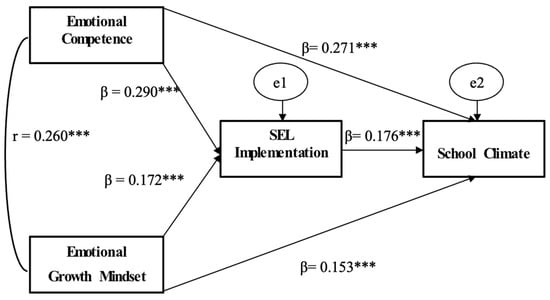
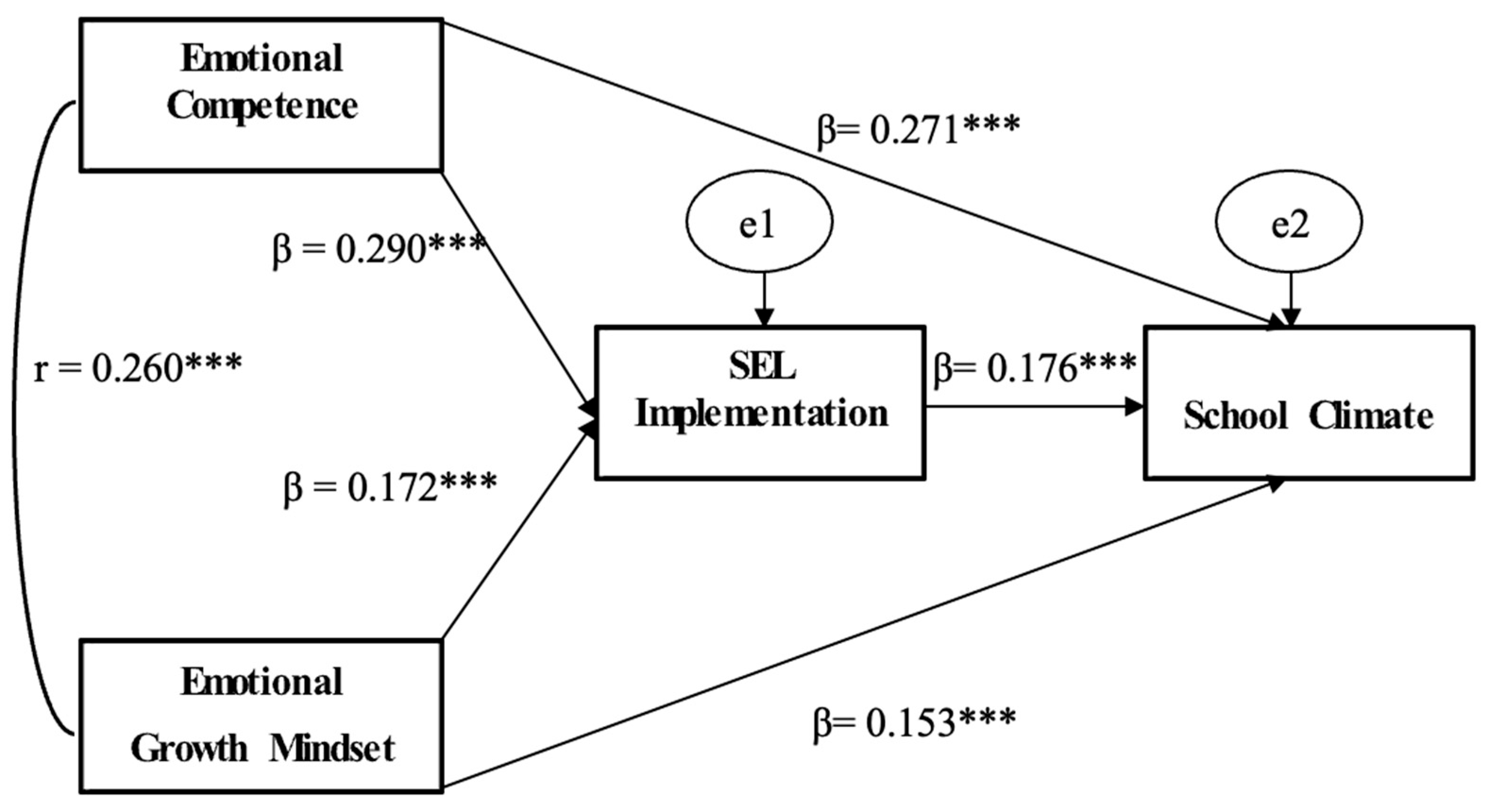
The primary observed-variable path model examined whether the observed associations among teachers’ emotional competence, emotional growth mindset, SEL implementation, and school climate perceptions were statistically consistent with an implementation-related pathway. Emotional competence was positively associated with SEL implementation (β = 0.287, p < 0.001), and SEL implementation was positively associated with school climate perceptions (β = 0.172, p < 0.001). Emotional competence also showed a significant direct association with school climate perceptions (β = 0.264, p < 0.001). Emotional growth mindset was positively associated with both SEL implementation (β = 0.176, p < 0.001) and school climate perceptions (β = 0.143, p < 0.001).
Because the observed-variable path model was just-identified (df = 0), global fit indices were not informative. Therefore, model evaluation focused on the estimated structural associations, explained variance, and indirect associations. The model accounted for approximately 13.9% of the variance in SEL implementation and 17.5% of the variance in school climate perceptions. The standardized structural path coefficients are presented in Table 2.
Table 2.
Standardized structural paths of the observed-variable path model.
As illustrated in Figure 1, the observed-variable path model shows the associations among emotional competence, emotional growth mindset, SEL implementation, and school climate.
Figure 1.
Observed-variable path model examining associations among emotional competence, emotional growth mindset, SEL implementation, and school climate. Note. Rectangles represent observed composite variables included in the observed-variable path model. Standardized path coefficients are presented. All displayed paths were statistically significant at p < 0.001. *** p < 0.001.
The strongest association with school climate was observed for emotional competence, indicating that teachers reporting higher emotional competence also tended to report more positive perceptions of their educational environments. SEL implementation also demonstrated a significant positive association with school climate perceptions, supporting its relevance as an implementation-related pathway within the proposed model.
Indirect-association analyses indicated statistically significant indirect associations through SEL implementation for both emotional competence and emotional growth mindset. The confidence intervals for both indirect associations excluded zero. The indirect and total association estimates are presented in Table 3.
Table 3.
Indirect and total associations of the observed-variable path model.
The estimated indirect associations were statistically significant for both emotional competence and emotional growth mindset in relation to school climate perceptions through SEL implementation. The indirect association was stronger for emotional competence (B = 0.001, β = 0.049, 95% CI [0.000, 0.002]) than for emotional growth mindset (B = 0.027, β = 0.030, 95% CI [0.015, 0.039]). Given the cross-sectional design and the use of teacher-reported measures, these indirect associations should be interpreted as statistically consistent pathways rather than evidence of causal mediation.
Emotional growth mindset showed significant positive associations with both SEL implementation and school climate perceptions, although these associations were smaller than those observed for emotional competence. This pattern supports its interpretation as a complementary psychological factor within the proposed model rather than as the primary explanatory variable.
Exploratory comparisons across professional roles using linear mixed models with school-level random intercepts indicated significant overall differences in emotional competence, F(8,1003) = 3.36, p < 0.001; emotional growth mindset, F(8,1005) = 4.64, p < 0.001; and SEL implementation, F(8,1004) = 18.60, p < 0.001. The overall difference in school climate perceptions was not statistically significant, F(8,990) = 1.21, p = 0.287. These findings suggest that professional roles may be associated with differences in educators’ emotional competence, emotional growth mindset, and reported SEL implementation, whereas differences in school climate perceptions were not supported by the overall test.
Holm-adjusted post hoc comparisons showed that coordinators reported higher emotional competence than primary school teachers (p = 0.012), while school psychologists/pedagogues/counselors reported higher emotional competence than both primary school teachers (p = 0.002) and secondary school teachers (p = 0.029). For emotional growth mindset, coordinators (p = 0.003), preschool teachers (p < 0.001), primary school teachers (p = 0.001), and school psychologists/pedagogues/counselors (p = 0.049) reported higher scores than secondary school teachers. For SEL implementation, significant differences indicated higher scores among preschool teachers than school leaders/directors (p < 0.001), coordinators (p = 0.003), primary school teachers (p < 0.001), secondary school teachers (p < 0.001), specialists (p < 0.001), administrative staff (p < 0.001), and participants reporting other roles (p < 0.001). Coordinators also reported higher SEL implementation than school leaders/directors (p = 0.029), secondary school teachers (p = 0.001), and administrative staff (p = 0.015), while primary school teachers reported higher scores than secondary school teachers (p < 0.001) and administrative staff (p = 0.004). School psychologists/pedagogues/counselors reported higher SEL implementation than school leaders/directors (p = 0.008), secondary school teachers (p < 0.001), and administrative staff (p < 0.001). The difference between school psychologists/pedagogues/counselors and specialists was borderline significant after Holm adjustment (p = 0.049). No Holm-adjusted pairwise comparisons were statistically significant for school climate. Comparisons involving administrative staff should be interpreted cautiously because this group comprised only eight participants.
4. Discussion
The present study examined the associations among teachers’ emotional competence, emotional growth mindset, SEL implementation, and school climate perceptions, with particular attention to potential implementation-related pathways. Using a large sample of teachers from RULER-affiliated schools, the findings indicate consistent associations in which emotional competence occupied a central position within the observed-variable model linking educators’ socioemotional functioning with school climate perceptions. More specifically, the findings were consistent with an implementation-oriented structural model in which emotional competence was positively associated with SEL implementation, which in turn was positively associated with school climate perceptions.
These findings are also consistent with the adults-first principle underlying the RULER approach, which emphasizes the importance of educators’ emotional competencies in relation to SEL practices in classrooms. Within the present cross-sectional design, however, this interpretation should be understood as an association rather than evidence that emotional competence is a prerequisite for SEL implementation or for the development of emotionally supportive learning environments (Brackett et al., 2019).
One of the most important findings of this study is the strong direct association between emotional competence and school climate. Teachers reporting higher emotional competence also tended to report more positive perceptions of school environments characterized by stronger school belonging, better interpersonal relationships, and more constructive disciplinary climates. This finding is consistent with previous research suggesting that emotionally competent educators may be better equipped to establish emotionally supportive interactions, manage interpersonal conflict, promote psychological safety, and foster emotionally responsive classroom environments. These patterns are consistent with previous research linking teachers’ emotional competence with classroom quality, relational support, reduced occupational distress, and emotionally supportive teacher–student interactions (Jennings & Greenberg, 2009; Collie, 2017).
This interpretation is consistent with research linking RULER implementation to positive changes in multiple dimensions of school climate in Mexican secondary schools (Baumsteiger et al., 2022) and to students’ psychological adjustment in Spanish primary schools (Castillo-Gualda et al., 2023). Related research also links school climate with students’ attitudes toward creativity (Hoffmann et al., 2025), suggesting that emotionally supportive school environments may have broader educational relevance. Although the present study did not directly examine these student outcomes, its findings contribute to this wider literature. This perspective also aligns with RULER’s systemic theory of change, which positions SEL as a whole-school process involving teachers and other adults in the school community, rather than an intervention delivered exclusively by psychological or guidance professionals (Brackett et al., 2019). However, the present study advances this literature by demonstrating that these associations remain significant even after accounting for SEL implementation processes and emotional growth mindset simultaneously within the proposed structural model.
Importantly, the results revealed statistically significant indirect associations through SEL implementation linking emotional competence with school climate perceptions. These findings are statistically consistent with the possibility that teachers’ emotional competence and their reported enactment of SEL-oriented practices are related to more positive perceptions of school climate. However, because all variables were measured cross-sectionally and through teacher self-report, the observed indirect association cannot establish temporal ordering or causal mediation. The pattern is therefore best understood as an implementation-related statistical pathway that warrants further examination using longitudinal, experimental, or multi-informant designs. This interpretation is consistent with ecological and implementation-oriented SEL frameworks emphasizing the importance of teachers’ socioemotional competencies and everyday enactment of SEL practices within school contexts (Brackett et al., 2019; Oberle et al., 2016; Mahoney et al., 2018; Reyes et al., 2012).
This study also contributes to the emerging literature on emotional growth mindset. Although emotional growth mindset showed weaker associations than emotional competence, it nevertheless showed statistically significant associations with both SEL implementation and school climate. This interpretation aligns with contemporary growth mindset literature suggesting that malleability beliefs may be associated with openness toward learning, professional engagement, and adaptive behavioral change processes (Yeager & Dweck, 2020). More broadly, contemporary growth mindset research has increasingly emphasized that beliefs regarding the malleability of personal abilities may be associated with motivation, persistence, openness toward learning, and adaptive engagement within educational contexts (Duckworth & Yeager, 2015; Yeager & Dweck, 2020).
At the same time, the comparatively stronger associations observed for emotional competence suggest that beliefs regarding emotional malleability alone may not capture the broader socioemotional capacities involved in teachers’ enactment of emotionally supportive behaviors in authentic classroom contexts. This interpretation is consistent with implementation-oriented perspectives emphasizing that successful SEL implementation depends not only on motivational readiness, but also on teachers’ own socioemotional competencies and relational capacities (Oberle et al., 2016; Schonert-Reichl, 2019).
The findings also hold important practical implications for educational systems and teacher professional development programs. The findings suggest that efforts to support positive school climate may benefit from going beyond isolated SEL curricula and placing greater emphasis on teachers’ own emotional competencies and their capacity to enact emotionally supportive practices consistently within everyday educational interactions. These findings are consistent with prior evidence suggesting that teacher-focused SEL professional development has been associated with improvements in classroom interactions, implementation quality, and emotionally supportive learning environments (Jennings et al., 2019; Schonert-Reichl, 2017; Zinsser et al., 2022).
The findings also raise questions about how responsibility for SEL implementation should be distributed between classroom teachers and school guidance professionals. Teachers are well positioned to integrate SEL into everyday classroom interactions, including emotional literacy activities, emotion regulation, and interpersonal problem-solving. School psychologists, pedagogues, and other educational guidance professionals may provide complementary expertise, particularly when students present complex socioemotional needs or when schools require specialized assessment and support. A collaborative approach may therefore allow teachers to sustain everyday SEL practices while drawing on specialist knowledge when needed. However, the present study does not establish which delivery arrangements are most effective or the conditions under which specialist support is necessary. These possibilities should be investigated directly in future research rather than inferred from the associations observed in the present study.
Consequently, educational policies seeking to support positive school climate may consider teacher emotional competence as an important organizational and pedagogical resource associated with the functioning of emotionally supportive schools.
Despite the conceptual, methodological, and applied contributions of the present study, several limitations should be acknowledged when interpreting the findings. First, the cross-sectional design precludes definitive causal inferences regarding the directionality of the observed associations. Although the proposed path model was theoretically grounded, its just-identified structure does not permit evaluation of global model fit; therefore, the indirect associations identified in the present study should not be interpreted as evidence of definitive causal mediation. Alternative reciprocal explanations remain possible, including the possibility that more positive school climates may facilitate greater SEL implementation or strengthen teachers’ emotional functioning over time. Accordingly, future longitudinal and experimental investigations are necessary to clarify the temporal and reciprocal relationships among emotional competence, SEL practices, and school climate processes.
Second, all variables were assessed exclusively through teacher self-report measures collected from the same respondent source at a single time point. Consequently, the observed associations may have been partially inflated by common method variance, shared source bias, and socially desirable responding. Additionally, because school climate, emotional competence, and SEL implementation were all assessed through self-perceptions, the findings should be interpreted primarily as reflecting educators’ subjective perceptions of emotionally supportive school functioning rather than fully objective indicators of educational climate or implementation quality. Future studies would benefit from incorporating multi-informant methodologies, including student reports, peer evaluations, classroom observations, leadership assessments, and administrative indicators of school functioning.
A further limitation concerns the Emotional Growth Mindset measure. Although the 21-item composite demonstrated excellent internal consistency (Cronbach’s α = 0.983) and showed theoretically coherent associations with emotional competence, SEL implementation, and school climate perceptions, the specific Spanish-language version used in this study has not undergone prior peer-reviewed validation. The psychometric evidence reported here should therefore be considered preliminary. Future research should examine the factorial structure, measurement invariance, and convergent and discriminant validity of this measure in independent samples.
Third, although the primary analyses accounted for the nesting of educators within schools through cluster-robust estimation, the present study did not explicitly model separate teacher- and school-level processes. Future research could therefore extend the present approach using multilevel structural models to examine whether the observed associations operate differently within and between schools.
Fourth, the sample was drawn exclusively from schools involved in RULER-related professional development and SEL-oriented implementation initiatives. As a result, participating educators may already possess comparatively elevated levels of SEL awareness, emotional literacy, or implementation readiness relative to teachers from more general educational contexts. Therefore, the generalizability of the findings to schools without prior SEL exposure or institutional commitment to socioemotional learning may be limited.
Fifth, school climate was operationalized exclusively through teacher perceptions. Although teacher perspectives constitute highly relevant indicators of educational functioning, school climate is inherently multidimensional and may vary substantially across students, families, school leadership, and observational indicators. Future studies should therefore incorporate broader ecological assessments of school climate across multiple educational stakeholders.
Sixth, several potentially relevant moderators were not examined in the present analyses, including educational stage, teaching experience, leadership roles, school type, and broader cultural or organizational factors. Future investigations should examine whether the proposed associations vary across different educational and institutional contexts.
Finally, the present study focused primarily on an implementation-oriented explanatory framework centered on teachers’ emotional competence, emotional growth mindset, and SEL implementation processes. Although the findings provide support for this model, additional research is needed to examine other contextual, organizational, and psychological factors that may further explain variability in emotionally supportive educational environments. Future studies may also extend the present findings by testing more comprehensive ecological and multilevel models across diverse educational contexts.
Future research should examine implementation dosage, the continuity and intensity of professional development, and follow-up and monitoring processes to clarify how these organizational conditions relate to the sustained implementation of SEL practices and school climate.
5. Conclusions
The present study contributes to the growing literature on teacher social and emotional functioning by showing that educators’ emotional competence is consistently associated with SEL implementation and positive school climate perceptions. Using a large sample of teachers from schools engaged in RULER-related initiatives, the findings were consistent with an observed-variable path model in which emotional competence was positively associated with both SEL-oriented practices and school climate perceptions. Importantly, the results suggest that SEL implementation may represent an important implementation-related process statistically associated with the relationship between emotional competence and positive school climate perceptions. These findings extend prior correlational literature by examining implementation-related indirect associations between teacher emotional competence and school climate perceptions within large-scale SEL-informed educational settings, while accounting for the clustering of educators within schools. More specifically, emotional competence showed the strongest standardized association with school climate within the proposed structural model, showing both direct associations with school climate and indirect associations through SEL implementation practices. In contrast, emotional growth mindset demonstrated comparatively weaker, although still statistically significant, associations across the principal study variables. These findings suggest that educators’ enacted socioemotional competencies may show stronger associations with school climate perceptions than beliefs regarding emotional malleability alone.
From a theoretical perspective, the findings are consistent with ecological and implementation-oriented conceptualizations of SEL, including frameworks such as RULER, emphasizing that emotionally supportive educational systems involve not only formal interventions, but also the everyday emotional practices, competencies, and interactions enacted by educators themselves. Consequently, teacher emotional competence may be considered not merely an individual wellbeing characteristic, but also an educational resource associated with the quality of school relational climates and the implementation of socioemotional educational initiatives.
Author Contributions
Conceptualization, R.C.-G.; methodology, R.C.-G.; software, D.H.M. and Á.M.R.; validation, D.H.M., Á.M.R., J.D.H., M.A.B., and R.C.-G.; formal analysis, Á.M.R.; investigation, J.D.H., and R.C.-G.; resources, R.C.-G.; data curation, D.H.M. and R.C.-G.; visualization, D.H.M.; supervision, Á.M.R. and R.C.-G.; project administration, R.C.-G.; writing-original draft preparation, D.H.M.; writing-review and editing, D.H.M., Á.M.R., J.D.H., M.A.B. and R.C.-G. All authors have read and agreed to the published version of the manuscript.
Funding
This research was funded by Ruth Castillo-Gualda, grant number XI Convocatoria de Ayudas a la Investigación: “Impacto de la educación emocional en el clima educativo y desarrollo profesional docente” (10_24_IELEC), Universidad Camilo José Cela.
Institutional Review Board Statement
All procedures complied with the ethical standards established in the Declaration of Helsinki and were approved by the corresponding institutional ethics committee at Universidad Camilo José Cela prior to data collection. (10_24_IELEC, approve date: 10 June 2024).
Informed Consent Statement
Participation was voluntary and anonymous. All participants provided informed consent prior to participation.
Data Availability Statement
The data presented in this study are available upon reasonable request from the corresponding author, subject to institutional and ethical restrictions.
Conflicts of Interest
The authors declare no conflict of interest.
References
- Baumsteiger, R., Hoffmann, J. D., Castillo-Gualda, R., & Brackett, M. A. (2022). Enhancing school climate through social and emotional learning: Effects of RULER in Mexican secondary schools. Learning Environments Research, 25(2), 465–483. [Google Scholar] [CrossRef] [Scilit]
- Blewitt, C., O’Connor, A., Morris, H., Mousa, A., Bergmeier, H., Nolan, A., Jackson, K., Barrett, H., & Skouteris, H. (2020). Do curriculum-based social and emotional learning programs in early childhood education and care strengthen teacher outcomes? A systematic literature review. International Journal of Environmental Research and Public Health, 17(3), 1049. [Google Scholar] [CrossRef] [Scilit] [PubMed]
- Brackett, M. A., Bailey, C. S., Hoffmann, J. D., & Simmons, D. N. (2019). RULER: A theory-driven, systemic approach to social, emotional, and academic learning. Educational Psychologist, 54(3), 144–161. [Google Scholar] [CrossRef] [Scilit]
- Brackett, M. A., Rivers, S. E., Reyes, M. R., & Salovey, P. (2012). Enhancing academic performance and social and emotional competence with the RULER feeling words curriculum. Learning and Individual Differences, 22(2), 218–224. [Google Scholar] [CrossRef] [Scilit]
- Brasseur, S., Grégoire, J., Bourdu, R., & Mikolajczak, M. (2013). The Profile of Emotional Competence (PEC): Development and validation of a self-reported measure that fits dimensions of emotional competence theory. PLoS ONE, 8(5), e62635. [Google Scholar] [CrossRef] [Scilit] [PubMed]
- Caouette, J. D., Robinson-Link, P. M., Metzger, A. N., Bailey, J. A., & Shapiro, V. B. (2025). Reliability and construct validity of a self-report measure of SEL capacities among K-12 educational leaders. Education Sciences, 15(11), 1418. [Google Scholar] [CrossRef] [Scilit]
- Castillo-Gualda, R., Moraleda, A., & Brackett, M. A. (2023). Preventative initiatives to promote psychological adjustment among primary students: Findings of RULER Approach in Spanish public schools. International Journal of Educational Psychology, 12(2), 206–232. [Google Scholar] [CrossRef] [Scilit]
- Collie, R. J. (2017). Teachers’ social and emotional competence: Links with social and emotional learning and positive workplace outcomes. In Scoial and emotional learning in Australia and the Asia-Pacific: Perspectives, programs and approaches (pp. 167–184). Springer. [Google Scholar] [CrossRef] [Scilit]
- Collie, R. J. (2020). The development of social and emotional competence at school: An integrated model. International Journal of Behavioral Development, 44(1), 76–87. [Google Scholar] [CrossRef] [Scilit]
- Collie, R. J., Shapka, J. D., & Perry, N. E. (2012). School climate and social-emotional learning: Predicting teacher stress, job satisfaction, and teaching efficacy. Journal of Educational Psychology, 104(4), 1189–1204. [Google Scholar] [CrossRef] [Scilit]
- Denham, S. A. (2018). Keeping SEL developmental: The importance of a developmental lens for fostering and assessing SEL competencies. Frameworks Brefs, 1, 127–152. [Google Scholar]
- Duckworth, A. L., & Yeager, D. S. (2015). Measurement matters: Assessing personal qualities other than cognitive ability for educational purposes. Educational Researcher, 44(4), 237–251. [Google Scholar] [CrossRef] [Scilit] [PubMed]
- Hoffmann, J. D., Ivcevic, Z., & Castillo-Gualda, R. (2025). School climate and students’ attitudes toward creativity. Thinking Skills and Creativity, 58, 101880. [Google Scholar] [CrossRef] [Scilit]
- Hövel, D. C., Röösli, P., Jurkic, A., Nideröst, M., Link, P.-C., & Sticca, F. (2025). Social-emotional learning (SEL) and its impact on teacher stress, self-efficacy, and attitudes towards inclusion: Longitudinal insights from the StaFF-BL Project. Behavioral Sciences, 15(1), 1511. [Google Scholar] [CrossRef] [Scilit] [PubMed]
- Jennings, P. A., Doyle, S., Oh, Y., Rasheed, D., Frank, J. L., & Brown, J. L. (2019). Long-term impacts of the CARE program on teachers’ self-reported social and emotional competence and wellbeing. Journal of School Psychology, 76, 186–202. [Google Scholar] [CrossRef] [Scilit] [PubMed]
- Jennings, P. A., & Greenberg, M. T. (2009). The prosocial classroom: Teacher social and emotional competence in relation to student and classroom outcomes. Review of Educational Research, 79(1), 491–525. [Google Scholar] [CrossRef] [Scilit]
- Kaplan, Z., & Göl-Güven, M. (2026). Teachers’ SEL identity (SEL-ID): An intersection between teacher identity and social and emotional learning (SEL). Behavioral Sciences, 16(1), 58. [Google Scholar] [CrossRef] [Scilit] [PubMed]
- Lozano-Peña, G., Sáez-Delgado, F., López-Angulo, Y., & Mella-Norambuena, J. (2021). Teachers‘ social-emotional competence: History concept, models, instruments, and recommendations for educational quality. Sustainability, 13(21), 12142. [Google Scholar] [CrossRef] [Scilit]
- Mahoney, J. L., Durlak, J. A., & Weissberg, R. P. (2018). An update on social and emotional learning outcome research. Phi Delta Kappan, 102(4), 18–23. [Google Scholar] [CrossRef] [Scilit]
- Mikolajczak, M., Brasseur, S., & Fantini-Hauwel, C. (2014). Measuring intrapersonal and interpersonal EQ: The Short Profile of Emotional Competence (S-PEC). Personality and Individual Differences, 65, 42–46. [Google Scholar] [CrossRef] [Scilit]
- Oberle, E., Domitrovich, C. E., Meyers, D. C., & Weissberg, R. P. (2016). Establishing systemic social and emotional learning approaches in schools: A framework for schoolwide implementation. Cambridge Journal of Education, 46(3), 277–297. [Google Scholar] [CrossRef] [Scilit]
- Osher, D., & Berg, J. (2017). School climate and social and emotional learning: The integration of two approaches. Edna Bennett Pierce Prevention Research Center, Pennsylvania State University. [Google Scholar]
- Pekrun, R. (2017). Emotion and achievement during adolescence. Child Development Perspectives, 11(3), 215–221. [Google Scholar] [CrossRef] [Scilit]
- Reyes, M. R., Brackett, M. A., Rivers, S. E., White, M., & Salovey, P. (2012). Classroom emotional climate, student engagement, and academic achievement. Journal of Educational Psychology, 104(3), 700–712. [Google Scholar] [CrossRef] [Scilit]
- Schonert-Reichl, K. A. (2017). Social and emotional learning and teachers. The Future of Children, 27(1), 137–155. [Google Scholar] [CrossRef] [Scilit]
- Schonert-Reichl, K. A. (2019). Advancements in the landscape of social and emotional learning and emerging topics on the horizon. Educational Psychologist, 54(3), 222–232. [Google Scholar] [CrossRef] [Scilit]
- Thapa, A., Cohen, J., Guffey, S., & Higgins-D’Alessandro, A. (2013). A review of school climate research. Review of Educational Research, 83(3), 357–385. [Google Scholar] [CrossRef] [Scilit]
- The Jamovi Project. (2024). Jamovi (Version 2.6) [Computer software]. Available online: https://www.jamovi.org (accessed on 7 May 2026).
- Wang, J., Meng, W., Xing, Q., & Moe, A. (2024). Motivating and demotivating teaching styles: A comparison among planned, adopted, and perceived. Social Psychology of Education, 27, 2993–3017. [Google Scholar] [CrossRef] [Scilit]
- Wang, M. T., & Degol, J. L. (2016). School climate: A review of the construct, measurement, and impact on student outcomes. Educational Psychology Review, 28(2), 315–352. [Google Scholar] [CrossRef] [Scilit]
- Yeager, D. S., & Dweck, C. S. (2020). What can be learned from growth mindset controversies? American Psychologist, 75(9), 1269–1284. [Google Scholar] [CrossRef] [Scilit] [PubMed]
- Zinsser, K. M., Christensen, C. G., & Torres, L. (2022). She’s supporting them; who’s supporting her? Preschool center-level social-emotional supports and teacher well-being. Journal of School Psychology, 59, 55–66. [Google Scholar] [CrossRef] [Scilit] [PubMed]

Disclaimer/Publisher’s Note: The statements, opinions and data contained in all publications are solely those of the individual author(s) and contributor(s) and not of MDPI and/or the editor(s). MDPI and/or the editor(s) disclaim responsibility for any injury to people or property resulting from any ideas, methods, instructions or products referred to in the content. |
© 2026 by the authors. Published by MDPI on behalf of the Spanish Scientific Society for Research and Training in Health Sciences. Licensee MDPI, Basel, Switzerland. This article is an open access article distributed under the terms and conditions of the Creative Commons Attribution (CC BY) license.