


Abstract
The flexible job shop scheduling problem (FJSP), which simultaneously involves machine assignment and operation sequencing under multiple constraints, is a typical NP-hard combinatorial optimization problem, and efficient scheduling is of great importance for improving production efficiency and manufacturing flexibility. To address this problem, the success-history beaver behavior optimizer (SHBBO) is introduced to solve FJSP with the objective of minimizing the makespan. First, considering the discrete characteristics of FJSP, an effective encoding and decoding scheme is designed to represent operation sequences and machine assignments. Then, the adaptive success-history mechanism of SHBBO is employed to dynamically adjust the search parameters during the optimization process, enabling a better balance between global exploration and local exploitation. Meanwhile, the behavioral update strategy of SHBBO is adapted to the scheduling environment so that candidate solutions can be effectively evolved in the discrete solution space. In addition, a population updating strategy and elite-guided search mechanism are incorporated to enhance solution quality and convergence performance. Finally, extensive experiments are conducted on benchmark FJSP instances to verify the effectiveness of the proposed method. Experimental results show that SHBBO achieves the best average results on 11 out of 12 CEC2022 benchmark functions, with particularly notable improvements over the original beaver behavior optimizer (BBO) on functions such as F6 (56.69%), F5 (12.20%), and F10 (9.18%). On the BRdata benchmark instances, SHBBO obtains the best or tied-best makespan on all 10 instances, with an average percentage relative deviation (PRD) of 0, and reduces the makespan by 7.69% on MK10 and 6.25% on MK06 compared with BBO.
1. Introduction
In modern manufacturing systems, efficient scheduling is essential for improving productivity, reducing production costs, and enhancing enterprise competitiveness. As a representative problem in production scheduling, the job shop scheduling problem (JSP) has been widely studied for decades. Nevertheless, conventional JSP generally assumes that each operation is processed on a predefined machine, which limits its applicability in increasingly dynamic and flexible manufacturing environments [1,2]. With the rapid growth of intelligent manufacturing, customized production, and small-batch multi-variety processing, FJSP has emerged as a more realistic and practical extension of JSP. Compared with traditional JSP, FJSP introduces machine flexibility by allowing an operation to be processed on one of several alternative machines, while also involving the sequencing of operations on machines [3,4]. As a result, FJSP requires addressing both machine assignment and operation scheduling simultaneously, making it a typical NP-hard combinatorial optimization problem [5].
In recent years, owing to the importance of FJSP in manufacturing systems, increasing attention has been paid to this problem by researchers worldwide. A large number of intelligent optimization algorithms have been introduced to solve FJSP, and different algorithms exhibit their own advantages and limitations in dealing with solution quality, convergence efficiency, and search robustness. The genetic algorithm (GA), characterized by fast convergence and strong optimization capability, has been widely applied to flexible job shop scheduling problems. For example, Meng et al. [6] proposed an improved genetic algorithm for the flexible job shop scheduling problem with limited AGVs, and the results showed that the proposed method outperformed several state-of-the-art algorithms. Xie et al. [7] developed a hybrid genetic tabu search algorithm for distributed flexible job shop scheduling, demonstrating superior solution quality and computational efficiency on benchmark instances. Xu et al. [8] introduced an ensemble genetic programming method for dynamic flexible job shop scheduling, which achieved better scheduling performance by enhancing population diversity and search space exploration. Tutumlu et al. [9] addressed the flexible job shop scheduling problem with job splitting and proposed a hybrid genetic algorithm combined with local search, showing better effectiveness than the classical GA. Liao et al. [10] proposed an artificial bee colony algorithm for FJSP with extra resource constraints. Kong et al. [11] developed an improved discrete particle swarm optimization algorithm for FJSP with handling and setup times. Du et al. [12] designed a hybrid estimation of distribution algorithm for the distributed assembly flexible job shop scheduling problem. Zhang et al. [13] presented an improved memetic algorithm for energy-saving distributed flexible job shop scheduling with machine breakdowns. Wang et al. [14] proposed an improved adaptive hybrid algorithm for the distributed flexible job shop scheduling problem. Zheng et al. [15] developed an improved whale optimization algorithm for FJSP with job priorities, transportation time, and setup time. Fuladi et al. [16] designed a hybrid metaheuristic framework for multi-criteria FJSP optimization. Shi et al. [17] proposed a novel two-stage neighborhood search method for FJSP with reconfigurable machine tools. Wang et al. [18] further introduced an enhanced memetic algorithm for energy-efficient and low-carbon FJSP considering machine restart. Lv et al. [19] presented an enhanced walrus optimization algorithm for FJSP with parallel batch processing operations. In addition, an improved sparrow search algorithm has also been introduced for FJSP with setup and transportation times, showing the continued vitality of population-based optimization in workshop scheduling [20]. Overall, these studies indicate that evolutionary and swarm-intelligence algorithms still play an important role in solving workshop scheduling problems.
Despite the encouraging progress achieved by existing studies, there is still room for improvement in solving FJSP efficiently. On the one hand, the strong discreteness, multiple constraints, and high-dimensional search space of FJSP make many existing algorithms vulnerable to premature convergence and local stagnation. On the other hand, maintaining a proper balance between exploration and exploitation remains a persistent challenge for metaheuristic scheduling methods. In addition, some improved algorithms rely heavily on problem-specific operators or complex hybrid mechanisms, which may increase algorithmic complexity and reduce their adaptability to different scheduling environments. Consequently, developing a simple yet effective metaheuristic with strong search capability and robustness is still of considerable significance for FJSP optimization.
Motivated by these considerations, this paper applies the success-history beaver behavior optimizer (SHBBO) to the flexible job shop scheduling problem. The core advantage of SHBBO lies in its success-history adaptation mechanism, which enables the algorithm to adjust search parameters dynamically according to historical successful search information. This mechanism helps improve the search efficiency and enhances the coordination between diversification and intensification during the optimization process. To adapt SHBBO to FJSP, a discrete representation framework is further constructed for machine assignment and operation sequencing, together with a corresponding evolutionary updating strategy. As a result, the proposed SHBBO-based approach provides a promising alternative for obtaining high-quality solutions to FJSP. The main contributions of this paper are summarized as follows:
- (a)
- An improved SHBBO is developed by embedding a success-history-based adaptive parameter mechanism into the original BBO framework. Different from the original BBO, the proposed SHBBO integrates adaptive differential recombination, elite-guided search, and archive-assisted update, thereby enhancing directional search capability, parameter self-adaptation, and the balance between global exploration and local exploitation.
- (b)
- A discrete optimization framework based on SHBBO is further established for the flexible job shop scheduling problem. By combining SHBBO with an effective encoding–decoding strategy for operation sequencing and machine assignment, the proposed method extends the improved bio-inspired optimizer from continuous optimization to discrete combinatorial scheduling, establishing an effective SHBBO-based solution framework for FJSP.
2. Flexible Job Shop Scheduling Problem
FJSP is an important extension of the classical job shop scheduling problem. In the classical JSP, each operation is processed on a predetermined machine, whereas in FJSP each operation can be assigned to one machine selected from a set of alternative eligible machines. This additional routing flexibility makes FJSP more consistent with practical manufacturing systems, but also significantly increases the complexity of the scheduling decision process. In essence, FJSP simultaneously addresses two strongly coupled subproblems: machine assignment and operation sequencing. The first determines which eligible machine should process each operation, while the second determines the processing order of operations on each machine. For this reason, FJSP is widely regarded as a highly challenging NP-hard combinatorial optimization problem.
In the considered problem, a set of n jobs is processed on m machines. Let the job set be denoted by and the machine set by . Each job Ji consists of a predetermined sequence of operations, and the j-th operation of job Ji is denoted by Oij. For each operation Oi,j, only a subset of machines is feasible; this eligible machine set is denoted by Mi,j ⊆ M. If operation Oi,j is processed on machine k ∈ Mij, its processing time is Pi,j,k. The objective considered in this paper is to minimize the makespan, i.e., the completion time of the last finished job in the schedule, which remains the most widely used benchmark objective in FJSP studies and related mixed-integer formulations.
To formulate the problem in a compact way, the following standard assumptions are adopted. All jobs and machines are available at time zero. Each operation must be processed without preemption once it has started. Each machine can process at most one operation at a time, and each operation can be assigned to exactly one eligible machine. The precedence relations among operations of the same job must be satisfied strictly. In addition, the basic formulation in this work does not consider transportation, setup, maintenance, or workforce coupling in order to focus on the canonical FJSP structure and provide a clear benchmark for evaluating the optimization capability of the proposed algorithm. These assumptions are consistent with the mainstream base model from which many recent FJSP variants are extended. Table 1 presents the relevant variables and their meanings in FJSP.
Table 1.
Relevant variables and their meanings in FJSP.
Based on the above notation, the mixed-integer programming model of FJSP can be established as follows.
The objective function is formulated as follows:
Equation (1) minimizes the makespan of the schedule.
The model is subject to the following constraints.
The completion time of each job cannot be smaller than the completion time of any of its operations:
The completion time of an operation processed on machine k must be no earlier than its start time plus the corresponding processing time if that machine is selected:
where Xijk ∈ {0, 1} denotes a binary variable, equal to 1 if operation Oij is assigned to machine k, and 0 otherwise.
Each operation must be assigned to exactly one eligible machine:
The technological precedence between two consecutive operations of the same job must be satisfied:
For any two operations Oij and Ohg that may be processed on the same machine k, one of them must precede the other:
where Zijhgk ∈ {0, 1} is a binary sequencing variable, equal to 1 if operation Oij is processed before Ohg on machine k, and 0 otherwise. H is a sufficiently large positive constant.
The makespan must be no smaller than the completion time of each job:
Non-negativity and binary requirements are imposed as:
The above formulation captures the two fundamental decision layers of FJSP, namely machine assignment and operation sequencing. Constraint (2) links job completion to operation completion. Constraint (3) defines the temporal relationship between the start time and completion time of an operation under machine selection. Constraint (4) guarantees that each operation is processed on one and only one eligible machine. Constraint (5) enforces the technological order inside each job. Constraints (6) and (7) are disjunctive machine-capacity constraints, ensuring that two operations assigned to the same machine cannot overlap in time. Constraint (8) defines the makespan as the latest job completion time. Similar big-H logic and disjunctive sequencing structures are widely used in recent MIP formulations of FJSP and its extensions.
3. Success-History Beaver Behavior Optimizer
The beaver behavior optimizer (BBO) is a recently proposed metaheuristic inspired by the cooperative behaviors of beavers during dam construction. By modeling biologically motivated role division and collaborative search, BBO provides a behavior-based mechanism for balancing exploration and exploitation [21]. Previous studies have shown that BBO performs competitively on benchmark functions and has shown promising applicability in solar photovoltaic parameter identification and several engineering optimization problems. However, the original BBO still exhibits limited directional guidance and insufficient adaptive parameter control in complex search landscapes. To address these limitations, a success-history beaver behavior optimizer (SHBBO) is proposed in this work. The proposed method preserves the biologically inspired role division of beavers into architects and prospectors, while replacing the original coordinate-wise random learning mechanism with a success-history-based adaptive differential recombination framework. In this way, SHBBO combines the elite-group guidance of BBO with the strong search efficiency of adaptive differential evolution.
To adapt SHBBO to the discrete characteristics of FJSP, a two-part solution representation is adopted, consisting of an operation-sequencing part and a machine-assignment part. The operation-sequencing part is used to determine the processing order of operations, while the machine-assignment part specifies the selected machine for each operation from its eligible machine set. In the encoding stage, each candidate solution generated by SHBBO is mapped into a priority-based representation. For the operation-sequencing part, the relative values of the corresponding decision variables are sorted and converted into a feasible processing priority order. During this process, repeated appearances of the same job index are interpreted according to the technological order of its operations, so that the first appearance corresponds to the first operation of that job, the second appearance corresponds to the second operation, and so on. In this way, the operation sequence always satisfies the internal precedence relationship of each job. For the machine-assignment part, the corresponding decision variables are mapped to the eligible machine set of each operation. Specifically, for each operation Oi,j, the encoded value is transformed into an index of the feasible machine set Mi,j, and the selected machine is then determined accordingly. Therefore, infeasible machine selections are avoided during decoding. In the decoding stage, the operations are scheduled one by one according to the obtained operation sequence. For each operation, the decoder identifies its assigned machine and determines the earliest feasible starting time by simultaneously considering two constraints: the completion time of its predecessor operation in the same job and the availability time of the assigned machine. The starting time is then set to the later of these two times, and the completion time is obtained by adding the corresponding processing time. By repeating this procedure for all operations, a complete feasible schedule can be constructed, from which the makespan is finally calculated. Through this encoding–decoding strategy, SHBBO can search in the continuous solution space while the decoding procedure converts each candidate solution into a feasible discrete FJSP schedule. This makes it possible to apply the improved SHBBO framework to the machine-assignment and operation-sequencing decisions of FJSP.
Assume that the optimization problem is defined in a D-dimensional continuous search space, and the population size is N. The i-th individual at iteration t is denoted by the bold vector , and its fitness value is .
At the beginning of the optimization process, each individual is randomly initialized within the search bounds:
where and denote the lower and upper bounds of the decision variables, respectively, is a uniformly distributed random vector, and ⊙ denotes element-wise multiplication.
The fitness of each initial individual is then evaluated as
The global best individual in the initial population is defined by
At each iteration, the population is sorted in ascending order according to fitness values. Let
where denotes the k-th ranked individual at iteration t.
To preserve the core mechanism of BBO, SHBBO divides the population into architects and prospectors. However, instead of using a fixed proportion, the architect ratio is dynamically increased during the evolutionary process to emphasize global exploration in the early stage and stronger elite exploitation in the later stage. The architect ratio is defined as
where Tmax is the maximum number of iterations. Accordingly, the number of architects is
Thus, the first individuals in the ranked population are regarded as architects, while the remaining individuals are considered prospectors.
Meanwhile, to control the strength of local exploitation, a p-best pool is constructed from the top-ranked individuals, and its size gradually shrinks during the search:
The pbest pool therefore contains the top individuals.
To improve the adaptability of the search process, SHBBO introduces two adaptive control parameters: the scaling factor F and the crossover rate CR. Unlike the original BBO, where the search strength is driven only by a deterministic time-varying factor, SHBBO uses a success-history mechanism to update these parameters online.
Assume that a historical memory of length H is maintained for both F and CR:
For each individual, one memory index r ∈ {1, 2, …, H} is randomly selected. Then, the crossover rate is generated by a Gaussian perturbation around the historical mean:
where clip(x, 0, 1) truncates x into the interval [0, 1].
Similarly, the scaling factor is sampled from a Cauchy distribution centered at MF,r.
and then truncated to
This mechanism allows SHBBO to automatically adapt its search step sizes according to previous successful search experiences.
For architect individuals, SHBBO emphasizes high-quality exploitation. Therefore, a current-to-pbest/1 mutation strategy is employed. For the i-th architect individual , a pbest individual is randomly selected from the top individuals, and two additional vectors are chosen from the current population and archive, respectively. The mutation vector is then generated as
where , and may come either from the current population or from the external archive. The first difference term guides the architect toward an elite solution, while the second term injects directional diversity to avoid premature convergence.
For prospector individuals, SHBBO focuses more on exploration. Instead of simply learning from architects through coordinate-wise random perturbations as in the original BBO, each prospector performs an architect-guided differential search. Specifically, two architect individuals and are selected, and two additional population/archive vectors are also sampled. The mutant vector of the i-th prospector is defined as
where is an architect vector, , , and are mutually different indices, and may be taken from the archive. In this mutation form, the first difference term explicitly guides the prospector toward architect knowledge, whereas the second difference term expands the search into unexplored regions.
Therefore, SHBBO preserves the biological interpretation of architects as high-quality resource organizers and prospectors as exploratory scouts, but replaces the original weak random learning process with more effective differential learning operators.
Because mutation and crossover may generate infeasible candidate solutions outside the predefined search range, SHBBO uses a midpoint-based boundary repair strategy. For each component , the repaired value is defined as
Compared with direct clipping, this repair mechanism reduces the risk of excessive solution accumulation on the boundaries and helps maintain smoother search trajectories.
The trial vector is then evaluated. If it performs better than the target vector , it replaces the target vector in the next generation:
If the trial vector is successful, the replaced parent vector is inserted into the external archive :
To prevent unlimited growth, the archive size is restricted to N. When the archive exceeds this size, randomly selected archived vectors are discarded.
The global best solution is updated as
The key adaptive component of SHBBO is the updating of parameter memories based on successful trial vectors. Suppose that during iteration t, there are successful updates. Their corresponding scaling factors and crossover rates are denoted by
For each successful update, its fitness improvement is defined as
where ε is a very small positive number used to avoid division by zero.
The normalized weight of each successful update is
The corresponding memory cell is then updated using a weighted mean. For the scaling factor, the weighted Lehmer mean is adopted:
For the crossover rate, the weighted arithmetic mean is used:
These updated memory values will be reused to generate the control parameters of subsequent individuals. In this manner, SHBBO gradually learns suitable search amplitudes and recombination strengths directly from successful evolutionary experiences.
From the above formulations, the search mechanism of SHBBO can be summarized as follows. First, the population is dynamically divided into architects and prospectors according to fitness ranking. Second, architects conduct strong exploitative learning from elite individuals, while prospectors perform an architect-guided exploratory differential search. Third, the trial solutions are generated through crossover and boundary repair. Finally, the successful trial vectors contribute not only to population evolution but also to the adaptive update of control parameter memories.
Therefore, SHBBO transforms the original BBO from a coordinate-wise random learning optimizer into a role-guided, success-history adaptive differential recombination optimizer. The architect-prospector role structure maintains the biological interpretability of the original BBO, while the newly introduced adaptive differential search mechanism substantially enhances directional search ability, population diversity maintenance, and convergence robustness.
The detailed procedure of the proposed SHBBO is summarized in Algorithm 1, where the architect-prospector role division, success-history parameter adaptation, and differential recombination are integrated into a unified optimization framework.
| Algorithm 1. Success-History Beaver Behavior Optimizer | |
| Input: objective function f(⋅), population size N, maximum iteration number Tmax, dimension D, lower bound l, upper bound u, memory size H. | |
| Output: best solution xbest, best fitness fbest. | |
| 1. | Initialize the population xi, evaluate fi = f(xi) |
| 2. | Determine the initial best solution xbest, best fitness fbest. |
| 3. | Initialize the memory vectors MF, MCR, set the archive 𝒜 = ∅, memory index k = 1. |
| 4. | for t = 1 to Tmax |
| 5. | Sort the population in ascending order of fitness. |
| 6. | Compute the architect ratio and the number of architects: , . |
| 7. | Compute the pbest ratio and the pbest pool size: |
| 8. | Initialize the success sets SF = ∅, SCR = ∅, and Δ = ∅. |
| 9. | for i = 1 to N |
| 10. | Randomly select a memory index r ∈ {1, 2, …, H}. |
| 11. | Generate the control parameters |
| 12. | if Xi is an architect |
| 13. | Select xpbest, , |
| 14. | Generate the mutant vector |
| 15. | else |
| 16. | Select architect , , , |
| 17. | Generate the mutant vector |
| 18. | end if |
| 19. | Perform binomial crossover between xi and vi to obtain the trial vector ui. |
| 20. | Repair ui if it violates the search bounds, and evaluate f(ui). |
| 21. | if f(ui) ≤ fi |
| 22. | Store xi into the archive 𝒜, replace xi with ui, and set fi = f(ui). |
| 23. | Record and into SF and SCR, respectively. |
| 24. | Record the fitness improvement |
| 25. | Update xbest and fbest if necessary. |
| 26. | end if |
| 27. | end for |
| 28. | if SF ≠ ∅ |
| 29. | Compute the normalized weights ws. |
| 30. | Update the memories MF,k, MCR,k. |
| 31. | Set k = k + 1, if k > H, then k = 1. |
| 32. | end if |
| 33. | if |𝒜| > N, randomly remove extra archived individuals. |
| 34. | Record the convergence value fbest. |
| 35. | end for |
| 36. | return xbest, fbest. |
4. Experimental Results and Validation
To comprehensively evaluate the proposed SHBBO, the experimental validation is conducted from two complementary aspects. First, SHBBO is tested on the CEC2022 benchmark suite to examine its general optimization capability, convergence behavior, and robustness in continuous search spaces. These benchmark tests are not intended to directly validate the scheduling contribution, but rather to verify the effectiveness of the improved search mechanism itself. Second, since the main application of this study is the flexible job shop scheduling problem, the practical scheduling contribution is further validated on the Brandimarte benchmark instances, where SHBBO is integrated with a discrete encoding–decoding framework for machine assignment and operation sequencing. In this way, the continuous benchmark experiments provide supplementary evidence for the optimizer improvement, whereas the discrete FJSP experiments provide the direct validation of its applicability to constrained scheduling optimization. In the implemented SHBBO, the main control parameters were fixed as parch = 0.25, c = 0.1, and μF = μCR = 0.5, while the archive size was limited to N. For the CEC2022 experiments, N = 30, Tmax = 1000, and D = 20, whereas the lower and upper bounds were determined by the standard benchmark definitions.
4.1. Benchmark Function-Based Performance Evaluation
To verify the effectiveness of the proposed SHBBO in continuous optimization, benchmark performance evaluation is first conducted on the CEC2022 test suite. It should be noted that this benchmark evaluation is used to assess the optimizer’s general search ability, convergence behavior, and robustness in continuous domains, rather than to directly represent the discrete and constrained nature of FJSP. The proposed algorithm is compared with the original BBO and several competitive recent algorithms, namely dung beetle optimizer (DBO) [22], gray wolf optimizer (GWO) [23], and Harris hawks optimization (HHO) [24]. In all experiments, each algorithm is run for 1000 iterations to guarantee adequate convergence, and 30 independent runs are carried out on each benchmark function to reduce the influence of randomness and ensure statistical reliability.
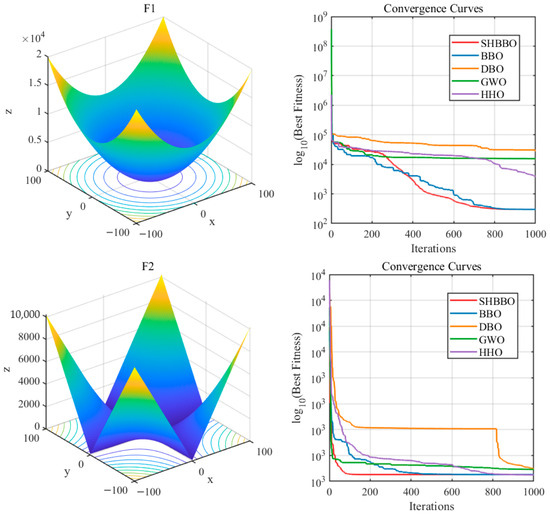
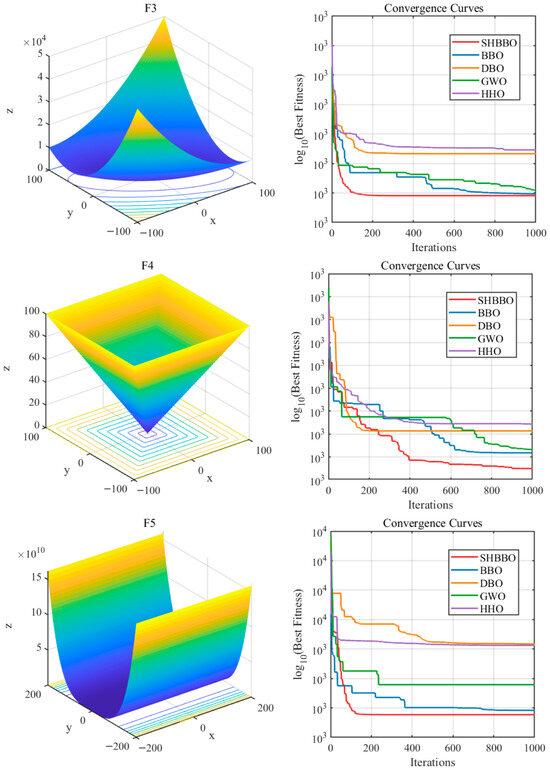
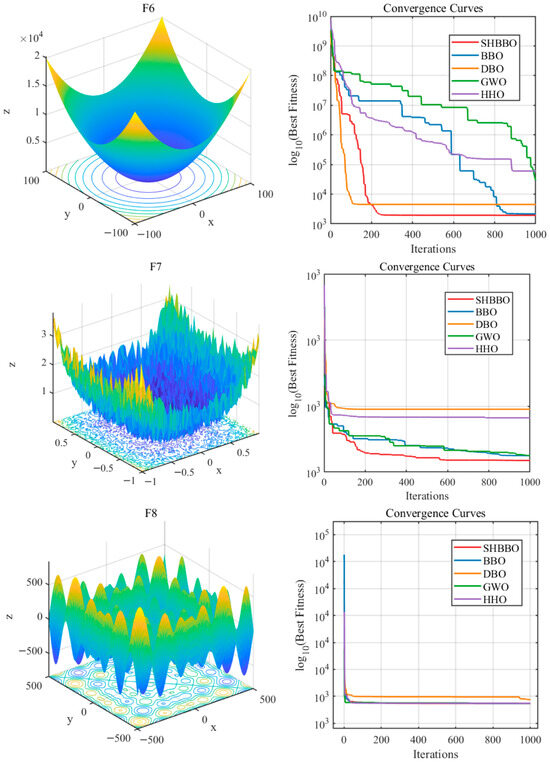
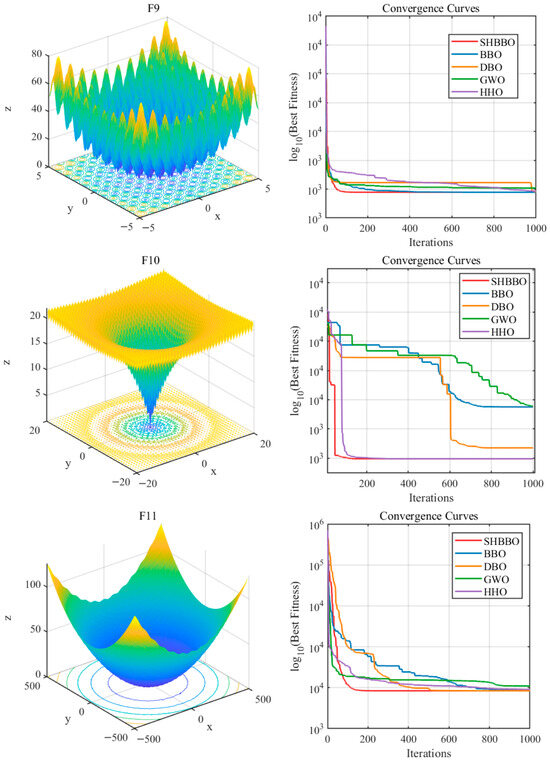
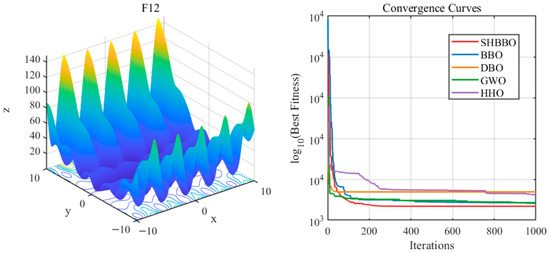
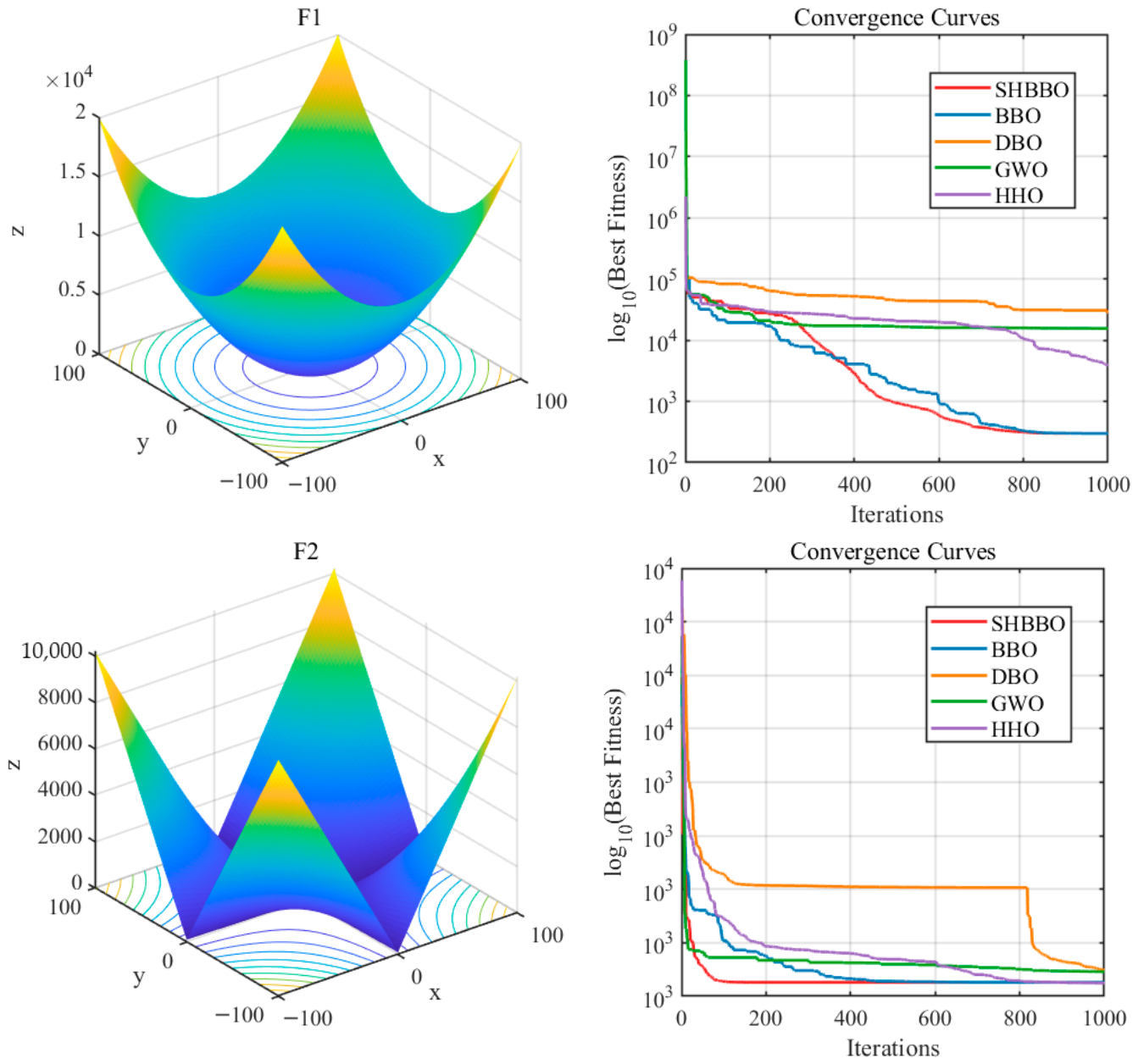
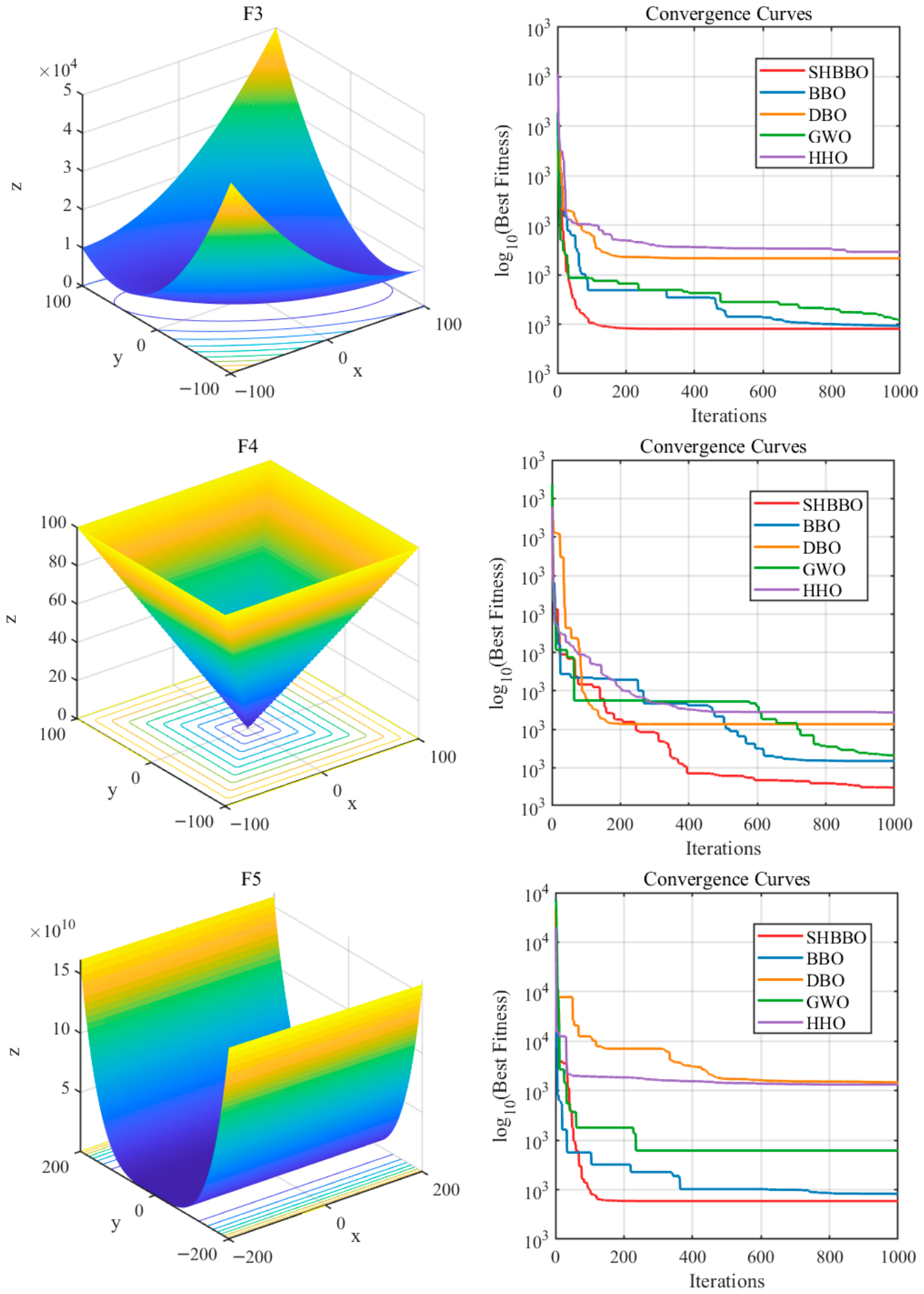
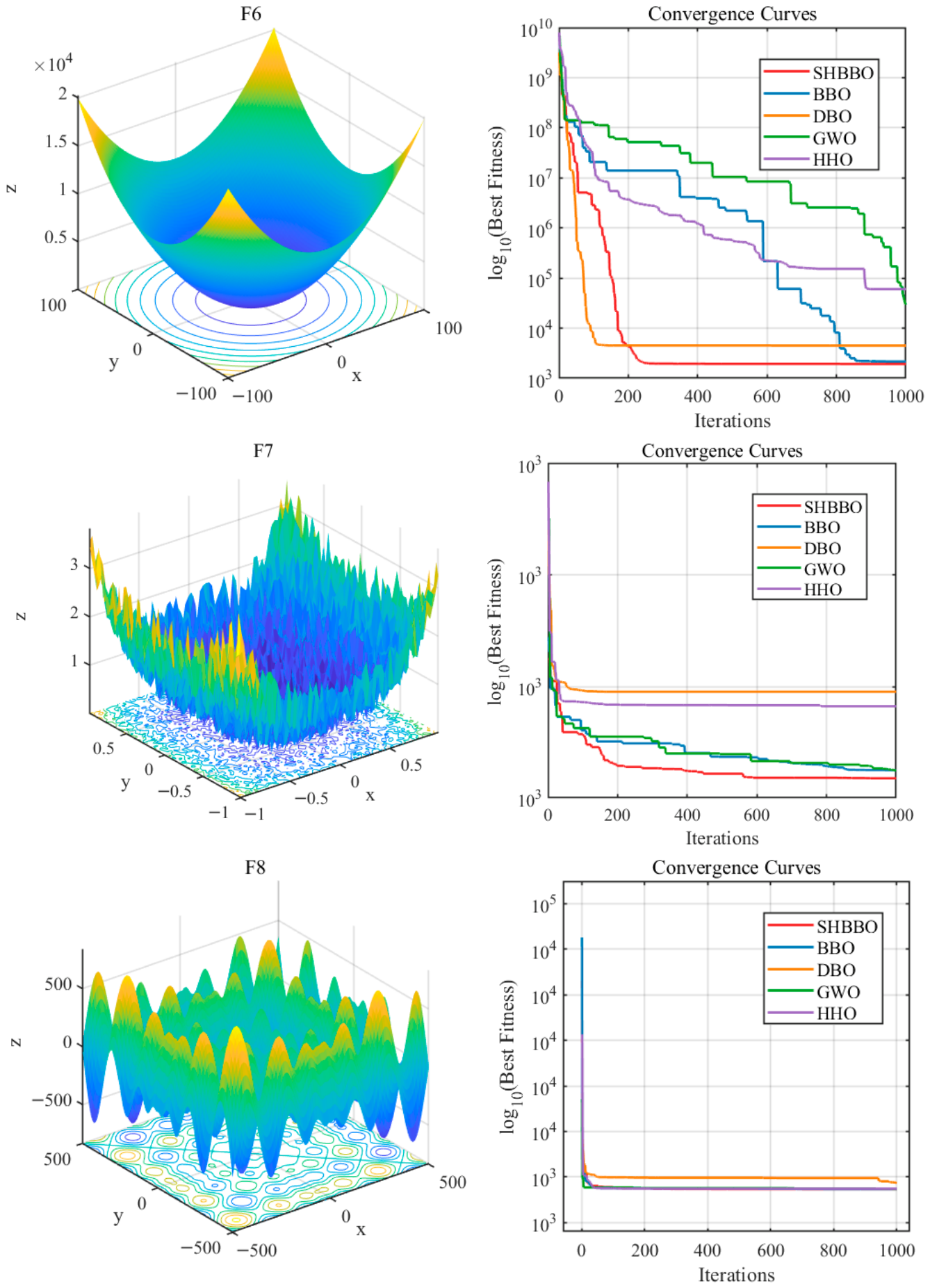
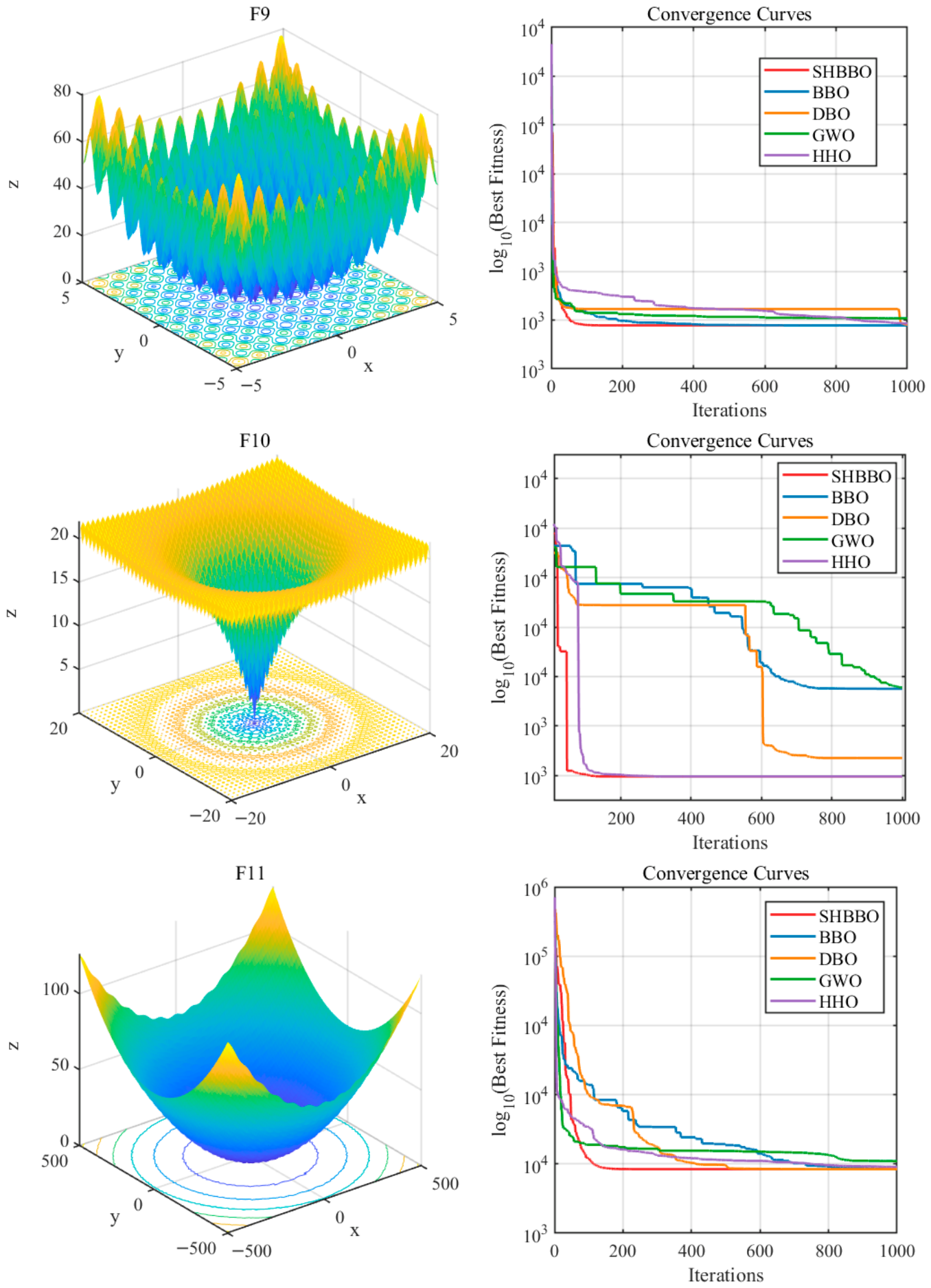
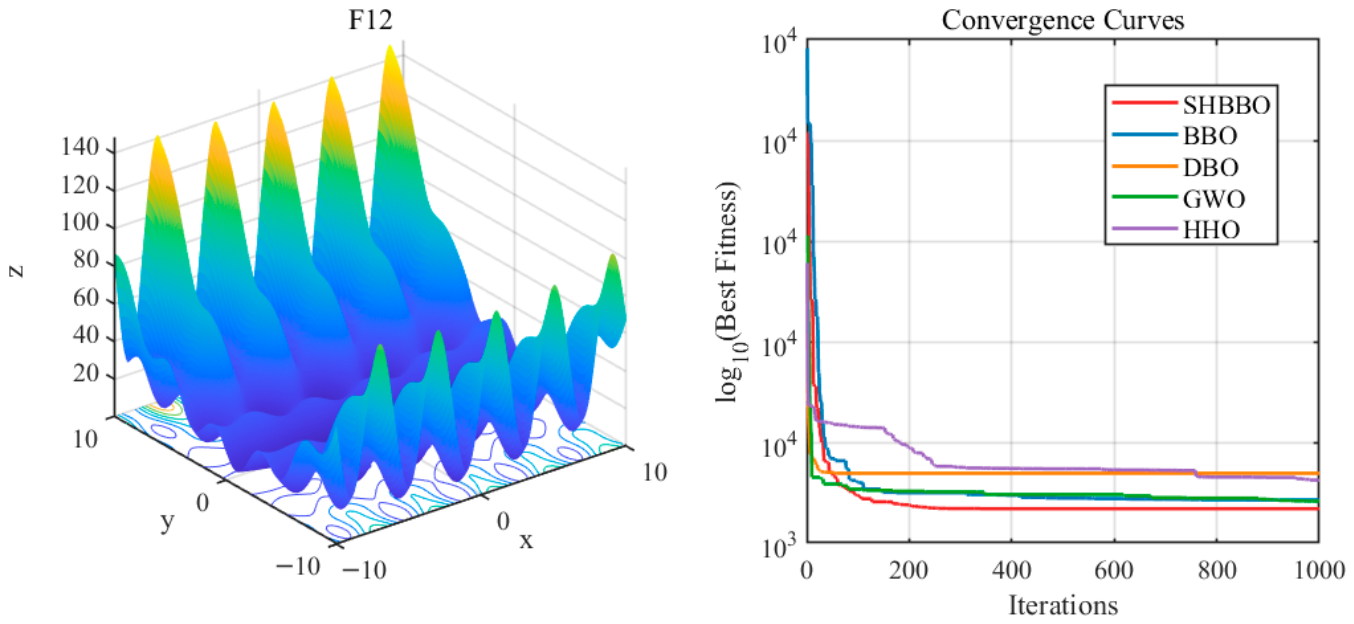
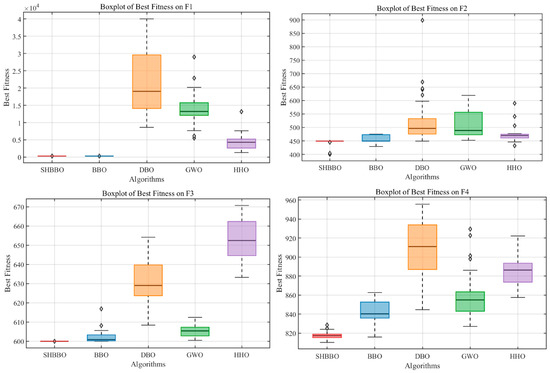
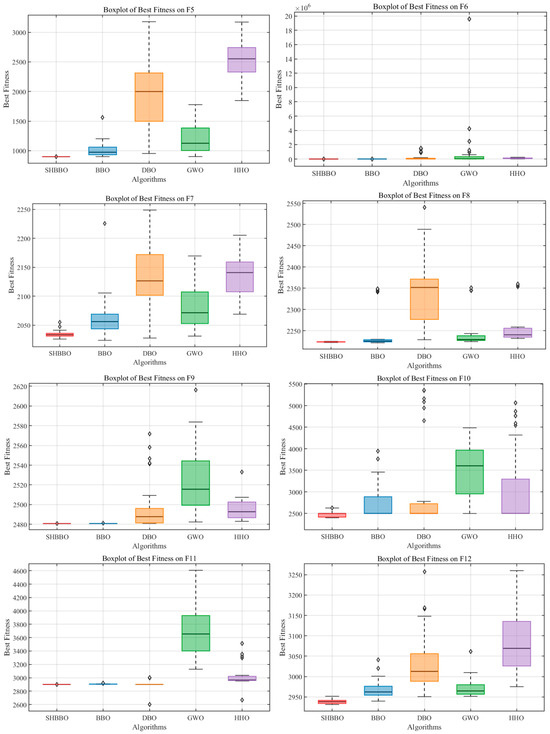
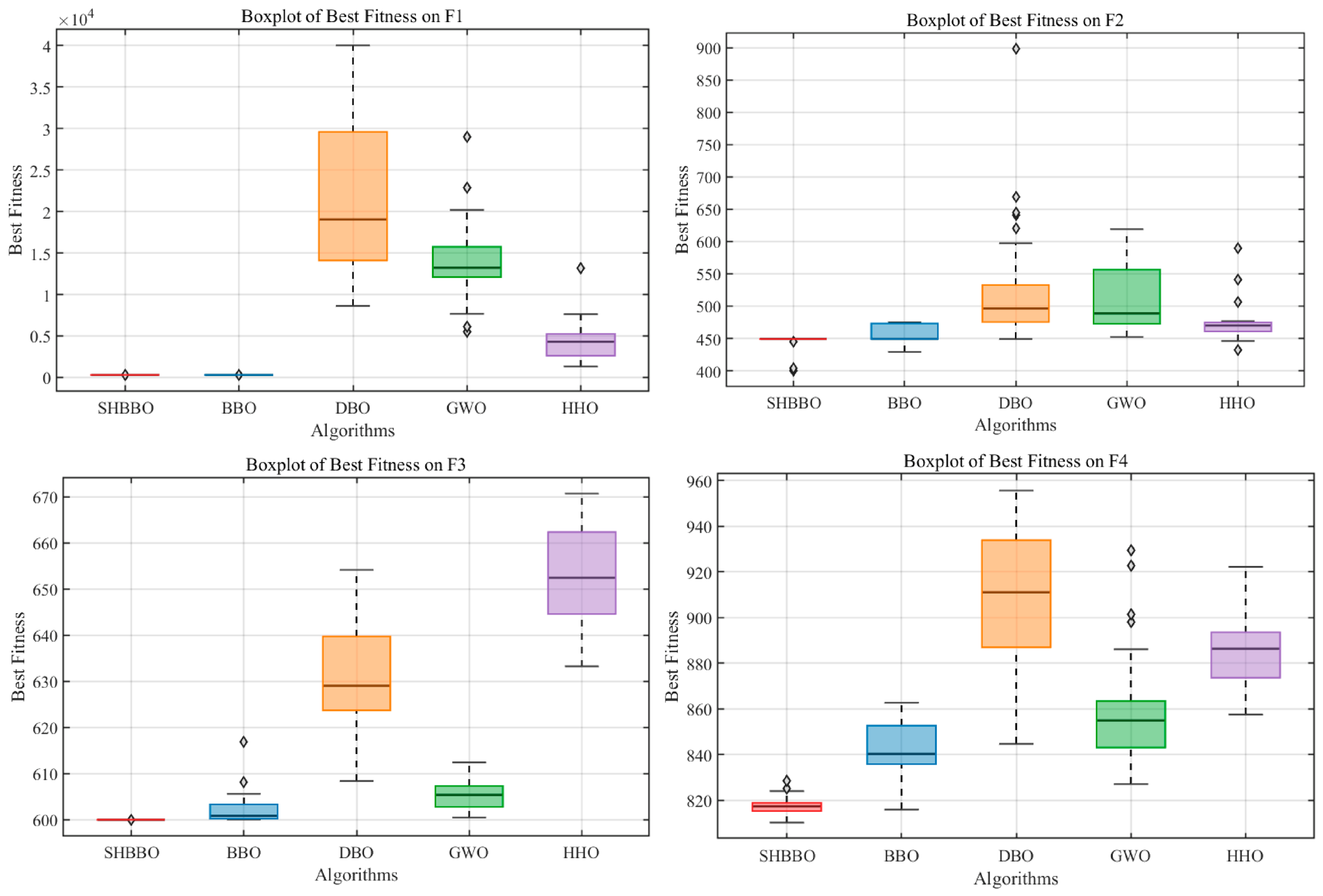
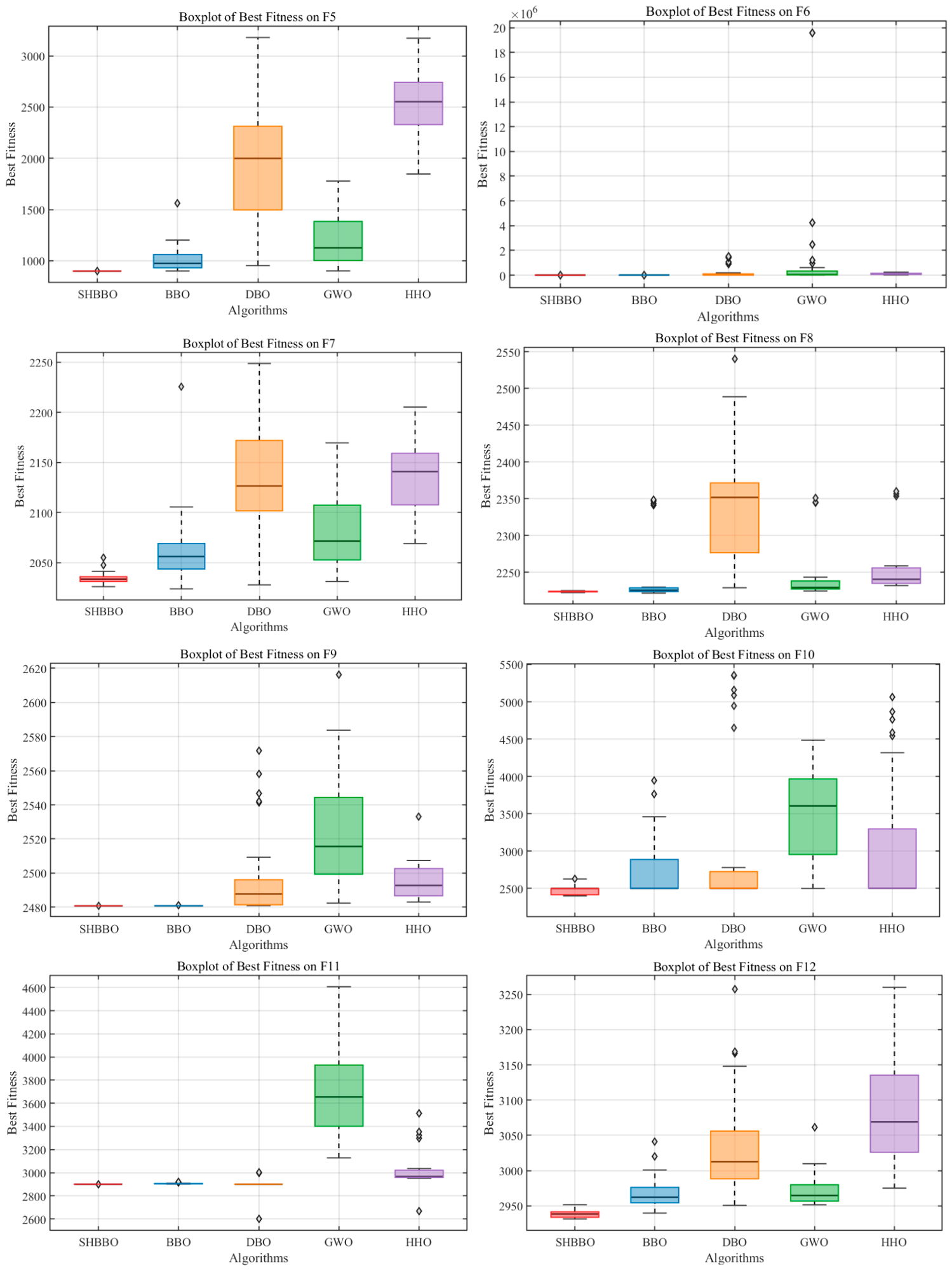
The average convergence curves of the five algorithms over 30 runs are presented in Figure 1, which reflect their iterative search behavior and convergence characteristics. Figure 2 further provides boxplot comparisons to visually demonstrate the dispersion, stability, and robustness of the optimization results. Moreover, the quantitative results on functions F1–F12 are summarized in Table 2, where the average value (Avg) and standard deviation (Std) are reported for each algorithm, enabling a comprehensive comparison of solution quality and robustness.
Figure 1.
Average convergence curves on CEC2022 benchmark functions.
Figure 2.
Boxplot comparison on CEC2022 benchmark functions.
Table 2.
Experimental results on the CEC2022 (Dim = 20).
From the average convergence curves shown in Figure 1, it can be observed that the proposed SHBBO exhibits competitive and, in most cases, superior convergence behavior on the CEC2022 benchmark functions. In the early stage of the search, SHBBO generally achieves a rapid reduction in fitness, indicating that the introduced success-history adaptation mechanism can effectively enhance the global search capability and accelerate the identification of promising regions. As the iterations proceed, SHBBO maintains a more stable downward trend on several functions, suggesting that it can preserve population diversity while continuously strengthening local exploitation. Compared with the original BBO, SHBBO demonstrates faster convergence speed and lower final fitness values on many test functions, which confirms that the proposed role-guided differential recombination strategy improves both convergence efficiency and solution quality. By contrast, some of the compared algorithms tend to stagnate prematurely or show slower late-stage refinement on several functions. Overall, the convergence characteristics in Figure 1 verify that SHBBO achieves a better balance between exploration and exploitation, thereby providing stronger robustness and optimization accuracy across different types of benchmark landscapes.
Figure 2 presents the boxplot comparison of the optimization results obtained by SHBBO, BBO, DBO, GWO, and HHO on the CEC2022 benchmark functions over 30 independent runs. It can be observed that SHBBO generally exhibits narrower interquartile ranges and fewer extreme outliers on most test functions, indicating that the proposed algorithm achieves better stability and robustness under repeated runs. On several functions such as F1, F3, F4, F5, F7, F8, F10, and F12, the median fitness value of SHBBO is lower than or comparable to that of the competing algorithms, while the dispersion of results remains relatively small, which demonstrates its strong capability to consistently obtain high-quality solutions. By contrast, DBO, GWO, and HHO often show wider boxes and more scattered outliers on several benchmark functions, suggesting larger performance fluctuations and lower solution reliability. Although BBO achieves competitive results on a few functions, its result distribution is still generally less concentrated than that of SHBBO. Overall, the boxplot results further confirm that the proposed SHBBO not only improves optimization accuracy but also enhances solution stability and robustness across different benchmark landscapes.
According to the quantitative results reported in Table 2, the proposed SHBBO demonstrates the best overall optimization performance among the compared algorithms on the CEC2022 benchmark set. In terms of the average value, SHBBO achieves the best results on almost all test functions, including F2–F12, and remains highly competitive on F1, where its result is also slightly better than that of the original BBO. In particular, the improvements on F5, F6, F7, F8, F10, and F12 are more pronounced, indicating that SHBBO has a stronger search capability in complex multimodal and hybrid optimization landscapes. In addition, from the perspective of standard deviation, SHBBO generally exhibits much smaller fluctuations than the other algorithms, especially on F1, F3, F5, F7, F8, F9, F10, F11, and F12, which confirms its superior robustness and stability over repeated independent runs. Compared with the original BBO, SHBBO not only further improves the solution accuracy on nearly all benchmark functions but also significantly enhances the consistency of the obtained results. Therefore, the statistical results in Table 2 provide strong evidence that the introduced success-history adaptation and role-guided differential recombination strategies effectively improve both the optimization accuracy and the robustness of the original BBO.
Overall, the benchmark function results on the CEC2022 test suite demonstrate that the proposed SHBBO achieves strong optimization performance in continuous search spaces. Compared with the original BBO and the other competing algorithms, namely DBO, GWO, and HHO, SHBBO shows superior convergence behavior, higher solution accuracy, and better robustness on most benchmark functions. The average convergence curves indicate that SHBBO is able to maintain both fast search efficiency and stable late-stage refinement, while the boxplot and statistical results further confirm its strong stability and reduced sensitivity to randomness over repeated independent runs. In particular, the results in Table 2 show that SHBBO attains highly competitive Avg and Std values across the majority of test functions, which verifies the effectiveness of the proposed success-history adaptation and role-guided differential recombination strategies. Therefore, it can be concluded that SHBBO significantly enhances the optimization capability of the original BBO and provides a reliable and effective approach for solving complex continuous optimization problems.
4.2. Validation Using Job Shop Scheduling Instances
Since FJSP is a discrete and constrained combinatorial optimization problem, the scheduling applicability of SHBBO is directly examined in this subsection through its discrete adaptation and validation on the Brandimarte benchmark instances. To further verify the applicability of the proposed SHBBO in practical combinatorial optimization problems, experiments are conducted on the well-known Brandimarte dataset (BRdata) for FJSP. In this subsection, SHBBO is compared with several representative metaheuristic algorithms, including GWO, the sparrow search algorithm (SSA) [25], the improved memetic algorithm (IMA) [26], and the original BBO, to provide a representative evaluation of its scheduling performance on the selected benchmark instances.
For each benchmark instance, the compared algorithms are independently executed multiple times under the same experimental settings, and the obtained results are assessed in terms of solution quality and relative performance. To provide a more intuitive comparison, the percentage relative deviation (PRD) is adopted, which is defined as:
where Best denotes the best solution obtained by a compared algorithm on a given instance, and Min represents the best value among all algorithms for that instance. A smaller PRD value indicates that the corresponding algorithm is closer to the best-known result on that instance and therefore reflects better scheduling performance.
Table 3 reports the computational results of SHBBO and the compared algorithms on the BRdata benchmark instances. To further evaluate the overall competitiveness of the considered methods, Table 4 presents the algorithm rankings together with the Friedman test results for the BRdata dataset. Through these comparisons, the effectiveness, robustness, and practical superiority of SHBBO in solving FJSP can be systematically validated.
Table 3.
Comparative results on BRdata.
Table 4.
PRD, Rankings, and Friedman test on BRdata.
According to the comparative results presented in Table 3, the proposed SHBBO demonstrates highly competitive performance on the BRdata benchmark instances for the flexible job shop scheduling problem. Specifically, SHBBO obtains the best results on MK04, MK06, MK07, MK08, MK09, and MK10, and achieves the same best value as other algorithms on MK01 and MK02. On MK03 and MK05, SHBBO also reaches the same optimal results as IMA, which indicates that the proposed method maintains strong competitiveness across different scheduling instances. Overall, SHBBO achieves the best or jointly best solutions on all ten benchmark instances, showing clear superiority over GWO, SSA, and the original BBO in most cases. In particular, compared with BBO, SHBBO produces improved results on MK04, MK06, MK07, MK08, MK09, and MK10, while maintaining no degradation on MK01 and MK02, which confirms that the introduced success-history adaptation and role-guided search mechanism effectively enhance the scheduling capability of the original BBO. These results demonstrate that SHBBO possesses strong solution quality and good robustness when applied to FJSP benchmark problems.
Although the results in Table 3 do not always reach the best-known makespan (BKV) values, this does not weaken the validity of the comparison. The BKV values are the best-known solutions reported in the literature and are usually obtained under different experimental conditions or with more specialized optimization strategies. In contrast, the purpose of this study is to evaluate the relative performance of SHBBO and the compared algorithms under the same computational setting. From this viewpoint, SHBBO still shows clear superiority on the BRdata instances, which confirms its strong scheduling capability and practical competitiveness.
According to the PRD, average PRD, ranking, and Friedman test results reported in Table 4, the proposed SHBBO demonstrates the best overall performance on the BRdata benchmark instances. Specifically, SHBBO achieves a PRD value of 0 on all ten instances, indicating that it consistently obtains the best solution among the compared algorithms for every test case. In contrast, the other algorithms exhibit nonzero PRD values on most instances, reflecting different degrees of deviation from the best obtained results. From the perspective of overall performance, SHBBO yields the lowest average PRD value of 0, ranking first among all methods, whereas BBO, IMA, GWO, and SSA rank second, third, fourth, and fifth, respectively. Furthermore, the Friedman test results show that the differences between SHBBO and the competing algorithms are statistically significant, since the corresponding p-values for GWO, SSA, IMA, and BBO are all lower than 0.05. These results further confirm that SHBBO not only achieves the best scheduling quality on the BRdata instances but also exhibits clear statistical superiority and stronger robustness compared with the other algorithms.
To further demonstrate the computational efficiency of the proposed SHBBO, the average CPU time of different algorithms on the ten Brandimarte instances (MK01–MK10) is reported in Table 5. As can be observed, SHBBO shows competitive runtime performance across most test cases. Specifically, compared with IMA, SHBBO requires substantially less computation time on all instances, indicating that the proposed method achieves a better balance between search effectiveness and computational burden. For example, on MK03, MK08, MK09, and MK10, the CPU time of SHBBO is 147.891 s, 241.396 s, 259.172 s, and 262.327 s, respectively, which are significantly lower than those of IMA (550.744 s, 474.188 s, 862.977 s, and 714.239 s). Compared with GWO and SSA, the runtime of SHBBO is generally in the same order of magnitude, while still remaining acceptable for the considered FJSP benchmark scale. Although SHBBO is not always the fastest method in every instance, its computational overhead is moderate and justified by the superior scheduling quality reported in the previous tables. In addition, compared with the basic BBO, the increased runtime of SHBBO is mainly caused by the introduced success-history learning and enhanced search mechanisms, which improve exploitation and solution stability. Therefore, the results in Table 5 verify that SHBBO maintains reasonable computational efficiency while achieving better optimization performance, demonstrating a favorable trade-off between solution quality and CPU cost for FJSP.
Table 5.
Comparison of average CPU time on BRdata.
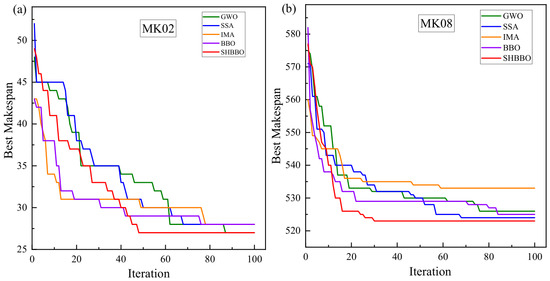
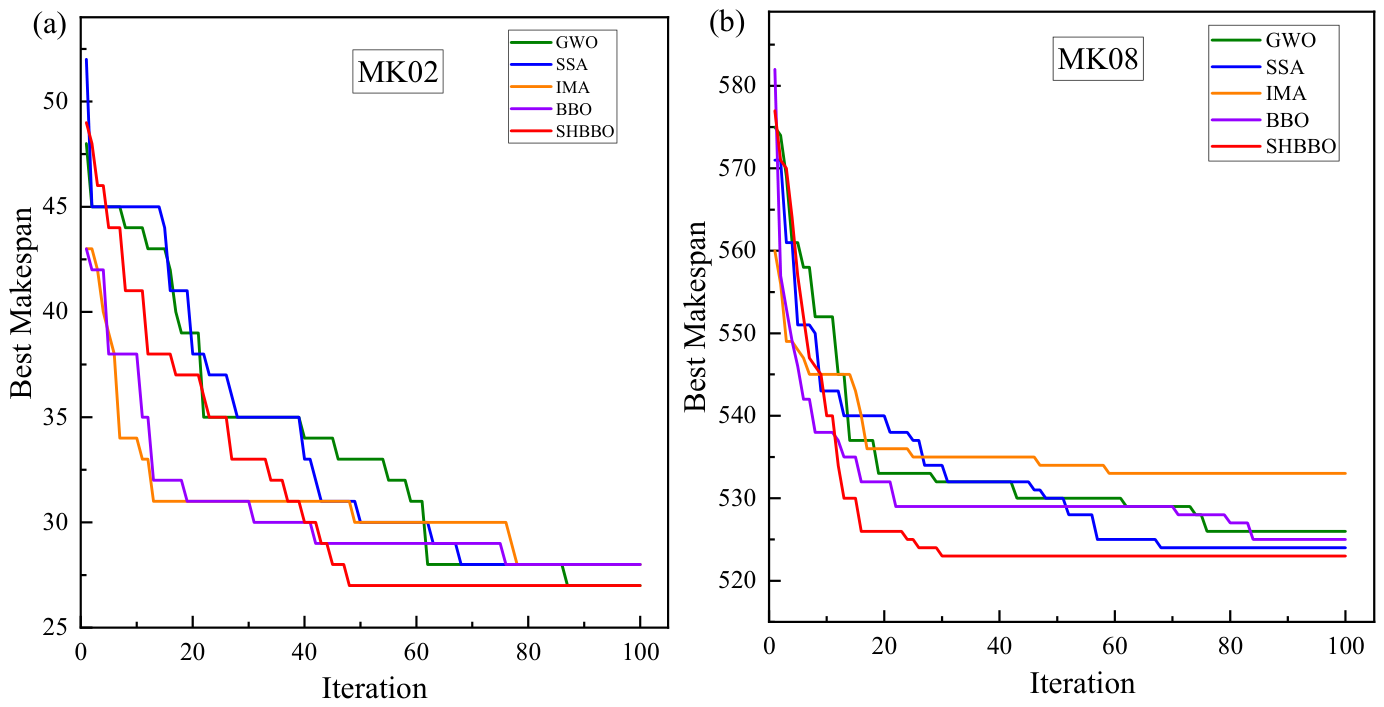
Figure 3 further presents the convergence curves of different algorithms on the representative BRdata instances MK02 and MK08. As shown in Figure 3a, for the relatively small-scale instance MK02, all algorithms exhibit a rapid decrease in makespan during the early iterations, indicating that the population-based search methods can quickly identify promising regions in the solution space. However, SHBBO shows a more stable and continuous improvement process and reaches the best final makespan among the compared algorithms. Compared with GWO, SSA, IMA, and BBO, SHBBO not only converges to a smaller objective value but also demonstrates a smoother late-stage refinement behavior, reflecting its stronger exploitation capability and better convergence stability.
Figure 3.
Convergence curves of different algorithms. (a) MK02; (b) MK08.
For the more complex instance MK08 in Figure 3b, the differences among algorithms become more evident. Although several algorithms achieve fast initial reductions, some of them enter stagnation relatively early and remain trapped at inferior makespan values. By contrast, SHBBO maintains a more effective downward search trend and finally obtains the smallest makespan among all compared methods. This result indicates that the proposed success-history-based adaptive search mechanism can better balance exploration and exploitation in complex scheduling landscapes, thereby enhancing the algorithm’s ability to escape local optima and improving the final scheduling quality. Overall, the convergence curves on MK02 and MK08 provide intuitive evidence that SHBBO exhibits better convergence behavior and stronger optimization competitiveness than the other compared algorithms on FJSP instances.
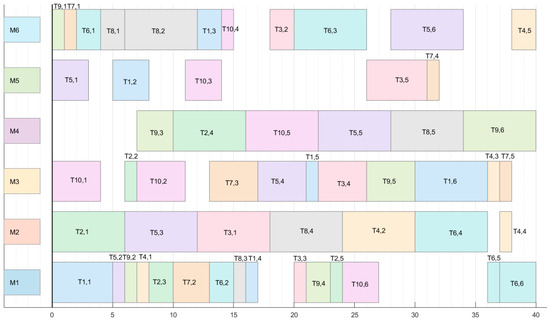
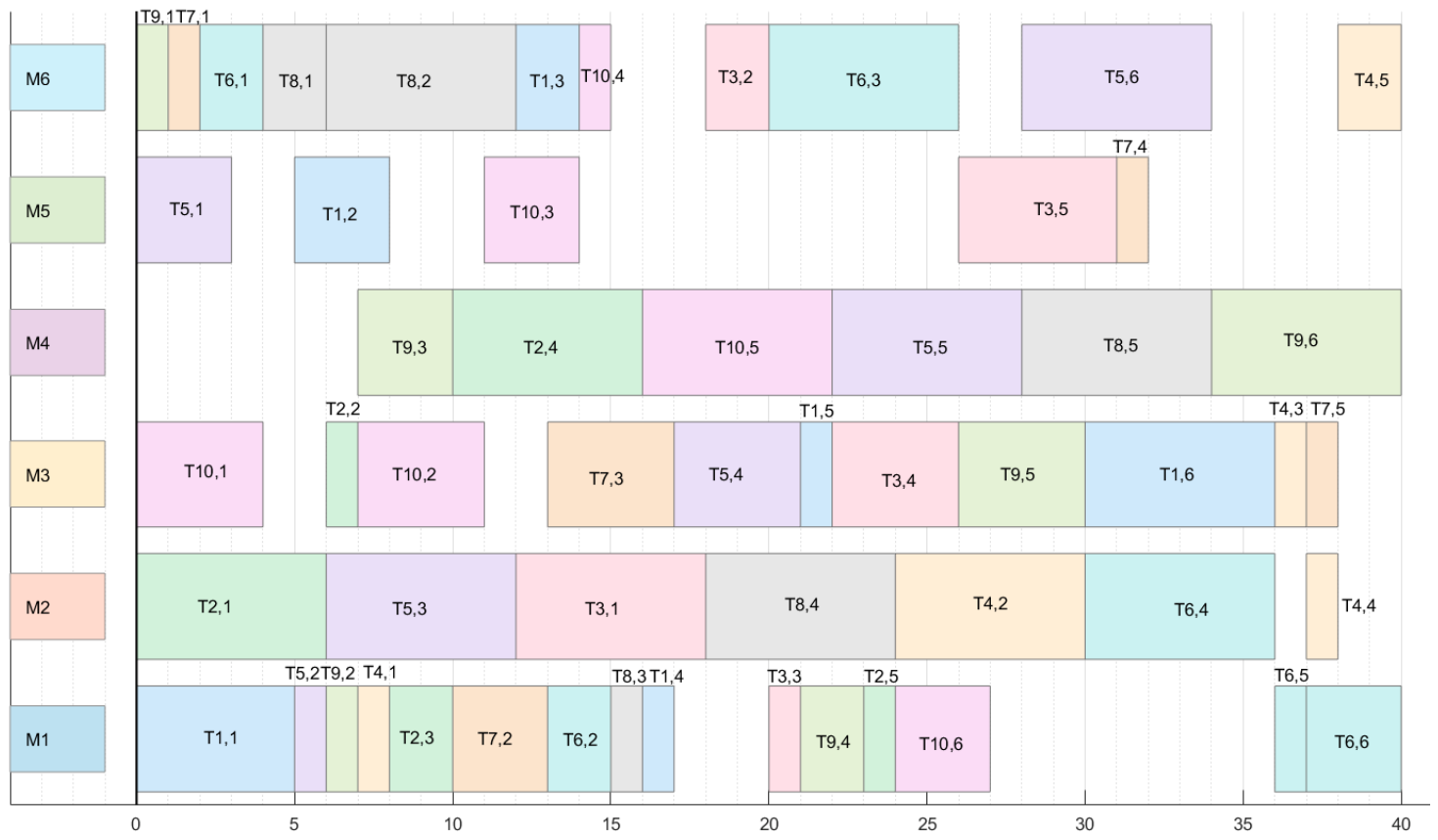
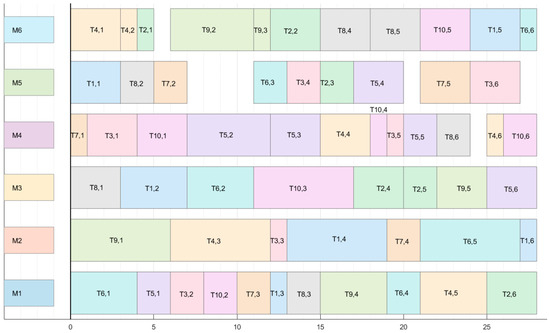
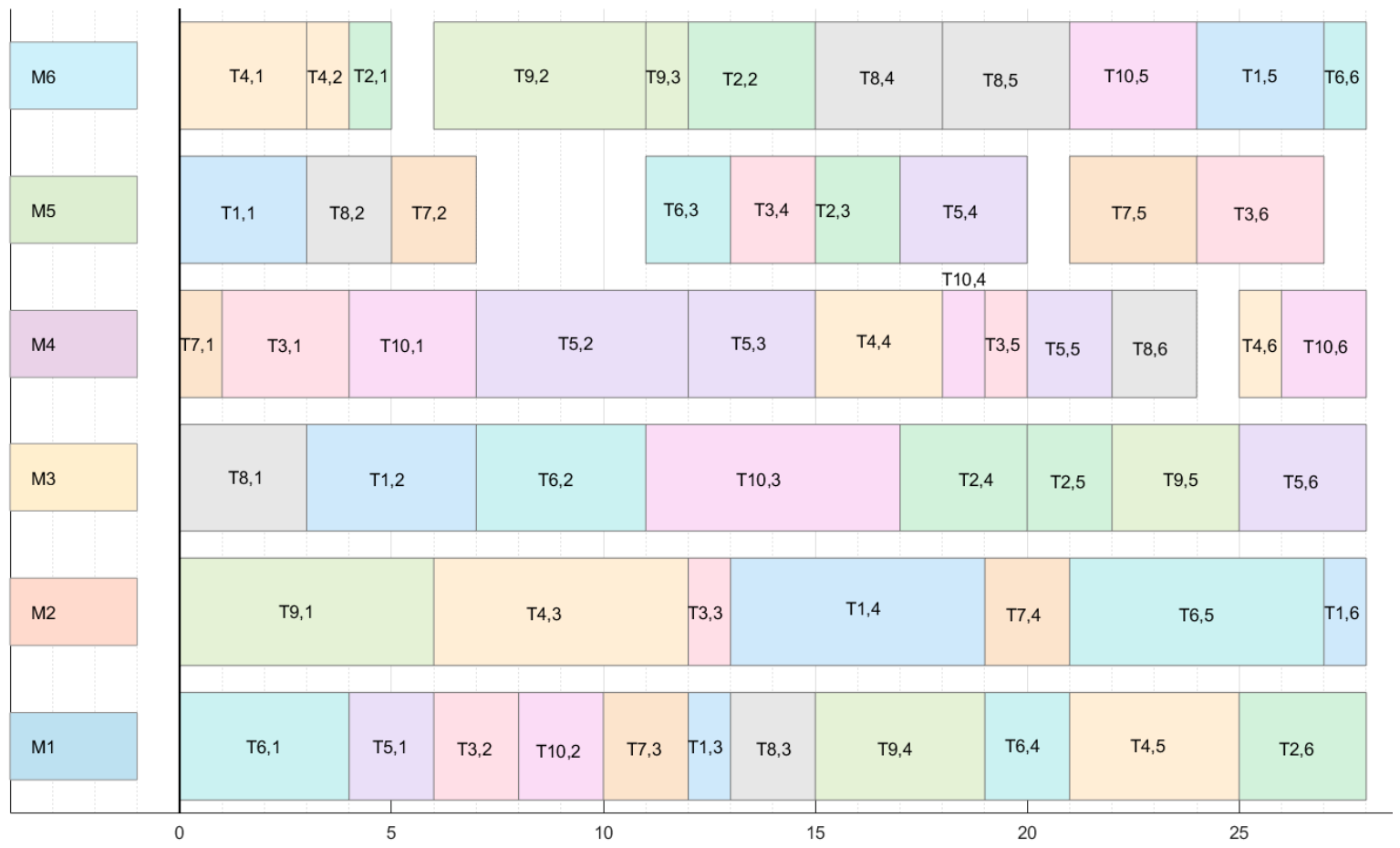
Figure 4 and Figure 5 show the optimal Gantt charts produced by SHBBO for the MK01 and MK02 instances, respectively. As illustrated in Figure 3, SHBBO yields an effective scheduling scheme for MK01 with a compact arrangement of operations on different machines. A similar result can be observed for MK02 in Figure 4, where the machine utilization and operation sequence are reasonably coordinated. Together with the comparative results in Table 3 and Table 4, these visual scheduling results further demonstrate that SHBBO can effectively reduce the makespan and provide high-quality schedules for FJSP, thereby confirming its strong practical applicability and excellent scheduling performance.
Figure 4.
Gantt chart of the optimal schedule obtained by SHBBO for MK01.
Figure 5.
Gantt chart of the optimal schedule obtained by SHBBO for MK02.
In summary, the results on the BRdata benchmark instances indicate that SHBBO exhibits strong competitiveness and effectiveness in solving FJSP. The proposed algorithm achieves the best overall performance among the compared methods in terms of solution quality, robustness, and statistical ranking. Moreover, the corresponding Gantt charts further verify its ability to produce efficient schedules with small makespan values. Therefore, SHBBO can be regarded as a promising metaheuristic for flexible job shop scheduling optimization.
Although the Brandimarte dataset is a representative and widely adopted benchmark for FJSP, the ten MK instances still provide a limited validation scale for fully assessing the robustness and competitiveness of SHBBO across broader scheduling scenarios. Therefore, more extensive validations on additional benchmark sets and larger-scale instances are still needed in future work.
5. Conclusions
In this paper, a success-history beaver behavior optimizer (SHBBO) was proposed for flexible job shop scheduling optimization. To adapt the original BBO to the discrete characteristics of FJSP, an effective encoding–decoding scheme was developed for operation sequencing and machine assignment, while a success-history-based adaptive mechanism, elite-guided search, and differential recombination were incorporated to improve the balance between global exploration and local exploitation. The main conclusions drawn from this study are summarized as follows:
- (a)
- For the benchmark-function experiments, SHBBO achieved the best average results on 11 out of 12 CEC2022 test functions, outperforming DBO, GWO, HHO, and BBO on most cases. Compared with BBO, the average objective values were reduced by 12.20% on F5, 56.69% on F6, and 9.18% on F10. In terms of stability, the standard deviations were further reduced by 99.83% on F5, 97.47% on F6, and 81.79% on F10, indicating that SHBBO achieved both better solution quality and stronger robustness in continuous optimization.
- (b)
- For the FJSP experiments, SHBBO obtained the best or tied-best makespan on all 10 Brandimarte instances and achieved an average PRD of 0, ranking first overall, whereas the average PRD values of GWO, SSA, IMA, and BBO were 2.53, 2.98, 2.51, and 2.85, respectively. This means that SHBBO reduced the average PRD by 100% relative to all compared algorithms. In addition, compared with BBO, SHBBO reduced the makespan by 4.62% on MK04, 6.25% on MK06, and 7.69% on MK10, which confirms its effectiveness and competitiveness in solving flexible job shop scheduling problems.
This study still has some limitations. The discrete scheduling validation was conducted only on the ten Brandimarte benchmark instances, and the comparison scope did not yet include more advanced discrete or hybrid scheduling methods. In addition, computational-efficiency evidence, such as runtime, CPU time, complexity, or scalability analysis, was not sufficiently provided. Therefore, the present results should be regarded as a representative validation of the proposed SHBBO framework.
Future work will focus on extending SHBBO to more complex scheduling scenarios, such as dynamic, distributed, and multi-objective flexible job shop scheduling problems, and on incorporating more problem-oriented discrete search strategies to further improve its practical applicability.
Author Contributions
Conceptualization, Z.H. and Y.D.; methodology, Z.H.; software, Z.H.; validation, J.L., Y.D. and X.H.; formal analysis, J.L.; investigation, J.L.; resources, J.L.; data curation, X.H.; writing—original draft preparation, Z.H.; writing—review and editing, Y.D.; visualization, X.H.; supervision, J.L.; project administration, Y.D.; funding acquisition, J.L. All authors have read and agreed to the published version of the manuscript.
Funding
This research was funded by the Open Funds of Extreme Material Dynamics Technology Laboratory (Grant No. 2025SCKT0907).
Data Availability Statement
All data generated and analyzed during this study are included in this published article.
Acknowledgments
The authors would like to express their sincere gratitude to their research team for their support, constructive suggestions, and helpful discussions throughout this study.
Conflicts of Interest
The authors declare no conflicts of interest.
References
- Xu, M.; Mei, Y.; Zhang, F.; Zhang, M. Learn to optimise for job shop scheduling: A survey with comparison between genetic programming and reinforcement learning. Artif. Intell. Rev. 2025, 58, 160. [Google Scholar] [CrossRef] [Scilit]
- Jiang, B.; Ma, Y.; Chen, L.; Huang, B.; Huang, Y.; Guan, L. A review on intelligent scheduling and optimization for flexible job shop. Int. J. Control Autom. Syst. 2023, 21, 3127–3150. [Google Scholar] [CrossRef] [Scilit]
- Dauzère-Pérès, S.; Ding, J.; Shen, L.; Tamssaouet, K. The flexible job shop scheduling problem: A review. Eur. J. Oper. Res. 2024, 314, 409–432. [Google Scholar] [CrossRef] [Scilit]
- Destouet, C.; Tlahig, H.; Bettayeb, B.; Mazari, B. Flexible job shop scheduling problem under Industry 5.0: A survey on human reintegration, environmental consideration and resilience improvement. J. Manuf. Syst. 2023, 67, 155–173. [Google Scholar] [CrossRef] [Scilit]
- Xin, B.; Lu, S.; Wang, Q.; Deng, F. A review of flexible job shop scheduling problems considering transportation vehicles. Front. Inf. Technol. Electron. Eng. 2025, 26, 332–353. [Google Scholar] [CrossRef] [Scilit]
- Meng, L.; Cheng, W.; Zhang, B.; Zou, W.; Fang, W.; Duan, P. An improved genetic algorithm for solving the multi-AGV flexible job shop scheduling problem. Sensors 2023, 23, 3815. [Google Scholar] [CrossRef] [Scilit] [PubMed]
- Xie, J.; Li, X.; Gao, L.; Gui, L. A hybrid genetic tabu search algorithm for distributed flexible job shop scheduling problems. J. Manuf. Syst. 2023, 71, 82–94. [Google Scholar] [CrossRef] [Scilit]
- Xu, M.; Mei, Y.; Zhang, F.; Zhang, M. Genetic programming for dynamic flexible job shop scheduling: Evolution with single individuals and ensembles. IEEE Trans. Evol. Comput. 2023, 28, 1761–1775. [Google Scholar] [CrossRef] [Scilit]
- Tutumlu, B.; Saraç, T. A MIP model and a hybrid genetic algorithm for flexible job-shop scheduling problem with job-splitting. Comput. Oper. Res. 2023, 155, 106222. [Google Scholar] [CrossRef] [Scilit]
- Liao, X.; Zhang, R.; Chen, Y.; Song, S. A new artificial bee colony algorithm for the flexible job shop scheduling problem with extra resource constraints in numeric control centers. Expert Syst. Appl. 2024, 249, 123556. [Google Scholar] [CrossRef] [Scilit]
- Kong, J.; Wang, Z. Research on flexible job shop scheduling problem with handling and setup time based on improved discrete particle swarm algorithm. Appl. Sci. 2024, 14, 2586. [Google Scholar] [CrossRef] [Scilit]
- Du, B.; Han, S.; Guo, J.; Li, Y. A hybrid estimation of distribution algorithm for solving assembly flexible job shop scheduling in a distributed environment. Eng. Appl. Artif. Intell. 2024, 133, 108491. [Google Scholar] [CrossRef] [Scilit]
- Zhang, H.; Qin, C.; Xu, G.; Chen, Y.; Gao, Z. An energy-saving distributed flexible job shop scheduling with machine breakdowns. Appl. Soft Comput. 2024, 167, 112276. [Google Scholar] [CrossRef] [Scilit]
- Wang, C.; Wei, M.; Liu, Q.; Zhang, X.; Li, X. An improved adaptive hybrid algorithm for solving distributed flexible job shop scheduling problem. Swarm Evol. Comput. 2025, 94, 101873. [Google Scholar] [CrossRef] [Scilit]
- Zheng, C.; Xie, Z. Research on the Flexible Job Shop Scheduling Problem with Job Priorities Considering Transportation Time and Setup Time. Axioms 2025, 14, 914. [Google Scholar] [CrossRef] [Scilit]
- Fuladi, S.K.; Kim, C.S. Flexible Job Shop Scheduling Optimization with Multiple Criteria Using a Hybrid Metaheuristic Framework. Processes 2025, 13, 3260. [Google Scholar] [CrossRef] [Scilit]
- Shi, Y.; Yu, C.; Ning, S. A novel two stage neighborhood search for flexible job shop scheduling problem considering reconfigurable machine tools. Complex Intell. Syst. 2025, 11, 312. [Google Scholar] [CrossRef] [Scilit]
- Wang, W.; Zhao, J. An enhanced memetic algorithm for energy-efficient and low-carbon flexible job shop scheduling problem considering machine restart. J. Manuf. Syst. 2025, 80, 457–478. [Google Scholar] [CrossRef] [Scilit]
- Lv, S.; Zhuang, J.; Li, Z.; Zhang, H.; Jin, H.; Lü, S. An enhanced walrus optimization algorithm for flexible job shop scheduling with parallel batch processing operation. Sci. Rep. 2025, 15, 5699. [Google Scholar] [CrossRef] [Scilit]
- Li, Y.; Han, S.; Li, Z.; Yang, F.; Sun, Z. An Improved Sparrow Search Algorithm for Flexible Job-Shop Scheduling Problem with Setup and Transportation Time. Int. J. Adv. Comput. Sci. Appl. 2025, 16, 408. [Google Scholar] [CrossRef] [Scilit]
- Ouyang, K.; Wei, D.; Sha, X.; Yu, J.; Zhao, Y.; Qiu, M.; Fu, S.; Heidari, A.; Chen, H. Beaver behavior optimizer: A novel metaheuristic algorithm for solar PV parameter identification and engineering problems. J. Adv. Res. 2025; in press. [CrossRef] [Scilit]
- Xue, J.; Shen, B. Dung beetle optimizer: A new meta-heuristic algorithm for global optimization. J. Supercomput. 2023, 79, 7305–7336. [Google Scholar] [CrossRef] [Scilit]
- Makhadmeh, S.N.; Al-Betar, M.A.; Doush, I.A.; Awadallah, M.A.; Kassaymeh, S.; Mirjalili, S.; Zitar, R.A. Recent advances in Grey Wolf Optimizer, its versions and applications. IEEE Access 2023, 12, 22991–23028. [Google Scholar] [CrossRef] [Scilit]
- Al-Adwan, S.; Abdullah, S.; Alweshah, M.; Kassaymeh, S.; Al-Qaisi, A.; Takruri, M.; Ratan Singh, W.K. A multi-strategy framework for enhancing Harris hawks optimization for global optimization problems. Sci. Rep. 2026, 16, 10614. [Google Scholar] [CrossRef] [Scilit] [PubMed]
- Wei, F.; Feng, Y.; Shi, X.; Hou, K. Improved sparrow search algorithm with adaptive multi-strategy hierarchical mechanism for global optimization and engineering problems. Clust. Comput. 2025, 28, 215. [Google Scholar] [CrossRef] [Scilit]
- Zheng, Y.; Peng, N.; Qi, H.; Gong, G.; Huang, D.; Zhu, K.; Liu, J.; Liu, G. An improved memetic algorithm for distributed hybrid flow shop scheduling problem with operation inspection and reprocessing. Meas. Control 2025, 58, 68–96. [Google Scholar] [CrossRef] [Scilit]

Disclaimer/Publisher’s Note: The statements, opinions and data contained in all publications are solely those of the individual author(s) and contributor(s) and not of MDPI and/or the editor(s). MDPI and/or the editor(s) disclaim responsibility for any injury to people or property resulting from any ideas, methods, instructions or products referred to in the content. |
© 2026 by the authors. Licensee MDPI, Basel, Switzerland. This article is an open access article distributed under the terms and conditions of the Creative Commons Attribution (CC BY) license.