1. Introduction
Kelp is a typical high-volume marine economic alga in China; its drying and processing directly affect product color, rehydration properties, and storage stability. In industrial production, traditional sun- and hot air-drying methods have disadvantages of long processing cycles, significant environmental variability, and uneven drying. Moreover, because kelp has a high moisture content (80–90%), these conventional methods often result in localized moisture regain and quality fluctuations. To improve the potential thermal condition suitability and process controllability, infrared drying, with its advantages of rapid heating and high energy efficiency, has been widely applied for the intensified drying of aquatic products and algae. However, kelp infrared drying systems remain complicated by pronounced spatial non-uniformity. Radiation coverage and obstruction by infrared arrays can cause incident radiation to distribute in spatial gradients, while the internal ventilation configuration and chamber boundary conditions may induce recirculation, short-circuiting airflow, and localized heat transfer variations. These factors ultimately result in non-uniform temperature fields and heat transfer intensities, leading to localized overheating, inconsistent drying, and quality fluctuations. Furthermore, in kelp infrared drying systems, the chamber-side distribution of temperature, airflow, and radiation is strongly coupled with the material-side thermal response; however, this coupling has rarely been quantified within a unified evaluation framework. The existing studies have mainly focused on either dryer design or material drying behavior, whereas relatively few have linked chamber-side field reconstruction, kelp surface thermal response, and operating condition screening within a single workflow [
1].
Although CFD-based dryer analyses, infrared heating studies, and material-side thermal simulations have all been documented in the drying research, these approaches have often been applied separately. For kelp infrared drying in particular, fewer studies have explicitly connected chamber-side field reconstruction, kelp surface transient thermal response, and operating condition screening within one engineering workflow. Accordingly, the contribution of the present study is not a new fundamental multiphysics theory, but an application-oriented integration of existing CFD, FEM, and MATLAB post-processing tools for a suspended infrared kelp dryer. The specific objectives are as follows: (i) to reconstruct the chamber-side temperature, velocity, and incident radiation fields under representative operating conditions; (ii) to map the resulting radiative and convective loads to a kelp FEM model to characterize the transient surface heating; and (iii) to compare the tested operating conditions by means of a composite objective function based on field uniformity indicators and engineering constraints [
2]. The results are therefore interpreted mainly in terms of thermal load distribution and thermal response, rather than the complete drying kinetics or product quality evolution.
The previous studies on drying systems can generally be grouped into three categories: chamber-side CFD analyses for equipment design and airflow organization, material-side drying/thermal simulations for product response, and optimization or decision-support studies for operating condition selection. However, these three aspects are not always explicitly linked in one workflow, especially for suspended infrared kelp drying systems. In this context, the present study attempts to link chamber-side field reconstruction and kelp-side transient thermal response under a unified evaluation route. Nevertheless, the framework should still be regarded as an engineering-based integration of existing methods, rather than a new general purpose multiphysics methodology [
1,
2].
2. Materials and Methods
2.1. Overall System Structure
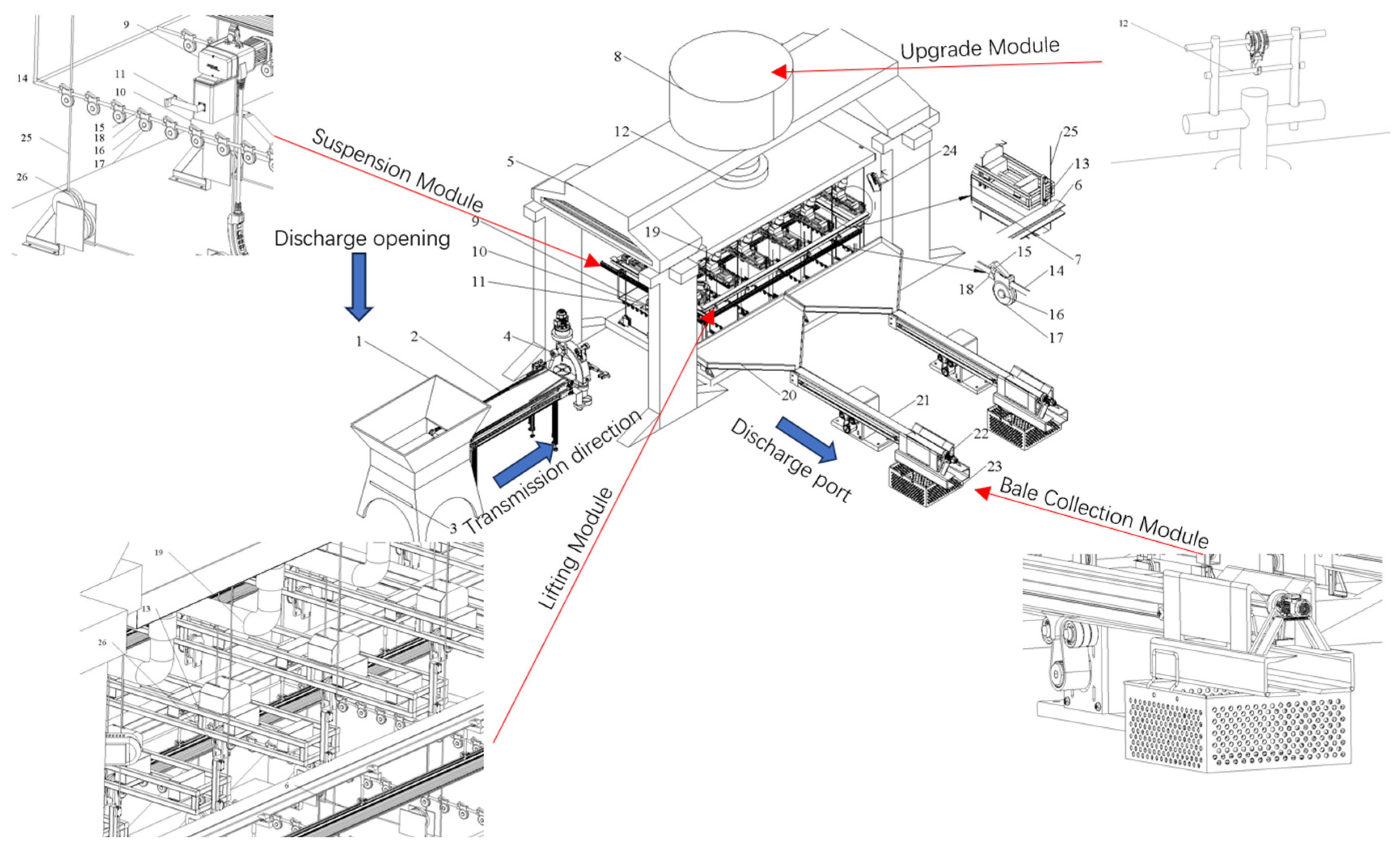
As shown in
Figure 1. The experimental system used in this study is a suspended infrared array kelp dryer developed during a previous project. For the purpose of numerical analysis, only the drying zone and its thermally relevant components are considered, including the chamber enclosure, infrared array, ventilation openings, kelp suspension region, and monitoring interface. The main function of the apparatus is to provide a continuous hanging–drying–unloading workflow, whereas the present study focuses on the thermal environment inside the drying zone. Accordingly, the subsequent CFD model is established on the basis of the chamber geometry, infrared array arrangement, opening-boundary layout, and monitored operating variables that directly affect heat transfer and airflow organization [
3,
4].
The key functional units of the system perform four functions: conveying and perforating, lifting and suspending, infrared array drying, and collection and packaging. The conveying and perforating unit comprises a hopper, a conveyor belt, and a perforating mechanism, and is used to continuously convey and perforate the kelp, thereby preparing it for subsequent suspension and fixation. The lifting and hanging unit utilizes KBK suspension rails and electric hoists to perform hanging, retrieval, and positioning. The kelp is secured to the drying rods using magnetic pin and clip hanging fixtures, and a spring-loaded stop mechanism ensures precise positioning and automatic reset, thereby guaranteeing hanging process stability and consistency during repeated loading and unloading. The infrared drying unit features an array of infrared lamps arranged above the drying zone to create a radiant heat source. Infrared monitoring units are positioned at the four corners of the drying zone to continuously capture the real-time temperature, humidity, and thermal field data, providing data support for the subsequent operational condition evaluation, threshold control, and load mapping. Upon drying completion, the collection and packaging unit uses an electric hoist in conjunction with a magnetic release mechanism to unlock the magnetic clamps, allowing the kelp to automatically drop into the deflector collection tray. It is then conveyed via a conveyor belt into the packaging machine for bundling and collection, achieving a continuous “drying–unloading–packaging” operation.
2.2. Technical Installation Approach
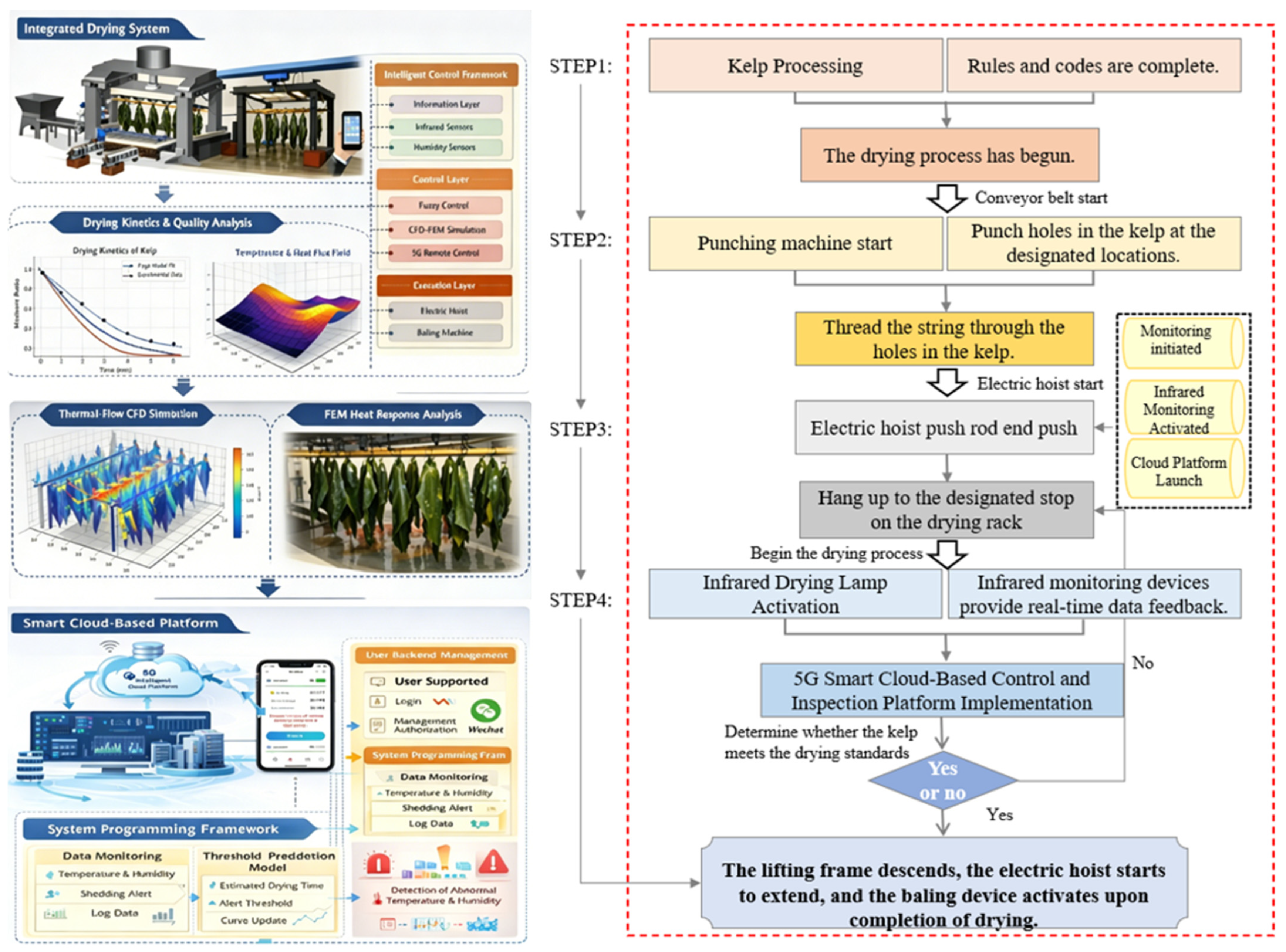
The overall operating route of the equipment is shown in
Figure 2. In brief, kelp is conveyed, perforated, and suspended before being transported into the infrared drying zone, where the temperature and humidity are monitored in real time. Once the preset drying criterion is reached, the material is unloaded and transferred to the downstream collection and packaging units. In this study, this process is used only to describe the dryer’s engineering background. The computational analysis therefore focuses on the drying zone, where CFD is used to obtain the chamber-side distributions of temperature, velocity, and incident radiation, and the resulting radiative and convective loads are then mapped onto the kelp finite element model for a transient thermal response analysis [
5].
Based on the technical approach outlined above, the numerical study in this paper therefore focuses on the “drying zone” as the core area: on the one hand, CFD is used to obtain the spatial distribution of the temperature, velocity, and incident radiation fields within the chamber, and to verify the numerical consistency of the steady-state solution; on the other hand, the thermal loads (radiation and convection boundary conditions) obtained from the CFD are mapped onto a kelp finite element model to calculate the evolution of the surface temperature field and temperature rise characteristics over time. This quantifies the impact of thermal environment differences on the thermal response from the material side and provides the basis for the subsequent operating condition screening.
2.3. Operating Condition Design and Parameter Definition
A multi-condition comparative strategy was adopted to evaluate the effects of operating conditions on the chamber-side field uniformity and kelp thermal response. The main operating variables included the infrared array power input, ventilation intensity, and open-boundary configuration. More specifically, the infrared array power was characterized by the incident radiation or equivalent heat flux; the ventilation intensity by the inlet or characteristic air velocity; and the open-boundary conditions by the pressure or outflow settings at different chamber openings, such as the front, back, left, and right sides. In addition, the mass flow rate at the open boundaries was used to verify steady-state convergence and mass conservation. To ensure consistency when evaluating and optimizing the different operating conditions, a fixed mid-plane within the drying zone was selected as the unified assessment section. For each operating condition, the temperature, velocity, and incident radiation fields were extracted from the same chamber mid-plane based on the CFD results. The temperature-related indicators included the mean, maximum, and minimum temperatures, while the field uniformity was quantified using the coefficient of variation (CV), including the temperature (
), velocity
, and incident radiation coefficients of variation (
. To facilitate comparability across multiple operating conditions and enable batch processing, the extracted field data were further subjected to coordinate unification, interpolation reconstruction, and normalization in MATLAB (version 2025) [
5]. Subsequently, statistical indicators, such as mean values, extreme values, standard deviation, and coefficients of variation, were obtained to support field reconstruction, operating condition comparison, multi-objective evaluation, and condition ranking. Meanwhile, based on this evaluation cross-section and its corresponding heat load distribution, the boundary heat flux and convective heat transfer conditions were mapped onto the kelp finite element model, thereby enabling a coupled analysis and validation of the chamber-side field distribution and material-side thermal response [
6,
7,
8].
The selected indicators—mean temperature, extreme temperatures, and the coefficients of variation for temperature, velocity, and incident radiation—were used to characterize the chamber-side thermal load intensity and spatial uniformity. These indicators are appropriate for screening the thermal environment and identifying potentially unfavorable conditions, such as local overheating, radiation concentration, and poor airflow organization. However, they do not directly represent the complete drying performance, because moisture migration, shrinkage, and product quality changes were not fully coupled in the present model. Accordingly, the subsequent evaluation should be interpreted as a thermal field assessment and operating condition screening rather than a full drying kinetics or product quality optimization.
3. Numerical Models and Methods
3.1. Development of CFD Numerical Models
3.1.1. Control Equations and Physical Models
In this study, to investigate the airflow and heat transfer characteristics within the drying chamber and solve the equations for mass, momentum, and energy conservation, a three-dimensional steady-state CFD model is established. Under steady-state conditions, the continuity equation is given by Equation (1):
Here, represents the density of air and represents the velocity vector.
A Reynolds-averaged (RANS) framework is used to model the turbulent flow; its momentum equations are shown in Equation (2):
Here,
represents the pressure,
represents the dynamic viscosity,
represents the turbulent viscosity, and
represents the acceleration due to gravity. Therefore, the energy transfer equation can be derived as shown in Equation (3):
Here,
is the specific heat capacity at a constant pressure,
is the temperature,
is the effective thermal conductivity, and
is the heat source term. To better account for the effect of radiative heat transfer on kelp drying under infrared array heating conditions, this study introduces a radiation model to obtain the distribution of incident radiation intensity. Taking the discrete order (DO) radiation model as an example, its radiation transfer equation is shown in Equation (4):
Here, represents the radiation intensity, is the propagation direction vector, is the absorption coefficient, is the scattering coefficient, is the phase function, and is the Stefan–Boltzmann constant.
3.1.2. Computational Domain, Solution Settings, and Convergence Criteria
The computational domain covers the interior of the drying chamber, with particular emphasis on the area where the infrared array is active and the typical ventilation opening locations. The open boundaries are designated as open-front, -back, -left, and -right to represent the mass exchange between the chamber and the external environment; the chamber walls are assigned appropriate thermal boundary conditions based on the actual operating conditions. To ensure computational accuracy and efficiency, the mesh is refined in the vicinity of openings, the infrared radiation zone, and areas with significant velocity and temperature gradients to enhance the flow structure and temperature gradient resolution. Furthermore, a steady-state solution strategy is adopted, combined with a comprehensive evaluation based on “residual convergence and stability of monitoring variables.” Taking the discrete equation of an arbitrary variable
as an example, its residual can be expressed using discrete imbalance quantities, as shown in Equation (5):
Here,
and
are the discrete coefficients and
is the source term. Additionally, to avoid situations where numerical convergence is determined solely by the residuals but the physical quantities continue to fluctuate, the monitoring variable of relative rate of change is introduced as an auxiliary convergence criterion, as shown in Equation (6):
Here,
represents the key monitored variables, such as the mass flow rate at the outlet and the average cross-sectional temperature;
is the number of iteration steps; and
is the tolerance threshold [
9]. When the residuals decrease and stabilize, and
satisfies the threshold requirement, the steady-state results can be considered reliable.
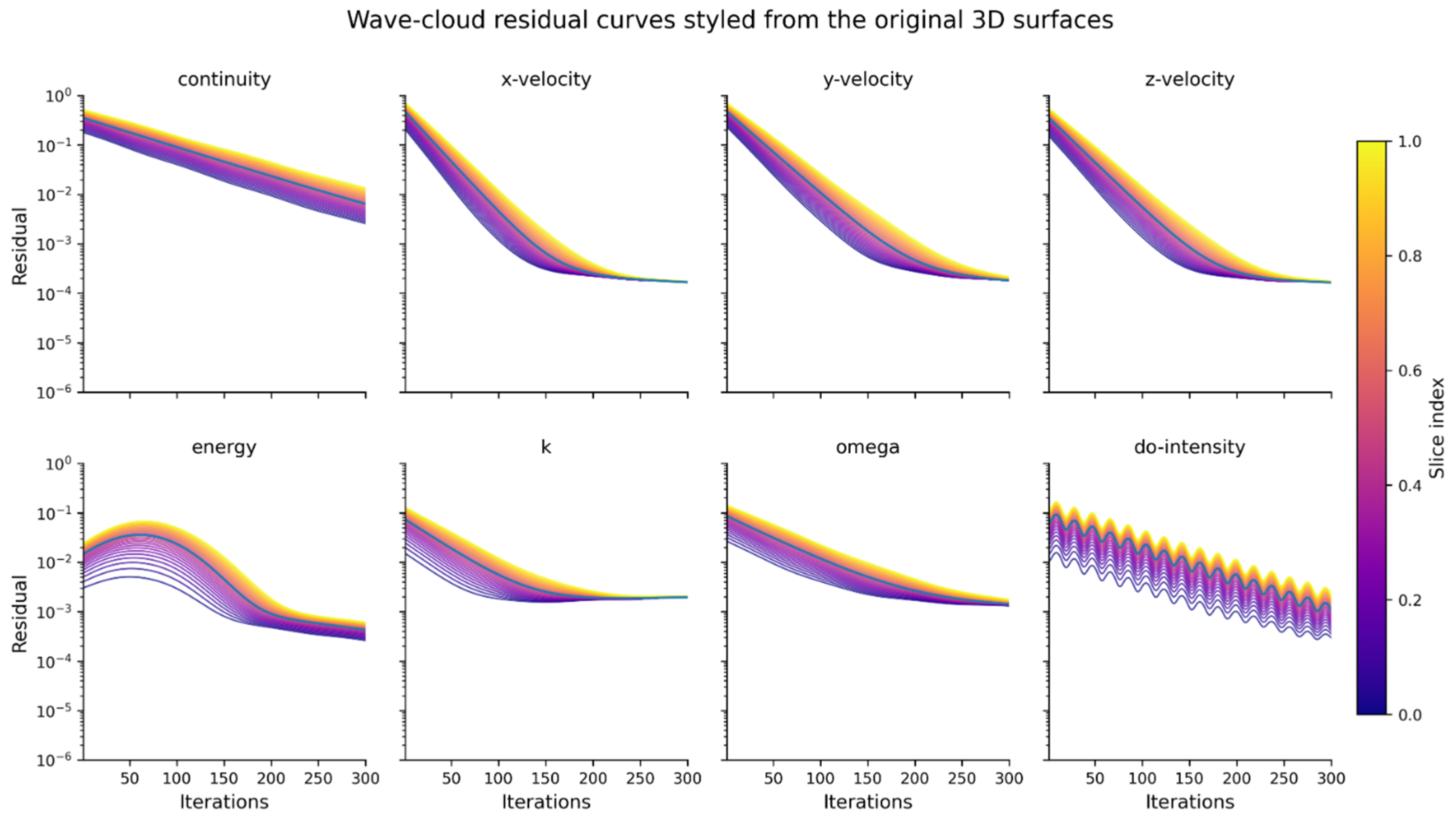
To ensure numerical solution reliability, the apparatus’ drying zone is modeled as a single CFD computational domain.
Figure 3 shows the convergence histories of the residuals for the governing equations in the drying chamber, displayed in a wave cloud style to emphasize their overall evolution and stability during the iterative process. The residuals of the velocity components decrease rapidly at the beginning of the calculation and then gradually approach stable levels, indicating effective momentum equation convergence. The energy residual decreases to approximately the 10
−6 level and remains stable in the later stage, suggesting satisfactory convergence of the thermal field. The residuals associated with the turbulence equations also exhibit a continuous downward trend and eventually stabilize, despite minor oscillations in some intervals. Overall, the residual curves show good convergence behavior and no evident divergence. Combined with the conservation of mass flow rate at the inlet and outlet boundaries and the stability of key monitoring variables, the numerical solution is considered to meet the convergence criteria.
3.1.3. Verifying the Law of Conservation of Mass and Determining the Steady State
To verify the physical plausibility of the steady-state solution, we perform a global mass conservation check on the mass fluxes at each open boundary in the computational domain. For the
-th open boundary
, the mass flux is defined as the integral of the normal mass flux over the area of that boundary, as shown in Equation (7):
Here,
is the air density,
is the velocity vector, and
is the unit normal vector to the boundary.
indicates that the fluid flows out of the computational domain along the normal direction, while
indicates that it flows into this domain (this paper adopts Fluent’s default sign convention for calculations; therefore, some openings yield positive values and others yield negative values, corresponding to inflow and outflow, respectively). Under steady-state conditions, the overall mass conservation of the computational domain requires that the algebraic sum of the mass flow rates at each opening be approximately zero. The net mass imbalance can be expressed by Equation (8):
where
is the number of open boundaries. To quantify the mass conservation error, we further introduce the relative mass imbalance, as shown in Equation (9):
The mass flow rates at each open boundary are calculated using Equations (7)–(9), and the net mass imbalance in the computational domain is determined based on these values. The results are summarized in
Table 1, where the net mass flow rate is 0.004077 kg/s. Compared to the order of magnitude of several hundred kg/s at each opening, this value is negligible, indicating that mass conservation is generally satisfied throughout the computational domain. The flow field has reached a steady state and can be used for subsequent load extraction and coupled analysis.
3.1.4. CFD Results for Heat, Flow, and Radiation Field Enclosure and Analysis
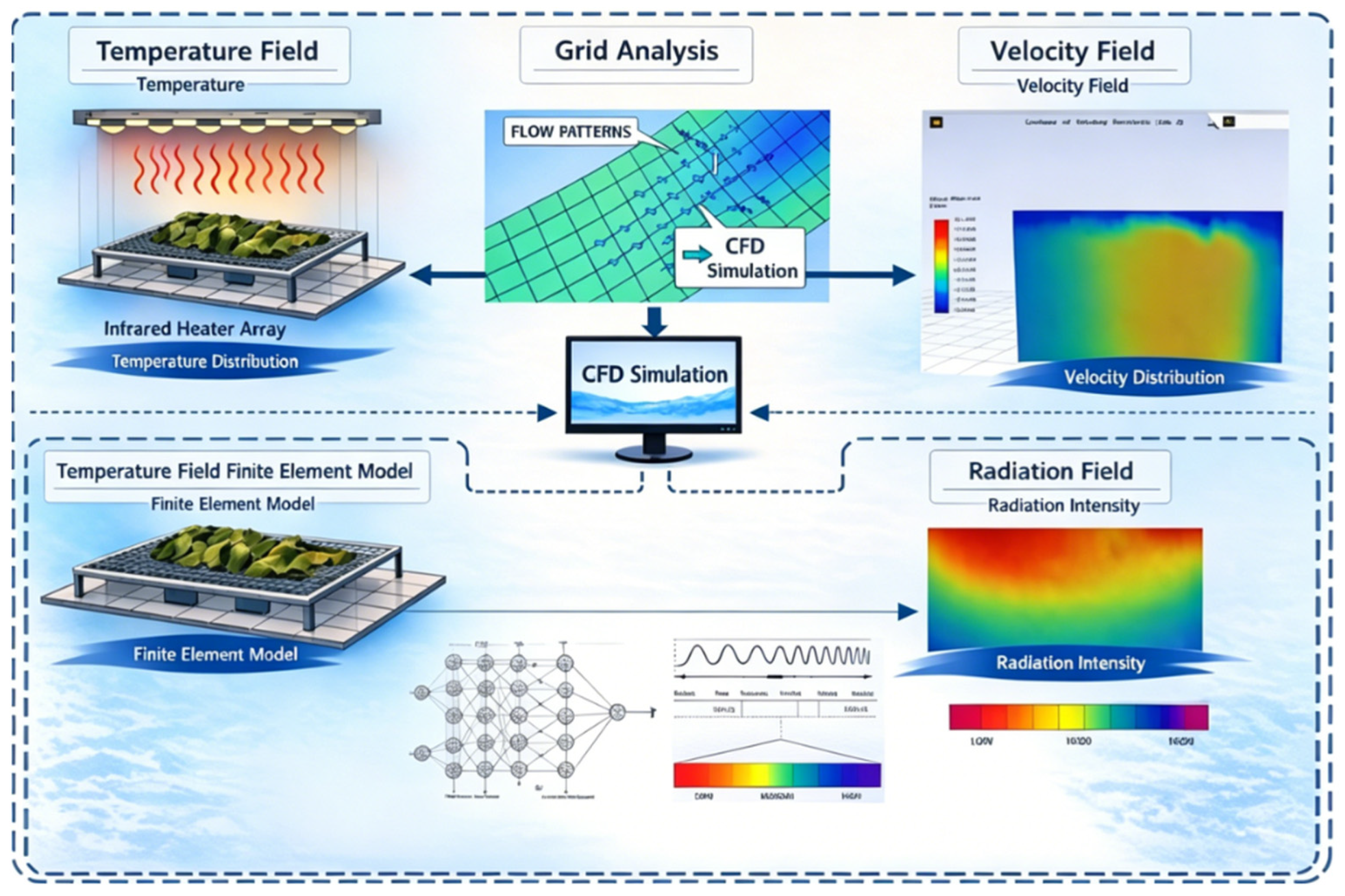
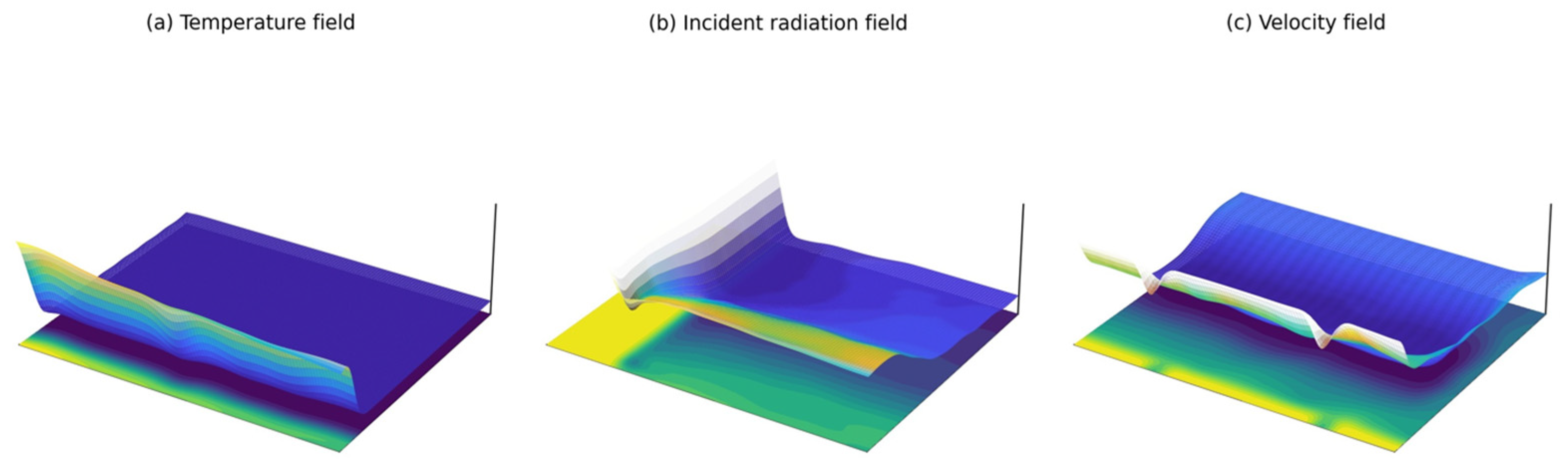
To provide a more intuitive visualization of the thermal–convective–radiative field distributions within the drying zone, this study uses CFD numerical simulations to obtain the spatial distributions of various physical quantities inside the chamber. These results provide the foundational data required for subsequently mapping the loads onto the kelp finite element model. As shown in
Figure 4, the overall temperature distribution within the chamber exhibits a distinct temperature gradient. The heat from the infrared array is concentrated above the drying zone, with the temperature gradually decreasing downward, indicating significant spatial non-uniformity in the heating effect of the infrared array. This characteristic directly influences the temperature rise process on the kelp surface. The heat flux varies under the influence of different openings and radiation arrays, further reflecting the complexity of radiation and convective heat transfer processes. This provides important thermal input data for the subsequent kelp finite element model, ensuring the determination of accurate thermal load effects on the kelp. The velocity field distribution within the chamber reveals the flow state of the fluid in the drying zone, including the recirculation areas and flow inhomogeneities. Changes in the velocity field affect the temperature transfer efficiency of the airflow, as well as the flow organization and temperature distribution uniformity in the drying zone; therefore, optimizing airflow organization and ventilation design is highly significant. Finally, the distribution of the incident radiation field inside the chamber further demonstrates the heating effect of the radiation array on the drying zone. The variations in radiation intensity provide foundational data for subsequent heat load mapping and temperature field distribution, ensuring the authenticity and accuracy of the heat transfer process. As demonstrated by these figures [
10], the CFD calculation results provide the necessary thermal input conditions for the subsequent kelp finite element thermal response simulations. Furthermore, the analysis of residuals, monitored variables, and global mass balance support the numerical consistency and physical plausibility of the CFD model. These data not only provide a crucial basis for the subsequent thermal response analysis and kelp optimization, but also offer robust support for the coupled model calculations.
Furthermore,
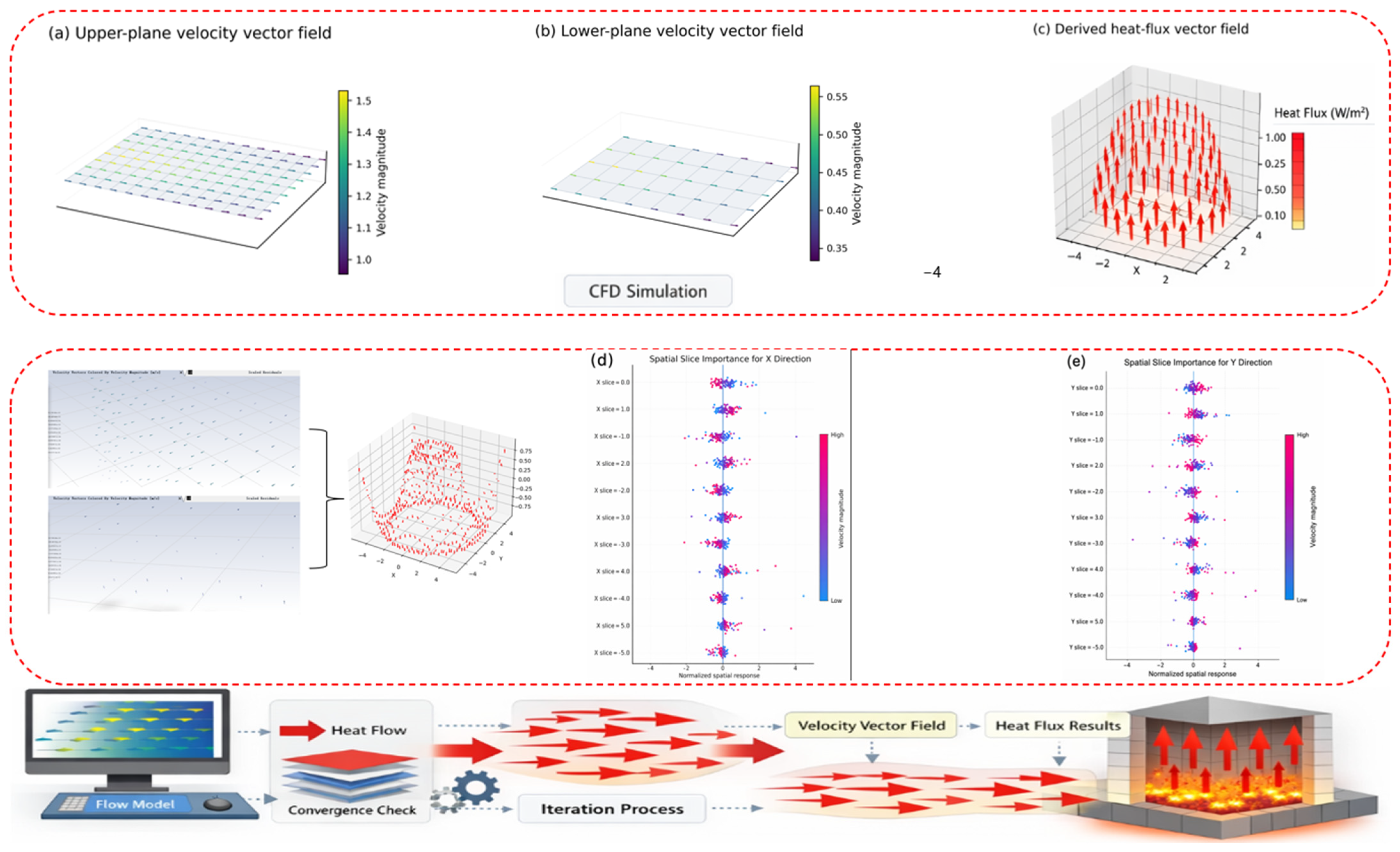
Figure 5 illustrates the airflow characteristics in the drying chamber through the velocity vector fields in the upper and lower sections, the derived heat flux vector field, and the supplementary spatial slice distributions in the X and Y directions. Panels (a) and (b) show that the airflow velocity is spatially non-uniform, with higher velocities in the upper section and lower velocities in the lower section. Such a velocity gradient affects local convective heat transfer and may lead to temperature differences within the chamber, thereby influencing drying uniformity. Panel (c) further presents the derived heat flux vector field, in which the red arrows indicate the transport direction and relative intensity of thermal energy. In addition, panels (d) and (e) provide supplementary normalized spatial response distributions in the X and Y directions, respectively, offering a more intuitive description of the airflow field’s sectional heterogeneity [
11,
12].
4. Kelp Surface FEM Thermal Response Model
4.1. Transient Heat Conduction Control Equations and Initial Conditions for Kelp
In the present study, kelp is simplified as a thin isotropic sheet with uniform thermophysical properties. Moisture migration, shrinkage, and temperature-dependent property variations are not explicitly coupled. The FEM model is therefore intended to describe the transient thermal response under the mapped chamber-side loads rather than the full coupled heat and mass transfer process of kelp drying. To more accurately simulate the temperature changes in kelp during the drying process, this paper establishes a finite element model based on the transient heat conduction equation. As a high-moisture, thin-sheet material, kelp’s internal temperature distribution undergoes dynamic changes over time; a transient thermal analysis is therefore required to describe its time-varying temperature process. More specifically, during the drying process, the heat applied to the kelp surface primarily originates from the radiation emitted by the infrared drying lamps inside the chamber and convective heat transfer from the air. These heat loads are obtained through the CFD simulation results, encompassing factors such as infrared radiation and convective heat transfer. These heat loads act on the surface and are gradually transferred to the entire object through heat conduction within the kelp. To describe this process, the transient heat conduction equation, as shown in Equation (10), is used to characterize the temperature distribution and heat transfer process within the kelp:
Here,
,
, and
represent the density, specific heat capacity, and thermal conductivity of the kelp, respectively;
is the surface temperature of the kelp; and
is time. Since heat conduction within the kelp is isotropic, the model assumes that the kelp has uniform thermal properties (Szpicer et al. 2023) [
8]. The initial temperature T
0 is set to the ambient temperature (25 °C), meaning that the kelp is at room temperature at the start of drying, as shown in Equation (11):
The temperature of the kelp surface is governed by the combined effects of infrared radiation and convective heat transfer. To transfer the CFD results to the kelp finite element model, the radiative heat flux and convective boundary conditions are imposed on the kelp surface as follows (12):
where
is the outward unit normal vector on the kelp surface,
is the incident radiative heat flux obtained from the CFD (W/m
2),
is the local convective heat transfer coefficient (W/m
2·K),
is the local air temperature, and
is the kelp surface temperature. In this way, the spatially varying chamber-side thermal loads are consistently mapped onto the finite element model under different operating conditions.
4.2. FEM Initial Conditions
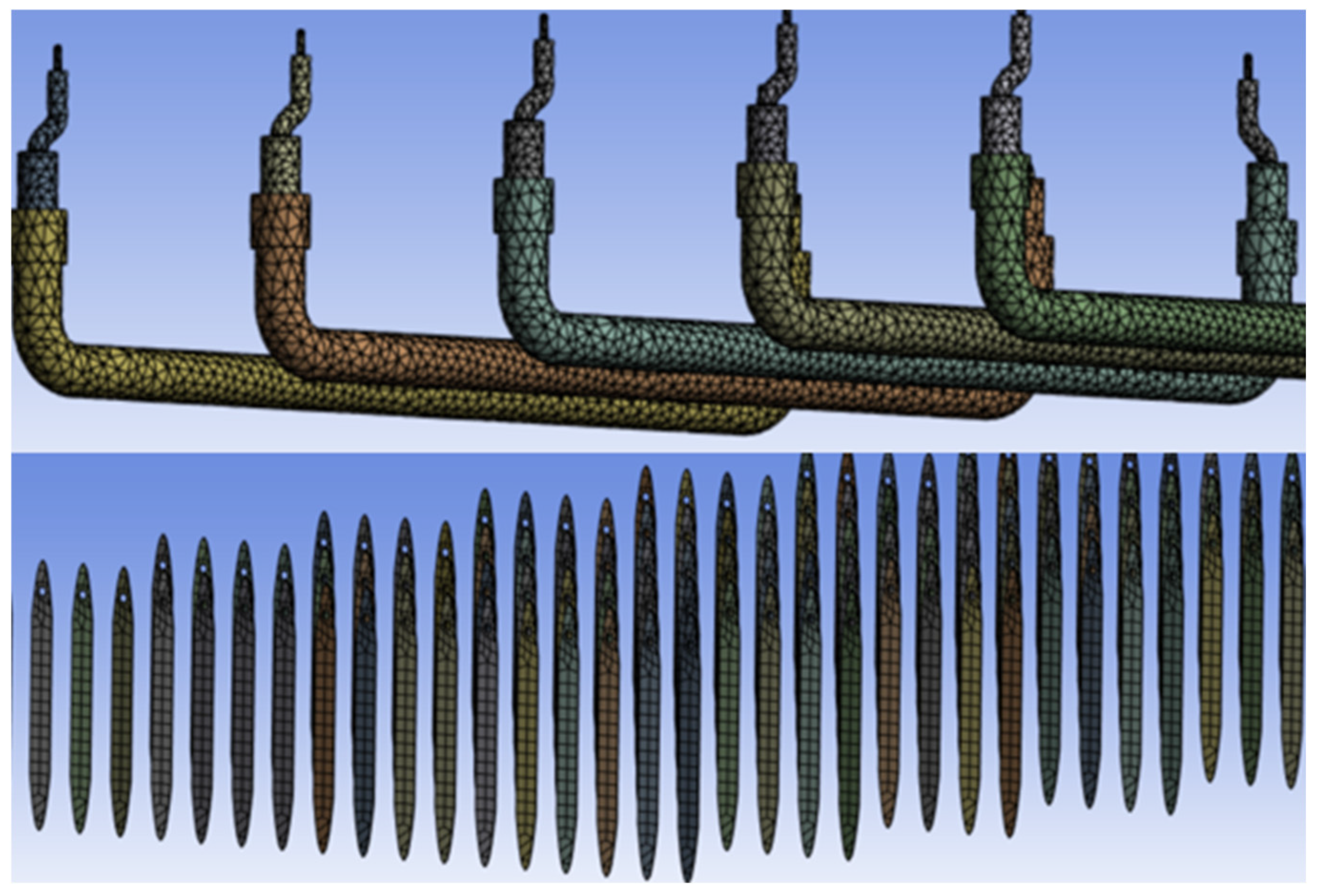
To ensure accurate simulation of kelp’s thermal response, we employed the finite element method (FEM) to mesh the kelp. Given the lengthy simulation time required for kelp drying and considering current hardware capabilities, the time step was reduced by a certain factor to improve the transient analysis efficiency during the process. As shown in
Figure 6, the geometric model of the kelp was simplified to a thin-plate structure, and a three-dimensional finite element model of the infrared drying lamp was established based on its actual dimensions and physical properties. During the meshing process, the mesh was refined in areas with significant temperature gradients, particularly near the radiant heat source, ventilation openings, and perforated hanging points [
13,
14,
15,
16]. This refinement aimed to improve the temperature field resolution, thereby more accurately simulating the temperature rise on the kelp’s surface.
The mapped kelp thermal response model was implemented in Ansys Mechanical Enterprise 2024 R2 using the Transient The specific relevant configuration parameters are shown in
Table 2 and
Table 3. Thermal module and the underlying MAPDL solver. All calculations were carried out in a consistent MKS unit system (m, kg, s, °C). A distributed memory parallel solution was adopted with 62 parallel processes, each with one thread. The total simulated heating duration was 60 s. The kelp’s geometry was simplified as a thin-sheet structure and discretized in the mechanical meshing environment with a global element size of 5.5 × 10
−2 m. For the mapped thermal loads, a prescribed temperature boundary was applied to the infrared heater surface set (NS_Lamp_Surf) and kept constant at 200 °C during the entire simulation period (0–60 s). Convective heat transfer was imposed on the kelp surface set (NS_Kelp_Surf_All) with a film coefficient of 10 W m
−2 K
−1 and an ambient temperature of 25 °C, which was also kept constant for the full 0–60 s. In addition, the surface-to-surface radiation on the radiation surface set (NS_Rad_All) was considered, with an emissivity of 0.95, ambient temperature of 25 °C, and view factor of 1. These settings provided the direct numerical implementation of the radiative and convective loads mapped from the chamber-side analysis to the kelp-side transient thermal model.
The above solver settings and boundary definitions improve the transient thermal simulation reproducibility and clarify how the chamber-side loads were numerically imposed on the kelp model.
Kelp Thermal Response Output and Results
By solving the finite element model of the kelp, we obtained the temperature field evolution on the kelp surface over time. We extracted the time-dependent curves for the maximum (
), minimum (
), and average temperatures (
) on the kelp surface, and used these data in conjunction with Equations (13) and (14) to calculate the kelp’s temperature uniformity index.
Here, and represent the standard deviation and mean of the kelp surface temperature, respectively. These metrics allowed us to quantify the temperature distribution uniformity on the kelp surface, thereby providing a reference for optimizing the subsequent drying process.
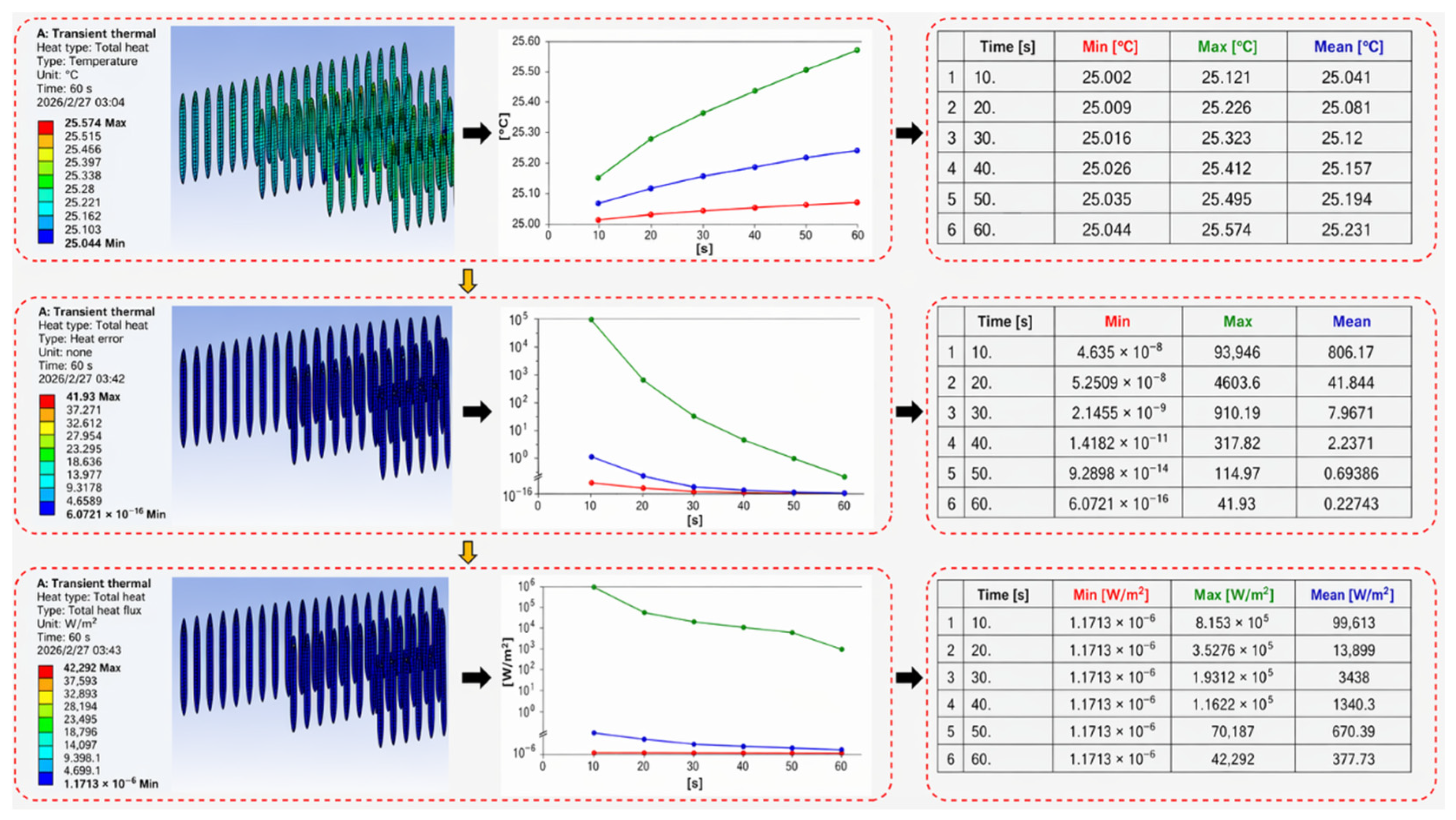
Based on the results obtained from the finite element simulations, this paper illustrates the evolution of temperature, thermal error, and total heat flux during the kelp drying process. As shown in
Figure 7, the three curves represent the time-dependent variations in the minimum (red curve), maximum (green curve), and average temperatures (blue curve) on the kelp surface. Over time, the surface temperature of the kelp gradually increased; the maximum temperature exhibited a linear growth trend, while the minimum and average temperatures remained within a relatively stable range, reflecting the trend toward a gradual and uniform heat distribution across the kelp surface. It was found that the thermal error decreased rapidly during the first few seconds and stabilized at a relatively low level within a short period. This indicates that during the initial heating stage there were significant temperature differences within the kelp, but as the drying process progressed [
17] these differences rapidly diminished and eventually reached equilibrium. Initially, the heat flux exhibited significant fluctuations, primarily due to the rapid temperature rise caused by the infrared array heating. However, as the drying process progressed, the heat flux gradually stabilized, indicating that the heat transfer had entered a relatively balanced phase. Based on the finite element simulation results,
Figure 7 presents the temporal evolution of the minimum, maximum, and average surface temperatures of kelp, together with the corresponding thermal error and total heat flux responses. The surface temperature increased rapidly at the beginning of heating and then evolved more gradually as internal heat diffusion proceeded. The gap among
,
, and
was more pronounced at the initial stage and decreased with time, indicating a tendency toward a more uniform surface temperature distribution. The thermal error curve also decreased rapidly during the early stage and then approached a relatively stable level, while the total heat flux exhibited an initially strong response followed by gradual stabilization. These results characterize kelp’s transient thermal behavior under the mapped chamber-side loads and provide a basis for the subsequent operating condition comparison.
4.3. CFD Load Mapping and Coupled Analysis with a Kelp Model
After completing the simulation, the obtained heat flux and velocity field data are mapped onto the finite element model of the kelp. By integrating these data with the geometric model of the kelp, we are able to apply appropriate thermal loads and convective heat transfer boundary conditions to the kelp surface. In this process, the heat flux
and convective heat transfer coefficient
from the CFD simulation results are input as boundary conditions into the kelp finite element model. The boundary conditions for the kelp surface temperature variation are shown in Equation (15):
Here,
represents the air temperature,
represents the kelp surface temperature,
is the unit normal vector to the kelp surface, and
is the kelp thermal conductivity. These boundary conditions drive the kelp thermal response model using data extracted from the chamber-side CFD results, thereby enabling a coupled numerical analysis of the chamber thermal environment and material-side transient temperature response. It should be emphasized that the present manuscript focuses mainly on numerical consistency and the thermal response characterization rather than a full quantitative experimental validation. Although the drying system is equipped with multi-point infrared monitoring and temperature/humidity sensing units, the experimental evidence presented here is preliminary and is only used to support the model’s engineering background and physical plausibility. The present coupled framework should therefore be interpreted as a numerical tool for thermal load mapping, transient thermal response analysis, and operating condition screening, rather than as a fully validated predictor of drying efficiency, moisture evolution, or product quality [
18,
19,
20].
5. MATLAB Post-Processing and Composite Objective-Based Screening
5.1. MATLAB Post-Processing Workflow
After completing the CFD and finite element model calculations, MATLAB was used to post-process the numerical results to ensure consistent comparison, quantitative evaluation, and the subsequent comparison and screening of different operating conditions. First, the temperature, velocity, and incident radiation fields obtained from the CFD simulations were exported from the drying zone and mapped onto a fixed chamber mid-plane as a unified evaluation cross-section. Because the original solver outputs were defined on a non-uniform numerical grid, interpolation reconstruction was performed to transform the data into a regular grid with unified coordinates, thereby improving data consistency and the robustness of subsequent statistical analysis. Based on the reconstructed fields, statistical parameters were calculated, including the mean, maximum, minimum, standard deviation, and coefficient of variation of each physical quantity. The temperature field uniformity was quantitatively evaluated using indicators such as the temperature coefficient of variation (
); where appropriate, the relative temperature difference was also introduced to describe the temperature non-uniformity. Meanwhile, the velocity field was further analyzed to extract the local velocity components and streamline the characteristics; this allowed us to identify non-ideal flow regions, such as recirculation and short-circuiting, as well as assess the influence of flow organization on heat transfer distribution through a local velocity gradient analysis [
21]. In addition, to account for local deviations induced by heat source input and heat transfer processes, thermal errors at different time points were also calculated to evaluate the thermal load stability and temperature field uniformity. For the kelp finite element results, the temporal evolution of the maximum, minimum, and average surface temperatures was extracted to characterize the material’s transient thermal response. These post-processed quantities provided a basis for evaluating the thermal response characteristics of kelp, supplying the key inputs for the subsequent composite objective evaluation, operating condition ranking, and discrete case screening [
22,
23,
24,
25,
26].
5.2. Composite Objective-Based Operating Condition Screening
To balance field uniformity and operational safety during infrared kelp drying, a MATLAB-based composite objective evaluation framework was established. Three normalized indicators, namely (
), (
), and (
), were used to quantify the non-uniformity of the reconstructed chamber-side fields. As shown in
Table 4, a composite objective function J was then defined by combining these indicators with penalty terms associated with deviations from the recommended temperature band, overheating risk, and insufficient preheating. Because only five predefined operating conditions were evaluated in this study, the procedure should be regarded as a discrete operating condition screening rather than a rigorous continuous multi-objective optimization. The tested cases were ranked according to J, and the best case was selected for subsequent CFD load mapping and kelp FEM thermal response analysis.
where
,
, and
are the normalized values of the corresponding indicators;
,
, and
are weighting coefficients that satisfy
;
is the penalty term for deviation from the recommended temperature band;
is the overheating penalty term; and
is the penalty term for insufficient preheating [
27]. In this study, lower
values indicate better overall performance.
Because only five predefined operating conditions were considered, the MATLAB procedure was implemented as a discrete case evaluation and ranking process rather than as a continuous particle-based optimization routine. For each candidate operating condition, the chamber-side CFD fields were reconstructed, the corresponding field uniformity indicators were extracted, and the composite objective value was calculated. The tested cases were then ranked according to J, and the most suitable case within the current dataset was selected for subsequent CFD load mapping and kelp FEM thermal response analysis.
5.2.1. Construction of a Composite Objective Function and Ranking and Screening of Operating Conditions
To transform the multi-criteria evaluation problem into actionable criteria for selecting operating conditions, a comprehensive objective function,
, was constructed in MATLAB, unifying metrics such as temperature, radiation and heat flux uniformity, and flow organization characteristics, within a single evaluation framework. Given the differences in the units and numerical ranges of the various metrics, each metric was first normalized [
28,
29]. Let a metric be denoted as
; it is normalized as shown in Equation (17):
Based on this, the composite objective function consists of the basic objective term in Equation (18) and the constraint penalty term.
In particular,
is used to describe the combined performance of uniformity and efficiency under different operating conditions; it can be expressed in a weighted form, as shown in Equation (19):
Here,
, and
represent the coefficients of variation for the mid-plane temperature, incident radiation (or equivalent heat flux), and velocity field, respectively, while
, and
are weighting coefficients (which can be set according to the focus of the study, provided that
). Additionally, to ensure that the screening results meet engineering safety and process window requirements, this paper introduces penalty terms,
, for scenarios such as overheating, temperature band deviation, and insufficient preheating. Taking the maximum temperature constraint as an example, when
exceeds the threshold
, a penalty function is introduced, as shown in Equation (20):
By assigning appropriate penalty terms for deviations from the “recommended temperature range” and insufficient coverage of incident radiation, the comprehensive objective function is designed to reflect improvements in uniformity while simultaneously avoiding the risks of overheating or operational unavailability that could result from focusing solely on a single metric. As shown in
Table 5, after processing in MATLAB, metrics such as
,
and
were obtained, and the composite objective function
was calculated. All operating conditions were then ranked and filtered to identify the top 10 sets of operating conditions with the best overall performance. Notably, the composite objective function
varied significantly across different operating conditions, indicating that the organization of the heat−flow−radiation fields in the drying zone has a marked impact on the uniformity metrics. More specifically, the top-ranked operating condition (demo_case02) had the lowest
value, while
,
, and
were also at relatively low levels. This indicates that the overall uniformity of the temperature, incident radiation, and flow fields was good under this condition, making it the preferred operating condition for the subsequent kelp load mapping and finite element thermal response analysis. In contrast, the
value increased significantly for the lower-ranked operating conditions, primarily due to the poorer uniformity metrics (especially a higher
in the flow field), suggesting the presence of strong non-uniform flow or localized heat load concentration [
30,
31,
32].
5.2.2. Comparison of Optimal and Reference Operating Conditions
As shown in
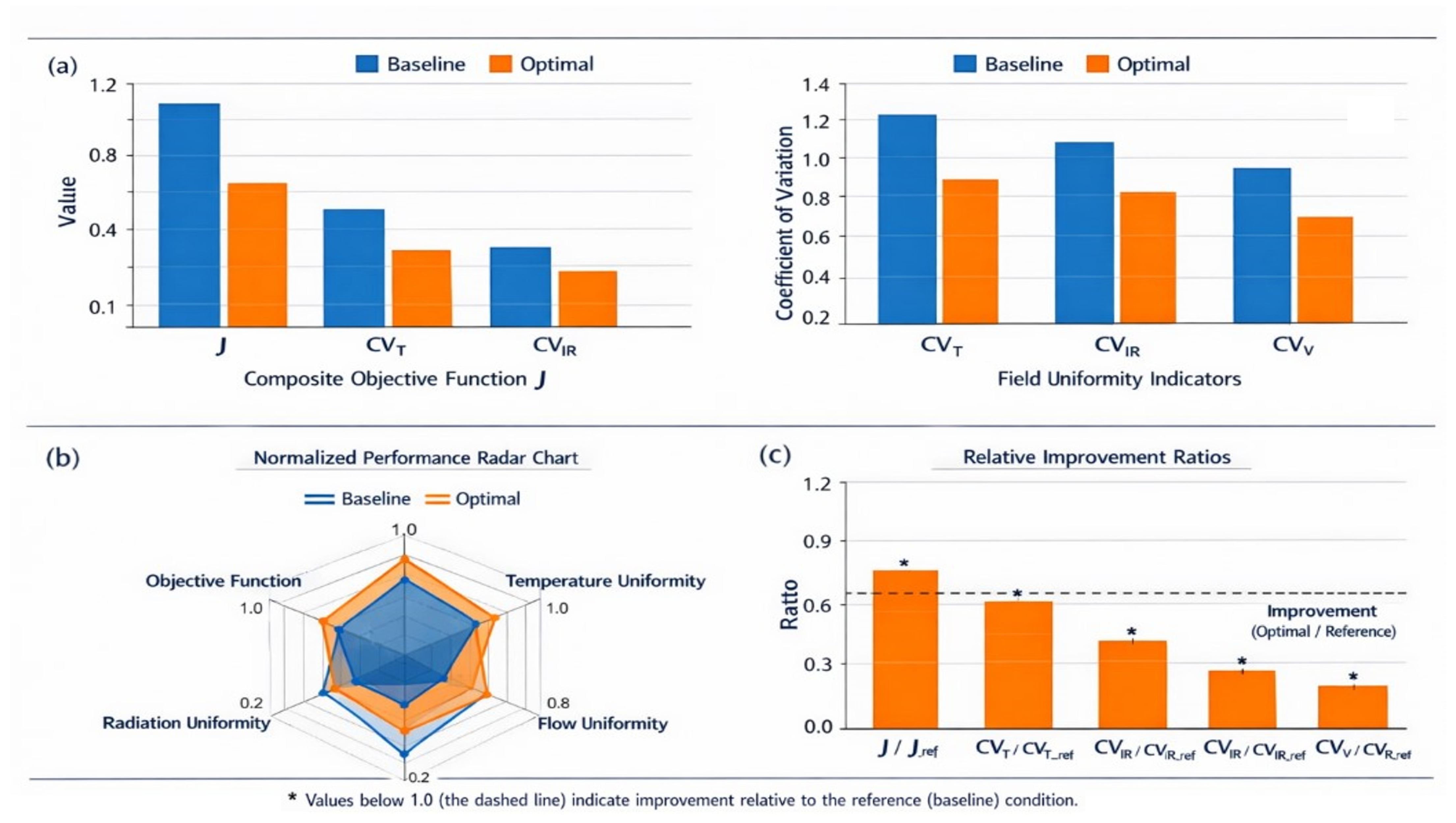
Figure 8, the baseline operating and selected optimal operating conditions were compared to verify the effectiveness of the multi-objective optimization procedure from four perspectives: the composite objective function, field uniformity indicators, normalized overall performance, and relative improvement ratios.
Figure 8a shows that the optimal operating condition yielded a lower composite objective value
than the baseline condition, indicating superior overall performance under the same evaluation framework.
Figure 8a further demonstrates that the optimized condition produced lower coefficients of variation for the temperature (
), incident radiation/heat load (
), and airflow fields (
), suggesting improved uniformity in each individual physical field, as well as better coordination among the coupled temperature–radiation–flow fields.
To provide a more intuitive multi-index evaluation,
Figure 8b presents a normalized radar chart of the main performance indicators. The optimal operating condition exhibits a more favorable and balanced performance profile, indicating enhanced comprehensive behavior in terms of objective reduction and multi-field coordination. In addition,
Figure 8c shows the relative improvement ratios expressed as optimal/reference. For all indicators, values below one indicate improvement, meaning that the optimized operating condition reduces the composite objective value and improves the uniformity of the temperature, radiation, and airflow fields relative to the baseline condition. Overall, these results confirm that the MATLAB-based post-processing evaluation and multi-objective screening procedure can effectively identify more suitable operating conditions, thereby providing more reasonable and stable boundary load conditions for subsequent CFD load mapping and finite element thermal response analysis of kelp.
5.2.3. Load Mapping and Coupled Optimization of the Thermal Response of Kelp Using the Finite Element Method
Based on the screened operating conditions, the chamber-side heat load distribution of the selected case was mapped onto the kelp finite element model for a transient thermal response analysis. Compared with the baseline condition, the selected case yielded a lower composite objective value and slightly improved temperature field uniformity within the current dataset, while the velocity field indicator remained unchanged. The main advantage of the selected case should therefore be interpreted as a modest improvement in the composite thermal field performance and constraint satisfaction, rather than as an experimentally proven enhancement of drying efficiency or product quality. For the quantitative validation of drying time, energy consumption, moisture removal, and quality attributes, dedicated experiments will be required in future work.
6. Results and Analysis
6.1. Chamber-Side Distributions of Temperature, Velocity, and Incident Radiation
The chamber mid-plane was selected as the common evaluation section for all operating conditions to analyze the spatial distribution characteristics of the heat–flow–radiation fields within the drying zone under the optimized infrared array, as shown in
Figure 9. The CFD results show that the chamber-side temperature field exhibits a clear spatial gradient, with relatively higher temperatures directly beneath the infrared array and lower temperatures away from the heating center, thereby forming a distinct stratified temperature distribution. In addition, a thermal boundary layer forms near the wall surface. These features indicate that the thermal input inside the drying chamber is spatially non-uniform, which may directly influence the kelp surface’s subsequent heating state. The incident radiation field displays a concentrated distribution in the array-covered region and gradually attenuates toward the peripheral region, showing a band-like distribution pattern and confirming the dominant role of infrared array layout in determining the heat input uniformity. The velocity field further reveals that the airflow structure at the chamber mid-plane consists of a main flow path coexisting with local recirculation regions. In some areas, reduced flow velocity and localized vortices are observed, suggesting the presence of short-circuiting airflow and recirculation structures. These non-ideal flow patterns may substantially weaken local convective heat transfer and consequently affect temperature field uniformity, indicating that airflow organization plays an important regulatory role in shaping the drying environment [
33].
The CFD solution’s physical plausibility is supported by the global mass conservation result, for which the net mass imbalance is only 0.004077 kg/s. Furthermore, the reconstructed mid-plane statistics show that the temperature field has a relatively low coefficient of variation, whereas for the velocity field this is much higher. This suggests that, under the current chamber configuration, flow non-uniformity remains a more critical challenge than temperature non-uniformity. Overall, these results provide the chamber-side basis for operating condition screening and subsequent thermal load mapping onto the kelp finite element model.
After steady-state convergence, to verify the physical plausibility of the numerical results, this paper performs a global mass conservation check on the mass fluxes at each open boundary of the computational domain. By integrating the mass fluxes at open-back, -front, -left, and -right, the net mass flux is obtained, as shown in Equation (21):
As shown in
Table 6, the coefficient of variation (CV) for the temperature field is 0.0539, indicating that its overall distribution is relatively uniform under the influence of the infrared array; however, the CV for the velocity field reaches 4.1221, suggesting that significant spatial variations still exist in the flow field, which may affect local convective heat transfer. The model converges reliably and the numerical solutions are physically consistent.
6.2. Kelp Surface Temperature Field Response and Temperature Rise Process
As shown in
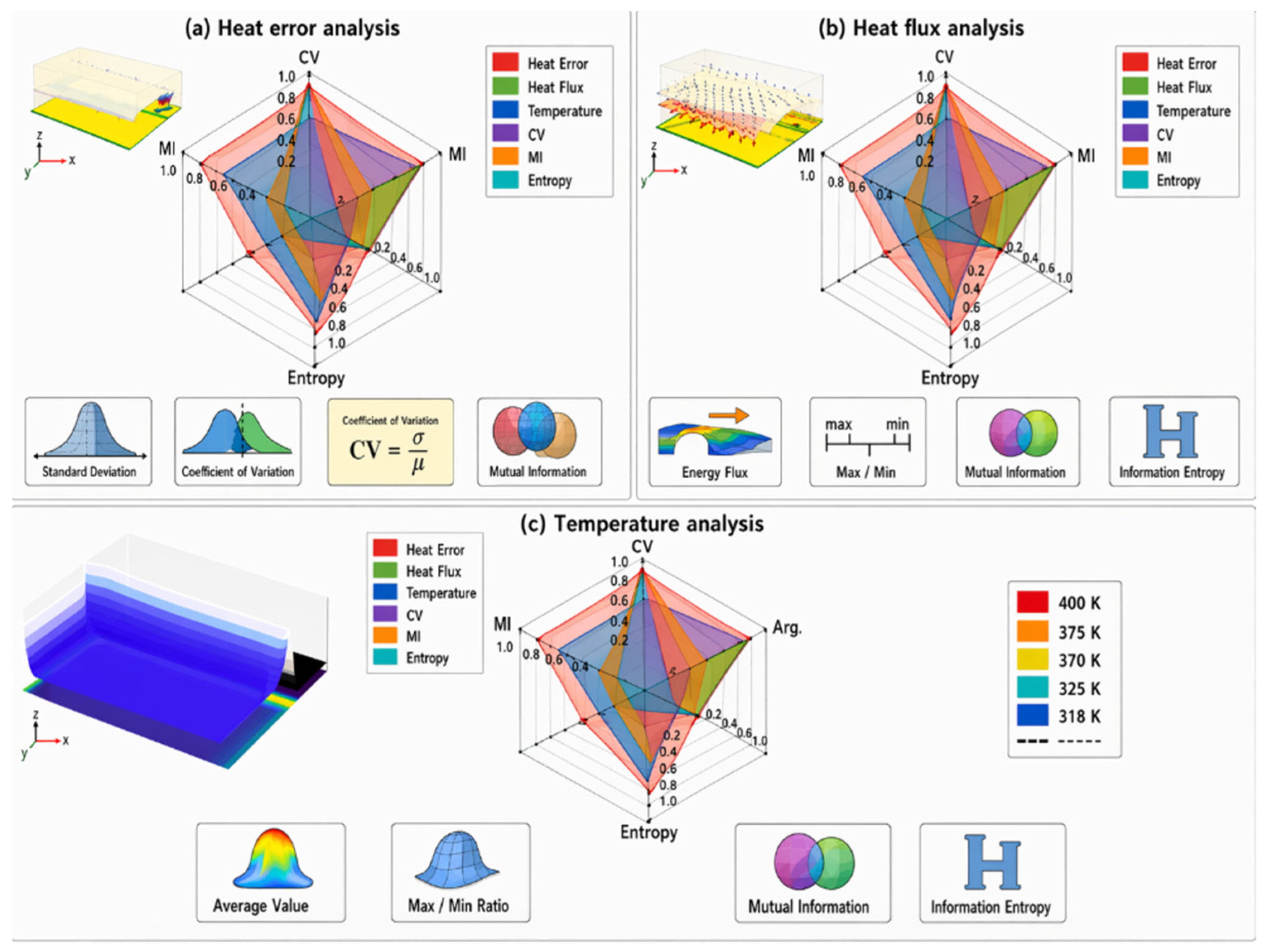
Figure 10, the mapped thermal and convective boundary loads under the optimized operating conditions were imposed on the kelp finite element model to calculate its transient thermal response during drying.
Figure 10 illustrates the spatial distributions of the heat error, total heat flux, and temperature fields, whereas the radar chart presents a supplementary evaluation of these response fields. The results show that the kelp surface temperature exhibits a clear staged evolution, with a rapid increase and relatively large temperature gradient in the initial heating stage, followed by gradual smoothing and stabilization as heat diffuses within the material.
To further quantify this process, the temporal variations in
,
, and
were extracted. A noticeable difference among the three curves was observed at the beginning of drying, indicating strong thermal non-uniformity, whereas the gap gradually decreased over time, suggesting progressive heat redistribution and stabilization. In addition, the radar chart summarizes the response characteristics of the heat error, total heat flux, and temperature fields using Avg, Max/Min, CV, MI, and Entropy. This supplementary analysis provides an integrated comparison of field intensity, uniformity, and complexity, thus complementing the direct visualization shown in
Figure 10.
In particular, to better quantify the temperature uniformity on the kelp surface, the coefficient of variation is calculated as shown in Equation (22):
Here,
represents the standard deviation of the surface temperature, and
denotes the average temperature.
Table 7 presents the extracted FEM temperature indicators for the selected kelp case at the exported output step. Under the current mapped loading condition, the average surface temperature reached 62.23075 °C and the maximum surface temperature reached 63.574 °C, both of which are consistent with the target operating range defined in the optimization framework. These results indicate that the selected condition can provide sufficient thermal input while keeping the peak temperature below the maximum allowable limit of 65 °C. The temporal evolution and uniformity trend of the kelp surface temperature are therefore mainly discussed based on
Figure 10, whereas
Table 7 summarizes the characteristic temperature levels at the selected output step.
To provide preliminary experimental support for the mapped thermal response model, the temperature histories at four representative locations were compared between the FEM prediction and the corresponding monitored data under case01. As summarized in
Table 8, both the predicted and monitored temperatures showed the same overall heating trend, namely rapid initial temperature rise followed by gradual stabilization. The spatial order of the four points was also consistent, with P1 and P2 remaining relatively hotter and P4 remaining comparatively cooler.
Table 9 further shows that the pointwise RMSE values ranged from 0.47 to 1.24 °C, with an overall RMSE of 0.78 °C and overall MAE of 0.65 °C. These results provide preliminary support for the physical plausibility of the transient thermal model, while more comprehensive validation using additional monitoring points, chamber thermocouple records, and drying-end moisture measurements is still required.
6.3. Results and Comparative Analysis of Composite Objective-Based Screening
After analyzing the thermal–flow–radiation field characteristics inside the chamber and calculating the kelp thermal response process, we further conducted a composite objective-based evaluation, screening the different operating conditions based on the MATLAB post-processing results and carrying out a systematic comparative analysis across multiple dimensions, including temperature, radiation, flow organization uniformities, and the composite objective function.
To quantitatively characterize the spatial dispersion of the chamber-side thermal and flow fields, we calculated the coefficients of variation of the temperature (
), incident radiation (
), and velocity fields (
) under different operating conditions. The candidate cases were then ranked according to the composite objective function
, where lower values indicate better overall performance. The ranking results are summarized in
Table 10. It can be seen that the best condition was case01 with the lowest
value of 0.4535, followed by case05 and case04. By contrast, case02 and case03 exhibited higher objective values and were therefore considered less favorable under the present evaluation framework. This result confirms that the operating condition screening should be based on the combined effect of temperature, radiation, and flow fields rather than on a single indicator alone.
Therefore, based on this, this paper normalizes the various indicators and constructs a composite objective function, as shown in Equation (23):
Here,
represents the weighting coefficient, and the penalty term is used to constrain the temperature upper limit and energy consumption conditions. By ranking all candidate operating conditions, the optimal solution with the best overall performance can be identified [
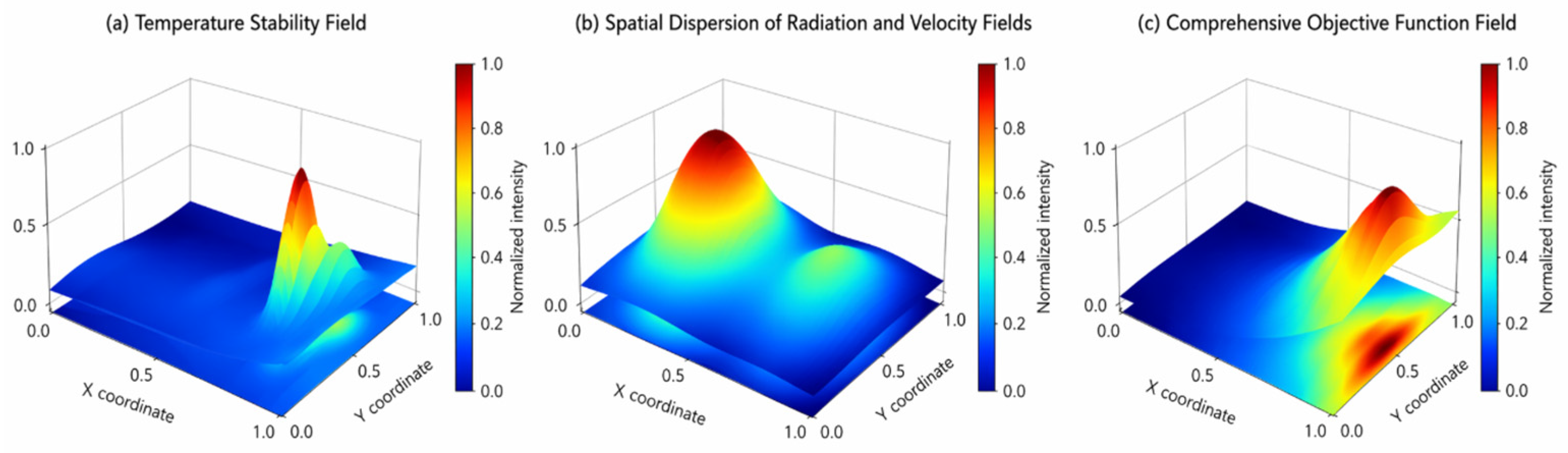
34]. As shown in
Figure 11, the ranking results indicate that the optimal operating condition significantly reduces the spatial dispersion of the radiation and velocity fields while maintaining temperature stability. Its comprehensive objective function value is notably lower than that of the baseline condition, indicating that this operating condition performs better overall under multi-field coupling conditions. To further interpret the ranking results, the selected optimal condition (case01) is compared with the reference condition (box_case1), as shown in
Table 11. The comparison shows that the optimal condition yields a lower composite objective value (
) than the reference condition, indicating better overall performance under the same evaluation framework. In terms of field uniformity indicators, the temperature field uniformity of the selected condition is slightly improved, whereas the velocity field indicator remains at the same level as the reference condition. Therefore, the main advantage of the selected condition in the current dataset lies in its lower overall objective value and its ability to satisfy the temperature band and overheating constraints while maintaining acceptable field uniformity performance. Because the reference
value is not explicitly reported in the current baseline table, a direct quantitative comparison of radiation field uniformity is not included here [
35].
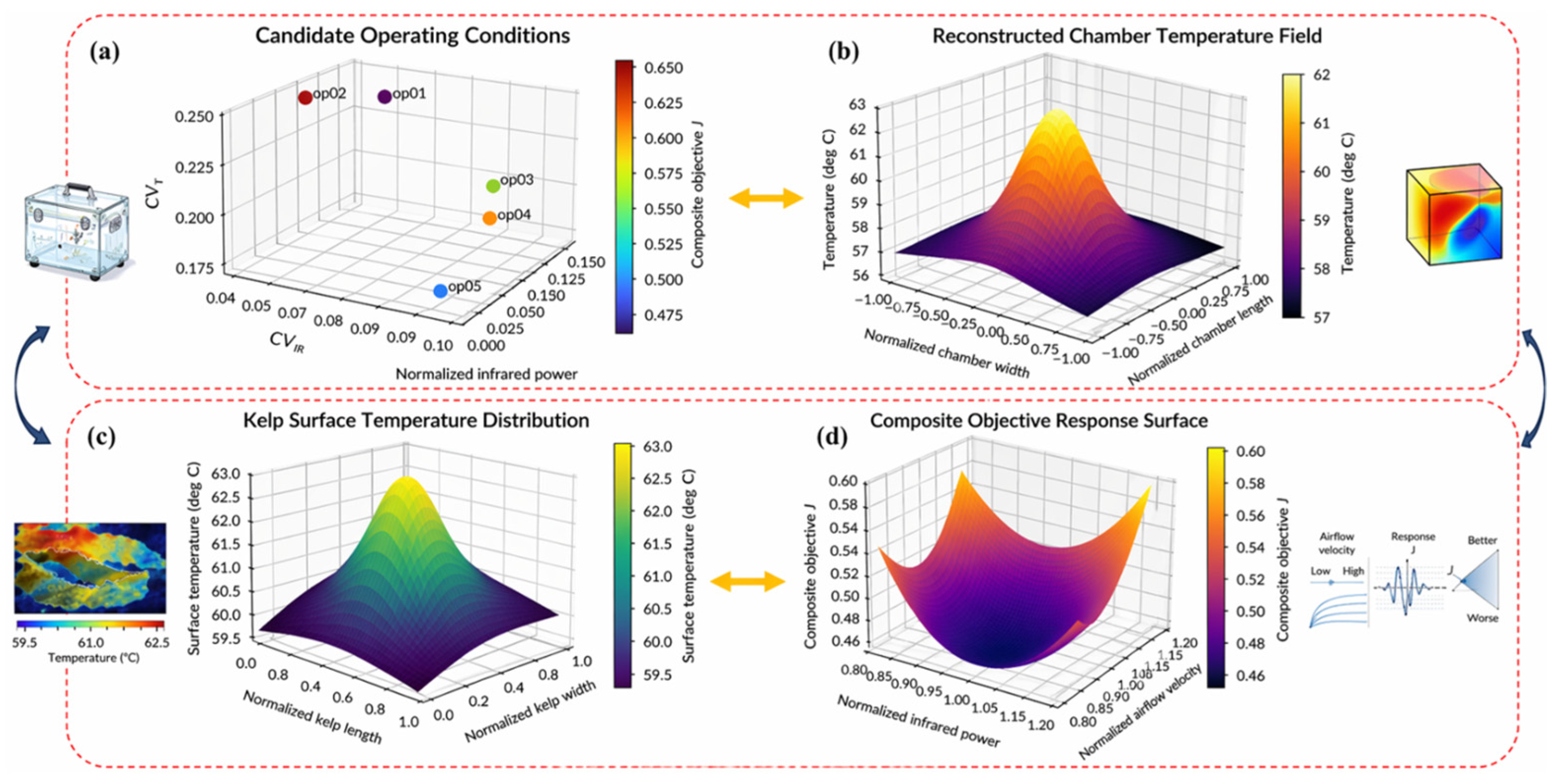
To provide an integrated visualization of the chamber-side field distribution, kelp surface thermal response, and screening landscape,
Figure 12 presents a combined three-dimensional summary of the main numerical results. It shows an integrated three-dimensional visualization of the analysis and screening results for infrared kelp drying, including (a) a screening space for candidate operating conditions based on
,
, and
; (b) the reconstructed mid-plane temperature field in the drying chamber; (c) the surface temperature distribution of kelp under the selected condition; and (d) the response surface of the composite objective function.
7. Discussion
The present results show that infrared kelp drying should be interpreted as a coupled chamber–material process involving the chamber-side temperature distribution, radiation coverage, and airflow organization, and the material-side thermal response, rather than as a single temperature field problem. Although the CFD solution reached a numerically consistent steady state, with a net mass imbalance of only 0.004077 kg/s, the reconstructed chamber-side fields remained spatially non-uniform. In particular, the temperature field appeared relatively smooth, whereas the radiation and velocity fields showed stronger spatial heterogeneity, indicating that temperature alone cannot adequately describe the actual drying environment. This is further supported by the mid-plane statistical indicators, where the coefficient of variation of temperature was much lower than that of velocity, suggesting that airflow non-uniformity remained a key factor affecting local convective heat transfer. Therefore, the chamber-side thermal environment in the current system is jointly governed by radiation input and airflow redistribution, and both should be considered in process evaluation.
After the radiative and convective loads were mapped from the CFD to the kelp model, the FEM results showed a staged surface temperature evolution characterized by rapid initial heating, gradual diffusion-driven redistribution, and a final tendency toward a more uniform state. This behavior is physically reasonable for thin biological materials and indicates that the proposed CFD–FEM coupling can reasonably characterize the link between the external chamber conditions and kelp-side transient thermal response. At the same time, the case screening results showed that the more suitable operating condition could not be identified from temperature uniformity alone. Some candidate cases exhibited acceptable temperature distributions but poorer overall performance because of less favorable radiation coverage or airflow organization. The combined use of , , , and the composite objective function J therefore provided a more rational basis for discrete operating condition screening. However, the quantitative improvement achieved by the selected case should be interpreted cautiously. Compared with the reference condition, J decreased from 0.4661 to 0.4535, decreased slightly from 0.0539 to 0.0531, and remained unchanged. The selected case is thus better described as the most suitable tested condition within the current dataset, rather than as a strongly optimized global solution.
Compared with previous studies on aquatic product drying, infrared drying, and CFD-based dryer analysis, the main contribution of this work lies in integrating a chamber-side CFD analysis, material-side FEM thermal response simulation, and MATLAB-based operating condition screening into one unified workflow. This framework is valuable for linking equipment-side field organization with kelp-side heating behavior and supporting engineering-level thermal field assessment within the tested cases. However, some important limitations remain. The kelp was simplified as a thin sheet with uniform thermal properties, and moisture migration, shrinkage, and temperature-dependent property variations were not fully coupled in the current model. In addition, although the preliminary monitored temperature comparison supports the physical plausibility of the thermal response prediction, the numerical analysis is still stronger than the experimental validation presented in the manuscript. The present framework should therefore be interpreted as an intermediate engineering tool for thermal response analysis and operating condition screening, rather than as a fully validated drying model. Future work should strengthen the quantitative validation using surface temperature histories, chamber thermocouple data, and drying-end moisture contents. Furthermore, future studies could further extend the model to coupled heat and mass transfer; dynamic material property updating; and quality-related indicators, such as color, rehydration, and bioactive retention.
8. Conclusions
In this study, a coupled CFD–FEM–MATLAB workflow was developed for infrared kelp drying, connecting chamber-side field reconstruction, kelp-side transient thermal response, and operating condition screening. The CFD results showed that the chamber-side temperature, incident radiation, and airflow fields were spatially non-uniform, with airflow organization remaining a major source of local thermal heterogeneity. After load mapping, the FEM results captured the transient surface temperature response of kelp, characterized by rapid initial heating followed by a diffusion-driven redistribution of surface temperature. These results support the use of the present framework for thermal response analysis and chamber-side field assessment.
Under the tested operating conditions, case01 yielded the lowest composite objective value (). Compared with the reference condition, decreased from 0.4661 to 0.4535, decreased slightly from 0.0539 to 0.0531, and remained unchanged. The advantage of the selected case should therefore be interpreted as a modest improvement in the composite thermal field performance within the current dataset, rather than a fully validated optimization of drying efficiency or product quality. While the preliminary comparison with representative monitored temperatures supported the main heating trend predicted by the thermal response model, the current validation remains limited in scope. Because the moisture migration, shrinkage, and temperature-dependent properties were not fully coupled, and the experimental validation remains preliminary, the proposed framework should be regarded as an intermediate engineering tool for thermal field screening and thermal response analysis.
Author Contributions
Conceptualization, K.S. and Y.F.; methodology, K.S.; validation, X.J.; investigation, K.S., X.J. and Y.F.; resources, H.L. and Q.H.; data curation, K.S.; writing—original draft preparation, K.S.; writing—review and editing, Y.F., X.J., H.L., Q.H. and H.Z.; visualization, H.Z.; supervision, H.L.; funding acquisition, H.L., project administration, Y.F. and Q.H. All authors have read and agreed to the published version of the manuscript.
Funding
This work was supported by the Liaoning Provincial Applied Basic Research Program (Project No. 2025JH2/101330041) and the National Key R&D Program of China (Grant No. 2018YFD0400800).
Data Availability Statement
The data that support the findings of this study are available on request from the corresponding author. The data are not publicly available due to privacy or ethical restrictions.
Conflicts of Interest
The authors declare no conflicts of interest.
References
- Cheng, S.; Su, W.; Yuan, L.; Tan, M. Recent developments of drying techniques for aquatic products: With emphasis on drying process monitoring with innovative methods. Dry. Technol. 2021, 39, 1577–1594. [Google Scholar] [CrossRef]
- Wu, W.; Li, H.; Chen, Y.; Luo, Y.; Zeng, J.; Huang, J.; Gao, T. Recent advances in drying processing technologies for aquatic products. Processes 2024, 12, 942. [Google Scholar] [CrossRef]
- Zeng, J.; Song, Y.; Cong, P.; Cao, Y.; Xu, J.; Xue, C. A systematic review of drying in aquatic products. Rev. Aquac. 2024, 16, 47–65. [Google Scholar] [CrossRef]
- Santhoshkumar, P.; Yoha, K.S.; Moses, J.A. Drying of seaweed: Approaches, challenges and research needs. Trends Food Sci. Technol. 2023, 138, 153–163. [Google Scholar] [CrossRef]
- Tolstorebrov, I.; Senadeera, W.; Eikevik, T.M.; Bantle, M.; Sæther, M.; Petrova, I. Study on drying of seaweeds and importance of glass transition and stabilization. Processes 2024, 12, 373. [Google Scholar] [CrossRef]
- Huang, D.; Yang, P.; Tang, X.; Luo, L.; Sundén, B. Application of infrared radiation in the drying of food products. Trends Food Sci. Technol. 2021, 110, 765–777. [Google Scholar] [CrossRef]
- Delfiya, D.S.A.; Prashob, K.; Murali, S.; Alfiya, P.V.; Samuel, M.P.; Pandiselvam, R. Drying kinetics of food materials in infrared radiation drying: A review. J. Food Process Eng. 2022, 45, e13810. [Google Scholar] [CrossRef]
- Szpicer, A.; Bińkowska, W.; Wojtasik-Kalinowska, I.; Salih, S.M.; Półtorak, A. Application of computational fluid dynamics simulations in food industry. Eur. Food Res. Technol. 2023, 249, 1411–1430. [Google Scholar] [CrossRef]
- Arsenoaia, V.N.; Roșca, G.R.; Cârlescu, P.; Băetu, M.; Rațu, R.; Veleșcu, I.; Țenu, I. Drying process modeling and quality assessments regarding an innovative seed dryer. Agriculture 2023, 13, 328. [Google Scholar] [CrossRef]
- Baidhe, E.; Clementson, C.L. A review of the application of modeling and simulation to drying systems for improved grain and seed quality. Comput. Electron. Agric. 2024, 222, 109094. [Google Scholar] [CrossRef]
- Adnouni, M.; Jiang, L.; Zhang, X.J.; Zhang, L.Z.; Pathare, P.B.; Roskilly, A.P. Computational modelling for decarbonised drying of agricultural products: Sustainable processes, energy efficiency, and quality improvement. J. Food Eng. 2023, 338, 111247. [Google Scholar] [CrossRef]
- Cebulski, D.; Cyklis, P. Application of CFD simulation to the design of an innovative drying chamber. Energies 2024, 17, 3338. [Google Scholar] [CrossRef]
- Ding, L.; Dou, Y.; Li, J.; Yao, T.; Ma, A.; Yuan, Y.; Wang, L.; Li, H. Design and optimization of a mixed-flow drying chamber for tiger nuts based on CFD-DEM heat and mass transfer model. Agriculture 2024, 14, 541. [Google Scholar] [CrossRef]
- Teleken, J.T.; Amorim, S.M.; Rodrigues, S.S.S.; de Souza, T.W.P.; Ferreira, J.P.; Carciofi, B.A.M. Heat and mass transfer in shrimp hot-air drying: Experimental evaluation and numerical simulation. Foods 2025, 14, 428. [Google Scholar] [CrossRef]
- Loemba, A.B.T.; Kichonge, B.; Kivevele, T. Comprehensive assessment of heat pump dryers for drying agricultural products. Energy Sci. Eng. 2023, 11, 2985–3014. [Google Scholar] [CrossRef]
- Sung, W.-C.; Lin, H.-T.; Liao, W.-C.; Fang, M. Effects of halogen lamp and traditional sun drying on the volatile compounds, color parameters, and gel texture of Gongliao Gelidium seaweed. Foods 2023, 12, 4508. [Google Scholar] [CrossRef] [PubMed]
- Vega-Gálvez, A.; Uribe, E.; Gómez-Pérez, L.S.; García, V.; Mejias, N.; Pastén, A. Drying kinetic modeling and assessment of mineral content, antimicrobial activity, and potential α-glucosidase activity inhibition of a green seaweed (Ulva spp.) subjected to different drying methods. ACS Omega 2022, 7, 34230–34238. [Google Scholar] [CrossRef]
- Lafeuille, B.; Tamigneaux, É.; Berger, K.; Provencher, V.; Beaulieu, L. Impact of harvest month and drying process on the nutritional and bioactive properties of wild Palmaria palmata from Atlantic Canada. Mar. Drugs 2023, 21, 392. [Google Scholar] [CrossRef]
- Ferdous, J.; Bensebaa, F.; Milani, A.S.; Hewage, K.; Bhowmik, P.; Pelletier, N. Development of a generic decision tree for the integration of multi-criteria decision-making (MCDM) and multi-objective optimization (MOO) methods under uncertainty to facilitate sustainability assessment: A methodical review. Sustainability 2024, 16, 2684. [Google Scholar] [CrossRef]
- Chen, F.; Liu, Y.; Yang, J.; Liu, J.; Zhang, X. A multi-objective particle swarm optimization with a competitive hybrid learning strategy. Complex Intell. Syst. 2024, 10, 5625–5651. [Google Scholar] [CrossRef]
- Ibrahim, A.; Amer, A.; Aboelasaad, G.; Hassan, M.F.; Elsebaee, I.; Gamal, A.; ElKholy, M. Design and fabricate a smart, energy-efficient, and quality-centric drum drying system. Discov. Food 2025, 5, 298. [Google Scholar] [CrossRef]
- Xuan, X.-T.; Yu, N.; Ding, T.; Shang, H.-T.; Cui, Y.; Lin, X.-D.; Zhu, L. Radio frequency-assisted hot air drying of Pacific white shrimp (Litopenaeus vannamei): Drying kinetics, product quality and composition evaluation. CyTA-J. Food 2024, 22, 2303445. [Google Scholar] [CrossRef]
- Fikry, M.; Benjakul, S.; Al-Ghamdi, S.; Tagrida, M.; Prodpran, T. Evaluating kinetics of convection drying and microstructure characteristics of Asian seabass fish skin without and with ultrasound pretreatment. Foods 2023, 12, 3024. [Google Scholar] [CrossRef] [PubMed]
- El-Mesery, H.S.; Ashiagbor, K.; Hu, Z.; Rostom, M. Mathematical modeling of thin-layer drying kinetics and moisture diffusivity study of apple slices using infrared conveyor-belt dryer. J. Food Sci. 2024, 89, 1658–1671. [Google Scholar] [CrossRef]
- Polat, A.; Taskin, O.; Izli, N. Assessment of freeze, continuous, and intermittent infrared drying methods for sliced persimmon. J. Food Sci. 2024, 89, 2332–2346. [Google Scholar] [CrossRef]
- Akhoundzadeh Yamchi, A.; Sharifian, F.; Kaveh, M. Drying kinetic, thermodynamic and quality analyses of infrared drying of truffle slices. J. Food Sci. 2024, 89, 3666–3686. [Google Scholar] [CrossRef]
- Avena-Bustillos, R.J.; Klausner, N.; Milczarek, R.; Alemán-Hidalgo, D.M.; Terán-Cabanillas, E.; Wang, H.; Wang, L.; McHugh, T.H.; Haff, R.P. Upcycling romaine lettuce outer leaves by infrared blanching and hot air drying. J. Food Sci. 2024, 89, 1988–2000. [Google Scholar] [CrossRef]
- Alkhaled, A.Y.; Selvi, K.C.; Kabutey, A.; Mizera, C.; Hrabe, P.; Svobodová, J.; Koçak, E.; Herák, D. Synergistic drying solutions: Combining vacuum and infrared techniques for optimal persimmon preservation. J. Food Sci. 2025, 90, e70347. [Google Scholar] [CrossRef] [PubMed]
- El-Mesery, H.S.; Hu, Z.; Ashiagbor, K.; Rostom, M. A study into how thickness, infrared intensity, and airflow affect drying kinetics, modeling, activation energy, and quality attributes of apple slices using infrared dryer. J. Food Sci. 2024, 89, 2895–2908. [Google Scholar] [CrossRef] [PubMed]
- Nzimande, N.A.; Mianda, S.M.; Seke, F.; Sivakumar, D. The effects of post-harvest pre-treatments and drying methods on in vitro bioaccessibility of phenolics and carotenoids in tomato (Solanum lycopersicum) cultivars. J. Food Sci. 2025, 90, e70001. [Google Scholar] [CrossRef]
- Washmin, N.; Sarmah, P.; Konwar, P.; Borah, T.; Saikia, J.; Phukan, A.; Banik, D. Impact of different drying techniques on Parkia timoriana pods: Physicochemical, nutritional, and bioactive insights through in vitro and in silico approaches. J. Food Sci. 2025, 90, e70228. [Google Scholar] [CrossRef] [PubMed]
- Yao, Y.; Lu, Z.; Gong, Y.; Guo, S.; Xiao, C.; Hu, W. Drying characteristics of a combined drying system of low-pressure superheated steam and heat pump. Processes 2022, 10, 1402. [Google Scholar] [CrossRef]
- Oyinloye, T.M.; Yoon, W.B. Optimizing texture and drying behavior of squid (Todarodes pacificus) for elder-friendly applications using alkaline pretreatment and intermittent drying: An experimental and numerical study. Processes 2025, 13, 2592. [Google Scholar] [CrossRef]
- Myhan, R.; Markowski, M. Generalized mathematical model of the grain drying process. Processes 2022, 10, 2749. [Google Scholar] [CrossRef]
- Selvi, K.Ç.; Alkhaled, A.Y.; Yıldız, T. Application of artificial neural network for predicting the drying kinetics and chemical attributes of linden (Tilia platyphyllos Scop.) during the infrared drying process. Processes 2022, 10, 2069. [Google Scholar] [CrossRef]
Figure 1.
Schematic diagram of the equipment unit module. 1-Hopper; 2-Conveyor belt; 3-Hopper discharge port; 4-Kelp perforator; 5-Mounting bracket; 6-KBK rail; 7-Electric hoist trolley; 8-Hinge plate; 9-Electric hoist; 10-Magnetic plate; 11-Push rod; 12-Lifting frame; 13-Lifting frame; 14-Drying rod; 15-Spring clip; 16-Magnetic pin; 17-Magnetic clip; 18-Spring stopper; 19-Infrared drying lamp; 20-Deflector collection tray; 21-Baling conveyor belt; 22-Baling machine; 23-Collection basket; 24-Infrared monitor; 25-Steel wire rope.
Figure 1.
Schematic diagram of the equipment unit module. 1-Hopper; 2-Conveyor belt; 3-Hopper discharge port; 4-Kelp perforator; 5-Mounting bracket; 6-KBK rail; 7-Electric hoist trolley; 8-Hinge plate; 9-Electric hoist; 10-Magnetic plate; 11-Push rod; 12-Lifting frame; 13-Lifting frame; 14-Drying rod; 15-Spring clip; 16-Magnetic pin; 17-Magnetic clip; 18-Spring stopper; 19-Infrared drying lamp; 20-Deflector collection tray; 21-Baling conveyor belt; 22-Baling machine; 23-Collection basket; 24-Infrared monitor; 25-Steel wire rope.
Figure 2.
Schematic work route map.
Figure 2.
Schematic work route map.
Figure 3.
Wave cloud representation of the convergence histories of CFD residuals in the drying-zone chamber.
Figure 3.
Wave cloud representation of the convergence histories of CFD residuals in the drying-zone chamber.
Figure 4.
Heat–flow–radiation field calculation diagram.
Figure 4.
Heat–flow–radiation field calculation diagram.
Figure 5.
Simulation of a fluid velocity vector field. (a) Upper-plane velocity vector field. (b) Lower-plane velocity vector field. (c) Derived heat-flux vector field. (d) Spatial Slice Importance for X Direction. (e) Spatial Slice Importance for Y Direction.
Figure 5.
Simulation of a fluid velocity vector field. (a) Upper-plane velocity vector field. (b) Lower-plane velocity vector field. (c) Derived heat-flux vector field. (d) Spatial Slice Importance for X Direction. (e) Spatial Slice Importance for Y Direction.
Figure 7.
FEM simulation results.
Figure 7.
FEM simulation results.
Figure 8.
Optimal and reference operating condition comparison charts.
Figure 8.
Optimal and reference operating condition comparison charts.
Figure 9.
Distribution maps of temperature, velocity, and radiation field characteristics inside the chamber.
Figure 9.
Distribution maps of temperature, velocity, and radiation field characteristics inside the chamber.
Figure 10.
Maps of kelp’s surface temperature distribution and temperature rise profile.
Figure 10.
Maps of kelp’s surface temperature distribution and temperature rise profile.
Figure 11.
Three-dimensional indicator and response surface visualizations used in the operating condition ranking analysis.
Figure 11.
Three-dimensional indicator and response surface visualizations used in the operating condition ranking analysis.
Figure 12.
Integrated three-dimensional visualization of chamber-side field distribution, kelp surface thermal response, and composite objective-based screening results.
Figure 12.
Integrated three-dimensional visualization of chamber-side field distribution, kelp surface thermal response, and composite objective-based screening results.
Table 1.
Mass flow report.
Table 1.
Mass flow report.
| Boundary | /(kg·s−1) |
|---|
| open_back | +81.590 |
| open_front | +255.743 |
| open_left | +203.937 |
| open_right | −541.266 |
|
| 0.004077 |
Table 2.
Numerical implementation details of the mapped kelp transient thermal model.
Table 2.
Numerical implementation details of the mapped kelp transient thermal model.
| Item | Settings Used in This Study |
|---|
| Software platform | Ansys Mechanical Enterprise 2024 R2 |
| Solver | MAPDL |
| Analysis type | Transient thermal analysis |
| Parallel solution mode | Distributed memory parallel |
| Parallel setting | 62 parallel processes, 1 thread per process |
| Unit system | Consistent MKS units (m, kg, s, °C) |
| Simulated physical time | 60 s |
| Geometry idealization | Thin-sheet kelp model |
| Meshing environment | Mechanical |
Table 3.
Thermal boundary conditions used in the mapped kelp FEM model.
Table 3.
Thermal boundary conditions used in the mapped kelp FEM model.
| Boundary Set | Boundary Type | Value | Time Definition |
|---|
| NS_Lamp_Surf | Prescribed temperature | 200 °C | Constant from 0 to 60 s |
| NS_Kelp_Surf_All | Convection | Film coefficient = 10 W m−2 K−1; ambient temperature = 25 °C | Constant from 0 to 60 s |
| NS_Rad_All | Surface-to-surface radiation | Emissivity = 0.95; ambient temperature = 25 °C; view factor = 1 | Constant from 0 to 60 s |
Table 4.
Variables, constraints, and evaluation strategy used for discrete operating condition screening.
Table 4.
Variables, constraints, and evaluation strategy used for discrete operating condition screening.
| Variable | Symbol | Description | Value Used in This Study | Unit | Role in Evaluation |
|---|
| Infrared array power | P | Heat source intensity/equivalent radiation input | Five coded operating levels corresponding to case01–case05 | — | Design variable |
| Air velocity | u | Ventilation intensity/characteristic inlet air velocity | Five coded operating levels corresponding to case01–case05 | m/s | Design variable |
Opening boundary configuration | B | Boundary settings of open_front, open_back, open_left, and open_right | Chamber-opening combination used in the CFD comparison | — | Design variable |
Maximum allowable temperature | Tmax,lim | Overheating constraint | 65 | °C | Used in Palarm |
Recommended temperature band | Tband | Target operating temperature band for screening | 60–63 | °C | Used in Pband |
Weight coefficient for temperature uniformity | w1 | Weight of CVT in the composite objective function | 0.33 | — | Used in Jbase |
Weight coefficient for radiation uniformity | w2 | Weight of CVIR in the composite objective function | 0.33 | — | Used in Jbase |
Weight coefficient for airflow uniformity | w3 | Weight of CVV in the composite objective function | 0.34 | — | Used in Jbase |
Penalty for insufficient preheating | Ppreheat | Penalty term activated when the kelp surface is insufficiently heated | Enabled | — | Used in J |
Penalty for deviation from target band | Pband | Penalty term activated when the temperature field deviates from the target band | Enabled | — | Used in J |
| Penalty for overheating | Palarm | Penalty term activated when Tmax > Tmax,lim | Enabled | — | Used in J |
Candidate operating conditions | — | MATLAB screening set | case01, case02, case03, case04, case05 | — | Ranking and comparison |
| Reference condition | — | Baseline condition used for comparison | box_case1 | — | Baseline case |
Selected optimal condition | — | Best operating condition after screening | case01 | — | Best case, J = 0.4535 |
Table 5.
Comprehensive evaluation and ranking results for typical operating conditions.
Table 5.
Comprehensive evaluation and ranking results for typical operating conditions.
| Ranking | Operating Conditions (xCase) | J | CV_T | CV_IR | CV_V | T_Mean/°C |
|---|
| 1 | demo_case02 | 0.453471 | 0.053052 | 0.243727 | 1.566927 | 60.0187 |
| 2 | box_case1 | 0.466127 | 0.053921 | — | 4.122063 | — |
| 3 | demo_case03 | 0.640073 | 0.040654 | 0.174214 | 4.252049 | 57.1515 |
| 4 | demo_case01 | 0.663163 | 0.087877 | 0.256038 | 3.192479 | 56.3815 |
| 5 | demo_case10 | 0.694105 | 0.095026 | 0.156987 | 3.499272 | 58.0562 |
| 6 | demo_case12 | 0.944904 | 0.098558 | 0.086061 | 3.163224 | 55.1202 |
| 7 | demo_case11 | 1.403282 | 0.078622 | 0.229122 | 5.209046 | 51.2098 |
| 8 | demo_case08 | 3.371103 | 0.043240 | 0.154682 | 2.740603 | 47.0238 |
| 9 | demo_case04 | 9.152367 | 0.091492 | 0.136519 | 3.363127 | 51.7090 |
| 10 | demo_case06 | 25.665356 | 0.071948 | 0.205309 | 5.277342 | 35.0499 |
Table 6.
Thermal and flow field statistics and uniformity metrics for the enclosure mid-plane.
Table 6.
Thermal and flow field statistics and uniformity metrics for the enclosure mid-plane.
| Case ID |
|
|
|---|
| box_case1 | 0.0539 | 4.1221 |
Table 7.
Characteristic kelp surface temperatures at the exported response time under the selected condition.
Table 7.
Characteristic kelp surface temperatures at the exported response time under the selected condition.
| Rank | Case ID | (°C) | (°C) | (°C) |
|---|
| 1 | kelp_case1 | 62.23075 | 63.574 | 30.044 |
Table 8.
Preliminary comparison between FEM-predicted and monitored temperature histories at four representative points under case01.
Table 8.
Preliminary comparison between FEM-predicted and monitored temperature histories at four representative points under case01.
| Time (s) | P1 Sim | P1 Monitored | P2 Sim | P2 Monitored | P3 Sim | P3 Monitored | P4 Sim | P4 Monitored |
|---|
| 0 | 25.00 | 25.00 | 25.00 | 25.00 | 25.00 | 25.00 | 25.00 | 25.00 |
| 60 | 39.60 | 39.00 | 37.20 | 36.90 | 35.60 | 35.80 | 32.40 | 31.70 |
| 120 | 49.30 | 48.70 | 46.00 | 45.50 | 43.90 | 43.40 | 39.60 | 38.50 |
| 180 | 55.20 | 54.60 | 52.40 | 51.90 | 50.40 | 49.80 | 45.50 | 44.20 |
| 240 | 59.00 | 58.20 | 56.50 | 55.80 | 54.20 | 53.50 | 49.50 | 48.20 |
| 300 | 61.00 | 60.40 | 58.80 | 58.30 | 56.80 | 56.00 | 52.70 | 51.10 |
| 420 | 62.50 | 61.90 | 60.40 | 59.90 | 59.00 | 58.50 | 55.80 | 54.10 |
| 600 | 63.40 | 62.70 | 62.05 | 61.60 | 61.18 | 60.50 | 59.72 | 58.40 |
Table 9.
Preliminary error statistics for FEM prediction against monitored temperatures.
Table 9.
Preliminary error statistics for FEM prediction against monitored temperatures.
| Point | RMSE (°C) | MAE (°C) | Final Absolute Error at 600 s (°C) |
|---|
| P1 | 0.61 | 0.56 | 0.70 |
| P2 | 0.47 | 0.43 | 0.45 |
| P3 | 0.56 | 0.50 | 0.68 |
| P4 | 1.24 | 1.13 | 1.32 |
| Overall | 0.78 | 0.65 | — |
Table 10.
Summary report of multi-objective evaluation results for different operating conditions.
Table 10.
Summary report of multi-objective evaluation results for different operating conditions.
| Case ID |
|
|
| J | Rank |
|---|
| case01 | 0.0531 | 0.2437 | 4.1221 | 0.4535 | 1 |
| case02 | 0.0986 | 0.0861 | 3.1632 | 0.5009 | 2 |
| case03 | 0.0950 | 0.1569 | 3.4993 | 0.6019 | 3 |
| case04 | 0.0407 | 0.1742 | 4.2520 | 0.6401 | 4 |
| case05 | 0.0788 | 0.2560 | 3.1925 | 0.6632 | 5 |
Table 11.
Comparison of the selected case and reference condition.
Table 11.
Comparison of the selected case and reference condition.
| Indicator | Reference (Box_Case1) | Best (Case01) | Change (%) |
|---|
| J | 0.4661 | 0.4535 | −2.70 |
| 0.0539 | 0.0531 | −1.48 |
| 4.1221 | 4.1221 | 0.00 |
| N/A | 0.2437 | N/A |
| Disclaimer/Publisher’s Note: The statements, opinions and data contained in all publications are solely those of the individual author(s) and contributor(s) and not of MDPI and/or the editor(s). MDPI and/or the editor(s) disclaim responsibility for any injury to people or property resulting from any ideas, methods, instructions or products referred to in the content. |