


Abstract
Mango leaves (Mangifera indica), an underutilized residue, represent a promising source of functional proteins with potential applications in emulsion-based delivery systems. Leaf protein concentrate (LPC) was extracted and modified by high-intensity ultrasound (HIU) to enhance its techno-functional properties. The modified protein was subsequently used as a natural emulsifier to develop oil-in-water (O/W) emulsions enriched with Curatella americana leaf extract, a phenolic-rich source of antioxidant bioactive compounds. Ultrasound-assisted emulsification (UAEm) conditions were optimized using a Box–Behnken experimental design, evaluating the effects of protein concentration (0.5, 1, and 1.5%), oil-to-water ratio (1:4, 1:4.5, and 1:5, mL:mL), and sonication time (2.5, 5, and 7.5 min) on droplet size (D[4,3], µm). The optimized formulation consisted of 1.5% protein, an O/W ratio of 1:4 mL, and a time of 7.5 min, producing an emulsion with a droplet diameter of 7.23 µm. The emulsions exhibited high resistance to storage, pH variation (2–10), ionic strength (100–500 mM NaCl), and thermal treatments up to 50 °C. Additionally, incorporating C. americana extract enhanced thermal stability, photostability, and antioxidant retention under UV exposure, suggesting the formation of reinforcing protein–polyphenol interactions. These findings demonstrate the potential of mango leaf protein as a sustainable emulsifier and protective carrier for sensitive bioactive compounds, supporting its application in functional food and nutraceutical formulations.
1. Introduction
In recent years, the demand for plant-derived proteins has increased considerably, driven by the growing adoption of plant-based diets and the transition towards more sustainable food systems [1]. Compared to animal proteins, plant proteins require up to 75% less water and generate up to 90% fewer greenhouse gas emissions, highlighting their significant environmental advantages. Beyond sustainability, plant-based proteins are recognized as nutritionally valuable ingredients, as they provide important protein fractions, mainly albumins, globulins, prolamins, and glutelins, which are rich sources of essential amino acids and have different applications in several sectors, including the pharmaceutical, cosmetic, material, and food industries [2,3].
In parallel, the food and agro-industrial sectors generate substantial amounts of by-products during agricultural production and processing. These residues represent an underutilized resource that can be valorized by recovering plant-based proteins, yielding ingredients with attractive nutritional and techno-functional properties while contributing to the development of a circular economy [4]. In this context, plant-based proteins derived from non-conventional sources have gained increasing attention as sustainable alternatives to traditional protein ingredients [5].
Mango (Mangifera indica L.) leaves represent a promising and underexploited agro-industrial by-product. In Mexico, annual or biannual pruning generates substantial amounts of leaf litter, which is typically discarded as waste [6]. However, these are a valuable source of compounds with potential applications in food systems. Their proximate composition, as previously reported, indicates a notable protein content of approximately 18.6%, along with dietary fiber, minerals, vitamins, and high-value biological compounds (HVBCs), such as phenolics and essential oils [7,8]. Proteins are among the major biomacromolecules in mango leaves, and their amino acid composition, including cysteine and methionine, confers nutritional and techno-functional benefits that are attractive for food applications [9].
Despite their potential, plant-based proteins often exhibit low solubility and limited interfacial activity, which are directly associated with poor emulsifying capacity and restrict their application in food systems. These limitations are often linked to their incomplete amino acid profiles, large molecular weight, and complex molecular structures compared to animal proteins [10,11]. Consequently, protein modification strategies are required to enhance their techno-functional properties. To address these limitations, chemical, enzymatic, and physical techniques have been employed [12].
Chemical modifications can effectively alter protein structure; however, they involve complex reaction pathways that may raise safety concerns. Enzymatic treatments, while selective, often require long processing times, increasing the risk of microbial contamination and limiting their industrial feasibility due to high costs. Moreover, enzymatic hydrolysis may generate undesirable sensory attributes such as bitterness and requires enzyme deactivation, typically through heat treatment, which can lead to the loss of amino acids [13,14,15].
Among physical modification techniques, high-intensity ultrasound (HIU) has emerged as a promising, efficient, and environmentally sustainable method for protein modification. HIU operates at power densities of 10 to 1000 W/cm2 and frequencies of 20 to 100 kHz, inducing cavitation that generates shock waves, microjets, shear forces, and localized increases in temperature and pressure. These effects disrupt weak intermolecular interactions, such as hydrogen bonds, electrostatic forces, and van der Waals forces, leading to significant structural rearrangements in proteins [16]. As a result, HIU has been successfully applied to improve the solubility, emulsification, foaming, viscosity, and gelation properties of various plant-based proteins, including soybean [17], guamuchil [18], pea [19], and sunnhemp [20].
Improved techno-functional properties of modified proteins can enhance the stabilization of HVBCs derived from plant extracts, thereby preserving their bioactive properties in emulsion systems. In this regard, Curatella americana L., a member of the Dilleniaceae family, has been traditionally used in folk medicine throughout Latin America. Leaf infusions and extracts have been used as hypoglycemic agents and menstrual cycle regulators, and limited studies have reported anti-inflammatory, antihypertensive, gastroprotective, antioxidant, analgesic, and vasodilatory activities. These biological effects are attributed to the phenolic compounds present in the leaves [21,22,23].
However, directly incorporating Curatella americana extracts into food systems may be limited by stability and bioavailability issues, as these HVBCs are highly sensitive to environmental factors such as temperature, oxygen, and light, which can lead to loss of bioactivity [24], underscoring the need for effective protection strategies. Within this framework, modifying mango leaf proteins using HIU is a promising approach to enhance their emulsifying capacity and enable their use as functional components in delivery systems. Improving the interfacial properties of these proteins may facilitate the development of stable emulsion-based delivery systems for incorporating and delivering Curatella americana leaf extract, thereby adding value to agricultural by-products and contributing to the development of sustainable, plant-based functional ingredients.
2. Materials and Methods
2.1. Vegetal Material
Mango leaves (Mangifera indica, variety Ataulfo) were collected from pruned trees at the Pani station, Vado del Cora, Nayarit. Healthy leaves were visually selected, washed, and disinfected. Leaves were then dried in a convection oven (Novatech, HS60-AID, Tlaquepaque, Jalisco, Mexico) at 60 °C for 24 h. Dried leaves were ground in an electric pulverizer (Gutstark 2000, Gutstark, Mexico City, Mexico). The resulting powder was sieved through a No. 100 mesh sieve (ASTM:100; 150 μm). The final powder was stored in polyethylene bags until use.
2.2. Mango Leaf Protein Concentrate Extraction
According to the methodology of Vera-Salgado et al. [25]. The extraction yield was calculated according to Equation (1).
2.3. Modification of Mango Leaf Protein by High-Intensity Ultrasound
Mango leaf protein concentrate was subjected to high-intensity ultrasound treatment. A 10% solids solution was prepared. Then, this solution (100 mL) was exposed to ultrasound probe treatment using an FSI-1200 sonicator (Shanghai, China) equipped with a 16 mm-diameter probe at 24 kHz and 1080 W for 10 min. The treated protein solutions were kept in a cold bath (4 °C) [26].
2.4. Drying of Mango Leaf Protein Concentrate
For drying both native and modified mango leaf protein, the methodology of Miss-Zacarías et al. [27] was followed. Protein solutions were adjusted to 10% (w/v). The solutions were dried in a laboratory-scale spray dryer (Büchi B-290; Flawil, St. Gallen, Switzerland). The process conditions were an inlet temperature of 115 °C, a feed rate of 4.5 mL/min, a feed nozzle diameter of 0.7 mm, a constant flow rate, and air pressures of 35 m3/h and 0.6 MPa, respectively. The solutions were stirred continuously at 25 °C and 350 rpm. The powder was recovered and stored in polypropylene tubes in a desiccator at 25 °C for later use.
2.5. Amino Acid Profile of Mango Leaf Protein Concentrate
Amino acid identification was performed according to the methodology of Brion-Espinoza et al. [28], with modifications. Native and modified mango leaf protein powder were subject to acid hydrolysis with 6 M HCl for 24 h at 110 °C. At the end of the acid hydrolysis, the sample was filtered (0.45 µm). Then, 2 mL were transferred to microtubes and centrifuged at 18,626× g for 15 min (Hettich MIKRO 200/200R, Hettich, Kirchlengern, Germany). Subsequently, 100 µL of the sample and 20 µL of Norleucine (0.2 mg/mL) as an internal standard were mixed in a 2 mL vial. The samples were dried under a flow of N2 until dry. The precipitate was dissolved in 200 µL of acetonitrile and 200 µL of N-tert-butyldimethylsilyl-N-methyltrifluoroacetamide (MTBSTFA). The solution was heated at 100 °C for 2.5 h in a glycerol bath. The standards for the L-amino acid mixture were assessed under the same conditions. The chromatographic analysis was performed using GC equipment (GC 7890A; Agilent Technologies; Palo Alto, CA, USA) coupled to a mass spectrometer (MS 240 Ion Trap, Palo Alto, CA, USA). A 1 µL sample of the derivatized solution was injected in split mode (20:1) at 260 °C. The free amino acids were separated using a capillary column Agilent J&W VF-5 ms (30 m length, 0.25 mm I.D., 0.25 µm film thickness) coated with 5% phenyl, 95% dimethylpolysiloxane. GC-MS parameters were as follows: ionization energy (70 eV), full-scan mode (35–650 m/z), ion trap (150 °C), manifold (80 °C), and transfer line (130 °C). The amino acids in the samples were identified by comparing their retention times and linear retention indices (LRIs) with those of the amino acid standards. NIST (version 2.3) software was used to confirm the identification by comparing mass spectra. The amino acid profile was reported as g of amino acids/100 g of protein.
2.6. Extracting High-Value Biological Compounds (HVBCs) from Curatella americana L.
The Curatella americana L. extract was obtained following the methodology proposed by Vázquez-González et al. [29], with some modifications. Briefly, the extraction was carried out using an ethanol:water mixture (80:20, v/v) as the solvent at a 1:10 (g of dry sample: mL of solvent) ratio. The ground sample was mixed with the solvent and kept at 10 °C to maintain an extraction temperature of 25 °C. The HVBCs were extracted using an ultrasonic bath (Model CD4820, Viewlight®, Guangzhou, Guangdong, China) at 42 kHz for 30 min. After sonication, the mixture was filtered using Whatman No. 1 filter paper, and the solvent was removed using a rotary evaporator (RV 10 basic S1, IKA, Staufen, Germany) at 45 °C and −90 kPa. The concentrated extract was stored at 4 °C until further use.
2.7. Box–Behnken Design for UAEm Conditions Optimization of Emulsion
A Box–Behnken design was used to identify the optimal conditions for the UAEm process. Three levels per factor, low (−1), medium (0), and high (+1), were used. The independent variables included protein fraction (0.5%, 1%, and 1.5%), O:W ratio (1:4, 1:4.5, and 1:5, mL: mL), and UAEm treatment time (2.5, 5, and 7.5 min). The selected response variable to be decreased was the volume-weighted mean diameter D[4,3] (µm), as an indirect stability indicator. The design consisted of 15 experimental runs (Table 1), and the data were included in a second-order polynomial model described by Equation (2).
where Y represents the predicted response; b0 is the intercept; b1, b2, and b3 are the linear coefficients; b12, b13, and b23 describe the interactions between factors; and b11, b22, and b33 are the quadratic coefficients associated with the squared terms. Optimization was performed using response surface methodology (RSM) in Statistica version 12.0 (StatSoft, Inc., Tulsa, OK, USA, 2011). The ANOVA and the desirability function were used to determine the interaction of factors that produced the smallest particle size and, consequently, the most stable emulsion. The particle size (D[4,3]) was measured using the Mastersizer 3000 software version 3.60 (Worcestershire, UK).
Table 1.
Box–Behnken experimental design and corresponding response values.
2.8. Preparation of O/W Emulsions
To obtain an oil/water (O/W) emulsion, a pre-emulsion was first prepared. The aqueous phase consisted of the protein fraction (0.5, 1, and 1.5%) and C. americana L. extract, dissolved in distilled water until fully solubilized. The concentration of C. americana L. extract was determined from preliminary solubility assays in the oil phase, which showed a maximum solubility of 2 mg/mL oil. Accordingly, the extract was incorporated proportionally to the volume of oil used in each formulation. Subsequently, olive oil was gradually added to the aqueous phase at O:W ratios of 1:4, 1:4.5, and 1:5 (mL:mL) while homogenizing both phases (IKA T10 basic ultra turrax, Staufen, Breisgau, Germany) at 10,000 rpm for 5 min. The resulting pre-emulsion was subjected to UAEm using a Digital Sonifier model S-150D (Branson Ultrasonics Corporation, Danbury, CT, USA) for 2.5, 5, and 7.5 min, in accordance with the experimental design, to obtain the final O/W emulsion.
2.9. Evaluation of Optimal Emulsion Stability Under Industrial Conditions
The optimal emulsion stability prepared separately as described previously was evaluated under various environmental stress conditions commonly encountered in industrial processing, such as storage stability, pH stability, ionic strength stability, and temperature stability; according to Nava de la Cruz et al. [30].
2.10. Thermal- and Photostability of Optimal Emulsion
The thermos- and photostability were evaluated as reported by Nava de la Cruz et al. [30].
2.11. Statistical Analysis
The results were expressed as the mean ± standard deviation of three replicates and subjected to a one-way analysis of variance (ANOVA). Subsequently, a post hoc analysis using the Least Significant Difference (LSD) test was conducted to compare means (p < 0.05) with STATISTICA software version 12.0 (Stat-Soft, Inc., 2011).
3. Results and Discussion
3.1. Yield and Amino Acid Profile of Native and High-Intensity Ultrasound-Modified Mango Leaf
The yield of mango leaf protein extraction was 10.88 ± 0.64%. This yield is higher than that reported for jackfruit leaf protein, which yielded 7.04%. Ultrasound-assisted extraction facilitates the rupture of leaf cell walls, allowing the extraction solvent to penetrate the plant material’s internal structure, thereby improving mass transfer and increasing yield [25].
Twelve amino acids were identified in mango leaf protein (Table 2), of which six are essential (valine, leucine, isoleucine, methionine, threonine, and phenylalanine) and the other six are non-essential (alanine, glycine, proline, serine, aspartic acid, and glutamic acid). This amino acid composition suggests the use of mango leaf protein in food applications. Mango leaf protein was found to have a high content of amino acids with hydrophobic groups (alanine, valine, isoleucine, leucine, phenylalanine, proline, and methionine). These amino acids are known to confer favorable surfactant properties on proteins, which predict good emulsifying and oil-binding properties [31]. Moreover, hydrophobic groups in proteins have been associated with enhanced interactions with free radicals due to their greater solubility in lipid environments, thereby making them more efficient antioxidants [32].
Table 2.
Amino acid profile of native and high-intensity ultrasound-modified mango leaf protein.
Aromatic amino acids, such as phenylalanine, identified in mango leaf protein, have been associated with strong free-radical scavenging activity via direct electron transfer [33]. Subsequently, hydrophobic and aromatic amino acids exhibit cellular antioxidant activity, reducing oxidative stress biomarkers, increasing the activity of several antioxidant enzymes, and regulating the levels of antioxidant molecules [34]. The modified protein showed an increased amino acid content. This behavior is attributed to HIU treatment disrupting the protein matrix, primarily through van der Waals forces and hydrogen bonds at the molecular level. This process can alter the secondary and tertiary structures of proteins, favoring the formation of more flexible structures that promote internal rearrangement [35].
3.2. Optimization of Ultrasound-Assisted Emulsification and Influence of Independent Variables on Droplet Size
The ultrasound-assisted emulsification (UAEm) process was optimized using a Box–Behnken experimental design to minimize droplet size in emulsions stabilized with mango leaf protein concentrate enriched with Curatella americana extract. The independent variables evaluated were protein concentration (X1), O:W ratio (X2), and ultrasound treatment time (X3). The coefficient of determination (R2) for the response variable D[4,3] (y, µm) was 0.8598 (Table 3), indicating good agreement between predicted and experimental values and showing that over 85% of the variability in droplet size was explained by the quadratic model. The experimental values of D[4,3] ranged from 5.69 ± 0.40 to 11.85 ± 0.78 µm (Table 1), representing an approximately 52% reduction under optimized UAEm conditions.
Table 3.
Regression coefficients adjusted for D[4,3] (y).
The quadratic model describes how linear, interaction, and quadratic terms affect D[4,3]. According to the model, ultrasound treatment time (X3) was the most influential factor, showing a negative linear correlation and significant effects through its interaction with protein concentration (X1X3) and its quadratic term (X32). The fitted quadratic equation for droplet size is presented in Equation (3). The observed decrease in particle size with increasing ultrasound treatment time can be attributed to acoustic cavitation. During sonication, the collapse of cavitation bubbles generates intense shear forces and shock waves that disrupt large oil droplets at the oil/water interface, fragmenting them into smaller droplets and forming a more uniform emulsion with a narrower droplet size distribution [36].
Moreover, increasing the protein concentration stabilizes droplets by providing more binding sites for adsorption at the oil/water interface. Previous studies have reported that smaller particle-size fractions enhance surface accessibility and protein solubility, thereby facilitating faster protein adsorption at the emulsion interface and improving stabilization of the resulting droplets during homogenization. This improved interfacial coverage favors the formation of smaller, more stable droplets [37].
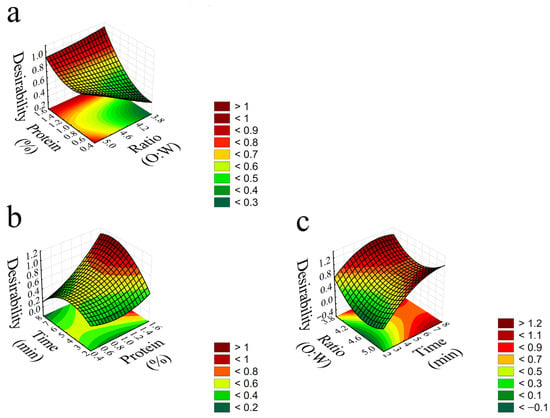
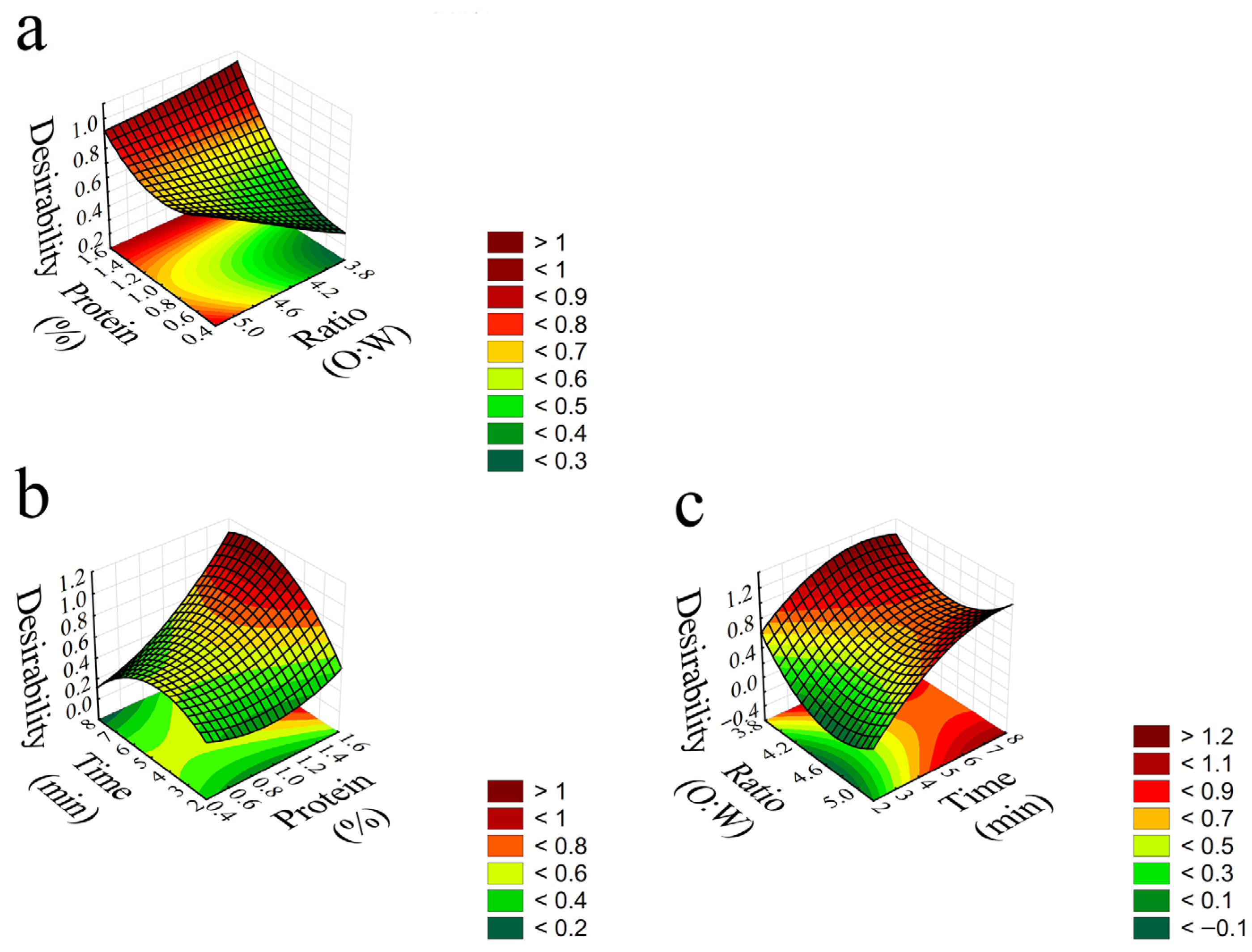
These effects are clearly illustrated in the 3D response surface plots (Figure 1b,c), which show that increasing ultrasound treatment time positively influences system desirability by promoting particle size reduction. Similarly, Shamsara et al. [38] reported that ultrasound-assisted emulsification resulted in smaller droplet sizes and enhanced ζ-potential values. Using apricot gum and apple pectin complex as emulsifiers, UAEm produced highly stable emulsions, attributed to steric repulsion at the droplet interface. The authors concluded that increasing sonication amplitude and duration reduced droplet size by enabling sufficient emulsifier adsorption onto the droplets, thereby forming flexible, viscoelastic interfacial films that improve emulsion stability.
Figure 1.
Desirability surface plots showing the interaction effects of O:W protein–ratio (a), time−protein (b), and ratio–time (c). The desirability scale next to each plot indicates the most favorable conditions for the response variables.
On the other hand, the interaction between protein concentration (X1) and the oil:water ratio (X2) was positively correlated with particle size. This effect can be explained by excessive oil content in the emulsion, which may exceed the available emulsifier capacity to fully cover the oil droplets [39]. Under these conditions, incomplete interfacial coverage increases the likelihood of droplet collisions and recoalescence, particularly due to changes in viscosity and higher collision frequency. Thereby, limiting UAEm’s effective disruption of droplets [40]. As a result, droplet coalescence may occur, increasing particle size. This behavior is illustrated in the RSM plot (Figure 1a), which suggests that increasing protein concentration while reducing oil content improves the system’s desirability by promoting smaller, more stable emulsion droplets.
These observations align with those of Linke et al. [41], who reported that droplet size decreases with increasing protein:oil ratio and more vigorous homogenization. In this study, emulsions stabilized with soy protein exhibited larger droplets and droplet clusters when the emulsifier was insufficient to fully cover the oil surface. Under these limited conditions, incomplete interfacial coverage promoted recoalescence, resulting in larger droplets and greater amounts of non-encapsulated oil. Consequently, the final droplet size was directly proportional to the emulsifier shortage, underscoring the importance of maintaining an adequate protein-to-oil ratio to ensure proper interfacial coverage and stability.
3.3. Validation and Verification of the Predicted Optimal Conditions
The model suggests that emulsions formulated with a 1.5% protein fraction, an oil:water ratio of 1:4, and a UAEm treatment time of 7.5 min achieved the lowest volume-weighted mean droplet diameter, D[4,3], of 6.66 ± 0.98 µm. The overall desirability value was 1.0, indicating that the conditions were suitable for optimization. Experimental validation showed no significant differences (p > 0.05) between the predicted and observed values (Table 4), confirming the model’s reliability. These findings demonstrate that UAEm is an effective approach for producing a stable emulsion with reduced droplet size. Therefore, the proposed model is accurate for process optimization.
Table 4.
Experimental and predicted D[4,3] (µm) values obtained under the optimized UAEm conditions.
3.4. Emulsion Stability
3.4.1. Particle Size Distribution
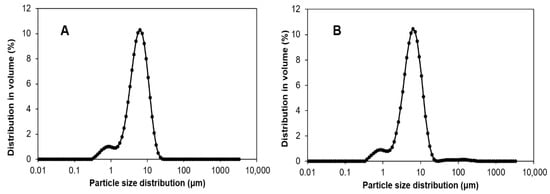
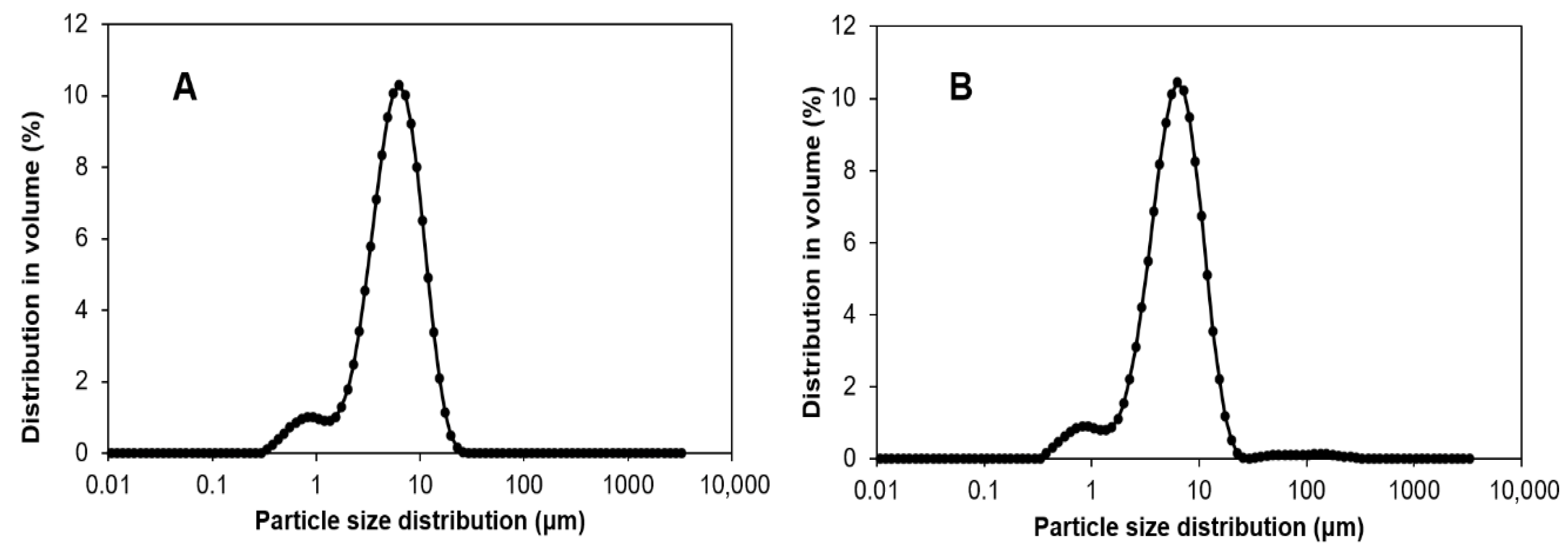
The emulsions stabilized with mango leaf protein showed a narrow, unimodal droplet size distribution immediately after emulsification, indicating rapid protein adsorption at the oil–water interface and the efficient formation of a cohesive interfacial film. The absence of multimodal peaks suggests that early-stage coalescence was effectively suppressed and that sufficient protein was available to saturate newly created interfaces during homogenization. Importantly, incorporating Curatella americana extract did not significantly alter the initial particle size distribution (Figure 2B), demonstrating that its phenolic compounds did not interfere with protein adsorption kinetics or droplet breakup mechanisms.
Figure 2.
Particle size distribution of (A) NE-Opt without extract (6.25 µm) and (B) with extract (7.23 µm).
This behavior aligns with advanced plant protein systems capable of forming structured interfacial layers. Yang et al. [42] reported that self-assembled plant protein complexes produce emulsions with highly uniform droplet populations and low polydispersity due to rapid interfacial coverage. Similarly, Sridharan et al. [43] demonstrated that self-assembled pea protein particles form dense, viscoelastic interfacial films that stabilize droplets against early aggregation. The similarity between these systems and the present emulsions suggests that mango leaf protein exhibits comparable interfacial functionality. The compatibility between mango leaf protein and Curatella americana phenolics indicates that bioactive compounds were incorporated without compromising emulsification efficiency. Phenolic compounds likely became embedded within the protein layer, potentially contributing to interfacial reinforcement during subsequent storage and under stress conditions.
3.4.2. Storage Stability
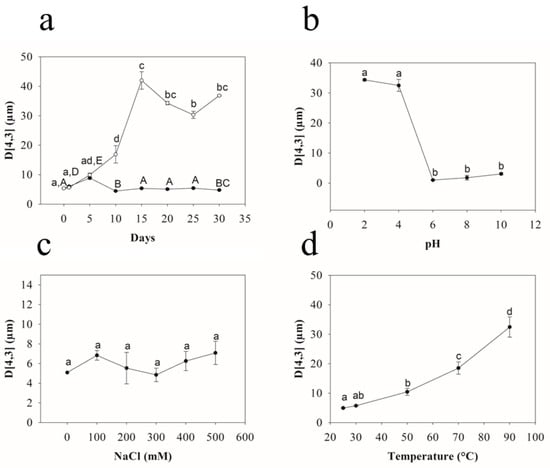
Over 30 days of storage at 4 °C (Figure 3a), the emulsions maintained nearly constant droplet size. They showed no visible creaming or phase separation, confirming strong colloidal stability under refrigerated conditions. Reduced thermal motion at low temperatures decreases droplet collision frequency and slows destabilization kinetics. The stability observed in emulsions containing Curatella americana suggests that protein–polyphenol interactions helped preserve interfacial integrity and protected the emulsifier from oxidative degradation. Santos et al. [44] documented that protein-stabilized nanoemulsions stored at low temperatures maintain structural integrity over extended periods due to preserved interfacial elasticity. Östbring et al. [45] similarly reported negligible droplet growth in refrigerated plant protein emulsions—the present system operated within this stability range, indicating competitive long-term performance.
Figure 3.
Influence on surface mean particle diameter of the optimal emulsion as affected by storage temperature ((a): 4 °C ●, 25 °C ○), pH (b), NaCl concentration (c), and temperature (d). Different letters indicate significant differences (p < 0.05) between treatments.
At 25 °C, emulsions exhibited a progressive increase in mean droplet diameter, consistent with thermally activated coalescence. However, emulsions enriched with Curatella americana showed slower droplet growth, indicating greater resistance to ambient destabilization. This effect suggests that phenolic compounds reinforced the interfacial film and reduced oxidative stress. Comparable improvements in storage stability have been linked to strengthened interfacial protein networks [44] and enhanced structural cohesion [45].
3.4.3. Effect of pH
Emulsion stability showed a strong dependence on pH (Figure 3b). Near the protein isoelectric point (pH 4), increased turbidity and droplet aggregation were observed, indicating reduced electrostatic repulsion and enhanced attractive interactions. Although destabilization occurred, emulsions containing Curatella americana exhibited slightly improved resistance to aggregation, suggesting partial steric stabilization provided by phenolic compounds. Feng et al. [46] reported pronounced aggregation of plant protein emulsions near isoelectric conditions due to charge neutralization. Demiate et al. [47] similarly observed structural instability when surface charge was minimized. The partial mitigation of aggregation in the presence of Curatella americana suggests that protein–polyphenol complexes increased interfacial thickness. Within the pH 6–8 range, emulsions remained homogeneous, with smaller droplet sizes and high ζ-potential values. This stability window corresponds to optimal conditions for electrostatic repulsion. Feng et al. [46] demonstrated that emulsions with strong surface charge remain stable over this pH range, and Demiate et al. [47] confirmed that such systems are suitable for food applications. Slight destabilization at pH 2 and 10 likely resulted from protein conformational changes that weakened interfacial cohesion.
3.4.4. Effect of Salinity
Increasing NaCl concentration from 100 to 500 mM significantly increased droplet size and creaming index, with destabilization becoming pronounced above 200 mM in emulsions formulated without extract. Emulsions enriched with C. americana extract improved tolerance to salinity (Figure 3c). This behavior may be associated with electrostatic screening, in which elevated ionic strength reduces electrostatic repulsion between droplets, thereby promoting droplet flocculation, as previously reported [48,49]. The improved stability following the addition of Curatella americana extract may be attributed to modifications in the interfacial layer. It has been suggested that the hydroxyl groups from phenolic compounds could interact with the proteins, potentially enhancing steric stabilization by forming thicker interfacial layers and altering protein conformation through interactions with amino acid residues [50,51].
Overall, emulsions stabilized with mango leaf protein and supplemented with C. americana exhibited enhanced resistance to ionic strength within the 100–500 mM NaCl range, suggesting their potential for stabilizing emulsions in food applications.
3.4.5. Temperature Stability
Emulsions maintained droplet size and visual stability up to 50 °C, while exposure to ≥70 °C induced coalescence and phase separation (Figure 3d). A significant increase in droplet size was observed after reaching 50 °C, indicating thermal destabilization of the emulsion. This behavior may be associated with protein unfolding at elevated temperatures, which can reduce interfacial viscoelasticity and promote droplet aggregation. Similar results have been reported for plant protein-stabilized emulsions, where thermal-induced structural changes weaken interfacial stability [52,53].
The enhanced thermal stability of the emulsion after the addition of Curatella americana extract may be attributed to stronger intermolecular interactions within the interfacial protein layer. Phenolic compounds may contribute to a more cohesive and structured interface and could improve resistance to thermal destabilization [54]. In addition, elevated temperatures may expose hydrophobic amino acid residues in both adsorbed and non-adsorbed proteins around the viscoelastic layer, facilitating interactions between droplets and promoting their aggregation [55]. These results suggest that processing temperatures below 50 °C are preferable for maintaining emulsion stability and preserving the bioactivity of HVBCs present in the Curatella americana extract incorporated into the system.
3.5. Thermal Analysis
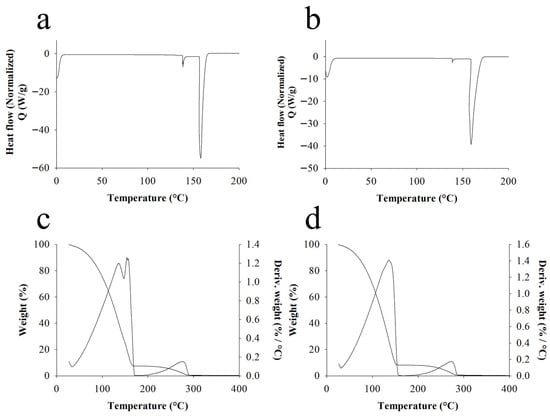
DSC analysis thermograms (Figure 4) revealed that the control emulsion exhibited an endothermic peak with an onset at 156.68 °C, a peak at 157.99 °C, and an enthalpy of 1499.4 J/g, corresponding to protein melting (Figure 4a). In contrast, the C. americana–enriched emulsion displayed an initial transition at 138.69 °C and a main endothermic peak at 159.05 °C, with an increased enthalpy of 1657.6 J/g (Figure 4b), corresponding to approximately a 10% increase in the thermal energy required for the melting of proteins and the extract added to the emulsion. This increase indicates stronger molecular organization within the interfacial protein network. Ding et al. [56] demonstrated that enhanced molecular packing elevates the thermal transition temperatures of plant proteins. Nava de la Cruz et al. [30] similarly reported that reinforced interfacial structures correlate with higher enthalpies. The increase in temperature at the endothermic peak observed with the use of proteins is consistent with that reported by Ramos-Hernández et al. [57] for the incorporation of whey protein (WP) in a matrix. This shift suggests enhanced thermal stability, as the high molecular mass (>10 kDa) and abundance of functional groups in proteins lead to a higher denaturation enthalpy, thereby increasing the matrix’s thermal stability.
Figure 4.
DSC and TGA thermograms of the optimal emulsion formulated without and with extract: (a) DSC without extract, (b) DSC with extract, (c) TGA without extract, and (d) TGA with extract.
TGA analysis showed two stages of mass loss in both emulsions. The first stage, associated with moisture evaporation and volatile components, occurred at approximately 95.16 °C with a mass loss of 93.99% for the emulsion without extract (Figure 4c) and at 89.37 °C with a loss of 91.65% for the emulsion containing extract (Figure 4d). The second stage, corresponding to the decomposition of the protein matrix, occurred at 250.51 °C and 249.79 °C, with mass losses of 7.89% and 8.62%, respectively. These differences suggest a redistribution of thermal events, consistent with a modified protein architecture and improved structural stability. Although decomposition temperatures were similar, the redistribution of thermal events supports the enhanced structural stability of the extract-enriched system. These results align with those reported by Nava de la Cruz et al. [30] regarding O/W emulsions formulated with Coccoloba uvifera protein and Randia monantha extract. This consistency stems from molecular interactions dictated by the chemical composition of the components, specifically the extract and the oil. Furthermore, thermal stability may be linked to protein structural decomposition [57]. Consequently, enhancing thermal stability in emulsions can lead to improved physicochemical and functional properties.
3.6. Photostability
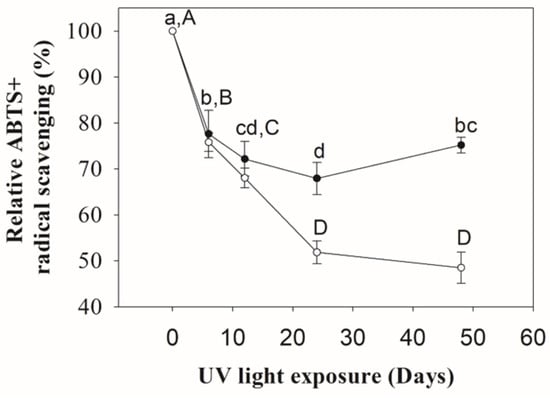
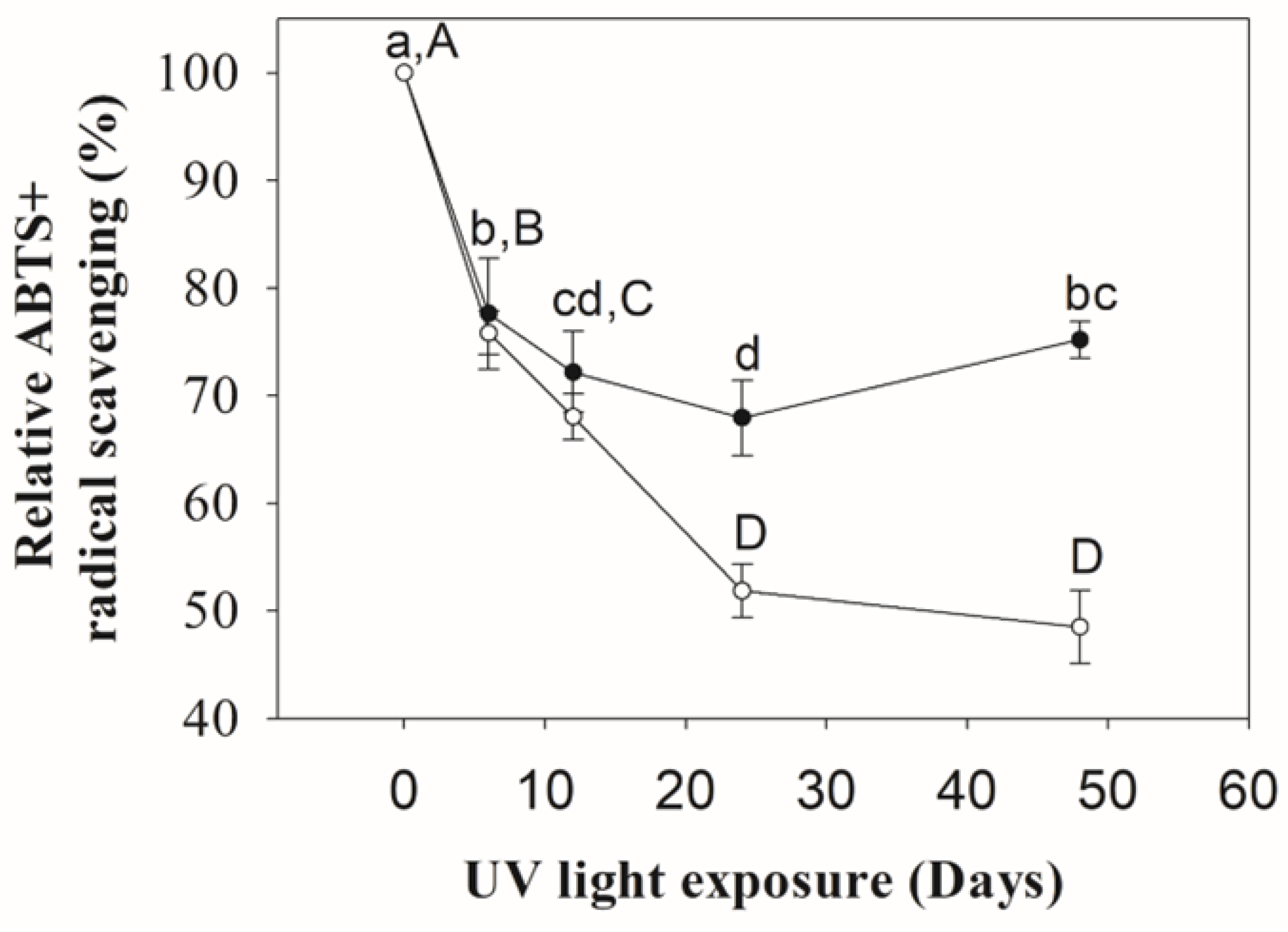
Photostability assay under UV radiation demonstrated that the emulsified system provided significant protection of antioxidant activity. After 48 h of UV exposure, emulsions retained more than 70% of their ABTS+ radical-scavenging activity, whereas the free Curatella americana extract lost over 40% of its activity (Figure 5).
Figure 5.
Relative ABTS+ radical scavenging activity of the optimal emulsion (●) and the extract (○) under different UV radiation exposure times. Different letters indicate significant differences (p < 0.05) between treatments.
The protective effect can be attributed to light scattering by oil droplets and to the formation of a protein-based interfacial layer that limits oxygen diffusion and photo-oxidation. Similar protective mechanisms have been reported for protein-stabilized emulsions, which serve as barriers to light-induced degradation [42,53]. The interaction between mango leaf protein and Curatella americana extract could therefore enhance the extract’s antioxidant preservation, highlighting the emulsion’s potential as an effective carrier for photosensitive HVBCs.
4. Conclusions
This study highlights the potential of mango leaf protein, an underutilized agro-industrial by-product, as a natural emulsifier for stabilizing oil-in-water (O/W) emulsions through optimized ultrasound-assisted emulsification. Ultrasound treatment produced emulsions with smaller droplets and improved stability under environmental stresses, including storage time, pH, temperature, and ionic strength, indicating applicability in the food industry. Incorporating Curatella americana extract significantly enhanced emulsion structure, improving thermal resistance, photostability, and antioxidant activity, suggesting effective delivery of HVBCs. Thermal analyses indicate that the emulsions are suitable for downstream processing, such as spray drying, thereby expanding their potential industrial applications. Overall, mango leaf protein, an underutilized agro-industrial by-product, represents a promising plant-based option for stabilizing sensitive bioactive compounds. Future work should focus on optimizing parameters such as protein-to-extract ratio, encapsulation efficiency, and in vitro bioaccessibility to maximize stability and functional performance in food formulations.
Author Contributions
Conceptualization, J.A.R.-H., M.C.-S. and J.A.R.-S. Methodology, software, validation, formal analysis, data curation, visualization, and investigation, O.I.-A., D.S.V.-G., D.M.d.J.M.-Z., C.C.-C., J.A.R.-H., M.C.-S. and J.A.R.-S. Resources, supervision, project administration, and funding acquisition, J.A.R.-S. and M.C.-S. Writing—original draft preparation, O.I.-A., D.S.V.-G., D.M.d.J.M.-Z. and C.C.-C. Writing—review and editing, C.C.-C., J.A.R.-H., M.C.-S. and J.A.R.-S. All authors have read and agreed to the published version of the manuscript.
Funding
This research was funded by Tecnológico Nacional de México, grant number 22117.25-P.
Data Availability Statement
The original contributions presented in this study are included in the article. Further inquiries can be directed to the corresponding author.
Conflicts of Interest
The authors declare no conflicts of interest.
References
- Jafarzadeh, S.; Qazanfarzadeh, Z.; Majzoobi, M.; Sheiband, S.; Oladzadabbasabad, N.; Esmaeili, Y.; Barrow, C.J.; Timms, W. Alternative Proteins: A Path to Sustainable Diets and Environment. Curr. Res. Food Sci. 2024, 9, 100882. [Google Scholar] [CrossRef] [Scilit]
- Johansson, E.; Carlsson, G.; Grimberg, Å.; Newson, W.R.; Prade, T.; Spendrup, S.; Svensson, S.E. Plant Proteins for Human Consumption—From Local to Global Opportunities and Challenges in a Full Value Chain Context. Clean. Responsible Consum. 2025, 19, 100319. [Google Scholar] [CrossRef] [Scilit]
- Sarathy, S.P.; Ravikumar, H.; Nanjan, P.; Alagesan, N.; Chua, B.L. Plant-Based Protein: A Multi-Nutritional Sustainable Alternative to Animal Foods and Their Structure, Functions, and Relationship: A Review. Int. J. Biol. Macromol. 2025, 321, 146465. [Google Scholar] [CrossRef] [Scilit] [PubMed]
- Hadidi, M.; Aghababaei, F.; Gonzalez-Serrano, D.J.; Goksen, G.; Trif, M.; McClements, D.J.; Moreno, A. Plant-Based Proteins from Agro-Industrial Waste and by-Products: Towards a More Circular Economy. Int. J. Biol. Macromol. 2024, 261, 129576. [Google Scholar] [CrossRef] [Scilit] [PubMed]
- Yang, Z.; Cheng, L. Impact of Ultrasound Emulsification on the Physicochemical Properties of Emulsions Stabilised by Quinoa Protein Isolates at Different PHs. Food Biophys. 2024, 19, 160–171. [Google Scholar] [CrossRef] [Scilit]
- Cruz-Barrón, V.; Bugarín-Montoya, R.; Alejo-Santiago, G.; Luna-Esquivel, G.; Juárez-López, P. Extraction and Macronutrient Requirements in “Ataulfo” Mango (Mangifera indica L.) with Management of Annual and Biennial Pruning. Rev. Mex. Cienc. Agríc. 2014, 5, 229–239. [Google Scholar]
- Ali, B.A.; Alfa, A.A.; Tijani, K.B.; Idris, E.T.; Unoyiza, U.S.; Junaidu, Y. Nutritional Health Benefits and Bioactive Compounds of Mangifera indica L. (Mango) Leaves Methanolic Extracts. Asian Plant Res. J. 2020, 6, 41–51. [Google Scholar] [CrossRef] [Scilit]
- Kaur, J.; Kaushik, D.; Kumar, M.; Babagil, G.E.; Amarowicz, R.; Proestos, C.; Oz, E.; Oz, F.; Esatbeyoglu, T.; Bordiga, M. Comprehensive Analysis and Characterization of Mangifera indica L. Leaf Powder. Food Sci. Nutr. 2025, 13, e70083. [Google Scholar] [CrossRef] [Scilit]
- Lawrence, G.; Marchaux, I.; Pejcz, E.; Wojciechowicz-Budzisz, A.; Olędzki, R.; Zając, A.; Paroń, O.; Aurore, G.; Harasym, J. Prescreening of Mango (Mangifera indica L.) Leaves as a Potential Functional Food Ingredient: Techno-Functional and Antioxidative Characteristics. Molecules 2025, 30, 3381. [Google Scholar] [CrossRef] [Scilit]
- Day, L. Proteins from Land Plants—Potential Resources for Human Nutrition and Food Security. Trends Food Sci. Technol. 2013, 32, 25–42. [Google Scholar] [CrossRef] [Scilit]
- Langyan, S.; Yadava, P.; Khan, F.N.; Dar, Z.A.; Singh, R.; Kumar, A. Sustaining Protein Nutrition Through Plant-Based Foods. Front. Nutr. 2022, 8, 772573. [Google Scholar] [CrossRef] [Scilit]
- Zhu, M.; Xiong, W.; Devkota, L.; Dhital, S. Ultrasound-Induced Changes in the Structure and Functionality of Starch and Protein. Food Hydrocoll. 2026, 172, 112111. [Google Scholar] [CrossRef] [Scilit]
- Pang, L.; Liu, M.; Li, X.; Guo, L.; Man, C.; Yang, X.; Jiang, Y. Effect of Enzymatic Hydrolysis Combined with Processing on Allergenicity of Food Allergens. Trends Food Sci. Technol. 2024, 143, 104248. [Google Scholar] [CrossRef] [Scilit]
- Vogelsang-O’dwyer, M.; Sahin, A.W.; Arendt, E.K.; Zannini, E. Enzymatic Hydrolysis of Pulse Proteins as a Tool to Improve Techno-Functional Properties. Foods 2022, 11, 1307. [Google Scholar] [CrossRef] [Scilit] [PubMed]
- Ye, Z.; Wang, J.; Ma, G.; Ma, J. Ultrasound and Glycosylation Modifications Enhance the Physicochemical and Functional Properties of Canola Protein Isolate for O/W Emulsion Stabilization. Food Chem. X 2025, 28, 102535. [Google Scholar] [CrossRef] [Scilit]
- Ragazzo-Calderón, F.Z.; Calderón-Chiu, C.; Calderón-Santoyo, M.; Hernández-Molina, D.S.; Martinez-Ramos, K.E.; Ragazzo-Sanchez, J.A. Application of High-Intensity Ultrasound to Coccoloba uvifera Seed Proteins and Its Effect on the Amino Acid Profile, Techno-Functional Properties and Antioxidant Capacity. Rev. Bio Cienc. 2025, 12, e1787. [Google Scholar] [CrossRef] [Scilit]
- Zhao, R.; Liu, X.; Liu, W.; Liu, Q.; Zhang, L.; Hu, H. Effect of High-Intensity Ultrasound on the Structural, Rheological, Emulsifying and Gelling Properties of Insoluble Potato Protein Isolates. Ultrason. Sonochem. 2022, 85, 105969. [Google Scholar] [CrossRef] [Scilit]
- Thalía Flores-Jiménez, N.; Armando Ulloa, J.; Esmeralda Urías-Silvas, J.; Carmen Ramírez-Ramírez, J.; Ulises Bautista-Rosales, P.; Gutiérrez-Leyva, R. Influence of High-Intensity Ultrasound on Physicochemical and Functional Properties of a Guamúchil Pithecellobium dulce (Roxb.) Seed Protein Isolate. Ultrason. Sonochem. 2022, 84, 105976. [Google Scholar] [CrossRef] [Scilit]
- Ozkan, G.; Tataroglu, P.; Gulec, S.; Capanoglu, E. Modification of Pea Protein Isolates by High-Intensity Ultrasonication: Functional, Structural and Nutritional Properties. Food Chem. Adv. 2024, 5, 100793. [Google Scholar] [CrossRef] [Scilit]
- Rawat, R.; Saini, C.S. High-Intensity Ultrasound (HIUS) Treatment of Sunnhemp Protein Isolate (Crotalaria juncea L.): Modification of Functional, Structural, and Microstructural Properties. Food Bioprocess Technol. 2023, 16, 1464–1477. [Google Scholar] [CrossRef] [Scilit]
- Cruz, L.L.; Ferreira Silva, B.S.; Araujo, G.G.; Leal-Silva, T.; Paula, V.G.; Souza, M.R.; Soares, T.S.; Moraes-Souza, R.Q.; Monteiro, G.C.; Lima, G.P.P.; et al. Phytochemical and Antidiabetic Analysis of Curatella americana L. Aqueous Extract on the Rat Pregnancy. J. Ethnopharmacol. 2022, 293, 115287. [Google Scholar] [CrossRef] [Scilit]
- Cruz, L.L.; Barco, V.S.; Paula, V.G.; Souza, M.R.; Gallego, F.Q.; Monteiro, G.C.; Lima, G.P.P.; Damasceno, D.C.; Volpato, G.T. Toxicological Effects of the Curatella americana Extract in Embryo Development of Female Pups from Diabetic Rats. Reprod. Biol. 2023, 23, 100819. [Google Scholar] [CrossRef] [Scilit] [PubMed]
- Lopes, R.H.O.; Macorini, L.F.B.; Antunes, K.Á.; de Toledo Espindola, P.P.; Alfredo, T.M.; da Rocha, P.d.S.; Pereira, Z.V.; dos Santos, E.L.; de Picoli Souza, K. Antioxidant and Hypolipidemic Activity of the Hydroethanolic Extract of Curatella americana L. Leaves. Oxidative Med. Cell. Longev. 2016, 2016, 9681425. [Google Scholar] [CrossRef] [Scilit] [PubMed]
- Shi, L.; Zhao, W.; Yang, Z.; Subbiah, V.; Suleria, H.A.R. Extraction and Characterization of Phenolic Compounds and Their Potential Antioxidant Activities. Environ. Sci. Pollut. Res. 2022, 29, 81112–81129. [Google Scholar] [CrossRef] [Scilit] [PubMed]
- Vera-Salgado, J.; Calderón-Chiu, C.; Calderón-Santoyo, M.; Barros-Castillo, J.C.; López-García, U.M.; Ragazzo-Sánchez, J.A. Ultrasound-Assisted Extraction of Artocarpus heterophyllus L. Leaf Protein Concentrate: Solubility, Foaming, Emulsifying, and Antioxidant Properties of Protein Hydrolysates. Colloids Interfaces 2022, 6, 50. [Google Scholar] [CrossRef] [Scilit]
- Ragazzo-Calderón, F.Z.; Iñiguez-Moreno, M.; Calderón-Santoyo, M.; Ragazzo-Sánchez, J.A. The Structural Modification of Jackfruit Leaf Proteins (Artocarpus heterophyllus Lam.) by High-Intensity Ultrasound Alters Their Techno-Functional Properties and Antioxidant Capacity. Appl. Sci. 2024, 14, 8301. [Google Scholar] [CrossRef] [Scilit]
- Miss-Zacarías, D.M.d.J.; Calderón-Santoyo, M.; Zamora-Gasga, V.M.; Ascanio, G.; Ragazzo-Sánchez, J.A. Spray Drying of Jackfruit (Artocarpus heterophyllus Lam.) Seeds Protein Concentrate: Physicochemical, Structural, and Thermal Characterization. Processes 2025, 13, 2319. [Google Scholar] [CrossRef] [Scilit]
- Brion-Espinoza, I.A.; Iñiguez-Moreno, M.; Ragazzo-Sánchez, J.A.; Barros-Castillo, J.C.; Calderón-Chiu, C.; Calderón-Santoyo, M. Edible Pectin Film Added with Peptides from Jackfruit Leaves Obtained by High-Hydrostatic Pressure and Pepsin Hydrolysis. Food Chem. X 2021, 12, 100170. [Google Scholar] [CrossRef] [Scilit]
- Vázquez-González, Y.; Ragazzo-Sánchez, J.A.; Calderón-Santoyo, M. Characterization and Antifungal Activity of Jackfruit (Artocarpus heterophyllus Lam.) Leaf Extract Obtained Using Conventional and Emerging Technologies. Food Chem. 2020, 330, 127211. [Google Scholar] [CrossRef] [Scilit]
- Nava de la Cruz, M.; Calderón-Chiu, C.; Vilchis-Gómez, D.S.; Calderón-Santoyo, M.; Jimenez-Sánchez, D.E.; Ragazzo-Sánchez, J.A. Optimization and Characterization of an O/W Emulsion Based on Coccoloba uvifera Seed Protein Loaded with Extract of Randia monantha. Processes 2025, 13, 2724. [Google Scholar] [CrossRef] [Scilit]
- Qoms, M.S.; Arulrajah, B.; Shamsudin, R.; Ibadullah, W.Z.W.; Saari, N. Valorization of Green Biomass Azolla pinnata Fern: Multi-parameter Evaluation of Processing Conditions on Protein Extractability and Their Influence on the Physicochemical, Structural, Techno-functional Properties and Protein Quality. J. Sci. Food Agric. 2022, 102, 6974–6983. [Google Scholar] [CrossRef] [Scilit] [PubMed]
- Aderinola, T.A.; Fagbemi, T.N.; Enujiugha, V.N.; Alashi, A.M.; Aluko, R.E. Amino Acid Composition and Antioxidant Properties of Moringa Oleifera Seed Protein Isolate and Enzymatic Hydrolysates. Heliyon 2018, 4, e00877. [Google Scholar] [CrossRef] [Scilit] [PubMed]
- Ketnawa, S.; Wickramathilaka, M.; Liceaga, A.M. Changes on Antioxidant Activity of Microwave-Treated Protein Hydrolysates after Simulated Gastrointestinal Digestion: Purification and Identification. Food Chem. 2018, 254, 36–46. [Google Scholar] [CrossRef] [Scilit] [PubMed]
- Aguilar-Toalá, J.E.; Liceaga, A.M. Cellular Antioxidant Effect of Bioactive Peptides and Molecular Mechanisms Underlying: Beyond Chemical Properties. Int. J. Food Sci. Technol. 2021, 56, 2193–2204. [Google Scholar] [CrossRef] [Scilit]
- Jadhav, H.B.; Das, M.; Das, A.; Geetha, V.; Choudhary, P.; Annapure, U.; Alaskar, K. Enhancing the Functionality of Plant-Based Proteins with the Application of Ultrasound—A Review. Meas. Food 2024, 13, 100139. [Google Scholar] [CrossRef] [Scilit]
- Prempeh, N.Y.A.; Nunekpeku, X.; Murugesan, A.; Li, H. Ultrasound in the Food Industry: Mechanisms and Applications for Non-Invasive Texture and Quality Analysis. Foods 2025, 14, 2057. [Google Scholar] [CrossRef] [Scilit]
- Vidosavljević, S.; Maravić, N.; Šereš, Z.; Fišteš, A.; Bojanić, N. Protein Level and Particle Size-Dependent Stabilization of Oil-in-Water Emulsions by Sunflower Meal. Processes 2025, 13, 3882. [Google Scholar] [CrossRef] [Scilit]
- Shamsara, O.; Jafari, S.M.; Muhidinov, Z.K. Fabrication, Characterization, and Stability of Oil in Water Nano-Emulsions Produced by Apricot Gum-Pectin Complexes. Int. J. Biol. Macromol. 2017, 103, 1285–1293. [Google Scholar] [CrossRef] [Scilit]
- Kori, A.H.; Mahesar, S.A.; Sherazi, S.T.H.; Khatri, U.A.; Laghari, Z.H.; Panhwar, T. Effect of Process Parameters on Emulsion Stability and Droplet Size of Pomegranate Oil-in-Water. Grasas Aceites 2021, 72, e410. [Google Scholar] [CrossRef] [Scilit]
- Taboada, M.L.; Chutani, D.; Karbstein, H.P.; Gaukel, V. Breakup and Coalescence of Oil Droplets in Protein-Stabilized Emulsions During the Atomization and the Drying Step of a Spray Drying Process. Food Bioprocess Technol. 2021, 14, 854–865. [Google Scholar] [CrossRef] [Scilit]
- Linke, A.; Weiss, J.; Kohlus, R. Factors Determining the Surface Oil Concentration of Encapsulated Lipid Particles: Impact of the Emulsion Oil Droplet Size. Eur. Food Res. Technol. 2020, 246, 1933–1943. [Google Scholar] [CrossRef] [Scilit]
- Yang, W.; Liang, X.; Xu, L.; Deng, C.; Jin, W.; Wang, X.; Kong, Y.; Duan, M.; Nei, Y.; Zeng, J.; et al. Structures, Fabrication Mechanisms, and Emulsifying Properties of Self-Assembled and Spray-Dried Ternary Complexes Based on Lactoferrin, Oat β-Glucan and Curcumin: A Comparison Study. Food Res. Int. 2020, 131, 109048. [Google Scholar] [CrossRef] [Scilit]
- Sridharan, S.; Meinders, M.B.J.; Bitter, J.H.; Nikiforidis, C.V. On the Emulsifying Properties of Self-Assembled Pea Protein Particles. Langmuir 2020, 36, 12221–12229. [Google Scholar] [CrossRef] [Scilit]
- Santos, J.; Jiménez-Rosado, M.; Trujillo-Cayado, L.A.; Romero, A. Sustainable Stabilization of Microfluidized Chia Oil Nanoemulsions by Mixed Proteins. Sci. Rep. 2025, 15, 31435. [Google Scholar] [CrossRef] [Scilit] [PubMed]
- Östbring, K.; Matos, M.; Marefati, A.; Ahlström, C.; Gutiérrez, G. The Effect of Ph and Storage Temperature on the Stability of Emulsions Stabilized by Rapeseed Proteins. Foods 2021, 10, 1657. [Google Scholar] [CrossRef] [Scilit] [PubMed]
- Feng, T.; Wang, X.; Wang, X.; Xia, S.; Huang, Q. Plant Protein-Based Antioxidant Pickering Emulsions and High Internal Phase Pickering Emulsions against Broad PH Range and High Ionic Strength: Effects of Interfacial Rheology and Microstructure. LWT 2021, 150, 111953. [Google Scholar] [CrossRef] [Scilit]
- Demiate, I.M.; Figueroa, A.M.; Zortéa Guidolin, M.E.B.; Rodrigues dos Santos, T.P.; Yangcheng, H.; Chang, F.; Jane, J. Physicochemical Characterization of Starches from Dry Beans Cultivated in Brazil. Food Hydrocoll. 2016, 61, 812–820. [Google Scholar] [CrossRef] [Scilit]
- He, Z.; Ma, T.; Zhang, W.; Su, E.; Cao, F.; Huang, M.; Wang, Y. Heat-Induced Gel Formation by Whey Protein Isolate-Lycium Barbarum Polysaccharides at Varying PHs. Food Hydrocoll. 2021, 115, 106607. [Google Scholar] [CrossRef] [Scilit]
- Can Karaca, A.; Tan, C.; Assadpour, E.; Jafari, S.M. Recent Advances in the Plant Protein-Polyphenol Interactions for the Stabilization of Emulsions. Adv. Colloid Interface Sci. 2025, 335, 103339. [Google Scholar] [CrossRef] [Scilit]
- Tu, Y.; Zhang, X.; Wang, L. Effect of Salt Treatment on the Stabilization of Pickering Emulsions Prepared with Rice Bran Protein. Food Res. Int. 2023, 166, 112537. [Google Scholar] [CrossRef] [Scilit]
- Tang, S.; Yang, X.; Wang, C.; Wang, C. Effects of Polyphenols on the Structure, Interfacial Properties, and Emulsion Stability of Pea Protein: Different Polyphenol Structures and Concentrations. Molecules 2025, 30, 1674. [Google Scholar] [CrossRef] [Scilit] [PubMed]
- Damas-Espinoza, J.A.; Alamilla-Beltrán, L.; Leyva-Daniel, D.E.; Villalobos-Castillejos, F.; Hernández-Sánchez, H.; Jiménez-Aparicio, A.R. Combined Effect of Plant Protein Isolate Content and the Homogenization Processes on the Physical Stability of Oily Extract Emulsions. Foods 2025, 14, 3717. [Google Scholar] [CrossRef] [Scilit]
- Zhang, X.; Wang, Q.; Liu, Z.; Zhi, L.; Jiao, B.; Hu, H.; Ma, X.; Agyei, D.; Shi, A. Plant Protein-Based Emulsifiers: Mechanisms, Techniques for Emulsification Enhancement and Applications. Food Hydrocoll. 2023, 144, 109008. [Google Scholar] [CrossRef] [Scilit]
- Ma, W.; Wang, J.; Wu, D.; Chen, H.; Wu, C.; Du, M. The Mechanism of Improved Thermal Stability of Protein-Enriched O/W Emulsions by Soy Protein Particles. Food Funct. 2020, 11, 1385–1396. [Google Scholar] [CrossRef] [Scilit]
- Çakir-Fuller, E. Enhanced Heat Stability of High Protein Emulsion Systems Provided by Microparticulated Whey Proteins. Food Hydrocoll. 2015, 47, 41–50. [Google Scholar] [CrossRef] [Scilit]
- Ding, X.Q.; Mukherjee, S.; Amagliani, L.; Schmitt, C.; Poh, C.L. Emulsifying Behavior of Plant Proteins Investigated via Surface Hydrophobicity and Molecular Weight Distribution. Colloids Surf. B Biointerfaces 2026, 259, 115330. [Google Scholar] [CrossRef] [Scilit]
- Ramos-Hernández, J.A.; Lagarón, J.M.; Calderón-Santoyo, M.; Prieto, C.; Ragazzo-Sánchez, J.A. Enhancing hygroscopic stability of agave fructans capsules obtained by electrospraying. J. Food Sci. Technol. 2021, 58, 1593–1603. [Google Scholar] [CrossRef] [Scilit]

Disclaimer/Publisher’s Note: The statements, opinions and data contained in all publications are solely those of the individual author(s) and contributor(s) and not of MDPI and/or the editor(s). MDPI and/or the editor(s) disclaim responsibility for any injury to people or property resulting from any ideas, methods, instructions or products referred to in the content. |
© 2026 by the authors. Licensee MDPI, Basel, Switzerland. This article is an open access article distributed under the terms and conditions of the Creative Commons Attribution (CC BY) license.